Author: Jason Goroncy

The strategy of giving away gifts: cultural guidelines for artists

Recently, I purchased 2 books by Calvin Seerveld, a neo-Calvinist in the Kuyperian and Wolterstorff tradition who is best known as a Christian aesthetician. He is practically the patron saint of contemporary Christians for the arts. In his classic book, Rainbows for a Fallen World, he writes: ‘Christ’s body does not need to finish its cultural task in a given generation: it only needs to be faithful with what it is entrusted.’ One such entrustment is art. Anyway, I’m getting off track. In this post, I reproduce a recent article of Seerveld’s on the question of guidlines of artists, including this little gem:’ No one thing has ruined art so much in Western civilization as the cumulative nonsense about the artist as supra-rational genius, the pious talk about “creativity,” and the Romanticist creed that an undisciplined bohemian life affords the milieu most conducive for having artistic “inspiration” strike.’

The strategy of giving away gifts: cultural guidelines for artists
January 2006 – V. 25 I. 10 by Calvin Seerveld

The historical reality we inhabit is complex. The scriptural direction is singularly clear: give back to the Lord and to your neighbour the gifts the Lord has given you, in a ministry of reconciliation (2 Corinthians 5: 17-19), joyously redeeming the time despite the tears (Colossians 4: 5, 6).

Do not become an ideological lobby group. Do not settle for the vanity of kitsch. Do not be confused about what you are doing. You may be doing handicraft, or art, commercial design, advertising art, song or hymn writing, you may be making monuments or painting murals, you may be in propaganda, posters, PR or the media. But let each one give away whatever kind of gift you have received from the Lord, give it away in a holy spirit, with a sure skill, as an innocent and wise, faithful, compassionate deed (Ephesians 4: 7, 12-16; Matthew 10: 16), no matter how imperfect. That is all the Lord requires of you as one of Christ’s body on earth (cf. Micah 6:8).

In Rainbows for the fallen world I gave five directives for those who want to be christian artists, distinguished in their artistry by the holy spirit of compassionate judgment proclaiming the Rule of Jesus Christ:

First, for those who want to be christian artists, that is, musicians, painters, poets, novelists, graphic designers, dramatists, cinematographers, distinguished in their artistry by the holy spirit of compassionate judgment proclaiming the Rule of Jesus Christ:

(1) Become filled with the wisdom of the Holy Spirit.

Unless one’s vision is full-orbed and one’s discernment of what God wants done is sure, one will be weak in artistic leadership and uncertain in testing the spirit of the art facing you and your neighbour. One’s roots have to be deep in Jesus Christ and one’s sensitivity to creation has to be uncommonly rich, if you mean to be vitally redemptive in doing anything with christian identity in this secular age. Christian artistry cannot be done by formula—choose these topics, refrain from that, add a prayer, and give a double tithe of the proceeds—no! It will take a prayer and fasting habit to exorcise secularism from our artistic deed (cf. Matthew 17: 14-21); so, like making a vow, one has to decide whether to suffer such a level of commitment (cf. Ecclesiastes 5: 1-7, Philippians 1: 27-30), and then plead with the Lord to use oneself for establishing his Rule. Without the working presence of the Holy Spirit in the product of our hands, mouth, feet or body, the “christian art” will be a sham, in vain. Unless the river bed of our consciousness is as deep as the living Spirit of God, no matter how fast the water flows or sparkling it seems, it is christianly shallow.

(2) Conceive art as work and undergo its training like a trade.

No one thing has ruined art so much in Western civilization as the cumulative nonsense about the artist as supra-rational genius, the pious talk about “creativity,” and the Romanticist creed that an undisciplined bohemian life affords the milieu most conducive for having artistic “inspiration” strike. Such adulatory isolation may prime artistic egos, but it inevitably undermines the ministry of christian art. Art is a task like building bridges and fixing meals; it takes intelligence, sensitivity to needs, and specialized knowledge. Good intentions and prayerful dedication are not enough in building bridges or seasoning foods: you fall through or the food is flat if the product is not sound. A weak-kneed poem or a shoddy, gaudy painting likewise will mislead little ones who come looking for shalom, and if they stumble on account of one’s irresponsibly botching it, one is in trouble as an artist, according to the Scriptures (cf. Luke 17: 1-2). The burden of producing masterpieces and of being “a star” is not necessary, it is not the easy yoke of Jesus Christ; but art is a job that one may be called to do—writing a song, repairing a chair, composing a speech, sculpturing stone—and after a period of apprenticeship it is important to become a qualified journeyman approved by God lest our painting or novel let our neighbour fall through.

(3) Distill a fruitful christian art historical tradition in your own blood and pioneer its contribution in our day.

Christians have no right to be ignorant of history just because they stand in the truth. As guardians of culture Christians should explore omnivorously whatever men and women have done in the Orient and Africa, Europe and the Americas, in ancient times and today, not to paste bits and pieces eclectically together and not to assimilate a nondescript “best” that has been artistically done throughout the ages, but in order to know surely the consistency and contours of one’s own particular christian tradition so that one can work out the integrity of our christian minority culture set off from but in the context of all the other ways men and women have invented cultivating responses.

I personally come at a christian culturing from a Reformation christian tradition that is Calvinian, Kuyperian, Torontonian—a perspective and dynamic which is not pre-Reformation mediaevalist nor an American Great Awakening Baptist tradition, but one that has a definite shape one can call “Reformational”—coursing deep I think, for example, in the blood of Henk Krijger’s paintings; and it is different from the local christian tradition Gabriela Mistral breathes, a mystical Catholicism of some Spanish variety reaching back to St. Francis of Assisi as patron saint. But both Krijger and Mistral are united as brother and sister in breaking at the heart of their art with secularity. The holy spirit impelling them which surfaces in their artistry is one foreign to accommodating what’s going on; it’s not even reformist—accepting something secularly current and snipping away at the edges. Their art is spirited, the very grain of the shaping colours and so silent flow of the words, as I perceive them, is cradled from the start in a singular affirmation of creation and its fullness as belonging to the Lord, of sin as a waste God hates, of present redemption possibilities and a future judging reconciliation of things back to God so that followers of Jesus Christ may look and read and sing through their tears. Krijger and Gabriela Mistral are examples of maturing indigenously in a christian tradition and of being unashamed at being positively christian (even though they wouldn’t bruit it about in my formulation). That is why both Krijger and Mistral are considered oddities by their secular colleagues who admit, nevertheless, to the quality of their art.

I believe it is a mistake to try to go back and recapture some earlier, canonic christian synthesis: a holy spirited undertaking will always be driven to work reformingly with an historical inheritance. But it is crucial for would-be christian artists in their youth to realize you cannot go it alone; and it is short-sighted, not to say stupid, in the correct desire to be relevant as christian artist in an unchristian age, to pick up the secular fashion of the immediate generation before us and immerse oneself in that as your tradition (cf. T.S. Eliot, in “Tradition and the Individual Talent,” 1919, in The Sacred Wood, London: Methuen & Co., 1960, pp. 48-49). That is why christian artists so often seem to be a generation late, rootless and drifting all by themselves, and seldom stand out from their day with art that raises the scandal of christian artistically presented insight.

A friend and I heard Allen Ginsberg and W.H. Auden at a poetry reading in London, England, several years ago. Two days later we happened upon Ginsberg downstairs in the Tate Gallery, peering intently at one after the other of William Blake’s paintings housed there. Since he was on crutches, having broken a leg recently, he had to sit down to rest; so we struck up a conversation about Blake’s Swedenbourgianism and mythology. Ginsberg told us about learning mantras and we argued about whether Paul’s experience of the third heaven was a drug trip. Why was Ginsberg interested in Blake? Early revolutionary Ginsberg had said: ‘the world is a mountain of shit: if it’s going to be moved at all, it’s got to be taken by handfuls.’

But Allen (“Howl”) Ginsberg had found out that shit doesn’t handful well, and here he was, later, filling in chinks of a tradition in mysticism so he could stay alive poetically and do more than rant in verse about the Pentagon. When he stood up to leave, “Pay special attention to the yellow,” said he, pointing to the paintings lining the walls; “that’s where it’s at.” And he hobbled off on his crutches.

Van Gogh’s yellow is closer to where it’s at, I think, than William Blake’s. But the point is—even though it takes years of maturing before you have really distilled an art historical tradition and made it your own: as christian song-writer plumbing the soul of black spirituals or the joy of early jazz, as christian poet getting blood transfusions from Chaucer, Spenser, Donne, Milton, Hopkins and Thompson, or as painters finding roots in Breughel, Rembrandt, Jan Steen or German “Expressionist” figures, it is imperative that one enters a communion of artistic saints if one would produce poems and songs and paintings of a third and fourth generation of those kept faithful by the Covenanting God of history.

(4) Integrate yourself as a band of christian artists with christian taskforces in other cultural areas in order to reach out as a peoplehood of God to the public at large.

Culture always has a global spread; so a minority culture cannot long, purposefully exist as a mini culture, a few loose strands. Christian schooling limps without supportive christian family life; the christian forming of certain abilities can go down the drain if they are ensnared in an utterly unredeemed, mercenary business enterprise; christian artistry remains badgered if there be no gallery outlet or publishing firm or media center that has ended initiation fees, “best seller” strictures and demands of crowd guarantee. There are numerous exasperating problems in building an integrating minority culture within a dominant, monolithic secular culture (Black culture found this out), for the current monolithic culture tries to disintegrate everything that resists its technocratic mould. I would be a false prophet to predict success for a christian minority culture in our age. But the point is this: the most full, cultural obedience by the communion of saints is not the stand-up testimonial of a lone christian artist, to which one may applaud, but rather an international community of christian artists’ showing themselves, in all their dedicated weakness, as one open door in a christian cultural ark not established by human hands, where young and old believers and unbelievers may enter as a relief and workshop, out of the pouring secular rain—an open-door, christian minority culture.

(5) Persevere in unfolding art historically, with a generations-long patience and hope.

Culture honouring the Lord has been born long ago (even though it doesn’t have birthdays), and in our seeing to it responsibly that christian culture gets born anew in our increasingly secularized day, we must plan long-range and take comfort in the promise of God that the believing generations still in our cultural loins will be given the time and grace to develop our communal offering (cf. Psalms 89, 145). Culture by nature is an ongoing affair that lasts longer than anyone’s lifetime. Therefore, to live under the promise of blessing upon the faithful cultivating responses of coming generations taking up our same task in the same spirit of praise and reconciliation takes the pressure off us Christians to set everything straight ourselves, something that bedevils counter-cultural movements. Christ’s body does not need to finish its cultural task in a given generation: it only needs to be faithful with what it is entrusted.

Such faithfulness includes, along with distilling a christian art tradition, acting in the present with communal horizons, being a qualified artisan filled by the Holy Spirit, that one unfold the specific creaturely strength of the art in question. In order for christian artists to extirpate the plague of elitism from themselves and be able to offer truly diaconal service to God’s people and the present-day men and women inundated by the mass media cultural hypnosis, painters may need to exchange easels and oils temporarily for murals like the “Wall of Respect” at 43rd and Langley in Chicago during the 1960s, and poets may need to forget ode structure and the elegant lines of blank verse for the rollic of ballads. But one may not go historically backward and run dissonance and steel out of our song and architectural experience or head toward picturesque scenes of Millet instead of “Harmony of Grey and Green” (1874) by Whistler. Christian artists who before God know what they are doing artistically—wary of being fooled by the artistic principalities and powers of this age—must persist in converting modern art into a language of healing insight. God’s people everywhere should pray for christian modern artists.

These five directives are still the best counsel I have from Scripture today, but I would like particularly to underline the fourth and fifth ones. We do not bring Christ’s Rule complete to the earth in our lifetime, and we need a vision that will reach across the generations. We only need to be generous stewards of what we have inherited, to edify the faithful and provide direction for the neighbour. God’s providing grace and the promise of Christ’s Rule is sure. Therefore we may develop a body of redemptive artists, art critics, art historians, art brokers, art theorists, surrounded by a host of historical witnesses, in hope. Perhaps someday you may sculpt a figure which will give cheer to someone whose life has been broken, as Ernst Barlach did with the aching curve of the doubting Thomas’ reunion with Christ [Die Wiedersehen]. Perhaps you may carry on Henk Krijger’s brief artistic ministry which led to little jewels like the smile of Somebody loves me, I wonder who?, where sunlit fields and a quiet sky form the ordered backdrop to the mailbox on which a homing pigeon stands to deliver a letter to a wondering fellow, almost like the dove’s proffering an olive branch to Noah. But whatever your talent be, remember the comfort of Psalm 2: Blessed be all those who have run artistically to take shelter with God.

This article consists of segments previously published in Rainbows for the fallen world (1980, 2005) and Bearing Fresh Olive Leaves: Alternative Steps in Understanding Art (2000). For more information see http://www.seerveld.com/tuppence.html.

The Gospel of Judas

Although I certain that reading Ray Anderson’s The Gospel According to Judas will offer the reader much more food for thought than the 1700 year old version, Stephen Carlson has some worthwhile postings to read on The Gospel of Judas text and for those who want the full smorgasboard, Mark Goodacre’s blog has got more than one man or an army could make a crack of. They are both worth the read, especially if you’re a Dan Brown fan (which I’m not). By the way, does anybody know if any serious theological commentary has been offered on The Gospel of Judas text?

Baptism – an Evangelical Sacrament Part 5

In this post, I continue my thoughts on baptism as an evangelical sacrament, seeking to explore what it means to say that Jesus Christ is baptism’s objective reality.

(ii) Christ as the objective reality of baptism.

In rejecting the ex opere operato, the Reformers were careful not to separate baptism from salvation, for the New Testament directly links baptism with a salvation event. This ruling out of ex opere operato is clearly seen in the Apostle Paul where, in 1 Corinthians 10:1ff., he corresponds baptism with the Exodus event, and in Titus 3:5f., where he wrote that God ‘saved us … by the washing of regeneration and renewal in the Holy Spirit, which he poured out upon us richly through Jesus Christ our Savior’. Likewise the Apostle Peter, identifying baptism with Noah and the flood narrative, wrote that ‘Baptism, which corresponds to this, now saves you, not as a removal of dirt from the body but as an appeal to God for a clear conscience, through the resurrection of Jesus Christ’ (1 Peter 3:21).

It may indeed be true, as Berkouwer notes, that baptism is ‘a cause of grace, but the objective character of baptism as saving grace is bound to the redemptive event of Christ’s life, death and resurrection. The original ‘regenerative aspect of baptism is the ‘regeneration of the body of Christ in resurrection. It is the humanity of Christ that is regenerated through his baptism (death and resurrection), and our baptism is a sign and seal of our participation and regeneration in his own new life, but always with the eschatological tension between the Word and power of this act. This is why we must speak of the regenerative aspect of baptism as associated with the ‘baptism of the Holy Spirit (1 Cor. 12:12-13), and not with the physical act itself. And it’s also why baptism is an unrepeatable and indelible act.

Thus baptism is salvation through faith as a divine act of grace. There is no disjunction between the objective aspect of baptism as a divine work and the human appropriation of baptism as a subjective act through faith and water on the part of the human subject. Faith is not a condition which effectually causes baptism to regenerate, but regeneration through the Holy Spirit effectually binds the human subject through faith to the salvation of Christ. It is in this sense that baptism is an ‘evangelical sacrament, for here, the evangel is declared every time this ‘proclamation activity is performed. It is for this reason that Torrance can conclude:

Quite clearly the word and sacraments belong together. The Gospel as it is proclaimed in and by the sacraments belongs to evangelism as much as the Gospel proclaimed in word. Christ communicates himself to us through both and through both together, providing us in different ways with the appropriate human response which we cannot make ourselves but through which the Gospel becomes established in us … Thus … the sacraments … are not to be regarded merely as ‘confirming ordinances but as ‘converting ordinances, for in and through them the Gospel strikes home to us in such a way as to draw us within the vicarious response to God which Jesus Christ constitutes in his own humanity, the humanity which he took from us and converted back to God the Father in himself.

Paul repeatedly refers baptism to the historical work of Christ in obtaining salvation. There is no ‘second cause, or causa instrumentalis, of salvation through baptism allowed in the form of faith as a subjective act. The fact that faith is indispensable to baptism issues out of the fact that baptism of the Holy Spirit is the effective cause of faith, apart from which there would be no sharing in the Baptism of Christ. As Weber perceptively writes,

Our relationship to the Covenant of God with us is not like an ‘objective fact’ which we can examine and then could appropriate as ours. It embraces us because Jesus Christ as ‘true God and true man’ is absolutely precedent to us as the Bearer and Guarantor of the Covenant. This precedence, this embrace, this surpassing of our faith through God’s covenant act is what defines baptism. If we understand it as a gift which we personally experience, then it is always ‘incomprehensible’. It becomes accessible, although not “comprehensible”, when we see in it the warrant of the Covenant of God which establishes our faith. In it God’s will to save and to covenant is made known as the will which first calls us into the existence of believers. The reason this is true is that both baptism and faith are established on Jesus Christ. The unity, the point of juncture between faith and baptism, is not found in the sequence of human or interpersonal acts but in him. That removes them from the realm of our manipulation. We can neither see faith based in baptism, nor see baptism grounded in faith. Both are based in the salvific act of God in Jesus Christ which is effectively communicated to us through the Holy Spirit. The error of the Anabaptist view is that it places this conjunction of human faith and humanly given and received baptism in a temporal sequence, whereas that can only be understood in a pneumatic way in their conjunction. What they failed to see is the surpassing significance of the Covenant, concluded in Jesus Christ and directed towards the Eschaton, still to come in terms of its visibility. This failure will always arise when human behaviour, faith, and a human-ecclesiastical action, baptism, are brought together as such. In that situation, faith will be examined for its controllable correctness and durability. And in that situation, baptism becomes an inner-worldly, calculable consequence of faith. But only in that situation! The Covenant of God surpasses both faith and baptism and comprehends them both.

The temporal or chronological sequence of faith and water baptism are both relative to the baptism of Christ. As the base of the triangle, faith and water baptism converge in the apex of Christ as the objective reality and content of both baptism and faith.

Baptism – an Evangelical Sacrament Part 4

(i) The baptism of Jesus as the basis for Christian baptism.

Jesus is baptised by John in the Jordan (Matt. 3:13ff.). The Baptism of John was a polemic against the Jews who assumed that they had standing within the Kingdom of God by virtue of their circumcision. Proselyte baptism of Gentiles was on the basis of their non-circumcision. Thus, for a circumcised Jew to be baptised by John was virtually to say that one was an ethos in the eyes of God!

Behind the motif of proselyte baptism lies the powerful theology of participation in the Exodus event, the crossing of the Red Sea, and the sanctificatory cleansing in the establishment of the Sinaiatic covenant. So when Jesus is baptised as the Messiah of Israel, as the second Adam, it happens at Bethany on the other side of the Jordan, where John was baptizing (Jn. 1:28). It appears significant, at least to me, that the Messiah, who was in himself, as munus triplex, the whole of Israel incarnate, had to leave the land, and then return into the land through the waters of the Jordan. Is it possible that he was calling his people to leave the occupied land also, that they may re-enter the land as the true and free people of Messiah, not only as an eschatological sign, but in the time and space of the first century world?

For a Jew to be baptised was a blow struck at the heart of the security claimed by adherence to Mosaic law, drawing the Jews under the judgement of the law and driving them to repentance and hope in the One who baptises with/by/in the Spirit and fire. The baptism by John had its counterpart in the cleansing, and/or, judgement, of the Temple by Jesus in preparation for his propitiatory sacrifice as the Lamb of God, a cleansing which points to the sanctification of the Church. For Jesus to submit to John’s baptism was an act of obedience and hope through which he drew his own humanity into the judgement which the law demands, and offered up through that humanity the obedient response in hope to the Father. In this sense, Jesus’ baptism by John was substitutionary and was completed in his baptism of blood on the Cross when he died as the representative of all humanity, both Israel and non-Israel. And in baptism, the Church binds itself to the covenant and the Heilsgeschichte of Christ. Furthermore, Jesus, as the baptised one who baptises with the Holy Spirit (John 1:33) continues the work of his own baptism through the Church.

The Abuse of Power and the Assault on Democracy

The New York Times calls Noam Chomsky ‘arguably the most important intellectual alive.’ The Boston Globe calls him ‘America’s most useful citize’. He was recently voted the world’s number one intellectual in a poll by Prospect and Foreign Policy magazines. Chomsky is professor of linguistics at the Massachusetts Institute of Technology and one of the foremost critics of U.S. foreign policy. He has just released a new book titled Failed States: The Abuse of Power and the Assault on Democracy. I have been listening profitably to Chomsky for years now. I suggest that he’s too important to ignore. To listen, watch and/or read more go to http://www.democracynow.org/article.pl?sid=06/03/31/148254. Does anyone know of any theological reflections done on Chomsky? Does anyone want to offer one here?

Images of Grace


Colin Gunton writes that ‘the notion of divine grace is best understood as a mode of God’s action towards, or relatedness to, the creature and not as some kind of substance that God imparts to the creature. For that reason there is much to be said for P. T. Forsyth’s objection to the expression in Newman’s hymn, ‘a higher gift than grace’. There can be no higher gift than grace if grace means a form of God’s relatedness to us. If that is so, it would also seem right to say that the relationship of God to Adam and Eve in Genesis 2, before the Fall, is a gracious one, or with Rahner that all creaturely existence is in some way graced existence. Grace is not something reserved for sinners, we might say, but the fundamental form of God’s relation to the creature.’ (God and Freedom, Edinburgh: T&T Clark, 1995,126). But don’t believe him, he’s just ‘messing with your head!:-)

Baptism – an Evangelical Sacrament Part 3

The human nature of Jesus is the sacramental reality of revelation on the ground of the hypostatic union between the divine and human in the one person. There is attestation, or witness of God to humanity and humanity to God in this primary event which is determinative of all secondary occurrences of the Christ event. So both Baptism and the Lord’s Supper are to be regarded, as they are in the New Testament, as two aspects of the one event. There is, therefore, properly speaking, only one sacrament, of which Baptism and the Lord’s Supper are correlated expressions. So the original presentation of God to humanity and humanity to God becomes a re-presentation in the sacramental life of the Church. In this sense, and only in this sense, does the sacrament give to the Church a communion in the mystery of Christ; the sacrament being the true sign of this mystery. And only here can we speak of the ‘’evangelical’ nature of baptism.

The very withdrawal of Jesus from visible and direct relation to the world casts the Church into an eschatological relation with Christ as the Head of the Church. The Church lives between the Cross and the parousia and thus the original sacramental relation of the creature to the Creator in the hypostatic union (incarnation) is now re-presented through the enactment of the life of the Church itself. But in this re-presentation the full presence of the parousia is screened, permitting the Church to have a genuine history in relation to the world. Perhaps we can even speak of baptism taking place on the morning of the seventh day, the eternal Sabbath, rather than on the evening of the sixth day.

So in God’s revealing to and through the Church in Jesus Christ, God also is concealed in order to be present, not merely as another ‘presence alongside the existence of others, but in and through their existence. But precisely in that place where the Church discovers the eschatological nature of the sacrament She discovers Christ who is in himself the eschatos – the One who is the ‘end of the age, the final Word of God to humanity, who has already come, is present, and yet to come. In Christ, the eschaton broke into the present and yet the final Word of judgement and present redemptive action of the Word are ‘held apart to leave room for repentance and faith. The sacrament functions to preserve this unity between Word and power while maintaining the eschatological tension. So with the sacrament is associated a ‘presence in absence, whilst pointing to their own disappearance as interim events sustaining the life of the Church between Pentecost and resurrection.

It is only against this general background that we can now come to consider the specific of Baptism as an ‘evangelical sacrament event within covenant and Heilsgeschichte. In particular, over the next three posts in this area, I will focus on three facets: (i) the baptism of Jesus as the basis for Christian baptism, (ii) Christ as the objective reality of baptism, and (iii) baptism as obedience and hope.

‘Cheeky bugger’ Pro Hart dies

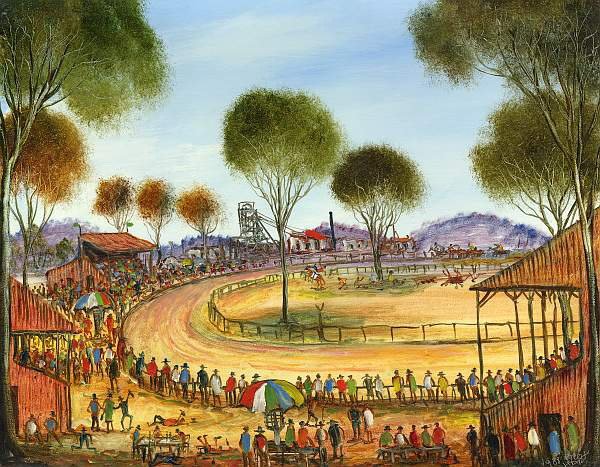
One of my favourite painters, Pro Hart, died this week after battling motor neurone disease. I thought I’d post a few of his pics for us to reflect on. PT Forsyth reminded us what Pro Hart taught us: that art can never be seperated from feidistic concerns, nor of other human pursuits such as philosophy or science. There may be a primacy in the arena of religion, but there can be no independence. ‘Our attitude to each is an indivisible function of the whole rational man. The whole man is turned upon Nature in earnest science, and the whole man is turned on God in real religion. What makes the real difference in our relations to them, in what we call the faculties, comes from the other end. It is a difference in the objects themselves and their behaviour’ (Authority, 148). For both men, I am grateful.


Psalm 23… revisited

I just came across this paraphrase of Psalm 23 from Max Lucado (who writes great kids books) and just ‘had to’ (you know what it’s like :-)) post it: ‘I am my own shepherd. I am always in need. I stumble from mall to mall, job to job, and shrink to shrink, seeking relief but never finding it. I creep through the valley of the shadow of death and fall apart. I fear everything from pesticides to power lines, and I’m starting to act like my mother. I go down to the weekly staff meeting and am surrounded by my enemies. I go home, and even the goldfish scowls at me. I anoint my headache with extra-strength Tylenol. My Jack Daniel’s runneth over. Surely misery and misfortune will follow me, and I will live in self-doubt for the rest of my lonely life.’ (Max Lucado, Traveling Light (Word Publishing, 2001), 26). Although, strictly speaking, Psalm 23 is not, of course, a lament psalm, like so many of the other psalms, it does acknowledge the chaotic darkness of the world. It invites us to reflect on the reality of walking in such darkness and promises not that we will be spared from it, but that a shepherd-light shines therein, and the darkness has not overcome him. Reading this paraprase of the psalm reminded me of Irenaeus’ invitation for us to see the world through ‘grace healed eyes’. Similarly, I was reminded of the words of Helmut Thielicke who once said, ‘There is no wilderness so desolate in our life that Jesus Christ will not and cannot encounter us there … There is no depth in which this Saviour will not become our brother … He comes for us wherever we are … For that is his majesty.’ (How To Believe Again, (Philadelphia: Fortress Press, 1974), 60.

On the conscience…

Lately, I’ve been digging into Forsyth’s thoughts on the human conscience, the centre not only of our racial unity but the sphere of God’s redemptive activity. There is a sense that understanding Forsyth here is to understand his entire theology. I thought I’d share a quote and invite responses: ‘What crushes my conscience is not a taunt from another individual, however great, but an indictment from the moral universe. I did not break a by–law, nor transgress a regulation; I collided with the moral unity of things, with the absolute holiness of God. I have to do with Him, and He with me. All the holiness of God bears down on my soul. Not His power, His influence, but His holiness. I am not a sensitive atom affected by Him, but a moral monad judged by Him. The question of personal religion therefore (the prime question, if not the first), the matter of most urgent certainty, is, How do I stand before my Judge?’ (Authority, 40-1).

Baptism – an Evangelical Sacrament Part 2

Jesus was baptised with the baptism meant for sinners, the baptism of repentance, not for his own sake but for ours, and in him our humanity was anointed by the Spirit and consecrated in sonship to the Father. Thomas Torrance writes that,

For Jesus, baptism meant that he was consecrated as the Messiah, and that he, the Righteous One, became one with us, taking upon himself our unrighteousness, that his righteousness might become ours. For us, baptism means that we become one with him, sharing in his righteousness, and that we are sanctified in him as members of the messianic people of God, compacted together in one Body in Christ. There is one baptism and one Body through the one Spirit. Christ and his Church participate in the one baptism in different ways – Christ actively and vicariously as Redeemer, the Church passively and receptively as the redeemed Community.

So we can never speak of baptism as a sacrament of what we do, but only as what God has done for us in Christ, in whom he has bound himself to us and bound us to himself, before we could ever respond to him. But it is also the sacrament of what God does now in us by his Spirit, uniting us with Christ in his faithfulness and obedience to the Father and making that the ground of our faith. So as an act done to us, baptism tells us that it is not upon our own faithfulness that we rely, but upon Christ alone and his vicarious faithfulness; it also tells us that in the freedom of the Spirit, God makes himself present to us and secures us creatively to himself in such remarkable ways that not only is faith called from us as our own spontaneous response to God’s grace in Christ, but it is undergirded and sustained by Christ and enclosed with his own faithfulness, and so grounded in the mutual relation between the incarnate Son and the Father. For, as Calvin observed,

For he (i.e. Christ) dedicated and sanctified baptism in his own body [Matt. 3:13] in order that he might have it in common with us as the firmest bond of the union and fellowship which he has designed to form with us. Hence, Paul proves that we are children of God from the fact that we put on Christ in baptism [Gal. 3:26-27]. Thus we see that the fulfillment of baptism is in Christ, whom also for this reason we call the proper object of baptism. Consequently, it is not strange that the apostles are reported to have baptized in his name [Acts 8:16; 19:5], although they had also been bidden to baptize in the name of the Father and of the Spirit [Matt. 28:19]. For all the gifts of God proffered in baptism are found in Christ alone.

Thus, before we can even begin to speak of sacraments in general (or baptism in particular), or what Weber preferred to call ‘proclamation activities’, we must see how Jesus Christ himself, in his own Person, is the primary sacrament, as he is the primary mysterion and revelation of the Triune God. In this sense, we must also speak of revelation as sacrament. For God to reveal Godself, this revelation must be disclosed in creaturely objectivity, adapted to our creaturely existence and knowledge. The theological concept of sacrament is thus bound up in the structure and nature of God’s revelation.

Thus, there is ambiguity from the perspective of the human person – the objectification of divine revelation is not a prediction of the creaturely mind – and a provisional aspect to revelation – the final Word of revelation encompasses the ‘end of history as well as its significance. This is no less true of baptism where believers baptised in the name of the Triune God are thereby simultaneously set in the trinitarian history of God” so that there is an eschatological tension between the revelation of God in its historical form and in its ultimate reality. This is true both of revelation and sacrament as a sign of revelation. So Jesus Christ remains the mysterion through which all sacramental ‘mystery is mediated and objectively confirmed (1 Tim. 3:16). So Barth:

In the New Testament mysterion denotes an event in the world of time and space which is directly initiated and brought to pass by God alone, so that in distinction from all other events it is basically a mystery to human cognition in respect of its origin and possibility. If it discloses itself to man, this will be, not from without, but only from within, through itself, and therefore once again only through God’s revelation … Faith as a human action is nowhere called a mystery, nor is Christian obedience, nor love, nor hope, nor the existence and function of the ecclesia, nor its proclamation of the Gospel, nor its tradition as such, nor baptism, nor the Lord’s Supper. Would this omission have been possible if the New Testament community had been aware that certain human attitudes, actions and institutions were freighted with the divine word and act, if it had ascribed to baptism in particular the quality of a bearer and mediator of grace, salvation, and its manifestation?

John Donne – his final sermon

BUILDINGS stand by the benefit of their foundations that sustain and support them, and of their buttresses that comprehend and embrace them, and of their contignations that knit and unite them. The foundations suffer them not to sink, the buttresses suffer them not to swerve, and the contignation and knitting suffers them not to cleave.

The body of our building is in the former part of this verse. It is this: He that is our God is the God of salvation; ad salutes, of salvations in the plural, so it is in the original; the God that gives us spiritual and temporal salvation too. But of this building, the foundation, the buttresses, the contignations, are in this part of the verse which constitutes our text, and in the three divers acceptations of the words amongst our expositors: Unto God the Lord belong the issues from death, for, first, the foundation of this building (that our God is the God of all salvation) is laid in this, that unto this God the Lord belong the issues of death; that is, it is in his power to give us an issue and deliverance, even then when we are brought to the jaws and teeth of death, and to the lips of that whirlpool, the grave.

And so in this acceptation, this exitus mortis, this issue of death is liberatio á morte, a deliverance from death, and this is the most obvious and most ordinary acceptation of these words, and that upon which our translation lays hold, the issues from death.

And then, secondly, the buttresses that comprehend and settle this building, that he that is our God is the God of all salvation, are thus raised; unto God the Lord belong the issues of death, that is, the disposition and manner of our death; what kind of issue and transmigration we shall have out of this world, whether prepared or sudden, whether violent or natural, whether in our perfect senses or shaken and disordered by sickness, there is no condemnation to be argued out of that, no judgment to be made upon that, for, howsoever they die, precious in his sight is the death of his saints, and with him are the issues of death; the ways of our departing out of this life are in his hands.

And so in this sense of the words, this exitus mortis, the issues of death, is liberatio in morte, a deliverance in death; not that God will deliver us from dying, but that he will have a care of us in the hour of death, of what kind soever our passage be.

And in this sense and acceptation of the words, the natural frame and contexture doth well and pregnantly administer unto us.

And then, lastly, the contignation and knitting of this building, that he that is our God is the God of all salvations, consists in this, Unto this God the Lord belong the issues of death; that is, that this God the Lord having united and knit both natures in one, and being God, having also come into this world in our flesh, he could have no other means to save us, he could have no other issue out of this world, nor return to his former glory, but by death.

And so in this sense, this exitus mortis, this issue of death, is liberatio per mortem, a deliverance by death, by the death of this God, our Lord Christ Jesus.

And this is Saint Augustine’s acceptation of the words, and those many and great persons that have adhered to him. In all these three lines, then, we shall look upon these words, first, as the God of power, the Almighty Father rescues his servants from the jaws of death; and then as the God of mercy, the glorious Son rescued us by taking upon himself this issue of death; and then, between these two, as the God of comfort, the Holy Ghost rescues us from all discomfort by his blessed impressions beforehand, that what manner of death soever be ordained for us, yet this exitus mortis shall be introitus in vitam, our issue in death shall be an entrance into everlasting life.

And these three considerations: our deliverance à morte, in morte, per mortem, from death, in death, and by death, will abundantly do all the offices of the foundations, of the buttresses, of the contignation, of this our building; that he that is our God is the God of all salvation, because unto this God the Lord belong the issues of death.

First, then, we consider this exitus mortis to be liberatio à morte, that with God the Lord are the issues of death; and therefore in all our death, and deadly calamities of this life, we may justly hope of a good issue from him. In all our periods and transitions in this life, are so many passages from death to death; our very birth and entrance into this life is exitus à morte, an issue from death, for in our mother’s womb we are dead, so as that we do not know we live, not so much as we do in our sleep, neither is there any grave so close or so putrid a prison, as the womb would be unto us if we stayed in it beyond our time, or died there before our time. In the grave the worms do not kill us; we breed, and feed, and then kill those worms which we ourselves produced. In the womb the dead child kills the mother that conceived it, and is a murderer, nay, a parricide, even after it is dead.

And if we be not dead so in the womb, so as that being dead we kill her that gave us our first life, our life of vegetation, yet we are dead so as David’s idols are dead. In the womb we have eyes and see not, ears and hear not.[347] There in the womb we are fitted for works of darkness, all the while deprived of light; and there in the womb we are taught cruelty, by being fed with blood, and may be damned, though we be never born. Of our very making in the womb, David says, I am wonderfully and fearfully made, and such knowledge is too excellent for me,[348] for even that is the Lord’s doing, and it is wonderful in our eyes;[349] ipse fecit nos, it is he that made us, and not we ourselves,[350] nor our parents neither. Thy hands have made and fashioned me round about, saith Job, and (as the original word is) thou hast taken pains about me, and yet (says he) thou dost destroy me.

Though I be the masterpiece of the greatest master (man is so), yet if thou do no more for me, if thou leave me where thou madest me, destruction will follow. The womb, which should be the house of life, becomes death itself if God leave us there. That which God threatens so often, the shutting of a womb, is not so heavy nor so discomfortable a curse in the first as in the latter shutting, nor in the shutting of barrenness as in the shutting of weakness, when children are come to the birth, and no strength to bring forth.[351]

It is the exaltation of misery to fall from a near hope of happiness. And in that vehement imprecation, the prophet expresses the highest of God’s anger, Give them, O Lord, what wilt thou give them? give them a miscarrying womb. Therefore as soon as we are men (that is, inanimated, quickened in the womb), though we cannot ourselves, our parents have to say in our behalf, Wretched man that he is, who shall deliver him from this body of death?[352] if there be no deliverer. It must be he that said to Jeremiah, Before I formed thee I knew thee, and before thou camest out of the womb I sanctified thee.

We are not sure that there was no kind of ship nor boat to fish in, nor to pass by, till God prescribed Noah that absolute form of the ark.[353] That word which the Holy Ghost, by Moses, useth for the ark, is common to all kind of boats, thebah; and is the same word that Moses useth for the boat that he was exposed in, that his mother laid him in an ark of bulrushes. But we are sure that Eve had no midwife when she was delivered of Cain, therefore she might well say, Possedi virum à Domino, I have gotten a man from the Lord,[354] wholly, entirely from the Lord; it is the Lord that enabled me to conceive, the Lord that infused a quickening soul into that conception, the Lord that brought into the world that which himself had quickened; without all this might Eve say, my body had been but the house of death, and Domini Domini sunt exitus mortis, To God the Lord belong the issues of death.

But then this exitus à morte is but introitus in mortem; this issue, this deliverance, from that death, the death of the womb, is an entrance, a delivering over to another death, the manifold deaths of this world; we have a winding-sheet in our mother’s womb which grows with us from our conception, and we come into the world wound up in that winding-sheet, for we come to seek a grave.

And as prisoners discharged of actions may lie for fees, so when the womb hath discharged us, yet we are bound to it by cords of hestae, by such a string as that we cannot go thence, nor stay there; we celebrate our own funerals with cries even at our birth; as though our threescore and ten years’ life were spent in our mother’s labour, and our circle made up in the first point thereof; we beg our baptism with another sacrament, with tears; and we come into a world that lasts many ages, but we last not. In domo Patris, says our Saviour, speaking of heaven, multae mansiones, divers and durable; so that if a man cannot possess a martyr’s house (he hath shed no blood for Christ), yet he may have a confessor’s, he hath been ready to glorify God in the shedding of his blood.

And if a woman cannot possess a virgin’s house (she hath embraced the holy state of marriage), yet she may have a matron’s house, she hath brought forth and brought up children in the fear of God. In domo Patris, in my Father’s house, in heaven, there are many mansions;[355] but here, upon earth, the Son of man hath not where to lay his head,[356] saith he himself. Nonne terram dedit filiis hominum?

How then hath God given this earth to the sons of men? He hath given them earth for their materials to be made of earth, and he hath given them earth for their grave and sepulchre, to return and resolve to earth, but not for their possession. Here we have no continuing city,[357] nay, no cottage that continues, nay, no persons, no bodies, that continue. Whatsoever moved Saint Jerome to call the journeys of the Israelites in the wilderness,[358] mansions; the word (the word is nasang) signifies but a journey, but a peregrination. Even the Israel of God hath no mansions, but journeys, pilgrimages in this life. By what measure did Jacob measure his life to Pharaoh? The days of the years of my pilgrimage.[359]

And though the apostle would not say morimur, that whilst we are in the body we are dead, yet he says, perigrinamur, whilst we are in the body we are but in a pilgrimage, and we are absent from the Lord:[360] he might have said dead, for this whole world is but an universal churchyard, but our common grave, and the life and motion that the greatest persons have in it is but as the shaking of buried bodies in their grave, by an earthquake. That which we call life is but hebdomada mortium, a week of death, seven days, seven periods of our life spent in dying, a dying seven times over; and there is an end. Our birth dies in infancy, and our infancy dies in youth, and youth and the rest die in age, and age also dies and determines all.

Nor do all these, youth out of infancy, or age out of youth, arise so, as the phoenix out of the ashes of another phoenix formerly dead, but as a wasp or a serpent out of a carrion, or as a snake out of dung. Our youth is worse than our infancy, and our age worse than our youth.

Our youth is hungry and thirsty after those sins which our infancy knew not; and our age is sorry and angry, that it cannot pursue those sins which our youth did; and besides, all the way, so many deaths, that is, so many deadly calamities accompany every condition and every period of this life, as that death itself would be an ease to them that suffer them. Upon this sense doth Job wish that God had not given him an issue from the first death, from the womb, Wherefore thou hast brought me forth out of the womb? Oh that I had given up the ghost, and no eye seen me! I should have been as though I had not been.[361]

And not only the impatient Israelites in their murmuring (would to God we had died by the hand of the Lord in the land of Egypt),[362] but Elijah himself, when he fled from Jezebel, and went for his life, as that text says, under the juniper tree, requested that he might die, and said, It is enough now, O Lord, take away my life.[363] So Jonah justifies his impatience, nay, his anger, towards God himself: Now, O Lord, take, I beseech thee, my life from me, for it is better to die than to live.[364]

And when God asked him, Dost thou well to be angry for this? he replies, I do well to be angry, even unto death. How much worse a death than death is this life, which so good men would so often change for death! But if my case be as Saint Paul’s case, quotidiè morior, that I die daily, that something heavier than death fall upon me every day; if my case be David’s case, tota die mortificamur; all the day long we are killed, that not only every day, but every hour of the day, something heavier than death fall upon me; though that be true of me, Conceptus in peccatis, I was shapen in iniquity, and in sin did my mother conceive me (there I died one death); though that be true of me, Natus filius irae, I was born not only the child of sin, but the child of wrath, of the wrath of God for sin, which is a heavier death: yet Domini Domini sunt exitus mortis, with God the Lord are the issues of death; and after a Job, and a Joseph, and a Jeremiah, and a Daniel, I cannot doubt of a deliverance.

And if no other deliverance conduce more to his glory and my good, yet he hath the keys of death,[365] and he can let me out at that door, that is, deliver me from the manifold deaths of this world, the omni die, and the tota die, the every day’s death and every hour’s death, by that one death, the final dissolution of body and soul, the end of all.

But then is that the end of all? Is that dissolution of body and soul the last death that the body shall suffer (for of spiritual death we speak not now). It is not, though this be exitus à morte: it is introitus in mortem; though it be an issue from manifold deaths of this world, yet it is an entrance into the death of corruption and putrefaction, and vermiculation, and incineration, and dispersion in and from the grave, in which every dead man dies over again.

It was a prerogative peculiar to Christ, not to die this death, not to see corruption. What gave him this privilege? Not Joseph’s great proportion of gums and spices, that might have preserved his body from corruption and incineration longer than he needed it, longer than three days, but it would not have done it for ever. What preserved him then? Did his exemption and freedom from original sin preserve him from this corruption and incineration?

It is true that original sin hath induced this corruption and incineration upon us; if we had not sinned in Adam, mortality had not put on immortality[366](as the apostle speaks), nor corruption had not put on incorruption, but we had had our transmigration from this to the other world without any mortality, any corruption at all. But yet since Christ took sin upon him, so far as made him mortal, he had it so far too as might have made him see this corruption and incineration, though he had no original sin in himself; what preserved him then? Did the hypostatical union of both natures, God and man, preserve him from this corruption and incineration? It is true that this was a most powerful embalming, to be embalmed with the Divine Nature itself, to be embalmed with eternity, was able to preserve him from corruption and incineration for ever.

And he was embalmed so, embalmed with the Divine Nature itself, even in his body as well as in his soul; for the Godhead, the Divine Nature, did not depart, but remained still united to his dead body in the grave; but yet for all this powerful embalming, his hypostatical union of both natures, we see Christ did die; and for all his union which made him God and man, he became no man (for the union of the body and soul makes the man, and he whose soul and body are separated by death as long as that state lasts, is properly no man).

And therefore as in him the dissolution of body and soul was no dissolution of the hypostatical union, so there is nothing that constrains us to say, that though the flesh of Christ had seen corruption and incineration in the grave, this had not been any dissolution of the hypostatical union, for the Divine nature, the Godhead, might have remained with all the elements and principles of Christ’s body, as well as it did with the two constitutive parts of his person, his body and his soul.

This incorruption then was not in Joseph’s gums and spices, nor was it in Christ’s innocency, and exemption from original sin, nor was it (that is, it is not necessary to say it was) in the hypostatical union. But this incorruptibleness of his flesh is most conveniently placed in that; Non dabis, thou wilt not suffer thy Holy One to see corruption; we look no further for causes or reasons in the mysteries of religion, but to the will and pleasure of God; Christ himself limited his inquisition in that ita est, even so, Father, for so it seemeth good in thy sight. Christ’s body did not see corruption, therefore, because God had decreed it should not.

The humble soul (and only the humble soul is the religious soul) rests himself upon God’s purposes and the decrees of God which he hath declared and manifested, not such as are conceived and imagined in ourselves, though upon some probability, some verisimilitude; so in our present case Peter proceeds in his sermon at Jerusalem, and so Paul in his at Antioch.[367] They preached Christ to have been risen without seeing corruption, not only because God had decreed it, but because he had manifested that decree in his prophet, therefore doth Saint Paul cite by special number the second Psalm for that decree, and therefore both Saint Peter and Saint Paul cite for it that place in the sixteenth Psalm;[368] for when God declares his decree and purpose in the express words of his prophet, or when he declares it in the real execution of the decree, then he makes it ours, then he manifests it to us.

And therefore, as the mysteries of our religion are not the objects of our reason, but by faith we rest on God’s decree and purpose–(it is so, O God, because it is thy will it should be so)–so God’s decrees are ever to be considered in the manifestation thereof.

All manifestation is either in the word of God, or in the execution of the decree; and when these two concur and meet it is the strongest demonstration that can be: when therefore I find those marks of adoption and spiritual filiation which are delivered in the word of God to be upon me; when I find that real execution of his good purpose upon me, as that actually I do live under the obedience and under the conditions which are evidences of adoption and spiritual filiation; then, so long as I see these marks and live so, I may safely comfort myself in a holy certitude and a modest infallibility of my adoption. Christ determines himself in that, the purpose of God was manifest to him; Saint Peter and Saint Paul determine themselves in those two ways of knowing the purpose of God, the word of God before the execution of the decree in the fulness of time.

It was prophesied before, said they, and it is performed now, Christ is risen without seeing corruption. Now, this which is so singularly peculiar to him, that his flesh should not see corruption, at his second coming, his coming to judgment, shall extend to all that are then alive; their hestae shall not see corruption, because, as the apostle says, and says as a secret, as a mystery, Behold I shew you a mystery, we shall not all sleep (that is, not continue in the state of the dead in the grave), but we shall all be changed in an instant, we shall have a dissolution, and in the same instant a redintegration, a recompacting of body and soul, and that shall be truly a death and truly a resurrection, but no sleeping in corruption; but for us that die now and sleep in the state of the dead, we must all pass this posthume death, this death after death, nay, this death after burial, this dissolution after dissolution, this death of corruption and putrefaction, of vermiculation and incineration, of dissolution and dispersion in and from the grave, when these bodies that have been the children of royal parents, and the parents of royal children, must say with Job, Corruption, thou art my father, and to the worm, Thou art my mother and my sister. Miserable riddle, when the same worm must be my mother, and my sister and myself! Miserable incest, when I must be married to my mother and my sister, and be both father and mother to my own mother and sister, beget and bear that worm which is all that miserable penury; when my mouth shall be filled with dust, and the worm shall feed, and feed sweetly[369] upon me; when the ambitious man shall have no satisfaction, if the poorest alive tread upon him, nor the poorest receive any contentment in being made equal to princes, for they shall be equal but in dust. One dieth at his full strength, being wholly at ease and in quiet; and another dies in the bitterness of his soul, and never eats with pleasure; but they lie down alike in the dust, and the worm covers them.[370]

In Job and in Isaiah,[371] it covers them and is spread under them, the worm is spread under thee, and the worm covers thee. There are the mats and the carpets that lie under, and there are the state and the canopy that hang over the greatest of the sons of men. Even those bodies that were the temples of the Holy Ghost come to this dilapidation, to ruin, to rubbish, to dust; even the Israel of the Lord, and Jacob himself, hath no other specification, no other denomination, but that vermis Jacob, thou worm of Jacob. Truly the consideration of this posthume death, this death after burial, that after God (with whom are the issues of death) hath delivered me from the death of the womb, by bringing me into the world, and from the manifold deaths of the world, by laying me in the grave, I must die again in an incineration of this flesh, and in a dispersion of that dust.

That that monarch, who spread over many nations alive, must in his dust lie in a corner of that sheet of lead, and there but so long as that lead will last; and that private and retired man, that thought himself his own for ever, and never came forth, must in his dust of the grave be published, and (such are the revolutions of the grave) be mingled with the dust of every highway and of every dunghill, and swallowed in every puddle and pond. This is the most inglorious and contemptible vilification, the most deadly and peremptory nullification of man, that we can consider. God seems to have carried the declaration of his power to a great height, when he sets the prophet Ezekiel in the valley of dry bones, and says, Son of man, can these bones live? as though it had been impossible, and yet they did; the Lord laid sinews upon them, and flesh, and breathed into them, and they did live.

But in that case there were bones to be seen, something visible, of which it might be said, Can this thing live? But in this death of incineration and dispersion of dust, we see nothing that we call that man’s. If we say, Can this dust live? Perchance it cannot; it may be the mere dust of the earth, which never did live, never shall. It may be the dust of that man’s worm, which did live, but shall no more. It may be the dust of another man, that concerns not him of whom it was asked.

This death of incineration and dispersion is, to natural reason, the most irrecoverable death of all; and yet Domini Domini sunt exitus mortis, unto God the Lord belong the issues of death; and by recompacting this dust into the same body, and remaining the same body with the same soul, he shall in a blessed and glorious resurrection give me such an issue from this death as shall never pass into any other death, but establish me into a life that shall last as long as the Lord of Life himself.

And so have you that that belongs to the first acceptation of these words (unto God the Lord belong the issues of death); That though from the womb to the grave, and in the grave itself, we pass from death to death, yet, as Daniel speaks, the Lord our God is able to deliver us, and he will deliver us.

And so we pass unto our second accommodation of these words (unto God the Lord belong the issues of death); that it belongs to God, and not to man, to pass a judgment upon us at our death, or to conclude a dereliction on God’s part upon the manner thereof.

Those indications which the physicians receive, and those presagitions which they give for death or recovery in the patient, they receive and they give out of the grounds and the rules of their art, but we have no such rule or art to give a presagition of spiritual death and damnation upon any such indication as we see in any dying man; we see often enough to be sorry, but not to despair; we may be deceived both ways: we use to comfort ourself in the death of a friend, if it be testified that he went away like a lamb, that is, without any reluctation; but God knows that may be accompanied with a dangerous damp and stupefaction, and insensibility of his present state.

Our blessed Saviour suffered colluctations with death, and a sadness even in his soul to death, and an agony even to a bloody sweat in his body, and expostulations with God, and exclamations upon the cross. He was a devout man who said upon his death-bed, or death-turf (for he was a hermit), Septuaginta annos Domino servivisti, et mori times? Hast thou served a good master threescore and ten years, and now art thou loth to go into his presence? Yet Hilarion was loth.

Barlaam was a devout man (a hermit too) that said that day he died, Cogita te hodie caepisse servire Domino, et hodie finiturum, Consider this to be the first day’s service that ever thou didst thy Master, to glorify him in a Christianly and a constant death, and if thy first day be thy last day too, how soon dost thou come to receive thy wages! Yet Barlaam could have been content to have stayed longer forth. Make no ill conclusions upon any man’s lothness to die, for the mercies of God work momentarily in minutes, and many times insensibly to bystanders, or any other than the party departing.

And then upon violent deaths inflicted as upon malefactors, Christ himself hath forbidden us by his own death to make any ill conclusion; for his own death had those impressions in it; he was reputed, he was executed as a malefactor, and no doubt many of them who concurred to his death did believe him to be so. Of sudden death there are scarce examples be found in the Scriptures upon good men, for death in battle cannot be called sudden death; but God governs not by examples but by rules, and therefore make no ill conclusion upon sudden death nor upon distempers neither, though perchance accompanied with some words of diffidence and distrust in the mercies of God.

The tree lies as it falls, it is true, but it is not the last stroke that fells the tree, nor the last word nor gasp that qualifies the soul. Still pray we for a peaceable life against violent death, and for time of repentance against sudden death, and for sober and modest assurance against distempered and diffident death, but never make ill conclusions upon persons overtaken with such deaths; Domini Domini sunt exitus mortis, to God the Lord belong the issues of death.

And he received Samson, who went out of this world in such a manner (consider it actively, consider it passively in his own death, and in those whom he slew with himself) as was subject to interpretation hard enough. Yet the Holy Ghost hath moved Saint Paul to celebrate Samson in his great catalogue,[372] and so doth all the church.

Our critical day is not the very day of our death, but the whole course of our life. I thank him that prays for me when the bell tolls, but I thank him much more that catechises me, or preaches to me, or instructs me how to live. Fac hoc et vive, there is my security, the mouth of the Lord hath said it, do this and thou shalt live. But though I do it, yet I shall die too, die a bodily, a natural death. But God never mentions, never seems to consider that death, the bodily, the natural death. God doth not say, Live well, and thou shalt die well, that is, an easy, a quiet death; but, Live well here, and thou shalt live well for ever.

As the first part of a sentence pieces well with the last, and never respects, never hearkens after the parenthesis that comes between, so doth a good life here flow into an eternal life, without any consideration what so manner of death we die. But whether the gate of my prison be opened with an oiled key (by a gentle and preparing sickness), or the gate be hewn down by a violent death, or the gate be burnt down by a raging and frantic fever, a gate into heaven I shall have, for from the Lord is the cause of my life, and with God the Lord are the issues of death.

And further we carry not this second acceptation of the words, as this issue of death is liberatio in morte, God’s care that the soul be safe, what agonies soever the body suffers in the hour of death.

But pass to our third part and last part: As this issue of death is liberatio per mortem, a deliverance by the death of another. Sufferentiam Job audiisti, et vidisti finem Domini, says Saint James (v. 11), You have heard of the patience of Job, says he: all this while you have done that, for in every man, calamitous, miserable man, a Job speaks. Now, see the end of the Lord, sayeth that apostle, which is not that end that the Lord proposed to himself (salvation to us), nor the end which he proposes to us (conformity to him), but see the end of the Lord, says he, the end that the Lord himself came to, death, and a painful and a shameful death.

But why did he die? and why die so? Quia Domini Domini sunt exitus mortis (as Saint Augustine, interpreting this text, answers that question),[373] because to this God our Lord belonged the issues of death. Quid apertius diceretur? says he there, what can be more obvious, more manifest than this sense of these words? In the former part of this verse it is said, He that is our God is the God of salvation; Deus salvos faciendi, so he reads it, the God that must save us. Who can that be, says he, but Jesus? For therefore that name was given him because he was to save us.

And to this Jesus, says he, this Saviour,[374] belong the issues of death; Nec oportuit eum de hac vita alios exitus habere quam mortis: being come into this life in our mortal nature, he could not go out of this life any other way but by death. Ideo dictum, says he, therefore it is said, to God the Lord belonged the issues of death; ut ostenderetur moriendo nos salvos facturum, to show that his way to save us was to die.

And from this text doth Saint Isidore prove that Christ was truly man (which as many sects of heretics denied, as that he was truly God), because to him, though he were Dominus Dominus (as the text doubles it), God the Lord, yet to him, to God the Lord belonged the issues of death; oportuit eum pati; more cannot be said than Christ himself says of himself; These things Christ ought to suffer;[375] he had no other way but death: so then this part of our sermon must needs be a passion sermon, since all his life was a continual passion, all our Lent may well be a continual Good Friday.

Christ’s painful life took off none of the pains of his death, he felt not the less then for having felt so much before. Nor will any thing that shall be said before lessen, but rather enlarge the devotion, to that which shall be said of his passion at the time of due solemnization thereof. Christ bled not a drop the less at the last for having bled at his circumcision before, nor will you a tear the less then if you shed some now.

And therefore be now content to consider with me how to this God the Lord belonged the issues of death. That God, this Lord, the Lord of life, could die, is a strange contemplation; that the Red Sea could be dry, that the sun could stand still, that an oven could be seven times heat and not burn, that lions could be hungry and not bite, is strange, miraculously strange, but super-miraculous that God could die; but that God would die is an exaltation of that. But even of that also it is a super-exaltation, that God should die, must die, and non exitus (said Saint Augustine), God the Lord had no issue but by death, and oportuit pati (says Christ himself), all this Christ ought to suffer, was bound to suffer; Deus ultimo Deus, says David, God is the God of revenges, he would not pass over the son of man unrevenged, unpunished. But then Deus ultionum libere egit (says that place), the God of revenges works freely, he punishes, he spares whom he will.

And would he not spare himself? he would not: Dilectio fortis ut mors, love is strong as death;[376] stronger, it drew in death, that naturally is not welcome. Si possibile, says Christ, if it be possible, let this cup pass, when his love, expressed in a former decree with his Father, had made it impossible. Many waters quench not love.[377] Christ tried many: he was baptised out of his love, and his love determined not there; he mingled blood with water in his agony, and that determined not his love; he wept pure blood, all his blood at all his eyes, at all his pores, in his flagellation and thorns (to the Lord our God belonged the issues of blood), and these expressed, but these did not quench his love. He would not spare, nay, he could not spare himself. There was nothing more free, more voluntary, more spontaneous than the death of Christ. It is true, libere egit, he died voluntarily; but yet when we consider the contract that had passed between his Father and him, there was an oportuit, a kind of necessity upon him: all this Christ ought to suffer.

And when shall we date this obligation, this oportuit, this necessity? When shall we say that began? Certainly this decree by which Christ was to suffer all this was an eternal decree, and was there any thing before that that was eternal? Infinite love, eternal love; be pleased to follow this home, and to consider it seriously, that what liberty soever we can conceive in Christ to die or not to die; this necessity of dying, this decree is as eternal as that liberty; and yet how small a matter made he of this necessity and this dying? His Father calls it but a bruise, and but a bruising of his heel[378] (the serpent shall bruise his heel), and yet that was, that the serpent should practise and compass his death. Himself calls it but a baptism, as though he were to be the better for it. I have a baptism to be baptized with,[379] and he was in pain till it was accomplished, and yet this baptism was his death. The Holy Ghost calls it joy (for the joy which was set before him he endured the cross),[380] which was not a joy of his reward after his passion, but a joy that filled him even in the midst of his torments, and arose from him; when Christ calls his calicem a cup, and no worse (Can ye drink of my cup)[381], he speaks not odiously, not with detestation of it. Indeed it was a cup, salus mundo, a health to all the world.

And quid retribuam, says David, What shall I render to the Lord? [382]Answer you with David, Accipiam calicem, I will take the cup of salvation; take it, that cup is salvation, his passion, if not into your present imitation, yet into your present contemplation.

And behold how that Lord that was God, yet could die, would die, must die for our salvation. That Moses and Elias talked with Christ in the transfiguration, both Saint Matthew and Saint Mark[383] tells us, but what they talked of, only Saint Luke; Dicebant excessum ejus, says he, They talked of his disease, of his death, which was to be accomplished at Jerusalem.[384] The word is of his exodus, the very word of our text, exitus, his issue by death. Moses, who in his exodus had prefigured this issue of our Lord, and in passing Israel out of Egypt through the Red Sea, had foretold in that actual prophecy, Christ passing of mankind through the sea of his blood; and Elias, whose exodus and issue of this world was a figure of Christ’s ascension; had no doubt a great satisfaction in talking with our blessed Lord, de excessu ejus, of the full consummation of all this in his death, which was to be accomplished at Jerusalem. Our meditation of his death should be more visceral, and affect us more, because it is of a thing already done.

The ancient Romans had a certain tenderness and detestation of the name of death; they could not name death, no, not in their wills; there they could not say, Si mori contigerit, but si quid humanitas contingat, not if or when I die, but when the course of nature is accomplished upon me.

To us that speak daily of the death of Christ (he was crucified, dead, and buried), can the memory or the mention of our own death be irksome or bitter? There are in these latter times amongst us that name death freely enough, and the death of God, but in blasphemous oaths and execrations. Miserable men, who shall therefore be said never to have named Jesus, because they have named him too often; and therefore hear Jesus say, Nescivi vos, I never knew you, because they made themselves too familiar with him. Moses and Elias talked with Christ of his death only in a holy and joyful sense, of the benefit which they and all the world were to receive by that. Discourses of religion should not be out of curiosity, but to edification.

And then they talked with Christ of his death at that time when he was in the greatest height of glory, that ever he admitted in this world, that is, his transfiguration.

And we are afraid to speak to the great men of this world of their death, but nourish in them a vain imagination of immortality and immutability. But bonum est nobis esse hic (as Saint Peter said there), It is good to dwell here, in this consideration of his death, and therefore transfer we our tabernacle (our devotions) through some of those steps which God the Lord made to his issue of death that day. Take in the whole day from the hour that Christ received the passover upon Thursday unto the hour in which he died the next day. Make this present day that day in thy devotion, and consider what he did, and remember what you have done.

Before he instituted and celebrated the sacrament (which was after the eating of the passover), he proceeded to that act of humility, to wash his disciples’ feet, even Peter’s, who for a while resisted him. In thy preparation to the holy and blessed sacrament, hast thou with a sincere humility sought a reconciliation with all the world, even with those that have been averse from it, and refused that reconciliation from thee? If so, and not else, thou hast spent that first part of his last day in a conformity with him.

After the sacrament he spent the time till night in prayer, in preaching, in psalms: hast thou considered that a worthy receiving of the sacrament consists in a continuation of holiness after, as well as in a preparation before? If so, thou hast therein also conformed thyself to him; so Christ spent his time till night. At night he went into the garden to pray, and he prayed prolixious, he spent much time in prayer, how much? Because it is literally expressed, that he prayed there three several times,[385] and that returning to his disciples after his first prayer, and finding them asleep, said, Could ye not watch with me one hour,[386] it is collected that he spent three hours in prayer.

I dare scarce ask thee whither thou wentest, or how thou disposedst of thyself, when it grew dark and after last night. If that time were spent in a holy recommendation of thyself to God, and a submission of thy will to his, it was spent in a conformity to him. In that time, and in those prayers, was his agony and bloody sweat. I will hope that thou didst pray; but not every ordinary and customary prayer, but prayer actually accompanied with shedding of tears and dispositively in a readiness to shed blood for his glory in necessary cases, puts thee into a conformity with him.

About midnight he was taken and bound with a kiss, art thou not too conformable to him in that? Is not that too literally, too exactly thy case, at midnight to have been taken and bound with a kiss?

From thence he was carried back to Jerusalem, first to Annas, then to Caiaphas, and (as late as it was) then he was examined and buffered, and delivered over to the custody of those officers from whom he received all those irrisions, and violences, the covering of his face, the spitting upon his face, the blasphemies of words, and the smartness of blows, which that gospel mentions: in which compass fell that gallicinium, that crowing of the cock which called up Peter to his repentance.

How thou passedst all that time thou knowest. If thou didst any thing that needest Peter’s tears, and hast not shed them, let me be thy cock, do it now. Now, thy Master (in the unworthiest of his servants) looks back upon thee, do it now.

Betimes, in the morning, so soon as it was day, the Jews held a council in the high priest’s hall, and agreed upon their evidence against him, and then carried him to Pilate, who was to be his judge; didst thou accuse thyself when thou wakedst this morning, and wast thou content even with false accusations, that is, rather to suspect actions to have been sin, which were not, than to smother and justify such as were truly sins? Then thou spentest that hour in conformity to him; Pilate found no evidence against him, and therefore to ease himself, and to pass a compliment upon Herod, tetrarch of Galilee, who was at that time at Jerusalem (because Christ, being a Galilean, was of Herod’s jurisdiction), Pilate sent him to Herod, and rather as a madman than a malefactor; Herod remanded him (with scorn) to Pilate, to proceed against him; and this was about eight of the clock. Hast thou been content to come to this inquisition, this examination, this agitation, this cribration, this pursuit of thy conscience; to sift it, to follow it from the sins of thy youth to thy present sins, from the sins of thy bed to the sins of thy board, and from the substance to the circumstance of thy sins? That is time spent like thy Saviour’s.

Pilate would have saved Christ, by using the privilege of the day in his behalf, because that day one prisoner was to be delivered, but they choose Barabbas; he would have saved him from death, by satisfying their fury with inflicting other torments upon him, scourging and crowning with thorns, and loading him with many scornful and ignominious contumelies, but they regarded him not, they pressed a crucifying. Hast thou gone about to redeem thy sin, by fasting, by alms, by disciplines and mortifications, in way of satisfaction to the justice of God? That will not serve that is not the right way; we press an utter crucifying of that sin that governs thee: and that conforms thee to Christ.

Towards noon Pilate gave judgment, and they made such haste to execution as that by noon he was upon the cross. There now hangs that sacred body upon the cross, rebaptized in his own tears, and sweat, and embalmed in his own blood alive. There are those bowels of compassion which are so conspicuous, so manifested, as that you may see them through his wounds. There those glorious eyes grew faint in their sight, so as the sun, ashamed to survive them, departed with his light too.

And then that Son of God, who was never from us, and yet had now come a new way unto us in assuming our nature, delivers that soul (which was never out of his Father’s hands) by a new way, a voluntary emission of it into his Father’s hands; for though to this God our Lord belonged these issues of death, so that considered in his own contract, he must necessarily die, yet at no breach or battery which they had made upon his sacred body issued his soul; but emisit, he gave up the ghost; and as God breathed a soul into the first Adam, so this second Adam breathed his soul into God, into the hands of God.

There we leave you in that blessed dependency, to hang upon him that hangs upon the cross, there bathe in his tears, there suck at his wounds, and lie down in peace in his grave, till he vouchsafe you a resurrection, and an ascension into that kingdom which He hath prepared for you with the inestimable price of his incorruptible blood. Amen.

References:

[348]Psalm 139:6.
[349]Psalm 118:23.
[350]Psalm 100:3.
[351]Isaiah 37:3.
[352]Rom. 7:24.
[353]Gen. 6:14.
[354]Gen. 4:1.
[355]John 14:2.
[356]Matt. 8:20.
[357]Heb. 13:14.
[358]Exod. 17:1.
[359]Gen. 47:9.
[360]2 Cor. 5:6.
[361]Job 10:18, 19.
[362]Exod. 16:3.
[363]1 Kings 19:4.
[364]Jonah 4:3.
[365]Rev. 1:18.
[366]1 Cor. 15:33.
[367]Acts 2:31; 13:35.
[368]Ver. 10.
[369]Job 24:20.
[370]Job 21:23, 25, 26.
[371]Isaiah 14:11.
[372]Heb. 11.
[373]De Civitate Dei, lib. 17.
[374]Matt. 1:21.
[375]Luke 24:26.
[376]Cant. 8:6.
[377]Cant. 8:7.
[378]Gen. 3:15.
[379]Luke 12:50.
[380]Heb. 12:2.
[381]Matt. 20:22.
[382]Psalm 116:12.
[383]Matt. 17:3; Mark 9:4.
[384]Luke 9:31.
[385]Luke 22:41.
[386]Matt. 26:40.


Baptism – an Evangelical Sacrament Part 1

Over the coming week, I propose to post some thoughts (in 7 sections) on baptism as an evangelical sacrament. I am reminded that in his lectures on Christology, Dietrich Bonhoeffer made a plea that we, in our theology, would give priority to the question of who over that of how, and that we will always seek to answer the latter in terms of the former. As we shall seek this is crucially important if we are to understand in what sense we can speak of baptism as an ‘evangelical sacrament’, as evangelium sacramentum.

This is because the sacraments of the Gospel find their ultimate ground in the Incarnation and the vicarious obedience and death of Jesus Christ in the humanity which he took from us and sanctified in and through his self-offering to the Father. This means that they have to be understood in terms of the historical Jesus from his birth to his resurrection and ascension, for their content, reality and power are constituted not simply by the saving act of God upon us in Christ but by the act of God fulfilled in the vicarious humanity of Christ, as he was begotten of the Virgin Mary, crucified under Pontius Pilate and resurrected from the tomb of Joseph of Arimathea. This is to say that the primary mysterion or sacramentum is Jesus Christ himself, the incarnate reality of the Son of the Father who has incorporated himself into our humanity and assimilated the people of God, both Jews and Gentiles, into himself as his own Body, so that the sacraments have to be understood as concerned with our koinonia or participation in the mystery of Christ and his Church through the koinonia of the Holy Spirit. In other words, we can only understand baptism as we look through its rite in water, administered in the name of the Triune God, back to the corporate baptism of the Church at Pentecost which itself stands behind the baptism of every individual, and through that baptism in the Spirit back to the one vicarious baptism with which Christ was baptised, not only in water and the Spirit at the Jordan but also his baptism in blood on the Cross, and hold it in steady focus as the primary fact which gives baptism its meaning.

Thus baptism is to be interpreted similarly to kerygma and yet not so much as to the actual act of proclamation itself, but rather as to what is proclaimed, namely, Jesus Christ himself. Similarly, baptism is to be understood as referring not simply to the baptising of someone in the name of Christ but to the baptism with which Jesus Christ himself was baptised as representative man, as the second, or last, Adam, from his birth to his resurrection, the one baptism which he continues to apply by his Spirit to us in our baptism into him, thereby making himself both its material content and its active agent. So we are baptised into that baptism which itself was Trinitarian.


The error of inerrancy

Some of you may have been following the postings by Chris Tilling on Biblical inerrancy here and here. Not wanting to leave this debate entirely in the hands of the biblical commentators, and wanting to say something in response, I wish here to offer a (not the only, nor indeed a particularly full) theological perspective on this vitally important question. ‘I do not believe in verbal inspiration. I am with the critics, in principle. But the true minister ought to find the words and phrases of the Bible so full of spiritual food and felicity that he has some difficulty in not believing in verbal inspiration. The Bible is the one enchiridion of the preacher still, the one manual of eternal life, the one page that glows as all life grows dark, and the one book whose wealth rebukes us more the older we grow because we knew and loved it so late’ (Preaching, 26). So said PT Forsyth to his American audience in his Positive Preaching and the Modern Mind. It seems to me the debate concerning infallibility is at core one about the nature and object of authority and where that authority for faith and life is to be found.

Notwithstanding the debates about terminology used, to my mind it is of great concern that people of faith should consider the ground of their faith a book, rather than in what that book testifies to. In some schools, this amounts to no less than bibliolatry. The Bible is not the Koran! An infallible book implies that our primary need is revelation, and that contained and conveyed in words. Whereas our greatest need is not intellectual but moral, not truth but grace, not revelation but redemption. I, for one, do not see a necessity for belief in the inerrancy of the Scriptures but, with Forsyth, I believe it should be difficult for us to not believe in verbal inspiration. I believe in that which creates the Bible, i.e. the gospel to which the Scriptures perfectly bear witness. And I believe that we must believe in the Bible’s finality, authority and inspiration.

Donald Bloesch’s definition of inspiration is helpful here: ‘. . . inspiration is the divine election and superintendence of particular writers and writings in order to ensure a trustworthy and potent witness to the truth’ (Holy Scripture, 119). The authority of the Scriptures lies in the same place that the authority for life and the Church exists: in the gospel itself. What, then, is the authority in the church? The church itself? The ex cathedra statements? The magisterium? Existential experience? The authority is where it always has been, in the apostolic testimony to Christ. The authority is carried by the apostolic word, but that word itself is not the authority. What we have is the apostolic message as it has been committed to writing by the apostles, in what we know as the New Testament.

So the question remains, do we believe what the apostles taught or not? The fact that we learn shape of the gospel from the Bible does not make the Bible an infallible witness, but a completely faithful one. (As an aside, why is it that so many of those who trumpet the inerrancy of scripture from pulpits either fail to use the Bible in their preaching or misuse it so severely? A wise preacher once said to me that you can tell what one’s view of Scripture is not from what one says about them, but rather from how one uses them.) The Scriptures are the authority, for no other reason than they are the definitive testimony to Christ. That would not imply that there is no further communication from God to us, simply that in what is written we have the certain word. All else is to be tested against that (1 Thess. 5:20-22; 1 John 4:1). So, ‘nothing beyond what is written’ (1 Cor. 4:6); ‘To the law and to the testimony: if they speak not according to this word, it is because there is no light in them’ (Isa. 8:20).

As PT Forsyth put it: ‘Inspiration and Revelation are two very different things, and one mistake we have made has been to treat them as being co-extensive, if not identical. The first mistake, of course, was in applying such words to a book. It is said the Bible is a revelation from God, or the Bible is inspired. The statement is loose. The Bible contains God’s revelation (though in no dissectible way); what is the revelation is the Gospel, as some put it, or, as others would say, Christ, or the line of historic redemption. And, as to Inspiration, it is not, strictly speaking, the Bible that was inspired, but the souls of the men whose writings fill it. The more we dwell on this, the more we may feel what important consequences flow from the correction. The verbal, literal infallibility of Scripture goes down at once, for example, and with it so many of the doubts, or attacks, it has roused’ (Parnassus, 243).

And again: ‘”Who shall tell me surely what to believe about Christ?” None can. No Church can. No book can; no saint, no theologian. None can but Christ Himself in actual presence-it may be without a word that I could report, or a theme I could frame-by overwhelming my soul with its greatness and its evil, its judgment and its salvation, in His invincible word of death, resurrection, and glory’ (Authority, 63).

And again: ‘The inspiration is not infallible in the sense that every event is certain or every statement final. You may agree with what I say without agreeing with all I say. The Bible’s inspiration, and its infallibility, are such as pertain to redemption and not theology, to salvation and not mere history. It is as infallible as a Gospel requires, not as a system. Remember that Christ did not come to bring a Bible but to bring a Gospel. The Bible arose afterwards from the Gospel to serve the Gospel. We do not treat the Bible aright, we do not treat it with the respect it asks for itself, when we treat it as a theologian, but only when we treat it as an apostle, as a preacher, as the preacher in the perpetual pulpit of the Church. It is saturated with dogma, but its writers were not dogmatists; and it concerns a Church, but they were not ecclesiastics. The Bible, the preacher, and the Church are all made by the same thing-the Gospel. The Gospel was there before the Bible, and it created the Bible, as it creates the true preacher and the true sermon everywhere. And it is for the sake and service of the Gospel that both Bible and preacher exist. We are bound to use both, at any cost to tradition, in the way that gives freest course to the Gospel in which they arose. The Bible, therefore, is there as the medium of the Gospel. It was created by faith in the Gospel. And in turn it creates faith among men. It is at once the expression of faith and its source. It is a nation’s sermon to the race. It is the wonder-working relic of a saint-nation which was the living organ of living revelation. What made the inspiration of the book? It was the prior inspiration of the people and of the men by the revelation. Revelation does not consist of communications about God. It never did. If it had it might have come by an inspired book dictated to one in a dream. But revelation is the self-bestowal of the living God, His self-limitation in the interest of grace. It is the living God in the act of imparting Himself to living souls. It is God Himself drawing ever more near and arrived at last. And a living God can only come to men by living men. Inspiration is the state of a soul, not of a book-of a book only in so far as the book is a transcript of a soul inspired. It was by men that God gave Himself to men, till, in the fullness of time, He came, for good and all, in the God-man Christ, the living Word; in whom God was present, reconciling the world unto Himself, not merely acting through Him but present in Him, reconciling and not speaking of reconciliation, or merely offering it to us.’ (Preaching, 9-11).

I remember once attending a packed wee (that means ‘little’ for those non-Scots) church to hear a preacher. I was at the back and could not see him, so I created a stack of Bible’s to stand on, that I might better see the preacher and hear the Word. I remember being told off for engaging in such ‘disrespectful’ activity. I complied, more out of embarrassment than anything else, but over the years I have reflected on what was happening here and the message that was given to me as a young Christian. They are many of course. But what was my reproofer saying about the Bible? Was it simply that I should respect it, and the church’s property? Or was it more? I’ve often wondered if the reaction would have been the same had I stood on a stack of hymnbooks. I’m afraid that in some places this may be even considered the ‘greater sin’. I know that standing on the word enabled me to hear the Word more clearly.

Finally, I love the Scriptures… all of them. I was converted reading the Scriptures. Sometimes I feel that I am reconverted when I read them. In them is where I discover their God-breathed nature and so their profit for teaching, for reproof, for correction, and for training in righteousness, that people may be competent, equipped for every good work.’ And for that I thank the Lord for the Scriptures. I have devoted my life to their study. With the psalmist, I say ‘Oh how I love your law! It is my meditation all the day and night’ (119:97). I love the Scriptures for in them is where I find life, where I hear the word of Christ in such a way that I cannot argue back. In this sense, they are final. Although more than happy to be convinced otherwise, why this requires, or even demands, a belief in inerrancy remains a mystery to me. Luther once said, ‘Christ is the Master; the Scriptures are only the servant. The true way to test all the Books is to see whether they work the will of Christ or not. No Book which does not preach Christ can be apostolic, though Peter or Paul were its author. And no Book which does preach Christ can fail to be apostolic though Judas, Ananias, Pilate or Herod were its author’ and that ‘The Bible is the cradle wherein Christ is laid.’ Not bad for a guy who (wrongly) called James an ‘epistle of straw!’ (NB. For those who wish to throw stones, or cans of fruit, may they please be well polished and, if fruit, I like peaches.)

In need of some cachinnation?

There comes a time in every theologian’s life (or day) when s/he must leave aside wading through Tillich and Barth and Jenson (never Forsyth of course!:-)) and just have a good cachinnate. So for those who are already at that time of the day/week (it is already Monday you know) here’s a piece you might appreciate. If, for some strange reason, you have a different sense of humour to me and do not appreciate this clip, then simply delete and get back to what you’re meant to be working on, like I should be doing.

http://ship-of-fools.com/Signs/blunders/hello_pastor.html

Am I wright to wish that I was in OZ at the moment?

I think I left Australia at the wrong time. Not only am I missing the Commonwealth Games, but Tom Wright is visiting there too. Here’s what he’s been saying:

  • ‘We Protestants belittle Paul, the Catholics have marginalised him, the Jews are afraid of him, let’s just get together and read the man again, and we’ll find that he’ll lead us all forward.’
  • ‘Now if you say that the body of Jesus stayed in the tomb, and that the disciples were aware of a spiritual presence of Jesus somewhere, then what you’re saying is this is just a local variation on a new kind of spirituality. It’s certainly not a new creation. The point about the resurrection is not that it’s an isolated, odd miracle, in which God does strange conjuring tricks with bones – as one of my distinguished predecessors in Durham once said. The point about Christianity is that it’s the moment when, through Jesus, the creator God launches the project of new creation and says, ‘OK, guys, come on in.’’
  • ‘The whole Bultmannian movement 100 years ago towards demythologisation was simply a misapprehension. Early Christianity was not like that, it really was rooted in what real people said, that their memories were incidents they’d taken part in.’
  • ‘Trying to get the message of the New Testament without the Old Testament is trying to make a tree stand up without a root system. Many Christians ignore the Old Testament and profit still from the fact that this tree is still flowering and bearing fruit. But in fact if you try cutting off that root system, you’ll find the tree falls down dead pretty soon.’

To read more, go to

http://www.abc.net.au/rn/talks/8.30/relrpt/stories/s1591836.htm.

There’s also info there about where he’ll be speaking. So if you’re in OZ, get along and hear him. No excuses … not even watching the Games.