 ‘The old layman demanded depth at any cost, for which he was willing to pay the inward price and meet the preacher half way; the new demands simplicity at no cost at all, and will have everything brought, cooked and flavoured, to his door. Simplicity for him is not what clears a concerned conscience, but it is what speaks the language of his business or consecrates the voice of his bosom. It is the Gospel deposited at his private address, without effort of his, for family use; it is not a Gospel which he travels miles of spiritual preparation to hear, and which might cost father, mother, wife, or child. He does not dig for it as for hid treasure – the ministry is there for that purpose, in the preparing of sermons. And the ministry fails because it either has to dig alone, or it is discouraged to do more than hoe the ground, and then finds nothing to make it more than a carrier and turn it to a prophet. In church going many hope at most to be impressed, and at least to have a treat: what they fear is to be humiliated – broken up, cast down, taught an obedience, frightened about their soul, and born again. Theirs is a cordial faith rather than a joyful – as the New Testament understands joy. It is a faith of the heart rather than the conscience, a faith in sunny Love rather than solemn Grace’. – P.T. Forsyth, ‘Lay Religion’. Constructive Quarterly 3, December (1915), 781-2.
Year: 2009
Forsyth: ‘Christianity and Society’
 Regular readers of Per Crucem ad Lucem can gear themselves up for some more Forsyth in the next few posts. Here’s a few nuggets from his 1914 essay, ‘Christianity and Society’ (Methodist Review Quarterly):
‘The Church’s true attitude and action in the world is Christ’s. It is that of him whose indwelling makes it a Church The question, therefore, of the Church’s relation to Society is really the whole question of Christology’. (pp. 3-4)
‘Christ is God by his eternal personal relation to the divine holiness, rather than by his essential relation to the divine substance’. (p. 4)
‘The Church is not simply the superlative of religious society. It is not spiritual Humanity coming to its own. Christianity is not the republication of the lex naturæ with supreme éclat. Grace is not a mere reēnforcement of nature. There is a new Creation. That is the vital thing’. (p. 5)
‘The principle of the Church is thus the antithesis of the world; and yet it is in constant and positive relation with it. They co-exist in a vital paradox which is the essence of all active religion. The Gospel can neither humor human nature nor let it alone. That is the grand collision of history, however its form may vary … Hence the first business of the Church is not to influence man but to worship and glorify God, and to act on man only in that interest. All its doctrine, preaching, culture, and conduct is a confession and glorification of the Saviour. The Church does not save; it only bears living witness and makes humble confession, in manifold ways, of a God who does. It is not a company for the promotion of goodness, but a society for the honor of God’. (p. 6)
‘The evil neglect of the theologian by the public today is in a measure his own fault. His truth has not kept pace with the growth of social interest. It has been too idealogical, and not enough social. His doctrine has not remained a living expression even of his own society of the Church. He has failed to show how necessary it is for the social interest itself. And he has not so construed the Gospel as to force a social regeneration on the Christian conscience. He has been often occupied with a God of substance, process, or ideas, instead of a God of act, life, and the Kingdom’. (p. 7)
‘Christianity has more and more to face a dechurched civilization. The circumstances are thus quite different from the mediæval state of things. The traditional civilization is turned more and more upon its own resources. Can they save it from anarchy? It is on its trial’. (p. 14)
‘… our eyes are being purged today to see many things. We feel the effects of a modernized Pelagianism, the effect of worshiping (if it is worship) a God whose revelation is too little of a moral crisis and re-creation of human nature, and too much of its glorification. We inherit a Christianity which allows too much to human nature, and therefore is conquered by it’. (p. 17)
Forsyth: ‘Christ – King or Genius?’
 Just been reading Forsyth’s essay, ‘Christ – King or Genius?’ published in the July 1916 edition of Methodist Review (pp. 433-47). It’s classic Forsyth-style, and picks up a great many of the themes that dominate his christology: Jesus’ self-identify, his difference from us, the soteriological priority given to his obedience, Christ as other than the apotheosis of Nature and the hierophant of humanity, his redeeming achievement as God’s Missionary, etc. Here’s a few Forsyth gems:
‘Hero worship is a precious protest against naturalism and for man; but it ends in Nietzsche and the superman unless it be itself superseded by the Godman’. (p. 438)
‘… the worship of God in Christ does not rest on a scorn of the gifted, but on a leveling grace which uplifts all. Truly it knows how mean man can be amid his very wisdom and greatness, how dark God may remain to us in the midst of culture’s kindliest light, and how weak he may be as a control amidst the men of genius, might, and liberty. But from such a brilliant and ignoble race Christ does not retire to the heights; he goes down to its depths – meaning not that he marches into its slums, but that he contracts himself into his impotence. He does not simply frequent man’s company; he is united with his soul and self-withdrawn into his sickness’. (p. 441)
Helmut Thielicke on the conscience
 ‘The conscience is not serene or troubled according to what we have done or not done. Peace of conscience depends solely upon what we are, i.e., on whether we believe – and the extent to which we believe – in the boundless unconditioned mercy of God … It is theologically wrong to try to pacify a conscience-stricken person by talking away his sins. To do so is to try to cure him by means of the “outer tent.” But there is no healing here, and cannot be. In fact the heart of his problem is that he is still loitering in this forecourt. The only way we can help is to point him to the εφαπαξ that which took place once-and-for-all for him in the crucifixion of Jesus Christ’. – Helmut Thielicke, Theological Ethics Volume 1: Foundations (Grand Rapids: Wm. B. Eerdmans, 1979), 310.
Forsyth on Luther’s merit
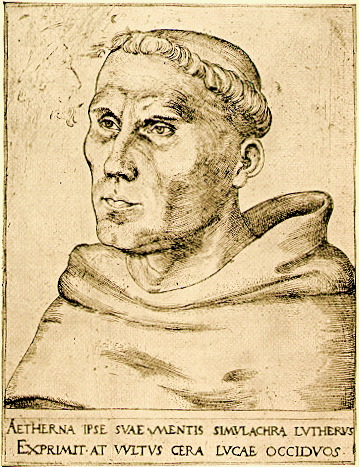 ‘Luther’s merit was not the heroism of his conscience, but the rediscovery of a new conscience beyond the natural, and beyond the institutional – whether canonical in the Church, or civil in the State. He found a conscience higher and deeper than the natural, the ecclesiastical, or the Political – the individual, the canonical, or the civil; more royal than culture, clergy, or crown. He found a conscience within the conscience. He found anew the evangelical conscience, whose ideal is not heroism at all, but the humility and obedience of the conscience itself, its lostness and its nothingness except as rescued and set on its feet by Christ, in whom no man is a hero, but every man a beggar for his life’. – Peter T. Forsyth, Rome, Reform and Reaction: Four Lectures on the Religious Situation (London: Hodder & Stoughton, 1899), 121.
Forsyth is aware that Christianity’s concern is not with the self-assertion or self-glorification of human nature, but with the redemption and reconstituting of wills. The conquered conscience recognises this ‘Another, greater and better … Who comes to us, gives Himself to us’ in such a way that we are enabled, in faith, to give ourselves to, and find ourselves in, him. There is, Forsyth avers, no higher relation possible to human persons. However, although faith consoles the conscience, it does not necessarily follow that the testimony of the gospel and the feeling of the conscience enter into some sort of harmony in faith. In fact, as Zachman notes in his brilliant study (The Assurance Of Faith: Conscience In The Theology Of Martin Luther And John Calvin), ‘in the experience of tribulation (Anfechtung), the opposition between the Word of God and the feeling of the conscience is intensified’ (p. 63; see also pp. 63-8, 80-7, 151, 182, 192, 198-203, 210-23, 226, 246). This is because, as Forsyth notes, the unconquerable relationship between conscience and Conscience entails the acquisition of a new and final authority:
The prime question of religion is not, “How do I stand to the spiritual universe?” but “How shall I stand before my Judge?” The last authority must be the authority owned by the conscience, and required by the sinful, guilty conscience of a race. It is the authority of a Saviour … One whose absolute property we are … It is the authority of the moral absolute, of the holy, which stands over us and changes us from self-satisfaction to self-scrutiny, self-knowledge, and self-humiliation in the presence of the righteousness loving and eternal. (Peter T. Forsyth, The Principle of Authority in Relation to Certainty, Sanctity and Society: An Essay in the Philosophy of Experimental Religion (London: Independent Press, 1952) 303-4; cf. pp. 400; Peter T. Forsyth, The Preaching of Jesus and the Gospel of Christ (Blackwood: New Creation Publications, 1987) 55-6.)
Lent Reflection 5: Hans Urs von Balthasar on the three decisive hours
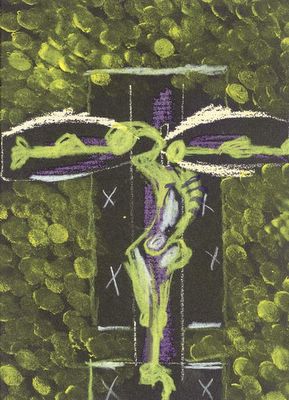 ‘”Now from the sixth hour there was darkness over all the land until the ninth hour.” It was as if the cosmos sensed that something decisive was going on here, as if it were participating in the darkness invading the soul of Christ. For our part, we do not need to experience this darkening, for we are already estranged and dark enough. It would suffice if we held onto our faith in a world that has become dark all around us; it would be enough for us to be convinced that all inner light, all inner joy and security, all trust in life owes its existence to the darkness of Golgotha and never to forget to give God thanks for it’. – Hans Urs von Balthasar, You Crown the Year With Your Goodness: Sermons Through the Liturgical Year (trans. Graham Harrison; San Francisco: Ignatius Press, 1989), 85-6.
I have posted previously von Balthasar’s entire sermon – The Scapegoat and the Trinity – from which this portion is lifted.
Rowan Williams on cynicism and scepticism
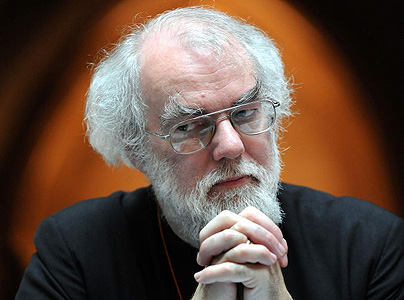 ‘… I think cynicism is one of the worst things that can afflict a society. Scepticism, the capacity to ask tough questions and not allow people to get away with things is healthy in a society. Cynicism, which simply assumes the worst and assumes that there’s nothing you can do about it except throw blame around in an endless kind of ‘paint-balling riot’ – that’s no use to anybody’. – Rowan Williams, ‘Interview with Radio 4 ‘Today’ programme ahead of G20 summit’, Tuesday 31 March 2009.
Robert Jenson: The 2009 Burns Lectures on Video
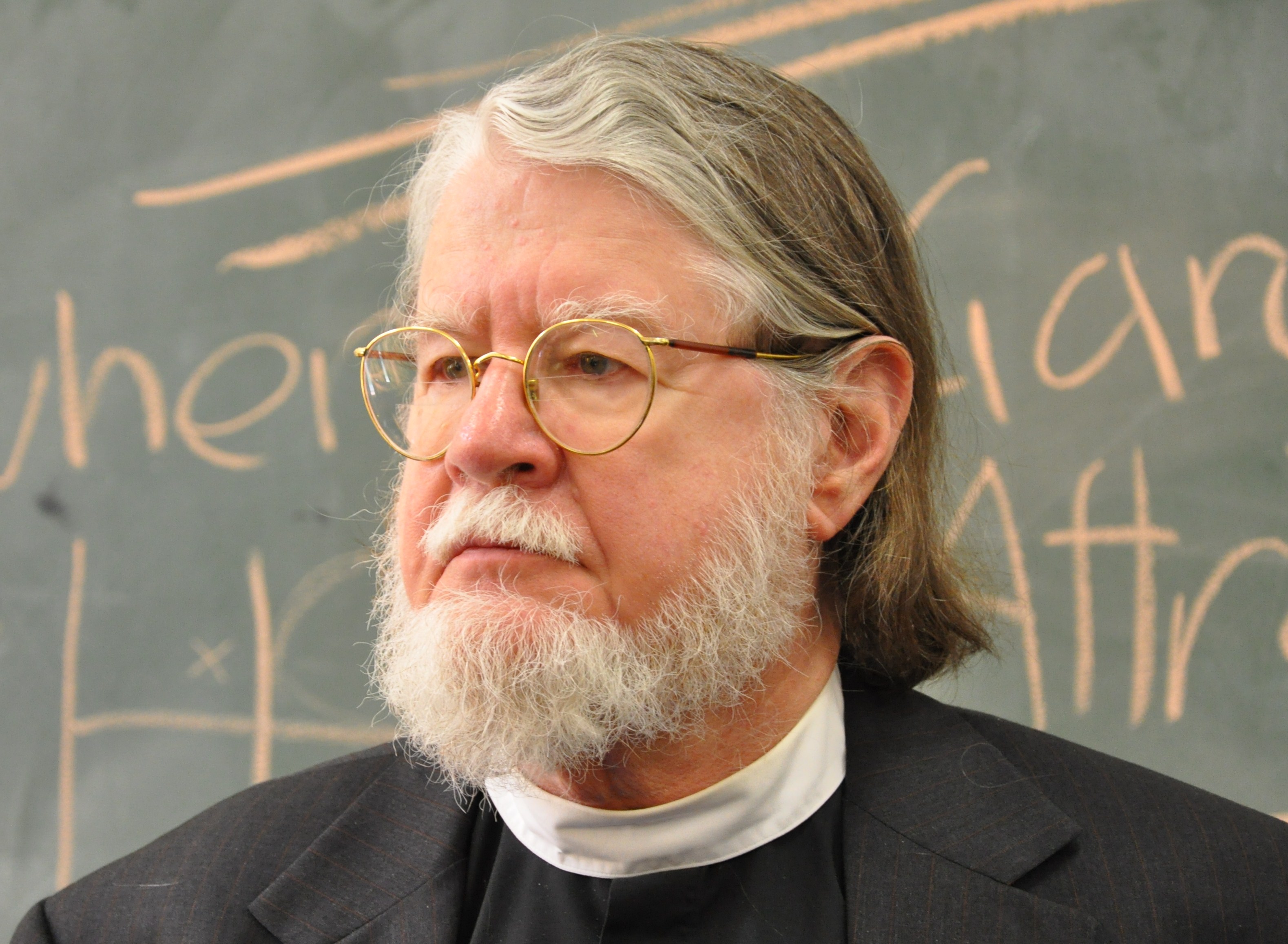
© 2009. Photo taken by John Roxborogh, when Robert Jenson visited the Knox Centre for Ministry and Leadership in Dunedin. Used with permission.
I recently posted notes on Robert Jenson’s 2009 Burn Lectures delivered at the University of Otago on the theme, ‘The Regula Fidei and Scripture’:
- Lecture 1: Creed, Scripture, and Their Modern Alienation
- Lecture 2: The Tanakh as Christian Scripture
- Lecture 3: The New Testament and the Regula Fidei
- Lecture 4: The Apostles’ Creed
- Lecture 5: The Creed as Critical Theory of Scripture
- Lecture 6: Genesis 1:1 and Luke 1:26-38
The video podcasts of those lectures are now available for download as MP4s:
- Lecture 1: Creed, Scripture, and their Modern Alienation
- Lecture 2: The Tanakh as Christian Scripture
- Lecture 3: The New Testament and the Regula Fidei
- Lecture 4: The Apostles’ Creed
- Lecture 5: The Creed as Critical Theory of Scripture
- Lecture 6: Genesis 1:1 and Luke 1:26-38
The New Statesman on ‘God – what do we believe?’
The latest New Statesman is a special issue on God and belief. Some of the more interesting pieces are:
- Kingdoms not of this world
- AN Wilson on his return to faith after a period of atheism
- CS Lewis: fiction and faith, by James Macintyre
- What God means to me
- Please, let’s not do God, by Christopher Hitchens
- Some interesting quotes on religion. My favourite: ‘I don’t believe in the after life, although I am bringing a change of underwear’ (Woody Allen)
John Pilger on the Brussels War Crimes Tribunal and the Blair War Crimes Foundation
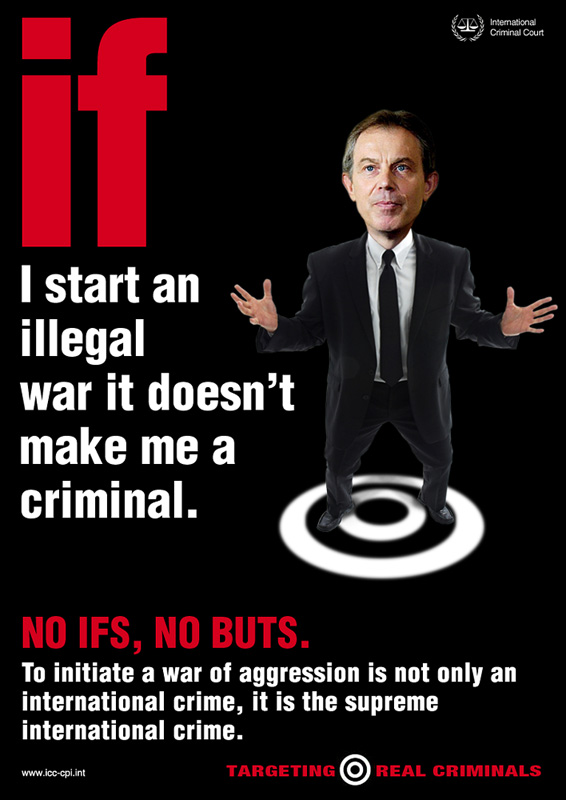 These are extraordinary times. With the United States and Britain on the verge of bankruptcy and committing to an endless colonial war, pressure is building for their crimes to be prosecuted at a tribunal similar to that which tried the Nazis at Nuremberg. This defined rapacious invasion as “the supreme international crime, differing only from other war crimes [sic] in that it contains within itself the accumulated evil of the whole”. International law would be mere farce, said the chief US chief prosecutor at Nuremberg, the Supreme Court justice Robert Jackson, “if, in future, we do not apply its principles to ourselves”.
That is now happening. Spain, Germany, Belgium, France and Britain have long had “universal jurisdiction” statutes, which allow their national courts to pursue and prosecute prima facie war criminals. What has changed is an unspoken rule never to use international law against “ourselves”, or “our” allies or clients. In 1998, Spain, supported by France, Switzerland and Belgium, indicted the Chilean dictator Augusto Pinochet, client and executioner of the west, and sought his extradition from Britain, where he happened to be at the time. Had he been sent for trial, he almost certainly would have implicated at least one British prime minister and two US presidents in crimes against humanity. The then home secretary, Jack Straw, let him escape back to Chile.
The Pinochet case was the ignition. On 19 January, the George Washington University law professor Jonathan Turley compared the status of George W Bush with that of Pinochet. “Outside [the United States] there is no longer the ambiguity about what to do about a war crime,” he said. “So if you try to travel, most people abroad are going to view you not as ‘former president George Bush’ [but] as a current war criminal.” For this reason, Bush’s first defence secretary, Donald Rumsfeld, who demanded an invasion of Iraq in 2001 and personally approved torture techniques for use in Iraq and Guantanamo Bay, no longer travels. Rumsfeld has twice been indicted for war crimes in Germany. On 26 January, the UN special rapporteur on torture, Manfred Nowak, said: “We have clear evidence that Mr Rumsfeld knew what he was doing but nevertheless he ordered torture.”
The Spanish high court is currently investigating a former Israeli defence minister and six other top Israeli officials for their role in the killing of civilians, mostly children, in Gaza. Henry Kissinger, who was largely responsible for bombing 600,000 peasants to death in Cambodia in 1969-73, is wanted for questioning in France, Chile and Argentina. Yet, on 8 February, as if demonstrating the continuity of American power, President Barack Obama’s national security adviser, James Jones, said: “I take my daily orders from Dr Kissinger.”
Like them, Tony Blair may soon be a fugitive. The International Criminal Court, to which Britain is a signatory, has received a record number of petitions relating to Blair’s wars. Spain’s celebrated judge Baltasar Garzón, who indicted Pinochet and the leaders of the Argentinian military junta, has called for George W Bush, Blair and the former Spanish prime minister José María Aznar to be prosecuted for the invasion of Iraq – “one of the most sordid and unjustifiable episodes in recent human history – a devastating attack on the rule of law” that had left the UN “in tatters”. He said: “There is enough of an argument in 650,000 deaths for this investigation to start without delay.”
This is not to say Blair is about to be collared and marched to The Hague, where Serbs and Sudanese dictators are far more likely to face a political court set up by the west. However, an international agenda is forming and a process has begun which is as much about legitimacy as the letter of the law, and a reminder from history that the powerful lose wars and empires when legitimacy evaporates. This can happen quickly, as in the fall of the Berlin Wall and the collapse of apartheid South Africa – the latter a spectre for apartheid Israel.
Today, the unreported “good news” is that a worldwide movement is challenging the once-sacrosanct notion that imperial politicians can destroy countless lives in the cause of an ancient piracy, often at a remove in distance and culture, and retain their respectability and immunity from justice. In his masterly Dr Jekyll and Mr Hyde, R L Stevenson writes in the character of Jekyll: “Men have before hired bravos to transact their crimes, while their own person and reputation sat under shelter . . . I could thus plod in the public eye with a load of genial respectability, and, in a moment, like a schoolboy, strip off these lendings and spring headlong into the sea of liberty. But for me, in my impenetrable mantle, the safety was complete.”
Blair, too, is safe – but for how long? He and his collaborators face a new determination on the part of tenacious non-government bodies that are amassing “an impressive documentary record as to criminal charges”, according to the international law authority Richard Falk. He cites the World Tribunal on Iraq, held in Istanbul in 2005, which heard evidence from 54 witnesses and published rigorous indictments against Blair, Bush and others. At present, the Brussels War Crimes Tribunal and the newly established Blair War Crimes Foundation are building a case for the former prime minister’s prosecution under the Nuremberg Principle and the 1949 Geneva Convention. In a separate indictment, a former judge of the New Zealand Supreme Court, E W Thomas, wrote: “My predisposition was to believe that Mr Blair was deluded, but sincere in his belief. After considerable reading and much reflection, however, my final conclusion is that Mr Blair deliberately and repeatedly misled cabinet, the British Labour Party and the people in a number of respects. It is not possible to hold that he was simply deluded but sincere: a victim of his own self-deception. His deception was deliberate.”
Protected by the fake sinecure of Middle East envoy for the Quartet (the US, EU, UN and Russia), Blair operates largely from a small fortress in the American Colony Hotel in Jerusalem, where he is an apologist for the US in the Middle East and Israel, a difficult task following the bloodbath in Gaza. To assist his mortgages, he recently received an Israeli “peace prize” worth $1m. He, too, is careful where he travels; and it is instructive to watch how he now uses the media. Having concentrated his post-Downing Street apologetics on a BBC series of obsequious interviews with David Aaronovitch, Blair has all but slipped from view in Britain, where polls have long exposed a remarkable loathing for a former prime minister – a sentiment now shared by those in the liberal media elite whose previous promotion of his “project” and crimes is an embarrassment, and preferably forgotten.
On 8 February, Andrew Rawnsley, the Observer’s former leading Blair fan, declared that “this shameful period will not be so smoothly and simply buried”. He demanded, “Did Blair never ask what was going on?” This is an excellent question made relevant with a slight word change: “Did the Andrew Rawnsleys never ask what was going on?” In 2001, Rawnsley alerted his readers to Saddam Hussein’s “contribution to international terrorism” and his “frightening appetite to possess weapons of mass destruction”. Both assertions were false and echoed official Anglo-American propaganda. In 2003, when the destruction of Iraq was launched, Rawnsley described it as a “point of principle” for Blair who, he later wrote, was “fated to be right”. He lamented, “Yes, too many people died in the war. Too many people always die in war. War is nasty and brutish, but at least this conflict was mercifully short.”
In the subsequent six years, at least a million people have been killed. According to the Red Cross, Iraq is now a country of widows and orphans. Yes, war is nasty and brutish, but never for the Blairs and the Rawnsleys.
Far from the carping turncoats at home, Blair has lately found a safe media harbour – in Australia, the original Murdochracy. His interviewers exude an unction reminiscent of the promoters of the “mystical” Blair in the Guardian of more than a decade ago, though they also bring to mind Geoffrey Dawson, editor of the Times during the 1930s, who wrote of his infamous grovelling to the Nazis: “I spend my nights taking out anything which will hurt their susceptibilities and dropping in little things which are intended to soothe them.”
With his words as a citation, the finalists for the Geoffrey Dawson Prize for Journalism (Antipodes) are announced. On 8 February, in an interview on the Australian Broadcasting Corporation, Geraldine Doogue described Blair as “a man who brought religion into power and is now bringing power to religion”. She asked him: “What would the perception be that faith would bring towards a greater stability . . . [sic]?”
A bemused and clearly delighted Blair was allowed to waffle about “values”. Doogue said to him that “it was the bifurcation about right and wrong, that’s what I thought the British found really hard [sic]”, to which Blair replied that “in relation to Iraq I tried every other option [to invasion] there was”. It was his classic lie, and it passed unchallenged.
However, the clear winner of the Geoffrey Dawson Prize is Ginny Dougary of the Sydney Morning Herald and the Times. Dougary recently accompanied Blair on what she described as his “James Bond-ish Gulfstream” where she was privy to his “bionic energy levels”. She wrote: “I ask him the childlike question: does he want to save the world?” Blair replied, well, more or less, aw shucks, yes. The murderous assault on Gaza, which was under way during the interview, was mentioned in passing. “That is war, I’m afraid,” said Blair, “and war is horrible.” No counter came that Gaza was not a war, but a massacre by any measure. As for the Palestinians, noted Dougary, it was Blair’s task “to prepare them for statehood”. The Palestinians will be surprised to hear that. But enough gravitas; her man “has the glow of the newly-in-love: in love with the world and, for the most part, the feeling is reciprocated”. The evidence she offered for this absurdity was that “women from both sides of politics have confessed to me to having the hots for him”.
These are extraordinary times. Blair, a perpetrator of the epic crime of the 21st century, shares a “prayer breakfast” with President Obama, the yes-we-can man now launching more war.
“We pray,” said Blair, “that in acting we do God’s work and follow God’s will.”
To decent people, such pronouncements about Blair’s “faith” represent a contortion of morality and intellect that is a profanation of the basic teachings of Christianity. Those who aided and abetted his great crime and now wish the rest of us to forget their part – or who, like Alastair Campbell, offer their bloody notoriety for the vicarious pleasure of some – might read the first indictment proposed by the Blair War Crimes Foundation: “Deceit and conspiracy for war, and providing false news to incite passions for war, causing in the order of one million deaths, four million refugees, countless maimings and traumas.”
These are indeed extraordinary times.
[Source: New Statesman]
New Zealanders are becoming less religious
 Surprise, surprise: a recent survey has found that New Zealanders are becoming less religious:
‘There has been a sharp rise in the number of New Zealanders with no religious affiliation, new research shows.
In a study by [Massey] University, 40 per cent of respondents say they have no religious affiliation compared to 29 per cent 17 years ago. Just over a third of New Zealanders describe themselves as religious.
Fifty-three per cent say they believe in God (although half of those say they have doubts), 20 per cent believe in some form of higher power and about third say they don’t believe or don’t know.
However, 60 per cent say they would prefer children to have religious education in state primary schools with strongest support for teaching about all faiths.
Researchers from the Department of Communication, Journalism and Marketing received responses from 1000 people as part of the International Social Survey Programme.
Professor Philip Gendall, who led the research team, says the view that New Zealand is a very secular country, is supported by the relatively low levels of active involvement in religion. “The survey shows that God is not dead, but religion may be dying,” Professor Gendall says.
“There is evidence that New Zealanders have become less religious over the last 17 years; however, most New Zealanders believe in God and there has been no change in the proportion of those who say they believe in a higher power.”
“So perhaps the apparent decline in religiosity reflects a decline in traditional religious loyalties – rather than a decline in spirituality as such.”
The study found that significant numbers of New Zealanders believe in the supernatural with 57 per cent believing in life after death, 51 per cent believing in heaven and 36 per cent believing in hell.
A quarter of those surveyed think star signs affect people’s futures, 28 per cent say good luck charms work and 39 per cent believe fortune-tellers can foresee the future.
The survey also asked questions about euthanasia and 70 per cent of respondents supported assisted suicide for someone with a painful incurable disease, provided a doctor gives assistance’.
[Source: Scoop]
Adolf Schlatter on the relationship between justification and sanctification
 ‘The difference, even contrast, between the one-time, initial act of God that establishes our relationship with him and the changing, oscillating events in our history may move us deeply, so that we experience the encounter of the absolute, timeless, divine activity with our time-bound history as a profound mystery. In the case of Paul, on the other hand, it is not clear that this issue was significant for him. He never phrases his absolute pronouncements regarding our inclusion in the divine grace in abstract terms that circumvent the practicalities of what we experience and do. Likewise, he does not separate the evaluation of these processes from those foundational certainties. He rather links the revelation of divine grace with the wealth of all its consequences. He connects our individual experiences with the full depth of their source’. – Adolf Schlatter, The Theology of the Apostles: The Development of New Testament Theology (trans. Andreas J. Köstenberger; Grand Rapids: Baker, 1998, 249
[BTW: this is my 1000th post!]
Tony Kelly on the ‘saturated phenomena’ of the child
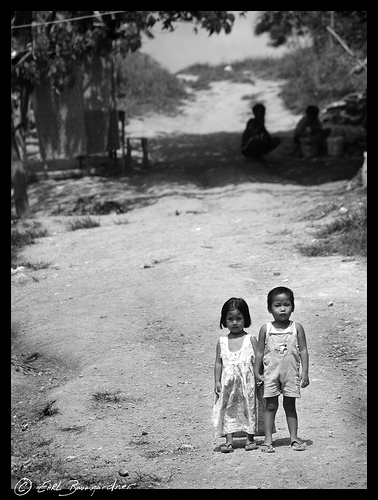 I have posted earlier on the theologies of childhood proffered by Calvin, Schleiermacher, Barth and Jensen (all Reformed perspectives), and on that of Karl Rahner. In this post, I turn to Australian Roman Catholic theologian Anthony Kelly on the ‘saturated phenomena’ of the child[1]. In his essay, ‘Spirituality and the Child’, Kelly identifies five phenomena of the child:
1. A unique ‘revelation’. The child comes in the form of a unique ‘revelation’, breaking into the experience of human community as the ‘occurrence of the new, at once a gift and a promise given into the heart of life’. In this way, the child is a ‘focus of wonder at the generativity of the universe’. The child calls the whole human family to a ‘new responsibility, if parents and relatives are to receive this gift of a new beginning in reverence and care. Consequently, the child invites certain questions: In a child, what new thing is being given and revealed?
2. An ‘event’. The child is an ‘event’. Despite the vulnerability of both the child and parent, the event or advent of a child has the potential to affect the lives and thinking of all around it. It evokes a new sense of both the past and the as-yet-undetermined future. Consequently, the arrival of a child is ‘an open-ended, transformative event. It is no fait accompli in terms of assignable causes and predictable effects, but an advent whose significance overflows as a unique new presence within the constitution of family, society and even world-history. To this degree, it is in the nature of such an event to resist calculated prediction of outcomes, but to inspire waiting, fidelity and hope, if what is given is to be received in its incalculable significance’.[2] The event – or advent – of the child also poses a number of questions:
- What has really happened in this coming?
- What might be its effect on parents, siblings, wider family, society, creation?
- How might the Church wait with couples in pregnancy?
- How might the gift of child be played out in church, family and in event of creation itself?
- What is the nature of hope?
 3. A gift and event. Kelly writes:
Despite the possibilities of violence and exploitation inherent in a grossly sexual objectification of relationships, the child is a witness to something else. He embodies, within the intimacy, ecstasy and generativity of our incarnate existence, a distinctively personal order of relationships. For she implicitly demands to be received as something more than a biological product of two sexual agents, and so to provoke a larger sense of life.[3]
This invites further questions:
- What is this larger sense of life?
- To what mystery/ies of life does the event of child point?
- How, in the Christian phenomenology of life centred in the Incarnation, is the child related to the Word who is himself made flesh, given into creation from the eternal generativity of God?
4. Something akin to a work of ‘art’. Like any work of art, the phenomenon of the child resists one-dimensional interpretations, resists detainment, resists ‘pre-designed space’. Instead, ‘its power is to command its own space and change the place given it’.[4] Kelly cites the poem, ‘Five Days Old’, by Australian poet Francis Webb (1925-1973). For most of his life Webb suffered with mental depression and was diagnosed with schizophrenia in the 1950s. ‘He spent most of his adult life in and out of psychiatric hospitals, writing poetry against terrible odds’.[5] In England during the war, he was being treated by a young Canadian doctor who had invited him home around Christmastime. The young parents put their five day old Christopher John in the poet’s arms, and left him alone for a while. This poem was the result:
Christmas is in the air.
You are given into my hands
Out of quietest, loneliest lands.
My trembling is all my prayer.
To blown straw was given
All the fullness of Heaven.
 The tiny, not the immense,
Will teach our groping eyes.
So the absorbed skies
Bleed stars of innocence.
So cloud-voice in war and trouble
Is at last Christ in the stable.
Now wonderingly engrossed
In your fearless delicacies,
I am launched upon sacred seas,
Humbly and utterly lost
In the mystery of creation,
Bells, bells of ocean.
Too pure for my tongue to praise,
That sober, exquisite yawn
Or the gradual, generous dawn
At an eyelid, maker of days:
To shrive my thought for perfection
I must breathe old tempests of action
 For the snowflake and face of love.
Windfall and word of truth.
Honour close to death.
O eternal truthfulness, Dove,
Tell me what I hold –
Myrrh? Frankincense? Gold?
If this is man, then the danger
And fear are as lights of the inn,
Faint and remote as sin
Out here in the manger.
In the sleeping, weeping weather
We shall all kneel down together.[6]
- In what ways is a child like/unlike a work of art?
- How does the coming of such vulnerability change/disrupt the life of a family? Of a faith community?
- How does the coming of such vulnerability call for new vision and ecclesiological modus operandi?
- How does the coming of such vulnerability call for ‘reconciliation among those whose murderous demands have foreclosed on new possibilities and made the world a dangerous place for children’?
- How might childhood point to the open-endedness of life?
- How might childhood resist calls to shut down eschatological hope?
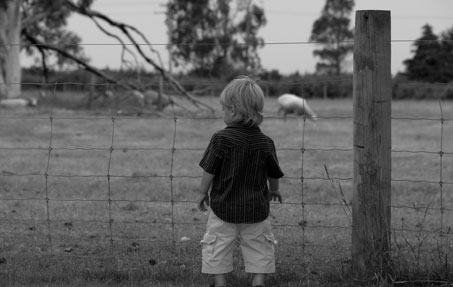 5. The ‘face’ of an other. So Kelly:
The face of the other is not a projection on one’s part of the other as an object, useful, exploitable or ignored … It stands for the totality of the reality of the other as given, calling me to responsibility. To allow oneself to be ‘faced’ by the other in this way, is to be called out of oneself, to make room for this other, however unsettling this may prove.[7]
Again this raises a series of challenges:
- Children are often easy to ignore in our communities. How might the children in our communities pose a challenge that we cannot afford to set aside or to palm off onto others?
- What does the child call those engaged in Christian ministry to?
[1] The phrase ‘saturated phenomena’ is taken from Jean-Luc Marion, De Surcroît: Études sur les phénomènes saturées (Paris: Presses Universitaires de France, 2001).
[2] Anthony J. Kelly, ‘Spirituality and the Child’ in Children, Adolescents and Spirituality (ed. Marian de Souza and Winifred Wing Han Lamb; Adelaide: ATF Press, 2008), 14. Italics mine.
[3] Ibid., 15.
[4] Ibid., 15.
[5] Carol Treloar, ‘Poetic Australians’, The Advertiser, 7 September 1991.
[6] Francis Webb, ‘Five Days Old’ in The Oxford Book of Australian Religious Verse (ed. Kevin Hart; Oxford/New York: Oxford University Press, 1994), 225. Italics mine.
[7] Kelly, ‘Spirituality and the Child’, 17.
Christians who believe in hell
 Yesterday’s New Statesman includes a piece by Eric Stoddart on Christians and bereavement wherein Stoddart makes the following claim about Christians who believe in hell:
‘… the hell-believing Christian carries an additional burden of uncertainty, sometimes significant fear, that their loved one will not be raised to enjoy everlasting life or, worse, be raised to everlasting punishment. There is a Christian form of grieving and it relies on the Jesus who wept being the Jesus who was resurrected’.
Let’s be honest …

Is there an Old Testament eschatology?
 From one of my favourite books:
‘… if eschatology is concerned with the reaching of a goal, then there can in principle be no eschatology in the Old Testament. It is only possible in and through the history of Jesus Christ’. – Adrio König, Here Am I: A Believer’s Reflection on God (Grand Rapids/London: Wm. B. Eerdmans/Marshall Morgan & Scott, 1982), 170.
March bests …
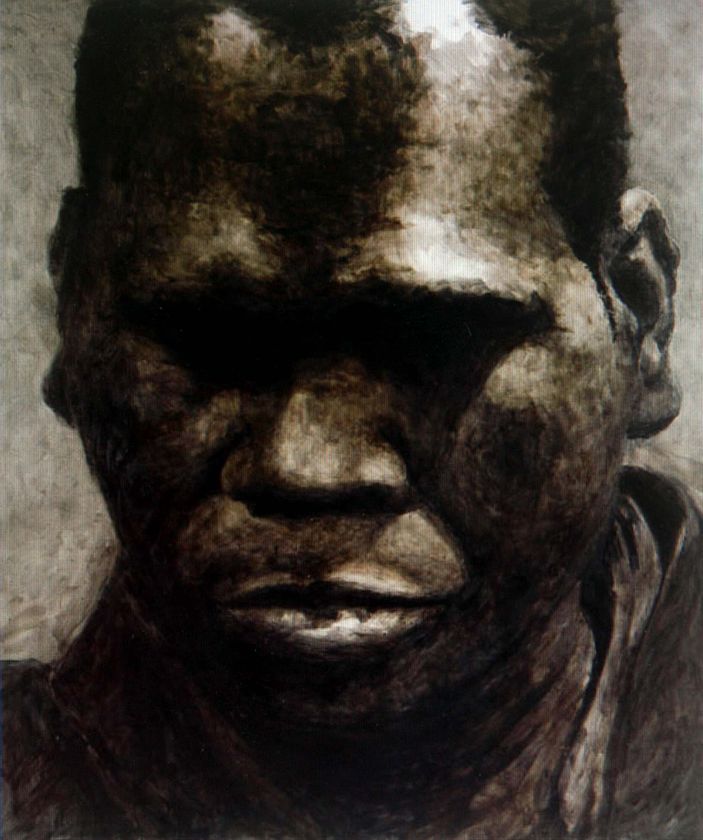
'Geoffrey Gurrumul Yunupingu', by Guy Maestri
Best books: Geoffrey A. Studdert Kennedy, After War, Is Faith Possible?: The Life and Message of Geoffrey “Woodbine Willie” Studdert Kennedy (Eugene: Cascade Books, 2008). (Reviewed here)
Best music: Geoffrey Gurrumul Yunupingu, Gurrumul [2008: This is one of the best albums I’ve heard in a long time]; U2, No Line on the Horizon [2009]; Bob Dylan, The Bootleg Series, Vol. 8: Tell Tale Signs – Rare and Unreleased 1989-2006 [2008]; The Panics, Cruel Guards [2008]; Paul McCartney, Flaming Pie [1997].
Best films: The Reader [2008]
Best drink: 2007 Two Paddocks Pinot Noir
Barth on our being in Christ
 ‘To be a Christian is per definitionem to be in Christ. The place of the community as such, the theatre of their history, the ground on which they stand, the air that they breathe, and therefore the standard of what they do and do not do, is indicated by this expression. Being in Christ is the a priori of all the instruction that Paul gives his churches, all the comfort and exhortation he addresses to them. – Karl Barth, Church Dogmatics IV/2, p. 277.
David Jensen on children
 David Jensen teaches reformed theology at Austin Presbyterian Theological Seminary. His delightful book, Graced Vulnerability: A Theology of Childhood (posted on here and here), focuses on the covenant grace of God which welcomes and encompasses vulnerability in human persons. Children (among others) constitute such authentic personhood. He suggests that to be a child is to be three things:
1. Chosen by God;
2. Open and vulnerable to the grace that makes life possible; and
3. A pilgrim, oriented Godward and toward the present.
1. Chosen by God – Children of election
Children are loved because of the simple fact that they are. The divine election
distances a theology of childhood from utilitarian considerations, where children are considered worthy because of something they possess (such as beauty) or provide (such as happiness to a parent). A revised doctrine of election claims first and foremost that children are worthy because God chooses them as subjects of divine love … In a society where genetic technologies promise a day in which parents will be able to select the “best” traits for their own children and filter out what is undesirable or unworthy, election proves subversive: God values infinitely those who are seen as disposable and valueless. God’s electing grace is the eternal yes to our tendency to say “no” to children. We neither choose children, nor do they choose us; and eternal choice precedes both parent and child. (pp. 44, 46)
2. Childhood vulnerability in difference
Living in God’s image, children are metaphors of openness to the One who creates each of us differently. Despite bourgeois longings to the contrary, there is no such thing as a model child … What some of the classic theologians have dismissed as the hallmarks of selfishness – the wails of hunger, the cries to be held – are actually the marks of relationship and dependence of life in God’s world. Infants cry not out of selfishness, but to speak of a profound need for another … (pp. 47, 49)
 3. The Pilgrim Child
Jensen considers children as pilgrims, as persons who are beginning to question life and to journey in it, who are as much – indeed more – oriented to the present as to the end. He writes:
Children subvert our understanding of pilgrimage in their attentiveness. They are pilgrims not because they are on their way somewhere, not because they are growing up to be somebody, but because they are already somewhere and somebody. Children’s pilgrimages call us to become who we already are: children of God, attentive to the surprise an mystery of creation … To be a pilgrim as children are is to live in the present, and to pay close attention to the immediacy of the journey … This present-orientation of childhood pilgrimage is not hedonistic, but the immediate delight of God’s world: an orientation that is not simply on the self, but on self-with-others … [Children’s] present-orientation affirms the enduring value and significance of human relationships. (pp. 53, 54; see also pp. 121-2)
For Jensen, such pilgrimage involves play (with its decidedly eschatological bent, so Zechariah 8:5: ‘The city streets will be filled with boys and girls playing there’), imagination and attention.
ITIA Conference: Reversed Thunder: The Art of the Psalms
 The Institute for Theology, Imagination and the Arts is hosting an international conference at which artists, biblical scholars, historians, theologians and others will explore the shaping impact of the Psalter on western imagination.
 jasongoroncy.com