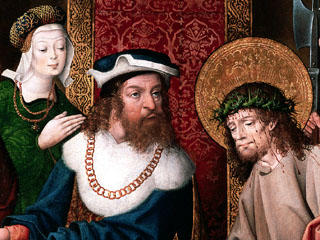
 ‘To the picture of the free but divinely ordained determination of the existence of Jesus to this outcome there must also be added everything that is said in the Gospels about the world around, in which the “wicked husbandmen” are given particular prominence as the decisive agents. We are not set at an indeterminate point in world history. The passion of the Son of Man is, of course, the work of the Gentiles, of Pilate and his race, but only secondarily and indirectly. Pilate has to be there, In more than one respect, especially as the responsible (although not really responsible) representative of government, he is one of the central figures in the Gospel story. Unwillingly and unwittingly he is the executor Novi Testamenti (Bengel). For by delivering Jesus to him, Israel unwittingly accomplishes-“they know not what they do” (Lk. 23:34)-His handing over to humanity outside Israel, and the Messiah of Israel becomes the Saviour of the world. Again, as Pilate delivers him to his men for execution, he is the man by whose will and work the divine act of redemption is accomplished. It is not the case however, as in some schematic presentations, that Israel and the Gentiles, Church and state, co-operated equally in accusing and condemning Jesus and destroying Him as a criminal. It is not for nothing that the one who initiates this action is the apostle Judas, and in his person the elect tribe of Judah to which Christ Himself also belonged, and in Judah (the Jews, as they are summarily described in John) the chosen and called people of Israel. It is in this sphere that we find ourselves in the passion story. We are not really in the main theatre of world history, but in the vineyard of the Lord. It is Israel, represented by its spiritual and ecclesiastical and theological leaders, but also by its vox populi, that refuses and rejects and condemns Jesus and finally delivers Him up as a blasphemer to the Gentiles, to be executed by them as a political criminal, although Pilate is quite unable and unwilling to pronounce Him guilty as such, and only causes Him to be put to death unjustly and against His better judgment. It was to this delivering up by this Israel which rejected and condemned Him, to death at the hands of this people, to this conclusion of His history that Jesus gave up Himself, and was given up by God. This is what we must always keep before us in our understanding of His passion’. – Karl Barth, Church Dogmatics IV.2 (ed. G.W. Bromiley and T.F. Torrance; trans. G.W. Bromiley; Edinburgh: T&T Clark, 1958), 260.
Month: March 2009
Karl Barth on Children

The Barth House
According to Hans Frei, what distinguished Karl Barth (1886-1968) as a theologian was the ‘startlingly consistent’ identification of ‘universal divine action with divine action in Christ alone’.[1] ‘Here God is present and known to us, and the only logical presupposition for this presence and this knowledge is – itself. For this unique thing there can be no set preconditions; it creates it own. No natural theology, no anthropology, no characterization of the human condition, no ideology or world view can set the conditions for theology or knowledge of God’,[2] and, by implication (after Calvin), for knowledge of creation.
This is where Barth begins. Indeed, there can be, for Barth, no other starting point than the eternal decision of God to be God for us – that God, in Jesus Christ elects to be humanity’s covenant partner and redeemer. We cannot understand humanity apart from this eternal decision of God to become incarnate for our sakes. We cannot understand personhood apart from the sovereign God’s decision to make covenant with God’s ‘other’.
While Barth wrote little directly regarding children,[3] Eberhard Busch has observed Barth’s great love for children, and his commitment to them, even when work pulled him away from home, and from his wife Nelly who assumed the major role in bringing up the Barth children. Busch records that around the time Barth was finishing writing the second edition of Der Römerbrief, Barth ‘watched his children … growing up, with care and delight. He still had time, for example, to comb his son Christoph’s hair every morning, “more for my own pleasure than for his gain and satisfaction”‘.[4] Busch also reports how Barth, during his years as pastor in Safenwil (1911-21), immersed himself in his confirmation and pre-confirmation classes, ‘told Bible stories to the twelve- to fourteen-year-olds in the so-called “children’s class” on Sunday after a sermon’, and held weekly meetings for young people already confirmed. He also had strong ideas about the form that these meetings should take: ‘It cannot merely be teaching and learning: we must discover each other personally and become good friends’. He also confessed that these weekly meetings ‘were always a dreadful worry for me’, that he often stood ‘awkwardly in front of bored faces’, and that he usually ‘simply ran out of steam, even in the most well-known things’.[5]
On comparing Augustine with Barth on children, consider these words from Augustine:
Who can recall to me the sin I did in my infancy? For in thy sight no one is clean of sin, not even the infant whose life is but one day upon earth … What, then, was my sin? Was it that I cried for more as I hung upon the breast? … Even in my infancy, therefore, I was doing something that deserved blame, but because I could not understand anyone who blamed me, custom and reason did not allow me to be blamed … It is clear, indeed, that infants are harmless because of physical weakness, not because of any innocence of mind.[6]
Augustine believes that all of us are born with evil tendencies by virtue of original sin. Indeed, he somewhat ‘fused biological ideas of heredity with the idea of the juridical liability of humanity’.[7] This view constitutes the mainstream Christian tradition.
Barth rejects this (negative) view, stressing instead that children are bearers of God’s gracious promise to make them – and indeed all humanity – his covenant partners in Jesus Christ.
Barth also presents three interrelated thoughts about children:
1. Children are needy beginners. They are ‘inept, inexperienced, unskilled, and immature’, but as such they may humbly acknowledge their need and assume a ‘sheer readiness to learn’.[8] Barth, like Calvin, makes a lot of the correlation between children and the life of filial reality before God:
In invocation of God the Father everything depends on whether or not it is done in sheer need (not self-won competence), in sheer readiness to learn (not schooled erudition), and in sheer helplessness (not the application of a technique of self-help). This can be the work only of very weak and very little and very poor children, of those who in their littleness, weakness, and poverty can only get up and run with empty hands to their Father, appealing to him. Nor should we forget to add that it can only be the work only of naughty children of God who have wilfully run away again from their Father’s house, found themselves among swine in the far country, turned their thoughts back home, and then – if they could – returned to their Father … Christians who regard themselves as big and strong and rich and even dear and good children of God, Christian who refuse to sit with their Master at the table of publicans and sinners, are not Christians at all, have still to become so, and need not be surprised if heaven is gray above them and their calling upon God sounds hollow and finds no hearing. The glory, splendour, truth, and power of divine sonship, and of the freedom to invoke God as Father, and therefore the use of this freedom – the Christian ethos in big and little things alike – depends at every time and in every situation on whether or not Christians come before God as beginners, as people who cannot make anything very imposing out of their faith in Jesus Christ, who even with this faith of theirs – and how else could it be if it is faith in Jesus Christ? – venture to draw near to his presence only with the prayer: “Help my unbelief” (Mk. 9:24). Mark well that this has nothing to do with Christian defeatism. It describes Christians on their best side and not their worst, in their strength and not their weakness (2 Cor. 12:10).[9]
That children are ‘beginners’ does not mean that they should be kept in dependence upon their elders. Rather, it implies that they may mature before the covenant God with a spirit of courage and cheerfulness.
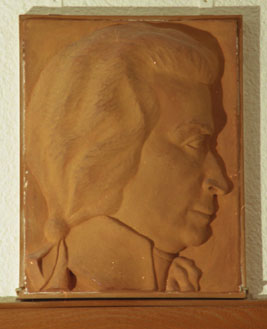
A portrait of Mozart in Barth's house
2. Being a child is characteristically to be at play. Here Barth draws upon Mozart, whose playing reflects the sheer absence of self-preoccupation. Mozart is not focused on personal confession (as is Beethoven); nor is he about ‘business’ or communicating doctrine (as Barth reads Bach as doing). Mozart just ‘sounds and sings’ with an objectivity that includes ‘an intuitive, childlike awareness of the essence or center – as also the beginning and end – of all things. It is from this center, from this beginning and end, that I hear Mozart create his music’.[10]
3. Being a child is about the opportunity to realise ‘freedom in limitation’. We respond to God’s call as those under the limitations of creation – space and time – and as those elected by God to particular vocations and places of responsibility. The call by the Word of God means freedom. That that same call comes to creatures means limitations. To be a child is to realise this two-fold truth, and to press in various directions in order to identify the boundary between the two – i.e. to step into freedom. This stepping requires what Barth calls a ‘youthful objectivity’.
Youth is the capacity and will to devote oneself to an object without considering or intending that the manner of this devotion should be specifically youthful, but rather in suppression of any such consideration or intention and with the serious aim of rivaling the objectivity of those who are older. He who wants to be a child is not a child; he is merely childish. He who is a child does not want to be a child; he takes his play, his study, his first attempts at accomplishment, his first wrestlings with his environment, in bitter earnest, as though he were already an adult. In so doing he is genuinely childlike. This is what it means to accept the command of the particular hour in true loyalty to its specific determination, to be free in its distinctive limitation.[11]
Directly and indirectly, Barth helps us to ask a number of questions that are pertinent for those in pastoral leadership:[12]
- Do I treat children as gifts who are promised God’s friendship, and not as corrupt or neutral objects who exist for the sake of my control and fashioning?
- Does my care for them communicate hope and possibility rather than a sense of failure and ruin?
- Am I moved to witness good news to other children not my own who need to and by grace may hear it when they have enough to eat, or when they have an opportunity to learn and develop their own powers for responsible life with others?
- And with my own children, do I really place first their relation with God and my summons joyfully to invite them to rejoice with me in God, rather than first insisting that they mimic my life history or ‘make something of themselves’?
Just before his eightieth birthday, Barth sketched a ‘Rule of life for older people in their relationship with the young’. Eberhard Busch recounts Barth’s words:
You must make it clear that our younger relations have the right to go their own way in accordance with their own principles, not yours … In no circumstances should you give them up: rather, you should go along with them cheerfully, allowing them to be free, thinking the best of them and trusting in God, loving them and praying for them, whatever happens.[13]
[1] Hans W. Frei, Theology and Narrative: Selected Essays (ed. George Hunsinger and William C. Placher; New York/Oxford: Oxford University Press, 1993), 228.
[2] Hans W. Frei, Types of Christian Theology (ed. George Hunsinger and William C. Placher; New Haven/London: Yale University Press, 1992), 154.
[3] Here I am drawing on an essay by William Werpehowski, ‘Reading Karl Barth on Children’ in The Child in Christian Thought (ed. Marcia JoAnn Bunge; Grand Rapids/Cambridge: Wm. B. Eerdmans, 2001), 386-405.
[4] Eberhard Busch, Karl Barth: His Life from Letters and Autobiographical Texts (trans. John Bowden; Philadelphia: Fortress Press, 1975), 121.
[5] Ibid., 64-66.
[6] Augustine, Confessions (trans. Rex Warner; New York: New American Library, 1963), 23-4.
[7] Henry Chadwick, Augustine (New York/Oxford: Oxford University Press, 1986), 111.
[8] Karl Barth, The Christian Life: Church Dogmatics IV.4: Lecture Fragments (trans. Geoffrey W. Bromiley; Edinburgh: T&T Clark, 1981), 79, 80.
[9] Ibid., 80.
[10] Karl Barth, Wolfgang Amadeus Mozart (trans. C.K. Pott; Eugene: Wipf & Stock, 2003), 16.
[11] Karl Barth, Church Dogmatics III.4 (trans. A.T. Mackay, et al.; Edinburgh: T&T Clark, 1961), 609.
[12] These questions are adapted from Werpehowski, ‘Barth on Children’, 405.
[13] Busch, Karl Barth, 476.
Candour: ‘Science and Christianity’
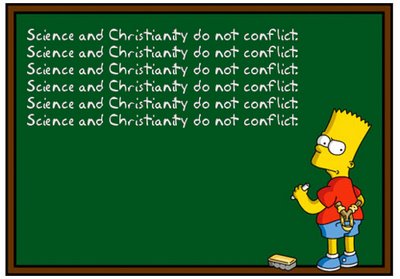 The Presbyterian Church of Aotearoa New Zealand produces a monthly magazine called Candour. The articles are targeted at church leaders and are usually of a good standard. The March issue is now out and concerns the theme ‘Science and Christianity’. You can become a subscriber by emailing here.
The TOC for the March issue is:
- Reading nature and Scripture today – Don Nield
- How can we inform bioethics decisions? – Helen Bichan
- From a backyard point of view – Bob Eyles
- Science and Christianity face an identical foe – John Kernohan
- Intelligent Design: The way forward? – Don Nield
- What kind of justice? – Douglas Mansill
Robert Jenson: Burns Lecture 1 – Creeds, Scripture, Niebuhr and the Preposition between Christ and Culture
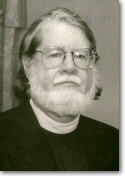 This afternoon, I was priviledged to hear a lecture by Robert W. Jenson who is visiting the University of Otago to deliver this year’s Burns Lectures on the theme of ‘The Regula Fidei and Scripture’. I’ve heard Professor Jenson lecture on a number of occassions, and on three different continents, and he is always enormously stimulating. In his opening lecture today entitled ‘Creed, Scripture, and Their Modern Alienation’, Jenson argued that the relationship between Holy Scripture and the ecumenical Creeds determines the whole life of the Church because together they witness to the Church being the same community yesterday, today and forever. He defined the Church as ‘the community of a message of the God of Israel who raised Christ from the dead’. Those already familiar with Jenson’s work would have heard here themes discussed and argued elsewhere in his writings.
Jenson proceeded to note that whereas the Christian community in the first century lived in the orbit of, and was defined in the light of, as it were, a first-hand history of Jesus and with little regard for its future, the second-century Church had to think through the community’s ‘future history’ and the shape which it would take as the institution of the future. It is to this end that both Scripture and the Regula Fidei bear witness to the one history of God with his people. Creeds are, he insisted, ‘a sort of communal linguistic awareness’ – a ‘gift of the Spirit’ who guides the church in every generation. On the relationship between the Regula Fidei and Church tradition more generally Jenson had little to say, at least in this lecture. [One hopes that this might get some teasing out in subsequent lectures].
Where more breath was expired, however, was over the question of Modernity and the demise of Regula Fidei. Modernity, Jenson repeated, sponsored a shift whereby Scripture and Creed came to be seen as alien to one another rather than as co-witnesses to the one Word of God and of the abiding presence of God with his people. Describing himself as an ‘unreliable Lutheran’, Jenson argued that the modern biblical studies movement began as a movement to redeem itself from creeds.
One fundamental conviction that drove Jenson’s entire presentation was his confidence that ‘Christ does not fit into other narratives. Other narratives have to fit into Christ’. I wish Jenson had unpacked this further (again, perhaps he will in the remaining lectures), but I did find one place where he does do such unpacking:
I have long thought that Niebuhr’s book, for all its individual insights, was based on a false setting of the question. Whatever preposition you put between Christ and culture, its mere presence there marks and enforces the supposition that Christ and culture are entities different in kind. But it is of course only the risen Christ who can now have a relation to a culture, and this living Christ’s body is the church. And the church – with its scriptures, odd rituals and peculiar forms of government – is plainly itself a culture.
Therefore the real question is always about the relation of the church culture to some other culture with which the church’s mission involves it at a time and place. And I do not think the relation can be the same in every case. During the time of “Christendom,” the culture of the church and the culture of the West were barely distinguishable. I do not think this “Constantinian settlement” was avoidable. When the empire said, “Come over and help us hold civilization together,” should the bishops have just refused?
As to Christendom’s consequences for faith, some were beneficial and some were malign, as is usual with great historical configurations. During the present collapse of Christendom and its replacement by an antinomian and would-be pagan culture, confrontation must of course be more the style.
Next lectures:
- Lecture 2: The Tanakh as Christian Scripture
- Lecture 3: The New Testament and the Regula Fidei
- Lecture 4: The Apostles’ Creed
- Lecture 5: The Creed as Critical Theory of Scripture
- Lecture 6: Genesis 1:1 and Luke 1:26-38
Friedrich Schleiermacher on Children
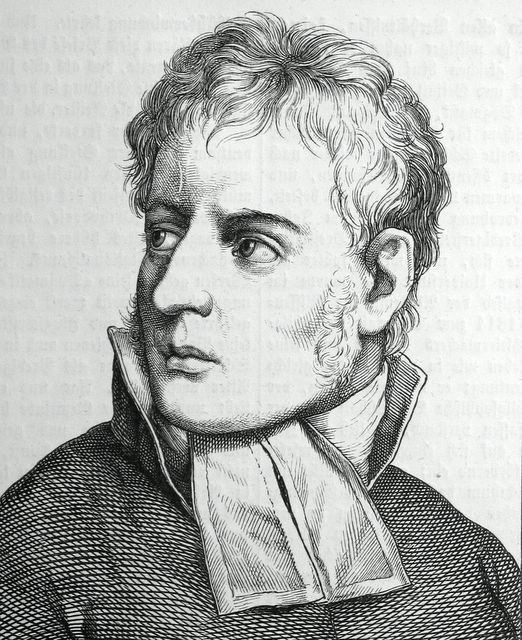 Friedrich Daniel Ernst Schleiermacher (1768-1834) is among the most significant Reformed theologians between Calvin and Barth.[1] What constitutes an area of great neglect in his thought, however, is his thinking on children, explored in a number of his writings: Soliloquies (1800), Celebration of Christmas (1806) and Sermons on the Christian Household (1820). He was concerned throughout to explore a number of questions:
- What is the child?
- What is the unique spiritual perspective of childhood?
- Must maturity alienate us from childhood?
- How might parents best nurture their children and draw out the unique individuality that expresses itself in children?
These kinds of questions were explored against the backdrop of a rise in the importance of the nuclear family as a social institution, and the sharper demarcation between the roll of mothers and fathers – the home, children and emotions were increasingly seen as the domain of mothers, the withdrawal of extended family, etc. More positively, there was greater emphasis on the value of children’s nurture and development through age-appropriate play and education. The period also saw the development of the kindergarten, children’s literature and children’s toys.
More than most theologians, it was Schleiermacher (and later people like Karl Rahner) who believed that children could teach adults, that children – as children – were full human beings and so worthy of respect and dignity. So, in Schleiermacher’s novella The Celebration of Christmas: A Conversation, one of the characters, Agnes, poses a series of important questions:
Is it then the case that the first childish objects of enjoyment must, in fact, be lost that the higher may be gained? May there not be a way of obtaining the latter without letting the former go? Does life then begin with a pure illusion in which there is no truth at all, and nothing enduring? How am I rightly to comprehend this? In the case of the man who has come to reflect upon himself and the world, and who has found God, seeing that this process is not gone through without conflict and warfare, do his joys rest upon the eradication, not merely of what is evil, but of what is blameless? For it is thus we always indicate the childlike, or even the childish, if you will rather so have it.[2]
In 1834, Schleiermacher preached a sermon on Mark 1:13-16. In exegeting v. 15 [‘anyone who will not receive the kingdom of God like a little child will never enter it’], he noted:
The peculiar essence of the child is that he is altogether in the moment … The past disappears for him, and of the future he knows nothing – each moment exists only for itself, and this accounts for the blessedness of a soul content in innocence.[3]
This, Schleiermacher believes, is a child’s gift to adults, and it is towards a recovery of precisely this perspective that Jesus has in mind for those who would enter the Kingdom of God – that those who know communion with God might live in the present with no anxiety about past or future. So DeVries on Schleiermacher:
Children remind us of the fact that God created humanity to live simply. They help adults shed their obsession with the complexities of work and public life. Indeed, children draw adults back into the most basic of human relationships.[4]
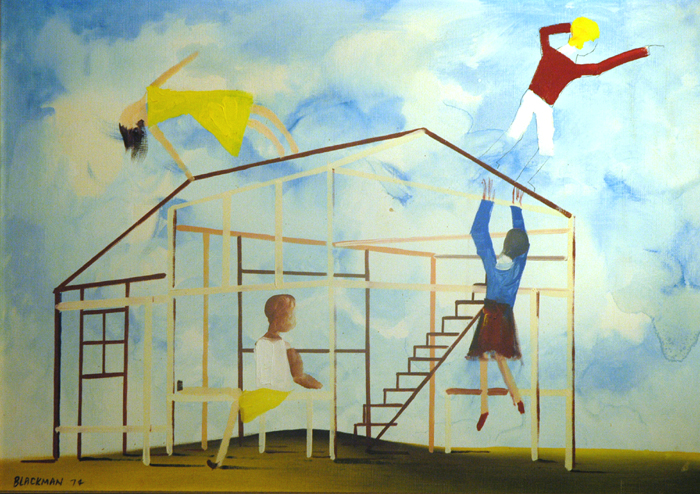
Charles Blackman, 'Children Playing' (1974)
Celebration of Christmas is a revelation into Schleiermacher’s theology (on many levels) and not least his (overly)-optimistic view of human personhood. It was this that Barth, in his 1923/24 Göttingen lectures on the Theology of Schleiermacher, rightly picked up on, criticising Schleiermacher for positing an anthropology too without regard for an adequate account of the realities of sin, conversion and the in-breaking of the Word of God.
In those lectures, Barth’s reading of Schleiermacher’s ‘Christological Festival Sermons’ (as Barth calls them) spans some 50 pages wherein Barth expresses his usual mixture of appreciation and criticism for the Silesian-born theologian. One place where Barth’s praise for Schleiermacher’s Christmas sermons is noted concerns Schleiermacher’s sermon on Acts 17:30-31 [‘In the past God overlooked such ignorance, but now he commands all people everywhere to repent. For he has set a day when he will judge the world with justice by the man he has appointed. He has given proof of this to everyone by raising him from the dead’]. On this, ‘the most powerful and impressive Christmas sermon that Schleiermacher preached’, Barth comments:
Let us look beyond the narrow sphere of individual life, Schleiermacher asks in the introduction, to the large and universal sphere. It is the Savior of the world whose coming we celebrate. A new world has dawned since the Word became flesh. His appearing was the great turning-point in the whole history of the human race. What is the change whereby the old age and the new may be distinguished? The fact that ignorance of God is no longer overlooked and tolerated by God. Christ’s life was from beginning to end an increasing revelation. The world’s childhood ended with it. Sin is now known and the image of God is evident. Hence judgement passes on all human action, and we ought to rejoice at this. We are now told that he commands everyone everywhere to repent.[5]
DeVries suggests that Barth’s reading of Schleiermacher’s (positive) child-anthropology is not nearly as nuanced as it ought to be. She notes that, for Schleiermacher, children a not perfect and sinless mediators of the higher life and are born with as much potential for sin as for salvation, and that it is the parents’ duty to nurture their children’s ‘higher self-consciousness’ which connect them to the transcendent and also opens their hearts to others.[6]
Rather than follow the formal catechesis that Calvin and Luther had stressed (and which Schleiermacher thought were too impersonal), the Moravian/Pietist-educated Schleiermacher stressed that the Christian home is the ‘first and irreplaceable school of faith’, for only here can children really experience the full range of what Christian faith is about and so come to faith in Christ. Schleiermacher believes that faith is more ‘caught’ than ‘taught’.
Still, he notes that parents can also damage a child in a number of ways:
- by failing to take their concerns/interests seriously.
- by failing to respond empathetically or appropriately to their emotions.
- parents whose own emotional lives are chaotic or unreliable will drive their children into secrecy.
- by attempting to live their own dreams/aspirations through children.
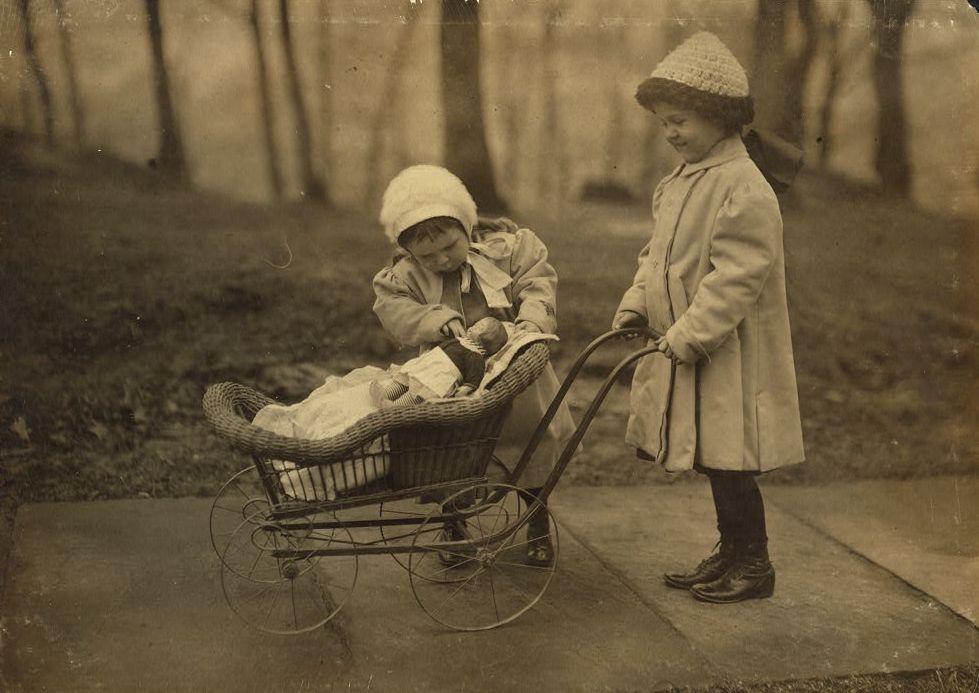
Lewis Hine, 'Children playing with Campbell Kid dolls' (1912)
Schleiermacher also stresses that pastors have a pivotal role to play in children’s faith, among the most important duty of which is informal and personalised catechises where the focus is on leading children to develop, in DeVries words, ‘sound and sophisticated abilities in reading and interpreting scripture. Such instruction might begin with memorizing Bible verses, but it should eventually lead to developing in children a way of thinking (Gedankenerzeugungsprozess) that can be applied to questions or situations that will arise when the catechizing process is over’.[7] In other words it is about helping children to think theologically about all of life. DeVries continues:
Schleiermacher holds high expectations of the catechizing pastor. He states that when children who have been raised in the church lose their faith in adulthood, it is often because they have received poor catechetical instruction. Mindless repetition of correct answers will not sustain faith through the journey to adulthood. Pastors should treat children as fellow seekers who will be no more satisfied with pat answers than adults. If there is a virtue to be developed in the teaching pastor, it is the virtue of humility, for teaching the faith is probably his [sic] most difficult task. Schleiermacher urges his ministry students always to consider their teaching a work in progress, and challenges them to be quick to admit their mistakes.
What children need more than anything else is living faith in Christ. Parents, teachers, and pastors must devote all their energy and enthusiasm to presenting Christ to their children. This is best achieved through the whole of life itself, lived with children. They should feel the love of adults as “reflecting the splendour of eternal love” in Christ. Children who have received the Spirit in baptism and who have been raised within the loving discipline of the Christian community give us reason to hope for the future.[8]
[1] Here I draw heavily upon an essay by Dawn DeVries, ‘”Be Converted and Become as Little Children”: Friedrich Schleiermacher on the Religious Significance of Childhood’ in The Child in Christian Thought (ed. Marcia JoAnn Bunge; Grand Rapids/Cambridge: Wm. B. Eerdmans, 2001), 329-49.
[2] Friedrich Schleiermacher, Christmas Eve: A Dialogue on the Celebration of Christmas (trans. W. Hastie; Edinburgh: T&T Clark, 1890), 33.
[3] Friedrich Schleiermacher, Friedrich Schleiermachers sämmtliche Werke (vol. II/6; Berlin: Georg Reimer, 1834-1864), 71-2.
[4] DeVries, ‘Schleiermacher on the Religious Significance of Childhood’, 341.
[5] Karl Barth, The Theology of Schleiermacher: Lectures at Göttingen, Winter Semester of 1923/24 (ed. Dietrich Ritschl; trans. Geoffrey W. Bromiley; Grand Rapids: Wm. B. Eerdmans, 1982), 72.
[6] See DeVries, ‘Schleiermacher on the Religious Significance of Childhood’, 341-2.
[7] Ibid., 345.
[8] Ibid., 346-7.
Lent Reflection 1
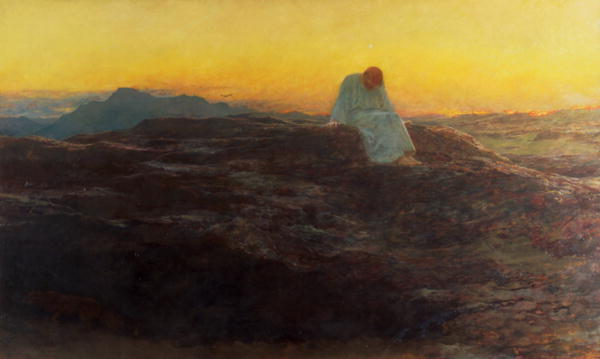
Briton Riviere, 'Christ in the Wilderness' (1898)
That obedient life which resisted temptation in both desert and garden culminated in an obedient death, a death concerned with holiness’ gracious victory. In Christ, God put himself onto the gallows of public shame – he descended into hell – from where he not only exposed himself to the actual onslaught and grasp of evil until it had done its worst, but confessed the holiness that undergirds not only his own Triune life, but all life.
So Forsyth:
Purity is shamed by human sin. Holiness carries it as a load, and carries it to its destruction. In the great desertion Christ could not feel Himself a sinner whom God rejects. For the sinner cannot carry sin; he collapses under it. Christ felt Himself treated as the sin which God recognises and repels by His very holiness. It covered and hid Him from God. He was made sin (not sinful, as I say). The holiness of God becomes our salvation not by slackness of demand but by completeness of judgment; not because He relaxes His demand, not because He spends less condemnation on sin, lets us off or lets sin off, or lets Christ off (“spared not”); but because in Christ judgment becomes finished and final … [The Work of Christ, 160]
Thus what is at stake in the two great temptations is far more than the destiny of this one man; it is the entire telos of creation itself, and God’s existence with it. In his humanity God declares the moral order of creation sanctified along with himself – Creator and creation are now one. Christ ‘sanctifies the whole lump of humanity by sanctifying Himself as the firstfruits’ [A.B. Bruce, The Humiliation of Christ In its Physical, Ethical and Official Aspects (Edinburgh: T&T Clark, 1895), 350].
No Line on the Horizon
 ‘… No Line on the Horizon is mostly restless, tentative and confused. It’s not terrible, but it feels like the work of musicians torn between the comfort of the present and the lure of one last run into the adventurous past … Not surprisingly, the album lacks a unified feel. On a few tracks, the Edge, drummer Larry Mullen Jr. and bassist Adam Clayton sound at home rumbling through the verses and blowing out the choruses in the old familiar way. But as No Line trudges on, it slumps under the weight of its own need to surprise … U2 has clearly found itself stuck in a very strange moment of self-reckoning’. – Josh Tyrangiel, ‘U2’s Unsatisfied — and Unsatisfying — New Album’. Time Magazine, 26 February, 2009.
‘Adam, where are you?’
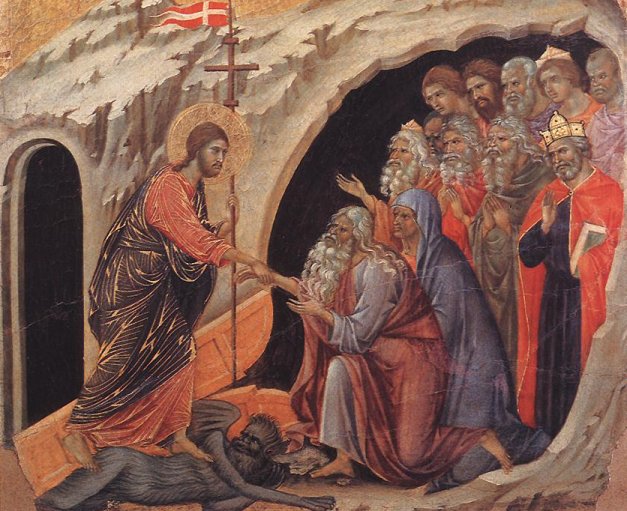 ‘God … has gone to search for Adam, our first father, as for a lost sheep. Greatly desiring to visit those who live in darkness and in the shadow of death, He has gone to free from sorrow Adam in his bonds and Eve, captive with him … “I did not create you to be a prisoner in hell. Rise from the dead, for I am the life of the dead”‘. – ‘Ancient Homily for Holy Saturday’, ascribed to Epiphanius of Constantia, cited in Catechism of the Catholic Church (Homebush: Society of St Pauls, 1994), 165:
Malcolm Gordon – ‘One Voice’ – A Review
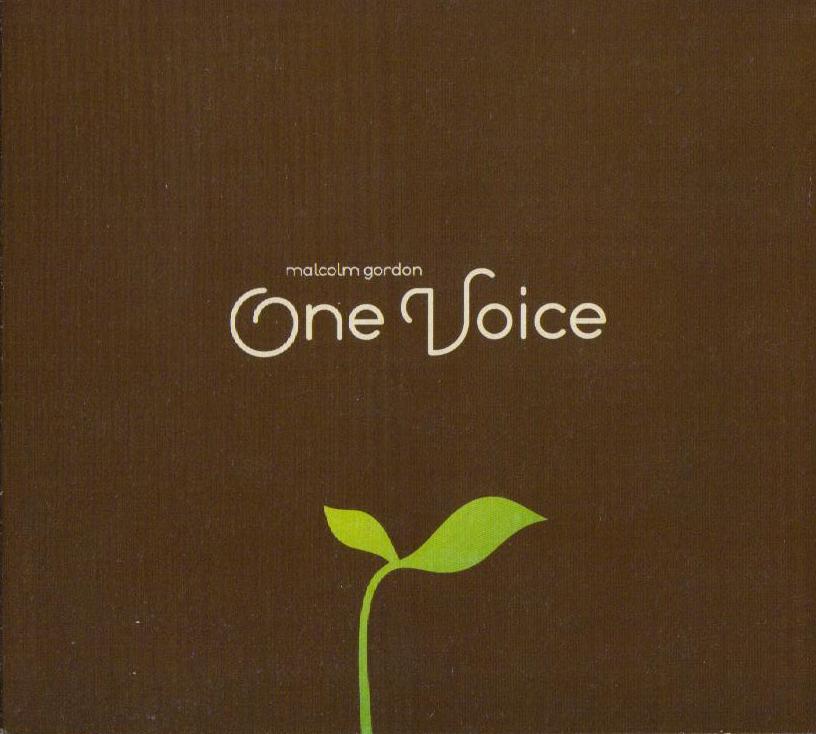 ‘People remember what they sing. Ultimately, they believe what they sing’. So believes Malcolm Gordon – a Presbyterian minister who writes songs, good songs, even songs ‘decently and in order’. In 2001, he toured with Y-One, and between 2002-2006 with the band Somebody’s Cousin, with whom he recorded two albums – ‘Brighter Day’ (2004) and ‘Here We Are (2006). Since then, this Kiwi has written and directed his first musical, and released his debut solo album, As I Am.
2008 witnessed the release of his latest album – One Voice – and the One Voice Project dedicated to ‘exploring contemporary expressions of Christian worship’ and to ‘rally song writers and lyricists to produce a resource of contextual and contemporary worship music every couple of years’. He writes that ‘the guiding principal throughout this has been to create music that is “Theologically authentic and culturally credible”. Too often music that is sung in churches tends to excel in one of those areas at the expense of the other’.
One Voice betrays the witness of a gifted artist with a theologically-astute nose, of one who believes that what we sing matters and whose heart joins those for whom ‘aching for the dawn’ defines the way of true being. The prayerful songs on this beautifully-produced album take up themes of hope, justice-making, and of identity – that ‘our stories might find their meaning’, rhyme and reason in God. Gordon recognises that however one chooses to express eschatological hope, the ultimate theological foundation remains a basic conviction concerning the faithfulness of the God whose relationship with this world is secured in one who – though one with God – did not consider equality with God something to be exploited, but who made himself nothing. Believers bear witness to this ground of hope every time we break bread and drink wine together – an act, of prolepsis as well as of obedience, undertaken by the Church in hope for a time when every tongue might taste the goodness of the Lord, when friends and enemies, victim and perpetrators, sit at the same table and find their healing in its host who has borne the pain, shame, isolation and fear of all. It is to this that the Church’s songs, including Gordon’s, bear witness. I recall words from one of Halden Doerge‘s sermons on ‘Holy Saturday‘:
In the face of hopelessness and death we [the church] are called to be conduits of hope that dare to speak and listen on the day of silence. We are to dare to continue to give of ourselves, even to the point of death even when all hope seems to have vanished. When foundations dissolve, when brothers betray and God seems silent, we are called to buy fields of hope, to stand between our betrayer and his noose and to break bread together in senseless hope that we serve a God who abounds in surprises that follow the day of silence. We are bound to remember Holy Saturday and to live in it in senseless, glorious hope. Let us be a church that lives in Holy Saturday, longing to see the surprises of the self-giving God who transforms fields of blood into fields of hope. We are called this day to continue in the form of the self-giving that is the very life of God. On this day, this cold and silent yet gloriously beautiful day, let us remember the brokenness and the senselessness that we face as followers of Christ. And then let us gather up our courage in the Spirit and continue to give ourselves away without ceasing. In the deathly quiet of Holy Saturday, let us interrupt it with songs of hope, bread broken and lives poured out.
 The invitation to such interruption is taken up by Gordon in his powerful song ‘Break the Bread’ (sample):
Let’s break the bread,
with the broken hearted.
Break the bread,
in broken homes and in broken lives.
Spill the wine, for all the tears they’ll cry
Spill the wine, wherever innocents die.
Let’s break the bread,
with the ragged stranger.
Break the bread,
with the friendless child.
Spill the wine, with those who spill our blood
Spill the wine, Lord, as we remember you.
I’m praying I’ll live to see the day
When the Table is open
I’m praying a time will come around
When Your hope isn’t wasted.
Let’s break the bread,
with the unclean before the Unseen.
Break the bread,
inside these cold prison walls.
Spill the wine; let it run rich and red across this land
Spill the wine, Lord, as we remember you.
I’m praying I’ll live to see the day
When peace is more than a ceasefire.
Let’s break the bread …
‘People remember what they sing. Ultimately, they believe what they sing’.
News from Burma
Al-Jazeera television recently aired the following Burma Campaign UK report on the plight of Karen refugees on the Burma-Thai border:
 On a related matter, Glasgow City Council recently awarded Aung San Suu Kyi with a Freedom Of The City in absentia. Their media release reads:
‘Burmese pro-democracy campaigner Dr Aung San Suu Kyi will be given the Freedom of the City of Glasgow in absentia, at the City Chambers at noon on Wednesday, March 4.
A representative of the iconic politician, Dr Thuang Htun, will accept the award on her behalf. Dr Suu Kyi remains under house arrest imposed by Burma’s military regime.
Dr Htun is a representative for United Nations Affairs for the National Coalition Government of the Union of Burma. He also represents the democracy movement at the United Nations Commission on Human Rights.
In advance of accepting the award on Dr Suu Kyi’s behalf, Dr Htun commented on the irony of the situation. He said: “The fact that Dr Aung San Suu Kyi should be given the freedom of a city far from her home, at a time that she is denied even basic freedoms in her own country is a sharp reminder of the reality of today’s Burma.”
Lord Provost Bob Winter will present the honour to Dr Htun who will also be presented with a silver plate and a crested scroll. He will then be guest of honour at a special lunch.
The Lord Provost said: “It is with profound respect and admiration for Dr Aung San Suu Kyi’s unflinching bravery that the Council has conferred upon her the Freedom of the City of Glasgow. This is tempered with frustration that she cannot be here today, in person.
“However, I am delighted that her loyal representative Dr Htun has been able to visit our city to accept the award in her absence. He goes with our very best wishes for Dr Suu Kyi, a shining beacon of hope in her country.”
The Freedom of the City Award was originally proposed by Amnesty International and Glasgow Women’s Library.
John Watson, Amnesty’s International’s Scottish Programme Director, said:
“Aung San Suu Kyi is an inspiration to the people of Burma and to those around the world who applaud bravery and dignity in the face of oppression. Amnesty International congratulates Glasgow City Council on its decision to present her with its highest award”
Dr Adele Patrick of Glasgow Women’s Library said: “As part of Glasgow Women’s Library’s ongoing efforts to celebrate, uncover, and promote women’s cultural and political achievements locally and globally we warmly congratulate Glasgow City Council’s decision to offer Dr Aung San Suu Kyi the Freedom of the City.
“We acknowledge how this award raises the profile of the life and work of this remarkable woman and, by extension the people of Burma. We look forward to more pioneering women being added to this roll of honour.”
Dr Suu Kyi is the daughter of Aung San, wartime leader of Anti-Fascist People’s Freedom League (AFPFL, assassinated 1947). She has endured prolonged periods of detention and imprisonment over the past 20 years by Burma’s oppressive regime.
She founded the National League for Democracy (NLD) in 1988 and was swiftly put under house arrest with the offer of freedom if she left Burma.
In 1990 the NLD won the general election decisively and once again Dr Suu Kyi was placed under house arrest. The election result was nullified by a military junta. This was also the year she was awarded the Sakharov Prize for Freedom of Thought.
Accepting the prize Dr Suu Kyi said: “It is not power that corrupts but fear. Fear of losing power corrupts those who wield it and fear of the scourge of power corrupts those who are subject to it. “
The following year she was awarded the Nobel Peace Prize and donated the $1.3 million prize money to establish a health and education trust for the people of Burma’.
I recall the closing words from an album that is very fastly growing on me: ‘Choose your enemies carefully ‘cos they will define you/Make them interesting ‘cos in some ways they will mind you/They’re not there in the beginning but when the story ends/Gonna last with you longer than your friends’.
‘Evolution and God’: a report
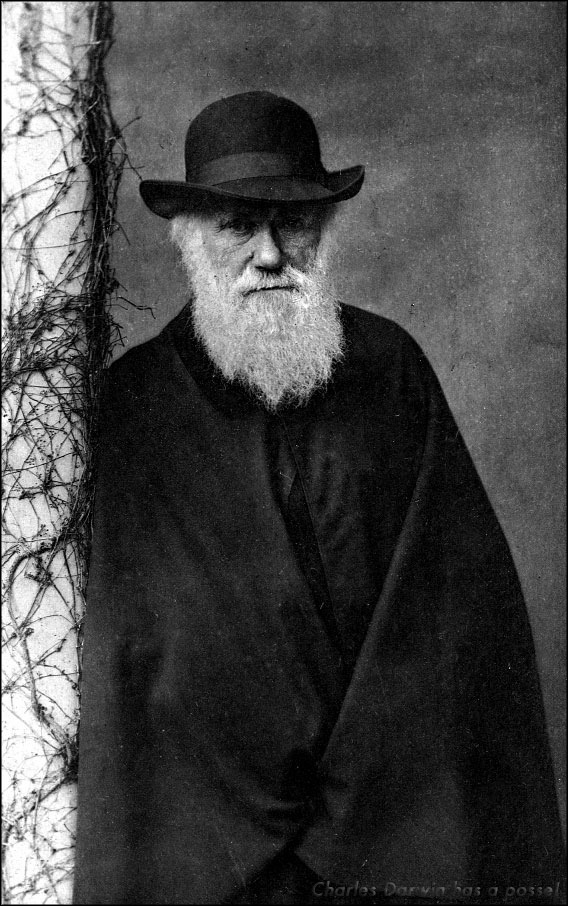 This report just in from Theos:
‘The findings of the biggest research project ever carried out into UK public opinion on evolution and human origins were published by Theos on Monday, ahead of a major conference in Rome on religion and science.
The independent research for Theos, undertaken by ComRes, was released in a new Theos report, Faith and Darwin. The publication is the second of four reports being launched as part of the Rescuing Darwinproject.
The report reveals that 54% of people know that Charles Darwin wrote The Origin of Species (3% believe he wrote The God Delusion by Richard Dawkins and 1% think he wrote The Naked Chef by Jamie Oliver). Only 15% of people know that Darwin was a self-described agnostic towards the end of his life (20% think he was an atheist). 42% of people believe that evolution presents some challenges to Christianity but that it is possible to believe in both.
ComRes also interviewed people across the UK about the origins of human life and found that the East of England has the largest proportion of people in the UK who believe that the theory of evolution removes any need for God (44%). Wales has the largest proportion of theistic evolutionists (the belief that evolution is part of God’s plan – 38%). Northern Ireland has the highest proportion of people who believe in Intelligent Design (16%) and Creationism (25%).
To read the report in full, click here.’
And while we’re on the topic, be sure to check out Kim Fabricius’ Ten propositions on Darwin and the deity. I hope that this latest ’10’ will contribute to the birth of Volume Two of what is a brilliant book.
Around the traps …
- Church and Postmodern Culture has been hosting a great 6-part conversation (1, 2, 3, 4, 5 & 6) on Nathan Kerr’s Christ, History and Apocalyptic: The Politics of Christian Mission. Be sure to also check out Halden’s posts on Kerr’s book too: Mission and Apocalyptic Ecclesiology and The Church as Polis? Some Biblical Reflections
- The latest edition of Journal of Reformed Theology (3/1, 2009) is out and includes articles by Veli-Matti Kärkkäinen, Christoph Schwöbel , Robert Letham, Dirkie Smit, Steve Holmes and Seung Goo Lee on the Trinity
- “Where are the Protestants?”
- Registration is now open for the 2009 Karl Barth Conference at Princeton Seminary
- Lots of Barth-related book reviews:
- Christophe Chalamet reviews Stefan Holtmann’s “Karl Barth als Theologe der Neuzeit”
- William Barnett reviews Eberhard Busch’s “Barth”
- David W. Congdon reviews P.H. Brazier’s “Barth and Dostoevsky”
- David W. Congdon also reviews R. Dale Dawson’s “The Resurrection in Karl Barth”
- John L. Drury reviews Stephen Wigley’s “Karl Barth and Hans Urs von Balthasar: A Critical Engagement”
- Shannon Nicole Smythe reviews “A Shorter Commentary on Romans by Karl Barth
- Shannon Nicole Smythe also reviews Donald Wood’s “Barth’s Theology of Interpretation”
- Jason T. Ingalls reviews Matt Jenson’s “The Gravity of Sin: Augustine, Luther, and Barth on Homo Incurvatus in Se”
- Jason T. Ingalls and W. Travis McMaken review Willimon’s “Conversations with Barth on Preaching” and Yocum’s “Ecclesial Mediation in Karl Barth”
- Alexander Massmann reviews Matthias D. Wüthrich’s “Gott und das Nichtige: Zur Rede vom Nichtigen ausgehend von Karl Barths KD § 50”
- W. Travis McMaken reviews Paul T. Nommo’s “Being in Action: The Theological Shape of Barth’s Ethical Vision”
- Shane Wilkins reviews Neil MacDonald’s “Karl Barth and the Strange New World within the Bible: Barth, Wittgenstein and the Metadilemmas of the Enlightenment”
- Byron Smith posts on Dying for the half-hearted and the corrupt
- Peter Liethart asks if there’s not even something right about the vision of Christendom
- Ben Myers posts a great quote from William Cavanaugh on Church and eucharist
- Steve Holmes asks What is evangelism?
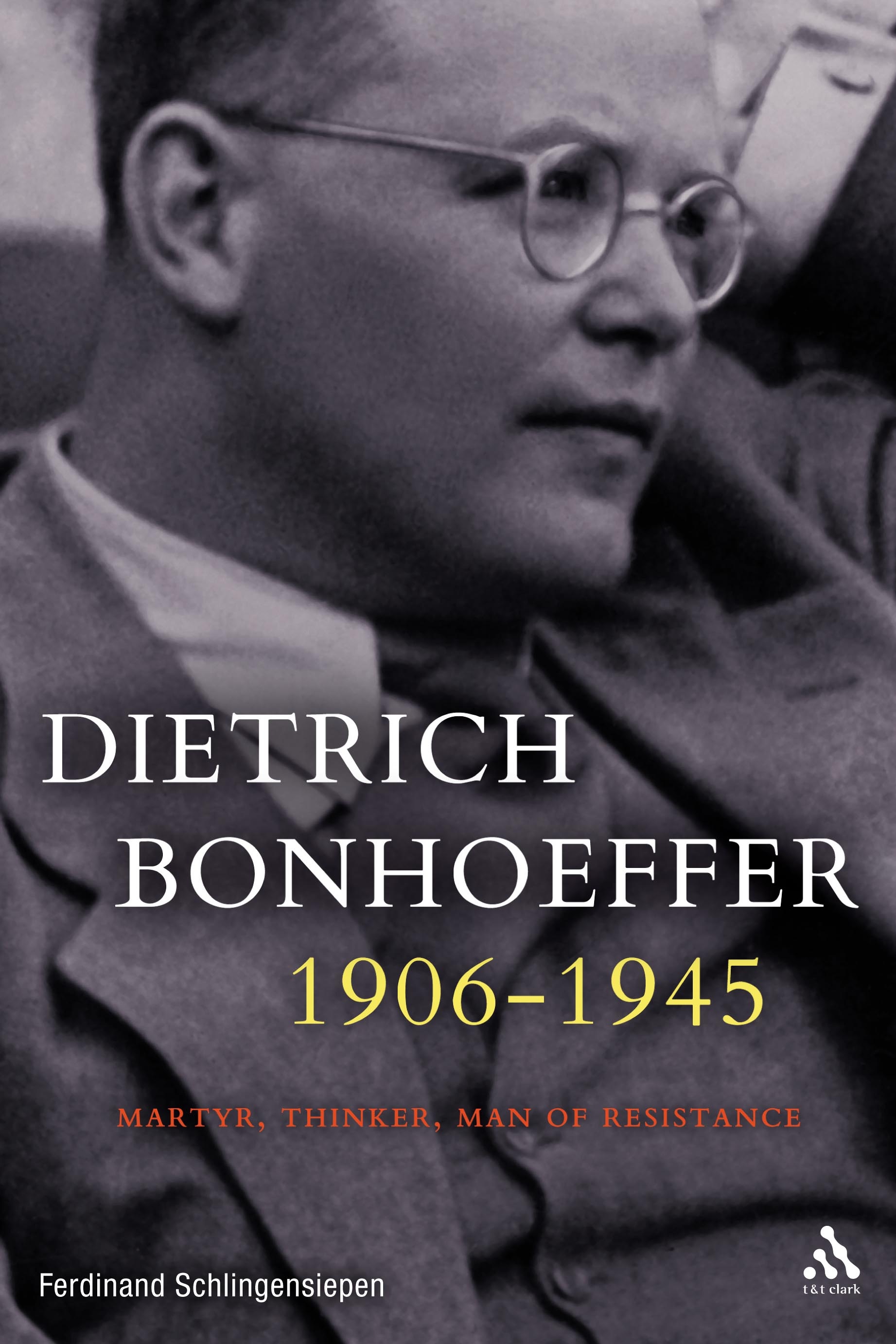
- A wonderful excerpt from a new biography on Dietrich Bonhoeffer. Dietrich Bonhoeffer 1906-1945. Martyr, Thinker, Man of Resistance is on its way in October. How awesome is that!
- Unmasking lies about Picasso
- John Pilger on the loss of freedom in totalitarian Britain
- Lawmakers Debate Establishing “Truth Commission” on Bush Admin Torture, Rendition and Domestic Spying: ‘… How did we get to a point where we were holding a legal US resident for more than five years in a military brig without ever bringing charges against him? How did we get to a point where Abu Ghraib happened? How did we get to a point where the United States government tried to make Guantanamo Bay a law-free zone, in order to deny accountability for our actions? How did we get to a point where our premier intelligence agency, the CIA, destroyed nearly a hundred videotapes with evidence of how detainees were being interrogated? How did we get to a point where the White House could say, “If we tell you to do it, even if it breaks the law, it’s alright, because we’re above the law”?’
- Italians get together to remember Calvin
John Calvin on Children

'The Young Calvin', by Oliver Crisp
Children take on a ‘largely symbolic character’ in most of Calvin’s writings wherein children are viewed as ‘metaphor for the religious life of adult Christians’.[1] Unlike Luther, Calvin tells us very little about his encounters with children. He does, however, tell us that he and his wife lost their only biological child: ‘God had given me a little boy. God took [him] away’.[2] We know little about his relationship with the two children from his wife’s first marriage aside from his pledge (on her deathbed) to care for them; or about the children of his brother Antoine, who lived in his household.
Calvin was not, however, indifferent to children. So Pitkin:
[Calvin’s] writings, along with the social and ecclesial changes he participated in and sought to effect, bear witness to the importance of children in church and society. Serious implications for children’s lives and important assumptions about their nature emerge in his radically theocentric theology of grace, especially in his understandings of providence, covenant, baptism, and human nature as created and fallen. Moreover, when one takes into account the full range of his reforming activity, especially his preparation of ordinances for regulation of the Genevan church (1541), his two catechisms (1537 and 1541-2), and his promotion of school reforms in Geneva, it becomes clear that Calvin, like many intellectuals and reformers of his day, was intensely interested in children and child rearing.[3]
There are multiple ways to approach Calvin’s thought on children, one of which is via his thinking on election: ‘the elect are from birth full inheritors of God’s covenant and members in the church’.[4] Another profitable avenue is via Calvin’s thinking on God’s providence. For Calvin, all human life exists under divine providence; children, therefore, are not ‘begotten … by a secret instinct of nature’ or the ‘fruit of chance’ but are gifts of God.[5] So even when he lost his only son (child mortality at the time ranged between 30 and 50 percent), he would write (to Pierre Viret):
The Lord has certainly inflicted a severe and bitter wound in the death of our infant son. But he is himself a Father, and knows best what is good for his children.[6]
Providence does not equate to laxness, however, and Calvin took seriously the responsibility of parents (indeed, it was a coordinated effort of family, state and church)[7] in rearing children:
… unless men regard their children as the gift of God, they are careless and reluctant in providing for their support, just as on the other hand this knowledge contributes in a very eminent degree to encourage them in bringing up their offspring. Farther, he who thus reflects upon the goodness of God in giving him children, will readily and with a settled mind look for the continuance of God’s grace; and although he may have but a small inheritance to leave them, he will not be unduly careful on that account.[8]
And what sort of children ought parents wish for?
… the children which we ought to wish for, are not such as may violently oppress the wretched and suffering, or overreach others by craft and deceit, or accumulate great riches by unlawful means, or acquire for themselves tyrannical authority, but such as will practice uprightness, and be willing to live in obedience to the laws, and prepared to render an account of their life. Farther, although fathers ought diligently to form their children under a system of holy discipline, yet let them remember that they will never succeed in attaining the object aimed at, save by the pure and special grace of God.[9]
Calvin consistently stressed the parental obligation to fulfil God’s commands and diligently instruct children in the family.
Associated with this is the duty of Christian parents to baptise their children. ‘Parents ought to consider that children in the home constitute a “mirror of God’s grace,” a sign that God cares for the family, and from this consideration be moved to fulfil their parental obligations’.[10] Unlike some, Calvin did not believe that baptism was strictly necessary for salvation. Salvation depends entirely on the promise of God in God’s word, and not on the sign of that promise. Christian parents, therefore, have a duty to baptise their children, but should not worry about the fate of children who die unbaptised.
Calvin takes all authority – parental and otherwise – with the utmost seriousness. But where parents lead their children to violate God’s law, ‘children should regard them not as parents but as strangers’.[11]
Stages of childhood
Like many of his contemporaries and predecessors, Calvin divides childhood up into three stages, each lasting about 7 years.
1-7 On Matthew 18:1-5:
[Jesus] holds up to them a little child as an emblem of humility. When he enjoins his followers to become like a child, this does not extend indiscriminately to all points. We know that in children there are many things faulty; and accordingly Paul bids us be children, not in understanding, but in malice, (1 Cor. xiv. 20;) and in another passage he exhorts us to strive to reach the state of a perfect man, (Eph. iv. 13). But as children know nothing about being preferred to each other, or about contending for the highest rank, Christ desires that their example should banish from the minds of his followers those eager longings after distinction … It will perhaps be objected, that children, even from the womb, have a native pride, which leads them to desire the highest honor and distinction; but the reply is obvious, that comparisons must not be too closely or too exactly carried out, so as to apply at all points. The tender age of little children is distinguished by simplicity to such an extent, that they are unacquainted with the degrees of honor, and with all the incentives to pride; so that they are properly and justly held out by Christ as an example’.[12]
Based on Psalm 8:2, Calvin considers young infants [those still nursing] as mature proclaimers of God’s goodness: ‘[David] says that babes and sucklings are advocates sufficiently powerful to vindicate the providence of God. Why does he not entrust this business to men, but to show that the tongues of infants, even before they are able to pronounce a single word, speak loudly and distinctly in commendation of God’s liberality towards the human race?’.[13]
These comments are remarkable given that Calvin’s stress on sin’s noetic effects. This statement remained unchanged from the 1536 Edition of the Institutes:
Even infants bear their condemnation with them from their mother’s womb; for, though they have not yet brought forth the fruits of their own iniquity, they have the seed enclosed within themselves. Indeed, their whole nature is a seed of sin; thus it cannot but be hateful and abominable to God. Through baptism, believers are assured that this condemnation has been removed and withdrawn from them, since (as was said) the Lord promises us by this sign that full and complete remission has been made, both of the guilt that should have been imputed to us, and of the punishment that we ought to have undergone because of the guilt.[14]
Infancy ends with the onset of reason, at about age six.
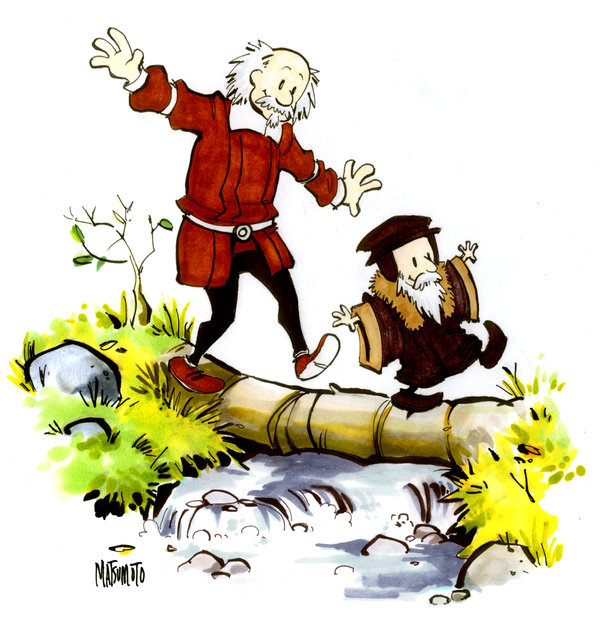 7-14 A period of intellectual, spiritual and moral maturation.
So Calvin, on 1 Corinthians 13:11 [‘When I was a child, I talked like a child, I thought like a child, I reasoned like a child. When I became a man, I put childish ways behind me’], insists on the necessity of education for childhood, but which does not suit those who have already reached ‘maturity’ (Latin commentary) or the ‘age of discretion’ (French commentary). The awakening of reason involves a lapse from the earlier simplicity. Consider Calvin’s comments on Genesis 8:21 [‘The LORD smelled the pleasing aroma and said in his heart: “Never again will I curse the ground because of human beings, even though every inclination of the human heart is evil from childhood [from youth]. And never again will I destroy all living creatures, as I have done’]:
… the clause which is added, “from youth”, more fully declares that men are born evil; in order to show that, as soon as they are of an age to begin to form thoughts, they have radical corruption of mind.[15]
Again from his comments on Psalm 8:2,
If God has appointed children even in infancy the vindicators of his glory, there is no absurdity in his making them the instruments of showing forth his praise by their tongues after they have arrived at the age of seven years and upwards.[16]
Education/instruction was at the forefront of the Church’s/parents’ responsibility towards children. Calvin taught (and practised) and that before a child was admitted to the Lord’s Supper at about age 11 or 12, they underwent weekly catechism classes (based on 52 question-and-answer format questions on nature of faith, the Creed, the Law, prayer, worship, Word and Sacraments) and learnt to sing the psalms. The assumption throughout, however, was that the child (indeed all children and not only those of Christian parents, because one could not know who the elect were) was to be treated as fully Christian (by virtue of the one covenant) and not as an object for conversion. 7-14-year-olds also had to give a public confession of their faith before the congregation. The confession proceeded an oral interview with a pastor and involved a brief verbal testimony. The catechism classes were not with a view to rote learning of answers but with a view to providing young catechumens with a vocabulary for articulating their growing faith.
14-21 [maybe slightly earlier for girls].
Calvin describes this as ‘an age of pride and rebelliousness fired by the awakening sex drive’.[17] Note Calvin on Genesis 34:4:
young men [ought] to take heed to themselves, lest in the slippery period of their age, the lusts of the flesh should impel them to many crimes. For, at this day, greater license everywhere prevails, so that no moderation restrains youths from shameful conduct.[18]
In sum:
Like Augustine, Calvin assumes a graduated guilt as one moves with age to greater accountability for acts of wrongdoing. However, he does not dwell on evidences of corruption in small children, as Augustine does … Although young children are corrupted by original sin, when compares to older children and adults, they demonstrate a lack of malice that their elders ought to emulate. The biblical basis for this view ins 1 Corinthians 14:20, where Paul urges believers to be children not in understanding but in malice … Adult believers ought to imitate children’s natural simplicity but not their lack of understanding … Calvin, the theologian of “total depravity,” is more appreciative of the positive character of children, dwelling less on their sinfulness that some of his forebears (such as Augustine) or successors (such as Jonathan Edwards).[19]
[1] Barbara Pitkin, ‘”The Heritage of the Lord”: Children in the Theology of John Calvin’ in The Child in Christian Thought (ed. Marcia JoAnn Bunge; Grand Rapids/Cambridge: Wm. B. Eerdmans, 2001), 161.
[2] John Calvin, ‘Responsio ad Balduini convicia’ in Ioannis Calvini Opera Quae Supersunt Omnia (ed. G. Baum, et al.; vol. 9 of Corpus Reformatorum; Brunswick/Berlin: C.A. Schwetschke and Son [M. Bruhn], 1863-1900), 576.
[3] Pitkin, ‘Children in the Theology of John Calvin’, 161-2.
[4] Ibid., 164.
[5] John Calvin, Commentary on the Book of Psalms, Vol. V (trans. James Anderson; Grand Rapids: Baker, 2003), 110.
[6] John Calvin, ‘To Viret. Geneva, 19th August 1542’ in Letters, Part I: 1528-1545 (ed. Jules Bonnet; vol. 4 of Selected Works of John Calvin: Tracts and Letters; Grand Rapids: Baker, 1983), 344.
[7] See Pitkin, ‘Children in the Theology of John Calvin’, 174-89.
[8] Calvin, Comm. Psalms V, 111.
[9] Ibid., 112.
[10] Pitkin, ‘Children in the Theology of John Calvin’, 173.
[11] Ibid., 172.
[12] John Calvin, Commentary on a Harmony of the Evangelists, Matthew, Mark, and Luke, Vol. 1 (trans. W. Pringle; vol. 16; Grand Rapids: Baker, 2003), 332-3.
[13] John Calvin, Commentary on the Book of Psalms, Vol. I (trans. James Anderson; vol. 4; Grand Rapids: Baker, 2003), 96.
[14] John Calvin, Institutes of the Christian Religion, 1536 Edition (trans. Ford Lewis Battles; Grand Rapids: The H.H. Meeter Centre for Calvin Studies/Wm. B. Eerdmans, 1975), 97; John Calvin, Institutes of the Christian Religion (ed. John T. McNeill; trans. Ford Lewis Battles; Philadelphia: The Westminster Press, 1977), 4.15.10.
[15] John Calvin, Commentaries on the First Book of Moses called Genesis, Vol. I (trans. J. King; vol. 1; Grand Rapids: Baker, 2003), 285.
[16] Calvin, Comm. Psalms I, 99.
[17] Pitkin, ‘Children in the Theology of John Calvin’, 165.
[18] John Calvin, Commentaries on the First Book of Moses called Genesis, Vol. II (trans. J. King; vol. 1; Grand Rapids: Baker, 2003), 219.
[19] Pitkin, ‘Children in the Theology of John Calvin’, 165, 169.
Alfonse Borysewicz: The Art of Lent
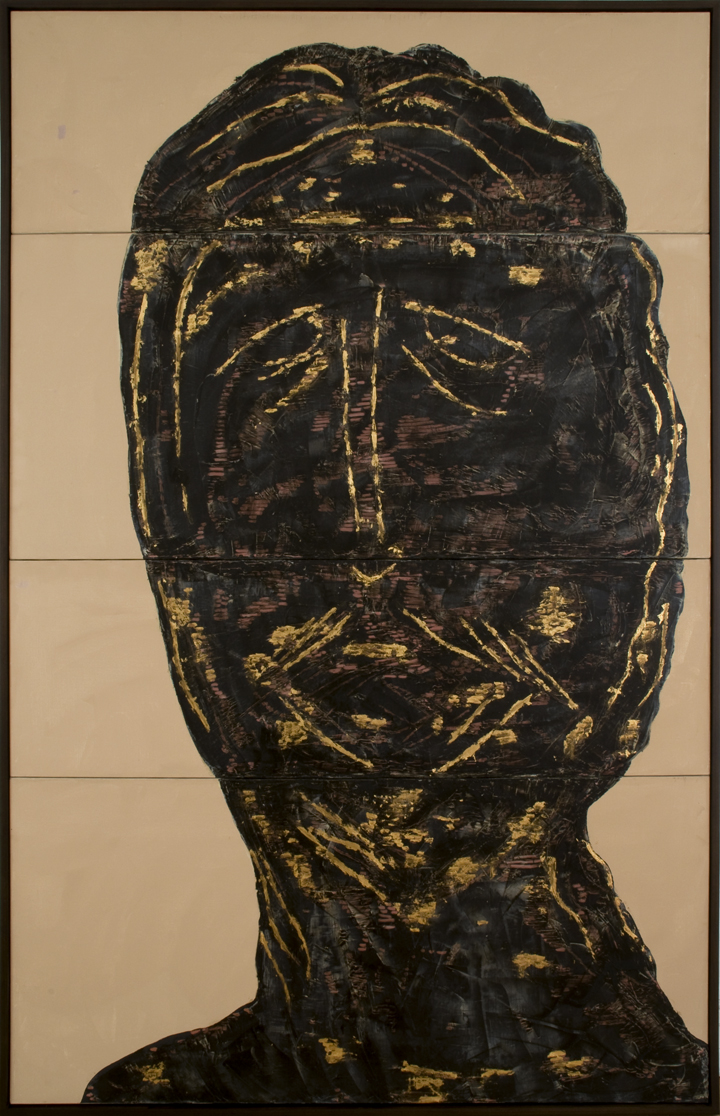 During Lent, the Oratory Church of St Boniface will exhibit the works of the distinguished Catholic artist and Oratory parishioner, Alfonse Borysewicz. I have posted previously on Alfonse here.
Alfonse was born in Detroit in 1957 and has been residing in Brooklyn since 1988 where he and his family have been members of the Oratory Church of St. Boniface. He received a master’s degree in theology before studying painting at the Museum School of Fine Arts in Boston. Borysewicz has received two Pollack-Krasner Foundation Grants (1987, 1992) and a Guggenheim Painting Fellowship (1995). He has exhibited widely in the United States, Europe and Japan. His writings can also be found in Image. Jonathon Goodman wrote in Art in America, ‘Borysewicz’s ability to invent a language of transcendence which is both traditional and of the moment makes him a compelling artist’.
The paintings on exhibit for Lent are a continuance of Borysewicz’s work for the Oratory since the early 1990s (he has completed two side chapels, a processional cross as well as paintings for the residence chapel).
 The Lenten paintings will cover the stained-glass windows for the 40 day period of Lent. These paintings with their austerity of near abstraction reverence the Icons of Christian antiquity. With a modern hand Borysewicz gives pictorial voice to the Catholic heritage. As Pope Benedict once observed, ‘next to the saints the art which the church has produced is the only real apologia for her history’.
Alfonse Borysewicz will also deliver the Brooklyn Oratory ‘2009 Baronius Lecture’ on 22 March at 4 pm. His lecture will be entitled ‘Art and Faith: Can You Be a Contemporary Artist and a Practicing Catholic?’. The lecture will be followed by a reception and tour of Alfonse’s paintings. See here for more details.
Left image: ‘Emmaus’, 2007; Right image: ‘Mary Magdalene’, 2007.
Towards a Theology of the Child
 Recently, I posted on Karl Rahner’s theology of childhood. Over the coming weeks, I plan to post similar reflections that contribute towards developing a theology of childhood. Initially, I propose to post mainly from those of the Reformed camp: John Calvin, Friedrich Daniel Ernst Schleiermacher, Karl Barth, David Jensen, Jürgen Moltmann, and from Australian Roman Catholic theologian Anthony Kelly. At some future stage, I’d also like to work on similar contributions from the Celtic and Anabaptist traditions (I’d welcome any relevant resources regarding these two areas).
February bests …
 Best book: Kim Fabricius, Propositions on Christian Theology: A Pilgrim Walks the Plank (Durham: Carolina Academic Press, 2008).
Best music: Archie Roach, Charcoal Lane; Morrissey, Years of Refusal [2009].
Best films: Seven Pounds [2008] ♦♦♦; The Wrestler ♦♦♦♦; Frozen River ♦♦♦½.
Best drink: Two Paddocks Pinot Noir (2007).
 jasongoroncy.com