Month: December 2008

December bests …

Best books: Giorgio Locatelli, Made in Italy: Food and Stories. New York: Ecco, 2007 (this one is easily among my favourite books of the year); Marcia JoAnn Bunge, ed. The Child in Christian Thought. Grand Rapids: Wm. B. Eerdmans, 2001; David H. Jensen, Graced Vulnerability: A Theology of Childhood. Cleveland: Pilgrim Press, 2005; and Ernest Hemingway, The Old Man and the Sea.

Best music: Malcolm Gordon, One Voice; and U2, The Golden Unplugged Album

Best films: Death Sentence (2007)

Best drink: Villa Maria Private Bin Merlot/Cabernet Sauvignon (2006)

A Year with Calvin’s Institutes

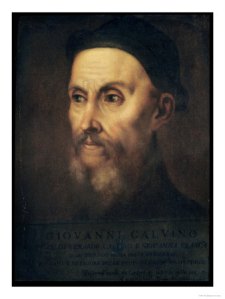
john-calvin-portrait-by-titian1During 2009, Princeton Theological Seminary is inviting the church, the academy, and individual Christians around the world to celebrate the 500th anniversary of John Calvin’s birth by participating in “A Year with the Institutes,” a daily reading of Calvin’s magnum opus, The Institutes of the Christian Religion.

There is never a bad time to start reading – or re-reading – the Institutes. Imagine that, Calvin’s Institutes every day for a year – even via iTunes or a RSS Feed.

More information here.

I will also add the feed to my sidebar.

Christians on their best side

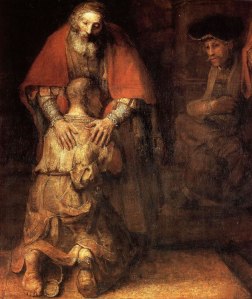
rembrant-prodigal-son-detail‘In invocation of God the Father everything depends on whether or not it is done in sheer need (not self-won competence), in sheer readiness to learn (not schooled erudition), and in sheer helplessness (not the application of a technique of self-help). This can be the work only of very weak and very little and very poor children, of those who in their littleness, weakness, and poverty can only get up and run with empty hands to their Father, appealing to him. Nor should we forget to add that it can only be the work only of naughty children of God who have wilfully run away again from their Father’s house, fond themselves among swine in the far country, turned their thoughts back home, and then – if they could – returned to their Father … Christians who regard themselves as big and strong and rich and even dear and good children of God, Christian who refuse to sit with their Master at the table of publicans and sinners, are not Christians at all, have still to become so, and need not be surprised if heaven is gray above them and their calling upon God sounds hollow and finds no hearing. The glory, splendour, truth, and power of divine sonship, and of the freedom to invoke God as Father, and therefore the use of this freedom – the Christian ethos in big and little things alike – depends at every time and in every situation on whether or not Christians come before God as beginners, as people who cannot make anything very imposing out of their faith in Jesus Christ, who even with this faith of theirs – and how else could it be if it is faith in Jesus Christ? – venture to draw near to his presence only with the prayer: “Help my unbelief” (Mk. 9:24). Mark well that this has nothing to do with Christian defeatism. It describes Christians on their best side and not their worst, in their strength and not their weakness (2 Cor. 12:10).’ – Karl Barth, The Christian Life: Church Dogmatics IV,4: Lecture Fragments (trans. Geoffrey W. Bromiley; Edinburgh: T&T Clark, 1981), 80.

A Challenge Towards Hospitality

‘Where welcoming gays and lesbians in congregations translates into a denial of their calling to ministry and a dismissal of same-sex partnerships; where welcoming the homeless means a remote corner of the church building may be reserved for “their” use; where extending hospitality to children means removing them from worship and whisking them away to a dingy and cluttered room, the hospitality of Jesus’ name is not extended … [T]o name Jesus in acts of hospitality and care is to be caught up in the entire trajectory of Jesus’ ministry. To speak his name is to be drawn into the way of Jesus Christ: away of vulnerable love made real in the flesh that opens us radically to others. This is not a way of privilege, superiority, and trumpeting exclusion, but covenant, vulnerability, and difference. To welcome in the name of Jesus means that others have a claim on us.’ – David H. Jensen, Graced Vulnerability: A Theology of Childhood (Cleveland: Pilgrim Press, 2005), 132.

Hans Urs von Balthasar in Communio

balthasarOne of the real joys for me this year was reading work by and about Hans Urs von Balthasar (David also sponsored a wonderful Balthasar Blog Conference this year). Consequently, I was to recently delighted to discover a goodly number of his essays in Communio: International Catholic Review, a journal that he founded in 1973 together with Joseph Ratzinger, Henri de Lubac, and others. Here’s a list of his articles that appear in Communio (Now I just need to find a library that subscribes to the journal. I’m having no success on that front so far):

“Conversion in the New Testament.” 1, no. 1 (1974): 47-59.

“In Retrospect.” 2, no. 3 (1975): 197-220.

“Select Bibliography of Hans Urs von Balthasar.” 2, no. 3 (1975): 220-27.

“The Meaning of Celibacy.” 3, no. 4 (1976): 318-29.

“On Unceasing Prayer.” 4, no. 2 (1977): 99-113.

“Catholicism and the Religions.” 5, no. 1 (1978): 6-14.

“Christian Prayer.” 5, no. 1 (1978): 15-22.

“Response to my Critics.” 5, no. 1 (1978): 69-76.

“Current Trends in Catholic Theology and the Responsibility of the Christian.” 5, no. 1 (1978): 77-85.

Pistis and Gnosis.” 5, no. 1 (1978): 86-95.

“The Grandeur of the Liturgy.” 5, no. 4 (1978): 344-51.

“On the Withdrawal of Hans Küng’s Authorization to Teach.” 7, no. 1 (1980): 90-93.

“Reflections on the Discernment of Spirits.” 7, no. 3 (1980): 196-208.

“Theology and Aesthetic.” 8, no. 1 (1981): 62-71.

“The Anti-Roman Attitude.” 8, no. 4 (1981): 307-21.

“From the Theology of God to Theology in the Church.” 9, no. 3 (1982): 195-223.

“Should Faith or Theology Be the Basis of Catechesis?” 10, no. 1 (1983): 10-16.

“Unity and Diversity in the New Testament Theology.” 10, no. 2 (1983): 106-16.

“Earthly Beauty and Divine Glory.” 10, no. 3 (1983): 202-6.

“Transcendentality and Gestalt.” 11, no. 1 (1984): 4-12.

“Jesus and Forgiveness.” 11, no. 4 (1984): 322-34.

“Life and Institution in the Church.” 12, no. 1 (1985): 25-32.

“The Holy Church and the Eucharistic Sacrifice.” 12, no. 2 (1985): 139-45.

“Toward a Theology of Christian Prayer.” 12, no. 3 (1985): 245-57.

“Peace and Theology.” 12, no. 4 (1985): 398-40.

“On the Concept of Person.” 13, no. 1 (1986): 18-26.

“The Poverty of Christ.” 13, no. 3 (1986): 196-98.

“God is His Own Exegete.” 13, no. 4 (1986): 280-87.

“Death is Swallowed up by Life.” 14, no. 1 (1987): 49-54.

“The Meaning of Christ’s Saying: ‘I Am the Truth.'” 14, no. 2 (1987): 158-160.

“Theology and Holiness.” 14, no. 4 (1987): 341-50.

“The Marian Principle.” 15, no. 1 (1988): 122-30 RT.

“Editorial: The Meaning of the Communion of Saints.” 15, no. 2 (1988): 160-62.

“Catholicism and the Communion of Saints.” 15, no. 2 (1988): 163-68.

“Creation and Trinity.” 15, no. 3 (1988): 285-93.

“Editorial: Buddhism-An Approach to Dialogue.” 15, no. 4 (1988): 403-10.

“A Résumé of My Thought.” 15, no. 4 (1988): 468-73.

“Natural Law and Private Ownership.” 17, no. 1 (1990): 105-19 RT.

“The Mission of Communio.” 19, no. 3 (1992): 509 NC.

“The Council of the Holy Spirit.” 17, no. 4 (1990): 595-611 RT.

“Eternal Life and the Human Condition.” 18, no. 1 (1991): 4-23.

“Still the First Commandment.” 19, no. 1 (1992): 179-82 RT.

Communio: International Catholic Review.” 19, no. 3 (1992): 507-8 NC.

“On the Task of Catholic Philosophy in Our Time.” 20, no. 1 (1993): 147-87 RT.

“A Word on Humanae Vitae.” 20, no. 2 (1993): 437-50 RT.

Theo-Logic: On the Work as a Whole.” 20, no. 4 (1993): 623-37.

“Women Priests? A Marian Church in a Fatherless and Motherless Culture.” 22, no. 1 (1995): 164-70 RT.

“Jesus as Child and His Praise of the Child.” 22, no. 4 (1995): 625-34.

“How Weighty is the Argument from ‘Uninterrupted Tradition’ to Justify the Male Priesthood?” 23, no. 1 (1996): 185-92 RT.

“Mary-Church-Office.” 23, no. 1 (1996): 193-98 RT.

“Georges Bernanos on Reason: Prophetic, Free, and Catholic.” 23, no. 2 (1996): 389-418 RT.

“Christ: Alpha and Omega.” 23, no. 3 (1996): 465-71.

“Thoughts on the Priesthood of Women.” 23, no. 4 (1996): 701-9.

“The Fathers, the Scholastics, and Ourselves.” 24, no. 2 (1997): 347-96 RT.

“Afterword to The Satin Slipper.” 26, no. 1 (1999): 186-211 RT.

“Faith and the Expectation of an Imminent End.” 26, no. 4 (1999): 687.

“Asceticism.” 27, no. 1 (2000): 14-26.

Good and Evil: Epilogue to Nietzsche.” 27, no. 3 (2000): 594-99 RT.

“Tribute to Mozart.” 28, no. 2 (2001): 398-399.

“Why We Need Nicholas of Cusa.” 28, no. 4 (2001): 854-859.

”Joy and the Cross.” 31, no. 2 (2004): 332-344. 

“Spirit and Fire. An Interview With Hans Urs von Balthasar.” 32, no. 3 (2005): 573-593. SH

“Communio: A Program.” 33, no. 1 (2006): 153-169.

“Where Does Fidelity Dwell?” 34, no. 4 (2007): 495-510.

Around the traps …

‘ … as always the gospel comes in with a sober ‘Yes, but…’ The saviour arrives, but goes unrecognised. He is hidden in the form of poverty and insecurity, a displaced person. Instead of peace and the golden age restored, there is conflict, a trial, a cross and a mysterious new dawn breaking unlike anything that has gone before. He was in the world and the world did not know him. Yet to those who recognise him and trust him, he gives authority (not just ‘power’, as our translations have it) to become something of what he is – to share in the manifesting of his saving work.

So what’s happening here to the idea of a saviour? The gospel tells us something hard to hear – that there is not going to be a single charismatic leader or a dedicated political campaign or a war to end all wars that will bring the golden age; it tells us that history will end when God decides, not when we think we have sorted all our problems out; that we cannot turn the kingdoms of this world into the kingdom of God and his anointed; that we cannot reverse what has happened and restore a golden age. But it tells us something that at the same time explodes all our pessimism and world-weariness. There is a saviour, born so that all may have life in abundance, a saviour whose authority does not come from popularity, problem-solving or anything else in the human world. He is the presence of the power of creation itself. He is the indestructible divine life, and the illumination he gives cannot be shrouded or defeated by the darkness of human failure.

But he has become flesh. He has come to live as part of a world in which conflict comes back again and again, and history does not stop, a world in which change and insecurity are not halted by a magic word, by a stroke of pen or sword on the part of some great leader, some genius. He will change the world and – as he himself says later in John’s gospel – he will overcome the world simply by allowing into the world the unrestricted force and flood of divine life, poured out in self-sacrifice. It is not the restoring of a golden age, not even a return to the Garden of Eden; it is more – a new creation, a new horizon for us all.

And it can be brought into being only in ‘flesh’: not by material force, not by brilliant negotiation but by making real in human affairs the depth of divine life and love; by showing ‘glory’ – the intensity and radiance of unqualified joy, eternal self-giving. Only in the heart of the ordinary vulnerability of human life can this be shown in such a way, so that we are saved from the terrible temptation of confusing it with earthly power and success’. (Rowan Williams)

Christmas as judgement

adventAs part of my advent journey this year I’ve been reading Schleiermacher’s 1806 novella Christmas Eve: A Dialogue on the Celebration of Christmas (trans. W. Hastie; Edinburgh: T&T Clark, 1890). It’s a beautiful read, not least because undergirded by Schleiermacher’s enormous respect for childhood as childhood. Like Rahner, Schleiermacher believes that children teach adults, that children – as children – are full human beings and so worthy of all the respect and dignity due to creaturely personhood.

For example, one of the characters in the story (Agnes) poses a series of important questions:

Is it then the case that the first childish objects of enjoyment must, in fact, be lost that the higher may be gained? May there not be a way of obtaining the latter without letting the former go? Does life then begin with a pure illusion in which there is no truth at all, and nothing enduring? How am I rightly to comprehend this? In the case of the man who has come to reflect upon himself and the world, and who has found God, seeing that this process is not gone through without conflict and warfare, do his joys rest upon the eradication, not merely of what is evil, but of what is blameless? For it is thus we always indicate the childlike, or even the childish, if you will rather so have it. (p. 33)

The book is a revelation into Schleiermacher’s – and Barth’s – theology (on many levels) and not least Schleiermacher’s (overly)-optimistic view of human personhood. It was this that Barth, in his 1923/24 Göttingen lectures on the theology of Schleiermacher, rightly picked up on, criticising Schleiermacher for positing an anthropology too without regard for an adequate account of the realities of sin, conversion and the in-breaking of the Word of God.

In those lectures, Barth’s reading of Schleiermacher’s ‘Christological Festival Sermons’ (as Barth calls them) spans some 50 pages wherein Barth expresses his usual mixture of appreciation and criticism for the Silesian-born theologian. One place where Barth’s praise for Schleiermacher’s Christmas sermons is noted concerns Schleiermacher’s sermon on Acts 17:30-31 [‘In the past God overlooked such ignorance, but now he commands all people everywhere to repent. For he has set a day when he will judge the world with justice by the man he has appointed. He has given proof of this to everyone by raising him from the dead’]. On this, ‘the most powerful and impressive Christmas sermon that Schleiermacher preached’, Barth comments:

Let us look beyond the narrow sphere of individual life, Schleiermacher asks in the introduction, to the large and universal sphere. It is the Savior of the world whose coming we celebrate. A new world has dawned since the Word became flesh. His appearing was the great turning-point in the whole history of the human race. What is the change whereby the old age and the new may be distinguished? The fact that ignorance of God is no longer overlooked and tolerated by God. Christ’s life was from beginning to end an increasing revelation. The world’s childhood ended with it. Sin is now known and the image of God is evident. Hence judgement passes on all human action, and we ought to rejoice at this. We are now told that he commands everyone everywhere to repent. [Karl Barth, The Theology of Schleiermacher: Lectures at Göttingen, Winter Semester of 1923/24 (ed. Dietrich Ritschl; trans. Geoffrey W. Bromiley; Grand Rapids: Wm. B. Eerdmans, 1982), 72.]

For the world to have been judged so graciously is indeed the good news that advent dare not dream to hope for.

Still … Maranatha.

Imagining the kingdom: a child’s perspective

girl-with-painted-handsJonathan Kozol once asked a thirteen year-old boy, ‘How long would you like to live?’ The answer: ‘I would like to live to see the human race grow up’. And then the boy proceeded to provide something of a ‘report’ on the nature of the kingdom of God:

‘God will be there. He’ll be happy that we have arrived. People shall come hand-in-hand. It will be bright, not dim and glooming like the earth. All friendly animals will be there, but no mean ones. As for television, forget it! If you want vision, you can use your eyes to see the people that you love. No one will look at you from the outside. People will see you from the inside. All the people from the street will be there. My uncle will be there and he will be healed. You won’t see him buying drugs, because there won’t be money. Mr. Mongo [a drug addict] will be there too. You might see him happy for a change. The prophets will be there, and Adam and Eve, and all of the disciples except Judas. [For an alternative word on Judas see here, here, here and here]. And, as for Edgar Allan Poe, yes, he will be there too, but not like somebody important. He will be a writer teaching students. No violence will there be in heaven. There will be no guns or drugs or IRS. You won’t have to pay taxes. You’ll recognize all the children who have died when they were little. Jesus will be good to them and play with them. At night he’ll come and visit at your house. God will be fond of you. How will you know that you are there? Something will tell you, “This is it! Eureka!” If you still feel lonely in your heart or bitterness, you’ll know you’re not there’.

Sounds like good news to me … Preach it kid!

Thinking Advent: Child and Childhood as Metaphors of Hope

I read a delightful essay today by Jürgen Moltmann entitled ‘Child and Childhood as Metaphors of Hope’ [Theology Today 56, no. 4 (2000): 592-603]. In this essay, Moltmann recalls that Jesus was ‘not merely a “gentle friend of children,” as the sentimental nineteenth century liked to picture him’ but a revolutionary contrast to the Roman world of antiquity wherein children were undervalued and where their legal status (alongside that of women and slaves) was very low; indicative of the fact that as the property of the paterfamilias, they could be sold or abandoned, and often were, particularly girls. Moltmann then offers some helpful commentary on key NT verses concerning children:

(1) “Let the little children come to me; do not stop them; for it is to such as these that the kingdom of God belongs” (Mark 10: 14; Matt 19:14; Luke 18:19). The disciples view children as unworthy and therefore try to keep them from their master. After all, they are not children anymore. Jesus reprimands the disciples; embracing and blessing the children, he proclaims what he embodies, that the kingdom of God is already theirs. According to Jesus’ Sermon on the Mount, the kingdom of God already belongs to the “poor,” the “hungry” and “those who are crying,” In the same way, it also now belongs to children, children are made partners in the covenant with God. Why? Did they deserve it? No. it is exactly because they do not deserve it and are unable to effect it, but in fact receive it like their own birth.

On the other hand, the kingdom “where peace and justice kiss” (as the psalm says) does not appear at the heights of human progress, among the clever and just, rich and beautiful of this world. Rather, it appears among the oppressed, the powerless, the poor, and the children, turning the status quo of human value systems upside down. If the kingdom comes into the world “down below,” those “up there” have been deprived of any religious legitimacy supporting their presumption to dominion. Just as the blessing of the poor was complemented by the lamentations over the rich, the benediction of children belongs with the curse pronounced over the violators of children: “If any of you put a stumbling block before one of these little ones who believe in me, it would be better for you if a great millstone were fastened around your neck and you were drowned in the depth of the sea” (Matt 18:6). If God’s kingdom comes into this world by way of the poor and the children, so does the judgment of God.

(2) “Whoever welcomes one such child in my name welcomes rne, and whoever welcomes me welcomes not me but the one who sent me” (Mark 9:37). And the one who sent Jesus, as we know, is the Father. By way of these identifications, Jesus declares children his representatives in society: Just as the God of his messianic mission is in him, so Christ is present in every child. Thus, whoever takes in a child, takes in Christ. This is exactly how Matthew describes the great judgment day: “Just as you did it to one of the least of these who are members of my family, you did it to me.” “For I was hungry and you gave me food … I was in prison and you visited me” (Matt 25:40, 35-36). The one who will judge the world identifies with the lowly. He is hidden and present in them already now and will eventually judge how the just and the unjust treated the least among humans. Children and the lowly are not, unlike the apostles, agents sent by God. Rather, in them, the poor, powerless, and imprisoned Christ is waiting for his followers to act. Whoever takes in a child, also takes in God. In children, God is waiting for us to take in God. In helpless children, God is waiting for our compassion. This is also the spontaneous impression the image of the child in the manger awakens in us.

(3) “Unless you change and become like children, you will never enter the kingdom of heaven.” This is Jesus’ answer to the question of the disciples: “Who is the greatest in the kingdom of heaven?” (Matt 18:3, 1) By saying this, Jesus underscores the point that whoever wants to be the greatest of all will have to be everybody else’s servant, “deny themselves,” and become “like a child” (18:4). He asks the disciples to accept themselves not in their power, but in their weakness, not in their wealth, but in their poverty: not as grown-up children, but as the children of their adulthood. He asks the disciples to reclaim the facets of their own being, which had been repressed by development and education. We can only come into the kingdom of God if we receive it like a child with empty hands. That does not mean one has to go back to being a child (which would be childish) but become upon analogy “like a child.” We don’t have to imitate children to become part of God’s future, rather we must be in solidarity with them, respecting their intimate proximity to God’s future. The point is not that children are closer to the kingdom of God because of especially childlike properties (like innocence or naivete that adults have lost), but rather that the kingdom of God is closer to them because they are loved, embraced, and blessed by God. We could also say: Whoever experiences God’s closeness in the community of Christ — as humans experienced it in the proximity of Jesus – will become like a child. Another, later way to phrase this is: Gotteskindschaft – “the community of God’s children.”

This stirred a number of questions in me that I’ll go to bed tonight thinking about:

  • What ought we make of Moltmann’s identification of children with Jesus’ words (in the Sermon on the Mount) regarding the “poor,” the “hungry” and “those who are crying”?
  • What ought we make of Moltmann’s claim that just as the God of Jesus’ messianic mission is in him, so too ‘Christ is present in every child’, so that ‘whoever takes in a child, also takes in God. In children, God is waiting for us to take in God’?
  • What might it mean for us to ‘reclaim the facets of [our] own being, which [have] been repressed by development and education’? Are there implications here for pastoral leadership?

Later on, Moltmann unsurprisingly draws on Ernst Bloch’s The Principle of Hope:

“Jesus is himself present among the helpless, as an element of this humbleness, standing in the dark, not in brightness … This is why the child in the manger becomes so important, along with the humbleness of all the circumstances in the out-of-the-way, cramped stable. The unexpectedness of finding the redeemer as a helpless child.” Christian love therefore “regards the helpless as important, that which is discarded by the world as called” and “gathers up its own in their out-of-the-wayness, their incognito to the world, their discordance with the world: into the kingdom where they do accord.”

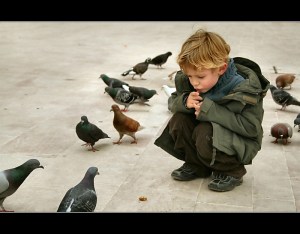
sinead-1I was reminded of another essay that I recently read by Tony Kelly where the author suggests that in a world of violent competition and the exponential growth of problems and responsibilities, the child calls for the rebirth of wonder, trust and playful contentment within the great womb of life and time. Where the harried adult might see only problems, and become weary in mind and heart, children live otherwise. ‘They breathe another air, content to play within the inexhaustible mystery of what has been so uncannily given. Every child is a call to return to the gift that was at the beginning, is now, and ever shall be’.
So too does this same refrain echo through Moltmann, who concludes his essay with three reasons for why children remain metaphors of hope:

(1) With every child, a new life begins, original, unique, incomparable. And while it seems that we always ask, who this or that child looks like (apparently because we seem to think we can only understand the new in the comparison with what is already known or similar), we also encounter the entirely different, the entirely dissimilar and unique in each child. It is these differences that we need to respect if we want to love life and allow an open future.

(2) With every beginning of a new life, the hope for the reign of peace and justice is given a new chance. It is important to see children in their own transcendent perspective and so to resist forming them according to the images of our world. Every new life is also a new beginning of hope for a homeland in this unredeemed world. If it were not, we would have no reason to expect anything new from a beginning.

(3) The last reason to see “a new beginning” or a “beginning of the New” in the beginning of a child’s life is the fact that, for me, children are not only metaphors of our hopes, of that which we want, wish for and expect, but also are metaphors of God’s hope for us: God wants us, expects us, and welcomes us. Humanity is God’s great love, God’s dream for God’s earthly world, God’s image for God’s beloved earth. God is “waiting” for the “human person” in every child, is “waiting” for God’s echo, resonance, and rainbow. Maybe that is the reason God is so patient with us, hearing the ruins of human history, inviting one human generation after the other into existence. God is not silent, God is not “dead” – God is waiting for the menschlichen Menschen the “truly humane human.” “In all of the prophets, I have waited for you,” Martin Buber has the Eternal One speak to the Messiah, “and now you have come.”

A Conference: Genesis and Christian Theology

genesis

The University of St Andrews has announced its third conference (14-18 July 2009) on Scripture and Christian Theology. ‘Since the first conference on the Gospel of John in 2003, the St Andrews conferences have been recognised as one of the most important occasions when biblical scholars and systematic theologians are brought together in conversation about a biblical text. The conferences aim to cut through the megaphone diplomacy or the sheer incomprehension that so often marks attempts to communicate across our disciplines’.

They have issued a call for papers that integrate close readings of Genesis with Christian theology. While the organisers are particularly interested in explorations of the dynamic relationship between Genesis and Christian doctrine, they also welcome proposals that combine careful reading of the text of Genesis with theological attention to art, creativity, ecology, ethics, the history of interpretation, or Jewish and Christian dialogue.

The call for paper proposals closes on 15 March 2009. Please visit the conference website for further details or to submit a proposal. Other enquiries can be directed to the conference administrator, the adroit Luke Tallon.

Confrontation(s) and (re)Discoveries

I’m still unpacking books. It’s often quite a disquieting experience being confronted with aspects your past (which is precisely what one’s library represents). There’s been not a few moments in recent weeks when I’ve found myself feeling somewhat embarrassed by a box’s contents, some of which have remained unopened for the best part of 4 years … and should have been thrown out 10 years before that. I can’t believe some of the junk that I’ve bought – and filled precious shelf-space with – over the years. The sense that one has matured a little is something of an encouragement. One of today’s highlights was the unearthing, after about 5 months, of Tom Smail’s brilliant (if not right at every point) Once and for All: A Confession of the Cross.  If only he didn’t write so clearly then perhaps he might be taken more seriously as a theologian. Anyway, here’s how he kicks off:

‘To write about the cross is, like Jacob at Peniel, to wrestle with something or, rather, with someone, who is totally mysterious and utterly unconquerable – a someone whom you cannot let go because you know that he has it in his power, certainly to wound you at the sore places he exposes, but also to bless you and to change your name and your destiny’. – Thomas A. Smail, Once and for All: A Confession of the Cross (Eugene: Wipf and Stock, 2005), ix.

The book has already been loaned out.

Barth on God’s patience

patienceI’ve never understood the charge that Barth is difficult to read. If one rejects the notion that the reader doesn’t have to do some work as well as the writer, and avoids the secondary literature and just reads the man himself, then, while one may certainly miss the odd nuanced or not-so-nuanced point here and there, there are few passages that do not break open to the persisting reader the great realities. In fact, there’s nothing quite like a dose of Barth to do just that. Here he is on the nature of divine patience:
‘We define God’s patience as His will, deep-rooted in His essence and constituting His divine being and action, to allow to another – for the sake of His own grace and mercy and in the affirmation of His holiness and justice – space and time for the development of its own existence, thus conceding to this existence a reality side by side with His own, and fulfilling His will towards this other in such a way that He does not suspend and destroy it as this other but accompanies and sustains it and allows it to develop in freedom’. – Karl Barth, Church Dogmatics II/1 (Edinburgh : T&T Clark, 2004), 409.

Might this not also constitute what patience means for those created imago Dei? The giving of ‘space and time’ for the development of the others’ own existence, accompanying, sustaining and allowing it to develop in the freedom who is Jesus Christ. This, it seems to me, is a deeply important word for those in the Church to hear, on both sides of the pulpit.

November bests …

Best books: TF Torrance, Incarnation: The Person and Life of Christ [2008] (this is among the most exciting of publications to appear this year); Barack Obama, The Audacity of Hope: Thoughts on Reclaiming the American Dream.

Best music: Andrew Peterson, Clear to Venus; Sting, Songs from the Labyrinth [2006]

Best films: Black Gold [2007]

Best drink: Teeccino Herbal Coffee Almond Amaretto (also available in Australia from NTP Health Products)

[Apologies for the delay in posting this monthly bests. It’s been a hectic time. As a consolation, let me draw attention to an encouraging post by Richard Floyd on Forsyth and baptism].

‘The C.O’s’, by Donald Baxter

archibald-baxterAfter something of a blogging hiatus, I thought I’d kick off again with a poem by Donald Baxter, written while in detention (26 July, 1917). ”The C.O’s’ refer to ‘conscientious objectors’. Donald was the brother of Archibald and uncle of James K. Baxter, New Zealand’s best-known poet.

Their names are writ in every Clink –
This small but steafast band
Who for themselves have dared to think
And firmly take their stand.

The tyrants’ boast to crush and kill
And this proud spirit bend
Does only strengthen each man’s will
To conquer in the end

Although to-night in prison cell
‘Neath Mammon’s lock and key.
It only holds the earthly shell –
The mind and soul are free.

The Brotherhood of Man’s their aim ;
So come whate’er betide
They’ll bear it all in Freedom’s name.
Their conscience is their guide,

Though each should fill a Martyr’s grave,
What grander end could be ?
Their death will only help to pave
The road to Liberty

Baxter’s poem was originally published in Harry Holland’s Armageddon or Calvary: The Conscientious Objectors and ‘The Process of their Conversion’ (1919).

The poem raises questions for me about what differences (if any, at least on one level) might exist between those imprisoned or executed or carry out horrific crimes because of commitments to various convictions about reality, and about the relationship between reality and claims of truth. What might be the relationship between ‘bear[ing] it all in Freedom’s name’ and employing conscience as guide?

[Painting: ‘Portrait of Archibald Baxter’, by Bob Kerr, 2007. For more in this series see here]

Regular blogging to resume soon

Apologies for the paucity of regular blogging of late. Our recent move from Scotland to New Zealand (with all the associated hassles) has meant that notebook time has been something of a rarity, although I have missed blogdom.

For those who may be interested, my induction as lecturer at the Knox Centre for Ministry and Leadership took place last night – with all the associated pomp that Kiwi Presbyterianism could muster. It was a good night and continued the warm sense of welcome that Judy and I have received since arriving in Dunedin just over a week ago. There’s a few pics of the event here. (I’m the good looking bloke in tweed).

Anyway, back to unpacking books …