Oliver O’Donovan on democracy


Two quotes from Oliver O’Donovan that arose out of this discussion on voting:

‘One could almost say that there is only one political question worth asking about liberal democracy: how firmly are the two elements, political freedom and and electoral legitimation, bound together? Is their conjunction a matter of necessity? Or is it merely the product of a peculiar socio-ecological niche, perhaps too fragile or too specialized to transplant?’ – Oliver O’Donovan, Ways of Judgment (Grand Rapids: Eerdmans, 2005), 168.

‘Electoral forms, then, not only fail to guarantee a just, or liberal, government; they are no guarantee of material representation either. The defense of Western democracy must, it seems, be even more modest than the most modest defense current among apologists. Perhaps it may take some form such as this: Modes of representation cannot be chosen in a vacuum; they are dependent upon the conditions of society and on the forms of spontaneous representation that arise unbidden. In a society that has lost most of its traditional representative forms to the unstable and shifting relations built on individualism and technology, but which can count on economic wealth, good communications, and general literacy, there is not serious alternative to the ballot box. Attempts to revive lost forms of loyalty are liable to be Ersatz and morally hollow; we had better secure ourselves against the temptations they present by setting a high procedural threshold for movement of spontaneous popular identity, and this electoral democracy provides. The case for democracy is that it is specifically appropriate to Western society at this juncture. It is a moment in the Western tradition; it has it own ecological niche. This allows us no universal claims of the “best regime” kind, nor does it permit the imperialist view that the history of democracy is the history of progress. Yet within its own terms it allows us to be positive about democracy’s strengths. The best regime is precisely that regimne that plays to the virtues and skills of those who are governed by it; and this one serves us well in demanding and developing certain virtues of bureaucratic and public discourse that the Western tradition has instilled. It is our tradition; we are bred in it; we can, if we are sensible about it, make it work’.  – Oliver O’Donovan, Ways of Judgment (Grand Rapids: Eerdmans, 2005), 178 .

Thirteen Propositions on Voting: a repost

I rarely do this, but some time ago, I posted Thirteen Propositions on Voting. Looking over them again today in light of tomorrow’s US elections, I thought that it was worth a repost:

A preamble: this is not an exhaustive list.

1. Remember, if you are a Christian then you are part of a pilgrim people who ought never really feel at home in this world because we have been made for another.

2. No matter which government is in power, the Church’s charge remains the same – to preach the Gospel. This will include, among other things, at least a 4-fold word: (i) challenging the structures of our society that demean humanity made in the image of God; (ii) challenging the agendas of our society that leave the poor and the widows and the orphans without a voice; (iii) challenging the complacency of a people who refuse to think, or can’t be bothered thinking, about the consequences of the decisions we are making (this has obvious international consequences); and (iv) challenging the selfishness of those who get fatter and fatter at the expense of others, and at the expense of the creation.

3. God’s people receive their identity not from earthly governments, but from the knowledge that they belong to the Lord Jesus and live under his government, and by his word.

4. Regardless of what’s going on in the fleeting world of politics, the Gospel will always have something to say to the world, and to a Church that must continuously strive to keep itself from ever thinking that the Gospel of the Cross is not enough.

5. We must beware lest we fall into the trap that so many Christians throughout history have fallen into of believing that there is such a thing as the only and true Christian form of government. No political party can be baptised, nor any political system. The radical call of Jesus remains regardless of what the government of the day is doing. This doesn’t mean that we shouldn’t strive to bring about godly reforms and laws in the land, but it does mean that we mustn’t delude ourselves into thinking that we can create a heaven on earth.

6. The temptation to deny Christ exists no matter what the political situation and culture is.

7. Don’t be among those who see voting as a chore and as a painful waste of time. Remember that it is a privilege to vote. God has placed many of us in countries where we have the opportunity to take part in decision making as well as in the keeping of our elected leaders accountable. Thank God that some of God’s people live in such places. [I have always struggled to understand how a democracy can encourage non-compulsory voting, not least given the claim of support for democracy-making in other parts of the world!]


8. Thank God for democracy, but never trust it. ‘Democracy’, wrote Forsyth, ‘is but a half-truth. It must have a King. Aristocracy is just as true and as needful. It builds on an authority in things no less than democracy builds on an equality. The free personality of democracy is only possible under a free authority. The free soul is only possible in a free King … There must always be a House of Moral Lords. There must always be leaders and led, prophets and people, apostles and members, genius and its circle, and elect and a called. Ah! democratic and aristocratic principles are both deep in the foundations of our Christian faith’. At the end of the day, ‘democracy is the recurrent suspicion that more than half of the people are right more than half the time’ (E. B. White). Recall the words of C.S. Lewis: ‘I am a democrat [believer in democracy] because I believe in the Fall of Man. I think most people are democrats for the opposite reason. A great deal of democratic enthusiasm descends from the ideas of people like Rousseau, who believed in democracy because they thought mankind so wise and good that every one deserved a share in the government. The danger of defending democracy on those grounds is that they’re not true … I find that they’re not true without looking further than myself. I don’t deserve a share in governing a hen-roost. Much less a nation … The real reason for democracy is just the reverse. Mankind is so fallen that no man can be trusted with unchecked power over his fellows. Aristotle said that some people were only fit to be slaves. I do not contradict him. But I reject slavery because I see no men fit to be masters’.

9. Remember that even secular leadership comes under the domain of God’s sovereignty, and that God uses non-Christians, as well as Christians, to bring about his purposes. The Bible assures us that all those who serve the people well are servants of God. So thank God for his own sovereign governing of the world (Rom 13:1-7).

10. Pray diligently for the leaders and all those in responsibilities of power and decision making. We are commanded by God to pray for all our leaders. Pray that they would make wise and just decisions and govern with mercy as well as strength. Pray for those who do not know Christ, that they would become Christians.

11. Pray for wisdom about your vote. Make your vote count. Make your vote a wise vote.

12. Don’t vote for the party who will best serve your pocket and own interests, but vote for the government or person who you prayerfully and honestly believe can best think through the necessary and complex issues with an attitude of serving others within their own country, and beyond.

13. Once the election has taken place, don’t grumble if your choice of party or person is not elected, for Peter tells us to, ‘Live such good lives among the pagans that, though they accuse you of doing wrong, they may see your good deeds and glorify God on the day he visits us. Submit yourselves for the Lord’s sake to every authority instituted among men: whether to the king, as the supreme authority, or to governors, who are sent by him to punish those who do wrong and to commend those who do right. For it is God’s will that by doing good you should silence the ignorant talk of foolish men. Live as free men, but do not use your freedom as a cover-up for evil; live as servants of God. Show proper respect to everyone: Love the brotherhood of believers, fear God, honour the king (1 Peter 2:12-17).

Getting Kant out of my system

Having spent most of today reading that great father of modern thought – Kant – I confess that what I once discerned as a growing admiration for this Enlightenment thinker with ‘a good dose of Lutheran and Pauline scepticism’ is slowly being ebbed away. In fact, the more I read, it seems, the quicker the ebb ebbs. For example, consider this sample:

Because men are exceedingly frail in all acts of morality, and not only what they practise as a good action is very defective and flawed, but they also consciously and wilfully violate the divine law, they are quite unable to confront a holy and just judge, who cannot forgive evil-doing simpliciter. The question is, can we, by our vehement begging and beseeching, hope for and obtain through God’s goodness the forgiveness of all our sins? No, we cannot without contradiction conceive of a kindly judge; as ruler he may well be kindly, but a judge must be just. For if God could forgive all evil-doing, He could also make it permissible and if He can grant impunity, it rests also on His will to make it permitted; in that case, however, the moral laws would be an arbitrary matter, though in fact they are not arbitrary, but just as necessary and eternal as God. God’s justice is the precise allocation of punishments and rewards in accordance with men’s good or bad behaviour. The divine will is immutable. Hence we cannot hope that because of our begging and beseeching God will forgive us everything, for in that case it would be a matter, not of well-doing, but of begging and beseeching. We cannot therefore conceive of a kindly judge without wishing that on this occasion He might close His eyes and allow Himself to be moved by supplications and flatteries; but this might then befall only a few, and would have to be kept quiet; for if it were generally known, then everyone would want it so, and that would make a mockery of the law … [Man] cannot, indeed, hope for any remission of punishment for his crimes from a benevolent ruler, since in that case the divine will would not be holy; but man is holy insofar as he is adequate to the moral law; he can, therefore, hope for kindness from the benevolent ruler, not only in regard to the physical, where the very actions themselves already produce good consequences, but also in regard to the moral; but he cannot hope to be dispensed from morality, and from the consequences of violating it. The goodness of God consists, rather, in the aids whereby He can make up for the deficiencies of our natural frailty and thereby display His benevolence. – Immanuel Kant, Lectures on Ethics (ed. P. Heath and J. B. Schneewind; trans. P. Heath. Cambridge: Cambridge University Press, 1997), 114–5.

Ouch! It makes one wonder if Kant had ever read Galatians, or Romans! For what is absent in Kant here is not only any notion that the law of God is the law of God’s own being and so cannot be abstracted from God, but also any notion that in a world like ours holiness literally takes the form of grace.

This relates to something else that I’ve been thinking of today, namely Forsyth (as I do), whose deep indebtment to Kant is not without its criticisms. One of Forsyth’s greatest critiques of Kant is reserved for his discussion on prayer. He grants that Kant certainly represents ‘intellectual power and a certain stiff moral insight’, but he lacks ‘spiritual atmosphere, delicacy, or flexibility, which is rather the Catholic tradition’. It is in Kant’s treatment of prayer, Forsyth contends, that he most betrays an intellectualism that ‘tends to more force than finish, and always starves or perverts ethic’. This is because he treats prayer with ‘the equipment of his age’ rather than with the ‘practical experience’ that he would have gleaned if he had immersed himself in ‘the great saints or captains of the race’ like Paul, Thomas à Kempis, or even Cromwell and Gustavus Adolphus. If only Kant had gone to them, Forsyth conjectures, he would have ‘realized the difference between shame and shyness, between confusion at an unworthy thing and confusion at a thing too fine and sacred for exposure’.

Around the traps …


God is for us!

Karl Barth once penned: ‘That man is against God is important and must be taken seriously. But what is far more important and must be taken more seriously is that in Jesus Christ God is for man. And it is only in the light of the second fact that the importance and seriousness of the first can be seen’. – Karl Barth, Church Dogmatics II.2 (Edinburgh: T&T Clark, 1957), 154.

Yes! In Jesus Christ, God has shown not only that God does not want to be God without humanity, but also that God does not want humanity to be humanity without God. God’s will is that God might not be only for himself, but that God might be for humanity all that God is in his eternity. And in the action of the Holy Spirit, the Triune God is present and active among us to hear and answer prayers, to create and sustain life in every minum of creation, to empower human beings to keep saying ‘No’ to sin and ‘Yes’ to God, and to continuously bring home afresh the good news of the Father’s sanctifying action in Jesus Christ, guaranteeing humanity’s inheritance, and empowering us to live in the reality of being ‘holy and blameless’ before God (Eph 1:4). Because God is Holy Love (one of Forsyth’s great themes), humanity’s failure to participate in God’s holiness, is, at core, a denial of God’s love. It is to receive God’s grace in vain. 

Who would have ever thought? God is for us! Hallelujah!

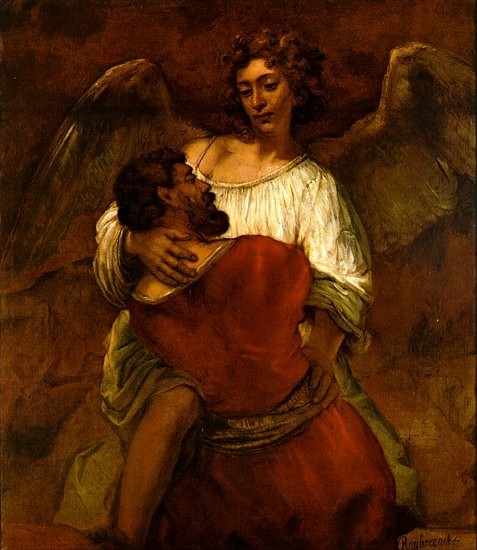
[Image: Rembrandt Harmensz. van Rijn, ‘Jacob Wrestling with the Angel’. Oil on canvas (137 × 116 cm) — ca. 1659/60. Gemäldegalerie der Staatlichen Museen, Berlin]

October bests …

Best books: The Rise of Neo-Kantianism: German Academic Philosophy between Idealism and Positivism, by Klaus Christian Köhnke; Theology in a Global Context: The Last Two Hundred Years by Hans Schwarz; and Theoria, by Peter Fuller.

Best music: Sons of Korah, Rain [2008]; Dar Williams, Cry Cry Cry [1998]

Best films: 10 Items or Less [2007]; An American Crime [2008]
 
Best drink: Heartland Directors’ Cut Shiraz 2006

Alfred Lord Tennyson: ‘Vastness’

I.

Many a hearth upon our dark globe sighs

after many a vanish’d face,

Many a planet by many a sun may roll

with the dust of a vanish’d race.


II. 

Raving politics, never at rest – as this poor

Earth’s pale history runs, –

What is it all but a trouble of ants in the

gleam of a million million of suns?


III. 

Lies upon this side, lies upon that side,

truthless violence mourn’d by the Wise,

Thousands of voices drowning his own in a

popular torrent of lies upon lies; 


IV. 

Stately purposes, valour in battle, glorious

annals of army and fleet,

Death for the right cause, death for the wrong cause,

trumpets of victory, groans of defeat;


V. 

Innocence seethed in her mother’s milk,

and Charity setting the martyr aflame;

Thraldom who walks with the banner of Freedom,

and recks not to ruin a realm in her name.


VI. 

Faith at her zenith, or all but lost in the

gloom of doubts that darken the schools;

Craft with a bunch of all – heal in her hand,

follow’d up by her vassal legion of fools;


VII. 

Trade flying over a thousand seas with her

spice and her vintage, her silk and her corn;

Desolate offing, sailorless harbours, famishing

populace, wharves forlorn;


VIII. 

Star of the morning, Hope in the sunrise;

gloom of the evening, Life at a close;

Pleasure who flaunts on her wide downway

with her flying robe and her poison’d rose;


IX. 

Pain, that has crawl’d from the corpse of

Pleasure, a worm which writhes all day, and at night

Stirs up again in the heart of the sleeper,

and stings him back to the curse of the light;


X. 

Wealth with his wines and his wedded harlots;

honest Poverty, bare to the bone;

Opulent Avarice, lean as Poverty; Flattery

gilding the rift in a throne;


XI. 

Fame blowing out from her golden trumpet

a jubilant challenge to Time and to Fate;

Slander, her shadow, sowing the nettle on

all the laurel’d graves of the Great;


XII. 

Love for the maiden, crown’d with marriage,

no regrets for aught that has been,

Household happiness, gracious children,

debtless competence, golden mean;


XIII. 

National hatreds of whole generations, and

pigmy spites of the village spire;

Vows that will last to the last death-ruckle,

and vows that are snapt in a moment of fire;


XIV. 

He that has lived for the lust of the minute,

and died in the doing it, flesh without mind;

He that has nail’d all flesh to the Cross, till

Self died out in the love of his kind;


XV. 

Spring and Summer and Autumn and Winter,

and all these old revolutions of earth;

All new-old revolutions of Empire –

change of the tide – what is all of it worth?


XVI. 

What the philosophies, all the sciences,

poesy, varying voices of prayer?

All that is noblest, all that is basest, all

that is filthy with all that is fair?


XVII. 

What is it all, if we all of us end but in

being our own corpse-coffins at last,

Swallow-d in Vastness, lost in Silence,

drown’d in the deeps of a meaningless Past?


XVIII. 

What but a murmur of gnats in the gloom,

or a moment’s anger of bees in their hive? –

.      .      .      .      .      .      .      .      .     

Peace, let it be! for I loved him, and love

him forever: the dead are not dead but alive.

The [best] poet is the true prophet

‘It has often been said that the teachers of the age’s religion are to be sought rather among its poets than its preachers. But it seems as if we must look for our noblest theology also to our poets, rather than to our clerical schools … The age is deeply theological, and does not know it. It is like the man who was amazed to find that all his life he had been talking prose without being aware of it. We are theological, and don’t know it. Hence part of our unhappiness. It is like the sorrow of some young Werther who bears in his bosom the ferment of a genius not yet apprehended, and the germ of a revolution not yet realised. Our atheology belies our true deep selves, and our great poets are in this but prophets. They steal upon our less aggressive hours, and reveal our soul and future to ourselves. They fore-shadow our destiny, and they tell us that, in spite of all the savants say about the impossibility of a theology, it is the passion for a theology which is at the root of our mind’s unrest, and the possession of a theology which alone can lay our mind’s anarchy’. – PT Forsyth, ‘The Argument for Immortality Drawn from the Nature of Love: A Lecture on Lord Tennyson’s “Vastness”’. Christian World Pulpit, 2 December 1885, 360.

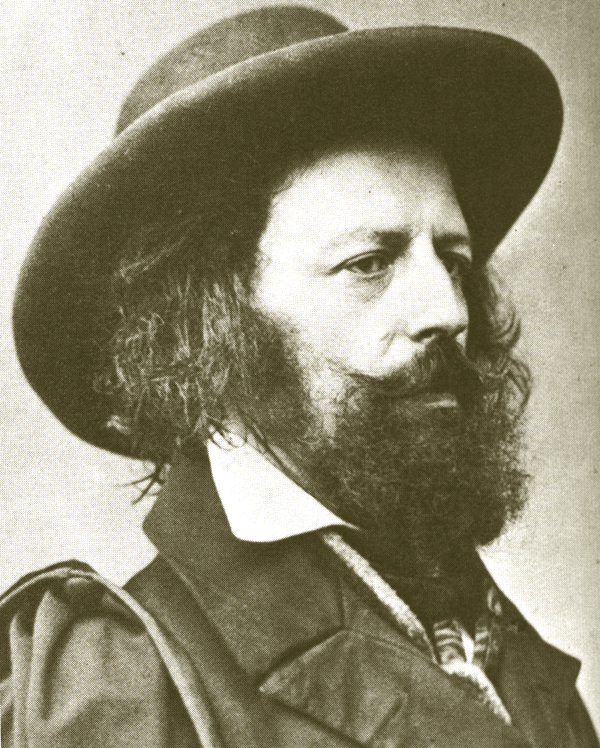
[Image: John Everett Millais, Alfred Tennyson 1881. Oil on canvas. Tate Gallery. Lent by National Museums Liverpool, Lady Lever Art Gallery]

Thinking blasphemy

While it is most usually true that in the Scriptures the object of mocking profanation and blasphemy is God’s name, rather than God’s self, the two cannot be separated. To blaspheme God’s name is to blaspheme God (Isa 37:23; Ezek 13:19; 22:26; Rom. 2:24 [quoting Isa 52:5; 1 Tim 6: Rev. 13:6; 16:9). Twice in Nehemiah 9, the Levites remind the returned exiles of their blasphemous past. The God who had ‘made a name for himself’ in the liberation of an enslaved people from an arrogant Egypt (9:10), had to in turn deal with an ‘arrogant’ people who refused to listen and obey. The epitome of their rebellion is illustrated ‘when they had made for themselves a golden calf’ and attributed to it their rescue (9:18). This and other great blasphemies’ were met by God’s forgiveness, grace, compassion and mercy which refused to ‘abandon them in the desert’ (9:17-19). Later on during this same time of the worship, the eight Levites recalled how Israel ‘captured fortified cities and a rich land, and took possession of houses full of all good things, cisterns already hewn, vineyards, olive orchards and fruit trees in abundance’ eating their fill, becoming fat and delighting in God’s goodness (9:25). Yet they were disobedient and rebelled against God, casting God’s law behind their backs and killing the prophets who had warned them with a view to turning them back to God. And, the Levites said ‘they committed great blasphemies (9:26b). This time their ‘great blasphemies were met by divine judgement expressed via the giving up of Israel ‘into the hand of their enemies, who made them suffer’ (9:27a), out of which they cried out again to the Lord who heard them, had compassion on them and, again rescued them from their enemies’ hand (9:27b). It would seem that it is not without significance that the Levites begin their praise in v. 5 with the words, ‘Blessed be your glorious name, which is exalted above all blessing and praise’ (9:5b). Furthermore, because God has attached his name to Israel, to mock Israel is to blaspheme God’s name. ‘”Their rulers wail,” declares the LORD, “and continually all the day my name is despised” (Isa 52:5; cf. Mal 1:11-14). The LXX adds the phrase εν τοις εθνεσιν, an addition that Paul adopts in Romans 2:24, ‘The name of God is blasphemed among the Gentiles (εν τοις εθνεσιν) because of you’ (cf. Rom 1:5). Clearly, there is a link between God’s name and God’s self-witness to the nations. Blank notes, ‘Divorced from its context, the assertion that God’s name suffers profanation because of his people can mean either of two things, either a) that God is defamed by the shameful conduct of his people, or b) that God is disgraced because of the shameful condition of his people’. Sheldon H. Blank, ‘Isaiah 52:5 and the Profanation of the Name’, HUCA 25 (1954), 6. Blank contends that the context of Isaiah 52:2 ‘proves’ that the author intended the latter meaning, whereas Paul misquotes the text in order to critique the Jews’ behaviour.

It seems to me that both readings are not only possible, but intricately related and implied in both texts. However, even if Blank is correct, the significant thing is that God’s has so attached his name to his people that God is shamed by Israel’s conduct and so sends them into exile. But their being in exile also defames God’s name among the nations for in their defeat, the nations see the defeat of their God whose reputation, fame, prestige and recognition is concerned. As Blank asserts, ‘To profane the name of God is to do damage to God’s reputation, to defame him, to lessen his prestige, to retard the process by which he receives recognition, to put off the day on which it shall be known that he is God’. Blank, ‘Profanation’, 8. Likewise in Romans 2, Israel is again in exile (not only is Paul’s audience presumably in Rome, but even those Jews in Palestine strive under foreign occupation which is a sign of their being under judgement) and called in exile to be ‘a guide to the blind, a light to those who are in darkness’ (2:19), that is to the nations, a calling that is apparently being undermined by their breaking of God’s law and so of dishonoring God’s name (as in Lev 18:21; 19:12; 20:3; 21:6; 22:2, 32; Jer 34:16; Ezek 20:39; Amos 2:7; Mal 1:12; cf. Ezek 13:19, 22:26).

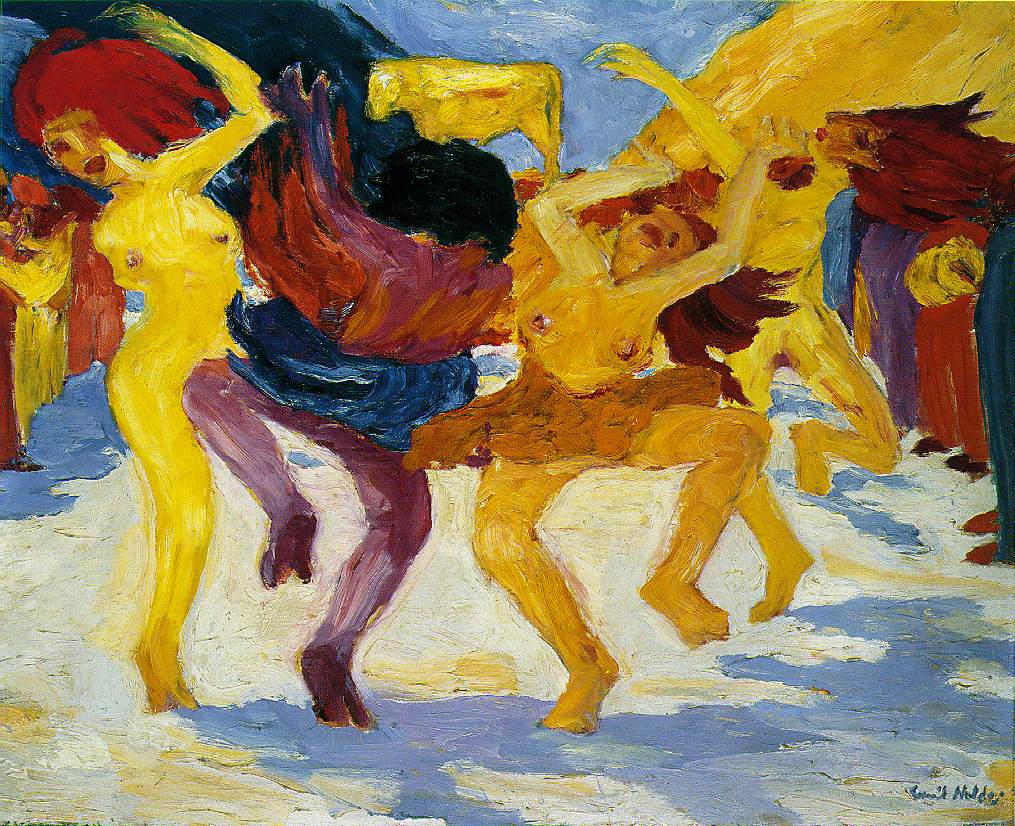
[Image: Emil Nolde, ‘Dance Around the Golden Calf’, 1910. Oil on canvas. 88 x 105.5 cm. Staatsgalerie moderner Kunst, Munich]

Rembrandt on the humanity of Christ

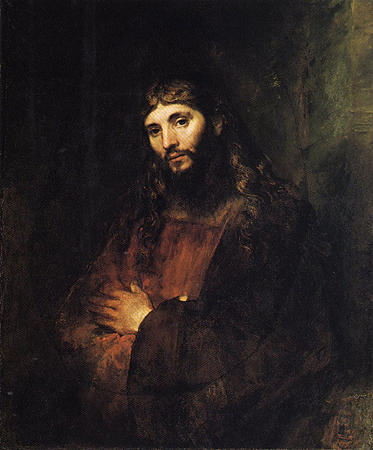
I’d like some help with something. I’ve spent a good bit of time today reflecting on these two paintings by Rembrandt. Specifically, I’ve addressed a certain question to them: Which one depicts a more human-looking Jesus? I’m not even certain yet why I’m asking the question. All the same, I’d value the thoughts of others.

 Christ (c. 1657–61; The Hyde Collection, Glens Falls, New York)

 The Resurrected Christ (1661; Bayerische Staatsgemäldesammlungen, AltePinakothek, Munich)


[For what it’s worth, my first thought was that the resurrected Jesus had a greater earthiness about him]

Luther on taking refuge in grace alone

‘Before the judgment seat of the world I am content to be dealt with according to the law; there I will answer and do what I ought. But before thee I would appeal to no law, but rather flee to the Cross and plead for grace and accept it as I am able. For the Scriptures teach me that God established two seats for men, a judgment seat for those who are still secure and proud and will neither acknowledge nor confess their sin, and a mercy seat for those whose conscience is poor and needy, who feel and confess their sin, dread his judgment, and yearn for his grace. And this mercy seat is Christ himself, as St. Paul says in Rom. 3 [:25], whom God has established for us, that we might have refuge there, since by ourselves we cannot stand before God. There shall I take my refuge when I have done or still do less than is meet and done much more of sin according to the law, both before and after my sanctification and justification. There my heart and conscience, regardless of how pure and good they are or can be in the sight of men, shall be as nothing, and they shall be covered over as it were with a vault, yea, with a fair heaven, which will mightily protect and defend them, the name of which is grace and the forgiveness of sins. Thereunder shall my heart and conscience creep and be safe’. – Martin Luther, Luther’s Works, Vol. 51: Sermons I (Edited by H.C. Oswald, J.J. Pelikan, H.T. Lehmann; Philadelphia: Fortress Press, 1999), 277.

On creation’s moral sensitivity


Seriously, has there ever been a more timeless exegete of Scripture than Calvin? Commenting on Genesis 4:10–12 Calvin remarks that God ‘constitutes the earth the minister of his vengeance, as having been polluted by the impious and horrible parricide: as if he had said, “Thou didst just now deny to me the murder which thou hast committed, but the senseless earth itself will demand thy punishment”’ (John Calvin, Commentaries on the First Book of Moses called Genesis, Vol. I (trans. J. King; vol. 1; Grand Rapids: Baker, 2003), 208). God does this, to ‘aggravate the enormity of the crime, as if a kind of contagion flowed from it even to the earth, for which the execution of punishment was required’. There is no sense, for Calvin, that cruelty can here be ascribed to the earth. Rather, the creation, reflecting the Creator’s hand, shows mercy because, in abhorrence of the pollution, it opens up its mouth to swallow the shed blood. For Calvin, this signifies that ‘there was more humanity in the earth than in man himself’ (Ibid., 209).

A similar observation is made by Motyer in his brilliant commentary on Isaiah 24:5: ‘As God’s creation, the world itself is morally sensitive, and the ‘thorns and thistles’ of Genesis 3:18 illustrate the two sides of this sensitivity. On the one hand, they evidence the way in which earth itself fights against sinners. It does not readily yield its bounty to them but turns its productive powers to their disadvantage. On the other hand, the fact that an earth which the Lord pronounced good can produce thorns and thistles is evidence that its nature has been damaged and the garden is in the process of becoming the wilderness’. (John A. Motyer, The Prophecy of Isaiah (Leicester: IVP, 1993), 198).

Understanding holiness takes a miracle

Defying empirical definition, holiness, like Christianity itself, only makes sense from the inside, from direct experience and that not only of hearing the seraphim calling to one another ‘Holy, holy, holy is the LORD of hosts’, not even when such confrontation brings the self-revelation of personal and corporate uncleanness. Holiness comes home in that action when the same ‘LORD of hosts’ calls one of those seraphim to fly towards you with a live coal in its hand which he had taken with tongs from the holy altar and place that coal at the very source of one’s unholiness and say, ‘Behold, this has touched your lips; your guilt is taken away, and your sin forgiven’ (Isa 6:7).

One recalls here Forsyth’s words: ‘the holy is the ideal good, fair, and true, translated in our religious consciousness to a transcendent personal reality, not proved but known, experienced immediately and honoured at sight as the one thing in the world valuable in itself and making a world’ (Peter T. Forsyth, The Principle of Authority in Relation to Certainty, Sanctity and Society: An Essay in the Philosophy of Experimental Religion (London: Independent Press, 1952), 6).

Human curiosity longs for a rational expression of ‘the holy’ at the same time that holiness defies such explanation or ‘justification’ apart from moral experience. It is known only as the human subject is thrown back onto the miracle of revelation, of grace. (Even Otto sees something of this when he notes that accompanying the disvaluing of self is the feeling of being unworthy to be in the presence of ‘the holy one’, that we may even defile him, and that we subsequently require a covering that renders the approacher numinous, freeing them from their ‘profane’ being,’ so that they are no longer unfit to relate to the Holy). Certainly, when we are dealing with the holy, we are in ‘a region which thought cannot handle nor even reach. We cannot go there, it must come here. We are beyond both experience and thought, and we are dependent on revelation for any conviction of the reality of that ideal which moral experience demands but cannot ensure … The situation is only soluble by a miracle’ (Forsyth, Authority, 6).

Ratzinger on the true nature of the Petrine office

Ratzinger’s essay on the conscience, despite making some valuable observations, is not a little disappointing. (It’s also hard to see how Amazon US sellers can in all good conscience charge $66+ for an 82 page book! … especially when you can pick it up direct from the publisher for $14.95 or from Amazon UK for £3.95). That said, it includes some interesting reflections on how Ratzinger understands the authority of the papacy, something that most Protestants dinna hae a scooby about:

‘The pope cannot impose commandments on faithful Catholics because he wants to or finds it expedient. Such a modern, voluntaristic concept of authority can only distort the true theological meaning of the papacy. The true nature of the Petrine office has become so incomprehensible in the modern age no doubt because we think of authority only on terms that do not allow for bridges between subject and object, Accordingly, everything that does not come from the subject is thought to be externally imposed’. – Joseph Ratzinger, On Conscience: Two Essays (Philadelphia/San Francisco: The National Catholic Bioethics Center/Ignatius Press, 2007 [1984]), 34.

‘One can comprehend the primacy of the pope and its correlation to Christian conscience only in this connection. The true sense of the teaching authority of the pope consists in his being the advocate of Christian memory. The pope does not impose from without. Rather, he elucidates the Christian memory and defends it. For this reason the toast to conscience indeed must precede the toast to the pope, because without conscience there would not be a papacy. All power that the papacy has is power of conscience. It is service to the double memory on which the faith is based – and which again and again must be purified, expanded, and defended against the destruction of memory that is threatened by a subjectivity forgetful of its own foundation, as well as by the pressures of social and cultural conformity’. (p. 36)

If nothing else, these words ought to encourage Protestants (and not least pastors, many of whom secretly aspire to be popes) to do the same work that Ratzinger is attempting to do: to think (and to keep thinking) about the nature and source of authority, and about the relationship between the Gospel and the offices of the church.

Around the traps …

John Paul II on faith and reason


‘Faith and Reason are like two wings on which the human spirit rises to the contemplation of truth; and God has placed in the human heart a desire to know the truth – in a word, to know himself – so that, by knowing and loving God, men and women may also come to the fullness of truth about themselves’. – Pope John Paul II. Fides et Ratio/On the Relationship between Faith and Reason (Boston: Pauline Books and Media, 1998, 7.

Trevor Hart on natural capacity for God


‘Human beings, sinful and fallen, have no ‘capacity’ in and of themselves, for God, no natural predisposition to hear and receive his Word. Again, the Spirit of God must come and create (ex nihilo in this respect) precisely such a capacity. Faith is a gift of the very God towards whom it is directed. In this respect, the attempt to secure some ‘point of contact’ in humanity for God is parallel to the doctrine of the immaculate conception: it assumes that wherever God and humanity come into close contact there must be some prepared ground, some fertile soil, some openness to and aptitude for God’s purposes: as if Mary’s obedient response were the result of some inherent immunity to the sin which blights the rest of us, rather than a result of the working of God’s Spirit’. – Trevor A. Hart, ‘A Capacity for Ambiguity? The Barth-Brunner Debate Revisited’. Tyndale Bulletin 44 (1993), 301.

Sermons are killing the Gospel

‘It is not sermons we need, but a Gospel, which sermons are killing … What we require is not a race of more powerful preachers, but that which makes their capital – a new Gospel which is yet the old, the old moralised, and replaced in the conscience, and in the public conscience, from which it has been removed. We need that the Gospel we offer be moralised at the centre from the Cross, and not rationalised at the surface by thin science. We need that more people should be asking “What must I do to be saved?” rather than “What should I rationally believe?”’ – P.T. Forsyth, The Church and the Sacraments (London: Independent Press, 1947 [1917]), 20.

Karl Barth on childlessness

‘… there are men who do not become parents. We are thinking of all those who broadly speaking might do so, and perhaps would like to do so, but either as bachelors or in childless marriage do not actually fulfil this possibility. What attitude are they to adopt to this lack? What has the divine command to say to them concerning it? In some degree they will all feel their childlessness to be a lack, a gap in the circle of what nature obviously intends for man, the absence of an important, desirable and hoped for good. And those who have children and know what they owe to them will not try to dissuade them. The more grateful they are for the gift of children, so much the more intimately they will feel this lack with them. Parenthood is one of the most palpable illuminations and joys of life, and those to whom it is denied for different reasons have undoubtedly to bear the pain of loss. But we must not say more. If we can use the rather doubtful expression “happy parents,” we must not infer that childlessness is a misfortune. And we must certainly not speak of an unfruitful marriage, for the fruitfulness of a marriage does not depend on whether it is fruitful in the physical sense. In the sphere of the New Testament message there is no necessity, no general command, to continue the human race as such and therefore to procreate children. That this may happen, that the joy of parenthood should still have a place, that new generations may constantly follow those which precede, is all that can be said in the light of the fact which we must always take into fresh consideration, namely, that the kingdom of God comes and this world is passing away. Post Christum natum there can be no question of a divine law in virtue of which all these things must necessarily take place. On the contrary, it is one of the consolations of the coming kingdom and expiring time that this anxiety about posterity, that the burden of the postulate that we should and must bear children, heirs of our blood and name and honour and wealth, that the pressure and bitterness and tension of this question, if not the question itself, is removed from us all by the fact that the Son on whose birth alone everything seriously and ultimately depended has now been born and has now become our Brother. No one now has to be conceived and born. We need not expect any other than the One of whose coming we are certain because He is already come. Parenthood is now only to be understood as a free and in some sense optional gift of the goodness of God. It certainly cannot be a fault to be without children’. – Karl Barth, Church Dogmatics III/4 (Edinburgh: T&T Clark, 2004), 265.

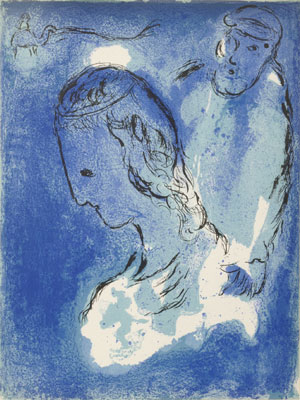
[Image: Marc Chagall, ‘Abraham and Sarah’, 1956]

‘Returning to the Church’: A conference

The Centre of Theology and Philosophy (Nottingham) and St Stephen’s House (Oxford) are organising a conference for 5–7 January 2009 entitled ‘Returning to the Church: Catholicity, Ecclesiology and the Mission of the Church of England’.

Speakers include: John Milbank, Alison Milbank, Graham WardAlister McGrath, Michael Northcott, Jeremy Morris and Simon Oliver

For more information contact Andrew Davison or visit www.ssho.ox.ac.uk/ecclesiology
or click here to download a conference poster.