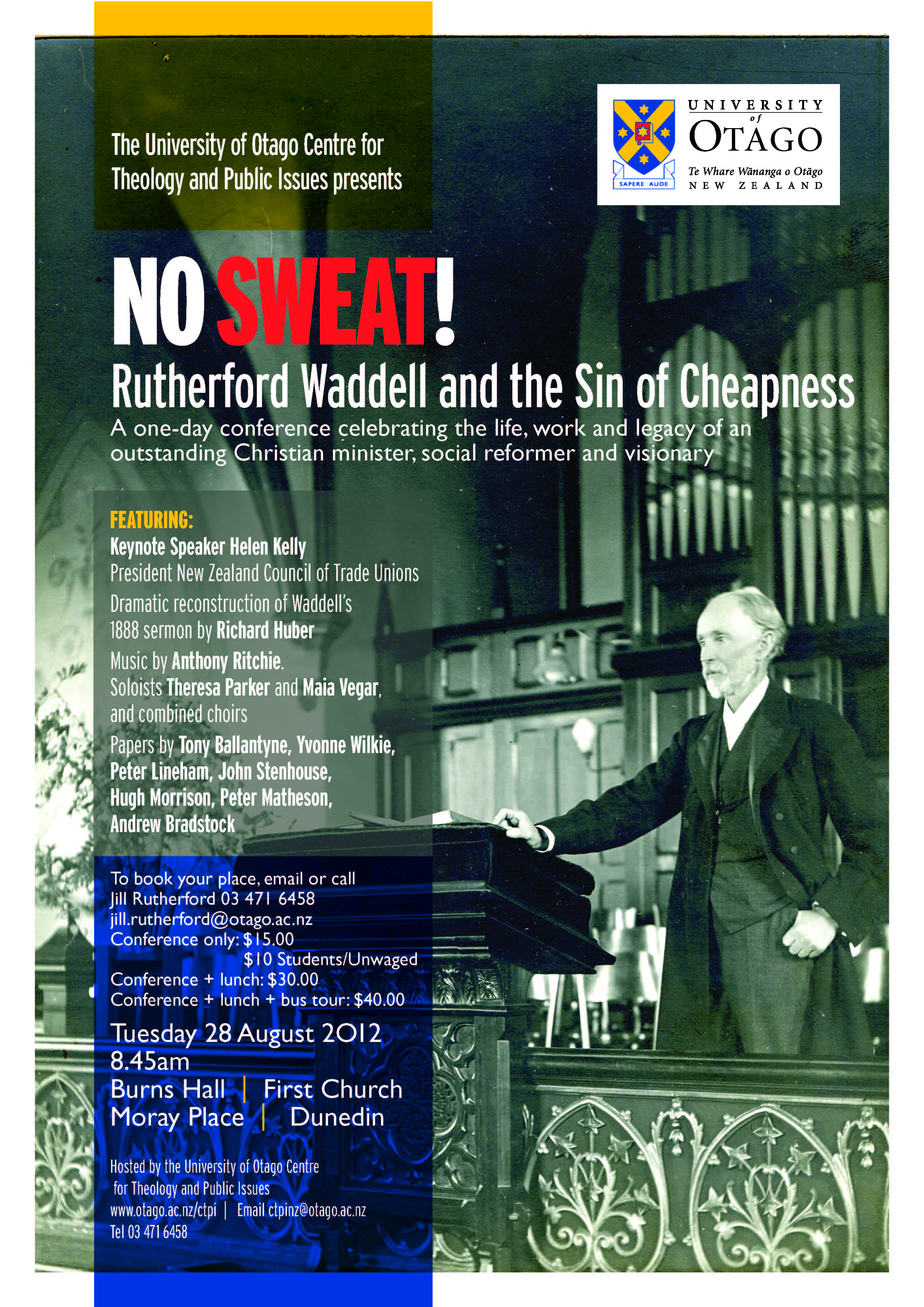
‘The Vernacularies’, by Brian Turner

Beware of strangers, the children are told.
In other words, just about everyone,
the message being it’s not worth
trying to find a saint
among the legions of sinners,
time’s too precious.

…………………………..Or so the old joker
who lives in the shack up the road reckons,
says he’s in the dark most of the time
though he’s working on it. ‘I’m
up with the vernacularies,’ he says
with a grin like a crack in schist.
‘I’m trying to shed some light
on the meaning of life.’

…………………………..My mother
would have approved of his manners,
said there’s a lesson for you
and reminded me of the need to
take people as you find them
and don’t go looking for the dark side
for that’s where the spiders are.

She could have said light and dark
go together like sweet and sour,
but she didn’t. You can put her
tact down to her age
and a certain intrinsic female poise
that goes with being a good woman
all her life, someone
unspectacularly spectacular.

You can make a pact
with someone like that
though there’s no guarantee
it will get you to heaven.

Kashmiri Butter Chicken

I’ve been making my way through Sara Lewis’ recipes in her attractively-produced book Ultimate Slow Cooker. (Technically, I purchased this book for my partner, but it was in much the same spirit as when I, as a ten-year-old or so, bought my babcia a cricket set; old habits die hard.) By far the best grub to come out of this collection thus far is the Kashmiri Butter Chicken. Here’s the low down, slightly modified from Lewis’ directions:

Serves 4
Preparation time: 30 mins
Cooking time: 5–7 hours
Cooking temperature: Low

Ingredients
2 onions, quartered
4 garlic cloves
6cm fresh root ginger, peeled
1 large red chilli, halved and de-seeded
8 boneless, skinless chicken thighs
1 tbsp canola oil
25g butter
1 tsp cumin seeds, crushed
1 tsp fennel seeds, crushed
4 cardamom pods, crushed
1 tsp paprika
1 tsp ground turmeric
1/4 tsp ground cinnamon
300ml chicken stock
1 tbsp light muscovado sugar
3 tbsp tomato purée
7 tbsp cream (or 5 tbsp of double cream)
salt
rice and/or naan bread

To garnish
2 tbsp flake almonds, toasted
sprigs of coriander

Method
1) Preheat the slow cooker.
2) Blend the onions, garlic, ginger and chilli in a food processor (or chop very finely).
3) Cut each chicken thigh into 4 pieces. Heat the oil in a large frying pan and add the chicken, a few pieces at a time, until all the meat has been added. Cook over a high heat until evenly browned. Lift the chicken pieces out of the pan with a slotted spoon and transfer to a plate.
4) Add the butter to the frying pan and, when it (i.e., the butter, not the pan) has melted, add the onion paste. Cook over a more moderate heat until it is just beginning to colour. Stir in the crushed seeds, cardamom seeds and pods and ground spices. Cook for 1 minute, then mix in the stock, sugar, tomato purée and salt. Bring to the boil, stirring.
5) Transfer the chicken to the slow cooker pot, pour the onion mixture and sauce over the top and press the chicken below the surface of the liquid. Cover and cook for 5–7 hours.
6) Stir in the cream and serve garnished with toasted flaked almonds, sprigs of coriander, and plain steamed rice and/or warm naan bread.

Stuck for a partnering beer? Try Kingsfisher or Kalyani Black Label or Kings Black Label premium pilsner.

[Note: the image is from Lewis’ book. I’m yet to learn the art of good food photography (which is something that today’s cookbook authors/publishers seem more interested in than in the actual recipes). Furthermore, after I’ve cooked and served, the last thing I feel like doing is farting around trying to take photos while dinner gets cold.]

Hearing and responding to Jesus Christ

So what is happening when a person hears and responds to Jesus Christ? Two things strike me. The first thing to say is that someone is not acting out on their own bat, so to speak. Every movement towards God is a movement that is already happening inside the triune life, and so it’s a kind of prayer, a listening and participation in the divine conversation. Here I am reminded of a recent sermon by Rowan Williams in which he writes:

When I pray, I ask God to bring me into that mystery of love, to bring me into that pouring out and pouring back of love between the Father, the Son and the Holy Spirit. I ask to be dropped into that ocean and carried along with its energy, its life.

Out of that, of course, come all sorts of other bits of praying. If you start there it makes sense to acknowledge that you have got things wrong, to acknowledge that you have failed – as in that wonderful song we sang earlier, ‘I am free to fail’, one of the most important messages any Christian can have. If I know that I am dropped into the ocean of God’s love, then I am not afraid to acknowledge just how much I have got wrong, just how much growing I still need to do. As I drop into that mystery I can say, ‘There is no comparison. Your goodness, your love, your abundance, your generosity are so immense that I cannot hold a light to them – I know how awful it must look. But hey, here I am in the ocean anyway. Let it come in, let it flood me through’. That is how our prayer includes confession.

And then in the context of that dropping into the love of God, we can also say to God, ‘You, God, must be passionate for the healing and the peace of my neighbours. You must care for their life, their openness to love and forgiveness. So I bring them to you knowing what you want for them. I put them in your hands because I know you want their life’. That is how we pray for one another, how we pray for peace in the world, and how we pray for our fellowship as a Church. Saying to God, ‘We know what you want for us and our neighbours’. That is the prayer of intersession, as we pray for each other.

The second thing to note is that a miracle has taken place; specifically, a miracle about the nature of Christian preaching itself. As one theologian put it, ‘No one has ever heard the gospel from the lips of a human being’; i.e., from the lips of a human being other than Jesus. If I have heard the gospel, then the who that I have heard is not the preacher but Jesus Christ. This reality describes both the possibility and the impossibility of preaching.

So when a person hears and responds to Jesus Christ (who is the Father’s right hand) one is gathered up by the Spirit (the Father’s left hand) to share in the inner relations of God’s own life and love with Christ by the Spirit in such a way that the very life of God is made to reverberate in us, and our very life is brought to reverberate in the spaciousness of God’s. This is sheer gift. As this happens, the Church recognises her true nature and purpose as centered with Christ in God in such a way that all her faith and obedience is a joyful and thankful sharing in and with the actual mission and ministry of the living Christ.

Live blog: women’s 200 metre final, London Olympics

0800: I’m waiting for the final of the women’s 200-metre race to begin. I’m watching it on free-to-air tv. I have a mug of earl grey tea and an empty breakfast bowl. I’m liking the look of Shelly-Ann Fraser-Pryce and wishing that I had her hair.

0801: They’re off!

0801: They seem to be running faster than I could. This will not be a surprise to many.

0801: Allyson Felix has won. Her hair is definitely not as cool.

0802: Not sure the live blog format quite works for these events.

0810: I’m still thinking about Shelly-Ann Fraser-Pryce’s hair. Time for a shower and to get ready for work.

‘A preacher’s morning hours’

God doesn’t seem to be too
interested in keeping office hours
and very few sermons are written
when the sun is up.
When it comes, the divine speech
almost always comes sometime during
the third watch. The sermons are
almost always long and taxing;
these are no homilies or ‘thoughts
for the day’. I ebb,
beaten, taken again to the lynching
tree; am wrenched once more
asunder.

© Jason Goroncy
7 August, 2012

On the art of disassociation

‘When the Catholic novelist closes his own eyes and tries to see with the eyes of the Church, the result is another addition to that large body of pious trash for which we have so long been famous’. So penned Flannery O’Connor in Mystery and Manners. In such ecclesiolatrous gogglesness, the Christian artist, O’Connor believes, sacrifices reality birthed and fostered through extra-ecclesial but no-less graced experience in favour of a sole voice very likely to soon sing out of key. And O’Connor calls for an end to what she understands to be a false dichotomy while drawing attention to a genuine tension which is neither false nor one typically handled with due care. O’Connor’s concern, however, is not here to dissolve this tension between what the church sees and what the artist sees; rather, she wishes to understand the nature of the Catholic artist’s responsibility to look with both eyes, as it were. The real vocation of (prophetic) artists, she argues, is to achieve and communicate a wholeness of vision, and to take a stand on such a vision rather than engage in enterprises about which side in the conflict is more correct or more fitting. This can only be done through the artist’s willingness to look at what is there to see – and further, to what is not yet seen. Either way, we are talking about activities of hope. (Here, too, the artist and the preacher have much in common.)

It seems to me that Jacques Maritain is trumpeting an analogous (though not the same) melody in Art and Scholasticism and the Frontiers of Poetry when he writes:

Do not make the absurd attempt to disassociate in yourself the artist and the Christian. They are truly one, if you are truly Christian, and if your art is not isolated from your soul by some system of aesthetics. But apply only the artist to the work; precisely because the artist and the Christian are one, the work will derive wholly from each of them.

To press even further, or perhaps to press backwards, I would still want to argue (with Paul Ricœur and others) for a more pronounced expression of and commitment to communal (ecclesial and other) existence; that the Christian artist – whether a prophet or not – does not carve out her own story ex nihilo, as it were, but rather works both at different levels of consciousness in the streams and side pools of narratives – and of that most basic of all Narratives – into which her existence and vocation have been gathered up and formed, and in a network of relationality in which her existence and vocation find the kind of meaning that is both healing and abiding. There is an acute difference, it seems to me, between disregarding one’s own eyes in favour of those of others alone (so O’Connor’s concern), and abandoning the cloud of witnesses altogether. The former posture is, among other things, a denial of our being-as-responsible. The latter is a performance (understood in its positive sense) of proper humility, hope and love, and an act of faith born of the conviction that whenever Jesus comes to us he always tends to bring his friends along with him as well. In like vein, there is no art without community.

Steve Hely on book reviewers

Most writers, from time to time, elect to set aside a little ink in order to get a few things off their chest. And it’s not uncommon for writers – and here I’m thinking of the likes of Charlotte Brontë, Dorothy Sayers and Kurt Vonnegut, to name just a few – to blow off a little steam about book reviewers (Brontë, for example, referred to them as ‘Astrologers, Chaldeans, and Soothsayers’). But in his very unextraordinary book, How I Became a Famous Novelist, Steve Hely takes the most sustained and pathetic shot at book reviewers that I’ve encountered:

I try not to hate anybody. ‘Hate is a four-letter word,’ like the bumper sticker says. But I hate book reviewers.

Book reviewers are the most despicable, loathsome order of swine that ever rooted about the earth. They are sniveling, revolting creatures who feed their own appetites for bile by gnawing apart other people’s work. They are human garbage. They all deserve to be struck down by awful diseases described in the most obscure dermatology journals.

Book reviewers live in tiny studios that stink of mothballs and rotting paper. Their breath reeks of stale coffee. From time to time they put on too-tight shirts and pants with buckles and shuffle out of their lairs to shove heaping mayonnaise-laden sandwiches into their faces, which are worn in to permanent snarls. Then they go back to their computers and with fat stubby fingers they hammer out ‘reviews.’ Periodically they are halted as they burst into porcine squeals, gleefully rejoicing in their cruelty.

Even when being ‘kindly,’ book reviewers reveal their true nature as condescending jerks. ‘We look forward to hearing more from the author,’ a book reviewer might say. The prissy tones sound like a second-grade piano teacher, offering you a piece of years-old strawberry hard candy and telling you to practice more.

But a bad book review is just disgusting.

Ask yourself: of all the jobs available to literate people, what monster chooses the job of ‘telling people how bad different books are’? What twisted fetishist chooses such a life? (pp. 146–47)

Certainly, it’s difficult to take this vitriol seriously. Perhaps it’s tongue in cheek, or satire. Yes, many reviewers are little more than poorly paid hookers for publishing companies or newspapers. Yes, many reviewers betray little evidence of actually having read the book under consideration, or of knowing its location in and contribution to the wider canon. Yes, many reviewers do appear to be ‘condescending jerks’. But Hely seems to have some seriously unresolved issues here, perhaps the most serious of all is that he appears to be entirely unfamiliar with John Updike who, as far as I am aware, never in all his days shoved a heaping mayonnaise-laden sandwich into his face.

‘They Have Threatened Us With Resurrection’

There is something here within us
Which doesn’t let us sleep,
Which doesn’t let us rest,
Which doesn’t stop pounding
Deep inside,
It is the silent, warm weeping
of Indian women without their husbands,
it is the sad gaze of the children
fixed there beyond memory,
in the very pupil of our eyes
which during sleep,
though closed, keep watch
with each contraction
of the heart,
in every wakening

Now six of them have left us,
And nine in Rabinal,
And two, plus two, plus two,
And ten, a hundred, a thousand.
a whole army
witnesses to our pain,
our fear,
our courage,
our hope!

What keeps us from sleeping
is that they have threatened us with Resurrection!
Because every evening
though weary of killings,
an endless inventory since 1954,
yet we go on loving life
and do not accept their death!

They have threatened us with Resurrection
Because we have felt their inert bodies,
and their souls penetrated ours
doubly fortified,
because in this marathon of Hope,
there are always others to relieve us
who carry the strength
to reach the finish line
which lies beyond death.

They have threatened us with Resurrection
because they will not be able to take away from us
their bodies,
their souls,
their strength,
their spirit,
nor even their death
and least of all their life.
Because they live
today, tomorrow, and always
in the streets baptized with their blood,
in the air that absorbed their cry,
in the jungle that hid their shadows,
in the river that gathered up their laughter,
in the ocean that holds their secrets,
in the craters of the volcanoes,
Pyramids of the New Day,
which swallowed up their ashes.

They have threatened us with Resurrection
because they are more alive than ever before,
because they transform our agonies
and fertilize our struggle,
because they pick us up when we fall,
because they loom like giants
before the crazed gorillas’ fear.

They have threatened us with Resurrection,
because they do not know life (poor things!).

That is the whirlwind
which does not let us sleep,
the reason why sleeping, we keep watch,
and awake, we dream.

No, it’s not the street noises,
nor the shouts from the drunks in the “St. Pauli,”
nor the noise from the fans at the ball park.

It is the internal cyclone of kaleidoscopic struggle
which will heal that wound of the quetzal
fallen in Ixcán,
it is the earthquake soon to come
that will shake the world
and put everything in its place.

No, brother,
it is not the noise in the streets
which does not let us sleep.

Join us in this vigil
and you will know what it is to dream!
Then you will know how marvelous it is
to live threatened with Resurrection!

To dream awake,
to keep watch asleep,
to live while dying,
and to know ourselves already
resurrected!

– Julia Esquivel, ‘They Have Threatened Us With Resurrection’ in Threatened with Resurrection: Prayers and Poems from an Exiled Guatemalan (Elgin: The Brethren Press, 1982), 59–61.

July stations …

Reading:

Listening:

Watching:

Church welcome signs and the divine hospitality

It doesn’t happen very often but every now and then, and usually more then than now, one happens across a church welcome sign that does not reinforce something of what is completely embarrassing about being a church person and which even goes some way towards bearing witness to the divine hospitality itself. This sign from the Our Lady of Lourdes Catholic Community is one such example:

We extend a special welcome to those who are single, married, divorced, gay, filthy rich, dirt poor, y no habla Ingles. We extend a special welcome to those who are crying new-borns, skinny as a rail or could afford to lose a few pounds.

We welcome you if you can sing like Andrea Bocelli or like our pastor who can’t carry a note in a bucket. You’re welcome here if you’re “just browsing,” just woke up or just got out of jail. We don’t care if you’re more Catholic than the Pope, or haven’t been in church since little Joey’s Baptism.

We extend a special welcome to those who are over 60 but not grown up yet, and to teenagers who are growing up too fast. We welcome soccer moms, NASCAR dads, starving artists, tree-huggers, latte-sippers, vegetarians, junk-food eaters. We welcome those who are in recovery or still addicted. We welcome you if you’re having problems or you’re down in the dumps or if you don’t like “organized religion,” we’ve been there too.

If you blew all your offering money at the dog track, you’re welcome here. We offer a special welcome to those who think the earth is flat, work too hard, don’t work, can’t spell, or because grandma is in town and wanted to go to church.

We welcome those who are inked, pierced or both. We offer a special welcome to those who could use a prayer right now, had religion shoved down your throat as a kid or got lost in traffic and wound up here by mistake. We welcome tourists, seekers and doubters, bleeding hearts … and you!

Beatitudes

for Aung San Suu Kyi

Blessed are those who watched
with stormcloud eyes
the ground open to swallow them
while fork-tongue drivers
drove whipcrack highways
on luxury serpents. Blessed
are those run down & flattened
fang-holed & spat on
for good measure of the trade index.
Blessed, those daughters set on high wires
to balance dollar signs, while bored crowds
jeered for another fall in interest rates. Blessed
too those with empty chests, soles ripped
from their shoes, fed to dogs. But most blessed
are those who stole the hound scraps
nailed them to their feet
& kept on marching.

– Paul Mitchell

Rutherford Waddell Conference

The University of Otago’s Centre for Theology and Public Issues is planning a one-day conference to celebrate the life, work and legacy of the inspirational Christian minister, social reformer and visionary Rutherford Waddell. Here’s the flyer:
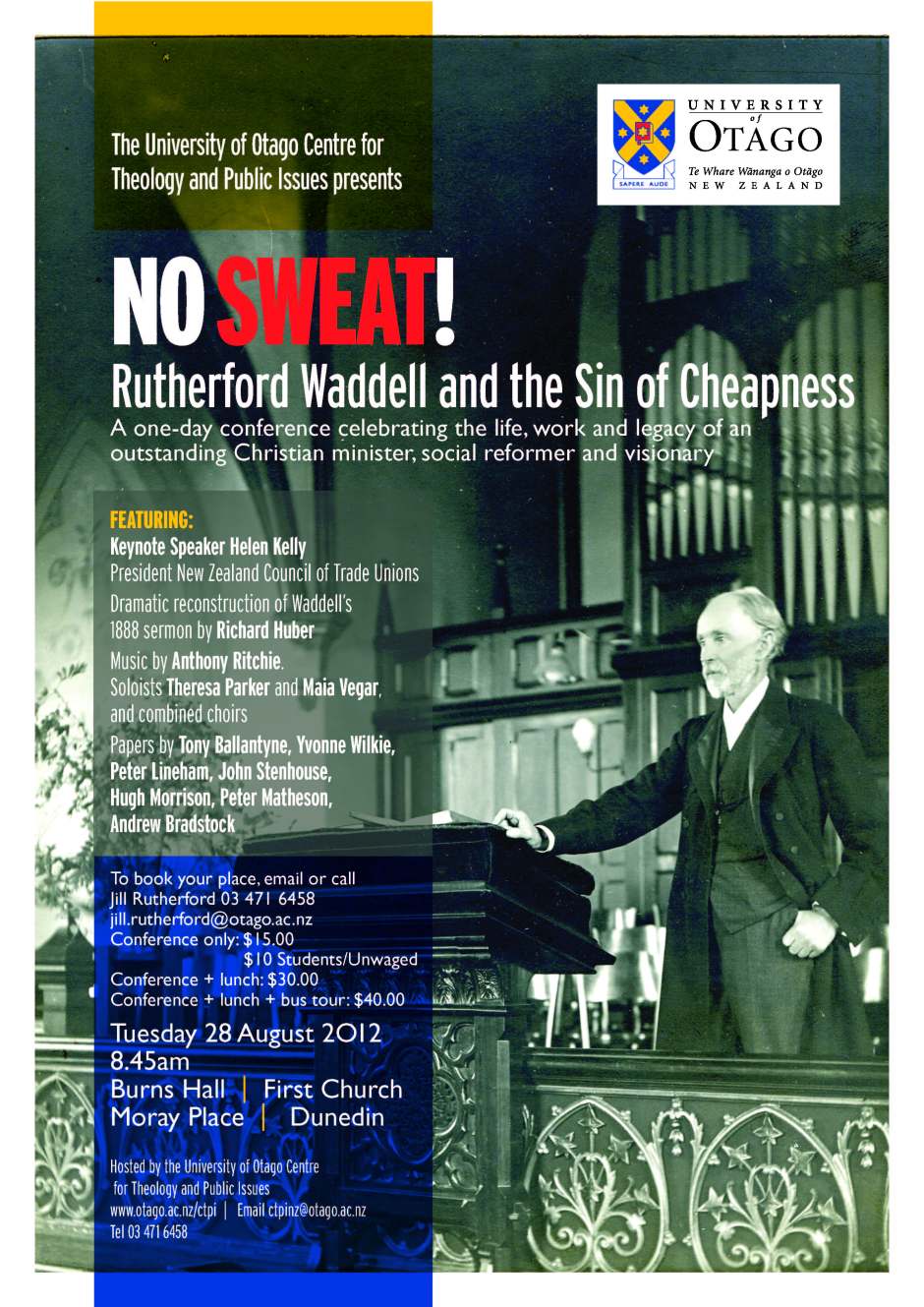
I can still remember my first exposure to Waddell’s writing. It was his delightful collection of essays published as The Fiddles of God and Other Essays. One of those ‘other essays’ was entitled ‘The Lure of the Trout’; this title alone was enough to make me fall in love with the guy. Now it’s true that I’ve fallen in love many times before (and almost as easily out of it again) but I can confess that my affection for him has continued to grow (perhaps I’m still falling) the more I have immersed myself in his exquisite prose – fed as it is by healthy doses of John Ruskin, Emily Brontë, George Eliot and James Lane Allen – and the more I have learnt about his extraordinary ministry right here in my home town of Dunedin. James Gibb once described Waddell as a man who ‘lived under the spell of Christ’. It’s a good description. Suffice it to say that I’m really looking forward to this gig.

For those readers of PCaL unfamiliar with Waddell, here’s the relevant entry, written by Ian Breward, from the Dictionary of New Zealand Biography:

Rutherford Waddell was born in Ballyroney, County Down, Ireland, probably sometime between 1850 and 1852. His father was the Reverend Hugh Waddell, a Presbyterian minister; his mother, Jean Reid, was the sister of Thomas Mayne Reid, a famous writer of adventure stories. Rutherford’s mother died when he was small and he was brought up by an aunt. He was educated at a national school where the teacher was brutal; Waddell regarded the years as wasted. At the age of 14 he became a draper’s apprentice in Banbridge for four years, after which he decided to follow the calling of his father and older brother, Hugh, in the ministry. He graduated MA from Queen’s University in Ireland in October 1875 and also studied at the Presbyterian Theological College, Belfast, from 1874 to 1876. On 27 January 1877, at Dublin, he married Kathleen Maud Ashton Newman. They were to have one daughter, Muriel Alice Newman, who was born on 28 April 1882.

Rejected both for missionary service in Syria and by an Irish congregation, Waddell accepted an invitation to join the ministry of the Canterbury Presbyterian Church Extension Association. He sailed with his young wife to Lyttelton, New Zealand, on the Piako, arriving in May 1877. After a short supply ministry at St Paul’s Church in Christchurch, he was inducted to the charge of Prebbleton and Lincoln on 25 September 1877. Called to the flourishing new charge of St Andrew’s Church in Walker Street (Carroll Street), Dunedin, Waddell was inducted on 18 April 1879 to minister to about 300 members, including many of Dunedin’s leading citizens.

Suspect because of his radical belief that the Christian gospel should be actively interpreted through social justice, Waddell soon won the confidence of the congregation and exercised wide influence through his writing and commitment to civic affairs. In 1888 he was one of the founders of the Dunedin and Suburban Reserves Conservation Society and in 1888 and 1889 an early supporter of technical education. In the parish at the Walker Street mission hall, which opened in 1888, he set up a savings bank, a free library and the first free kindergarten (1889). He also developed a wide range of literary, religious and educational societies, along with a cricket club, gymnasium, and debating and mutual improvement societies. Waddell was deeply committed to overseas missions; the congregation supported three missionaries as well as providing a spiritual home for many students for the ministry.

Waddell was well read. His knowledge of classic and contemporary English literature went with wide reading in theology, economics and sociology, all carefully recorded in notebooks. In his student days he was decisively influenced by reading George Eliot’s Adam Bede. Young and old found his sensitivity to their doubts and questions one of the most attractive features of his ministry. He was deeply compassionate, but was not content just to offer help in his own parish. Reading in politics and social science convinced him that social change was possible, but with this went the conviction that changed laws must be accompanied by changed lives.

Waddell played a leading part in exposing sweated labour in Dunedin (he himself had worked long hours for nothing as a draper’s apprentice in Banbridge). In October 1888 he delivered a sermon at St Andrew’s Church on the ‘sin of cheapness’, arguing that a lust for bargains was forcing prices down to a point where wages fell below subsistence level. In November he took the matter to the Synod of the Presbyterian Church of Otago and Southland and a motion was passed deploring the existence of sweating in New Zealand. The press took up the matter and revealed cases of sweating in Dunedin. His blend of prophetic passion and skilful use of the press and public meetings led in 1890 to a royal commission on sweating on which he served. Its recommendations were an important part of the foundation for the social legislation of the 1890s. Waddell believed that trade unions were an essential part of reform: he became the first president of the Tailoresses’ Union of New Zealand from 11 July 1889. He was also actively involved in temperance reform, the Bible in schools movement and was one of the main supporters of the First Offenders’ Probation Act 1886, a pioneering penal reform.

As well as being a notable minister and social reformer, Waddell was an active journalist and editor of the national Presbyterian weekly, the Christian Outlook (later called the Outlook), from 1894 to 1902. Forced by a breakdown in health to give up that responsibility, he continued to write elegant and thought-provoking columns for the Evening Star under the name ‘Ror’ for 27 years. His other notable achievement was to initiate the deaconess order in the Presbyterian Church of New Zealand. In March 1901 Sister Christabel Duncan, one of the first to graduate from the Presbyterian Deaconess Institute in Melbourne, began her duties among the poor in St Andrew’s parish. Her stipend for the first year was paid by Waddell, but the caution of the deacons was overcome by the end of the year and they became her enthusiastic supporters. In addition, Christabel Duncan was actively involved in the expansion of the Presbyterian Women’s Missionary Union, working as travelling secretary for two years from 1918.

Lightly built and with a slight speech impediment, Waddell became one of the country’s most notable preachers, whose sermons were published in their thousands. He pushed himself to his physical limits and had to take sick leave in 1882, 1886, 1902 and 1913. The last years of his ministry were hampered by severe deafness. He retired in 1919, after a remarkable career. Kathleen Waddell became a chronic invalid and died in Seacliff Mental Hospital on 7 September 1920.

Rutherford Waddell married Christabel Duncan at Melbourne on 3 December 1923. He stayed intellectually vital during his last years; in 1929 he was first president of a fellowship of New Zealand writers. Despite illness he continued to hunt, fish and enjoy golf. He died in Dunedin on 16 April 1932, survived by his wife. Waddell was an important liberalising influence in the Presbyterian church, demonstrating that it was possible to be evangelical and missionary without being rigidly tied to the confessionalism of a strong group in the Synod.

Earl Grey Tea Loaf

Whether we’re talking creating or eating, I really don’t do desserts. But every now and then a recipe comes along that is both easy peasy to follow, and yields very yummy results. This recipe for Earl Grey Tea Loaf, adapted from that by Jo Seagar, is one example:

Ingredients

  • 1 cup of boiling water
  • 3–4 tea bags of Earl Grey tea (I know, tea bags are a woeful invention – no doubt a conspiracy authored by the coffee industry – but they do work better with this recipe. If really desperate, you can use an inferior leaf such as English Breakfast)
  • 1 cup of raisins (weirdos might think that they can get away with using sultanas)
  • 1 cup of brown sugar
  • 2 cups of self-raising flour (here you could use plain flour plus 2 teaspoons of baking powder)
  • 1 egg
  • 1 orange or lemon zest

Method

1. In a covered bowl, brew the tea in boiling water for 2–3 minutes. Add the raisins and sugar, stir and soak for around 10 minutes (or it can be left until the tea is cold).

2. Preheat the oven to 180˚C. Line a loaf tin with baking paper. Remove the tea bags from your tea mixture. Then add the egg, flour and zest, and gently stir that baby for 2–3 minutes. Pour into the prepared loaf tin and bake for one hour.

3. Gently remove from the tin, cool it down just a bit on a wire rack, slice thickly and serve warm with butter.

Poached Pears in Blackcurrant Juice

Ingredients
1 litre blackcurrant juice (you can also use pear or apple juice)
½ cup of sugar (or less if you prefer)
1 vanilla pod
1 cinnamon stick
Orange zest (1/2 an orange worth with do)
6 pears, peeled and cored

Method
Place the fruit juice into a deep medium size pot, add the sugar (sweetness is up to you) add the vanilla pod and orange zest. Bring to the boil then reduce the temperature to a gentle simmer. Place the pears in the liquid and lid on the pot. Poach gently for 20 minutes or until the pears are tender all the way through.

Remove the pears carefully onto a platter and return the liquid back to heat and boil vigorously until the liquid has reduced to thick syrup. Don’t overcook it or you’ll burn it and stink the house out (like I did the first time)

Serve the pears whole with the fruit syrup poured over with either vanilla ice cream, cream or perhaps crème fraiche.

There were no complaints …

[HT: Otago Farmers Market]

Happy birthday Woody Guthrie

‘Life’s pretty tough . . . you’re lucky if you live through it’.

Today marks the hundredth birthday of one of America’s great human beings – Woody Guthrie (July 14, 1912 – October 3, 1967) – who, in the spirit of the Hebrew prophets and other great secular saints, understood well that it’s damn impossible to tell the truth apart from some form of protest; i.e., apart from being a stone in the shoe every now and then, or what is referred to in French as ‘pissing others off’. I was reminded of this fact recently while reading Poems of Protest: Old & New, a volume edited by Arnold Kenseth, and musician John Mellencamp put it well this week in his own poetic tribute to Guthrie.

Of course, there’s much to admire about Guthrie. Not only was he a poet-musician who inspired (both directly and indirectly) a generation – and subsequent ones too; Guthrie’s famous ‘ripples’ come readily to mind – but he did so precisely by championing (not unlike William Stringfellow) that the integrity that attends truth-telling is to be prized above all those powers that would clamour for a culture’s attention and value bank. So, for example and most famously, denying the copyright nazis and their lawyers who would, albeit mostly in ignorance (I, on better days, like to think), seek to put a culture’s creative processes in chains to be prostituted off to the highest bidder, Guthrie, with the boldness and humour that telling and loving the truth demands, wrote (in the late 1930s) of one of his songs:

This song is Copyrighted in U.S., under Seal of Copyright # 154085, for a period of 28 years, and anybody caught singin’ it without our permission, will be mighty good friends of ours, cause we don’t give a darn. Publish it. Write it. Sing it. Swing to it. Yodel it. We wrote it, that’s all we wanted to do.

The BBC aired a worthwhile documentary on Guthrie in 1988 which is well worth watching; you can do so here. And here’s a clip of Woody singing ‘John Henry’ (with Sonny Terry and Brownie McGhee) from 1946 where he’s doing his darndest to prove that ‘Anyone who uses more than two chords is just showing off’:

And, of course, no post on Guthrie would be complete without a reference to Steve Earle’s fantastic tribute to Guthrie, ‘Christmastime In Washington’:

Happy birthday Woody.

Yanks and Kiwis

In his recent book Fairness and Freedom: A History of Two Open Societies – New Zealand and the United States – which I’m yet to read (a fact which doesn’t always give me reason to pause from offering comment) – David Hackett Fischer observes that whereas public discourse and public policy in America is dominated by the rhetoric of freedom and liberty, here in New Zealand the same are organised around the principles of fairness and social justice. Throwing Australia into this mix would make a fascinating study and, I think, challenge some of Fischer’s conclusions. Still, Fischer’s sounds like an attractive thesis (nicely summarised in this article), and I look forward to checking out the book. (Just as good, however, might be reading a review of the book by American ex-pat Kim Fabricius.)

Mass, Dunedin style

New Zealand Tablet, Volume IV, Issue 169, 23 June 1876, Page 1.

‘The first Mass was celebrated … in the loft of the old bottle store of Burke the brewer. About 20 people were present and they had to ascend a rather rickety ladder and squeeze through a narrow trapdoor to get to the loft. The second Catholic Mass in Dunedin was celebrated in the skittle alley of the Queen’s Arms Hotel, Princes Street South’. – Frank Tod, Pubs Galore: History of Dunedin Hotels 1848–1984, p. 67. [HT: Jennie Coleman]

On helping Tony Abbott to be a Christian

I am so encouraged that Australia’s opposition leader, the honourable Tony Abbott, takes seemingly every opportunity to publicly offer every indication of his sincere intent on being a good Christian. Praise the Lord! Furthermore, it’s great to know that Mr Abbott believes, and that with such costly passion, that ‘Christians’ should be concerned with doing ‘the right thing’. Unfortunately, it appears that Mr Abbot’s got no idea what ‘the right thing’ is; i.e., what is the demand that the gospel lays on him? To be sure, people like Malcolm Fraser and Julian Burnside are doing their darndest to try to educate the poor fella, and I wondered if some accompanying music might help Mr Abbott too. And here I can think of few better than kiwi musician Dave Dobbyn to assist brother Tony to get the ‘Christian’ message (surely he’s not chasing ‘the “Christian” vote’) that he seems so intent on expressing his unyielding fidelity to:

Tonight I am feeling for you
Under the state of a strange land
You have sacrificed much to be here
‘there but for grace…’ as I offer my hand.

Welcome home, I bid you welcome, I bid you welcome
Welcome home from the bottom of my heart.

Out here on the edge
The empire is fading by the day
And the world is so weary in war
Maybe we’ll find that new way.

So welcome home, see I made a space for you now
Welcome home from the bottom of our hearts
Welcome home from the bottom of our hearts.

Keep it coming now – keep it coming now
You’ll find most of us here with our hearts wide open
Keep it coming now – keep on coming now
Keep it coming now – keep on coming now.

There’s a woman with her hands trembling – haere mai
And she sings with a mountain’s memory – haere mai.

There’s a cloud the full length of these isles
Just playing chase with the sun
And it’s black and it’s white and it’s wild
All the colours are one.

So welcome home, I bid you welcome, I bid you welcome
Welcome home from the bottom of our hearts
Welcome home, see I made a space for you now
Welcome home from the bottom of our hearts
From the bottom of our hearts.

[Image: HT to Andrew Beeston, Jono Coates and Jesus]