- Keith Thomas laments the state of the modern university, in Universities under Attack.
- Charles Simic on Serenity.
- Alan Hollinghurst and Jeffrey Eugenides on the art of fiction.
- The Changi POW artwork of Des Bettany is finally online – a beautiful project. Speaking of war art, check out Macy Halford’s piece on An Artist’s War.
- Chad Marshall reviews Mark S. Gignilliat’s Karl Barth and the Fifth Gospel: Barth’s Theological Exegesis of Isaiah.
- Michiko Kakutani reviews Robert Hughes’s Rome: A Cultural, Visual, and Personal History.
- Jarrod M. Longbons’s interview with Tracey Rowland on Pope Benedict XVI.
- The gospel according to Stephen Fry; and Fry on London.
- The Centre for Theology and Ministry (Uniting Church in Australia) is seeking a new Professor of Systematic Theology.
- Robert Fisk on bankers as the dictators of the West.
- Ben Myers looks through an icon of theophany.
- Rick Floyd reminds me of that old Bing Crosby cassette I probably still have laying around in a box somewhere.
- A Rowan Williams lecture on The Future of Interfaith Dialogue.
- Crispin Blunt’s lecture on Restorative Justice.
- Steve Holmes reviews Scot McKnight’s Junia Is Not Alone.
- Finally, I’m still relishing John Updike’s Higher Gossip.
War
On blood and guts, violence and death
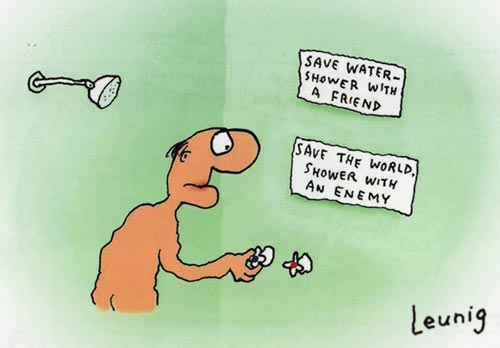
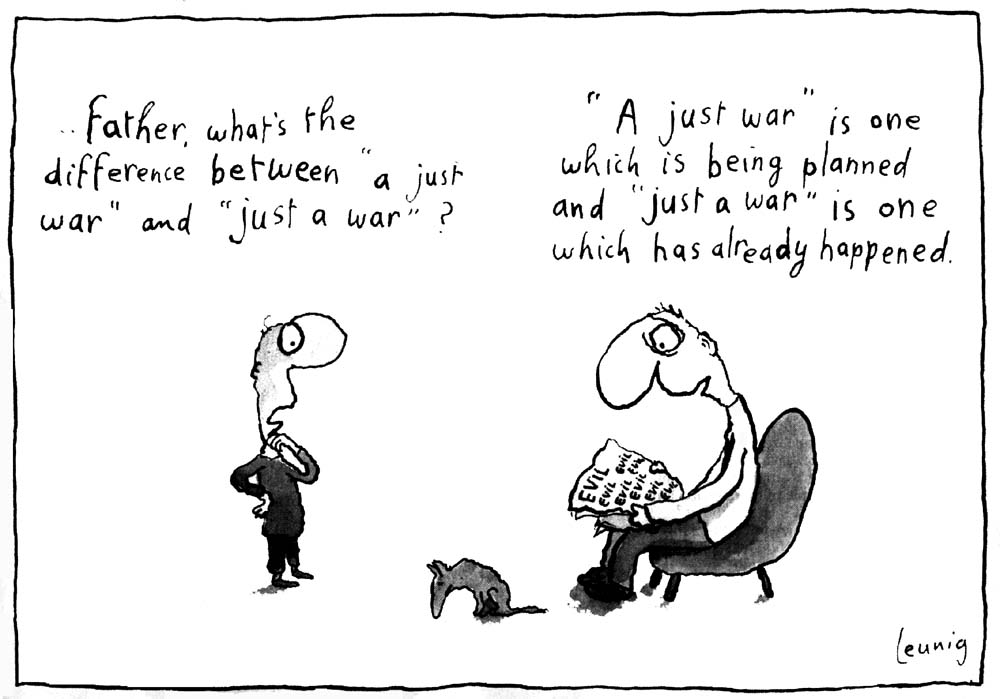
I’ve been enjoying this delightful collection of short essays by the Melbourne-born poet, artist and cultural commentator Michael Leunig. Here’s a snippet from his essay ‘Blood and Guts, Violence and Death’:
“No nation can go to war without a sufficient reserve of hatred, cruelty and bloodlust politely concealed in its general population, and if our so-called Western democracies wanted their ‘war against terror’, then let them now at least see the graphic details of war’s sickening and hideous consequences.
The curse is, however, that it’s the children who are most defiled and blighted by such frightening imagery – and they had no part in it.
My years in the abattoir taught me that society denies its bloodlust and cruelty and imagines that such impulses appropriately belong to prehistoric barbarians, or ‘rough and uncouth men’. But I believe we now have the unique modern cruelty of the refined and educated Western man, the respected gentleman in the fine suit who has never much dirtied his hands or killed a living creature, never meditated upon a rotting corpse and never had his consciousness infected with the messy organic substances of violent death – yet who can sign with an elegant golden pen the document that unleashes the cowardly invasion and who can then go out to dine on claret and lamb cutlets.
The likes of these men abound in the halls of academia, the boardrooms and corridors of power, and the chicken-coop workstations of the media, where they have clamoured for war, for all sorts of ungodly and unfathomable reasons, without really knowing in their bones how it works – the business of violence and blood and guts.
They are primally inexperienced, unconnected and unwise. Their flesh has not been seared. Their repressed death fascination and sly cruelty has not yet been transformed into reverence and understanding by initiation into things carnal and spiritual, by the actual sights and sounds of splattering blood and crunching bone, and the pitiful flailing and wailing of violent death – the very thing they would unleash upon others. Just one sordid street-fight or one helpless minute of aerial bombardment might redeem them. They lack the humbling erudition of the slaughterman, the paramedic and, no doubt, the soldier who has really been a soldier.
I dare say there’s something foul, creepy and disgraceful emerging in the character of corporate and political leadership in ‘Western civilisation’, and I sense it’s substantially the result of an insipid masculinity problem.
The insatiable need for heartless power and ruthless control is the telltale sign of an uninitiated man – the most irresponsible, incompetent and destructive force on earth.”
– Michael Leunig, The Lot: In Words (Camberwell: Penguin, 2008), 50–2.
Hauerwas on the Church and the abolition of war
In Hauerwas’ latest piece, ‘Ten Years and Counting: The Church and the Abolition of War’, we hear, near the eve of 9/11, themes long-echoed by Yoder’s most prolific publisher:
‘I want to convince Christians that war has been abolished. The grammar of that sentence is very important. The past tense is very deliberate. I do not want to convince Christians to work for the abolition of war, but rather I want us to live recognizing that in the cross of Christ war has been abolished.
So I am not asking Christians to work to create a world free of war. The world has already been saved from war. The question is how Christians can and should live in a world of war as a people who believe that war has been abolished’.
You can read the rest here.
I’ve also posted some resources on pacifism and war here.
‘How To Kill’, by Keith Douglas
Under the parabola of a ball,
a child turning into a man,
I looked into the air too long.
The ball fell in my hand, it sang
in the closed fist: Open Open
Behold a gift designed to kill.
Now in my dial of glass appears
the soldier who is going to die.
He smiles, and moves about in ways
his mother knows, habits of his.
The wires touch his face: I cry
NOW. Death, like a familiar, hears
And look, has made a man of dust
of a man of flesh. This sorcery
I do. Being damned, I am amused
to see the centre of love diffused
and the wave of love travel into vacancy.
How easy it is to make a ghost.
The weightless mosquito touches
her tiny shadow on the stone,
and with how like, how infinite
a lightness, man and shadow meet.
They fuse. A shadow is a man
when the mosquito death approaches.
– Keith Douglas, ‘How To Kill’ in Keith Douglas: The Complete Poems (ed. Desmond Graham; London: Faber & Faber, 2000), 119.
Writing off Yoder
The latest edition of One the Road, the journal of the Anabaptist Association of Australia and New Zealand, includes a helpful piece by Michael Buttrey titled ‘12 ways to prematurely write off Yoder: Some common misconceptions about Yoder’s ‘Neo-Anabaptist’ vision’. Buttrey identifies the twelve ‘misconceptions’ as:
1. Yoder believes Constantine corrupted the church.
2. Yoder thinks that there was no salt or light in the medieval church.
3. Yoder hates Luther, Calvin and the other magisterial Reformers.
4. Yoder has a low view of God’s sovereignty over history. Or:
5. He idolizes the early church.
6. Yoder inappropriately sees Jesus’ earthly life as normative.
7. Yoder fails to deal with the Old Testament, especially the wars of Joshua.
8. Yoder’s pacifism inhibits any effective witness to the state, especially regarding war.
9. Even for Christians, Yoder’s pacifism is impossible, or at least irresponsible.
10. Yoder advocates separation from the world that ‘God so loved.’ And:
11. Isn’t Yoder a ‘fideistic sectarian tribalist’ like Stanley Hauerwas?
Here, Buttrey writes:
These common accusations seriously misunderstand Yoder.
First, Yoder’s context was one where he was urging traditionally quietist Anabaptists to realize they had a social ethic and witness to society, while simultaneously calling activist Christians to realize they need not abandon the gospel and take up the methods of the world in their impatience to get things done. Ironically, Yoder has often been taken more seriously by theologians and political philosophers outside his tradition – such as Stanley Hauerwas and Romand Coles – than those on the ‘inside.’
Second, Yoder has no desire to divide the church further. Indeed, in “The Kingdom As Social Ethic” he deeply objects to the labelling of radically obedient groups as sectarian, for they had no intentions of separating themselves:
[Such groups] have called upon all Christians to return to the ethic to which they themselves were called. They did not agree that their position was only for heroes, or only possible for those who would withdraw from wider society. They did not agree to separate themselves as more righteous from the church at large. (85)
Third, Yoder is fundamentally not interested in withdrawal or separation from society. In “The Paradigmatic Public Role of God’s People,” Yoder agrees with Karl Barth that ‘what believers are called to is no different from what all humanity is called to. … To confess that Jesus Christ is Lord makes it inconceivable that there should be any realm where his writ would not run.’ (25) Of course, those who seriously see Christ’s commands as normative for all tend to be called fideists or theocrats. Yoder is neither.
Yoder is not a fideist because, unlike most realists, he sees the gospel as having a truly universal appeal. Christian realists typically assume that the gospel is inaccessible and incomprehensible to all other groups, and so it is necessary to use a neutral, ‘public’ language to oblige non-Christians ‘to assent to our views on other grounds than that they are our views.’ (16–7) Indeed, it is not Yoder but his critics who tend to think that their faith is fundamentally irrational and its public demands must be set aside for that reason. This reverse fideism is not surprising, however, given how modern liberal democracies understand religious groups and language.
Further, Yoder is not a theocrat, because he does not call for the violent imposition of the gospel, which would be an oxymoron. Rather, the challenge for the church is to purify its witness so ‘the world can perceive it to be good news without having to learn a foreign language.’ (24) Christ’s universal lordship obliges the church to make great demands of the world, but by definition, the gospel witness is a process of public dialogue, not coercion.
In short, the best word for Yoder’s understanding of the church’s witness to society is that of model. Consider some of these potential imperatives for civil society Yoder derives theologically in that same essay:
- egalitarianism, not because it is self-evident (history suggests that it is clearly not!) but because baptism into one body breaks down ethnic and cultural barriers;
- forgiveness as commanded by Christ (he agrees with Hannah Arendt that a religious origin and articulation for forgiveness is no reason to discount it in secular contexts);
- radical sharing and hospitality, even voluntary socialism, as implied in the Eucharist; and
- open public meetings and dialogue, as Paul instructed the Corinthians.
This sketch is almost a political “platform,” and hardly separatist. But for Christians with typical approaches to politics, Yoder’s call for the church to be where God’s vision for society is first implemented and practiced is an enormous stumbling block. It is yet another irony that realists are so often closet quietists: they see the only choice as being between transforming society and letting it go its own way. Yoder, however, asks us to obey Christ even if no one else is interested – although he trusts that the Kingdom will advance if the word of God is faithfully witnessed and embodied amid the powers and principalities of the world.
12. Yoder and Stanley Hauerwas are the same.
You can read the full piece here.
Hauerwas on War, Sacrifice and the Alternative to the Sacrifices of War
The ABC’s outstanding Religion and Ethics site has recently posted a stirring three-part reflection on war by Stanley Hauerwas:
- The Sacrifices of War
- War as the Sacrifice of the Refusal to Kill
- The Sacrifice of Christ and the Sacrifices of War
Here are some tasters:
- ‘I think the language of sacrifice is particularly important for societies like the United States in which war remains our most determinative common experience, because states like the United States depend on the story of our wars for our ability to narrate our history as a unified story’.
- ‘I think it is a mistake to focus – as we most often do – only on the sacrifice of life that war requires. War also requires that we sacrifice our normal unwillingness to kill. It may seem odd to call the sacrifice of our unwillingness to kill “a sacrifice,” but I will argue that this sacrifice often renders the lives of those who make it unintelligible. The sacrifice of our unwillingness to kill is but the dark side of the willingness in war to be killed. Of course I am not suggesting that every person who has killed in war suffers from having killed. But I do believe that those who have killed without the killing troubling their lives should not have been in the business of killing in the first place … Killing creates a world of silence isolating those who have killed’.
‘Awarding of medals becomes particularly important. Medals gesture to the soldier that what he did was right and the community for which he fought is grateful. Medals mark that his community of sane and normal people, people who do not normally kill, welcome him back into “normality.” [Lt Col Dave] Grossman calls attention to Richard Gabriel’s observation that “primitive societies” often require soldiers to perform purification rights before letting them rejoin the community. Such rites often involve washing or other forms of cleaning. Gabriel suggest the long voyage home on troop ships in World War II served to give soldiers time to tell to one another their stories and to receive support from one another. This process was reinforced by their being welcomed home by parades and other forms of celebration. Yet soldiers returning from Vietnam were flown home often within days and sometimes hours of their last combat. There were no fellow soldiers to greet them. There was no one to convince them of their own sanity. Unable to purge their guilt or to be assured they had acted rightly, they turned their emotions inward’.- ‘Killing shatters speech, ends communication, isolating us into different worlds whose difference we cannot even acknowledge. No sacrifice is more dramatic than the sacrifice asked of those sent to war, that is, the sacrifice of their unwillingness to kill. Even more cruelly, we expect those who have killed to return to “normality”’.
- Hauerwas also cites from Carolyn Marvin’s and David Ingle’s book Blood Sacrifice and the Nation: Totem Rituals and the American Flag: ‘In the religiously plural society of the United States, sectarian faith is optional for citizens, as everyone knows. Americans have rarely bled, sacrificed or died for Christianity or any other sectarian faith. Americans have often bled, sacrificed and died for their country. This fact is an important clue to its religious power. Though denominations are permitted to exist in the United States, they are not permitted to kill, for their beliefs are not officially true. What is really true in any society is what is worth killing for, and what citizens may be compelled to sacrifice their lives for’. To which Hauerwas comments: ‘This is a sobering judgment, but one that cannot be ignored if Christians are to speak truthfully to ourselves and our neighbours about war. I think, however, Christians must insist that what is true is not what a society thinks is worth killing for, but rather that for which they think it worth dying. Indeed, I sometimes think that Christians became such energetic killers because we were first so willing to die rather than betray our faith. Yet the value of Marvin’s and Ingle’s claim that truth is to be found in that for which you are willing to kill is how it helps us see that the Christian alternative to war is not to have a more adequate “ethic” for conducting war. No, the Christian alternative to war is worship … The sacrifices of war are undeniable. But in the cross of Christ, the Father has forever ended our attempts to sacrifice to God in terms set by the city of man. We (that is, we Christians) have now been incorporated into Christ’s sacrifice for the world so that the world no longer needs to make sacrifices for tribe or state, or even humanity. Constituted by the body and blood of Christ we participate in God’s Kingdom so that the world may know that we, the church of Jesus Christ, are the end of sacrifice. If Christians leave the Eucharistic table ready to kill one another, we not only eat and drink judgment on ourselves, but we rob the world of the witness necessary for the world to know there is an alternative to the sacrifices of war’.
Stanley Hauerwas on patriotism, pacifism and just warriors
On 2 March 2003, David Rutledge conducted the following interview with Stanley Hauerwas on ABC’s Encounter program:
David Rutledge: One of the most prominent Christian pacifist voices in the US at the moment is Stanley Hauerwas, from Duke University in North Carolina. His prominence – or notoriety, perhaps – was established by Time magazine in its “America’s Best” issue of 2001, which proclaimed Stanley Hauerwas as “America’s Best Theologian” and ran a profile on him, entitled Christian Contrarian. In that article, he called on Christians not to be defined by their political community, and he condemned “any and all forms of patriotism, nationalism and state worship”. Well that issue of Time magazine hit the newsstands on September 10th, just 24 hours before the terrorist attacks that dramatically altered the American psyche – and that suddenly put Stanley Hauerwas out on the radical fringe of American public life. I asked Stanley Hauerwas if there was anything in that article that he would have changed, had he known that history was about to take the turn that it did.
Stanley Hauerwas: No, not a thing. I suppose that the claim that radical pacifism and Christian non-violence means that you’re critical of all forms of patriotism – I don’t know that I’m critical of “all forms of patriotism”, because I don’t know what “all forms of patriotism” would look like. I’m certainly critical of the kind of patriotism that we find in America. That is the worst kind possible, because it’s not just a loyalty to the particularities of history and geography, but because of America’s basis within the fundamental norms of the Enlightenment – freedom, equality, abstractions like that – then that means American patriotism cannot help but be a form of imperialism. And that’s always the way it has been. And I think it’s one of the most dangerous forms – indeed it’s virulent on the world stage.
Americans can’t understand – I mean, we just – Americans assume that if you just had enough education and enough money, you would want to be just like us – because we’re what free people look like. And therefore American patriotism, I think, is one of the worst forms that could possibly be present in the world.
I think that in America now, we’re really being ruled by the Right. And I think that they have a view of the world that is just not going to be open to any evidence. And so they’re determined to do this. I really believe that this war was on the drawing tables of many of the people that came into the Bush administration. And I think that September 11th was their licence to do it. September 11th determinatively changed American politics, there is absolutely no question about that. The mid-term elections that we just had, in which the Republicans gained seats both in the Senate and the Congress, is really – I mean, that has never happened in America. That’s new. And I think it has everything to do with Americans’ desire for security. September 11th brought the world home to America – and they don’t like it, they just don’t like it. And they’re willing to go with anyone that’s going to promise safety. And that’s what Bush is offering them.
But I really believe, since I’m a Christian, that you always live in a world at risk. Indeed, what Christianity is about, is always learning how to die early for the right reasons. And Americans just – that’s a thought that is unthinkable right now. I think the American response to September 11th is exactly the other side of the Americans’ unbelievable support for crisis care medicine. They think that if we just get good enough at curing cancer, or good enough at doing something about people suffering heart attacks, or good enough with genetics today, then they’re going to get out of this life alive. It’s just not going to happen.
David Rutledge: Can we go back to just war for a minute? You made an interesting comment, that the just war tradition raises the right kinds of questions; but then the just war tradition is seemingly being invoked at the moment as a justification for war. The assumption seems to be that we can and do wage war, so how can we do it and still remain faithful to our Christian ideals. Now as a pacifist, do you think that that is legitimate? How do you evaluate the just war tradition?
Stanley Hauerwas: I’m certainly willing always to join serious just war thinkers in trying to think through what the implications of being a just warrior should be. But if you take the war on Iraq: why is America able to even imagine going to war in Iraq? It’s because we can. We’ve got all this unbelievable military power, so we can envision it, because we have the capacity for it. Now, the question is: did you get the capacity to wage that kind of war on just war considerations? Is the United States’ foreign policy a just war foreign policy? Is the United States’ military preparedness based on just war considerations? No way! They’re based on presuppositions, that you’d better have as much military might as you can, in a world of anarchy, because the one with the most weapons at the end, wins.
Now, if just war people were more serious about raising questions about the implications of what just war would commit them to – for example, the war on terrorism could not possibly be a just war. I don’t even think it’s a war, I mean that’s a metaphorical use of the word “war” that comes from Americans’ views of – you know, the “war on drugs”, the “war on crime” – I mean, it’s just crap. Because what they need to think about is: just war is always about a political end, that you need to declare, so your enemy will know how they can resign and surrender. And so if you’re about annihilating your enemy, as we were in World War II – that is, we fought it for unconditional surrender – you can’t fight a just war for unconditional surrender, because you’re not trying to destroy your enemy, you’re only trying to stop your enemy from doing the wrong that you declared the war for. I mean, there can’t be a just war against terrorism, because you don’t even know who the enemy is, and you get to keep changing it, and the presumption that a just war should be in response to aggression: well, in what way is Iraq really threatening America? That hasn’t been shown at all. What Iraq threatens is American imperial hegemony in the world. How is that a criterion for just war?
So I regard most of the people that are trying to give an account of why it is that the war against Iraq could meet just war criteria, as just an ideological cover for American realism. And notice: no one’s talking about the war on terrorism that much in America right now, because we lost it. Or at least, we haven’t won it. So instead, everyone’s talking about the war against Iraq, and so you’ve made the shift from the war on terrorism to the war against Iraq, which you’re going to win, and so Bush is not being held accountable for the mistaken strategy of ever declaring war against terrorism.
David Rutledge: Theologian and pacifist Stanley Hauerwas, talking earlier this year on the eve of the American attack on Iraq.
Stanley Hauerwas: What I find absolutely crucial is reflecting on Christ’s death and resurrection. What that means is that God would rather die, God would rather have God’s own Son die, than to redeem the world through violence. And that central story is what Christians are about.
I go to an Episcopal church, and after we finish the Mass, one of the prayers that I find a deep comfort is – I just have the Book of Common Prayer here – Eternal God, heavenly Father, you have graciously accepted us as living members of your Son, our saviour Jesus Christ. You have fed us with spiritual food, in the sacrament of His body and blood. Send us now into the world in peace, and grant us strength and courage to love and serve you, with gladness and singleness of heart, through Christ our Lord. Amen. Now, how could someone that prays that prayer every week at the Eucharistic sacrifice – and remember, the Eucharistic sacrifice is where we become part of Christ’s sacrifice for the world, so the world will know it’s got an alternative to violence – how can anyone that prays that prayer, week after week, run for the Presidency of the United States? It beats the hell out of me.
You know, I’m not trying to call Christians out of being politically involved; I just want them to be there as Christians. And instead, what they get is they think they have a personal relationship with Jesus, which makes it OK for them to do anything that they damn well please, in the name of what’s important for national defence. Well, Jesus is a political saviour, and that prayer is a political prayer. And that’s the kind of seizing of the imagination I’m trying to help Christians regain in America. Because in America, Christians just cannot distinguish themselves – what it means to be Christian, they assume it goes hand in hand with what it means to be an American. And that’s just a deep mistake. But how to help Christians recover that difference is very difficult indeed.
David Rutledge: How much help are you getting in that from the American Christian leadership?
Stanley Hauerwas: Well, for example: the Methodist bishops have given a kind of statement against going to war pre-emptively. And you know, they want you to work through the UN, and that kind of thing. They don’t just come out and say “you do it, George, and your soul is going to Hell. Or your soul is already in Hell”. Which I wish they would do. But George Bush, on the whole, is just ignoring any of that kind of statement, because he knows it doesn’t represent the American Methodists. Most American Methodists assume “well, something needs to be done”, and they therefore wouldn’t follow the lead of their bishops.
There’s been quite a number of statements by most of the mainstream religious bodies – you know, saying “go through the UN” and that kind of thing, but it’s had no effect. Because I think that Bush is right: most of the laity doesn’t know how to think about war at all. And the reason most Christian laity don’t know how to think about war at all, is because our religious leadership has never helped educate the American people. As a pacifist, when I go and lecture to churches about the ethics of war, and try to introduce them to just war considerations – because I think that just war is certainly a very serious alternative that people, if they do it seriously, it raises the right kinds of questions that ought to be raised – I usually get a hand stuck up, and someone says “no one’s every told me that Christians have a problem with war”. Isn’t that remarkable? I say “I know you’ve been betrayed. Fire your bishops”. The teaching office of the church has just been absent, over the years, about these kinds of matters.
David Rutledge: There was commentator in the journal First Things, who said that when Christian go off to fight a just war, they’re following Christ, but at a distance. And I wonder if, in your pacifism, you’re talking about something much more immediate, you’re talking about pacifism as the road to Calvary, if it has to be that way, as following Christ in such a way as to be led unresisting to a horrible death, if that’s what your Christianity calls you to do? Is that the kind of end that you have in mind?
Stanley Hauerwas: It certainly could be. I mean, what is the deep problem? The deep problem of Christian non-violence is: you must be willing to watch innocent people suffer for your convictions. Of course, that’s true. In the hard cases, it means it’s not just your death, it’s watching other people die, whom you might have been able to defend. Now of course, you want to try to do everything you can that would prevent that alternative. But you may have to envision that.
But look: the just warriors are in exactly the same position. Hiroshima and Nagasaki, on just war grounds, were murder. There’s no other description for that. Just warriors need to argue that it would have been better for more people to die on the beaches of Japan, both Americans and Japanese, than to commit one murder. That’s what the position should be committed to holding. So of course, any account of serious attempt to morally control war, would mean that if you’re a just warrior, you’re going to have to watch the innocent suffer for your convictions – just like the pacifist does. But on the whole, most people who argue on just war grounds don’t want to acknowledge that. But they should.
David Rutledge: Do you think that one of the key problems for a message like yours, in America or in the world right now, is that when you talk about watching innocent people suffer in the course of a war, the most outstanding recent example of that is the deaths of thousands of Americans at the World Trade Centre and the Pentagon. And the most difficult thing in the world at the moment is for Americans to say “well, in the name of justice, we can’t allow those deaths to be the pretext for more deaths” – even though that’s right at the heart of Christian teaching?
Stanley Hauerwas: Well, I think that Americans simply cannot contemplate Americans getting to die as victims. And they want to turn their deaths into some good. And when they do that, you exactly betray – at least, as Christians – what we should have learned through the Cross: that the attempt to make life meaningful, even life that has died, through further violence, is absolutely futile. But we seem determined to want to do that, and I think we in the world will pay a great price for that. I mean, the price that Americans are going to have to pay for the kind of arrogance that we are operating out of right now, is going to be terrible indeed. And I think that when America isn’t able to rule the world, that people will exact some very strong judgements against America – and I think we will well deserve it.
Around the traps … [updated]
- Podcasts of William Lane Craig on Searching for the Historical Jesus and of William Lane Craig and Shelly Kagan on Is God Necessary for Morality?.
- Ernst Troeltsch and the resurrection: an Easter sermon by Kim Fabricius.
- A new book on Karl Barth: The Trinity and Creation in Karl Barth by Gordon Watson.
- Andrew Sullivan is Thinking Out Loud.
- David Bentley Hart’s bizarre thoughtlessness regarding pacifism by Brian Hamilton. Dave Belcher also posts on David Bentley Hart.
- The New York Times is running some photographs (by Jehad Nga, who was one of American Photo’s Emerging Artists in 2007) and audio of US troops leaving Iraq.
- Protect peaceful Moldovan protesters from police ill-treatment.
- Justine Toh on Clint Eastwood and the ethics of violence.
- And in case you missed it: David’s Ten Theses on Prayer and Ben’s stellar reflection on Led Zeppelin IV.
Pacifism and War: Some Resources [Updated]
I’m trying to put together a list of responsible books/essays that explore theologically questions of Christian pacifism and Christian attitudes to war, and would be keen to hear of such that others have found helpful (and, if possible, why). Here’s what I’ve come up with so far:
Wilma A. Bailey, “You shall not kill” or “You shall not murder”?: The Assault on a Biblical Text (Collegeville: Liturgical Press, 2005).
Roland H. Bainton, Christian Attitudes Towards War and Peace: A Historical Survey and Critical Re-evaluation (Nashville: Abingdon Press, 1960).
Oliver R. Barclay, ed., Pacifism and War (When Christians Disagree) (Leicester: Inter-Varsity Press, 1984).
Clive Barrett, ed., Peace Together: A Vision of Christian Pacifism (Cambridge: James Clarke & Co., 1987).
Eberhard Bethge, Dietrich Bonhoeffer: Man of Vision, Man of Courage (New York: Harper & Row, 1970).
Robert W. Brimlow, What About Hitler?: Wrestling with Jesus’s Call to Nonviolence in an Evil World (Grand Rapids: Brazos, 2006).
Martin Ceadel, Pacifism in Britain, 1914-45: Defining of a Faith (Oxford: Clarendon Press 1980).
*David L. Clough and Brian Stiltner, Faith and Force: A Christian Debate About War (Washington D.C.: Georgetown University Press, 2007).
Robert G. Clouse, ed., War: Four Christian Views (Downers Grove: InterVarsity Press, 1981).
James Denney, War and the Fear of God (London: Hodder and Stoughton, 1916).
Kim Fabricius, Ten Propositions on Peace and War (with a postscript)
Kim Fabricius, Ten Stations on My Way to Christian Pacifism
Gabriella Fiori, Simone Weil: An Intellectual Biography (trans. J.R. Berrigan; Athens/London: University of Georgia Press, 1989).
Peter T. Forsyth, The Christian Ethic of War (London: Longmans, Green, and Co., 1916).
Peter T. Forsyth, The Justification of God: Lectures for War-Time on a Christian Theodicy (London: Independent Press, 1957).
*Stanley Hauerwas, Against the Nations: War and Survival in a Liberal Society (Notre Dame: University of Notre Dame Press, 1992).
Stanley Hauerwas, Dispatches from the Front: Theological Engagements with the Secular (Durham: Duke University Press, 1994).
Stanley Hauerwas, September 11: A Pacifist Response. From remarks given at the University of Virginia, October 1, 2001.
Stanley Hauerwas, ‘No, This War Would Not Be Moral’, in Time (3 March, 2003).
Stanley Hauerwas and Paul Griffiths, ‘War, Peace & Jean Bethke Elshtain’, in First Things (October, 2003).
Stanley Hauerwas, Performing the Faith: Bonhoeffer and the Practice of Nonviolence (Grand Rapids: Brazos Press, 2004).
Stanley Hauerwas and Jean Vanier, Living Gently in a Violent World: The Prophetic Witness of Weakness (Downers Grove: IVP, 2008).
Eberhard Jüngel, Christ, Justice and Peace: Toward a Theology of the State in Dialogue with the Barmen Declaration (Edinburgh: T&T Clark, 1992).
Geoffrey A. Studdert Kennedy, Rough Rhymes of a Padre (Toronto: Hodder & Stoughton, 1918).
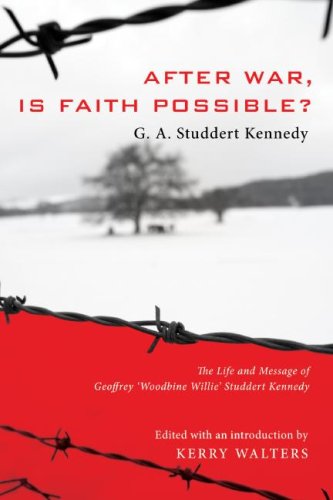
Geoffrey A. Studdert Kennedy, After War, Is Faith Possible?: The Life and Message of Geoffrey “Woodbine Willie” Studdert Kennedy (ed. Kerry Walters; Eugene: Cascade, 2008). [Reviewed here]
Jean Lasserre, War and the Gospel (London: James Clarke, 1962).
Philip Matthews and David Neville, ‘C.S. Lewis and Christian Pacifism’ in Faith and Freedom: Christian Ethics in a Pluralist Culture (Hindmarsh: ATF Press, 2004), 205-16.
Paul O’Donnell and Stanley Hauerwas, A Pacifist’s Look at Memorial Day: Duke University Divinity professor Stanley Hauerwas on nonviolence, Iraq and killing Hitler.
Oliver O’Donovan, In Pursuit of a Christian View of War (Bramcotte Notts: Grove Books, 1977).
*Oliver O’Donovan, The Just War Revisited (Cambridge: Cambridge University Press, 2003).
George Orwell, ‘Pacifism and the War’, Partisan Review August-September (1942).
Paul Ramsey, War and the Christian Conscience (Durham: Duke University Press, 1968).
Paul Ramsey, The Just War: Force and Political Responsibility (Lanham/Oxford: Rowman & Littlefield, 2002).
Alan Ruston, ‘Protestant Nonconformist Attitudes towards the First World War’, in Protestant Nonconformity in the Twentieth Century (ed. Alan P. F. Sell and Anthony R. Cross; Milton Keynes: Paternoster, 2003), 240-263. [The book is reviewed here]
*W. J. Sheils, ed., The Church and War: Papers read at the Twenty-first Summer Meeting and the Twenty-second Winter Meeting of the Ecclesiastical History Society (Oxford: Basil Blackwell, 1983).
Ronald J. Sider, Christ and Violence (Kitchener: Herald Press, 1979).
*Glen H. Stassen, ed., Just Peacemaking: The New Paradigm for the Ethics of Peace and War (Cleveland: Pilgrim Press, 2008).
John Stott, ed., The Year 2000AD (London: Marshalls, 1983), 27-71.
John Stott, Issues Facing Christians Today: New Perspectives on Social and Moral Dilemmas (London: William Collins Sons & Co., 1990), 82-112.
Helmut Thielicke, Theological Ethics Volume 2: Politics (Grand Rapids: Wm. B. Eerdmans, 1979).
Miroslav Volf, ‘Christianity and Violence’ (A paper presented at the Boardman Lectureship in Christian Ethics, Boardman Lecture XXXVIII, University of Pennsylvania, 1 March, 2002).
Alan Wilkinson, Dissent or Conform? War, Peace and the English Churches, 1900-1945 (London: SCM Press, 1986).
*John Howard Yoder, The Original Revolution: Essays on Christian Pacifism (Scottdale/Kitchener: Herald Press, 1971).
John Howard Yoder, When War is Unjust: Being Honest in Just-War Thinking (Minneapolis: Augsburg, 1984).
John Howard Yoder et al., What Would You Do?: A Serious Answer to a Standard Question (Scottsdale/Kitchener: Herald Press, 1983).
John Howard Yoder, Christian Attitudes to War, Peace, and Revolution (ed. Theodore J. Koontz and Andy Alexis-Baker; Grand Rapids: Brazos Press, 2009).
Supplementary Readings
Terry Eagleton, ‘Isaiah Berlin and Richard Hoggart’ in Figures of Dissent: Critical Essays on Fish, Spivak, Žižek and Others (London/New York: Verso, 2003), 104-8.
Robert Jenson: Burns Lecture 2 – The Tanakh as Christian Scripture

© 2009. Photo taken by John Roxborogh, when Robert Jenson visited the Knox Centre for Ministry and Leadership in Dunedin. Used with permission.
The Burns Lectures are definitely warming up. In this lecture Robert Jenson dealt with the Tanakh, or Old Testament (as is his preferred terminology with appropriate qualification: ‘old’ equals ‘prior’ rather than ‘antiquated’) as Christian scripture. He began by clarifying the appropriate questions – the status of the OT as Christian scripture was never questioned and for Jenson this can’t be the Church’s question since it is both absolutely prior (presumably in the sense that it constitutes the world in which the Christian faith is born) and necessary for the Church’s self-understanding. Jenson says that the really interesting question for the first Christians was a kind of obverse to that which questions the status of Israel’s scriptures, namely whether Israel’s scriptures could accept the proclamation of the resurrection. The Church, he insisted, did not accept Israel’s scriptures. Rather, Israel’s scriptures received the Church. Jenson noted that for the century, it was Israel’s scriptures which served the Gospel rather than the obverse. This question is alive even though it cannot be clearly asked since God has already answered it in raising Jesus.
Jenson proceeded to highlight how this question is constantly in the background of NT writing and how the NT demonstrates in the way it tells its story a ‘narrative harmony’ with Israel’s scriptures – relationship between passion narrative and Isaiah 53 being a case in point. The OT prophets were the one’s who provided the answer to ‘why’ did Jesus needed to die. Jenson argued that we cannot ask why the OT Scripture after Christ. Rather, we can only ask how scripture is the way for the Christian community. He also observed that the Church reads the OT as narrative because her gospel is itself a narrative, and because her gospel recognizes itself as the climax of the story told in the OT. Jenson cautioned about ‘unguarded talk of the unique fullness of God’s revelation in Christ’ [is that the mythological Christomonism?]. Such talk requires, says Jenson, the important qualification that the God present to the OT sages is the same Word, Jesus Christ. Jesus taught the scriptures with ‘authority’ says Jenson, ‘that is, as if he were the author … because, in a sense, he is’. Jenson continued this line with comments like ‘Christ prayed the psalms as the leader of Israel’s worship gathered as the body of Christ’. When ancient Israel gathered in the temple with their hymns and lamentations they were gathered as ‘the body of Christ’. At this point he introduced some of the difficult issues that were to arise later in his lecture also. In response to those who wonder whether Christians can pray the Psalms that call for the destruction of their enemies and the bashing of babies against rocks, he suggested, with some rhetorical flourish, that they could pray them at the foot of the cross against the devil and his angels. [We shall return to this claim]
The key question which the latter part of Jenson’s lecture focuses on is not whether the OT is Christian scripture but precisely how it so functions. Jenson’s answer is that it functions as ‘narrative of God’s history with his people’, including the Church. This arises because the Church’s gospel is narrative and it identifies itself as the climax of the narrative of Israel’s history. Why this should be so stems from the character of the ‘regula fidei’ as a ‘plotted sequence of God’s acts’ (economy) on the one hand and the nature of the book the Church wrote as a second testament. He interestingly contrasts the two movements to emerge from old Israel with the destruction of the temple – rabbinic Judaism ended up using the Tanakh differently from the Church because their second testament (Mishnah) had a legal character which meant that they read their Torah with law as a guiding concept. On the other hand the Church with its narrative gospel ended up contextualising law within the narrative of God with his people. This also had a lot to do with Paul’s very complex problematisation of the law.
The ‘how’ question in relation to the role of the OT was forged in contrast to various challenges to the initial role of the OT – Gnosticism, Marcionism, and Platonism. Although there was a certain ‘Church History 101’ feel to the lecture here, Jenson’s characterization of the movements and issues was always interesting. In response to all these developments, but particularly to that ‘monomaniacal Paulinist’ Marcion, Jenson says that Christians have no way of avoiding the fact that the God of Israel is a ‘man of war’ who goes into battle, sometimes for, sometimes against, his people, but a God who takes sides in history. This, says Jenson, is the only alternative to a god who abandons history. God is either involved in fallen history as the God of Israel is, or God is not. If God is to engage a violent history God cannot do so without being a ‘God of war’, that is, without getting God’s hands dirty. And it seems, for Jenson, to be involved is to be implicated as an agent of violence. Like Hans Boersma has also recently argued, Jenson seems to hold that God uses violence as a means justified by God’s ends – that God participates in the world’s violence but he does so by entering into that violence and dying in it, through which violence is undone.
When questioned as to whether there was a third alternative, namely to suffer violence as the crucified one, Jenson responded effectively that in relation to this issue it was not really a third alternative since the crucifixion was an event in which God was both the crucifier and the crucified – and therefore, presumably, not non-violent. He also presumed that the question was motivated by the issue of theodicy.
Three critical questions arise at this point:
- The first picks up on the difference the revelation of God in Christ makes. Why did Jenson limit the praying of that psalm to prayers against “the devil and his angels”? If he is to be consistently true to the ‘man of war’ motif, why do not Christians pray against their human enemies and their enemy’s babies? And if they do so, how is this consistent with love for one’s enemies?
- Is it necessary that if the Father sent the Son to the cross and the Son went to the cross in obedience to the Father that the God of Israel must be seen as both the crucified and the crucifier? Surely the willingness to be crucified and the willingness to let the Son be crucified (not my will but yours) do not entail the agency of crucifixion. Surely the fact that this evil event is ultimately good (Friday) lies in the good consequent upon it (for the joy that was set before him). There is no paradoxical necessity to make God (in whom there is no darkness) the agent of death. Surely the triune God is here its defeater.
- Finally, does the fact that the Old Testament is the Church’s scripture rule out the possibility that it, like the New Testament, is a ‘text in travail’ bearing witness to Israel education by God. Is it not possible to discern in the light of the crucifixion and resurrection of Christ a journey within Israel to unlearn pagan violence – we think here of a trajectory which includes the Cain/Abel story, the Akideh, the repentance of God post flood, the Joseph story, story of Job, the servant songs and so much more. So rather than accepting a strand which is taken for granted in the scriptures – God as man of war – why not discern how that strand is being deconstructed in the course of Israel’s journey with God? If such a reading is persuasive then the motivation to question the ‘man of war’ motif need not be motivated by theodicy, or not in any simplistic way.
Past Lectures:
1. Creed, Scripture, and Their Modern Alienation
Following Lectures:
3. The New Testament and the Regula Fidei
5. The Creed as Critical Theory of Scripture
6. Genesis 1:1 and Luke 1:26-38
Notes by Bruce Hamill and Jason Goroncy
‘After War, Is Faith Possible?’: A Commendation
Geoffrey A. Studdert Kennedy, After War, Is Faith Possible?: The Life and Message of Geoffrey “Woodbine Willie” Studdert Kennedy (ed. Kerry Walters; Eugene: Cascade, 2008). xii + 225 pages. ISBN: 978-1-55635-379-6. Review copy courtesy of Wipf and Stock.
One the real delights of my research into the thought of PT Forsyth has been revisiting, and in some cases discovering for the first time, others who were writing around the same time, and often of the same events. To re-read James Denney, or James Baldwin Brown, or FD Maurice, is one of the best ways one could spend a month … or two. Another giant personality to add to that list would have to be Geoffrey A. Studdert Kennedy, better known as ‘Woodbine Willie’. (I posted on ) My copies of Studdert Kennedy’s work, which are all over 90 years old, form a truly valuable part of my library and one to which I return not infrequently. Collected Poetry (London: Hodder & Stoughton, 1927), The Hardest Part (London: Hodder & Stoughton, 1918), I Believe: Sermons on the Apostles Creed (New York: George H. Doran, 1921), Rough Rhymes of a Padre (Toronto: Hodder & Stoughton, 1918) and The Wicket Gate, or Plain Bread (London: Hodder & Stoughton, 1923) all constitute exceptional reading.
And so I was absolutely delighted to discover that Wipf & Stock decided to republish some Woodbine Willie excerpts, all well chosen and just enough to plant an appetite in those who will no doubt want to hear more from ‘the bloody parson!’ (p. 12). The collection was edited by Kerry Walters, who also contributed a very fine introduction on Studdert Kennedy’s life and message, and a helpful bibliography of the primary and secondary literature.
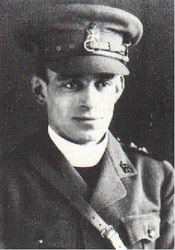
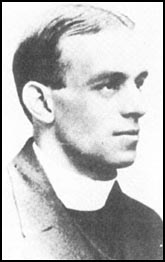
This WWI padre was, of course, one of the best-known and most-loved Christian pacifists of the early twentieth century. Unlike those theological yuppies who defend pacifism on purely ideological grounds and over a café latte in Lygon Street – informed by the Gospel or otherwise – Woodbine Willie’s commitment to pacifism was birthed in the trenches alongside frightened men and their dead mates. In all that he wrote, a number of questions incessantly occupied his thought: ‘Given the insanity and brutality of war (‘the universal disaster’; p. 14), what must the God who allows it be like? (p. 13); How is evil to be gotten rid of? (p. 3); What sort of universe ought an honest person believe in? (p. 15). His answer to these questions eventually led to the conviction that God is not sadistic, or indifferent to the world’s evil. Neither is God ‘Almighty’ enough to prevent such evils: ‘I see no evidence anywhere in nature of the Almighty Potentate Who guides and governs all things with His rod, and knows no failure and thwarting of His Will’ (p. 81). What God does do, Woodbine Willie insists (in Moltmannesque manner), is to suffer with and alongside humanity. This is love’s character – not raw despotic power but entering into the sorrows of the beloved. War then, which is evil in its most acute form, is ‘the test case for determining if Christianity can cope with evil’ (p. 21).
Against those who would ‘blather’ about the ‘glory of war’, or who would hold out hope for war being a converting ordinance, Woodbine Willie says that ‘war is pure undiluted, filthy sin. I don’t believe that it has ever redeemed a single soul – or ever will’ (p. 62):
War is only glorious when you buy it in the Daily Mail and enjoy it at the breakfast table. It goes splendidly with bacon and eggs. Real war is the final limit of damnable brutality, and that all there is in it. It’s about the silliest, filthiest, most inhumanly fatuous thing that ever happened. It makes the whole universe seem like a mad muddle. One feels that all talk of order and meaning in life is insane sentimentality. (p. 41)

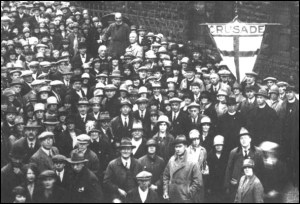
Geoffrey Studdert Kennedy speaking at Tredegar during an Industrial Christian Fellowship Crusade in 1928.
There are no words foul and filthy enough to describe war. Yet I would remind you that this indescribably filthy thing is the commonest thing in History, and that if we believe in a God of Love at all we must believe in the face of war and all it means. The supreme strength of the Christian faith is that it faces the foulest and filthiest of life’s facts in the crude brutality of the Cross, and through them sees the Glory of God in the face of Jesus Christ. (p. 49)
Waste of Muscle, waste of Brain,
Waste of Patience, waste of Pain,
Waste of Manhood, waste of Health,
Waste of Beauty, waste of Wealth,
Waste of Blood, and waste of Tears,
Waste of Youth’s most precious years,
Waste of ways the Saints have trod,
Waste of Glory, waste of God –
War! (p. 50)
I cannot say that war, disease, pestilence, famine, and all the other characteristics of the process are good. If this word “Almighty” means that the Father could have made this world, and obtained the results He desires, in a thousand other ways, but that He deliberately chose this, that makes my gorge rise. Why in thunder choose this one? It is disreputable if He could have done it otherwise, without this cruelty and wrong. It is not commonly respectable. He must be an evil-minded blackguard, with a nasty disposition like a boy that likes pulling the wings off flies. I cannot get up any reverence for such a being. Why, bless my life, He tortures children, voluntarily tortures them to death, and has done so for thousands of years. I can’t stand that at all – it’s dirty; and when I am told that I must believe it, and that every detail of the process was planned out precisely as He wished, I begin to turn sick. Snakes, sharks, and blood-sucking vermin – what sort of a God is this? He chose this way because He gloried in it! That beats the band. It turns me clean up against the process. I cannot see its beauty for its brutality. I cannot hear the lark sing for the squealing of a rabbit tortured by a stoat, I cannot see the flowers for the face of a consumptive child with rotten teeth, the song of the saints is drowned by the groans of murdered men. (p. 75)
A soldier in time of war is not a person but a puppet, who moves when you pull strings. (p. 78)
… our armaments are symbols, not of our power, but of our weakness … Our military power is an exact index of our spiritual and moral impotence. (p. 79)
Life is one, from the single cell to the Savior in the flesh. I cannot separate swine from Shakespeare or Jellyfish from Jesus of Nazareth; they all are products of the process. So behind the process there must be a Spirit which is like the Spirit of man. (p. 81)
I am not a pacifist (I’ve been too persuaded by Forsyth and Jüngel here), but reading Woodbine Willie continuously challenges me to ask myself whether I should be, whether our Lord’s command to ‘Love your enemies’ (Matt 5:44) really does, in Barth’s words, abolish ‘the whole exercise of force’. Either way, Barth is most certainly correct when he challenges: ‘In conformity with the New Testament, one can be pacifist not in principle but only in practice (praktisch Pazifist). But let everyone consider very carefully whether, being called to discipleship, it is possible to avoid – or permissible to neglect – becoming a practical pacifist!’ (Church Dogmatics IV/2, 549-50).
Faith does not mean that we cease from asking questions; it means that we ask and keep on asking until the answer comes; that we seek and keep on seeking until the truth is found; that we knock and keep on knocking until the door is opened and we enter into the palace of God’s truth. (p. 63)
Woodbine Willie dares us to keep on prayerfully asking the questions …
If the Church is to be a Church indeed, and not a mere farce – and a peculiarly pernicious farce, a game of sentimental make-believe – she must be filled to overflowing with the fire of the ancient prophets for social righteousness, with the wrath and love of the Christ. (p. 196)
The Church is not, and never can be, an end in itself; it is a means to an end; a means to the salvation of the world and the building of the Kingdom of God. It is not the Ark of Salvation for themselves, it is the Agent of Salvation for mankind. It is not a refuge of peace, but an army preparing for war. They seek in it, not security, but sacrifice. This is the infallible mark of the Church, the hallmark of the Cross. And if the sin of our modern slums, and the degradation that they cause; if the sin of our over-crowded, rotten houses, and the ugliness and vice they bring; if the sin of unemployment, with the damnation of body and soul that it means to men and women, boys and girls; if the sin of the heartless, thoughtless luxury at one end, standing out against the squalid and degrading poverty at the other; if the sin of commercial trickery and dishonesty, and wholesale defrauding of the poor; if the sin of prostitution, and the murder of women and children by venereal disease; if the sin of war, the very sin of sins, which is but the bursting into a festering sore of all the filth that the others have bred in years of miscalled peace; if all that is not laid upon the Church as a burden, and Christ’s members do not feel it as their own, then the Church is not a Church at all; and no amount of organization, propaganda, and evangelization can make it live. It has missed its vocation. (p. 167)
John Pilger on ‘The politics of bollocks’
While much of the world has been observing the post-election balloons starting to deflate, the last streamers being swept up, and the last drop of bubbly being sculled (though some of us have now refilled our flutes after recent news), John Pilger‘s gutsy pen has been resisting all efforts to shut up and be grateful that at least President Bush is gone. It’s time, he says, for Obama-lovers to grow up. He is, of course, right. Here’s Pilger piece published in yesterday’s New Statesman:
‘Growing up in an Antipodean society proud of its rich variety of expletives, I never heard the word bollocks. It was only on arrival in England that I understood its magisterial power. All classes used it. Judges grunted it; an editor of the Daily Mirror used it as noun, adjective and verb. Certainly, the resonance of a double vowel saw off its closest American contender. It had authority.
A high official with the Gilbertian title of Lord West of Spithead used it to great effect on 27 January. The former admiral, who is a security adviser to Gordon Brown, was referring to Tony Blair’s assertion that invading countries and killing innocent people did not increase the threat of terrorism at home.
“That was clearly bollocks,” said his lordship, who warned of a perceived “linkage between the US, Israel and the UK” in the horrors inflicted on Gaza and the effect on the recruitment of terrorists in Britain. In other words, he was stating the obvious: that state terrorism begets individual or group terrorism at source. Just as Blair was the prime mover of the London bombings of 7 July 2005, so Brown, having pursued the same cynical crusades in Muslim countries and having armed and disported himself before the criminal regime in Tel Aviv, will share responsibility for related atrocities at home.
There is a lot of bollocks about at the moment.
The BBC’s explanation for banning an appeal on behalf of the stricken people of Gaza is a vivid example. Mark Thompson, the BBC’s director general, cited the corporation’s legal requirement to be “impartial . . . because Gaza remains a major ongoing news story in which humanitarian issues . . . are both at the heart of the story and contentious”.
In a letter to Thompson, David Bracewell, a licence-fee payer, illuminated the deceit behind this. He pointed to previous BBC appeals for the Disasters Emergency Committee that were not only made in the midst of “an ongoing news story” in which humanitarian issues were “contentious”, but also demonstrated how the corporation took sides.
In 1999, at the height of the illegal Nato bombing of Serbia and Kosovo, the TV presenter Jill Dando made an appeal on behalf of Kosovar refugees. The BBC web page for that appeal was linked to numerous articles meant to stress the gravity of the humanitarian issue. These included quotations from Blair himself, such as: “This will be a daily pounding until he [Slobodan Milosevic] comes into line with the terms that Nato has laid down.” There was no significant balance of view from the Yugoslav side, and not a single mention that the flight of Kosovar refugees began only after Nato had started bombing.
Similarly, in an appeal for victims of the civil war in the Congo, the BBC favoured the regime led by Joseph Kabila by not referring to Amnesty, Human Rights Watch and other reports accusing his forces of atrocities. In contrast, the rebel leader Laurent Nkunda was “accused of committing atrocities” and ordained the bad guy by the BBC. Kabila, who represented western interests, was clearly the good guy – just like Nato in the Balkans and Israel in the Middle East.
While Mark Thompson and his satraps richly deserve the Lord West of Spithead Bollocks Blue Ribbon, that honour goes to the cheer squad of President Barack Obama, whose cult-like obeisance goes on and on.
On 23 January, the Guardian‘s front page declared, “Obama shuts network of CIA ‘ghost prisons'”. The “wholesale deconstruction [sic] of George Bush’s war on terror”, said the report, had been ordered by the new president, who would be “shutting down the CIA’s secret prison network, banning torture and rendition . . .”
The bollocks quotient on this was so high that it read like the press release it was, citing “officials briefing reporters at the White House yesterday”. Obama’s orders, according to a group of 16 retired generals and admirals who attended a presidential signing ceremony, “would restore America’s moral standing in the world”. What moral standing? It never ceases to astonish that experienced reporters can transmit PR stunts like this, bearing in mind the moving belt of lies from the same source under only nominally different management.
Far from “deconstructing the war on terror”, Obama is clearly pursuing it with the same vigour, ideological backing and deception as the previous administration. George W Bush’s first war, in Afghanistan, and last war, in Pakistan, are now Obama’s wars – with thousands more US troops to be deployed, more bombing and more slaughter of civilians. Last month, on the day he described Afghanistan and Pakistan as “the central front in our enduring struggle against terrorism and extremism”, 22 Afghan civilians died beneath Obama’s bombs in a hamlet populated mainly by shepherds and which, by all accounts, had not laid eyes on the Taliban. Women and children were among the dead, which is normal.
Far from “shutting down the CIA’s secret prison network”, Obama’s executive orders actually give the CIA authority to carry out renditions, abductions and transfers of prisoners in secret without threat of legal obstruction. As theLos Angeles Times disclosed, “current and former US intelligence officials said that the rendition programme might be poised to play an expanded role”. A semantic sleight of hand is that “long-term prisons” are changed to “short-term prisons”; and while Americans are now banned from directly torturing people, foreigners working for the US are not. This means that America’s numerous “covert actions” will operate as they did under previous presidents, with proxy regimes, such as Augusto Pinochet’s in Chile, doing the dirtiest work.
Bush’s open support for torture, and Donald Rumsfeld’s extraordinary personal overseeing of certain torture techniques, upset many in America’s “secret army” of subversive military and intelligence operators because it exposed how the system worked. Obama’s newly confirmed director of national intelligence, Admiral Dennis Blair, has said the Army Field Manual may include new forms of “harsh interrogation” which will be kept secret.
Obama has chosen not to stop any of this. Neither do his ballyhooed executive orders put an end to Bush’s assault on constitutional and international law. He has retained Bush’s “right” to imprison anyone, without trial or charge. No “ghost prisoners” are being released or are due to be tried before a civilian court. His nominee for attorney general, Eric Holder, has endorsed an extension of Bush’s totalitarian USA Patriot Act, which allows federal agents to demand Americans’ library and bookshop records. The man of “change” is changing little. That ought to be front-page news from Washington.
The Lord West of Spithead Bollocks Prize (Runner-Up) is shared. On 28 January, a nationally run Greenpeace advertisement opposing a third runway at Heathrow Airport in London summed up the almost wilful naivety that has obstructed informed analysis of the Obama administration.
“Fortunately,” declared Greenpeace beneath a Godlike picture of Obama, “the White House has a new occupant, and he has asked us all to roll back the spectre of a warming planet.” This was followed by Obama’s rhetorical flourish about “putting off unpleasant decisions”. In fact, the president has made no commitment to curtail America’s infamous responsibility for the causes of global warming. As with George W Bush and most other modern-era presidents, it is oil, not stemming carbon emissions, that informs his administration. His national security adviser, General Jim Jones, a former Nato supreme commander, made his name planning US military control over the exploitation of oil and gas reserves from the Persian Gulf and the Caspian Sea to the Gulf of Guinea off Africa.
Sharing the Bollocks Runner-Up Prize is the Observer, which on 25 January published a major news report headlined, “How Obama set the tone for a new US revolution”. This was reminiscent of the Observer almost a dozen years ago when liberalism’s other great white hope, Tony Blair, came to power. “Goodbye xenophobia” was the Observer‘s post-election front page in 1997 and “The Foreign Office says ‘Hello World, remember us?'”. The government, said the breathless text, would push for “new worldwide rules on human rights and the environment” and implement “tough new limits” on arms sales. The opposite happened. Last year, Britain was the biggest arms dealer in the world; currently, it is second only to the United States.
In the Blair mould, the Obama White House “sprang into action” with its “radical plans”. The president’s first phone call was to that Palestinian quisling, the unelected and deeply unpopular Mahmoud Abbas. There was a “hot pace” and a “new era”, in which a notorious name from an ancien régime, Richard Holbrooke, was despatched to Pakistan. In 1978, Holbrooke betrayed a promise to normalise relations with the Vietnamese on the eve of a vicious embargo ruined the lives of countless Vietnamese children. Under Obama, the “sense of a new era abroad”, declared the Observer, “was reinforced by the confirmation of Hillary Clinton as secretary of state”. Clinton has threatened to “entirely obliterate Iran” on behalf of Israel.
What the childish fawning over Obama obscures is the dark power assembled under cover of America’s first “post-racial president”. Apart from the US, the world’s most dangerous state is demonstrably Israel, having recently killed and maimed some 4,000 people in Gaza with impunity. On 10 February, a bellicose Israeli electorate is likely to put Binyamin Netanyahu into power. Netanyahu is a fanatic’s fanatic who has made clear his intention of attacking Iran. In the Wall Street Journal of 24 January, he described Iran as the “terrorist mother base” and justified the murder of civilians in Gaza because “Israel cannot accept an Iranian terror base [Gaza] next to its major cities”. On 31 January, unaware he was being filmed, Tel Aviv’s ambassador to Australia described the massacres in Gaza as a “pre-introduction” – a dress rehearsal – for an attack on Iran.
For Netanyahu, the reassuring news is that the new US administration is the most Zionist in living memory, a truth that has struggled to be told from beneath the soggy layers of Obama-love. Not a single member of the president’s team demurred from his support for Israel’s barbaric actions in Gaza. Obama himself likened the safety of his two young daughters with that of Israeli children but made not a single reference to the thousands of Palestinian children killed with American weapons – a violation of both international and US law. He did, however, demand that the people of Gaza be denied “smuggled” small arms with which to defend themselves against the world’s fourth-largest military power. And he paid tribute to the Arab dictatorships, such as Egypt, which are bribed by the US treasury to help the United States and Israel enforce policies described by the UN special rapporteur Richard Falk, a Jew, as “genocidal”.
It is time the Obama lovers grew up. It is time those paid to keep the record straight gave us the opportunity to debate informatively. In the 21st century, people power remains a huge and exciting and largely untapped force for change, but it is nothing without truth. “In the time of universal deceit,” wrote George Orwell, “telling the truth is a revolutionary act.”
Chomsky on ‘”Exterminate all the Brutes”: Gaza 2009’
On Saturday December 27, the latest US-Israeli attack on helpless Palestinians was launched. The attack had been meticulously planned, for over 6 months according to the Israeli press. The planning had two components: military and propaganda. It was based on the lessons of Israel’s 2006 invasion of Lebanon, which was considered to be poorly planned and badly advertised. We may, therefore, be fairly confident that most of what has been done and said was pre-planned and intended.
That surely includes the timing of the assault: shortly before noon, when children were returning from school and crowds were milling in the streets of densely populated Gaza City. It took only a few minutes to kill over 225 people and wound 700, an auspicious opening to the mass slaughter of defenseless civilians trapped in a tiny cage with nowhere to flee.
In his retrospective “Parsing Gains of Gaza War,” New York Times correspondent Ethan Bronner cited this achievement as one of the most significant of the gains. Israel calculated that it would be advantageous to appear to “go crazy,” causing vastly disproportionate terror, a doctrine that traces back to the 1950s. “The Palestinians in Gaza got the message on the first day,” Bronner wrote, “when Israeli warplanes struck numerous targets simultaneously in the middle of a Saturday morning. Some 200 were killed instantly, shocking Hamas and indeed all of Gaza.” The tactic of “going crazy” appears to have been successful, Bronner concluded: there are “limited indications that the people of Gaza felt such pain from this war that they will seek to rein in Hamas,” the elected government. That is another long-standing doctrine of state terror. I don’t, incidentally, recall the Times retrospective “Parsing Gains of Chechnya War,” though the gains were great.
The meticulous planning also presumably included the termination of the assault, carefully timed to be just before the inauguration, so as to minimize the (remote) threat that Obama might have to say some words critical of these vicious US-supported crimes.
Two weeks after the Sabbath opening of the assault, with much of Gaza already pounded to rubble and the death toll approaching 1000, the UN Agency UNRWA, on which most Gazans depend for survival, announced that the Israeli military refused to allow aid shipments to Gaza, saying that the crossings were closed for the Sabbath. To honor the holy day, Palestinians at the edge of survival must be denied food and medicine, while hundreds can be slaughtered by US jet bombers and helicopters.
The rigorous observance of the Sabbath in this dual fashion attracted little if any notice. That makes sense. In the annals of US-Israeli criminality, such cruelty and cynicism scarcely merit more than a footnote. They are too familiar. To cite one relevant parallel, in June 1982 the US-backed Israeli invasion of Lebanon opened with the bombing of the Palestinian refugee camps of Sabra and Shatila, later to become famous as the site of terrible massacres supervised by the IDF (Israeli “Defense” Forces). The bombing hit the local hospital – the Gaza hospital – and killed over 200 people, according to the eyewitness account of an American Middle East academic specialist. The massacre was the opening act in an invasion that slaughtered some 15-20,000 people and destroyed much of southern Lebanon and Beirut, proceeding with crucial US military and diplomatic support. That included vetoes of Security Council resolutions seeking to halt the criminal aggression that was undertaken, as scarcely concealed, to defend Israel from the threat of peaceful political settlement, contrary to many convenient fabrications about Israelis suffering under intense rocketing, a fantasy of apologists.
All of this is normal, and quite openly discussed by high Israeli officials. Thirty years ago Chief of Staff Mordechai Gur observed that since 1948, “we have been fighting against a population that lives in villages and cities.” As Israel’s most prominent military analyst, Zeev Schiff, summarized his remarks, “the Israeli Army has always struck civilian populations, purposely and consciously…the Army, he said, has never distinguished civilian [from military] targets…[but] purposely attacked civilian targets.” The reasons were explained by the distinguished statesman Abba Eban: “there was a rational prospect, ultimately fulfilled, that affected populations would exert pressure for the cessation of hostilities.” The effect, as Eban well understood, would be to allow Israel to implement, undisturbed, its programs of illegal expansion and harsh repression. Eban was commenting on a review of Labor government attacks against civilians by Prime Minister Begin, presenting a picture, Eban said, “of an Israel wantonly inflicting every possible measure of death and anguish on civilian populations in a mood reminiscent of regimes which neither Mr.Begin nor I would dare to mention by name.” Eban did not contest the facts that Begin reviewed, but criticized him for stating them publicly. Nor did it concern Eban, or his admirers, that his advocacy of massive state terror is also reminiscent of regimes he would not dare to mention by name.
Eban’s justification for state terror is regarded as persuasive by respected authorities. As the current US-Israel assault raged, Times columnist Thomas Friedman explained that Israel’s tactics both in the current attack and in its invasion of Lebanon in 2006 are based on the sound principle of “trying to `educate’ Hamas, by inflicting a heavy death toll on Hamas militants and heavy pain on the Gaza population.” That makes sense on pragmatic grounds, as it did in Lebanon, where “the only long-term source of deterrence was to exact enough pain on the civilians – the families and employers of the militants – to restrain Hezbollah in the future.” And by similar logic, bin Laden’s effort to “educate” Americans on 9/11 was highly praiseworthy, as were the Nazi attacks on Lidice and Oradour, Putin’s destruction of Grozny, and other notable attempts at “education.”
Israel has taken pains to make clear its dedication to these guiding principles. NYT correspondent Stephen Erlanger reports that Israeli human rights groups are “troubled by Israel’s strikes on buildings they believe should be classified as civilian, like the parliament, police stations and the presidential palace” – and, we may add, villages, homes, densely populated refugee camps, water and sewage systems, hospitals, schools and universities, mosques, UN relief facilities, ambulances, and indeed anything that might relieve the pain of the unworthy victims. A senior Israeli intelligence officer explained that the IDF attacked “both aspects of Hamas – its resistance or military wing and its dawa, or social wing,” the latter a euphemism for the civilian society. “He argued that Hamas was all of a piece,” Erlanger continues, “and in a war, its instruments of political and social control were as legitimate a target as its rocket caches.” Erlanger and his editors add no comment about the open advocacy, and practice, of massive terrorism targeting civilians, though correspondents and columnists signal their tolerance or even explicit advocacy of war crimes, as noted. But keeping to the norm, Erlanger does not fail to stress that Hamas rocketing is “an obvious violation of the principle of discrimination and fits the classic definition of terrorism.”
Like others familiar with the region, Middle East specialist Fawwaz Gerges observes that “What Israeli officials and their American allies do not appreciate is that Hamas is not merely an armed militia but a social movement with a large popular base that is deeply entrenched in society.” Hence when they carry out their plans to destroy Hamas’s “social wing,” they are aiming to destroy Palestinian society.
Gerges may be too kind. It is highly unlikely that Israeli and American officials – or the media and other commentators – do not appreciate these facts. Rather, they implicitly adopt the traditional perspective of those who monopolize means of violence: our mailed fist can crush any opposition, and if our furious assault has a heavy civilian toll, that’s all to the good: perhaps the remnants will be properly educated.
IDF officers clearly understand that they are crushing the civilian society. Ethan Bronner quotes an Israeli Colonel who says that he and his men are not much “impressed with the Hamas fighters.” “They are villagers with guns,” said a gunner on an armored personnel carrier. They resemble the victims of the murderous IDF “iron fist” operations in occupied southern Lebanon in 1985, directed by Shimon Peres, one of the great terrorist commanders of the era of Reagan’s “War on Terror.” During these operations, Israeli commanders and strategic analysts explained that the victims were “terrorist villagers,” difficult to eradicate because “these terrorists operate with the support of most of the local population.” An Israeli commander complained that “the terrorist…has many eyes here, because he lives here,” while the military correspondent of the Jerusalem Post described the problems Israeli forces faced in combating the “terrorist mercenary,” “fanatics, all of whom are sufficiently dedicated to their causes to go on running the risk of being killed while operating against the IDF,” which must “maintain order and security” in occupied southern Lebanon despite “the price the inhabitants will have to pay.” The problem has been familiar to Americans in South Vietnam, Russians in Afghanistan, Germans in occupied Europe, and other aggressors that find themselves implementing the Gur-Eban-Friedman doctrine.
Gerges believes that US-Israeli state terror will fail: Hamas, he writes, “cannot be wiped out without massacring half a million Palestinians. If Israel succeeds in killing Hamas’s senior leaders, a new generation, more radical than the present, will swiftly replace them. Hamas is a fact of life. It is not going away, and it will not raise the white flag regardless of how many casualties it suffers.”
Perhaps, but there is often a tendency to underestimate the efficacy of violence. It is particularly odd that such a belief should be held in the United States. Why are we here?
Hamas is regularly described as “Iranian-backed Hamas, which is dedicated to the destruction of Israel.” One will be hard put to find something like “democratically elected Hamas, which has long been calling for a two-state settlement in accord with the international consensus” – blocked for over 30 years by the US and Israel, which flatly and explicitly reject the right of Palestinians to self-determination. All true, but not a useful contribution to the Party Line, hence dispensable.
Such details as those mentioned earlier, though minor, nevertheless teach us something about ourselves and our clients. So do others. To mention another one, as the latest US-Israeli assault on Gaza began, a small boat, the Dignity, was on its way from Cyprus to Gaza. The doctors and human rights activists aboard intended to violate Israel’s criminal blockade and to bring medical supplies to the trapped population. The ship was intercepted in international waters by Israeli naval vessels, which rammed it severely, almost sinking it, though it managed to limp to Lebanon. Israel issued the routine lies, refuted by the journalists and passengers aboard, including CNN correspondent Karl Penhaul and former US representative and Green Party presidential candidate Cynthia McKinney. That is a serious crime – much worse, for example, than hijacking boats off the coast of Somalia. It passed with little notice. The tacit acceptance of such crimes reflects the understanding that Gaza is occupied territory, and that Israel is entitled to maintain its siege, even authorized by the guardians of international order to carry out crimes on the high seas to implement its programs of punishing the civilian population for disobedience to its commands – under pretexts to which we return, almost universally accepted but clearly untenable.
The lack of attention again makes sense. For decades, Israel had been hijacking boats in international waters between Cyprus and Lebanon, killing or kidnapping passengers, sometimes bringing them to prisons in Israel, including secret prison/torture chambers, to hold as hostages for many years. Since the practices are routine, why treat the new crime with more than a yawn? Cyprus and Lebanon reacted quite differently, but who are they in the scheme of things?
Who cares, for example, if the editors of Lebanon’s Daily Star, generally pro-Western, write that “Some 1.5 million people in Gaza are being subjected to the murderous ministrations of one of the world’s most technologically advanced but morally regressive military machines. It is often suggested that the Palestinians have become to the Arab world what the Jews were to pre-World War II Europe, and there is some truth to this interpretation. How sickeningly appropriate, then, that just as Europeans and North Americans looked the other way when the Nazis were perpetrating the Holocaust, the Arabs are finding a way to do nothing as the Israelis slaughter Palestinian children.” Perhaps the most shameful of the Arab regimes is the brutal Egyptian dictatorship, the beneficiary of most US military aid, apart from Israel.
According to the Lebanese press, Israel still “routinely abducts Lebanese civilians from the Lebanese side of the Blue Line [the international border], most recently in December 2008.” And of course “Israeli planes violate Lebanese airspace on a daily basis in violation of UN Resolution 1701” (Lebanese scholar Amal Saad-Ghorayeb, Daily Star, Jan. 13). That too has been happening for a long time. In condemning Israel’s invasion of Lebanon in 2006, the prominent Israeli strategic analyst Zeev Maoz wrote in the Israeli press that “Israel has violated Lebanese airspace by carrying out aerial reconnaissance missions virtually every day since its withdrawal from Southern Lebanon six years ago. True, these aerial overflights did not cause any Lebanese casualties, but a border violation is a border violation. Here too, Israel does not hold a higher moral ground.” And in general, there is no basis for the “wall-to-wall consensus in Israel that the war against the Hezbollah in Lebanon is a just and moral war,” a consensus “based on selective and short-term memory, on an introvert world view, and on double standards. This is not a just war, the use of force is excessive and indiscriminate, and its ultimate aim is extortion.”
As Maoz also reminds his Israeli readers, overflights with sonic booms to terrorize Lebanese are the least of Israeli crimes in Lebanon, even apart from its five invasions since 1978: “On July 28, 1988 Israeli Special Forces abducted Sheikh Obeid, and on May 21, 1994 Israel abducted Mustafa Dirani, who was responsible for capturing the Israeli pilot Ron Arad [when he was bombing Lebanon in 1986]. Israel held these and other 20 Lebanese who were captured under undisclosed circumstances in prison for prolonged periods without trial. They were held as human `bargaining chips.’ Apparently, abduction of Israelis for the purpose of prisoners’ exchange is morally reprehensible, and militarily punishable when it is the Hezbollah who does the abducting, but not if Israel is doing the very same thing,” and on a far grander scale and over many years.
Israel‘s regular practices are significant even apart from what they reveal about Israeli criminality and Western support for it. As Maoz indicates, these practices underscore the utter hypocrisy of the standard claim that Israel had the right to invade Lebanon once again in 2006 when soldiers were captured at the border, the first cross-border action by Hezbollah in the six years since Israel’s withdrawal from southern Lebanon, which it occupied in violation of Security Council orders going back 22 years, while during these six years Israel violated the border almost daily with impunity, and silence here.
The hypocrisy is, again, routine. Thus Thomas Friedman, while explaining how the lesser breeds are to be “educated” by terrorist violence, writes that Israel’s invasion of Lebanon in 2006, once again destroying much of southern Lebanon and Beirut while killing another 1000 civilians, was a just act of self-defense, responding to Hezbollah’s crime of “launching an unprovoked war across the U.N.-recognized Israel-Lebanon border, after Israel had unilaterally withdrawn from Lebanon.” Putting aside the deceit, by the same logic, terrorist attacks against Israelis that are far more destructive and murderous than any that have taken place would be fully justified in response to Israel’s criminal practices in Lebanon and on the high seas, which vastly exceed Hezbollah’s crime of capturing two soldiers at the border. The veteran Middle East specialist of the New York Times surely knows about these crimes, at least if he reads his own newspaper: for example, the 18th paragraph of a story on prisoner exchange in November 1983 which observes, casually, that 37 of the Arab prisoners “had been seized recently by the Israeli Navy as they tried to make their way from Cyprus to Tripoli,” north of Beirut.
Of course all such conclusions about appropriate actions against the rich and powerful are based on a fundamental flaw: This is us, and that is them. This crucial principle, deeply embedded in Western culture, suffices to undermine even the most precise analogy and the most impeccable reasoning.
As I write, another boat is on its way from Cyprus to Gaza, “carrying urgently needed medical supplies in sealed boxes, cleared by customs at the Larnaca International Airport and the Port of Larnaca,” the organizers report. Passengers include members of European Parliaments and physicians. Israel has been notified of their humanitarian intent. With sufficient popular pressure, they might achieve their mission in peace.
The new crimes that the US and Israel have been committing in Gaza in the past weeks do not fit easily into any standard category – except for the category of familiarity; I’ve just given several examples, and will return to others. Literally, the crimes fall under the official US government definition of “terrorism,” but that designation does not capture their enormity. They cannot be called “aggression,” because they are being conducted in occupied territory, as the US tacitly concedes. In their comprehensive scholarly history of Israeli settlement in the occupied territories, Lords of the Land, Idit Zertal and Akiva Eldar point out that after Israel withdrew its forces from Gaza in August 2005, the ruined territory was not released “for even a single day from Israel’s military grip or from the price of the occupation that the inhabitants pay every day… Israel left behind scorched earth, devastated services, and people with neither a present nor a future. The settlements were destroyed in an ungenerous move by an unenlightened occupier, which in fact continues to control the territory and kill and harass its inhabitants by means of its formidable military might” – exercised with extreme savagery, thanks to firm US support and participation.
The US-Israeli assault on Gaza escalated in January 2006, a few months after the formal withdrawal, when Palestinians committed a truly heinous crime: they voted “the wrong way” in a free election. Like others, Palestinians learned that one does not disobey with impunity the commands of the Master, who continues to prate of his “yearning for democracy,” without eliciting ridicule from the educated classes, another impressive achievement.
Since the terms “aggression” and “terrorism” are inadequate, some new term is needed for the sadistic and cowardly torture of people caged with no possibility of escape, while they are being pounded to dust by the most sophisticated products of US military technology – used in violation of international and even US law, but for self-declared outlaw states that is just another minor technicality. Also a minor technicality is the fact that on December 31, while terrorized Gazans were desperately seeking shelter from the ruthless assault, Washington hired a German merchant ship to transport from Greece to Israel a huge shipment, 3000 tons, of unidentified “ammunition.” The new shipment “follows the hiring of a commercial ship to carry a much larger consignment of ordnance in December from the United States to Israel ahead of air strikes in the Gaza Strip,” Reuters reported. All of this is separate from the more than $21 billion in U.S. military aid provided by the Bush administration to Israel, almost all grants. “Israel’s intervention in the Gaza Strip has been fueled largely by U.S. supplied weapons paid for with U.S. tax dollars,” said a briefing by the New America Foundation, which monitors the arms trade. The new shipment was hampered by the decision of the Greek government to bar the use of any port in Greece “for the supplying of the Israeli army.”
Greece‘s response to US-backed Israeli crimes is rather different from the craven performance of the leaders of most of Europe. The distinction reveals that Washington may have been quite realistic in regarding Greece as part of the Near East, not Europe, until the overthrow of its US-backed fascist dictatorship in 1974. Perhaps Greece is just too civilized to be part of Europe.
Were anyone to find the timing of the arms deliveries to Israel curious, and inquire further, the Pentagon has an answer: the shipment would arrive too late to escalate the Gaza attack, and the military equipment, whatever it may be, is to be pre-positioned in Israel for eventual use by the US military. That may be accurate. One of the many services that Israel performs for its patron is to provide it with a valuable military base at the periphery of the world’s major energy resources. It can therefore serve as a forward base for US aggression – or to use the technical terms, to “defend the Gulf” and “ensure stability.”
The huge flow of arms to Israel serves many subsidiary purposes. Middle East policy analyst Mouin Rabbani observes that Israel can test newly developed weapons systems against defenseless targets. This is of value to Israel and the US “twice over, in fact, because less effective versions of these same weapons systems are subsequently sold at hugely inflated prices to Arab states, which effectively subsidizes the U.S. weapons industry and U.S. military grants to Israel.” These are additional functions of Israel in the US-dominated Middle East system, and among the reasons why Israel is so favored by the state authorities, along with a wide range of US high-tech corporations, and of course military industry and intelligence.
Israel apart, the US is by far the world’s major arms supplier. The recent New America Foundation report concludes that “U.S. arms and military training played a role in 20 of the world’s 27 major wars in 2007,” earning the US $23 billion in receipts, increasing to $32 billion in 2008. Small wonder that among the numerous UN resolutions that the US opposed in the December 2008 UN session was one calling for regulation of the arms trade. In 2006, the US was alone in voting against the treaty, but in November 2008 it was joined by a partner: Zimbabwe.
There were other notable votes at the December UN session. A resolution on “the right of the Palestinian people to self-determination” was adopted by 173 to 5 (US, Israel, Pacific island dependencies). The vote strongly reaffirms US-Israeli rejectionism, in international isolation. Similarly a resolution on “universal freedom of travel and the vital importance of family reunification” was adopted with US, Israel, and Pacific dependencies opposed, presumably with Palestinians in mind.
In voting against the right to development the US lost Israel but gained Ukraine. In voting against the “right to food,” the US was alone, a particular striking fact in the face of the enormous global food crisis, dwarfing the financial crisis that threatens western economies.
There are good reasons why the voting record is consistently unreported and dispatched deep into the memory hole by the media and conformist intellectuals. It would not be wise to reveal to the public what the record implies about their elected representatives. In the present case it would plainly be unhelpful to let the public know that US-Israeli rejectionism, barring the peaceful settlement long advocated by the world, reaches such an extreme as to deny Palestinians even the abstract right to self-determination.
One of the heroic volunteers in Gaza, Norwegian doctor Mads Gilbert, described the scene of horror as an “All out war against the civilian population of Gaza.” He estimated that half the casualties are women and children. The men are almost all civilians as well, by civilized standards. Gilbert reports that he had scarcely seen a military casualty among the 100s of bodies. The IDF concurs. Hamas “made a point of fighting at a distance — or not at all,” Ethan Bronner reports while “parsing the gains” of the US-Israeli assault. So Hamas’s manpower remains intact, and it was mostly civilians who suffered pain: a positive outcome, according to widely-held doctrine.
These estimates were confirmed by UN humanitarian chief John Holmes, who informed reporters that it is “a fair presumption” that most of the civilians killed were women and children in a humanitarian crisis that is “worsening day by day as the violence continues.” But we could be comforted by the words of Israeli Foreign Minister Tzipi Livni, the leading dove in the current electoral campaign, who assured the world that there is no “humanitarian crisis” in Gaza, thanks to Israeli benevolence.
Like others who care about human beings and their fate, Gilbert and Holmes pleaded for a ceasefire. But not yet. “At the United Nations, the United States prevented the Security Council from issuing a formal statement on Saturday night calling for an immediate ceasefire,” the New York Times mentioned in passing. The official reason was that “there was no indication Hamas would abide by any agreement.” In the annals of justifications for delighting in slaughter, this must rank among the most cynical. That of course was Bush and Rice, soon to be displaced by Obama who compassionately repeats that “if missiles were falling where my two daughters sleep, I would do everything in order to stop that.” He is referring to Israeli children, not the many hundreds being torn to shreds in Gaza by US arms. Beyond that Obama maintained his silence.
A few days later, under intense international pressure, the US backed a Security Council resolution calling for a “durable ceasefire.” It passed 14-0, US abstaining. Israel and US hawks were angered that the US did not veto it, as usual. The abstention, however, sufficed to give Israel if not a green at least a yellow light to escalate the violence, as it did right up to virtually the moment of the inauguration, as had been predicted.
As the ceasefire (theoretically) went into effect on January18, the Palestinian Centre for Human Rights released its figures for the final day of the assault: 54 Palestinians killed including 43 unarmed civilians, 17 of them children, while the IDF continued to bombard civilian homes and UN schools. The death toll, they estimated, mounted to 1,184, including 844 civilians, 281 of them children. The IDF continued to use incendiary bombs across the Gaza Strip, and to destroy houses and agricultural land, forcing civilians to flee their homes. A few hours later, Reuters reported more than 1,300 killed. The staff of the Al Mezan Center, which also carefully monitors casualties and destruction, visited areas that had previously been inaccessible because of incessant heavy bombardment. They discovered dozens of civilian corpses decomposing under the rubble of destroyed houses or removed by Israeli bulldozers. Entire urban blocks had disappeared.
The figures for killed and wounded are surely an underestimate. And it is unlikely that there will be any inquiry into these atrocities. Crimes of official enemies are subjected to rigorous investigation, but our own are systematically ignored. General practice, again, and understandable on the part of the masters.
The Security Council Resolution called for stopping the flow of arms into Gaza. The US and Israel (Rice-Livni) soon reached an agreement on measures to ensure this result, concentrating on Iranian arms. There is no need to stop smuggling of US arms into Israel, because there is no smuggling: the huge flow of arms is quite public, even when not reported, as in the case of the arms shipment announced as the slaughter in Gaza was proceeding.
The Resolution also called for “ensur[ing] the sustained re-opening of the crossing points on the basis of the 2005 Agreement on Movement and Access between the Palestinian Authority and Israel”; that Agreement determined that crossings to Gaza would be operated on a continuous basis and that Israel would also allow the crossing of goods and people between the West Bank and the Gaza Strip.
The Rice-Livni agreement had nothing to say about this aspect of the Security Council Resolution. The US and Israel had in fact already abandoned the 2005 Agreement as part of their punishment of Palestinians for voting the wrong way in a free election in January 2006. Rice’s press conference after the Rice-Livni agreement emphasized Washington’s continuing efforts to undermine the results of the one free election in the Arab world: “There is much that can be done,” she said, “to bring Gaza out of the dark of Hamas’s reign and into the light of the very good governance the Palestinian Authority can bring” – at least, can bring as long as it remains a loyal client, rife with corruption and willing to carry out harsh repression, but obedient.
Returning from a visit to the Arab world, Fawwaz Gerges strongly affirmed what others on the scene have reported. The effect of the US-Israeli offensive in Gaza has been to infuriate the populations and to arouse bitter hatred of the aggressors and their collaborators. “Suffice it to say that the so-called moderate Arab states [that is, those that take their orders from Washington] are on the defensive, and that the resistance front led by Iran and Syria is the main beneficiary. Once again, Israel and the Bush administration have handed the Iranian leadership a sweet victory.” Furthermore, “Hamas will likely emerge as a more powerful political force than before and will likely top Fatah, the ruling apparatus of President Mahmoud Abbas’s Palestinian Authority,” Rice’s favorites.
It is worth bearing in mind that the Arab world is not scrupulously protected from the only regular live TV coverage of what is happening in Gaza, namely the “calm and balanced analysis of the chaos and destruction” provided by the outstanding correspondents of al-Jazeera, offering “a stark alternative to terrestrial channels,” as reported by the London Financial Times. In the 105 countries lacking our efficient modalities of self-censorship, people can see what is happening hourly, and the impact is said to be very great. In the US, the New York Times reports, “the near-total blackout…is no doubt related to the sharp criticism Al Jazeera received from the United States government during the initial stages of the war in Iraq for its coverage of the American invasion.” Cheney and Rumsfeld objected, so, obviously, the independent media could only obey.
There is much sober debate about what the attackers hoped to achieve. Some of objectives are commonly discussed, among them, restoring what is called “the deterrent capacity” that Israel lost as a result of its failures in Lebanon in 2006 – that is, the capacity to terrorize any potential opponent into submission. There are, however, more fundamental objectives that tend be ignored, though they too seem fairly obvious when we take a look at recent history.
Israel abandoned Gaza in September 2005. Rational Israeli hardliners, like Ariel Sharon, the patron saint of the settlers movement, understood that it was senseless to subsidize a few thousand illegal Israeli settlers in the ruins of Gaza, protected by the IDF while they used much of the land and scarce resources. It made more sense to turn Gaza into the world’s largest prison and to transfer settlers to the West Bank, much more valuable territory, where Israel is quite explicit about its intentions, in word and more importantly in deed. One goal is to annex the arable land, water supplies, and pleasant suburbs of Jerusalem and Tel Aviv that lie within the separation wall, irrelevantly declared illegal by the World Court. That includes a vastly expanded Jerusalem, in violation of Security Council orders that go back 40 years, also irrelevant. Israel has also been taking over the Jordan Valley, about one-third of the West Bank. What remains is therefore imprisoned, and, furthermore, broken into fragments by salients of Jewish settlement that trisect the territory: one to the east of Greater Jerusalem through the town of Ma’aleh Adumim, developed through the Clinton years to split the West Bank; and two to the north, through the towns of Ariel and Kedumim. What remains to Palestinians is segregated by hundreds of mostly arbitrary checkpoints.
The checkpoints have no relation to security of Israel, and if some are intended to safeguard settlers, they are flatly illegal, as the World Court ruled. In reality, their major goal is harass the Palestinian population and to fortify what Israeli peace activist Jeff Halper calls the “matrix of control,” designed to make life unbearable for the “two-legged beasts” who will be like “drugged roaches scurrying around in a bottle” if they seek to remain in their homes and land. All of that is fair enough, because they are “like grasshoppers compared to us” so that their heads can be “smashed against the boulders and walls.” The terminology is from the highest Israeli political and military leaders, in this case the revered “princes.” And the attitudes shape policies.
The ravings of the political and military leaders are mild as compared to the preaching of rabbinical authorities. They are not marginal figures. On the contrary, they are highly influential in the army and in the settler movement, who Zertal and Eldar reveal to be “lords of the land,” with enormous impact on policy. Soldiers fighting in northern Gaza were afforded an “inspirational” visit from two leading rabbis, who explained to them that there are no “innocents” in Gaza, so everyone there is a legitimate target, quoting a famous passage from Psalms calling on the Lord to seize the infants of Israel’s oppressors and dash them against the rocks. The rabbis were breaking no new ground. A year earlier, the former chief Sephardic rabbi wrote to Prime Minister Olmert, informing him that all civilians in Gaza are collectively guilty for rocket attacks, so that there is “absolutely no moral prohibition against the indiscriminate killing of civilians during a potential massive military offensive on Gaza aimed at stopping the rocket launchings,” as the Jerusalem Post reported his ruling. His son, chief rabbi of Safed, elaborated: “If they don’t stop after we kill 100, then we must kill a thousand, and if they do not stop after 1,000 then we must kill 10,000. If they still don’t stop we must kill 100,000, even a million. Whatever it takes to make them stop.”
Similar views are expressed by prominent American secular figures. When Israel invaded Lebanon in 2006, Harvard Law School Professor Alan Dershowitz explained in the liberal online journal Huffington Post that all Lebanese are legitimate targets of Israeli violence. Lebanon’s citizens are “paying the price” for supporting “terrorism” – that is, for supporting resistance to Israel’s invasion. Accordingly, Lebanese civilians are no more immune to attack than Austrians who supported the Nazis. The fatwa of the Sephardic rabbi applies to them. In a video on the Jerusalem Post website, Dershowitz went on to ridicule talk of excessive kill ratios of Palestinians to Israelis: it should be increased to 1000-to-one, he said, or even 1000-to-zero, meaning the brutes should be completely exterminated. Of course, he is referring to “terrorists,” a broad category that includes the victims of Israeli power, since “Israel never targets civilians,” he emphatically declared. It follows that Palestinians, Lebanese, Tunisians, in fact anyone who gets in the way of the ruthless armies of the Holy State is a terrorist, or an accidental victim of their just crimes.
It is not easy to find historical counterparts to these performances. It is perhaps of some interest that they are considered entirely appropriate in the reigning intellectual and moral culture – when they are produced on “our side,” that is; from the mouths of official enemies such words would elicit righteous outrage and calls for massive preemptive violence in revenge.
The claim that “our side” never targets civilians is familiar doctrine among those who monopolize the means of violence. And there is some truth to it. We do not generally try to kill particular civilians. Rather, we carry out murderous actions that we know will slaughter many civilians, but without specific intent to kill particular ones. In law, the routine practices might fall under the category of depraved indifference, but that is not an adequate designation for standard imperial practice and doctrine. It is more similar to walking down a street knowing that we might kill ants, but without intent to do so, because they rank so low that it just doesn’t matter. The same is true when Israel carries out actions that it knows will kill the “grasshoppers” and “two-legged beasts” who happen to infest the lands it “liberates.” There is no good term for this form of moral depravity, arguably worse than deliberate murder, and all too familiar.
In the former Palestine, the rightful owners (by divine decree, according to the “lords of the land”) may decide to grant the drugged roaches a few scattered parcels. Not by right, however: “I believed, and to this day still believe, in our people’s eternal and historic right to this entire land,” Prime Minister Olmert informed a joint session of Congress in May 2006 to rousing applause. At the same time he announced his “convergence” program for taking over what is valuable in the West Bank, leaving the Palestinians to rot in isolated cantons. He was not specific about the borders of the “entire land,” but then, the Zionist enterprise never has been, for good reasons: permanent expansion is a very important internal dynamic. If Olmert is still faithful to his origins in Likud, he may have meant both sides of the Jordan, including the current state of Jordan, at least valuable parts of it.
Our people’s “eternal and historic right to this entire land” contrasts dramatically with the lack of any right of self-determination for the temporary inhabitants, the Palestinians. As noted earlier, the latter stand was reiterated by Israel and its patron in Washington in December 2008, in their usual isolation and accompanied by resounding silence.
The plans that Olmert sketched in 2006 have since been abandoned as not sufficiently extreme. But what replaces the convergence program, and the actions that proceed daily to implement it, are approximately the same in general conception. They trace back to the earliest days of the occupation, when Defense Minister Moshe Dayan explained poetically that “the situation today resembles the complex relationship between a Bedouin man and the girl he kidnaps against his will…You Palestinians, as a nation, don’t want us today, but we’ll change your attitude by forcing our presence on you.” You will “live like dogs, and whoever will leave, will leave,” while we take what we want.
That these programs are criminal has never been in doubt. Immediately after the 1967 war, the Israeli government was informed by its highest legal authority, Teodor Meron, that “civilian settlement in the administered territories contravenes the explicit provisions of the Fourth Geneva Convention,” the foundation of international humanitarian law. Israel’s Justice Minister concurred. The World Court unanimously endorsed the essential conclusion in 2004, and the Israeli High Court technically agreed while disagreeing in practice, in its usual style.
In the West Bank, Israel can pursue its criminal programs with US support and no disturbance, thanks to its effective military control and by now the cooperation of the collaborationist Palestinian security forces armed and trained by the US and allied dictatorships. It can also carry out regular assassinations and other crimes, while settlers rampage under IDF protection. But while the West Bank has been effectively subdued by terror, there is still resistance in the other half of Palestine, the Gaza Strip. That too must be quelled for the US-Israeli programs of annexation and destruction of Palestine to proceed undisturbed.
Hence the invasion of Gaza.
The timing of the invasion was presumably influenced by the coming Israeli election. Ehud Barak, who was lagging badly in the polls, gained one parliamentary seat for every 40 Arabs killed in the early days of the slaughter, Israeli commentator Ran HaCohen calculated.
That may change, however. As the crimes passed beyond what the carefully honed Israeli propaganda campaign was able to suppress, even confirmed Israeli hawks became concerned that the carnage is “Destroying [Israel’s] soul and its image. Destroying it on world television screens, in the living rooms of the international community and most importantly, in Obama’s America” (Ari Shavit). Shavit was particularly concerned about Israel’s “shelling a United Nations facility…on the day when the UN secretary general is visiting Jerusalem,” an act that is “beyond lunacy,” he felt.
Adding a few details, the “facility” was the UN compound in Gaza City, which contained the UNRWA warehouse. The shelling destroyed “hundreds of tons of emergency food and medicines set for distribution today to shelters, hospitals and feeding centres,” according to UNRWA director John Ging. Military strikes at the same time destroyed two floors of the al-Quds hospital, setting it ablaze, and also a second warehouse run by the Palestinian Red Crescent society. The hospital in the densely-populated Tal-Hawa neighbourhood was destroyed by Israeli tanks “after hundreds of frightened Gazans had taken shelter inside as Israeli ground forces pushed into the neighbourhood,” AP reported.
There was nothing left to salvage inside the smoldering ruins of the hospital. “They shelled the building, the hospital building. It caught fire. We tried to evacuate the sick people and the injured and the people who were there. Firefighters arrived and put out the fire, which burst into flames again and they put it out again and it came back for the third time,” paramedic Ahmad Al-Haz told AP. It was suspected that the blaze might have been set by white phosphorous, also suspected in numerous other fires and serious burn injuries.
The suspicions were confirmed by Amnesty International after the cessation of the intense bombardment made inquiry possible. Before, Israel had sensibly barred all journalists, even Israeli, while its crimes were proceeding in full fury. Israel’s use of white phosphorus against Gaza civilians is “clear and undeniable,” AI reported. Its repeated use in densely populated civilian areas “is a war crime,” AI concluded. They found white phosphorus edges scattered around residential buildings, still burning, “further endangering the residents and their property,” particularly children “drawn to the detritus of war and often unaware of the danger.” Primary targets, they report, were the UNRWA compound, where the Israeli “white phosphorus landed next to some fuel trucks and caused a large fire which destroyed tons of humanitarian aid” after Israeli authorities “had given assurance that no further strikes would be launched on the compound.” On the same day, “a white phosphorus shell landed in the al-Quds hospital in Gaza City also causing a fire which forced hospital staff to evacuate the patients… White phosphorus landing on skin can burn deep through muscle and into the bone, continuing to burn unless deprived of oxygen.” Purposely intended or beyond depraved indifference, such crimes are inevitable when this weapon is used in attacks on civilians.
It is, however, a mistake to concentrate too much on Israel’s gross violations of jus in bello, the laws designed to bar practices that are too savage. The invasion itself is a far more serious crime. And if Israel had inflicted the horrendous damage by bows and arrows, it would still be a criminal act of extreme depravity.
Aggression always has a pretext: in this case, that Israel’s patience had “run out” in the face of Hamas rocket attacks, as Barak put it. The mantra that is endlessly repeated is that Israel has the right to use force to defend itself. The thesis is partially defensible. The rocketing is criminal, and it is true that a state has the right to defend itself against criminal attacks. But it does not follow that it has a right to defend itself by force. That goes far beyond any principle that we would or should accept. Nazi Germany had no right to use force to defend itself against the terrorism of the partisans. Kristallnacht is not justified by Herschel Grynszpan’s assassination of a German Embassy official in Paris. The British were not justified in using force to defend themselves against the (very real) terror of the American colonists seeking independence, or to terrorize Irish Catholics in response to IRA terror – and when they finally turned to the sensible policy of addressing legitimate grievances, the terror ended. It is not a matter of “proportionality,” but of choice of action in the first place: Is there an alternative to violence?
Any resort to force carries a heavy burden of proof, and we have to ask whether it can be met in the case of Israel’s effort to quell any resistance to its daily criminal actions in Gaza and in the West Bank, where they still continue relentlessly after more than 40 years. Perhaps I may quote myself in an interview in the Israeli press on Olmert’s announced convergence plans for the West Bank: “The US and Israel do not tolerate any resistance to these plans, preferring to pretend – falsely of course – that `there is no partner,’ as they proceed with programs that go back a long way. We may recall that Gaza and the West Bank are recognized to be a unit, so if resistance to the US-Israeli annexation-cantonization programs is legitimate in the West Bank, it is in Gaza too.”
Palestinian-American journalist Ali Abunimah observed that “There are no rockets launched at Israel from the West Bank, and yet Israel’s extrajudicial killings, land theft, settler pogroms and kidnappings never stopped for a day during the truce. The western-backed Palestinian Authority of Mahmoud Abbas has acceded to all Israel’s demands. Under the proud eye of United States military advisors, Abbas has assembled `security forces’ to fight the resistance on Israel’s behalf. None of that has spared a single Palestinian in the West Bank from Israel’s relentless colonization” – thanks to firm US backing. The respected Palestinian parliamentarian Dr. Mustapha Barghouti adds that after Bush’s Annapolis extravaganza in November 2007, with much uplifting rhetoric about dedication to peace and justice, Israeli attacks on Palestinians escalated sharply, with an almost 50% increase in the West Bank, along with a sharp increase in settlements and Israeli check points. Obviously these criminal actions are not a response to rockets from Gaza, though the converse may well be the case, Barghouti plausibly suggests.
The reactions to crimes of an occupying power can be condemned as criminal and politically foolish, but those who offer no alternative have no moral grounds to issue such judgments. The conclusion holds with particular force for those in the US who choose to be directly implicated in Israel’s ongoing crimes – by their words, their actions, or their silence. All the more so because there are very clear non-violent alternatives – which, however, have the disadvantage that they bar the programs of illegal expansion.
Israel has a straightforward means to defend itself: put an end to its criminal actions in occupied territories, and accept the long-standing international consensus on a two-state settlement that has been blocked by the US and Israel for over 30 years, since the US first vetoed a Security Council resolution calling for a political settlement in these terms in 1976. I will not once again run through the inglorious record, but it is important to be aware that US-Israeli rejectionism today is even more blatant than in the past. The Arab League has gone even beyond the consensus, calling for full normalization of relations with Israel. Hamas has repeatedly called for a two-state settlement in terms of the international consensus. Iran and Hezbollah have made it clear that they will abide by any agreement that Palestinians accept. That leaves the US-Israel in splendid isolation, not only in words.
The more detailed record is informative. The Palestinian National Council formally accepted the international consensus in 1988. The response of the Shamir-Peres coalition government, affirmed by James Baker’s State Department, was that there cannot be an “additional Palestinian state” between Israel and Jordan – the latter already a Palestinian state by US-Israeli dictate. The Oslo accords that followed put to the side potential Palestinian national rights, and the threat that they might be realized in some meaningful form was systematically undermined through the Oslo years by Israel’s steady expansion of illegal settlements. Settlement accelerated in 2000, President Clinton’s and Prime Minister Barak’s last year, when negotiations took place at Camp David against that background.
After blaming Yassir Arafat for the breakdown of the Camp David negotiations, Clinton backtracked, and recognized that the US-Israeli proposals were too extremist to be acceptable to any Palestinian. In December 2000, he presented his “parameters,” vague but more forthcoming. He then announced that both sides had accepted the parameters, while both expressed reservations. The two sides met in Taba Egypt in January 2001 and came very close to an agreement, and would have been able to do so in a few more days, they said in their final press conference. But the negotiations were cancelled prematurely by Ehud Barak. That week in Taba is the one break in over 30 years of US-Israeli rejectionism. There is no reason why that one break in the record cannot be resumed.
The preferred version, recently reiterated by Ethan Bronner, is that “Many abroad recall Mr. Barak as the prime minister who in 2000 went further than any Israeli leader in peace offers to the Palestinians, only to see the deal fail and explode in a violent Palestinian uprising that drove him from power.” It’s true that “many abroad” believe this deceitful fairy tale, thanks to what Bronner and too many of his colleagues call “journalism”.
It is commonly claimed that a two-state solution is now unattainable because if the IDF tried to remove settlers, it would lead to a civil war. That may be true, but much more argument is needed. Without resorting to force to expel illegal settlers, the IDF could simply withdraw to whatever boundaries are established by negotiations. The settlers beyond those boundaries would have the choice of leaving their subsidized homes to return to Israel, or to remain under Palestinian authority. The same was true of the carefully staged “national trauma” in Gaza in 2005, so transparently fraudulent that it was ridiculed by Israeli commentators. It would have sufficed for Israel to announce that the IDF would withdraw, and the settlers who were subsidized to enjoy their life in Gaza would have quietly climbed into the lorries provided to them and travelled to their new subsidized residences in the West Bank. But that would not have produced tragic photos of agonized children and passionate calls of “never again.”
To summarize, contrary to the claim that is constantly reiterated, Israel has no right to use force to defend itself against rockets from Gaza, even if they are regarded as terrorist crimes. Furthermore, the reasons are transparent. The pretext for launching the attack is without merit.
There is also a narrower question. Does Israel have peaceful short-term alternatives to the use of force in response to rockets from Gaza. One short-term alternative would be to accept a ceasefire. Sometimes Israel has done so, while instantly violating it. The most recent and currently relevant case is June 2008. The ceasefire called for opening the border crossings to “allow the transfer of all goods that were banned and restricted to go into Gaza.” Israel formally agreed, but immediately announced that it would not abide by the agreement and open the borders until Hamas released Gilad Shalit, an Israeli soldier captured by Hamas in June 2006.
The steady drumbeat of accusations about the capture of Shalit is, again, blatant hypocrisy, even putting aside Israel’s long history of kidnapping. In this case, the hypocrisy could not be more glaring. One day before Hamas captured Shalit, Israeli soldiers entered Gaza City and kidnapped two civilians, the Muammar brothers, bringing them to Israel to join the thousands of other prisoners held there, almost 1000 reportedly without charge. Kidnapping civilians is a far more serious crime than capturing a soldier of an attacking army, but it was barely reported in contrast to the furor over Shalit. And all that remains in memory, blocking peace, is the capture of Shalit, another reflection of the difference between humans and two-legged beasts. Shalit should be returned – in a fair prisoner exchange.
It was after the capture of Shalit that Israel’s unrelenting military attack against Gaza passed from merely vicious to truly sadistic. But it is well to recall that even before his capture, Israel had fired more than 7,700 shells at northern Gaza after its September withdrawal, eliciting virtually no comment.
After rejecting the June 2008 ceasefire it had formally accepted, Israel maintained its siege. We may recall that a siege is an act of war. In fact, Israel has always insisted on an even stronger principle: hampering access to the outside world, even well short of a siege, is an act of war, justifying massive violence in response. Interference with Israel’s passage through the Straits of Tiran was part of the pretext for Israel’s invasion of Egypt (with France and England) in 1956, and for its launching of the June 1967 war. The siege of Gaza is total, not partial, apart from occasional willingness of the occupiers to relax it slightly. And it is vastly more harmful to Gazans than closing the Straits of Tiran was to Israel. Supporters of Israeli doctrines and actions should therefore have no problem justifying rocket attacks on Israeli territory from the Gaza Strip.
Of course, again we run into the nullifying principle: This is us, that is them.
Israel not only maintained the siege after June 2008, but did so with extreme rigor. It even prevented UNRWA from replenishing its stores, “so when the ceasefire broke down, we ran out of food for the 750,000 who depend on us,” UNRWA director John Ging informed the BBC.
Despite the Israeli siege, rocketing sharply reduced. The ceasefire broke down on November 4 with an Israeli raid into Gaza, leading to the death of 6 Palestinians, and a retaliatory barrage of rockets (with no injuries). The pretext for the raid was that Israel had detected a tunnel in Gaza that might have been intended for use to capture another Israeli soldier. The pretext is transparently absurd, as a number of commentators have noted. If such a tunnel existed, and reached the border, Israel could easily have barred it right there. But as usual, the ludicrous Israeli pretext was deemed credible.
What was the reason for the Israeli raid? We have no internal evidence about Israeli planning, but we do know that the raid came shortly before scheduled Hamas-Fatah talks in Cairo aimed at “reconciling their differences and creating a single, unified government,” British correspondent Rory McCarthy reported. That was to be the first Fatah-Hamas meeting since the June 2007 civil war that left Hamas in control of Gaza, and would have been a significant step towards advancing diplomatic efforts. There is a long history of Israel provocations to deter the threat of diplomacy, some already mentioned. This may have been another one.
The civil war that left Hamas in control of Gaza is commonly described as a Hamas military coup, demonstrating again their evil nature. The real world is a little different. The civil war was incited by the US and Israel, in a crude attempt at a military coup to overturn the free elections that brought Hamas to power. That has been public knowledge at least since April 2008, when David Rose published in Vanity Fair a detailed and documented account of how Bush, Rice, and Deputy National-Security Adviser Elliott Abrams “backed an armed force under Fatah strongman Muhammad Dahlan, touching off a bloody civil war in Gaza and leaving Hamas stronger than ever.” The account was recently corroborated once again in the Christian Science Monitor (Jan. 12, 2009) by Norman Olsen, who served for 26 years in the Foreign Service, including four years working in the Gaza Strip and four years at the US Embassy in Tel Aviv, and then moved on to become associate coordinator for counterterrorism at the Department of State. Olson and his son detail the State Department shenanigans intended to ensure that their candidate, Abbas, would win in the January 2006 elections – in which case it would have been hailed as a triumph of democracy. After the election-fixing failed, they turned to punishment of the Palestinians and arming of a militia run by Fatah strong-man Muhammad Dahlan, but “Dahlan’s thugs moved too soon” and a Hamas pre-emptive strike undermined the coup attempt, leading to far harsher US-Israeli measures to punish the disobedient people of Gaza. The Party Line is more acceptable.
After Israel broke the June 2008 ceasefire (such as it was) in November, the siege was tightened further, with even more disastrous consequences for the population. According to Sara Roy, the leading academic specialist on Gaza, “On Nov. 5, Israel sealed all crossing points into Gaza, vastly reducing and at times denying food supplies, medicines, fuel, cooking gas, and parts for water and sanitation systems…” During November, an average of 4.6 trucks of food per day entered Gaza from Israel compared with an average of 123 trucks per day in October. Spare parts for the repair and maintenance of water-related equipment have been denied entry for over a year. The World Health Organization just reported that half of Gaza’s ambulances are now out of order” – and the rest soon became targets for Israeli attack. Gaza’s only power station was forced to suspend operation for lack of fuel, and could not be started up again because they needed spare parts, which had been sitting in the Israeli port of Ashdod for 8 months. Shortage of electricity led to a 300% increase in burn cases at Shifaa’ hospital in the Gaza Strip, resulting from efforts to light wood fires. Israel barred shipment of Chlorine, so that by mid-December in Gaza City and the north access to water was limited to six hours every three days. The human consequences are not counted among Palestinian victims of Israeli terror.
After the November 4 Israeli attack, both sides escalated violence (all deaths were Palestinian) until the ceasefire formally ended on Dec. 19, and Prime Minister Olmert authorized the full-scale invasion.
A few days earlier Hamas had proposed to return to the original July ceasefire agreement, which Israel had not observed. Historian and former Carter administration high official Robert Pastor passed the proposal to a “senior official” in the IDF, but Israel did not respond. The head of Shin Bet, Israel’s internal security agency, was quoted in Israeli sources on December 21 as saying that Hamas is interested in continuing the “calm” with Israel, while its military wing is continuing preparations for conflict.
“There clearly was an alternative to the military approach to stopping the rockets,” Pastor said, keeping to the narrow issue of Gaza. There was also a more far-reaching alternative, which is rarely discussed: namely, accepting a political settlement including all of the occupied territories.
Israel’s senior diplomatic correspondent Akiva Eldar reports that shortly before Israel launched its full-scale invasion on Saturday Dec. 27, “Hamas politburo chief Khaled Meshal announced on the Iz al-Din al-Qassam Web site that he was prepared not only for a `cessation of aggression’ – he proposed going back to the arrangement at the Rafah crossing as of 2005, before Hamas won the elections and later took over the region. That arrangement was for the crossing to be managed jointly by Egypt, the European Union, the Palestinian Authority presidency and Hamas,” and as noted earlier, called for opening of the crossings to desperately needed supplies.
A standard claim of the more vulgar apologists for Israeli violence is that in the case of the current assault, “as in so many instances in the past half century – the Lebanon War of 1982, the `Iron Fist’ response to the 1988 intifada, the Lebanon War of 2006 – the Israelis have reacted to intolerable acts of terror with a determination to inflict terrible pain, to teach the enemy a lesson” (New Yorker editor David Remnick). The 2006 invasion can be justified only on the grounds of appalling cynicism, as already discussed. The reference to the vicious response to the 1988 intifada is too depraved even to discuss; a sympathetic interpretation might be that it reflects astonishing ignorance. But Remnick’s claim about the 1982 invasion is quite common, a remarkable feat of incessant propaganda, which merits a few reminders.
Uncontroversially, the Israel-Lebanon border was quiet for a year before the Israeli invasion, at least from Lebanon to Israel, north to south. Through the year, the PLO scrupulously observed a US-initiated ceasefire, despite constant Israeli provocations, including bombing with many civilian casualties, presumably intended to elicit some reaction that could be used to justify Israel’s carefully planned invasion. The best Israel could achieve was two light symbolic responses. It then invaded with a pretext too absurd to be taken seriously.
The invasion had precisely nothing to do with “intolerable acts of terror,” though it did have to do with intolerable acts: of diplomacy. That has never been obscure. Shortly after the US-backed invasion began, Israel’s leading academic specialist on the Palestinians, Yehoshua Porath – no dove – wrote that Arafat’s success in maintaining the ceasefire constituted “a veritable catastrophe in the eyes of the Israeli government,” since it opened the way to a political settlement. The government hoped that the PLO would resort to terrorism, undermining the threat that it would be “a legitimate negotiating partner for future political accommodations.”
The facts were well-understood in Israel, and not concealed. Prime Minister Yitzhak Shamir stated that Israel went to war because there was “a terrible danger… Not so much a military one as a political one,” prompting the fine Israeli satirist B. Michael to write that “the lame excuse of a military danger or a danger to the Galilee is dead.” We “have removed the political danger” by striking first, in time; now, “Thank God, there is no one to talk to.” Historian Benny Morris recognized that the PLO had observed the ceasefire, and explained that “the war’s inevitability rested on the PLO as a political threat to Israel and to Israel’s hold on the occupied territories.” Others have frankly acknowledged the unchallenged facts.
In a front-page think-piece on the latest Gaza invasion, NYT correspondent Steven Lee Meyers writes that “In some ways, the Gaza attacks were reminiscent of the gamble Israel took, and largely lost, in Lebanon in 1982 [when] it invaded to eliminate the threat of Yasir Arafat’s forces.” Correct, but not in the sense he has in mind. In 1982, as in 2008, it was necessary to eliminate the threat of political settlement.
The hope of Israeli propagandists has been that Western intellectuals and media would buy the tale that Israel reacted to rockets raining on the Galilee, “intolerable acts of terror.” And they have not been disappointed.
It is not that Israel does not want peace: everyone wants peace, even Hitler. The question is: on what terms? From its origins, the Zionist movement has understood that to achieve its goals, the best strategy would be to delay political settlement, meanwhile slowly building facts on the ground. Even the occasional agreements, as in 1947, were recognized by the leadership to be temporary steps towards further expansion. The 1982 Lebanon war was a dramatic example of the desperate fear of diplomacy. It was followed by Israeli support for Hamas so as to undermine the secular PLO and its irritating peace initiatives. Another case that should be familiar is Israeli provocations before the 1967 war designed to elicit a Syrian response that could be used as a pretext for violence and takeover of more land – at least 80% of the incidents, according to Defense Minister Moshe Dayan.
The story goes far back. The official history of the Haganah, the pre-state Jewish military force, describes the assassination of the religious Jewish poet Jacob de Haan in 1924, accused of conspiring with the traditional Jewish community (the Old Yishuv) and the Arab Higher Committee against the new immigrants and their settlement enterprise. And there have been numerous examples since.
The effort to delay political accommodation has always made perfect sense, as do the accompanying lies about how “there is no partner for peace.” It is hard to think of another way to take over land where you are not wanted.
Similar reasons underlie Israel’s preference for expansion over security. Its violation of the ceasefire on November 4 2009 is one of many recent examples.
An Amnesty International chronology reports that the June 2008 ceasefire had “brought enormous improvements in the quality of life in Sderot and other Israeli villages near Gaza, where before the ceasefire residents lived in fear of the next Palestinian rocket strike. However, nearby in the Gaza Strip the Israeli blockade remains in place and the population has so far seen few dividends from the ceasefire.” But the gains in security for Israel towns near Gaza were evidently outweighed by the felt need to deter diplomatic moves that might impede West Bank expansion, and to crush any remaining resistance within Palestine.
The preference for expansion over security has been particularly evident since Israel’s fateful decision in 1971, backed by Henry Kissinger, to reject the offer of a full peace treaty by President Sadat of Egypt, offering nothing to the Palestinians – an agreement that the US and Israel were compelled to accept at Camp David eight years later, after a major war that was a near disaster for Israel. A peace treaty with Egypt would have ended any significant security threat, but there was an unacceptable quid pro quo: Israel would have had to abandon its extensive settlement programs in the northeastern Sinai. Security was a lower priority than expansion, as it still is. Substantial evidence for this basic conclusion is provided in a magisterial study of Israel’s security and foreign policy by Zeev Maoz, Defending the Holy Land.
Today, Israel could have security, normalization of relations, and integration into the region. But it very clearly prefers illegal expansion, conflict, and repeated exercise of violence, actions that are not only criminal, murderous and destructive but are also eroding its own long-term security. US military and Middle East specialist Andrew Cordesman writes that while Israel military force can surely crush defenseless Gaza, “neither Israel nor the US can gain from a war that produces [a bitter] reaction from one of the wisest and most moderate voices in the Arab world, Prince Turki al-Faisal of Saudi Arabia, who said on January 6 that `The Bush administration has left [Obama] a disgusting legacy and a reckless position towards the massacres and bloodshed of innocents in Gaza…Enough is enough, today we are all Palestinians and we seek martyrdom for God and for Palestine, following those who died in Gaza’.”
One of the wisest voices in Israel, Uri Avnery, writes that after an Israeli military victory, “What will be seared into the consciousness of the world will be the image of Israel as a blood-stained monster, ready at any moment to commit war crimes and not prepared to abide by any moral restraints. This will have severe consequences for our long-term future, our standing in the world, our chance of achieving peace and quiet. In the end, this war is a crime against ourselves too, a crime against the State of Israel.”
There is good reason to believe that he is right. Israel is deliberately turning itself into perhaps the most hated country in the world, and is also losing the allegiance of the population of the West, including younger American Jews, who are unlikely to tolerate its persistent shocking crimes for long. Decades ago, I wrote that those who call themselves “supporters of Israel” are in reality supporters of its moral degeneration and probable ultimate destruction. Regrettably, that judgment looks more and more plausible.
Meanwhile we are quietly observing a rare event in history, what the late Israeli sociologist Baruch Kimmerling called “politicide,” the murder of a nation – at our hands.
Source: ZNet
Howard Zinn on ‘War and Social Justice’
I appreciate reading and listening to American historian and playwrite Howard Zinn. Democracy Now recently posted a wonderful speech by Zinn which he gave at Binghamton University a few days after the 2008 presidential election. The speech is entitled ‘War and Social Justice’. It’s also available as Real Video Stream, Real Audio Stream or MP3, as well as via iTunes for thoser who subscribe to the DN podcast (audio) or (video).
Robert Bly, ‘Call and Answer’
Tell me why it is we don’t lift our voices these days
And cry over what is happening. Have you noticed
The plans are made for Iraq and the ice cap is melting?
I say to myself: “Go on, cry. What’s the sense
Of being an adult and having no voice? Cry out!
See who will answer! This is Call and Answer!”
We will have to call especially loud to reach
Our angels, who are hard of hearing; they are hiding
In the jugs of silence filled during our wars.
Have we agreed to so many wars that we can’t
Escape from silence? If we don’t lift our voices, we allow
Others (who are ourselves) to rob the house.
How come we’ve listened to the great criers—Neruda,
Akhmatova, Thoreau, Frederick Douglass—and now
We’re silent as sparrows in the little bushes?
Some masters say our life lasts only seven days.
Where are we in the week? Is it Thursday yet?
Hurry, cry now! Soon Sunday night will come.
– Robert Bly, ‘Call and Answer’, August 2002.
Pilger: ‘The lies of Hiroshima live on’
There’s a challenging reflection by John Pilger in today’s Guardian on the USA’s murder of Japanese people in 1945:
‘The atomic bombing of Hiroshima and Nagasaki was a criminal act on an epic scale. It was premeditated mass murder that unleashed a weapon of intrinsic criminality. For this reason its apologists have sought refuge in the mythology of the ultimate “good war”, whose “ethical bath”, as Richard Drayton called it, has allowed the west not only to expiate its bloody imperial past but to promote 60 years of rapacious war, always beneath the shadow of The Bomb … Catching war criminals is fashionable again. Radovan Karadzic stands in the dock, but Sharon and Olmert, Bush and Blair do not. Why not? The memory of Hiroshima requires an answer’.
The full article is re-posted at Civicus.
A book commendation: Some years ago now, I read the inspiring biography of Takashi Nagai, a Japanese victim of terminal radiation disease, a peace activist, a physician, and a convert to Christianity. The book, A Song for Nagasaki, recounts the horrors of atomic devastation, the ironies of the bomb’s dropping on one of Japan’s few Christian communities, Nagai’s struggle to find meaning in suffering, and the power of the word of forgiveness and reconcilation. The book is written by Paul Glynn, an Australian Marist Brother who served over 20 years in Japan.
Slavoj Žižek and Hans Blix on Iraq, US Foreign Policy and Global Nuclear Bans

Recently Amy Goodman (leading reporter for Democracy Now) interviewed Slavoj Žižek on the Iraq War, the Bush Presidency, the War on Terror & More.
Part One: Transcript; Video; MP3
Part Two: Transcript; Video; MP3
Also, former Chief UN Weapons Inspector Hans Blix (who is always great to listen to … if only more did!) talks about the USs Rush to War in Iraq, the Threat of an Attack on Iran, and the Need for a Global Nuclear Ban to Avoid Further Catastrophe.
Theodicy: The Justification Of God – 7
THE COMING EVENT IN HISTORY
Study 7
A guest post by Trevor Faggotter
ONE FAR-OFF DIVINE EVENT
Jesus said: Heaven and earth will pass away, but my words will not pass away. But about that day or hour no one knows, neither the angels in heaven, nor the Son, but only the Father. Beware; keep alert; for you do not know when the time will come. (Mark 13:31-32).
The poet Lord Alfred Tennyson, concluded his poem, In Memoriam with these words:
That God, which ever lives and loves,
One God, one law, one element,
And one far-off divine event,
To which the whole creation moves.
Just as there was a day when the Messiah, and Saviour of the world, Jesus, was born into this world in a town called Bethlehem, so too there will be a day when Christ’s coming-appearing will be an actual event in our very real, daily human history. Tennyson described that occasion as “one far-off divine event, to which the whole creation moves”. The seeming delay in Jesus Christ’s coming-appearing – coupled with this expectation but non-arrival in every age since that of the early Christians – has driven some people to mistrust all such prophecy, and to doubt or deny the Christian story, and gospel.
This coming anew of the ascended, reigning Christ into human history, to put things right, and close off this age with finality, is an essential part of a biblical theodicy. It is one component, which is always lacking in a philosophical theodicy, where an understanding of the world is sought apart from the action of God in Christ. The difficult, or seemingly unanswerable questions of theodicy have often produced great doubt, and a kind of faithlessness in many people.
Only this week I noticed that a well-known University Professor in New Testament studies, by the name of Bart Ehrman has concluded that the questions of theodicy, and the unsatisfactory answers he has found, have forced him to take up the stance of an agnostic, rather than hold to his former Christian faith. He has now authored a book telling why.[1] One of the reasons given is his unbelief in much of the Christian creed – such as the resurrected, ascended, currently reigning Christ, and his coming appearing.
We should note that P.T. Forsyth draws our attention to the importance of faith, which looks forward to a teleology – God’s planned goal – arriving in history.
The faith of a teleology in history protects us from the vagrancy of soul, which dogs the notion that things are but staggering on, or flitting upon chance winds over a trackless waste. It saves us from the timidity, which so easily besets us before the incalculable.[2]
Praying and not losing heart are important qualities for a human being to have, and to wrestle to maintain, and sustain. Jesus asked a good question about this persistent, enduring approach, especially when living amidst human injustice and suffering: ‘When the Son of Man comes will he find faith on earth?’ (Luke 18:8).
LIVING IN THE MYSTERY
Jesus said… ‘To you has been given the mystery of the kingdom of God, but for those outside, everything comes in parables’. (Mark 4:11).
He went on to say: ‘Then pay attention to how you listen; for to those who have, more will be given; and from those who do not have, even what they seem to have will be taken away (Luke 8:18).
Geoffrey Bingham has helped us to see that a mystery is not a problem to be solved, but a revealed reality in which one lives:
The Scriptures do not seem to us to be mysterious, since we can read and noetically understand every idea put forward, but in what we think we understand, there is, nevertheless, mystery. Christ said that in certain cases it has to be given to understand certain mysteries. That is, such mysteries cannot be understood by intellectual endeavour. Somewhere-and somehow-the heart and the will are involved in true comprehension. This is a baffling thought; namely, that such mysteries are not puzzles to be solved. God is Himself the great mystery, and He retains the right to open up Himself and all concomitant mysteries, or to close them off. This is a fearful thought-that mysteries may be shut off from us, and we from them![3]
Humility is especially necessary in the matter of theodicy, and in understanding the nature and origins and activity of evil. In our previous study we commenced by including these two passages from Scripture, concerning the matter of evil:
For the mystery of lawlessness (or mystery of iniquity) is already at work (2 Thessalonians 2:7).
And he (Jesus) said, ‘It is what comes out of a person that defiles. For it is from within, from the human heart, that evil intentions come: fornication, theft, murder, adultery, avarice, wickedness, deceit, licentiousness, envy, slander, pride, folly (Mark 7:22).
Paul’s phrase in 2 Thessalonians 2:7 teaches and cautions us that sin, lawlessness or iniquity is a mystery. Aware of this one can consider carefully such questions as:
- The origin, cause or reason for evil, as well as, perhaps, a prior question about its essence or nature. What is evil? St. Augustine (354-430) denounced as absurd all efforts to reflect upon the origin of evil as long as one does not know what it is.
- How long O Lord, must I call for help, but you do not listen? Or cry out to you ‘Violence!’ but you do not save? Why do you make me look at injustice? Why do you tolerate wrong? (Habakkuk 1:2)
- What is Victory? And, when does it arrive, this Victory over evil? For a humanity that is overwhelmed by suffering (evil endured) and guilt (evil committed), that is the question that matters.[4]
Whilst we are reading and listening to Forsyth seeking understanding – especially of his exposition of the significance of the cross of Christ – we need to bear in mind that we are not merely searching for intellectual insights, but rather, gospel insight – which comes by hearing with faith as Christ speaks!
EVIL TOUCHING OUR NERVE
Forsyth recognizes that there is a greater problem than merely staggering on to nowhere:
But our worst trouble is not due to a mere tracklessness in the course of history. That is too negative to try us keenly. We are exposed to positive assault. The iron enters our soul. The worst question rises, and the chief protest, when the disorder in the world touches our nerve in the shape of positive pain, evil, or guilt; when our personal life is deranged by that alien invasion, or is crushed, instead of stayed, by our connection with the course of things; when conscience rises in protest at the fate of the good, or the falsity of ourselves. Questions then come home about the connection of evil and suffering, sin and sorrow, grief and goodness. Then it is that the desire for a teleology deepens into a passion for a theodicy. Has the teleology a moral end?[5]
Other writers reflecting upon the more horrendous crimes of World War 2, seem to keep looking at the issue of guilt, and the need for it to be attributed, acknowledged and dealt with. But how is guilt to be dealt with, if you have done such things? Is there any hope for a person who has committed gross evil? What about our own less than righteous lives? It is valuable, even if very painful to recount what has happened and keeps happening in human history. In searching for a theology for Auschwitz, Simon writes:
We are dealing with the deaths of millions, mostly non-combatant Jews, who had been rounded up and sent to various concentration-camps designed entirely for their extermination. Auschwitz was the largest but by no means the only place of infamy. At Treblinka, Maideneck, Ravensbruck, Dachau, Buchenwald, Belsen, Chelmo, Sohibor, Mauthausen and many lesser known places the same dimensions of sin and suffering prevailed. Auschwitz stands here for the whole guilt which has stained the earth, not only in Europe but also in Asia.
This guilt must in the first place be ascribed to Hitler, the German Chancellor from 1933 until his death by suicide, probably on April 30th, 1945, in Berlin. He appointed the men who carried out the task of extermination with ruthless efficiency.[6]
Our problem is evil as it affects our own lives, so terribly. Over Nyholm produced a film documentary entitled ‘The Anatomy of Evil’, in which he interviewed mostly the perpetrators of mass murder in World War 2 and the Balkans War. In setting out on his task, he said, “I have decided to confront heartlessness, heartlessness itself, face to face.”[7] The interviewer’s final conclusion is honest, as he asks about what he might have done in the same circumstances: “I cannot answer if I would do it; if I say I know myself it is not correct; I can’t predict if I can handle it; I no longer have certainty … from certainty to maybe – that is a profound loss. That is my condition!”
WHEN GOD TRUSTED MAN WITH FREEDOM
When a film documentary maker, cautiously, fearfully, and sadly concludes that virtually all human beings are capable of terrible evil, and many have exercised it in such an atrocious manner, then it seems clear enough that we have been given such freedom as to include even a terrifying capacity for genocide. What then are we to say of our Creator?
There was never such a fatal experiment as when God trusted man with freedom. But our Christian faith is that He knew well what He was about. He did not do that as a mere adventure, not without knowing that he had the power to remedy any abuse of it that might occur, and to do this by a new creation more mighty, marvellous, and mysterious than the first. He had means to emancipate even freedom, to convert moral freedom, even in its ruin, into spiritual. If the first creation drew on His might, the second taxed His all-might. It revealed His power as moral majesty, as holy omnipotence, most chiefly shown in the mercy that redeems and reconciles.[8]
In the light of the Cross’s power, Forsyth goes on the revel in God’s grand plan:
To redeem creation is a more creative act than it was to create it … The supreme power in the world is not simply the power of God but of a holy God, upon whose rule all things wait, and may wait long. It is no slack knot that the Saviour has to undo. All the energy of a perverse world in its created freedom pulled on the tangle to tighten it. And its undoing has given the supreme form to all God’s dealing with the world. But at the same time the snarl is not beyond being untied. Man is born to be redeemed. The final key to the first creation is the second; and the first was done with the second in view … The first creation was the prophecy of the second; the second was the first tragically ‘arrived’. There was moral resource in the Creator equal to anything that might happen to the creature or by him.[9]
The Cross is at once creation’s fatal jar and final recovery. And there is no theodicy for the world except for a theology of the Cross … No reason of man can justify God in a world like this. He must justify Himself, and He did so in the Cross of His Son.[10]
As Forsyth reflects upon the 1914-1917 war to end all wars, he urges us to see the greatness of the gospel of redemption, and the role the church has to know her Lord, and proclaim his Act of Redemption, accomplished, (and recounted), in the power of the weakness of the cross:
We are now in a crisis that no individual can measure, nor his piety deal with and it is beyond any philosophy or idealism of a time. In needs that faith of an agelong holy Church to grasp it. Would that the Church’s faith could always handle it in the true power of that crisis greater still which made the Church – in the power of the Church’s Cross and Gospel. An awful crisis of wickedness like war can only be met on the Church’s height and range of faith; and it forces us up to levels and aspects of our belief which our common hours or moral slackness too easily feel extreme. Nothing but the great theologies of redemption are adequate to the great tragedies of the world … Christ finished the world-work given Him to do. He brought the world home.[11]
Isaiah once said of the suffering servant to come – Jesus – that ‘He shall see the fruit of the travail of his soul and be satisfied’. (Isaiah 53:11 RSV). Forsyth takes up the same words and applies them to the whole creation, and its travail:
In Him the whole creation sees the travail of its soul and is satisfied. He who can take away the sin of the world has in His reversion the reason, completion, peace, joy, and glory of all things. The Destroyer of guilt pacifies all grief, the Reconciler of our enmity ends all question. To see the devastator a truly penitent thief would compensate any Christian victim. The Justifier of men is the one and only theodicy of God.[12]
Further reflection upon the sadness and horror of the war, brings Forsyth to describe the situation as elements of hell breaking through into the daily life of humanity, as judgment on the world, but also upon the Church’s failure to serve the world well:
After all, the present cataclysm is an acute condensation of what has been going on in nature, human and other, for millenniums. If faith could survive that, need it succumb to this? If the existence of hell is compatible with faith in God, and is even of His ordinance, must we lose faith when it comes through the earth’s crust in a volcano? … The dirty chimney needed to be fired … The present situation is a monument to the failure of the Church![13]
We are driven to a very personal involvement in the cross, where we can not consider it from afar, nor just talk about it – rather, by the Spirit, we are taken into its action, in the embrace of our Saviour, as he bears our sin, we say – I have been crucified with Christ:
The Cross is not a theological theme, not a forensic device, but the crisis of the moral universe on a scale far greater than earthly war. It is the theodicy of the whole God dealing with the whole soul of the whole world in holy love, righteous judgment, and redeeming grace.[14]
HOW WEIGHTY IS THE GLORY THAT IS TO COME?
Concerning the coming glory, Alister McGrath chimes in with a helpful word:
Some say that nothing could ever be adequate recompense for suffering in this world. But how do they know? Have they spoken to anyone who has suffered and subsequently been raised to glory? Have they been through this experience themselves? One of the greatest tragedies of much writing about human suffering this century has been its crude use of rhetoric. ‘Nothing can ever compensate for suffering!’ rolls off the tongue with the greatest of ease. It has a certain oratorical force. It discourages argument. It suggests that what has been said represents the distillation of human wisdom in the subject, and is so evidently correct that it does not require justification. It implies that anyone who disagrees is a fool. But how do they know nothing can compensate for suffering? Paul believed passionately that the sufferings of the present life would be outweighed by the glory that is to come (Romans 8:18). How do they know that he is wrong, and that they are right? Have they tasted the glory of the life to come, so that they can make the comparison? Have they talked to others who have been through the bitter experience of suffering and death, and have been caught up in the risen and glorious life of Christ, and asked them how they now feel about their past suffering? No. Of course they haven’t. The simple truth is that this confident assertion of the critics of Christianity is just so much whistling in the wind. Their comments are made from our side of the veil which separates history from eternity.’[15]
[1] Bart D. Ehrman, God’s Problem: How the Bible Fails to Answer our Most Important Question – ‘Why we Suffer’, HarperOne, 2008.
[2] P. T. Forsyth, The Justification of God, NCPI, 1988, p. 120.
[3] Geoffrey C. Bingham, The Glory of the Mystery and the Mystery of the Glory, NCPI, Blackwood, 1998, p. xii.
[4] Henri Blocher, Evil and the Cross, Apollos, IVP, England, 1994, p. 12-13.
[5] P. T. Forsyth, The Justification of God, NCPI, 1988, p. 120.
[6] Ulrich Simon, A Theology of Auschwitz, SPCK, London, 1967, p. 11.
[7] The following are comments made by men who once killed their civilian victims, so mercilessly:
Ø Many people will ask, is there no light in this murderous dark? The light in the darkness is the shame.
Ø Generally speaking I am not a good man at all. I am not a good Christian. I succumbed to instincts to do evil to others.
Ø I envy people who have normal lives BBQ and go to the beach. I envy tramps. I am no longer like them. Now I don’t belong anywhere, any particular place. I belong here (prison). I’ve lost what is most important – morality.
[8] P. T. Forsyth, The Justification of God, NCPI, 1988, pp. 123-124.
[9] Forsyth, pp. 123-124.
[10] Forsyth, p. 122.
[11] Forsyth p. 126.
[12] Forsyth p. 127.
[13] Forsyth p. 129.
[14] Forsyth p. 133.
[15] Alister McGrath, Suffering, Hodder & Stoughton, London, 1992, pp. 96-7.
Theodicy: The Justification Of God – 6
FAILURE OF THE CHURCH AS
INTERNATIONAL
Study 6
A guest post by Trevor Faggotter
CHURCH FAILURE
(readings: Mark 7:14-23; 2 Thess. 2:7)
It is, unfortunately, simple enough to recall our own failures. Small wholly geriatric congregations and the selling off of stacks of local church buildings – shout or whisper to us of congregational failure. In the New Testament local churches (Rev. 2-3), where failure was rife, Jesus gave severe warnings concerning their future. Many of the distinctive public failures of denominational or national churches have been well documented and evaluated; however, as far as I can see, it is not customary for church leaders to speak of the Failure of the Church International. However, P.T. Forsyth drew attention to this fact. The historical context of international relations was of course unique, and unrepeatable. During World War One he noted:
That the greatest and cruellest war in the world should take place between the two nations for which evangelical Christianity has done the most, and to which its history owes most…[1]
A general reading of history will show that prior to WWI the British Empire and Germany had both been greatly influenced for good, by the gospel.[2] But, how did people of the day grasp and interpret what was happening across Europe? Forsyth observed:
It is a staggering blow to a faith that grew up in a long peace, a high culture, a shallow notion of history, society, or morality, and a view of religion as but a divine blessing upon life instead of a fundamental judgment and regeneration of it. It is fatal to the piety of pony carriage, shaven lawn, or aesthetic tea.[3]
In the light of this, Forsyth raised the question as to whether the church had anything substantial to give to the wider world as it contemplated the significance of this war. What could it offer to the many perplexed people looked for understanding?
Can the Church give the ravaged and bewildered world a theodicy equal in power to the challenge? Or is its own faith but staggering on to its goal, with many falling out to die by world, which He has allowed to get unto such a state? Has He gone deeper than its the way? Is its God justified in expecting the trust and the control of a tragedy? Is the Cross He bore really a greater tragedy and monstrosity than war?[4]
Statistics for World War 1 reveal that there were some 37.5 million casualties, consisting of 8.5 million people killed, 21.2 million wounded, and some 7.75 million taken as prisoners or missing in action.[5] While Forsyth would not have had these grim statistics to hand when he wrote, he was nevertheless a fellow sufferer, together with all members of his own nation during these days. He writes as a preacher of the cross of Christ:
The war is a greater misery and curse than we know, greater than we have imagination to realise – even if we had more facts for imagination to work on. Are we quite sure that it is a greater cross to God than to us, that it is but a part of the tragic and bloody course of history whose sword pierced through His own heart also, and that His Redemption still is in command of all, and His Kingdom sure? His insight misses nothing of all the facts and His holiness none of the horror.
Forsyth earnestly wants people to consider, and then rediscover the power of the cross for the healing of the nations of the world. Of the horror and global grief brought about by the war, he asks, regarding the power of Christ:
does it unhinge Him? Or is the Word of His Cross a vaster salvation than we dream, who are blinded by fears and tears, and whose conscience is not equal to conceiving either the enormity or the salvation?
GRATUITOUS OPTIMISM
To be realistic as a person secure in Jesus Christ is to be neither unduly pessimistic, nor superficially optimistic. It has been said that someone who is unduly optimistic has a misty optic. Forsyth addressed the light and easy optimism of his day, which seemed to stubbornly persist – even during the war – within the church:
One reads appeals made sans gêne[6] by some whose measure of the situation is not equal to their good intention, and who even give the impression of meeting the Atlantic with a mop. We come across machine-made appeals to the Church to be getting ready to handle the situation when the war is over. As if a Church which could not prevent its coming about would have much effect on the awful situation when it is done! If the Churches so little gauged the civilization, which they had allowed to grow up, and which carried the war in its womb, are they more likely to grasp the case when the moral confusion is worse. If they were so impotent before, how are they going to be more powerful now? What new source of strength have they tapped?[7]
Clearly Forsyth believed the Church, globally had some more work to do in order to grasp the true authority and power which lies at the heart of their message and mission:
The Church reared the nations but it is not able to control them for the Kingdom of God. Why? What is missing in its message for adult peoples?[8]
He believed that the matter of real international power lay in integrating the peoples with moral and not merely political force.[9] The source of this moral force is ever the cross of Christ, where sinful humanity is crucified with Christ, and raised to a new dignity and vision for the world in him. Even national parochialism gives way to the larger vision of the purity of, and service to, the human race, and the present will and desire to speak to one’s own nation of such things, believing that a fresh hearing of the gospel is possible. Forsyth said somewhere in his writings, ‘that which goes deepest to the conscience goes widest to the world’. So he was keen to speak with global vision, about the matter of salvation, holy love, and its – at certain times in history – amazing effects.
A CALL TO REDISCOVER THE RADICAL METHOD
If the Church left such a war possible, what encourages us to think that it will discover the radical method by which ‘a recurrence of these experiences may be rendered impossible’? Democratic control! Who or what is controlling or instructing the democracy? The ideologues? A parliament of blue birds! If ‘it has been shown how inadequate the influence of the Churches has been to restrain the forces of international strife,’ it is not because the Churches have been inactive. They have been active even to bustle, not to say fuss. Is there something wrong or inept in the rear of their activity, in the matter of it, in their mental purview, spiritual message, and moral power? And is it more than fumbling with the subject to indulge in platform platitudes about ‘wielding a universal influence over the actions not only of individuals but of the whole community of nations’. This kind of speech does something to depreciate the value of language, and to lighten the moral coinage.
The Gospel is not primarily and offhand a message of peace among men, but among peace of men of goodwill. If the amateur advisers of the Church will realise that its first work, which carries all else with it, it not to lubricate friction but to create among men that goodwill, to revise and brace the belief which has failed to do it, to think less of uniting the Church and more of piercing to a deep Gospel that will; if they will distrust the bustling forms of activity, the harder beating of the old drums, the provision of ever more buns and beverages.[10]
Today there is much talk in churches of the importance of food and table fellowship. But it is still crucial that we open, and are opened time and again to the content of the gospel – Christ himself, and him crucified, bearing our evil away. A person I knew well, often said of potluck suppers, with little content of the Word: ‘The church is stuffing itself again’. We so quickly depart, and desert the one who called us in the grace of Christ, and turn to a different gospel (Galatians 1:6). Of Jesus, we must rediscover as nations, and as individuals: “He is King of Kings and Lord of Lords”, and King and Lord of the race!
THE BRITISH EMPIRE – AND PATRIOTIC PRAYER
It might be valuable to take in some of Forsyth’s historical reflections from our text book; and at the same time to bear in mind what has happened in the British Empire in recent years, particularly the advance of Islam into the very heart of British Society.
“February 8, 2008; LONDON – The archbishop of Canterbury called Thursday for Britain to adopt aspects of Islamic Shariah law alongside the existing legal system. His speech set off a storm of opposition among politicians, lawyers and others, including some Muslims. The archbishop, the Most Rev. Rowan Williams, spiritual leader of the world’s Anglicans, said in his speech and a BBC radio interview that the introduction of Shariah in family law was “unavoidable”.[11]
One wonders how Forsyth, Wesley, and Churchill, to name but a few, would view this nation, Britain, today. We might ask, and observe again, with Forsyth:
- We of this country have indeed much to answer for. Some of our greatest leaders and policies have been but pagan. Much of our conduct is still. But we remember that twice we have saved the liberty of the world – in the Armada, and at Waterloo. Have we become unworthy to do it again?
- We sent forth the great free people of the West.
- There are those who think that Britain’s record in such things as Slave Emancipation, Catholic Emancipation, the emancipation of the workman, the woman, and the child; [… show a growing repentance].
- In the self-denying ordinance taking effect in the government of India by way of atonement for its acquisition.
- In the treatment of South Africa since the Boer War, and especially of our enemies there (a treatment of which no other country than England was capable).
- I say there are those who think that such and other like things show a growing repentance which only prigs could call Pharisaism, and a moral power which only pagans would call quixotic [i.e. idealistic].
- These things place us in another class, so far as God’s Kingdom goes, from a nationalism which is ostentatiously outside moral or humane regards, and is abetted by its Church in their neglect.
- We have at least begun to reverse our engines. The cause of the weaker nations has often owed us much …[12]
He went on to encourage patriotic prayer, in so far as victory in the war, would be “a means to continue a service to that Kingdom which other nations have not yet given.”
“And yet, and yet. The present judgment is one upon a whole egoist and godless civilisation, of which we also are a part, and whose end is public madness.”[13]
[1] P. T. Forsyth, The Justification of God, NCPI, 1988, p. 99.
[2] German Composers: Bach, Beethoven, Brahms, Strauss, Wagner;
English Composers: Purcell, S. Wesley, Handel, etc. – all indicative of cultural achievement and success.
[3] Forsyth, p. 99.
[4] Ibid.
[5] http://www.spartacus.schoolnet.co.uk/FWWdeaths.htm
[6] Sans gêne: without embarrassment or constraint.
[7] Forsyth, p. 100.
[8] Forsyth, p. 101.
[9] Ibid.
[10] Ibid.
[11] http://www.nytimes.com/2008/02/08/world/europe/08canterbury.html?_r=1&ref=world&oref=slogin
[12] Forsyth, p. 77.
[13] Forsyth p. 103.
Theodicy: The Justification Of God – 3
TOWARDS THE CERTAIN GOAL
Study 3
A guest post by Trevor Faggotter
Prayer: Dear Lord, in your mercy and love, pour your Spirit upon us anew, and help us to love you with all our heart, strength and soul, and particularly in this study, with our mind. Enable us to apply our minds, that we might receive your blessing with joy, and faith – that our hope may be stirred, awakened, renewed. In Jesus name – Amen!
INTRODUCTION
At the outset of this study – lest we become perturbed by the difficult words and concepts in P.T. Forsyth’s, The Justification of God – let us consider carefully two important theological terms – revelation and teleology. Grasping them afresh should encourage us.
Revelation
Revelation: That which takes place when the hidden is unveiled, disclosed, revealed.
Jesus said, ‘Whoever has seen me has seen the Father’ (John 14:9). The hidden God has been revealed. We only know God because he willingly comes to us, to unveil himself and his plan, in the incarnation – the birth, life, deeds, teaching, death and resurrection of Jesus. The outpouring of the Spirit of the Father, and Son, now enables us to know:
“…what no eye has seen, nor ear heard, nor the human heart conceived, what God has prepared for those who love him” – these things God has revealed to us through the Spirit; for the Spirit searches everything, even the depths of God (1Corinthians 2:9-10).
When we ponder the future of creation we are pressed, (yet confined), to the knowledge and understanding, which comes from God to humanity, through revelation. Although at present we see in a mirror, dimly (1 Corinthians 13:12), nevertheless, we do see! In Christ, God has revealed his will and plan, in sufficient detail, and the apostles have made more explicit, that which the Risen Jesus opened to them. For these things God has revealed to us. The creation waits with eager longing (Romans 8:21), for all that the new creation brings, namely, the renewal of all things when the Son of man is seated on the throne of his glory (Matthew 19:28). The regeneration! This is the telos.
Teleology
Teleology: The study of the telos, or goal, which God the Father, has set.
This goal is for the redemption of humanity in Christ, the glorification of all creation.
This was planned in Christ from before the foundation of the world (Ephesians 1:4).
THE PROBLEMS: REVELATION AND TELEOLOGY
Forsyth conceded that the matters of revelation and teleology did continue to arise for the church, and the world. In an effort to explore how difficult it can be to comprehend history, and grasp what is to be understood of the future, and the coming appearing of Christ and to then to proclaim it, Forsyth asks many difficult yet probing questions (see pp. 43-47 of The Justification of God), after this brief introduction:
The radical questions of a belief are forced upon us anew by each crisis of the world. And the first task of the Church, before it go to work on the situation that a crisis leaves behind, is to secure the truth and certainty for its own soul of its faith in the overcoming of evil by good; an operation which may mean the recasting of much current and favourite belief.[1]
Here are some of his searching questions that follow:
1. Is there a divine government of such a world, a world whose history streams with so much blood, ruin, and misery as to make civilisation seem to many doubtfully worthwhile?[2]
2. That question means for its answer another, Is there a divine goal of the world?
3. Because if there is, God who secures it has the right to appoint both its times and its means; and a good government of the world is what helps best in our circumstances to bring us there. But is there such a goal, and where do we find it?
4. How shall we be sure of it?
5. Are we to believe in it only if we can sketch its economy, and trace the convergence of all lines, whatever their crook or curve, to that point?
6. Do I believe that all is well with my soul only in so far as I see that all goes well?
7. Can we be sure that all is well with the world only if the stream of its history run through no dreadful caves, nor shoot wild cataracts, nor ever sink to a trickle in the sand of deserts horrible?
8. Is there, in spite of all appearance, a divine teleology for the soul and for the race?[3]
A revelation will be great, universal, and final just as it does answer such questions, and pacifies even the soul it does not yet satisfy.[4]
In other words, the very doctrine of the goal, and the aim, and the destiny set for the creation by God, and being worked out in history – as it is set forth by Scripture, and proclaimed by the church to the world – has an important effect, even on a world who is as yet uncertain, unbelieving or unconvinced. We need to recall, that the blessed assurance we know in the Lord, the certainty of faith, comes to a person by faith. A person who has through revelation, through believing the gospel, met Christ, and come to faith, can say with an indescribable joy:
Now faith is being sure of what we hope for and certain of what we do not see (Hebrews 11:1 – NIV).
Wherever our witness is humble and clear, this certainty has its beneficial effect upon the wider world. As Forsyth says, it pacifies even the soul it does not yet satisfy.
The searching questions continue:
1. Nature not only exists, nor only changes; it grows. It certainly grows in complexity. It grows, with all its order, more heterogeneous.[5] It is full of new departures. It grows in quantity and variety. But does it grow in quality?
2. Is the evolution process really progress? Is the complexity more than complicated, is it sublimated?[6] Is it all but a mode of motion, or does the long series rise to action? Is it really dramatic, or only spectacular? Is it a play or a tableau?[7] Does it work up to anything?
3. Does it work anything out?
4. Has it a denouement[8], a reconciliation?
5. Is there a teleology of nature’s living history?
6. Is there a growing organism of organisms from the mollusc to the man? And if it come to a head in man, does man come to a head in anything? He is an end – has he an end? Has he a chief end, a destiny? How do you know?
7. What is it, where, when? Does the human history in which nature issues crown the teleological side of nature or the dysteleological, the fitness of things or their ‘cussedness’? Does it seal the order or the ravage of nature?
8. Does war exist for peace, or peace for war? Which element is the natural selection of history?
9. Is there a drift in all things? And is it a torrent over Niagara, or a fine vapour steaming, like praise, to the hills and the heavens?
10. Is the world a whole? And, if it is, is it a whole marmoreal,[9] statuesque, and symmetrical, or organic, vital and moving. If it move, what is its goal? Has it a perfection, and is that perfection in itself?
Such are the questions that a world calamity brings home in passionate and tragic terms. Perhaps, if we survey them in our calm, we may find an anchorage ready in our storm. Through the clearer water we may discern a bottom that will hold when our old moorings drag.[10]
Are you clear what the questions are?[11]
Forsyth is probing the idea many may have in their minds in the face of a global crisis, which is so tragic, that is defies explanation: is history therefore only dumb?[12]
THAT POINT IS CHRIST
We must continually come anew to the purpose for which the Son of God appeared – to destroy the works of the devil (1 John 3:8) – to deal with our guilt as a race, and to so break the leverage that the devil has in blinding us to the way God gives for a genuine future. Forsyth asks: ‘Is there any divine visitation that puts us in possession, in petto[13], of the goal of all surmise?[14] Is there any divine gift and deed that fixes the colours seen by genius in the eternal purpose and Kingdom of God, where all earth’s hues are not mere tints but jewels – not mere perpetual gleams, but enduring, precious foundation stones?’[15]
To all such questions Christianity answers with an everlasting yea, however Christendom may blue or belie it. The eternal finality has become an historic event. There is a point of Time at which Time is no longer, and it passes into pure but concrete Eternity. That point is Christ. In Christ there is a spot where we are known far more than we know.[16]
[1] P. T. Forsyth, The Justification of God, NCPI, 1988, p. 42.
[2] The 20th Century catalogue of Genocide is a frightening matter to contemplate:
http://www.historyplace.com/worldhistory/genocide/
The term ‘Genocide’ was coined by a jurist named Raphael Lemkin in 1944 by combining the Greek word ‘genos’ (race) with the Latin word ‘cide’ (killing). Genocide as defined by the United Nations in 1948 means any of the following acts committed with intent to destroy, in whole or in part, a national, ethnic, racial or religious group, including: (a) killing members of the group (b) causing serious bodily or mental harm to members of the group (c) deliberately inflicting on the group conditions of life calculated to bring about its physical destruction in whole or in part (d) imposing measures intended to prevent births within the group (e) forcibly transferring children of the group to another group.
Recent to Past Occurrences
• Bosnia-Herzegovina: 1992-1995 – 200,000 Deaths
• Rwanda: 1994 – 800,000 Deaths
• Pol Pot in Cambodia: 1975-1979 – 2,000,000 Deaths
• Nazi Holocaust: 1938-1945 – 6,000,000 Deaths
• Rape of Nanking: 1937-1938 – 300,000 Deaths
• Stalin’s Forced Famine: 1932-1933 – 7,000,000 Deaths
• Armenians in Turkey: 1915-1918 – 1,500,000 Deaths
Adolf Hitler to his Army commanders, August 22, 1939:
“Thus for the time being I have sent to the East only my ‘Death’s Head Units’ with the orders to kill without pity or mercy all men, women, and children of Polish race or language. Only in such a way will we win the vital space that we need. Who still talks nowadays about the Armenians?”
[3] P. T. Forsyth, The Justification of God, NCPI, 1988, p. 42.
[4] Forsyth, The Justification of God, p. 43.
[5] Heterogenous means: completely different; incongruous; not homogenous.
[6] Sublimated means to make nobler, or purer.
[7] A tableau is a dramatic scene; in a play, an interlude where everyone freezes.
[8] Denouement means: the final resolution of a complex sequence of events.
[9] Marmoreal means: Like marble, in whiteness, hardness.
[10] Ibid. p. 44.
[11] Ibid.
[12] Ibid. p. 45.
[13] In Petto means: In secret, or private.
[14] Surmise: An idea or opinion based on insufficiently conclusive evidence; to make a guess or conjecture.
[15] Ibid. p. 45.
[16] Ibid. p. 47.