Sermons

Richard Hays on ‘Limping and Praising’: An ordination sermon

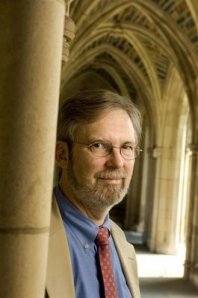
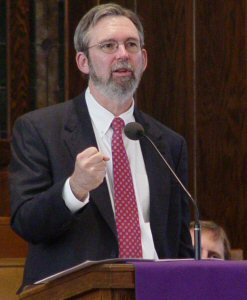
richard-haysHere’s a sermon preached by the Rev. Richard Hays for the ordination of his son, the Rev. Christopher Hays, at La Crescenta Presbyterian Church, La Crescenta, Calif., on March 8, 2009.

Texts: Genesis 32:9-1122-30Colossians. 1:9-14Revelation 4:10-5:10

I have to admit, I didn’t always see this coming. But having watched Chris grow up, I realize now that I probably should have anticipated this day, because there is a pattern here.

When Chris was five years old, there was that classic pennant race between the Boston Red Sox and the New York Yankees, the one that ended in a one-game playoff won by the Yankees on Bucky Dent’s home run. Chris watched his longsuffering dad desperately rooting for his beloved Red Sox – and he decided to become a Yankees fan.

Later, when Chris began to feel the inexorable pull of vocation to the serious academic study of theology, he sized up his father’s career as a New Testament scholar – and decided to assert his intellectual independence by going into the field of Old Testament studies.

And so, when the time came that Chris felt God’s powerful call to ordained ministry, it was probably inevitable that he would take note of his dad’s service as a United Methodist minister and once again rebel against the paternal example – by being ordained in the PC(USA). And so we find ourselves here this evening … to celebrate this latest contrarian act of rebellion.

To be fair, I should acknowledge that Chris comes by his Calvinist inclinations with an honest sense of family roots. His proud mother was a cradle Presbyterian and indeed served as an elder in the First Presbyterian Church of New Haven during Chris’s formative adolescent years. And even his Methodist father harbors the secret opinion that Calvin and Barth got a lot of things right.

The truth is, of course, that all of us are here to celebrate this glad occasion with great joy, along with the due sense of awe that always attends any service of ordination to the ministry of word and sacrament in the church of Jesus Christ. We are here to solemnize the particular call that lies on Chris’s life and to confirm publicly the office he now assumes within the church. But at the same time, we are mindful that ministry is first and last the work of the Holy Spirit in the church, and that all of us, as the people of God, are called in one way or another to share in the work of ministry through the diverse gifts and graces which the Spirit distributes broadly among us all. And so, as we reflect together on the Scriptural texts and on the prayers and liturgical actions through which we set Chris apart for this work, each of us here should also prayerfully consider our own calling and renew our own sense of vocation, whatever it may be, within the church’s ministry.

But as we enter that process of prayerful consideration, we have to acknowledge that the Scriptural texts Chris has chosen for this occasion are more than a little daunting. Interestingly, none of them says anything at all about ordination or about ministry as such. The letter to the Colossians is addressed to all “the saints and faithful brothers and sisters in Christ in Colossae,” (Colossians 1:2) and it speaks to all of them, together, as people who have been “rescued us from the power of darkness and transferred us into the kingdom of his beloved Son.” (Colossians 1:13) And we get the distinct impression from our other two texts that being transferred into that kingdom is both a cause for joy and – at the same time – a strange and fearsome experience, as love always is. I want to reflect with you tonight about these two strange texts from the beginning and end of the canon, from Genesis and Revelation. What do they have to teach us about ministry?

We begin with Jacob. From the day of his birth, he was a trickster and an operator, grabbing and scrambling, figuring the angles to outsmart and outmaneuver his brother Esau – indeed, cutting a deal to swindle him out of his rightful inheritance – then later jockeying for economic advantage with his equally devious father-in-law, Laban. You can bet that if the banking business had existed in his day (it was actually forbidden by Old Testament law – but that’s a topic for another day), Jacob would have been packaging derivatives and collecting sweet executive bonuses. But – as is always the case – the day of reckoning was coming. After long absence, Jacob is returning home, preparing to face his estranged brother Esau, whom he had defrauded. And it is under these circumstances that he meets God.

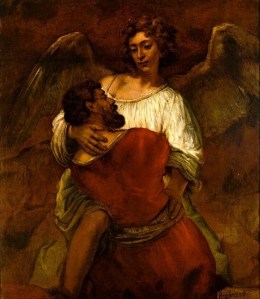
God does not come to him as some sweet, forgiving presence. Rather, under the cloak of darkness, God comes as a mysterious adversary, appearing from nowhere to accost Jacob in a wrestling match. The struggle is lengthy and inconclusive, but Jacob hangs on for dear life, refuses to let go without receiving a blessing. And the blessing he receives includes a new name: Israel – the one who strives with God. The name Israel recalls a protracted struggle in the dark – a struggle that leaves Israel lame, permanently limping as a reminder of surviving a strange face-to-face encounter with God.

What does all that have to do with ministry? First, if Jacob/Israel is our precursor as one who first receives and then finally gives blessings (and surely that is not a bad description of what we do in ministry), then we should remember that we don’t deserve what we get or get what we deserve. Why does God choose Jacob as the one through whom the line of promised blessing is to extend? God knows … but it certainly wasn’t because Jacob was more devout or virtuous than others around him. One of the particular charisms you Calvinists bring to the church universal is the gift of depravity. You remind us constantly that we receive God’s grace despite our total unworthiness. That’s not a popular message in an age that prizes self-esteem, but it is, simply put, the gospel. That is what Paul means when he characterizes God as the one who “justifies the ungodly” (Romans 4:5). God chose Jacob to become Israel for reasons we cannot begin to fathom. Just before this midnight encounter, you will recall, Jacob had rightly prayed, “I am unworthy of the steadfast love and all the faithfulness you have shown to your servant” (Genesis 32:10). And so it is also with those who are called to ministry – not just Chris, but all of us here.
richard-hays-1

Precisely for that reason, the encounter with God as Genesis 32 describes it is a fearsome one. If we unworthy servants are to be transferred from the power of darkness, that means God is going to have to come after us in the dark. If we are honest with ourselves, we will see it couldn’t be any other way. And it also means that ministry has its genesis in a struggle. Those who encounter God in the dark will be not only changed but also marked, left with the wound created by God’s wrenching us out of one life and blessing us with a new one. And this God who wrenches us free may well have a dreadful aspect.

Such a God cannot be lightly named. Jacob asks the name of his adversary, but the only reply he receives is this: “Why do you ask my name?” What kind of an answer is that? In the book of Judges, there is a similar passage that may give us a clue. The angel of the Lord appears to Samson’s mother and father to proclaim that they are at last, after years of barrenness, to have a child. They too ask the messenger’s name, and this is his answer: “Why do you ask my name? It is too wonderful” (Judges 13:18). So also with the divine figure who wrestles with Jacob: His name is too wonderful to be spoken. And thus Jacob comes to realize with whom he has been wrestling: “I have seen God face to face, and yet my life is preserved.”

Those called to the work of ministry will emerge from such an encounter limping and chastened, knowing that our words are inadequate, that we are not sufficient for these things. But we also will know that the God whom we serve, the God who has graciously and inexplicably called and blessed us, is wonderful beyond all telling.

And with that we turn to our other text from the Book of Revelation. Those saints casting down their crowns around the heavenly throne know well the wonder of God. The God they worship is worthy “to receive glory and honor and power,” for this is the God who has created all things. This word “worthy” echoes through the whole passage. The Lord God on the throne is worthy, but no one else can be found who is worthy to open the scroll.

Now, I don’t know for sure why Chris chose this text for his ordination service, but I do know this: For those of us in the business of biblical scholarship, there is nothing more enticing than an unopened scroll with hidden writing on it. You could build a whole career on the basis of finding something like that. But apart from any career-building concerns, we are just dying with curiosity – holy curiosity, if I may say so – to find out what might be in that sealed scroll. This scroll, it seems, contains the revelation of God’s hidden designs for all history. So we go to school for years and study Greek and Hebrew, or even Akkadian and Ugaritic, in hopes that we might be deemed prepared and worthy to read that mysterious text. But the seer John is insistent: “No one in heaven or on earth or under the earth was able to open the scroll, or to look into it” – not even if they have a Ph.D. in Old Testament. And so he weeps bitterly. You have to understand how frustrating this would be: all those years of study, all this vast erudition – it all comes to nothing. No one is worthy.

There is only one, it turns out, who is worthy to open the scroll that hides the secrets of creation, the one whom one of the heavenly elders calls “the Lion of the tribe of Judah.” And so we are expecting a glorious, roaring figure to appear and break open the seals. But then John looks, and what does he see? “A Lamb, standing as if it had been slaughtered.” The heavenly chorus proclaims in their new song that only this one is worthy to open the scroll. Why? Not because he is smarter than everyone else, not because he commands an army, but precisely because he has been slaughtered. And by his blood he has ransomed a great throng from all over the world and “made them to be a kingdom and priests serving our God.”

So again, I ask, what does this have to do with ministry? As it turns out, everything. We constantly live with the illusion that our effectiveness in ministry, our fitness for the job, will have something to do with our intellectual acuity, our level of dedication and hard work, our interpersonal skills, our passion for justice. The book of Revelation punctures that illusion with a simple devastating pronouncement: No one was found worthy. It is only the slain Lamb who can be the revealer. If Jacob was marked by a limp, this Lamb is marked by the wounds of the cross. Only so does he open what is otherwise hidden, and only so does he make us into priests serving our God.

What, then, is our role in ministry? Chiefly, above all else, it is to follow the Lamb wherever he goes and to join the great heavenly chorus, singing – perhaps to music composed by Handel – “Worthy is the Lamb who was slain, to receive power and wealth and wisdom and might and honor and glory and blessing.” Praise is our vocation. It is in blessing God that we in turn are blessed. As the Reformed tradition confesses, our chief end – and our fulfillment – is to glorify God and to enjoy him forever. That is why it is fitting that our first hymn today offers up this prayer: “Come thou fount of every blessing,/ Tune my heart to sing thy grace,/ Streams of mercy, never ceasing,/ Call for songs of loudest praise.”

“Tune my heart.” Just as the tuning of a guitar is different from the tuning of a violin or the tuning of a piano, for each of us it will mean something slightly different to have our hearts rightly tuned for praise. For Chris, being rightly tuned for praise will indeed mean opening books, including those Ugaritic books, and sharing with students snatches of the mysterious melody of creation and redemption. That is at least part of the unfinished song he has been given. Much of the rest of it remains to be disclosed and played later.

So, as we wrestle with these texts, they press upon us this understanding of ministry: We are unworthy of the blessings we receive and the tasks to which we are called, limping as we go. The heart of our service is simply to worship faithfully, to declare the praise of the God who spoke us into being and rescued us from the power of darkness by the self-giving death of the One who is worthy: the Lamb. All else will follow from that.

Only when we understand ministry in this way can we join together in praying for Chris the prayer that Paul offers for the Colossians:

“… May you walk worthily of the Lord … as you bear fruit in every good work, and as you grow in the knowledge of God.”

[Source: Faith & Leadership]
Forsyth on the current claptrap against theology

forsyth-13‘It is doubtful if anywhere so much ability is going to seed as in the pulpit, if so much toil, ingenuity, intelligence, and feeling are being wasted anywhere as in the thousands of sermons that go to their drawers as to their last cradle and long home, week by week, to haunt as feckless ghosts the preacher’s soul. Hence the restlessness that is observable in the ministry in various quarters, the sense of ineffectiveness, the desire to try a new soil with the same seed, in the hope that the Spirit may at last reward the effort and bring back His sheaves with Him. But it is not a change of sphere that is required most. That may but foment the unquiet, or else become the soul’s narcotic, It is a change of note that is needed, and a change that no new place can bring. If the lack is power, the cause of the lack is the absence of a definite, positive, and commanding creed which holds us far more than we hold it, holds us by the conscience, founds and feeds us on the eternal reality, and, before we can do anything with it, does everything with us. Every Church and every preacher is bound to run down without such a creed, and no amount of humane sympathy or vivid interests can avert the decline. In every direction, the Church is suffering from the inability to know its own spiritual mind, or to strike a stream from its own rock, and from its indisposition to face the situation or its impotence to fathom it. For a generation now we have been preaching that experience is the great thing, and not creed; till we are losing the creed that alone can produce an experience higher than the vagaries of idiosyncrasy, or the nuances of temperament, or the tradition of a group, or the spirit of the age … The current claptrap against theology is only an advertisement of the lack in religion of that passion of spiritual radicalism and mental veracity which will settle nowhere but at the very roots of things, and must draw its strength from the last realities of the soul’s intelligent life. The result of the defect is a vague sense of insecurity as to foundations and an insidious dubiety which, unconsciously to the preacher, conveys itself to his flock, and generates a malaise that nobody can explain’. – PT Forsyth, ‘Veracity, Reality, and Regeneration’, London Quarterly Review 123 (1915), 194, 195.

The Scandal of Weak Leadership: A Sermon on 2 Corinthians 11:16–12:10

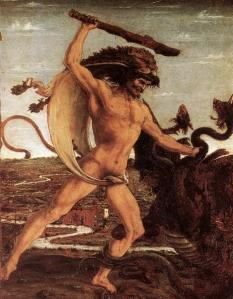
herculesSt Hercules Presbyterian Church in Lake Paringa is looking for a new minister. The ad reads:

Minister Required:

  • For a growing, charismatic church with a congregation of diverse backgrounds.
  • Must have strong leadership qualities and the ability to cast vision.
  • Must be an excellent preacher.
  • Needs to demonstrate appropriate spiritual gifts.
  • The ability to interact with influential figures in our local community is a definite advantage.
  • Attractive remuneration package with bonuses available when the church grows (which, of course, it will just as brother Ebenezer received the vision).

This is the sort of ad that I can imagine the church in Corinth writing. How disappointed they must have been when they got Paul! He was not the eloquent speaker for which they had hoped. Instead of providing the ‘strong’ leadership they wanted, he treated them with gentleness. And while he was prepared to teach about spiritual gifts, he hardly ever talked about his own ‘spiritual’ experiences, even less gloat about them. And rather than mixing with the influential, he insulted them. Even worse – he would not take their money!

Instead of getting Arnold Schwarzenegger or Napoleon or Takaroa, in Paul the Corinthians were given a weak, sick, persecuted, afflicted and bruised human being. And then to add insult to injury, Paul had the audacity to tell them that his weakness was actually proof that he was genuine!

What we have come to call 2 Corinthians constitutes Paul’s defence of his apostleship. All through this letter, Paul insists that the appropriate model for Christian ministry is one where divine power is demonstrated in the presence of weakness. He begins in Chapter 1 praising ‘the Father of mercies and the God of all consolation, who consoles us in all our affliction’ (1:3-4). In Chapter 2, he pictures himself as one led in a procession of death for Christ’s sake – not as the great victor of heroic Greek epics, but as the defeated captive of the exploits of worldly power and ambition. And he makes it clear that his presence in such a procession is not due to his own achievement, nor to God’s failure to care for him, but rather is due to God’s victory. And twice in the space of just a few verses (2:17-3:6) Paul tells us that he labors as he does because of his relationship with Christ, and because the focus of Christian ministry is to bear witness to one who was – as Paul tells us later on – ‘crucified in weakness, but who lives as a result of God’s power’ (13:4).

The fact that ministry can only be conducted in God’s power is reiterated again in Chapter 4. Indeed that’s precisely why, Paul says, we should not loose heart (4:1). He is even more explicit in vv. 7-11. Reading from Eugene Peterson’s The Message:

If you only look at us, you might well miss the brightness. We carry this precious Message around in the unadorned clay pots of our ordinary lives. That’s to prevent anyone from confusing God’s incomparable power with us. As it is, there’s not much chance of that. You know for yourselves that we’re not much to look at. We’ve been surrounded and battered by troubles, but we’re not demoralized; we’re not sure what to do, but we know that God knows what to do; we’ve been spiritually terrorized, but God hasn’t left our side; we’ve been thrown down, but we haven’t broken. What they did to Jesus, they do to us – trial and torture, mockery and murder; what Jesus did among them, he does in us – he lives! Our lives are at constant risk for Jesus’ sake, which makes Jesus’ life all the more evident in us.

So welcome to Christian ministry. Welcome to the life of the baptised, to the way of God’s reconciling the world to himself in Christ.

shard_potteryThroughout this letter, Paul is up against the criticisms and accusations of those ‘pseudo-apostles’ who consider him weak and inferior. But instead of succumbing to boasting of his family connections and academic qualifications and spiritual experiences, Paul is embarrassed to talk about them. Instead of hiding those things in his life which would make him appear weak and vulnerable, he glories in them, no matter how much it makes him feel ‘a fool’ and ‘out of his mind’ to do so. Instead of putting together a hero’s résumé to impress the great minds of his age, Paul recites the persecutions he has endured, the dangers from which he has only narrowly escaped, and the crippling sense of responsibility that pressurises him every day. ‘Troubles, deprivations and anxieties – that has been my lot’, says Paul. ‘And how do I cope with all that? Do I emerge like some old President, dopey but glowing with self-confidence at the end of each test? No way!’: ‘Who is weak, and I do not feel weak? Who is led into sin, and I do not inwardly burn?’ (11:29). ‘In fact, if you really want to know what sort of apostle I am’, Paul says, ‘I am the sort who when the going gets really tough, bails out. In fact, I’ve always been like it. One of the first things I did after I was baptised was to run away’: ‘In Damascus the governor under King Aretas had the city of the Damascenes guarded in order to arrest me. But I was lowered in a basket from a window in the wall and slipped through his hands’. (11:32-33).

And as for that mysterious ‘thorn in the flesh’, who knows? The commentators have a field day here: Paul had a theological opponent; Paul had an unbelieving wife; Paul had poor eyesight; Paul had homosexual urges; Paul had malaria – all of which are possibilities, but must remain speculations. Whatever it was, and however much Paul at times wished it removed, it served as a constant reminder to him that the integrity and effectiveness of his ministry would rest not on his worthiness or credentials but on God’s grace. And even though we can’t know what the thorn was, Paul at least tells us why it was given to him and he asserts God’s promise to him that no hindrance would be suffered in his ministry as a result of it:

To keep me from becoming conceited because of these surpassingly great revelations, there was given me a thorn in my flesh, a messenger of Satan, to torment me. Three times I pleaded with the Lord to take it away from me. But he said to me, “My grace is sufficient for you, for my power is made perfect in weakness.” (12:7-9a)

‘… power is made perfect in weakness’. That’s how v. 9 is usually translated. But the verb used here (teleitai) could equally be translated as ‘brought to an end, finished, done with’. In other words, ‘My grace is sufficient for you; for power is brought to an end in weakness’. Indeed, the context indicates that Paul’s intention was not primarily to comfort people who were weak and suffering, but rather to challenge those obsessed with a particular brand of power. At heart, what Paul bears witness to is the revelation of God’s way with us as the way of paradox – of that recurring Word which warns against overly-optimistic reliance upon techniques or technicians which can intensify or alter creation’s true way of being, as if creation could fulfill and complete itself apart from the action of the initiative-taking God.

Paul’s words invite us to consider a different form of human life and service than that which is often trumpeted by so-called leadership gurus. For when we stand in God’s service, we must be able sometimes, and perhaps for long periods, to be still, to wait, to keep silent, to suffer. This, too, is power. Indeed, it is the power of God, the power of Jesus Christ, the power of the Lamb as well as the Lion, of the cross as well as the resurrection, of humiliation as well as exaltation, of death as well as life. As one theologian put it, the power which comes from God is

the capacity to be high or low, rich or poor, wise or foolish. It is the capacity for success or failure, for moving with the current or against it, for standing in the ranks or for solitariness. For some it will almost always be only the one, for others only the other, but usually it will be both for all of us in rapid alternation. In each case, however, it will be true capacity, the good gift of God, ascribed to each as needed in His service. God demands one service to be rendered in the light, another which can be performed only in shadow … Either way, it is grace, being for each of us exactly that which God causes to be allotted to us.[1]

Indeed, here is grace’s way – of Israel’s birth through a barren womb. Here is grace’s way – of the champion from Gath killed by Jesse’s youngest son. Here is grace’s way – of the Word taking on fallen flesh and stubbornly refusing to be fallen in it. Here is grace’s way – of ostracised women being commissioned as proclaimers of God’s good news. Here is grace’s way – that the deepest revelations of God are not given to the wise and understanding but to infants. Here is grace’s way – that God has a deliberate policy of positive discrimination towards nobodies, that the kingdom of God belongs to the poor and that the earth will be inherited by the meek. Here is grace’s way – love your enemies and bless those who make life hell for you. Here is grace’s way – of God making foolish and weak the wisdom and power of the world. Here is grace’s way – of God putting his treasure into jars of clay in order to show that God’s all-surpassing power is from God and not from us. Here is grace’s way – that only in humiliation do we find God exalting us, only in dying do we find God making us alive, only in throwing our lives away do we find God giving life back to us. Here is grace’s way – of power being brought to an end in weakness. Here is grace’s way – that we might actually be more use to God with our thorns than without them. Only when I am weak, am I strong.

chain2Father Mike Buckley once wrote a letter to ordinands who were preparing for ordination. In it he asked them this question: ‘Are you weak enough to be a priest?’ Buckley was taking a shot at the way society commonly evaluates people by listing their strengths. If someone is a capable speaker with an agile mind, we think they’ll make a good lawyer or a persuasive politician. If someone has good judgement, a scientific bent and manual dexterity we decree they’d make a splendid surgeon. And the tendency, Buckley says, for those of us in the church is to transfer this method of evaluation, to line up all the pluses to say that such and such a person would make a good minister.

Buckley says that such a transfer is disastrous because a more crucial question is ‘Is this person weak enough to be a priest?’ That’s a key question that needs to be asked by students training for pastoral ministry. It’s also a question that parish councils need to ask when they are meeting with a prospective minister. Is this person deficient enough that they have not been able to ward off suffering, that they have lived with a certain amount of failure, because it is in this deficiency, in this weakness, in this tasting of temptation, that they become qualified like that great high priest to sympathise with others in their weakness.

So Henri Nouwen reminds us, and with this I finish, that:

The way of the Christian leader is not the way of upward mobility in which our world has invested so much, but the way of downward mobility ending on the cross … Here we touch the most important quality of Christian leadership in the future. It is not a leadership of power and control, but a leadership of powerlessness and humility in which the suffering servant of God, Jesus Christ, is made manifest … To come to Christ is to come to the crucified and risen One. The life-giving apostle embodies in himself the crucifixion of Jesus in the sufferings and struggles he endures as he is faithful and obedient to his Lord. So Paul preaches the crucified and risen Jesus, and he embodies the dying of Jesus in his struggles to further point to the Savior. His message is about the cross and his life is cruciform, shaped to look like the cross … I leave you with the image of the leader with outstretched hands, who chooses a life of downward mobility. It is the image of the praying leader, the vulnerable leader, and the trusting leader. May that image fill your hearts with hope, courage, and confidence.[2]


[1] Karl Barth, Church Dogmatics III.4 (trans. A.T. Mackay, et al.; Edinburgh: T&T Clark, 1961), 396-7.

[2] Henri J.M. Nouwen, In the Name of Jesus: Reflections on Christian Leadership (New York: Crossroad, 1989), 62-3, 70, 73.

Rowan Williams on entering the world of revealed religion

rembrant-jacob-wrestling-angelArchbishop Rowan Williams is a brilliant theologian and preacher. Yesterday, Williams was at Great St Mary’s Church, Cambridge, to deliver the Hulsean Sermon. Its title? ‘Seeing the Question: Revelation and Self-Knowledge’. He drew upon work by Barth, Augustine and TF Torrance; and here’s what he had to say about revelation:
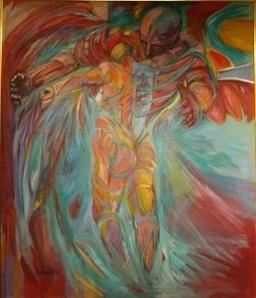
Revelation is the discovery that you are already, before you knew it, in relation to a vision that is both utterly compassionate and utterly truthful: to discover this in the face, in the presence of another human being within history, not even in the presence of an archaic statue, starts the long, draining and exhilarating trail of recasting what has been taken for granted about God and the world, the created and the uncreated, and sketches what might have to be said about a God who is free not only to engage with the human world but to do so from within. I am shown to myself as a person already in relation: God is shown to me as the agency that is eternally prepared for relation. And the creeds begin to cast their shadow before them; because of that single human presence about which we can only say, ‘he told me everything I ever did’.

Revealed religion can so easily be presented as the enemy of many things that our culture holds precious: intellectual humility and intellectual adventure; the sense of ultimate otherness or strangeness within our relations with one another; the fascination with our own inner elusiveness, our otherness to ourselves. Yet all these themes seem themselves to arise out of the gradual apprehension of what revelation actually entails. If theology – the theology of revealed religion – has a place in the academy, it is because of the way in which it underscores the strength of the goading to know that drives all serious mental enterprise and at the same time the unfinished character of that enterprise. It does so not by appealing to a vague belief that all verbal forms are provisional or that the spiritual nature of human beings is worth taking seriously, but as a discipline that wrestles with intractable history and particular narrative, with the ways in which human beings think within time and relationship and create language together.

In a cultural context where – so we are repeatedly told – ‘spirituality’ is more popular than ‘religion’, it doesn’t hurt to remind ourselves of what the claim to revelation and the focus on historical particulars involves for the life of faith and the exploration of that life in art or theology. Here at least we are in a world in which the characteristic pressure of intellectual activity makes sense – the conviction of an obligation to persistence and novak-jacob-wrestling-the-angelhonesty, the cautions against imagining that issues have been resolved when they have only been named; here the life of the mind and of a properly demanding imagination are recognisably involved. Grace and struggle both belong inseparably in the process of receiving and responding to a revealing God. What the preference for a generic spirituality may lose hold of is just this partnership of the awareness of gift and the pressure to speak as truthfully as can be in the light of the steady weight of that gift as received by generations.

To enter the world of revealed religion, to make one’s own the vocabulary of a free self-disclosure on the part of the transcendent, is not to abandon discovery or darkness: because it is grounded in the simultaneous new awareness of who God is and who I and my neighbour are, it cannot be simply the delivery of the last pieces in a puzzle. To become conscious that you are seen is potentially frightening; to become conscious that you are seen by a presence that has no selfish interest, no advantage to be exploited, no will to manipulate, but one that gratuitously shares the secret of itself, its reality and ‘density’, is perhaps not
less frightening (you hate it because it hurts’) but is also to find yourself just beginning in the way of fearlessness. My story is told to me afresh; and I find that it is embraced, graced, opened. ‘You must change your life’; but in fact my life is changed, not by me, if I can bear the gaze.

The full sermon manuscript is available here.

Bleby and Pennicook on the Holy Spirit

New Creation Teaching Ministry has made available for download the talks from the 2007 NSW Spring School. Here they are:

‘The Spirit of Glory’, Martin Bleby (50 min)

‘The Love of the Spirit’, Martin Bleby (58 min)

‘The Spirit and the Community of Love’, Ian Pennicook (62 min)

‘The Spirit and the Son – Part 2’, Martin Bleby (51 min)

‘The Ministry of the Spirit’, Ian Pennicook (47 min)

Plus 2 sermons:

‘Can These Bones Live?’ (Ezekiel 37), Ian Pennicook (36 min)

‘The Breath of God Has Come’, (Ezekiel 37), Martin Bleby (27 min)

Blogging around

Kevin has a nice post on Barth’s ongoing legacy, including a quote from Neuhaus in which he recalls Jarislav Pelikan’s identification of ‘the most influential theological mind of the past two hundred years’ as John Henry Newman. Why? ‘Newman’s thought has been received into the tradition of the Catholic Church, whereas Schleiermacher and Harnack, brilliant though they were, wrote against the tradition, and Barth was, as he claimed to be, a “church theologian” but a church theologian without a church capable of bearing his contribution through successive generations. Pelikan understood, as Wilken said at Yale, that it is orthodoxy that is the most consequential, the most adaptable, the most enduring.”‘ Read the full post here.

Byron notes some great words from C.S. Lewis on forgiveness.

Travis generously shares with us his notes from Eberhard Busch’s fascinating lecture at Princeton entitled, ‘A Swiss Voice: The Campaign of the Swiss Government Against the Voice of Karl Barth During the Second World War’. In the lecture, Busch introduces us to some largely ignored documentation from the Swiss and German governments during WWII. He writes,

‘The Swiss government slowly began tightening its grip on critical publication, classifying some of Barth’s lectures as political instigation. Organs of the Swiss government even described Barth as a ‘theologian of hate,’ and he was accused of political agitation against Germany under the cover of religion. The two kingdoms doctrine was even marshaled against Barth, and he was told that he could say whatever he wanted about theology but that he couldn’t give political lectures under the guise of ecclesial style. The publication of certain of Barth’s published lectures and booklets was forbidden. Barth contested these things, arguing that the theologians of the Reformed church in the tradition of Calvin and Zwingli have not only the right but the duty to speak politically. When his appeal failed, Barth was unable to publish or lecture on the political situation in Switzerland. Barth’s phone was tapped, and his correspondence was monitored and censured. In one instance, one of Barth’s letters, including a picture of him in his military uniform bearing the caption ‘Resist the evil with all means,’ was confiscated’.

After spending an afternoon sifting through an ‘impressive pile’ of his old sermons (30 worth worth!), Jim asks ‘When is a sermon past its use by date?‘ After reminding us that his hero James Denney claimed to have burned all his sermons when he left Broughty Ferry in 1897 (‘but fortunately there’s still a few hundred of them so he must only have burned the ones he thought unpreachable elsewhere’), Jim invites us to reflect on two fair questions: 1. What criteria should be used to decide if a sermon preached in the past is worth keeping now? And 2. Should an old sermon ever be re-cycled?

Employing Barth’s help, Michael encourages us to see things differently.

Scott announces the start of a mini-series on the Trinitarian thought of Henry of Ghent. He asks, somewhat provocatively, ‘We know there are three persons, and one ‘substance’/’ousia’ from Scripture and our orthodox Creeds, but is there anything that we could say that might account for why there are three, and not say five divine persons? Or even, why not say there is a potential infinity of divine persons (on some contestable account of the deification of believers)? You get my point. Why three divine persons and what makes it that there are three, no more and no less?’

The ABC’s ‘Religion Report’ makes available via podcast a recent discussion on the Australian Christian Lobby’s invitation to election candidates to justify why they are ‘worthy of the “so-called” Christian vote’.

While on podcasts, there’s a download available here of ‘Tractatus Logico-Philosophicus’ by Ludwig Wittgenstein, and this one on ‘The Emptiness of Existence’ by Arthur Schopenhauer.

Good Friday homily

For the first time in as many years as I’ve got toes, I didn’t preach this Good Friday. I did however engage in worship of the ‘combined service’ type. Why do churches just do at C & E times? Anyway, for those who want a homily worth reading, I found Peter Leithart’s word great. Here’s a snippert: ‘The cross is the crux, the crossroads, the twisted knot at the center of reality, to which all previous history led and from which all subsequent history flows. By it we know all reality is cruciform – the love of God, the shape of creation, the labyrinth of human history.’ For the rest, click here.

And after you’ve read that, check out his latest input on paedocommunion here. I really enjoyed this later piece. Chatting to a pastor mate about it, he said ‘What perplexes me more is whether there’s an age I should stop offering it to them, and then only re-start after baptism’. Now there’s an interesting thought. On what basis such a decision could be made however, could invite a shift in the goal posts.