Poetry

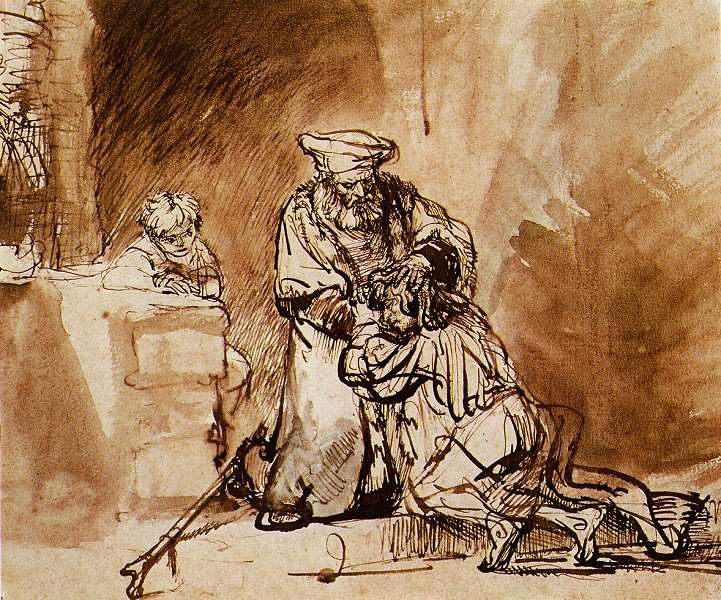
‘What the Father Came to See’, by Paul Mariani

How old the story is, we have come to see, and yet how true.
The kid’s back home at last, knowing he’s lost everything
the old man gave him, spent on booze and one-night
stands, a sucker for every sob story his friends had found
to separate him from what they saw as their inheritance.
And, now, when the cash was gone, and the kid out on his own,

alone, reduced to doling out ripe slops to pigs, while his own
gut growled for what the swine had trampled on, true
to their indifferent boorish nature (the inheritance
all such pigs are born to), the kid kept thinking how everything
he’d ever needed the old man had always given him. And so he found
himself heading home at last, even as his sick soul’s dark night—

replete with hissing fevers—loomed ever larger. So, with one eye open night
after chilly night in some piss-soaked alleyway he longed to call his own
as he watched for snarling dogs and whistling perverts, he somehow found
himself at last back home, where his father—and this is true, true,
so help me God—ran out in ragged slippers to hold his lost son up, everything
forgiven, as the kid slumped earthward, believing his inheritance

had gone up in acrid smoke. But the father knew his real inheritance—
the only thing that mattered—was what the cold, indifferent night
had unwillingly given up: his boy kneeling there before him, the one thing
worth living for: his kid back home again, alive, his own
beloved son, chastened, yes, but somehow still alive. True,
the boy looked awful and he stank of shit, but the old man found

his deepest prayers were answered, that the one he’d lost was found
and home again. Time to celebrate, then, time to make a new inheritance
for his son—now sobered—something the kid would try to earn. True,
all of this would only come with the daily round of things. But that night
the old man meant to throw a party for everyone, serve up his own
best fattened calf, along with wine and cakes and song, oh, everything!

But then there was the other son, the good one, who’d done everything
the old man had ever asked of him, dutifully, and had even found
some satisfaction in doing it, if not much fun, and just then did not feel like own-
ing that he knew this ragged wretch who no doubt meant to eat up his inheritance.
You see him there, bigger than the kneeling son, truculent, the bleak night
shadows etched there on his face, and justified, if what we know about ourselves is true.

And the older son is right, it’s true, which the father knows as he knows day from night.
God knows the good son deserves the inheritance which for him means everything,
But these are his sons, his very own, of whom one at least was lost and has been found.

[Source: First Things]

(Some people, like Anne Stewart, literally live – or at least try to live – on the assumption that the kind of economy of relations witnessed to in Luke 15 might actually say something about how things are. The world is possible because of such saints. So is the Church. And just as I can no longer read the Book of Exodus without seeing Charlton Heston, I can no longer read Luke 15 without recalling Anne’s passion for divine irresponsibility. Thanks Anne. And thanks too for ragged slippers that move at such speed to hold up lost children.

‘The first thing that must strike a non-Christian about the Christian’s faith is that it obviously presumes far too much. It is too good to be true: the mystery of being, revealed as absolute love, condescending to wash his creatures’ feet, and even their souls, taking upon himself all the confusion of guilt, all the God-directed hatred, all the accusations showered upon him with cudgels, all the disbelief that arrogantly covers up what he had revealed, all the mocking hostility that once and for all nailed down his inconceivable movement of self-abasement – in order to pardon his creature, before himself and the world’. – Hans Urs von Balthasar, Love Alone is Credible (San Francisco: Ignatius Press, 2004), 102.)


‘5:00 Mass’ by Franz Wright

The church is a ship in the brightening snowstorm;
shafts of light falling in through blue windows.
It’s almost night and starting to get light!
The planet, too, adrift
in an infinite blizzard of stars –
Where most of us are sick
and starving in the pitching dark, and the partying
masters up above
don’t know where we are either.
We love one another. We don’t really know
anyone well, but
we love one
another.

– Franz Wright, ‘5:00 Mass’, in Walking to Martha’s Vineyard (New York: Alfred A. Knopf, 2003), 28.

‘Unseasonable Journey’, by Susan Jones

I remember it as if it was yesterday
the day he set his face
and turned towards Jerusalem.

We all knew that look,
all of us women
who followed him
Mary, Joanna,
Susanna and the rest,
we knew, all of us,
once that look was in his eyes
and his jaw set in that determined way
nothing any of us could say would change his mind.

An autumn chill
whispered its way
around my heart
the long, lovely summer
of camaraderie and companionship
was over

for I knew
we all knew
(especially him, although he never said)
death
lay at the end of this unseasonable journey.

Looking back now,
I remember the slow,
inevitable
irrevocable
feel of that time

his words falling on our ears
as leaves fall
one by one
from trees
weeping away their life
in golden tears

(afterwards, we looked back,
surprised at the depth
of golden leaves
which had gathered at our feet)

the first few leaves
fluttered gently to the ground
as he told the men to let the children be.
‘the kingdom belongs to such as these,’ he said.
We women knew what he meant
we know children
the gut honesty
that hasn’t been veneered with social graces yet.
We knew what he meant.

And it seemed a single golden leaf
gently touched my hair
as I heard him say
‘Mary has chosen the better part
it shall not be taken from her’

and it hasn’t.

A few more leaves fell
when he wept over the city

the stormy tension was all through Jerusalem
like one of those autumn storms
that pulls leaves from the trees in jealous fury

but once,
there was a lull,
when, through the heavy scent of ointment
above the women’s tears he said to the stony faces
about him
‘she has done this for my burial’
and a shower of golden leaves
joined the others on the ground.

But autumn ends
with gaunt skeletons
against a wintry sky
and so his end came
on a gaunt tree
starkly black
amidst a darkened day
and the chill of winter
settled on my soul
the pile of leaves
about my feet
lost their glow
as the promises lost their power.

The cold went deep within me,
and even when love had burst forth
out of season
life in the middle of death
warmth in the heart of winter,
and the leaves at my feet
had regained their golden glow
(for now I knew the promises were true)
the memory of that desolation remained

Reminding me God does not wait for spring
but offers life in winter
for love knows no season

– Susan Jones, What was it like?: Bible Reflections (Melbourne: Joint Board of Christian Education, 1993).

‘The Country Clergy’, by R.S. Thomas

I see them working in old rectories
By the sun’s light, by candlelight,
Venerable men, their black cloth
A little dusty, a little green
With holy mildew. And yet their skulls,
Ripening over so many prayers,
Toppled into the same grave
With oafs and yokels. They left no books,
Memorial to their lonely thought
In grey parishes; rather they wrote
On men’s hearts and in the minds
Of young children sublime words
Too soon forgotten. God in his time
Or out of time will correct this.

– RS Thomas, ‘The Country Clergy’, in Collected Poems, 1945–1990 (London: Dent, 1993), 82.

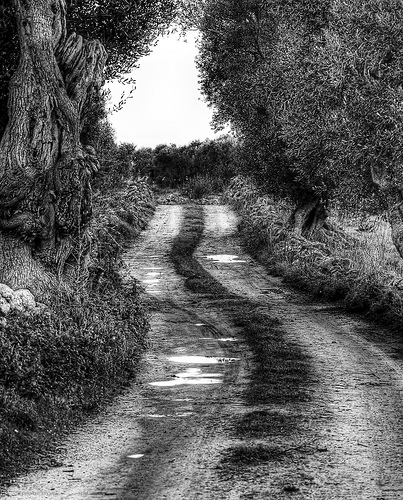
[Image: Gozaic]

‘Topography of a Better World’, by Günter Eich

Vain the cruel hope
that the screams of the tortured
might pave the way for a brighter future:

observe whose voice trembles with emotion,
whose heart is stirred
when the rolls are changed
at twenty-eight minute intervals.

Greetings, cemeteries!

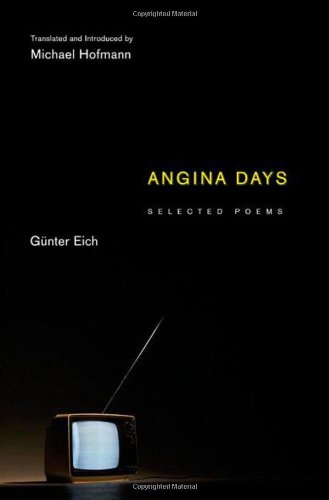
– Günter Eich, Angina Days: Selected Poems (trans. Michael Hofmann; Princeton/Oxford: Princeton University Press, 2010), 87.

‘Journey’, by Günter Eich

You can turn away
from the leper’s rattle,
close your ears and windows
and wait for him to go.

But when you’ve heard it once,
you will always hear it,
and because he won’t leave,
you will have to.

Pack a bundle, not too heavy,
because no one will help you carry it.
Sneak out, and leave the door open behind you,
you’ll not be back.

Travel far to get clear of him,
take ship or go out into the wilderness:
the rattle of the leper will never stop.

You’ll take it with you while he stays behind.
That boom-boom-boom in your ears—
it’s the sound of your own heart!

– Günter Eich, Angina Days: Selected Poems (trans. Michael Hofmann; Princeton/Oxford: Princeton University Press, 2010), 35.

‘The body is mine and the soul is mine’, by R.S. Thomas

‘The body is mine and the soul is mine’
says the machine. ‘I am at the dark source
where the good is indistinguishable
from evil. I fill my tanks up
and there is war. I empty them
and there is not peace. I am the sound,
not of the world breathing, but
of the catch rather in the world’s breath.’
Is there a contraceptive
for the machine, that we may enjoy
intercourse with it without being overrun
by vocabulary? We go up
into the temple of ourselves
and give thanks that we are not
as the machine is. But it waits
for us outside, knowing that when
we emerge it is into the noise
of its hand beating on the breast’s
iron as Pharisaically as ourselves.

– R.S. Thomas, Counterpoint (Newcastle upon Tyne: Bloodaxe Books, 1990), 47.

[Image: Irene Rice Pereira, Man and Machine, 1936. Oil on coarse plain weave linen, 36 1/4 x 48 1/4″]

‘One Heart’, ‘Baptism’, and ‘Old Story’ by Franz Wright

There are two poets whose work I’ve been devouring of late: RS Thomas and Franz Wright. I will write more about the former at some other stage, of why the Welshman’s words haunt me in the hours I ought to be sleeping and of why he may in fact be one of the poets that I’ve been listening for for all my life. This wee post, however, is about Wright, an American poet writing with a different energy to Thomas’, and whose words, which are no less honest, move at a pace which betrays that he inhabits not only a different time, but a younger nation as well.

Published about a year ago, in a NYT article titled ‘Dark Glamour’, Daisy Fried writes about Franz Wright’s poems:

‘Wright’s poems sometimes feel insufficient, but also, in that insufficiency, authentic. Is there really any such thing as reconciliation? the poet seems to ask, even as he yearns for reconciliation. Anyone else might have come to terms with this quandary years ago. But poetry, like quandaries, should be unsolvable. What’s bothersome about Franz Wright is what keeps his poetry alive, and makes him worth coming back and back to’.

While these may not be the most striking examples, there is, I think, in this Pulitzer Prize-winning poet’s poems ‘One Heart’, ‘Baptism’ and ‘Old Story’ (all published in Walking to Martha’s Vineyard), instances of what Fried is eluding to:

◊◊◊

One Heart

It is late afternoon and I have just returned from
the longer version of my walk nobody knows
about. For the first time in nearly a month, and
everything changed. It is the end of March, once
more I have lived. This morning a young woman
described what it’s like shooting coke with a baby
in your arms. The astonishing windy and altering light
and clouds and water were, at certain moment,
You.

There is only one heart in my body, have mercy
on me.

The brown leaves buried all winter creatureless feet
running over dead grass beginning to green, the first scent-
less violet here and there, returned, the first star noticed all
at once as one stands staring into the black water.

Thank You for letting me live for a little as one of the
sane; thank You for letting me know what this is
like. Thank You for letting me look at your frightening
blue sky without fear, and your terrible world without
terror, and your loveless psychotic and hopelessly
lost
with this love.

◊◊◊


Baptism

That insane asshole is dead
I drowned him
and he’s not coming back. Look
he has a new life
a new name
now
which no one knows except
the one who gave it.

If he tastes
the wine now
as he is allowed to
it won’t, I’m not saying it
will
turn to water

however, since You
can do anything, he
will be safe

his first breath as an infant
past the waters of birth
and his soul’s, past the death water, married–

Your words are spirit
and life.
Only say one
and he will be healed.

◊◊◊

Old Story

First the telephone went,
then
the electricity.

It was cold,
and they both went to sleep
as though dressed for a journey.

Like addictions condoned
from above evening
fell, lost

leaves waiting
to come back as leaves–
the long snowy divorce. . .

That narrow bed, a cross
between an altar
and an operating table. Voice

saying, While I was alive
I loved you.
And I love you now.


‘It is one of those faces’, by R.S. Thomas

It is one of those faces
beginning to disappear
as though life were at work
with its eraser. It drizzles
at the window through which
I regard it. As one realising
its peril, it accosts me
in silence at every corner
of my indifference, appealing
to me to save it gratuitously
from extinction. There was a moment
it became dear to me, a skull
brushed by a smile as the sun
brushes a stone through ravelled
passages in the hill mist.
Must I single it with a name?
I am coming to believe,
as I age, so faithful its attendance
upon the eye’s business, it is myself
I court; that this face, vague
but compelling, is a replica
of my own face hungry for meaning
at life’s pane, but blearing it
over as much with my shortness
of faith as of breath.

– R.S. Thomas, Counterpoint (Newcastle upon Tyne: Bloodaxe Books, 1990), 46.

‘God’s fool, God’s jester’, by R.S. Thomas

God’s fool, God’s jester
capering at his right hand
in torment, proving the fallacy
of the impassible, reminding
him of omnipotence’s limits.

I have seen the figure
on our human tree, burned
into it by thought’s lightning
and it writhed as I looked.

A god has no alternative
but himself. With what crown
plurality but with thorns?
Whose is the mirthless laughter
at the beloved irony
at his side? The universe over,
omniscience warns, the crosses
are being erected from such
material as is available
to remorse. What are the stars
but time’s fires going out
before ever the crucified
can be taken down?
Today
there is only this one option
before me. Remembering,
as one goes out into space,
on the way to the sun,
how dark it will grow,
I stare up into the darkness
of his countenance, knowing it
a reflection of the three days and nights
at the back of love’s looking –
glass even a god must spend.

– R.S. Thomas, Counterpoint (Newcastle upon Tyne: Bloodaxe Books, 1990), 36–7.

Leonard Cohen, Happy Birthday

I really wasn’t going to post today, but it’s Leonard Cohen‘s 76th birthday, and as I count down the weeks until the Christchurch concert, I’ve just discovered (to my rapturous joy and my wife’s inconsolability) his latest album released last week – Songs From The Road – a cd/dvd package of 12 live tracks performed across the globe during Cohen’s 2008–2010 tour.

And also this poem, ‘I have not lingered in European monasteries’:

I have not lingered in European monasteries
and discovered among the tall grasses tombs of knights
who fell as beautifully as their ballads tell;
I have not parted the grasses
or purposefully left them thatched.

I have not held my breath
so that I might hear the breathing of God
or tamed my heartbeat with an exercise,
or starved for visions.
Although I have watched him often
I have not become the heron,
leaving my body on the shore,
and I have not become the luminous trout,
leaving my body in the air.

I have not worshipped wounds and relics,
or combs of iron,
or bodies wrapped and burnt in scrolls.

I have not been unhappy for ten thousands years.
During the day I laugh and during the night I sleep.
My favourite cooks prepare my meals,
my body cleans and repairs itself,
and all my work goes well.

– Leonard Cohen, ‘I Have Not Lingered In European Monasteries’, in Stranger Music: Selected Poems and Songs (New York: Vintage Books, 1994), 18.

So happy birthday Mr Cohen, a man who ‘has a way to betray the revolution’.

‘To be alive then’, by R.S. Thomas

To be alive then
was to be aware how necessary
prayer was and impossible.

The philosophers had done
their work well, demolishing
proofs we never believed in.

We were drifting in space-
time, in touch with what we had
left and could not return to.

We rehearsed the excuses
for the deficiencies of love’s
kingdom, avoiding our eyebeams.

Beset, as we were,
with science’s signposts, we whimpered
to no purpose that we were lost.

We are here still. What
is survival’s relationship
with meaning? The answer once

was the bone’s music at the lips
of time. We are incinerating
them both now in the mind’s crematorium.

– R.S. Thomas, Counterpoint (Newcastle upon Tyne: Bloodaxe Books, 1990), 44.

Intimate Horizons: The Post-Colonial Sacred in Australian Literature – A Review

Intimate Horizons: The Post-Colonial Sacred in Australian Literature, by Bill Ashcroft, Frances Devlin-Glass, and Lyn McCredden. (Adelaide: ATF Press, 2009), vi + 364 pp. IBSN 9781921511790

Intimate Horizons is an erudite and intriguing overture to post-colonial Australian literature and, via such, into the psyche of a nation. Its enquiry proceeds on the assumption that the twentieth-century’s final defeat of the gods is injudicious and that Australian authors working after the savageries of two world wars – and as indigenous peoples began to speak back to their colonisers, and in so doing open up new vistas of understanding about the land and about human relationships – began to “encounter the sacred as a region of difference, transformation and empowerment” (2).

The clear movement of Australian literature at the middle of the century is away from time – and its correlates such as history and rationality – to space which overwhelms it, and to the bodies and the proximate material world, and their stories, around which space is constituted. The conclusion to be made from this is that the literary engagement with place during this period, veering away from the horizontal sublime towards the sense of the sacred in the proximate, ordinary and material world, undertakes an unconscious movement towards Aboriginal experience, towards place as an embodied presence – characteristic of Aboriginal culture. (22–3)

The works of Francis Webb, Roland Robinson, David Malouf, and others, echo a fugue of common themes replayed across genres and decades, and which relate to the sacredness of place and embodiment, and the production of aesthetic “presence,” both of which are demotic and proximate, which stand in tension with those inherited forms from Europe, and “in which the sacred is glimpsed outside structure of interpretation” (18). Indeed, the authors of this volume (Bill Ashcroft, Frances Devlin-Glass and Lyn McCredden) believe that art and literature have been the “cultural discourses most successful in shedding the European yoke” (4) and have created, in Joseph Addison’s words, a “spacious horizon” as liberating as it is terrifying and which intimates distance and “placelessness” (8) that overwhelms the colonial imagination, disrupting the Romantic notion of the sublime and opening up the way to an acuity of the sacred in the broad spaces that characterise the horizontal experience of place. The authors are particularly critical of that literature which “seeks refuge in a melancholic and privileged mythologising of Australian history and white settler responses to it” (258).

Perceptive chapters on Patrick White (who “seemed to promise a new imagining of what is meant to be Australian” (33)), James McAuley (whose poetry speaks in a “haunted, homeless and displaced register” (105)), and Judith Wright (whose “‘parabolic’ vision … ‘runs beside or beyond the world of everyday’” (143)), are complemented with follow-up chapters exploring the “creative collision/encounter of paradigms of bush nationalism … and earthed sacredness” (165), and, drawing upon the work of Xavier Herbert, Kim Scott and Alexis Wright, “versions of the Indigenous sacred” (206) which find voice from the ecological depths of indigenous epistemology.

Chapter Seven, perhaps the most engaging of the chapters, surveys some contemporary Australian poetry which invites us to embrace questions of sacredness – a “theology of the earth” (285) – through “an immersion in the material world of place and time, and the material processes of poetic language” (244). Here we are introduced to poems by Kevin Hart, Robert Adamson, Gwen Harwood, Les Murray, Robert Gray, Lionel Fogarty and Sam Wagan Watson, whose poetry “triggers possibilities for change, even as it keeps the horrors of the colonial past in sight (283). Heirs to Webb and Wright, each of these poets, it is argued, when read within the context of the sacred, can be seen “grappling in new, demotic forms of language with the thisness of place, … with the intricate, lived realities of history in Australia” (245), and that partly by a refusal to be “pale reflections of European forms and ideas” (250). Such particularities, it is suggested, “are never merely backdrops to the poetry; nor does some abstracted ‘other’ seem to be the desired goal. Rather, in different but related ways, the poets confront this palpable, earthed, proximate place, Australia, through processes that do not cede any simplistic or monolithic access to the sacred” (245). This is evident, our authors observe, in “the drive to find new words” – “earthed, demotic languages of the sacred” – in order to respond to the “tangible realities of this place” (248). One place where this drive is evidenced is when Murray (a Roman Catholic) and Gray (one deeply influenced by Buddhist and Dharmic thought) are brought into conversation: “Gray’s Australia is permeated by the moral and spiritual meditativeness of a solitary poet, a cosmopolitan intellectual and sensualist, given to the detailed ‘thinginess’ of this place, but facing finally towards universalising formulations garnered across the centuries, into his reading and writing. Murray’s is a much more embattled, idiosyncratic and restless imagination” (277).

The final chapter considers the ways in which contemporary Australian fiction operates in a continual and heteroglossic dialogue with “earlier voices, a dialogue between different perceptions of the sacred sublime, and increasingly a dialogue between white and Aboriginal, between meaning cultures and presence cultures … [and which] constantly avoids closure” (288). It is one thing to suggest that the apotheosis of language adheres to an “intimation of the horizon of meaning at the edge of language” (321), to treat language as in some sense “sacramental” (232), to avoid monologism and to embrace a “multiplicity of voices” (288); it is another entirely to avoid clarifying the basis upon which such a discourse might take place. It is of little help to the reader to confess (after wading through over 300 pages!) that this book “avoids defining the term [‘the sacred’] because the very ground of our discussion – the concept of Presence, of meaning which exceeds final interpretation – makes definitions useless” (325). To be sure, I am not calling here for a kind of “doctrinal statement,” what I take the authors to mean by “orthodoxy” (288). Rather, as a Christian theologian, I wish to suggest that the dialogue and quest for new languages that a “metaphorically displaced society” (318) is groping after are literally given to us not in silence (as the authors suggest) but in the noise of divine incarnation, in the enfleshment of the divine in a particular location and story – in the ordinary – which is indeed “realised in the creative imagination” (300). As it stands, the pseudo-mysticism assumed throughout the book is as destructive of discursive knowledge as it is of birthing ethical action, concerns which are, I suspect, not far from some of the writers herein considered.

Those with deep allergies to natural theology – of the grammar of “place that remains the path to the sacred” (32) – will find much herein to baulk at: in its starkness, a borrowed fight which reminds the reader that while escape into cosmic emotions contemplating the grandeurs of antipodean place and space has some draw, any enlargement of the intelligence and calm of the mind is offset by the starvation of the soul groping for what Murray calls “unpurchased lifelong plenishment.”

The authors of Intimate Horizons assume much of their readers. They assume knowledge of Australian history, of post-colonial literature, of aboriginal spirituality, of the basic contours of theological grammar, of current discourse around race-relations, of the sense and sacramentality of place, and of antipodean attitudes to sentimentalism and religion. Some grasp of Heidegger’s notion of “Being” would be of help too.

The book highlighted again for me the legitimacy of Ian Anderson’s claim (in his Introduction to Blacklines: Contemporary Critical Writing by Indigenous Australians, edited by Michele Grossman), that “in the context of settler colonial states, such as Australia, colonial structures have never been dismantled. Colonial ways of knowing are not historical artefacts that simply linger in contemporary discourse. They are actively reproduced within contemporary dynamics of colonial power. Yet this fundamental observation does not really seem to have penetrated mainstream postcolonial theory” (24). Still, this stimulating book invites, and deserves, close reading. It helps one read Australian fiction and poetry – and, indeed, a national mythology – with more informed and sharpened eyes.

[An edited version of this review is to appear in Colloquium in due course]
‘There is a being, they say’, by R.S. Thomas

There is a being, they say,
neither body nor spirit,
that is more power than reason, more reason
than love, whose origins
are unknown, who is apart
and with us, the silence
to which we appeal, the architect
of our failure. It takes the genes
and experiments with them and our children
are born blind, or seeing have
smooth hands that are the instruments
of destruction. It is the spoor
in the world’s dark leading away
from the discovered victim, the expression
the sky shows us after
an excess of spleen. It has gifts it
distributes to those least fitted
to use them. It is everywhere and
nowhere, and looks sideways into the shocked face
of life, challenging it to disown it.

– R.S. Thomas, Counterpoint (Newcastle upon Tyne: Bloodaxe Books, 1990), 20.

‘April Peepers, Flaubert, and Springsteen’, by Robert Cording

Now that the sun’s hanging around longer,
These first warm evenings bring
The peepers up out of the muck, aroused
By temperatures and a ferocious desire
To peep and trill a hundred times a minute,
Nearly six thousand times a night,
Each wet, shining body a muscle of need
That says faster, louder, faster, louder.

Life, life to have erections, that’s what it’s
All about—that’s Flaubert ringing
In my old ears, some drained chamber
Of the heart pumping again, interrupting
My bookish evening. I should tie myself
To my chair or stopper my ears. But I’m up
And answering my sirens’ call, overcome
By some need to be outside, to be
Part of this great spring upheaval.

In the dark amid their chorus, I hold
A flashlight on a peeper that pulses
Under its skin, its entire body a trill reaching
Toward a silent female, and now I’m calling
To my wife to come out, to hurry,
And when she finds me, I swear I feel as if
I’m shining like something that has come up
From deep under the earth, and singing

It ain’t no sin to be glad you’re alive.

– Robert Cording, ‘April Peepers, Flaubert, and Springsteen’ in Love Poems and Other Messages for Bruce Springsteen (ed. Bosveld Jennifer; Columbus: Pudding House Publications, 2009), 64.

Around: ‘Love seeketh not itself to please’

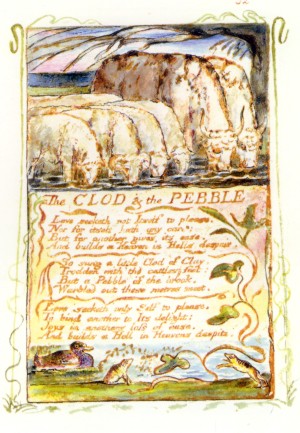
‘The Clod and the Pebble’

‘Love seeketh not itself to please,
Nor for itself hath any care,
But for another gives its ease,
And builds a heaven in hell’s despair.’

So sung a little clod of clay,
Trodden with the cattle’s feet,
But a pebble of the brook
Warbled out these metres meet:

‘Love seeketh only Self to please,
To bind another to its delight,
Joys in another’s loss of ease,
And builds a hell in heaven’s despite.’

‘Much Laughter’, by Robert Cording

Boswell’s only note after an evening with Dr. Johnson.

Nothing about the food, the wine, the subjects
Of that night’s passions. Nothing even about
The weather – rain most likely, the damp seeping
Under doors. Just those two words for a night
When everything else slipped into the vacancies
Of the unrecorded. That’s all that’s left. We know
Now the more complete story that Boswell chose
Not to tell: the good doctor’s wearied martyr’s gaze
As he walked the alleyways where the poor remained
Poor, the blind, blind, where the only lesson learned
From suffering was how much better it would be
Not to suffer. We know, too, that Johnson wanted
About this time to rest in God and yet could not
Imagine how to surrender himself to a future
He couldn’t anticipate; he couldn’t help but believe,
To his dismay, that all life needed to go wrong was
The hope it would go right. Too many could not see
How evil fouled the gears of the century’s benign God.
He was headed for another breakdown; Mrs. Thrale
Had already been secretly entrusted with a padlock
And chain to restrain his fits when the time came.
But on this particular evening, happiness must have
Arrived when he least expected it. A few hours
When everyone’s burdens were shouldered, when
There was no tomorrow sprouting its thousand forms
Of grief and humiliation and defeat. Just jokes
And small talk, and wine sweetened with oranges
And sugar tumbling down the doctor’s throat.
A night, perhaps, when all the timorous and beaten
Faces suddenly brightened in their common temple
Of laughter. A night when even a stray black dog
Might have been allowed to lick clean a patron’s
Greasy hands and warm its flea-bitten belly
Near the fire. A night caught in the genius and irony
Of Boswell’s two words – what they left unsaid
And what they say, the simple phrase like a pardon
After our sins have been listened to one by one,
And there is nothing left to remember but “much
Laughter” after another day on earth is done.

– Robert Cording, Common Life: Poems (Fort Lee: CavanKerry Press, 2006), 93–94.

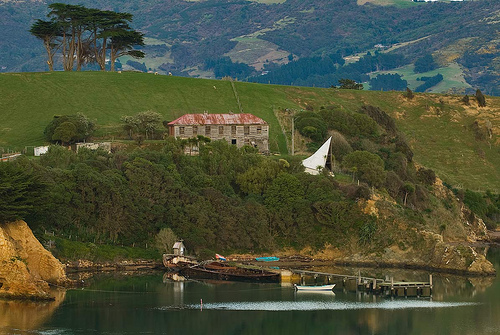
‘The Chapel, St Martin’s Island’, by John Birnie

you were well above the other yachts and boats
the ripples and sparkles below were like a dream
when you sailed calm as an ocean liner
into the side of the hill

the ripples kept jiggling in before the breeze
the light sprang off this and that surface
and the air came in above it all
pushed for a moment then flowed around
your sail run aground and turned to stone

all the trees billowed out
and turned to waves as your sail and hull
anchored you into the green hill
a school of sheep drift past

it could all be dismissed as fanciful
or laughed off as a half-remembered dream
but for the testimony of sand on the floor
gritty as questions and prayers
except for the witness of ribs and planks
except for the amen of the figurehead
the wooden cross setting a course
out over the open sea

[I’ve mentioned before my association with the very special St Martin Island Community who gather on a beautiful and historically-significant island in Otago Harbour. This poem appeared in today’s Otago Daily Times]

‘The Musician’, by R. S. Thomas

A memory of Kreisler once:
At some recital in this same city,
The seats all taken, I found myself pushed
On to the stage with a few others,
So near that I could see the toil
Of his face muscles, a pulse like a moth
Fluttering under the fine skin,
And the indelible veins of his smooth brow.

I could see, too, the twitching of the fingers,
Caught temporarily in art’s neurosis,
As we sat there or warmly applauded
This player who so beautifully suffered
For each of us upon his instrument.

So it must have been on Calvary
In the fiercer light of the thorns’ halo:
The men standing by and that one figure,
The hands bleeding, the mind bruised but calm,
Making such music as lives still.
And no one daring to interrupt
Because it was himself that he played
And closer than all of them the God listened.

– R. S. Thomas, ‘The Musician’ in Tares (Chester Springs: Dufour Editions, 1961), 19.

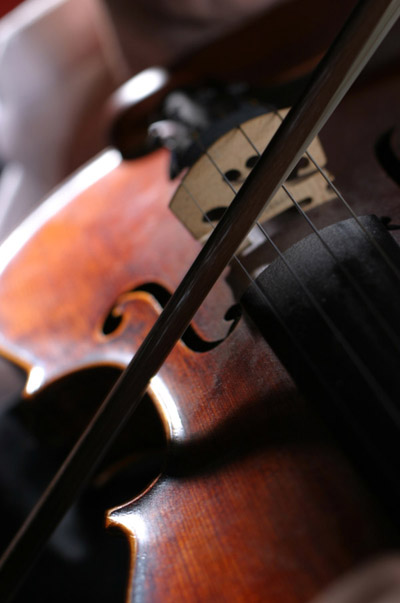
‘To My Father’s Violin’, by Thomas Hardy

Does he want you down there
In the Nether Glooms where
The hours may be a dragging load upon him,
As he hears the axle grind
Round and round
Of the great world, in the blind
Still profound
Of the night-time? He might liven at the sound
Of your string, revealing you had not forgone him.

In the gallery west the nave,
But a few yards from his grave,
Did you, tucked beneath his chin, to his bowing
Guide the homely harmony
Of the quire
Who for long years strenuously –
Son and sire –
Caught the strains that at his fingering low or higher
From your four thin threads and eff-holes came outflowing.

And, too, what merry tunes
He would bow at nights or noons
That chanced to find him bent to lute a measure,
When he made you speak his heart
As in dream,
Without book or music-chart,
On some theme
Elusive as a jack-o’-lanthorn’s gleam,
And the psalm of duty shelved for trill of pleasure.

Well, you can not, alas,
The barrier overpass
That screens him in those Mournful Meads hereunder,
Where no fiddling can be heard
In the glades
Of silentness, no bird
Thrills the shades;
Where no viol is touched for songs or serenades,
No bowing wakes a congregation’s wonder.

He must do without you now,
Stir you no more anyhow
To yearning concords taught you in your glory;
While, your strings a tangled wreck,
Once smart drawn,
Ten worm-wounds in your neck,
Purflings wan
With dust-hoar, here alone I sadly con
Your present dumbness, shape your olden story.

– Thomas Hardy, ‘To My Father’s Violin’, in Selected Poems (New York: Penguin, 1998), 116–7.