- Podcasts of William Lane Craig on Searching for the Historical Jesus and of William Lane Craig and Shelly Kagan on Is God Necessary for Morality?.
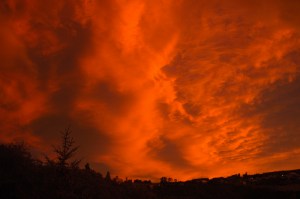
A recent Dunedin sunrise.
- Ernst Troeltsch and the resurrection: an Easter sermon by Kim Fabricius.
- A new book on Karl Barth: The Trinity and Creation in Karl Barth by Gordon Watson.
- Andrew Sullivan is Thinking Out Loud.
- David Bentley Hart’s bizarre thoughtlessness regarding pacifism by Brian Hamilton. Dave Belcher also posts on David Bentley Hart.
- The New York Times is running some photographs (by Jehad Nga, who was one of American Photo’s Emerging Artists in 2007) and audio of US troops leaving Iraq.
- Protect peaceful Moldovan protesters from police ill-treatment.
- Justine Toh on Clint Eastwood and the ethics of violence.
- And in case you missed it: David’s Ten Theses on Prayer and Ben’s stellar reflection on Led Zeppelin IV.
News
Requisiat En Pace: Father Richard John Neuhaus
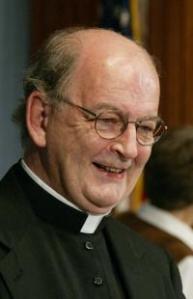 The National Catholic Reporter reports that Fr. Richard John Neuhaus, the founder of First Things and ‘a leading voice of Catholic conservatism in America, and one of those rare theologians and spiritual leaders whose influence vastly exceeded the boundaries of their religious community, has died at 72’.
Related stories can found be at:
- Remembering Fr. Neuhaus
- ‘A Second Brother Dies’: Remembrance by Michael Novak
- ‘The Two Neuhauses’: Remembrance by Damon Linker
- Remembrance by National Review Editors
- Remembrance by Ross Douthat, The Atlantic
Regular blogging to resume soon
 Apologies for the paucity of regular blogging of late. Our recent move from Scotland to New Zealand (with all the associated hassles) has meant that notebook time has been something of a rarity, although I have missed blogdom.
For those who may be interested, my induction as lecturer at the Knox Centre for Ministry and Leadership took place last night – with all the associated pomp that Kiwi Presbyterianism could muster. It was a good night and continued the warm sense of welcome that Judy and I have received since arriving in Dunedin just over a week ago. There’s a few pics of the event here. (I’m the good looking bloke in tweed).
Anyway, back to unpacking books …
A new Theology and Public Issues appointment
The University of Otago has appointed Dr Andrew Bradstock as the first holder of the Howard Paterson Chair in Theology and Public Issues. This is an exciting and encouraging development.
Around the traps …
- There’s an interesting podcast on Solzhenitsyn’s One Day in the Life of Ivan Denisovich
- Zondervan Academic have started a blog called Koinonia
- Scot McKnight continues some helpful summaries of What the Best College Teachers Do by Ken Bain
- A tragic story about a boy who was starved for not saying ‘Amen’
- Walter Moberly reviews The Bible and the Crisis of Meaning: Debates on the Theological Interpretation of Scripture by D. Christopher Spinks
- The final release of The Digital Library of the Catholic Reformation is now live
David John Williams (1933–2008): Requiescat in pace
In 1993, I was an undergraduate student at Ridley College. It was a year I thoroughly enjoyed and will always be grateful for. All my teachers provided for me a rich introduction to the world of formal theological education. I was saddened to learn today that my NT professor during that year – Dr David Williams – recently passed away. David modelled a passion for the NT and its application that was infectious. I also remember him as a very caring and patient person. (Anyone who was going to try and teach me Greek would have to be). Here’s the ‘farewell to a faithful pastor’ written by Revd Jonathan Wei-Han Kuan, Honorary Archivist, Ridley College:
In David John Williams the church was blessed with a man of gentle godliness, integrity, scholarship and great faithfulness. For half a century his name has been associated with Ridley College. He was an internationally acknowledged New Testament scholar, serving on the translation committee for the New International Version of the Bible and author of commentaries on Acts and 1 & 2 Thessalonians. His magnum opus was Paul’s Metaphors, a study of Pauline metaphors in their first-century contexts.
David was born on 29 October 1933 in Perth. He described himself as an example of what happens when the philosophy behind church schools actually works. It was at Perth’s Hale School, founded by the evangelical Bishop Mathew Hale, that David came under the influence of the Crusaders movement and was converted to Christ. During his first Crusaders’ camp at Bickley Hills he heard the Good News of Christ explained by his tent leader and responded to his invitation to pray to accept Jesus as Saviour and Lord. David was thirteen. He went on to be an active member of St Margaret’s Anglican Church Nedlands and the Church Missionary Society’s League of Youth.
David worked in a bank for four years, during which time the seed of the idea of entering the ordained ministry grew. In 1955 he became a candidate for ordination with the Anglican Diocese of Perth and, following other League of Youth members, came to Melbourne to study at the evangelical Ridley College with his wife Audrey. He would remain in Melbourne and at Ridley for the rest of his working life.
David entered Ridley when the dynamic Stuart Barton Babbage was principal and part-time Dean of St Paul’s Cathedral. It was Babbage who pressed David into being ordained for the Diocese of Melbourne and organised an ‘odd-bods’ ordination by Frank Woods in the middle of 1959. David was appointed an honorary assistant curate at St Michael’s North Carlton and started tutoring New Testament Greek at Ridley straight away. He would continue imparting his love for the New Testament across another four decades’ worth of students.
Also at Ridley at the time were Leon Morris and Frank Andersen, two other notable biblical scholars encouraged by Babbage. David, like them, was encouraged to pursue further studies, earning his PhD in 1967 alongside several other degrees from The University of Melbourne and Fuller Theological Seminary. His stature as a biblical scholar was recognised when he was selected to serve on the translation committee for the New International Version of the Bible.
Morale was low at Ridley at the departure of Babbage from Melbourne. Leon Morris was appointed principal and together with Frank and David, worked to rebuild student numbers and confidence in evangelical faith. On top of his teaching load, David was college registrar from 1960 -72 and librarian from 1971-78. It was David who brought in second-hand army huts to make up for the lack of appropriate teaching rooms and recognised the possibility of securing government funding through having residential college students by affiliation with the University of Melbourne. That funding, generous donors and an incredible amount of work by the college leadership team enabled the dining hall and library to be built. David also oversaw the phasing out of the Licentiate of Theology and the introduction of Bachelors and later Masters of Theology degrees, as well as certificate level courses.
David would be embarrassed by this recollection of his achievements. He was a quiet, shy and gentle person concerned with the advancement of the kingdom of God and not at all interested in self-promotion. David’s students remember him as a godly softly-spoken teacher who loved the New Testament and who had an encyclopedic knowledge of the first-century context. He had voluminous folders of careful Greek New Testament translation notes in his office. The publication of Paul’s Metaphor’s shortly after his retirement was a fitting capstone to a lifetime devoted to careful analysis of the biblical text. David was loved for his pastoral heart. He was always there with a genuinely concerned enquiry and ready with a kind word of encouragement. Students, undergraduate and higher up, recall his generous exam hints often prefaced by the remark, “If I were studying for the exams…”.
David was also a faithful pastor, taking charge of several parishes when Ridley’s fortunes meant that it was sometimes necessary for lecturers to find other part-time employment. His pastorate at St Michael’s North Carlton from 1974-81 is remembered as a period of renewal and growth. According to David it was mainly an accident of changing demographics. However the reality was that the parish was on the brink of closure when he arrived. It was his biblical preaching and David and Audrey’s loving pastoral care that attracted, nurtured and retained the young families of the area, setting the course for the parish’s healthy development up to this day.
David was acting principal of Ridley on no less than 6 occasions. He once applied, unsuccessfully, for the job but readily admitted that God made the right appointment. Typically self-effacing, David commented that Maurice Betteridge was exactly who the College needed after Leon Morris. It was Betteridge who appointed him Vice-Principal, a post he held from 1982 until his retirement in 1998. He remained active, teaching and deputizing for Ridley up to 2004.
Although David and Audrey lived at or around Ridley over four decades, they made their home at a country property in Bullengarook, outside Gisborne, where they enjoyed growing their own produce and providing generous hospitality. Generations of Ridley students recall picnics on the ground, and weekends away to study the Bible and pray together in a relaxed setting. They hosted a college missions team event there in 2005.
In late 2007 David was diagnosed with cancer. Audrey and David enjoyed a Ridley study tour to Israel that summer. David was called home to the Lord from Bullengarook in the evening of 15 May 2008. He is survived by Audrey and three sons, Michael, Peter, and Stephen; two of whom have followed David into paid Christian work. David John Williams exemplified the gospel that he preached and taught to generations of Ridley students, who in turn have and are still serving the Lord Jesus Christ across Melbourne, Australia and indeed the world.
‘Gregory MacDonald’ enters blogdom
 ‘Gregory MacDonald’, the pseudonymous author of The Evangelical Universalist (which I have written a wee note about here) has started a blog with a view to fostering discussion about Christian universalism. Those who have not yet read ‘MacDonald’s’ book really ought to get their hands on it and READ it … especially if you’re planning on contributing anything meaningful to the discussion over at ‘Gregory’s’ blog, The Evangelical Universalist.
Some time ago now, Chris Tilling and Jason Clark posted some helpful discussion on the book too.
David F. Wright (1937-2008) – Requiescat in pace
I was saddened to hear today of the passing away of Professor (Emeritus) David F. Wright, who died yesterday. The New College website reports that he was a ‘distinguished member of the New College academic staff from 1964 till his retirement in 2003. He was awarded the DD as a higher doctorate for his many respected publications, and was subsequently awarded a personal chair in Patristic and Reformation Studies. He had suffered from cancer for several years, but maintained a very active in lecturing internationally and in several publication projects until the last few months. Prof. Wright will be remembered affectionately by many students, including his numerous PhD students. He is survived by his wife, Anne Marie, and their son and daughter. Condolences can be sent to Mrs. Wright care of New College’.
I only met Professor Wright a few times, but each time discovered in him one who was a great encourager, in person and in print. Many of his books continue to grace my shelves, two of which (he co-edited) receive near incessant consultation: New Dictionary of Theology and the particularly helpful The Dictionary of Scottish Church History & Theology. In more recent years, his attention turned to questions of baptism, evidenced in his 2003 Didsbury Lectures, published as What Has Infant Baptism Done to Baptism? An Enquiry at the End of Christendom and, most recently, his challenging essays in Infant Baptism in Historical Perspective: Collected Studies.
Advent Reflections
To believe that the eternal Light which entered the world is none other than God in flesh, God in flesh – to believe that, well that is what it means to be human.
Which reminds me, there’s a team of folk posting daily Advent reflections over at Hopeful Imagination.
Dan Hardy (1930-2007)
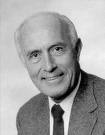 Andy has shared with us the very sad news of Dan Hardy‘s passing yesterday. He writes:
‘Rev Professor Dan Hardy was an outstanding Anglican theologian, who taught at Birmingham, Durham (where he was Van Mildert Professor), the Centre for Theological Inquiry (where he was the Director) and most recently, although retired, at Cambridge. He was editor of the excellent Cambridge Studies in Christian Doctrine (jointly with Colin Gunton until he died). He was the co-author of Jubilate (1984, reprinted recently as Living in Praise, 2005), God’s Ways with World (1996), Finding the Church (1999) and co-editor with Colin Gunton of On Being the Church (1989). In more recent years he was at the forefront of the scriptural reasoning movement with his son-in-law Professor David Ford and Peter Ochs. He will be sadly missed’.
Indeed. Dan was deservedly one of the most respected theologians in Britain. He was also, with Colin Gunton, a Forsyth fan. In his excellent essay, ‘Created and Redeemed Sociality’, he bore witness to this love, and to his deeper love for the Church and her Lord, and his world:
As few others have done, Forsyth recognised the social problem as primary for civilisation and for Christianity; there is an inseparable connection between the two. And the Church is called as an apostle and witness to society as a whole on behalf of One whose work was for the whole of society, its witness being determined by Christ’s achievement in securing the Kingdom of God through and ethical and spiritual victory’. – Daniel Hardy, ‘Created and Redeemed Sociality’, in On Being the Church: Essays on the Christian Community (ed. Colin E. Gunton and Daniel W. Hardy; Edinburgh: T&T Clark, 1989), 39.
Alone?
 Today’s The Independent includes a story of an international panel of retired pilots and aviation officials who have ‘risked ridicule by sharing their personal stories of close encounters with unidentified flying objects, and urging the US government to reopen its investigation into extra-terrestrial spacecraft’.
Amidst the usual cries of ‘government coverup’ and ‘natural but not-as-yet known explanations’, the article notes that ‘among the UFO incidents discussed by the gathering in Washington DC this week was an alleged sighting of a triangular-shaped flying machine with unfamiliar markings near the former US air base at RAF Woodbridge in Suffolk in 1980. “Nothing in my training prepared me for what we were witnessing,” James Penniston, a retired US Air Force pilot, told the panel. He said the UFO, with “blue and yellow lights swirling around the exterior”, was “warm to the touch and felt like metal”. Finally, “it shot off at an unbelievable speed” in front of 80 witnesses. “In my log book, I wrote ‘speed: impossible’,” Mr Penniston added. At the time, the case was labelled the “English Roswell” – referring to the furore caused by the alleged discovery of UFO parts in New Mexico in 1948.’ Read on here.
UFO’s or not, my thesis is not going to write itself, so its head down for the rest of the day … ish.
Ezra
A young mate of mine – who happens to be a good theologian – has started a website with some friends. Ezra is aimed to ‘encourage, challenge and build-up the next generation of believers to live all out for Jesus everyday. It is aiming to provide an area where people can get real with God and with each other through sharing their thoughts, art and school CU/youth group news’.
Weekly Meanderings
‘Hundreds of demonstrators have defied the military junta in Burma to stage a rare protest march, despite the arrests of 13 leading pro-democracy activists.
Witnesses said 300 people staged an hour-long march then were dispersed by gangs of unidentified men, believed to be members of the regime-created Union Solidarity and Development Association (Usda).
There has been a series of midnight raids aimed at confronting the growing protests over rising fuel prices. Among those arrested were some of the country’s most important dissidents.’ Read on here.
Also, there’s a wee interview with Pat Dodson, Pete Postlethwaite, Michael Long and Bishop John Selby Spong here and, more interestingly, Clive James here. Also, there’s an interview here with an Iraq veteran speaking out against the war and media coverage of Iraq.
More MP3’s of interest include this one on Religious Toleration in an Age of Terrorism (at about 18 mins) and this one on Minority Religious Groups in Iraq, and The War For Children’s Minds.
I really enjoyed this wee piece by Brendon O’Connor entitled Just something about George or is an anti-American century likely? and this piece by George Williams on ‘Does Australia need a Charter of Rights?’
And finally there’s Robert Fisk, who is always worth reading, on The Iraqis don’t deserve us. So we betray them… and this shocker on Abu Ghraib abuse.
And after all that heavy reading and listening …


A Call to Amend the ETS’s Doctrinal Basis
Denny Burk and Ray Van Neste are proposing an amendment to the ETS’s doctrinal basis along the lines of the UK’s Tyndale Fellowship which agrees with the statement of belief used by the UK’s Universities and Colleges Christian Fellowship (UCCF). There are no surprises in the proposed list, which suggests a shift from the current two-part statement to an eleven-part statement. You can read more about it here.
Unsurprisingly, so far under the ‘Categories’ in the sidebar, there are 4 articles on ‘Amendment’ and 8 on ‘Evangelicals and Catholics’.
David Brown @ St Andrews
For those who are around Scotland, the Revd Canon Professor David Brown (Van Mildert Professor in the University of Durham), who is always worth hearing, will be presenting a paper on ‘Pork, eels and aphrodisiacs: Finding God in food’ on Monday 18 June 2007 at the School of Divinity at the University of St Andrews. For more information, contact Gavin Hopps (who is also always worth hearing) or phone (+44) (0) 1334 462 841.
Francis Beckwith, ETS and Rome
full communion with the Roman Catholic Churchit’s good to hear/read the story straight from the horse’s mouth, so to speak.
Christian Union ban sparks debate
Here’s a copy of a piece from the BBC news website by Jon Silverman. For those of the praying kind, this is worthy of our God-centered and God-directed attention.

There has been employment litigation which has centred on alleged discrimination on religious grounds.
But the Exeter case is thought to be the first to go to law in the education world.
Given a number of acrimonious conflicts between Christian groups and their student bodies over exclusive membership policies, the outcome will be of some significance.
The Evangelical Christian Union (ECU) at Exeter University will almost certainly seek to use Section 13 of the Human Rights Act in its judicial review.
That section was inserted specifically to assuage concerns by religious organisations that their beliefs and practices would not be circumscribed by the act.
Barrister Schona Jolly, from the firm, Cloisters, said: “On the face of it, the decision by the student guild at Exeter to freeze the ECU’s bank account and suspend it from membership, is a breach of Section 13.
“However, this case is about a clash of competing equalities.
“The guild will probably argue that it is entitled to take financial measures because the law requires it to uphold the principle of equality of opportunity and that it is not obliged to fund a society which openly excludes some prospective members, whether on grounds of sexual orientation or religious belief.”
Assuming that the High Court accepts that a university is a “public authority” – which it almost certainly will – the first question to decide is whether the ECU can claim the protection of the Human Rights Act at all.
The European Court of Human Rights has taken a fairly narrow view of the freedom to “manifest” one’s religion.
‘Pressing social need’
In the Exeter case, the ECU’s requirement that members sign a statement of beliefs might be interpreted as a different matter from manifesting one’s religion and thus not protected by law.
Historically, it has been harder for churches and religious organisations than individuals to make such a case.
A number of articles of the European Convention on Human Rights are relevant to this case – those dealing with freedom of thought, conscience and religion, freedom of expression, freedom of assembly and association and prohibition of discrimination.
But none is absolute and all may be qualified by a public authority so long as such action is lawful, necessary and proportionate.
The guild will need to show that there is a “pressing social need” for the action it has taken.
If there is a full judicial review, it could be a ground-breaking case.
The end is in sight…
 This week has largely seen me out of blogdom, though I have been watching from the sidelines.
I’ve enjoyed reading Ben’s post on the myth of expository preaching, and Kim’s 9.5 theses on listening to preaching.
But my favourite web discovery this week has been From the Fishouse: a site loaded with contemporary poems to read and listen to. Not a few times this week has it been water to my soul.
Mostly, I have been working flat out lately trying to put an article together for a journal. I didn’t get much notice. It’s practically finished and I’m reasonably pleased with how it has come together. The theme of the article is on why the church needs the world, and explores PT Forsyth’s engagement with the Norwegian poet and dramatist Henrik Ibsen. I’ve really enjoyed writing it but now I’m just ready to spend time with my family, enjoy a beer, watch the world cup final with friends, and catch up on some sleep. Now that all sounds almost as exhasuting as writing another article … but O what bliss exhaustion.
‘Cheeky bugger’ Pro Hart dies
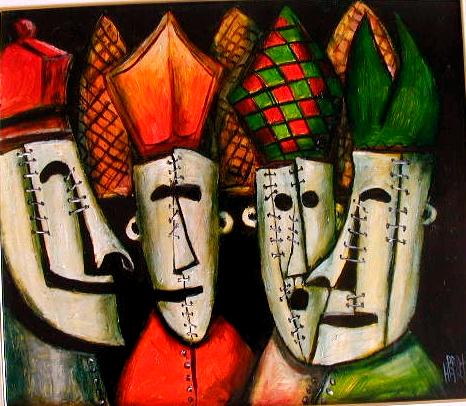
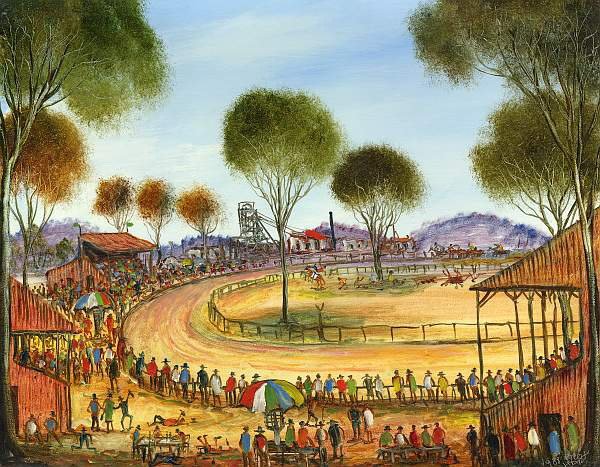
 One of my favourite painters, Pro Hart, died this week after battling motor neurone disease. I thought I’d post a few of his pics for us to reflect on. PT Forsyth reminded us what Pro Hart taught us: that art can never be seperated from feidistic concerns, nor of other human pursuits such as philosophy or science. There may be a primacy in the arena of religion, but there can be no independence. ‘Our attitude to each is an indivisible function of the whole rational man. The whole man is turned upon Nature in earnest science, and the whole man is turned on God in real religion. What makes the real difference in our relations to them, in what we call the faculties, comes from the other end. It is a difference in the objects themselves and their behaviour’ (Authority, 148). For both men, I am grateful.
Finally…
Logos Bible Software have placed the Barth’s Church Dogmatics (all 14 volumes!) in its pre-publication system. Given enough interest it will be produced and made available electronically in Logos Bible Software. Read more here. Now, tell your friends. What a Christmas present!
 jasongoroncy.com