- Peter Leithart on why we need to be ‘something like’ Biblicists
- David Guretzki has a fantastic post on Christmas preaching with Karl Barth
- John Mark Reynolds posts Ten Reasons for Calvinists to be Cheerful This Christmas
- Ben Myers announces a Sydney symposium on ‘Sarah Coakley and the Future of Systematic Theology’
- Cynthia Nielsen introduces Hans-Georg Gadamer (Part I, II)
- The latest Journal of Reformed Theology is out, and includes an essay by fellow-blogger David W. Congdon titled ‘Jesus and Faith: The Doctrine of Faith in Scripture and the Reformed Confessions’
- Trevor Faggotter reflects on the relationship between church and compost
Church
Rob Bell and Don Golden on eucharist and the new humanity
 ‘In the new humanity, them becomes us, they becomes we, and those become ours. This is why it is very dangerous when a church becomes known for being hip, cool, and trendy. The new humanity is not a trend. Or when a church is known for attracting one particular kind of demographic, like people of this particular age and education level, or that particular social class or personality type. There’s obviously nothing wrong with the powerful bonds that are shared when you meet up with your own tribe, and hear things in a language you understand, and cultural references are made that you are familiar with, but when sameness takes over, when everybody shares the same story, when there is no listening to other perspectives, no stretching and expanding and opening up – that’s when the new humanity is in trouble.
The beautiful thing is to join with a church that has gathered and find yourself looking around thinking, “What could this group of people possibly have in common?” The answer, of course, would be the new humanity. A church is where the two people groups with blue hair – young men and older women – sit together and somehow it all fits together in a Eucharistic sort of way. Try marketing that. Try branding that. The new humanity defies trends and demographics and the latest market research.
In Acts 8 some of Jesus’ first followers are healing people, and a man named Simon sees this and offers them money and says, “Give me also this ability.” Simon is seduced into thinking that the movement of the Spirit of God is a commodity to be bought and sold like any other product. The apostles chastise him for his destructive thinking, because … the Eucharist is not a product.
Glossy brochures have the potential to do great harm to the body and blood. Church is people. The Eucharist is people. People who have committed themselves to being a certain way in the world. To try to brand that is to risk commodifying something intimate, sacred, and holy.
A church is not a center for religious goods and services, where people pay a fee and receive a product in return. A church is not an organization that surveys its demographic to find out what the market is demanding at this particular moment and then adjusts its strategy to meet that consumer niche.
The way of Jesus is the path of descent. It’s about our death. It’s our willingness to join the world in its suffering, it’s our participation in the new humanity, it’s our weakness calling out to others in their weakness. To turn that into a product blasphemes the Eucharist.
The Eucharist is what happens when the question is asked, What does it look like for us to be a Eucharist for these people, here and now? What does it look like for us to break ourselves open and pour ourselves out for the healing of these people in this time in this place? The temptation is simply to duplicate the Eucharist of someone else’.
– Rob Bell and Don Golden, Jesus Wants to Save Christians: A Manifesto for the Church in Exile (Grand Rapids: Zondervan, 2008), 156–8.
Aliens in the Church: A Reflection on ANZAC Day, National Flags and the Church as an Alternative Society
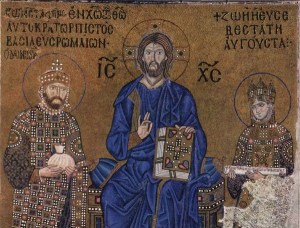
Hagia Sophia - Mosaic of Christ with Constantine IX and Zoe
‘There is no agreement between the divine and the human sacrament, the standard of Christ and the standard of the devil, the camp of light and the camp of darkness. One soul cannot be due to two masters — God and Cæsar’. So was Tertullian’s response (in On Idolatry 19) to a question he posed of ‘whether a believer may turn himself unto military service, and whether the military may be admitted unto the faith, even the rank and file, or each inferior grade, to whom there is no necessity for taking part in sacrifices or capital punishments’.
My recent return to the Antipodes (after only 3 years) has been met with something of a shock at what I observe to be a distinct revival of patriotism in this part of the world symbolised not least in the hoisting of national flags. I can only interpret this as a public confession that the soul of the nation is distressed. Holding this thought, I remember once hearing (on tape) the great Welsh preacher Martyn Lloyd-Jones lamenting that the saddest day in ecclesiastical history was when Emperor Constantine converted to Christianity. (Of course, it may been different if Constantine had turned out to be a different kind of Emperor, but that’s not my point here). At the time, I wondered if this was a bit of an overstatement (a brilliant preacher’s rhetoric beclouding more constrained reflection on what is only one of millions of possible ‘saddest day’ candidates), but he was certainly onto something: that the Church’s jumping into bed with and baptising nationhood with its programs and events – such as Anzac Day – serves to highlight yet again that there is literally all the difference in the world between discipleship and citizenship, that with or without the third verse the Church cannot in good conscience sing the hymn ‘I vow to thee, my country’, words which were rung out at many a recent Anzac Day service. (And while I’m on Anzac Day services, let me tout that the Church can only faithfully recall the deaths that war has claimed if she does so as part of her proclamation against all war.)
The Church betrays its witness to the one Word of God when she includes a national flag among – or alongside – her emblems of worship. Nationalism and patriotism are always idolatrous enemies of a jealous Lord who tolerates no rivals. To see a national flag displayed in a place of Christian worship is to witness a message as scandalous and confusing as to see an ATM machine in a ‘church foyer’. Moreover, to witness (or to participate in) what Lesslie Newbigin described as ‘the Constantinian trap’ is to observe (and/or to participate in) the greatest of public failures – the denial of the Church’s font, table and pulpit, its raison d’être and its catholicity in the world. It is to preach that the greatest thing in the world – the Church – has become a chaplain of the State and its violent machinery. Paul Fromont recently gave voice to similar concerns by drawing upon Stanley Hauerwas’ writing as that concerned with ‘liberation’. For Hauerwas, he writes, this typically centres on a two-fold dynamic: (1) The liberation of the church from its captivity to agendas, values and practices intrinsically alien to its character and calling; and (2) liberation (in order to) restore the church to be and act as what [Hauerwas] terms a ‘free agent’ of the Kingdom appropriate to God’s agenda of the salvation of the cosmos and its re-creation (cf. Rev 21:1; Rom 8:22). I recall Hauerwas’ words from another context: to ‘worship in a church with an American flag’ means that ‘your salvation is in doubt’. Patriotism is no Christian virtue. (See Hauerwas’ Dissent from the Homeland, p. 184). The problem in Germany during the 1930s and 40s wasn’t that German Christians draped the cross with a Nazi flag; it was that they draped the cross with a flag full stop. Christian communities ought remove all national flags from their places of worship, and to do so at least as publicly as when they were first placed there. The removal should be accompanied by a public prayer of confession for despoiling the Church’s witness to its Lord, and to its own catholicity.
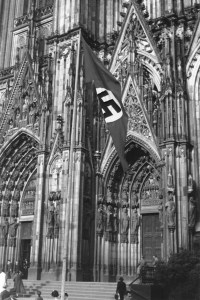
Cologne Cathedral, 1937
Against those who contend that the Church’s role is to baptise those creations of common good that the State concerns itself with, William Cavanaugh, in his brilliant essay, ‘Killing for the Telephone Company: Why the Nation-State is not the Keeper of the Common Good’ (Modern Theology 20/2, 2004), observes that Christian social ethics more often than not proceed on the false assumption that the responsibility for promoting and protecting the common good falls to the State. He avers:
The nation-state is neither community writ large nor the protector of smaller communal spaces, but rather originates and grows over against truly common forms of life. This is not necessarily to say that the nation-state cannot and does not promote and protect some goods, or that any nation-state is entirely devoid of civic virtue, or that some forms of ad hoc cooperation with the government cannot be useful. It is to suggest that the nation-state is simply not in the common good business. At its most benign, the nation-state is most realistically likened, as in MacIntyre’s apt metaphor, to the telephone company, a large bureaucratic provider of goods and services that never quite provides value for money. The problem, as MacIntyre notes, is that the nation-state presents itself as so much more; namely, as the keeper of the common good and repository of sacred values that demands sacrifice on its behalf. The longing for genuine communion that Christians recognize at the heart of any truly common life is transferred onto the nation-state. Civic virtue and the goods of common life do not simply disappear; as Augustine saw, the earthly city flourishes by producing a distorted image of the heavenly city. The nation-state is a simulacrum of common life, where false order is parasitical on true order. In a bureaucratic order whose main function is to adjudicate struggles for power between various factions, a sense of unity is produced by the only means possible: sacrifice to false gods in war. The nation-state may be understood theologically as a kind of parody of the Church, meant to save us from division. The urgent task of the Church, then, is to demystify the nation-state and to treat it like the telephone company. At its best, the nation-state may provide goods and services that contribute to a certain limited order – mail delivery is a positive good. The state is not the keeper of the common good, however, and we need to adjust our expectations accordingly. The Church must break its imagination out of captivity to the nation-state. The Church must constitute itself as an alternative social space, and not simply rely on the nation-state to be its social presence. The Church needs, at every opportunity, to “complexify” space, that is, to promote the creation of spaces in which alternative economies and authorities flourish. (pp. 266–7)
Cavanaugh contends that by regarding the nation-state as responsible for the common good, ‘the Church’s voice in such crucial moral matters as war becomes muted, pushed to the margins. Just war reasoning becomes a tool of statecraft, most commonly used by the state to justify war, rather than a moral discipline for the Church to grapple with questions of violence. The Church itself becomes one more withering “intermediate association”, whose moral reasoning and moral formation are increasingly colonized by the nation-state and the market. To resist, the Church must at the very least reclaim its authority to judge if and when Christians can kill, and not abdicate that authority to the nation-state. To do so would be to create an alternative authority and space that does not simply mediate between state and individual’ (p. 268). That is why one appropriate Christian witness might be the refusal of those who reside in States where funding goes to pay for the machinery of aggressive war to withhold a percentage of their income tax commensurate with the State’s war budget. (Here I have in mind Yoder’s essay ‘Why I Don’t Pay All My Income Tax’).
While the Church shares some cultural space with the world, it is not an institution alongside others, and it exists for the propping up of none. The Church, as Peter Leithart argues in Against Christianity, is both ‘an alternative world unto herself’, and a participant in the Spirit’s ‘subversive mission of converting whatever culture she finds herself in’. And the Church participates in the second only as she lives authentically as the first – i.e. as she embodies an alternative Societas determined by its own jealous Servant-Lord and shaped by its own unique narrative. Christendom can never undertake this mission because it can only propose ideas or offer the Church as a ‘new sort of religious association’, essentially no different to a local lawn bowls club. It does not form an alternative city, a ‘new, eschatological ordering of human life’. ‘Constantinianism … is a theological and missiological mistake’ (Rodney Clapp).
If Leithart is right that the mission of the Church involves the converting of culture then, as I intimated above, this can only happen as the congregation of Jesus lives uncompromisingly under a different economy and politic. The consequence of such living will inevitably provoke a declaration of war by the gods. History is indeed the battle for worship, as the Book of the Revelation bears witness to.
Anyway, back to the issue of the flag. Few have named the stakes as cogently and as carefully as Karl Barth, with whose words I bring this post to a close:
[The] combining of the Word of Jesus Christ with the authority and contents of other supposed revelations and truths of God has been and is the weak point, revealed already in the gnosis attacked in the New Testament, at almost every stage in the history of the Christian Church. The prophecy of Jesus Christ has never been flatly denied, but fresh attempts have continually been made to list it with other principles, ideas and forces (and their prophecy) which are also regarded and lauded as divine, restricting its authority to what it can signify in co-ordination with them, and therefore to what remains when their authority is also granted. Nor is this trend characteristic only of early and mediaeval Catholicism. It is seen in Protestantism too, from the very outset in certain circles, even in the Reformers themselves, and then with increasing vigour and weight, until the fatal little word “and” threatened to become the predominant word of theology even in this sphere where we might have hoped for better things in view of what seemed to be the strong enough doctrine of justification. It needed the rise of the strange but temporarily powerful sect of the German Christians of 1933 to call us back to reflection, and at least the beginning of a return, when the more zealous among them, in addition to their other abominations, awarded cultic honour to the portrait of the Führer. The overthrow of this whole attitude, and its provisional reversal, was accomplished in the first thesis of Barmen which is the theme of the present exposition. But there are other Christian nations in which it is customary to find a prominent place in the church for national flags as well as the pulpit and the Lord’s table, just as there are evangelical churches which substitute for the Lord’s table a meaningfully furnished apparatus for the accomplishment of baptism by immersion [or, one might add, that most holy of contemporary ecclesiastical furniture – the data projector and its accompanying screen]. These externals, of course, are trivial in themselves. But as such they may well be symptoms of the attempt which is possible in so many forms to incorporate that which is alien in other prophecies into what is proper to that of Jesus Christ. If these prophecies are prepared for this – and sooner or later they will make an open bid for sole dominion – the prophecy of Jesus Christ asks to be excused and avoids any such incorporation. If it is subjected to such combinations, the living Lord Jesus and His Word depart, and all that usually remains is the suspiciously loud but empty utterance of the familiar name of this Prophet. “No man can serve two masters” (Mt. 6:24). No man can serve both the one Word of God called Jesus Christ and other divine words’. – Karl Barth, Church Dogmatics IV.3.1 (ed. G.W. Bromiley and T.F. Torrance; trans. G.W. Bromiley; Edinburgh: T&T Clark, 1999), 101–2.
Robert Jenson: Burns Lecture 3 – The New Testament and the Regula Fidei
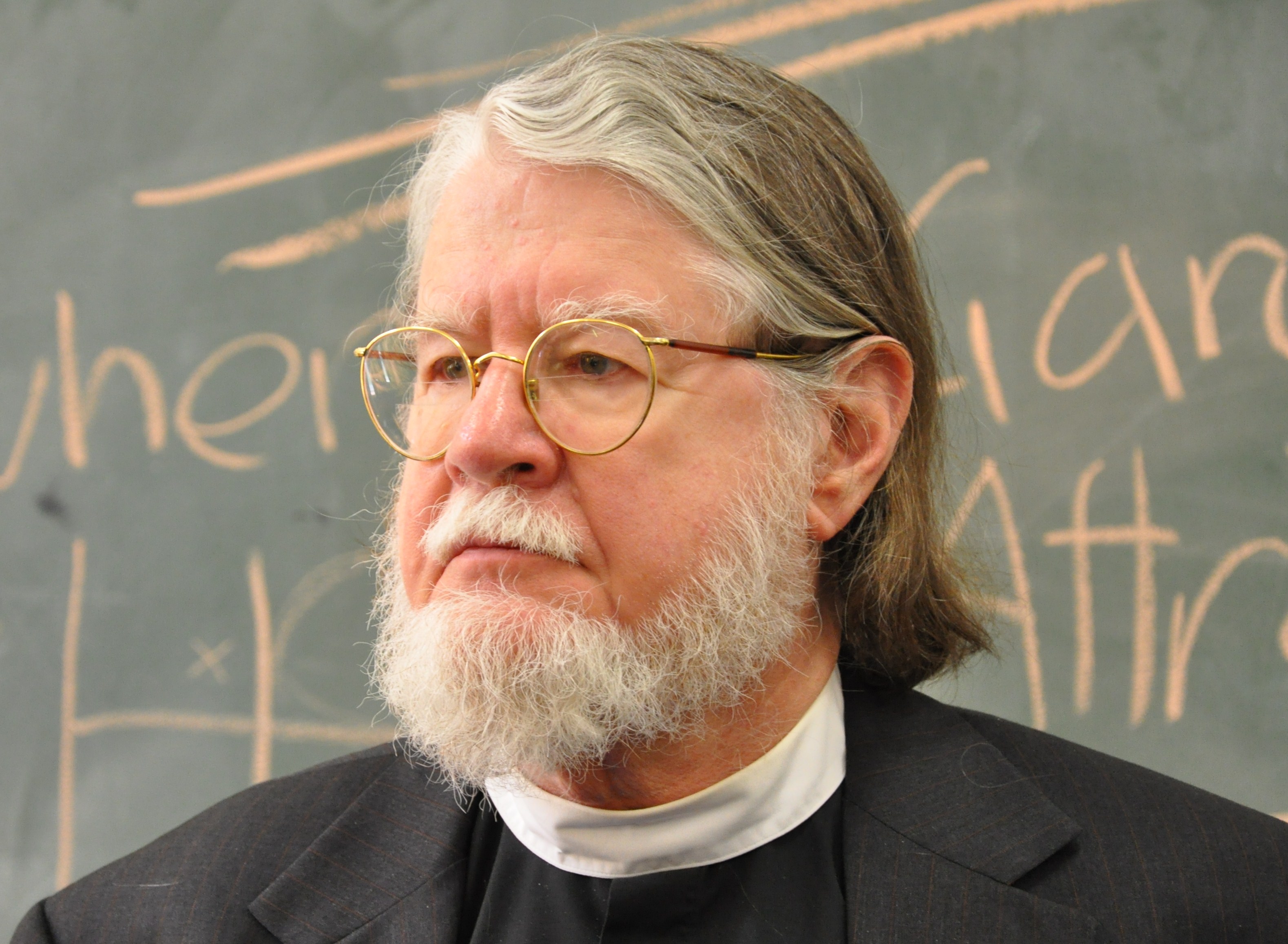
© 2009. Photo taken by John Roxborogh, when Robert Jenson visited the Knox Centre for Ministry and Leadership in Dunedin. Used with permission.
Professor Jenson’s third Burns Lecture was concerned with the emergence of the NT as canon.
Initially he looked at the emergence of the NT canon as documented in the writings of Irenaeus. He noted that Irenaeus‘ arguments are circular, however, this is not a vicious circularity, indeed ‘circularity is the very mark of the Holy Spirit’.
In the search for authoritative apostolic teaching, Paul’s writings were accepted in spite of the appearance of gnosticism. Paul’s letters are scripture but only in the broader context of the story to which they contribute. The acceptance of the gospels arose due to the ‘logical relation’ between the gospel and the earliest expressions of the regula fidei. ‘Jesus is risen’ – ‘the ‘shortest statement of the gospel’ – calls out for narrative specification of Jesus’ identity. The gospel offered precisely that thickness of description and ‘morally and religiously specific news’ that the Church’s continuing identity required. On the other hand the theology of Paul and the other writers gave specificity to the meaning of ‘is risen’. So ‘Jesus’ is a reference to a real person; ‘is risen’ is a statement of ‘utmost salvific import’, especially in Second Temple Judaism.
The overall argument of the lecture was for the mutual interdependence of gospels and letters, alongside the mutual interdependence of creed and canon. Just as the crisis of identity threatening the Church’s fading regula fidei called for both the narrative of the gospels and the theology of the letters, so the emerging creedal formulations arising out of the regula fidei required the canon.
In something of a introductory survey of the Second-Century Church, Jenson reminded us that it was Clement of Alexandria who was the first to refer to the ‘Old Testament’ and to the ‘New Testament’. He also argued that the NT canon probably would have been formed even without Marcion, but that it may have been a different canon. Still, ‘we cannot say’.
Jenson proceeded to argue that creed and canon ‘fit together’ like two halves of a puzzle: the NT is indispensable to the creedal tradition and the canon is indispensable to the NT. Although he didn’t specify which creeds have authority for the Church (e.g. what ought we make of the Reformation creeds?), he did define the criterion by which that may be determined. He reserved the title ‘creed’ for those statements which derived ‘organically out of the regula fidei‘. Thus this notion of the communal self-consciousness of the first witnesses (he praised Bauckham’s recent study here, Jesus and the Eyewitnesses) becomes more and more central to his emerging argument. Canon and creed together as the source of the identity of the Church over time take over where ‘regula fidei’ leaves off.
He made a brief comment on inspiration, stressing that the work of the Spirit – undergirding that circular reasoning we talked of earlier – was a work from within (not from outside) both the writers and the interpreters of the canon. The inspiration of the Spirit, on Jenson’s view, is not a gift separable from the presence of the Spirit. Like other gifts, it is a gift in the self-giving of the Spirit and not apart from that.
Past Lectures:
1. Creed, Scripture, and Their Modern Alienation
2. The Tanakh as Christian Scripture
Next Lectures:
5. The Creed as Critical Theory of Scripture
6. Genesis 1:1 and Luke 1:26-38
Notes by Bruce Hamill and Jason Goroncy
Robert Jenson: Burns Lecture 2 – The Tanakh as Christian Scripture
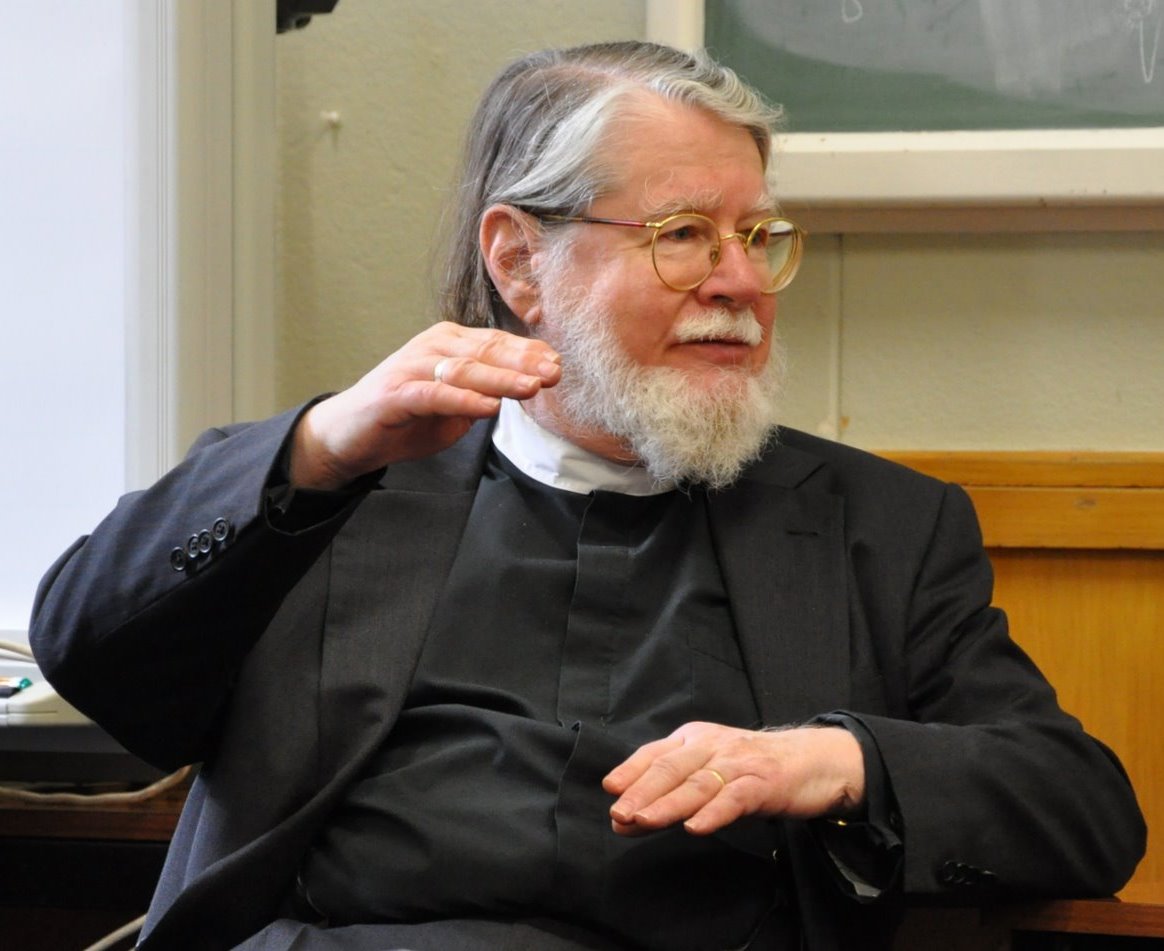
© 2009. Photo taken by John Roxborogh, when Robert Jenson visited the Knox Centre for Ministry and Leadership in Dunedin. Used with permission.
The Burns Lectures are definitely warming up. In this lecture Robert Jenson dealt with the Tanakh, or Old Testament (as is his preferred terminology with appropriate qualification: ‘old’ equals ‘prior’ rather than ‘antiquated’) as Christian scripture. He began by clarifying the appropriate questions – the status of the OT as Christian scripture was never questioned and for Jenson this can’t be the Church’s question since it is both absolutely prior (presumably in the sense that it constitutes the world in which the Christian faith is born) and necessary for the Church’s self-understanding. Jenson says that the really interesting question for the first Christians was a kind of obverse to that which questions the status of Israel’s scriptures, namely whether Israel’s scriptures could accept the proclamation of the resurrection. The Church, he insisted, did not accept Israel’s scriptures. Rather, Israel’s scriptures received the Church. Jenson noted that for the century, it was Israel’s scriptures which served the Gospel rather than the obverse. This question is alive even though it cannot be clearly asked since God has already answered it in raising Jesus.
Jenson proceeded to highlight how this question is constantly in the background of NT writing and how the NT demonstrates in the way it tells its story a ‘narrative harmony’ with Israel’s scriptures – relationship between passion narrative and Isaiah 53 being a case in point. The OT prophets were the one’s who provided the answer to ‘why’ did Jesus needed to die. Jenson argued that we cannot ask why the OT Scripture after Christ. Rather, we can only ask how scripture is the way for the Christian community. He also observed that the Church reads the OT as narrative because her gospel is itself a narrative, and because her gospel recognizes itself as the climax of the story told in the OT. Jenson cautioned about ‘unguarded talk of the unique fullness of God’s revelation in Christ’ [is that the mythological Christomonism?]. Such talk requires, says Jenson, the important qualification that the God present to the OT sages is the same Word, Jesus Christ. Jesus taught the scriptures with ‘authority’ says Jenson, ‘that is, as if he were the author … because, in a sense, he is’. Jenson continued this line with comments like ‘Christ prayed the psalms as the leader of Israel’s worship gathered as the body of Christ’. When ancient Israel gathered in the temple with their hymns and lamentations they were gathered as ‘the body of Christ’. At this point he introduced some of the difficult issues that were to arise later in his lecture also. In response to those who wonder whether Christians can pray the Psalms that call for the destruction of their enemies and the bashing of babies against rocks, he suggested, with some rhetorical flourish, that they could pray them at the foot of the cross against the devil and his angels. [We shall return to this claim]
The key question which the latter part of Jenson’s lecture focuses on is not whether the OT is Christian scripture but precisely how it so functions. Jenson’s answer is that it functions as ‘narrative of God’s history with his people’, including the Church. This arises because the Church’s gospel is narrative and it identifies itself as the climax of the narrative of Israel’s history. Why this should be so stems from the character of the ‘regula fidei’ as a ‘plotted sequence of God’s acts’ (economy) on the one hand and the nature of the book the Church wrote as a second testament. He interestingly contrasts the two movements to emerge from old Israel with the destruction of the temple – rabbinic Judaism ended up using the Tanakh differently from the Church because their second testament (Mishnah) had a legal character which meant that they read their Torah with law as a guiding concept. On the other hand the Church with its narrative gospel ended up contextualising law within the narrative of God with his people. This also had a lot to do with Paul’s very complex problematisation of the law.
The ‘how’ question in relation to the role of the OT was forged in contrast to various challenges to the initial role of the OT – Gnosticism, Marcionism, and Platonism. Although there was a certain ‘Church History 101’ feel to the lecture here, Jenson’s characterization of the movements and issues was always interesting. In response to all these developments, but particularly to that ‘monomaniacal Paulinist’ Marcion, Jenson says that Christians have no way of avoiding the fact that the God of Israel is a ‘man of war’ who goes into battle, sometimes for, sometimes against, his people, but a God who takes sides in history. This, says Jenson, is the only alternative to a god who abandons history. God is either involved in fallen history as the God of Israel is, or God is not. If God is to engage a violent history God cannot do so without being a ‘God of war’, that is, without getting God’s hands dirty. And it seems, for Jenson, to be involved is to be implicated as an agent of violence. Like Hans Boersma has also recently argued, Jenson seems to hold that God uses violence as a means justified by God’s ends – that God participates in the world’s violence but he does so by entering into that violence and dying in it, through which violence is undone.
When questioned as to whether there was a third alternative, namely to suffer violence as the crucified one, Jenson responded effectively that in relation to this issue it was not really a third alternative since the crucifixion was an event in which God was both the crucifier and the crucified – and therefore, presumably, not non-violent. He also presumed that the question was motivated by the issue of theodicy.
Three critical questions arise at this point:
- The first picks up on the difference the revelation of God in Christ makes. Why did Jenson limit the praying of that psalm to prayers against “the devil and his angels”? If he is to be consistently true to the ‘man of war’ motif, why do not Christians pray against their human enemies and their enemy’s babies? And if they do so, how is this consistent with love for one’s enemies?
- Is it necessary that if the Father sent the Son to the cross and the Son went to the cross in obedience to the Father that the God of Israel must be seen as both the crucified and the crucifier? Surely the willingness to be crucified and the willingness to let the Son be crucified (not my will but yours) do not entail the agency of crucifixion. Surely the fact that this evil event is ultimately good (Friday) lies in the good consequent upon it (for the joy that was set before him). There is no paradoxical necessity to make God (in whom there is no darkness) the agent of death. Surely the triune God is here its defeater.
- Finally, does the fact that the Old Testament is the Church’s scripture rule out the possibility that it, like the New Testament, is a ‘text in travail’ bearing witness to Israel education by God. Is it not possible to discern in the light of the crucifixion and resurrection of Christ a journey within Israel to unlearn pagan violence – we think here of a trajectory which includes the Cain/Abel story, the Akideh, the repentance of God post flood, the Joseph story, story of Job, the servant songs and so much more. So rather than accepting a strand which is taken for granted in the scriptures – God as man of war – why not discern how that strand is being deconstructed in the course of Israel’s journey with God? If such a reading is persuasive then the motivation to question the ‘man of war’ motif need not be motivated by theodicy, or not in any simplistic way.
Past Lectures:
1. Creed, Scripture, and Their Modern Alienation
Following Lectures:
3. The New Testament and the Regula Fidei
5. The Creed as Critical Theory of Scripture
6. Genesis 1:1 and Luke 1:26-38
Notes by Bruce Hamill and Jason Goroncy
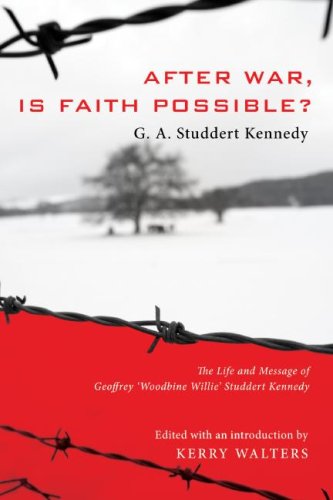
‘After War, Is Faith Possible?’: A Commendation
 Geoffrey A. Studdert Kennedy, After War, Is Faith Possible?: The Life and Message of Geoffrey “Woodbine Willie” Studdert Kennedy (ed. Kerry Walters; Eugene: Cascade, 2008). xii + 225 pages. ISBN: 978-1-55635-379-6. Review copy courtesy of Wipf and Stock.
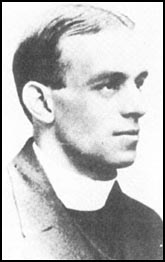
One the real delights of my research into the thought of PT Forsyth has been revisiting, and in some cases discovering for the first time, others who were writing around the same time, and often of the same events. To re-read James Denney, or James Baldwin Brown, or FD Maurice, is one of the best ways one could spend a month … or two. Another giant personality to add to that list would have to be Geoffrey A. Studdert Kennedy, better known as ‘Woodbine Willie’. (I posted on ) My copies of Studdert Kennedy’s work, which are all over 90 years old, form a truly valuable part of my library and one to which I return not infrequently. Collected Poetry (London: Hodder & Stoughton, 1927), The Hardest Part (London: Hodder & Stoughton, 1918), I Believe: Sermons on the Apostles Creed (New York: George H. Doran, 1921), Rough Rhymes of a Padre (Toronto: Hodder & Stoughton, 1918) and The Wicket Gate, or Plain Bread (London: Hodder & Stoughton, 1923) all constitute exceptional reading.
And so I was absolutely delighted to discover that Wipf & Stock decided to republish some Woodbine Willie excerpts, all well chosen and just enough to plant an appetite in those who will no doubt want to hear more from ‘the bloody parson!’ (p. 12). The collection was edited by Kerry Walters, who also contributed a very fine introduction on Studdert Kennedy’s life and message, and a helpful bibliography of the primary and secondary literature.
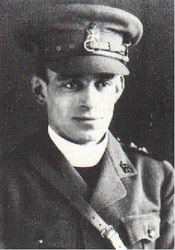
Woodbine Willie, (June 27, 1883 - March 8, 1929)
This WWI padre was, of course, one of the best-known and most-loved Christian pacifists of the early twentieth century. Unlike those theological yuppies who defend pacifism on purely ideological grounds and over a café latte in Lygon Street – informed by the Gospel or otherwise – Woodbine Willie’s commitment to pacifism was birthed in the trenches alongside frightened men and their dead mates. In all that he wrote, a number of questions incessantly occupied his thought: ‘Given the insanity and brutality of war (‘the universal disaster’; p. 14), what must the God who allows it be like? (p. 13); How is evil to be gotten rid of? (p. 3); What sort of universe ought an honest person believe in? (p. 15). His answer to these questions eventually led to the conviction that God is not sadistic, or indifferent to the world’s evil. Neither is God ‘Almighty’ enough to prevent such evils: ‘I see no evidence anywhere in nature of the Almighty Potentate Who guides and governs all things with His rod, and knows no failure and thwarting of His Will’ (p. 81). What God does do, Woodbine Willie insists (in Moltmannesque manner), is to suffer with and alongside humanity. This is love’s character – not raw despotic power but entering into the sorrows of the beloved. War then, which is evil in its most acute form, is ‘the test case for determining if Christianity can cope with evil’ (p. 21).
Against those who would ‘blather’ about the ‘glory of war’, or who would hold out hope for war being a converting ordinance, Woodbine Willie says that ‘war is pure undiluted, filthy sin. I don’t believe that it has ever redeemed a single soul – or ever will’ (p. 62):
War is only glorious when you buy it in the Daily Mail and enjoy it at the breakfast table. It goes splendidly with bacon and eggs. Real war is the final limit of damnable brutality, and that all there is in it. It’s about the silliest, filthiest, most inhumanly fatuous thing that ever happened. It makes the whole universe seem like a mad muddle. One feels that all talk of order and meaning in life is insane sentimentality. (p. 41)
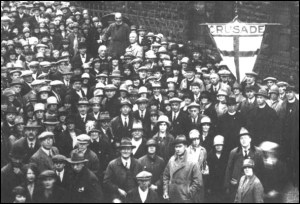
Geoffrey Studdert Kennedy speaking at Tredegar during an Industrial Christian Fellowship Crusade in 1928.
There are no words foul and filthy enough to describe war. Yet I would remind you that this indescribably filthy thing is the commonest thing in History, and that if we believe in a God of Love at all we must believe in the face of war and all it means. The supreme strength of the Christian faith is that it faces the foulest and filthiest of life’s facts in the crude brutality of the Cross, and through them sees the Glory of God in the face of Jesus Christ. (p. 49)
Waste of Muscle, waste of Brain,
Waste of Patience, waste of Pain,
Waste of Manhood, waste of Health,
Waste of Beauty, waste of Wealth,
Waste of Blood, and waste of Tears,
Waste of Youth’s most precious years,
Waste of ways the Saints have trod,
Waste of Glory, waste of God –
War! (p. 50)
I cannot say that war, disease, pestilence, famine, and all the other characteristics of the process are good. If this word “Almighty” means that the Father could have made this world, and obtained the results He desires, in a thousand other ways, but that He deliberately chose this, that makes my gorge rise. Why in thunder choose this one? It is disreputable if He could have done it otherwise, without this cruelty and wrong. It is not commonly respectable. He must be an evil-minded blackguard, with a nasty disposition like a boy that likes pulling the wings off flies. I cannot get up any reverence for such a being. Why, bless my life, He tortures children, voluntarily tortures them to death, and has done so for thousands of years. I can’t stand that at all – it’s dirty; and when I am told that I must believe it, and that every detail of the process was planned out precisely as He wished, I begin to turn sick. Snakes, sharks, and blood-sucking vermin – what sort of a God is this? He chose this way because He gloried in it! That beats the band. It turns me clean up against the process. I cannot see its beauty for its brutality. I cannot hear the lark sing for the squealing of a rabbit tortured by a stoat, I cannot see the flowers for the face of a consumptive child with rotten teeth, the song of the saints is drowned by the groans of murdered men. (p. 75)
A soldier in time of war is not a person but a puppet, who moves when you pull strings. (p. 78)
… our armaments are symbols, not of our power, but of our weakness … Our military power is an exact index of our spiritual and moral impotence. (p. 79)
Life is one, from the single cell to the Savior in the flesh. I cannot separate swine from Shakespeare or Jellyfish from Jesus of Nazareth; they all are products of the process. So behind the process there must be a Spirit which is like the Spirit of man. (p. 81)
 I am not a pacifist (I’ve been too persuaded by Forsyth and Jüngel here), but reading Woodbine Willie continuously challenges me to ask myself whether I should be, whether our Lord’s command to ‘Love your enemies’ (Matt 5:44) really does, in Barth’s words, abolish ‘the whole exercise of force’. Either way, Barth is most certainly correct when he challenges: ‘In conformity with the New Testament, one can be pacifist not in principle but only in practice (praktisch Pazifist). But let everyone consider very carefully whether, being called to discipleship, it is possible to avoid – or permissible to neglect – becoming a practical pacifist!’ (Church Dogmatics IV/2, 549-50).
Faith does not mean that we cease from asking questions; it means that we ask and keep on asking until the answer comes; that we seek and keep on seeking until the truth is found; that we knock and keep on knocking until the door is opened and we enter into the palace of God’s truth. (p. 63)
Woodbine Willie dares us to keep on prayerfully asking the questions …
If the Church is to be a Church indeed, and not a mere farce – and a peculiarly pernicious farce, a game of sentimental make-believe – she must be filled to overflowing with the fire of the ancient prophets for social righteousness, with the wrath and love of the Christ. (p. 196)
The Church is not, and never can be, an end in itself; it is a means to an end; a means to the salvation of the world and the building of the Kingdom of God. It is not the Ark of Salvation for themselves, it is the Agent of Salvation for mankind. It is not a refuge of peace, but an army preparing for war. They seek in it, not security, but sacrifice. This is the infallible mark of the Church, the hallmark of the Cross. And if the sin of our modern slums, and the degradation that they cause; if the sin of our over-crowded, rotten houses, and the ugliness and vice they bring; if the sin of unemployment, with the damnation of body and soul that it means to men and women, boys and girls; if the sin of the heartless, thoughtless luxury at one end, standing out against the squalid and degrading poverty at the other; if the sin of commercial trickery and dishonesty, and wholesale defrauding of the poor; if the sin of prostitution, and the murder of women and children by venereal disease; if the sin of war, the very sin of sins, which is but the bursting into a festering sore of all the filth that the others have bred in years of miscalled peace; if all that is not laid upon the Church as a burden, and Christ’s members do not feel it as their own, then the Church is not a Church at all; and no amount of organization, propaganda, and evangelization can make it live. It has missed its vocation. (p. 167)
Bruce Hamill: ‘Response to Kevin Ward’s Inaugural Lecture’
 Rev Dr Kevin Ward’s recent lecture – ‘It may be emerging, but is it church?’ – has sparked a good deal of constructive conversation, a conversation that was kicked off by a brief public response to the lecture by one who had enquired after one of Kevin’s earlier lectures – ‘So where’s the theology in all this? – the Rev Dr Bruce Hamill. Here’s Bruce’s gracious and insightful response to Kevin’s paper:
Introduction
Thanks for the privilege of responding to today very briefly, in just 10 minutes… Kevin, those who know you expect nothing less than a broad-visioned, scholarly, insightful, pastoral, provocative but conciliatory lecture, grounded in your passion for the church and the gospel. You have not disappointed us…
Since I am expected to ask theological questions I will try not to disappoint.
Right Question?
I particularly liked the provocative title… however, as I have thought about the relation between the title and the concluding answer, I reached the conclusion that, for all its provocation this question is not quite right. Not that I want to avoid your question, but perhaps to narrow down the scope of my response…a better question might be: Does this movement within the church (or among the churches) point the way forward for reform of the body of Christ? Does this movement with its 3 foci of (1) alignment with postmodernism (2) relevance (3) incarnationalism have the theological resources for a missional church in our time? Now my suspicion is that your answer to this question would be a nuanced one, but probably, like mine, a ‘no’. Indeed the last half of your paper demonstrates how the emergent church consistently shows a conflict with the classical marks of the church – a strong indicator that its theological principles and direction is fundamentally flawed. In this respect my response is, I suspect in basic agreement with your view (particularly in the latter half of your paper)
Incarnation and Mission
However, if this is the case, then I fear that the framework you inherit from Niebuhr and others in the missiology movement is too close to that used by the emergent church itself, to really expose its flaws. In what remains of my few minutes response I want to indicate some of the tensions within your argument.
To begin with I would note that your adoption of the term incarnation, as an adjective (‘incarnational’) to represent a stance which is neither isolationist nor accomodationist, raises my theological antennae. This appears to me to be a sociologising of the language of theology – of incarnation – which trades on its theological background.
So to a more directly theological question: What is the incarnation? (in just 5 minutes!) And how does it relate to the church’s cultural existence and mission?
David Congdon, a Princeton theologian who has influenced my response to this, says:
‘the incarnation is sui generis, i.e., it is wholly unique and unrepeatable. In short, the incarnation is an event, not an idea that can be applied or a process that can be completed or a reality that can be replicated.’
What I believe lies behind this is the whole doctrine of divine grace emerging from the church’s experience of salvation in the raising of the crucified Jesus. Namely, that the life of Jesus originated unnecessarily (contingently) and freely from God’s transcendent act and being. In the incarnation God’s freedom from us is the basis for God’s freedom for us in the life of Jesus.
 In this sense Jesus life represents a break in the fabric of culture and tradition and original sin. It introduces a radical newness from the Word of God. In this sense the church came to talk of him as being born of a virgin and also suggest that the Holy Spirit ‘overshadowed’ even the maternal contribution to Jesus existence. God enters into the physical conditions of human life, adopting, as it were, the human condition, however this is not an accommodation to or adaption to culture, but rather human culture is here accommodated to the Word of God.
So as Congdon argues, the incarnation cannot be a model for us. However, it does transform and con-form our life. As already enfleshed and enculturated, fallen human beings, we are, because of the incarnation and the form and history it took, reculturated (that’s my word) by God.
In Christ we are not made ‘incarnational’, but a given a history that conforms to his history culminating in death and resurrection. It is here that we see the weakness of the link so often made between ‘incarnation’ and ‘adaptation to human culture’. ‘As the Father sent me…’ refers not to his incarnation but to the form of his life culminating in crucifixion and resurrection – a transformative, salvific encounter with culture.
Other Missional Language in Tension
Let me mention some further places where I think the language of the earlier half of your paper leads you closer to the framework of the ’emerging church’ than the latter half of your paper should allow. You suggest that the aim of missional thinking is a ‘culturally indigenous church’. According to my dictionary “indigenous” means: “born in or originating from where it is found”. If however, the church is created by the crucifixion and resurrection of the incarnate Word it may look like its surrounding culture (like Paul sought to in 1 Cor 9 in order to serve those cultures) but it will not originate from where it is found. The cultural processes that we rely on in the creation of the church are not indigenous processes of human meaning-making. They are the processes whereby God “crunches” from the old order, in all its indigenous and alienated diversity and constant change, a new social order. Jesus very definitely did take the human context in all its particularity seriously, seriously enough to get crucified by it (as you point out). Seriously enough to spend most of his time with those who functioned as essentially non-representative of the culture – the culturally marginalised. I contend that to take culture seriously as Jesus did, is not to conform to its agenda.
As you say ‘there are limits to how far the culture can set the agenda and determine the shape’. My contention is that the issue is not the presence of a limit, but how that limit is set (and who determines it). I believe it is not by the balancing of principles, especially if one of those principles is Andrew Walls’ rather cosy ‘the gospel is at home in every culture and every culture is at home in the gospel’. Such a principle, even if balanced by the pilgrim principle which says that ‘the gospel is never fully at home’, makes the cross the exception rather than the culmination of Christ’s life. One cannot serve two masters, Christ and Culture (as Walls’s balancing act suggests). Cultural processes must have their limits set for them by Christ in the formation of his body, or our enlightenment culture becomes the default determiner of this process.
Church is not people who ‘have the gospel’ (like some ideal) and then apply it, enlightenment style, to the world’s forms. They are worldly people being re-formed by Spirit and Word and re-culturated into a new creation and an anticipation of the kingdom.
Barth, Form and Content
Which brings me to Karl Barth’s problem. He says that there is no ‘sacred sociology’, however I feel he needs to be challenged, by those like John Milbank, to understand the need of a theological sociology – a fuller ecclesiology.
Quoting Barth you say, “If then the church has been, and indeed should (the should is your addition) have its forms determined by whatever the current “political, economic and cultural models” of “its situation in world history” are, does that mean that anything goes?” [loaded question!] Barth has no “should”. I suspect he does not see such accomodation as an ecclesiological virtue – just an inevitability. However, I want to go beyond Barth and challenge the easy separation between form and content. Not only is it not true that anything goes (as you also clearly argue), but it is true that the form as well as the content should be subject to Christ and the Spirit (as you hinted at in places in your paper). This claim does not, as many seem to fear, imply that it will be a fixed form, or that to believe this requires identifying the form that Christ gives the church with a human form from the post. On the contrary it simply requires a formative process, by which enculturated people attend to Word and Sacrament, not just in their private spiritualities but also in their social habits and structures. This is in my view what it means to be a Reformed Church – constantly being re-formed socially.
Thanks again for the chance to respond to your stimulating lecture.
Kevin Ward: ‘It may be emerging, but is it church?’
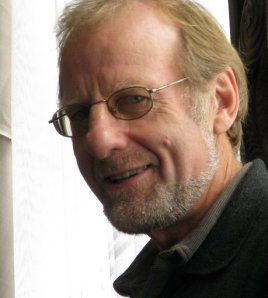 A week or so ago, I posted some reflections on the emerging church. I offered these in anticipation of Rev Dr Kevin Ward‘s then forthcoming inaugural lecture at the Knox Centre for Ministry and Leadership entitled ‘It may be emerging, but is it church?’ Kevin delivered his lecture on Monday, which was followed by a brief response by Rev Dr Bruce Hamill. Bruce’s response can be read here. Here’s Kevin’s paper:
‘IT MIGHT BE EMERGING: BUT IS IT CHURCH?’, a guest post by Kevin Ward
At a recent theological conference I was attending, one of the presenters outlining some of the factors in the changing context for theological education, referred to “fresh expressions” which he said was a more appropriate term than the previously favoured descriptor for experimental faith communities, “emerging church”, since as it turned out most of what they were emerging from was not church. He was Anglican and the term “fresh expressions” is a phrase developed by the C of E for some of its new developments, but the term “emerging church’ is still widespread and gains much attention from younger church leaders in NZ, including many of those accepted for ministry training by the PCANZ and coming to the Knox Centre for Ministry and Leadership. One of our courses here is now titled “Missional and Emerging Churches.” At the VisionNZ Conference last year one of the major presentations was “A Kiwi Emerging Kiwi Church: Yeah Right!” by Steve Taylor, who has emerged as the leading spokesperson for emerging church in NZ, and a significant global voice. Indeed it is interesting in reading on the movement globally how much NZ comes up in the material as being, along with, Australia and the UK initiators in it. Mike Riddel and Mark Pierson from NZ, and Michael Frost and Alan Hirsch from Australia are seen as pioneers. I might add that as well as being from down under, they along with Taylor are Baptists, a heritage of course I share myself, and something I will come back to.
A google search of “emerging church” came up with about 1,530,000 entries. So what are we to make of what Scot McKnight calls “the most controversial and misunderstood movement in the church today”. One article I read was titled “Emerging Churches – Heroes or Heretics.” Clearly unambivalent about the answer a brochure I received at the beginning of the year blazed out. “The last days Apostacy. Coming to a church near you. The emergent church.” It warns that “With the move of the Church back to Rome through organisations like evangelicals and Catholics together, Alpha, Promise Keepers and Interfaith dialogue… Rick Warren’s Purpose Driven and now the postmodern Emergent wave… believe that today’s post modern culture needs a more relevant and experiential approach to God, Church and Worship. Eg. Playing u2 as an expression of worship using multi-sensory stimulation, candles, icons, art, images, stained glass etc.” And it warns “The Emergent Church has taken hold in NZ and its teachings have been aired on Radio Rhema and also being taught in the BCNZ.” I must point out that the Knox Centre for Ministry and Leadership you’ll be pleased to know was not listed among those who have fallen into “the last days deception.”
We need of course to ask the question why has this movement arisen? The broad answer is fairly simple: it is part of a number of responses over the past half century to the increasingly obvious fact that the church in particular and Christian faith in general has been having a rather difficult time of it in western societies like NZ. I have written in a number of places on this, as have many others, and have no intention of rehearsing that fact. It is simply a given, whatever figures one uses and however positive the spin one tries to put on them. There have been many responses to this post Christian, or perhaps more correctly post Christendom reality, from the God is Dead theologies of the 60s, through the Church Growth movement of the 70s and Cell Churches of the 80s, to the Seeker Sensitive Churches of the 90s. Despite all these grand initiatives the rot continues.
What emerged in the 1990s was the realisation among some that not only were our western societies post Christendom, but they were also postmodern in at least some ways. That term is rather problematic, and again it is not my intention to explore all the issues around it. However in the broadest sense it is helpful to identify the fact that the cultural, social and intellectual world we live in today is very different from that which existed in 1960, even if there may well be more continuities than discontinuities. In this world all sorts of institutions that have existed for centuries have increasingly struggled. A number of Christian thinkers and leaders began arguing that the problem with all the recent efforts to reorganise church for our postChristendom world, was that they were still based on the assumptions and thinking of a modern society and culture. As that was rapidly diminishing and being replaced by postmodern forms so these attempts were simply short term arrangements, much like rearranging the deck chairs on the Titanic. Something more fundamental was needed.
There are many attempts, some helpful others not, to define the emerging church movement, but perhaps the simplest and most widely used is that by Eddie Gibbs and Ryan Bolger, in their study of the phenomenon, which they titled Emerging Churches¸ “communities that practice the way of Jesus within postmodern cultures.” Brian McLaren, who has emerged as its main spokesperson wrote in 1998 in the first of his many books:
You see, if we have a new world, we will need a new church. We don’t need a new religion per se, but a new framework for out theology. Not a new Spirit, but a new spirituality. Not a new Christ, but a new kind of Christian. Not a new denomination, but a new kind of church… The point is … you have a new world.
Now I want to say at this point that overall I would agree with the broad parameters of this argument. As Randall Prior summarised it at the Presbyterian General Assembly last year, “The form of the church which evolved in the era of Christendom and which served us well in that period is no longer sustainable. It is dying. It will die.” However I do want to add at least one cautionary note. Often the people involved use rather hyperbolic language, as if the church has only ever existed in one form or shape, at least since the inception of Christendom, often referred to as inherited church. Now that old form needs to be discarded and a brand new form developed. This is of course quite misleading. The form and shape of the church has constantly changed throughout its 2000 years of history. We see this even in the NT, and writers such as Hans Kung, David Bosch and Andrew Walls have provided helpful ways of understanding this.
Andrew Walls invites us to imagine a long living, scholarly visitor from space, a Professor of Comparative Inter Planetary Religions, able to get periodic study grants to visit planet earth every few centuries, to study earth religion, Christianity, on principles of Baconian induction. He visits a group of Jerusalem Jewish Christians about 37 CE; his next visit is in about 325 CE to a Church Council in Nicea; then in about 650 CE he visits a group of monks on a rocky outcrop in Ireland; in the 1840s he visits a Christian assembly in Exeter Hall London promoting mission to Africa; finally in 1980 he visits Lagos Nigeria where a white robed group is dancing and chanting through the streets on the way to church. At first glance they might appear to have nothing in common, or be part of the same religious community at all, but on deeper analysis he finds an essential continuity about the significance of Jesus, the use of scriptures, of bread and wine and water. But writes Walls, he recognises that these continuities are “cloaked with such heavy veils belonging to their environment that Christians of different times and places must often be unrecognizable to others, or even to themselves, as manifestations of a single phenomenon.”
At the heart of this debate about these emerging new forms of church life is the question of just what is the relationship between the historic faith and the environment in which it presently finds itself, between Christ and culture, of theology to context . This question is actually at the heart of many of the disputes that go on in the church, and I am aware were fought with some intensity and lasting consequences around a variety of issues in these hallowed halls for some considerable time.
When it comes to the relationship between the church and the culture that surrounds it there are a number of different models used to explain the various orientations. The classic work, which has formed the basis for all following discussions, is that of Richard Niebuhr, in Christ and Culture. He identifies five basic models: Christ against culture, the Christ of culture, Christ above culture, Christ and culture in paradox and Christ the transformer of culture. It seems, though, that the alternatives can be more simply discussed by reducing these to three.
(i) An “anticultural” response, “Christ against culture”. The attitude where the church sets itself up in opposition to the prevailing culture. The difficulty with this position is that there is no such thing as a culture free articulation of theology or understanding of the church. Consequently this position while opposing contemporary culture is in fact usually holding on to some culture of the past. The Amish, for example, hold on to the culture of early nineteenth century German settlers in Pennsylvania, traditional Anglicans to 1950s England and many fundamentalists to the pre 1960s American south.
(ii) An “accommodationist” response, “Christ of culture”. This is the opposite, where the church is so anxious to fit into the world that it becomes merely an extension of the culture and has lost any distinguishing particularity as a culture of its own. This response assumes the congruence of church and culture. It is assumed that the primary symbols of the church and of the culture are identical. The church sees itself in some way as representative of the culture at large and prides itself on its shaping, transforming role. Churches in nations where the two grew up together often exhibit the most radical forms of this. This has been a strong tendency in liberalism in western countries and can be seen as a major factor in the decline of mainstream denominations. The view fails to recognise that there is a basic incompatibility between the church and whatever time in which it lives.
(iii) An “incarnational” response. This response recognises some kind of tension between Christ and culture, as is found in all of Niebuhr’s final three categories. There is both continuity and discontinuity. Lesslie Newbigin rightly insists that the gospel only retains “its proper strangeness, its power to question us… when we are faithful to its universal suprarational, supranational, supracultural nature.” Yet the gospel travels through time not in some ideal form, but from one inculturated form to another. Consequently what missiologists call the “culturally indigenous church” is the aim of the incarnational approach.
A number of different terms are used to describe this approach to culture. The one that I find most helpful is “contextualisation”, although heated debate over its precise meaning continues, with Ecumenical and Evangelical interpretations differing considerably. At the core though is a recognition that many aspects of what humans believe, think, and do are contextually shaped. William Reiser defines it as “the process of a deep, sympathetic adaptation to, and appropriation of, a local culture in which the Church finds itself, in a way that does not compromise its faith.”
At the heart of the process is the model of the incarnation. In Jesus God took the human context in all its particularity seriously. Jesus was a historical person and so he was chronologically, geographically, religiously and culturally a first-century Jew. He neither repudiated his humanity or his Jewishness. The early church continued the principle as the gospel moved out of the language and culture of Jesus and his disciples into that of Graeco-Roman culture. Ever since those most effective in mission have “assumed that any culture can be host to Jesus Christ.”
However the critical point to note in an authentic contextual or incarnational approach is that there are limits to how far culture can set the agenda or determine the shape. Andrew Walls reminds us there are two important principles. On the one hand there is the ‘indigenzing’ principle, which affirms that the gospel is at home in every culture and every culture is at home with the gospel. But then there is the ‘pilgrim’ principle, which warns us that the gospel is never fully at home in any culture and will put us out of step with every society.
So there are two critical dimensions, which Max Stackhouse defines as the “textuality’ of the church – its faithfulness to the gospel – and its “contextuality” – its faithfulness to the world in which it finds itself. Hans Kung contends that we should aim for a “critical correlation” between the biblical message and the paradigm of the culture” and that “the task today is to come to terms with a postmodern paradigm”. The emerging church movement is endeavouring to take that task seriously and is to be commended for that.
If I can engage in a bit of personal narrative at this point, because, in a sense this lecture is part of an ongoing and unfinished conversation with myself. This is the second time I have given the inaugural lecture here. My earlier title was “Is New Zealand’s Future Churchless?” I outlined the paradox of countries like NZ where the data showed an ongoing resilience of relatively high levels of religious, and mainly Christian, believing and relatively low and declining levels of religious belonging. In light of this while it seemed religion was destined to continue rather than die out, as had been previously postulated in various forms of secularisation theory, the church itself may face a somewhat tenuous and uncertain future. I suggested that it would continue but needed to develop many more diverse forms, and these in essence would be “less church” in the sense of being much looser, less institutionalised, more eclectic, fluid rather than solid. Sounds much like emerging church!
After the address, Bruce Hammil, who through fate or destiny has been asked to be the respondent today, came up to me and asked “Where’s the theology in all of this?” A somewhat surprising question from Bruce! It was though a healthy rejoinder to me and a reminder that, central to my own thesis was the proposition that churches which had thrived had not only shown an ability to adapt their life and message to their rapidly changing cultural and social situation, but had also held a strong commitment to the central tenets of orthodox Christian belief. My major focus has been on the first half of that proposition, endeavouring to help churches realise the forms their life and message have taken have been wedded to a cultural and social context that has not existed for some time, and while they continue in their current form they indeed have a rather limited future. They are no longer incarnating the gospel in their context. To quote the new leader of the Labour Party, they have “lost touch with their electorate” and “need to reconnect”. Change is the essential challenge for the church, and I continue to be invited to help a broad range of churches understand the context they are in and how they might change to become culturally connected.
Now this is an essential task. While in some realms of theology we might be able to argue for some pure theology of the word, although I am somewhat sceptical of both the possibility and worth of that, even that great theologian Karl Barth, so often used to buttress the case for disregarding context when it comes to constructing theology, that it must be based solely on the self revelation of God in Christ, argued when it came to the church:
… in every age and place its constitution and order have been broadly determined and conditioned by political, economic, and cultural models more or less imperatively forced on it by its situation in world history… It has had and still has to adapt or approximate itself to these in order to maintain itself… in respect of the form of its existence… there is no sacred sociology [of the church].
There are then no sacred forms of church, however sacrosant these might appear to some. Of course we in the reformed tradition have always held this to be so, holding central to our understanding the reformation principle, ecclesia reformata semper reformanda. If then the church has its forms determined by whatever the current “political, economic and cultural models” of “its situation in world history” are does that mean that anything goes? That the answer to Bruce’s question is that “theology does not have a place in determining the form of church life.” That in fact ecclesiology is a pointless discipline. There is not a theology of the church, merely a praxis.
It is interesting to review literature on the church, from a historical perspective. It used to be for centuries that the basic questions these endeavoured to answer was “What are the marks of a true church?” From the 1970s on the nature of the question most writing was endeavouring to answer had changed, by one word. Instead of “What are the marks of a true church?” it was “What are the marks of a successful church?” – the word ‘successful’ some times being interchanged with the word ‘growing’, since to be successful was equated with growing. Probably two things lay behind this: as the decline of churches in the west became increasingly evident the overwhelming preoccupation became with turning decline into growth; and as the church splintered into greater and greater variety as the culture became more and more diverse, it became seen as a hopeless task to try and presume there was any true form. It was reinforced by a developing culture that became suspicious of any insistence on adherence to one particular form or expression in any area of life. Indeed ideology became the enemy, grammar was fascist, theory was irrelevant, praxis was what mattered. I might add that in NZ, which has always had a bent toward pragmatism and suspicion of intellectualism, all of this found fertile ground.
And so in the emerging church movement there is a sense of anything goes. For those for whom tradition or inherited forms are in fact the obstacle to being effective churches and a barrier to the mission of Jesus, it is a waste of time to listen to what it might have to say us about how the church should form its life. Graham Redding may have asked the question did Calvin have any place in the Café Church? in his 2005 inaugural lecture, but café church is relatively mild fare and rather orthodox when church can apparently be a bunch of kids at a skate board park or bmx track, a group of students gathering in pub or dance club, or some mid life couples sharing a few wines and a movie together.
So when is a gathering of followers of Jesus actually a church?
Many of those engaged in experimental forms of church argue that because Jesus promised that “wherever two or three come together in my name, there am I with them”, any such gathering is church. Within the Baptist tradition this is the primary definition that is used, as in the Pentecostal and Charismatic streams. The presence of Jesus by the Spirit is all that matters. It is thus no coincidence that many of the initiators of the emerging church movement in NZ and Australia have been Baptist. Such a simple definition leaves them much freer to experiment with a diversity of forms. I would hasten to add that for some quite some time I would also have held that as sufficient. It is interesting to observe though that the Baptist movement in NZ, after being driven by sheer pragmatism for the past couple of decades, is now acknowledging it has significant problems and challenges. The current leader of the movement in conversation with me in December said “our first task is to get our ecclesiology sorted out”. Interesting for me in that this drift was a significant factor in my leaving to become Presbyterian.
Further reflection though has made me realise I was still more Baptist than I imagined. As I mentioned one half of my thesis argued that effective churches had maintained a strong commitment to the central tenets of orthodox Christian beliefs. I identified these as being beliefs about Jesus Christ, about God, about scripture and about conversion, and used the Nicene Creed to define these. Nothing about the church though. No ecclesiology. And of course the Nicene Creed does include among its statements “We believe in one holy catholic and apostolic church”. So if we use this as a measure how does the emerging movement measure up? Is it in fact church?
1. One. Everybody affirms the unity or the oneness of the church, but ever since the Schism of 1054 that oneness has been somewhat difficult to locate, and since the splintering of the Reformation even more so. Daniel Migliore helpfully defines it as “a distinctive unity rooted in communion with God through Christ in the Spirit. The unity of the church is a fragmentary and provisional participation in the costly love of the triune God.” Recent trinitarian theology with its focus on a plurality within an essential oneness is helpful for us in understanding how the Christian gospel embraces both diversity and unity. Much of the NT is written dealing with this issue. The unity of the church does not lie in either a controlling doctrinal conformity or a formal institutional structure, and I would eschew all endeavours to impose either of those kinds of unity on the church. Within the diversity of our expressions it is in the life we participate in together with the triune God, and as Hans Kung expresses it, “It is one and the same God who gathers the scattered from all places and all ages and makes them into one people of God.”
However ever since the Reformers placed the focus on seeing the unity of the church in the invisible church rather than the visible church, that understanding has been used as a way of enabling churches and their leaders to do nothing about working to see unity as an actual mark of the church in its present reality. We have continued to be happily schismatic, tearing apart the fabric of church it seems whenever we have something on which we differ. What has been called the “creeping congregationalism”, which afflicts all varieties of church life in contemporary societies, heightens the tendency to focus on the local and the particular, as if that is all there was to being church. Jesus left behind a visible community not an invisible concept. A community he called to be one, and so it is incumbent on we who are the church to continually work hard to find ways to express in our increasingly diverse culture that this is a reality, not merely some ethereal and mystical entity. If the life of the trinity is the model of our unity then it does involved the diverse members working synergistically together for the glory of the one. One of my criticisms of the emerging church movement, is that with its brisk dismissal of inherited forms of church life, its distancing itself from tradition, its reluctance to work with the church as it is, it magnifies the image of a divided church and fails to put energy into working hard at ways to give expression to and so maintain the unity of the church. While I would admire its willingness to engage with our cultures and seek to find new ways of incarnating gospel and church within those, I believe it would be more true to being the church of Jesus Christ in the world today if it sought to do that working with the church as it already is. Brian McLaren says we need “a new church”. There is only one church, and it already is. The challenge is to continue to work within that church so it might better faithfully be the presence of God in Christ through the Spirit in the diverse communities it inhabits.
2. Holy. The word holy and the concept of holiness is hardly a popular word in our contemporary context, either inside or outside the church. It raises images of a “holier than thou” judgmentalism and an isolationist separatism fearful of contamination by an evil world. A preoccupation with holiness it is suggested has been a major hindrance to the mission of the church in the world. Identification and engagement with the world is what the creator God is about. The word holy is of course the primary word used to name the essence of the nature of God. It is if you like what marks out God as God, as distinctly different from everything else in creation. It is something that belongs essentially to God. For other things or persons to be described as holy therefore is to claim that they also are marked by the essence of the character of God, and in this way are to some extent different from the rest of creation. But how do we know what God is like if we are to share in that character. The central claim of the NT and of Christian thought is that the fullest revelation of God is to be found in the human person Jesus Christ. By looking at the life of Jesus we see what it is like to live a human life marked by the character, or holiness, of God. But more than that the NT claims that by his death, resurrection and gift of the Holy Spirit Christ mediates to us the very life of God so we can share in the fellowship of the trinity. Here is the essence of the holiness of the church. It can be identified by the degree to which it lives a life reflecting the glory of God seen in Christ and this is made possible by the presence of the Spirit in its midst. When we do this we will demonstrate a distinctive quality to our life that will indeed mark us out as different, distinct from others, as Peter put it a “peculiar people”. While this quality of holiness will be demonstrated in the church in an imperfect way, as Calvin put it, it is the “measure toward which it is daily advancing”.
 As suggested in my overview of the relationship of church and culture, the church lives in a relationship of some tension with whatever culture it lives in. It needs to both incarnate the gospel into that culture but also allow the gospel to transcend and judge every culture in which it is present. Part of the problem with Christendom and the way of being church that developed in that context, is that it ended up identifying the culture of those societies as being Christian, and simply became a reflection of the societies in which they existed. They no longer were a distinct or holy people. As the society and the culture in which they existed changed rapidly in the post war era they ended up with nothing left to offer the new societies which emerged and were seen as antiquarian reminders of a world that once was. Dean Inge once said that “If you marry the spirit of the age you will find yourself a widow in the next.” Sadly that has come to be true of much of mainline Protestantism in the West, including many of its evangelical expressions, shaped more by the values of the consumer market and business models than the gospel. The emerging church movement has been quite right in much of the critique it has offered of the way in which traditional church life had been simply an expression of modern western life and values.
But while some of its analysis of what has been problematic for the church is invaluable, in its headlong rush to become relevant to the emerging culture of a postmodern world, it runs the risk of making the same mistake and may end up wedding itself to the spirit of this age, just as firmly as the church it critiques may have to a previous age. When the wonders of this age begin to wind down, and I might suggest it might be a phase in history that is much more short lived than the previous, where will it be then? What will it have to offer and to say when all its flaws have been laid bare. The emerging church articulates strongly an incarnational theology and understands Jesus almost solely in these terms. Yet any serious reading of the life and ministry of Jesus will identify that while he did live incarnationally within the culture of first century Judaism, he also lived in considerable tension with most in that culture, at times spoke judgement on it, and ended up being rejected by it. If he was simply concerned with relevance why was he strung up on a cross. At times it is difficult to distinguish an emerging café or night club church from any other café or night club down the street. Postmodern culture is neither any better nor any worse than modern culture. So emerging leaders celebrate the death of modernity and raise three cheers for the arrival of postmodernity, without recognising the need to provide a proper critique of that which is problematic for living a Christ shaped life. On the other hand some critics of the emerging movement such as Don Carson and David Wells see only a culture antithetical to Christ in postmoderrnity, and fail to recognise they are just as closely wedded to the culture of modernity. Whatever culture we happen to be in as the church of Jesus Christ, we need first to allow Christ by the Spirit to form us into a distinctive culture of its own that preaches in the language of the time and place in which it is set the unique holy life of our Trinitarian God.
3. Catholic. The affirmation of the catholicity of the church refers to its universality and inclusivity. It is the church that has existed everywhere, always and for all. It guards the church against parochialism, sectarianism, racism and conceit chronology, among other things. It is clear that both the unity and the catholicity of the church go together, they are two interwoven dimensions of the one church. However as with oneness we need to guard against it being understood merely as an abstract kind of universalism hovering over the particularities of culture and history. Again it is a mark that needs to be demonstrated in the life of the visible church, its expression in the life of local congregations. Avery Dulles claims that catholicity “is not the accomplished fact of having many members or a wide geographical distribution, but rather the dynamic catholicity of a love reaching out to all and excluding no one.” I would agree with Daniel Migliore that the “church today needs to interpret the meaning of catholic as inclusive of all kinds of people”. What might this mean for us today?
One of the major trends of a post 60s world of the global village, has been a growing pluralism of our societies. Not just through the coming to societies such as NZ of markedly different cultural groups from overseas, but also by the breakup of the dominant white European culture into a multiplicity of subcultures. Not only is this across generations, but also within generations, so much so that since the beginning of the 90s it has been pointless to talk even about youth culture. This pluralisation has been heightened by the fact that increasingly people do not live their life in one geographical place where they might mix with people of a wide variety of ages and cultures, but rather are mobile and live their life with communities of choice, usually consisting of people of the same culture as me. Often these subgroups are quite exclusive, having their own distinctive language, symbols and lifestyles. At a time in the past when people in a community lived their lives in that particular community, when generations shared many of the activities of life together, the local church embraced within its community members from every walk and stage of life within that community. It was catholic, inclusive, in that sense. This was the parish or family church, an increasingly rare bird in our pluralistic society. How do we reach people today within all these different cultural subgroups, when the culture of church as it is, represents that culture of a bygone age?
The answer of much of the emerging church is that we need separate churches to incarnate the gospel into all those cultural subgroups. And so we have youth church, student church, young adults church, young marrieds church, breakfast church, café church, biker church – and so on and so on. These churches become quite age or culture specific. One practical question to ponder is what happens to these churches when their particular niche finishes? But there is a bigger issue. Murray Robertson retires this month after 40 years as Pastor of Spreydon Baptist Church during which he has had significant influence on the church in NZ. Last year he served as President of the Baptist Church, and wrote a series of columns in the Baptist Magazine on his observations as he visited churches around NZ. In one of these he noted that churches now “tend to divide along shared interest lines” and there is “an age based apartheid”. He writes “Maybe this is part of the phenomenon of people looking for a church in which they will feel comfortable, but… something quite precious is lost when you only meet and share with people who are pretty much identical to yourself.” Indeed is it a church when its membership is so exclusively limited to some subgroup that others are in fact shut out? The emerging church movement is again to be commended for its recognition that in our multicultural world there is no one expression of the gospel that will incarnate it for “all” those, even within one community in NZ. They draw correctly on the missional principle Paul spells out in 1 Corinthians 9 of becoming “all things to all peoples so that I might by all possible means save some”. But that needs to be balanced by the ecclesial principle he spells out in Ephesians 2, talking about the major cultural divide of his world, that “Christ…. Has made the two one and has destroyed the barrier, the dividing wall… to create in himself one new humanity.” Maybe what is a legitimate mission group is not in fact a church. It needs to see itself as part of the church catholic, and commit itself to being part of that church, and share its life with the greater whole in its lived practices, so that in this fractured divided tribalised world people may see that the gospel makes a difference, that estranged groups can be reconciled, that in Christ cultural separation might be transcended and that the new community of God’s people is inclusive of people of every race and every tribe and every tongue, even here now on earth. Might these questions also be asked of ethnic specific churches? To quote David Bosch
The new fellowship transcends every limit imposed by family, class or culture. We are not winning people like ourselves to ourselves but sharing the good news that in Christ God has shattered the barriers that divide the human race and has created a new community. The new people of God has no analogy; it is a “sociological impossibility” that has become possible.
4. Apostolic. Randall Prior at the Presbyterian Assembly defined the Apostolicity of the church as its essential missional nature. That before it is anything else it is missional, a view expressed by the missional church movement. While it is true the word apostle does have in it the idea of one who is sent, and while I agree fully with the sentiment being expressed, I do not believe that interpretation of apostolic as a mark of church is how it was understood by those who created the Nicence Creed or historically within the church. In confessing the apostolicity of the church we are acknowledging that the true church is founded on the apostles. The faith and life of the church must stand in continuity with their enduring witness. This continuity is ensured not by some physical continuity through the sacramental laying on of hands, but by our faithfulness to and reaffirmation of the gospel they gave witness to in the writings of the NT. As Jurgen Moltmann puts it: “The apostolic succession is in fact and in truth the evangelical succession, the continuing and unadulterated proclamation of the gospel of the risen Christ.”
It is of course one thing to affirm that “our supreme rule of faith is the Word of God” as the Presbyterian Church does or that “the Bible is the final authority in all matters of faith and practice”, as a Baptist church might. It is quite another to interpret what those words actually mean for us today. One of the things postmodern hermeneutics has made us aware of is there is no such thing as an un-interpreted word or act. There are two things this raises in relation to our engagement with emerging church. Being faithful to the apostolic witness is not just mere repetition of those words, or repeating the way in which they might have been interpreted as being appropriate to another place and another time. The apostolic word must be interpreted anew for every generation and every context. The emerging church is to be commended for its willingness, by and large, to take scripture seriously, and to seek to interpret afresh what it might mean for us today in our particular context rather than just repeat unthinkingly the formulas and answers of the past.
But secondly how do we know that new appropriation or interpretation is faithful to the witness of the apostles. Calvin argued that interpretation of scripture must take place within the hermeneutical community of the church. Too often in protestant and evangelical circles the doctrine of the priesthood of all believers has been understood within the culture of enlightenment individualism, to mean the right of every individual to interpret scripture for them self, a tendency heightened in the radical individualism of late modernity. So much so that Kevin van Hoozer asks in his hermeneutical tour de force, Is there a meaning in this text? or is there in fact just a never ending possibility of meanings. Listening to the voice of the church, the hermeneutical community, is one of the significant factors to take account of in discovering what this text means for us today. And by the church we mean the “one, holy, catholic, apostolic church”, the church throughout time historically and throughout the world geographically. This means giving due, but not stifling, weight to the voice of tradition. GK Chesterton wrote: “Tradition means giving votes to the most obscure of all classes – our ancestors. It is the democracy of the dead. Tradition refuses to submit to the small and arrogant oligarchy of those who happen to walking around.” With its ditching of traditional church, its giving up on traditions that might have developed and been passed on for centuries, apart from occasionally ransacking them and tearing out of any meaningful context some token that seems cute in the eclecticism of postmodern culture, the emerging church runs the risk of missing the wisdom that has developed over the centuries, of listening to the caution that might come from previous misinterpretations, and thus in the end run outside the boundaries of where the Spirit might be willing to venture with them. Sadly this is a pattern that has happened all too often in the history of well intentioned new movements. There is a use of scripture which is false teaching. There is heresy that is full of proof texts. Less dramatically there are also representations of the gospel that are unbalanced and therefore unhelpful, and maintaining conversation and community with the whole church so interpretation occurs within the checks and balances of that will help ensure an ongoing yet presently meaningful faithfulness to the gospel within the emerging movement.
Two further marks of the church have also been identified, particularly among Protestants. As Calvin put it, “Wherever we see the Word of God purely preached and heard, and the sacraments administered according to Christ’s institution, there it is not to be doubted, a church of God exists.” Holding this definition central to our understanding of the church, the Presbyterian Church has sent to Knox another group of students this year, to hopefully complete the final stage of their training so they can be ordained as Ministers of Word and Sacrament. So that we will have communities of believers where the “Word of God is purely preached” and as other definitions put it “the sacraments are rightly administered”. The former is in some ways easier to assess than the latter. What does it mean to ensure the sacraments are rightly administered? Orthodox theologian John Zizioulas argued it is the presence of the bishop that makes it so. Obviously a problematic definition for many churches. For Catholics and Anglicans it is someone rightly appointed by the bishop who ensures it is in faithful continuity with the apostolic tradition. We have argued here that being apostolic means faithfulness to the witness of the apostles as contained in the NT. Hence for Calvin, “as instituted by Christ”. Here is why the Reformed tradition has held word and sacrament together, because it is not just receiving the bread and the wine but doing so in the context of hearing the gospel story of what they mean that makes them a sacrament, a means of grace. So a theologically informed and properly recognised ministry is important to ensure that the church remains apostolic, faithful to the scriptures, in all aspects of its life, including the preaching and sacraments.
Parts of emerging church, as well as other experimental forms of church life, have often been critical of and resistant to theological training, often preferring to have leaders and pastors who are more entrepreneurial and creative. Too much theology kills those. Many Baptist churches in NZ have followed this also. And I have to say that at times I have been in churches and listened to sermons or seen communion or baptisms, that at best have not been faithful to the Scriptures and at times even heretical. An entertaining event but scarcely a sacrament. Sometimes they are missing completely. Which of course raises the question, is it church? A central reformation principle is ecclesia reformata semper reformanda, “the church reformed is always being reformed”. This phrase is often quoted by those who want to change and reform and do church in different ways . We are being true to our tradition in doing this. In some senses yes, but it is a misunderstanding of the reformers intent to see it as giving carte blanche to try whatever we want. The reformers reformed the church in the light of the Scriptures. Luther did not just way “Here I stand I can do no other”, but “My conscience is bound to the word of God, here I stand…” It is why ministers were teaching elders, and now ministers of word and sacrament, so that by placing the role of scripture central in life of the church and office of ministry the church will be continually reformed in the light of scripture. As the Church of Scotland statement on ministry in 2000 puts it, they are “to represent Christ in the faithful proclaiming of the Word and right administration of the Sacraments and so ensure the possibility of such reform and renewal.” The emerging church movement would do well to seek to ensure a theologically formed leadership so that it too will experience the renewing presence of Christ that come from faithful preaching of the gospel and administration of the sacraments.
I want to finish briefly by drawing from a sociological insight. Some of you might be surprised that it has taken me this long to mention one. Many of the grand theories of the earlier sociologists are now viewed with much suspicion. However there is one theory I think continues to provide invaluable insight. Max Weber’s theory of the routinisation of charisma. He argues that what happens in the evolution of religion is that a new group gathers around a charismatic leader and is a dynamic, free, loose charismatic movement. Over time it rationalises, routinises and systemises its life and so looses its charisma. Some people become frustrated with this and break away around the edges to form a new charismatic group with new energy and dynamism. It is this that ensures the ongoing renewal of the religion. Looking at the history of Christianity in the west there is much that can be helpfully explained by Weber. There is no question that much of church life in the west has become routinised and rationalised, there is little dynamism and charisma. The Spirit has been routinised out. I believe the emerging church movement can be understood in these terms, as can the charismatic movement of the 1960s and 70s. What has happened often in the past is that the established religious institution dechurches the new movement and the action is reciprocated by the movement. My hope is that in this instance we can avoid repeating history and that by remaining in communion and continuing in conversation, the emerging church may be part of the movement for renewal and reformation of the church in the west, and that the emerging church movement may gain from the wisdom and catholicity of the church to grow into a more faithful and dynamic communion of the triune God in our challenging western context.
When is a church a church? I would probably in the end agree with Miroslav Volf’s conclusion, that “where two or three are gathered in Christ’s name, not only is Christ present among them, but a Christian church is there as well, perhaps a bad church, a church that may well transgress against love and truth, but a church nonetheless.” Many in the emerging movement prefer to talk about the emerging conversation than emerging church. My plea would be for those within the movement to include in the conversation all of those who with them are members of the “one holy catholic apostolic church”, so they might come to more adequately share those marks. And to those sure they are members of that church, but suspicious as to whether these new comers qualify, to reach out in conversation with them and so help us all to more fully demonstrate the transforming presence of the risen Christ in our life together.
Brian McLaren, Reinventing Your Church, Grand Rapids: Zondervan, 1998, 13-14.
Andrew Walls, The Missionary Movement in Christian History, Edinburgh: T&T Clark, 1996, 3-7.
H. Richard Niebuhr, Christ and Culture, New York: Harper Brothers, 1953.
Lesslie Newbigin, “The Enduring Validity of Cross-Cultural Mission,” International Bulletin of Missionary Research 12, 1988 50.
As quoted in L. Sweet, Aquachurch. Loveland: Group Publishing, 1999. 81.
D. R. Jacobs, “Contextualization in Mission.” In Toward the Twenty First Century in Christian Mission, J.M. Phillips and R.T. Coote eds. Grand Rapids: Eerdmans, 1993. 236.
Max Stackhouse, “Contextualization, Contextuality and Contextualization.” In One Faith, Many Cultures: Inculturation, Indigenization, and Contextualization, R.O. Costas ed. New York: Orbis Books, 1988, 6.
Hans Kung, Theology for the Third Millennium: An Ecumencial View, New York: Doubleday, 1998, 166, 211.
Karl Barth, Church Dogmatics, IV/ 3/2: The Doctrine of Revelation, transl. G. Bromiley, Edinburgh: T&T Clark, 1962, 739.
Daniel Migliore, Faith Seeking Understanding: An Introduction to Christian Theology, Grand Rapids: Eerdmans, 1991, 201.
Hans Kung, The Church, New York: Image Books, 1967, 353.
Avery Dulles, Models of the Church, New York: Doubleday, 1974, 122.
David Bosch, Transforming Mission, Maryknoll: New York, 1991, 389.
Jurgen Moltmann, The Church in the Power of the Spirit¸ New York: Harper & Row, 177, 359.
Max Weber, The Sociology of Religion, Boston: Beacon Press, 1963.
Miroslav Volf, After Our Likeness: The Church as the Image of the Trinity¸Grand Rapids: Eerdmans, 1998, 136.
When things fall apart in theology and church practice
 ‘… we have been given a perennially valid paradigm for theology in our Christ-centered trinitarian confession of faith, expressed in the classic ecumenical creeds of Nicaea, Constantinople, Ephesus and Chalcedon. When things seem to be falling apart in theology and church practice, then I would propose that we reclaim once again the strong name of the Trinity, because there we find a continuing framework of Christian identity, transcending the discontinuities and oscillations of history and culture’. – Carl E. Braaten, ‘The Cultural Captivity of Theology: An Evangelical Catholic Perspective’ (a paper presented at The Inaugural Margaret McKinnon Memorial Lecture on Christianity and Culture, Nepean Presbytery of the Uniting Church in Australia, Melbourne, 1997), 20.
Ray Anderson on the ‘difference’ Christ makes
‘The kenotic community as an imperative which the Incarnation demands permits no distinction between the Christian and the non-Christian which resides intrinsically in the Christian (or the church) as such. When one ‘defines’ the church or the Christian, then, the distinctive must be solely in the ‘difference’ which has its source in the historical transcendence of God. The ‘difference’ is Christ, not that redemption is set over against creation, but so that man is liberated to participate in Christ’s ek-static fulfillment of all creaturehood through the life of the Spirit. The ‘difference’ is the centre (Christ) and not in distinctions drawn between men, or between the church and the world as entities’. – Ray S. Anderson, ‘Living in the World’, in Ray S. Anderson (ed.)., Theological Foundations for Ministry: Selected Readings for a Theology of the Church in Ministry. Edinburgh/Grand Rapids: T. & T. Clark/Wm. B. Eerdmans, 1979, 591.
Children and Church
 Since being joined to the church, I have always struggled with the notion of children being ‘sent out’ of the service. I hear the rhetoric of church as ‘family’ and so often see this translated as ‘the men’ going off to do their thing, ‘the women’ going off to do their thing, and ‘the children’ going off to do their thing. Lots of groups ‘doing their thing’; but not much family. It’s all a bit like a ‘get your own lunch today’ day that we sometimes have at our place … and, as convenient as it sometimes is, and as it means that I usually get to eat what I want to eat (when I want to eat it), I don’t like it one bit!
Having a toddler of my own has not changed my mind about kids in church one bit. Sure, it’s not always the most convenient way to pray while someone is pulling off your glasses and hitting you in the head with a Bible, but I want to publically worship with my daughter and with the other kids, not have them shoved out to the back hall while ‘we’ do the real ‘church stuff’. Not only are these young people missing out on worshipping with – and learning from – us adults, but we are missing out on worshipping with – and learning from – our kids.
Of course, we’re all familiar with the old arguments that kids learn differently, that their attention spans are less – and these are important considerations that I don’t want to undermine – but what I (and too often they) really hear is ‘they’re a distraction’, and ‘we can’t be bothered thinking of a way of doing church that is relevant to non-adults, or at least to non-adults different from ‘us’.
So it is that I was excited to come across the following words from FW Boreham, cited by Geoff Pound (and reprinted here with his permission):
I am told that, away beyond the Never-Never ranges [remote areas of Australian outback] there is a church from which the children are excluded before the sermon begins.
I wish my informant had not told me of its existence. I am not often troubled with nightmare, my supper being quite a frugal affair.
But just occasionally I find myself a victim of the terror by night. And when I am mercifully awakened, and asked why I am gasping so horribly and perspiring so freely. I have to confess that I was dreaming that I had somehow become the minister of that childless congregation.
As is usual after nightmare, I look round with a sense of inexpressible thankfulness on discovering that it was only a horrid dream. An appointment to such a charge would be to me a most fearsome and terrifying prospect. I could not trust myself.
In a way, I envy the man who can hold his own under such circumstances. His transcendent powers enable him to preserve his sturdy humanness of character, his charming simplicity of diction, his graphic picturesqueness of phrase, and his exquisite winsomeness of behaviour without the extraneous assistance which the children render to some of us.
But I could not do it. I should go all to pieces. And so, when I dream that I have entered a pulpit from which I can survey no roguish young faces and mischievous wide-open eyes, I fancy I am ruined and undone. I watch with consternation as the little people file out during the hymn before the sermon, and I know that the sermon is doomed. The children in the congregation are my salvation. – FW Boreham, ‘Pity My Simplicity!’ Mushrooms on the Moor (London: Charles H Kelly, 1915), 151-152.
If the NT is anything of a reliable witness, it is clear that kids loved being with Jesus. What does this tell us about Jesus? What ought this tell us about the way that the church (the body of which he is head) ought to be?
On Good Friday this year, I took my daughter to a service at the Baptist Church in St Andrews. Many things struck me at that service. Here’s three of them: (i) The worship leader made an enormous effort to help ‘all’ those at the service to worship God in a way that was meaningful to them; (ii) The welcome of children was a fantastic and practical reflection of the stained-glassed window above the communion table that represented Jesus welcoming children; and (iii) Sitting on a pew surrounded by the wriggles and voices of children and their praise, I worshipped God with them.
Three further notes:
1. I am not necessarily advocating the cessation of Sunday Schools.
2. Perhaps the argument that children are better served by the Christian family via some more age-appropriate teaching time (during the sermon, for example) is the most practical (and convenient) compromise, but is it really the best option? I don’t know. Perhaps it is. If so, how can churches better communicate to young people that this service to them is an act of love and an affirmation of their value to the community, and to God? Perhaps this is the real issue behind this post.
3. My wife is convinced that my theological idealisms do not translate into the ‘real world’. She may be right! She usually is!
‘Ecumenical and Eclectic’: A Review
 Anna M. Robbins (ed.), Ecumenical and Eclectic: The Unity of the Church in the Contemporary World: Essays in Honour of Alan P. F. Sell (Milton Keynes: Paternoster, 2007). xiv + 313 pages. ISBN: 978 1 84227 432 3. Review copy courtesy of Paternoster/Authentic Books.
Anna M. Robbins is a lecturer in Theology and Contemporary Culture at the London School of Theology. She completed her doctoral work under the supervision of Professor Alan Sell, and has continued to benefit from his work and friendship. Thus it is entirely appropriate that she gather together this volume of fifteen essays dedicated to honouring the ministry of Professor Sell. And it is entirely appropriate that this volume be published in this series of Studies in Christian History and Thought, a series to which Sell has been a contributor and of which he is one of the editors. My appreciation for both Professor Sell’s work and for the series in which this particular book belongs has already been noted here and here.
The diversity of essays – their themes and countries of origin – is itself a significant reminder of the testimony to the influence and interests that Alan Sell has so faithfully dedicated his energies towards: Reformed theology, ecumenism, philosophy, nonconformity, church history, mission, ethics and apologetics among them. As the introduction to this volume notes, ‘Throughout [Sell’s] work, he has sought to expose unsatisfactory divisions amongst the people of Christ, to pose necessary challenges to those who hold sectarian attitudes, and offer constructive proposals for ongoing dialogue and other expressions of unity’ (p. 1).
The essays in this volume are organised in three movements. The first, ‘Ecumenical & Eclectic: Roots’, includes essays by Donald McKim, D. O. Thomas, Martin Fitzpatrick and Andrew MacRae. McKim begins his essay as many of the contributors do, by acknowledging his appreciation for Sell’s work and friendship. He writes of Sell, ‘There is no one I respect more as a theologian and whose work I appreciate more as a Reformed theologian’ (p. 7). High praise indeed. The essay proceeds to consider how some Reformed foundations serve the unity of the Church. Specifically, that the unity of the Church is Christ and is from God, that it is a unity of faith, that it is unity that acknowledges diversity, and that it is a unity that is both given and sought as divine gift. Unsurprisingly, and appropriately, McKim draws heavily from Calvin. Thomas’ essay examines the nature of the distinction between abstract and practical virtue in the thinking of Richard Price, again with an eye on the question of Church unity in the context of dissent and divine authority. Fitzpatrick too proffers a number of philosophical reflections on unity and dissent. Surveying the thought of the unitarian Joseph Priestley, and the eighteenth-century Rational Dissenters, Fitzpatrick argues how dissent may actually contribute to the unity of the Church. The final piece in this section is entitles ‘The Power of Christian Unity’. Here, Andrew MacRae, with an eye on both Scripture and more recent ecumenical developments, proposes a theological exposition on the power of Christian unity. His argument is that there can be multiple brands of ecumenical movements, all of which may contribute to the unity of the Church without being intrinsically divisive.
The second section is entitled ‘Ecumenical and Eclectic: Reflections’. With this group of six essays the focus shifts more to analyses historical, biblical and sociological. Clyde Binfield opens the section with one of the densest and heavily-researched pieces of writing on church history that I’ve ever read in a collection of this sort. He examines the sermons of William Page Roberts in order to demonstrate the relationship between change and continuity in the life of the Church. I thoroughly enjoyed this essay, but be warned, it really is one that you need to read when you are completely awake. David Peel invites us to reflect both appreciatively and critically on the legacy of Lesslie Newbigin, and David Cornick considers some of the ecumenical reflections of Olive Wyon. As one who has always wondered who this woman who translated Emil Brunner’s Dogmatics was, I was especially excited to be introduced to her through this essay. Indeed, Brunner once confessed that his theology was better in her English than his German. Cornick writes:
[Wyon] travelled the world, but Geneva made a great impression on her. She was particularly influenced by her contact with the Community of Grandchamp, founded by a group of Reformed women in 1931 as a centre for prayer, silence and meditation, but which developed into a Women’s Religious Order that worshipped according to the Taizé Office. That experience convinced her of the value of Christian community where ‘… men and women find each other in Christ and begin to pray and work as never before for the extension of the spirit of unity.’ She valued her Reformed roots deeply, but they rooted her in Scripture and therefore in the experience of all Christians, and she drank deeply and with delight from other wells. It is that combination of roots and generous openness that make her still a compelling guide to the spiritual life. (p. 150)
Cornick’s essay proceeds to explore her contributions to prayer (principally through her 1943 book, The School of Prayer), vocation and ecumenism. He notes that Wyon begins her exploration of the relationship between prayer and Scripture with the Barmen Declaration: ‘The Bible deals with God, and with nothing apart from God. Whoever seeks God in the Bible will find God there; for God comes to seek and find us in His Word…’. This, Wyon argued, is the core of the relationship between Scripture and prayer. Cornick comments on Wyon’s urging: ‘Being alone with Scripture and taking it seriously is a dangerous business, for we meet with Christ there. In his light we find ourselves judged and can “suddenly … find that Christ steps out of the pages and confronts us with an absolute demand”. Being alone with the Bible means risking a revolution in one’s life. That sounds austere and frightening, but judgement is merely the obverse of salvation; so Scripture also leads us to a knowledge of the trustworthiness of God, of forgiveness and mercy and “infinite support”‘. Citing Wyon, Scripture is the ‘springboard from which we may dive into the fathomless ocean of the love of God’ (p. 151).
The General Secretary of the United Reformed Church then proceeds to note Wyon’s ‘profound sense of the vocation of the church’ (p. 153). He cites Wyon: ‘The world is waiting for a “revelation” of God in community. The church is called to be this living community, in which all barriers between man and man, class and class, race and race, are down for ever’ (pp. 153-4). This is not something that the Church can achieve but is the work of God. Cornick then introduces us to Wyon’s book, The Altar Fire: Reflections on the Sacrament of the Eucharist, wherein she describes Reformed worship thus:
… the service begins with the revealed Word. That is: the first note struck in this rite is not the need of the worshippers, but the fact of revelation. From the very first the Christian Church realised that all worship must begin with God Transcendent. It is from such a God that we receive the revelation of His Being and His purpose. We begin with God, the high and Holy One, ‘who inhabiteth eternity’. We listen, first of all, to His Word (p. 154)
Cornick notes that Wyon was an exceptionally well-read theologian, who gently corrected the tendency towards individualism which is so characteristic of Western Protestantism by stressing the way in which the New Testament always speaks of the priestly activity of the whole church. ‘It is the whole church which is intended in the good purposes of God to bring God to humanity and humanity to God’ (p. 156).
The next essay is from the pen of John Tudno Williams who considers two Welsh New Testament scholars – namely C.H. Dodd and W.D. Davies – and their contribution to thinking on the nature and unity of the Church. Peter Ball, Chair of New Testament Studies at Károli Gáspár Reformed University in Budapest, contributes a paper on whether it is parents or Christ who have the foremost authority in the family and what it means for how children should honour their parents. He asks ‘Did the first Christians fulfil the expectation to honour their parents?’ (p. 175). The final contribution in this second section comes from lrving Hexham, who considers the work of Weber and Troeltsch with respect to the development of the grammar of ‘sect’ and ‘cult’. He concludes that such language is sectarian and ideologically loaded, and so ultimately unhelpful.
The final section is headed ‘Ecumenical and Eclectic: Resonances’ and invites reflection on the future of ecumenism and the practices of church life. It consists of essays by Keith Clements, Alan Falconer, Botond Gaál, Anna Robbins and Gabriel Fackre. Clements reflects on where two decades of intentional ecumenism in Europe has led us, highlighting its future uncertainty. Falconer, Gaál and Robbins also explore this theme in terms of ecumenical dialogue, the latter in light of how the church’s fragmentation weakens its voice to speak on issues that affect the whole world and about which the world is concerned. In the concluding essay, Gabriel Fackre takes on board some of Sell’s own apologetic methodology and explores the question of divine impassibility by reflecting on Mel Gibson’s film, The Passion of the Christ. He argues that ‘the film can be an occasion for confessing and commending the faith if treated as a Reformation-like “teaching moment”, the interpretive Word conjoined to the visible Word’ (p. 270). Fackre proceeds to use the film to talk about ‘the very heart of God’ in the cross. In an interesting turn, Fackre seeks to resurrect the ancient fishhook-bait analogy of the early Fathers. Commenting on the cry from the cross, ‘My Lord’, Fackre writes:
… it means that the knowledge that the effects of our sin reach into the very heart of God overwhelms us. Is that what prompts the tears of worshippers in the theatre pews when they view this film? How else do we know ourselves to be the sinners that we really are unless we see our hand in the very crucifixion of God? And hear from the Victim’s lips, ‘Father, forgive …’? No power in this world can so drive us to our knees. Only this Power of the divine powerlessness, the Christ who reigns from the cross. The fishhook-bait analogy has yet another meaning. The Devilfish did get caught. The power of God in the powerlessness of Jesus accomplished its purpose. So Aulén, interpreting Irenaeus, says: ‘The redemptive work is accomplished by the Logos through the Manhood of His instrument, for it could be accomplished by no power than by God Himself.’ Can we put it this way? God stoops to conquer. God comes into our midst in human form in Galilee and on the road to Calvary in order there to expose us for who we are. We see first-hand One who is as we should be and strike out at this embarrassing Presence. Yet it is, paradoxically, only through our lacerating and crucifying ways that God can disclose as well as expose, disclose the suffering Love that makes reconciliation possible. The proper emphasis on the suffering of Jesus when it excludes the suffering of God constitutes the discontinuity Aulén rightly criticizes. Without making the mistake of this discontinuity, we can yet affirm the concern to preserve the role of the humanity of Christ in the Work of salvation, while knowing that it was the God who was ‘in Christ’ who evokes our repentance and brings forgiveness to the sinner. (pp. 280-1).
He concludes by asserting that defenders of divine impassibility are ‘right in what they affirm – the tearless power of God at the beginning and end of the cosmic drama, and wrong in what they deny – the God who weeps in and for Jesus at the centre of the Story’ (p. 282)
Like most edited volumes, Ecumenical and Eclectic is not immune from its weaker contributions. However, every essay bears witness to something of the work of the one to whom it is meant to honour, and has something important to donate in its particular area of concern. Unfortunately, there is no essay devoted to theological education, an area which Sell has contributed not a little. That said, those interested in many themes that so interest Alan Sell will not be disappointed with many of the papers in this book. It also includes a comprehensive 27-page bibliography of Alan Sell’s work.
‘Protestant Nonconformity in the Twentieth Century’: A Review
 Alan P. F. Sell and Anthony R. Cross (eds.), Protestant Nonconformity in the Twentieth Century (Milton Keynes: Paternoster, 2003). x + 398 pages. ISBN: 978 1 84227 221 3. Review copy courtesy of Paternoster/Authentic Books.
This book, edited by Alan Sell and Anthony Cross, is another worthy addition to what is an excellent series of Studies in Christian History and Thought, a series comprising monographs, revised dissertations, and collections of papers which explore the church’s witness through history. The series includes some important contributions to scholarship, among which is David Wright’s Infant Baptism In Historical Perspective, Byung Ho Moon’s Christ the Mediator of the Law: Calvin’s Christological Understanding of the Law as the Rule of Living and Life-giving, and David Bebbington’s brilliant 1998 Didsbury Lectures, Holiness In Nineteenth-Century England.
Protestant Nonconformity in the Twentieth Century is a collection of papers presented at the second conference of The Association of Denominational Historical Societies and Cognate Libraries, held at Westhill College, Birmingham, in July 2000. The result is twelve papers from scholars representing a number of Nonconformist traditions which invite reflection on Nonconformist contributions to biblical studies, theology, worship, evangelism, spirituality, and ecumenism during the twentieth century.
Sell’s own contribution, ‘The Theological Contribution of Protestant Nonconformists in the Twentieth Century: Some Soundings’, is an embryonic version of his 2006 Didsbury Lectures, published as Nonconformist Theology in the Twentieth Century and reviewed here (I wish I’d noticed this before I was near the end of the chapter, although it was great to read over this material again). He again reminds us that Nonconformists are nothing if not diverse. Employing Dale’s summary on the question of the final fate of the impenitent, Sell writes:
The twentieth century provided Nonconformist theologians with both inner-family and external stimuli to theological endeavour. As the century opened the Wesleyans were earnestly debating the question of eternal life. The particular question at issue was the final fate of the impenitent. Discussion of this topic had been rumbling on at least since the eighteenth century, and R.W. Dale had specified the options in 1877. There are, he said, those who cannot make up their minds on the subject: ‘They cannot warn men against eternal condemnation, because they are not sure that any man will be eternally condemned.’ There are those who hold that the impenitent are to be condemned to suffering, whilst hoping that ‘there may be some transcendent manifestation of the Divine grace in reserve, of which as yet we have no hint.’ There are those who believe that the Christ who came to seek and to save the lost will persist in this effort even though, because of the invincibility of human freedom, it cannot be affirmed that all will in fact be saved. There are those who believe that God’s love cannot finally be thwarted, and hence all will finally be saved; those who hold that the impenitent will nevertheless enjoy an eternal life on a lower plane than the saved; and those who deny that the impenitent can finally be restored. (p. 36)
While all the studies are certainly erudite and deserving of comment, I wish here to identify a few for special mention. Norman Wallwork’s piece, ‘Developments in Liturgy and Worship in Twentieth-Century Protestant Nonconformity’ is a helpful survey of the general issues and particular contributions that concern Nonconformist worship. The contributions of Unitarians, Free Catholics, Presbyterians, Congregationalists, the United Reformed Church, Congregational Federation, Baptists and are all attended too with care, and the Quakers, Methodists, Independent Methodists and Salvation Army are also considered. Wallwork writes:
Of all the Free Churches the Unitarians were the most given to textual revision of the Book of Common Prayer [no surprises here], but their demise included their destruction of the Trinitarian theology which undergirded the Anglican tradition. However, Martineau’s love of good liturgical language passed over into all the Free Churches not least into Congregationalism. The Free Church Catholic and ritualistic revival under Lloyd Thomas and Orchard was short-lived, but the prayers in Orchard’s Divine Service furnished other service books for over fifty years. The movement for liturgical renewal which hit the Free Churches in the 1960’s and created the Joint Liturgical Group produced some fine liturgical texts and created new service books centred on classical eucharistic texts, an increase in the frequency of communion, a shift to morning all-age celebrations, and a much greater emphasis on the Christian year. In the end, only the Methodists and the United Reformed Church would place a eucharistic rite in the hands of their congregations. In all the traditions worship leaders and preachers turned to a variety of available resources, often without the approval of any recognizable magisterium. The memory of revival songs from the Sankey and Moody era helped to secure a place for lively and spontaneous worship revived among the Free Churches, as in Anglicanism, by a new wave of charismatic prayer and praise and the new tradition of heavy ‘biblical teaching’ in Sunday worship. This movement had its strongest support among the Baptists and many of the original ‘Plymouth’ Brethren congregations who now renamed themselves ‘Evangelical Churches’. The influence of the High Genevan school of the English Reformed tradition was still seen in the liturgical texts of the United Reformed Church but much of its worship was dominated by the twin calls to inclusive all-age worship and to be relevant and engaged in issues of local and international justice. Several babies went out with the bath water. (pp. 130-1)
Other essays I particularly valued were David Bebbington’s, ‘Evangelism and Spirituality in Twentieth-Century Protestant Nonconformity’, and ‘Protestant Nonconformist Attitudes towards the First World War’, by Alan Ruston. Ruston, who is editor of the Transactions of the Unitarian Historical Society, surveys how WWI witnessed Nonconformist churches becoming increasingly part of the establishment, particularly in attitude. They became, he writes, ‘an integral element within the political machine in almost the same terms as the established church. But flying into the sun in this way burnt their wings and like Icarus they fell to the sea. They did not drown like Icarus but the weakness engendered by the war remained with them for the rest of the century’ (p. 240). Ruston’s contribution to this volume is a powerful reminder of how voluntaryist assumptions about church, state and society inform Nonconformist contributions to religious, social and political life.
Those who identify themselves with the Nonconformist family, and those with an interest in (particularly early) Twentieth Century theology and history would be well served by reading this book.
Theology is a Matter of the Church
 ‘Theology is not a private reserve for theologians. It is not a private affair for professors … Nor is it a private affair for pastors … Theology is a matter of the church … The term “the laity” is one of the worst in the vocabulary of religion and ought to be banished from Christian conversation’. – Karl Barth in Theologische Fragen and Antworten (1957), pp. 175, 183-184. [HT: Andrew]
Experience and Evangelical Succession
 ‘What Christ has done for me has become possible only by what He did even more powerfully for others whose faith and experience have been deeper and richer than mine, but who reflect my experience all the same, even while they diversify and enlarge it mightily. Standing over my experience is the experience of the whole evangelical succession. And standing over that is the historic fact of Christ’s own person, and His consciousness of Himself (“All things are delivered to me of the Father”) as Lord of the world, Lord of nature in miracle, of the soul in redemption, and of the future in judgment. When I meet Him in my inmost soul I meet one whose own inmost soul felt itself to be all that, and who has convinced the moral flower of the race, in the whole historic Church, that He is what He knew Himself to be. And in that conviction the Church has become the finest product of Humanity, and the mightiest power that ever entered and changed the course of history from its moral centre’. – Peter T. Forsyth, The Person and Place of Jesus Christ, 204-5.
The Parable of the Engineers

‘Once a corps of engineers was assigned to continue the building of a magnificent cathedral which had already been under construction many centuries and which had benefited from the devout labor of great engineers of many generations. Some of the new engineers, however, began to question the architectural soundness of the plans. They said that the plans had numerous errors and contradictions in them. When asked for clarification by some of their fellows, they pointed out that architectural styles were changing and that the plans erroneously presented older stylistic characteristics and contradicted current styles. In reply, a few engineers noted that this did not make the plans erroneous or contradictory in themselves, and that it was the architect’s business to draw the plans and the engineers to follow them. The majority did not agree, but they did not want to cast direct aspersions on the architect or abandon the construction. So they had recourse to a number of stratagems.
1. First, they argued that though the plans were erroneous and contradictory this was not the architect’s fault and should be attributed to his draughtsmen. (Intransigent engineers claimed that the architect was always responsible for his draughtsmen, but this argument was brushed aside.) Endeavours were thus made to ignore the “draughtsmen’s errors” while accepting the architect’s “true ideas” as conveyed by the draughtsmen’s plans. But since the only knowledge of the architect’s ideas came by way of the draughtsmen’s plans, this endeavour miserably failed and led to more radical suggestions. (It is perhaps worth pointing out that while these discussions went on, relatively little building was done.)
2. Then the engineers argued that the purpose of the plans had been misunderstood. They were not intended to be followed as such, but contact with them would increase the engineer’s inner sensitivity to true building methods. But one engineer’s inner sensitivity did not produce the same results as another’s, considerable confusion set in, and a tower collapsed.
3. A particularly brilliant engineer now suggested that everything in the plans was symbolic of the architect himself. However, it was soon discovered that if everything was symbolic and nothing literal, no engineer could determine the real meaning of any particular element in the plans. More disputes set in, and another section of the building crumbled.
4. Now the people for whom the cathedral was being built were becoming more and more agitated and many would not enter the half completed edifice at all because of the danger of falling stones, loose mortar, and buckling floors. Some were even crying for a new staff of engineers. This made the engineers terribly nervous and excitable, and finally some of them, to placate the mob, began to claim that there was no architect at all, that the people for whom the cathedral was being built were more important than anything else, and that everyone was in as good a position as the inaccurate draughtsmen to draw up plans. Oddly enough, this seemed to infuriate the people even more, for the latter apparently considered it self-evident that the plans, the great engineers of the past who had faithfully followed them, and the earlier work on the cathedral (the work done before the present confusion) all presupposed an architect. They began to become violent and even claimed that the engineers were destroying their cathedral and making a mockery out of the engineering profession.
5. At this point a very vocal engineer tried to convince the people that such efforts as he and the others were making were really acts of great heroism and that even though the plans of the architect were impossibly naive and had been hopelessly muddled by past draughtsmen and engineers, he himself could lead them through the maze by direct communication with dead engineers of the past, thereby proving the deathless value of engineering science. But instead of being considered a repristination of heroic, reforming engineers of early times, this engineer was regarded as an epitomal fool by virtually all of his colleagues and the great mass of the people. Only the media of communication featured him, for they quickly discovered that people followed his exploits with horror and fascination even as they did the latest scandals of famous entertainers.
Thus did the great cathedral eventually crumble and fall, killing not only the people who had loved it but also the engineers responsible for its loss. Pathetically, there were a few engineers who, right up to the moment of final destruction, still pleaded that the only hope lay in following rigorously the original plans, that the engineers must bring their stylistic ideas into conformity with the architect’s, and that deviations from their notions of style did not constitute genuine errors or contradictions in the plans. But their voices were scarcely heard amid the din of engineering teams working at cross-purposes to each other, and the deafening roar of falling masonry.
And the rain descended, and the floods came, and the winds blew, and beat upon that cathedral; at it fell: and great was the fall of it’.
From John Warwick Montgomery, The Suicide of Christian Theology, 25–27.
Developing a Reading List – 3
 Developing a Reading List – 3
So far I have listed books on (1) Theological Method and Prolegomena, (2) Systematics/Dogmatics (3) Biblical Theology, and (4) Theology Proper, (5) Patriology, (6) Christology, (7) Pneumatology and (8) Revelation. Below is a list of books that I’ve found helpful in thinking about Creation, Soteriology, Ecclesiology, Anthropology. Remember, this series of 5 posts is with a view to developing some sort of a reading list for various areas of systematic and pastoral theology, and that the kind of thing I have in mind is a reading list and resource for English-speaking undergraduate theology students. It is to this end that I am inviting your help.
Reading List: 9. Creation:
Colin E. Gunton, The Triune Creator
Colin E. Gunton, Christ and Creation
David Bentley Hart, The Beauty of the Infinite
Dietrich Bonhoeffer, Creation and Fall
Jonathan Edwards, Concerning the End for Which God Created the World
Joseph Ratzinger, In the Beginning
Jürgen Moltmann, God in Creation
Langdon Gilkey, Maker of Heaven and Earth
Reading List: 10. Soteriology:
Albrecht Ritschl, The Christian Doctrine of Justification and Reconciliation: The Positive Development of the Doctrine
Anselm, Cur Deus Homo?
Athanasius, On the Incarnation
Colin E. Gunton, The Actuality of Atonement
David Peterson, Possessed by God: A New Testament Theology of Sanctification and Holiness
Edward Schillebeeckx, Christ: The Experience of Jesus as Lord
Geoffrey C. Bingham, Christ’s Cross Over Man’s Abyss
Gustaf Aulén, Christus Victor
Hans Boersma, Violence, Hospitality, and the Cross: Reappropriating the Atonement Tradition
James Denney, The Christian Doctrine of Reconciliation
James Denney, The Death of Christ
John McLeod Campbell, The Nature of the Atonement
John R. W. Stott, The Cross of Christ
John Webster, Holiness
Karl Barth, Church Dogmatics IV/1
Kenneth Grayston, Dying, We Live: A New Enquiry into the Death of Christ in the New Testament
Leon Morris, The Apostolic Preaching of the Cross
Michelle A. Gonzalez, Created in God’s Image: An Introduction to Feminist Theological Anthropology
Molly T. Marshall, What It Means to Be Human
Nigel M. de S. Cameron (ed.), Universalism and the Doctrine of Hell
Paul Fiddes, Past Event and Present Salvation: The Christian Idea of Atonement
Peter T. Forsyth, The Cruciality of the Cross
Peter T. Forsyth, The Work of Christ
Reinhold Niebuhr, The Nature and Destiny of Man, vol. 1: Human Nature
Stephen C. Barton (ed.), Holiness: Past and Present
Thomas F. Torrance, The Mediation of Christ
Thomas Smail, Once and For All: A Confession of the Cross
Reading List: 11. Ecclesiology:
Colin E. Gunton (ed.), Trinity, Time, and Church: A Response to the Theology of Robert W. Jenson
Dietrich Bonhoeffer, Sanctorum Communio: A Theological Study of the Sociology of the Church
Dietrich Bonhoeffer, Life Together
Dietrich Bonhoeffer, The Cost of Discipleship
Donald G. Bloesch, The Church
Geoffrey W. Bromiley, Children of Promise
Hans Küng, The Church
John D. Zizioulas, Being As Communion: Studies in Personhood and the Church
Jürgen Moltmann, The Church in the Power of the Spirit
Donald G. Bloesch, The Church: Sacraments, Worship, Ministry Mission
Miroslav Volf, After Our Image: The Church as the Image of the Trinity
Peter Leithart, Against Christianity
Peter T. Forsyth, The Church and the Sacraments
Peter T. Forsyth, The Church, The Gospel and Society
Reading List: 12. Anthropology:
Alan Torrance, Persons in Communion: an Essay on Trinitarian Description and Human Participation
Christoph Schwobel & Colin Gunton (eds), Persons, Divine and Human
Fyodor Dostoevsky, Crime and Punishment
Harry R. Boer, An Ember Still Glowing: Humankind as the Image of God
Helmut Thielicke, Being Human … Becoming Human
John D. Zizioulas, Being As Communion: Studies in Personhood and the Church
Pope John Paul II, The Theology of the Body: Human Love in the Divine Plan
Randall C. Zachman, The Assurance Of Faith: Conscience in the Theology Of Martin Luther and John Calvin
Ray S. Anderson, On Being Human: Essays in Theological Anthropology
Stanley Grenz, The Social God and the Relational Self
Thomas Smail, Like Father, Like Son
Wolfhart Pannenberg, Anthropology in Theological Perspective
Next on the list: Prayer and Meditation, Missiology, Ethics, and Doxology.
Names and the Name – 19
 On Blasphemy 4
Revelation 13:1–8 describes a beast ‘rising out of the sea, with ten horns and seven heads, with ten diadems on its horns and blasphemous names on its heads’ who is given power and authority from the great dragon of the previous chapter, a dragon intent on destroying the women and her offspring. The whole earth worships both the dragon and the beast not unlike Israel worshipped the golden calf, saying, ‘Who is like the beast, and who can fight against it?’ (13:4). John goes on:
And the beast was given a mouth uttering haughty and blasphemous words, and it was allowed to exercise authority for forty-two months. It opened its mouth to utter blasphemies against God, blaspheming his name and his dwelling, that is, those who dwell in heaven. Also it was allowed to make war on the saints and to conquer them. And authority was given it over every tribe and people and language and nation, and all who dwell on earth will worship it, everyone whose name has not been written before the foundation of the world in the book of life of the Lamb that was slain. (13:6–8)
In light of this reality that John describes – a current reality for both God and for God’s people – Forsyth’s words are worth chewing on long and hard. Forsyth reminds us that the righteousness of God is not in a requirement, system, book, or Church, but in a Person, and sin is defined by relation to him. He came to reveal not only God but sin. The essence of sin is exposed by the touchstone of his presence, by our attitude to him. He makes explicit what the sinfulness of sin is; he even aggravates it. He rouses the worst as well as the best of human nature. There is nothing that human nature hates like a holy God. All the world’s sin receives its sharpest expression when in contact with Christ; when, in face of his moral beauty, goodness, power, and claim, he is first ignored, then discarded, denounced, called the agent of Beelzebub, and hustled out of the world in the name of God. The great sin against God was done in the name of God by genuine believers, by a Church. The sin against the Holy Ghost is real enough; but it is the sin of an age, rather than of an individual; and it is the sin of an age’s religion; not of its indifference or paganism, but its religion, its Church. It is the sin of those who believe in Satan enough to call satanic the very action of God. It is the sin of a religion. It is the sin of certain Churches in their treatment of others today. And it is preparing for certain Churches a great shock and awakening. The power of the Spirit acts by confounding and humbling the world (especially that part of it in the Church) with this discovery, that there is but one sin, the sin of touching the Son of God in his spiritual effects, and yet practically calling him the child of the devil, as the pre-Christian Church did. The Spirit’s judgement is not on the intellectual sceptic; that person is not a dangerous character in the Bible. It is the moral sceptic that is to be confounded, the Church worldling, the religious Pharisee, the breed of those who tried Christ the Trier of the reins, the living Conscience, and found him wanting. They knew the law as he did not, but they knew no better than to judge their Judge.
Whilst it may begin as indifference, the effect of sin upon God is so severe that it threatens God’s sovereignty, God’s righteousness, even his very being. ‘Sin is the death of God. Die sin must or God’, writes Forsyth. But this does not mean God’s annihilation, but ‘an encroachment upon his harmony’. ‘Sin … cost Godhead not Its existence but Its bliss. It cost the Son of God not His soul but all that makes life a conscious fullness and joy. It cost Him the Cross, and all that that meant for such a life as His.’ Forsyth insists that humanity’s sin has not destroyed or ‘in the least weakened’ God’s power and God’s resources to deal with humanity’s revolt. ‘It has only refused it’; but in refusing it, it has changed God’s mode of action on humanity. God is no less King because of humanity’s sin but that kingship takes another shape.
Forsyth goes on in another place to note how there are churches that seem to live in an atmosphere of affable bustle, where all is heart and nothing is soul, where people decay and worship dies. There is an activity which is an index of more vigour than faith, more haste than speed, more work than power. It is sometimes more inspired by the business passion of efficiency than the Christian passion of fidelity or adoration. Its aim is to make the concern go rather than to compass the Righteousness of God. We want to advance faster than faith can, faster than is compatible with the moral genius of the Cross, and the law of its permanent progress. We occupy more than we can hold. If we take in new ground we have to resort to such devices to accomplish it that the tone of religion suffers and the love or care for Christian truth. And the preacher, as he or she is often the chief of sinners in this respect, is also the chief of sufferers. And so we may lose more in spiritual quality than we gain in Church extension. In God’s name we may thwart God’s will. Faith, ceasing to be communion, becomes mere occupation, and the Church a scene of beneficent bustle, from which the Spirit flees. Religious progress outruns moral, and thus it ceases to be spiritual in the Christian sense, in any but a vague pious sense. Before long the going power flags, the petrol gives out on a desert.
A note: After 19 posts in this series on the Name (and with few more to come) I plan to take a break from this series for a bit. Still to come in the series includes posts on: God as witness, YHWH and Jesus, the hallowing of the Name, God’s name is ‘Father’. I will return to these in a wee while. For my next series of posts, I want to invite readers to develop a theological reading list with me. Until the next post …
Another note: Brevard Childs died at 2 p.m. on Saturday. Until his retirement in 1999, Childs was Sterling Professor of Divinity and Fellow of Davenport College, The Divinity School, Yale University, and author of Biblical Theology in Crisis, and great commentaries on The Book of Exodus and Isaiah (OTL). My friend here at St Andrews, Daniel Driver (not related to S R or G R Driver) is doing research on Childs and maintans a Child’s-related website here. Kevin has also posted an In Memorium here. (HT’s: Jim and Ben).
Also, Jim is currently revising and updating his fine book, Evangelical Spirituality: From the Wesleys to John Stott, and is considering adding a new chapter. As it stands the final chapter compares Martyn Lloyd Jones and John Stott. He asks, ‘If I were to write a further chapter, comparing and contrasting two contemporary leading Evangelicals, who should they be?’ A tough question. Jim is keen to hear suggestions. Got any? You can read (and respond to) his full post here.
Also, for those who haven’t seen it, there’s a video of Bill Hybels interviewing Bono on YouTube, beginning here.
On Gospel, Historical Criticism and Faith
 ‘It is the Gospel that must save the Church and its beliefs; it is not the Church that can ever save the Gospel. The historic Gospel saved everything at the Reformation; it saved the Church from itself, and it must go on doing so. We must not come to the Gospel with the permission of the critics, we come to criticism in the power of the Gospel. Faith does not wait upon criticism, but it is an essential condition of it. The complete critic is not a mere inquirer, but a believer. It was to believers, not critics, that the things appealed which are criticised most today. Critical energy is only just and true when it is in the hands of a Church whose heart is full of evangelical faith. The passion of an apostolic missionary faith is an essential condition to a sound criticism and a safe; and by “sound” I don’t merely mean sound to the Confessions, I mean sound to the mind; and by “safe” I do not merely mean safe for the Church, but safe for the soul. I mean that faith in the Gospel, evangelical faith, is essential for that full complete view of the case upon which sound results are based; it is essential in order to be fair to all the facts. It must enter in, not to decide whether we shall expect proved results, but to decide the results which we are to count as proved. Faith is not only an asset which criticism must include in its audit, but it is an organ that criticism must use. The eye cannot say to the ear, “I have no need of thee.”‘ PT Forsyth, ‘An Allegory of the Resurrection’, Christian World Pulpit 61 (14 May 1902): 314.
Baptism – an Evangelical Sacrament Part 7 (final)
I began this 7-part series by quoting a portion of Scripture from Paul’s letter to the Ephesians, and I have tried to show in this paper how that one baptism in this Pauline passage, points directly to Jesus Christ as the one Lord of the Church, for it was through his vicarious activity in life, death and resurrection that the Church came into being. Thus the Church can, and does, baptise, as it is in Christ. Christ himself was both the ontological ground and unifying core of the Church which he appropriated to himself as his own peculiar possession, and identified with himself as his own Body. Hence baptism in his name signified incorporation of the baptised in Christ as members of his body.One the other hand, one baptism pointed to the one Sprit, for it is one Spirit as well as through Christ that the Church has access to the Father. Furthermore, “the Holy Spirit is not only the bond of unity between the three divine Persons in the one being of God, but the bond of unity between God and human beings as they are baptised into the one Lord and are united with him and one another in one faith.”
It would be amiss of me if I did not also speak of the evangelical content of that one baptism, namely, ‘the remission of sins, the resurrection of the dead and the life of the world to come’ (Nicene Creed). The forgiveness of sins was associated with baptism from the very beginning. In baptism we are united to Christ through the Holy Spirit in such a way that we partake of the whole substance of the Gospel, for all grace and truth are embodied in him. In other words, saving grace is not something detached from Christ which can be dispensed at will, but is identical with Christ in the unity of his Person, Word and Act. It is through the one baptism which we have in common with Christ, or rather which he has in common with us, that we share in all that God has in store for us. Because baptism is one (the baptism with which Christ was baptised for our sakes, and the baptism in which we are given to share in all he was, is and will be) to be baptised is much more than to be initiated into the sphere where forgiveness is proclaimed and dispensed in the Church. It is to be ‘delivered from the dominion of darkness and brought us into the kingdom of the Son he loves, in whom we have redemption, the forgiveness of sins’. It is to have our frail transient existence taken up into Christ himself in such a way that, without any loss to our creaturely reality but rather with its perfecting through his Spirit, it is united to God and established in union with his eternal reality.
‘The remission of sins, the resurrection of the dead, and the life of the world to come’, belong together to the very core of this mystery, for they are the saving benefits that flow from union with Christ through one baptism and one Spirit, and are enjoyed in one Body. They are not benefits that we may have outside of Christ but only in Christ, and so they may not be experienced in separation from one another for they cohere indivisibly in him. Nor may they be enjoyed in the experience of separated individuals, but only as individuals share together in the one baptism of Christ and his Spirit. People are certainly baptised one by one, yet only in such a way that they are made members of the one Body of Christ, share in his benefits as a whole, and share in them together with all other members of Christ’s Body.
To be united to the crucified and risen Christ through the baptism of his Spirit, necessarily carries with it sharing with him in the resurrection of the dead and the life of the world to come. Through his incarnation the Son of God took up into himself our physical existence enslaved to sin, thereby making our corruption, death and judgement his own and offering himself as a substitute for us, so that through the atoning sacrifice of his own life, he might destroy the power that corruption and death have over us. And through the resurrection of our physical human nature in himself Christ has set us upon an altogether different basis in relation to God in which there is no longer any place for corruption and death. Thus the central focus of Christian belief is upon the incarnate, crucified and risen Saviour, who is himself the ‘evangelical sacrament’ in whom we participate, for he has penetrated and destroyed the bands of death and brought ‘life and immortality to light’ – that is the forgiveness of sins and resurrection from the dead into which we are once for all baptised by the Holy Spirit. So, far from being just a promise for the future, baptism is an evangelical declaration of what has already taken place in Christ, and in him continues as a permanent triumphant reality throughout the whole course of time to its consummation, when Christ will return with glory in judgement, and to unveil the great regeneration which he has accomplished for the whole creation.
So here and now in the ongoing life of the Church we live in the midst of the advent-presence of Christ, already partaking of this regeneration and sharing in its blessings with one another. Because the Church is the Body of the risen, ascended, and coming, Christ, all that is said about the one baptism is proleptically conditioned by the future. Hence due to its union with Christ through one baptism and one Spirit the Church cannot but look through its participation in the saving death of Christ to its participation in his resurrection from the dead, and thus look forward in expectation to the general resurrection at the return of its risen Lord and Saviour when its whole existence will be transformed and it will enjoy to the full the sanctity and eternal life of God himself. So Paul writes: ‘Christ loved the church and gave himself up for her, that he might sanctify her, having cleansed her by the washing of water with the word, that he might present the church to himself in splendor, without spot or wrinkle or any such thing, that she might be holy and without blemish’.
 jasongoroncy.com