Books

Rituals of rebirth: planning some 2010 reading

Here’s some books I’m looking forward to reading (and, in some cases, re-reading) in 2010:

All of which reminds me of Alberto Manguel’s invitation to engage in reading (‘a ritual of rebirth’), an invitation which also carries the warning that spending too much time on the internet is to play with something like hell:

‘In our time, bereft of epic dreams – which we’ve replaced with dreams of pillage – the illusion of immortality is created by technology. The Web, and its promise of a voice and a site for all, is our equivalent of the mare incognitum, the unknown sea that lured ancient travelers with the temptation of discovery. Immaterial as water, too vast for any mortal apprehension, the Web’s outstanding qualities allow us to confuse the ungraspable with the eternal. Like the sea, the Web is volatile: 70 percent of its communications last less than four months. Its virtue (its virtuality) entails a constant present – which for medieval scholars was one of the definitions of hell. Alexandria and its scholars, by contrast, never mistook the true nature of the past; they knew it to be the source of an ever-shifting present in which new readers engaged with old books which became new in the reading process. Every reader exists to ensure for a certain book a modest immortality. Reading is, in this sense, a ritual of rebirth’. – Alberto Manguel, The Library at Night (New Haven/London: Yale University Press, 2006), 27–8.

December bests …

From the reading chair:

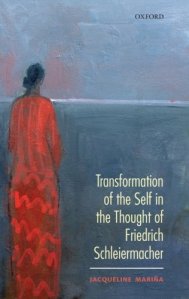
Wrestling with God: The Story of My Life by Lloyd Geering; On Human Worth: A Christian Vindication of Equality by Duncan B. Forrester; Transformation of the Self in the Thought of Friedrich Schleiermacher by Jacqueline Mariña (reviewed here); Calvin’s Bible Commentary on the Psalms, Part I by John Calvin; Christianity: The First Three Thousand Years by Diarmaid MacCulloch; Home: A Novel by Marilynne Robinson.

Through the iPod:

Sweet Bells by Kate Rusby; Guillaume de Machaut: Motets, Morimur, Motetten and English and Italian Renaissance Madrigals by Hilliard Ensemble, Officium – Jan Gabarek & The Hilliard Ensemble by Cristobal de Morales; Battle Studies by John Mayer; Stay Strong by Blair Douglas.

On the screen:

Allie Eagle and Me; Eagle vs. Shark; Doubt; The Lion King.

By the bottle: Coriole Redstone Cabernet Sauvignon 2006.

Transformation of the Self in the Thought of Friedrich Schleiermacher: A Review

A Review: Transformation of the Self in the Thought of Friedrich Schleiermacher, by Jacqueline Mariña. Pp. x + 270. Oxford: Oxford University Press, 2008, ISBN 978 0 19 920637 7. £61.

In this study, Jacqueline Mariña, a Professor of Philosophy at Purdue University, seeks to provide an exposition and analysis of the key metaphysical concepts undergirding Friedrich Schleiermacher’s thought regarding moral and spiritual transformation. She does so via an exegesis of the post-Enlightenment and post-Kantian metaphysics upon which the mature Schleiermacher develops his ethics – particularly the notions of self-consciousness and personal identity – and that in sustained conversation with some of the German theologian’s key dialogue partners, principally Kant, but also Spinoza and Leibniz, and, less so, Fichte and Jacobi, and with Platonic and Augustinian metaphysics of the self. Mariña also offers some helpful analyses of the development of Schleiermacher’s thought regarding ethics.

Mariña’s essay has notable merits, principal among them being its defence of Schleiermacher’s overall moral theory as both the cornerstone of his thought and a legitimate entrée for understanding his theology. She understands that Schleiermacher’s ethics are irreversibly engaged with his metaphysics of the absolute and the philosophy of religion. Building on the work of Frederick Beiser, she argues that ethical theory is ‘central to Schleiermacher’s outlook’ and that ‘it is in the sphere of ethics that religion has its ultimate meaning, for the fruit of all true religion lies in its transformative power over the self’ (p. 3). The significance of Schleiermacher’s achievement, Mariña argues, is that by focusing on religious experience and the transcendental conditions of subjectivity, Schleiermacher offers an account of religion unencumbered by reductionism and dogmaticism. Insofar as he does this, Mariña contends, Schleiermacher makes an important contribution to contemporary interreligious dialogue.

Drawing on Schleiermacher’s early essays On Freedom (1790–2), his notes on Kant’s second Critique (1789), the third of his Dialogues on Freedom (1789), and his review of Kant’s Anthropology from a Pragmatic Point of View (1799), the opening chapter, titled ‘The Philosopher’s Stone’, examines Schleiermacher’s struggle with Kant’s practical philosophy. Mariña notes that while he had some sympathies with Kant’s project, the early Schleiermacher became ‘increasingly dissatisfied with some of the deep philosophical problems posed by the notion of transcendental freedom’ (p. 16).

Chapters Two and Three provide an analysis of two early works (1793–94) by Schleiermacher on Spinoza, namely Spinozism and the Short Presentation of the Spinozistic System. Chapter Two examines Schleiermacher’s claim that there are no genuine individuals, and does so by way of considering Kant’s distinction between noumena and phenomena. Mariña argues that Kant’s analysis of transcendental subjectivity remains an important part of the early Schleiermacher’s thought and informs his decision to abandon Spinozism. She concludes: ‘Despite his familiarity with Kant’s arguments against the possibility of knowledge of the transcendent, in Spinozism Schleiermacher had already come to the conclusion that it is through the transcendental activity of the self that the soul comes into contact with what is genuinely real’ (p. 75). Chapter Three builds on the work undertaken in the previous chapter and considers more deeply issues of personal identity and (in agreement with Kant) our lack of access to a substantial noumenal self.

Mariña then turns to the influence of Leibniz – ‘a poor philosopher [who] from time to time … developed better insights’ (p. 109) – on Schleiermacher’s thought by way of discussion on Schleiermacher’s Monologen (1800) wherein Schleiermacher, playing on Leibniz’s notion of the self as a mirror of the world, envisions transcendentally-free beings expressing themselves into the world. The author recalls Schleiermacher’s appropriation of Kant’s critique of rational psychology and his avouchment that we have no access to knowledge of self as it is in itself. ‘Self-knowledge is only of the empirical self, and this means that the self knows itself only in its relation to that which is different from it and stands outside it. It is, therefore, through the world that the self comes to know itself’ (pp. 110–11). ‘Without the other, there is no knowledge of the self. The person expresses him or herself to the other, and the self as thus expressed is reflected back to the self in the self-consciousness of the other. Loss of the other is therefore a loss of oneself’ (p. 143). This contextualises and anticipates the later discussion on christology, and addresses a foundation of Schleiermacher’s employment of Leibniz’s (and Hegel’s) claim that it is ‘only in relation to a historical individual with a perfect God-consciousness’ that human beings can ‘achieve moral perfection. For only such a one who expresses the divine love perfectly knows the essence of all rational beings as their capacity to express the divine love. Such a one reflects this essence back to them so that they can thereby know themselves as beings that express the divine love’ (p. 144). Clearly, Schleiermacher has moved beyond Kant. The author here identifies key Leibnizian themes that Schleiermacher will develop further in his Dialektik (1814–15) and in Der christliche Glaube (1821–22); particularly the relationship between God and the self, and the self and the world, and the integration that occurs between one’s representation of the world and one’s own desires, and so one’s actions.

In Chapter Five, Schleiermacher’s 1805–06 works, Notes on Ethics, and his Outline of a Critique of Previous Ethical Theories (1803), serve as the basis for exploring the implications of ensouled human nature, and so a reality in which sensuously-conditioned desires can be infused with ethical content. Mariña considers how the teleology of moral action seeks the perfection of this world and not some other. She recognises (in a later chapter) that at the centre of Schleiermacher’s ethics lies the ‘non-transposable character of individuals and historical communities, each of which has a special character determined by a particular historical development’ (p. 168), and that ‘Schleiermacher recognized that not to acknowledge our situatedness can only lead to delusions of absolute knowledge having the most pernicious of consequences’ (p. 176), but unfortunately she does not take up Karl Barth’s suggestion, in The Theology of Schleiermacher, that we know Schleiermacher best when we understand him as a virtuoso of family life, in the society of relatives either of blood or of one’s own choosing (pp. 108–9).

The notion of ensoulment is further developed in Chapter Six, wherein Mariña probes the ensoulment of human nature through reason and through the establishment of community, and in Chapter Seven, ‘Transforming the Self through Christ’, in which the author recalls Schleiermacher’s christology (a subject which ‘encapsulates the whole of his theology’ (p. 187)) in terms of Christ’s own God-consciousness and in terms of Christ’s creating God-consciousness in others, consequently transforming their ethical outlook. Mariña contends that Schleiermacher’s Christ – the one who ‘defines what it means to be human’ (p. 196) – engages in person-forming activity, a work established in the original divine decree and which involves a transformation of ethic. Insofar as he does this, Christ is, in Schleiermacher’s words, ‘the completion of the creation of man’ (cited on p. 196). This means, Mariña contends, that for Schleiermacher, ‘Jesus is no mere teacher of morality, but that what he mediates is a relation to the ground of being and love, and thereby to the transcendental ground of all true religion and ethics’ (p. 197). Moreover, our assimilation into Jesus’ divine life is ‘achieved through the communication of his words and deeds’, both of which are required to effect the divine love in history and shape human self-consciousness and being in the world. ‘The divine love manifest in the life of the historical Jesus brings a new way of envisioning what it means to be a human being, and what it means to be in community’ (p. 219).

The final chapter returns to the challenges of religious pluralism which were broached in the introduction and does so via an analysis of arguments proffered in the 1821 edition of On Religion and in the second edition of Der christliche Glaube. Mariña argues that Schleiermacher’s thought provides a ‘generally coherent account of how it is possible that differing religious traditions are all based on the same experience of the absolute’ (p. 224). She further claims that religious differences are differences only in degree, not in kind. ‘It is because there is a single, fundamental experience to which all the world’s religions are related that there can be meaningful and significant dialogue among them’ (p. 243).

Mariña’s study has a number of strengths. Building upon her already published work on Schleiermacher and Kant, she offers a valuable analysis of several chief sources of Schleiermacher’s thought, and of Schleiermacher’s employment, discarding and development of some of their ideas through various stages of his own theological and philosophical maturation, properly observing the way in which Schleiermacher’s ethics are grounded upon his theological claims, that philosophical ethics is purposely descriptive of how divine causality finds shape in human community through individual persons. Insofar as she does this, Mariña’s essay fills a noticeable gap in the English-speaking literature, and is a welcome complement to works by Richard R. Niebuhr (Schleiermacher on Christ and Religion, 1964), Albert Blackwell (Schleiermacher’s Early Philosophy of Life: Determinism, Freedom, Phantasy, 1982), Brian Gerrish (A Prince of the Church: Schleiermacher and the Beginnings of Modern Theology, 1984), Julia A. Lamm (The Living God: Schleiermacher’s Theological Appropriation of Spinoza, 1996), Catherine L. Kelsey, (Thinking about Christ with Schleiermacher, 2003), and Richard Crouter (Friedrich Schleiermacher: Between Enlightenment and Romanticism, 2005).

Mariña’s argument could have been more persuasive had she attended further to a number of her claims: for example, the claim that Schleiermacher’s proposals concerning transcendental freedom are made at the cost of abandoning determinism. Readers may also be left unsatisfied that Mariña stops short of recounting how the transformation of self with which Schleiermacher is so concerned is effected, and what lay behind the author’s decision to give relatively little attention to Schleiermacher’s more mature ethics (for example, his lectures on philosophical ethics delivered at the University of Berlin between 1812–1830, a period which overlaps Hegel’s time at that same institution, or Schleiermacher’s six Akademieabhandlungen read before the Academy of Sciences between 1819 and 1830) which invite us to consider how language, tradition and institutions inform the moral shape of human being both universally and particularly, and which may have assisted Mariña to provide a more rigorous comparison between Schleiermacher’s early and later ethics and their relation to Schleiermacher’s christology developed in Der christliche Glaube (1821/22, 1830/31) – to which she appropriately turns in her penultimate chapter though fails to develop as fully as her project requires – and particularly the relationship between Jesus’ own God-consciousness, the ethical significance of the hypostatic union, and his mediating to us divine causality. Moreover, Schleiermacher’s privileging of God’s ecclesiological community as that creation of the Spirit with which Jesus’ religiosity is a contemporary reality is disregarded by Mariña. Here, some readers may also take issue that Mariña’s reading of Schleiermacher as positing unmediated moments of the feeling of absolute dependence (a notion which betrays Leibniz’ influence) are offered too independently of Schleiermacher’s careful underscoring of historical, social, theological and cultural contingencies and practices with which much of his philosophical ethics are concerned. Finally, while appropriately situating this project and its value against the backdrop of contemporary challenges posed by various forms of religious (and other) fundamentalism and inter-religious dialogue, the author minimises the obstacles to interreligious dialogue and overplays the profitability that Schleiermacher’s project offers therein.

Few will follow Mariña on every point, and those seeking a particularly transpicuous exposition of Schleiermacher’s thought might well be disappointed, but this remains a valuable essay all the same, and those wishing to engage with Schleiermacher’s abiding significance for ethics will not want to be without it.

Some holiday reading/listening

The postie was very kind to me today, delivering no bills but only the following fun Christmas reading/listening:

And I’m still working my way through Diarmaid MacCulloch’s latest tome, Christianity: The First Three Thousand Years.

But first things first: fishing!

November bests …

From the reading chair:

Reforming Theology: Explorations in the Theological Traditions of the United Reformed Church by David Peel; Dr. Dog by Babette Cole; Theology of Hope by Jürgen Moltmann; Open Secrets: A Spiritual Journey Through a Country Church by Richard Lischer; First As Tragedy, Then As Farce by Slavoj Žižek; Windows on the Cross by Tom Smail; The Seven Storey Mountain by Thomas Merton; The Pseudonyms of God by Robert McAfee Brown.

Through the iPod: Raising Sand by Alison Krauss and Robert Plant; American III: Solitary Man and American V: A Hundred Highways by Johnny Cash; Battle Studies by John Mayer; Play On by Carrie Underwood; The Charity of Night, Stealing Fire and Life Short Call Now by Bruce Cockburn; The Circle by Bon Jovi; Jennifer Hudson by Jennifer Hudson; Reality Killed the Video Star by Robbie Williams (this one took a while to grow on me); The North Star by Roddy Frame (HT: Bruce put me on to this). And as I begin to get into the Christmas thing, I’m listening to Christmas by Bruce Cockburn; Christmas in the Heart by Bob Dylan; My Christmas by Andrea Bocelli; Come to the Cradle by Michael Card; and Breath Of Heaven: A Christmas Collection by Vince Gill.

On the screen: Perfume: The Story of a Murderer [2006]

October bests …

Draw the LineFrom the reading chair: Celtic Christianity: Making Myths and Chasing Dreams by Ian Bradley; The Quest For Celtic Christianity by Donald E. Meek; Banner in the West: A Spiritual History of Lewis and Harris by John Macleod; Why Study The Past?: The Quest For The Historical Church by Rowan Williams; Loving God With Our Minds: The Pastor As Theologian edited by Michael Welker and Cynthia A. Jarvis; Why Your World Is About to Get a Whole Lot Smaller: Oil and the End of Globalization by Jeff Rubin; Liberating Reformed Theology, Christianity and Democracy: A Theology for a Just World Order and Theology & Ministry in Context & Crisis: A South African Perspective by John W. de Gruchy; Witness to the World: The Christian Mission in Theological Perspective by David J. Bosch; Black and Reformed: Apartheid, Liberation, and the Calvinist Tradition by Allan A. Boesak; Praying with Paul by Thomas A. Smail.

Through the iPod: Kind of Blue (50th Anniversary) by Miles Davis; Looking for Butter Boy by Archie Roach; Daughtry and Leave This Town by Daughtry; Draw the Line by David Gray (this is easily in my top 10 for 2009); X&Y by Coldplay; Christmas In the Heart by Bob Dylan (Judy says that it won’t be being played in ‘our’ house this Christmas, so does anyone want me over for lunch).

By the bottle: Mt Difficulty Long Gully Pinot Noir 2007; Carrick Josephine Riesling 2007.

The Poetry of Care and Loss

davisDoing the rounds this week:

  • Ellen Davis presented her inaugural lecture as the Amos Ragan Kearns Distinguished Professor of Bible and Practical Theology on October 27, 2009, at Duke Divinity School. The title of the lecture was ‘The Poetry of Care and Loss’. It is available via iTunes.
  • The Thailand Burma Border Consortium compares Eastern Burma to Darfur.
  • Julian Bell reviews Vincent van Gogh – The Letters (now we just need Thames & Hudson to review the price!).
  • A fascinating interview with Slavoj Žižek: ‘… it’s very easy to have a radical position which costs you nothing and for the price of nothing it gives you some kind of moral superiority. It also enables them to avoid the truly difficult questions’.
  • Andrew Brower Latz continues his note sharing on Alan Torrance’s 2009 Didsbury Lectures (Parts I, II and III).
  • Jim Gordon reminds us why reading Bonhoeffer is ‘like engaging in a theological detox programme’.
  • Kyle Strobel writes about Evangelical Idolatry.
  • Rick Floyd posts on Lesslie Newbigin’s The Gospel in a Pluralist Society.
  • W. Travis McMaken, on his way into his final qualifying exam in systematic theology, shares a quote from TF Torrance on modern preaching and the god named ‘existentialist decision’.

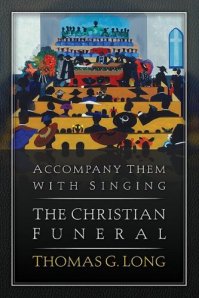
Thomas Long on Christian funerals

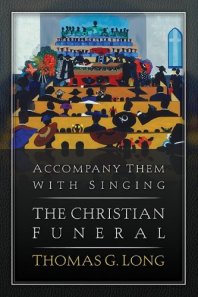
Accompany Them with SingingThere is a genuine sense in which every act of worship is a funeral, entailing acts of judgement and the declaration of God’s hope for humanity in Jesus Christ. That said, it’s really not easy finding good books about funerals (though I am always open to suggestions). And that’s why I’m encouraged by the appearance of Thomas Long‘s new book Accompany Them with Singing. I ordered my copy today, but while I’m waiting for it to arrive, here’s a few tasters:

Accompany them with singing

In a funeral, what is true about all worship, namely, that the gospel story is reenacted in dramatic form, comes to particular focus around the occasion of a death. The major theme of a funeral is the gospel story, and the life story of the person who has died is a motif running through this larger theme; perhaps more precisely, a funeral is about the intertwining of these two narratives. At a funeral, the faithful community gathers to enact the promises of the gospel and the convictions of the Christian faith about life and death, as they are refracted through the prism of the life of the one who has died.

To say that a funeral is a gospel liturgical drama seems simple and true, but this is precisely one of the aspects of the Christian funeral most obscured and crusted over by so many contemporary funeral customs. When it is clear that the funeral is a dramatic reenactment of the gospel, this shines a bright light on what a funeral is not. Despite popular misconceptions, a funeral is not primarily a quiet time when people gather to reflect on the legacy of the deceased, a devotional service dealing with grief, a show of community support for the mourning family, or even a “celebration of life.” Good funerals, in fact, do all of these things – console the grief-stricken, remember and honor the deceased, display community care, and give thanks for all the joys and graces experienced in the life of the one who has died. But these are some of the consequences of a good funeral, not its central meaning or purpose.

The funeral as drama

While it is true that the gospel is proclaimed in the words of the funeral, it is also true that the gospel is proclaimed in the actions of the funeral. The whole funeral, as an act of drama growing out of baptism, proclaims the gospel.

When a Christian dies, the church gathers to act out the story of what this death means in the light of the gospel, but it is a story that began long before the person died. It is a story that began at baptism. Since a funeral is built on the foundation of baptism, we cannot fully grasp the dramatic aspects of a funeral without seeing them in baptism as well, and it is there that we must begin.

On the banks of Louisiana’s Ouachita River, the congregation of St. Paul’s Baptist Church, an African American congregation, gathers every year, after several days of fervent prayer meetings and vigorous revival preaching, to baptize new converts to the Christian faith. The older members of the church call this spot on the river “the old burying ground,” because of what Paul said about baptism: “Therefore we have been buried with him by baptism into death, so that, just as Christ was raised from the dead by the glory of the Father, so we too might walk in newness of life” (Rom. 6:4). Here, in the flowing currents of the Ouachita, sinners are plunged beneath the waters symbolically to die with Christ, to be washed clean, and to be raised up to a new way of life.

On those days when the congregation of St. Paul’s gathers for baptism, the Ouachita River is, of course just the Ouachita, but in the drama of baptism it becomes much more. It is the Red Sea, the waters through which the children of Israel passed on their way to freedom and to the promised land. On baptism day, the Ouachita is also the Jordan River, the place of Jesus’ baptism, and it is the “river of the water of life, bright as crystal, flowing from the throne of God and of the Lamb” (Rev. 22:1) through the heavenly city. “We gather here on this old river that drifts into the sea,” said the pastor of St. Paul’s, standing hipdeep in the water one baptismal day, “because we have come back here. Things may have changed uptown; banks may have gone out; shopping centers may have closed, but this old river just keeps on. So we thought the church would come back here and tell the Lord, we thank him for this old river.”

The candidates for baptism, wearing cotton robes sewn especially for them by the older women in the congregation, “the mothers of the church,” stand on the riverbank waiting. At the beckoning of the pastor, the deacons take each of them by the hand, one by one, and lead them down into the river, as the congregation sings old hymns and spirituals like “Take me to the water; take me to the water; take me to the water to be baptized.”

When those baptized come out of the river, they are taken to an improvised dressing room, from which they emerge dressed in dazzling white “Sunday clothes,” and they go back to the river to sing and pray while others are baptized. Then the whole congregation goes back to the church building for a festive ceremony in which these new Christians are “fellowshipped into the church.”

Notice that the Baptists of St. Paul’s Church don’t just talk about their convictions concerning baptism; they act them out in a dramatic piece of what could be called Christian community theater there on the river. Baptism is about dying and rising with Christ. Baptism is about being washed clean from sin. Baptism is about being welcomed into a community of the faithful as a brother or sister in Christ. Baptism is about responding to a holy call and setting out on an adventure of faith. Every one of these claims about baptism, and more, is acted out in the drama of the baptismal service.

The same is true whenever and wherever baptism is performed. Whether it is the Baptists assembled on the banks of the muddy Ouachita or a Lutheran congregation around the font in a candle-lit church in Wisconsin or an assembly of Catholics observing the sacrament of baptism in a Texas cathedral, though the details may differ, the essential baptismal drama is the same. In the waters of baptism — river, lake, pool, or font — Christians “die” to the old self, and emerge from the waters to set out on a journey of new life. One of the earliest names for the Christian movement was “the Way” (Acts 9:2), because the faith was not understood as a set of ideas or intellectual beliefs, but as a journey down a road, a way of life. Just as Jesus came up out of the baptismal waters of the Jordan River and set out on the road to the cross, just so, Christians pass through the waters of baptism and begin to travel, following in the path of Jesus. Christians do not take this road alone, but, as the baptismal drama makes plain, they travel in the company of the saints. Those being baptized are visibly and audibly surrounded by the faithful, who pray and sing these new Christians along their baptismal way. The prayer for the baptismal journey in the Episcopal Book of Common Prayer points toward the road: “Send them into the world in witness to your love,” and then names the destination, “Bring them to the fullness of your peace and glory.” The church promises in the words of the Presbyterian Book of Common Worship, “to guide and nurture [them] by word and deed, with love and prayer, encouraging them to know and follow Christ.”

A Christian funeral is a continuation and elaboration of the baptismal service. If baptism is a form of worshipful drama performed at the beginning of the Christian life, a funeral is — or should be — an equally dramatic, and symmetrical, performance of worship performed at the end of life. When Christians traveling along the baptismal path die, the company of the faithful who were there to guide them at the beginning are also there to carry them at the end. In baptism, new Christians are “buried with Christ by baptism into death,” and they come up from the waters raised to “walk in newness of life.” In funerals, these same Christians, having traveled the pilgrim way, are once again buried with Christ in death in the sure confidence that they will be raised to new life. In baptism, the faithful sang them into this new way of life; now they gather around to sing them to God in death. Just as they washed the new Christian in the waters of baptism, they now lovingly wash the body of the deceased. Just as they adorned the newly baptized Christian with the garments of Christ, they now adorn the deceased in clothes fitting to meet God and perhaps place a pall, a symbol of the garments of baptism, over the coffin. As the church has been traveling with the baptized saint along the road of faith, the church now walks with the deceased on “the last mile of the way” to the place of farewell.

The funeral, then, is not just a collection of inspiring words said on the occasion of someone’s death. It is, rather, a dramatic event in which the church acts out what it believes to be happening from the perspective of faith. In this sense, a Christian funeral is a piece of theater, but it has more in common with ancient forms of religious drama than with popular theater. The philosopher Martha Nussbaum once contrasted ancient Greek drama with more contemporary Broadway style theater. Today, observed Nussbaum, a playgoing audience sits quietly in a darkened theater, “in the illusion of splendid isolation,” and watches the actors perform on a stage “bathed in artificial light, as if it were a separate world of fantasy and mystery.” Not so in ancient Greece. Greek plays “took place during a solemn civic/religious festival, whose trappings made spectators conscious that the values of the community were being examined and communicated.” Also, the plays were performed in broad daylight and “in the round,” that is, in the midst of the community. People could look across the stage and see the faces of their neighbors and fellow citizens on the other side. “To respond to these events,” says Nussbaum, “was to acknowledge and participate in a way of life.” Greek drama, like other forms of art, “was thought to be practical, aesthetic interest a practical interest—an interest in the good life and in communal self-understanding. To respond in a certain way was to move already toward this greater understanding.”

Just so, at a funeral the congregation does not gather as an audience to hear and see a production performed “on stage” at the front of the church or funeral home chapel. In fact, the congregation at a funeral is not an “audience” at all; they are the actors, and they are themselves on stage, moving and gesturing at the right times; singing, speaking, and praying their lines in the great drama of death and life. “[A]ll Christians are performers,” claims [theologian Shannon] Craigo-Snell, “and the entire Christian life is a performance in which we attempt to enact and create the events called for by the script/Scripture. Those who sit in the rear pew on Sunday mornings are no less actors than the clergy up front.” Even those neighbors, friends, and family members who are not a part of the church but who have come for this funeral are welcomed with the hospitality of God and invited to take up powerful roles in this drama.

[HT: Faith and Leadership]
 

(Essential) books for preaching

preachAnna Carter Florence, over at The Christian Century, recently listed her 7 essential books for preaching. Her suggestions?

I think it’s a great list and, in addition to that growing list of ‘essential’ reading for the minister, and to some books on preaching I’ve mentioned elsewhere, I would want to suggest some further nominees:

I have here, on the main, deliberately chosen to not list books that attend primarily to issues of homiletical method (there are a plethora of excellent studies available on this) but rather to draw attention to those in which the evangelical content of preaching is the main concern. This decision was made because it is here at this point that the church faces its greatest crisis. We have loads of ‘excellent speakers’ and ‘gifted communicators’ who have absolutely nothing to say that’s worth hearing, let alone the Word of God. Recently, Ben Myers’ excellent review, titled Dietrich Bonhoeffer in New York, bore witness to this crisis. Reading my American Patriot’s Bible or my New Spirit-Filled Life Bible or my Green Bible (as opposed to my Green Chile Bible) will never be quite the same again.

Apologies (LOL) for another lengthy list, but Per Crucem ad Lucem is, after all, ‘a theology site on steroids’. Thanks Rick.

Reading Twentieth-Century Reformed & Presbyterian Thought

Man readingSome months back, I posted a list of suggested novels, plays and collections of poetry that I thought theology students and pastors ought to read, and in response received a number of excellent additional suggestions. Thanks heaps to those who offered such! Now, I am putting together a wee course on twentieth-century Reformed & Presbyterian thought for interns training for ordained pastoral ministry, part of which means offering some pre-reading suggestions. So far I’m considering selections from some of the following:

I’m also considering some of the following essays:

Am I missing anything really obvious here, particularly stuff that would be important for Presbyterian ordinands to engage with? Keep in mind that this is only one module of seven in an entire course dedicated to Presbyterian and Reformed studies, and that there is a separate module that attends to key New Zealand figures.

So what other texts ought I consider? And – to make it broader – if you’re a Pressie/Reformed minister, or even one from some lesser tribe, what twentieth-century reformed theology do you wish you had read when you were training?

September bests …

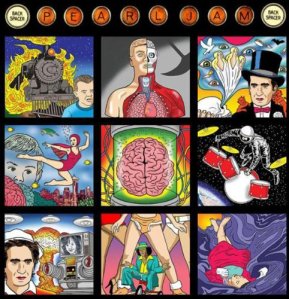
BackspacerFrom the reading chair: Biography as Theology: How Life Stories Can Remake Today’s Theology by James Wm. McClendon; The Concentration Camp and Other Stories by Geoffrey C. Bingham; The End of Suffering: Finding Purpose in Pain by Scott Cairns [reviewed here]; Pastoral Theology in the Classical Tradition by Andrew Purves; Poems for Gardeners edited by Germaine Greer; No Rusty Swords: Letters, Lectures, and Notes from the Collected Works by Dietrich Bonhoeffer.

Through the iPod: Come Up Full and The Crossing by Meg Hutchinson; Backspacer by Pearl Jam; Beautiful World and The Road Between by Khristian Mizzi; My Holiday by Mindy Smith; Our Bright Future by Tracy Chapman; Death Magnetic by Metallica; Symphony No. 4 in E minor, Op. 98 – Carlos Kleiber/Vienna Philharmonic Orchestra by Johannes Brahms.

On the screen: Shooting Dogs [2007], reviewed here;  Wallace and Gromit: A Matter of Loaf or Death [2009]; Shaun the Sheep: Sheep on the Loose [2009]; Shaun the Sheep: Off the Baa! [2008]; Sometimes in April [2005].

By the bottle: Seppeltsfield Cellar No 9 Muscat Rutherford (tasting notes).

Scott Cairns: ‘The End of Suffering: Finding Purpose in Pain’

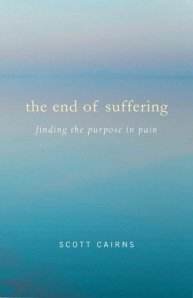
End of SufferingScott Cairns’ most recent publication – The End of Suffering: Finding Purpose in Pain (Brewster: Paraclete Press, 2009) – invites a play on the word end. Cairns recalls that while we can believe that a day will come when suffering will be no more, we live now in ‘our puzzling meantime’, aware both that suffering is no end in itself but also that we sense something of ‘suffering’s purpose’, that ‘our own descents into suffering may turn out to be the occasions in which we – imitating [Christ’s] unique and appalling descent – come to know Him all the more intimately’ (p. 99). Here’s a further snippert:

Saint Isaac counsels, “Blessed is the person who knows his own weakness, because awareness of this becomes for him the foundation and the beginning of all that is good and beautiful.” Affliction appears to be our only reliable access to this kind of knowledge, this necessary confrontation with our own weaknesses, and this advantageous mitigation of our pride. And it seems to be the only way we come against self-esteem to glimpse and thereafter to know our condition, to appreciate our vulnerability, and to live according to this new and chastening light. (pp. 18–19)

Throughout this book, Cairns draws not only upon Saint Isaac, but also upon work by George Steiner, W.H. Auden, G.K. Chesterton, Dostoevsky (mainly his The Brothers Karamazov), Dietrich Bonhoeffer, Archimandrite Sophrony, Saint Theophan the Recluse, Kallistos Ware, Alexander Schmemann, Simone Weil, and others. This essay serves as not only an accessible reflection on suffering (it would be a good book to work through in small groups), but also as a nuanced entrée into the Christian tradition (particularly into its Orthodox branch), and into a way of doing theology that invites us to embrace – or, rather, to be embraced by – a new vision of life via the ‘puzzlement’ of our afflictions. Those already familiar with Cairns’ poetry (and if you’re not, shame on you!) will want to go back and re-read it. Those unfamiliar with Cairns the poet, will (hopefully) get enough of a taste of it in this essay that they will want to ‘take up and read’ [it].

The book concludes – appropriately – by recalling Alexander Schmemann’s reflection on Lent:

For many, if not for the majority of Orthodox Christians, Lent consists of a limited number of formal, predominantly negative, rules and prescriptions: abstention from certain food, dancing, perhaps movies. Such is the degree of our alienation from the real spirit of the Church that it is almost impossible for us to understand that there is “something else” in Lent – something without which all these prescriptions lose much of their meaning. This “something else” can best be described as an “atmosphere,” a “climate” into which one enters, as first of all a state of mind, soul, and spirit, which for seven weeks permeates our entire life. Let us stress once more that the what is lacking purpose of Lent is not to force on us a few formal obligations, but to “soften” our heart so that it may open itself to the realities of the spirit, to experience the hidden “thirst and hunger” for communion with God.

Cairns recalls how that for Schmemann, ‘a “quiet sadness” permeates the Lenten services themselves; “vestments are dark, the services are longer than usual and more monotonous, there is almost no movement.” He observes that despite the alternating readings and chants, “nothing seems to happen.” And so, he acknowledges, we stand for a very long time in this quiet, this sadness, this monotony. “But then we begin to realize that this very length and monotony are needed if we are to experience the secret and at first unnoticeable ‘action’ of the service in us. Little by little, we begin to understand, or rather to feel, that this sadness is indeed ‘bright,’ that a mysterious transformation is about to take place in us.” Moving through the sadness’, Cairns writes, ‘we glimpse the joy. We feel its effects on us and feel how it changes us. We are thereby led to a place where noises, distractions, and false importance of the street – of our dissipated lives – finally “have no access – a place where they have no power.” Similarly, then, in those seasons of our afflictions – those trials in our lives that we do not choose but press through – a stillness, a calm, and a hope become available to us; they are a stillness, a calm, and a hope that must be acquired slowly, because – as Father Schmemann says of our joy in Lent – “our fallen nature has lost the ability to accede there naturally.”’ We are obliged, Cairns insists, to ‘recover this wisdom slowly, bit by bit’. (pp. 112–14)

August bests …

Moltmann - A Broad PlaceFrom the reading chair: In the Beauty of the Lilies, by John Updike; A Broad Place, by Jürgen Moltmann; An Educated Clergy: Scottish Theological Education and Training in the Kirk and Secession, 1560-1850, by Jack C. Whytock.

Through the iPod: Jewel, Lullaby; KD Lang, Watershed; jj, jj n° 2; Lucinda Williams, Little Honey and West; Emmylou Harris, All I Intended to Be; John Hiatt, Same Old Man and Slow Turning.

On the screen: Leonard Cohen: I’m Your Man [2005]; Disgrace [2008]

In the glass: Two Degrees Pinot Noir 2007.

July bests …

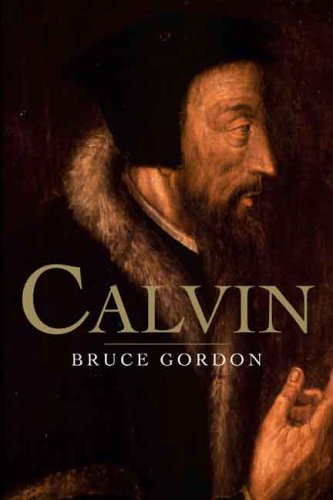
CalvinFrom the reading chair: Housekeeping: A Novel, and The Death of Adam: Essays on Modern Thought, both by Marilynne Robinson; John Calvin as Teacher, Pastor, and Theologian: The Shape of His Writings and Thought, by Randall C. Zachman; Calvin, by Bruce Gordon; Calvin’s Preaching, by T.H.L. Parker; The Theology of John Calvin by Charles Partee; Why Go to Church?: The Drama of the Eucharist, by Timothy Radcliffe; Christian Worship in Reformed Churches Past and Present, edited by Lukas Vischer; Calvin, Participation, and the Gift: The Activity of Believers in Union with Christ, by J. Todd Billings; Grace and Gratitude: The Eucharistic Theology of John Calvin, and The Old Protestantism and the New: Essays on the Reformation Heritage, both by Brain A. Gerrish; and A Theology of Proclamation by Dietrich Ritschl. 

Through the iPod: Twist, by Dave Dobbyn; Bruckner’s Symphonies 1–9, by Berlin Philharmonic conducted by Herbert von Karajan; Troubadour, by George Strait; Lady Antebellum, by Lady Antebellum; My One and Only Thrill, by Melody Gardot; Worrisome Heart, by Melody Gardot.                                                

On the screen: Dogville; Frost/Nixon; Milk; The Pawnbroker; The War on Democracy; The Savages.

In the glass: Speight’s Old Dark.

‘What Language Shall I Borrow?’: Reading for ministry

Picasso - The ReaderThere is a lot in the observation that pastors who read (and there are too few of those) not to be drawn into a deeper place of grappling with realities human and otherwise but who engage in page turning primarily with a view to ‘finding illustrations’, or sponsoring homiletical self-aggrandisement that can be employed for doing something ‘really significant’, only betray themselves as soon as they take up the invitation to speak, whether in a public setting or in a more private one. I recall the words of Michael Dirda, the editor of the Washington Post Book World, who once opined:

A true literary work is one that makes us see the world or ourselves in a new way. Most writers accomplish this through an imaginative and original use of language, which is why literature has been defined as writing that needs to be read (at least) twice. Great books tend to feel strange. They leave us uncomfortable. They make us turn their pages slowly. We are left shaken and stirred. But who now is willing to put in the time or effort to read a real book? Most people expect printed matter to be easy. Too often, we expect the pages to aspire to the condition of television, and to just wash over us. But those who really care about literature nearly always sit down with a pencil in their hands, to underline, mark favorite passages, argue in the margins. The relationship between a book and reader may occasionally be likened to a love affair, but it’s just as often a wrestling match. No pain, no gain. This is why the NEA report shows that poetry is suffering most of all. Poets keep their language charged, they make severe demands on our attention, they cut us no slack. While most prose works the room like a smiling politician at a fundraiser, poetry stands quietly in the dusty street, as cool and self-contained as a lone gunfighter with his serape flapping in the wind. It’s not glad-handing anybody. (Washington Post, July 2004)

Moreover, good writing leaves us humbled and grateful for the privilege of learning from adroit diagnosers and physicians of the soul, the accumulation of whose experiences serve to assist those of us charged with ministering to those who labour with diseases and distempers of spirit beyond our own experience.

Therefore, in order to sponsor such happenings, I’m wanting to compile a list of suggested novels, plays and collections of poetry as assigned reading for theology students and pastors. And to this end I am soliciting the help of readers of Per Crucem ad Lucem. I’m thinking of work by Geraldine Brooks, John Updike, John Steinbeck, J.M. Coetzee, David Malouf, F. Scott Fitzgerald, Flannery O’Connor, Jim Crace, Thomas Carlyle, Francine Prose, Kenzaburō Ōe, Thomas Lynch, George MacDonald, A.S. Byatt, and Nathaniel Hawthorne; and poets like William Blake, John Donne, E.E. Cummings, T.S. Eliot, George Herbert, Philip Levine, Sylvia Plath, Anna Akhmatova and John Ciardi.

Here’s some additional suggestions to kick us off:

Novels


Poetry/Plays


What might you add?

‘Poems for the Pastor’

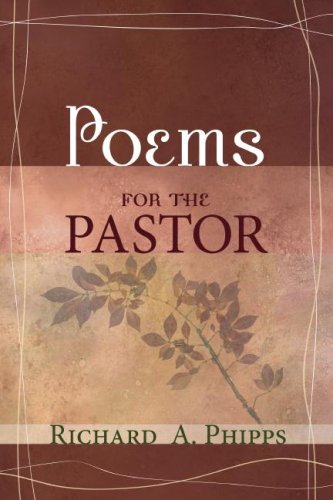
Poems for the PastorSøren Kierkegaard, in Either/Or, once stated that a poet is ‘an unhappy person who conceals profound anguish in his heart but whose lips are so formed that as sighs and cries pass over them they sound like beautiful music’. He may well be right, and that not only of poets; I think too of pastors, for the years have taught me to be less surprised that poetry is one of God’s greatest gifts to pastors. Because happy or otherwise, there remains something about pastoral realities which well echoes Kierkegaard’s description.

I’ve just finished reading Poems for the Pastor: The Reflections and Poetry of Richard A. Phipps (2008), another book from our friends at Wipf and Stock. Phipps is certainly no Les Murray or Jack Kerouac or James K. Baxter – nor does he claim to be – but one is hard-pressed to know why many of these poems deserve to be in print (especially under a publishing label which is deservedly earning a stellar reputation). I love the idea of a collection of poems penned by a pastor for pastors, for those who ‘struggle for the words to express our deepest desires, hurts, expectations, counsel, and prayers for our beloved flock of sinners saved by grace’ (p. ix), but very few lines in this wee volume (74 pages!) quite cut it for me.

If you’re into sentimental, this volume might be your thing. But in my experience, sentimental never gets near to cutting it in pastoral ministry. Am I missing something here?

June bests …

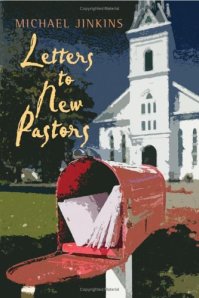
Letters to New PastorsBest books: Voicing Creation’s Praise, by Jeremy S. Begbie; Calvin: A Biography, by Bernard Cottret; Letters to New Pastors, by Michael Jinkins. (On Jinkins’ book: It’s been many moons since I read an entire book in a day, particularly in a day already replete with so many other commitments, but this one was impossible to put down. I think it’ll not be long before parts of it, at least, are revisited).

Best music: Dave Matthews Band, Big Whiskey And The GrooGrux King [2009]; Krzysztof Penderecki, St Luke Passion (Warsaw National Philharmonic Orchestra); Guy Clark, Keepers.

Best films: In Search of a Midnight Kiss [2007]; Så som i himmelen [2004]

Best drink: Glenmorangie, 18 Years Old

On Books …

BooksRick writes:

‘I’ve noticed a strange thing over the last few years. During that time I have been privileged to know and work with a number of young clergy and seminarians, men and women. Most of them are gifted, hard–working, dedicated and capable. There is a lot to like about them. But one thing is noticeably missing. They don’t love my books. They don’t stare at them, or touch them, or covet them. They don’t even notice them when they come into my study. They are more likely to notice and comment on my computer.

This worries me. Can the church maintain a “learned clergy” without instilling a love of books? Is it possible that books are really passé as some say? That in the future the digital age will restrict if not eliminate their use? I hope not. Because books are more than mere information. Throughout my life they have always been my companions and friends. They can invoke wonder and create mystery. They can witness to faith. They are grist for my sermonic mill. But they are more than that. They fuel not just my work but my imagination. I wouldn’t be the minister I am without them. I wouldn’t be who I am without them’.

Yes. Yes. Yes. How can anyone ever trust someone who doesn’t read? Like non-drinkers, there’s something sinister about people who avoid books. It’s really hard to justify that one deserves dinner at the end of a day wherein one has failed to read, discuss and recommended a decent book. And I mean a book, not a blog post or anything on a screen. It’s gotta be something caressable, capable of being made love with …

At a time when theological education and training for pastoral ministry is embracing a lowest-common denominator approach, we could certainly do worse than heed the words of Martyn Lloyd-Jones:

‘Time must be found for reading, and we turn now to the more intellectual type of reading. The first is theology. There is no greater mistake than to think that you finish with theology when you leave a seminary. The preacher should continue to read theology as long as he is alive. The more he reads the better and there are any authors and systems to be studied. I have known men in the ministry, and men in various other works of life who stop reading when they finish their training. They think they have acquired all they need; they have their lecture notes, and nothing further is necessary. The result is that they vegetate and become quite useless. Keep on reading; and read the big works’. Preaching and Preachers (Hodder and Stoughton, 1985), 177.

I mean really, who would take advice from a doctor who hasn’t read anything since the 1950s?

But there’s more. Non-readers, or people addicted to reading trash, clearly aren’t into ‘Ahs’! (and insofar as this is true, they’re not human in any recognisable sense). Vernon Sproxton explains:

‘There are good books, indifferent books, and bad books. Amongst the good books some are honest, inspiring, moving, prophetic, and improving. But in my language there is another category: there are Ah! Books …. Ah! Books are those which induce a fundamental change in the reader’s consciousness. They widen his sensibility in such a way that he is able to look upon familiar things as though he is seeing and understanding them for the first time. Ah! Books are galvanic. They touch the nerve-centre of the whole being so that the reader receives an almost palpable physical shock. A tremor of excited perception tipples through the person … Ah! Books give you sentences which you can roll around in the mind, throw in the air, catch, tease out, analyse. But in whatever l way you handle them, they widen your vision. For they are essentially Idea-creating, in the sense that Coleridge meant when he described the Idea as containing future thought – as opposed to the Epigram which encapsulates past thought. Ah! Books give the impression that you are opening a new account, not closing an old one down’. – Vernon Sproxton, ‘Introduction’,  to Fynn. Mister God, This Is Anna (London: Fount, 1979), 1-2.

And as for ‘educated clergy’, Carnegie Samuel Calian (who is President Emeritus of Pittsburgh Theological Seminary) put it well when he reminded us that ‘Everything we learn at seminary is for someone else …  The aim of seminary education is not simply to produce an educated clergy, but even more so to build up the people of God to become an educated congregation in Christ. The practice of learning is for the purpose of giving hope to others’. The Ideal Seminary (Westminster John Knox, 2003), p. 5.

It is precisely for this end that pastors must be readers. So if pastors don’t want to read for themselves (which is a completely ridiculous position to hold, but is evidently possible), then they ought to read, read and read for those they have been called to love and serve.

[Image: Andre Martins de Barros]