Books

School(s) for Conversion – a commendation

On 14 January 1935, Dietrich Bonhoeffer penned the following words to his brother Karl-Friedrick: ‘… the restoration of the church will surely come only from a new type of monasticism which has nothing in common with the old but a complete lack of compromise in a life lived in accordance with the Sermon on the Mount in the discipleship of Christ. I think it is time to gather people together to do this …’

Whether we are thinking about explicitly religious, or of broader, expressions of new ways of being human community, the birthing of new types of monasticism has long been a feature of ecclesial existence. While having at times drifted in and out of neomonastic communities, and while wrestling frequently with the kingdom-foreignness of the way of being-in-communion that my own introverted default setting reboots to, I’ve mainly been an intrigued onlooker who has read very little in the last decade or so that has come from within the movements themselves that articulates in any depth the intentionalism of such life together. (Whether or not all such communities characterise the ‘new type of monasticism’ for which Bonhoeffer longed is not the point here.)

But I’ve been eager to read and think more. I was delighted, therefore, to discover Wipf and Stocks’ New Monastic Library Series, of which School(s) for Conversion: 12 Marks of a New Monasticism, a book edited by The Rutba House, is a part. (I’m also currently reading Community of the Transfiguration: The Journey of a New Monastic Community by Paul R. Dekar, and “Follow Me”: A History of Christian Intentionality by Ivan J. Kauffman, both of which I’m enjoying immensely.)

The ‘new’ monasticism differs from the ‘old’ in a number of ways. Here are three, for example: (i) vows of celibacy, poverty and obedience are relatively rare; (ii) while geographic proximity of members is preferable, it is not necessary; and (iii) distinctive religious habits have been largely replaced by non-distinctive Levis.

The movement of the Spirit from which this book is birthed sees itself as characterised by the following twelve marks:

1) Relocation to the abandoned places of Empire;

2) Sharing economic resources with fellow community members and the needy among us;

3) Hospitality to the stranger;

4) Lament for racial divisions within the church and our communities combined with the active pursuit of a just reconciliation;

5) Humble submission to Christ’s body, the church;

6) Intentional formation in the way of Christ and the rule of the community along the lines of the old novitiate;

7) Nurturing common life among members of intentional community;

8) Support for celibate singles alongside monogamous married couples and their children;

9) Geographical proximity to community members who share a common rule of life;

10) Care for the plot of God’s earth given to us along with support of our local economies;

11) Peacemaking in the midst of violence and conflict resolution within communities along the lines of Matthew 18; and

12) Commitment to a disciplined contemplative life.

This book attends to these marks, one chapter on each, exploring each theme drawing upon Scripture, contemporary examples, and personal experience.

Taking up Alasdair MacIntyre’s challenge to construct ‘local forms of community within which civility and the intellectual and moral life can be sustained through the new dark ages which are already upon us’, the contributors to this volume believe that when such longing as this instructs the church, ‘the local forms of community for which MacIntyre calls are no longer primarily for the sustenance of intellectual and moral life. Nor are they communities that withdraw from the world to insure their own survival and the flourishing of their members. Rather, within the life of the church a new monasticism exists to sustain knowledge of the gospel of the kingdom that was proclaimed, embodied, and accomplished in Jesus Christ. And the communities of the new monasticism exist for the sake of witness to Jesus Christ who is the life and hope of the world’.

This book is written not by theoreticians or monasticism-virgins cutting their idealistic and yuppie teeth in a utopian wilderness for a while before retreating back to ‘the real world’. Rather, these challenging essays betray a maturity and realism that one might expect from those who have the runs on the board, so to speak, whose commitment to embodying the kingdom which is truly the life of the ‘real world’ is humbling and utopia-destroying, and who love the church as God’s community in travail and often so slow to be on the way.

March stations

Reading:

Listening:

Watching:

Reading Maurice Gee … finally

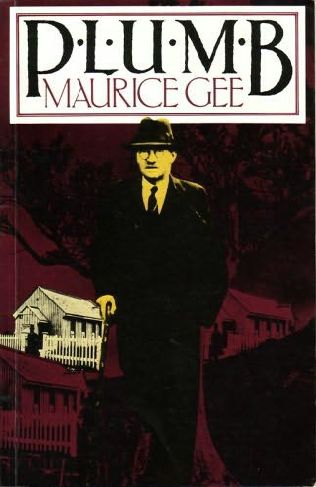
There can be little doubt that among the most exciting things about living in any part of the world is becoming acquainted with the local (farmers) markets, the cuisine, the drink, the music, the slangs … and the stories. And then there are the local writers. While one looks in vain to discover any decent Kiwi journalists being published in this country (to be sure, there are some fantastic bloggers), it’s another game entirely when it comes to academics, poets, and writers of fiction. One of the first enquiries I made even before I landed on the southern climbs that I now call ‘home’ concerned Kiwi authors, and particularly those given to spin a good yarn. And among the names that kept appearing was the Whakatane-born writer Maurice Gee. Gee has penned some thirty novels, and a host of short stories. But the place to begin with Gee, I was repeatedly told, was with his highly-acclaimed book Plumb (1978). So after collecting dust on the bedside box for not a few months, I finally got around to reading Plumb, a book somewhat reminiscent of Marilynne Robinson’s Gilead and Home (with their themes of family, doubt, faith, healing, secrets, generations and death) and which paints the story of the Revd George Plumb, a character moulded in no small part upon Gee’s own grandfather, a pacifist who was sent to prison for his convictions. Here are some of my favourite sentences from Plumb:

  • ‘Life on the margins has a pain the sharper for my knowledge that here those I love are in a state of exile’. (p. 3)
  • ‘The Presbyterians of Emslie went to their church for religious reasons, not to be told how go conduct their lives’. (p. 57)
  • ‘But whoso hath this world’s goods, and seeth his brother have need, and shutteth up his bounds of compassion from him, how dwelleth the love of God in him? A good question, and not to be answered by donations to charity’. (p. 62)
  • ‘I [i.e., George Plumb] tried to explain to her [Meg, his daughter] my belief in man’s spiritual destiny … I talked in large optimistic terms – because I had lost my path. I was in darkness again and felt I might never come out of it, and so I made loud noises to persuade back my memories.’ (p. 204)

With the seed of enthusiasm for Gee’s writing now firmly planted, it will certainly not be so long before I read him again. I already have three more in the pile ready to go: Prowlers, Going West, and Live Bodies; and then, of course, there’s the final two volumes in the Plumb trilogyMeg and Sole Survivor – which trace the ‘Plumb’ story over a further two generations. Yeah for Gee!

Jürgen Moltmann’s Ethics of Hope: Eschatological Possibilities For Moral Action: A Review

A review of Timothy Harvie, Jürgen Moltmann’s Ethics of Hope: Eschatological Possibilities For Moral Action (Ashgate New Critical Thinking in Religion, Theology and Biblical Studies; Aldershot: Ashgate, 2009).

It was Karl Barth who, in his Ethik (1928), reminded us that Christian theology is always ethics, that ethics belongs to theology proper precisely because God makes himself responsible for us, and that ‘ethics as a theological discipline is the auxiliary science in which an answer is sought in the Word of God to the question of the goodness of human conduct’. It is of little surprise, therefore, that such a commitment is shared by one of Barth’s most prolific students, Jürgen Moltmann, whose own articulations concerning theological ethics remain valuable though, in his own words, ‘an unfinished task and an unfulfilled wish’ (p. ix).

Timothy Harvie’s volume (a ‘slightly revised version’ of his doctoral dissertation submitted to the University of Aberdeen and supervised by Professor John Webster) represents an attempt to consider and extend an unfinished trajectory in Moltmann’s theology; namely, and appropriately, an ethics of hope. It is, in the words of its author, ‘not a piece of applied ethics engaging specific moral quandaries or the nature of Christian virtues’ but rather ‘an attempt to theologically describe the sphere of Christian moral action and the means by which this is enabled to take place’ (p. 3). Harvie makes it clear in the Introduction that his essay will argue that Moltmann does not begin with antecedent ethical presuppositions and then mould dogmatics to fit these concerns. Rather, ‘Moltmann begins with an investigation of theological concerns stemming from the biblical history and then attempts to articulate the moral relevance this theological conception has for the current social situation of humanity’ (p. 6).

The book is divided into two parts. In Part I, Harvie attends to the christological, pneumatological and eschatological foundations for an ethics of hope, and offers readers (and particularly those unfamiliar with Moltmann’s oeuvre) an accessible entrée into a number of vistas fundamental to Moltmann’s theological project. Through four chapters, Harvie’s aim is to rehearse how Moltmann is principally concerned with articulating the Christian gospel, and subsequently concerned to point to how the Church’s convictions about the gospel inform her ethical assertions.

He opens with a chapter on hope and promise, noting that the generative thrust and unambiguous priority of Christian hope, for Moltmann, is birthed in the divine promise given in a particular locus in history, and creating and securing a new trajectory for history and for human existence: ‘In the midst of a history wrought with injustice, turmoil and sin, the promise of God (given definitively in the resurrection of Jesus Christ) secures a new future which contravenes the sinful status quo of the present with a new creative work of God for a redeemed cosmos. This new, creative work secured in the promise is a novum in history which moves towards the present’ (p.15). Harvie proceeds to cite Moltmann – ‘The simple prolongation of the status quo no longer provides a future for which it is worth living’ (p. 26) – and avers that eschatological hope grounded in the cross-resurrection means that Christian living becomes subversive, demanding not onlookers but, in Moltmann’s words, ‘combatants’ (p. 26). The promise of God in Jesus Christ creates in history an interval between promise and fulfilment, a Zwischenraum or ‘between-space’, which sets in motion a way of living adumbrated in the promised future but ‘enacted through the creative work of God in such a way that in Christ humans [i.e., the Exodus community, Exodusgemeinde] may now participate in this space … in contradistinction to the world’ (p. 28). This way of living is ‘life commensurate with the Kingdom of God’ (p. 36).

The Kingdom of God, another topic of decided importance for Moltmann, is the subject of Chapter Two. Herein, Harvie outlines the way that Kingdom and christology are inextricably bound up together, and attends to the way that, for Moltmann, the Kingdom represents not only a positive description of the content of Christian hope but also ‘a foil to critique societal situations [Moltmann] perceives to be unjust’ (p. 40). Jesus’ embodiment of the Kingdom, it is noted, means table fellowship with sinners, liberating proclamation and praxis for the poor, and healing to the broken.

Chapters Three and Four attend to the role that pneumatology and the doctrine of the trinity, respectively, play in Moltmann’s theology, and how each informs the ethical shape of his theology of hope. With clarity, Harvie outlines that while, for Moltmann, the trinitarian history of the divine life with the world begins with the history of the promise, a history which culminates in the death and resurrection of the Son, it is the faithful and historical efficacy of the Spirit which ‘constitutes the continuing presence of the Kingdom’ in both Church and world. ‘This’, he continues, ‘in no way denigrates the future horizon of Christian hope for the Kingdom, but rather structures the initial fulfilment of the divine promise, which creates a surplus of expectation and hope for the eschatological novum’ (pp. 57–8). He notes how, for Moltmann, those empowered by the Spirit are ‘led to be non-conformists with the unfulfilled present, which leads to death. The Church, through the work of the Spirit, is empowered to resist in its Zwischenraum of tension, to overcome death with life, violence with peace, and hate with love’ (p. 92). Harvie is critical of Moltmann’s emphasis on a ‘universal society’ (p. 85), arguing that such ambiguity blurs the distinction between the Spirit’s work in the Church and in wider society. In Chapter Four, Harvie gathers up many of the already-attended-to themes and brings them into dialogue with Moltmann’s exposition on the trinity, noting that the creature’s moral living does not equate principally to imitatio of the trine life so much as, by the Spirit, being ‘taken up into the divine communion as an-other … to participate in and live out of the divine love’ (p. 109). Herein, as Moltmann explains it, the ‘lived circulation’ (p. 118) which is the divine life has two kinds of openness: first, there is an intra-Trinitarian openness between the three persons; second, and implying no deficiency of being, the Trinity is open for communion with creation. ‘This divine openness’, Harvie suggests, ‘fundamentally alters the moral life of the Christian through justification and sanctification’ (p. 122). In an interesting conversation with work by Carl Schmitt and Richard Bauckham, Harvie notes how Moltmann’s thoroughly trinitarian theology creates an eschatological ethic which rejects both clerical and political monotheisms, and he follows Bauckham’s critique of Moltmann that the tendency to inadequately distinguish between the triune life in se and the social life of creatures has ‘no biblical basis’ (p. 128). Turning then to the way that creatures participate by the Spirit in the fellowship of love, Harvie considers how, for Moltmann, the notion of divine apatheia both sponsors a utopian hope and undermines the command to be ‘present in open, loving solidarity with those who suffer’ (p. 135).

Harvie then turns – in Part II – to a more focused consideration of the ethical shape that the theological foundations he has outlined in Part I take in creaturely existence. He does this via three discussions on hope: on (i) time and space for hope, (ii) hope for humanity, and (iii) hope for the economy.

In the first of these, what I found to be the most stimulating part of the book, Harvie draws upon Augustine and Bauckham to very helpfully explicate how Moltmann understands, and makes use of, christologically-determined categories of time over against, say, Kathryn Tanner’s ‘futureless eschatology’ (what Carl Braaten calls ‘eschatology sans eschaton’) and time’s modern myths, and how these then inform what Moltmann wishes to aver about the theo-ethical implications of such in the kingdom of God wherein space – conceived as both Zeitraum and Zwischenraum – is opened up for hope and moral action. The present earthly time – the time of promise – is ‘characterized by expectation and anticipation of the novum which is anticipated in the promise and ensured by the divine faithfulness’ (p. 151) and, by the tension created between the divine-human covenant which existentially orients creaturely perspective to the future, sensitises covenant partners to the incongruous nature of their surroundings. Contra Mark Lewis Taylor and Rubem Alves, Harvie notes that, for Moltmann, ‘the ethical space envisioned in a moral theology of hope is not simply the space of human structures where moral action is attempted through one’s own empowerment to one’s own end. Rather, it is a space created by the promise of God through the death and resurrection of Christ in which human structures are transformed by the efficacious work of the Holy Spirit to manifest the eschatological Kingdom. This space orients Christian moral action, through the divine promise, to the future. The result is that this space is then in tension with those structures, circumstances and actions which are not located within the Kingdom of God or brought about through the beneficent work of God through the Spirit’ (p. 167).

Harvie turns, in the final two chapters, to the subjects of human nature, human dignity and human rights, and to outline how he understands Moltmann’s theology of hope might inform conversations about economics. He rightly notes that for Moltmann, the imago Dei depends upon, and says more about, God than it does upon any human trait per se, that the imago Christi is paramount for an ethics of hope, and that ‘it is precisely at this Christologically focused point within eschatological history that the Zwischenraum of tension … is understood to constitute the sphere of Christian moral action’ (p. 172). He also rightly notes that ‘the claim that human beings have equal and intrinsic worth is difficult to maintain as a universal presupposition apart from God’s revelation as creator and redeemer of the world’ (p. 181).

These concluding chapters, however, are disappointingly conservative in their application of the ethic that Moltmann’s thought invites. Harvie proposes no genuine protest to the structures of that world put to death in the crucified God, and very little hint of the novum created by the radical interruption of Jesus’ resurrection and the life that this event births. The praxiological content of the eschatological Zwischenraum which is characterised as life in the Spirit, in other words, is left drastically underdeveloped. The ethical implications of Moltmann’s professional project call for a more radical engagement – or what Ernst Wolf calls a ‘creative discipleship’ – of the ecclesia than Harvie outlines here. Moreover, as Moltmann avers in Theologie der Hoffnung, we must speak not only of the historic transformation of social and public life but also of the suffering, self-surrender, self-expenditure and sacrifice that attend such ‘day-to-day obedience’, and which mark a different way from the glories of self-realisation and the miseries of self-estrangement arising from ‘hopelessness in the world of lost horizons’ – ways disclosed to the laos tou theou in the future of the crucified God in whose life they participate, and to whom they look for the coming of the kingdom in fulness. At the end of the day, Harvie tumbles into the very trap that Hauerwas outlines (and which Harvie cites on p. 183): ‘One of the things that bothers me about such discourse is the designation “us,” meaning Christians, and “them,” meaning the poor. Such language inherently presupposes that Christians have no convictions that might not make them poor. As a result we privilege our place as rich Christians who can justify our being rich because we are concerned about justice’.

While the essay is unduly repetitive, it is amiably unencumbered with distractive engagements with secondary literature and side issues. Where these are relevant, they are appropriately attended to, and that so as not to sidetrack the reader from the main line of enquiry; namely, Moltmann’s own presentation of a foundation for an ethic grounded in trinitarian space-making and orientated toward the future in the kingdom of life and love. And while the ethical implications drawn by Harvie are, to my mind, drastically undercooked, there can be little doubt that those interested in exploring a rich theological foundation for Christian ethics will find much here of value.

February stations …

Reading:

Listening:

Watching:

January stations …

I’ve decided to continue on with my habit of recording some of my stopping points – books read, music listened to, films watched, etc. – each month. Some readers seem to enjoy knowing from where I’m being fertilised, and I enjoy keeping a track of my journeys. So here’s January’s ‘stations’:

Reading:

Listening:

Watching:

Some other news
I’m anticipating that posts here at Per Crucem ad Lucem might be a little scantier over the next few weeks. I have some other writing that I need to set aside some extra time to do, and I’ll be away speaking at a number of events, including Going Further. By the way, upon my return I’ll be giving a public lecture on the Supper entitled ‘Learning to See and to Waddle with our Tongues: a view from the Table’. All are heartedly invited (both to the lecture and to the Supper!). For any who may be interested, I plan to post a copy of my talk here after the event.


Christopher Morse on heaven

An interesting wee interview with Christopher Morse appeared in today’s Salisbury Post in which Morse (the Dietrich Bonhoeffer Professor of Theology and Ethics at Union Theological Seminary) speaks about his latest book The Difference Heaven Makes: Rehearing the Gospel as News. Here’s a few snippets:

‘The reason I titled my book “The Difference Heaven Makes” is that I find that the subject of heaven is trivialized today in both academic and popular contexts. One reviewer has commented that it was surprising to find a professor from Union seminary writing about heaven. When schools of the church cease to explore afresh the traditions of scriptural and doctrinal testimonies regarding heaven other voices in the public media, often with little knowledge of these traditions, presume to speak for Christianity in their place without any accountability. Heaven becomes, as one author has written, whatever we want it to be. But rather than complaining that such popular writings sell many times over our books as professors, we should work harder as theologians and scholars to convey as clearly and vitally as possible how it all really matters’.

‘To pray that “Thy kingdom come, Thy will be done on earth as it is in heaven,” is to acknowledge that heaven involves a doing. Notice, it is a doing based upon a coming. But what in practice does this mean? In the Gospel this heavenly doing is said to be a coming to us from God that is described as “at hand” but not under our control, not in our hands or originating from us. From this Gospel standpoint what we call ethics, or our human responsibility, is actually our being enabled to respond to what is taking place. Jesus called his disciples to seek this kingdom at hand in the promise that it is the Father’s good pleasure to give it to us. In doing so we are said to become witnesses of what is being done in heaven’.

Read the entire interview here.

2010: ‘It was the best of times …’

‘It was the best of times, it was the worst of times, it was the age of wisdom, it was the age of foolishness, it was the epoch of belief, it was the epoch of incredulity, it was the season of Light, it was the season of Darkness, it was the spring of hope, it was the winter of despair, we had everything before us, we had nothing before us, we were all going direct to heaven, we were all going direct the other way – in short, the period was so far like the present period, that some of its noisiest authorities insisted on its being received, for good or for evil, in the superlative degree of comparison only’. – Charles Dickens, A Tale of Two Cities.

Best books

Theology

Biography

Ministry

History

Cooking

Poetry

Best albums

1. Officium Novum by Jan Garbarek & The Hilliard Ensemble.
2. The Age of Miracles by Mary-Chapin Carpenter.
3. Foundling by David Gray.
4. Scratch My Back by Peter Gabriel.
5. Sacrificium by Cecilia Bartoli.
6. Women and Country by Jakob Dylan.
7. 100 Miles From Memphis by Sheryl Crow.
8. Great and Small by Butterflyfish.
9. Downtown Church by Patty Griffin.
10. No Better Than This by John Mellencamp.

Honorable mentions: All Delighted People by Sufjan Stevens; The Age of Adz by Sufjan Stevens; Leave Your Sleep by Natalie Merchant; Go by Jónsi; April Uprising by The John Butler Trio; The Promise by Bruce Springsteen; The Astounding Eyes of Rita by Anouar Brahem; American VI: Aint No Grave by Johnny Cash; San Patricio by The Chieftains & Ry Cooder; In Person & On Stage by John Prine; How I Learned to See in the Dark by Chris Pureka.

Best films

1. How I Ended This Summer
2. Winter’s Bone
3. Abandoned
4. The Infidel
5. Shutter Island
6. Boy

Overrated films

Worst films

Best TV shows

1. An Idiot Abroad (Series 1)
2. Rev

Some Personal Highlights

December exploits …

Not sure why (although holidays and extended daylight may have something to do with it), but December seemed to be a month in which I knocked over a bucket-load of reading, listened to a tonne of music, and enjoyed more flicks than usual. Here’s my exploits:

Reading:

Listening:

Watching:

Brewing: Sumatra Mandaling

Drinking:


November exploits …

Reading:

Listening:

Watching:

Drinking:

Cooking

‘In the beginning was the Word. It was only when human beings appeared that the Word became food on a table. We know that language allows us to understand each other and to express what we think and feel. We humans, however, are more than language. We humans are cookingage, i.e., that which allows us to prepare the food with which we can nourish not only our body, but also our spirit. It was when we started to cook our first meals and when we started to conjugate the incarnate Word that we noticed that we were human. Both table and Word humanize us. No wonder it is essential that the table on which our meals are served be conjoined with good conversation: at the table, the word is essential’. (p. vi)

So writes Joaquín Racionero Page in his ‘Foreword’ to Angel F. Mendez Montoya’s delightful book The Theology of Food: Eating and the Eucharist, a book which recalls something that Lévi-Strauss once argued; namely, that in order to properly learn who we are, we need to look at the food and cooking patterns we enjoy for these reveal to us, like language itself, something of the basic structure of our systems of signification.

Such revelation, discovery, participation, is of the bene esse of life. And Voltaire was right, ‘Nothing would be more tiresome than eating and drinking if God had not made them a pleasure as well as a necessity’. Indeed, and I would say the same about cooking. One of my greatest – and increasing so – life-giving joys in recent years has been cooking, and all things related – like opening up the door of the glass house and having one’s nasal passages and entire head literally attacked by the aroma of basil and tomatoes! Along the way, I’ve started to build up the beginnings of a decent library of books on food. Here’s some of my favourites:

And here’s a few more that I’m chasing (and which are on my Wishlist, if anyone’s feeling particularly generous)

What’s your ‘must have’ cookbook/book on food?

BTW: there’s no such thing as ‘just a little’ garlic, nor a ‘dash’ of wine.

Ordinary Time

There is much to appreciate about Joan Chittister’s book The Liturgical Year: The Spiraling Adventure of the Spiritual Life. It’s a well-penned introduction to the foundational narrative of Christian discipleship framed against the backdrop of its requisite ecclesiology and its own sense of time, a time inimitable because grounded in the one unique narrative of Jesus Christ and enfleshed in the body with which he has so incontrovertibly and enduringly bound himself. To be exact, the sense of time – the liturgical calendar which ‘puts in relief the full array of Christian mysteries and spiritual cycles for all to see’ and which contrasts so powerfully with the civic metanarrative – is a given time, graced time, time which outlasts all times.

And while each of Chittister’s lyrical and informative elucidations of the feasts and seasons of the Church year provide much fare for reflection, it is what she has to say about ‘Ordinary Time’ – that time between Christmas and Lent, and then between Pentecost and Advent – that struck me most, and which I want to share here:

‘Ordinary Time refuses to overwhelm us with distractions, even religious and liturgical distractions, regardless how pious they may seem. Instead, it keeps us rooted in the great, driving truths of the faith: Jesus was, is, and will come again. In those three insights is all there is to know. In that conviction we have enough spirituality for a lifetime. Everything else is in apposition, is simply a modifier, an explanation, an example of the truth of it. But that takes a lifetime of contemplation, of pause, of reflection. That takes an understanding of the value and purpose of Ordinary Time’. (p. 99)

‘It doesn’t take a lot of living to realize that life is more than simply a series of highs and lows. By and large, existence as we know it is not a display of moments marked either by excitement or despair, by dazzling hope or formidable tragedy. It is, in fact, basically routine. Largely uneventful. Essentially predictable. Life is, by and large, more commonplace than exciting, more customary than electrifying, more usual than unusual. And so, not surprisingly, is the liturgical year.

Because the liturgical year is a catalog of the dimensions of the spiritual life, it is not unlike life itself. It, too, is made up of the habitual and the common coordinates of what it means to live a spiritual life. What’s more, it is precisely this routine of holiness-as-usual that is the ultimate measure of the quality of a soul’. (pp. 182–3)

October exploits …

Reading:

Listening:

Watching:


A new book on William Stringfellow: An Alien in a Strange Land: Theology in the Life of William Stringfellow

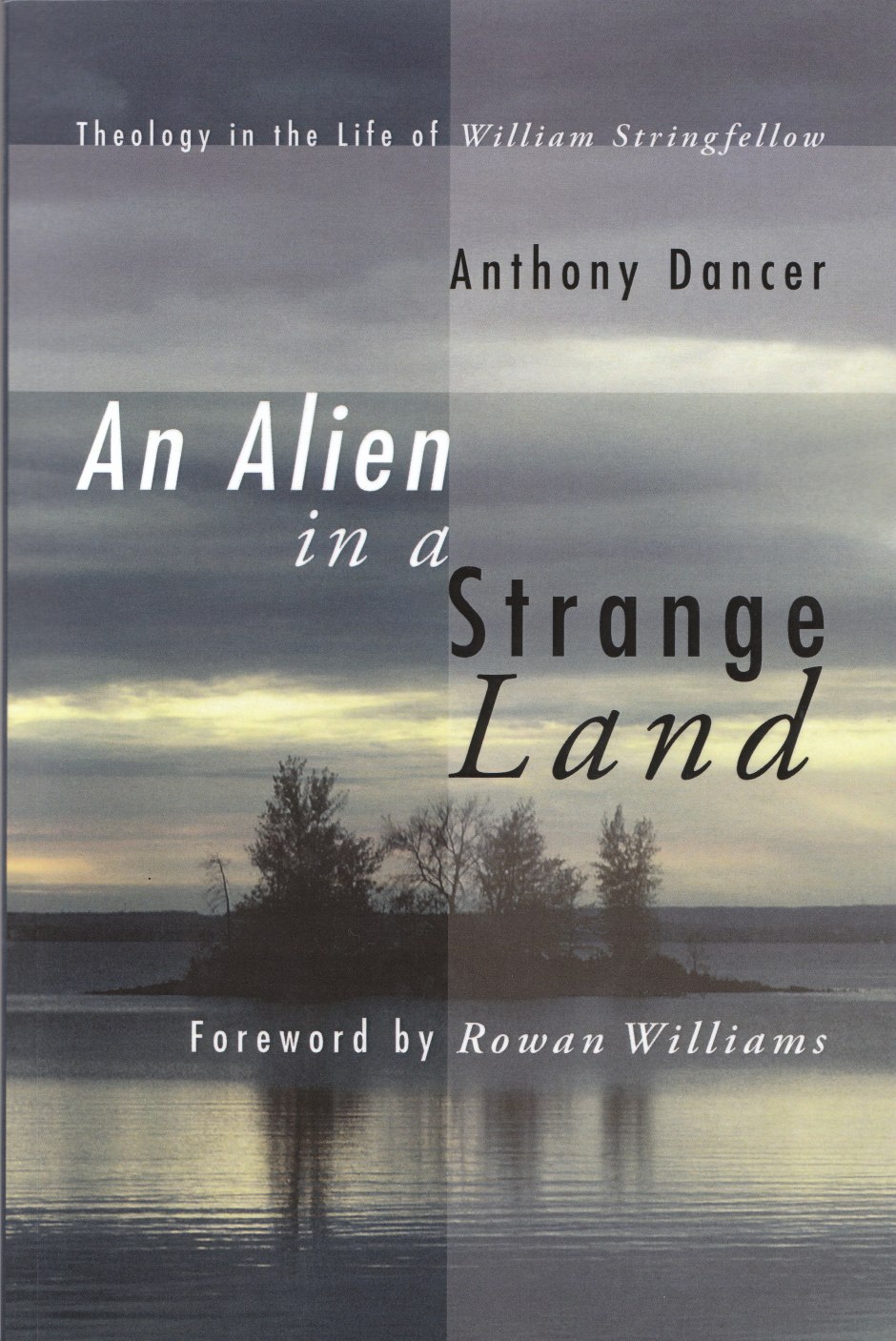
Today, from a land not too far away, landed upon my desk a signed copy of Anthony Dancer’s latest book, An Alien in a Strange Land: Theology in the Life of William Stringfellow (Wipf & Stock, 2010), launched just a few weeks ago here in New Zealand. Readers of Per Crucem ad Lucem will know of my interest in William Stringfellow, whose work I am still drinking deeply from. Now we have Anthony’s volume (which began as a thesis in 1988 under the supervision of John Webster and Chris Rowland, and which includes a ‘Foreword’ by Rowan Williams) to look forward to as well. As a taster, here’s the ‘Introduction’:

William Stringfellow was the kind of oddity that doesn’t come along every day. He spoke truth to power, whether either party was fully ready for such a conversation, as so often they were not. His was a voice from the margins, honed on the street, eloquent and incisive. His was a very human, fragile, passionate life attempting to live in freedom and obedience to God, against the tyranny of empire. He spoke as much with his life as he did his writing. Although reprints of Stringfellow’s books in recent years provide easier access to much of his published writing, there remains no sustained treatment of and engagement with Stringfellow at a biographical level. There are many reasons for this, and although this is no biography it does contain within it a sustained engagement with his life. It is only by engaging his theology through biography that we can begin more fully and comprehensively to appreciate Stringfellow’s significance to us today, particularly as we seek to discern what it means to be human and faithful amidst our rapidly changing social context. Theology, as Stringfellow realized only too well, is a fundamentally practical, political, and missional discipline orientated around, and orientating, our life in the world.

The first chapter introduces Stringfellow and establishes the research methodology employed herein. The relationship of Stringfellow’s life and his theology is such that in seeking to understand the latter it is necessary to enquire into the former. This research therefore takes the form of biographical theology: a critical examination of Stringfellow’s lifework that explores the way in which his commitment to politics and faith informed his vocational (and therefore theological) formation and articulation to the point at which his moral theology becomes most fully immersed in the politics of the Bible. This commitment to politics and faith make personal and social context, private and political life, crucial to the formation of his life and theology, and therefore this book places Stringfellow’s lifework within his socio-political context.

Chapter 2 examines the socio-political context of the 1950s, in relation to which Stringfellow essentially sought to locate himself. These were crucial years for America, dominated by the themes of threat (Cold War and communism) and prosperity (economic growth); excess and fear amidst a culture of consumption provided the framework for cultural identity.

Chapter 3 goes on to examine Stringfellow’s engagement with both the law and the church during this period and pays particular attention to his decision for both faith and law: on both counts a conversion experience was to prove paradigmatic for his later work. This chapter also draws upon his experiences in the ecumenical movement, the law, and later in Harlem. The themes of reconciliation and authenticity emerge to the fore, and the politics of ecumenism—the political dimension of unity—has a high profile. Paying particular attention to examining the emergence of this politicization, it examines his time in Europe, before discussing his commitment to the Bible and the layperson. Attention is also given to his emerging understanding of the Christian life as worship, and the consequences this has for his understanding of the law and the church. Finally, it examines his lifework as he encounters the East Harlem Protestant Parish and poverty, and discovers the concrete reality of the power of death in the principalities and powers. The empirical imperative that dominates his lifework is here a desire for political and personal authenticity.

Following this, chapter 4 explores some of the salient features of the sociopolitical landscape of the 1960s. It shows how this period was one of hopeful democracy, in which movements of dissent and protest began to emerge; it was a time of radical protest and liberal government, and yet by the beginning of the 1970s the nation had become polarized. It explores how, whilst the “threat” of communism persisted, and in fact took very real and manifest form, liberal politics dominated government in the form of the Great Society, and politics and law were seen as morally determinate. Issues of rights came to the fore, mostly on the back of successful civil rights legislation, and left wing politics found a voice on the campuses of America’s colleges through the movement of the new left.

Next, attention is given to Stringfellow’s lifework during this period, in which he confronted what he saw as the state’s bullish attitude of invincibility, along with religion’s apostasy. The dominant theme of his public and private encounters throughout the 1960s and beyond was his commitment to articulating the relevance and importance of the politics of the Bible for living in freedom from the power of death. Emphasis is given to the way it was ultimately, however, less an act of criticism and more an act of restoring hope.

Therefore, chapter 5 explores how he called the church to account through his polemical writing, confronting religion in America, and identifying the complicity of White Anglo-Saxon Protestants in the maintenance of the state and their betrayal of the gospel. It also examines the hope which he extended by exploring what he believed the ministry and mission of the authentic church of Christ might look like: the centrality of the Bible, the restoration of the roles of priests and people, the seminary underground, and the character of the Christian life which this fosters.

Chapter 6 moves on to examine three radicalizing encounters that transformed his lifework: his meeting with Karl Barth (who advocated America should listen to this man), his rejection at an ecumenical conference on Religion and Race (at which he declared the answer to the racial crisis is baptism), and his meeting and falling in love with Anthony Towne (through which he discovered and experienced love and acceptance at a personal level). It discusses how these events radicalized his lifework in relation to biblical politics.

Following these discussions, chapter 7 examines their effects upon his lifework by examining his prophetic confrontation with Johnson’s Great Society. This represents not so much a radical departure as a radical reorientation in relation to the power of death. The Great Society was the political hallowed ground of the mid-1960s, and Stringfellow’s confrontation draws upon the resources of his lifework to date. Particular attention is given to his criticisms of race and poverty, given their prominence in his lifework. It goes on to show how, following these criticisms, Stringfellow once again offers hope, this time detailing what he terms the ethics of reconciliation—a demand not for novelty, but orthodoxy for life. It therefore looks at his incarnational christological ethic, which requires a revolution in the way in which America conceives of Jesus Christ: it is biblical politics—reconciliation of creation to God in Christ, fostering realism, inconsistency, radicalism, and intercession.

Finally, this book explores his own experience of life-threatening illness and personal confrontation of death. It discusses the way in which this was at once both a personal and public encounter, upon which he brought biblical politics to bear in resistance and advocacy. It then goes on to discuss the way in which this fostered a further and final point of radicalization in his lifework leading directly up to the production of An Ethic for Christians and Other Aliens in a Strange Land: the emergence of semiotic creativity, in which Babylon and Jerusalem confront one another.

The chapters of this book weave our way through a foundational part of his life and work. His lifework teaches us about hope. It is deeply political and intensely personal. It is vulnerable, human, inconsistent, and not without mistakes. It is woven together at the edges of society, pulling together the varied threads of experience and encounter. There is both a sweetness and a lament in the weaving that teach us something profound about being biblical people.

This book is dedicated to all who walk this path. Most especially, it is dedicated to Hera.

Finally, there is a saying in Maori: E kore te kumara e korero mo tona ake reka (The kumara never tells of its own sweetness). A traditional staple food for Maori, it is left for those who delight in the kumara and feed off it to speak on its behalf. So it is with Stringfellow. I am proud to have the responsibility to speak of such sweetness, and hope it may enrich lives.


September exploits …

Reading: Desiring the Kingdom: Worship, Worldview, and Cultural Formation by James K.A. Smith; A Long Obedience in the Same Direction: Discipleship in an Instant Society by Eugene H. Peterson; Home by Marilynne Robinson; Absence of Mind: The Dispelling of Inwardness from the Modern Myth of the Self (The Terry Lectures Series) by Marilynne Robinson; On My Country and the World by Mikhail Gorbachev; The Theology of Food: Eating and the Eucharist by Angel F. Mendez Montoya; Theology of the Reformed Confessions by Karl Barth; Practicing Our Faith: A Way of Life for a Searching People edited by Dorothy C. Bass; Confessions of a Reformission Rev.: Hard Lessons from an Emerging Missional Church by Mark Driscoll (I confess that some skim reading was required here, but this is proof that I read widely!); The Challenge of Jesus’ Parables edited by Richard N. Longenecker; Counterpoint by R.S. Thomas; The Parables of Grace by Robert Farrar Capon; Between Two Worlds: Understanding And Managing Clergy Stress by Andrew R. Irvine; Theological Controversies in the Presbyterian Church of New South Wales, 1865–1915: The Rise of Liberal Evangelicalism by Peter Barnes.

Listening: Songs of Love & Hate by Leonard Cohen; Beneath Southland Skies by Mike Brosnan; Mass in G Minor by Vaughan Williams; In Buenos Aires Volume 1: 1973 Concert by Bill Evans Trio; Symphonies Nos. 7 ‘Sinfonia Antartica’ & 8 by Vaughan Williams; God Willin’ & The Creek Don’t Rise by Ray Lamontagne & The Pariah Dogs; Trouble and Gossip In The Grain by Ray LaMontagne; August & Everything After, Recovering the Satellites, This Desert Life, Across A Wire: Live In New York City, Films About Ghosts, Saturday Nights & Sunday Mornings, New Amsterdam: Live at Heineken Music Hall and Hard Candy by Counting Crows; So Much More, Hope for the Hopeless and Brett Dennen by Brett Dennen; Supply And Demand and Last Days At the Lodge by Amos Lee; Stop All The World Now, Sound The Alarm, Australia by Howie Day; You Can Tell Georgia, Take My Blanket and Go, Stompin Grounds, Sessions From Motor Ave., Paris In The Morning, Only Four Seasons, Last Clock On The Wall, Julie Blue, Joe Purdy and Canyon Joe by Joe Purdy.

Watching: U2: Go Home – Live from Slane Castle; Abandoned; Law Abiding Citizen; Salt; Saw VI; Alice in Wonderland; The Matrix; When Did You Last See Your Father?; Pink Floyd: Pulse; Robin Hood; Love Happens.

Brewing: Sumatra Mandaling.

Drinking: Felton Road Pinot Noir Cornish Point 2009; Waipara Hills Pinot Noir 2008.

[Image: Elizabeth Kaeton]

Saturday Link Love

August exploits …

From the reading chair: A People Betrayed: The Role of the West in Rwanda’s Genocide by Linda Melvern; Colossians and Philemon: An Introduction and Commentary by NT Wright; Critical Reflections Of Stanley Hauerwas’ Theology Of Disability: Disabling Society, Enabling Theology edited by John Swinton; The Disabled God: Toward a Liberatory Theology of Disability by Nancy L Eiesland; The Good and Beautiful God: Falling in Love With the God Jesus Knows by James Bryan Smith; Christian Identity (Studies in Reformed Theology) edited by Eddy Van Der Borght; Counterpoint by RS Thomas; Uncommon Gratitude: Alleluia for All That Is by Joan Chittister & Rowan Williams; The Promise of the Father: Jesus and God in the New Testament by Marianne Meye Thompson; How to Read a Poem: And Fall in Love with Poetry by Edward Hirsch; Teachers As Cultural Workers: Letters to Those Who Dare Teach by Paulo Freire; Theological Fragments: Essays in Unsystematic Theology by Duncan B. Forrester; Very Little … Almost Nothing: Death, Philosophy and Literature by Simon Critchley; Foundations of Dogmatics, Vol. 1 by Otto Weber; Reformational Theology: A New Paradigm for Doing Dogmatics by Gordon J. Spykman; Care of the Soul : A Guide for Cultivating Depth and Sacredness in Everyday Life by Thomas Moore; Bread Baking: An Artisan’s Perspective by Daniel T. DiMuzio; Books of Amos and Hosea by Harry Mowvley; Resist!: Christian Dissent for the 21st Century edited by Michael G. Long.

Through the iPod: U2 Go Home – Live from Slane Castle by U2; London Calling: Live in Hyde Park by Bruce Springsteen & The E Street Band; Foundling by David Gray; All Delighted People by Sufjan Stevens.

On the screen: Edge of Darkness; Where the Wild Things Are; Shelter; Shutter Island; The Infidel; The Wolfman; After Life; Into the Storm; Into the Wild.

There he goes, tacking against the fields’ uneasy tides …

[Image: Members of the staff of the Bank of New Zealand, on Lambton and Customhouse Quays, Wellington, gather around the first electronic book-keeping machine installed in the bank, 1960. HT: National Library of New Zealand]

July bests …

From the reading chair:

Hannah’s Child: A Theologian’s Memoir by Stanley Hauerwas; White on Black by Ruben Gallego; Les Murray: A Life in Progress by Peter F. Alexander; Metamorphosis and Other Stories by Franz Kafka; The South Pole: An Account of the Norwegian Antarctic Expedition in the “Fram” 1910–1912 by Roald Amundsen; On Human Worth: A Christian Vindication of Equality by Duncan B. Forrester; God’s Being is in Becoming: The Trinitarian Being of God in the Theology of Karl Barth by Eberhard Jüngel; Prayers Plainly Spoken by Stanley Hauerwas.

Through the iPod:

Life in Slow Motion by David Gray; Sunshine on Leith by The Proclaimers; Telling Stories by Tracy Chapman; Masterpieces by Bob Dylan; Complete Recordings by Robert Johnson; In Person & On Stage by John Prine; The Age of Miracles by Mary-Chapin Carpenter; I and Love and You by The Avett Brothers; Mingus Ah Um by Charles Mingus; 11:11 by Rodrigo y Gabriela; Open Sesame by Freddie Hubbard; 100 Miles From Memphis by Sheryl Crow; Songs From The Heart by Celtic Woman; The Imagine Project by Herbie Hancock; Sweet and Wild by Jewel; Heart and Soul by Kenny G; Need You Now by Lady Antebellum; Revolution by Miranda Lambert; Journey to the One by Pharoah Sanders; Fearless by Taylor Swift; Monk’s Dream by Thelonious Monk; Backatown by Trombone Shorty; Sigh No More by Mumford & Sons; Go by Dexter Gordon; April Uprising by The John Butler Trio; Intriguer by Crowded House.

On the screen:

The Road [2009]. (BTW: The worst flick I saw this month was The Lovely Bones [2010])

Eating Out:

Catlins Café: The best lunch I’ve had out in many moons. Remember those burgers we used to eat in the seventies? I found them again here. Soooo good. The food in this wee Owaka café was brilliant, the coffee was very nice, and the new hosts – Aileen & Steve Clarke – are delightful … friendly, but not ‘in-ya-face’ kind of friendly. If you’re in the Catlins, you ought consider popping in for a feed. They also run some accommodation. And just in case you’re wondering, I’m not getting paid for this wee plug. And if you do visit the area, make sure you get along to Nugget Point, one of my favourite bits of coastline in the world.


William Stringfellow, Instead of Death – Part I

In 1962, Stringfellow was approached by the Christian Education Department of the Executive Council to pen a book for adolescents that would be included in its high school curriculum. Instead of Death, a book with ‘an astonishing career’ (p. 3), represents Stringfellow’s generous response to that request, a book concerned not with death as such but rather upon the historic transcendence of death, i.e. with resurrection from death. Concerning this book, Stringfellow writes:

Instead of Death seeks to cope pastorally with a few issues which confront young people, as well as other persons, in self-conscious individual circumstances. But the theological connection of any of these matters to the ubiquity of the power of death and the redemptive vitality of the word of God in this world applies equally to political affairs and social crises and, moreover, does so in a  way which renders apparently private concerns political’ (p. 4).

Throughout the book, Stringfellow recalls his own journeys alongside death – his own unremitting pain and sickness, the deathly institutions, authorities, agencies and bureaucracies with which he engaged as a Harlem lawyer, and the way in which the community of East Harlem helped him to identity the relentless and ruthless structures, procedures and regimes which dehumanise us, and which are as militant and as morally real as that death which visits us in our illness and personal challenge to life. Stringfellow charges that the Church has all-too-often preached an innocuous image of Jesus, a Jesus who demonstrates no real authority over death’s power, and has supposed a distinction between the personal and the public (or political) which undermines the eventfulness and accessibility of the resurrection for every human being in every situation in which death is pervasive, whether that be in realms political, economical, cultural, psychological or personal. To announce the resurrection of Jesus from the dead is to announce the liberation of all of human life from ‘the meaning and purpose of death in loneliness, in sexuality, and in daily work’ (p. 9), three of the six themes that are then taken up throughout the book.

While sin, evil and death are related, Stringfellow warns that we should not confuse with them each other:

‘Death is not the consequence of either evil or sin, nor is death some punishment for evil or sin. Nor is there any such thing as objective evil; that is, some knowledge or idea or principle of evil which people can learn or discover or discern and then, by their own will, do evil or good. If humans knew or could know what is good and what is evil in that sense, then they would be like God himself … What one person or nation considers to be good or evil can never be claimed by that person or nation to be the equivalent or even the approximation of God’s judgment, although persons and nations constantly make just that pretense. They do it as a way of mocking God, as a way of pretending that they can second guess how God will judge their decisions or actions, as a way of asserting that they already know how God will judge themselves and others. That is perilous because only a person who does not believe in God would so seriously usurp and absurdly challenge the freedom of God in judging all persons and all things in the world … Sin is not essentially the mistaken, inadvertent, or deliberate choice of evil by human beings, but the pride into which they fall in associating their own self-interests with the will of God. Sin is the denunciation of the freedom of God to judge humans as it please him to judge them. Sin is the displacement of God’s will with one’s own will. Sin is the radical confusion as to whether God or the human being is morally sovereign in history. And those persons who suppose that they are sovereign exist in acute estrangement in this history, separated from life itself and from the giver of life, from God’. (pp. 18, 19–20)

And from this decision for or against God, for or against life, none are exempt, not even the youngest of persons:

‘Death does not wait for full maturity and adulthood, for infirmity or age, for sickness o weakness to assail human life. The work of death begins at the very moment of birth: death claims every person on the first consciousness of existence. Death does not respect or wait upon the foolish amenities which cause people to hide from their offspring the truth that, for all the ingenuity and capability of human beings, death is present, powerful, and active in every moment, in every event and transaction of human experience. No one is given birth who does not imminently confront the claim of death over his life’. (pp. 20–1)

But neither death nor life-after-death is the last word – that word Stringfellow insists, is Jesus Christ.

Wipf & Stock have offered readers of Per Crucem ad Lucem 40% off the retail price of any of the Stringfellow volumes. To obtain the 40% discount, just include the coupon code STRINGFELLOW with your order.