Books

A new Updike book, Higher Gossip

Forget (nearly) everything else you’re reading: there’s a new posthumous collection of essays, reviews, poems and stories from John Updike‘s brilliant pen – Higher Gossip: Essays and Criticism. As I type, my ordered copy is in the hands of the USPS, which means that it could arrive any time between next week and some future Christmas. In the meantime, I’ve had to content myself with some reviews – one here, and another one here wherein Updike’s writing is described thus:

‘He was unstintingly alert to the significance with which, sometimes desperately, we invest the smallest incidents and sensations — especially in retrospect, when “customary reticence is discarded, as needless baggage from the forsaken world of midlife responsibilities,” and “our tears fatten upon our memories of joy.” He wrote with tactile intensity about everything, be it a boy petting with his first girlfriend in the car as moonlight “anointed her bare front with the shadows of raindrops still clinging to the windshield” or the feel of fingering the “merry dimples” of a golf ball’.

And while I’m mentioning reviews, I’ll give a shout out to this review of Julian Barnes’ The Sense of an Ending, a brilliant book (and worthy winner of the 2011 Booker Prize), and certainly one of my favourite reads this year.

On Moby-Dick

‘“Moby-Dick” is not a novel. It’s barely a book at all. It’s more an act of transference, of ideas and evocations hung around the vast and unknowable shape of the whale, an extended musing on the strange meeting of human history and natural history. It is, above all, a sui-generis creation, one that came into the world as an unnatural, immaculate conception …

In an age of uncertain faith, then as now, “Moby-Dick” resembles a religious tract, an alternative testament. Little wonder that one of its early set-pieces is Father Mapple’s fire-and-brimstone sermon from the prow-shaped pulpit in the Seamen’s Bethel, New Bedford, or that Philbrick takes the title for his own first chapter, “The Gospels in This Century,” from Melville’s wry and rather Wildean remark on the unsalability of his work: “Though I wrote the Gospels in this century, I should die in the gutter.” As he told Nathaniel Hawthorne, “I have written a wicked book, and I feel as spotless as the lamb.”

When I finally began reading “Moby-Dick” (had I wasted my time before then?), I found I couldn’t put it down. I’d carry about with me a tiny, Oxford World Classics edition, anonymously bound in blue cloth, to be studied chapter by chapter, like the Bible or the Koran, as I sat on the Tube or on an airplane, or in the early hours of the morning. As Philbrick exhorts his readers, ” ‘Moby-Dick’ is a long book, and time is short. Even a sentence, a mere phrase will do.”

Much of the impact of Melville’s book on any fierce new convert is implicit in that sense of time travel. Sometimes I read it and I feel like I’m going backward, fast. It reads like something that was written before books were invented, yet it is utterly modern—pre-postmodern, perhaps. It is part of its own prediction, as if it and its characters had been there all along, and had only been waiting to be written. Just as in the real New Bedford’s Bethel a pulpit-prow had to be built, in the nineteen-sixties, because so many visitors expected to find one there; and, just as Melville wrote vividly of Nantucket, an island that he had yet to visit, much of “Moby-Dick” is conjured out of the air and the sea’.

– Philip Hoare, What “Moby-Dick” Means to Me

October stations …

Reading:

Some re-reads:

Listening:

Watching:


New Apps:

  • I guess it was inevitable, but the AAR/SBL App for iPhone/iPad/iPod Touch has arrived.

September stations …

Reading:

Some re-reads (because some books provoke many visits)

Listening:

Watching:

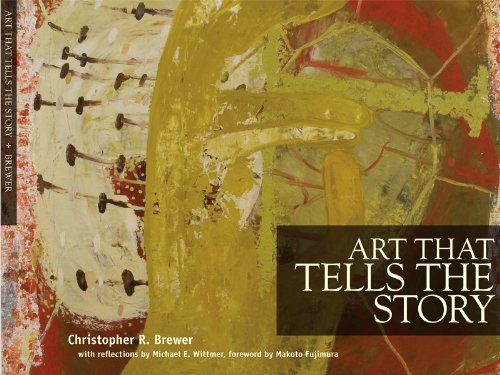
Art that Tells the Story: a commendation

We homo sapiens are, essentially, both a storied people and a story-telling people. So, a basic human question is not primarily, ‘What am I, as an individual, to do or decide?’ but rather, ‘Of what stories do I find myself a part, and thus who should I be?’; for we literally live by stories. The Church, too, understands itself as a pilgrim people, as a people storied on the way, as a people whose very way becomes the material which shapes the narrative that has long preceded it and which is being written with it. It understands that being human never begins with a white piece of paper. As Alasdair MacIntyre rightly reminds us in After Virtue: A Study in Moral Theory, we never start anywhere. Rather, we simply find ourselves within a story that has been going on long before our arrival and will continue long after our departure. Moreover, Christian community begins with being found in the very act of God’s self-disclosure, an act which, in Jamie Smith’s words, ‘cuts against the grain of myths of progress and chronological snobbery’ and places us in the grain of the universe. And what – or, more properly, who – is disclosed in that crisis of discovery is one who provides memory, unity, identity and meaning to the story of our life. So Eberhard Jüngel: ‘We are not … simply agents; we are not just the authors of our biography. We are also those who are acted upon; we are also a text written by the hand of another’. Hence it is not just any story by which the Church lives but rather a particular story given to it – namely, Israel’s story in which, in the words of R.S. Thomas, it ‘gaspingly … partake[s] of a shifting identity never [its] own’.

Back in 1993, Robert Jenson wrote a great little piece titled ‘How the World Lost Its Story’ (First Things 36 (1993), 19–24). He opened that essay with these words:

It is the whole mission of the church to speak the gospel … It is the church’s constitutive task to tell the biblical narrative to the world in proclamation and to God in worship, and to do so in a fashion appropriate to the content of that narrative, that is, as a promise claimed from God and proclaimed to the world. It is the church’s mission to tell all who will listen, God included, that the God of Israel has raised his servant Jesus from the dead, and to unpack the soteriological and doxological import of that fact.

To speak the gospel and, in Jenson’s parlance, to ‘do so in a fashion appropriate to the content of that narrative’, the Church is given a pulpit, a font and a table; in fact, many pulpits, fonts and tables. And these remain the principle ‘places’ where the people of God can expect to hear and to see and to taste and to learn and to proclaim the story into which they have been gathered, redeemed and made an indispensable character. This is not, however, to suggest that these are the only places wherefrom the free and sovereign Lord may speak, nor to aver in any way that the gospel is somehow kept alive by the Church’s attempt to be a story teller, for the story is itself nothing but God’s own free and ongoing history in Jesus. As Jüngel put it in God as the Mystery of the World, ‘God does not have stories, he is history’. To speak gospel is literally to proclaim God, speech that would be a lie and completely empty were it not the story of God with us, of the saving history which has become part of God’s own narrative, of the world which has, in Jesus Christ, become ‘entangled in the story of the humanity of God’ (Jüngel), a story at core kerygmatic and missionary, and unfinished until all its recipients are included in its text. For, as Jenson has written in his much-too-neglected Story and Promise, the story of Jesus – who is the content of the gospel – ‘is the encompassing plot of all men’s stories; it promises the outcome of the entire human enterprise and of each man’s involvement in it’. To know this man’s story, therefore, is to know not only the story of God but also our own story. Indeed, it is the story that makes human life possible at all. As Jenson would write elsewhere, ‘Human life is possible — or in recent jargon “meaningful” — only if past and future are somehow bracketed, only if their disconnection is somehow transcended, only if our lives somehow cohere to make a story’.

And here we come up against the perennial question of human speech, and it’s back to Jüngel (and to Peter Kline’s article on Jüngel and Jenson) to help me out: ‘The language which corresponds to the humanity of God’, writes Jüngel, ‘must be oriented in a highly temporal way in its language structure. This is the case in the language mode of narration, [or] telling a story’. In other words, if Kline reads Jüngel correctly, Jüngel is suggesting that narrative or story is the mode of human language which most appropriately corresponds to the form of God’s life among and with us. Commenting on Jüngel, Kline argues that narrative alone witnesses to the change from old to new, can capture the movement and becoming in which God has his being, corresponds to the eschatological event of Jesus’ death and resurrection, and brings ‘the word of the cross’ to expression in a way apposite to us. So Jüngel: ‘God’s humanity introduces itself into the world as a story to be told’. Kline notes that for Jüngel, the church is given a story to tell, but, in Jüngel’s words, it ‘can correspond in [its] language to the humanity of God only by constantly telling the story anew’. God’s humanity ‘as a story which has happened does not cease being history which is happening now, because God remains the subject of his own story . . . God’s being remains a being which is coming’. The community, Kline says, tells only the story of Jesus Christ’s history, and so it constantly looks back to what has happened. Yet the telling of this story is also always new because God’s entrance into human language that once happened continues to happen again and again as Jesus Christ continues to live in the freedom of the Spirit. God is not confined to his once-enacted history, to one language or culture; history does not consume God. So Jüngel again: ‘God who is eschatologically active and who in his reliability is never old [is] always coming into language in a new way’.

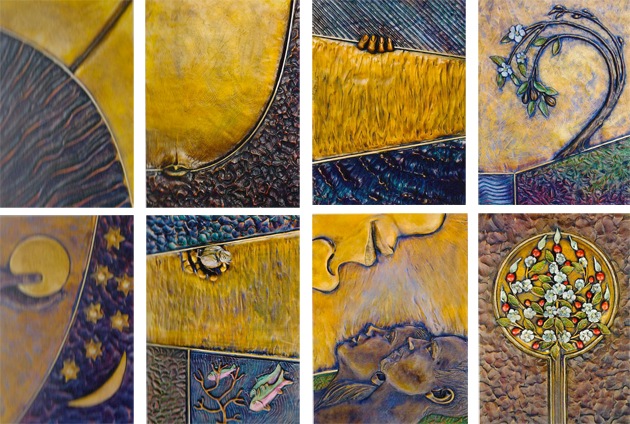
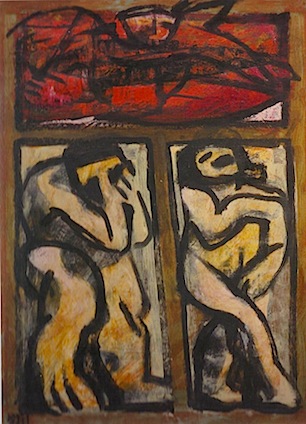
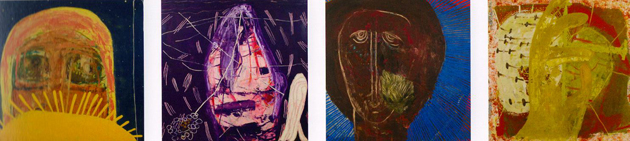
‘Telling the story anew’. ‘God … [is] always coming into language in a new way’. Which brings me to Chris Brewer’s new book, Art that Tells the Story. Others have already summarised the book, so let me simply say that Art that Tells the Story is a freshly-presented and beautifully-produced book which attempts to tell the old, old story … again. Boasting some intriguing prose (by Michael E. Wittmer) and coupled with well-curated images from a diverse array of accomplished visual artists including Jim DeVries, Wayne Forte, Edward Knippers, Barbara Februar, Clay Enoch, Julie Quinn, Michael Buesking and Alfonse Borysewicz, among others, herein, word and image work in concert to open readers up to hear and see again, and to hear and see as if for the first time, the Bible’s story of creation, fall, redemption, and consummation, inviting – nay commanding!, for the gospel is command – readers to comprehend in this story their own, and to enter with joy into the narrative which is the life of all things. A book this beautiful ought to be in hardback; but may it, all the same, find itself opened and dialogued with next to many coffee mugs, and in good and diverse company. Like its subject, this is one to sit with, to be transformed by, and to share with others.

Flannery O’Connor once confessed, in Mystery and Manners, that ‘there is a certain embarrassment about being a story teller in these times when stories are considered not quite as satisfying as statements and statements not quite as satisfying as statistics’. ‘But’, she continued, ‘in the long run, a people is known, not by its statements or statistics, but by the stories it tells’. And so the dogged persistence of theologians and artists. Indeed, it is stories – in fact, a particular, if not very short or simple, story – that Brewer’s book is primarily concerned to tell. That his chosen medium is the visual arts reminded me of something that NT Wright once said, and which is, I think, worth repeating:

We have lived for too long with the arts as the pretty bit around the edge with the reality as a non-artistic thing in the middle. But the world is charged with the grandeur of God. Why should we not celebrate and rejoice in that? And the answer sometimes is because the world is also a messy and nasty and horrible place. And, of course, some artists make a living out of representing the world as a very ugly and wicked and horrible place. And our culture has slid in both directions so that we have got sentimental art on the one hand and brutalist art [on] the other. And if you want to find sentimental art then, tragically, the church is often a good place to look, as people when they want to paint religious pictures screen out the nasty bits. But genuine art, I believe, takes seriously the fact that the world is full of the glory of God, and that it will be full as the waters cover the sea, and, at present (Rom 8), it is groaning in travail. Genuine art responds to that triple awareness: of what is true (the beauty that is there), of what will be true (the ultimate beauty), and of the pain of the present, and holds them together as the psalms do, and asks why and what and where are we … And our generation needs us to do that not simply to decorate the gospel but to announce the gospel. Because again and again, when you can do that you open up hermeneutic space for people whose minds are so closed by secularism that they just literally cannot imagine any other way of the world being. I have debated in public … with colleagues in the New Testament guild who refuse to believe in the bodily resurrection and, again and again, the bottom line is when they say ‘I just can’t imagine that’, the answer is, ‘Smarten up your imagination’. And the way to do that is not to beat them over the head with dogma but so to create a world of mystery and beauty and possibility, that actually there are some pieces of music which when you come out of them it is much easier to say ‘I believe in the Father and the Son and the Holy Spirit’ than when you went in.

Art that Tells the Story is grounded upon the premise that artists and theologians can not only help us to see better, but also that like all human gestures toward the truth of things, the work of artists can become an instrument through which God calls for our attention. And here I wish to conclude by re-sounding a call trumpeted by Michael Austin in Explorations in Art, Theology and Imagination:

Theologians must be on their guard against commandeering art for religion, must allow artists to speak to them in their own language, and must try to make what they can of what they hear. What they will hear will tell of correspondences and connections, of similarities, of interactions and of parallel interpretations and perceptions which will suggest a far closer relationship of essence between art and religion than many theologians have been prepared to acknowledge. As the churches at the beginning of the twenty-first century become more fearful and therefore more conservative there may be fewer theologians prepared to take the risks that embracing a truly incarnational religion demands of them. In particular what they hear may suggest to them that their many (often contradictory) understandings of God and redemption and salvation in Christ need to be radically reconsidered if a new world is to be made.

Chris Brewer’s Art that Tells the Story is just such an attempt. It’s good stuff.

Around the boab trees

There’s some good reading around at the moment. Here’s a few pieces I’ve enjoyed:

August stations …

Reading:

Listening:

Watching:

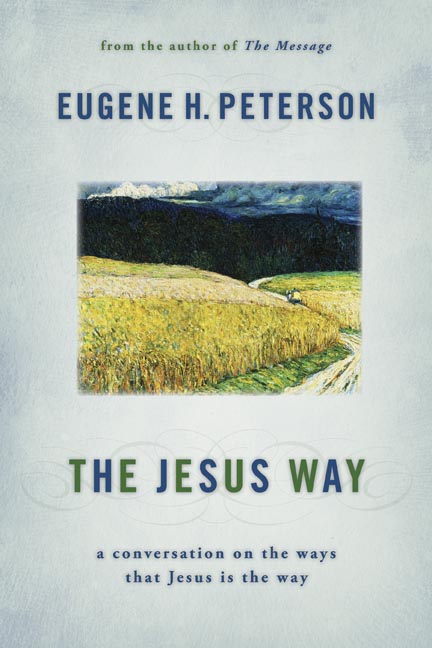
Eugene Peterson on The Jesus Way

Eugene Peterson’s The Jesus Way: A Conversation on the Ways That Jesus Is the Way will be released in paperback in a couple of weeks. Here’s the taster:

Here is a text, words spoken by Jesus, that keeps this in clear focus: “I am the way, the truth, and the life” (John 14:6). The Jesus way wedded to the Jesus truth brings about the Jesus life. We can’t proclaim the Jesus truth but then do it any old way we like. Nor can we follow the Jesus way without speaking the Jesus truth.

But Jesus as the truth gets far more attention than Jesus as the way. Jesus as the way is the most frequently evaded metaphor among the Christians with whom I have worked for fifty years as a North American pastor. In the text that Jesus sets before us so clearly and definitively, way comes first. We cannot skip the way of Jesus in our hurry to get to the truth of Jesus as he is worshiped and proclaimed. The way of Jesus is the way that we practice and come to understand the truth of Jesus, living Jesus in our homes and workplaces, with our friends and family.

A Christian congregation, the church in your neighborhood, has always been the primary location for getting this way and truth and life of Jesus believed and embodied in the places and among the people with whom we most have to do day in and day out. There is more to the church than this local congregation. There is the church continuous through the centuries, our fathers and mothers who continue to influence and teach us. There is the church spread throughout the world, communities that we are in touch with through prayer and suffering and mission. There is the church invisible, dimensions and instances of the Spirit’s work that we know nothing about. There is the church triumphant, that “great cloud of witnesses” who continue to surround us (Heb. 12:1). But the local congregation is the place where we get all of this integrated and practiced in the immediate circumstances and among the men, women, and children we live with. This is where it becomes local and personal.

The local congregation is the place and community for listening to and obeying Christ’s commands, for inviting people to consider and respond to Jesus’ invitation, “Follow me,” a place and community for worshipping God. It is the place and community where we are baptized into a Trinitarian identity and go on to mature “to the measure of the full stature of Christ” (Eph. 4:13), where we can be taught the Scriptures and learn to discern the ways that we follow Jesus, the Way.

The local congregation is the primary place for dealing with the particulars and people we live with. As created and sustained by the Holy Spirit, it is insistently local and personal. Unfortunately, the more popular American church strategies in respect to congregation are not friendly to the local and the personal. The American way with its penchant for catchy slogans and stirring visions denigrates the local, and its programmatic ways of dealing with people erode the personal, replacing intimacies with functions. The North American church at present is conspicuous for replacing the Jesus way with the American Way. For Christians who are serious about following Jesus by understanding and pursuing the ways that Jesus is the Way, this deconstruction of the Christian congregation is particularly distressing and a looming distraction from the Way of Jesus.

A Christian congregation is a company of praying men and women who gather, usually on Sundays, for worship, who then go into the world as salt and light. God’s Holy Spirit calls and forms this people. God means to do something with us, and he means to do it in community. We are in on what God is doing, and we are in on it together.

And here is how we are in on it: we become present to what God intends to do with and for us through worship, become present to the God who is present to us. The operating biblical metaphor regarding worship is sacrifice — we bring ourselves to the altar and let God do with us what he will. We bring ourselves to the eucharistic table and enter into that grand fourfold shape of the liturgy that shapes us: taking, blessing, breaking, giving — the life of Jesus taken and blessed, broken and distributed. That eucharistic life now shapes our lives as we give ourselves, Christ in us, to be taken, blessed, broken, and distributed in lives of witness and service, justice and healing.

But that is not the American way. The great American innovation in congregation is to turn it into a consumer enterprise. We Americans have developed a culture of acquisition, an economy that is dependent on wanting more, requiring more. We have a huge advertising industry designed to stir up appetites we didn’t even know we had. We are insatiable.

It didn’t take long for some of our Christian brothers and sisters to develop consumer congregations. If we have a nation of consumers, obviously the quickest and most effective way to get them into our congregations is to identify what they want and offer it to them, satisfy their fantasies, promise them the moon, recast the gospel in consumer terms: entertainment, satisfaction, excitement, adventure, problem-solving, whatever. This is the language we Americans grew up on, the language we understand. We are the world’s champion consumers, so why shouldn’t we have state-of-the-art consumer churches?

Given the conditions prevailing in our culture, this is the best and most effective way that has ever been devised for gathering large and prosperous congregations. Americans lead the world in showing how to do it. There is only one thing wrong: this is not the way in which God brings us into conformity with the life of Jesus and sets us on the way of Jesus’ salvation. This is not the way in which we become less and Jesus becomes more. This is not the way in which our sacrificed lives become available to others in justice and service. The cultivation of consumer spirituality is the antithesis of a sacrificial, “deny yourself” congregation. A consumer church is an antichrist church.

We can’t gather a God-fearing, God-worshipping congregation by cultivating a consumer-pleasing, commodity-oriented congregation. When we do, the wheels start falling off the wagon. And they are falling off the wagon. We can’t suppress the Jesus way into order to sell the Jesus truth. The Jesus way and the Jesus truth must be congruent. Only when the Jesus way is organically joined with the Jesus truth do we get the Jesus life.


On the sermons of PT Forsyth

It might well be argued that before he was anything else, PT Forsyth was principally a preacher. It would certainly not be going too far to say that the greatest portion of Forsyth’s public life was given over to preaching, and to encouraging preachers. To be sure, and by any standards, his literary output was significant. But by far the majority of the words in his published articles and books are sermons, or were ideas developed from sermons. And even those that are not betray the rhetorical form of one shaped by the pulpit and the task that attends that space. And this is not so strange, for Forsyth believed in preaching.

I too believe in preaching. I also believe that Forsyth has much still to teach us about preaching. To be sure, not everything about his own manner or approach remains helpful today, or is particularly worthy of emulation. (But of whom might that not be true!) Still, regarding the things that really matter, it is difficult to go past the likes of one like Forsyth. (We could add here too the names of Karl Barth, Eduard Thurneysen, James Denney, Helmut Thielicke, Paul Tillich and others.)

I have suggested before that one of the real gifts that the Aberdonian bequeaths to the Church is the encouragement of her pastors to forego the ‘sin of bustle’ that would see them running errands for the culture motivated in no small part by an attempt to convince the world – and the church! – of the use, value and worthiness of their vocation, and to instead give themselves to preach the Gospel, to believe in that divinely-ordained foolishness – what Forsyth calls ‘the folly of the cross’ – and to trust its effects to God.

Those who carry the burden – a joyous burden to be sure, but a burden nonetheless – of preaching week after week will no doubt be familiar with that anxiety that attends the final read through the manuscript, the fruit of one’s wrestling with the very real possibility of God’s communication – which is nothing less than God’s self-disclosure – to those not only desperate to hear the Word of life but also to those long-deafened by the drums of seemingly-endless counter words, that Saturday-night feeling that, despite all one’s best efforts, things for tomorrow’s sermon just don’t seem right, that the fire that burns so freshly in the heart of the biblical witness has all but been snuffed out by the time the sermon was penned, and perhaps the best that one can now hope for is to simply trust that something that one says might find fertile soil. To be sure, to believe in preaching is to believe in miracles; or, more properly, it is to believe in One who not only already longs to speak but who also ‘gives life to the dead and calls into existence things that do not exist’ (Romans 4.17). Moreover, to believe in preaching is to believe that such calling into existence occurs via the irresponsible method of liberally sowing seeds whether in places where there is no soil, or on rocky ground, or among thorns, or in fertile and productive soil.

I’m in the near-final currents of preparing a manuscript of some unpublished, and hard to find, sermons of Forsyth’s. This will be published by Wipf & Stock under the tentative title of ‘Descending on Humanity and Intervening in History’: Notes from the Pulpit Ministry of P.T. Forsyth. To those who also believe in preaching – or who wish to believe in preaching in spite of all appearances – I hope that the words of this volume might come as as much an encouragement to them as they have been for me.

As I write, I’m thinking about why people read Forsyth, why they should, and what strikes them when they do. One of my friends, who has himself published on Forsyth, has suggested that the answer lies somewhere in the fact that ‘Forsyth loved the Lord, knew the scriptures, and understood ahead of his time the pitfalls of both a vague liberalism and an obscurantist fundamentalism. He also knew the difference between theology and anthropology. And he could turn a phrase’. Another has been struck by the ‘affective tone of the whole; the desire to really embrace the Triune God in all the beauty, terror, majesty and mystery’. I agree with both of these statements, and the latter reflects too what Forsyth so appreciated about Jonathan Edwards’ theology, and Calvin’s for that matter. I will post some more thoughts in due course, but for now I’m very keen to hear yours. If you’d prefer to email rather than leave a comment online, then you can reach me here.

Telling our story: two book commendations

Stories have always played an indispensable role in human life. Whether via oral tradition or in written form, stories provide a framework for transmitting values, heritage, culture and traditions, even for transmitting the self across spaces and generations, for keeping the self alive, as it were. Stories also enable us to acquire expectations about the world. These expectations then provide a framework for organising other pieces of incoming information. In short, without stories, we cannot process our experiences. Without stories, we do not know who we are. It is certainly true that the people of God have long known this, and even if that knowledge has at times been submerged deep in the common memory, our being and witness is grounded in story, a particular story to be sure – the very story of God – but a story nonetheless.

And here comes a rub; for as Flannery O’Connor once noted, ‘there is a certain embarrassment about being a story teller in these times when stories are considered not quite as satisfying as statements and statements not quite as satisfying as statistics; but in the long run, a people is known, not by its statements or statistics, but by the stories it tells’. So tell stories we must. And, of course, the Church has a long tradition of telling and re-telling its own story. And there are radical implications for so doing, for, as Rowan Williams observes in Lost Icons, ‘Every “telling” of myself is a retelling, and the act of telling changes what can be told next time, because it is, precisely, an act, with consequences. The self lives and moves in, and only in, acts of telling – in the time taken to set out and articulate a memory, the time that is a kind of representation (always partial, always skewed) of the time my material and mental life has taken, the time that has brought me here … The process of “making” a self by constructing a story that is always being told is a prosaic and universal one’ (p. 144).

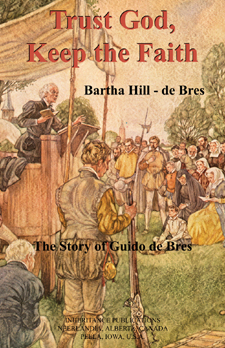
There are at present two books on my desk which seek to contribute to this long tradition of helping the Church to know itself by retelling its own story. As it happens, they are both books which are accessible to children, which is particularly exciting because I’m always on the hunt for ways to tell my children, and others too in my community of faith, their own story. The first is by New Zealand writer Bartha Hill, and is called Trust God, Keep the Faith: The Story of Guido de Bres. It recounts the inspiring story of pastor and theologian Guido de Bres. De Bres was a student of both Calvin and Beza, and is best known as the author of the Belgic Confession (1561). The book paints the story of de Bres against the background of an eventful sixteenth century in Europe, events which proved to be costly for many of those who stood on the Protestant side of church reform. It can be ordered from Inheritance Publications or, if you are in New Zealand, directly from the author. For the latter, contact Bartha directly via email.

The second book is John Calvin by Simonetta Carr, and is nicely illustrated by Emanuele Taglietti. It is published by Reformation Heritage Books and is targeted at children from 6–12 years of age. Like Hill’s book on de Bres, Carr’s too wonderfully introduces readers (and their imaginations) to the narrative, humanity and rich theological contribution of its subject, and does so in a clear, readable and attractive way. The Church, and its young families, is much in need of the kind of resources that these two small volumes evidence. Both would make great gifts too.

July stations …

Reading:

Listening:

Watching:

Candour reviews

I recently accepted the illustrious mantle of reviews editor for Candour, a magazine for ministers and leaders of the Presbyterian Church of Aotearoa New Zealand. The aim is that each edition of Candour will include a medium-length review of some kind, mostly of books but hopefully also of plays, music, dance and film. Consequently, I’m now on the hunt for possible reviewers, i.e., for those who would be willing to do the occasional review, and pick up a ‘free’ book in the process. If you’d like your name added to the list of reviewers that I can call on from time to time, then please let me know via email, indicating the kind of areas (e.g., missiology, history, fiction, prayer, etc.) that you are most interested in writing about, and any relevant qualifications you may have.

June stations …

Reading:

Listening:

Watching:

Hinterland Theology: A Stimulus to Theological Construction: A Review

Alan P.F. Sell, Hinterland Theology: A Stimulus to Theological Construction (Studies in Christian History and Thought; Milton Keynes/Colorado Springs/Secunderabad: Paternoster, 2008). xvi+715pp.

In his book Defending and Declaring the Faith: Some Scottish Examples 1860–1920 (1987), Alan Sell had already demonstrated his ardour and gift for bringing the dead back to life, for turning strangers into friends, and for wading the small streams and largely-inaccessible rivers on the landscape of British ecclesiastical life. Now, over two decades later, Professor Sell, in Hinterland Theology: A Stimulus to Theological Construction, turns his binoculars south to introduce readers to some other forgotten saints, to those whose writings are not the staple of general undergraduate courses. These are the second eleven (actually ten), if you like, of Nonconformist Dissent – drawn from among those who served the Church in the wake of the Toleration Act of 1689 after which there was ‘no longer one authority to which appeals on religious questions could be lodged’ (p. 54), and in the wake of the Enlightenment and the Evangelical Revival, and in the wakes of modern biblical criticism and theological liberalism. From the outset, Sell suggests that ‘we have not fully understood the Lockes and Barths of this world until we have investigated what the hinterland people made of them’ (p. 2).

Drawing upon letters, sermons, tracts and monographs, and with an eye on doctrinal controversies, the prevailing intellectual winds, and impressively alert to pastoral challenges, Sell has penned an encyclopaedic dictionary of rarely-mentioned theologians – Thomas Ridgley, Abraham Taylor (who ‘shot across the London sky like a volatile theological meteor’ (p. 41)), Samuel Chandler, George Payne, Richard Alliott, David Worthington Simon, T. Vincent Tymms, Walter Frederick Adeney, Robert S. Franks and Charles S. Duthie. Apart from Chandler, who was Presbyterian, and Tymms, who was Baptist, the rest were Congregationalists, and all but two (or perhaps three) were sons of the manse. Each chapter begins with a comprehensive biography of the chosen personality before turning to introduce and then engage with their thought, contribution and intellectual location. A familiar encore of themes appear over the period surveyed (1667 to 1981), including deism, miracles, apologetics, supernaturalism, Bible, Trinity, theism, Arianism, Calvinism, Unitarianism, Roman Catholicism, theological method, the eternal generation of the Son, kenotic christology, divine impassibility, natural theology, ecclesiology and pastoral ministry, among others, suggesting that theological adjustments and time-lags, and the ongoing ‘construction through conversations’ (p. 1) conducted by hinterland theologians, significantly stimulated the philosophico-theological landscape, and bore significant fruit – for good and for ill – in the Church.

After a brief Introduction, the book is presented in five parts. In Part One, ‘In the Wake of Toleration’, and with colour and wit, Sell introduces us to Thomas Ridgley whose ‘greatest contribution lay in the field of theological education’ (p. 13), and to Abraham Taylor and his defence against John Gill’s charge of antinomianism, and his plunge into the debates over the doctrinal declension betrayed in eighteenth-century trinitarian controversies and, in particular, his dissatisfaction in these matters with fellow Congregationalist, Isaac Watts. (Taylor charged Watts with sponsoring Sabellianism and Socinianism, with teaching that Christ possessed a super-angelic spirit, and with displaying a lack of clarity over the nature of divine personhood, among other things). Sell also introduces us to Samuel Chandler, the ‘moderate Calvinist’ and ‘apostle of liberty of conscience and freedom of thought’ (p. 85) who also wrestled with John Gill (on the relationship between morality and the will of God) and with Anthony Collins, John Locke and Thomas Morgan (on deism), and with John Guyse (on what it means to preach Christ),who spoke at Watts’ internment, who (from 1732 to 1739) was a prime advocate of the repeal of the Test and Corporation Acts that precluded Dissenters from holding state or civic office’ (p. 77) and whose greatest talents most conspicuously shone forth from the pulpit.

In Part Two, ‘In the Wake of Enlightenment and Revival’, Sell considers the life and contribution of George Payne, a thinker who ‘set out to be “useful” but was perceived as “dangerous”’ (p. 123). Sell’s discussion here introduces us to the landscape of early-nineteenth century thinking on metaphysics and ethics, on moderate Calvinism, and on the Trinity. Sell turns next to the inexorable logician and winsome evangelist Richard Alliott, who was ‘among the first Congregationalists to notice Schleiermacher in print’ (p. 191) and who, while longing for the revival of the Church, insisted that there would be no revival until believers ‘experience within stronger faith in the presence and word of our God, in the finished work of Christ, [and] in the indwelling of the Spirit in our hearts’ (p. 200). But Alliot, who by 1860 held the Chair of Theology and Philosophy at Spring Hill College,  held no misconceptions that ‘piety by itself will not sustain a ministry’ and that ‘scholarship will render a preacher more effective’ (p. 203). Sell describes Alliot, who authored Psychology and Theology (1855), as ‘a theologian between the times’ in whom ‘classical theism’s cosmological-causal head came together with Romanticism’s heart, and the whole was undergirded by the Evangelical Revival’s concern for souls’ (p. 222).

Part Three is titled ‘In the Wake of Modern Biblical Criticism’. Here we are acquainted with David Worthington Simon, T. Vincent Tymms, and Walter Frederick Adeney. Describing Simon as ‘the most spiritually anguished, the slowest-burning, and the most pioneering scholar – and hence the most highly suspect – to fall with the confines of this book’ (p. 227), Sell recalls Simon’s study at Lancashire College and in Germany (a land to which he returned again), his oversight of the newly formed church at Birkenhead from 1855, and his call to serve as Resident Tutor and Professor of Theology at Spring Hill College, ‘an institution where at least relatively open theological enquiry was the order of the day’ (p. 236), and then, from 1883, as Principal of the Scottish Congregational Theological Hall in Edinburgh, and thereafter as Principal of Yorkshire United Independent College on Bradford (1893 until 1907). Alive to the changing intellectual environment, Simon, championing what Sell names as a ‘biblical-historical-pneumatic epistemology’ (p. 250), championed a marriage of both intellectual and spiritual depth, resisting attempts by some to divorce the historical and the spiritual and arguing that the soul’s relation to God is not independent of biblical facts. From Simon, Sell turns to Tymms, tracing the Baptist theologian’s journey from Regent’s Park College, to his pastorates at Berwick, Accrington and Clapton, to Vice-President of the Baptist Union of Great Britain and Ireland, to President of the London Baptist Association, and to the Presidency of Rawdon College, Leeds. Sell reflects on Tymms’ widely-read book, The Mystery of God, and his embroilment in controversies over Bible translation, particularly as such affected the Indian mission field. He notes that Tymms distinguished himself by encouraging ‘original thought among his students rather than … prepar[ing] them for examinations’ (p. 311), and by his Forsyth-like witness to the centrality of Christ’s Cross which has ‘irradiated the world with light, and is filling the moral universe with songs of everlasting joy’ (p. 317). Tymms would press further still, insisting in his stimulating and judicious book The Christian Idea of Atonement, that ‘the cross is God’s definition of Himself’ (p. 340). Moreover, the cross is, Tymms insists, the only word of theodicy available to the Christian: ‘The cross is … precious because it reveals that God is not a mere passionless watcher of an agonising evolution, but is Himself a partaker of the universal travail, and has been constrained by love to take the chief labour on Himself’ (p. 345). Sell introduces us next to Adeney, Congregationalist minister turned Professor of Church History and New Testament, whose attention to the centrality of the cross fell some way short of Tymms’, but among whose enviable gifts included an ability to ‘write at varying degrees of technicality, and … a particular concern to reach ministers, people in the pews, and children’ (p. 366). He was one of those ‘believing biblical critics’, like Westcott, Hort, Peake and W.H. Bennett, who ‘harvested the fruits of modern biblical criticism in such a way that only the most suspicious conservative evangelicals’ (p. 410) would think to accuse him of undermining Scripture. No advocate of sentimental theology, Adeney championed the truth of God’s fatherly love – love expressed in the ‘essentially Christian’ (p. 399) doctrine of the Trinity – as ‘the source and spring of the Christian gospel’ (p. 395). Still, he warned that ‘speculation about God always plunges us into darkness’, an observation which draws the following comment from Sell: ‘It is, no doubt, an unsanctified thought, but one sometimes feels that some present-day theologians think that they know as much about the inner working of the Trinity as some older Calvinist divines thought they knew about God’s inscrutable will’ (p. 411).

‘In the Wake of Theological Liberalism’ is the equally-revealing title of Part Four, and the subjects here are Robert S. Franks and Charles S. Duthie. Again, Sell locates each personality in their biographical and intellectual context before turning to introduce and appraise their writings and thoughts. Sell highlights the former’s engagement with the thought of Kant, Abelard, Anselm, and Schleiermacher, and the latter’s engagement with Pascal, Barth, Thielicke, Ferré and Tillich. Of these last two named, Duthie’s introducing of their thought to both Church and students (he spent 30 years of his life training ministers) was ‘not because [he agreed] with all the main positions they occupy but because [he felt] deeply that they are concerned to fashion a living theology for our own time, a theology which is faithful to the “given” Gospel in terms of man’s predicament today’ (p. 521). In calling the Church to its evangelistic task, Duthie suggested that we not only read Tillich with Barth in hand, but also the reverse.

After 562 pages, Sell still has more to say, and the book’s final part is a 71-page conclusion wherein Sell retraces the landscape he has just surveyed, recapitulates key themes, offers suggestions about contemporary practice, and recalls that the voices of hinterland theologians – past and present – are ‘frequently constructive, occasionally provocative, and variously stimulating. They have pertinent observations to share on our current theological agenda, and they challenge us by reminding us of some themes which we may have been inclined to overlook’ (p. 635).

Readers already familiar with Professor Sell’s writing will know that he is a meticulous researcher whose reading is extensive, whose commitment to ecumenism is exemplary, whose love for, and devotion to, the Nonconformist tradition is contagious, who is not shy of noting error and distortion of the Gospel when and where he sees it, whose acumen for critically-identifying contemporary theological trends is cultivated and well coached, and whose writing betrays not a few hours of pastorally-informed reflection. While Hinterland Theology could certainly have done with a more meticulous proof-reader, with this hefty tome Sell has given us a rich resource. That he decided to take the trouble to write this book leaves the Church in his debt. This volume will be of interest to historians, theologians, philosophers, and a must-read for those with a particular interest in British Nonconformity.


May stations …

Reading:

Listening:

Watching:

Entering the New Theological Space: A Review

John Reader and Christopher R. Baker, eds, Entering the New Theological Space: Blurred Encounters of Faith, Politics and Community. Explorations in Practical, Pastoral and Empirical Theology (Farnham/Burlington: Ashgate, 2009), pp. xiii + 241, £55.00, ISBN 978-0-7546-6339-3.

Nicholas Lash, in his book Holiness, Speech and Silence: Reflections on the Question of God, gives voice to the difficulty of thinking Christianly in ‘a culture whose imagination, whose ways of “seeing” the world and everything there is to see, are increasingly unschooled by Christianity and, to a considerable and deepening extent, quite hostile to it’. He notes the serious and dangerous demands posed in such a situation by continuing to hold the Gospel’s truth rather than paying mere lip-service to ‘undigested information’ (p. 4). Believing that the time has come to help missiological communities to engage and digest in the linear spaces opened up between post-Christendom politics and interfaith actualities, institutional monads and inter-organisational networks, rural and urban spaces, the status of paid and unpaid, and the contested and evolving relationship between faith and science, for example, the contributors to Entering the New Theological Space seek, in different ways, to map such space ‘by means of a triangulation between narrative, praxis and theory’, to ‘offer some idea of the complexity and interdisciplinarity associated with this new space’ – a so-called ‘third space’, the ‘space of the both/and’ (p. 5), a more fluid space which discards the oft-maintained binarism of the either/or space – and to assist readers to analyse the significance of such ‘blurred encounters’ which, the editors believe, are ‘forcing the church to develop increasingly fluid and experimental forms’ (p. 10).

Each of the fifteen essays in this volume are in their own way stimulating, and most are well-researched and eruditely penned. They cover a range of topics, from John Atherton’s ethical-economical-theological reflection on a ‘pilgrimage’ down Edinburgh’s Royal Mile to explore places where ‘inevitable and potentially creative’ (p. 25) ‘“edges” have become mainstream’ (p. 19), to Malcolm Brown’s essay on the ‘social atomisation’ and ‘rootlessness’ (p. 70) of London’s suburbs, to Margaret Goodall’s exploration of human personhood in a thought-provoking essay on dementia, to Clare McBeath’s piece which asks whether a community or a city can be said to ‘suffer from mental illness’ (p. 147), to Philip Wagstaff’s reflection on the fluidity and stability of rural ministry.

Two essays merit special mention: Martyn Percy’s considers the nature of the cultural dynamics, implicit theology and ‘invisible religion’ (p. 179; the phrase is Thomas Luckmann’s) that continue to birth requests for baptism (or ‘christening’) of children from non-churched families. He writes concerning the ‘deeply coded ways in which people talk and act about God’, that ‘religious language is carried in the emotion, timbre and cadence of worship’ and that ‘deeply coded language is not [necessarily] a strategy for avoiding explicit theological language’ (p. 184). Percy’s attempt to sketch a theology of cultural conversation, and to explore some implications of such conversations for missional and risky engagement in the ‘areas of overlap and hinterlands between the life of the church and the world’ (p. 179) merits further thought.

Drawing upon the work of Bruno Latour and Slavoj Žižek, and bringing their thought into conversation with events surrounding the 2007 outbreak (in Surrey) of foot and mouth disease, John Reader contributes an intriguing, if somewhat undercooked, essay on the nature, possibility and linguistic challenges posed to truth speech by the mutual encounter of science and theology. He concludes by stating that it is ‘only by keeping the insights and theories of both faith and science in circulation’ that we can be ‘certain of remaining “in the truth”‘, and that it is ‘only by loading into the process that contact with the wider world’ that we ‘avoid an unhealthy closure of questioning and debate’ (p. 208).

Some reservations: the noticeable absence in this volume of any discussion on the significance and place of technology (blogging, social media and gaming, for example) in theological and ecclesial discourse and praxis, and vice-versa, represents a disappointing gap. Also, there is in this volume a significant number of typological, grammatical and factual errors (John Knox, for example, was not the ‘first Presbyterian minister of St Giles and Scotland’ (p. 20)), errors which one expects would be corrected before print and to be rare in a book wearing such an inflated price tag. Finally, while one may well concur that ‘all the essays in this book are a testament to the ongoing adaptability and robust mutuality of Christian thought and the church’ (p. 7), if this volume represents ‘the new theological space’ then one might be forgiven for observing that, with one or two exceptions, such space is a little light on the theology front.

These reservations aside, not a few of the essays in this volume deserve wide reading, and the ongoing conversations encouraged therein are to be commended. Social planners, missiologists, pastoral practitioners and those training them will all benefit from reading this book, and from taking up the challenge to engage in the interdisciplinary and multilayered interstices of cultural, political and theological realities.

‘The Club’

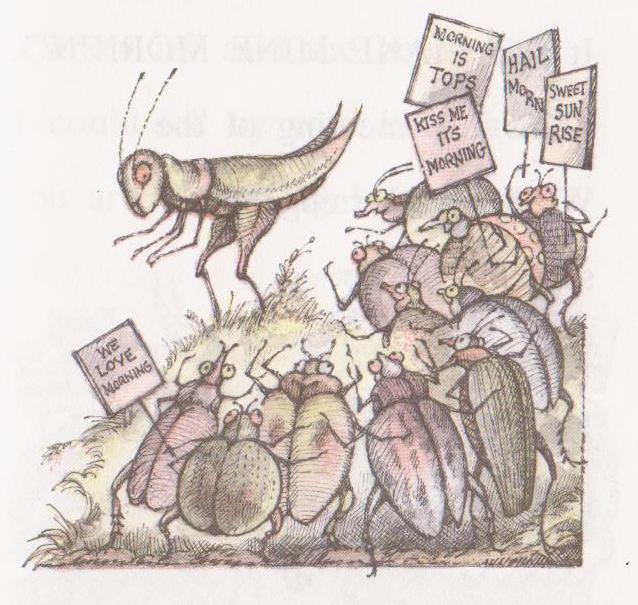
One of the most delightful little books that I’ve read in recent weeks is Grasshopper on the Road, a ‘Level 2’ book by Arnold Lobel. I just had to share my favourite story. It’s called ‘The Club’:

Grasshopper walked quickly along the road.
He saw a sign on the side of a tree.
The sign said MORNING IS BEST.
Soon Grasshopper saw another sign.
It said THREE CHEERS FOR MORNING.

Grasshopper saw a group of beetles.
They were singing and dancing.
They were carrying more signs.
“Good morning,” said Grasshopper.
“Yes,” said one of the beetles.
“It is a good morning. Every morning is a good morning!”
The beetle carried a sign.
It said MAKE MINE MORNING.
“This is a meeting of the We Love Morning Club,” said the beetle. “Every day we get together to celebrate another bright, fresh morning. Grasshopper, do you love morning?” asked the beetle.
“Oh yes,” said Grasshopper.
“Hooray!” shouted all the beetles.
“Grasshopper loves morning!”
“I knew it,” said the beetle. “I could tell by your kind face. You are a morning lover.”

The beetles made Grasshopper a wreath of flowers.
They gave him a sign that said MORNING IS TOPS.
“Now,” they said, “Grasshopper is in our club.”

“When does the clover sparkle with dew?” asked a beetle.
“In the morning!” cried all the other beetles.
“When is the sunshine yellow and new?” asked the beetle.
In the morning!” cried all the other beetles.
They turned somersaults and stood on their heads.
They danced and sang.
“M-O-R-N-I-N-G spells morning!”

“I love afternoon too,” said Grasshopper.
The beetles stopped singing and dancing.
“What did you say?” they asked.
“I said that I loved afternoon,” said Grasshopper.
All the beetles were quiet.
“And night is very nice,” said Grasshopper.

“Stupid,” said a beetle.
He grabbed the wreath of flowers.
“Dummy,” said another beetle.
He snatched the sign from Grasshopper.
“Anyone who loves afternoon and night can never, never be in our club!” said a third beetle.

“UP WITH MORNING!” shouted all the beetles.
They waved their signs and marched away.
Grasshopper was alone.
He saw the yellow sunshine.
He saw the dew sparkling on the clover.
And he went on down the road.

– Arnold Lobel, ‘The Club’ in Grasshopper on the Road (New York: HarperCollins, 1978), 8–16.

April stations

Reading:

Listening:

Watching:

Community of the Transfiguration: a commendation

Paul Dekar’s book, Community of the Transfiguration: The Journey of a New Monastic Community (Cascade Books, 2008), maps the historical, theological, liturgical, and missiological life of Holy Transfiguration Monastery [HTM], or what many of us know better as The Breakwater Community – a Baptist monastic community in Geelong, near Melbourne. HTM was birthed in the early 1970s and bound together by ‘a common calling to contemplative prayer, simplicity, a Eucharistic focus, and the nurture of monastic spiri­tuality’ (p. 33). How this birth happened, and the shape that the life birthed has taken, and is taking, is a focus of this book; it is, however, by no means the only focus.

Dekar, who is Professor Emeritus of Evangelism and Mission at Memphis Theological Seminary and (as I understand it) a ‘Companion in identifica­tion with HTM as a spiritual home’, locates the story of the Breakwater Community among the wider stories and history of Christian monasticism in both its ancient and contemporary forms: ‘HTM exhibits many generic traits of its monastic forebears and of the new monastic communities. These include the centrality of Jesus Christ, communal life under a rule of life, vital worship, use of the visual arts, care for youth, care for the natural world; and ministries among marginalized persons. In this sense, the life of Community mem­bers is neither unique, nor original, perhaps only “newly born … a spirit and an endless trying, changing and beginning again”’ (p. 57). That the members of the Community have sought to explore and live out of traditional monastic spiri­tuality for over thirty-five years has, in Dekar’s words, ‘made the Community somewhat of a working model, or bridge, between past and contemporary forms of monastic religious life’ (pp. 61–62).

Dekar believes that ‘the radical love Community members have extended to lay people, pastors, denomi­national leaders, critics, and even enemies is perhaps its greatest gift’ (p. xvi). That I can count myself as one among many who has been, on more than one occasion, the recipient of the hospitable love of this extraordinary and permission-giving community (once in the form of home-made lemonade and a pumpkin – food for the journey, so to speak), is but one the reasons that I was so keen to read this book. From my brief experience and observation as a pastor in the Baptist Union of Victoria, among the greatest gifts bestowed by the Breakwater Community to the wider Church is the centrality, rhythm, and theological maturity afforded to gathered worship, and the attendant invitation to live all of life as an expression of and participation in the One who gives himself in the eucharist. It is, I believe, appropriate, then, that Dekar devotes a significant portion of the book to introducing readers to some of the liturgical resources and prayers authored by the Community, and to outlining the theology and practice of HTM’s worship, the shape that a community in which ‘the nurture of warm, personal intimacy with the Holy Trinity’ (p. 89) lies at the heart of common life.

On occasion, Dekar gets sidetracked from the main story and expends ink on some of his additional interests which, although loosely related to the book’s subject, disrupt its flow. Still, this moving and challenging book records a fascinating and important – albeit small – chapter of the story of Victorian Baptists, and locates that story in both a wider and more grassroots ecumenical and catholic context. Those already familiar with the inspirational life and witness of the Breakwater Community and its relationship with the Baptist family in Victoria, and those interested in hearing a more detailed account of one community that religion sociologists might locate in a movement known as ‘New Monasticism’, will find much of interest here.

The Wisdom of Stability: A Review

In The Wisdom of Stability: Rooting Faith in a Mobile Culture (Brewster: Paraclete Press, 2010), Jonathan Wilson-Hartgrove seeks to write a book about ‘staying put and paying attention’. In a culture characterised by unprecedented mobility, he believes that ‘the most important thing most of us can do to grow spiritually is to stay in the place where we are’ (p. 1). The author insists that the life of Spirit is, in Rowan Williams’ words, impossible ‘in abstraction from the actual business of living in the body of Christ, living in concrete community. The life of intimacy with God in contemplation is both the fruit and the course of a renewed style of living together’. Or, in Wilson-Hartgrove’s words, ‘Apart from stability in the life of a community, the songs of Zion quickly begin to sound like wishful thinking’ (p. 63).

Drawing from the experiences of the monastic fathers and mothers, and from his own journey now as a minister of St. Johns Baptist Church and member of Rutba House, Wilson-Hartgrove properly argues that the practices of stability cannot be ‘reduced to a quick fix for the spiritual anxiety of a placeless people’, and that ‘if our feelings of rootlessness are what drive us to the practice, we’ll need something more than an immediate sense of relief to help us stay’ (pp. 110–11). He turns then to consider three ‘midday demons’ which require resistance if we are to be serious about not being perpetual pot plants but being planted in soil where our roots have room to reach deeper. These are ambition, boredom and vanity.

He writes of ambition: ‘ambition tempts us to forsake the mundane for the sake of unlimited growth – or, at least, new opportunities. We are so easily unimpressed by the ordinary, longing for the feeling of excitement that comes with a new task to take up, new people to engage, new challenges to face (p. 114). And of boredom: ‘Whereas ambition pushes us toward perpetual motion, boredom paralyzes, leaving us unable to love our neighbors or even take care of our own basic needs. Though different in character, these midday twins tempt us to the same lack of care. In their grip, it is impossible for us to find joy in community’ (p. 118). And of vanity: ‘Vainglory comes midway along our journey to suggest that all our care is best directed toward self-preservation … Vainglory will try to persuade us that there is nothing more important in the world than our own stability, encouraging us to defend it at all costs against any potential threat’ (pp. 122, 123).

There is wisdom in these words, and there’s much to like about the book. Still, I have two reservations about commending it: First, it’s nauseatingly repetitive, yet another example of a standard article-length piece being padded out to make a book. Second, and more substantially, there is, surprisingly, a drift towards an unearthed nostalgia here which works to undermine the author’s basic thesis. (It may be, of course, that my cultural eyeglasses are simply the child of a different prescription to those of Wilson-Hartgrove’s.) Walter Brueggemann once observed of memory that it is that which ‘may be enmeshed in a nostalgic longing for normalcy and “the good old days,” when life was simple and agrarian, settled, and well-ordered. That nostalgia is all intertwined with evangelical memory, so that the nostalgia has a vague religious feeling about it. There is a need to sort out the normative memory from this other vague yearning’. I’m unconvinced that Wilson-Hartgrove (in this volume) succeeds fully in doing the kind of sort out that Brueggemann, rightly to my mind, calls for.

For me, the highlight of the book was this poem (on p. 106):

The house was built in ’98,
prior to my arrival.
And a big maple tree at the corner of the porch
was run over and buried lots of times by wagons
moving in materials to build the house.
And the other maples what Daddy had planted,
they had no trouble at all.
But they all died and this one lived that had such rough treatment.
And there’s a saying
“Rough weather makes good timber.”
It may be
that the trouble with folks today
is that they’re raised like hothouse flowers,
and they don’t have much to go on
at the end.