Books

September bests …

Best books: The Changing Shape of English Nonconformity, 1825-1925, by Dale A. Johnson; Karl Barth’s Theology of Relations: Trinitarian, Christological, and Human: Towards an Ethic of the Family, by Gary W. Deddo

Best music: Roby Lakatos, The Gypsy Violin – Live in Budapest (2003); Show of Hands, Witness (2006); Martin Simpson, The Bramble Briar (2001)

Best films: Rails & Ties (2007); Cassandra’s Dream (2007)

Best drink: Trade Winds from the Cairngorm Brewery

‘Toward a Culture of Freedom’: A Review

Thorwald Lorenzen, Toward a Culture of Freedom: Reflections on the Ten Commandments Today (Eugene: Cascade, 2008), viii + 253 pages. ISBN: 978 1 55635 296 6. Review copy courtesy of Wipf and Stock.

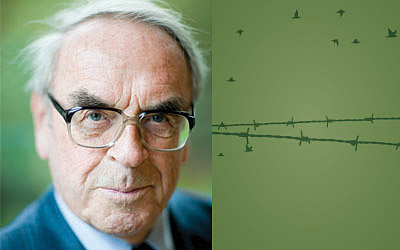
Some years ago I took a fascinating (for many reasons) course on resurrection. One of the principle teachers was Thorwald Lorenzen, who was at that time a Baptist pastor serving in Canberra but now serves as Professor of Theology at Charles Sturt University. Dr Lorenzen is an erudite and [com]passionate NT scholar and theologian who brings to the task of doing theology a wide horizon of international experiences which inform his particular concern for human rights, expressed in a deep respect for the United Nations bill on The Universal Declaration of Human Rights. A key text for the resurrection course was Lorenzen’s Resurrection and Discipleship, a book deserving of a wide readership and one which helped to open at least one undergraduates eyes to a plethora of issues about the nature and role of NT narrative, about the value (and over-value) of tradition, and particularly about the relationship between resurrection faith and justice.

While nowhere near as carefully researched as Resurrection and Discipleship, and even at times offering surprisingly sloppy and unfair caricatures [eg. ‘Calvinist Christians expect God to plan and enact every detail in life’ (p. 1)], Lorenzen’s latest book continues to bring together his passions for justice, human rights, ethics and biblical exegesis in the service of the people of God and their witness to God’s good news in the world. Lorenzen properly resists interpreting the Ten Words moralistically or in abstraction from their deep rootedness in the covenant life and history of a people in communion (however seemingly fragile at times) with their God. He is also concerned at every point to let these Words speak to our world – and address our questions – in light of the wider sweep of the Scriptures’ metanarrative, and particularly in light of the final Word of God’s revelation – Jesus Christ. The chapter on adultery is a case in point, wherein Lorenzen does not shy away from the complex issues that continue to challenge the Church in its faithfulness to the Word of God and to compassionate witness to that Word in the world. On the question of gay and lesbian marriages, for example, he proffers the following:

‘Civil contracts in which gay and lesbian couples make a legal pledge to each other before the law are in order. They provide security and fairness for a committed and long-term relationship. Marriage, however, is another matter because it entails the desire for family. I think that every child has the right to experience the life-shaping presence of a mother and a father. The rights of a child precede the rights of gays and lesbians because the child is the more vulnerable part in the relationship’. (p, 129)

For those looking to rethink some implications of the Decalogue in a contemporary and increasingly politically-aware context, for those looking for helpful ideas for pulpit ministry, or for those looking for a book to work through in small study groups, Towards and Culture of Freedom might be a good place to consider stopping awhile. Not all will agree will every conclusion Lorenzen reaches, or even with the way he gets there; but to my mind, that’s one more reason why reading the book is worthwhile.

Here’s a few more tasters:

‘Each of us has, or rather is, a conscience. Conscience is the centre of our personhood. It makes us who we are. It shapes our identity. It is worth understanding and caring for’. (p. 20)

‘Deeds of liberation call for structures of liberation. God does not liberate people so that they can fall into the hands of false gods. Freedom therefore needs discipline and structures to ensure that it remains grounded in its author. The “ten words”, but also the statutes and ordinances, the cult and the prophets were all intended to preserve, protect and guide the ongoing journey of freedom’. (p. 24)

‘When some reformers in the sixteenth century took down the pictures and removed the statues from the churches, they wanted to make room for the living voice of the gospel. They wanted to celebrate Jesus as the one word that we need to hear, trust and obey in life and in death. But soon others, lesser minds and lesser hearts, came along and put a book where the pictures had been. So for many Christians the living voice of the gospel has been frozen into a book, the Bible. And around the world there are many Christians who spend more time and energy fighting about the Bible than in worshipping and obeying the Christ to whom the Bible points’. (p. 52)

‘A generation that ignores the wisdom and errors, achievements and failures of its predecessors is ill-prepared to face the future. Would the revolutions of Germany’s youth in the 1960s and of America’s youth in the 1970s have happened if their parents had talked about their war experiences and the associated horror and guilt and doubts?’ (p. 86)

The Theology of the Cross in Historical Perspective: A Review

Anna Madsen, The Theology of the Cross in Historical Perspective (Eugene: Pickwick Publications, 2007. ix + 269 pages. ISBN: 978-1-59752-835-1. Review copy courtesy of Wipf and Stock.

It is encouraging to see a growing stream of books dedicated to engaging with the work of Jürgen Moltmann. I have just finished reading Anna Madsen’s ambitious study The Theology of the Cross in Historical Perspective (Eugene: Pickwick Publications, 2007), part of the young ‘Distinguished Dissertations in Christian Theology’ series that Wipf and Stock are co-sponsoring with the journal Word and World: Theology for Christian Ministry and with the Christian Theological Research Fellowship (CTRF). In this book, this Assistant Professor of Religion at Augustana College in South Dakota (USA) traces the currents of a theology of the cross in St Paul, Luther, von Loewenich, Kitamori and Moltmann, before turning our gaze towards Feminist and Liberationist evaluations and applications of a theologia crucis.

On Luther, the author reminds us that we miss the whole catalyst for the German monks’ revolutionary theological advance when we divorce his theologia crucis from the context of the Church’s appeal for alms in the form of indulgences. The issue, she claims, is that God can not be ‘bought off’.

She explores the twentieth century’s witnessing of a variety of theologies of the cross, some of which, ironically, actually call for the cross itself to be discarded on the grounds that it symbolises (and glorifies) not hope but only violence. The tired divine child-abuse paradigms are briefly discussed. Conversely, Madsen observes that there remain those who insist that in the face of unparalleled and devastating poverty, destruction, abuse, exploitation and suffering, the cross provides the only interpretive tool which theology can offer. Specifically, the cross becomes the symbol to announce God’s full identification with the sufferers and God’s condemnation of the privileged. An adequate critique of this liberationist reading is not forthcoming in this volume.

The section on Moltmann (pp. 181-207) serves as a particularly helpful introduction to Moltmann’s theology as a whole, especially for those unfamiliar with the work of this creative and Reformed theologian. That it is explored in the context of a theological tradition from Paul through Luther et al makes it all the more helpful, for, as Madsen notes, no matter how much Moltmann’s theology of the cross consciously attends to life post-Auschwitz and more consciously extends justification as that which leads to justice-seeking, it remains fundamentally dependent upon Luther’s.

Madsen’s study argues that while there is no uniform theology of the cross, ‘Paul’s approach provides the soundest and most comprehensive’ vista, not least because his is a theology most elucidated not in isolation from but rather vis-à-vis the resurrection. Paul’s theology of the cross is, therefore, (while its various tones and emphases were always determined by its context) that which always concerns the removal of boundaries – both horizontal and vertical. Still, Madsen concludes, the theology of the cross remains that which announces that ‘God is found in death … in the death of sin, of suffering, of uncertainty’, and is marked by service, and is that which assures the people of God that God is present. It is therefore a theology of grace, of freedom and trust. Moreover, without a theology of the cross, she insists, it is unclear what the Church is called to be and to preach.

I warmly commend Madsen’s study as an accessible contribution to a topic at the heart of Christian good news, and as a valuable introduction to work by von Loewenich and Forde (On Being a Theologian of the Cross remains, to my mind, one of the best introductions to Luther’s theology available, alongside Randall Zachman’s The Assurance of Faith, with which, oddly, Madsen fails to engage), Moltmann and Sölle, Sobrino and Gutierrez. It is a clearly-written and pastorally-aware study … and it’s got a beautiful cover!

Back to Moltmann studies: Alongside Madsen’s study, I also have on my desk another book that engages with Moltmann’s thought: Tim Chester’s, Mission and the Coming of God: Eschatology, the Trinity and Mission in the Theology of Jürgen Moltmann (Milton Keynes: Paternoster, 2006). I’m hoping to read and post a review of it sometime soon(ish). Also, Ashgate recently announced that 2009 will witness the arrival of Timothy Harvie’s book, Jürgen Moltmann’s Ethics of Hope: Eschatological Possibilities for Moral Action (Aldershot: Ashgate, 2009). Paternoster too are planning to publish Nik Ansell’s insightful study, The Annihilation of Hell: Universal Salvation and the Redemption of Time in the Eschatology of Jürgen Moltmann.

Again, it’s encouraging to see these studies appearing. Moltmann’s work deserves the attention, and critical evaluation.

Books worth waiting for: Ansell on Moltmann, and Williams on Dostoeveky

Every now and again, there comes along the book that you just can’t wait to read. For me, at the moment there are two deserving of that honour: First, there’s a excellent study that I’m currently reading by Nik Ansell entitled, The Annihilation of Hell: Universal Salvation and the Redemption of Time in the Eschatology of Jürgen Moltmann (soon to be published by Paternoster). This is a laudable first-rate study.

The other is a study on Dostoevsky by Rowan Williams entitled Dostoevsky: Language, Faith, and Fiction. I’ve just ordered my copy. William’s Grace and Necessity is one the most exciting theological books I’ve read, and I’m predicting that Dostoevsky will be just as thrilling. I mean seriously, who better to write a study on the world’s greatest writer than one who has so plunged the (theological) depths of the Russian psyche and who appears to be continuously working through the implications of what it means that grace has encountered the human than Williams! In the meantime here’s what the reviewers are saying:

‘Reading Dostoevsky is like looking from a high peak at several mountain ranges, some brightly lit, others dark with mist, going back farther than the eye can see. In this breathtaking book, Rowan Williams takes us on a journey through literary art, the nature of fiction, psychological depths, historical and cultural setting and allusion, and beyond all else a world of faith and doubt, of philosophy and theology not dry on the page but moist with tears of compassion. We return to Dostoevsky with new insight and wide-ranging understanding and to real life with fresh perspectives on what it means to be human, to be under threat from the demonic, and above all to sense the dark and urgent presence of the living God’. – N.T. Wright, Bishop of Durham

‘Rowan Williams here reveals the originality and daring that have made him such a controversial (and inspiring) leader of his church. The readings demonstrate an impressive grasp of current scholarly criticism of Dostoevsky. But this is not just another book about Dostoevsky. The literary interpretations are guided by an intense humanism that shares at points surprising parallels with radical leftist critiques. As author of a previous book of Sergej Bulgakov, Williams is at home in Russian philosophy, particularly the Orthodox emphasis on kenosis, the voluntary emptying out of Christ’s divine attributes during his time on earth. This aspect of Russian thought was important for Bakhtin, who serves as a kind of dialogic third partner in Williams conversation with his reader. This is a work of learning and passion, a heteroglot blend of literary, ethical, and subtle theological argument that is full of surprising local triumphs of interpretation — and that most un-academic virtue, wisdom’. – Michael Holquist, Professor Emeritus of Comparative and Slavic Literature, Yale University

‘Rowan Williams, in this study of Dostoevsky’s characters, brings to attention the theological anthropology implicit in and generative of the narratives’ dynamics. In his hands, theology becomes not a kind of explanation or completion but both a release, an opening of the narratives to the as yet unsaid, and a clarification of the continuities between the characters and the Orthodox Christianity of the setting. Crucial to this reading of Dostoevsky is an understanding of personal identity not as a possession but as a consequence of an ongoing relational process and an interweaving of freedom with a responsibility for others. As we no longer read Dostoevsky the way we did before reading Mikhail Bakhtin, so also, having read Williams, we no longer will read either Dostoevsky or Bakhtin as we once did’. – Wesley A. Kort, Professor of Religion, Duke University

Around the traps …

I’ve really had no time for blogging of late, but there’s been some good reads around the traps:

In their combination of a sophisticated philosophy with religious aspiration, the pagan Neoplatonists had only one serious rival-Christianity, and, anti-Christian though they were, it was the incorporation of their ideas into Christian theology that ensured their permanent influence on European culture. (p. viii).

The principal figure in the transmission of Neoplatonist thought into Christian theology is St. Augustine. (p. 177)

‘SCM Core Text: Christian Doctrine’: A Review

Mike Higton, SCM Core Text: Christian Doctrine. London: SCM Press, 2008. xi + 413pp. £22.99.

While the finest of Christian dogmatics employs the grammar of praxis, proposition and imagination, much of what passes for ‘orthodoxy’ privileges proposition and is (to varying degrees) suspicious of those attempts to faithfully make sense of life encountered and interpreted in a specific time and space biography, drawing upon God’s action corporately experienced, and upon the narratives and metaphors that inform Christian imagination. As invaluable as propositions are, they ought not be, according to Mike Higton, ‘extricated from the Christian lives and imaginations’ (p. 73) that provide the context for comprehending and evaluating all things in light of that one determining Word of God who has taken on flesh and who, in the Spirit, is dancing created humanity into participation in God’s life in the world. It is this grand narrative that stirs Higton’s theological project in Christian Doctrine (part of the SCM Core Text series), and provides the matrix through which he seeks to assist readers to make sense of life as individuals and communities in relation to each other, and in relation to God.

Knowing and loving God, Higton presses, is more akin to knowing, loving and sharing identity with a piece of music – it is to resonate with, and to participate in, even to become an aspect of, God’s eternally-playing melody – than it is to ‘grasp fully, define and explain’ (p. 57) the otherwise unknowable God. Such knowledge is interruptive, transformative and self-involving, drawing a responsive participant into – to be ‘caught up … grasped by’ (p. 57) – the same love and justice that is God’s life and which God has revealed to the world in Jesus of Nazareth and made real by the invading, transforming and overwhelming Spirit who draws human persons to Christ, ‘impels and enables participation’ in God’s kingdom, and who produces a response ‘consistent with the claim that God is love’ (p. 255). While ‘imagining how the immanent life of God functions is not our business’ (p. 99), Higton is confident that what God makes known in the economy is the ‘dance’ of God’s own immanent life – God’s one endless threefold way; that is why, according to the author, God can be trusted and known. ‘The economy is enough‘ (p. 102). As Higton repeatedly reminds, the triune God who is love ‘all the way down’ is ‘immanently Christlike’ (p. 71):

[To] learn to speak appropriately about God’s immanent life is to learn to see the human being Jesus – a graspable, knowable, historical, economic reality – as the coming to the world of the ineffable, eternal Son; it is to learn to see the Father who appears in one’s economic imaginations and words as the coming to the world of the eternal, ineffable Father; it is to learn to see the shakings and stirrings of the Spirit’s historical, economic work as the coming to the world of the ineffable Spirit. It is to learn to see the whole patterned drama of the economy, into which Christians believe all are called, as the opening up to the world of God’s own immanent life’. (pp. 101-2)

Christian Doctrine emerges out of a certificate course in theology that Higton teaches at Exeter, and is targeted at second- and third-year undergraduate students. Resisting all attempts to merely download the tradition, Higton seeks to encourage the critical making, breaking and remaking of sense that is all around us, and to do so with careful attentiveness to the transforming light of the Christian story – at the heart of which is God’s love and justice.

The book consists of two parts: The first, ‘Life in God’ (pp. 1-166), explores with startling clarity questions of epistemology, the indivisible relationship between knowing and loving (here he draws upon Exodus 3:13-17 and 1 John 4:7-21), God-talk, God’s trinitarian economy, and God’s human life. On the latter, Higton draws upon depictions of Jesus in painting and film, contrasting Piero della Francesca’s Baptism with Antonello da Messina’s Le Christ à la colonne, and two parts of Matthias Grünewald’s Eisenheim Altarpiece. The author presses that triune love made flesh – that is, one ‘utterly human, unreservedly and unadulteratedly human’ (p. 130) – is ‘God’s way of loving the world’ (p. 124), and belief in which occasions rearrangement and transformation of every area of one’s life and every aspect of one’s world. The book’s first part concludes with a chapter on pneumatology, on the enlivening Spirit who sustains, animates and enlivens all life, who draws out and nurtures skills, wisdom and justice, who erupts against idolatry, injustice, darkness, estrangement and oppression, and who patterns human persons for their deeper share in ‘unfragmented communion’ (p. 161) in God’s life through a ‘journey of learning and unlearning’ (p. 152) while working to complete and perfect creation. ‘It is the Spirit’s work to draw what might otherwise be a cacophonic disunity into symphony. The Spirit worked to transcribe God’s music for playing on the human instrument of Jesus of Nazareth; the Spirit now works to orchestrate that theme for an ensemble of billions’ (p. 161)).

Part Two, ‘Life in the World’ (pp. 167-404), seeks to unpack the implications of God’s threefold action for our assessment of creation, providence and freedom, eschatology, suffering, love, theodicy, harmartiology and soteriology, and the four traditional ecclesiological marks. The discussion on the Church’s sacramental activities (pp. 314-24) deserves careful reading. Higton presses that the two sacraments ‘don’t simply say something about what the Church is, but are part of the process by which the Church actually becomes what it should be’ (p. 316), and is ‘redescribed’ (p. 321). In the two final chapters, Higton identifies some popular lenses – ‘settlements’ – that are often employed to interpret the Bible’s message(s), before offering his own proposal, what he names ‘trinitarian settlement’ which, he suggests, understands the core narrative of Holy Scripture as concerned with a journey into the triune life itself; the Bible being read not as a ‘moral handbook’ (p. 379), but ‘around Jesus’, ‘in the Spirit’ (which means at least read ecumenically, in conversation with the tradition, in openness to previously excluded voices, and in hope), and ‘on the way to the Father’ (pp. 376-400). Throughout, Higton is concerned to relate central Christian doctrines to the experienced realities of human being, resolute to show how such doctrines affect how one conceives, interprets and lives with everything else, all the while pressing that the ‘world is called to the fulfilment of its creatureliness, not the abandonment of it’ (p. 182).

There are a number of underlying commitments that find expression in Christian Doctrine. I will name four: (i) a deep commitment to Trinitarian theology: ‘The word “God” simply refers to the reality that Christians come to know, and whose life they come to share, as they find themselves, in the Spirit, caught up in the Son’s love of the Father and the Father’s sending of the Son’ (p. 90). Higton is suspicious of those attempts to describe the triune life along social trinitarian lines (see pp. 96-101) because, he argues, such steer too close to positing ‘three realities that share the same defining characteristics’ (p. 97). He suggests that such attempts threaten (at least temporarily) to lose sight of the particularity of the persons and that if trinitarian theologians are serious about the nature of community, they must ground their theology not in a general account of personhood and relationality, but in reflection of the life specifically of the three Persons. ‘Talk about the Trinity’, he insists, ‘should not ever be something different from the Bible’s talk about the grace of the Lord Jesus Christ, the love of God and the fellowship of the Holy Spirit’ (p. 100). Moreover, Higton rightly rejects throughout all attempts to think about, talk about or imagine God by way of going behind the economy and beginning with a set of abstract propositions (see pp. 97-9); (ii) that the goal of human life is theosis – being drawn in time and space to share in the love and justice which is God’s life; (iii) an unashamed commitment to helping those within and without the Church to value and ‘do’ theology; and (iv) that theological realities ought to inform all aspects of life in the world.

Presumably, because of the classroom context out of which this material arose, it is at times unnecessarily repetitious. This makes the volume longer than it needs to be. Also, the chapters are qualitatively uneven; I found chapters 1, 2, 5, 8, 9, 10 and 13 to be the strongest. Another reservation is that whereas Higton situates his theology in a covenantal context, there is very little discussion of the place of law in his exploration of central Christian doctrines. Moreover, while the ‘not-yet’ of holiness is properly explored, the author’s discussion on the Church’s mark of holiness inadequately explores the Church’s faithful confession of its ontological life as the ‘set-apart’ of God, and the divine election by virtue of which the Church is already holy. Also, occasionally (e.g. p. 177) Higton expresses a somewhat more panentheistic vision of reality that some readers may feel moves beyond that witnessed to in Scripture, even though he is careful throughout to distinguish – while not separating – divine transcendence from divine immanence, and to not conflate creation into divinity.

These shortcomings aside, Christian Doctrine is a lucid introduction to the subject, and it is encouraging to see a work targeted at mid-level undergraduate students. Pastorally sensitive, receptive of the tradition, accessibly written, and inviting of conversation, Higton attractively resists over-presuming on his claims and he models an unashamed agnosticism on matters where less sober minds might push for sight (see, for example, his treatment on the parousia on pages 218-21). Exegetically informed, Higton patterns a theological commitment which requires that one approach Scripture expectantly and vulnerably, prepared to be ‘unsettled, overthrown and remade’ (p. 400). The book’s structure, and that of each chapter, serves the reiteration of key teaching points, each of which are also helpfully illustrated with well-chosen examples from life, Scripture and/or the arts. The inclusion throughout of carefully-chosen exercises, discussion starters and suggestions for additional reading well compliments each section. A useful complement to recent introductions by Migliore, McGrath, Ford and Gunton, Christian Doctrine is a constructive introductory volume for the student, and a helpful model for the teacher – an all-too-rare combination.

[NB: A version of this review has been submitted to IJST]

‘Reflections on Grace’: A Review

Thomas A. Langford, Reflections on Grace (ed. Philip A. Rolnick, Jonathan R. Wilson; Eugene: Cascade Books, 2007. xi + 113 pages. ISBN: 978 1 55635 058 0. Review copy courtesy of Wipf and Stock.

‘God present is grace’. So begins this collection of brief, but rich, reflections on the most precious of realities – the inexhaustible grace of God. In under 100 pages, Langford shares with us his reflections – penned during the last years of his life and published posthumously – of what he has learnt over a lifetime of learning about grace as gift, as truth, and as the converse of disgrace. Ever interpreted christologically, and never divorced from its enfleshment in the realities of creation and in the nurturing and interpretation within the community of God’s people, Langford gently – graciously – invites us to catch glimpses of nothing less than the Triune God, and to believe that this God not only speaks in ‘the tongue of our time’ (p. 22), but that he holds nothing of himself back as he throws himself into the most despicable and hopeless of human situations in order to bring transformation. This is grace’s self-giving and cruciform ‘edge’; it is ‘as real as the conditions in which life must be lived’ (p. 29).

Grace, Langford argues, is not only God’s ‘way of being’, but – precisely because it is such – it establishes our way of being, and makes possible ‘the integrity of the faithful responder’ (p. 105). Rejection of this grace, therefore, issues in the malformation of life. This United Methodist minister reminds us that our attempts to live as though God were absent atrophies human possibility and being.

While not convincing at every point (he over-presses, at times, a strained disjunction between God’s love and his law, for example), this is a beautifully-written book and deserves to be read slowly. It would be a great book to work through in a small group.

Another new FW Boreham book – ‘A Packet of Surprises’

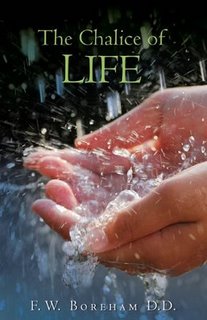
In addition to the forthcoming FW Boreham book, The Chalice of Life

The book, A Packet of Surprises: The Best Essays and Sermons of F W Boreham, can be ordered by contacting Mike Dalton.

Geoff Pound has also generously made available a copy of his Preface to this new book, which I reproduce here:

Selecting the Best

Choosing the best essays of F W Boreham is as excruciating as selecting some children to get the honors and telling the others that they did not make the grade. As mentioned in the preface to The Best Stories of F W Boreham the selection is subjective. But there is some rhyme and reason to the choices. Some were voted in by current Boreham readers so they appear by popular demand. Others are clearly Boreham’s choice or were popular in his day. His biographer, T Howard Crago, reported that ‘The Other Side of the Hill’ (a variation of which was entitled ‘The Sunny Side of the Ranges’, was an address delivered 80 times and ‘The House that Jack Built’ was given 140 times to churches that requested Dr Boreham to give this lecture to their community as a fund raiser.[1]

In compiling this selection an effort has been made to include essays on a range of themes, those which illustrate different homiletical methods and others that are drawn from different periods in Boreham’s career. The sermons, ‘Mind Your Own Business’, ‘He Made as Though’ and ‘A Prophet’s Pilgrimage’ represent extensive reflections on Biblical stories. The chapters entitled, ‘Dominoes’, ‘Please Shut the Gate!’ and ‘I.O.U.’ are fine examples of the way F W Boreham told parables by taking ordinary, everyday objects or expressions and skillfully helped his hearers to discover a deeper truth. The messages on the favorite texts of Catherine Booth, Fyodor Dostoyevsky and Abraham Lincoln are representative of the 100+ addresses in the most popular Boreham sermon series that are contained in the five books on the theme, ‘Texts that Made History’. ‘The Squirrel’s Dream’ and ‘Waiting for the Tide’ offer glimpses into the way F W Boreham used paintings to illustrate his themes.

The sermon ‘The Whisper of God’ may at face value have not made the cut in Boreham’s best but it is included because it is the best of his earliest sermons and it illustrates how his preaching changed in style, structure and length. His contemporary, J J North, judged Boreham’s early literary ventures to be “long-worded” because “the terse Boreham had not arrived.”[2] Amid the many admiring reviews, it was said of Boreham’s first volume of sermons, The Whisper of God, that “if illustrations and incidents did not jostle so thickly on the pages and the poetical quotations were remorselessly reduced the sermons would gain much in value.”[3] The Best Essays of F W Boreham demonstrates the way that Boreham worked hard to remodel his writing and preaching through such things as the removal of wordy clutter for it is clear to see the emergence of a simple and flowing style.

Genre

Already the terms ‘essay’, ‘sermon’, ‘lecture’ and ‘address’ have been used in this introduction. Some of the chapters in his books are clearly one genre or another but F W Boreham was, as Lindsay Newnham described, the great ‘recycler’ who suited his style to his audience and tweaked his material to fit the allotted time or word limits.[4]

In a review of the book A Bunch of Everlastings, Dr. James Hastings, editor of the famous Dictionary of the Bible, asked a question that many readers have asked: “Is Mr. Boreham able to preach such sermons as these, exactly as they are printed here? Their interest is undoubted and intense. For Mr. Boreham is an artist. Every sermon is constructed. Every thought is in its place, and appropriately expressed. And there are no marks left in the constructing. To the literary student, as to the average reader of sermons, every sermon is literature.” Howard Crago, (whose text was read by F W Boreham) answered, ‘The fact was, of course, that each of these sermons was preached from memory in almost the exact words in which it was printed.’”[5]

Truth through Personality

If the content of these sermons and lectures were word for word the same as what we read in this volume they do not convey fully the total impact of the preaching event—the pausing, the modulation of his voice, the twinkle in the eye and the response of his hearers. Fortunately Howard Crago has recorded this colourful insight into how one of F W Boreham’s addresses was received:

“As time went on and ‘The House That Jack Built’ grew in popularity, the lecturer developed it and perfected its delivery until the whole thing flowed on for more than an hour of fascinating elocution and magnificent eloquence. He himself revelled in reciting it, and the audience enjoyed it to the full while being unconsciously influenced by its gentle suggestiveness.”

“A typical audience-reaction was that of the Rev. C. Bernard Cockett, M.A., who, after hearing the lecture in a Surrey Hills church said, ‘It is not to be wondered at that individuals who appreciate the words of an author are interested in him as a man, lecturer and minister. Therefore, when the Rev. F. W. Boreham’s presence was heralded in a Melbourne suburb many people asked, `What is he like?’ `Can he speak and preach as well as write?’ `Has he personality and originality in the pulpit as well as in the study?’ Boreham came-spoke-and conquered! He spoke for an hour; but the minutes passed by on shimmering wings. He speaks quite as well as he writes—the voice is strong and sweet; ringing, yet winning, and the word lives in the message. ‘The House That Jack Built’ was a brilliant drama, staged and performed by the author. And his control of the audience! A happy and original introduction; apposite stories from history, science, and romance, related with telling effect; soft touches on the varying notes of the human soul, making it tremble with childlike laughter, and then a sudden chord of richer music with concentrated and arresting power—while the listener perceives God through smiles.’”

“Moving a vote of thanks at Wangaratta [Victoria], a local farmer expressed a good deal when he said, ‘I enjoyed the lecture because I could see that Mr. Boreham was enjoying it so much himself.’”[6]

Inflaming Passion

These essays and sermons have been brought together not for literary inspection and homiletical interest but so they might speak powerfully to readers in this contemporary age. F W Boreham believed in the importance of heroes, he devoted an entire chapter of his autobiography to two of his preaching models [7] and he encouraged preachers to study evangelistic models to “inflame your devotion.”[8]

But Boreham sounded a warning about copying the style of someone else. Writing on the topic, ‘A troop of apes’, he drew analogies from nature (lyre bird, jays, ostriches and apes) to state that, “life abounds in mimicry” and if our tendency to imitation is so strong and impossible to eradicate, then human beings must select “worthy models.”[9]

Be Yourself

The great hope for this new book is that it might stimulate among its readers one of the major themes of F W Boreham—that each person, with their God-given gifts might develop their unique style:

“He sees as nobody else sees. He must therefore paint or preach or pray or write as nobody else does. He must be himself: must see with his own eyes and utter that vision in the terms of his own personality.”[10]

[1] T Howard Crago, The Story of F W Boreham (London: Marshall, Morgan & Scott, 1961), 172-174. [2] J J North, New Zealand Baptist, April 1943. [3] Review of Whisper of God, (n.p., n.d.). This review appears in a cutting that Boreham kept in his own copy of his book Whisper of God. [4] Lindsay L Newnham, ‘Recycling by Dr F W Boreham’, Our Yesterdays 5 (Melbourne: Victorian Baptist Historical Society, 1997), 78. [5] Crago, The Story of F W Boreham, 179. [6] Crago, The Story of F W Boreham, 172-173. [7] F W Boreham, My Pilgrimage (London: The Epworth Press, 1940), 98-103. [8] F W Boreham, I Forgot to Say, 42. [9] F W Boreham, Mercury, 8 October 1955. [10] Boreham, Mercury, 9 September 1950.

A new Boreham book

Geoff Pound, who served as principal of Whitley Theological College where I trained, and who is something of a FW Boreham devotee (and a great guy), has announced that a new Boreham book, The Chalice of Life, has just hit the printers. This is exciting news, and worthy of a plug. As a taster, here’s Geoff’s ‘Foreword’ to the book:

This book is a collection of five addresses that F W Boreham delivered on some major stages of life and this quintet is accompanied by two further essays in which the author develops the theme of life’s milestones.

Most of these essays were written soon after Boreham attained the particular milestone even though for his later lecture series he gave them a polish and wrote a new one for a stage he had not written about earlier.

It is good to reflect on Frank Boreham’s life at the time he reached each age as he draws much upon his own experience. At the age of thirty (1901) F W Boreham was married with one daughter, he was pastor of the Mosgiel Baptist church in New Zealand, contributor to the Taieri Advocate and the Otago Daily Times, editor of the New Zealand Baptist, and President of the Baptist Union. At the age of forty (1911) he had two more daughters, was pastor of the Hobart Baptist Tabernacle, he had authored several books and he was soon to begin his marathon commitment with the Hobart Mercury. At the age of fifty (1921) Boreham was pastor of the Armadale Baptist church in Melbourne, he had fathered a boy and another daughter in this last decade and his publishing ministry was in top gear. At the age of sixty (1931) F W Boreham was officially retired from pastoral ministry and was serving as a minister-at-large, across the denominations of the church and undertaking preaching and teaching tours overseas. At the age of seventy (1941), Dr Boreham had published his autobiography, in which he signaled that he had entered into the final stage of life. This was not entirely accurate as he churned out several more books and his weekly ministry at Scot’s Church was blossoming.

It is interesting to note that F W Boreham did not have an article on Life at Twenty, especially as he was fond of quoting Southey who said, “However long a person’s life, the first twenty years represent by far the biggest half of it.”[1] It is also significant that Boreham did not appear to write an article on Life at Eighty, even though he was still publishing books and preaching weekly.

F W Boreham remarks in one of these addresses that the one thing that each of these milestones has is life. F W Boreham was a self-confessed “lover of life.”[2] This theme pulsates through this book and in all his writing and preaching. In an essay on the coming of Spring Boreham reflects on the source of his love for life when saying, “I have learned that my quenchless longing for life is, after all, all unconsciously, a secret, unutterable yearning after God; for how can you conceive of life apart from Him?[3]

Throughout the pages of this volume one feels the sheer exuberance that Boreham had for life. He is possessed with a sense of wonder about the newness of each day:

“Half the fun of waking up in the morning is the feeling that you have come upon a day that the world has never seen before, a day that is certain to do things that no other day has ever done. Half the pleasure of welcoming a new-born baby is the absolute certainty that here you have a packet of amazing surprises….Here is novelty, originality, an infinity of bewildering possibility.[4]

It is Frank Boreham’s love of life that motivates his curiosity and his ministry to people:

“I have so thoroughly relished the little bit of life that was doled out to me that I find myself clamoring for all the lives that I can see….the same hunger underlies my passion for biography and even my fondness for the Bible. …Life has been so sweet to me that I like to mark the relish with which others tell their enjoyment of it.[5]

F W Boreham was very attentive to anniversaries and he kept a ‘birthday book’ or Personal Almanac in which he recorded special dates. He noted down each year the arrival of the first swallow[6] and the exact day that the elms around his house, “attired themselves in their new spring dresses.”[7] Many of his editorials commenced with reference to the birth or death of his subject. Two of his books contain the word ‘milestone’ in the title. His autobiography is a comprehensive record of the important dates of his life and family and it describes the way he remembered and celebrated the key events of his ministry.

The Chalice of Life is not so much about the exact ages as the general stages of life—their pitfalls and their possibilities. What then was Boreham’s favorite stage in life? This question is like asking him to decide which of his children was his favorite. Concerning his three churches he spoke with equal warmth and affection, even though he highlighted their different qualities. In a similar fashion and at the risk of being told that “all his swans were geese” Boreham writes with high commendation of each age and stage of life. What is happening is akin to the way he explained his growing love for Australia, “Life has a wonderful way of coaxing us into a frame of mind in which we not only become reconciled to our lot: we actually fall in love with it.”[8]

In the final two essays of this book, ‘So It’s Your Birthday!’ and ‘Life’s Landmarks’, we see the way F W Boreham is not merely registering dates in a diary or counting commemorations on a calendar. His approach is to greet each day with expectancy and to make the momentous decisions with which life confronts us. F W Boreham claimed that the greatest day of a person’s life was not their birthday, their wedding anniversary or the date of their death but, “The greatest day in a man’s life is the day on which he finds himself overwhelmed and bowed to earth by a sense of the greatness of God.”[9]

Enjoy this book and most importantly, drink deeply from “the chalice of life.”[10]

Dr. Geoff Pound.

Image: Front cover of The Chalice of Life, so beautifully created by Laura Zugzda.

P.S. F W Boreham’s son, Frank, told me that his wife Betty did most of the proof reading of his books. The ship would dock in Melbourne, the proofs would be delivered the next day and FWB and Betty would read and make the corrections before the ship left in a couple of days to return to England. When the first copy of each new book appeared FWB would take it warmly, kiss it and pass it to other members of the family for them to do the same. Producing Boreham books was a concern and a delight of the whole Boreham family.
Footnotes
[1] F W Boreham, My Pilgrimage (London: The Epworth Press, 1940), 91.
[2] F W Boreham, The Golden Milestone (London: Charles H. Kelly, 1915), 9
[3] F W Boreham, The Three Half-Moons (London: The Epworth Press, 1929), 125.
[4] F W Boreham, Faces in the Fire (London: The Epworth Press, 1916), 14.
[5] F W Boreham, On the Other Side of the Hill (London: The Epworth Press, 1917), 173.
[6] Boreham, The Golden Milestone, 34.
[7] F W Boreham, The Passing of John Broadbanks (London: The Epworth Press, 1936), 261.
[8] Boreham, My Pilgrimage, 137.
[9] F W Boreham, A Witch’s Brewing (London: The Epworth Press, 1932), 155.
[10] F W Boreham, A Bunch of Everlastings (London: The Epworth Press, 1920), 88.

On Festschriften

One review I read recently described Festschriften as those ‘essays from the bottom drawer which could find no other home, and a disparate volume for which the many are asked to pay high prices for the sake of the few’. A bit harsh perhaps, but all too familiar isn’t it: volumes of essays with very little inter-connection, of interest to about 3 people in the world (including the authors’ mothers), and with a print run so small that basically only libraries can afford them, or remortgaging is required.

It made me wonder though, what is it that makes a good Festschrift? And what one/s have you placed on your must read list?

For my money, there’s four that jump to mind:

At least the first three of these volumes could not be accused of throwing the family budget into turmoil, and none of them of nebulous unrelated content. Each of them is packed with significant essays that contribute to not only some key themes explored by the one being honoured, but do so with a view to engaging with an ongoing conversation about those very themes in a way that will appeal to a wider audience.

But are there other criteria? Fidelity to the work/themes of the one being honoured? Brevity? Does it come with a DVD?

Thoughts?

[One I’m yet to read is Daniel J. Adams’ From East to West: Essays in Honor of Donald G. Bloesch. I’d be keen to hear from anyonwe who is familiar with this volume]

Around … [reloaded]

  • James Merrick reflects (with McCabe) on the politics of jubilee. He writes: ‘the antithesis of Jubilee is the politics of fear wherein one’s personal freedom conflicts with the freedom of others, where freedom is something protected not shared’.
  • John Stackhouse has posted 4 critical and (mostly) very fair reflections (here, here, here and here) on The Shack. [I’ve blogged on this book here and here].
  • Steve Holmes offers some valuable thoughts on the Christian duty to find error attractive.
  • The Worldwide Church of God have posted two short videos on CS Lewis shot on location in Oxford.
  • Ben Meyers points us towards some free MP3’s from St Vladimir’s Seminary Press.
  • Halden Doerge offers some helpful advice on reading Robert Jenson. [BTW. I just received my copy of Jenson’s A Large Catechism this week and am loving it … and now I’m very much anticipating the publication of his commentary on Ezekiel].
  • Richard Mouw seeks to make ‘a good case for “seeker sensitive” preaching by appealing to the authority of John Calvin’ and (hold your breath) Karl Barth!
  • Tim Keller recently gave an insightful apologetic talk on his The Reason for God as part of the Authors@Google series. It goes for just over an hour.
  • With no UK team in Euro 2008, how do Brits choose who to support? Well why not make the choice based on ethical criteria? The World Development Movement has created a handy website to aid that all important (read: completely arbitrary) choice of team(s) to support each match. It ranks each team using criteria such as: spending on the military and healthcare; corruption; contribution to climate change; and income inequality. Overall Sweden ranks as the most ‘ethical’ team in the competition, and Russia comes in last. [HT: New Statesman]
  • Damaris have produced and are now making available (free if you’re in the UK) some multimedia and study resources for schools and churches to complement the new Narnia flick, Prince Caspian (which is, btw, a much better-produced movie than The Lion, the Witch and the Wardrobe – which I thought totally stank]
  • Noam Chomsky was recently interviewed by Gabriel Mathew Schivone on the United States of Insecurity.
  • Coffee lovers might be interested in this interview with Michaele Weissman, author of God in a Cup: The Obsessive Quest for the Perfect Coffee.

Books, books, books

Ben, over at Faith and Theology, offers a wee review of Robert L. Short’s, The Parables of Dr. Seuss.

And while I’m mentioning books, I’ve been meaning for ages to draw attention to Amanda Craig, an author of five novels, and children’s book critic for The Times and columnist for The Sunday Times. Her site is a mine of helpful reviews and recommendations for children’s books, and anyone who loves all the Hairy Maclary books and is ‘increasingly resistant to pop-ups, and other gimmicks’ is already earning some major brownie points from me.

Fifty Prayers by Karl Barth

Kent draws our attention to a  new translation of Fifty Prayers by Karl Barth. This is very exciting, not least because these prayers issue from the pen of one for whom prayer was the first and basic act of theological work.

Lord our God, when we are afraid, do not permit us to doubt! When we are disappointed, let us not become bitter! When we have fallen, do not leave us lying down! When we have come to the end of our understanding and our powers, do not leave us to die! No, let us then feel your nearness and your love, that you have promised to those whose hearts are humble and broken, and who fear your Word (pp. 11-12)

Standard Operating Procedure

There’s a chilling-sounding new book out: Standard Operating Procedure, by Philip Gourevitch and Errol Morris. It’s the story of American soldiers who were sent to Iraq as ‘liberators’ only to find themselves working as jailers in Saddam Hussein’s old dungeons, responsible for implementing the sort of policy they were supposed to be fighting against. It is the story of a defining moment in the war, and a defining moment in our understanding of ourselves— – the story of the infamous Abu Ghraib photographs of prisoner abuse, as seen through the eyes, and told through the voices, of the soldiers who took them and appeared in them. It is the story of how those soldiers were at once the instruments of a great injustice and the victims of a great injustice.

Drawing on more than two hundred hours of Errol Morris’’s frank and intimate interviews with the soldier-photographers who gave us what have become the iconic images of the Iraq war, Standard Operating Procedure is a book that makes you see, and makes you feel, and above all makes you think about what it means to be human. It is an original book that stands to endure as essential reading long after the current war in Iraq passes from the headlines, and long after the current (and past) cronies in the US administration – and British and Australian Governments – have putted in their last golf ball laughing all the way that they have escaped the war crimes tribunals they so blatantly deserve to face, not to mention their copious violations of the Geneva Conventions. Americans, Brits and Aussies should (and many will) feel and bear the shame that attends such horrific actions.

On theological education

In Theological Reflection and Education for Ministry: The Search for Integration in Theology, John Paver observes that the credit for the definitive catergorisation in modern theology and its attendant implications for the training of pastoral ministers lays with Schleiermacher. He writes:

‘… including theology in a research university could be seen as a betrayal of the educational revolution that the research university represented. Schleiermacher had to answer to these objections if theology was to have a place so he added another pole [to the “Berlin” type of theological education] by advocating that theological education should constitute professional education. His argument was partly sociological and partly philosophical-theological. Schleiermacher’s sociological argument was that every human society has sets of practices dealing with bodily, health, social order, and religious needs. These are socially necessary for the well-being of society as a whole and each of these requires properly trained leadership. Schleiermacher’s philosophical-theological argument proposed that religions such as Christianity do not rest on principles, but on a kind of initiation or insightful experience, which can be the subject of philosophical enquiry. hence, Christian theology can be a subject of Wissenschaft enquiry without threat or compromise to Christianity’s integrity or the integrity of the university’. – John E. Paver, Theological Reflection and Education for Ministry: The Search for Integration in Theology (Aldershot: Ashgate, 2006), 8.

Paver’s essay is a significant contribution to the ever-burgeoning field of theological education, training for ministry practice, and pastoral supervision as a vehicle for theological reflection. Whether it justifies the £55 price tag is another story, but then that’s what libraries are for.

After War, Is Faith Possible?

Month after month, the amazing team at Wipf and Stock continue to make available an enormously helpful range of great books, not a few of which would simply be left to die (go out of print) if it were not for their ministries of discernment and resurrection. (Would that other publishing houses followed their lead!). They have recently announced the release of Geoffrey A. Studdert Kennedy’s After War, Is Faith Possible?: The Life and Message of Geoffrey “Woodbine Willie” Studdert Kennedy, edited by Kerry Walters. I have much appreciated being exposed to ‘Woodbine Willie’s’ thought in recent years, and very much look forward to reading this volume.

Here’s the wee endorsement from John Perry, SJ, Associate Professor, Arthur V. Mauro Center for Peace and Justice, St. Paul’s College, University of Manitoba:

Kerry Walters and Cascade Books deserve our thanks for retrieving for us in the twenty-first century, embroiled as we are in various violent conflicts, an accessible and coherent presentation of Studdert Kennedy’s early twentieth-century religious thought on war and its aftermath. Earning the nickname ‘Woodbine Willie’ from English soldiers he served as chaplain in the ‘Great War to end all wars,’ the cigarette-smoking padre knew firsthand the unspeakable horrors of war. He also knew that faith was not only possible after the hostilities ceased; it was necessary.

His was not a disembodied or privatized faith. He is especially helpful in linking the Eucharist with social justice. Although fellow Anglicans and interested Protestants may well treasure this collection of Studdert Kennedy’s writing, Roman Catholics like myself will appreciate his passionate love for the poor, wounded, and dying Christ and his commitment to the church, where he and others can insist that, indeed, after war faith is possible.

Marilynne Robinson’s Housekeeping

Having thoroughly enjoyed Marilynne Robinson’s Gilead some time ago, I’ve finally gotten around to ordering a copy of her Housekeeping. What spurred this huge plunge of a couple of pounds (33p +p/h) was this fan letter to Robinson posted in Sunday’s New York Times. Here’s a snippert:

There is something so familiar (and familial) in your book’s battle of chaos with humble order. There is a joy in its readiness to care and feed and rescue even the ghosted children. The house at its center reminds me of the house all children draw. There is the work’s certainty that Escape and Transcendence — across one suspended railroad tie at a time — is basically a normative day for most of us on earth.

What I find harder to describe … is how the novel “took” the colors of everyone’s recent struggles, their hard-won victories. Your book seemed to give back whatever a particular reader sought, and at whatever level of questioning could be offered during this reading of the novel. The work offers an un-saccharine promise: that struggle itself remains our sole guaranteed transcendence. A Protestant vision.

After much study, I don’t know how you did it. The book is so much about its making and yet all traces of construction seem obscured. “Housekeeping” seems the least autobiographical work I know and yet it’s also the one closest-in. It’s theological, but it always pertains as immediately as any fairy tale does. Harsh in its outcomes, it’s also a psychological work of such density, restraint. The limpid acceptance of death finds reflection in all its aqueous properties. There are few living males in it and little dry land. Somehow it starts with death and moves toward life, a reversal of most books I know.

I mention this because for the next fortnight, the NYT will be hosting a discussing of the book and some of my regular readers may be interested in getting on board. They’ve already posted the following links:

Commending Jesus Ascended

An enthusiastic plug: I’ve just finished reading Gerrit Scott Dawson’s Jesus Ascended: The Meaning of Christ’s Continuing Incarnation (London/Phillipsburg: T&T Clark/P&R Publishing, 2004). While I don’t have time to write up a review of it at the moment (though I hope to at some stage) I want to highly commend this excellent and very accessible study.

This is theology as it should be done: formed by scripture, with gratitude for the best of the tradition, and with eyes directed towards the church’s praxis in the world. A must read for pastors, worship leaders, missiologists, and anyone who prays – or wishes they did … and theologians! A taster:

Rejecting the story of Jesus at any point after his crucifixion completely skews the understanding of the church … A Christ who did not ascend has not established our primary identity in heaven, and he is not returning to bring in the new heavens and the new earth. (p. 149)

[Those interested may also like to read my review of a collection of papers edited by Dawson entitled An Introduction to Torrance Theology: Discovering the Incarnate Saviour]

April Book Notes – 1

While there certainly remains a place for more lengthy book reviews, I thought it might be useful to just pen a few very brief book notes (and give some scores – ♦ – out of 5) on some of the more significant books I read each month. So here’s a few from April so far. As you can see, I’ve been following a definite theme.

Geiko Müller-Fahrenholz, The Kingdom and the Power: The Theology of Jürgen Moltmann (trans. John Bowden; Minneapolis: Fortress Press, 2000).

This is one of the most helpful introductions to Moltmann’s thought available. Appreciative, but not uncritical at key points, Müller-Fahrenholz introduces us to the big themes in Moltmann’s major works. Recommended. ♦♦♦

Nigel M. de S. Cameron, ed., Universalism and the Doctrine of Hell: Papers Presented at the Fourth Edinburgh Conference on Christian Dogmatics, 1991 (Carlisle/Grand Rapids: Paternoster/Baker, 1993).

Like most collections of essays, this one is a bit hit and miss. The better essays are those by Trevor Hart, David Powys, TF Torrance and Henri Blocher. ♦♦½

Thomas Talbott, The Inescapable Love of God (Boca Raton: Universal, 1999).

See my review here. ♦♦♦

Robin A. Parry and Christopher H. Partridge, ed., Universal Salvation? The Current Debate (Carlisle: Paternoster, 2003).

This is a well chosen collection of essays and authors on a timely and important topic for evangelicals. It seeks to engage with Talbott’s thesis of dogmatic universalism which Talbott outlines in the first 3 chapters. His chapter on ‘Christ Victorious’ expands on what I believe is an underplayed theme in his The Inescapable Love of God, and so I was encouraged to see it included here. Biblical, philosophical, theological and historical responses are then offered. Talbott responds briefly in the final chapter. The best responses are those offered by Eric Reitan, David Hilborn and Don Horrocks. Overall, it’s a helpful discussion. It needs an index, but the book is worth buying for the bibliography alone. It’s 18 pages! ♦♦♦

Gregory MacDonald, The Evangelical Universalist (Eugene: Cascade Books, 2006).

This is the most well argued exegetical treatment on the subject of universalism currently available. It’s well written, and the combination of ‘MacDonald’s’ cogency of argument, respect for the Biblical texts, and personal humility as to his claims makes his advocacy of evangelical universalism most attractive. Those who disagree with his position will find here a case worthy of as humble response. Good bibliography, but no index. ♦♦♦♦

Rowan Williams, Tokens of Trust: An Introduction to Christian Belief (Norwich: Canterbury Press, 2007).

A beautifully-written reflection – it’s almost a poem – that deserves the widest readership. ♦♦♦♦

Hans Urs von Balthasar, Dare We Hope “That All Men Be Saved”? With a Short Discourse on Hell (Fort Collins: Ignatius Press, 1988).

While this wee book is not particularly well written (it may be better in the German), it’s almost impossible to put down, and it really does have not a few flashes of magnificent insight. Von Balthasar’s overall thesis regarding a hopeful universalism is attractive, even if not at every point convincing. His aggregating of quotes reminded me of Bloesch’s work (which I love). A good read. ♦♦♦½

Lindsey Hall, Swinburne’s Hell and Hick’s Universalism: Are we free to reject God? (Aldershot: Ashgate, 2003).

This is a helpfully lucid outline and critical response to important themes in the theology of Richard Swinburne and John Hick. While her own position is considerably more Hickian than perhaps most evangelical universalists will be comfortable with, Hall is to be commended for avoiding stereotypes and for offering a cogent contribution to an increasingly voluminous discussion on the question of Christian universalism. ♦♦♦

Richard Bauckham and Trevor Hart, Hope Against Hope: Christian Eschatology at the Turn of the Millennium (Grand Rapids/Cambridge: Eerdmans, 1999).

Richard Bauckham and Trevor Hart pair up again for this project that arose out of number of conferences and the result is a stunning collection of six essays on Christian hope – its context, its value, its basis, its power, its praxis, and its goal. Bauckham and Hart set out not merely to expose modernity’s myth of inevitable progress and postmodernity’s Nietzschian anti-metanarrative and deconstruction of mimetic imagination, but do so by laying before our eyes the broad and graced vision of God’s promises begun in the resurrection of Jesus Christ and fully realised in the new creation. Inspired by the work of Jürgen Moltmann (to whom the book is dedicated), this is a book that requires careful and reflective reading, stopping regularly to view the terrain, and then returning to again and again to grapple with its implications. This is one to buy, read, keep and re-read. [NB. This may be a biased note as Trevor is my doctoral supervisor]. ♦♦♦♦