Author: Jason Goroncy

Solzhenitsyn on the legalism that kills

‘Western society has given itself the organization best suited to its purposes, based, I would say, on the letter of the law. The limits of human rights and righteousness are determined by a system of laws; such limits are very broad. People in the West have acquired considerable skill in using, interpreting and manipulating law, even though laws tend to be too complicated for an average person to understand without the help of an expert. Any conflict is solved according to the letter of the law and this is considered to be the supreme solution. If one is right from a legal point of view, nothing more is required, nobody may mention that one could still not be entirely right, and urge self-restraint, a willingness to renounce such legal rights, sacrifice and selfless risk: it would sound simply absurd. One almost never sees voluntary self-restraint. Everybody operates at the extreme limit of those legal frames. An oil company is legally blameless when it purchases an invention of a new type of energy in order to prevent its use. A food product manufacturer is legally blameless when he poisons his produce to make it last longer: after all, people are free not to buy it.

I have spent all my life under a communist regime and I will tell you that a society without any objective legal scale is a terrible one indeed. But a society with no other scale but the legal one is not quite worthy of man either. A society which is based on the letter of the law and never reaches any higher is taking very scarce advantage of the high level of human possibilities. The letter of the law is too cold and formal to have a beneficial influence on society. Whenever the tissue of life is woven of legalistic relations, there is an atmosphere of moral mediocrity, paralyzing man’s noblest impulses.

And it will be simply impossible to stand through the trials of this threatening century with only the support of a legalistic structure’.

– Alexander Solzhenitsyn, ‘A World Split Apart’ (A paper presented at the Harvard Class Day Afternoon Exercises, Harvard University, Thursday, 8 June, 1978).

Solzhenitsyn on a decline in courage

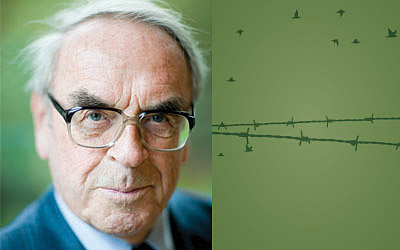
Apart from having a vodka or two, giving thanks to God, and spending some time today reading Solzhenitsyn, I wanted to find some other way to honour the life of a man who has taught me so much and with whose story I have journeyed so intimately. [The fact that my paternal grandmother is Russian and has lived under some of the same conditions as Solzhenitsyn brings his words just a little closer to home for me.] So over the next few days, I will post some excerpts from Solzhenitsyn’s famous lecture – ‘A World Split Apart’ – delivered at Harvard University in 1978. The entire lecture can be downloaded here. Here’s Solzhenitsyn on courage:

‘A decline in courage [. . .] may be the most striking feature which an outside observer notices in the West in our days. The Western world has lost its civil courage, both as a whole and separately, in each country, each government, each political party and of course in the United Nations. Such a decline in courage is particularly noticeable among the ruling groups and the intellectual elite, causing an impression of loss of courage by the entire society. Of course there are many courageous individuals but they have no determining influence on public life. Political and intellectual bureaucrats show depression, passivity and perplexity in their actions and in their statements and even more so in theoretical reflections to explain how realistic, reasonable as well as intellectually and even morally warranted it is to base state policies on weakness and cowardice. And decline in courage is ironically emphasized by occasional explosions of anger and inflexibility on the part of the same bureaucrats when dealing with weak governments and weak countries, not supported by anyone, or with currents which cannot offer any resistance. But they get tongue-tied and paralyzed when they deal with powerful governments and threatening forces, with aggressors and international terrorists. Should one point out that from ancient times decline in courage has been considered the beginning of the end?’ – Alexander Solzhenitsyn, ‘A World Split Apart’ (A paper presented at the Harvard Class Day Afternoon Exercises, Harvard University, Thursday, 8 June, 1978).

Aleksandr Isayevich Solzhenitsyn (1918-2008): Requiescat in pace

What an enormously courageous and prophetically-astute witness Solzhenitsyn has been to those with ears to hear. Appropriately, tributes are appearing all over the place to honour his life and work. He passed away today at the age of 89:

The obituary in the Chicago Tribune reads: MOSCOW (AP) — Alexander Solzhenitsyn, the Nobel Prize-winning author whose books chronicled the horrors of the Soviet gulag system, died Sunday. He was 89.

His son, Stepan Solzhenitsyn, said his father died of heart failure.

Solzhenitsyn’s unflinching accounts of torment and survival in the Soviet Union’s slave labor camps riveted his countrymen, whose secret history he exposed. They earned him 20 years of bitter exile but international renown and the Nobel Prize for Literature in 1970.

Beginning with the 1962 short novel “One Day in the Life of Ivan Denisovich,” Solzhenitsyn devoted himself to describing the human “meat grinder” that had caught him and millions of other Soviet citizens: capricious arrests, often for trifling and absurd reasons, followed by sentences to slave labor camps where cold, starvation and punishing work crushed inmates physically and spiritually.

His “Gulag Archipelago” trilogy of the 1970s shocked readers by describing the savagery of the Soviet state under dictator Josef Stalin. It helped erase sympathy for the Soviet Union among many leftist intellectuals.

But his account of that secret system of prison camps was also inspiring in its description of how one person — Solzhenitsyn himself — survived, physically and spiritually, in a penal system of soul-crushing hardship and injustice.

The West offered him shelter and accolades. But Solzhenitsyn’s refusal to bend despite enormous pressure, perhaps, also gave him the courage to criticize Western culture for what he considered its weakness and decadence.

Here’s some excerpts from his works:

‘We have to condemn publicly the very idea that some people have the right to repress others. In keeping silent about evil, in burying it so deep within us that no sign of it appears on the surface, we are implanting it, and it will rise up a thousandfold in the future. When we neither punish nor reproach evildoers, we are not simply protecting their trivial old age, we are thereby ripping the foundations of justice from beneath new generations. It is for this reason, and not because of the ‘weakness of indoctrinational work,’ that they are growing up ‘indifferent.’ Young people are acquiring the conviction that foul deeds are never punished on earth, that they always bring prosperity’. – The Gulag Archipelago, 1973

‘Standing there to be counted through the gate of an evening, back in camp after a whole day of buffeting wind, freezing cold and an empty belly, the zek longs for his ladleful of scalding hot watery evening soup as for rain in time of drought. He could knock it back in a single gulp. For the moment that ladleful means more to him than freedom, more than his whole past life, more than whatever life is left to him’. One Day in the Life of Ivan Denisovich, written 1959, published 1962

‘He had drawn many a thousand of these rations in prisons and camps, and … he knew no way of standing up for his rights, he, like every other prisoner, had discovered long ago that honest weight was never to be found in the bread-cutting. There was short weight in every ration. The only point was how short. So every day you took a look to soothe your soul – today, maybe, they haven’t snitched any’. – One Day in the Life of Ivan Denisovich, 1962

‘And all of a sudden the fateful gate swings quickly open, and four white male hands, unaccustomed to physical labor but nonetheless strong and tenacious, grab us by the leg, arm, collar, cap, ear, and drag us in like a sack, and the gate behind us, the gate to our past life, is slammed shut …’. – The Gulag Archipelago, 1973

‘On top of everything, the cancer wing was Number 13. Pavel Nikolayevich Rusanov had never been and could never be a superstitious person, but his heart sank when they wrote ‘Wing 13′ on his admission card. They should have had the ingenuity to assign number 13 to some kind of prosthetic or intestinal department’. – Cancer Ward, 1968

‘Sending ‘Gulag’ would be a rash, a very risky, business, but opportunities were few … Right, I would send it. The heart had surfaced from one anxiety only to plunge into another … Two novels of mine appearing simultaneously in the West? A double? I felt like the Hawaiian surf riders described by Jack London, standing upright on a smooth board … on the crest of the ninth wave …’. – The Oak and the Calf, 1980

‘Until I came to the West myself and spent two years looking around, I could never have imagined to what an extreme degree the West had actually become a world without a will, a world gradually petrifying in the face of the danger confronting it…All of us are standing on the brink of a great historical cataclysm, a flood that swallows up civilization and changes whole epochs’. – Testimony to the U.S. Congress, July 8 1975.

And in speech delivered at Harvard in June 8, 1978, he described the problems of both East and West as ‘a disaster’ rooted in agnosticism and atheism. They are ‘the calamity of an autonomous, irreligious humanistic consciousness … It has made man the measure of all things on earth—imperfect man, who is never free of pride, self-interest, envy, vanity, and dozens of other defects. We are now paying for the mistakes which were not properly appraised at the beginning of the journey. On the way from the Renaissance to our days we have enriched our experience, but we have lost the concept of a Supreme Complete Entity which used to restrain our passions and our irresponsibility’.

An interview with Solzhenitsyn

Der Spiegel have published this absolutely fascinating interview with Aleksander Solzhenitsyn [who, sadly, died today]:

SPIEGEL: Alexander Isayevich, when we came in we found you at work. It seems that even at the age of 88 you still feel this need to work, even though your health doesn’t allow you to walk around your home. What do you derive your strength from?

Solzhenitsyn: I have always had that inner drive, since my birth. And I have always devoted myself gladly to work — to work and to the struggle.

SPIEGEL: There are four tables in this space alone. In your new book “My American Years,” which will be published in Germany this fall, you recollect that you used to write even while walking in the forest.

Solzhenitsyn: When I was in the gulag I would sometimes even write on stone walls. I used to write on scraps of paper, then I memorized the contents and destroyed the scraps.

SPIEGEL: And your strength did not leave you even in moments of enormous desperation?

Solzhenitsyn: Yes. I would often think: Whatever the outcome is going to be, let it be. And then things would turn out all right. It looks like some good came out of it.

SPIEGEL: I am not sure you were of the same opinion when in February 1945 the military secret service arrested Captain Solzhenitsyn in Eastern Prussia. Because, in his letters from the front, Solzhenitsyn was unflattering about Josef Stalin, and the sentence for that was eight years in the prison camps.

Solzhenitsyn: It was south of Wormditt. We had just broken out of a German encirclement and were marching to Königsberg (now Kaliningrad) when I was arrested. I was always optimistic. And I held to and was guided by my views.

SPIEGEL: What views?

Solzhenitsyn: Of course, my views developed in the course of time. But I have always believed in what I did and never acted against my conscience.

SPIEGEL: Thirteen years ago when you returned from exile, you were disappointed to see the new Russia. You turned down a prize proposed by Gorbachev, and you also refused to accept an award Yeltsin wanted to give you. Yet now you have accepted the State Prize which was awarded to you by Putin, the former head of the FSB intelligence agency, whose predecessor the KGB persecuted and denounced you so cruelly. How does this all fit together?

Solzhenitsyn: The prize in 1990 was proposed not by Gorbachev, but by the Council of Ministers of the Russian Soviet Federative Socialist Republic, then a part of the USSR. The prize was to be for “The Gulag Archipelago.” I declined the proposal, since I could not accept an award for a book written in the blood of millions.

In 1998, it was the county’s low point, with people in misery; this was the year when I published the book “Russia in Collapse.” Yeltsin decreed I be honored the highest state order. I replied that I was unable to receive an award from a government that had led Russia into such dire straits.

The current State Prize is awarded not by the president personally, but by a community of top experts. The Council on Science that nominated me for the award and the Council on Culture that supported the idea include some of the most highly respected people of the country, all of them authorities in their respective disciplines. The president, as head of state, awards the laureates on the national holiday. In accepting the award I expressed the hope that the bitter Russian experience, which I have been studying and describing all my life, will be for us a lesson that keeps us from new disastrous breakdowns.

Vladimir Putin — yes, he was an officer of the intelligence services, but he was not a KGB investigator, nor was he the head of a camp in the gulag. As for service in foreign intelligence, that is not a negative in any country — sometimes it even draws praise. George Bush Sr. was not much criticized for being the ex-head of the CIA, for example.

SPIEGEL: All your life you have called on the authorities to repent for the millions of victims of the gulag and communist terror. Was this call really heard?

Solzhenitsyn: I have grown used to the fact that, throughout the world, public repentance is the most unacceptable option for the modern politician.

SPIEGEL: The current Russian president says the collapse of the Soviet Union was the largest geopolitical disaster of the 20th century. He says it is high time to stop this masochistic brooding over the past, especially since there are attempts “from outside,” as he puts it, to provoke an unjustified remorse among Russians. Does this not just help those who want people to forget everything that took place during the county’s Soviet past?

Solzhenitsyn: Well, there is growing concern all over the world as to how the United States will handle its new role as the world’s only superpower, which it became as a result of geopolitical changes. As for “brooding over the past,” alas, that conflation of “Soviet” and “Russian,” against which I spoke so often in the 1970s, has not passed away either in the West, or in the ex-socialist countries, or in the former Soviet republics. The elder political generation in communist countries was not ready for repentance, while the new generation is only too happy to voice grievances and level accusations, with present-day Moscow a convenient target. They behave as if they heroically liberated themselves and lead a new life now, while Moscow has remained communist. Nevertheless, I dare hope that this unhealthy phase will soon be over, that all the peoples who have lived through communism will understand that communism is to blame for the bitter pages of their history.

SPIEGEL: Including the Russians.

Solzhenitsyn: If we could all take a sober look at our history, then we would no longer see this nostalgic attitude to the Soviet past that predominates now among the less affected part of our society. Nor would the Eastern European countries and former USSR republics feel the need to see in historical Russia the source of their misfortunes. One should not ascribe the evil deeds of individual leaders or political regimes to an innate fault of the Russian people and their country. One should not attribute this to the “sick psychology” of the Russians, as is often done in the West. All these regimes in Russia could only survive by imposing a bloody terror. We should clearly understand that only the voluntary and conscientious acceptance by a people of its guilt can ensure the healing of a nation. Unremitting reproaches from outside, on the other hand, are counterproductive.

SPIEGEL: To accept one’s guilt presupposes that one has enough information about one’s own past. However, historians are complaining that Moscow’s archives are not as accessible now as they were in the 1990’s.

Solzhenitsyn: It’s a complicated issue. There is no doubt, however, that a revolution in archives took place in Russia over the last 20 years. Thousands of files have been opened; the researchers now have access to hundreds and thousands of previously classified documents. Hundreds of monographs that make these documents public have already been published or are in preparation. Alongside the declassified documents of the 1990’s, there were many others published which never went through the declassification process. Dmitri Volkogonov, the military historian, and Alexander Yakovlev, the ex-member of the Politburo — these people had enough influence and authority to get access to any files, and society is grateful to them for their valuable publications.

As for the last few years, no one has been able to bypass the declassification procedure. Unfortunately, this procedure takes longer than one would like. Nevertheless the files of the country’s most important archives, the National Archives of the Russian Federation (GARF), are as accessible now as in the 1990’s. The FSB sent 100,000 criminal- investigation materials to GARF in the late 1990s. These documents remain available for both citizens and researchers. In 2004-2005 GARF published the seven-volume “History of Stalin’s Gulag.” I cooperated with this publication and I can assure you that these volumes are as comprehensive and reliable as they can be. Researchers all over the world rely on this edition.

SPIEGEL: About 90 years ago, Russia was shaken first by the February Revolution and then by the October Revolution. These events run like a leitmotif through your works. A few months ago in a long article you reiterated your thesis once again: Communism was not the result of the previous Russian political regime; the Bolshevik Revolution was made possible only by Kerensky’s poor governance in 1917. If one follows this line of thinking, then Lenin was only an accidental person, who was only able to come to Russia and seize power here with German support. Have we understood you correctly?

Solzhenitsyn: No, you have not. Only an extraordinary person can turn opportunity into reality. Lenin and Trotsky were exceptionally nimble and vigorous politicians who managed in a short period of time to use the weakness of Kerensky’s government. But allow me to correct you: the “October Revolution” is a myth generated by the winners, the Bolsheviks, and swallowed whole by progressive circles in the West. On Oct. 25, 1917, a violent 24-hour coup d’etat took place in Petrograd. It was brilliantly and thoroughly planned by Leon Trotsky — Lenin was still in hiding then to avoid being brought to justice for treason. What we call “the Russian Revolution of 1917” was actually the February Revolution.

The reasons driving this revolution do indeed have their source in Russia’s pre-revolutionary condition, and I have never stated otherwise. The February Revolution had deep roots — I have shown that in “The Red Wheel.” First among these was the long-term mutual distrust between those in power and the educated society, a bitter distrust that rendered impossible any compromise, any constructive solutions for the state. And the greatest responsibility, then, of course falls on the authorities: Who if not the captain is to blame for a shipwreck? So you may indeed say that the February Revolution in its causes was “the results of the previous Russian political regime.”

But this does not mean that Lenin was “an accidental person” by any means; or that the financial participation of Emperor Wilhelm was inconsequential. There was nothing natural for Russia in the October Revolution. Rather, the revolution broke Russia’s back. The Red Terror unleashed by its leaders, their willingness to drown Russia in blood, is the first and foremost proof of it.

SPIEGEL: Your recent two-volume work “200 Years Together” was an attempt to overcome a taboo against discussing the common history of Russians and Jews. These two volumes have provoked mainly perplexity in the West. You say the Jews are the leading force of global capital and they are among the foremost destroyers of the bourgeoisie. Are we to conclude from your rich array of sources that the Jews carry more responsibility than others for the failed Soviet experiment?

Solzhenitsyn: I avoid exactly that which your question implies: I do not call for any sort of scorekeeping or comparisons between the moral responsibility of one people or another; moreover, I completely exclude the notion of responsibility of one nation towards another. All I am calling for is self-reflection.

You can get the answer to your question from the book itself: “Every people must answer morally for all of its past — including that past which is shameful. Answer by what means? By attempting to comprehend: How could such a thing have been allowed? Where in all this is our error? And could it happen again? It is in that spirit, specifically, that it would behoove the Jewish people to answer, both for the revolutionary cutthroats and the ranks willing to serve them. Not to answer before other peoples, but to oneself, to one’s consciousness, and before God. Just as we Russians must answer — for the pogroms, for those merciless arsonist peasants, for those crazed revolutionary soldiers, for those savage sailors.”

SPIEGEL: In our opinion, out of all your works, “The Gulag Archipelago” provoked the greatest public resonance. In this book you showed the misanthropic nature of the Soviet dictatorship. Looking back today, can you say to what extent it has contributed to the defeat of communism in the world?

Solzhenitsyn: You should not address this question to me — an author cannot give such evaluations.

SPIEGEL: To paraphrase something you once said, the dark history of the 20th century had to be endured by Russia for the sake of mankind. Have the Russians learned the lessons of the two revolutions and their consequences?

Solzhenitsyn: It seems they are starting to. A great number of publications and movies on the history of the 20th century — albeit of uneven quality — are evidence of a growing demand. Quite recently, the state-owned TV channel “Russia” aired a series based on Varlam Shalamov’s works, showing the terrible, cruel truth about Stalin’s camps. It was not watered down.

And, for instance, since last February I have been surprised and impressed by the large-scale, heated and long-lasting discussions that my previously written and now republished article on the February Revolution has provoked. I was pleased to see the wide range of opinions, including those opposed to mine, since they demonstrate the eagerness to understand the past, without which there can be no meaningful future.

SPIEGEL: How do you assess the period of Putin’s governance in comparison with his predecessors Yeltsin and Gorbachev?

Solzhenitsyn: Gorbachev’s administration was amazingly politically naïve, inexperienced and irresponsible towards the country. It was not governance but a thoughtless renunciation of power. The admiration of the West in r eturn only strengthened his conviction that his approach was right. But let us be clear that it was Gorbachev, and not Yeltsin, as is now widely being claimed, who first gave freedom of speech and movement to the citizens of our country.

Yeltsin’s period was characterized by a no less irresponsible attitude to people’s lives, but in other ways. In his haste to have private rather than state ownership as quickly as possible, Yeltsin started a mass, multi-billion-dollar fire sale of the national patrimony. Wanting to gain the support of regional leaders, Yeltsin called directly for separatism and passed laws that encouraged and empowered the collapse of the Russian state. This, of course, deprived Russia of its historical role for which it had worked so hard, and lowered its standing in the international community. All this met with even more hearty Western applause.

Putin inherited a ransacked and bewildered country, with a poor and demoralized people. And he started to do what was possible — a slow and gradual restoration. These efforts were not noticed, nor appreciated, immediately. In any case, one is hard pressed to find examples in history when steps by one country to restore its strength were met favorably by other governments.

SPIEGEL: It has gradually become clear to everyone that the stability of Russia is of benefit to the West. But there is one thing that surprises us in particular: When speaking about the right form of statehood for Russia, you were always in favor of civil self- government, and you contrasted this model with Western democracy. After seven years of Putin’s governance we can observe totally the opposite phenomenon: Power is concentrated in the hands of the president, everything is oriented toward him.

Solzhenitsyn: Yes, I have always insisted on the need for local self-government for Russia, but I never opposed this model to Western democracy. On the contrary, I have tried to convince my fellow citizens by citing the examples of highly effective local self-government systems in Switzerland and New England, both of which I saw first-hand.

In your question you confuse local self-government, which is possible on the most grassroots level only, when people know their elected officials personally, with the dominance of a few dozen regional governors, who during Yeltsin’s period were only too happy to join the federal government in suppressing any local self-government initiatives.

Today I continue to be extremely worried by the slow and inefficient development of local self-government. But it has finally started to take place. In Yeltsin’s time, local self-government was actually barred on the regulatory level, whereas the state’s “vertical of power” (i.e. Putin’s centralized and top-down administration) is delegating more and more decisions to the local population. Unfortunately, this process is still not systematic in character.

SPIEGEL: But there is hardy any opposition.

Solzhenitsyn: Of course, an opposition is necessary and desirable for the healthy development of any country. You can scarcely find anyone in opposition, except for the communists, just like in Yeltsin’s times. However, when you say “there is nearly no opposition,” you probably mean the democratic parties of the 1990s. But if you take an unbiased look at the situation: there was a rapid decline of living standards in the 1990s, which affected three quarters of Russian families, and all under the “democratic banner.” Small wonder, then, that the population does not rally to this banner anymore. And now the leaders of these parties cannot even agree on how to share portfolios in an illusory shadow government. It is regrettable that there is still no constructive, clear and large-scale opposition in Russia. The growth and development of an opposition, as well as the maturing of other democratic institutions, will take more time and experience.

SPIEGEL: During our last interview you criticized the election rules for State Duma deputies, because only half of them were directly elected in their constituencies, whereas the other half, representatives of the political parties, were dominant. After the election reform made by president Putin, there is no direct constituency at all. Is this not a step back?

Solzhenitsyn: Yes, I think it is a mistake. I am a convinced and consistent critic of “party-parliamentarism.” I am for non-partisan elections of true people’s representatives who are accountable to their regions and districts; and who in case of unsatisfactory work can be recalled. I do understand and respect the formation of groups on economical, cooperative, territorial, educational, professional and industrial principles, but I see nothing organic in political parties. Politically motivated ties can be unstable and quite often they have selfish ulterior motives. Leon Trotsky said it accurately during the October Revolution: “A party that does not strive for the seizure of power is worth nothing.” We are talking about seeking benefit for the party itself at the expense of the rest of the people. This can happen whether the takeover is peaceful or not. Voting for impersonal parties and their programs is a false substitute for the only true way to elect people’s representatives: voting by an actual person for an actual candidate. This is the whole point behind popular representation.

SPIEGEL: In spite of high revenues from oil and gas exports, in spite of the development of a middle class, there is a vast contrast between rich and poor in Russia. What can be done to improve the situation?

Solzhenitsyn: I think the gap between the rich and the poor is an extremely dangerous phenomenon in Russia and it needs the immediate attention of the state. Although many fortunes were amassed in Yeltsin’s times by ransacking, the only reasonable way to correct the situation today is not to go after big businesses — the present owners are trying to run them as effectively as they can — but to give breathing room to medium and small businesses. That means protecting citizens and small entrepreneurs from arbitrary rule and from corruption. It means investing the revenues from the national natural resources into the national infrastructure, education and health care. And we must learn to do so without shameful theft and embezzlement.

SPIEGEL: Does Russia need a national idea, and what might it look like?

Solzhenitsyn: The term “national idea” is an unclear one. One might think of it as a widely shared understanding among a people as to the desired way of life in their country, an idea that holds sway over the population. A unifying concept like that can be useful, but should never be created artificially or imposed top-down by the powers-that-be.

Over the latest historical periods these concepts have been developed in France, for example after the eighteenth century, in the United Kingdom, the United States, Germany, Poland etc. When the whole discussion of “developing a national idea” hastily began in post-Soviet Russia, I tried to pour cold water on it with the objection that, after all the devastating losses we had experienced, it would be quite sufficient to have just one task: the preservation of a dying people.

SPIEGEL: But Russia often finds itself alone. Recently relations between Russia and the West have gotten somewhat colder, and this includes Russian-European relations. What is the reason? What are the West’s difficulties in understanding modern Russia?

Solzhenitsyn: I can name many reasons, but the most interesting ones are psychological, i.e. the clash of illusory hopes against reality. This happened both in Russia and in West. When I returned to Russia in 1994, the Western world and its states were practically being worshipped. Admittedly, this was caused not so much by real knowledge or a conscious choice, but by the natural disgust with the Bolshevik regime and its anti-Western propaganda.

This mood started changing with the cruel NATO bombings of Serbia. It’s fair to say that all layers of Russian society were deeply and indelibly shocked by those bombings. The situation then became worse when NATO started to spread its influence and draw the ex-Soviet republics into its structure. This was especially painful in the case of Ukraine, a country whose closeness to Russia is defined by literally millions of family ties among our peoples, relatives living on different sides of the national border. At one fell stroke, these families could be torn apart by a new dividing line, the border of a military bloc.

So, the perception of the West as mostly a “knight of democracy” has been replaced with the disappointed belief that pragmatism, often cynical and selfish, lies at the core of Western policies. For many Russians it was a grave disillusion, a crushing of ideals.

At the same time the West was enjoying its victory after the exhausting Cold War, and observing the 15-year-long anarchy under Gorbachev and Yeltsin. In this context it was easy to get accustomed to the idea that Russia had become almost a Third World country and would remain so forever. When Russia started to regain some of its strength as an economy and as a state, the West’s reaction — perhaps a subconscious one, based on erstwhile fears — was panic.

SPIEGEL: The West associated it with the ex-superpower, the Soviet Union.

Solzhenitsyn: Which is too bad. But even before that, the West deluded itself — or maybe conveniently ignored the reality — by regarding Russia as a young democracy, whereas in fact there was no democracy at all. Of course Russia is not a democratic country yet; it is just starting to build democracy. It is all too easy to take Russia to task with a long list of omissions, violations and mistakes.

But did not Russia clearly and unambiguously stretch its helping hand to the West after 9/11? Only a psychological shortcoming, or else a disastrous shortsightedness, can explain the West’s irrational refusal of this hand. No sooner did the USA accept Russia’s critically important aid in Afghanistan than it immediately started making newer and newer demands. As for Europe, its claims towards Russia are fairly transparently based on fears about energy, unjustified fears at that.

Isn’t it a luxury for the West to be pushing Russia aside now, especially in the face of new threats? In my last Western interview before I returned to Russia (for Forbes magazine in April 1994) I said: “If we look far into the future, one can see a time in the 21st century when both Europe and the USA will be in dire need of Russia as an ally.”

SPIEGEL: You have read Goethe, Schiller and Heine in the original German, and you have always hoped that Germany would be something of a bridge between Russia and the rest of the world. Do you believe Germans can still play this role?

Solzhenitsyn: I do. There is something predetermined in the mutual attraction between Germany and Russia. Otherwise, this attraction would not have survived two ghastly World Wars.

SPIEGEL: Which German poets, writers and philosophers have influenced you the most?

Solzhenitsyn: Schiller and Goethe were very much present in my childhood and adolescence. Later I was drawn by Schelling. I highly appreciate the great German musical tradition. I can’t imagine my life without Bach, Beethoven and Schubert.

SPIEGEL: The West knows nearly nothing about modern Russian literature. What is, in your opinion, the situation in Russian literature today?

Solzhenitsyn: Periods of rapid and fundamental change were never favorable for literature. Significant works, not to mention great works, have nearly always and everywhere been created in periods of stability, be it a good or a bad stability. Modern Russian literature is no exception. The educated reader today is much more interested in non-fiction — memoirs, biographies, and documentary prose. However, I do believe that justice and conscience will not be cast to the four winds, but will remain in the foundations of Russian literature, so that it may be of service in brightening our spirit and enhancing our comprehension.

SPIEGEL: The idea of the influence of Orthodox Christianity on the Russian world can be traced throughout your works. What is the moral qualification of the Russian church? We think it is turning into a state church today, just like it was centuries ago — an institution that in practice legitimizes the head of Kremlin as the representative of God.

Solzhenitsyn: On the contrary, we should be surprised that our church has gained a somewhat independent position during the very few years since it was freed from total subjugation to the communist government. Do not forget what a horrible human toll the Russian Orthodox Church suffered throughout almost the entire 20th century. The Church is just rising from its knees. Our young post-Soviet state is just learning to respect the Church as an independent institution. The “Social Doctrine” of the Russian Orthodox Church, for example, goes much further than do government programs. Recently Metropolitan Kirill, a prominent expounder of the Church’s position, has made repeated calls for reforming the taxation system. His views are quite different from those of government, yet he airs them in public, on national television. As for “legitimizing the head of Kremlin,” do you mean the funeral service for Yeltsin in the main cathedral and the decision not to hold a civil funeral ceremony?

SPIEGEL: That too.

Solzhenitsyn: Well, it was probably the only way to keep in check public anger, which has not fully subsided, and avoid possible manifestations of anger during the burial. But I see no reason to treat the ceremony as the new protocol for the funerals of all Russian presidents in the future. As far as the past is concerned, our Church holds round-the-clock prayers for the repose of the victims of communist massacres in Butovo near Moscow, on the Solovetsky Islands and other places of mass burials.

SPIEGEL: In 1987 in your interview with SPIEGEL founder Rudolf Augstein you said it was really hard for you to speak about religion in public. What does faith mean for you?

Solzhenitsyn: For me faith is the foundation and support of one’s life.

SPIEGEL: Are you afraid of death?

Solzhenitsyn: No, I am not afraid of death any more. When I was young the early death of my father cast a shadow over me — he died at the age of 27 — and I was afraid to die before all my literary plans came true. But between 30 and 40 years of age my attitude to death became quite calm and balanced. I feel it is a natural, but no means the final, milestone of one’s existence.

SPIEGEL: Anyhow, we wish you many years of creative life.

Solzhenitsyn: No, no. Don’t. It’s enough.

SPIEGEL: Alexander Isayevich, we thank you for this interview.

Interview conducted by Christian Neef and Matthias Schepp.

Source: Der Spiegel

In praise of beer … some be[er]atitudes

  • Not all chemicals are bad. Without chemicals such as hydrogen and oxygen, for example, there would be no way to make water, a vital ingredient in beer. – Dave Barry
  • Nothing quenches the thirst like a wheat beer, or sharpens the appetite like an India pale ale. Nothing goes as well with seafood as a dry porter or stout, or accompanies chocolate like an imperial stout. Nothing soothes like a barley wine. These are just a few of the specialty styles of beer. – Michael Jackson
  • So popular is beer, the world’s best-selling alcoholic drink, that it is often taken for granted. Yet scientific analysis shows that a glass of beer has within it as many aromas and flavors as fine wine. Not everyone understands this, but an increasing number of people do. – Michael Jackson
  • Whoever makes a poor beer is transferred to the dung-hill. – Edict, City of Danzig, 11th Century
  • Beer drinking doesn’t do half the harm as love-making. – Anonymous
  • Fermentation and civilization are inseparable. – John Ciardi (1916-1986)
  • Give me a woman who truly loves beer, and I will conquer the world. – Kaiser Wilhelm II (1859-1941)
  • He who drinks beer sleeps well/He who sleeps well cannot sin/He who does not sin goes to heaven/Amen. – Unknown German Monk
  • It is better to think of church in the ale-house than to think of the ale-house in church. – Martin Luther (1483-1546)
  • The selling of bad beer is a crime against Christian love. – Law, the City of Augsburg, 13th Century
  • A good local pub has much in common with a church, except that a pub is warmer, and there’s more conversation. – William Blake
  • Beer is proof that God loves us. – Ben Franklin
  • It is my design to die in the brew-house; let ale be placed to my mouth when I am expiring, that when the choirs of angels come, they may say, “Be God propitious to this drinker.” – Saint Columbanus, AD 612
  • From man’s sweat and God’s love, beer came into the world. – Saint Arnoldus
  • God made yeast, as well as dough, and loves fermentation just as dearly as he loves vegetation. – Ralph Waldo Emerson (1803-1882)
  • There are more old drunks than old doctors. – Anonymous
  • Of doctors and medicines we have in plenty more than enough … what you may, for the Love of God, send is some large quantity of beer. – Dispatch from the Colony, New South Wales, 1854
  • The Puritanical nonsense of excluding children and therefore to some extent women from pubs has turned these places into mere boozing shops instead of the family gathering places that they ought to be. – George Orwell (1903-1950)
  • Beer makes you feel the way you ought to feel without beer. – Henry Lawson
  • Wine is but single broth, ale is meat, drink, and cloth. – 16th Century English Proverb
  • At social parties no gentleman ever thought of leaving the table sober; the host would have considered it a slight on his hospitality. – F.W. Hackwood, comment on manners, 18th Century England
  • Beer … “a high and mighty liquor.” – Julius Caesar
  • Of beer, an enthusiast has said that it could never be bad, but that some brands might be better than others. – A.A. Milne
  • Beer, of course, is actually a depressant, but poor people will never stop hoping otherwise. – Curt Vonnegut, Jr., Hocus Pocus, 1990
  • He is not deserving the name of Englishman who speaketh against ale, that is, good ale. – George Borrow (1803-1881)
  • Ere’s to English women an’ a quart of English beer. – Rudyard Kipling
  • For a quart of Ale is a dish for a King. – Shakespeare (A Winter’s Tale)
  • I would give all my fame for a pot of ale and safety. – William Shakespeare (King Henry V)
  • There’s nothing as heartening as the sight of an empty pub in the morning, the shelves full and everything spick and span before the barbarian hordes come in. Them that drinks bottles spoil the look of the shelves but draught is a different story – you never see the barrel going down. – Patrick McGinley
  • No poems can live long or please that are written by water-drinkers. – Horace 65-8 BC
  • Work is the curse of the drinking classes. – Oscar Wilde
  • When I read about the evils of drinking, I gave up reading. – Henny Youngman
  • I’d rather have a bottle in front of me, than a frontal lobotomy. – Tom Waits
  • Beer is good food. – John Goodman
  • All other nations are drinking Ray Charles beer and we are drinking Barry Manilow. – Dave Barry
  • Without question, the greatest invention in the history of mankind is beer. Oh, I grant you that the wheel was also a fine invention, but the wheel does not go nearly as well with pizza. – Dave Barry’s Bad Habits
  • The problem with the world is that everyone is a few drinks behind. – Humphrey Bogart

    Photograph by Daniel Foucachon (http://www.foucachon.com)

  • Give a man a fish and he will eat for a day. Teach him how to fish, and he will sit in a boat and drink beer all day.
  • Give a man a beer, and he wastes an hour, but teach a man how to brew, and he wastes a lifetime.
  • He that buys land buys many stones, He that buys flesh buys many bones, He that buys eggs buys many shells, But he that buys good ale buys nothing else. – John Ray
  • Draft beer, not people.
  • People who drink light ‘beer’ don’t like the taste of beer; they just like to pee alot. – Capital Brewery, Middleton
  • Beer will always have a definite role in the diet of an individual and can be considered a cog in the wheel of nutritional foods. – Bruce Carlton
  • No soldier can fight unless he is properly fed on beef and beer. – John Churchill, First Duke of Marlborough
  • Always remember that I have taken more out of alcohol than alcohol has taken out of me. – Winston Churchill
  • Make sure that the beer – four pints a week – goes to the troops under fire before any of the parties in the rear get a drop. – Winston Churchill to his Secretary of War, 1944
  • ‘Sir, if you were my husband, I would poison your drink.’ – Lady Astor to Winston Churchill; ‘Madam, if you were my wife, I would drink it.’ – His reply
  • If God had intended us to drink beer, He would have given us stomachs. – David Daye
  • If you ever reach total enlightenment while drinking beer, I bet it makes beer shoot out your nose. – Deep Thought, Jack Handy
  • Sometimes when I reflect back on all the beer I drink I feel ashamed – Then I look into the glass and think about the workers in the brewery and all of their hopes and dreams. If I didn’t drink this beer, they might be out of work and their dreams would be shattered. Then I say to myself, ‘It is better that I drink this beer and let their dreams come true than be selfish and worry about my liver.’ – Deep Thought, Jack Handy
  • A woman drove me to drink and I didn’t even have the decency to thank her. – W.C. Fields
  • Everybody has to believe in something. … I believe I’ll have another drink. – W.C. Fields
  • I am a firm believer in the people. If given the truth, they can be depended upon to meet any national crisis. The great point is to bring them the real facts, and beer. – Abraham Lincoln
  • We old folks have to find our cushions and pillows in our tankards. Strong beer is the milk of the old. – Martin Luther
  • Prohibition makes you want to cry into your beer and denies you the beer to cry into. – Don Marquis
  • Why is American beer served cold? So you can tell it from urine. – David Moulton
  • He was a wise man who invented beer. – Plato
  • I would kill everyone in this room for a drop of sweet beer. – Homer Simpson
  • All right, brain, I don’t like you and you don’t like me – so let’s just do this and I’ll get back to killing you with beer. – Homer Simpson
  • I feel sorry for people who don’t drink. When they wake up in the morning, that’s as good as they’re going to feel all day. – Frank Sinatra
  • [I recommend] … bread, meat, vegetables and beer. -Sophocles’ philosophy of a moderate diet
  • This is grain, which any fool can eat, but for which the Lord intended a more divine means of consumption … Beer! – Robin Hood, Prince of Thieves, Friar Tuck
  • Fermentation may have been a greater discovery than fire. – David Rains Wallace
  • Beer: So much more than just a breakfast drink. – Whitstran Brewery sign
  • You can’t be a real country unless you have a beer and an airline – it helps if you have some kind of a football team, or some nuclear weapons, but at the very least you need a beer. – Frank Zappa
  • It is disgusting to note the increase in the quantity of coffee used by my subjects and the amount of money that goes out of the country in consequence. Everybody is using coffee. If possible, this must be prevented. My people must drink beer. – Frederick the Great
  • It was as natural as eating and, to me, as necessary. I would not have thought of eating a meal without drinking a beer. – Ernest Hemingway
  • Keep your libraries, your penal institutions, your insane-asylums … give me beer. You think man needs rule, he needs beer. The world does not need morals, it needs beer … The souls of men have been fed with indigestibles, but the soul could make use of beer. – Henry Miller
  • In my opinion, most of the great men of the past were only there for the beer. – Alan John Percivale Taylor, British historian (1906-1990)
  • Nothing quenches the thirst like a Wheat Beer, or sharpens the appetite like an India Pale Ale. Nothing goes as well with seafood as a Dry Porter or Stout, or accompanies chocolate like an Imperial Stout. Nothing soothes like a Barley Wine. These are just a few of the specialty styles of beer.” – Michael Jackson
  • Malt does more than Milton can/To justify God’s ways to Man.- A.E. Housman

[If you know of any more notes of praise for ‘the world’s oldest and most consumed alcoholic beverage’ then post in the comments]

Hegel and Barth: thinking more and thinking differently

The more I read Ricoeur, the more I like him. I’m currently reading his collection of essays in Figuring the Sacred. In one particularly-powerful essay, he gives us two more reasons why we should not neglect reading Hegel and Barth: ‘With Hegel we try to think more, with Barth to think differently’. – Paul Ricoeur, ‘Evil: a Challenge to Philosophy and Theology’, in Figuring the Sacred: Religion, Narrative, and Imagination (ed. Mark I. Wallace; Minneapolis: Fortress, 1995), 256.

And from the same essay, this provocative claim: ‘Suffering is only a scandal for the person who understands God to be the source of everything that is good in creation, including our indignation against evil, our courage to bear it, and our feeling of sympathy towards victims. In other words, we believe in God in spite of evil. To believe in God in spite of … is one of the ways in which we can integrate the speculative aporia into the work of mourning’. (p. 260)

Karl Heim on guilt, the absolute evil

‘Guilt alone is the absolute evil, the absolutely terrible and unbearable, the simply irrevocable loss. Compared to guilt all else that may be terrible in the world is very slight indeed. If one weighs guilt against all other suffering in the world, unhappy love which makes life a hell, life-long hard labour in the mines of Siberia, continuous suffering from cancer without any hope but the prospect of a painful death, softening of the brain leading to madness, epilepsy with increasing stupefaction – the guilt will easily outweigh all the other evils in the scale. And if on the other hand we think of all that the world offers by way of good things, then all the riches, power and happiness of the world cannot balance and replace the damage caused by one guilty act’. – Karl Heim, Jesus the World’s Perfector: The Atonement and the Renewal of the World (trans. D.H. van Daalen; Edinburgh/London: Oliver and Boyd, 1959), 15.

The Theology of the Cross in Historical Perspective: A Review

Anna Madsen, The Theology of the Cross in Historical Perspective (Eugene: Pickwick Publications, 2007. ix + 269 pages. ISBN: 978-1-59752-835-1. Review copy courtesy of Wipf and Stock.

It is encouraging to see a growing stream of books dedicated to engaging with the work of Jürgen Moltmann. I have just finished reading Anna Madsen’s ambitious study The Theology of the Cross in Historical Perspective (Eugene: Pickwick Publications, 2007), part of the young ‘Distinguished Dissertations in Christian Theology’ series that Wipf and Stock are co-sponsoring with the journal Word and World: Theology for Christian Ministry and with the Christian Theological Research Fellowship (CTRF). In this book, this Assistant Professor of Religion at Augustana College in South Dakota (USA) traces the currents of a theology of the cross in St Paul, Luther, von Loewenich, Kitamori and Moltmann, before turning our gaze towards Feminist and Liberationist evaluations and applications of a theologia crucis.

On Luther, the author reminds us that we miss the whole catalyst for the German monks’ revolutionary theological advance when we divorce his theologia crucis from the context of the Church’s appeal for alms in the form of indulgences. The issue, she claims, is that God can not be ‘bought off’.

She explores the twentieth century’s witnessing of a variety of theologies of the cross, some of which, ironically, actually call for the cross itself to be discarded on the grounds that it symbolises (and glorifies) not hope but only violence. The tired divine child-abuse paradigms are briefly discussed. Conversely, Madsen observes that there remain those who insist that in the face of unparalleled and devastating poverty, destruction, abuse, exploitation and suffering, the cross provides the only interpretive tool which theology can offer. Specifically, the cross becomes the symbol to announce God’s full identification with the sufferers and God’s condemnation of the privileged. An adequate critique of this liberationist reading is not forthcoming in this volume.

The section on Moltmann (pp. 181-207) serves as a particularly helpful introduction to Moltmann’s theology as a whole, especially for those unfamiliar with the work of this creative and Reformed theologian. That it is explored in the context of a theological tradition from Paul through Luther et al makes it all the more helpful, for, as Madsen notes, no matter how much Moltmann’s theology of the cross consciously attends to life post-Auschwitz and more consciously extends justification as that which leads to justice-seeking, it remains fundamentally dependent upon Luther’s.

Madsen’s study argues that while there is no uniform theology of the cross, ‘Paul’s approach provides the soundest and most comprehensive’ vista, not least because his is a theology most elucidated not in isolation from but rather vis-à-vis the resurrection. Paul’s theology of the cross is, therefore, (while its various tones and emphases were always determined by its context) that which always concerns the removal of boundaries – both horizontal and vertical. Still, Madsen concludes, the theology of the cross remains that which announces that ‘God is found in death … in the death of sin, of suffering, of uncertainty’, and is marked by service, and is that which assures the people of God that God is present. It is therefore a theology of grace, of freedom and trust. Moreover, without a theology of the cross, she insists, it is unclear what the Church is called to be and to preach.

I warmly commend Madsen’s study as an accessible contribution to a topic at the heart of Christian good news, and as a valuable introduction to work by von Loewenich and Forde (On Being a Theologian of the Cross remains, to my mind, one of the best introductions to Luther’s theology available, alongside Randall Zachman’s The Assurance of Faith, with which, oddly, Madsen fails to engage), Moltmann and Sölle, Sobrino and Gutierrez. It is a clearly-written and pastorally-aware study … and it’s got a beautiful cover!

Back to Moltmann studies: Alongside Madsen’s study, I also have on my desk another book that engages with Moltmann’s thought: Tim Chester’s, Mission and the Coming of God: Eschatology, the Trinity and Mission in the Theology of Jürgen Moltmann (Milton Keynes: Paternoster, 2006). I’m hoping to read and post a review of it sometime soon(ish). Also, Ashgate recently announced that 2009 will witness the arrival of Timothy Harvie’s book, Jürgen Moltmann’s Ethics of Hope: Eschatological Possibilities for Moral Action (Aldershot: Ashgate, 2009). Paternoster too are planning to publish Nik Ansell’s insightful study, The Annihilation of Hell: Universal Salvation and the Redemption of Time in the Eschatology of Jürgen Moltmann.

Again, it’s encouraging to see these studies appearing. Moltmann’s work deserves the attention, and critical evaluation.

Around the traps …

  • Michael reviews Third Day’s new album ‘Revelation’
  • Ben reviews Engaging the Doctrine of God: Contemporary Protestant Perspectives
  • Reno informs us of some a soon-to-released collection of essays on Tolkien
  • Trevor offers some helpful tips on guiding children’s learning
  • Mike conintues his series on the body’s grace – on why sex is ‘always more complicated, and more risky’ than we often think – here and here.
  • James Panero asks: ‘What is art criticism today if not a muddied profession?’

Books worth waiting for: Ansell on Moltmann, and Williams on Dostoeveky

Every now and again, there comes along the book that you just can’t wait to read. For me, at the moment there are two deserving of that honour: First, there’s a excellent study that I’m currently reading by Nik Ansell entitled, The Annihilation of Hell: Universal Salvation and the Redemption of Time in the Eschatology of Jürgen Moltmann (soon to be published by Paternoster). This is a laudable first-rate study.

The other is a study on Dostoevsky by Rowan Williams entitled Dostoevsky: Language, Faith, and Fiction. I’ve just ordered my copy. William’s Grace and Necessity is one the most exciting theological books I’ve read, and I’m predicting that Dostoevsky will be just as thrilling. I mean seriously, who better to write a study on the world’s greatest writer than one who has so plunged the (theological) depths of the Russian psyche and who appears to be continuously working through the implications of what it means that grace has encountered the human than Williams! In the meantime here’s what the reviewers are saying:

‘Reading Dostoevsky is like looking from a high peak at several mountain ranges, some brightly lit, others dark with mist, going back farther than the eye can see. In this breathtaking book, Rowan Williams takes us on a journey through literary art, the nature of fiction, psychological depths, historical and cultural setting and allusion, and beyond all else a world of faith and doubt, of philosophy and theology not dry on the page but moist with tears of compassion. We return to Dostoevsky with new insight and wide-ranging understanding and to real life with fresh perspectives on what it means to be human, to be under threat from the demonic, and above all to sense the dark and urgent presence of the living God’. – N.T. Wright, Bishop of Durham

‘Rowan Williams here reveals the originality and daring that have made him such a controversial (and inspiring) leader of his church. The readings demonstrate an impressive grasp of current scholarly criticism of Dostoevsky. But this is not just another book about Dostoevsky. The literary interpretations are guided by an intense humanism that shares at points surprising parallels with radical leftist critiques. As author of a previous book of Sergej Bulgakov, Williams is at home in Russian philosophy, particularly the Orthodox emphasis on kenosis, the voluntary emptying out of Christ’s divine attributes during his time on earth. This aspect of Russian thought was important for Bakhtin, who serves as a kind of dialogic third partner in Williams conversation with his reader. This is a work of learning and passion, a heteroglot blend of literary, ethical, and subtle theological argument that is full of surprising local triumphs of interpretation — and that most un-academic virtue, wisdom’. – Michael Holquist, Professor Emeritus of Comparative and Slavic Literature, Yale University

‘Rowan Williams, in this study of Dostoevsky’s characters, brings to attention the theological anthropology implicit in and generative of the narratives’ dynamics. In his hands, theology becomes not a kind of explanation or completion but both a release, an opening of the narratives to the as yet unsaid, and a clarification of the continuities between the characters and the Orthodox Christianity of the setting. Crucial to this reading of Dostoevsky is an understanding of personal identity not as a possession but as a consequence of an ongoing relational process and an interweaving of freedom with a responsibility for others. As we no longer read Dostoevsky the way we did before reading Mikhail Bakhtin, so also, having read Williams, we no longer will read either Dostoevsky or Bakhtin as we once did’. – Wesley A. Kort, Professor of Religion, Duke University

NT Wright’s Lambeth Lecture: ‘The Bible and Tomorrow’s World’

NT Wright’s lecture from the 2008 Lambeth Conference (Wednesday, July 30) is available. The topic: ‘The Bible and Tomorrow’s World’. I thought it was a good piece and was worth reposting here:

Introduction

My theme today has obviously been designed to go with today’s Indaba group work on our use of the Bible. This is an opportune time, as our Conference quickens its pace, to reflect on how we use scripture, not least how we Bishops use scripture as part of our vocation, as in the main theme of this Conference, to be ‘bishops in mission.’

Let me draw your attention to a book of mine which is foundational for what I’m going to say. Scripture and the Authority of God grew directly out of my work on both the Lambeth Commission and the International Anglican Theological and Doctrinal Commission. It was published in America under the strange title The Last Word – strange, because it certainly wasn’t the last word on the subject, and also because if I was going to write a book called The Last Word I think it ought to be about Jesus Christ, not about the Bible. But such are the ways of publishers.

The puzzle about the book’s title, though, points forward to the first thing I want to say this afternoon, which is about the nature of biblical authority and the place of the Bible within the larger edifice of Christian theology and particularly missiology. I turn to my first main section.

1. Scripture and the Authority of God

a. Scripture as the vehicle of God’s authority

Debates about the authority of scripture have tended to get off on the wrong foot and to turn into an unproductive shouting-match. This is partly because here, as in matters of political theology, in the words of Jim Wallis ‘the Right gets it wrong and the Left doesn’t get it’. And sometimes the other way round as well. We have allowed our debates to be polarized within the false either/or of post-enlightenment categories, so that we either see the Bible as a holy book, almost a magic book, in which we can simply look up detached answers to troubling questions, or see it within its historical context and therefore claim the right to relativize anything and everything we don’t immediately like about it. These categories are themselves mistaken; the Bible itself helps us to challenge them; and when we probe deeper into the question, ‘what does it mean to say that the Bible is authoritative’, we discover a new and richer framework which simultaneously enables us to be deeply faithful to scripture and energizes and shapes us, corporately and individually, for our urgent mission into tomorrow’s world.

Consider: How does what we call ‘the authority of the Bible’ relate to the authority of God himself – and the authority of Jesus himself? When the risen Jesus commissions his followers for their worldwide mission, he does not say ‘all authority in heaven and earth is given to – the books you people are going to go and write.’ He says that all authority is given to him. When we say the closing words of the Lord’s prayer, we don’t say that the kingdom, the power and the glory belong to the Bible, but to God himself. And when Jesus commissions the disciples for mission in John 20, he doesn’t say ‘receive this book’ but ‘receive the Holy Spirit’. Authority, then, has a trinitarian shape and content. If we want to say, as I certainly want to say in line with our entire Anglican tradition, that the Bible is in some sense our authority, the Bible itself insists that that sentence must be read as a shorthand way of saying something a bit more complicated, something that will enable us to get some critical distance on the traditional shouting-match. From very early on in the church, it became clear that those entrusted with God’s mission included some who were called to write – to write letters on the one hand, and to collect, edit and write up the stories about Jesus, and the story of Jesus, on the other hand. The composition-criticism of the last few decades has moved us on a long way from the old half-truth that the biblical authors ‘didn’t think they were writing scripture’. Paul certainly believed that God had entrusted him with an authoritative mission, and that his letter-writing formed part of that Spirit-given, Christ-shaped, kingdom-bringing activity. And the gospel writers, in their different ways, write in such a manner as to say, with quite a rich artistry: here is the continuation and culmination of the great story you know from Israel’s scriptures, and this is how, through its central character, it is now transformed into the narrative of God’s dealings not just with Israel but with the whole world. Any first-century Jew who has the nerve to begin a book with ‘In the beginning’, weaving the themes of Genesis and Exodus, of Isaiah and the Psalms, into the story of Israel’s Messiah, and doing so in such a way as to provide a framework around and energy for the mission and life of the followers of this Messiah – anyone who does something like this is either astonishingly un-self-aware or is making the definite claim to be writing something that corresponds, in a new mode, to the scriptural narrative of ancient Israel.

From very early on the first Christians discovered that the church was to be shaped, and its mission and life taken forward, by the work of people who were called to write about Jesus, and about what it meant to follow him in his kingdom-mission. The new dispensation, the Messianic age, did not mean the abandonment of the notion of being shaped by a God-given book, but rather its transformation into something new, new genres and themes developing out of the old. But this already indicates that the Bible was not something detached, an entity apart from the church, simply standing over against it. The Bible as we know it, Old and New Testaments, was, from the first, part of the life of God’s people, and remained so as it was read in worship, studied in controversy, and made the basis for mission. But this did not mean then, and does not mean now, that the Bible can be twisted into whichever shape the church wants at a particular time. You can’t say, as some have tried to say, ‘the church wrote the Bible, so the church can rewrite the Bible’. Paul would have had sharp words to say about that, as would the author of Revelation. From very early on, all the more powerful for being implicit and not yet much thought through, we find the first Christians living under scripture, that is, believing that this book is its peculiar gift from its Lord, through the work of his Spirit, designed to enable the church to be the church, which is of course as we have been thinking throughout this Conference not a static thing but to be the church in mission, to be sent into the world with the good news of God’s kingdom through the death and resurrection of his Son and in the power of that same Spirit.

b. God’s Authority and God’s Kingdom

When we say ‘the authority of scripture’, then, we mean – if we know our business – God’s authority, Christ’s authority, somehow exercised through the Bible. But what is ‘God’s authority’ all about? To look again at scripture itself, it is clear that one of the most common models assumed by many in today’s world simply won’t do. We have lived for too long in the shadow of an older Deism in which God is imagined as a celestial C. E. O., sitting upstairs and handing down instructions from a great height. The Bible is then made to fit into the ontological and epistemological gap between God and ourselves; and, if it is the Deist God you are thinking of, that gap has a particular shape and implication. The Bible is then bound to become merely a source-book for true doctrines and right ethics. That is better than nothing, but it is always vulnerable to the charge, made frequently these days, that it is after all only an old book and that we’ve learnt a lot since then. The Left doesn’t get it, and often all the Right can do is to respond with an ever more shrill repetition of ‘the Bible, the Bible the Bible’. As the late great Phil Ochs sang during Vietnam,

And they argue through the night,

Black is black and white is white,

And walk away both knowing they are right;

And nobody’s buying flowers from the flower lady.

I know that quoting a Vietnam protest song dates me, but I guess that I’m not the only one in this room radically shaped by the events of the late 1960s . . .

The real problem with the Deism that infected so much of the western world in the eighteenth century and dominates it still – thank God for our brothers and sisters from elsewhere who didn’t have that problem! – is that it lives by serious reaction against the whole notion of God’s kingdom coming ‘on earth as in heaven’. (Actually, much Protestant theology couldn’t really cope with this idea either, perhaps in reaction against the perceived worldly kingdom of mediaeval Catholicism, which is why it privileged a particular reading of St Paul over against the gospels, a problem still with us in the guise of the Bultmannian legacy.) But when we re-read the gospels and the kingdom-announcement we find there into the centre of our own life and thought, we discover that God is not a distant faceless bureaucrat handing down ‘to do’ lists, our ‘commands for the day’. The God of scripture is with us in the world, his world, the world in which he lived and died and rose again in the person of his Son, in which he breathes new life through the person of his Spirit. Scripture is the vehicle of the kingdom-bringing ‘authority’, in that sense, of this God. That is why the Left, which prefers a detached Deism so it can get on and do its own thing, disregarding instructions that seem to come from a distant God or a distant past, gets it wrong, and why the Right, which wants an authoritarian command from on high, doesn’t get it.

There is a particular problem here, because our Anglican formularies speak of scripture and its authority in terms of ‘things which are to be believed for eternal salvation’. Living as they did within the late mediaeval western view, our Anglican fathers rightly saw scripture as the norm which guided you towards God’s promised salvation through faith in Jesus Christ; but, like everyone else at the time, they saw that salvation less in terms of God’s kingdom coming on earth as in heaven and more in terms of being rescued from this earth for a ‘salvation’ somewhere else. We can’t go into this in any detail, but I just want to note that part of the exciting work today of re-integrating gospels and epistles and rethinking the whole notion of the kingdom and particularly new creation and resurrection is not without its effect on the place and role of scripture in the whole process. Basically, I believe that scripture is the book through which the church is enabled to be the church, to be the people of God anticipating his sovereign rule on earth as in heaven, and that this fleshes out what our formularies say in a three-dimensional and energetic fashion. I have said more about all this in the relevant section of Surprised by Hope. And to say more about it I move to my third sub-section.

c. Scripture and the Story of God’s Mission

So how does the Bible function in the way I have described? Answer: by being itself; and ‘being itself’ means, primarily, being itself as story. I do not mean by this what some have seen as ‘mere story’, that is, a cheerfully fictive account to be relegated to the world of ‘myth’. The Christian Bible we know is a quite astonishingly complete story, from Chaos to Order, from first creation to new creation, from the Garden to the City, from covenant to renewed covenant, and all fitting together in a way that none of the authors can have seen but which we, standing back from the finished product, can only marvel at. Speaking as a student of ancient literature, I am continually astonished by the shape of scripture, which can’t simply be explained away as the product of some clever decisions by a third- or fourth-century Council. Of course scripture contains many sub-plots, and many parts which are not in themselves ‘narrative’ at all – poems, meditations, wisdom sayings, and so on. But the narrative shape continues to stand out, and indeed to stand over against all attempts to flatten scripture out either into a puzzle-book of secret gnostic wisdom, which deconstructs the stories, or into a book of true answers to dogmatic and ethical questions, which also deconstructs the stories but from a different angle.

And this raises the question, how can a narrative be authoritative? This is the right question to ask, and it raises some exciting possibilities. As I have set out at length elsewhere, scripture offers precisely the unfinished narrative of God’s heaven-and-earth project, God’s great design, as Paul puts it, echoing the Law and the Prophets, to join everything in heaven and earth into one in Christ. And the unfinished narrative functions like an unfinished play, in which those who belong to Jesus Christ are now called to be the actors, taking forward the drama towards its intended conclusion. This is actually a far stronger, and more robust, version of ‘authority’ than the one which simply imagines the Bible as a source-book for true dogmatic and ethical propositions. Of course such propositions are to be found in it, and they matter; but they matter as the tips of a much, much larger iceberg, which is the entire drama. And it is by soaking ourselves in that whole drama that we, God’s people in Christ Jesus, are to live with and under scripture’s authority, not simply by knowing which bits to look up on which topics, but by becoming people of this story, people formed and shaped in our imaginations and intuitions by the overall narrative, so that we come to know by second nature not only what scripture says on particular topics but why it says those things. And living under scriptural authority, contrary to what has been said by liberalism ever since the eighteenth century, does not then mean being kept in an infantile state, shut up to merely parrotting an ancient text, but rather coming alive, growing up, taking responsibility for seeing how the narrative has gone forward and where it must go next. We are, in short, to be improvisers, which as any musician knows doesn’t mean playing out of tune or out of time but rather discerning what is appropriate in terms of the story so far and the story’s intended conclusion.

This, I submit, has a strong claim to be an intrinsically Anglican way of thinking about scripture, insofar as there can be said to be such a thing. I am always intrinsically suspicious of claims to discover a specifically or intrinsically Anglican approach to anything, not just because of the myriad of local variations but because of the characteristic Anglican claim that Anglicans have no specific doctrine of their own – it’s just that if something is true, Anglicans believe it. The truth behind that old joke is that we have tried over the years, when it comes to scripture at least, to nourish a tradition of careful scholarship, rooted in philology, history and the early Fathers, hand in hand with a readiness to let the Bible resonate in new ways in new situations. As an example of this I cherish Brooke Fosse Westcott, Bishop of Durham a hundred and ten years ago, who is buried close to J. B. Lightfoot in the great chapel at Auckland Castle. Westcott is known, of course, for his meticulous textual criticism, and his magisterial commentaries on John and Hebrews. But in Durham he is also remembered for being the Bishop who, before the days of trade unions, settled a long and damaging miners’ strike by negotiating so hard with the mine owners that eventually they met the workers’ demands. For Westcott, careful biblical scholarship and hard street-level work for God’s kingdom were two parts of the same whole, and we should be proud when Anglicanism reflects similar combinations.

All this is of course nurtured by the straightforward but deeply powerful tradition of the daily offices, with the great narratives of scripture read through day by day, preferably on a lectio continua basis, so that ‘living prayerfully within the story’ is the most formative thing, next to the Eucharist itself, which Anglicans do. Classic mattins and evensong, in fact, are basically showcases for scripture, and the point of reading Old and New Testaments like that is not so much to ‘remind ourselves of that bit of the Bible’, as to use that small selection as a window through which we can see, with the eyes of mind and heart, the entire sweep of the whole Bible, so that our ‘telling of the story’ is not actually aimed primarily at informing or reminding one another but rather at praising God for his mighty acts, and acquiring the habit of living within the story of them as we do so. That, I suggest, is the heart of Anglican Bible study.

Seeing the Bible in terms of its great story enables us, in particular, to develop a layered and nuanced hermeneutic which retains the full authority of the whole Bible while enabling us to understand why it is, for instance, that some parts of the Old Testament are still directly relevant to us while others are not, and how this is not arbitrary but rooted in serious theological and exegetical principle. In the book I have developed the model of the five-act play, with Creation and Fall as the first two acts, then Israel, then Jesus himself, and then the act in which we ourselves are still living, whose final scene we know from passages like Romans 8, 1 Corinthians 15 and Revelation 21 and 22. The point of this model is partly to explain the notion of ‘improvising’ I mentioned earlier – when living within the fifth act, we are required to improvise our way to the necessary conclusion while remaining completely faithful to the narrative, and the characterisations, of the earlier acts and indeed to the opening scenes of our own present act, i.e. Easter and Pentecost. But it is also partly to provide a way of understanding how it is that though, for instance, the book of Leviticus is part of our story, a non-negotiable part of that story, it is not the part where we presently live. When you live in Act 5, you cannot repeat, except for very special effect, a speech which was made in Act 3. Thus we do not offer animal sacrifice; the Letter to the Hebrews makes that abundantly clear. A similar argument is mounted by Paul in Galatians about God’s gift of the Mosaic law: it was good and God-given, but those of its prescriptions which separate out Jews from Gentiles are no longer appropriate, since we are not any longer in Act 3 but in Act 5, and with that eschatological moment the old distinctions are done away. This could be pursued at much greater length, but let me just make one particular and important point. There are of course a good many features of the Pentateuch which are not only retained but enhanced in the New Testament; one cannot assume that because some features of Mosaic law are abolished that all are equally redundant, just as it would be a bad mistake to suppose that the reason some parts have become redundant is simply because they’re old or because we now ‘know better’. Things are not that shallow. In fact, it gradually becomes clear that the OT is continually calling Israel to a way of life which is about discovering a genuinely human existence, and that, granted the achievement of Jesus the Messiah in Act 4, a good many features of the Mosaic law are not only retained but enhanced. This holds true for the Decalogue itself, with the sole exception of the sabbath law, and it certainly holds for the codes of sexual conduct, as a great wealth of scholarship has shown again and again. In the whole Bible, what men and women do sexually resonates with larger cosmic issues, and particular commands and prohibitions are not arbitrary, detached rules, but tip-of-the-iceberg features revealing a deep and structured worldview underneath. I commend the five-act model to you as a creative and fresh way of understanding and using the Bible for all it’s worth.

But it is of course particularly designed to explain how the great story of the Bible is designed to point us to our mission and to equip us precisely for that mission. The story begins with the creation of heaven and earth, and it ends with their eventual marriage, their coming together in fulfilling, God-ordained union. The biblical story reaches its climax of course in Jesus Christ, where this union of heaven and earth was inaugurated, modelled and accomplished – against all the powers that would keep them apart – through his death and resurrection. And the mission of the church in the power of the Spirit is to implement the achievement of Jesus and so to anticipate the eventual goal. Mission, in other words, takes place within the overall narrative of scripture, and is reinforced and kept in place by the reading and studying of the text that speaks this way, drawing together all features of wider culture that point in this direction and standing over against all features of wider culture which point elsewhere. It is only by living within this overall narrative that we, as bishops committed to leading the church in mission, can keep our bearings when so many elements of our own culture and our various traditions would threaten to sidetrack us this way or that. As I have written elsewhere, the larger biblical narrative offers us a framework for developing and taking forward a wholistic mission which refuses to split apart full-on evangelism, telling people about Jesus with a view to bringing them to faith, and full-on kingdom-of-God work, labouring alongside anyone and everyone with a heart for the Common Good so that God’s sovereign and saving rule may be glimpsed on earth as in heaven. Anglicanism has tended to oscillate between these two, between a primary reading of the epistles as being about private and personal salvation and a primary reading of the gospels as being about ‘social justice’. The two need one another, and in the best Anglican traditions they join up, like all the other complementarities in God’s world. So my point at this stage is this: a serious Anglican reading of scripture can and should generate a five-act hermeneutic in which our goals in mission are greatly clarified and our energy and sense of direction for that mission reinforced, as the Spirit uses our telling and retelling of the story to shape the habits of our hearts, minds and wills. And to say that is of course to say that, at the very heart of it all, the point of scripture is to root, form and shape our spirituality as a people and as individuals. We are to be a scripture-shaped praying people, which of course means a Jesus-shaped praying people, which of course includes being a scripture-shaped and Jesus-shaped eucharistic people. It is out of that scripturally formed well of personal and corporate spirituality, continually confronting, transforming and directing us, that we draw water to be refreshed as we find our way forward in the service of God, his gospel and his kingdom. But all this points us on to our present culture and the challenges it presents. How can scripture form us for mission in tomorrow’s world?

2. Scripture and the Task of the Church

a. Foundation: Bible and Culture

The confrontation between Christian faith and contemporary culture, between (if you like) Jerusalem and Athens, is as old as the gospel itself. It is rooted in turn in the confrontation between the Old Testament people of God and the surrounding cultures of Egypt, Canaan, Assyrian, Babylon and then, later, Persia, Greece, Syria and eventually Rome. Indeed, cultural confrontation and the complex negotiations it generated are woven into the very fabric of scripture itself. Jonathan Sacks, who we so revelled in listening to last night, wrote an article the other day about the way in which languages without vowels, such as Hebrew, tend to go from right to left, driven by right-brain intuition, whereas languages with vowels, such as Greek, tend to go from left to right, as the left-brain passion for getting things worked out accurately drives from that side. I asked him at dinner whether he’d had any feedback on the article, and he said rather disappointedly that he hadn’t; but he drew the moral, which I now develop, that part of the power of the early Christian faith was to take a right-brain religion such as Judaism and express it within a left-brain language like Greek. (Of course, you could argue that the Rabbis made up for lost left-brain time with the Mishnah and Talmud, but that would be another story.) From the very beginning Christianity was engaged with its many surrounding cultures, and no one model – Niebuhr, you recall, explored five in his classic book Christ and Culture – will catch all the nuances we might wish. Even in a short address such as Paul’s on the Areopagus we can see all kinds of different things going on. Paul is in head-on collision with the great temples all around him, and the endless stream of sacrifices being offered at them, yet he can begin from the Altar to the Unknown God and work up from there, quoting Greek poets on the way. And, reading between the lines, we can see how the message he brought could say both Yes and No to the Stoic, the Epicurean and the Academic. The Stoic supposes that all is predetermined, that divinity is simply suffused within the world and working its purpose out. Well, says Paul, you are right that God is not far from any of us, but wrong to suppose that God and the world are the same thing. The Epicurean supposes that God, or the gods, are a long way away, and that the best thing to do is make such shift as we can in this world. Well, says Paul, you are right that God and the world are not the same thing, but you are wrong to suppose that God is not interested in the world, and us human creatures. The Academic sits on the fence: there isn’t really enough evidence to be sure about the gods, so it’s best to keep the old state religion going just in case (a position not unfamiliar, alas, to some Anglicans).Well, says Paul, you are right that there hasn’t really been quite enough evidence to be sure of anything; but now all that has changed, because there is a man called Jesus whom God raised from the dead, and he is going to sort everything out from top to bottom.

Now of course the point of all that is not simply an interesting set of skirmishes about different ideas. The point is that these ideas had legs, and went about in the ancient world making things happen. They altered the way you saw things, the way you did things, the goals you set yourself and the ways you ordered your world and society. From the beginning no serious Christian has been able to say ‘this is my culture, so I must adapt the gospel to fit within it’, just as no serious Christian has been able to say ‘this is my surrounding culture, so I must oppose it tooth and nail’. Christians are neither chameleons, changing colour to suit their surroundings, nor rhinoceroses, ready to charge at anything in sight. There is no straightforward transference between any item of ordinary culture and the gospel, since all has been distorted by evil; but likewise there is nothing so twisted that it cannot be redeemed, and nothing evil in itself. The Christian is thus committed, precisely as a careful reader of scripture, to a nuanced reading of culture and a nuanced understanding of the response of the gospel to different elements of culture. You can see this in Philippians, where Paul is clear that as a Christian you must live your public life in a manner worthy of the gospel, and that whatever is pure, lovely and of good report must be celebrated – but also that Jesus is Lord while Caesar isn’t, and that we are commanded to shine like lights in a dark world. There are no short cuts here, no easy answers. Prayer, scripture and complex negotiation are the order of the day.

There is of course a very particular Anglican spin to some of this. Many parts of the older Anglican world, not least here in England itself, have become very used to going with the flow of the culture, on the older assumption that basically England was a Christian country so that the Church would not be compromised if it reflected the local social and cultural mores. That strand of Anglicanism has always been in danger of simply acting as Chaplain to whatever happened to be going on at the time, whether it was blessing bombs and bullets in the first world war or going to tea at Buckingham Palace. Within that world, the Bible has often been quietly truncated. We don’t like the bits about judgment, so we miss them out. We are embarrassed by the bits about sex, so we miss them out too – and then we wonder why, in a world full of hell and sex, people imagine the Bible is irrelevant! The Bible is a kind of spiritual Rorschach test: if you find you’re cutting bits out, or adding bits in, it may be a sign that you’re capitulating to cultural pressure. Equally, of course, there are many parts of the Anglican world where nothing but confrontation has been possible for a long time, and there people may have to learn the difficult lesson that actually the world is still charged with the grandeur of God, and that the biblical Christian must learn to rejoice with those who rejoice and weep with those who weep, no matter who they are, what they believe or how they behave. It is crucial to our vocation, and to our particular vocation granted our particular histories, that we rediscover the art, which itself is rooted in scripture, of discriminating (as Paul says) between things that differ, and of affirming what can and must be affirmed and opposing what can and must be opposed. Those of us who are involved in the business of politics and government know that this is a difficult and often thankless task, but it must be undertaken.

b. The Bible and Gnosticism

All this brings us to three particular features of tomorrow’s world which stand out particularly and call for a biblical engagement as we take forward our God-given mission. I am here summarizing the Noble Lectures I was privileged to give at Harvard University two years ago, which are yet to be published. The three features are gnosticism, empire and postmodernity, which fit together in fascinating ways and which provide a grid of cultural and personal worldviews within which a great many of our contemporaries live today. I speak particularly of the western world, and I regret that I am not qualified to do more of a ‘world tour’. But I remind all of us that, whether we like it or not, when the West sneezes everyone else catches a cold, so that cultural trends in Europe and North America will affect the whole world. (I notice that, though the current American election will affect everybody on the face of the earth for good or ill, only Americans get to vote. This strikes me as odd, though of course we British were in the same position for long enough and didn’t seem to mind at the time.)

Addressing these three issues could sound like an abstract intellectual exercise, but believe me it isn’t. This is the real world where people struggle and sin and suffer, and it is fatally easy for the church to be pulled down into the cultural assumptions of the day and so have no gospel, nothing to offer, no basis for mission or content to it either.

The first of the three makes this point graphically. When I was in college we studied Gnosticism as a strange ancient phenomenon, little imagining that it was already alive and well in western culture and that it would sweep through our world dramatically, not only in obvious thing like The Da Vinci Code but in the subtext of half the Hollywood movies and, more sadly, half the would-be theological thinking in our church. Two features stand out. First, a radical dualism in which the created order is irrelevant because we, the enlightened ones, are just passing through it and can use or ignore it as we please. At this point the Gnosticism of the right says, We can do what we like with our planet, because it’s all going to be destroyed soon and we’ll be snatched away to a distant heaven. And the Gnosticism of the left says, We can do what we like with our bodies, because they are irrelevant to the reality within us. And both are held in place by the larger Gnosticism of the western Enlightenment itself which has said, for the last two hundred years, We westerners are the enlightened ones, with our modern science and technology; we can make up the rules, we can saunter around the world exploiting its resources and its people, we can drop bombs on people to make whole countries do what we want, and it doesn’t matter much because we, the enlightened ones, are the natural possessors of justice, freedom and peace so those other people don’t matter as much as we do.

Along with the radical dualism goes Gnosticism as a religion, not of redemption, but of self-discovery. This is the real ‘false gospel’ at the heart of a good many contemporary debates. The Gnostic does not want to be rescued; he or she wants to discover ‘who they really are’, the inner spark of divine life. There is even a danger that we Anglicans spend time discussing ‘who we really are’, as though there were some inner thing, the Anglican spark, and if only we could identify that then we’d be all right. And in some of our most crucial ethical debates people have assumed for a long time that ‘being true to myself’ was all that really mattered (at this point the existentialism and romanticism of the last two hundred years reinforce the underlying gnosticism). This is a religion of pride rather than of faith, of self-assertion rather than of hope, of a self-love which is a parody of the genuinely biblical self-love which is regard for oneself, body and all, as reflecting the image of the creator.

And this false religion, though it often uses the language of Christianity, makes it impossible for people to have real Christian faith, or for that matter real Jewish faith; because in the Bible you discover ‘who you really are’ only when the living God, the creator, is rescuing you and giving you a new identity, a new status, a new name. The Bible is itself the story of, and the energy to bring about, the redemption of creation, ourselves included, not the discovery within ourselves of a spark which just needs to express itself. Gnosticism hates resurrection, because resurrection speaks of God doing a new thing within and for the material world, putting it right at last, rather than God throwing the material world away and allowing the divine spark to float off free. And it is resurrection – the resurrection of Jesus in the past, and of ourselves in the future – which is the ground of all Christian ethical life in the present. Christian ethics is not a matter of ‘discovering who you truly are’ and then being true to that. It is a matter, as Jesus and Paul insist, of dying to self and coming alive to God, of taking up the cross, of inaugurated eschatology, of becoming in oneself not ‘what one really is’ already but ‘what one is in Christ’, a new creation, a small, walking, breathing anticipation of the promised time when the earth shall be filled with God’s glory as the waters cover the sea. A biblically-based mission must learn from the great narrative of scripture to set its face against all Gnosticism, because it cuts the nerve of the mission both to the world of politics and society and to the life of every man, woman and child.

c. The Bible and Empire

Second, Empire. We British had an empire on which the sun never set, and we have spent the last hundred years puzzling over what went wrong and counting the cost. As I have said often enough, I hope and pray my beloved American friends don’t have to do the same. Let’s be clear: there is nothing absolutely wrong with empire in itself; empires come and go, they always have done, and the point is not ‘wouldn’t it be a better world without empires at all’ but ‘how can empires be called to account, be reminded that God is God and that they are not?’ All empires declare that they possess justice, freedom and peace; Greece did it, Rome did it, the British did it a century ago, the Americans do it now. Who will be next, and are we ready for that with a biblical narrative of empire that will say, with Colossians 1, that all the powers in heaven and on earth were created in and through and for Jesus Christ and were redeemed by the blood of his cross? Are we ready, in our biblically-shaped mission, to transcend the futile rhetoric of left and right – a very recent invention, in fact itself an invention of the Enlightenment – and to understand power the way the Bible understands it, as given by God to bring order to his creation on the one hand and, on the other, to anticipate in the present that final putting-to-rights of all things which we are promised? If we are thinking biblically we have a narrative which encodes a mission, the mission of God both to the rulers of this age and to those whose lives are either enhanced by them or crushed by them, or quite often simply confused by them in the middle. We in the West need to learn from our brothers and sisters who live under regimes which are deeply hostile to the church and would prefer that it disappeared altogether. And, dare I say, we need to learn these lessons quite quickly, because people are already talking about the next great superpower, and whether it is India or China we can be sure that, unless something truly extraordinary happens, the world will be dominated for the first time since ancient Rome by a superpower that does not stand within the Judaeo-Christian tradition, and which will see that tradition as a threat. If we don’t prepare ourselves now for the future reality, and if we don’t learn the biblical lessons here and now of what Christian mission looks like under empire, we will fail not only the world of our own day but also the world of our children’s and grandchildren’s day.

Notice how empire and Gnosticism go together. Gnosticism arises under empire, because when you are powerless to change anything about your world you are tempted to turn inwards and suppose that a spiritual, inner reality is all that matters. Carl Jung put it nicely if chillingly: who looks outside, dreams; who looks inside, awakens. Welcome to the world of navel-gazing. That’s why second-century gnosticism arose when it did, following the collapse of the final Jewish revolt in 135 AD. And the empires of the world are delighted when people embrace gnosticism. Again in the second century the people who were reading the Gospel of Thomas and other books of the same sort were not burnt at the stake or thrown to the lions. That was reserved for the people who were reading Matthew, Mark, Luke, John and the rest. There is a massive lie out there at the moment, which is that the canon of scripture colludes with imperial power while the gnostic literature subverts it. That is the exact opposite of the truth. Caesar couldn’t care less if someone wants to pursue a private spirituality. But if they go around saying that all authority in heaven and on earth is given to the crucified and risen Jesus, Caesar shivers in his shoes. And going around saying that is at the heart of Christian mission, which is sustained and energised by scripture itself, the book that will keep not only individual Christians but whole churches steadfast and cheerful in that mission when everything seems bent on blowing them off course.

c. Postmodernity

Whenever I mention postmodernity my wife either groans or yawns. Sadly she’s not here today to demonstrate the point, but before you have those same reactions let me say what I mean. We live in a world – the western world, but increasingly the global community – where truth is at a discount. Relativism is everywhere; there is only ‘your truth’ and ‘my truth’. Facts don’t matter, spin is all that counts. Likewise, and deeply worrying for the church, because we easily get sucked into this, argument and reason are set aside, and instead of debate we have the shrill swapping of hurt emotions. ‘I am a victim; you are prejudiced; end of conversation’. Or, in one of those worrying irregular verbs, ‘I am speaking from the heart, you are prejudiced, he or she is a bigot.’ My friends, this entire way of thinking – a world where the only apparent moral argument is the volume of the victim’s scream – is an affront to the biblical world, to the Anglican world, to the world of scripture, tradition and reason. Reason is not the same as emotion or indeed experience. Genuine screams of genuine victims matter enormously, of course, and are all taken up into the cry of dereliction from the cross. But they are to be addressed, not with more screams, still less competing ones, but with healing, biblical wisdom. The reaction against scripture within postmodern Christianity is no worse than the reaction against reason itself. And ‘experience’, which for John Wesley when he elevated it alongside scripture, tradition and reason meant ‘the experience of God the Spirit at work transforming my life’, has come to mean ‘whatever I feel’ – which is no more a safe guide to anything than a glance at the English sky in the morning is a safe guide to the weather later in the day.

Of course, postmodernity doesn’t stop with the deconstruction of truth. It deconstructs the self as well. At this point the Gnostic would do well to hide, because in postmodernity there is no such thing as the inner spark, the true inward reality. That’s why, for instance, in today’s debates among the gay community, the essentialist position (‘this is who I am’) is increasingly discounted by the constructivists (‘this is what I choose to be today’) – though you wouldn’t know that from the way the church still talks about the matter. But the greatest deconstruction of all is of course that of the overarching narrative, the great stories. Big stories, like truth-claims, declares the postmodernist, are claims to power. Live within the modernist story and the modernists will end up running the show. That’s how the world has worked for long enough.

And of course that presents quite a challenge to the Christian; because the Bible, as I have stressed, is precisely a great narrative, the huge, sprawling story of creation and new creation, of covenant and new covenant, with Jesus in the middle of it. That is why many Christians today shrink their mission to the mere attempt to give some people, here and there, a spiritual life and a hope out beyond, rather than taking the mission where it needs to go, into every corner of God’s world and its systems and structures. But please note: the deconstruction of power-stories is itself a claim to power. Pontius Pilate asked Jesus ‘what is truth’, because for him the only truth was what came out of the scabbard of a sword. Indeed, the conversation between Jesus and Pilate in John 18 and 19 stands near the heart of a biblical theology of mission, though sadly I’m not sure if that will come out in our Bible Studies in the next few days. In other words, though the postmodernist sneers at empire and its grandiose dreams, in the final analysis it colludes with it. It can scoff, but it cannot subvert. All those years of Jacques Derrida, and we still got George Bush. And Tony Blair.

So what does the Bible itself have to say on the matter? How can the great story I’ve been speaking of respond to the postmodern challenge – because make no mistake, if it doesn’t, our mission will shrink into a sad little parody of its true self. The answer is that the story of scripture is not a story of power, but a story of love – genuine love, overflowing love for the world God made. Note carefully what happens at this point.

I said postmodernity had one moral value only, the scream of the victim. That isn’t quite true. It has one other: the duty to, as is often said ‘embrace the Other’. This has come from various sources and it’s sometimes joined up, though I have to say with minimal justification, with some elements of the work of Jesus. This is at the heart of the appeal that we ‘live with difference’, and so on. I have spoken about that elsewhere; it all depends on a decision as to which differences you can and should live with and which you shouldn’t and can’t. There is an enormous amount of begging the question currently on this matter. But when we consider the biblical narrative we discover that here again postmodernity has produced a parody of the reality. In scripture, God makes a world that is other than himself, and that is full of complementarities: heaven and earth, night and day, sea and land, vegetation and animals, and ultimately humans, with the complementarity of male and female growing more evident within that world until it is finally affirmed, producing a picture of a world of radical differences with the differences made for one another. Within the biblical narrative, of course, this reaches its great conclusion when heaven and earth finally come together, with the new Jerusalem as the bride of Christ. This is the biblical story of love: the love of God for his world, the love within that world for that which is radically different from me, from us, the love which really does ‘embrace the other’, not in a casual and floppy sense of ‘anyone who’s a bit different from me’, but in the deep ontological sense of a love which goes out into a different country altogether to affirm the goodness of God’s creation there and to discover, in that affirmation, the greatest delight which mirrors the delight of God the creator, the delight of Christ the lover.

What we desperately need, if we are to pursue a biblical, Christian and indeed Anglican mission in the postmodern world, is the Spirit of Truth. There is no time to develop this further, but it is vital to say this one thing. We have got so used to the postmodern sneer that any truth-claim is instantly suspect. And at that point many Christians have lurched back to the apparent safety of a modernist claim: conservative modernists claim that they can simply look up truth in the Bible, without realising what sort of book it is, while radical modernists claim they find truth in today’s science, without realising what sort of a thing that is either. But we cannot go back; we have to go on; and the Spirit of Truth, often invoked in favour of any and every innovation in the church, is actually at work when we live within the great story, the love story, God’s love-story, and become in turn agents, missional agents, of that story in the world. Truth is not something we possess and put in our pockets, because truth is grounded in the goodness of creation, the promise of redemption for that creation, and the vocation of human beings to speak God’s word both of naming the original creation and of working for new creation – the word, in other words, of mission. The Spirit of Truth is given so that, living within the great biblical story, we can engage in those tasks.

Conclusion

There is much more to say, as Jesus himself said in the Farewell Discourses, but you cannot bear it now. I hope I have said enough to spark off some discussion and open up some topics of more than a little relevance to who we are as bishops in the Anglican Communion and what we should be about in our mission in tomorrow’s world. I have tried to offer a robust account of the way in which the Bible is designed to be the vehicle of God’s authority, not in an abstract sense but in the dynamic sense of the story through which God’s mission in the world goes forward in the power of the Spirit. And within that larger picture, the small details slot into place, not as isolated fragments of disjointed moral or theological musings, but, as I said before, as tips of the iceberg which show what is there all along just under the surface. There are other questions I haven’t addressed, not least the way in which the Bible demands to be read both individually and corporately in each generation, so that each generation can grow up intellectually, morally, culturally and Christianly. We will never get to the point where scholarship has said all that needs to be said and subsequent generations will just have to look up the right answers. Thank God it isn’t like that. But, as we in turn give ourselves to the tasks of being bishops-in-mission, of being biblical-bishops-in-mission, we must always remind ourselves that the Bible is most truly itself when it is being, through the work of God’s praying people and not least their wise shepherds, the vehicle of God’s saving, new-creational love going out, not to tell the world it is more or less all right as it is, but to do for the whole creation, and every man, woman and child within it, what God did for the children of Israel in Egypt, and what God did for the world in the death and resurrection of Jesus: to say ‘I have heard your crying, and I have come to the rescue.’

Source: ntwrightpage.com

David John Williams (1933–2008): Requiescat in pace

In 1993, I was an undergraduate student at Ridley College. It was a year I thoroughly enjoyed and will always be grateful for. All my teachers provided for me a rich introduction to the world of formal theological education. I was saddened to learn today that my NT professor during that year – Dr David Williams – recently passed away. David modelled a passion for the NT and its application that was infectious. I also remember him as a very caring and patient person. (Anyone who was going to try and teach me Greek would have to be). Here’s the ‘farewell to a faithful pastor’ written by Revd Jonathan Wei-Han Kuan, Honorary Archivist, Ridley College:

In David John Williams the church was blessed with a man of gentle godliness, integrity, scholarship and great faithfulness. For half a century his name has been associated with Ridley College. He was an internationally acknowledged New Testament scholar, serving on the translation committee for the New International Version of the Bible and author of commentaries on Acts and 1 & 2 Thessalonians. His magnum opus was Paul’s Metaphors, a study of Pauline metaphors in their first-century contexts.

David was born on 29 October 1933 in Perth. He described himself as an example of what happens when the philosophy behind church schools actually works. It was at Perth’s Hale School, founded by the evangelical Bishop Mathew Hale, that David came under the influence of the Crusaders movement and was converted to Christ. During his first Crusaders’ camp at Bickley Hills he heard the Good News of Christ explained by his tent leader and responded to his invitation to pray to accept Jesus as Saviour and Lord. David was thirteen. He went on to be an active member of St Margaret’s Anglican Church Nedlands and the Church Missionary Society’s League of Youth.

David worked in a bank for four years, during which time the seed of the idea of entering the ordained ministry grew. In 1955 he became a candidate for ordination with the Anglican Diocese of Perth and, following other League of Youth members, came to Melbourne to study at the evangelical Ridley College with his wife Audrey. He would remain in Melbourne and at Ridley for the rest of his working life.

David entered Ridley when the dynamic Stuart Barton Babbage was principal and part-time Dean of St Paul’s Cathedral. It was Babbage who pressed David into being ordained for the Diocese of Melbourne and organised an ‘odd-bods’ ordination by Frank Woods in the middle of 1959. David was appointed an honorary assistant curate at St Michael’s North Carlton and started tutoring New Testament Greek at Ridley straight away. He would continue imparting his love for the New Testament across another four decades’ worth of students.

Also at Ridley at the time were Leon Morris and Frank Andersen, two other notable biblical scholars encouraged by Babbage. David, like them, was encouraged to pursue further studies, earning his PhD in 1967 alongside several other degrees from The University of Melbourne and Fuller Theological Seminary. His stature as a biblical scholar was recognised when he was selected to serve on the translation committee for the New International Version of the Bible.

Morale was low at Ridley at the departure of Babbage from Melbourne. Leon Morris was appointed principal and together with Frank and David, worked to rebuild student numbers and confidence in evangelical faith. On top of his teaching load, David was college registrar from 1960 -72 and librarian from 1971-78. It was David who brought in second-hand army huts to make up for the lack of appropriate teaching rooms and recognised the possibility of securing government funding through having residential college students by affiliation with the University of Melbourne. That funding, generous donors and an incredible amount of work by the college leadership team enabled the dining hall and library to be built. David also oversaw the phasing out of the Licentiate of Theology and the introduction of Bachelors and later Masters of Theology degrees, as well as certificate level courses.

David would be embarrassed by this recollection of his achievements. He was a quiet, shy and gentle person concerned with the advancement of the kingdom of God and not at all interested in self-promotion. David’s students remember him as a godly softly-spoken teacher who loved the New Testament and who had an encyclopedic knowledge of the first-century context. He had voluminous folders of careful Greek New Testament translation notes in his office. The publication of Paul’s Metaphor’s shortly after his retirement was a fitting capstone to a lifetime devoted to careful analysis of the biblical text. David was loved for his pastoral heart. He was always there with a genuinely concerned enquiry and ready with a kind word of encouragement. Students, undergraduate and higher up, recall his generous exam hints often prefaced by the remark, “If I were studying for the exams…”.

David was also a faithful pastor, taking charge of several parishes when Ridley’s fortunes meant that it was sometimes necessary for lecturers to find other part-time employment. His pastorate at St Michael’s North Carlton from 1974-81 is remembered as a period of renewal and growth. According to David it was mainly an accident of changing demographics. However the reality was that the parish was on the brink of closure when he arrived. It was his biblical preaching and David and Audrey’s loving pastoral care that attracted, nurtured and retained the young families of the area, setting the course for the parish’s healthy development up to this day.

David was acting principal of Ridley on no less than 6 occasions. He once applied, unsuccessfully, for the job but readily admitted that God made the right appointment. Typically self-effacing, David commented that Maurice Betteridge was exactly who the College needed after Leon Morris. It was Betteridge who appointed him Vice-Principal, a post he held from 1982 until his retirement in 1998. He remained active, teaching and deputizing for Ridley up to 2004.

Although David and Audrey lived at or around Ridley over four decades, they made their home at a country property in Bullengarook, outside Gisborne, where they enjoyed growing their own produce and providing generous hospitality. Generations of Ridley students recall picnics on the ground, and weekends away to study the Bible and pray together in a relaxed setting. They hosted a college missions team event there in 2005.

In late 2007 David was diagnosed with cancer. Audrey and David enjoyed a Ridley study tour to Israel that summer. David was called home to the Lord from Bullengarook in the evening of 15 May 2008. He is survived by Audrey and three sons, Michael, Peter, and Stephen; two of whom have followed David into paid Christian work. David John Williams exemplified the gospel that he preached and taught to generations of Ridley students, who in turn have and are still serving the Lord Jesus Christ across Melbourne, Australia and indeed the world.

Is Google Making Us Stupid?

There’s a recent article in The Atlantic by Nicholas Carr (author of The Big Switch: Rewiring the World, From Edison to Google) which explores the effects of the internet on our reading – and thinking – habits. Drawing upon research by developmental psychologist Maryanne Wolf and sociologist Daniel Bell (among others), and citing as examples Friedrich Nietzsche’s use of a typewriter, Frederick Winslow Taylor’s efficiency experiments, Gutenberg’s printing press, and Kubrick’s 2001, Carr makes us wonder what we might be risking when we hand over to the internet (and Google) what we once considered to be far too invaluable to even commit to print – our ability to think!

Carr recalls the spirit of Plato’s Phaedrus, wherein Socrates bemoans the development of writing: ‘He feared that, as people came to rely on the written word as a substitute for the knowledge they used to carry inside their heads, they would, in the words of one of the dialogue’s characters, “cease to exercise their memory and become forgetful.” And because they would be able to “receive a quantity of information without proper instruction,” they would “be thought very knowledgeable when they are for the most part quite ignorant.” They would be “filled with the conceit of wisdom instead of real wisdom.” Socrates wasn’t wrong – the new technology did often have the effects he feared – but he was shortsighted. He couldn’t foresee the many ways that writing and reading would serve to spread information, spur fresh ideas, and expand human knowledge (if not wisdom)’.

Carr also cites from a recent essay by playwright Richard Foreman wherein Foreman writes:

I come from a tradition of Western culture, in which the ideal (my ideal) was the complex, dense and “cathedral-like” structure of the highly educated and articulate personality – a man or woman who carried inside themselves a personally constructed and unique version of the entire heritage of the West. [But now] I see within us all (myself included) the replacement of complex inner density with a new kind of self-evolving under the pressure of information overload and the technology of the “instantly available.”

As we are drained of our “inner repertory of dense cultural inheritance,” Foreman concluded, we risk turning into “‘pancake people’ – spread wide and thin as we connect with that vast network of information accessed by the mere touch of a button.”

For the full article.

Samuel Cox on Christ following our path to the end

As well as reading ‘The Gospel of Nicodemus’ (see my previous post), most of today has been spent reading a book that’s been sitting on my ‘to-read’ list for months now: Samuel Cox’s, Salvator Mundi: or, Is Christ the Saviour of all Men?. Cox served as president of the Baptist Association in 1873 and received a DD from St Andrews in 1882. All I can say is that it’s been worth the wait, and I’m glad it didn’t get erased off the list. Here’s one of my favourite passages, not least because of its enormous existential charge:

‘If Christ took flesh and dwelt among us that He might become at all points like as we are and threw open the kingdom of heaven to all believers; if He trod, step by step, the path we have to travel from the cradle to the grave, must He not also, for us men and our salvation, have passed on into that dim unknown region on which our spirits enter when we die? Did He leave, did He forsake our path at the very moment when it sinks into a darkness we cannot penetrate, just when, to us at least, it seems to grow most lonely, most critical, most perilous? And if He followed our path to the end, and passed into that awful and mysterious world into which we also must soon pass, could his Presence be hid? Must not truth and mercy, righteousness and love attend Him wherever He goes? Would not the eternal Gospel in his heart find fit and effectual utterance, and the very darkness of Hades be illuminated and dispersed as it was traversed by the Light of Life? Surely our own reason confirms the revelations of Scripture, and constrains us to believe that, in all worlds and in all ages, as in this, Christ will prove Himself to be the great Lord and Lover of men, and will claim all souls for his own’. – Samuel Cox, Salvator Mundi: or, Is Christ the Saviour of all Men? (London: C. Kegan Paul and Co., 1878), 196-7.

On fearlessly entering the borders of hell

‘When Hell and death and their wicked ministers saw that, they were stricken with fear, they and their cruel officers, at the sight of the brightness of so great light in their own realm, seeing Christ of a sudden in their abode, and they cried out, saying: We are overcome by thee. Who art thou that art sent by the Lord for our confusion? Who art thou that without all damage of corruption, and with the signs of thy majesty unblemished, dost in wrath condemn our power? Who art thou that art so great and so small, both humble and exalted, both soldier and commander, a marvelous warrior in the shape of a bondsman, and a King of glory dead and living, whom the cross bare slain upon it? Thou that didst lie dead in the sepulchre hast come down unto us living and at thy death all creation quaked and all the stars were shaken and thou hast become free among the dead and dost rout our legions. Who art thou that settest free the prisoners that are held bound by original sin and restorest them into their former liberty? Who art thou that sheddest thy divine and bright light upon them that were blinded with the darkness of their sins? After the same manner all the legions of devils were stricken with like fear and cried out all together in the terror of their confusion, saying: Whence art thou, Jesus, a man so mighty and bright in majesty, so excellent without spot and clean from sin? For that world of earth which hath been always subject unto us until now, and did pay tribute to our profit, hath never sent unto us a dead man like thee, nor ever dispatched such a gift unto Hell. Who then art thou that so fearlessly enterest our borders, and not only fearest not our torments, but besides essayest to bear away all men out of our bonds? Peradventure thou art that Jesus, of whom Satan our prince said that by thy death of the cross thou shouldest receive the dominion of the whole world’. – ‘The Gospel of Nicodemus, or Acts of Pilate’, in The Apocryphal New Testament (Oxford: Clarendon Press, 1924), 20:1.

In the Beginning: An Interview with Olivera Petrovich

The Saturday Age recently ran this interesting piece. My desire to seek out more then led me to discover this interview with Olivera Petrovich by Rebecca Bryant. I thought it was worth re-posting:

Young children see the world with fresh minds that embrace both scientific causality and metaphysical speculation, says Oxford psychologist Olivera Petrovich. And their conceptions show striking similarities across widely differing cultures, she tells Rebecca Bryant in this exclusive interview with Science & Spirit.

Science & Spirit: What is your current role in the field?

Olivera Petrovich: I am currently with the Experimental Psychology Department at Oxford University, where I research and tutor in developmental psychologist. I also lecture in psychology of religion at Oxford — my course is open to theology, philosophy, and psychology students.

S&S: Your research interests lie in the psychology of religion, focusing especially on the development of spirituality in children. How do you go about it?

Petrovich: My approach to this is very strictly empirical. It begins with children’s accounts of the physical world — notably their causal explanations and the way they categorize objects and events around them. I’m interested in children’s spirituality as it develops in their encounter with the physical world, not through the teaching they may receive in bible classes and so on. I’m not at all looking at the cultural transmission of spirituality.

S&S: You recently conducted cross-cultural studies involving British and Japanese children. What were the aims — and the findings — of this research?

Petrovich: I was really interested in children’s ability to offer both scientific causal explanations and metaphysical explanations, which go beyond the scientific. Japanese culture is very different from Western culture with a very different history of science and religious tradition. So I thought I should be able to get some interesting comparisons between Japanese and Western children.

I tested both the Japanese and British children on the same tasks, showing them very accurate, detailed photographs of selected natural and man-made objects and then asking them questions about the causal origins of the various natural objects at both the scientific level (e.g. how did this particular dog become a dog?) and at the metaphysical level (e.g. how did the first ever dog come into being?). With the Japanese children, it was important to establish whether they even distinguished the two levels of explanation because, as a culture, Japan discourages speculation into the metaphysical, simply because it’s something we can never know, so we shouldn’t attempt it. But the Japanese children did speculate, quite willingly, and in the same way as British children. On forced choice questions, consisting of three possible explanations of primary origin, they would predominantly go for the word “God,” instead of either an agnostic response (e.g., “nobody knows”) or an incorrect response (e.g., “by people”). This is absolutely extraordinary when you think that Japanese religion — Shinto — doesn’t include creation as an aspect of God’s activity at all. So where do these children get the idea that creation is in God’s hands? It’s an example of a natural inference that they form on the basis of their own experience. My Japanese research assistants kept telling me, “We Japanese don’t think about God as creator — it’s just not part of Japanese philosophy.” So it was wonderful when these children said, “Kamisama! God! God made it!” That was probably the most significant finding.

I’ve also established that children’s natural concepts of God aren’t purely anthropomorphic. They certainly acquire a conception of God-as-man through their religious education, but no child actually links the representation of, for example, God-as-Jesus with the creator of the world. Rather, their images of God the creator correspond to abstract notions like gas, air, and person without a body. When you press them, they of course fall back on what they’ve been told, saying things like, “I know he’s a man because I saw him on the telly,” or “He’s just like my daddy.” These are very rational responses, but they’re not natural conceptions formed by children. Rather they’re imposed by the culture in which the children live.

S&S: In what ways do adults’ religious concepts differ from those of children?

Petrovich: I did test adults in Britain, but not yet in Japan. The results show that the differences between lay adults and children tested under the same conditions are largely quantitative. Adults are more accurate at identifying objects and describing their physical properties, but the categories they use in their explanations aren’t qualitatively different from those used by children. When it comes to adults’ speculations about the creator — the source of objects — they do display greater cultural influences than children, but when you systematically compare adults’ and children’s descriptions, you see significant similarities — in their references to God being something like air or gas, for example. Children’s descriptions are very basic, whereas adults use more sophisticated vocabulary, but there is no more information about God in adults’ references than there is in children’s. I think this is perfectly plausible and predictable because we can’t say that we as adults have more privileged access to God than children do. We’re all in the same position.

S&S: From your research, do you think it’s possible that the inclination toward religion or spirituality is universal?

Petrovich: I think possibility is the precise word to use here. I can’t be more certain than that because I have only worked with children aged three-and-a-half upward, and that’s already an old age when it comes to basic understandings, some of which are in evidence in the first year of life. However, the cumulative contribution of many domains of cognitive developmental psychology suggests to me that it’s a serious possibility that spirituality is a universal aspect of human cognition. Recent research shows that human infants aren’t passive recipients of information around them, but obviously think, making inferences and forming hypotheses. There’s also a lot of research showing that very young children are quite good at handling temporarily hidden objects. So, I think it needn’t be too difficult for them to make the inference that surely there must be some kind of invisible principle for what we see around us.

S&S: What drew you to the psychology of religion, as opposed to any other field in psychology?

Petrovich: I’ve always been interested in religion as well as psychology — even before I knew the word “psychology” existed. As a child I remember being interested in how people think, in why I thought this way and others thought that way. I began to notice that some people go to church and believe in God and others don’t. Also, like all children, I kept asking questions about the origin of the world. But I might’ve been more fortunate than some other children because I remember, for example, my mother telling me that even though we don’t really know the answers to these questions, it nonetheless remains very important to think about such issues.

As soon as I discovered psychology as a possible area of serious study, I thought that religion must surely be the most fascinating aspect of human thought. You can’t say that this stimulus is more likely to lead you to the concept of God than any other, and so the interesting question is how thought about God occurs.

S&S: How do you see your work fitting into the wider field of science and religion?

Petrovich: This is a very important question indeed. What drives me is the realization — which I hope is correct — that psychology is probably the best-placed science to explain both the origin and continuity of the interaction between science and religion in human affairs. You can find astronomers, geologists, biologists, and chemists throughout history who have either been religious or non-religious. And the difference between these two groups has always intrigued me. What is it in people’s thought patterns, in their education, in their further development, in their interaction with other people and disciplines that makes them perceive the world in one way rather than the other? I think experimental cognitive psychology is in a unique position to answer most of these questions because we can’t achieve a great deal in inspiring others to see the world as we see it unless we first understand how the human mind works — and that is just what cognitive psychologists aim to do.

S&S: Where do you see your interest in science and religion taking you in the future?

Petrovich: What I ideally would like to do is obtain a proper, funded post in academic psychology of religion within a psychology department. That doesn’t exist at the moment, anywhere, but the interest is tremendous — every year for the past four or five years I’ve had inquiries from students wanting to do research in this area.

The other thing would be to get funding for one or two studentships to work on a large project with me so that people can get trained. At the moment, you have very good psychologists with no education in theology or religion, and theology people who have no technical knowledge of how to do psychological research. Why is that relevant? Because if people have no idea about a field, they can never reach a hypothesis that’s worth investigating.

Olivera Petrovich is the author of the upcoming book, The Child’s Theory of the World. She can be contacted at olivera.petrovich@wolfson.ox.ac.uk. Rebecca Bryant has a doctoral degree in philosophy from Oxford University. She is a writer and researcher based in Oxford.

Do children have a ‘natural belief in God’?

Over the weekend, the Melbourne newspaper The Saturday Age ran this interesting piece:

‘INFANTS are hard-wired to believe in God, and atheism has to be learned, according to an Oxford University psychologist.

Dr Olivera Petrovich told a University of Western Sydney conference on the psychology of religion that even preschool children constructed theological concepts as part of their understanding of the physical world.

Pyschologists have debated whether belief in God or atheism was the natural human state. According to Dr Petrovich, an expert in psychology of religion, belief in God is not taught but develops naturally.

She told The Age yesterday that belief in God emerged as a result of other psychological development connected with understanding causation.

It was hard-wired into the human psyche, but it was important not to build too much into the concept of God. “It’s the concept of God as creator, primarily,” she said. Dr Petrovich said her findings were based on several studies, particularly one of Japanese children aged four to six, and another of 400 British children aged five to seven from seven different faiths.

“Atheism is definitely an acquired position,” she said.

Source: The Age

The conversation is picked up on Barney Zwartz’s blog, The Religious Write, where Zwartz asks whether or not Petrovich’s findings might support an evolutionary anachronism that we are outgrowing. So, what ought we make of all this? Should we really be surprised? Should theists be encouraged by such findings? What difference does it make that the children studied were 3.5+ years old?

There’s also an interview with Olivera Petrovich that I’ve posted here on Paternal Life that sheds more light on the subject.