Author: Jason Goroncy

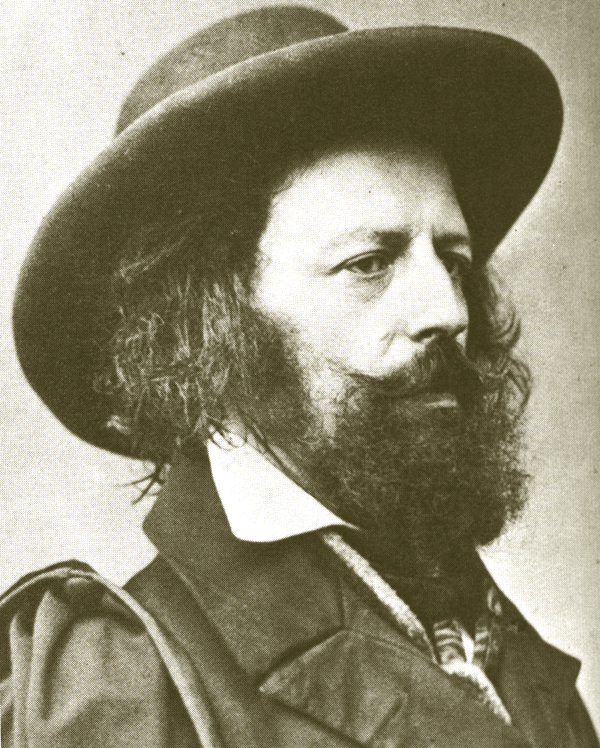
Alfred Lord Tennyson: ‘Vastness’

I.

Many a hearth upon our dark globe sighs

after many a vanish’d face,

Many a planet by many a sun may roll

with the dust of a vanish’d race.


II. 

Raving politics, never at rest – as this poor

Earth’s pale history runs, –

What is it all but a trouble of ants in the

gleam of a million million of suns?


III. 

Lies upon this side, lies upon that side,

truthless violence mourn’d by the Wise,

Thousands of voices drowning his own in a

popular torrent of lies upon lies; 


IV. 

Stately purposes, valour in battle, glorious

annals of army and fleet,

Death for the right cause, death for the wrong cause,

trumpets of victory, groans of defeat;


V. 

Innocence seethed in her mother’s milk,

and Charity setting the martyr aflame;

Thraldom who walks with the banner of Freedom,

and recks not to ruin a realm in her name.


VI. 

Faith at her zenith, or all but lost in the

gloom of doubts that darken the schools;

Craft with a bunch of all – heal in her hand,

follow’d up by her vassal legion of fools;


VII. 

Trade flying over a thousand seas with her

spice and her vintage, her silk and her corn;

Desolate offing, sailorless harbours, famishing

populace, wharves forlorn;


VIII. 

Star of the morning, Hope in the sunrise;

gloom of the evening, Life at a close;

Pleasure who flaunts on her wide downway

with her flying robe and her poison’d rose;


IX. 

Pain, that has crawl’d from the corpse of

Pleasure, a worm which writhes all day, and at night

Stirs up again in the heart of the sleeper,

and stings him back to the curse of the light;


X. 

Wealth with his wines and his wedded harlots;

honest Poverty, bare to the bone;

Opulent Avarice, lean as Poverty; Flattery

gilding the rift in a throne;


XI. 

Fame blowing out from her golden trumpet

a jubilant challenge to Time and to Fate;

Slander, her shadow, sowing the nettle on

all the laurel’d graves of the Great;


XII. 

Love for the maiden, crown’d with marriage,

no regrets for aught that has been,

Household happiness, gracious children,

debtless competence, golden mean;


XIII. 

National hatreds of whole generations, and

pigmy spites of the village spire;

Vows that will last to the last death-ruckle,

and vows that are snapt in a moment of fire;


XIV. 

He that has lived for the lust of the minute,

and died in the doing it, flesh without mind;

He that has nail’d all flesh to the Cross, till

Self died out in the love of his kind;


XV. 

Spring and Summer and Autumn and Winter,

and all these old revolutions of earth;

All new-old revolutions of Empire –

change of the tide – what is all of it worth?


XVI. 

What the philosophies, all the sciences,

poesy, varying voices of prayer?

All that is noblest, all that is basest, all

that is filthy with all that is fair?


XVII. 

What is it all, if we all of us end but in

being our own corpse-coffins at last,

Swallow-d in Vastness, lost in Silence,

drown’d in the deeps of a meaningless Past?


XVIII. 

What but a murmur of gnats in the gloom,

or a moment’s anger of bees in their hive? –

.      .      .      .      .      .      .      .      .     

Peace, let it be! for I loved him, and love

him forever: the dead are not dead but alive.

The [best] poet is the true prophet

‘It has often been said that the teachers of the age’s religion are to be sought rather among its poets than its preachers. But it seems as if we must look for our noblest theology also to our poets, rather than to our clerical schools … The age is deeply theological, and does not know it. It is like the man who was amazed to find that all his life he had been talking prose without being aware of it. We are theological, and don’t know it. Hence part of our unhappiness. It is like the sorrow of some young Werther who bears in his bosom the ferment of a genius not yet apprehended, and the germ of a revolution not yet realised. Our atheology belies our true deep selves, and our great poets are in this but prophets. They steal upon our less aggressive hours, and reveal our soul and future to ourselves. They fore-shadow our destiny, and they tell us that, in spite of all the savants say about the impossibility of a theology, it is the passion for a theology which is at the root of our mind’s unrest, and the possession of a theology which alone can lay our mind’s anarchy’. – PT Forsyth, ‘The Argument for Immortality Drawn from the Nature of Love: A Lecture on Lord Tennyson’s “Vastness”’. Christian World Pulpit, 2 December 1885, 360.

[Image: John Everett Millais, Alfred Tennyson 1881. Oil on canvas. Tate Gallery. Lent by National Museums Liverpool, Lady Lever Art Gallery]

Benedict Rogers on the International Crisis Group’s latest report

Burma is ruled by one of the world’s most brutal regimes, guilty not only of suppressing democracy but of causing one of the world’s worst humanitarian crises. In response, the International Crisis Group (ICG)has lost the plot.

Earlier this year, Cyclone Nargis hit Burma. Unlike almost any other government in response to a natural disaster, the junta in Burma initially refused, and then restricted and diverted international aid efforts. Aid was stolen by the regime (pdf). Burmese people who tried to help deliver aid were arrested. The little aid that was officially distributed was given for propaganda purposes and often taken back when the photocalls were over. At least 140,000 people died and 2.5 million left homeless in the wake of the regime’s deliberate neglect.

Following the cyclone another humanitarian crisis has unfolded, this time in western Burma (pdf)Chin State (pdf) has been hit by a famine caused by a plague of rats who multiply due to flowering of bamboo, a natural phenomenon that occurs every 50 years. True to form, the regime did nothing to prepare the people for the anticipated famine and has actively obstructed aid efforts. Officials took the World Food Programme to the wrong area, causing them to declare there was no famine. Since then, the WFP has revised its view – but the regime continues to block attempts to help the starving Chin people.

Burma’s military is continuing an offensive against ethnic peoples in eastern Burma, causing further humanitarian misery. Since 1996, more than 3,200 villages have been destroyed, and a million people displaced. Civilians are shot at point-blank range, or raped, taken for forced labour or used as human minesweepers. Children are taken off the streets andforced to join the Burmese army, which has the highest number of child soldiers in the world. Over 2,100 political prisoners languish in jail, double the number of last year, subjected to horrific torture, and Aung San Suu Kyi, Burma’s pro-democracy leader and Nobel laureate, marked 13 years in house arrest last week.

The International Crisis Group says this is all our fault. In one of the most extraordinary reports ever produced by a responsible and until-now respected organisation, ICG provides a subtle defence of the junta and blames the international community for focusing too much on “the political struggle”. It was understandable, ICG suggests, that the regime “hesitated to provide full, unfettered access for anyone claiming to be doing relief work”, because the west has been putting the junta under so much pressure to stop killing its people. Western media is at fault too, according to ICG, for showing images of dead bodies being dumped by regime officials in the river – something that was “very embarrassing” for the poor generals.

While grudgingly conceding that the root causes of the crisis are political, ICG appears to reject the notion that the solutions are therefore political too. The report rightly calls for more aid to Burma, and support for civil society projects, and warns that the country is on the verge of a major humanitarian crisis. I agree. The stories and statistics speak for themselves. But ICG goes on to perpetuate the lie that pro-democracy activists oppose aid. In reality, it is campaign groups that have called for more aid.

It was the Burma Campaign UK and Christian Solidarity Worldwide that led the effort last year to get the UK government to increase aid to Burma – with success. We have been calling for more funding for civil society and democracy groups, for cross-border humanitarian relief and for UN engagement for years (PDF). Much of our time has been spent on getting the generals to talk with the UN, the democracy movement and the ethnic groups (PDF). What we have opposed is ICG’s call for money to go into the pockets of the regime – for the simple reason that the junta will use such finance to expand their army, buy more guns and kill more people. I thought ICG was about conflict prevention. Now it seems they are about regime protection.

[Source: Guardian]

Thinking blasphemy

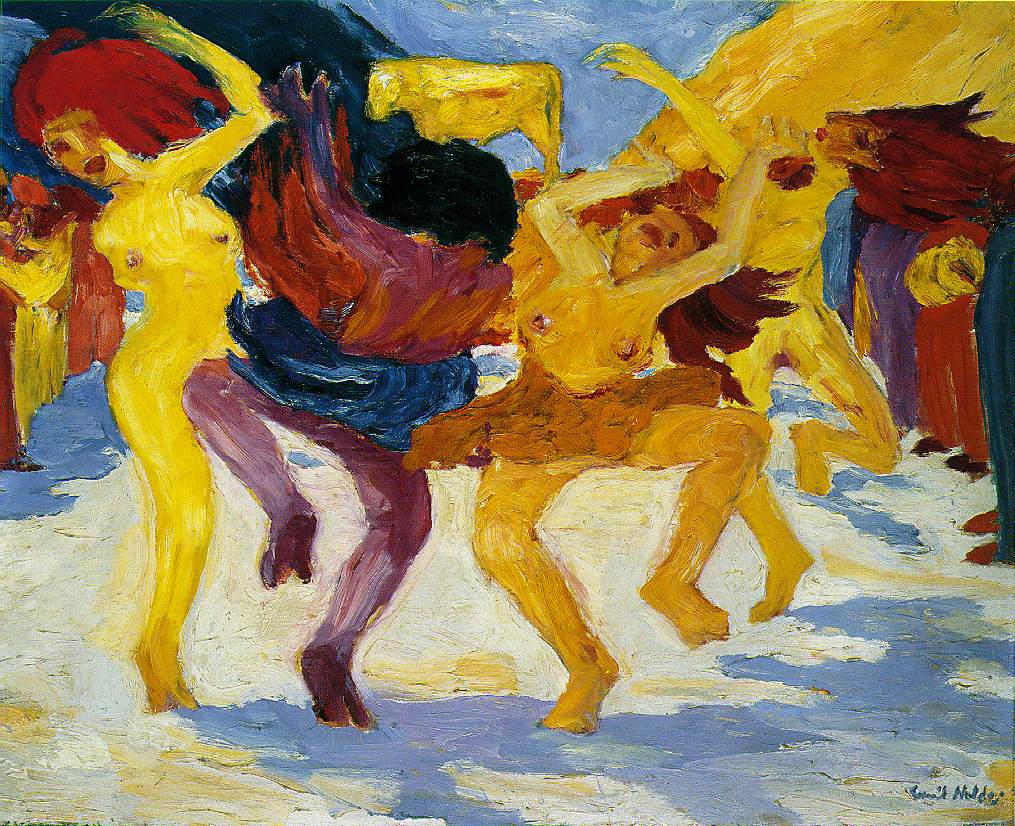
While it is most usually true that in the Scriptures the object of mocking profanation and blasphemy is God’s name, rather than God’s self, the two cannot be separated. To blaspheme God’s name is to blaspheme God (Isa 37:23; Ezek 13:19; 22:26; Rom. 2:24 [quoting Isa 52:5; 1 Tim 6: Rev. 13:6; 16:9). Twice in Nehemiah 9, the Levites remind the returned exiles of their blasphemous past. The God who had ‘made a name for himself’ in the liberation of an enslaved people from an arrogant Egypt (9:10), had to in turn deal with an ‘arrogant’ people who refused to listen and obey. The epitome of their rebellion is illustrated ‘when they had made for themselves a golden calf’ and attributed to it their rescue (9:18). This and other great blasphemies’ were met by God’s forgiveness, grace, compassion and mercy which refused to ‘abandon them in the desert’ (9:17-19). Later on during this same time of the worship, the eight Levites recalled how Israel ‘captured fortified cities and a rich land, and took possession of houses full of all good things, cisterns already hewn, vineyards, olive orchards and fruit trees in abundance’ eating their fill, becoming fat and delighting in God’s goodness (9:25). Yet they were disobedient and rebelled against God, casting God’s law behind their backs and killing the prophets who had warned them with a view to turning them back to God. And, the Levites said ‘they committed great blasphemies (9:26b). This time their ‘great blasphemies were met by divine judgement expressed via the giving up of Israel ‘into the hand of their enemies, who made them suffer’ (9:27a), out of which they cried out again to the Lord who heard them, had compassion on them and, again rescued them from their enemies’ hand (9:27b). It would seem that it is not without significance that the Levites begin their praise in v. 5 with the words, ‘Blessed be your glorious name, which is exalted above all blessing and praise’ (9:5b). Furthermore, because God has attached his name to Israel, to mock Israel is to blaspheme God’s name. ‘”Their rulers wail,” declares the LORD, “and continually all the day my name is despised” (Isa 52:5; cf. Mal 1:11-14). The LXX adds the phrase εν τοις εθνεσιν, an addition that Paul adopts in Romans 2:24, ‘The name of God is blasphemed among the Gentiles (εν τοις εθνεσιν) because of you’ (cf. Rom 1:5). Clearly, there is a link between God’s name and God’s self-witness to the nations. Blank notes, ‘Divorced from its context, the assertion that God’s name suffers profanation because of his people can mean either of two things, either a) that God is defamed by the shameful conduct of his people, or b) that God is disgraced because of the shameful condition of his people’. Sheldon H. Blank, ‘Isaiah 52:5 and the Profanation of the Name’, HUCA 25 (1954), 6. Blank contends that the context of Isaiah 52:2 ‘proves’ that the author intended the latter meaning, whereas Paul misquotes the text in order to critique the Jews’ behaviour.

It seems to me that both readings are not only possible, but intricately related and implied in both texts. However, even if Blank is correct, the significant thing is that God’s has so attached his name to his people that God is shamed by Israel’s conduct and so sends them into exile. But their being in exile also defames God’s name among the nations for in their defeat, the nations see the defeat of their God whose reputation, fame, prestige and recognition is concerned. As Blank asserts, ‘To profane the name of God is to do damage to God’s reputation, to defame him, to lessen his prestige, to retard the process by which he receives recognition, to put off the day on which it shall be known that he is God’. Blank, ‘Profanation’, 8. Likewise in Romans 2, Israel is again in exile (not only is Paul’s audience presumably in Rome, but even those Jews in Palestine strive under foreign occupation which is a sign of their being under judgement) and called in exile to be ‘a guide to the blind, a light to those who are in darkness’ (2:19), that is to the nations, a calling that is apparently being undermined by their breaking of God’s law and so of dishonoring God’s name (as in Lev 18:21; 19:12; 20:3; 21:6; 22:2, 32; Jer 34:16; Ezek 20:39; Amos 2:7; Mal 1:12; cf. Ezek 13:19, 22:26).

[Image: Emil Nolde, ‘Dance Around the Golden Calf’, 1910. Oil on canvas. 88 x 105.5 cm. Staatsgalerie moderner Kunst, Munich]

Rembrandt on the humanity of Christ

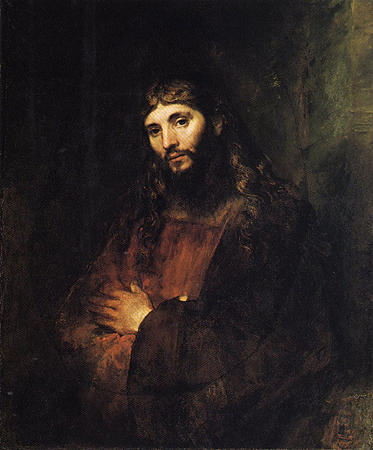
I’d like some help with something. I’ve spent a good bit of time today reflecting on these two paintings by Rembrandt. Specifically, I’ve addressed a certain question to them: Which one depicts a more human-looking Jesus? I’m not even certain yet why I’m asking the question. All the same, I’d value the thoughts of others.

 Christ (c. 1657–61; The Hyde Collection, Glens Falls, New York)

 The Resurrected Christ (1661; Bayerische Staatsgemäldesammlungen, AltePinakothek, Munich)


[For what it’s worth, my first thought was that the resurrected Jesus had a greater earthiness about him]

Luther on taking refuge in grace alone

‘Before the judgment seat of the world I am content to be dealt with according to the law; there I will answer and do what I ought. But before thee I would appeal to no law, but rather flee to the Cross and plead for grace and accept it as I am able. For the Scriptures teach me that God established two seats for men, a judgment seat for those who are still secure and proud and will neither acknowledge nor confess their sin, and a mercy seat for those whose conscience is poor and needy, who feel and confess their sin, dread his judgment, and yearn for his grace. And this mercy seat is Christ himself, as St. Paul says in Rom. 3 [:25], whom God has established for us, that we might have refuge there, since by ourselves we cannot stand before God. There shall I take my refuge when I have done or still do less than is meet and done much more of sin according to the law, both before and after my sanctification and justification. There my heart and conscience, regardless of how pure and good they are or can be in the sight of men, shall be as nothing, and they shall be covered over as it were with a vault, yea, with a fair heaven, which will mightily protect and defend them, the name of which is grace and the forgiveness of sins. Thereunder shall my heart and conscience creep and be safe’. – Martin Luther, Luther’s Works, Vol. 51: Sermons I (Edited by H.C. Oswald, J.J. Pelikan, H.T. Lehmann; Philadelphia: Fortress Press, 1999), 277.

On creation’s moral sensitivity


Seriously, has there ever been a more timeless exegete of Scripture than Calvin? Commenting on Genesis 4:10–12 Calvin remarks that God ‘constitutes the earth the minister of his vengeance, as having been polluted by the impious and horrible parricide: as if he had said, “Thou didst just now deny to me the murder which thou hast committed, but the senseless earth itself will demand thy punishment”’ (John Calvin, Commentaries on the First Book of Moses called Genesis, Vol. I (trans. J. King; vol. 1; Grand Rapids: Baker, 2003), 208). God does this, to ‘aggravate the enormity of the crime, as if a kind of contagion flowed from it even to the earth, for which the execution of punishment was required’. There is no sense, for Calvin, that cruelty can here be ascribed to the earth. Rather, the creation, reflecting the Creator’s hand, shows mercy because, in abhorrence of the pollution, it opens up its mouth to swallow the shed blood. For Calvin, this signifies that ‘there was more humanity in the earth than in man himself’ (Ibid., 209).

A similar observation is made by Motyer in his brilliant commentary on Isaiah 24:5: ‘As God’s creation, the world itself is morally sensitive, and the ‘thorns and thistles’ of Genesis 3:18 illustrate the two sides of this sensitivity. On the one hand, they evidence the way in which earth itself fights against sinners. It does not readily yield its bounty to them but turns its productive powers to their disadvantage. On the other hand, the fact that an earth which the Lord pronounced good can produce thorns and thistles is evidence that its nature has been damaged and the garden is in the process of becoming the wilderness’. (John A. Motyer, The Prophecy of Isaiah (Leicester: IVP, 1993), 198).

Understanding holiness takes a miracle

Defying empirical definition, holiness, like Christianity itself, only makes sense from the inside, from direct experience and that not only of hearing the seraphim calling to one another ‘Holy, holy, holy is the LORD of hosts’, not even when such confrontation brings the self-revelation of personal and corporate uncleanness. Holiness comes home in that action when the same ‘LORD of hosts’ calls one of those seraphim to fly towards you with a live coal in its hand which he had taken with tongs from the holy altar and place that coal at the very source of one’s unholiness and say, ‘Behold, this has touched your lips; your guilt is taken away, and your sin forgiven’ (Isa 6:7).

One recalls here Forsyth’s words: ‘the holy is the ideal good, fair, and true, translated in our religious consciousness to a transcendent personal reality, not proved but known, experienced immediately and honoured at sight as the one thing in the world valuable in itself and making a world’ (Peter T. Forsyth, The Principle of Authority in Relation to Certainty, Sanctity and Society: An Essay in the Philosophy of Experimental Religion (London: Independent Press, 1952), 6).

Human curiosity longs for a rational expression of ‘the holy’ at the same time that holiness defies such explanation or ‘justification’ apart from moral experience. It is known only as the human subject is thrown back onto the miracle of revelation, of grace. (Even Otto sees something of this when he notes that accompanying the disvaluing of self is the feeling of being unworthy to be in the presence of ‘the holy one’, that we may even defile him, and that we subsequently require a covering that renders the approacher numinous, freeing them from their ‘profane’ being,’ so that they are no longer unfit to relate to the Holy). Certainly, when we are dealing with the holy, we are in ‘a region which thought cannot handle nor even reach. We cannot go there, it must come here. We are beyond both experience and thought, and we are dependent on revelation for any conviction of the reality of that ideal which moral experience demands but cannot ensure … The situation is only soluble by a miracle’ (Forsyth, Authority, 6).

Ratzinger on the true nature of the Petrine office

Ratzinger’s essay on the conscience, despite making some valuable observations, is not a little disappointing. (It’s also hard to see how Amazon US sellers can in all good conscience charge $66+ for an 82 page book! … especially when you can pick it up direct from the publisher for $14.95 or from Amazon UK for £3.95). That said, it includes some interesting reflections on how Ratzinger understands the authority of the papacy, something that most Protestants dinna hae a scooby about:

‘The pope cannot impose commandments on faithful Catholics because he wants to or finds it expedient. Such a modern, voluntaristic concept of authority can only distort the true theological meaning of the papacy. The true nature of the Petrine office has become so incomprehensible in the modern age no doubt because we think of authority only on terms that do not allow for bridges between subject and object, Accordingly, everything that does not come from the subject is thought to be externally imposed’. – Joseph Ratzinger, On Conscience: Two Essays (Philadelphia/San Francisco: The National Catholic Bioethics Center/Ignatius Press, 2007 [1984]), 34.

‘One can comprehend the primacy of the pope and its correlation to Christian conscience only in this connection. The true sense of the teaching authority of the pope consists in his being the advocate of Christian memory. The pope does not impose from without. Rather, he elucidates the Christian memory and defends it. For this reason the toast to conscience indeed must precede the toast to the pope, because without conscience there would not be a papacy. All power that the papacy has is power of conscience. It is service to the double memory on which the faith is based – and which again and again must be purified, expanded, and defended against the destruction of memory that is threatened by a subjectivity forgetful of its own foundation, as well as by the pressures of social and cultural conformity’. (p. 36)

If nothing else, these words ought to encourage Protestants (and not least pastors, many of whom secretly aspire to be popes) to do the same work that Ratzinger is attempting to do: to think (and to keep thinking) about the nature and source of authority, and about the relationship between the Gospel and the offices of the church.

Around the traps …

John Paul II on faith and reason


‘Faith and Reason are like two wings on which the human spirit rises to the contemplation of truth; and God has placed in the human heart a desire to know the truth – in a word, to know himself – so that, by knowing and loving God, men and women may also come to the fullness of truth about themselves’. – Pope John Paul II. Fides et Ratio/On the Relationship between Faith and Reason (Boston: Pauline Books and Media, 1998, 7.

Trevor Hart on natural capacity for God


‘Human beings, sinful and fallen, have no ‘capacity’ in and of themselves, for God, no natural predisposition to hear and receive his Word. Again, the Spirit of God must come and create (ex nihilo in this respect) precisely such a capacity. Faith is a gift of the very God towards whom it is directed. In this respect, the attempt to secure some ‘point of contact’ in humanity for God is parallel to the doctrine of the immaculate conception: it assumes that wherever God and humanity come into close contact there must be some prepared ground, some fertile soil, some openness to and aptitude for God’s purposes: as if Mary’s obedient response were the result of some inherent immunity to the sin which blights the rest of us, rather than a result of the working of God’s Spirit’. – Trevor A. Hart, ‘A Capacity for Ambiguity? The Barth-Brunner Debate Revisited’. Tyndale Bulletin 44 (1993), 301.

Sermons are killing the Gospel

‘It is not sermons we need, but a Gospel, which sermons are killing … What we require is not a race of more powerful preachers, but that which makes their capital – a new Gospel which is yet the old, the old moralised, and replaced in the conscience, and in the public conscience, from which it has been removed. We need that the Gospel we offer be moralised at the centre from the Cross, and not rationalised at the surface by thin science. We need that more people should be asking “What must I do to be saved?” rather than “What should I rationally believe?”’ – P.T. Forsyth, The Church and the Sacraments (London: Independent Press, 1947 [1917]), 20.

Karl Barth on childlessness

‘… there are men who do not become parents. We are thinking of all those who broadly speaking might do so, and perhaps would like to do so, but either as bachelors or in childless marriage do not actually fulfil this possibility. What attitude are they to adopt to this lack? What has the divine command to say to them concerning it? In some degree they will all feel their childlessness to be a lack, a gap in the circle of what nature obviously intends for man, the absence of an important, desirable and hoped for good. And those who have children and know what they owe to them will not try to dissuade them. The more grateful they are for the gift of children, so much the more intimately they will feel this lack with them. Parenthood is one of the most palpable illuminations and joys of life, and those to whom it is denied for different reasons have undoubtedly to bear the pain of loss. But we must not say more. If we can use the rather doubtful expression “happy parents,” we must not infer that childlessness is a misfortune. And we must certainly not speak of an unfruitful marriage, for the fruitfulness of a marriage does not depend on whether it is fruitful in the physical sense. In the sphere of the New Testament message there is no necessity, no general command, to continue the human race as such and therefore to procreate children. That this may happen, that the joy of parenthood should still have a place, that new generations may constantly follow those which precede, is all that can be said in the light of the fact which we must always take into fresh consideration, namely, that the kingdom of God comes and this world is passing away. Post Christum natum there can be no question of a divine law in virtue of which all these things must necessarily take place. On the contrary, it is one of the consolations of the coming kingdom and expiring time that this anxiety about posterity, that the burden of the postulate that we should and must bear children, heirs of our blood and name and honour and wealth, that the pressure and bitterness and tension of this question, if not the question itself, is removed from us all by the fact that the Son on whose birth alone everything seriously and ultimately depended has now been born and has now become our Brother. No one now has to be conceived and born. We need not expect any other than the One of whose coming we are certain because He is already come. Parenthood is now only to be understood as a free and in some sense optional gift of the goodness of God. It certainly cannot be a fault to be without children’. – Karl Barth, Church Dogmatics III/4 (Edinburgh: T&T Clark, 2004), 265.

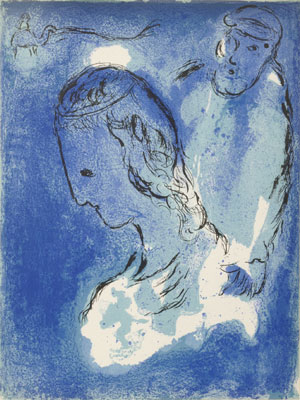
[Image: Marc Chagall, ‘Abraham and Sarah’, 1956]

‘Returning to the Church’: A conference

The Centre of Theology and Philosophy (Nottingham) and St Stephen’s House (Oxford) are organising a conference for 5–7 January 2009 entitled ‘Returning to the Church: Catholicity, Ecclesiology and the Mission of the Church of England’.

Speakers include: John Milbank, Alison Milbank, Graham WardAlister McGrath, Michael Northcott, Jeremy Morris and Simon Oliver

For more information contact Andrew Davison or visit www.ssho.ox.ac.uk/ecclesiology
or click here to download a conference poster.

Introducing: Samuel Cox

Samuel Cox (1826–1893), a religious journalist and author, was born on 19 April 1826 near London, and educated at a school at Stoke Newington. At the age of fourteen he was apprenticed at the London docks, where his father was employed, but on the expiry of his indentures he resigned his position and entered Stepney College to prepare himself for the Baptist ministry. After passing the college course and matriculating at London University, Cox became in 1852 pastor of the Baptist chapel in St Paul’s Square, Southsea. In 1854 he accepted an invitation to Ryde, Isle of Wight, where he remained until 1859. A disorder in the throat compelled him to cease preaching, and caused him to turn his attention seriously to literature. He wrote for The Freeman, the organ of the Baptists, and occasionally acted as editor, and became a contributor to The Nonconformist, the Christian SpectatorThe Quiver, and other religious periodicals. In 1861 he was appointed secretary to the committee for arranging the bicentenary of the Ejection of 1662. But his throat problem proved less permanent than had been feared, so that in 1863 he accepted a call to become pastor of the Mansfield Road Baptist Chapel, Nottingham, a position he occupied successfully and happily until 1888, when failing health compelled his resignation. In 1873 he married Eliza Tebbutt of Bluntisham, Huntingdonshire. He retired to Hastings, where he died at his home, Holme, Godrich Road, on 27 March 1893. He was buried in the general cemetery at Nottingham. His wife survived him. 

Although Cox’s ministry was effective and zealous, his chief activity was as a writer. His resumption of ministerial work in 1863 did not interfere with his literary energy, and he became in 1875 editor of The Expositor. The conception of this monthly magazine was evolved by Cox from his own work as a preacher and writer on the Bible. He was editor until 1884, being responsible for the first twenty volumes, some of which he wrote almost entirely himself. But he gathered round him a distinguished staff, including authors from a variety of denominations, such as W. C. Magee, Marcus Dods, and William Robertson Smith. The journal had a powerful influence on the religious thought of the day. Its general tendency is perhaps best indicated by a sentence in Cox’s own exposition of his aims in the first number:

Our sole purpose is to expound the scriptures honestly and intelligently by permitting them to explain themselves; neither thrusting upon them miracles which they do not claim or dogmas to which they lend no support, nor venturing to question the doctrines they obviously teach or the miracles which they plainly affirm.

Cox’s services to learning received the remarkable recognition of nearly simultaneous offers from Aberdeen, Edinburgh, and St Andrews universities of their degree of DD. Cox accepted in 1882 the offer of the last-named, but found himself compelled after 1884 to resign his editorship because the breadth of his views had become displeasing to the proprietors of the magazine. Cox stated that he was the writer of thirty volumes and the editor of twenty more. Most of these were biblical expositions. The most widely read and influential was Salvator Mundi: or, Is Christ the Saviour of all Men? (1877), which was followed in 1883 by a sequel, The Larger Hope, in which Cox defined his position with regard to universalism, and answered some of his critics. Among counterblasts to Cox’s teaching may be mentioned The Doctrines of Annihilation and Universalism … with Critical Notes and a Review of ‘Salvator mundi’ (1881), by Thomas Wood. The postscript of this challenges Cox’s impartiality as editor of The Expositor, and is an instance of the kind of complaints which brought about his resignation.

An example the kind of theology that attracted opposition for Cox is evident in these words from his Salvator Mundi: or, Is Christ the Saviour of all Men?:

‘If Christ took flesh and dwelt among us that He might become at all points like as we are and threw open the kingdom of heaven to all believers; if He trod, step by step, the path we have to travel from the cradle to the grave, must He not also, for us men and our salvation, have passed on into that dim unknown region on which our spirits enter when we die? Did He leave, did He forsake our path at the very moment when it sinks into a darkness we cannot penetrate, just when, to us at least, it seems to grow most lonely, most critical, most perilous? … Surely our own reason confirms the revelations of Scripture, and constrains us to believe that, in all worlds and in all ages, as in this, Christ will prove Himself to be the great Lord and Lover of men, and will claim all souls for his own’. – Samuel Cox, Salvator Mundi: or, Is Christ the Saviour of all Men? (2 ed; London: C. Kegan Paul and Co., 1878, 196–7.

Principal Source: Ronald Bayne’s article in Oxford Dictionary of National Biography.

Sources: E. Cox, ‘Prefatory memoir’, in S. Cox, The Hebrew twins (1894) · The Freeman (7 April 1893) · Independent and Nonconformist (6 April 1893) · British Weekly(30 March 1893) · Christian World (30 March 1893) · CGPLA Eng. & Wales (1893) · P. Schaff and S. M. Jackson, Encyclopedia of living divines and Christian workers of all denominations in Europe and America: being a supplement to Schaff-Herzog encyclopedia of religious knowledge (1887)

ArchivesU. Nott. L., notes and sermons

Wealth at death: £445 1s. 2d.: probate, 7 June 1893, CGPLA Eng. & Wales 

Note: Additional dictionary content from The Oxford Dictionary of National Biography can be obtained free in the UK from public libraries thanks to a national deal with the MLA.

See here for more biographies in the Introducing Series.

Seized in the divine economy

‘The trinitarian name of God gives us the final glance into what God is. However, it has truth and power only then, when it does not lose its connection to the act of God out of which it arises. The theological tradition has not always emphasised this connection clearly. Rather, the inclination has been to turn the dogma of the Trinity into a description of God that stands for itself, not telling us anything about his relationship to us. Under these conditions, it [the doctrine of the Trinity] does not only remain worthless but easily becomes damaging. That is, it generates an appearance of knowledge of God which consists merely in words. The New Testament does not participate in this employment of the doctrine of the Trinity because it grounds all its statements about God in the divine action that seizes us’. – Adolf Schlatter, Das christliche Dogma (Stuttgart: Calwer Verlag, 1977), 356.

Karl Barth on the task of every Christian

‘Biblical study … is not merely the affair of a few specialists but fundamentally of all the members of the community. For none is infallible, and all need to be subject to the control of the rest. And again, it might some day be asked of any Christian to give an answer to those without concerning “the hope that is in you” (v. 15). For this no little knowledge of the Bible, and indeed some understanding and therefore study, are indispensable. The statement: “I am a mere layman and not a theologian” is evidence not of humility but of indolence … The Christian must also be in a position to see his way clearly and not to be constantly bewildered in the dramas, tragedies and comedies of the past and present history of the community … Hence there is need of the catechism and even of some memory work’. (CD IV/3, p. 870f.)

‘The task of every Christian … is his task as a bearer of the Gospel to the others who still stand without. To what end? To bring them into the Church, to make them Christians? In the event this too, but the real point is that to all those who by reason of their being outside demand an account of the living hope that is in him this account should be given by what he does and what he leaves undone, by his work and word. More restless than the most restless, more urgent than the most urgent revolutionaries in his immediate or more distant circle, he asks: “Where art thou, peace of all the world?” – and he asks it the more restlessly and the more urgently because he is sure of this future peace, because he consciously looks and moves forward to the future which is filled by it. To him who is thus endowed and blessed there applies the “go” of Mt. 28:19, not as a member of a Christian collective, but very personally. Here are the marching orders which are given directly and specifically to him’. (CD IV/4, p. 200f.)

In Memoriam: Ernst Cassirer

This is the locust season of our days
When the ripe meadows of the mind are bare,
This is the month of the never-born maize
Upon whose golden meats we shall not fare.
This is the week of the stunted stalk
And fruit that is dust on the bones of rock,
This is the day of the hungry hawk
And the songbirds dead by the fallen flock.
This is the noon of our derelict plain,
The sun-parched hour of most desolate pain.

Yet there is a valley where sweet grain grows
In strong-rooted stands, in tall splendid rows.
Here toiled in the meadows a man wise and serene,
And the meadows bore fruit and the meadows are green.

– Edward Murray Case, ‘In Memoriam: Ernst Cassirer’, in The Philosophy of Ernst Cassirer (edited by Paul Arthur Schilpp; Library of Living Philosophers, 6. Evanston: George Banta Publishing Company, 1949), 40.

DKBA soldiers attack Karen village in Thailand


Download report as PDF [Adobe Acrobat PDF 455 kb]

After disputes over arbitrary taxation payments and accusations of favouring the KNLA, 40 to 50 soldiers of DKBA Battalion #907 – under brigade commander N’Kaw Mway – attacked the village of Mae Gklaw Kee in Thailand’s Umphang District. Troops shelled the village tract leader’s house, shot at villagers’ houses and then burnt down villagers’ crop storage barns. The Batallion subsequently set up a camp in nearby Gklaw Ghaw village. As SPDC and DKBA troops work together in an effort to take control of the area, villagers face increased restrictions, overlapping taxation demands, and the threat of future attacks and land confiscation.


On Saturday, October 4th 2008, Democratic Karen Buddhist Army (DKBA) officer Bla Nah, under the command of brigade commander N’Kaw Mway, led 40-50 soldiers of Battalion #907 in an attack on Mae Gklaw Kee village in Umphang District of Thailand (only three kilometres from the Burma border). After shelling the village tract leader’s house with a grenade launcher, soldiers shot at the villagers’ houses, shot out truck tyres and then burnt the villagers’ crop stores. After the attack, the soldiers set up camp in nearby Gklaw Ghaw village on the other side of the Burma border in Kawkareik township of Dooplaya District and are now working with nearby Light Infantry Battalions #401 and #407 of the State Peace and Development Council (SPDC)[1] to place movement restrictions on the villagers.

According to information collected by a KHRG researcher, a combination of factors seem to have led to this attack, with one of the major reasons being a refusal by the villagers (or inability) to pay the full amount of taxes demanded by the DKBA. As Mae Gklaw Kee village is located so close to the border, the villagers regularly travel back into Burma to work in their rented corn fields in the area around Bplah Doh village, close to Gklaw Ghaw village, in Maw Kee village tract of Kawkareik township. The area around Gklaw Ghaw and Bplah Doh villages is largely controlled by Karen National Liberation Army (KNLA) Battalion #201, but SPDC and DKBA soldiers also operate in the area. Other villages in Maw Kee village tract closer to the DKBA base at Gaw Lay village are largely controlled by the DKBA. Villagers are therefore faced with competing tax demands as the different military groups vie for control of the area.

Corn fields farmed by local villagers have been particularly subject to these overlapping taxation demands. Each local corn field usually produces from 3,000 to 6,000 big tins[2] of sweet corn per year and sometimes up to 10,000 big tins. Each year, KNLA soldiers demand 10 Thai baht (US $0.29) for each sack of corn – one sack of corn cobs contains approximately seven big tins of corn – from local farmers (including Mae Gklaw Kee village) or an estimated 4,286 to 8,571 Thai baht (US $123.86 to $248.06) for a field with a normal yield. However, in 2007 the DKBA also placed a much higher tax demand on the corn produced by the villagers – demanding eight Thai baht (US $0.23) for each big tin of sweet corn and 100 baht (US $2.89) for each big tin of sweet corn seed. For a normal yield, this is equivalent to 24,000 to 48,000 Thai baht (US $694.40 to $1,388.80) per field (not including the tax on corn seed). Struggling to meet the demands of both armed groups, villagers from Mae Gklaw Kee village told DKBA soldiers that they could only afford to pay them three baht per tin, as opposed to the eight baht demanded. In response, the DKBA soldiers simply increased the tax demand for 2008, asking for 15 baht for each big tin of corn, approximately 45,000 to 90,000 baht (US $1,302.07 to $2,604.13) for a normal yield field and 150 baht for each big tin of seed. The villagers knew they would be unable to pay this amount following the harvest (which usually starts in October) and, the village tract leader reportedly referred to DKBA soldiers as ‘dogs’ for placing such demands upon the villagers. This apparently angered commander N’Kaw Mway and prompted him to call for the attack upon Mae Gklaw Kee village. At this time, the villagers had not paid any tax to the DKBA for 2008, as the harvest was not yet completed. A KHRG field researcher also noted the villagers’ support of the KNLA as another reason for the attack and the Bangkok Post referred to a ‘brawl’ between DKBA soldiers and local teenagers from the village in September as another motive for the attack.[3]

Since the attack on Mae Gklaw Kee village, SPDC and DKBA soldiers have been restricting the movements of villagers in the area around Gklaw Ghaw village in an effort to take control of the area away from the KNLA. In the past, KNLA soldiers have ambushed and attacked DKBA and SPDC soldiers operating in the area. However, although KNLA soldiers remain in the area, they have not yet attacked the new DKBA camp at Gklaw Ghaw. KNLA soldiers claim that they are currently hesitant to attack the camp at Gklaw Ghaw for fear of creating more problems for the villagers, after a recent spate of retaliatory actions by SPDC and DKBA soldiers against villagers for such KNLA attacks – such as the burning down of corn storage barns in the area.

Villagers in the surrounding area therefore face increased restrictions imposed by the SPDC and DKBA soldiers based at Gklaw Ghaw, as soldiers try to clamp down on any possible communication between villagers and the KNLA. In Gklaw Ghaw village itself, civilians have been forbidden to travel outside of the village, even for work or trade, and have also had their mobile phones confiscated.[4] Villagers in Mae Gklaw Kee have currently been able to remain in their village with increased security from Thai authorities, but still live with the threat of further attacks and the future of their corn field farming remains uncertain, given the increased troop build-up by SPDC and DKBA forces in the area.

DKBA soldiers have had a record of imposing arbitrary taxation demands upon villagers, with other villages in the area having faced similar problems to Mae Gklaw Kee. In another incident in 2007, DKBA soldiers succeeded in extorting more than the original eight baht per big tin of corn demanded, by pretending that they were also collecting tax for the KNLA. In this way, villagers from Gaw Lay, Htee Ther Lay and Oo Poe Hta villages (all also located in the large Maw Kee village tract in Kawkareik township) were forced to pay ten baht per tin of corn. Villagers have also been threatened with land confiscation for KNLA use of landmines. On October 6th 2008, DKBA Battalion #907 officers Muang Shwe Wa, Kyaw Pa Pu and Bo Kyaw Kyaw summoned village heads from Ler Gaw, Lay Ghaw, Oo Poe Hta, Oo Gray Hta, Wa Mee Hta, Maw Ker Hta and Gaw Lay villages to meet with them at the DKBA army camp in Gaw Lay village, where brigade commander N’Kaw Mway is based. During the meeting, the DKBA officers reportedly told the village heads that if any DKBA soldier in the area should step on a landmine planted by the KNLA, they would take away all of the lands owned by the villagers.

With money to be gained from agriculture, logging, mining and taxes upon villagers, the DKBA and SPDC are keen to gain control of this border area. As the various armed groups vie for control of village tracts on both sides of the Thai-Burma border (in Dooplaya District on one side and Umphang District on the other), villagers face competing demands for taxation on their crops, increased restrictions on their movement and communication, and the increased threat of attacks and land confiscation by the SPDC and DKBA.

For more information on the situation in Dooplaya District and the human rights abuses involved in DKBA and SPDC control in other areas of Karen State, see the following previously published KHRG reports:

Footnotes

[1] The State Peace and Development Council (SPDC) is the military junta currently ruling Burma.

[2] A ‘big tin’ is a local measurement of approximately 2 litres or 4.5 gallons in volume.

[3] “Karen fighters attack village”, Bangkok Post, October 5th 2008, accessed athttp://www.bangkokpost.com/051008_News/05Oct2008_news12.php on October 9th 2008.

[4] Villagers were previously able to use Thai mobile networks to communicate with other villages in the area and in Thailand due to the proximity of the border, but are now unable to do so.

[Source: KHRG]