Author: Jason Goroncy

Thinking Advent: Child and Childhood as Metaphors of Hope

I read a delightful essay today by Jürgen Moltmann entitled ‘Child and Childhood as Metaphors of Hope’ [Theology Today 56, no. 4 (2000): 592-603]. In this essay, Moltmann recalls that Jesus was ‘not merely a “gentle friend of children,” as the sentimental nineteenth century liked to picture him’ but a revolutionary contrast to the Roman world of antiquity wherein children were undervalued and where their legal status (alongside that of women and slaves) was very low; indicative of the fact that as the property of the paterfamilias, they could be sold or abandoned, and often were, particularly girls. Moltmann then offers some helpful commentary on key NT verses concerning children:

(1) “Let the little children come to me; do not stop them; for it is to such as these that the kingdom of God belongs” (Mark 10: 14; Matt 19:14; Luke 18:19). The disciples view children as unworthy and therefore try to keep them from their master. After all, they are not children anymore. Jesus reprimands the disciples; embracing and blessing the children, he proclaims what he embodies, that the kingdom of God is already theirs. According to Jesus’ Sermon on the Mount, the kingdom of God already belongs to the “poor,” the “hungry” and “those who are crying,” In the same way, it also now belongs to children, children are made partners in the covenant with God. Why? Did they deserve it? No. it is exactly because they do not deserve it and are unable to effect it, but in fact receive it like their own birth.

On the other hand, the kingdom “where peace and justice kiss” (as the psalm says) does not appear at the heights of human progress, among the clever and just, rich and beautiful of this world. Rather, it appears among the oppressed, the powerless, the poor, and the children, turning the status quo of human value systems upside down. If the kingdom comes into the world “down below,” those “up there” have been deprived of any religious legitimacy supporting their presumption to dominion. Just as the blessing of the poor was complemented by the lamentations over the rich, the benediction of children belongs with the curse pronounced over the violators of children: “If any of you put a stumbling block before one of these little ones who believe in me, it would be better for you if a great millstone were fastened around your neck and you were drowned in the depth of the sea” (Matt 18:6). If God’s kingdom comes into this world by way of the poor and the children, so does the judgment of God.

(2) “Whoever welcomes one such child in my name welcomes rne, and whoever welcomes me welcomes not me but the one who sent me” (Mark 9:37). And the one who sent Jesus, as we know, is the Father. By way of these identifications, Jesus declares children his representatives in society: Just as the God of his messianic mission is in him, so Christ is present in every child. Thus, whoever takes in a child, takes in Christ. This is exactly how Matthew describes the great judgment day: “Just as you did it to one of the least of these who are members of my family, you did it to me.” “For I was hungry and you gave me food … I was in prison and you visited me” (Matt 25:40, 35-36). The one who will judge the world identifies with the lowly. He is hidden and present in them already now and will eventually judge how the just and the unjust treated the least among humans. Children and the lowly are not, unlike the apostles, agents sent by God. Rather, in them, the poor, powerless, and imprisoned Christ is waiting for his followers to act. Whoever takes in a child, also takes in God. In children, God is waiting for us to take in God. In helpless children, God is waiting for our compassion. This is also the spontaneous impression the image of the child in the manger awakens in us.

(3) “Unless you change and become like children, you will never enter the kingdom of heaven.” This is Jesus’ answer to the question of the disciples: “Who is the greatest in the kingdom of heaven?” (Matt 18:3, 1) By saying this, Jesus underscores the point that whoever wants to be the greatest of all will have to be everybody else’s servant, “deny themselves,” and become “like a child” (18:4). He asks the disciples to accept themselves not in their power, but in their weakness, not in their wealth, but in their poverty: not as grown-up children, but as the children of their adulthood. He asks the disciples to reclaim the facets of their own being, which had been repressed by development and education. We can only come into the kingdom of God if we receive it like a child with empty hands. That does not mean one has to go back to being a child (which would be childish) but become upon analogy “like a child.” We don’t have to imitate children to become part of God’s future, rather we must be in solidarity with them, respecting their intimate proximity to God’s future. The point is not that children are closer to the kingdom of God because of especially childlike properties (like innocence or naivete that adults have lost), but rather that the kingdom of God is closer to them because they are loved, embraced, and blessed by God. We could also say: Whoever experiences God’s closeness in the community of Christ — as humans experienced it in the proximity of Jesus – will become like a child. Another, later way to phrase this is: Gotteskindschaft – “the community of God’s children.”

This stirred a number of questions in me that I’ll go to bed tonight thinking about:

  • What ought we make of Moltmann’s identification of children with Jesus’ words (in the Sermon on the Mount) regarding the “poor,” the “hungry” and “those who are crying”?
  • What ought we make of Moltmann’s claim that just as the God of Jesus’ messianic mission is in him, so too ‘Christ is present in every child’, so that ‘whoever takes in a child, also takes in God. In children, God is waiting for us to take in God’?
  • What might it mean for us to ‘reclaim the facets of [our] own being, which [have] been repressed by development and education’? Are there implications here for pastoral leadership?

Later on, Moltmann unsurprisingly draws on Ernst Bloch’s The Principle of Hope:

“Jesus is himself present among the helpless, as an element of this humbleness, standing in the dark, not in brightness … This is why the child in the manger becomes so important, along with the humbleness of all the circumstances in the out-of-the-way, cramped stable. The unexpectedness of finding the redeemer as a helpless child.” Christian love therefore “regards the helpless as important, that which is discarded by the world as called” and “gathers up its own in their out-of-the-wayness, their incognito to the world, their discordance with the world: into the kingdom where they do accord.”

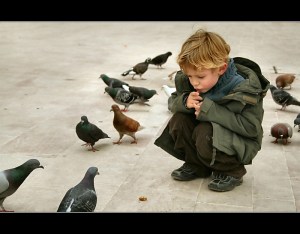
sinead-1I was reminded of another essay that I recently read by Tony Kelly where the author suggests that in a world of violent competition and the exponential growth of problems and responsibilities, the child calls for the rebirth of wonder, trust and playful contentment within the great womb of life and time. Where the harried adult might see only problems, and become weary in mind and heart, children live otherwise. ‘They breathe another air, content to play within the inexhaustible mystery of what has been so uncannily given. Every child is a call to return to the gift that was at the beginning, is now, and ever shall be’.

So too does this same refrain echo through Moltmann, who concludes his essay with three reasons for why children remain metaphors of hope:

(1) With every child, a new life begins, original, unique, incomparable. And while it seems that we always ask, who this or that child looks like (apparently because we seem to think we can only understand the new in the comparison with what is already known or similar), we also encounter the entirely different, the entirely dissimilar and unique in each child. It is these differences that we need to respect if we want to love life and allow an open future.

(2) With every beginning of a new life, the hope for the reign of peace and justice is given a new chance. It is important to see children in their own transcendent perspective and so to resist forming them according to the images of our world. Every new life is also a new beginning of hope for a homeland in this unredeemed world. If it were not, we would have no reason to expect anything new from a beginning.

(3) The last reason to see “a new beginning” or a “beginning of the New” in the beginning of a child’s life is the fact that, for me, children are not only metaphors of our hopes, of that which we want, wish for and expect, but also are metaphors of God’s hope for us: God wants us, expects us, and welcomes us. Humanity is God’s great love, God’s dream for God’s earthly world, God’s image for God’s beloved earth. God is “waiting” for the “human person” in every child, is “waiting” for God’s echo, resonance, and rainbow. Maybe that is the reason God is so patient with us, hearing the ruins of human history, inviting one human generation after the other into existence. God is not silent, God is not “dead” – God is waiting for the menschlichen Menschen the “truly humane human.” “In all of the prophets, I have waited for you,” Martin Buber has the Eternal One speak to the Messiah, “and now you have come.”

A Conference: Genesis and Christian Theology

genesis

The University of St Andrews has announced its third conference (14-18 July 2009) on Scripture and Christian Theology. ‘Since the first conference on the Gospel of John in 2003, the St Andrews conferences have been recognised as one of the most important occasions when biblical scholars and systematic theologians are brought together in conversation about a biblical text. The conferences aim to cut through the megaphone diplomacy or the sheer incomprehension that so often marks attempts to communicate across our disciplines’.

They have issued a call for papers that integrate close readings of Genesis with Christian theology. While the organisers are particularly interested in explorations of the dynamic relationship between Genesis and Christian doctrine, they also welcome proposals that combine careful reading of the text of Genesis with theological attention to art, creativity, ecology, ethics, the history of interpretation, or Jewish and Christian dialogue.

The call for paper proposals closes on 15 March 2009. Please visit the conference website for further details or to submit a proposal. Other enquiries can be directed to the conference administrator, the adroit Luke Tallon.

Confrontation(s) and (re)Discoveries

I’m still unpacking books. It’s often quite a disquieting experience being confronted with aspects your past (which is precisely what one’s library represents). There’s been not a few moments in recent weeks when I’ve found myself feeling somewhat embarrassed by a box’s contents, some of which have remained unopened for the best part of 4 years … and should have been thrown out 10 years before that. I can’t believe some of the junk that I’ve bought – and filled precious shelf-space with – over the years. The sense that one has matured a little is something of an encouragement. One of today’s highlights was the unearthing, after about 5 months, of Tom Smail’s brilliant (if not right at every point) Once and for All: A Confession of the Cross.  If only he didn’t write so clearly then perhaps he might be taken more seriously as a theologian. Anyway, here’s how he kicks off:

‘To write about the cross is, like Jacob at Peniel, to wrestle with something or, rather, with someone, who is totally mysterious and utterly unconquerable – a someone whom you cannot let go because you know that he has it in his power, certainly to wound you at the sore places he exposes, but also to bless you and to change your name and your destiny’. – Thomas A. Smail, Once and for All: A Confession of the Cross (Eugene: Wipf and Stock, 2005), ix.

The book has already been loaned out.

Barth on God’s patience

patienceI’ve never understood the charge that Barth is difficult to read. If one rejects the notion that the reader doesn’t have to do some work as well as the writer, and avoids the secondary literature and just reads the man himself, then, while one may certainly miss the odd nuanced or not-so-nuanced point here and there, there are few passages that do not break open to the persisting reader the great realities. In fact, there’s nothing quite like a dose of Barth to do just that. Here he is on the nature of divine patience:
‘We define God’s patience as His will, deep-rooted in His essence and constituting His divine being and action, to allow to another – for the sake of His own grace and mercy and in the affirmation of His holiness and justice – space and time for the development of its own existence, thus conceding to this existence a reality side by side with His own, and fulfilling His will towards this other in such a way that He does not suspend and destroy it as this other but accompanies and sustains it and allows it to develop in freedom’. – Karl Barth, Church Dogmatics II/1 (Edinburgh : T&T Clark, 2004), 409.

Might this not also constitute what patience means for those created imago Dei? The giving of ‘space and time’ for the development of the others’ own existence, accompanying, sustaining and allowing it to develop in the freedom who is Jesus Christ. This, it seems to me, is a deeply important word for those in the Church to hear, on both sides of the pulpit.

November bests …

Best books: TF Torrance, Incarnation: The Person and Life of Christ [2008] (this is among the most exciting of publications to appear this year); Barack Obama, The Audacity of Hope: Thoughts on Reclaiming the American Dream.

Best music: Andrew Peterson, Clear to Venus; Sting, Songs from the Labyrinth [2006]

Best films: Black Gold [2007]

Best drink: Teeccino Herbal Coffee Almond Amaretto (also available in Australia from NTP Health Products)

[Apologies for the delay in posting this monthly bests. It’s been a hectic time. As a consolation, let me draw attention to an encouraging post by Richard Floyd on Forsyth and baptism].

‘The C.O’s’, by Donald Baxter

archibald-baxterAfter something of a blogging hiatus, I thought I’d kick off again with a poem by Donald Baxter, written while in detention (26 July, 1917). ”The C.O’s’ refer to ‘conscientious objectors’. Donald was the brother of Archibald and uncle of James K. Baxter, New Zealand’s best-known poet.

Their names are writ in every Clink –
This small but steafast band
Who for themselves have dared to think
And firmly take their stand.

The tyrants’ boast to crush and kill
And this proud spirit bend
Does only strengthen each man’s will
To conquer in the end

Although to-night in prison cell
‘Neath Mammon’s lock and key.
It only holds the earthly shell –
The mind and soul are free.

The Brotherhood of Man’s their aim ;
So come whate’er betide
They’ll bear it all in Freedom’s name.
Their conscience is their guide,

Though each should fill a Martyr’s grave,
What grander end could be ?
Their death will only help to pave
The road to Liberty

Baxter’s poem was originally published in Harry Holland’s Armageddon or Calvary: The Conscientious Objectors and ‘The Process of their Conversion’ (1919).

The poem raises questions for me about what differences (if any, at least on one level) might exist between those imprisoned or executed or carry out horrific crimes because of commitments to various convictions about reality, and about the relationship between reality and claims of truth. What might be the relationship between ‘bear[ing] it all in Freedom’s name’ and employing conscience as guide?

[Painting: ‘Portrait of Archibald Baxter’, by Bob Kerr, 2007. For more in this series see here]

Regular blogging to resume soon

Apologies for the paucity of regular blogging of late. Our recent move from Scotland to New Zealand (with all the associated hassles) has meant that notebook time has been something of a rarity, although I have missed blogdom.
For those who may be interested, my induction as lecturer at the Knox Centre for Ministry and Leadership took place last night – with all the associated pomp that Kiwi Presbyterianism could muster. It was a good night and continued the warm sense of welcome that Judy and I have received since arriving in Dunedin just over a week ago. There’s a few pics of the event here. (I’m the good looking bloke in tweed).

Anyway, back to unpacking books …

St Forsyth on St Paul


Paul‘[Paul] descended on the world … rather than arose from it. He defied it rather than deified it … He made the Church victorious by making it unpopular. He compelled the world to accommodate itself to him by preserving an evangelical isolation from it. He overcame the religious liberalism of his day by thought too profound to be welcome to the lazy public, and too positive to be welcome to the amateur discursive schools’. – PT Forsyth, Positive Preaching and Modern Mind: The Lyman Beecher Lecture on Preaching, Yale University, 1907 (London: Hodder & Stoughton, 1907), 80.

Robert Bly, ‘Call and Answer’

Tell me why it is we don’t lift our voices these days
And cry over what is happening. Have you noticed
The plans are made for Iraq and the ice cap is melting?

I say to myself: “Go on, cry. What’s the sense
Of being an adult and having no voice? Cry out!
See who will answer! This is Call and Answer!”

We will have to call especially loud to reach
Our angels, who are hard of hearing; they are hiding
In the jugs of silence filled during our wars.

Have we agreed to so many wars that we can’t
Escape from silence? If we don’t lift our voices, we allow
Others (who are ourselves) to rob the house.

How come we’ve listened to the great criers—Neruda,
Akhmatova, Thoreau, Frederick Douglass—and now
We’re silent as sparrows in the little bushes?

Some masters say our life lasts only seven days.
Where are we in the week? Is it Thursday yet?
Hurry, cry now! Soon Sunday night will come.

– Robert Bly, ‘Call and Answer’, August 2002.

Barth’s assumptions


And who wouldn’t want to read a commentary by one who would pen in its Preface these words:

‘When I am faced by such a document as the Epistle of Paul to the Romans, I embark on its interpretation on the assumption that he is confronted with the same unmistakable and unmeasurable significance of that relation [with the figure of Jesus Christ] as I myself am confronted with, and that it is this situation which moulds his thought and its expression’. – Karl Barth, The Epistle to the Romans (trans. E.C. Hoskyns. 2 ed. Oxford: Oxford University Press, 1968), 10.

Moltmann on dogmatic thinking


‘[D]ogmatic thinking in theology likes to express itself in theses; not in theses for discussion, but in theses that are simply promulgated, which evoke agreement or rejection, but not independent thinking and responsible decision. They enforce their own ideas on the listener; they do not help him to formulate his own’. – Jürgen Moltmann, Trinity and the Kingdom of God: The Doctrine of God (trans. by Margaret Kohl; Minneapolis: Fortress, 1993), xii.

Forsyth on the difference between ‘Liberal’ and ‘Positive’ theology


kiefer-the-five-wise-virginsWhile a liberal theology may or may not bear little trace of Christian experience, a positive Gospel, Forsyth contends is ‘given as a power to our Christian experience’. It is at bottom a theology of conversion, and not of being merely academically convinced. With echoes of Anselm, Forsyth avers that Positive theology is ‘faith giving a reasonable account of itself; it is not reason shaping, amending, or licensing faith … Its datum is in history, not in thought. It has the stigmata of the Cross on its heart’. While Liberal theology is doctrinaire, dogmatic, intellectualist and concerned with truth, Positive theology is more devout, pneumatic, evangelical and moral. Liberal concerned with life; the liberal is more doctrinaire and concerned with truth. The latter is ‘part of the religion’, the former, ‘a view of the religion’.

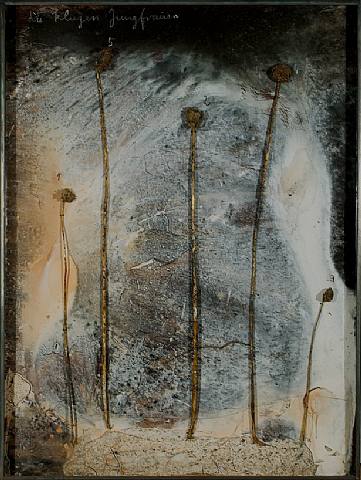
[The image comes from another Anselm, Anselm Kiefer, and depicts his 2007 work, ‘The Five Wise Virgins’]

Forsyth on the holiness of Christ

Forsyth‘We have seen in Christ a holiness the prophet did not know. It is not less solemn, it is not less sublime, but it is more sweet, it is more deep, it is more abiding. It is not a vision, but a presence and a power. We have seen through the smoke which filled the house. We have seen the face of Him that sat upon the throne. We have seen the Cross upon the altar. We have seen that the holiness of God is the holiness of love. There is no such awful gulf fixed between the King and the creature. We too are kings in Him. The word we hear is judgment indeed, and fear, but it is more. It is our judgment laid on the Holy. It is such mercy, pity, peace, and love. It is, indeed, infinite tenderness; but it is soul tenderness, it is moral tenderness, it is atoning, redeeming tenderness. It is the tenderness of the Holy, which does not soothe but save. It is love which does not simply comfort, and it is holiness which does not simply doom. It is holy love, which judges, saves, forgives, cleanses the conscience, destroys the guilt, reorganises the race, and makes a new world from the ruins of the old’. – PT Forsyth, Missions in State and Church: Sermons and Addresses (London: Hodder & Stoughton, 1908), 233.

Oliver O’Donovan on democracy


Two quotes from Oliver O’Donovan that arose out of this discussion on voting:

‘One could almost say that there is only one political question worth asking about liberal democracy: how firmly are the two elements, political freedom and and electoral legitimation, bound together? Is their conjunction a matter of necessity? Or is it merely the product of a peculiar socio-ecological niche, perhaps too fragile or too specialized to transplant?’ – Oliver O’Donovan, Ways of Judgment (Grand Rapids: Eerdmans, 2005), 168.

‘Electoral forms, then, not only fail to guarantee a just, or liberal, government; they are no guarantee of material representation either. The defense of Western democracy must, it seems, be even more modest than the most modest defense current among apologists. Perhaps it may take some form such as this: Modes of representation cannot be chosen in a vacuum; they are dependent upon the conditions of society and on the forms of spontaneous representation that arise unbidden. In a society that has lost most of its traditional representative forms to the unstable and shifting relations built on individualism and technology, but which can count on economic wealth, good communications, and general literacy, there is not serious alternative to the ballot box. Attempts to revive lost forms of loyalty are liable to be Ersatz and morally hollow; we had better secure ourselves against the temptations they present by setting a high procedural threshold for movement of spontaneous popular identity, and this electoral democracy provides. The case for democracy is that it is specifically appropriate to Western society at this juncture. It is a moment in the Western tradition; it has it own ecological niche. This allows us no universal claims of the “best regime” kind, nor does it permit the imperialist view that the history of democracy is the history of progress. Yet within its own terms it allows us to be positive about democracy’s strengths. The best regime is precisely that regimne that plays to the virtues and skills of those who are governed by it; and this one serves us well in demanding and developing certain virtues of bureaucratic and public discourse that the Western tradition has instilled. It is our tradition; we are bred in it; we can, if we are sensible about it, make it work’.  – Oliver O’Donovan, Ways of Judgment (Grand Rapids: Eerdmans, 2005), 178 .

Thirteen Propositions on Voting: a repost

I rarely do this, but some time ago, I posted Thirteen Propositions on Voting. Looking over them again today in light of tomorrow’s US elections, I thought that it was worth a repost:

A preamble: this is not an exhaustive list.

1. Remember, if you are a Christian then you are part of a pilgrim people who ought never really feel at home in this world because we have been made for another.

2. No matter which government is in power, the Church’s charge remains the same – to preach the Gospel. This will include, among other things, at least a 4-fold word: (i) challenging the structures of our society that demean humanity made in the image of God; (ii) challenging the agendas of our society that leave the poor and the widows and the orphans without a voice; (iii) challenging the complacency of a people who refuse to think, or can’t be bothered thinking, about the consequences of the decisions we are making (this has obvious international consequences); and (iv) challenging the selfishness of those who get fatter and fatter at the expense of others, and at the expense of the creation.

3. God’s people receive their identity not from earthly governments, but from the knowledge that they belong to the Lord Jesus and live under his government, and by his word.

4. Regardless of what’s going on in the fleeting world of politics, the Gospel will always have something to say to the world, and to a Church that must continuously strive to keep itself from ever thinking that the Gospel of the Cross is not enough.

5. We must beware lest we fall into the trap that so many Christians throughout history have fallen into of believing that there is such a thing as the only and true Christian form of government. No political party can be baptised, nor any political system. The radical call of Jesus remains regardless of what the government of the day is doing. This doesn’t mean that we shouldn’t strive to bring about godly reforms and laws in the land, but it does mean that we mustn’t delude ourselves into thinking that we can create a heaven on earth.

6. The temptation to deny Christ exists no matter what the political situation and culture is.

7. Don’t be among those who see voting as a chore and as a painful waste of time. Remember that it is a privilege to vote. God has placed many of us in countries where we have the opportunity to take part in decision making as well as in the keeping of our elected leaders accountable. Thank God that some of God’s people live in such places. [I have always struggled to understand how a democracy can encourage non-compulsory voting, not least given the claim of support for democracy-making in other parts of the world!]

8. Thank God for democracy, but never trust it. ‘Democracy’, wrote Forsyth, ‘is but a half-truth. It must have a King. Aristocracy is just as true and as needful. It builds on an authority in things no less than democracy builds on an equality. The free personality of democracy is only possible under a free authority. The free soul is only possible in a free King … There must always be a House of Moral Lords. There must always be leaders and led, prophets and people, apostles and members, genius and its circle, and elect and a called. Ah! democratic and aristocratic principles are both deep in the foundations of our Christian faith’. At the end of the day, ‘democracy is the recurrent suspicion that more than half of the people are right more than half the time’ (E. B. White). Recall the words of C.S. Lewis: ‘I am a democrat [believer in democracy] because I believe in the Fall of Man. I think most people are democrats for the opposite reason. A great deal of democratic enthusiasm descends from the ideas of people like Rousseau, who believed in democracy because they thought mankind so wise and good that every one deserved a share in the government. The danger of defending democracy on those grounds is that they’re not true … I find that they’re not true without looking further than myself. I don’t deserve a share in governing a hen-roost. Much less a nation … The real reason for democracy is just the reverse. Mankind is so fallen that no man can be trusted with unchecked power over his fellows. Aristotle said that some people were only fit to be slaves. I do not contradict him. But I reject slavery because I see no men fit to be masters’.

9. Remember that even secular leadership comes under the domain of God’s sovereignty, and that God uses non-Christians, as well as Christians, to bring about his purposes. The Bible assures us that all those who serve the people well are servants of God. So thank God for his own sovereign governing of the world (Rom 13:1-7).

10. Pray diligently for the leaders and all those in responsibilities of power and decision making. We are commanded by God to pray for all our leaders. Pray that they would make wise and just decisions and govern with mercy as well as strength. Pray for those who do not know Christ, that they would become Christians.

11. Pray for wisdom about your vote. Make your vote count. Make your vote a wise vote.

12. Don’t vote for the party who will best serve your pocket and own interests, but vote for the government or person who you prayerfully and honestly believe can best think through the necessary and complex issues with an attitude of serving others within their own country, and beyond.

13. Once the election has taken place, don’t grumble if your choice of party or person is not elected, for Peter tells us to, ‘Live such good lives among the pagans that, though they accuse you of doing wrong, they may see your good deeds and glorify God on the day he visits us. Submit yourselves for the Lord’s sake to every authority instituted among men: whether to the king, as the supreme authority, or to governors, who are sent by him to punish those who do wrong and to commend those who do right. For it is God’s will that by doing good you should silence the ignorant talk of foolish men. Live as free men, but do not use your freedom as a cover-up for evil; live as servants of God. Show proper respect to everyone: Love the brotherhood of believers, fear God, honour the king (1 Peter 2:12-17).

Getting Kant out of my system

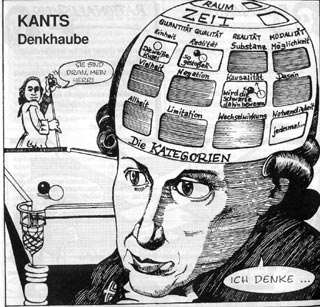
Having spent most of today reading that great father of modern thought – Kant – I confess that what I once discerned as a growing admiration for this Enlightenment thinker with ‘a good dose of Lutheran and Pauline scepticism’ is slowly being ebbed away. In fact, the more I read, it seems, the quicker the ebb ebbs. For example, consider this sample:

Because men are exceedingly frail in all acts of morality, and not only what they practise as a good action is very defective and flawed, but they also consciously and wilfully violate the divine law, they are quite unable to confront a holy and just judge, who cannot forgive evil-doing simpliciter. The question is, can we, by our vehement begging and beseeching, hope for and obtain through God’s goodness the forgiveness of all our sins? No, we cannot without contradiction conceive of a kindly judge; as ruler he may well be kindly, but a judge must be just. For if God could forgive all evil-doing, He could also make it permissible and if He can grant impunity, it rests also on His will to make it permitted; in that case, however, the moral laws would be an arbitrary matter, though in fact they are not arbitrary, but just as necessary and eternal as God. God’s justice is the precise allocation of punishments and rewards in accordance with men’s good or bad behaviour. The divine will is immutable. Hence we cannot hope that because of our begging and beseeching God will forgive us everything, for in that case it would be a matter, not of well-doing, but of begging and beseeching. We cannot therefore conceive of a kindly judge without wishing that on this occasion He might close His eyes and allow Himself to be moved by supplications and flatteries; but this might then befall only a few, and would have to be kept quiet; for if it were generally known, then everyone would want it so, and that would make a mockery of the law … [Man] cannot, indeed, hope for any remission of punishment for his crimes from a benevolent ruler, since in that case the divine will would not be holy; but man is holy insofar as he is adequate to the moral law; he can, therefore, hope for kindness from the benevolent ruler, not only in regard to the physical, where the very actions themselves already produce good consequences, but also in regard to the moral; but he cannot hope to be dispensed from morality, and from the consequences of violating it. The goodness of God consists, rather, in the aids whereby He can make up for the deficiencies of our natural frailty and thereby display His benevolence. – Immanuel Kant, Lectures on Ethics (ed. P. Heath and J. B. Schneewind; trans. P. Heath. Cambridge: Cambridge University Press, 1997), 114–5.

Ouch! It makes one wonder if Kant had ever read Galatians, or Romans! For what is absent in Kant here is not only any notion that the law of God is the law of God’s own being and so cannot be abstracted from God, but also any notion that in a world like ours holiness literally takes the form of grace.

This relates to something else that I’ve been thinking of today, namely Forsyth (as I do), whose deep indebtment to Kant is not without its criticisms. One of Forsyth’s greatest critiques of Kant is reserved for his discussion on prayer. He grants that Kant certainly represents ‘intellectual power and a certain stiff moral insight’, but he lacks ‘spiritual atmosphere, delicacy, or flexibility, which is rather the Catholic tradition’. It is in Kant’s treatment of prayer, Forsyth contends, that he most betrays an intellectualism that ‘tends to more force than finish, and always starves or perverts ethic’. This is because he treats prayer with ‘the equipment of his age’ rather than with the ‘practical experience’ that he would have gleaned if he had immersed himself in ‘the great saints or captains of the race’ like Paul, Thomas à Kempis, or even Cromwell and Gustavus Adolphus. If only Kant had gone to them, Forsyth conjectures, he would have ‘realized the difference between shame and shyness, between confusion at an unworthy thing and confusion at a thing too fine and sacred for exposure’.

Around the traps …


God is for us!

Karl Barth once penned: ‘That man is against God is important and must be taken seriously. But what is far more important and must be taken more seriously is that in Jesus Christ God is for man. And it is only in the light of the second fact that the importance and seriousness of the first can be seen’. – Karl Barth, Church Dogmatics II.2 (Edinburgh: T&T Clark, 1957), 154.

Yes! In Jesus Christ, God has shown not only that God does not want to be God without humanity, but also that God does not want humanity to be humanity without God. God’s will is that God might not be only for himself, but that God might be for humanity all that God is in his eternity. And in the action of the Holy Spirit, the Triune God is present and active among us to hear and answer prayers, to create and sustain life in every minum of creation, to empower human beings to keep saying ‘No’ to sin and ‘Yes’ to God, and to continuously bring home afresh the good news of the Father’s sanctifying action in Jesus Christ, guaranteeing humanity’s inheritance, and empowering us to live in the reality of being ‘holy and blameless’ before God (Eph 1:4). Because God is Holy Love (one of Forsyth’s great themes), humanity’s failure to participate in God’s holiness, is, at core, a denial of God’s love. It is to receive God’s grace in vain. 

Who would have ever thought? God is for us! Hallelujah!

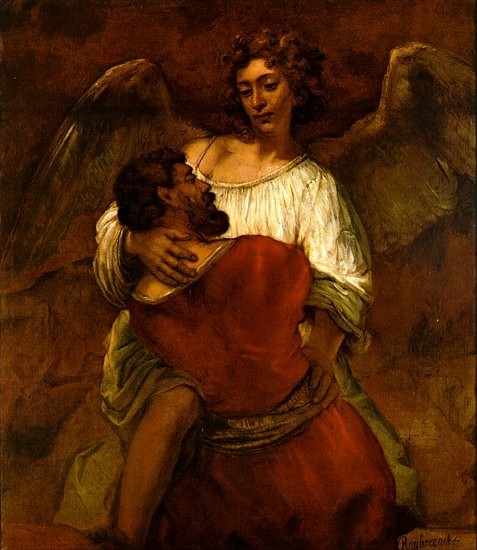
[Image: Rembrandt Harmensz. van Rijn, ‘Jacob Wrestling with the Angel’. Oil on canvas (137 × 116 cm) — ca. 1659/60. Gemäldegalerie der Staatlichen Museen, Berlin]

October bests …

Best books: The Rise of Neo-Kantianism: German Academic Philosophy between Idealism and Positivism, by Klaus Christian Köhnke; Theology in a Global Context: The Last Two Hundred Years by Hans Schwarz; and Theoria, by Peter Fuller.

Best music: Sons of Korah, Rain [2008]; Dar Williams, Cry Cry Cry [1998]

Best films: 10 Items or Less [2007]; An American Crime [2008]
 
Best drink: Heartland Directors’ Cut Shiraz 2006