Author: Jason Goroncy

Jack Clemo, ‘On the Death of Karl Barth’

He ascended from a lonely crag in winter,
His thunder fading in the Alpine dusk;
And a blizzard was back on the Church,
A convenient cloak, sprinkling harlot and husk –
Back again, after all his labour
To clear the passes, give us access
Once more to the old prophetic tongues,
Peak-heats in which man, time, progress
Are lost in reconciliation
With outcast and angered Deity.

He has not gone silenced in defeat:
The suffocating swirl of heresy
Confirms the law he taught us; we keep the glow,
Knowing the season, the rhythm, the consummation.

Truth predicts the eclipse of truth,
And in that eclipse it condemns man,
Whose self-love with its useful schools of thought,
Its pious camouflage of a God within,
Is always the cause of the shadow, the fall, the burial,
The smug rub of hands
Amid a reek of research.

The cyclic, well-meant smothering
Of the accursed footprints inside man’s frontier;
The militant revival,
Within time and as an unchanged creed,
Of the eternal form and substance of the Word:
This has marked Western history,
Its life’s chief need and counter-need,
From the hour God’s feet shook Jordan.

We touched His crag of paradox
Through our tempestuous leader, now dead,
Who ploughed from Safenwil to show us greatness
In a God lonely, exiled, homeless in our sphere,
Since his footfall breeds guilt, stirs dread
Of a love fire-tongued, cleaving our sin,
Retrieving the soul from racial evolution,
Giving it grace to mortify,
In deeps or shallows, all projections of the divine.

– Jack Clemo, ‘On the Death of Karl Barth’ in The New Oxford Book of Christian Verse (ed. Donald Davie; Oxford/New York: Oxford University Press, 1988), 291–2.

Robert Jenson on the Supper

I’ve just completed writing a lecture on the Supper. It was great fun to research, not least because I used it as an excuse to read Robert Jenson’s two-volume systematics. And while I don’t engage with Jenson in the lecture per se, his charateristically-stimulating work charged my thinking in ways that I had not anticipated and which birthed some fruitful avenues of thought. Here’s one passage that I spent some time meditating on:

‘When the Eucharist is celebrated, Christ’s promises of the Kingdom and of his presence in it are in fact fulfilled: even though the Kingdom is still future so long as we are not risen, each celebration is already a wedding feast. Anticipation, we may say, is visible prophecy; so in the Eucharist we come together to live the Kingdom’s fellowship beforehand. But our coming together, however faithful and pious, does not locate us at the gate of heaven, unless God puts us there. That he does is the content of faith that has the Supper itself as the external object to which it clings. That is, it is the content of faith in those other promises: “This bread is my body. This cup is my blood of the new covenant”’. – Robert W. Jenson, Systematic Theology, Volume 2: The Works of God (New York: Oxford University Press, 1999), 216.

Grace and the City [of God]

The ABC’s Encounter program recently aired a worthwhile discussion about the contemporary relevance of Augustine’s City of God. The program, titled ‘Grace and the City’ can be read here, listened to via a stream here, or downloaded here.

The guests on the program include Charles Mathewes (Associate Professor in Religious Studies, University of Virginia), John von Heyking (Associate Professor, Department of Political Science, University of Lethbridge, Alberta), Lawrence Cross (Associate Professor, Faculty of Theology and Philosophy, Australian Catholic University), John Milbank (Professor in Religion, Politics and Ethics, The University of Nottingham) and Thomas Smith (Associate Professor, Department of Political Science, Villanova University).

There are also extended interviews with John Milbank and Charles Mathewes available as downloads.

While I’m thinking Augustine, can anyone recommend a decent biography on Augustine? I have read a few older biographies, and I own, but have not yet read, Augustine: A New Biography by James O’Donnell. And I’m wondering about I’ve just purchased Peter Brown’s book Augustine of Hippo: A Biography which Diarmaid MacCulloch cites favourably. Other recommendations? Warnings?

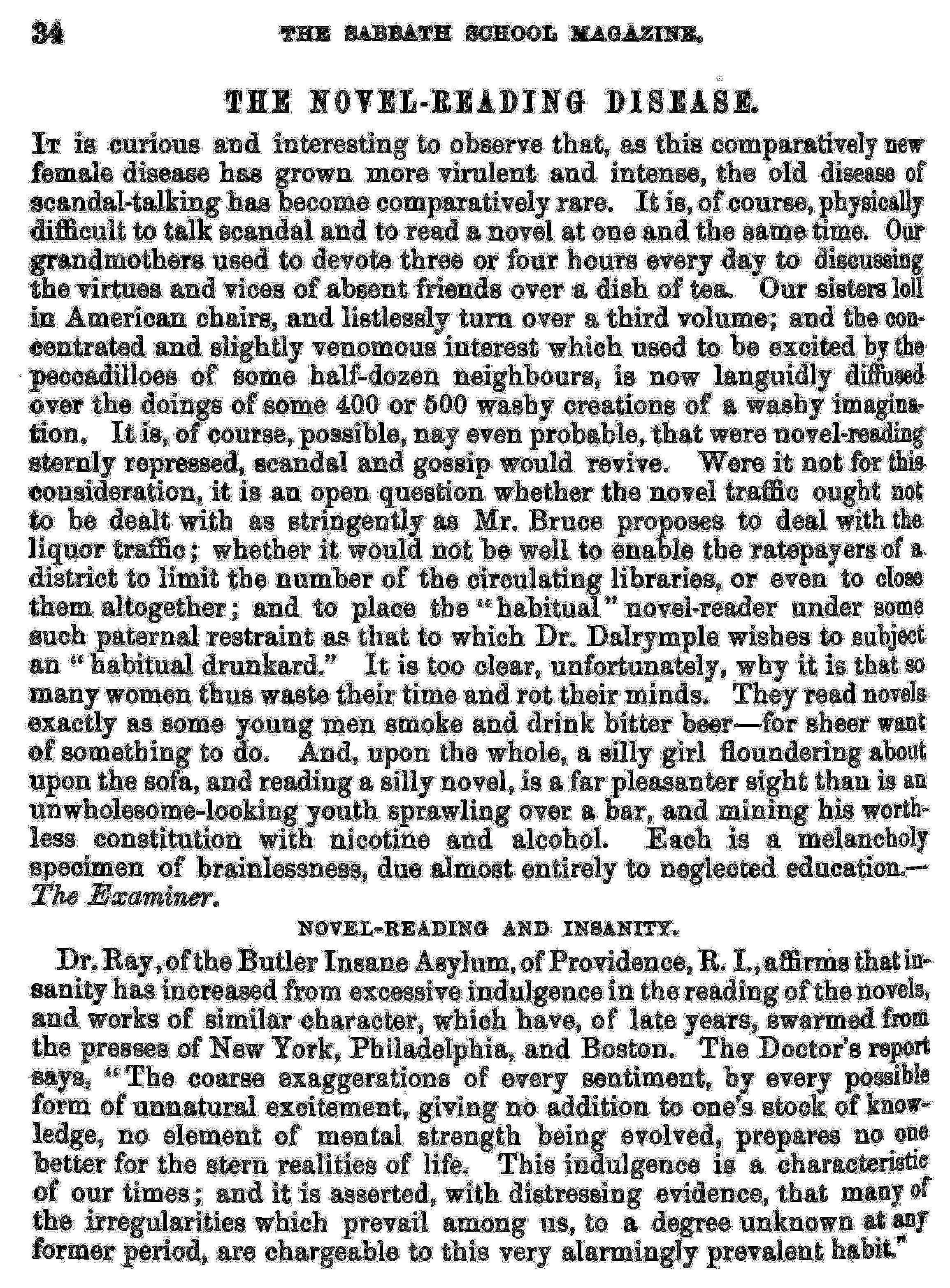
The Novel-Reading Disease

Every historian can testify that one of the real stimulants in their field of study is happening quite unexpectedly upon amusing choice morsels, even if they come via the help of Google Books. Here’s one that I happened across today on the dangers of engaging in that most womanly of contemporary vices – reading novels!

‘The Novel-Reading Disease’ and ‘Novel-Reading and Insanity’ both appeared in The Sabbath School Magazine, designed for the use of teachers, adult scholars, and parents (ed. William Keddie; Glasgow: John M’Callum, 1872), 34.

Why poetry?

Tucked away in one of last year’s editions of Christian Century – an edition I picked up largely to read articles by John de Gruchy on Bonhoeffer, Clifford Green on Metaxas’ version of Bonhoeffer, and Stanley Hauerwas’ review of Peter Leithart’s Defending Constantine – is a delightful review (pp. 62–5) by Brian Doyle, of Mink River fame, on three books of poetry: Every Riven Thing by Christian Wiman, Swan by Mary Oliver and Walking Papers by Thomas Lynch. Doyle begins by ‘tiptoeing’ towards an answer to the question, ‘Why poetry?’ As someone who reads, and posts, a goodly number of poems, I thought his answer worth repeating:

‘Poetry is “memorable speech,” said the (great) poet Wystan Hugh Auden, “about birth, death, the Beatific Vision.” Or, in less lovely words: good poetry, great poetry, is the distilled salt and song of the way we speak; it is espresso speech, perhaps; it pierces and penetrates and illuminates, it makes us see fresh.

Poetry is crucial to us as human beings, for speaking memorably and listening ferociously is perhaps how we best evolve and pray powerfully and stutter toward grace and peace and joy, toward a world where no child weeps and violence is a dark memory. If we do not, as a species, speak memorably and listen ferociously, we have no horizon, no map, no theme. Think, for example, of a world in which the thin Jewish man Yeshua ben Joseph did not speak so colorfully and memorably of forgiveness and grace. Would we have come even this far toward the Light?

I know there are some among us who court silence as their prayer, but I cannot imagine a world shorn of the music of language, the dance of words, the mysterious ways that lines and sentences and images conspire to awaken and elevate and inspire us. Yes, inspire; how very many times have we been lifted by songs and poems, chants and litanies, a twist of words that exactly caught the way we felt but could not say? More times than we can ever count, yes?

So, if we are serious about attentiveness – which is to say, if we are hard at work spiritually – we read poetry on the chance that it might move and startle and illuminate us, that it might be memorable in ways that other written (and sung) language is not. This is why we are so often left cold by lesser poetry, because many poems are merely precious, allusive, self-conscious and self-absorbed without being memorable, moving, startling or accessible. Sometimes I think that great poetry is the highest literary art because it has to claw past such an ocean of terrible muck’.

Library services

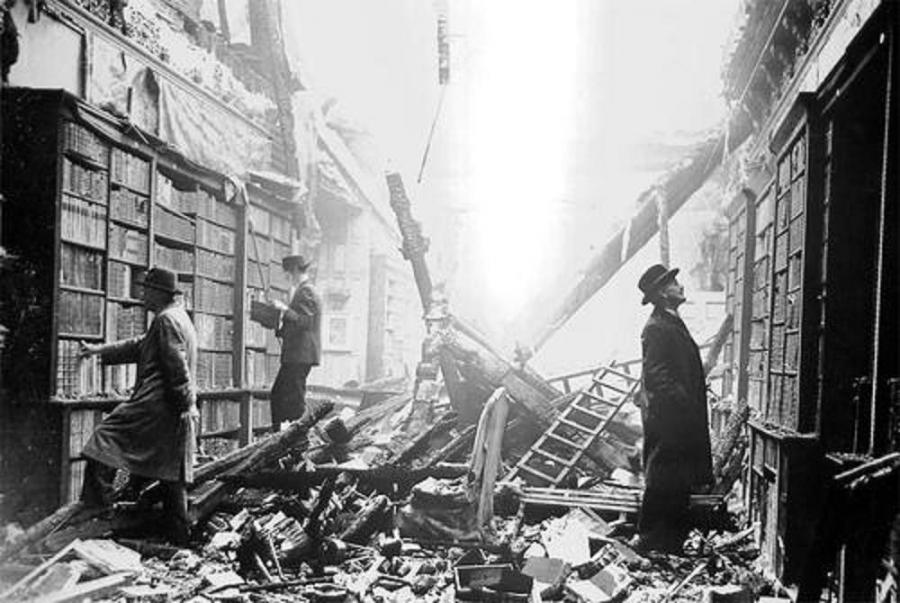
After reading about this latest threat from the depraved, short-sighted, unimaginative and wreckless Dunedin Council to cut library services, I was inspired to read (via Jim Gordon’s blog) about the people in Stony Stratford, near Milton Keynes, Buckinghamshire, who have spent the week withdrawing their maximum allowance of books in protest against council plans to close it as part of budget cuts. They withdrew all 16,000 books from their library. So we’re off to the library again to max out our borrowing, doing our bit to undermine the claim that ‘the proposed changes reflected the number of people using the library …’, a claim I find astonishing given the high number of library users I observed when I was in there last week; in fact, every time I’ve been in there. In fact, I don’t think that I’ve ever seen so many using a public library. It was a bit like a packed stadium, only the crowds were there for longer. So if you live in Dunners, and you’re not a regular at our library, please get reading our books!

BTW: here’s one of the priceless images from last century, depicting the London Library after the 1940 blitz:

Update: I will continue to post links related to this issue here as I find, or am alerted to, them:


Reducing to nothing the things that are: a wee reflection on the politics of power

Vince Boudreau’s book Resisting Dictatorship: Repression and Protest in Southeast Asia begins with these words:

There are times and places about which nothing seems more significant than the sheer energy and violence that states direct against basic freedoms. The snippets of information that filter from these dictatorial seasons – tales of furtive hiding and tragic discovery: hard times and uneasy sleep – describe lives utterly structured by state repression. Authoritarians bent on taking power, consolidating their rule or seizing resources frequently silence opponents with bludgeons, bullets and shallow graves, and those who find themselves in the path of the state juggernaut probably have trouble even imagining protest or resistance without also calculating the severity or likelihood of state repression. Such considerations surely influence whether individuals take action or maintain a frustrated silence, and will over time broadly shape protest and resistance. (p. 1)

My long interest in the people and politics of Burma, in particular, means that I think a lot about this kind of stuff, and particularly about how the community of God might witness to and in the midst of such situations where the abuses of authority birth such blatantly evil fruit and where the climate of hope has been beclouded in fear. [Rose Marie Berger’s recent post on Guantanamo: When Will it Get Foreclosed?, for example, recalled such fruit in another part of the world]. Certainly, all human relationships and institutions live under the constant threat of the abuse of power. And even a cursory reading of history will reveal that the Church too has been both victim and perpetrator of such abuse. (I am aware that already I have used the words authority and power interchangeably here. Certainly they are at least related, and the proper understanding and use of each will decide whether the ways being pursued bring the fragrance of life or the stench of death to a situation.)

In my teaching, I am particularly interested to encourage thinking about the relationship between power and pastoral ministry, between the politics of power and what I call the ‘eucharistic ontology’ of Christian witness. Of course, we might do just as well reading 1 Corinthians 1.27–29, and recalling that ‘God chose what is foolish in the world to shame the wise, what is weak in the world to shame the strong, what is low and despised in the world, things that are not, to reduce to nothing things that are, so that no one might boast in the presence of God’. I guess that I am concerned with exploring the Church’s option of resistance to powers’ abuse as noted by Boudreau; namely, whether we ‘take action or maintain a frustrated silence’. And if the Church is called, among other things, to participate in Jesus’ work of destroying ‘the works of the devil’ (1 John 3.8), then what weapons does God (for surely, to paraphrase Bonhoeffer, that section of humanity in which Christ is taking form must resist the temptation to take up other weapons!) arm the friends of Jesus with?

In his ‘Reflections on the Notification Sent to Jon Sobrino’, published in Getting the Poor Down From the Cross: Christology of Liberation, José Comblin recalls that ‘Christendom has meant that there has been a close alliance between the clergy and the civil powers, meaning the civil authorities. A long reflection that is not only theory, but that has emerged out of living together with the poorest of the people, has demonstrated that this alliance has left no space for the Church of the Poor. This alliance has treated the poor like beggars, and has not allowed them to grow socially and/or culturally. This has been the case despite the pretty speeches of the authorities, meaning the dominant aristocracies’ (p. 75).

The fact is, as Duncan Forrester has also reminded us of in his Theological Fragments, Christian worship loses its integrity when it becomes either isolated from the realities of life, or an escape from the implications of oppression. ‘It is impossible to keep company with Christ if we refuse to accept the company he has chosen to keep. Following the patristic principle ubi Christus ibi ecclesia (where Christ is, there is the Church), it is necessary to go to find Christ and therefore the Church among the poor he loves, to listen to them, and to learn afresh from them how to worship God in Spirit and in truth … Worship separated from the great issues of liberty and justice has become idolatry, an instrument of ideological manipulation, a way of hiding from God rather than encountering Him’ (pp. 109, 110).

So the need to keep worshipping, to keep being confronted by the Word who puts us and our schemes to death and then calls us to participate in his action, and to keep hoping, like John the Baptist, that the One we encounter on the road might be ‘the one who is to come’ (Matt 11.3//Luke 7.19–20).

A prayer for refreshed sensibilities

‘O Lord, refresh our sensibilities. Give us this day our daily taste. Restore to us soups that spoons will not sink in and sauces which are never the same twice. Raise up among us stews with more gravy than we have bread to blot it with, and casseroles that put starch and substance in our limp modernity. Take away our fear of fat, and make us glad of the oil which ran upon Aaron’s beard. Give us pasta with a hundred fillings, and rice in a thousand variations. Above all, give us grace to live as true folk – to fast till we come to a refreshed sense of what we have and then to dine gratefully on all that comes to hand. Drive far from us, O Most Bountiful, all creatures of air and darkness; cast out the demons that possess us; deliver us from the fear of calories and the bondage of nutrition; and set us free once more in our own land, where we shall serve thee as though hast blessed us – with the dew of heaven, the fatness of the earth, and plenty of corn and wine’. – Robert Farrar Capon, The Supper of the Lamb: A Culinary Reflection (Garden City: Doubleday, 1969), 278.

Christopher Morse on heaven

An interesting wee interview with Christopher Morse appeared in today’s Salisbury Post in which Morse (the Dietrich Bonhoeffer Professor of Theology and Ethics at Union Theological Seminary) speaks about his latest book The Difference Heaven Makes: Rehearing the Gospel as News. Here’s a few snippets:

‘The reason I titled my book “The Difference Heaven Makes” is that I find that the subject of heaven is trivialized today in both academic and popular contexts. One reviewer has commented that it was surprising to find a professor from Union seminary writing about heaven. When schools of the church cease to explore afresh the traditions of scriptural and doctrinal testimonies regarding heaven other voices in the public media, often with little knowledge of these traditions, presume to speak for Christianity in their place without any accountability. Heaven becomes, as one author has written, whatever we want it to be. But rather than complaining that such popular writings sell many times over our books as professors, we should work harder as theologians and scholars to convey as clearly and vitally as possible how it all really matters’.

‘To pray that “Thy kingdom come, Thy will be done on earth as it is in heaven,” is to acknowledge that heaven involves a doing. Notice, it is a doing based upon a coming. But what in practice does this mean? In the Gospel this heavenly doing is said to be a coming to us from God that is described as “at hand” but not under our control, not in our hands or originating from us. From this Gospel standpoint what we call ethics, or our human responsibility, is actually our being enabled to respond to what is taking place. Jesus called his disciples to seek this kingdom at hand in the promise that it is the Father’s good pleasure to give it to us. In doing so we are said to become witnesses of what is being done in heaven’.

Read the entire interview here.

On confession

One of the things that the so-called ‘Parable of the Two Sons’ teaches us is that as far as God is concerned, repentance is not principally about the admission of guilt or the acknowledgement of fault but rather is first and foremost about the confession of death. Another thing that the parable announces is that as far as Jesus is concerned, real confession is subsequent to forgiveness. Confession is not a transaction. Confession is not a negotiation in order to secure forgiveness. Confession is, as Robert Farrar Capon avers in The Parables of Grace, ‘the after-the-last gasp of a corpse that finally can afford to admit it’s dead and accept resurrection. Forgiveness surrounds us, beats upon us all our lives; we confess only to wake ourselves up to what we already have … The sheer brilliance of the retention of infant baptism by a large portion of the church catholic is manifest most of all in the fact that babies can do absolutely nothing to earn, accept, or believe in forgiveness; the church, in baptizing them, simply declares that they have it … And our one baptism for the forgiveness of sins remains the lifelong sacrament, the premier sign of that fact. No subsequent forgiveness – no eucharist, no confession – is ever anything more than an additional sign of what baptism sacramentalizes … We may be unable, as the prodigal was, to believe it until we finally see it; but the God who does it, like the father who forgave the prodigal, never once had anything else in mind’ (pp. 140–1).

Some encouragement for preachers

In Luke 12, Jesus tells his ‘little flock’ a number of things: He tells them (and here I’m following Eugene Peterson’s paraphrase) to not fuss about what’s on the table at mealtimes or if the clothes in their closet are in fashion. He directs them to look at the ravens, free and unfettered, to not be tied down to a job description, and to be carefree in the care of God. He commands them to be generous, to give to the poor, and to keep their shirts and lights on waiting for the master to return. To all of which Peter replied, ‘Master, are you telling this story just for us? Or is it for everybody?’ And the Master said, ‘Let me ask you: Who is the dependable manager, full of common sense, that the master puts in charge of his staff to feed them well and on time? Blessed is the person who is doing their job when the master shows up’.

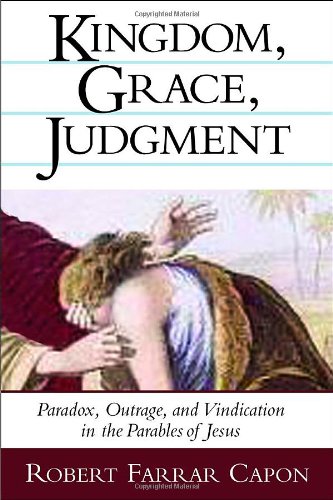
In light of this Lukan text, Robert Farrar Capon (in Kingdom, Grace, Judgment: Paradox, Outrage, and Vindication in the Parables of Jesus) suggests that preachers labour under three distinct requirements:

First, they are to be faithful (pistoí). They are called to believe, and they are called only to believe. They are not called to know, or to be clever, or to be proficient, or to be energetic, or to be talented, or to be well-adjusted. Their vocation is simply to be faithful waiters on the mystery of Jesus’ coming in death and resurrection. What the world needs to hear from them is not any of their ideas, bright or dim: none of those can save a single soul. Rather, it needs to hear – and above all to see – their own commitment to the ministry of waiting for, and waiting on, the only Lord who has the keys of death (Rev. 1:18).

Second, the clergy are to be wise (phrónimoi). They are not to be fools, rich or poor, who think that salvation can come to anyone as a result of living. The world is already drowning in its efforts at life; it does not need lifeguards who swim to it carrying the barbells of their own moral and spiritual efforts. Preachers are to come honestly empty-handed to the world, because anyone who comes bearing more than the folly of the kerygma – of the preaching of the word of the cross (1 Cor. 1:21, 18) – has missed completely the foolishness (mōrón) of God that is wiser (sophōteron) than [human beings]. The wise (phrónimos) steward, therefore, is the one who knows that God has stood all known values on their heads – that, as Paul says in 1 Cor. 1:26ff., [God] has not chosen the wise, or the mighty, or the socially adept, but rather that [God] has chosen what the world considers nonsense (ta mōrá) in order to shame the wise (sophoús), and what the world considers weak (ta asthené) in order to shame the strong. The clergy are worth their salt only if they understand that God deals out salvation solely through the klutzes (ta agené) and the nobodies (ta exouthenéména) of the world-through, in short, the last, the least, the lost, the little, and the dead. If they think God is waiting for them to provide them with classier help, they should do everybody a favor and get out of the preaching business. Let them do less foolish work …

[And thirdly], … preachers are stewards whom the Lord has ‘set over his household servants to provide them with food at the proper time.’ After all the years the church has suffered under forceful preachers and winning orators, under compelling pulpiteers and clerical bigmouths with egos to match, how nice to hear that Jesus expects preachers in their congregations to be nothing more than faithful household cooks. Not gourmet chefs, not banquet managers, not caterers to thousands, just Gospel pot-rattlers who can turn out a decent, nourishing meal once a week. And not even a whole meal, perhaps; only the right food at the proper time. On most Sundays, maybe all it has to be is meat, pasta, and a vegetable. Not every sermon needs to be prefaced by a cocktail hour full of the homiletical equivalent of Vienna sausages and bacon-wrapped water chestnuts; nor need nourishing preaching always be dramatically concluded with a dessert of flambéed sentiment and soufléed prose. The preacher has only to deliver food, not flash; Gospel, not uplift. And the preacher’s congregational family doesn’t even have to like it. If it’s good food at the right time, they can bellyache all they want: as long as they get enough death and resurrection, some day they may even realize they’ve been well fed. (pp. 243–5).

An anniversary

Today, Judy and I celebrated our wedding anniversary. Ten years ago, we made public vows to one another to ‘establish our marriage in the cross of Christ’, we shared in our first holy communion together as partners-in-covenant, and then we enjoyed another meal together with family and friends, some of whom we still keep in touch with.

Though this morning’s news that parts of the recently-opened Mediterranean Garden at the Dunedin Botanic Garden had again been vandalised left something of a cloud over an already-cloudy Dunedin day, it was good to pack the troops into the ute and drive down to the Taieri Mouth where we sat in the car, ate home-made salami Caesar salad out of old ice-cream containers, drink a bottle of cheap-but-Aussie Cabernet Sauvignon out of chipped plastic picnic glasses, and enjoy knowing that the downpour which was blurring our view of the Taieri River at its low and muddy tide was also filling our near-empty water tank at home. I think we also broke the record in how many knock-knock ‘jokes’ (I use the word loosely) a perfect four-year-old daughter and her besotted-father can author in an afternoon. Samuel appeared unimpressed. A stop at Pier 24 – for hot chocolate, a fluffy and a barely-passable flat white – on the way home was required by all, and was ruined only by watching the seagulls defecate all over the car that I’d just washed for the first time in twelve months. It’s not like they don’t have anywhere else to void excrement from their little sand- and chip-filled bowels!

We decided that dinner tonight would be at one of our favourite eating holes – Fleurs Place. It was a good choice. We began with seafood chowder, and scallops (from Nelson) cooked with mushroom and locally-cured bacon. Then came the main course: a whole blue cod, baked, and served with locally-grown vegetables and four additional fish fillets – sole, moki, gurnard and more blue cod – lightly pan-fried and served with chilli, coconut and coriander. Good Central Otago wine and an appropriate amount of pilsner accompanied a conversation in which gratitude, joy and hope recurred as dominant themes. It’s often hard, but it’s good to love, to keep loving, and to share together in the hope of love’s great victory. There was no room left for dessert.

The drive home was slow, as after-dinner driving should be. The heavy fog on the highway had by now largely lifted, or was blown away. We talked more, and wondered about these two poems by RS Thomas:

Anniversary
Nineteen years now
Under the same roof
Eating our bread,
Using the same air:
Sighing, if one sighs,
Meeting the other’s
Words with a look
That thaws suspicion.

Nineteen years now
Sharing life’s table,
And not to be first
To call the meal long
We balance it thoughtfully
On the tip of the tongue.
Careful to maintain
The strict palate.

Nineteen years now
Keeping simple house.
Opening the door
To friend and stranger;
Opening the womb
Softly to let enter
The one child
With his huge hunger.

– RS Thomas, ‘Anniversary’, in Collected Poems, 1945–1990 (London: Dent, 1993), 103.

A Marriage

We met
under a shower
of bird-notes.
Fifty years passed,
love’s moment
in a world in
servitude to time.
She was young;
I kissed with my eyes
closed and opened
them on her wrinkles.
‘Come.’ said death,
choosing her as his
partner for
the last dance. And she,
who in life
had done everything
with a bird’s grace,
opened her bill now
for the shedding
of one sigh no
heavier than a feather.

– RS Thomas, ‘A Marriage’, in Collected Poems, 1945–1990 (London: Dent, 1993), 533.


Critics, writing, Sudoku and some other interesting stuff …

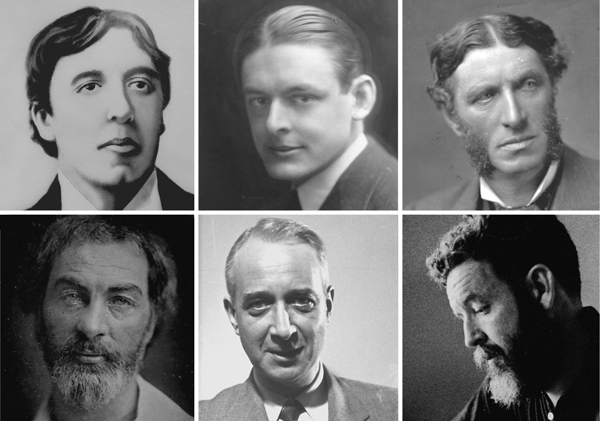
Oscar Wilde, T. S. Eliot, Matthew Arnold, Randall Jarrell, Lionel Trilling and Walt Whitman.

The New York Times recently ran a fascinating multi-author series on criticism, and on why criticism (still) matters:

An interesting wee piece by Ed Park on The Art of the Very Long Sentence.

Richard Bauckham has a very witty piece on ‘Reconstructing the Pooh Community’ wherein he has a swipe at some of the speculative sociological readings of the NT that some in the guild are want to become obsessed with.

Ben Myers continues to enthral us with his own fiction, this time with ‘a short story’ called The Shakespearean Death.

Benedict Carey tells me why I’m a Sudoku- and crossword-junkie (and more recently a jigsaw-puzzle-junkie) in his article on Tracing the Spark of Creative Problem-Solving.

Michael Jinkins posts some Nominees for Today’s Niebuhr.

The latest edition of the Journal of Reformed Theology is out. It includes articles by David P. Henreckson (‘Possessing Heaven in Our Head: A Reformed Reading of Incarnational Ascent in Kathryn Tanner’, pp. 171–184), Paul Helm (‘Reformed Thought on Freedom’, pp. 185–207) and Meine Veldman (‘Secrets of Moltmann’s Tacit Tradition: Via Covenant Theology to Promise Theology’, pp. 208–239).

‘Epiphany’, by R.S. Thomas

Three kings? Not even one
any more. Royalty
has gone to ground, its journeyings
over. Who now will bring

gifts and to what place? In
the manger there are only the toys
and the tinsel. The child
has become a man. Far

off from his cross in the wrong
season he sits at table
with us with on his head
the fool’s cap of our paper money.

– RS Thomas, ‘Epiphany’, in Collected Poems, 1945–1990 (London: Dent, 1993), 363.

David Edwards on Christianity in Aotearoa-New Zealand

While browsing through David L. Edwards’ 664-page Christianity: The First Two Thousand Years (1997), I noticed that it was not until page 599 that New Zealand even rated a mention (which is fair enough), and even then very little ink (113 words) was spilt (which is, I guess, understandable in such a volume). But the bromidic summary is unforgiveable, and it’s hard to believe that this was written – and published – in the 1990s!

‘The history of Christianity in New Zealand is not unlike that story [of Australia]. Here the original inhabitants were the more ‘developed’ Maoris who arrived from Polynesia and the intruding British were settlers who acquired their land (after stout resistance) by treaties which were formal although unequal; these agreements were subsequently broken. American and Asian influences have so far been less strong than in Australia, Man has been less able to damage islands much smaller but more fertile and more beautiful, and the position of the churches is stronger. However, although relatively conservative New Zealand is in significant ways postmodern. The days when missionaries hoped for a nation of Christian Maoris without settlers are distant.’

Now I consider myself a very generous and fair reader, but with this kind of drivel it’s hard to understand why Edwards bothered mentioning New Zealand at all.

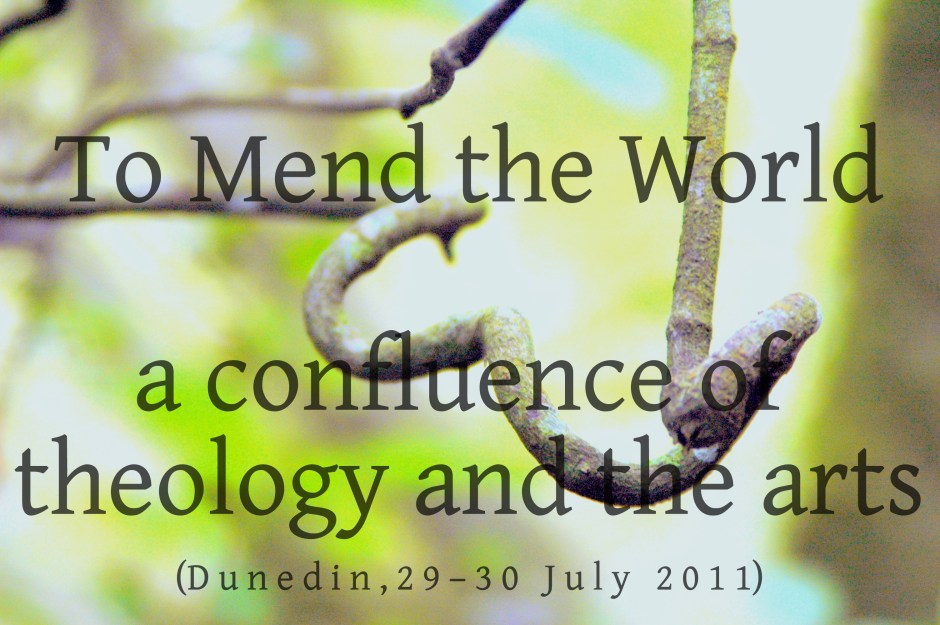
To Mend the World (Tikkun Olam): a confluence of theology and the arts

The traditions of artistic expression and of Christian faith are richly intertwined. Artists help us to see differently. They draw attention to the order of things, and to their disorder. They help us to see the world’s beauty; they present us with its simplicity, and confront us with its tragedy. Now and again the work of artists becomes something more. Like all human gestures toward the truth of things, the work of artists can become an instrument through which God calls for our attention.

Attentiveness to God is also the task of Christian theology. Theology is, simply, a mode of attentiveness to the self-disclosure of God, and a striving to see the truth of things in light of that self-disclosure.

A group of us here in Dunedin are organising a conference and exhibition which will bring together artists and theologians to foster this intertwining.

The conference and exhibition are premised on the conviction that artists, theologians and people of faith have things to learn from one another, things about the complex inter-relationality of life, and about a coherence of things given and sustained by God.

The aim is to bring painters, poets, musicians, indeed, artists of all descriptions, together with theologians, and with people of faith, to explore a particular theme; can there be repair? Can there be a mending of the world, wounded as it is by war, by hatred, by exploitation and by neglect. We have chosen the Hebrew phrase ‘Tikkun Olam’ – to mend the world – to signal the conference theme, and to pose the question: Can there be repair? Can art and can theology tell the truth of the world’s woundedness and still speak of hope? Can poetry still be written after unspeakable tragedy, a concerto played, a brush taken up? Must it be written, played, or taken up, perhaps more than ever?

We invite you to join us in exploring this theme.

Conference Dates & Place

29–30 July 2011. Knox Centre for Ministry and Leadership, Knox College, Arden Street, Dunedin.

Conference Speakers

The theme will be addressed by a range of speakers including Professor William Dyrness, Professor of theology and culture at Fuller Theological Seminary, California.

Exhibition Dates & Place

An exhibition of work that picks up the theme of the conference – To mend the world: Tikkun Olam – is also being organised and will run for a week over the period of the conference.

Invitation to Artists

Artists are invited to participate in a group exhibition to be held at a Dunedin gallery. Information about submissions is available here.

More information on both the conference and exhibition is available here.

‘First of January’, by Günter Eich

Only a calendar would start the day by talking about a new year,
the walls know damn well this isn’t the start of anything new.
Outside, as ever, the clouds blow past, light as hair,
and the wind rattles the windows with the same hands.

March and April will come, and eventually
a day will fill you with its endless hours;
along with the sky and the blown clouds
it will fall into your hands and your house.

Sometimes you catch your face at night in a mirror
obscurely filled with aging—
a faded envelope with unbroken seal,
stuffed always with the same script.

Every day is new and a jubilee,
but pain is a long way off ,
and of the celestial trophies
the only one in your possession is the evening star.

– Günter Eich, Angina Days: Selected Poems (trans. Michael Hofmann; Princeton/Oxford: Princeton University Press, 2010), 13.

2010: ‘It was the best of times …’

‘It was the best of times, it was the worst of times, it was the age of wisdom, it was the age of foolishness, it was the epoch of belief, it was the epoch of incredulity, it was the season of Light, it was the season of Darkness, it was the spring of hope, it was the winter of despair, we had everything before us, we had nothing before us, we were all going direct to heaven, we were all going direct the other way – in short, the period was so far like the present period, that some of its noisiest authorities insisted on its being received, for good or for evil, in the superlative degree of comparison only’. – Charles Dickens, A Tale of Two Cities.

Best books

Theology

Biography

Ministry

History

Cooking

Poetry

Best albums

1. Officium Novum by Jan Garbarek & The Hilliard Ensemble.
2. The Age of Miracles by Mary-Chapin Carpenter.
3. Foundling by David Gray.
4. Scratch My Back by Peter Gabriel.
5. Sacrificium by Cecilia Bartoli.
6. Women and Country by Jakob Dylan.
7. 100 Miles From Memphis by Sheryl Crow.
8. Great and Small by Butterflyfish.
9. Downtown Church by Patty Griffin.
10. No Better Than This by John Mellencamp.

Honorable mentions: All Delighted People by Sufjan Stevens; The Age of Adz by Sufjan Stevens; Leave Your Sleep by Natalie Merchant; Go by Jónsi; April Uprising by The John Butler Trio; The Promise by Bruce Springsteen; The Astounding Eyes of Rita by Anouar Brahem; American VI: Aint No Grave by Johnny Cash; San Patricio by The Chieftains & Ry Cooder; In Person & On Stage by John Prine; How I Learned to See in the Dark by Chris Pureka.

Best films

1. How I Ended This Summer
2. Winter’s Bone
3. Abandoned
4. The Infidel
5. Shutter Island
6. Boy

Overrated films

Worst films

Best TV shows

1. An Idiot Abroad (Series 1)
2. Rev

Some Personal Highlights