Author: Jason Goroncy

Samuel Johnson, 1709–84

'Samuel Johnson', by Sir Joshua Reynolds. Oil on canvas, 1756–1757. 1276 mm x 1016 mm. National Portrait Gallery, London.

‘Samuel Johnson’, by Sir Joshua Reynolds. Oil on canvas, 1756–1757. 1276 mm x 1016 mm. National Portrait Gallery, London.

The small off-white cardboard
plaque says that you were
plagued with nervous tics,
a victim of melancholia, and
a bit of a gasbag.
That may be true.
But Sir Joshua Reynolds (1723–92)
has made you appear
already in your Hades;
ashen, and clad in rags
already the colour of
the dust (of which you were formed
and to which you have long returned),
and all but abandoned for the
company of friends who gave you life;
and forgotten but for
the Dictionary that bears your name.
Certainly, you now hang alongside
a most uninteresting tribe,
and unaware, it seems, that
the adventurous and handsome Joseph Banks
hangs not 30 metres from you
in the next room, and that
the inspiring Charles Kingsley – and his fishing pole –
hangs on the wall in the room above.

– Jason Goroncy

On being catholic

Pieter Bruegel the Elder - The Tower of Babel 1563 aLast week, I was in Rüdlingen for a very fruitful gathering of the Network of Reformed Theologians associated with the work of the World Communion of Reformed Churches. (I chair the working group on Church and Society). One of the real gifts of being part of such a network, and of our regular face-to-face meetings, is that it occasions a situation in which it is extremely difficult, unattractive, and wasteful to engage in theological ruminations in non-catholic ways.

Catholicity, of course, does not mean uniformity; neither does it equate to the flattening of ethnic/cultural realities, a blending or hybridisation of such to the extent that all that remains is theo-cultural soup. But catholicity is, in fact, intrinsically related to the most radical particularity, the sui generis movement of the God who suckled on Mary’s breast. Responsible Christian theology will want to insist that both true unity and catholicity are possible only in the man Jesus Christ, the Son of the catholic God in whom particularism does not cancel out the universal horizon of love’s creative movement. It is the church’s claim, in other words, that the only reality that makes the church both catholic and one is not any particular form or set of practices but its catholic Lord who in his very person – i.e., in the hypostatic union – is the reconciliation between God and the warring factions that characterise the history of human cultures and relations, is the undoing of Babel’s achievement.

Moreover, in Christ, we learn to tell the truth not only about ourselves but also about our ‘others’, the recognition of which leads to what Miroslav Volf calls ‘double vision’ (the ability to view not only ‘from here’ but also ‘from there’) and thereby make possible the embrace of the other in such a way that both ‘our’ otherness and ‘their’ otherness is affirmed and blessed, made porous without loss of distinctives, and individual limitations transcended. Presupposing that we can both stand with a given tradition and learn from other traditions, and drawing upon Hannah Arendt’s notion of an ‘enlarged way of thinking [which] needs the presence of others “in whose place” it must think, [and] whose perspective it must take into consideration’, Volf describes the process by which ‘double vision’ is able to take place. It happens, he says,

by letting the voices and perspectives of others, especially those with whom we may be in conflict, resonate within ourselves, by allowing them to help us see them, as well as ourselves, from their perspective, and if needed, readjust our perspectives as we take into account their perspectives. Nothing can guarantee in advance that the perspectives will ultimately merge and agreement be reached. We may find that we must reject the perspective of the other. Yet we should seek to see things from their perspective in the hope that competing justices may become converging justices and eventually issue in agreement.

Responsible Christian theology will, I think, want to be explicit in grounding such talk of ‘double vision’ in trinitarian terms; i.e., in imitation of and participation in the triune dialogue. And there are important implications here too for interfaith engagement – that such be informed by a vision of the Triune Life who is both host and guest – and, as David Dark intimates, for the kinds of behaviour that characterise international politics:

To label entire populations – or even sections of the globe – as ‘enemy’ is bad theology, and no government that does so can claim to be operating in any mindful way ‘under’ God. To allow an all-too-human governing body to describe the world for us is to hand over our God-given duty to the likes of a phone book or a demonic stronghold. We have to take our thinking back. The same summons is communicated by Iraqi Christians who publicly pray that American Christians might consider more deeply their understanding of the body of Christ. Does our understanding of this communion move beyond national boundaries when it really counts? Do our imaginations, the way we think about other people, acquiesce to the idolatrous and destructive divisions of nation-states? The defensive distance we maintain between ourselves and the people we see in images of war and deprivation is a deadly construct.

‘Deixa a Cúria, Pedro!’, by Pedro Casaldáliga

BANANA PLANTATION WORKERSPedro Casaldáliga, who is bishop emeritus of São Félix do Araguaia, Brazil, has penned what I think is a challenging poem – ‘Deixa a Cúria, Pedro!’ – in response to Benedict XVI’s announced retirement. Here is an English translation of the poem:

Leave the Curia, Peter,
disassemble the Sanhedrin and the walls,
order all the impeccable scrolls to be changed
to words of life and love.

Let us go to the garden of the banana plantations,
undercover and by night, at any risk,
for there, the Master sweats the blood of the poor.

The tunic/vestment is this humble disfigured flesh,
so many cries of children unanswered,
and memories embroidered with the anonymous dead.

A legion of mercenaries besieges the frontier of the rising dawn
and Caesar blesses them in his arrogance.
In the tidy bowl, Pilate, legalistic and cowardly, washes himself.

The people are just a “remnant”,
a remnant of hope.
Leave them not alone among the guards and princes.
It’s time to sweat with His agony,
It’s time to drink the chalice of the poor,
lift the cross, devoid of certainties,
shatter the building — law and seal — of the Roman tomb,
and wake up to
Easter.

Tell them, tell us all
that the grotto of Bethlehem,
the Beatitudes,
and the judgement of love as food,
remain in force and steadfast.

Be no longer troubled!

As you love Him,
love us,
simply,
as an equal, brother.

Give us, with your smiles, your new tears
the fish of joy,
the bread of the word,
roses of embers …
… the clarity of the untrammeled horizon,
the Sea of Galilee,
ecumenically open to the world.

February stations …

Reading:

Listening:

Watching:

O God of earth and altar (Cum terra Deus arae)

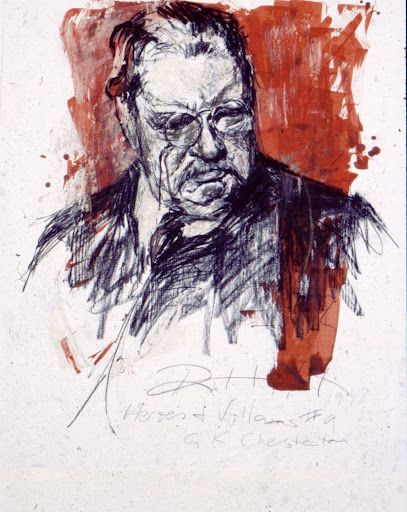
G K ChestertonO God of earth and altar,
Bow down and hear our cry,
Our earthly rulers falter,
Our people drift and die
The walls of gold entomb us,

The swords of scorn divide,
Take not thy thunder from us,
But take away our pride.

From all that terror teaches,
From lies of tongue and pen,
From all the easy speeches
That comfort cruel men,

From sale and profanation,
Of honour and the sword,
From sleep and from damnation,
Deliver us, good Lord!

Tie in a living tether
The prince and priest and thrall,
Bind all our lives together,
Smite us and save us all;
In ire and exultation
Aflame with faith, and free,
Lift up a living nation, 
A single sword to thee.

– G. K. Chesterton

Apocalyptic identity: How ‘new’ is the new identity? – a comment on Gal 3.27–28 & 1 Cor 7.17–24

identityIn his essay on ‘The Apocalyptic Gospel in Galatians’, J. Louis Martyn insists that Paul’s apocalyptic theology – particularly in Galatians – is ‘focused on the motif of invasive movement from beyond’. In other words, Paul is concerned to track the shape of God’s ‘fundamental and determining line of movement’ and its ecclesial/missional implications. He writes:

In Paul’s gospel … the fundamental and determining line of movement is God’s. Since the antidote to what is wrong in the world does not lie in the world, the point of departure – on the apocalyptic landscape – from which there can be movement to set things right cannot be found in the world, or in any of its ideas of bad news and good news.

In short, it is not as though, provided with a good religious foundation for a good religious ladder, one could ascend from the wrong to the right. Things are the other way around. God has elected to invade the realm of the wrong – ‘the present evil age’ (1:4) – by sending God’s Son and the Spirit of the Son into it from outside it (4:4–6). And it is in this apocalyptic invasion that God has liberated us from the powers of the present evil age. Galatians is a particularly clear witness to one of Paul’s basic convictions: the gospel is not about human movement into blessedness (religion); it is about God’s liberating invasion of the cosmos (theology).

The divine movement in Jesus Christ and specifically in his cross, Martyn avers, is set against the ‘community-destroying effect of Sin as a cosmic power’ and the creation of an embodied new community characterised by mutual service in the world and by the putting to death of religion and the boundaries – ethnic and otherwise – that religion is concerned to preserve, often taking up the tools of violence in order to do so. He writes:

The Christ who is confessed in the formula solus Christus is the Christ in whom there is neither Jew nor Gentile. Instead of being the holy community that stands apart from the profane orb of the world, then, the church of this Christ is the active beachhead God is planting in a war of liberation from all religious differentiations. In short, it is in the birth and life of the church that Paul perceives the polarity between human religion and God’s apocalypse. Thus, a significant commentary on Paul’s letters can be found in the remark of Dietrich Bonhoeffer that ‘God has founded his church beyond religion …’.

Such a claim immediately raises the question about just how ‘new’ is this ‘active beachhead’ that God has created and/or is creating. Certainly there ought to be no (over-realised) talk of the community being anything other than truly worldly. And although we must go on to say something about the fact that the community resides in the world as ‘aliens and strangers’ (1 Pet 2.11), it is, in fact, the most worldly of communities, called and given over by the Word for a vocation entirely in this world but dependent entirely on resources from outwith. We might even say that apart from the church there is no world. This need not, of course, be to claim any more than Barth is hinting at when he reminds us that

The only advantage of the Church over against the world is that the Church knows the real situation of the world. Christians know what non-Christians do not … It belongs to the Church to witness to the dominion of Christ clearly, explicitly, and consciously.

One of the clearest expressions of this witness (made explicit in the Galatian letter) is when the Christian community resists the temptation to define itself along lines determined by the old creation and instead is defined by the apocalyptic reality dawned in Christ’s resurrection from the old order. So 3.27–28:

As many of you as were baptised into Christ have clothed yourselves with Christ. There is no longer Jew or Greek, there is no longer slave or free, there is no longer male and female; for all of you are one in Christ Jesus.

The baptismal liturgy drawn upon here presupposes that clothes are removed, an act which signifies a departure from ‘the old self with its practices and [being] clothed … with the new self’ (Col 3.9–10); i.e., with Christ who is himself both ‘the “place” in which the baptized now find their corporate life’ and the announcement of the old cosmos’ end. In this new situation, ‘there is no longer Jew or Greek, there is no longer slave or free, there is no longer male and female; for all of you are one in Christ Jesus’ (Gal 3.28). Martyn suggests elsewhere that while in the Epistle to the Galatians Paul is only interested in the first pair of opposites (i.e., the relationship between ‘Jew’ and ‘Gentile’), the text here presents a table in which certain pairs of opposites were identified as the elements that, it was believed, give to the cosmos its dependable structure. To therefore ‘pronounce the nonexistence of these opposites is to announce nothing less than the end of the cosmos’.

Religious, social, and sexual pairs of opposites are not replaced by equality, but rather by a newly created unity … so fundamentally and irreducibly identified with Christ himself as to cause Paul to use the masculine form of the word ‘one’. Members of the church are not one thing; they are one person, having been taken into the corpus of the One New Man.

St Paul was unwavering in his conviction that ‘God was making a new creation by drawing into one church both Jews and Gentiles’, believing that it was not enough simply to maintain a spiritual unity in the church catholic; the unity created in the second – or last – Adam needed to be seen and experienced in a concrete and local social reality as well. The break in sharing meals together would end the social unity of the church against the divisive forces of human recalcitrance.

While St Paul in Galatians is uninterested in attending to the distinction between ‘male and female’, our attendance to such can serve to sharpen our appreciation of the Apostle’s overall argument in this passage and to highlight how it exemplifies the apocalyptic nature of the Gospel that he was intent on proclaiming. In Galatians 3.28, the words ‘male and female’ seem to refer back to the Genesis narrative as if to say the distinction and differentiation was important then but in Christ those created distinctions cease to be relevant to God’s purposes; that is, they are superseded by participation in Christ, in the new creation.

The Synoptics, of course, reveal an astonishing tension on matters of sexual differentiation and family. On the one hand – say the example of Jesus’ response to the question about divorce – Jesus is content to employ the ancient and widespread assumptions based on the fact of how things were (or were perceived to be) ‘from the beginning of creation’ (Mark 10.6), suggesting an ethic grounded in (at least) the abiding functional goodness of creation. On the other hand, when informed that his biological mother and brothers were waiting for him, Jesus’ response indicates a re-evaluation of family relationships based not on the logic of the old creation but of the radical newness of the new eschatological family defined around himself (Mark 3.33–35). He is, it would seem, the new creation in nuce.

There is clearly a discernible tension here between theological arguments offered on the basis of creation and those made on the gospel’s power to bring about a new reality. We see this tension not only in the Gospels but also in Paul’s writing itself. So, for example, in Romans 1.18–32, Paul employs an argument explicitly based on creation and draws certain conclusions from ‘the things [God] has made’ in ‘the creation of the cosmos’ (Rom 1.20). In Galatians 3 and 6, however, Paul employs an entirely different – we might even say ‘opposite’ – logic when he argues that it is ‘explicitly not creation, but rather the new creation in which the building blocks of the old creation are declared to be nonexistent’ that the church is to take her theological and ethical cues from.

The divine affirmation recorded in Genesis 2 – ‘It is not good that the man should be alone (Gen 2.18) – is now brought under the scrutiny of the inbreaking of a new reality in the resurrection resulting in a different answer to Adam’s problem. ‘Now the answer to loneliness is not marriage, but rather the new-creational community that God is calling into being in Christ, the church marked by mutual love, as it is led by the Spirit of Christ (Gal 3:28b; 5:6,13, 22; 6:15)’. Of course, in a different context, Paul’s polemic takes different shape. So in the Corinthian correspondence, for example, the strict dichotomy between old and new is not so strictly championed and the pastor-missionary-theologian will ‘negotiate the relation between new creation and creation by advising married people to be married as though not being married (1 Cor 7:20)’. The apocalyptic realism underscored so heavily in Galatians cannot – if Paul is to be our theological guide – be simply employed to create a template to be placed on all and every situation. Rather, the theologian’s task calls for much more sensitivity than that, and requires equal attention to the particularities of context. So James Dunn:

It must be stressed again that this recognition of the historical relativity of the word of God does not diminish its authority as word of God. Precisely to the contrary, it sets scripture free to function as word of God in the way intended. If we insist, with the logic of the inerrancy school, that scripture must always say precisely the same thing in every historical context, then we muzzle scripture: we filter the word of God through a systematizing and harmonizing process which filters out much that God would say to particular situations, and lets through a message which soon becomes predictably repetitive, whatever the scripture consulted. Why should it be so hard to accept that God speaks different words to different situations (because different situations require different words)? In Jesus Christ, God committed his word to all the relativities of historical existence in first-century Palestine. Paul did not hesitate to express the gospel in different contexts, terms which no doubt would sound contradictory if they were abstracted from these contexts into some system and harmony which paid no heed to these contexts (1 Cor 9:20f.) – hence the apparent conflict between Paul and James (cf. Rom 3:28, ‘justified by faith apart from works’; James 2:26, ‘faith without works is dead’). Mark did not hesitate to press the implications of Jesus’ words about true cleanliness with a view presumably to the Gentile mission (Mark 7:19); whereas Matthew softened the force of the same words, since he had the Jewish mission in view (Matt 15:17). If we ignore such differentiation of the word of God in and to different situations, we rob scripture of its power to speak to different situations. It is only when we properly recognise the historical relativity of scripture that our ears can be properly attuned to hear the authoritative word which God speaks to us in the words of scripture here and now.

While 1 Corinthians 7.17–24, words which appear in an epistle addressed to a ‘multi-ethnic community’ (Witherington) existing in an ethnically and religiously diverse population, is principally concerned with social rather than ethnic realities, it is possible that we might observe here a general principle – ‘to remain as you are’ – that concerns both. In a recent study, J. Brian Tucker surveys and assesses ways in which the Apostle Paul negotiates and transforms existing social identities of the Christ-followers in Corinth in order to extend his gentile mission. He notes that the apostle is concerned to form a Christ-movement identity in the diaspora churches in such a way that previous ethno-social identities are not abrogated but are genuinely transformed ‘in Christ’. Rejecting the view that the church is a community in which such identities are so radically relativised as to be rendered meaningless, Tucker argues (on the basis of 1 Corinthians 7.17, 20 and 24) that Paul’s ‘primary ideological perspective’ is that Christ-followers should remain in the situation they were in when God called them. ‘The result of this interpretive move’, he suggests, ‘is that Paul, rather [than] seeking to obliterate existing social identities, is seen as one drawing from these to form diverse expressions of Christ-movement identity’. He concludes that for Paul, the continuation of various social and ethnic identities remains an open question and is always situationally determined. We might here wish to follow Gordon Fee and insist that such situational determination is determined first and foremost by God’s call rather than by the situation itself, and that the challenge that 1 Corinthians 7 poses to us is that believers need to learn to live out their calling before God in whatever situation they are found, letting the call of God itself ‘sanctify to oneself the situation’.

This is indeed consistent with what we observe throughout the Pauline corpus; namely, that the retention of one’s particularity in Christ is a basic characteristic in our understanding of the process of identity-construction as Christ-followers. This means, among other things, that ‘despite our enormous potential for identity construction, not all structures are feasible or available to us’ as identity builders. ‘We are forced to start from where we are and, in the world of Paul’s day, that meant as either Jews or gentiles, accepting these components to a great extent as part of the given’. So Philip Esler:

In any particular case, therefore, we need to be open to the possible stubbornness of ethnic affiliation, while not underestimating the power of individuals and groups to modify ethnic identity for particular social, political or religious ends.

It is important to note also, particularly if St Paul is to be our guide here, that the construction of identity in Christ occurs within a complex of layers of significant sub-identities (so Rom 11.1; Phil 3.5–6) all of which are important although not equally so and none of which ought to dethrone the primacy of baptismal identity in Christ. So William Campbell:

Paul shares with gentiles in Christ the primary identity-marker which is faith in Christ. He shares with gentiles a special bond as apostle to the gentiles but he differs from them in that he is both Jewish and, by divine commission, apostle to the gentiles. So whilst Paul shares the primary identification of being in Christ, this is accompanied by a differentiation in terms of ethnic and cultural affiliation. He is an Israelite but they are not Israelites despite being in Christ.

To be in Christ is not universal and the same for all peoples. Paul’s converts from the nations are clearly designated by him as gentiles throughout his letters. His strong insistence on their not becoming Jews underlines the fact that for Paul Jew and gentile are fundamental categories and that however much Jews and gentiles share in Christ this in no wise makes them the same … In Christ ethnic difference is not transcended but the hostility that accompanies this should be … Paul’s theologizing is dynamic and he by no means views his converts as continuing in an unchanged existence. They are continually changed by being in Christ but this involves their transformation as Jews or as gentiles, not into some third entity.

So what is being championed by the Apostle Paul (in Galatians, 1 Corinthians, and elsewhere) is not that humanity has been liberated from religious boundaries in order to take up residence as a citizen of a secular, desacralised world, but rather that those baptised into Christ are now to live in the reality of Christ as both the boundary and centre of their existence, a boundary which includes all humanity in our cultural/ethnic/gendered/social/historical particularities. Christ’s kenotic community therefore must not violate the divine-human solidarity announced and secured in the hypostatic union by placing boundaries between itself and the world. But this is not all, for, the radical solidarity created in the incarnation also creates a dissonance between that which depends upon arrangements which are passing away and those which depend upon and point to the coming reign of God. Put otherwise, the incarnation and the coming of the eschatological Spirit announce that ‘historical precedence must give way to eschatological preference’. So John Zizioulas insists that even Jesus must be liberated from his past history in order to bring to the present history of the church his eschatological presence and power:

Now if becoming history is the particularity of the Son in the economy, what is the contribution of the Spirit? Well, precisely the opposite: it is to liberate the Son and the economy from the bondage of history. If the Son dies on the cross, thus succumbing to the bondage of historical existence, it is the Spirit that raises him from the dead. The Spirit is the beyond history, and when he acts in history he does so in order to bring into history the last days, the eschaton.

The beard as sign

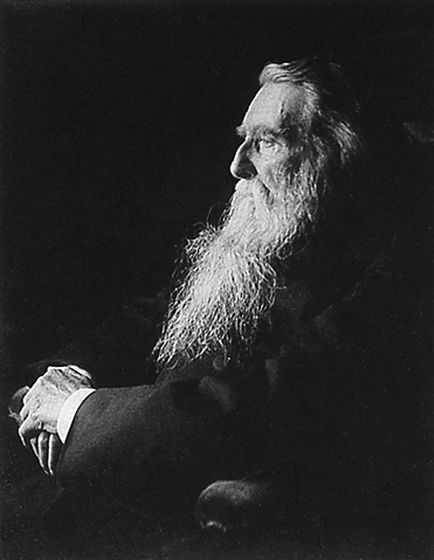
john_ruskin_1894Tonight, while taking a break from writing a paper on an entirely different subject, I was dipping into Sharon Weltman’s book Performing the Victorian: John Ruskin and Identity in Theater, Science, and Education. She recalls how Ruskin did not object to women playing men in the pantomime; not object, that is, ‘until they whip out their cigars’. The problem for Ruskin (as for his contemporaries, it seems) came down not only to those cigar-smoking women but also to the presence of that wonderful gift – a gift which Ruskin himself cultivated over the years – ‘the beard’. The problem with ‘the beard’, as with ‘the cigar’, Weltman suggests, is that it ‘symbolizes masculinity too forcefully for critical comfort. A conventionally feminine pantomine boy poses less of a sexual threat, especially since tights show off shapely female legs, often specifically admired by Victorian theater critics. But women with beards and cigars symbolically suggest morphological possibilities too unsettling and compromise gender boundaries too bluntly to pass unremarked’ (p. 32).

This got me thinking about what other kinds of ‘morphological possibilities’ beards might communicate – like how sheer laziness with the grooming side of things can communicate a lack of consideration of a partner’s longing for smooth chins – and of the ways which such might serve as social and ideological signs; and that led me to a couple of amusing images (from here and here) that I thought worth sharing:

Growing beards

The beards of ministry

Ecclesia and Ethics: An Eco-friendly and Economically-feasible Online Biblical Studies and Theology Conference

Ecclesia and Ethics: An Eco-friendly and Economically-feasible Online Biblical Studies and Theology Conference is an academic and ecclesial conference taking place on Saturday May 18th and Saturday May 25th 2013 in real-time via Webinar.

Main papers will be presented by N.T. Wright, Michael Gorman, Dennis Hollinger, Shane Claiborne, Stanley Hauerwas, Brian Rosner, Mariam Kamell, and Nijay Gupta. Additionally, there will be five Multiple Paper sessions throughout the conference, via five Virtual Rooms which will feature papers from a total of 20-25 selected papers.

No software will need to be purchased by presenters or attendees, and Webinar access is provided entirely for free due to a generous Capod Innovation Grant through the University of St Andrews in Scotland. Participants and attendees will be able to sign on, present, and listen to or watch presentations from anywhere in the world with a reliable internet connection and a computer. Registration for the conference consists of a $10/£7 (minimum) donation to a Recommended Charity.

Conference organisers are also seeking abstracts/papers which deal with the role and relationship of the Church to Christian Ethics and/or Moral Formation. Papers may be rooted in the areas of: the Exegesis of New Testament texts, New Testament Theology, the Exegesis of Old Testament texts, Biblical Theology, Practical Theology, Systematic Theology, or Theological Ethics. Selected candidates will present a 35-40 minute final paper (approx 5000-5500 words). All accepted papers will be considered for inclusion in the publication of the proceedings with T&T Clark. Interested parties are invited to submit a 250-300 word (max) abstract to ecclesiaethics@gmail.com for consideration from January 2013-March 2013.

For more information/registration, visit http://www.ecclesiaethics.com.

Jesus found!

Thanks to the help of Google Maps, I just discovered Jesus! Apparently, he lives in a wee creek that runs between Porters Lodge and Jesus Green in Cambridge, UK. (So he may, after all, be a Baptist but at least he’s not American.) He even has a lane and a college named after him.

Jesus

December-January stations …

GreenvoeReading:

Listening:

Watching:

The great new theology e-group experiment

Theology G+ GroupRecently, I undertook to begin building a wee e-community via Google Plus’s new ‘Communities’ feature. It’s called Theology: thinking faith together, and the intention is that it be a space ‘for the mutual sharing of and discussion about mature theological ideas (however developed) and resources which serve those who attend to the tasks of faith thinking’. The experiment is monitored by yours truly (believe me, and I know that this is difficult to verify with any degree of anything, but there are looneys out there who are even loonier than me), but if it sounds like something that you’re into, then consider joining in. It starts here.

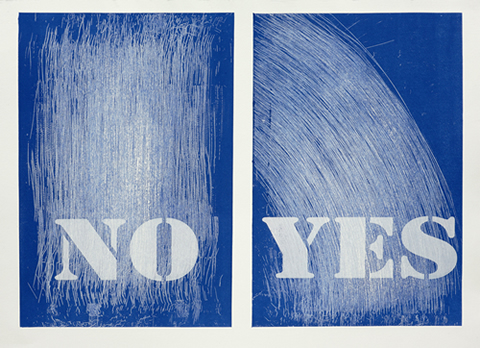
Following Jesus means learning to say both ‘Yes’ and ‘No’

yes noOver the years, I’ve learnt to be grateful – really grateful – for anyone who helps me to take more seriously what it means to follow Jesus. And part of what I’ve learnt – and need to keep learning – is that to follow Jesus means not only learning to say ‘Yes’ but also learning to say ‘No’; not only learning to say ‘I love’ but also learning to say, with equal discipline, ‘I hate’. Yes, I agree, ‘hate’ is a word that ought be used sparingly. And yes, I believe that Martin Luther King, Jr. was right to insist that only love can drive out hate, and that Frederick Buechner is spot on to observe that pure ‘haters simply lose themselves’. But ‘hate’ is not, for these reasons, a word that ought to be completely outlawed or which is out of place in faithful and loving speech. In fact, sometimes it’s quite the opposite. So, for example, it’s because I love my partner that I hate all that threatens to diminish our relationship. It’s because God loves marriage that God hates divorce (Mal 2.16; and, yes, I know that there are alternative renderings of this verse).

But back to ‘Yes’ and ‘No’. The Barmen Confession, more explicitly than perhaps any other Reformed confession, reminds us that genuine confession of faith is always both an affirmation of truth and a denial of untruth. Elsewhere, Barmen’s chief author put it thus: ‘If the Yes does not in some way contain the No, it will not be the Yes of a confession … If we have not the confidence to say damnamus [what we refuse], then we might as well omit the credimus [what we believe]’ (CD I/2, 631, 630). Of course, that there is a ‘Yes’ and a ‘No’ to be said (and acted upon) doesn’t rusticate the ‘Maybes’. But that there are not only Maybes means that to be a response-able human being is to live other than on a fence. Luther’s famous ‘Here I stand’ speech comes to mind here, as does Kierkegaard’s Abraham. And so, for example, it’s because I want to say ‘Yes’ to the Father whose face is made available to me in Jesus Christ that I must say ‘No’ to those church liturgies which replace/mimic the triune name with a set of functions. (Isn’t it a no brainer? God has a name. God went to a lot of trouble to tell us that name. So use it!) It’s because I want to say ‘Yes’ to Christ that I must say ‘No’ to Caesar. It’s because I want to say ‘Yes’ to the ploughshare that I must say ‘No’ to the sword. It’s because I want to say ‘Yes’ to life that I must say ‘No’ to life’s enemies. It’s because I want to say ‘Yes’ to personhood that I must say ‘No’ to individualism. It’s because I want to say ‘Yes’ to prayer that I must say ‘No’ to distraction. It’s because I want to say ‘Yes’ to faithful tellings of the gospel that I must say ‘No’ to the way that the likes of John Piper and Mark Driscoll sometimes spout theological bullshit in the name of Christian truth (and ‘No’ to the way that so-called Christian publishers profit from their verbiage).

So back to ‘Hate’. While those who live in – and so are formed by – Facebookland are dis-encouraged to feel so strongly about anything that they should ‘hate’ it, or even ‘dislike’ it, human beings are not called to live lives constituted by Mark Zuckerberg but by the event of God’s decision to be human among us, an event that calls everything into question. Some of those questions will be met by a ‘Yes’ and others by a ‘No’, some by a ‘Love’ and others by a ‘Hate’. And I was reminded of this recently when watching this wee clip of Uncle Stanley (who is one of those who has helped me to take more seriously what it means to follow Jesus) talking about the things that he hates.

Some updates on forthcoming publications

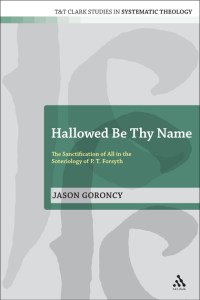
Hallowed be thy nameA number of folk have contacted me recently to ask about the publishing date for my book Hallowed Be Thy Name: The Sanctification of All in the Soteriology of P. T. Forsyth. If all stays on track – and thus far that has been the case – it is scheduled for release on 28 March. It will also be available in e-formats (epub and pdf). It forms part of the T&T Clark Studies in Systematic Theology series.

2013 will also see – again, all going well – two other books that I’ve been working on come to light, both being published by Pickwick Publications (an imprint of Wipf and Stock). The first is a book of sermons (about half of which are previously unpublished) by PT Forsyth and is titled ‘Descending on Humanity and Intervening in History’: Notes from the Pulpit Ministry of P.T. Forsyth. It includes a Foreword by Professor David Fergusson and a lengthy Introduction by yours truly. Publication is scheduled for May-June. I am very excited about this book.

The other book, about which I am equally roused, is an edited volume of essays written by artists and theologians invited to explore the notion of Tikkun Olam (to repair or heal the world). It is (provisionally) titled “Tikkun Olam”—To Mend the World: a confluence of theology and the arts. The relevant bits of the Table of Contents read thus:

Foreword: Alfonse Borysewicz
Jason Goroncy, Introduction

  1. William Dyrness, ‘“Prophesy to these Dry Bones”: Artists’ Role in Healing the Earth’
  2. Trevor Hart, ‘Cosmos, Kenosis and Creativity’
  3. Carolyn Kelly, ‘Re-forming Beauty: Can Theological Sense Accommodate Aesthetic Sensibility?’
  4. Jono Ryan, ‘Questioning the Extravagance of Beauty in a World of Poverty’
  5. Libby Byrne, ‘Living Close to the Wound’
  6. Jo Osborne and Allie Eagle, ‘The Sudden Imperative and Not the Male Gaze: Reconciliatory Relocations in the Art Practice of Allie Eagle’
  7. Murray Rae, ‘Building from the Rubble: Architecture, Memory and Hope’
  8. John Dennison, ‘The Interesting Case of Heaney, the Critic, and the Incarnation’
  9. Julanne Clarke-Morris, ‘New Media Art Practice: A Challenge and Resource for Multimedia Worship’
  10. Steven Guthrie, ‘Silence, Song, and the Sounding-Together of Creation’

I must say that while my foray into the world of being an editor has proved to be a little more time consuming than I had anticipated, it has been a real joy and I hope that I have the opportunity to edit another collection sometime in the future; in fact, I’m already scheming about two or three more possibilities.

Not in Christ’s name

Channel_Markers‘The name of Christ should not be misused as a “carrot and stick” to motivate people to do what ordinary self-interest and a few altruistic genes can accomplish just as well … The business of the church is to be faithful to the word and wisdom of the revealed God (deus revelatus), one who does not meet us anonymously within the ambiguities of the world process. The church is not called to minister in [sic] behalf of some anonymous Christ, or some unfleshed deity immanently directing the course of history incognito. The biblical line of promise is a thin line, and the church must learn once again to walk it faithfully, rather than take the easy road of popular trends and fashionable movements’. – Carl E. Braaten, ‘The Mission of the Gospel to the Nations’, Dialog 30, no. 2 (1991), 129.

[Image: ‘Channel Markers’, by Melbourne photographer Andrew Sanigorski]

A Review of Chris Green’s, Toward a Pentecostal Theology of the Lord’s Supper

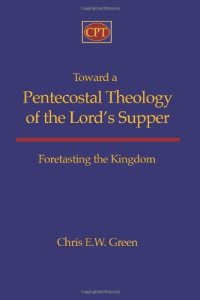
Toward a Pentecostal Theology of the Lord's SupperChris E. W. Green, Toward a Pentecostal Theology of the Lord’s Supper: Foretasting the Kingdom (Cleveland: CPT Press, 2012). ISBN: 9781935931300

Reading this study meant jumping some hurdles. First, while it may well say something embarrassing about me and my reading habits, it is not very often at all that I pick up a book of theology and get almost half way through it without recognising more than a handful of the names mentioned therein. Then again, I don’t read a lot of historical theology concerned to tell a particular chapter of Pentecostalism’s story. Consequently, there were times when reading this study by the young Pentecostal theologian Dr Chris Green (the Assistant Professor of Theology at the Pentecostal Theological Seminary in Cleveland) that it felt something like what I imagine it may have been like to visit a foreign country in pre-flying days where even if you recognised something of the language upon arrival there was simply no escaping that you were a long way from home.

And then there was the inkling that a book on Pentecostals and the Lord’s Supper represents something, to say the least, of an oxymoron. But Green has convinced me that while Pentecostals do still have ‘an “allergic response” to the sacramentalism’ (p. 35) of higher church traditions and their ‘sacramental baggage’ (as Amos Young calls it), it was not always so. Indeed, Green goes to considerable length, and depth, to build precisely such an argument, the presentation of which appears to serve his own apologetic purposes and assists him to avoid the cheap and undue polemics so often associated with wider discussions on the Supper.

The book proper begins with a helpful survey of the scholarly literature in which Green documents what Pentecostal scholars have said and are saying about the sacraments in general and the Lord’s Supper in particular. He begins by noting that while it is widely believed – both within and outwith Pentecostalism – that Pentecostals have attended little to sacramental thinking and practice, and that while Pentecostals have often spoken about the sacraments in predominantly negative terms, ‘this is far from the whole of the story’ (p. 5). Surveying the work of a long list of some 40 Pentecostal theologians – from Myer Pearlman, Ernest Swing Williams and C.E. Brown writing in the 1930s and 50s, to figures such as Simon Chan, Veli-Matti Kärkkäinen, Jamie Smith and Daniel Tomberlin working more recently and whose work represents something of a ‘“turn” to the sacraments among Pentecostals’ (p. 71)  – Green ably catalogues the development and state of Pentecostal theological reflection with regard to the sacraments generally and the Eucharist in particular. He draws attention both to the diverse paths that Pentecostal sacramental theology has taken – it is not an overly unified story – as well as to ‘some common ground’, namely an eschewing of any ‘magical’ views of the sacraments, and a shared allergy of ‘the dangers of liturgical formalism and clericalism’ (p. 72).

Green then turns our attention, in Chapter 3, to a careful and comprehensive reading of the early Pentecostal periodical writings from 1906–1931, attending to the breadth within the movements (e.g., the Wesleyan-Holiness and Finished Work ‘streams’) under the Pentecostal umbrella, and identifying the contours, convictions and habits that characterised early Pentecostal sacramental theology and practice. He concludes by noting that

It is impossible to appreciate early Pentecostal spirituality generally, or their sacramentality specifically, unless one discerns that they arose from a form of imitatio Christi. It was a following of Jesus ‘to fulfill all righteousness’ that fired their experience of the sacraments. They observed the ordinances of water baptism, Holy Communion, and footwashing as occasions for encountering and imitating the risen Jesus and mediation of the grace of divine transformative presence. These rites were never merely ceremonial or memorialistic, although their rich symbolism was not lost on the practitioners. The evidence indicates first generation Wesleyan-Holiness and Finished Work Pentecostals experienced these rites as ‘sacred occasions’, unique opportunities for the Spirit to work in the community. (p. 178)

Green also notes that early Pentecostals ‘did not find themselves compelled to explain the metaphysics of Christ’s presence in the Supper, even though plainly many of them did believe that Christ himself was present to the church through, or at least with, the observance of the Meal. For them, the Lord’s Supper was never merely a memorial feast. Numerous accounts of dreams or visions about the Supper illuminate in an inimitable way how formative the Eucharist was for early Pentecostal spirituality’ (p. 179).

With the literature and historical surveys complete, Green turns then to outline his own constructive proposal beginning, in Chapter 4, with a careful reading and commentary on a number of the key Bible texts, before turning, in Chapter 5, to assemble his own theological vision for a Pentecostal theology of the Supper. Green’s stated intention is to draw ‘heavily on the texts’ “effective history”, allowing what the texts have meant to other Christian readers, pre-modern and contemporary, to influence the shape of [his] own reading’ (p. 3). Matters of hermeneutics and the relationship between Spirit and Word are handled with a watchful and responsible eye, and readings of some key texts (especially Acts 2.41–47, 1 Corinthians 10.14–22 and John 6.25–59, etc.) unearth some creative and theologically mature results. On 1 Corinthians 10, for example, Green consistently and convincingly argues that the Supper ‘shows itself to be one of the ways in which Christ’s body is “there” for the church’ (p. 202), that it is a meal which makes the Community, and which forces on the Community the responsibilities of love such as creativity, humility and longsuffering patience. He suggests too that ‘it is helpful to see the church’s receiving of the Lord’s Supper as a romantic gesture, as a gift between lovers, a tryst with Christ who is jealous for his bride, and a way in which Christ, God fleshed, is bodily present to and for his church’ (p. 207). From the Johannine material, he concludes that because the Gospel teaches us that what happens to us in our sacramental encounter with Christ is beyond human understanding, that it remains too beyond our capacity to answer how it is possible, it also reminds us that the willingness to remain in eucharistic communion with Christ even in the face of confusion marks the decisive difference between those who believe in him and those who do not. Indeed, Green suggests that the mysteriousness of the meal makes possible the articulation of the abiding faith of believers. Furthermore, he proposes that Paul, Luke, and John – in addition to the communities for and to whom they spoke – understood the church’s celebration of the Supper as in some sense a continuation of Jesus’ own ministry, a re-enacting of Jesus’ life of sweeping, boundary-violating hospitality and his atoning death for the life of the world, while all the while pre-enacting the future messianic feast as well. Certainly, Green is, to my mind, correct to consider the Eucharist as both a ‘missionary meal that precisely in its strangeness draws all people to Christ’, and a meal which ‘precisely in its mysteriousness reveals God truly’ (p. 242). He does not neglect ways that the Supper also represents a sounding of divine judgement, even while resituating and re-narrating not only the Church but all creation too into the ‘one story of creation and redemption and consummation, the story of Israel and the church and the world for which they are called as God’s ambassadors and collaborators’. Insofar as the Supper is the promised location in which God in God’s gracious freedom is present in the power of divine love, the Supper is for us ‘the “present tense of Calvary”, and in some sense is also the present tense of all the feasts of God’s people, past and future, including of course the eternal messianic banquet’ (p. 241).

Chapter 5 represents the book’s theologically most constructive chapter, and is concerned with discerning and proposing a theologically mature Pentecostal theology of the Supper. Here is Green in full flight, attending in some detail to those issues that he adjudges to be especially important to Pentecostals. These Green identifies early in the book as ‘questions of how God works in and through the church’s celebration of the Communion rite and how Christ and the Spirit are personally present and active in the eating and drinking of the Eucharistic bread and the wine’ (pp. 3–4). Here he is also concerned with issues of praxis, and with forms of Eucharistic practice which are both recognisably catholic and distinctively Pentecostal. Against the perception – or reality – that many if not most distinctly Pentecostal theologies of the sacraments have tended to be carried out in exclusively baptistic terms, complete with an imbalance on the Supper’s memorialist dimensions and even being spoken of as ‘mere ordinances’, Green reminds his readers that this has not always been the case, and he proceeds in this chapter to bring ‘the fathers and mothers of the Pentecostal movement’, the exegetical work undertaken in the previous chapter, and dialogue partners from both within and outwith the Pentecostal tradition(s) to put forward a ‘constructive and revisionary proposal’ for a theology of the Supper, concerned to ‘remain true to the biblical witness and [to] the Pentecostal tradition’ (pp. 244–45). Along the way, Green attends to many of the familiar themes associated with theologies of the Supper – e.g., the Supper as Divine Lex, the Supper as thanksgiving, Supper as anamnesis, Supper as covenant renewal, Supper as a location for Spirit-led discernment, Supper and healing, Supper as divine-human dialogue, Supper and soteriology, Supper and sanctification or ‘moral formation’ (p. 312), Supper and theological method, Supper and mission, Supper and worship, Supper as a sign and foretaste of eschatological feast or what Green calls ‘an ontologically-transforming proleptic share in the metaphysics of the life everlasting’ (p. 271), etc. – and he does so in ways that betray a mind that is well read and conversant with the issues, with courage to identify practices and ideas that are problematic, and with a genuine concern for the church and her faithful witness to the Word of which she is a creature. The section on the metaphysics of the Supper, in particular, echoes rich Jensonesque tones, skilfully accompanied by John of Damascus and Sergius Bulgakov. It is Green’s contention that ‘Christ is really, personally, and bodily present in Communion because the Father wills it and the Spirit makes it so for the sanctification of the church on mission in the world. In the Eucharist-event’, he believes, ‘the Spirit “broods over” the cosmically-enthroned Christ, the celebrating congregation, and the elements on the Table, opening the celebrants to the presence of the risen Jesus who the Spirit makes in that moment bodily present for them with, in, and through the thereby-transfigured bread and wine’ (p. 282). Green also believes that short of the beatific vision, Christ’s ‘embodiment at the Father’s right hand includes the Eucharistic bread and wine, the preached Gospel, and the sanctorum communio’, and [that] these last serve as sacraments – effective signs in the present of the future eschatological state of things’ (p. 283). So, contra Herbert McCabe, Green contends that bread and wine are ‘both-at-once’ natural objects and eschatological objects. Put otherwise, bread and wine ‘remain natural objects that have been eschatologized’ (p. 285).

On the question of hermeneutics, Green argues that ‘the charismatic and Eucharistic community as it communes in the Spirit with the totus Christus is the authoritative interpreter of Scripture. As a result, it is in the context of the community’s Spirit-baptized and Spirit-led Eucharistic worship that believers learn best what Scripture is and is for, and over time learns the habits necessary for reading faithfully, with an ever-deepening appreciation for Scripture’s “fuller sense”. All the many other faithful uses of Scripture, whether scholarly or devotional, pastoral or evangelistic, should be judged in this light’ (p. 296). And on the question of how the Supper relates to Christian worship, Green is concerned throughout, and appropriately so, to ‘guard against the flattening and hardening of the sacramental celebration into mere ritual’ (p. 319). He is equally concerned that ‘the Eucharist-event should be recognized as the hub of the worship service … as the hearth around which all the other liturgical furniture is arranged’ (p. 316). Fair enough, but just how the Supper is to be both ‘framed and undergirded by Pentecostal practices, such as the altar call, “tarrying”, prayers for healing, testimonies, and footwashing’ (p. 317) is not spelled out, readers being left to work out on their own how such practices ‘underscore the communal reality of Communion’ (p. 318).

The study concludes with a description of major contributions and an invitation to further research.

My enthusiasm for this book does not mean that there are not things therein that disappoint or distract. Here I will note just three: The first concerns the scattering throughout of Latin and Greek phrases. Where such are necessary – and this, I suggest, is on a much rarer occurrence than we find here – some translation should have been provided, particularly for the benefit of those readers unfamiliar with the terms. As it stands, it may just be for many readers a distraction from and hurdle within the main flow of the writing.

Second, there is, from time to time, a creeping Pelagianism at work in this essay. Perhaps just one example will suffice. At the conclusion of Green’s stimulating and fruitful exegesis on some of the key New Testament texts, he suggests that ‘these texts teach us that the sharing of a common loaf and cup is truly the Lord’s Supper for us only as we faithfully respond to the Word of God that comes to us alongside, through, and as the sacred meal’ (p. 242. Italics mine). Not only does such a claim seem to be somewhat at odds with what Green has stated elsewhere in the book (for example, on p. 285: ‘the reality of Christ’s and the Spirit’s shared presence in the Supper does not wait on our believing (in) it. Christ is there by the Spirit, whether we believe it or not’. Italics mine.), but short of interpreting such statements in a more explicitly trinitarian framework, and that particularly in ways that highlight the vicarious humanity of the Son and the revelatory work of the Spirit, such claims on their own threaten to undermine or deny the depths of the twofold movement that God makes possible when and as the baptised gather around broken loaves and generous helpings of pinot noir.

Third, while Green’s essay has been strengthened significantly via (mostly) judicious engagement with voices from across the ecumenical amphitheatre, it is disappointing and unfortunate that there is relatively little engagement therein with the best of the Reformed tradition (to be sure, he draws briefly upon the work of Michael Welker, Jürgen Moltmann and J. Rodman Williams), and that for a number of reasons. Not only is the Reformed a project with considerable sympathy at countless points with that brand of Pentecostalism Green is keen to encourage, but also because such a conversation may well have served to bring some needed clarity around the issue I raised above regarding whatever creeping Pelagianism may exist. I wonder too whether if Green had drawn more on the Reformed (and especially upon John Calvin and, perhaps, George Hunsinger) and less on the Anglicans, the Orthodox and Robert Jenson (upon whom he relies heavily in the final chapter), the thesis would have been considerably better served and the book’s reception among Pentecostals better attend to Green’s own apologetic intention.

These three caveats aside, there is no doubt in my mind that Pentecostals – and not only Pentecostals – will be much blessed, challenged and inspired in the reading of this fine study, a study that is indeed intended ‘first and foremost as a conversation starter for the Pentecostal communities’ (p. xi). To be sure, some readers both from within and outwith that ecclesial tribe may lament that the volume lacks hard critique of current Pentecostal practice, and that Green’s presentation is so revisionist that one can only really read here a ‘Pentecostal’ theology of the Supper by underscoring the word ‘Toward’ in the title, but that would be most unfair, for Dr Green has served up a great dinner here, and I suspect that his readers will no doubt find themselves as I do – in his debt. Now let the conversation begin!

In lieu of a ‘Best of …’ list

SAMSUNGFor a couple of reasons, I’m not going to do one of those ‘Best of …’ lists for 2012. For one thing, and here along with the rest of the human race, I’m in no position to suggest what books ought to be included on such a list. Another reason is that despite the claim that there were apparently lots of books published this year, I read very few of them, and about half of those that I did read were, to be polite, very average. That said, I am happy to list some of my favourite reads and re-reads for the year:

Biography

History

Ministry

Novels

Philosophy

Poetry

Short Stories

Theology