Author: Jason Goroncy

Dialog

The latest issue of Dialog: A Journal of Theology is now out and includes some interesting papers. The theme is Luther. Some highlights for me include:

Did Paul Get Luther Right?
David A. Brondos

Abstract: Did Paul and Luther proclaim the same gospel? Although Luther’s understanding of the work of Christ and his idea of the “joyous exchange” between Christ and believers reflect many ideas that are foreign to Paul’s thought, both agree on the heart of the gospel, namely, that justification is by faith alone, since “faith alone fulfills the law.” In Christ God graciously accepts sinners just as they are, so that as they live out of faith, trusting solely in God for forgiveness and new life, they may become the righteous people God desires that they be, not for God’s sake, but for the sake of human beings themselves.

Paul and the Revisionists: Did Luther Really Get it All Wrong?
Karl P. Donfried

Abstract: After the advent of the “new perspective” on Paul as explicated in E. P. Sanders, Krister Stendahl, and N.T. Wright, we need to ask: did Luther get Paul right? In this essay, Donfried analyzes N.T. Wright along with David Brondos on whether Paul—and Luther—properly interpreted concepts such as “law” or “justification” in light of ancient Judaism(s). In contrast to the “new perspective,” Donfried argues that Paul got the Judaisms of his own era right and Luther got Paul right: we are justified or rightwised before God because of the presence of Jesus Christ in the faith of the one who believes.

A Theological Autobiography, to Date
Robert W. Jenson

Jenson’s final word: ‘to be authentic, theology must be written for the undivided church that the Spirit will surely someday grant. I intend to keep trying.’

A passion for Bach

Every day for the past few weeks, I have given myself the space to listen to Bach’s Matthäus-Passion. Whether or not David Bentley Hart is right to identify Bach as ‘the greatest of Christian theologians’ I will not venture to debate here. What I will say is that listening to Bach is something ‘like’ listening to God.

The opening Chorus invites:

Come, ye daughters, share my mourning,
See ye—whom?— the bridegroom there,
See him—how?— just like a lamb!

Then the Chorale:

O Lamb of God, unspotted
Upon the cross’s branch slaughtered,
See ye,—what?—see him forbear,
Alway displayed in thy patience,
How greatly wast thou despisèd.
Look—where, then?—upon our guilt;
All sin hast thou born for us,
Else we had lost all courage.
See how he with love and grace
Wood as cross himself now beareth!
Have mercy on us, O Jesus!

The final Chorus, over an hour later, is an amazingly moving climax to the work:

We sit down in tears
and call to you in the grave:
Rest softly, softly rest!
Rest, you weary limbs!
Rest softly, rest well!
Your grave and tombstone shall be
to the troubled conscience
a comfortable pillow,
and for the soul a resting place.
In highest contentment,
there my eyes close in slumber.

Leonard Bernstein said of the piece:

‘Suddenly the chorus breaks into two antiphonal choruses. ‘See him!’ cries the first one. ‘Whom?’ asks the second. And the first answers: ‘The Bridegroom see. See Him!’ ‘How?’ ‘So like a Lamb.’ And then over and against all this questioning and answering and throbbing, the voices of a boy’s choir sing out the chorale tune, ‘O Lamb of God Most Holy,’ piercing through the worldly pain with the icy-clear truth of redemption. The contrapuntal combination of the three different choruses is thrilling. There is nothing like it in all music.’

To my mind, Bach represents the best of Protestant music, combining not merely structure and thought, but faith, love and hope. Like Beethoven, Bach gives to art a noble seriousness, making it’s pursuit, in Forsyth’s words, ‘a moral discipline or continual sacrifice and toil’ (Christ on Parnassus, 209).

While showing preference to Mozart above all other artists, Barth noted that whereas in Beethoven we hear ‘a personal confession’, in Bach we hear ‘a message’ … and that message is the triumph of grace over all.

Gunton Conference

For those who haven’t caught up on the news, there is a day-conference coming up on Colin Gunton. The title of the conference is The Triune God in the Theology of Colin E. Gunton. The conference will be held on Monday 10 September 2007, at Spurgeon’s College in London (from 10:30 am to 4:45 pm). There will be four speakers who will present papers on some aspect of Gunton’s theology:

Robert W. Jenson (Center of Theological Inquiry, Princeton)
John E. Colwell (Spurgeon’s College, London)
Stephen R. Holmes (St Mary’s College, St Andrews)
Douglas H. Knight (Birkbeck, London)

For more information, contact Terry Wright here.

Thanks Ben for bringing this to our attention. Why I in Scotland have to find our about a London conference from a guy in Queensland I have no idea, but it’s great to know anyway.

A plea for more theological fools

‘Every king needs at least one fool. The fool is meant to disturb with glimpses of confounding truths that elude rational formulation. To herald the advent of cosmic shifts and to apprehend their significance. To challenge by jest and conundrum all that is sacred and all that the savants have proved to be true and immutable. Every leader, like King Lear, needs at least one Fool. (Warren Bennis, On Becoming a Leader, p. 196).

The painting, Jester with a Lute, is by Frans Hals from c. 1620-5. Oil on wood, 71 x 62 cm; Musée du Louvre, Paris.

NT Wright on Romans, ‘Simply Christian’, and more

Steve Hayhow (thanks Steve) has linked to three talks on Romans by NT Wright. Also, I’ve been listening to Wright’s talks on his latest book Simply Christian. As on any topic, Wright is well worth listening too. These can all be downloaded here.

On Romans:
God’s Gospel, God’s Son, God’s Righteousness (30.1MB MP3)
New Exodus, New Creation, New Humanity (27.8MB MP3)
‘All Israel’ and the Church’s Task (29.9MB MP3)

On Simply Christian:
Simply Christian: Why Christianity Makes Sense, Part 1 of 2 (68 MB MP3)
Simply Christian: Why Christianity Makes Sense, Part 2 of 2 (38 MB MP3)

There’s also a stack more available from NT Wright’s page which I list here:

InterVarsity Press Conference, January 1999:
Jesus and the Kingdom (8.5MB MP3)
Jesus and the Cross (8.2MB MP3)
Jesus and God (10.4MB MP3)
Jesus and the World’s True Light (9.8MB MP3)

Calvin College, January 2007:
Simply Christian
Space, Time and Sacraments

The Memorial Church of Harvard University, October 2006:
2006 William Belden Noble Lectures

KFUO Radio Interview: Issues, Etc.
The Problem of Evil (9MB MP3)

KFUO Radio Interview: Issues, Etc.
Direct Link (49MB MP3)

Nashotah House, May 2006:
Commencement Address (MP3)

Washington National Cathedral video, May 2006:
Simply Christian

City Church, May 2006:
Open Forum with N.T. Wright

Grace Cathedral, May 2006:
N.T. Wright and Anne Rice: Writing Our Way to God

SHAC Celebration Service, March 2006:
The Power of God vs the Powers of the World (4.6MB MP3)

St Barnabas Anglican Church, March 2006:
Sermon on Worship (4.75MB MP3)

Durham New Testament Seminar, October 2005:
Jesus (7.5MB MP3)
Paul (7MB MP3)
November 2005: Further Thoughts on Romans 10 (10.8MB MP3)

Seattle Pacific University, May 2005: The Bible and Christian Imagination

Pepperdine University, January 2005:
The Challenge of Following Jesus in the 21st Century:
Lecture 1
Lecture 2
Lecture 3

Open Source Theology, September 2004:
Future of the People of God talks

Calvin College, January 2003:
St. Paul in the Big Picture

Baylor Chapel, October 2002: Lecture on Evil

Calvin College, January 2002:
Freedom and Framework, Spirit and Truth: Recovering Biblical Worship

Yale University, 1996. The Veritas Forum:
The Jesus of Myth and History (28MB MP3)
So What? (20MB MP3)

BBC Radio interview

BBC Radio 3 Interview, Transcript

Jerry Bowyer interview: N.T. Wright and New Insights on Paul (11.4MB MP3)

Käsemann on the Church

I’ve just been reading Ernst Käsemann’s essay on ‘Unity and multiplicity in the New Testament doctrine of the Church’ in New Testament Questions of Today (trans. W. J. Montague; London: SCM Press, 1969). Discovered a few blogworthy statements:

Theology never grows in the vacuum of abstraction, untouched by contemporary history. While this fact is generally admitted, it is nevertheless frequently deprived of its offending sting.’ (p. 255)

‘… in spite of all its vicissitudes, its tensions and its contradictions, primitive Christianity proclaimed the one Church, not in the sense of a theory of organic development but in the name of the reality and the truth of the Holy Spirit. How was this possible? How can we take up this task in our own day? How can our insight into this diversity of ecclesiologies deepen and clarify our confession of the unity of Christ’s Church rather than destroy it? … I am convinced that the solution of this problem lies neither on the historical plane nor at the level of organizational strategy. The unity of the Church was, is and remains primarily an eschatological property, to be enjoyed only as a gift, never as an assured possession. The unity of the Church cannot be apprehended except by faith which hears the voice of the one Shepherd and obeys his call to form one flock, his flock.’ (p. 257)

Here I am reminded of Forsyth’s insistence that Church unity would not come by working in co-operation, nor by breaking down social barriers among the Churches, nor by agreement of creedal formula (as important as these things are. Church unity, he maintained, would come by thinking, by thinking of the reality that we are already one in Christ and his Gospel. It is finally theological question. It is confessional. (see Theology in Church and State, 23).

‘Is not the supremely important thing that the Lord should remain sovereign over his servants, the head over the members, and that our picture of him and his lordship should not displace, overshadow, seem to correct his own? If this were realized in practice, then the relationship of Christ and his Church would never be reversible and the unity of the Church would then require of us that we should not place ourselves on the same footing with him nor think to complete his work nor make ourselves in any way independent of him. We should have to decrease, in order that he might increase. Christology is the permanent measure of all ecclesiology.’ (pp. 257-8)

‘ … all tradition and all ministerial office within the Church can possess authority only as long and as far as they help us to hear Christ addressing us; as far, that is, as they continue to be servants of the promise of the Gospel and of the means of grace designated in the New Testament.’ (p. 258)

Can [the true being of the community of Jesus] really be a religious association among others, measurable in terms of piety and morality, of cult and organization, of profound speculations and wide influence? Doubtless, this is what it looks like from outside, and this is how its members, corporately and individually, very frequently understand it. But what has all this to do with the Jesus who associated with tax-collectors and sinners and died for the godless. Is not the only relevant criterion here whether or not this community follows him? That would liberate it from staying put in earthly camps and despatch it at once to the far corners of the earth, there to show forth God’s solidarity with his creatures. In following the crucified one, it would have its part in the glory of the Christ. To sum up: the worth of every ecclesiology, even in the New Testament, can be estimated precisely. The criterion is the extent to which it succeeds in declaring the royal freedom and the lordship of Jesus Christ who, according to Eph. 2, is himself alone the unity of his Church. (pp. 258-9)

Eucatastrophe

J.R.R. Tolkien first coined the term ‘eucatastrophe’ to refer to the sudden turn of events at the end of a story which result in the protagonist‘s well-being. He formed the word by affixing the Greek prefix eu, meaning good, to catastrophe, the word traditionally used in classically-inspired literary criticism to refer to the “unraveling” or conclusion of a drama’s plot. For Tolkien, the term appears to have had a thematic meaning that went beyond its implied meaning in terms of form. In his definition as outlined in his 1947 essay On Fairy-Stories, eucatastrophe is a fundamental part of his conception of mythopoeia. Though Tolkien’s interest is in myth, it is also connected to the gospels; Tolkien calls the Incarnation the eucatastrophe of “human history” and the Resurrection the eucatastrophe of the Incarnation.’ From here.

If by ‘Incarnation’ we mean the whole action of the Incarnate Son, then I agree. Forsyth speaks of grace as ‘Nature’s destiny.’ For while ‘nature cannot of itself culminate in grace, at least it was not put there without regard to grace. Grace is Nature’s destiny’ Apart from grace, nature becomes abstruse, unreal and inhuman. Apart from nature, the physical stuff of the world too dust-bound to satisfy metaphysical enquiry, grace tends to despair and absurdity. ‘Nature, if not the mother, is the matrix of Grace.’ But that grace is bloodied, despised and rejected, crushed for the iniquities of, and laden with punishment for, those who hide their faces from it. Grace is never an abstract thing. Nor is it cheap.

Grace is a man groaning on a cross, dying on a ‘bitter tree,’ not only for his friends but also for those who would wish him and his Father dead. Grace is a person redeeming in holy love. Grace is God in his eucatastrophic action in the face of Nature’s catastrophe. Grace is God taking seriously the scandalous nature of sin’s offence, and himself going down into the experience of nothingness and dread, into hell, into death, into the furnace of his own wrath, into the radical depths of its wound, in order to save. There can be no higher gift. Moreover, such grace alone satisfies the human (and divine) conscience, which requires not merely an explanation of the Cross, but its revelation. This grace alone, the grace of the initiating Father, carries humanity home and brings peace to the human spirit.

12th Edinburgh Dogmatics Conference

For those interested, information on the 12th Edinburgh Dogmatics Conference is now available. The dates are Monday 27th August to Thursday 30th August and the theme is ‘The Person of Christ’. Speakers are Bob Fyall, Stephen Williams (not this one), John Webster, Jamie Grant, Richard Bauckham, Oliver Crisp, Henri Blocher, Andrew McGowan, Bruce McCormack, Donald Macleod, and Steve Holmes. More information is available here.

I have written a brief review of a book from an earlier conference here.

Barth and Schleiermacher on the Doctrine of Election

Today I received a copy of Matthias Gockel’s latest offering, <!– –>Barth and Schleiermacher on the Doctrine of Election: A Systematic-Theological Comparison, to review from our friends at the Journal of Theological Studies. The book is a revised version of his PhD thesis, completed at Princeton and defended in 2002. I’m looking forward to reading it and offering some thoughts on it here at PT Forsyth Files. If anyone has already read it and wants to offer me a heads up on what I’m in for (or what I’m not), then don’t hold back.

For now, here’s the blurb on it from OUP:


‘The book argues that the doctrine of election in Karl Barth’s early theology shows a striking resemblance to the position of Friedrich Schleiermacher, and that his later christological revision of the doctrine overcomes the limitations of his earlier ‘Schleiermacherian’ position. Initially, both agree that predestination is not a pre-temporal decision by which God has decreed once and for all who will believe and who will not believe. Instead, the outcome of the divine decision is determined when God addresses a human being here and now. Schleiermacher’s concept of a single divine decree is consistent with Barth’s assertion that God addresses every person in the same way, but the responses to the address are diverse. Their doctrine of election is theocentric and envisions a teleological relation between reprobation and election, in which the former always serves the purpose of the latter, without an endorsement of universalism. Whereas Schleiermacher rejects the concept of double predestination, Barth modifies it twice. In Church Dogmatics II/2 it refers no longer to the twofold possibility of faith and unbelief but to the double determination of individual human beings and God’s own being. It explains that God sees every human being and also Himself in Christ.’

George Frederick Watts: Hope

George Frederick Watts (1817-1904) was a Victorian English painter and sculptor associated with the Symbolist Movement. Forsyth notes that for Watts, ‘Art . . . is a branch of sacred hermeneutics’ (Religion in Recent Art, 88). ‘Let natural beauty be what it may, artistic beauty is higher. And why? because it is spiritual. Because you have in Art the finished product of which Nature is but the initial stage’ (ibid., p. 89). Art is nature ‘born again’ and ‘is to Nature what salvation is to the soul’ (ibid., 90).

Though Watts shares a Victorian fascination with death, Forsyth asserts that this fascination with death is not to be condemned as morbid since ‘Like Art itself, Death is one of the great interpreters and expanders of life’ (ibid., 98). Forsyth writes that of the artists of his day, ‘Mr. Watts is our only artist who is capable of wrestling with death and therefore the only one who understands life’ (ibid., 130). For beyond death Watts has seen the power of love triumphant and has recognised in death itself ‘the arm of the Lord and the shadow of His wing’ (ibid., 115). His work therefore expresses a truly ‘supernatural hope’.

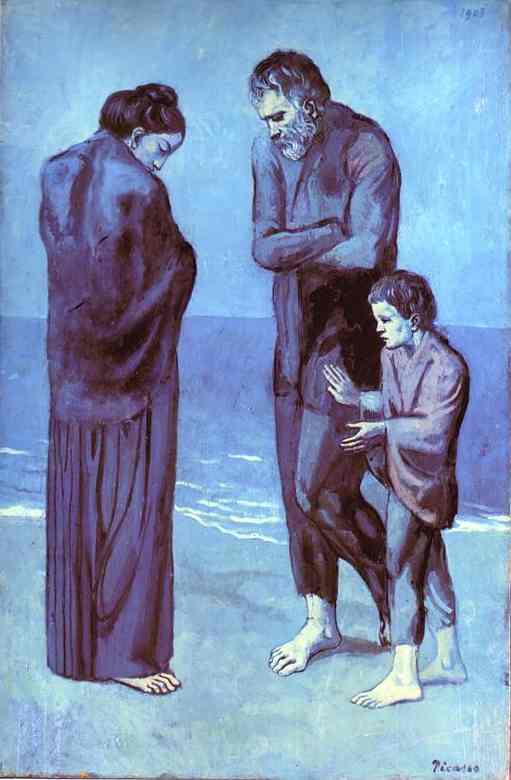
In one of his best known works, ‘Hope’, Watts pictures a blind folded woman sitting on what we take to be the world. She embraces a lyre of which every string is broken … but one. Above, the sky entertains a single star. With its blues and greys, the work is reminiscent of some of Picasso’s blue period works, such as his ‘Tragedy‘.

But is Watts depicting despair or something else? Forsyth argues that here in this work we have the depiction not of hope itself, but certainly of one who hopes. Like her Victorian Age, she has conquered the world, and yet such conquering has brought her neither joy, peace or power. She has turned her face away from ‘heaven’s light’ ‘and now, with earth searched and heaven to explore, her gaze is not up but down, her heaven-searching power of faith is quenched’. But quenched does not mean despair, for ‘the thirst to believe is still there. Look how the darkened soul stoops and strains for the one string’s note, for the one voice to tell her a gospel that all her achievement has not yet attained, and all the round and mastered world cannot promise. The soul has in its own self and nature a note that Nature has not. But is that note of nature only in the soul? Is it a subjective dream of its own? Is there any promise in the ‘not-ourselves’? . . . Yes, there is one star, though the poor soul sees it not. The painter sees it, and we see it. A star is there and a dim dawn.’ (Religion in Recent Art, 108).

Death’s Duel

I have spent this morning re-reading John Donne‘s last sermon, preached in 1631. It was a meditation on Psalm 68:20, ‘And unto God the Lord belong the issues of death (i.e. deliverance from death).’ It was so good for my soul. For those who are interested in reading the sermon, read on (apologies for a lengthy post but I just didn’t know where to cut it, and those guys knew how to preach!). BTW, the image is from the National Portrait Gallery in London.

BUILDINGS stand by the benefit of their foundations that sustain and support them, and of their buttresses that comprehend and embrace them, and of their contignations that knit and unite them. The foundations suffer them not to sink, the buttresses suffer them not to swerve, and the contignation and knitting suffers them not to cleave …

To read in, click here.

Kierkegaard Conference

Those with an interest in Kierkegaard may be keen to note that the Søren Kierkegaard Society of the UK is organising a conference from 18-21 June 2007 in Liverpool. The theme of the conference is ‘Kierkegaard, Culture and Christendom: Art and Media; Church and Society’.

Plenary speakers include Clare Carlisle, Harvie Ferguson, Martin Matustik and George Pattison.

More information here.

Chesterton on original sin

‘Certain new theologians dispute original sin, which is the only part of Christian theology which can really be proved. Some followers of the Rev. R. J. Campbell, in their almost too fastidious spirituality, admit divine sinlessness, which they cannnot see even in their dreams. But they essentially deny human sin, which they can see in the street. The strongest saints and the strongest sceptics alike took positive evil as the starting-point of their argument. If it be true (as it certainly is) that a man can feel exquisite happiness in skinning a cat, then the religious philosopher can only draw one of two deductions. He must either deny the existence of God, as all atheists do; or he must deny the present union between God and Man, as all Christians do. The new theologians seem to think it a highly rationalistic solution to deny the cat.’ – Gilbert Keith Chesterton, Orthodoxy (San Francisco: Ignatius Press, 1995), 19.

McCormack’s Justification in Perspective: A Review

JUSTIFICATION IN PERSPECTIVE: HISTORICAL DEVELOPMENTS AND CONTEMPORARY CHALLENGES. Edited by Bruce L. McCormack. Grand Rapids/Edinburgh: Baker Academic/Rutherford House, 2006. Pp. 277. $24.99, (currently $17.24), ISBN 10:0-8010-3131-1; ISBN: 13: 978-0-8010-3131-1.

This collection of 10 papers and a sermon from the tenth Edinburgh Dogmatics Conference(2003) seeks to explicate more fully the Protestant teaching on justification. The papers are gathered into 3 sections: (i) Sermon, (ii) Antecedents and Historical Development, and (iii) Continuities and Discontinuities in Current Challenges to the Traditional View.

The volume’s editor, Bruce McCormack, asserts that the function of this collection is to serve as ‘a progress report on the state of the Protestant doctrine of justification today in the midst of challenge and change’ (p. 9). He also confesses that ‘no effort was made to ensure uniformity of perspective’ (ibid). This is, arguably, part of the collection’s strength. That it is offered as something of an ‘in-house’ conversation amongst evangelicals of a Reformed flavour makes the exchange deeper and more exciting, even if narrower in scope. Contributors include Mark Bonnington, Nick Needham, David Wright, Carl Trueman, Karla Wübbenhorst, Anthony Lane, Andrew McGowan, Bruce McCormack, Henri Blocher, Simon Gathercole, and Tom Wright.

Some highlights from the menu for this reviewer include Needham’s offering on ‘Justification in the Early Church Fathers’, wherein he convincingly argues that notions of imputed righteousness, penal substitution, and justification through faith alone occur in the fathers. Wübbenhorst’s paper is an impressive reminder of Calvin’s indebtedness to, and critical appropriation of, Luther’s thinking, whilst McGowan helpfully explores the relationship between justification and the ordo salutis, identifying two main streams of ‘union with Christ’ thinking within the Reformed tradition thus reminding us of the tradition’s diversity.

McCormack’s paper on Justitia Aliena in Barth is an opulent and timely feast. While not all readers will be convinced, McCormack offers not only a faithful exposition of Barth’s doctrine of justification, but also ample evidence that Barth is one who ought rightly be regarded as standing clearly in the ‘Reformed’ stream. In the final essay, Wright responds provocatively and, at times, scathingly to critics of the ‘New Perspective’ outlining the main tenets of the ‘Perspective’ and clarifying his own position within and against the smorgasbord of ‘Perspectives’.

Justification in Perspective makes a worthy contribution alongside recent works by Thomas Oden (The Justification Reader), David Aune (Rereading Paul Together: Protestant and Catholic perspectives on justification, Alister McGrath (Iustitia Dei: A History of the Christian Doctrine of Justification), Tuomo Mannermaa (Christ Present In Faith: Luther’s View Of Justification), and Mark Husbands and Daniel Treier (Justification: What’s at Stake in the Current Debates). While the volume as a whole betrays a dearth of serious exegetical work (a fact that Wright annunciates), it remains a valuable collection from which the undergraduate or informed historian and systematician will glean much.

A modified version of this review is to be soon published in Religious Studies Review, after which the definitive version will be available from Blackwell Synergy.

‘But that was just Paul’s experience …’

‘Paul never really proclaimed anything he, himself, had not experienced. Whatever theology he may have had prior to his experiences, he appears to speak primarily from experience and not from some theological rationalisation of the same. He talked of Christ as Lord because that was the way he met him. He spoke of forgiveness because he had been forgiven, and of justification because he had been justified. The Cross meant everything to him because he had been there: ‘I have been crucified with Christ’. He knew the gift of the Spirit because he had received the Gift, as indeed he had been filled by him.’ – Geoffrey Bingham, Paul, the Pursued and Pursuer of God (Blackwood: New Creation, 1986), v.

The painting is Rembrandt’s The Apostle Paul (c. 1657). Oil on canvas. The National Gallery of Art, Washington, DC, USA.

McGlasson’s Invitation to Dogmatic Theology: A Review

INVITATION TO DOGMATIC THEOLOGY: A CANONICAL APPROACH. By Paul C. McGlasson. Grand Rapids: Brazos Press, 2006. Pp. 284. $24.99, ISBN 10:1-58743-174-2; ISBN: 13: 978-1-58743-174-6.

Pastor and former seminary professor, Paul McGlasson, is no newcomer to the world of theological publication, having already published a number of notable works, including:

In this latest offering, Invitation to Dogmatic Theology, McGlasson presents a case for how and why theology must consciously serve the church’s ministry, and particularly its preaching. Well aware of the issues that continue to plague not only the discipline of doing theology, but also those of the wider church, McGlasson, leaning on Karl Barth, boldly reminds us that theology’s task has long been, and must continue to be, the proclamation of God’s action in Christ in the power of the Spirit.

The book consists of five parts: (i) The Authority of Scripture, (ii) The New World of God, (iii) Proclamation, (iv) The Trinity, and (v) The Divine Imperative. Building on Brevard Childs’ insights on the primacy of canon, McGlasson seeks to show why and how biblical studies and dogmatic theology need to inform one another as they share the task of ‘expounding scripture for the church, though in different but complementary ways’ (p. 27). McGlasson argues that dogmaticians need to begin where biblical scholars end, trusting that the latter have done their homework in providing a basic orientation to the true nature of the Scriptures. For more on this topic, see my posts on Biblical critics and dogmaticians in dialogue here and here.

McGlasson makes assumptions and draws conclusions that not all would agree with, and possibly some of his claims are overstated. However, McGlasson is seeking to raise many of the right questions, and he does so in a manner that is always respectful, fair and generous to those with whom he is in disagreement. The book would be considerably enhanced by the inclusion of an index.

A modified version of this review is to be soon published in Religious Studies Review, after which the definitive version will be available from Blackwell Synergy.

Holiness According to Otto – 5

Whilst scholars are generally agreed that the notion of ‘otherness’ is not absent, Forsyth posits that it is more appropriate to define God’s holiness by considering its expression in history, centrally in the incarnation of the Son, but also in the sending of the Spirit, and his election of a people (both Israel and the Church) out of all the peoples of the earth to be as he is, to shape its life after him. For the Christian, there is no other God than the one who has suckled on Mary’s breast and was crucified under Pontius Pilate. Neither can holiness be understood apart from this one. In this vein, Forsyth affirms that ‘holiness is not anything that can just be shown; it must be done’. Revelation is action.

Söding argues that ‘God’s powerful holiness manifests itself in creating and sustaining, in judging and delivering the world of humankind. According to John, in agreement with the whole Old Testament, God evinces his holiness in his actions, which mediate the historical and cosmic presence of God together with his absolute transcendence.’ In other words, divine holiness must find expression in its ever longing to exert itself in action. It is not enough that God’s love be emptied out on creation. God must himself take upon himself the evil for which he is held liable. God in Christ is his own theodicy. He alone does full justice to God’s holy name, offering his holy self to the holy God in holy confession ‘from sin’s side’. As holy love, God goes out to establish command of all, not simply plucking it out of hell or even making it innocent, but taking it into heaven and making it holy, presenting humanity to God ‘presanctified’. Forsyth insists that ‘the holiness of love’s judgment must be freely, lovingly, and practically confessed from the side of the culprit world. It must be answered with perfect holiness’. Though transcendent, here is no remote or static god of the deists or the epicureans. Forsyth’s German contemporary, Ernst Troeltsch (1865-1923), whose (at least) early writings are familiar to Forsyth expresses this well:

‘The divine holiness is no moralism. God did not give the world his law and then abandon it; instead, he searches for the creature with love and passion, creating the very holiness that he demands. Here we find no cold law, no crushing commandment that seeks fulfilment in human compliance; we find a holy love that embraces us and incorporates us into itself, thereby bringing us to faith.’