 ‘He was man as we are. His condition was no different from ours. He took our flesh, the nature of man as he comes from the fall … His sinlessness was not therefore His condition. It was the act of His being in which He defeated temptation in His condition which is ours, in the flesh … He emptied Himself … placing Himself in the series of men who rebelled against God in their delusion … In so doing, in His own person, He reversed the fall in their place and for their sake’. – Karl Barth, Church Dogmatics IV/1 (Edinburgh: T&T Clark), 1956, 259.
Author: Jason Goroncy
Advent Reflection 10: That Which Christ Assumes
 ‘If any assert that He has now put off His holy flesh, and that His Godhead is stripped of the body, and deny that He is now with his body and will come again with it, let him not see the glory of His coming … For that which He has not assumed He has not healed … If only half of Adam fell, then that which Christ assumes and saves may by half also; but if the whole of his nature fell, it must be united to the whole nature of Him that was begotten, an so be save as a whole. Let them not, then, begrudge us our complete salvation’. – Gregory of Nazianzus (4th cent. A.D.), Epistle 101, in Nicene and Post-Nicene Fathers, Vol. 7 (Peabody: Hendrickson), 1994, 440.
Neue Zeitschrift für Systematische Theologie und Religionsphilosophie
The latest edition of Neue Zeitschrift für Systematische Theologie und Religionsphilosophie is out and includes two articles of interest to me:
‘Can the Electing God be God without us? Some Implications of Bruce McCormack’s Understanding of Barth’s Doctrine of Election for the Doctrine of the Trinity’, by Paul D Molnar (pp. 199-222)
Abstract:
This article is the attempt at a dialogue with Bruce McCormack about the position he espoused in The Cambridge Companion to Karl Barth concerning the relation between God’s Election of grace and God’s Triunity. I had criticized McCormack’s position in my book, Divine Freedom and the Doctrine of the Immanent Trinity (2002), but I did not elaborate on it in great detail. To develop the dialogue I will: 1) consider McCormack’s claim that in CD II/2 Barth made Jesus Christ “rather than” the Eternal Logos the subject of election; 2) consider what Barth means when he speaks of Jesus Christ “in the beginning”; 3) compare McCormack’s thesis that the Father never had regard for the Son, apart from the humanity to be assumed, with Barth’s belief that we must not dispute the eternal will of God which “precedes even predestination”; 4) analyze in detail McCormack’s rejection of Barth’s belief that the logos asarkos in distinction from the logos incarnandus is a necessary concept in trinitarian theology; 5) discuss Barth’s concept of the divine will in relation to the concept advanced by McCormack and suggest that McCormack has fallen into the error of Hermann Schell by thinking that God in some sense takes his origin from himself, so that God would only be triune if he elected us; 6) explain why it is a problem to hold, as McCormack does, that God’s self-determination to be triune and his election of us should be considered one and the same act; and finally 7) explain McCormack’s confusion of time and eternity in his latest article on the subject in the February, 2007 issue of the Scottish Journal of Theology, and his own espousal of a kind of indeterminacy on God’s part (which he theoretically rejects).
‘The Difference Totality Makes. Reconsidering Pannenberg’s Eschatological Ontology’, by Benjamin Myers (pp. 141-155)
Abstract:
Summary Wolfhart Pannenberg’s eschatological ontology has been criticised for undermining the goodness and reality of finite creaturely differentiation. Drawing on David Bentley Hart’s recent ontological proposal, this article explores the critique of Pannenberg’s ontology, and offers a defence of Pannenberg’s depiction of the relationship between difference and totality, especially as it is presented in his 1988 work, Metaphysics and the Idea of God. In this work, Pannenberg articulates a structured relationship between difference and totality in which individual finite particularities are preserved and affirmed within a coherent semantic whole. Creaturely differences are not sublated or eliminated in the eschatological totality, but they are integrated into a harmonious totality of meaning. This view of the semantic function of totality can be further clarified by drawing an analogy between Pannenberg’s ontological vision and Robert W. Jenson’s model of the eschatological consummation as a narrative conclusion to the drama of finite reality.
Baxter Kruger has entered blogdom
 C. Baxter Kruger has started blogging. When he’s not fishing, Dr Kruger (whose doctoral supervisor was James Torrance) serves as the Director of Perichoresis Ministries. He has authored 7 books, including The Great Dance, Jesus and the Undoing of Adam and Across All Worlds (which I mentioned here). I also mentioned Baxter in this review on the recent book, An Introduction to Torrance Theology.
He writes on in his first posting:
It was not the Father’s anger or the Holy Spirit’s that was poured out on Jesus; it was ours. We rejected him, cursed him, beat him and brutally murdered him. Either the Father, Son and Spirit were caught off guard by our horrific response to Jesus, or our bitter rejection of Jesus was clearly anticipated and deliberately used as the way of reconciliation.
Along with the launch of his blog, Baxter has made available a copy of his latest essay, ‘Bearing Our Scorn’. Here’s a taster from that essay:
The eternal, unflinching purpose of the Father, Son and Spirit is to share their trinitarian life with us, and to bring us to taste and feel and know and experience their shared life—adoption. But such sharing of life necessarily involves meeting us where we are in our tragic alienation. “Reconciliation means sharing in all that the other is.” But how can the Lord really meet us in our fallenness, share in our confusion, and identify with us? It would seem impossible that the blessed Trinity could so enter into our miserable, projecting nightmare as to make contact with the real us. But what is reconciliation if it leaves the real us trapped in our confusion, unable to hear and see and receive the Father’s love? What kind of reconciliation would it be that declared humanity legally clean, yet left us lost in the cosmos of the fallen mind and its appalling pain?
Steve Holmes on Bruce McCormack’s TF Torrance Lectures
Though a newcomer to theo-blogdom, Steve Holmes (not this one, nor this one, and definitely not this Transylvanian Saxon from Sibiu) is no stranger to most of us. He has kicked off his blog – Shored Fragments – with, among other tidbits, a number of helpful reflections on Bruce McCormack’s recent TF Torrance Lectures (formerly the SJT lectures) held at the University of St Andrews. Here’s Steve’s posts:
Rowan Williams and Ricky Gervais on God
Advent Reflection 9: Going the Whole Way
 ‘The cross was the reflection (or say rather the historic pole) of an act within Godhead. The historic victory was the index and the correlate of a choice grid a conquest in Godhead itself. Nothing less will carry the fulness of faith, the swelling soul, and the Church’s organ voice of liturgy in every land and age. If our thought do not allow that belief we must reduce the pitch of faith to something plain, laic, and songless, and, in making it more homely, make it less holy, less absolute, less adoring. The adoration of Christ can only go with this view of Him in the long run. Nothing lower takes with due seriousness the superhuman value of the soul, the unearthliness of our salvation, and its last conquest of the whole world. It would reduce the unworldly value of the soul if it could be saved by anything less than a Christ before the worlds. It came upon me, as upon many at the first it must have mightily done, that His whole life was not simply occupied with a series of decisions crucial for our race, or filled with a great deed then first done; but that that life of His was itself the obverse of a heavenly eternal deed, and the result of a timeless decision before it here began. His emergence on earth was as it were the swelling in of heaven. His sacrifice began before He came into the world, and his cross was that of a lamb slain before the world’s foundation. There was a Calvary above which was the mother of it all, His obedience, however impressive, does not take divine magnitude if it first rose upon earth, nor has it the due compelling power upon ours. His obedience as man was but the detail of the supreme obedience which made him man. His love transcends all human measure only if, out of love, he renounced the glory of heavenly being for all he here became. Only then could one grasp the full stay and comfort of words like these “Who shall separate us from the love of Christ?” Unlike us, he chose the oblivion of birth and the humiliation of life. He consented not only to die but to be born. His life here, like His death which pointed it, was the result of his free will. It was all one death for him. It was all one obedience. And it was free. He was rich and for our sakes became poor. What he gave up was the fulness, power, and immunity of a heavenly life. He became “a man from heaven.”’ – Peter T. Forsyth, The Person & Place of Jesus Christ: The Congregational Union Lecture for 1909 (London: Congregational Union of England and Wales/Hodder & Stoughton, 1910), 270–2.
You Tube on Neo-Orthodoxy
NT Wright – ‘Can a Scientist Believe in the Resurrection?’
 Last night I attended a packed-out NT Wright lecture, ‘Can a Scientist Believe in the Resurrection?’. It was the clearest I have heard the good bishop for a while (of course, this could be because I was the most awake, a rare thing in itself). Those expecting to hear a ‘scientific’ engagement with the issues may have been disappointed; for the historians (and apologists) among us, however, it was great. Nothing at all new but classic apologia – Wright-style.
This lecture has also been made available in a number of formats.
- Lecture transcript (99Kb PDF)
- Lecture transcript (73Kb DOC)
- Lecture audio (14Mb MP3)
- Lecture movie – complete lecture (147MB MOV)
- Lecture movie – questions following lecture (48Mb MOV)
- Post-lecture dinner discussion audio (20Mb MP3)
- Post-lecture dinner discussion transcript (94Kb DOC)
Alastair has saved us some work by posting his excellent summary of the talk here. My notes are considerably more scrappy (resembling the state of my mind) but for the record, here they are:
- Science can never be enough for a full and flourishing account of human being.
- Resurrection in the C1st necessarily impinged on the the public world. It meant a real physical act. To talk of resurrection is to do history rather than science because it is a unique, unrepeatable, event.
- Resurrection is not about life after death; it is about what happens after life after death.
- Christianity stands with the Pharisees rather than with the Sadducees or Philo on the question of resurrection.
- The resurrected body – though created out of the ‘stuff’ of the old body – contains new properties. The resurrected body used up all the old properties (hence the empty tomb). The resurrected body has a ‘new kind of physicality’, one equally at home on earth as in heaven. It is not capable of decay or death.
- Resurrection is not resuscitation, which is merely the return to the corruptible body.
- No Jewish hope envisaged a two-stage process of resurrection, the second part of which was a general resurrection.
- The resurrection of Jesus transformed Jewish notions of a messiah. No Jew expected the Messiah to be resurrected because no Jew expected the Messiah to be killed.
- ‘Death is the last weapon of the tyrant; and the point of the resurrection is that death has been defeated’.
 Discrepancies in the accounts in the four canonical gospels concerning the resurrection of Jesus is evidence which supports the historicity of the event. If we only had one account – or of the accounts were derived from one another – then the story would be more improbable.
- The resurrection accounts witnessed to in the gospels are very early, arising from oral traditions.
- 1 Corinthians 15 is a later revision from the earlier gospel accounts wherein the first witnesses were women. In the C1st, women were considered incredible witnesses. There appearance in the gospels, therefore, suggests that the gospel accounts were the earlier.
- Christianity appeals to history and so to history it must go. And yet who we meet as we go challenges us to rethink – and reconceive – our worldview, including our understanding of history.
- Faith does not ignore history but respects and transforms history because it is faith in the Creator-God.
- When something turns up in science that doesn’t fit the paradigm with which we’ve been working, we must be prepared to change our paradigm even while not rejecting all that had gone before. The faith by which we know is determined by the nature of its object. This corresponds to the methodology adopted by science. Scientific epistemology occasionally requires having to change ways of seeing to that which is more appropriate to the new reality. So too with Christian faith.
- Hope in the resurrection is actually a ‘mode of knowing’. Wright cites Wittgenstein, ‘It is love which believes the resurrection’; as it was for Peter. The reality of the resurrection cannot be known is we insist on a mechanistic view of reality. Belief in the resurrection requires a full devotion of love. This love-epistemology relates to a new ontology of the resurrection.
- Unlike with lust, love requires a real other, a real external knower. To believe in the resurrection, therefore, is to believe in the one resurrected.
- All knowing is a gift from God – no so less scientific and historical knowing – and ought be situated within the arena of knowing established by faith, hope and love. But the greatest of these is love.
Forthcoming James Gregory Public Lectures are:
February 28, 2008: John Polkinghorne, ‘Has Science Made Religion Redundant?’
April 17, 2008: Bruno Guiderdon, ‘Islam and Science’
Bleby and Pennicook on the Holy Spirit
New Creation Teaching Ministry has made available for download the talks from the 2007 NSW Spring School. Here they are:
 ‘The Spirit of Glory’, Martin Bleby (50 min)
‘The Love of the Spirit’, Martin Bleby (58 min)
‘The Spirit and the Community of Love’, Ian Pennicook (62 min)
 ‘The Spirit and the Son – Part 2’, Martin Bleby (51 min)
‘The Ministry of the Spirit’, Ian Pennicook (47 min)
Plus 2 sermons:
‘Can These Bones Live?’ (Ezekiel 37), Ian Pennicook (36 min)
‘The Breath of God Has Come’, (Ezekiel 37), Martin Bleby (27 min)
‘Will the Love of God Finally Triumph?’: A response to David Fergusson
 Professor David Fergusson is one of the ablest theologians teaching and writing in Britain today. A few weeks ago, I heard him give a delightful paper on providence, a mere entrée to a larger project that he’s currently working on. Everything I’ve read of his I’ve thoroughly enjoyed, especially his Scottish Philosophical Theology, The Cosmos and the Creator, and Christ Church and Society: Essays on John Baillie and D. Donald Baillie (which he edited). And so it was that I approached his essay ‘Will the Love of God Finally Triumph?’ with the certain sense of excitement, never dreaming that I might be disappointed with its contents. The essay, which was originally presented at the Sixth Edinburgh Dogmatics Conference, appears in a collection from that conference entitled, Nothing Greater, Nothing Better: Theological Essays on the Love of God, edited by Kevin J. Vanhoozer (pp. 186–202).
Fergusson properly begins his essay by reminding us that ‘the love of God demands an eschatology’ (p. 186) before proceeding to rehearse the three possible ways in which his title question can be answered. In the first section, he outlines the Augustinian and Reformed traditions in which the love of God triumphs only through the limiting of its scope, i.e. towards the elect. This, Fergusson suggests, is ‘unacceptable’ (p. 188).
In the next section, ‘Universalizing the Scope’, Fergusson turns to Karl Barth, and to what he considers to be an inconsistency between Barth’s doctrine of the election of humanity in Jesus Christ and his denial of an apokatastasis. After fairly outlining Barth’s position and properly emphasising the Swiss theologian’s fall-back position in the divine freedom, Fergusson elicits Berkouwer’s criticism of Barth in support:
‘In view of Barth’s emphasis on the factuality of Christ’s rejection, it is not possible to close the door to the apokatastasis doctrine by pointing to the fact that the Bible speaks of rejection as well as election and then entrust everything eschatologically to the hand of God. Did not the hand of God become visible in His works, and specifically in the one central “modus” of his work in Jesus Christ, in election as the decretum concretum, in the triumph of grace?’ (p. 192)
The third, and final, section is entitled ‘Against Universalism’. It is in this section that Fergusson outlines his own proposal for answering the question he began with. He begins this section, by asking ‘what is wrong with universalism in any case’? (p. 196). After noting the ‘burgeoning literature on this subject’ (p. 196) he proceeds to note that ‘one of the more perplexing aspects of the current controversy is the way in which critics of the universalist case concede that it would be nice if it were true’ (p. 196-7). He cites Stephen Davis and William Lane Craig as examples of those who would like to believe that ‘universalism were true, but it is not’ (p. 197). He then comments: ‘Such remarks are puzzling. Are we saying that God’s final scheme is undesirable? Are we even suggesting that our own moral preferences are somehow better than God’s. Can we claim to be evangelical if we hold that it would be good if universalism were true while also lamenting wistfully that it is not what God has on offer? There is a good dominical response to this: “If you then, who are evil, know how to give good gifts to your children, how much more will your Father who is in heaven give good things to those who ask him” (Matt. 7:11)’ (p. 197). I believe that we ought to hear these questions with their full force, regardless of where we end up on this vexed question.
 Fergusson proceeds to note that universalism’s attraction is its ‘ability to present a vision of cosmic fulfillment in which God executes justice, not only for human beings whose lives have been maimed by nature or society, but also for the whole creation … Universalism should not be tempered therefore until its profound attractions are understood. We might try to avoid it by proposing that the grace of God is offered to all in Christ but, for those who reject it, God’s scheme of justice demands eternal punishment or at least annihilation’ (p. 197).
Fergusson rehearses the well-worn argument that any certainty in an apokatastasis, while a theoretical possibility, is ultimately ‘as deterministic and destructive of human freedom as the doctrine of double predestination in hyper-Calvinism’ (p. 199). The theoretical possibility Fergusson entertains is entirely dependent on an advance in human free will. He employs the usual rhetoric of love needing to be a free human response, an ontological reality that makes the possibility of rejecting God a final possibility. One of the problems with this common argument is that Jesus potentially died for no-one. And so parroting Davis’ and Craig’s response to universalism, I confess that it would be nice if the free will argument was true, but it’s not. As I’ve argued elsewhere, the only two tenable (i.e. biblically and theologically defensible) positions available for this soteriological question are either (i) a robust reaffirmation of limited atonement (the negative side of which includes the possibility of annihilation), or (ii) some form of christological universalism (as opposed to the Hickian vision).
Fergusson’s final answer to the question that he started off with, that is, ‘Will the Love of God Finally Triumph?’, seems to be answered by, ‘Only with our help’! He concludes: ‘An eschatology needs to express the ways in which our lives are bound up with those of our neighbors and with creation as a whole and involve decisions and projects of eternal significance. By so doing the eschatological vision of the kingdom of God can furnish us with a sense of the permanence and grandeur of God’s love. The possibility that we may inexplicably exclude ourselves from this ultimate community is a condition of the significance , of our God-given freedom’ (p. 202).
My question is this: In the light of God’s action in Christ, is Fergusson’s vision all that we can reasonably hope for? I hope not, and Barth’s witness in 4/1 reminds me why I have good reason to hope not:
The ordaining of salvation for man and of man for salvation is the original and basic will of God, the ground and purpose of His will as Creator. It is not that He first wills and works the being of the world and man, and then ordains it to salvation But God creates, preserves and over-rules man for this prior end and with this prior purpose, that there may be a being distinct from Himself ordained for salvation, for perfect being, for participation in His own being, because as the One who loves in freedom He has determined to exercise redemptive grace – and that there may be an object of this His redemptive grace, a partner to receive it … The “God with us” has nothing to do with chance. As a redemptive happening it means the revelation and confirmation of the most primitive relationship between God and man, that which was freely determined in eternity by God Himself before there was any created being. In the very fact that man is, and that he is man, he is as such chosen by God for salvation; that eschaton is given him by God. Not because God owes it to him. Not in virtue of any quality or capacity of his own being. Completely without claim. – Karl Barth, Church Dogmatics IV.1 (ed. G. W. Bromiley and T. F. Torrance; trans. G. W. Bromiley; Edinburgh: T&T Clark, 1961), 9–10.
Pilger on Britain’s New Labour
 I don’t normally read The Guardian, but yesterday’s carried this piece by John Pilger (whose essays I always read). In his typically undisguised style, Pilger argues that Tony Blair and ‘his cult’ have ‘destroyed the very liberalism millions of Britons thought they were voting for’. He writes:
In the murdochracy that Britain has largely become, once noble terms such as democracy, reform, even freedom itself, have long been emptied of their meaning.
Gone is the bourgeoisie that in good times would extend a few rungs of the ladder to those below. From Blair’s pseudo-moralising assault on single parents a decade ago to Peter Hain’s recent attacks on the disabled, the “project” has completed the work of Thatcher and all but abolished the premises of tolerance and decency, however amorphous, on which much of British public life was based. The trade-off has been mostly superficial “social liberalism” and the highest personal indebtedness on earth.
And, according to Pilger, things are not looking any different under Brown:
Behind a facade of liberal concern for the world’s “disadvantaged”, such as waffle about millennium goals and anti-poverty stunts with the likes of Google and Vodafone, the Brown government, together with its EU partners, is demanding vicious and punitive free-trade agreements that will devastate the economies of scores of impoverished African, Caribbean and Pacific nations. In Iraq, the blood-letting of a “liberal intervention” may well have surpassed that of the Rwanda genocide, while the British occupiers have made no real attempt to help the victims of their lawlessness. And putting out more flags will not cover the shame. “The mortality of children in Basra has increased by nearly 30% compared to the Saddam Hussein era,” says Dr Haydar Salah, a paediatrician at Basra children’s hospital. In January nearly 100 leading British doctors wrote to Hilary Benn, then international development secretary, describing how children were dying because Britain had not fulfilled its obligations under UN security resolution 1483. He refused to see them.
Whole British communities now live in fear of the police. The British are distinguished as one of the most spied upon people in the world …
The cause of any real civil threat to Britons has been identified and confirmed repeatedly by the intelligence services. It is “our” continuing military presence in other people’s countries and collusion with a Washington cabal described by the late Norman Mailer as “pre-fascist”. When famous liberal columnists wring their hands about the domestic consequences, let them look to their own early support for such epic faraway crimes.

Britain is now a centralised single-ideology state, as secure in the grip of a superpower as any former eastern bloc country.
Dear John, ‘Do not prophesy to us what is right; speak to us smooth things, prophesy illusions, leave the way, turn aside from the path …’ (Isaiah 30:10b-11a)
Loius Charles Birch
 Loius Charles Birch (b. 1918) is an Australian geneticist, biologist, ecologist and theologian who has written widely on the topic of science and religion, winning the 1990 Templeton Prize. Birch has written a new book, Science and Soul, a memoir in which he looks back with gratitude to the long list of world-famous scientists and philosophers of religion who have influenced his work – Theodosius Dobzhansky, J.B.S.Haldane, Paul Erlich, Paul Tillich, Reinhold Niebuhr, Margaret Mead, and many more. In this podcast, Charles Birch talks about his life and his belief in a God that feels and grows as we do. While at the end of the day he bears witness to a god who isn’t worth worshipping (he is a process theologian after all), the interview is interesting. He discusses Paul Tillich (whose lectures he attended), Richard Dawkins’ The God Delusion, Reinhold Niebuhr, theology in the post-WWII period, the rising popularity of fundamentalism, ethics and rights of non-humans.
For those who are interested in more, you can also download this file on Birch which includes a medium bandwidth video extracts from the TV Program, transcripts of the full unedited interview, thumbnail-sized video of the full unedited interview, a brief biography, a study guide, tv script and a list of links to related resources.
HR Mackintosh, ‘The Person of Jesus Christ’: A Review
Scotland has produced a fair share of weighty theologians, and Paisley-born Hugh Ross Mackintosh (1870-1936) is among her best. From 1904 to 1936 he served as Professor of Systematic Theology at New College (TF Torrance took his systemetics class during 1935-36), where he himself was formerly a student. Between his student days and his teaching days, Mackintosh served churches in Largs (1896-1897), Tayport (1897-1901) and Aberdeen (1901-1904), and also spent time in Freiburg, Halle and Marburg, where he befriended the great Wilhelm Herrmann. Mackintosh’ most significant work was The Person of Jesus Christ (republished in 2000 by T&T Clark) in which he closely followed PT Forsyth’s kenoticism (still, to my mind, the most compelling presentation of the doctrine; though I am awaiting the full exposition of McCormack’s kenoticism). He also penned Christian Experience of Forgiveness, a brilliant work which creatively restates the doctrines of justification and atonement, urging that justification is forgiveness and that the cross is forgiveness’ cost to God.

Discerning Reader has recently published the following review of his The Person of Jesus Christ:
‘Locating a Christology book that is both solidly doctrinal and warmly devotional is rare, but The Person of Jesus Christ by Hugh Ross Mackintosh rewards on both counts. It is at once an exposition of the figure of Christ as God and man, and a celebration of Christ himself. Originally delivered as a series of lectures at Christian student meetings in 1912, Mackintosh’s lectures give the impression of being more of a personal meditation on the person and work of Jesus Christ than a scholarly paper devoid of any emotion. This is an advantage, as it is doubtful a lesser work would have lasted in print these almost one hundred years since its first publication.
An eminent scholar in his own right, in our time Mackintosh has been obscured by his considerably more famous pupil, Thomas F. Torrance. Fittingly, Torrance has written an introduction as a postscript appreciation for T&T Clark’s reissue of this worthy little work. In the introduction, Torrance iterates the value of Mackintosh’s book, explains how it came to be published, and briefly outlines the control center of Mackintosh’s theology, the atonement. Mackintosh himself called the atonement “the subduing magnitude of the Divine sacrifice.” It should be noted that ‘subduing’ is a word frequently deployed in this short book; one gets the distinct sense that Mackintosh was often rightly overcome by the enormity of his subject matter.
The main body of the work sets out “to contemplate the Lord Jesus Christ reverently in … his attitude to men in Palestine … as he still speaks and lives within human souls … [and] to indicate his connexion with the inner life of God.” No problems are more sublime, Mackintosh says, and no problems are so intensely practical. Here is a professor who sought not to live in the ivory tower, but to commune with Christ and his fellowmen in the highways and byways of life.
Every section is simply beautifully crafted. Only one page into the work, I was struck by the way Mackintosh sets up the confluence of the Father and the Son: Jesus “cannot think of himself without thinking also of God who sent him and who is perpetually with him … I am he, he said; I am the Sent of God, in whom every promise is answered and every human prayer fulfilled.” Mackintosh goes on to investigate Christ’s claims to Messiahship, his forgiveness of sins, his miracle-working, and the meaning of his sufferings.
The second section opens by considering Christ in light of our experience of him as Christians: “in many instances … Christ has transformed [our] lives. Men and women like ourselves have been re-created by his influence, changed in the depths and inmost secrets of being. In every man that change takes a different, because a personal, shape. His redemption is as original and individual a fact as the colour of his eyes. Each rising sun, touching the wing of sleeping birds, wakes over the woods a fresh burst of melody, as if the sun had never risen before; and just so, wherever a man finds and grasps redemption, faith in the heart is a new creation, as if he were the first to discover Jesus.” As if the second section needed anything more to commend it after that stunning turn of phrase, Mackintosh later provides food for thought by distinguishing “between a merely past and a present Christ, when we have the courage to ask, not only what we think of him, but what he thinks of us. For that is to bring the question under the light of conscience, with the result that his actual moral supremacy, his piercing judgment of our lives, now becomes the one absorbing fact. His eyes seem to follow us, like those of a great portrait. When men accept or reject him, they do so to his face.”
Finally, Mackintosh explores Christ’s role “in the relationship of God to man which no other can ever fill.” In this section, Mackintosh propounds an understanding of God’s majesty and holiness that is not in the least at odds with Divine Love, and ends with a gospel call of Christ’s lordship over all of life. His admiring student T.F. Torrance rounds out the book with an appreciation essay originally published in the Scottish Bulletin of Evangelical Theology thirty years after Mackintosh’s death. In it, Torrance continues to grind away at the reality of Christ in Mackintosh’s life and thought, and traces the intellectual genealogy of Mackintosh’s theology. Most winsomely, Torrance paints a vivid picture of a sixty-five year-old Mackintosh entering the classroom, brow still furrowed from pondering the intricacies of the person and work of Jesus Christ.
Besides the extraordinary writing craft Mackintosh obviously possessed, two other things stood out in this book. Firstly, that Mackintosh was a friend of Wilhelm Hermann, the liberal theologian who had an early influence on J. Gresham Machen. Like Machen, Mackintosh was able to distill genuine Christological insights out of Hermann’s liberalism. And although he would often publicly disagree with Hermann’s theological positions, ad hominem attacks had no place in Mackintosh’s vocabulary. Secondly, I was struck by a seemingly different historical picture than I learned in high school and university. I had always understood the years leading up to World War I in terms of fin de siècle ennui (industrial-age world-weariness) but here is a professor of the period describing what he identifies as a then-contemporary fascination with the figure of Jesus Christ, both as a historical figure and a Savior.
The Person of Jesus Christ is simply one of the best books I have read all year. As C.S. Lewis admonishes us, we should be reading at least two to three books written by dead authors to every book written by a current author. This little gem, as Torrance calls it, is worth the money spent. The passion and wisdom of this bygone, departed Scottish professor belongs on your bookshelf.’
Introductory bible texts
 A most conscientious first year theology student recently asked me for some recommendations of introductions to the old and new testaments for his holiday reading. It’s been a while since I read an introduction to the testaments, so I basically suggested to him what I found helpful when I was a first year student. Here’s what I suggested to him (denoted with *) … plus a few that I didn’t mention:
Introduction to the Old Testament
*Adrio König, Here Am I: A Christian Reflection on God
Brevard S. Childs, Old Testament Theology in a Canonical Context
*Brevard S. Childs, Introduction to the Old Testament as Scripture
*Christopher J. H. Wright, Knowing Jesus Through the Old Testament
Geerhardus Vos, Biblical Theology: Old and New Testaments
Gerhard Von Rad, Old Testament Theology: The Theology of Israel’s Traditions
*John Goldingay, Old Testament Theology (3 vols)
Walter Brueggemann, Theology of the Old Testament: Testimony, Dispute, Advocacy
*Walter Brueggemann, An Introduction to the Old Testament: The Canon and Christian Imagination
Walter Eichrodt, Theology of the Old Testament (2 vols)
*William J. Dumbrell, The Faith of Israel. A Theological Survey of the Old Testament
*William J. Dumbrell, Covenant & Creation: A Theology of Old Testament Covenants
William J. Dumbrell, Search for Order: Biblical Eschatology in Focus
*William Sanford La Sor, David Allan Hubbard, Frederic William Bush, and Leslie C. Allen, Old Testament Survey: The Message, Form, and Background of the Old Testament

Introduction to the New Testament
*Adolf Schlatter, The Theology of the Apostles
*Donald A. Carson and Douglas J. Moo, Introduction to the New Testament
Donald A. Carson, The Gospel According to John: An Introduction and Commentary
E. P. Sanders and Margaret Davies, Studying the Synoptic Gospels
*George Eldon Ladd, A Theology of the New Testament
*Herman Nicolaas Ridderbos, Paul: An Outline of His Theology
J. Christiaan Beker, Paul The Apostle
Joel B. Green (ed.), Hearing the New Testament: Strategies for Interpretation
John H. Hayes, Biblical Exegesis: A Beginner’s Handbook
Karl Barth, The Epistle to the Romans
Luke Timothy Johnson, The Writings of the New Testament: An Interpretation
*Merrill Chapin Tenney, New Testament Survey
N. T. Wright, The Climax of the Covenant: Christ and the Law in Pauline Theology
Philip E. Hughes, A Commentary on the Epistle to the Hebrews
Richard Bauckham, James: Wisdom of James, Disciple of Jesus the Sage
Richard Bauckham, The Theology of the Book of Revelation
Richard B. Hays, The Conversion of the Imagination: Paul As Interpreter of Israel’s Scripture
Richard B. Hays, The Moral Vision of the New Testament: Community, Cross, New Creation, A Contemporary Introduction to New Testament Ethics
Robert H. Gundry, Survey of the New Testament
Now what have I left off this list that is as ‘must’ as they come? For those who can remember that far back, what did you find most helpful (or otherwise) as a first year biblical studies student?
NB: This list plus a few others have been added to this blog’s Reading List.
A Bonhoeffer Intensive
 Whitley College has invited Dr Keith Clements to teach an intensive course in February 2008, entitled ‘Bonhoeffer’s Theology in Historical Context’. More information here.
To paraphrase Pink Floyd, ‘How I wish, how I wish I was there …’
Advent Reflection 8: What God Uses

‘When Christ assumed a human body, he entered fully into the created order, using what God had created to accomplish his purposes’. – C. R. Koester, Hebrews: A New Translation with Introduction and Commentary (Anchor Bible Commentary 36; New York: Doubleday, 2001), 97.
Journal of Reformed Theology is out
The latest edition of the Journal of Reformed Theology (Volume 1, Number 3, 2007) is out and includes the following articles:
‘A Search for Karl Barth’s ‘Public Theology’: Looking into Some Defining Areas of his Work in the post-World War II Years’, by Martin Laubscher
‘Vocation, Christendom, and Public Life: A Reformed Assessment of Yoder’s Anabaptist Critique of Christendom’, by Douglas J. Schuurman
‘Becoming One Self: A Critical Retrieval of ‘Choice Biography’’, by Frits de Lange
‘Reformed Theology in South Africa: Black? Liberating? Public?’, by Nico Koopman
‘Economic Justice as Social Justice in a Globalized World: A Theological Analysis’, by Gotlind Ulshöfer
‘A Theological Evaluation of the South African Constitutional Value of Human Dignity’, by Nico Vorster
‘How Shy Can A Reformed Theology Be?’, by Clive Pearson
Advent Reflection 7: Incarnation is Revelation
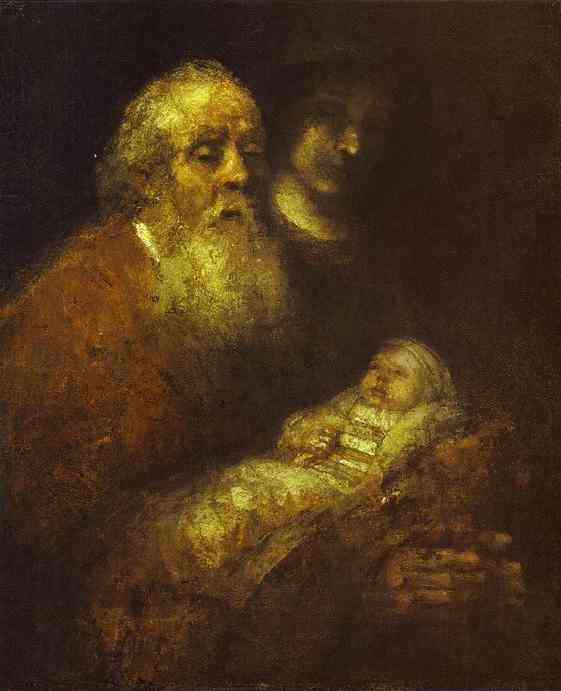
‘For the eternal Word’s becoming incarnate must be understood as a divine endorsement of how God intends himself and his purposes to be known. This would suggest, therefore, that when we come to interpret God’s purposes for humanity our thinking should be informed by this Word, not as an afterthought or as icing on a cake that has been prepared in advance but right from the outset. Second, beginning with the person of Christ takes cognizance of the fact that the Incarnation is revelatory as the Self-presentation not merely of God as God but of God as human. In God’s Self-disclosure God presents us with all that it is to be truly human’. – Alan J. Torrance.
Image: Rembrandt Harmenszoon van Rijn, Simeon with the Christ Child in the Temple. c. 1666-69. Oil on canvas. Nationalmuseum, Stockholm, Sweden.
Advent Reflection 6: ‘Ich bringe alles wieder’
 In his ‘Editor’s Forward’ to Dietrich Bonhoeffer’s most precious book, Letters and Papers from Prison, Eberhard Bethge recalls how this German Lutheran pastor spent the first eighteen months (from April 5th 1943 until October 8th 1944) of his confinement in the military section of Tegel Prison in Berlin. After not a little quibbling he was given permission to write to his parents. Within six months, Bonhoeffer had ‘made such good friends among the warders and medical orderlies’ that he was also able to start writing to them, ‘partly by letter, partly on scraps of paper’. In one such letter, written in Advent 1943, Bonhoeffer penned to a friend the following words, words which betray not only what was on his mind and in his heart at this time of year, but in doing so also serve as an indictment to so much of what passes for Christianity today, a Christianity for whom the Word which created it – and for which it exists to serve – has become all too foreign.
… For the past week or two these words have been constantly running through my head:
Let pass, dear brother, every pain;
What lacketh you I’ll bring again.
What does ‘bring again’ mean? It means that nothing is lost, everything is taken up again in Christ, though of course it is transfigured in the process, becoming transparent, clear and free from all self-seeking and desire. Christ brings it all again as God intended it to be, without the distortion which results from human sin. The doctrine of the restoration of all things – avnakefalaiw,sij – which is derived from Ephesians 1.10, recapitulatio (Irenaeus), is a magnificent conception, and full of comfort. This is the way in which the words ‘God seeketh again that which is passed away’ are fulfilled. And no one has expressed this more simply than Paul Gerhardt in the words which he puts in the mouth of the Christ-child:
Ich bringe alles wieder.
– Dietrich Bonhoeffer, Letters and Papers from Prison (ed. Eberhard Bethge; trans. Reginald H. Fuller; London: SCM, 1954), 87.
(NB. This is a reposting of my contribution to the Advent reflections at Hopeful Imagination)
 jasongoroncy.com