Month: June 2017

‘Holiness in Victorian and Edwardian England’

Reading.jpg

I was honoured to have been invited to contribute a little piece for a Festschrift being prepared for Professor Yolanda Dreyer, of the University of Pretoria. Papers for the Festschrift are being published in the online journal HTS Teologiese Studies/Theological Studies.

My paper is titled ‘Holiness in Victorian and Edwardian England: Some Ecclesial Patterns and Theological Requisitions’. Its Abstract reads:

This essay begins by offering some observations about how holiness was comprehended and expressed in Victorian and Edwardian England. In addition to the ‘sensibility’ and ‘sentiment’ that characterised society, notions of holiness were shaped by, and developed in reaction to, dominant philosophical movements; notably, the Enlightenment and Romanticism. It then considers how these notions found varying religious expression in four Protestant traditions – the Oxford Movement, Calvinism, Wesleyanism, and the early Keswick movement. In juxtaposition to what was most often considered to be a negative expression of holiness associated primarily with anthropocentric and anthroposocial behaviour as evidenced in these traditions, the essay concludes by examining one – namely, P. T. Forsyth – whose voice called from within the ecclesial community for a radical requisition of holiness language as a fundamentally positive reality describing the divine life and divine activity. The relevance of a study of the Church’s understanding of holiness and how it sought to develop its doctrine while engaging with larger social and philosophical shifts endures with us still.

The paper can be accessed here.

When is political power legitimate?

John Bale.jpg

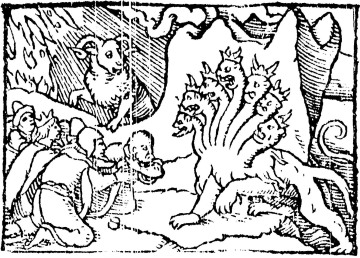
John Bale, ‘Revelation Chapter 13’, 1545

‘When is political authority legitimate? When does the state have a status and function that may be considered “ordained by God”? When are those who rule – emperors or presidents, parliaments or police – due honor, not out of fear, because they wield the sword and command the means to intimidate, dominate and coerce human beings, but as a matter of conscience?

These have not been abstract issues in the American context. The founding premises of the nation define legitimacy in government, both with respect to a rule considered so obnoxious to human life in society that it was to be resisted and overthrown (the Declaration of Independence), and, thereafter, with respect to the limitations upon political authority and the institutionalization of public accountability (the Constitution). Between the Declaration and the Constitution, political legitimacy concerns how political power is established and how such power is used. Incumbency in itself is not enough to validate any exercise of political authority.

Nor is the matter abstract nowadays. In the past decade the opposition, notably that of Christians, to the war and to the war enterprise in Southeast Asia has upheld the position that the illegal and unconstitutional conduct of the war renders incumbent political authority illegitimate. It is this very point that occasioned the witness of the Berrigan brothers in becoming fugitives at a time when they had been ordered to submit to imprisonment. To have surrendered to illegitimate authority voluntarily would have seemed to condone it. For the Berrigans, there could be no obedience to criminal power.

At a time when the President is reported to be frustrated and angry that his rule lacks credibility and that he does not receive automatic homage, it is edifying to recall that many who have all along opposed him and his regime – and also the Government of Lyndon Johnson – have not done so as weirdos, cowards, far-out radicals or malcontents. In truth, they have upheld the classic American view of political legitimacy. The very citizens President Nixon has been so desirous to watch and spy upon, defame and persecute, humiliate and ostracize, prosecute and punish have been those who have acted to redeem legitimacy in government so that political authority could be conscientiously honored (again) in this nation.

And, more than that, such persons have acted within the traditional doctrine of Romans 13. John Calvin’s comment could hardly be more emphatic or more immediately relevant to both the war and Watergate as manifestations of political illegitimacy:

Understand further, that powers are from God … because he has appointed them for the legitimate and just government of the world. For though tyrannies and unjust exercise of power, as they are full of disorder, are not an ordained government; yet the right of government is ordained by God for the well-being of mankind. As it is lawful to repel wars and to seek remedies for other evils, hence the Apostle [Paul] commands us willingly and cheerfully to respect and honor the right and authority of magistrates, as useful to men …

If that be the truth, for citizens who are biblical people, the way to expose illegitimate authority is to oppose the incumbent regime. In that case President Nixon may not invoke Romans 13 to indulge vanity, induce tribute, evade guilt or compound deceit; rather, he is consigned to suffer Romans 13 as a stunning and awesome rebuke – and as a fearful and timely warning’.

– Mr Stringfellow

‘My mother’s God’, by Geoff Page

Blake - God Judging Adam (c. 1795).jpg

My mother’s God
has written the best
of the protestant proverbs:

you make the bed
you lie in it;
God helps him

who helps himself.
He tends to shy away from churches,
is more to be found in

phone calls to daughters
or rain clouds over rusty grass.
The Catholics

have got him wrong entirely:
too much waving the arms about,
the incense and caftan, that rainbow light.

He’s leaner than that,
lean as a pair of
grocer’s scales,

hard as a hammer at cattle sales
the third and final
time of asking.

His face is most clear
in a scrubbed wooden table
or deep in the shine of a

laminex bench.
He’s also observed at weddings and funerals
by strict invitation, not knowing quite

which side to sit on.
His second book, my mother says,
is often now too well received;

the first is where the centre is,
tooth for claw and eye for tooth
whoever tried the other cheek?

Well, Christ maybe,
but that’s another story.
God, like her, by dint of coursework

has a further degree in predestination.
Immortal, omniscient, no doubt of that,
he nevertheless keeps regular hours

and wipes his feet clean on the mat,
is not to be seen at three in the morning.
His portrait done in a vigorous charcoal

is fixed on the inner
curve of her forehead.
Omnipotent there

in broad black strokes
he does not move.
It is not easy, she’d confess,

to be my mother’s God.

– Geoff Page

[Audio]

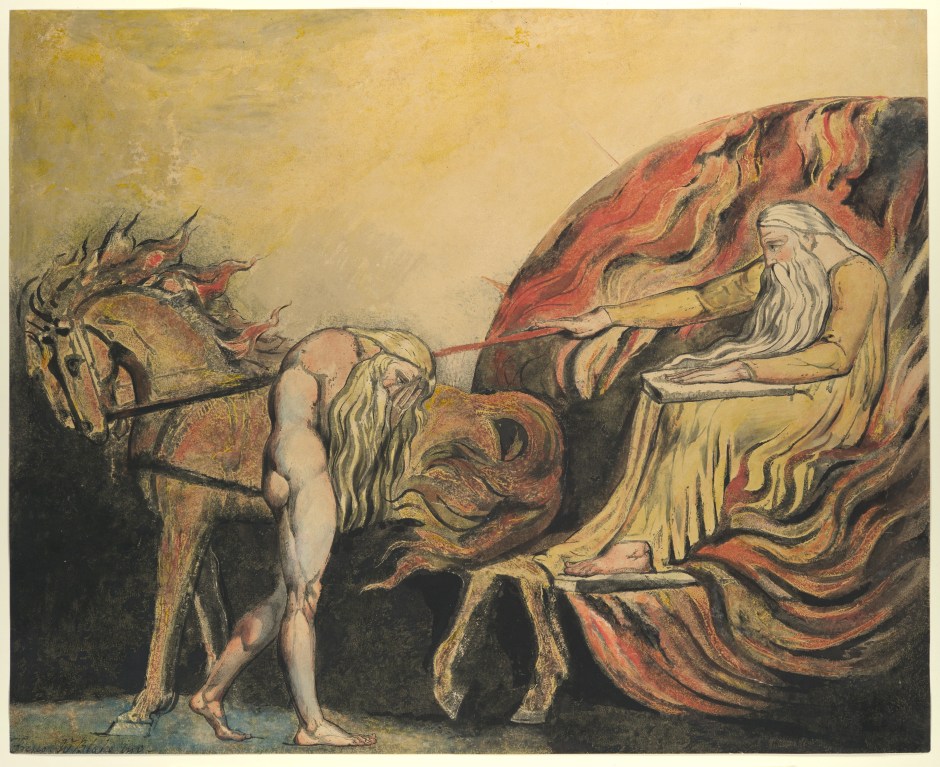
Image: William Blake, ‘God Judging Adam’ (c. 1795)

‘Grace always bats last’

A confession: I’m not normally a fan of TED talks (especially the religious ones), but every non-fan ought to at least live with the possibility of making an exception every now and then:

‘The mystery of grace is that God loves Henry Kissinger and Vladimir Putin and me exactly as much as He or She loves your new grandchild. Go figure. The movement of grace is what changes us, heals us and heals our world. To summon grace, say, “Help,” and then buckle up. Grace finds you exactly where you are, but it doesn’t leave you where it found you. And grace won’t look like Casper the Friendly Ghost, regrettably. But the phone will ring or the mail will come and then against all odds, you’ll get your sense of humor about yourself back. Laughter really is carbonated holiness. It helps us breathe again and again and gives us back to ourselves, and this gives us faith in life and each other. And remember — grace always bats last’.

Grace always bats last’! Well said Anne Lamott.

Physician assisted suicide, euthanasia, and capitalism

There’s a good little piece here by Daniel Fleming, who reminds us of the larger economic context in which debates about physician assisted suicide and euthanasia are taking place; and, should the legislation be passed, of the context in which the legislation will be enacted. Here’s a taster:

Where we make social interventions in our context, we should also remember that it will inevitably become someone’s business to deliver on them. Correlatively, in answer to the first question, we should consider what the impact of private, for-profit, companies which specialise in the provision of euthanasia might be. Such companies would have as their primary purpose profit or return to share-holders. They would, assumedly, be required to increase business in order to produce better annual results. What would their marketing strategies look like? Who would their target market be?

One can quickly imagine a strategic planning meeting whereby the market of those who are dying or those who are close to someone who is dying become the aim of the product, perhaps also particularly those who would not be able to afford other forms of end of life care, or those who are suffering from some form of depression. The current proposed legislation [in Victoria and New South Wales] rests on the possibility of someone making a free and fully informed decision, but freedom and coercion have a tenuous relationship when it comes to marketing strategies – especially those directed at vulnerable groups, and that is something we should consider in this case.

To put it crudely, if we agree to this legislation we should be willing to accept active and aggressive marketing strategies from companies who enact it …

Such companies do not currently exist, but for-profit health insurance companies do, and so we should also consider what the proposed legislation might look like from the perspective of an insurance company which is trying to improve its bottom line. Could it be that insurance companies would direct patients toward the cheaper option instead of agreeing to a larger payout for more expensive care?

In the United States, for example, a physician recently claimed that “insurance companies in states where assisted suicide is legal have refused to cover expensive, life-saving treatments for his patients but have offered to help them end their lives instead.” As anyone who has sat in a budget meeting will know, the logic applied here by the insurance companies is perfectly compatible with the value-set imposed by capitalism.

These are uncomfortable considerations, and they take the debate outside of its typical contours which consider the suffering of an individual and sometimes their family, and whether or not it is right for that person to end their own life with medical assistance. That debate still needs to be had. However we land there, it is crucial to remember that the debate takes place in an ideological context, and if or when the legislation is enacted it will be done in a way that takes it beyond the intent of those proposing it, and into the realm of the value set of capitalism. Any legislation or major social interventions has social consequences beyond its original purpose.

You can read the full article here.

Some afternoon meanderings

warhol-brillo-box-hero.jpg.webrend.1920.350.jpg


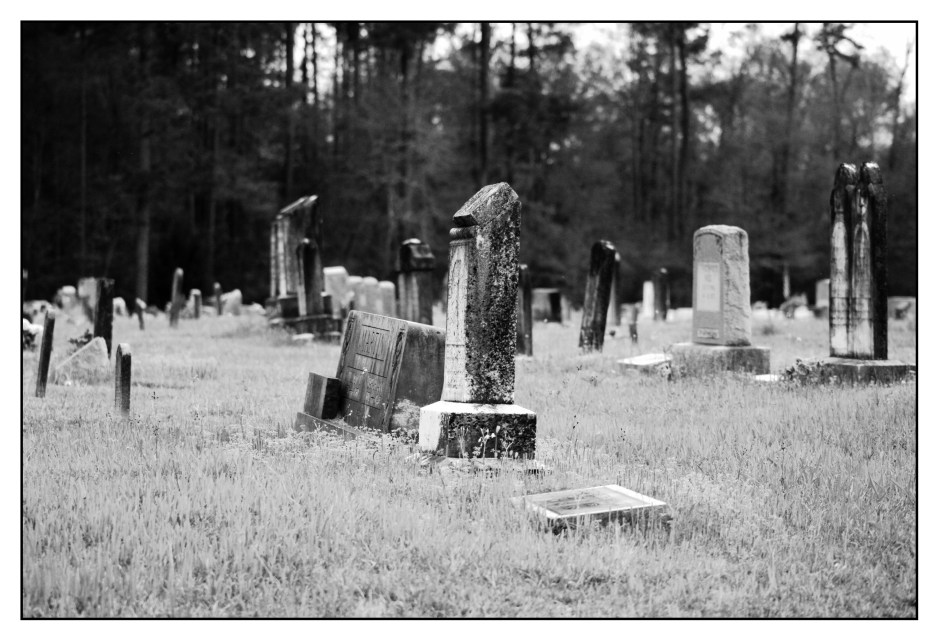
‘Elegy from a Seaside Graveyard’, by John Stokes

graves-317566.jpg

From ‘The Eden Set – coming on the coast suddenly’

… and this stone-picture’s Wayne, the Suicide
doing it his way: longest finger
cocked up from the earth
into the sealight fading.

Here the surfer, boy of the sea
still suckled by his mother feeling
his salt mouth, his sighing
over the tablet gravestone of the waves.

Here the incongruous Calvinist whalers
moaning with their predestinations:
born in sin, living to lament
relieving themselves in death

and here the mother lover, with her child
still moving, on top and hung
in the harness, the smash cut
gently into the mind at twilight

and Brad, who knew Sherryl
in the fullest biblical sense
and Nathanial, who knew the kill
and the smell and ways of the mulloway.

These deaths are so Australian
and yet the same. They are sung
in the tongue of the water, the hiss
of the sand-grains rubbing

one with another, and another
and another, under bellbirds
sounding their death knells
into the sealight fading.

So leave the dead ones to it
– they are, after all, forever –
love them, leave them, go
pausing once, at some corner

(you will know when)
so the car-hoon
when he misses you by a nail
gives you the finger!

Resurrect your breath.

Drive on.

– published in Meanjin 66–67, no. 4–1 (2008), 22–23.

Some notes on church worship in Chile

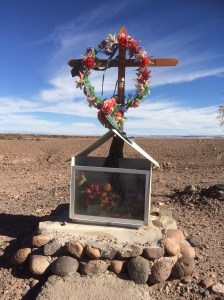
One thing I often like to do when I’m travelling is to visit places of religious worship, whether such be Buddhist, Baha’i, or Hindu temples, or Muslim mosques, or Jewish synagogues, or Christian houses of worship. Among other reasons, this is partly because understanding the cultus (i.e., those convictions and values embodied in ritual and ceremony) of a place is a window into better understanding its broader culture, and partly because I’m fascinated by how such strange creatures as we constantly seek to orient our lives around, from, and towards things transcendent. We are, after all, homo religiosus, as St Augustine taught. One way that this is manifest is in the erection of little shrines around the country, such as this one pictured on the left – a phenomena prevalent in every part of the world I’ve visited.

Currently, I’m in Chile. It’s a country where about 61% of the population describe ‘religion’ as being either ‘very important’ or ‘somewhat important’ in their lives, and where somewhere in the order of 70% of those over the age of 14 identify themselves as ‘Christian’, the majority of whom (60–70%) are Roman Catholic, and around 15% identify as ‘evangelical’. 90% of evangelicals tick the box that says ‘Pentecostal’. The remaining 10% of Protestants are a smorgasbord of mostly Lutherans, Anglicans, Presbyterians, Baptists, Seventh-Day Adventists, and Methodists. While the numbers are debatable, Mormons claim to be the second largest religious group in the country, after Roman Catholics. There are only around 17,000 Jews, and 3,000–4,000 Muslims in the entire country.
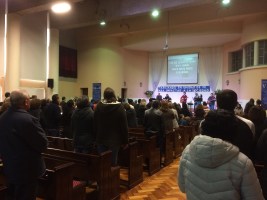
During my time here, I’ve visited a number of churches, both Catholic and Protestant. Last Sunday, for example, I was in Santiago and spent time at the Primera Iglesia Bautista de Santiago (pictured on the right), a large Baptist church with strong links to the Southern Baptist Convention. It was an interesting experience, although I must say that an hour of 80s-style rock ‘n’ roll – even when led by a delightful worship leader, as it was – followed by a sermon that goes for over an hour is hard work on the crowd, especially since it seemed like all the important stuff was happening ‘up the front’ as it were. Still, it seemed that most people like it this way. Open Bibles and the provision of a detailed sermon outline indicated that here were people wanting to be schooled in Christ. That said, judging by the queues for the loo after the service it also seems like many were literally busting to get out of there. I know I was. And yet, at the same time I very much welcomed this connection with my Baptist sisters and brothers.
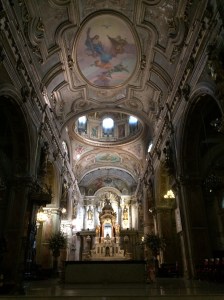
During the week, I also visited a number of Roman Catholic churches, mostly in Santiago’s inner city. These were near empty on Sunday morning, but during the week these cold, dark, dusty, and musty buildings were frequently occupied by somewhere between 40–100 or so people who were praying, mostly at the various side chapels, a couple of which in each place were clearly more important – or more interesting, or more something else – than the others. People stood to pray, knelt to pray, sat to pray. I was struck by how expressive much of this prayer was. (To be sure, it was on par with other forms of physical expression I observed in countless public places.) Apart from the sidelines of sporting fields or the endless checkouts of shopping malls, such out-in-the-open demonstration of one’s religion is rarely seen in Australia, where we tend to keep our religion more private and where public displays of such are likely to attract the unforgivable accusation of ‘hypocrite’ or ‘religious wanker’.

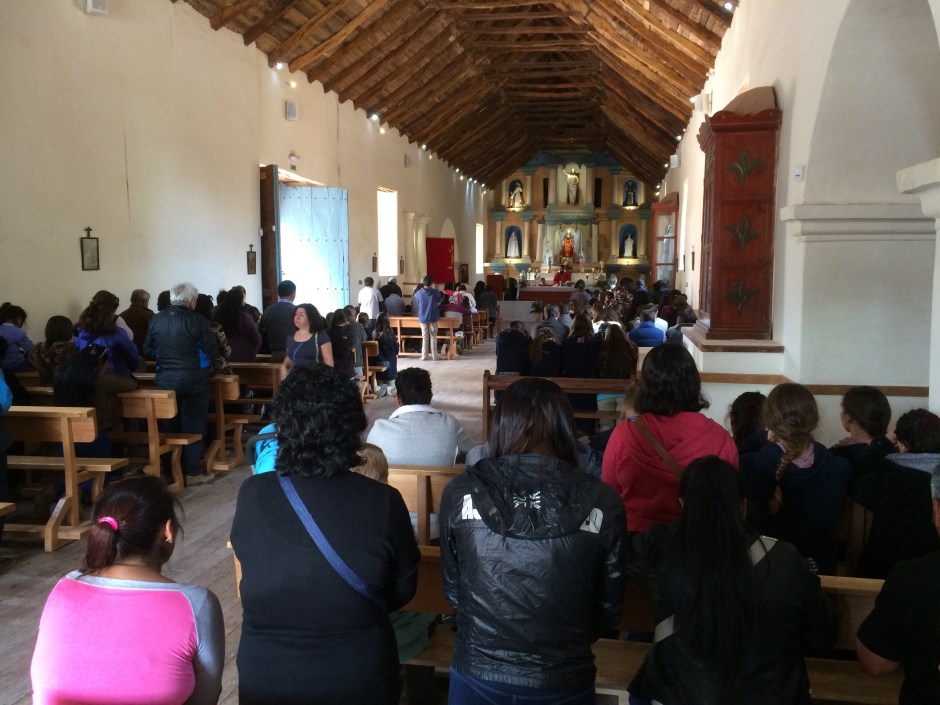
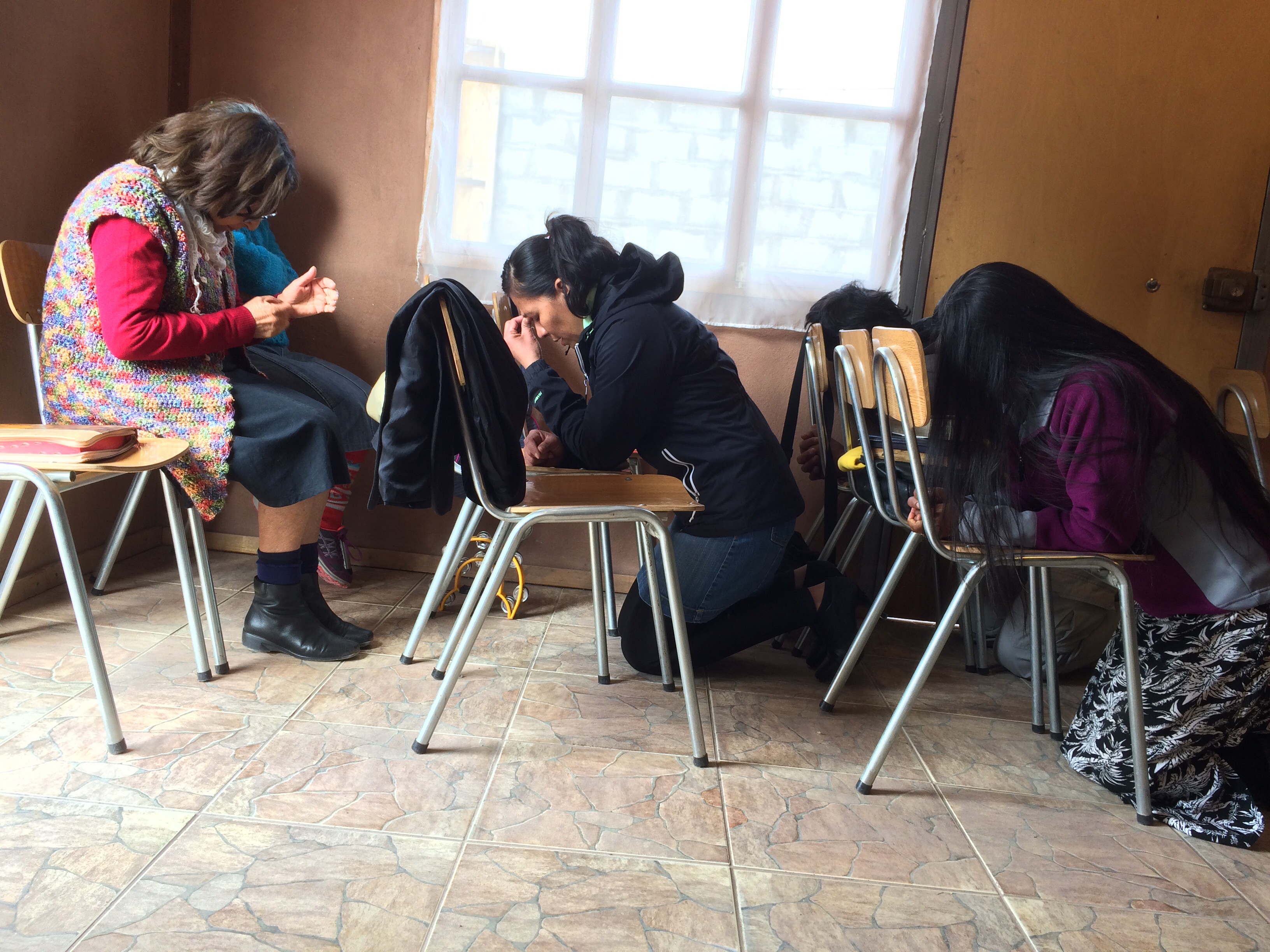
Today, when the church marked Pentecost, I attended two church services in San Pedro de Atacama, in northern Chile. The first was at the Ministerio Iglesia Apostolica Internacional. Here a small, friendly, and welcoming congregation of just under 20 devoted worshippers meet each Sunday morning in a very small and minimally-adorned room on the edge of town. I too heard the Call to Worship here:

Here, there were no song sheets or data projector to be had (what a relief!), and a sole musician strummed a nylon-string guitar, simply. It was beautiful.

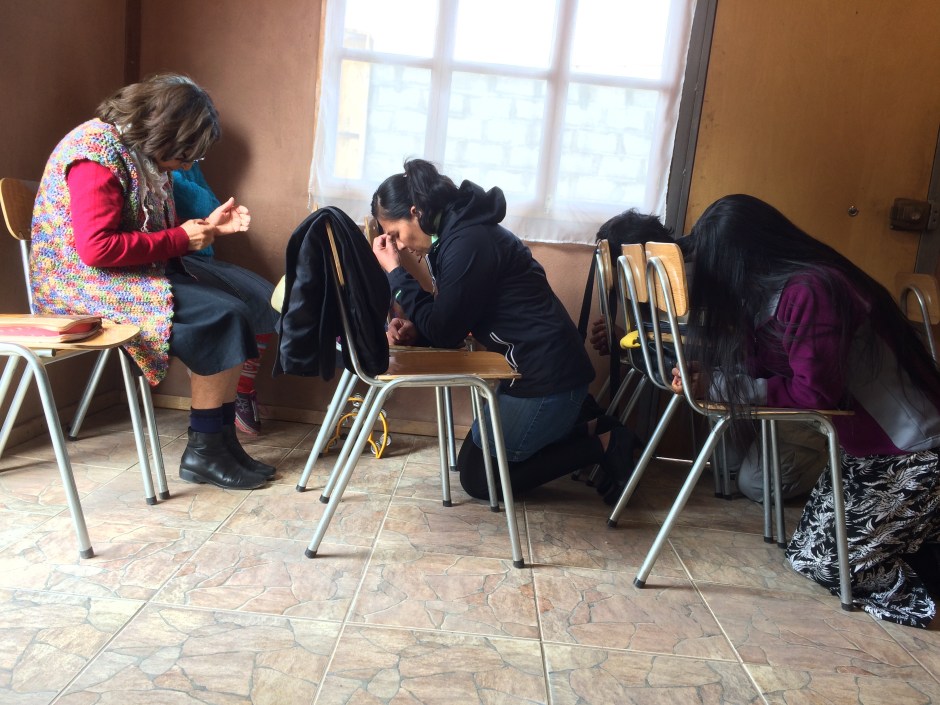
These were humble and decent folk. For two-and-a-half hours, they loved Jesús nuestro Señor together (it was unclear who ‘the’ pastor was, as most adults seemed to take various leadership responsibilities) through some very loud singing and prayers and constant sharing of potato chips, through the reading of Holy Scripture (they stood for the Gospel reading. The preacher read the full text, and then the congregation all read it together), and through an impassioned 20-minute sermon on Matthew 13.45–46, during which time the kids and two women went to a house up the street for Sunday School. Together, they prayed as if ‘God’ might be able to hear them. They prayed like people desperate to find a rare pearl in a field of weeds. They prayed as if their entire world depended on these two hopes. They prayed like they lived – expectantly.

​​The sermon was immediately followed by most people falling onto their knees and praying – led loudly by the preacher; I did wonder at times if some of the men here imagined that God was deaf – and by the mysteriously-coordinated return of the children and their teachers. I wondered about Barth’s warnings about giving ‘no opportunity for enthusiastic rhapsody’, but it was not my task here to make that call; and anyway, if he was serious about that then he should never have written IV/2.

This was followed by a time of laying-on-of-hands and of mutual blessing.

Overall, the gathered seemed to go through an enormous number of tissues, wiping eyes and blowing noses that had been stimulated by some very emotional worship.

Did I mention that it was beautiful?
Not yet worshipped out, an hour or so later I attended Mass at the beautiful Iglesia San Pedro de Atacama, probably the second oldest church building in Chile. The church building is made principally of mud and algarrobo and cacti woods, and bound together by llama leather. It was first constructed during the seventeenth century, and has undergone various modifications and additions since. Here, two priests adorned in Pentecost red, a few nuns, and an impressive music group, led a packed cathedral in worship. I was grateful for the moments of silence here, silence shared with so many devoted people who were seeking connection with things transcendent.

And as the handsome priest placed the wafer on my tongue, I found myself joining them. It was as if the entire week – indeed my entire life, including all those worship events – was simply the prelude to this moment when the Body of God might be consumed.