Year: 2009

Alfonse Borysewicz: ‘Can You Be a Contemporary Artist and a Practicing Catholic?’

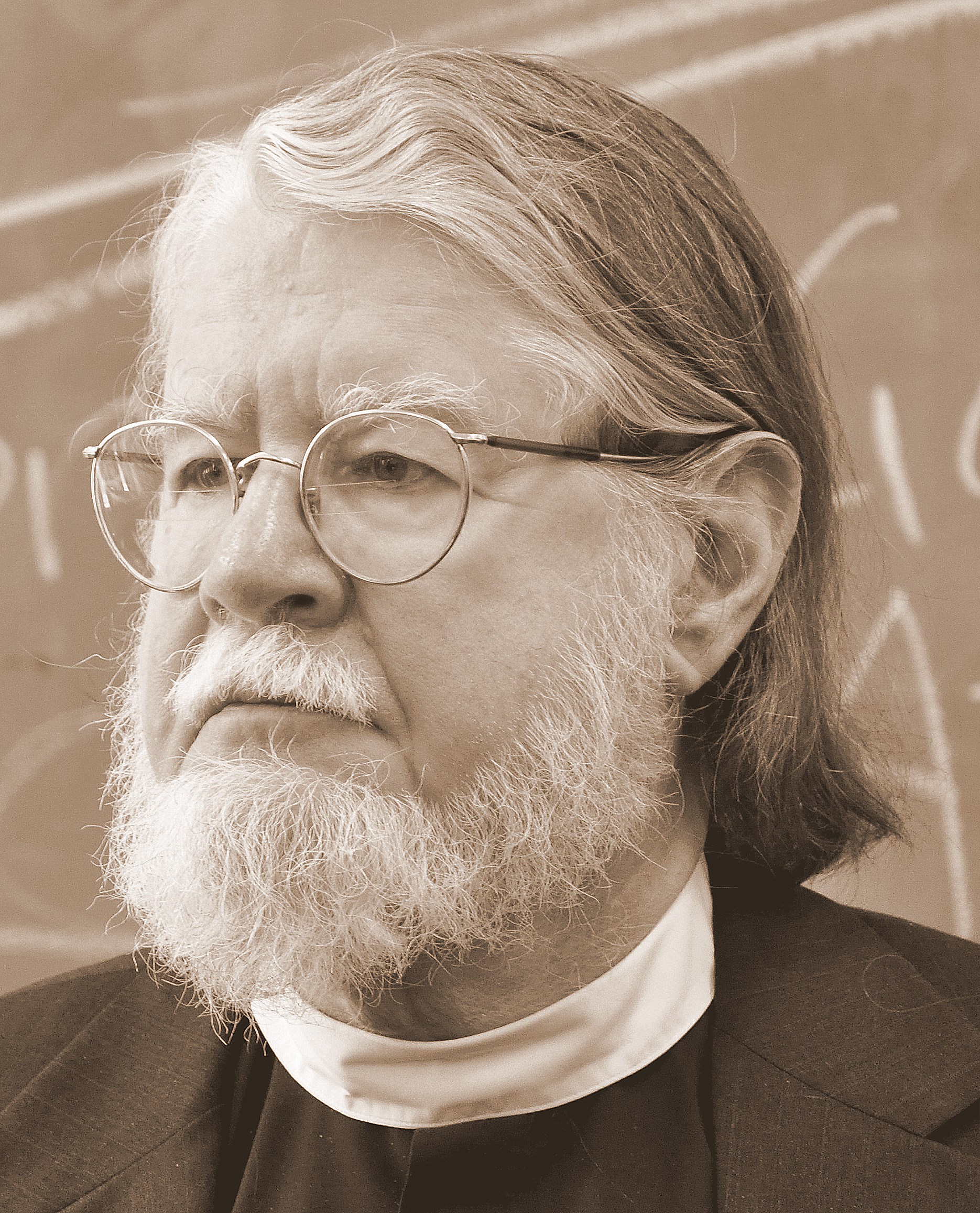
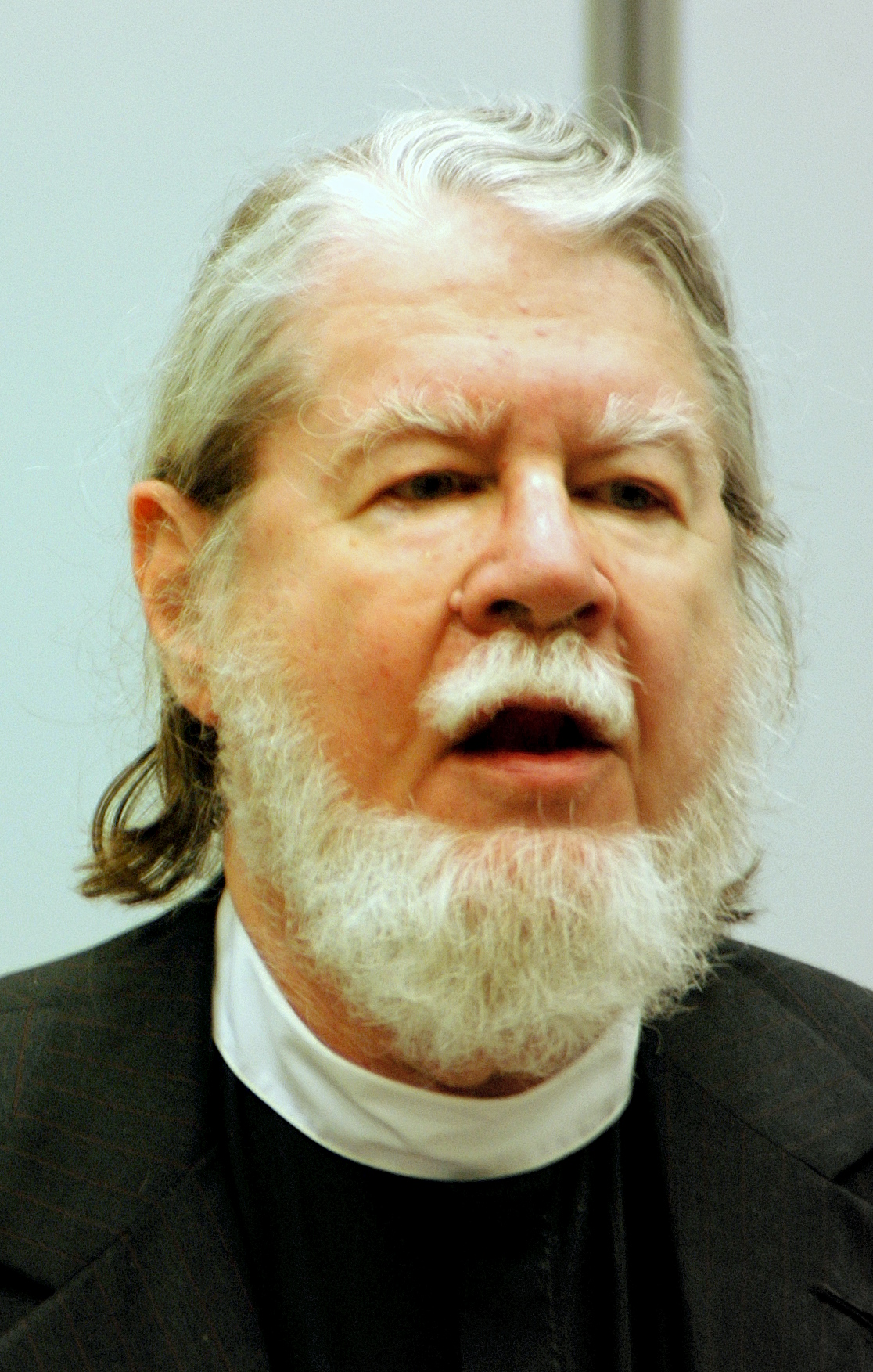
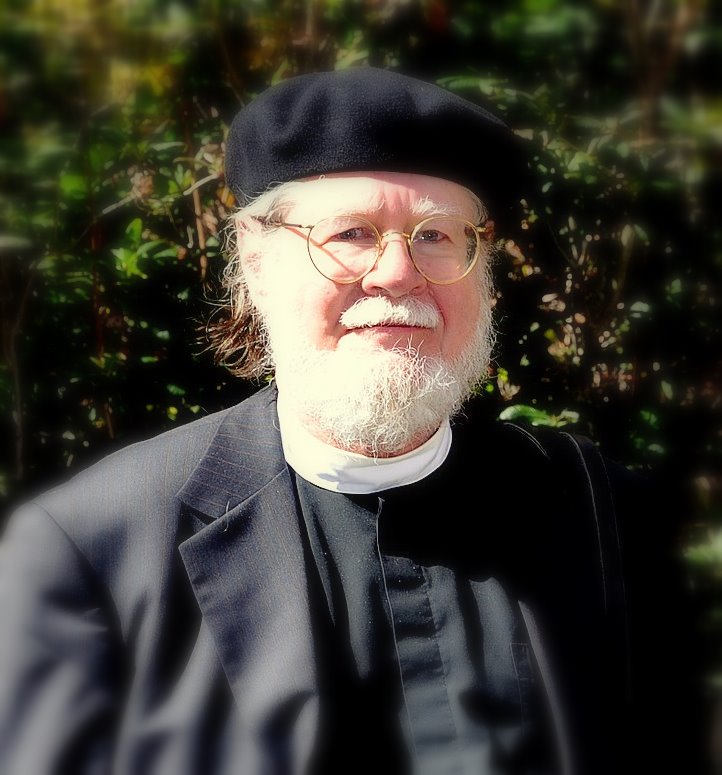
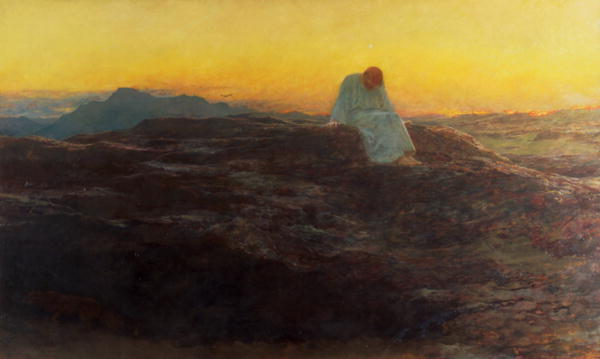
alfonse-borysewicz-1I have posted on Alfonse Borysewicz before: here and here. In the latter post I mentioned that Alfonse would be delivering the Brooklyn Oratory‘2009 Baronius Lecture. He has been kind enough to send me a copy:


Baronius Lecture 2009 – Alfonse Borysewicz

Oratory Church of St. Boniface, Brooklyn, New York

Can You Be a Contemporary Artist and a Practicing Catholic?


There is a story about a rabbi going to see another rabbi and finds himself immersed in the reading of the Torah. “What are you doing?”-“I’m trying to interpret a passage that I’ve been studying for years and can’t explain completely to myself.” “Let me see: I’ll try to explain it to you myself.” “That won’t do any good, I can explain it to other people; what I can’t do is explain it to myself.”

In 1977, on my first day of seminary, after two years of college at a Jesuit university in Detroit, I found in my hands a book of poems by Gerard Manly Hopkins. To this day I still make pilgrimages with that old college Penquin paperback; particularly one poem, “Carrion Comfort,” which has become a personal mantra for me.  The opening lines of this heart-felt poem are:

NOT, I’ll not, carrion comfort, Despair, not feast on thee;
Not untwist-slack they may be-these last strands of man
In me ór, most weary, cry I can no more….

Three decades have passed since I finished my seminary studies, and, in a clumsy way, decided not to become a priest, and instead have spent now 30 odd years working as a painter, first in Boston, with quick recognition and subsequently in the New York art world. Today when I ask myself if I can be a contemporary artist and a practicing Catholic, Hopkins’ words, “despair” , “weary” and “these last strands of man,” squeeze me hard. For me this question is a real-life drama. And it is not as simple as one might think.

In his autobiography, Henry Adams, heir to two presidents and an accomplished author of biographies, novels, a nine-volume history of the US, and works on education and art, portrays himself as a misfit. From a literary standpoint his life was an extraordinary success, but in his own estimation he had failed miserably. He saw himself as a human fossil, a survivor from an earlier era confronted with a bewildering, changing world. In The Education of Henry Adams, he wrote: “What could become of such a child of the seventeenth and eighteenth centuries, when he should wake up to find himself required to play the game of the twentieth?”
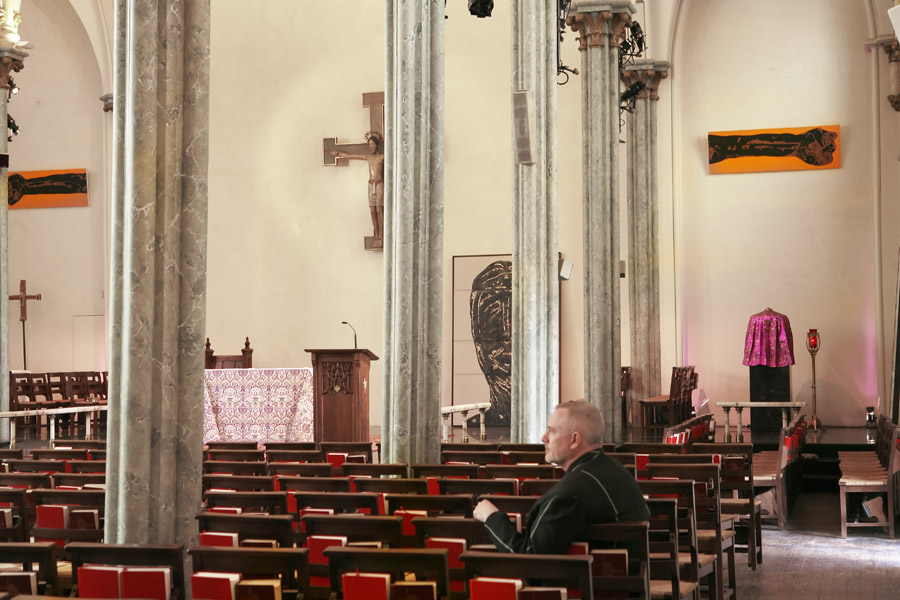
alfonse-borysewicz-21Like Adams, I’m often tempted to see myself as a human fossil. As a practicing Catholic I am in many ways a product of other centuries, yet contemporary art requires me to play-exclusively- the game of the twenty-first century, a world that changes even faster than the one Adams lived in. With the compounded temptation to idolize an ever increasing material and technological world at the expense of a sacramental vision of the world.

In the book The Church Confronts Modernity, published by Catholic University, several authors reflect on the church and culture in Quebec, Ireland, and the United States. With regard to the “home country,” so to speak, one author makes a distinction between two Catholicisms in America: one emphasizing authority, one emphasizing individual conscience. The former highlights knowing the church’s teachings; the other, being a good Christian. The first views modern society as evil, the second as God’s creation. And so it goes.

Regardless of which model you follow, the dilemma is the same: either you can risk denying your ultimate identity by changing (or pandering), or else by refusing to change you can become obsolete, out of step with the modern, or should I say, the lost modern world.

When I was in my thirties, my paintings, though they were full of religious meaning for me, were safely abstract, and I was welcomed into the gallery scene of the time. As I entered my forties, my Catholicism became more important to me (the culture wars, raising children, terror and war, etc.), and my paintings began to change (less abstract, more representational with direct religious imagery). This new work was no longer welcome in the galleries that had once shown my work and, it seems, in the dialogue of the culture. Recently I have come to the realization that my erasure from the art world was no fluke. Rather my initial 15 years of success was the fluke. That is to say, my intuitive drive to unite my art with my faith and religion was doomed to fail in the culture world at large from the get go. The boulder I have been pressing to move, the truncated and distorted views of God and the Faith and the Church, has been there for centuries. And it’s taken me 51 years to realize this. But the wonder and gift is I have realized this. The question now is do I attempt to participate in the contemporary culture-art world by changing and updating or  as Zsigmond Moricz wrote in the great Central European classic novel of a budding artist’s struggle, do I remain “faithful unto death”?

Why remain faithful to religious imagery in an increasing secularized world? This is a question I often ask myself at around five AM when I wait for the sunrise and the soon honking horns outside my window. Why am I still pressing this boulder that has cost my family and I so dearly?  It is an old question, and one that lives at the heart of Christian worship, which brings ancient events into the here and now by presenting us with images. Our liturgy, so beautifully celebrated in this Church, celebrates events that take place in the present, and are at the same time linked to a historical past we can barely imagine. Yet this is what both the Middle Ages and the Renaissance did: they portrayed biblical stories in a contemporary setting.

I can think of many more recent artists who do this, but one American nomadic modernist in particular comes to mind: Marsden Harltey of New York and Maine, who in 1941 painted Fisherman’s Last Supper, an ordinary family at dinner minus the loved ones lost recently at sea. From this fishing village portrait to the Ghent Altarpiece or The Adoration of the Mystic Lamb, all imply, as Heather Dubrow writes in The Challenge of Orpheus, that “the figure within it is, as it were, alive and well in that very church at that very moment.” Saint Augustine echoes this: “Easter happened once yet the yearly remembrance brings before our eyes, in a way, what once happened long ago.” Why this recreation of Christian events, reoccurring from medieval peasants to the geniuses of the Renaissance to New York neurotics like Marsden Harltey and myself? Augustine answers: “for fear we should forget what occurred but once, it is re-enacted every year for us to remember.”

One cannot talk about American Catholic identity, culture, and the artistic endeavor, without (forgive me) genuflecting to the writer working from Milledgeville, Georgia-Flannery O’Connor. Echoing Chesterton, O’Connor insisted that the free will essential to Catholicism also freed the imagination. As she put it: “The Catholic novelist believes that you destroy your freedom by sin; the modern reader believes, I think, that you gain in that way.” In other words, do you live and create in an ordered autonomy where your freedom is guided by transcendent values or a radical autonomy where anything goes. Or, in short, a freedom that views life as a gift or a freedom that views life as something to me manipulated. I think the latter is the prevalent operative mode in our culture today, though recently it is showing signs of stress. As Karl Barth writes even God put limits on God’s own freedom by resting on the seventh day of creation.

So where am I?  Like Adams, am I a misfit? With my sacred obsessions, I feel like a genetic mutant unfossilized from the thirteenth century into the twenty-first.  When asked why she had a penchant for writing about freaks, Flannery O’Connor replied, “because I can still recognize one.” Why, in a culture divorced from and hostile to religious devotion, am I painting religious images and icons? Because, as O’Connor said, “I can still recognize one.”

The Czech philosopher Habermas warns us that “global capitalism’s triumphal march encounters few genuine oppositions and, in that regard, religion, as a repository of transcendence, has an important role to play. It offers a much-needed dimension of otherness: the values of love, community, and godliness to help offset the global dominance of competitiveness, acquisitiveness, and manipulation that predominates in the vocational sphere.” Or more basic, I don’t want my children or their children, my friends and their friends, or the passerby/stranger to abandon or forget their place in, as Pope Benedict illuminated in his first encyclical Deus Caritas Est, in this ongoing love story. To bring it back home from a hymn sang here two just two Fridays ago at the noon mass (#630 Lord, Whom Love is Humble Service):

Still your children wander homeless

Still the hungry cry for bread

Still the captives long for freedom

Still in grief we mourn our dead

As. O Lord, your deep compassion

Healed the sick, and feed the soul.

Use the love your Spirit kindles

Still to save and make us whole.

Look around, folks. You might not see anything like this for some time to come. Honestly, I have nowhere to go with these works. The galleries won’t exhibit them; they’ve abandoned religious expression.  Except for occasional moments like this, the Church and its parishes won’t display them. They have neglected or forgotten their own heritage, and so my work seems unusual to them at best, or at worst, dangerous. The universities, well, they will only show them on PowerPoint. ..Or perhaps Saul Bellow was right when he said “art can’t carry the weight of religion.”
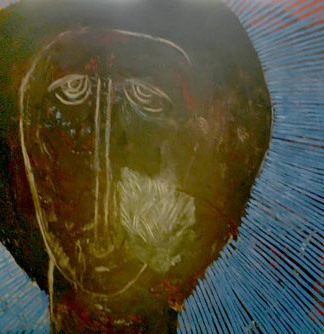
alfonse-borysewicz-3-1My hero, the Jesuit theologian Bernard Lonergan, saw the crisis of culture and faith years ago. In 1967, he wrote: “There is bound to be formed a solid right that is determined to live in a world that no longer exists. There is bound to be formed a scattered left, captivated by now this and that new possibility. But what will count is a perhaps not a numerous center, big enough to be at home in both the old and new, painstaking enough to work out one by one the transition to be made, strong enough to refuse half measure and insist on complete solutions even though it has to wait….”

In 1987, desperately hungry for a community to worship with, I took a bike ride to the Cathedral of St. James and found my home. After that first mass and walking up to Fr. Jim Hinchey inquiring about Baptism for my daughter in budding he soon put me to work in the bookstore. Then the transition from St. James to here when Fr. Dennis Corrado implored me to make a processional cross, do some gold leafing, and more…I will never forget his mandate: “Alfonse don’t worry about money because we don’t have any.” Though profoundly grateful to have worked in this church, to bring my art in this sacred space, I don’t think I can stomach again, like I did a few weeks ago and again ten years before, right here, holding the ladder while Fr. Mark Lane balances himself like an acrobat on these ladders to reach a hook, without a nerve in his body trembling while I shook below.

As for myself, like Saint Augustine, I have become a question to myself. About a year ago the Jesuit magazine printed an article about my works entitled “An Ordinary Mystic”. I actually brought up the Rahnerian idea after hearing about it from a friend; a beautiful idea. As my friend

Jesuit Michael Paul Gallagher writes “ future believers will have to be mystics or else they will not have faith. Clearly this cannot mean that everyone has to have the special gift of mystical saints. Rather it suggests that, in a more secular context, faith will have to be grounded in a personal experience of grace. It will need an ability to recognize the Spirit at work in one’s ordinary life.”

On the question of whether one can be a Catholic artist and be a contemporary painter, I will defer. I’m too saturated, too involved, too subjective, too neurotic to answer. They say that one doesn’t look at icons, but they look at you. My paintings, my icons, are looking down at you. Let me know. There-on my left-is Mary Magdalene. The Danish philosopher Kierkegaard writes “the words of the angel to Mary Magdalene at the grave could be used here: Do not be afraid; for I know that you seek Jesus of Nazareth; because until confidence appears, the person who seeks Jesus at first actually experiences fear before him, before his holiness.” Or as the filmmaker Bresson in Diary of a Country Priest, echoing St. Therese of Lisieux , all is grace.
Lent Reflection 4: TF Torrance on power

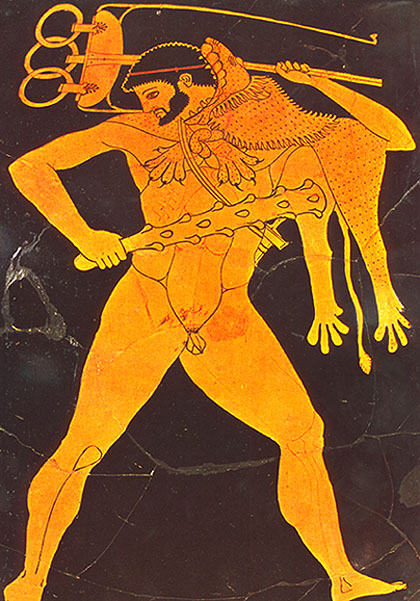
Hercules‘[The] movement of God’s holy love into the heart of the world’s evil and agony is not to be understood as a direct act of sheer almighty power, for it is not God’s purpose to shatter and annihilate the agents and embodiments of evil in the world, but rather to pierce into the innermost center of evil power where it is entrenched in the piled-up and self-compounding guilt of humanity in order to vanquish it from within and below, by depriving it of the lying structures of half-truth on which it thrives and of the twisted forms of legality behind which it embattles itself and from which it fraudulently gains its power. Here we have an entirely different kind and quality of power, for which we have no analogies in our experience to help us understand it, since it transcends every kind of moral and material power we know, the power which the Bible calls grace …’. – Thomas F. Torrance, Divine and Contingent Order (Edinburgh: T&T Clark, 2005), 136.

Around the traps …

  • Phil Baiden writes an appreciation of PT Forsyth.

  • The latest IJST (11/2) is out, and includes articles on:
    • ‘Development of Doctrine, or Denial? Balthasar’s Holy Saturday and Newman’s Essay’ (p 129-145), by Alyssa Pitstick
    • ‘The Descent into Hell as a Solution for the Problem of the Fate of Unevangelized Non-Christians: Balthasar’s Hell, the Limbo of the Fathers and Purgatory’ (p 146-171), by Gavin D’Costa
    • ‘One Commixture of Light’: Rethinking some Modern Uses and Critiques of Gregory of Nazianzus on the Unity and Equality of the Divine Persons’ (p 172-189), by Ben Fulford
    • ‘The Cruciality of the Cross’: P.T. Forsyth’s Understanding of the Atonement’ (p 190-207), by Theng-Huat Leow (Congratulations Theng-Huat!!)
    • ‘The Grammar of Pneumatology in Barth and Rahner: A Reconsideration’ (p 208-224), by Travis Ables

Lent Reflection 3: Gerhard Forde on Jesus’ cry of desolation

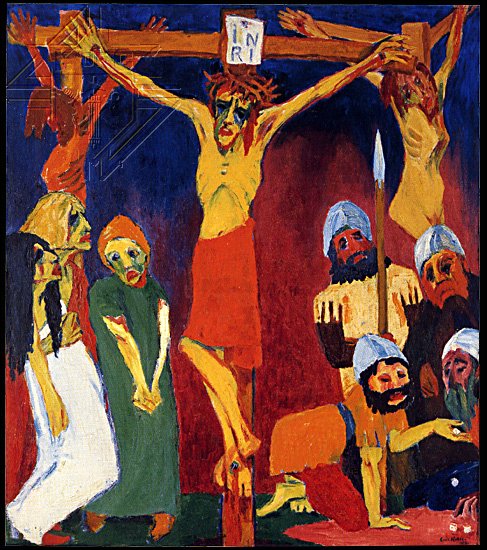
emil-nolde-crucifixion-1912‘Most everyone – conservative, orthodox, or liberal – seems to have trouble thinking the cry [of desolation] could be real. It seems as though having dispatched him to a humiliating, cruel, and agonizing death, we are surprised and shocked that he should find it all that bad. We just can not give up on making him our religious hero, desperately seeking in him the last spark of divinity, the courage, the faith, that will somehow see him through and thus enable us to avoid facing the end. There must be some way for him to transcend the fate to which we have dispatched him. It is as though by crucifying him we had merely provided the occasion for him to exercise his divinity, or as though as his murderers we hope that our crime was all a bad dream. For if he goes into the blackness of death forsaken even by God, what chance do we have?

But that is, of course, precisely the point. We have no chance. He comes to die for us, to enter into the blackness, the nothingness of death alone. Thus he goes the road of being human to the end. But it is even more than that. He took our place. He took our nature, being born under the law. He was made a curse for us, and he followed the course to death on the cross. In the end he cries out in an agony that Mark concentrates into the totally human question, “Why?” And there is no answer. Beyond the “Why?” there is only God. We are, once again, simply brought up against God. God is done to us. The true human can only wait on God here. “Father, into your hands I commend my spirit.” The human Jesus brings us to that end. This is his self-emptying (kenosis). Not that he divests himself temporarily of some divine prerogatives, but that he pours himself out into that last desolate cry.

Only by so pouring himself out can he finally be for us. Were he to hold something back or somehow to be protected from the stark reality of the death, he would be our lawgiver but not our Savior. His dying words to us would be some sort of admonition to stop our perfidy, shape up, and perhaps take him down from the cross before it all goes too far. His dying would be perhaps just the supreme example of how to die, and so the most strenuous law of all. That, one might say, is the theological way of taking him down from the cross. Only by truly dying does he put an end to us as old beings so that we can be made new. Only so do we come up against the one who calls into being that which is from that which is not’. – Gerhard O. Forde, Theology is for Proclamation (Minneapolis: Fortress Press, 1990), 112-3.

Robert Jenson: The 2009 Burns Lectures on ‘The Regula Fidei and Scripture’

robertjenson-8

© 2009. Photo taken by John Roxborogh, when Robert Jenson visited the Knox Centre for Ministry and Leadership in Dunedin. Used with permission.

Here’s a list of recently posted notes on Robert Jenson‘s 2009 Burn Lectures delivered at the University of Otago:

The video podcasts of those lectures are now available for download as MP4s. See here for details.

Robert Jenson: Burns Lecture 6 – Genesis 1:1 and Luke 1:26–38

jenson-2For his grand finale Robert Jenson offered a practical demonstration of what had been argued for in the first five lectures, namely, a creedal critical exegesis of Scripture. Due to time limitations Jenson took as his text Genesis 1:1-3 only. The joy of hearing him on this text was that it touched on many of the key themes of Jenson’s thought and gave us a kind of overview of his doctrine of creation and time.

His starting point was the observation that, although the two well-known translations of Genesis 1:1 are both grammatically possible, the shift in the NRSV to the temporal subordinate clause (‘when God created the heavens and the earth’) is a move from the most straightforward and default translation to something that more closely reflects the religiosity of ancient paganism. (There is no reason, Jenson contends, to abandon the LXX and KJV here) It is a departure from radical Judaism to a view of the universe in which chaos is antecedent to and coeval with God’s creating. Jenson noted that if in the beginning there is both God and chaos then both God and chaos are involved – at least at one level – in our creation. Creedal criticism, where the creed provides the lens for our suspicion of appearances, makes us immediately alert to this reading which assimilates YHWH to the anthropomorphic gods of religion. Even if it is only chaos it is a foothold outside God – a point of independence – something other than the absolute beginning of the Christian faith. It challenges our faith in the world’s ‘self-founded timeless being’. It is, says Jenson, Scripture’s scandalous ‘metaphysical put-down’ that we try and avoid. Interestingly, Jenson notes this same impulse in the cosmologist’s attempt to avoid creatio ex nihilo by means of positing multiple universes – a totally untestable and therefore unscientific hypothesis, which has nothing other than the conviction of ‘no absolute beginning’ as its basis.

With an eye on the creed Jenson continues: ‘Who is this God who tolerates no antecedents of his work?’ Creedal criticism assumes it to be obvious that it is the Father of the Son, Jesus Christ. It thus justifies the gloss ‘In the beginning the Father of Jesus created the heavens and the earth’. Thus we may conclude that ‘the contingency of the world is founded on the contingency of the life of Jesus’.

Jenson cites Westermann to claim that Genesis 1:1 is a caption summary for the whole story that follows. This then leads on to 1:2, which is where the creation narrative properly begins. Jenson claims that the best scholarship locates this verse in the post-exilic editing of a priestly savant in the second temple and then poses the question of whether this scholar was (a) thinking paganly or (b) using pagan language of Near Eastern mythology to serve the purposes of 1:1. Under the guidance of the creed, Jenson choses to read it the second way. His account of 1:2 is something like this. Given the unavoidable sequentiality of the narration of events, the writer wields the language of subsistent nothingness as a place-marker to indicate an absence. There can be no question about before. In Jenson’s phraseology, ‘To ask what was God doing before he created the world is a dumb question.

Again in verse 3 Jenson’s creedally-suspicious mind spots ideology at work in the NRSV’s translation of ‘a wind from God’ where in every other instance of the phrase ruach elohim is translated ‘Spirit of/from God’. What’s more, because Genesis 1:3 is a late text the tradent knew this title. Jenson’s creedal reading thus concludes ‘The Holy Spirit agitated the empty possibility posited when God begins to create and there is nothing’. What’s more, this suggests that there is an ‘inner liveliness in God’ which is directed towards making something when there is nothing.

At this point Jenson offered asides on the Nicene concept of the Holy Spirit as ‘enlivener’ and the folly of continuing to insist on the filoque which was after all an illegal addition.

From here the story of creation begins: (a) God said let there be light; (b) God saw that the light was good; (c) God separated the light from the darkness. The world simply is an affirmative response to God’s command: ‘That’s all there is to it’! And this explosion of energy (light) is good (for something). Here Jenson explores all the non-creedal and non-trinitarian puzzlements surrounding this text. A monotheistic/Unitarian/Aristotelian God cannot speak. For such a god eternity is necessarily silent.  At best, if a god like Aristotle’s did speak it would be an act of condescension. Moreover, for such a god to speak presupposes a polytheistic pantheon. However the creedal critic knows that not only can the Triune God speak, but God can be conceived as a conversation. ‘God is a conversation’. Only the Triune God who is a conversation can issue a command to creation before creation existed because the second person of the Trinity is himself a creature – Jesus of Nazareth. At this point Jenson talked of a conversation in which the Son, as the creature Jesus Christ, hears and speaks. ‘In what language does God speak?’, Jenson provocatively asks. In the language of Spirit – that universally self-translating language heard by the prophets, and which at Pentecost all the nations heard as their own.

And God saw that the light was good. Was it good because he saw it so, or did he discover it to be good? Jenson responds that there is ‘no humanly ascertainable difference’. However the key question Jenson moves quickly on to is, ‘Good for what?’ And here he refers us to the second and third articles of the creed – that is, that creation is the good stage for the drama of Jesus Christ. Moreover, this 78-year old ‘unreliable’ Lutheran affirms with Barth that creation is the ‘outer basis’ or ground for the covenant and its events, and that covenant is the inner ground of creation.

What about darkness? Does God create a non-good. Jenson accepts Augustine’s reading of darkness as absence, where light runs out. Evil is the ‘running out’ of being in its finitude. Thus like the dimming of light an apparent necessity (or at least an actuality) of created finitude. The creation of life includes within it ‘death on an enormous scale.’

The story moves from the creation of life (‘energy’ in (post-)modern parlance) to its endless differentiation. Jenson comments: ‘Never rest too much on agreement between science and theology’ precisely because science is constantly changing and it is inherent in its claim to be science that it is open to such change. So Jenson argues, our priestly savant used the best science of his day to tell of God’s creation of the world – ‘what other science was there?’ We ought to emulate his courage?

Question time followed. The first question in the gladiatorial fray went to the heart of Jenson’s theology asking whether the creatureliness of the Son (no logos asarkos) implied the eternity of creation (pantheism?). Jenson, clearly familiar with the need to defend this ‘novelty’ in his thought, was surprisingly brief in his response. It was two-fold: (a) his Ockham’s razor saw no need for a pre-incarnate logos (begging some prima facie questions posed by John’s prologue, of the Word’s becoming) and (b) a pre-incarnate logos becoming flesh presupposes a common timeline in divine and human history. This doesn’t correspond to Jenson’s view of the relation between time and eternity, and is a nonsense. However, he didn’t feel the need to defend this claim here. No doubt time did not permit.

Further questions focused on theodicy. In different ways, Jenson’s succinct conclusion was that ‘we can’t get God off the hook for evil. We can’t do it, but we have confidence that God can do it!’ Jenson mentioned in passing the open theist theodicy which diminishes the notion of omnipotence so that God is not morally responsible for all that happens. Jenson is not personally happy with this, but was not completely dismissive either.

The lecture was a powerful presentation of Christian reading/exegesis which depends on the premises of his previous lectures (see I, IIIIIIV and V). One might reasonably be not entirely convinced by Jenson’s radically post-modern/pre-modern scepticism with respect to objective meaning in texts (see Lecture 5) and therefore have some doubts about the pathway Jenson takes to a theological interpretation. Are authorial intentions really as private as Jenson suggests (and Vanhoozer, for example, denies)? A comment Jenson made to post-graduates at a seminar on Wednesday morning about the infinite malleability of texts makes one wonder about the distinction between reading a text and projecting onto the text – if this distinction is lost the proposal of a creedal exegesis seems to have a certain kind of arbitrariness. However, even if Jenson is wrong about hermeneutics, it does not follow that his theological reflections on the text of Genesis 1 are wrong, just that its relation to something one might call ‘the meaning of Genesis 1’ is different from how he conceives it.

One might also think that Jenson’s suggestion that the contingent creaturely life of Jesus is part of the eternal life and conversation which is the Triune God requires considerably more unpacking than Jenson is want to do. Might Jenson’s formulation suggest that this creature who is also creator might be in fact self-creating? Might Ockham be cutting himself shaving?

A final thought: however one arrives, one never leaves a Jenson lecture unchanged. Whether he is lecturing on theology proper, on eschatology, on the Trinity, on culture, on anthropology, on ecumenism or on the relationship between Holy Scripture and the Church’s Creeds, Jenson is undoubtedly one of the most original and erudite theologians of our time. Certainly, as one commentator noted, ‘Jenson’s mind makes stimulating company’. One comes away from this series of Burns Lectures with a renewed love for Scripture, with a new appreciation of the abiding witness and value of the Church’s Creeds, and with a lively sense of doxological fervour for the Triune God. At the end of the day, isn’t that what all theology exists to be about?


Past Lectures:

1. Creed, Scripture, and Their Modern Alienation

2. The Tanakh as Christian Scripture

3. The New Testament and the Regula Fidei

4. The Apostles’ Creed

5. The Creed as Critical Theory of Scripture


Notes by Bruce Hamill and Jason Goroncy

Christianity as Spiritual Architecture

‘Although contemporary people often think of architecture as static or perhaps stifling, buildings often “live.” Medieval Christians attempted to translate their spiritual sensibilities into some sort of structure that would communicate life – even long after the builders died. Chartres Cathedral would not exist if not for the two great institutions of the Middle Ages – the monastery and the parish church.

To medieval people, church buildings expressed their spirituality – their visions, virtues, and dreams of God. Church buildings were the geography of paradise, the actual location where God’s reign of beauty and justice could be experienced. Buildings, and the arts and liturgies therein, demonstrated the mysterious interweavings of the worlds, the playful combination of this world and the one beyond. Holiness was translated into visible structures where people might see, touch, and feel the beauty of God. Medieval builders captured this sense, creating sacred spaces that were both spiritually unpredictable and theologically structured at the same time.

Because the church building was holy geography, communities spend enormous resources of time, money, and talent constructing church buildings; the church stood as both a location of paradise and an icon of communal identity. Medieval people associated the actual building with God’s reign and were ferociously protective of their churches. In the 1130s, Peter of Bruis, a French preacher, promoted the idea that God had no use for church buildings. To him they interfered with the purity and simplicity of faith. Peter urged Christians in the town of Saint-Gilles to give up their church and burn its ornaments, including its crosses, dramatically illustrating the point by lighting a pyre. The people of Saint-Gilles, whose church was a major pilgrimage site, responded by tossing poor Peter on his own bonfire’. – Diana Butler Bass, A People’s History of Christianity: The Other Side of the Story (New York: HarperOne, 2009).

Robert Jenson: Burns Lecture 5 – The Creed as Critical Theory of Scripture

Robert Jenson‘Texts by themselves do not automatically flaunt the meaning they harbour’. From this postulation Professor Jenson proceeded – in this his fifth Burns Lecture (for earlier lectures see I, II, III, IV) – to challenge Modernist attempts to discern what the text is ‘really saying’. He warned of the limited value of efforts to understand ‘who is up to what’ with any particular writing (authorial intent), but also that the Church cannot simply opt out of Modernity’s critical agendas. The question becomes then which critical theory to adopt.

Jenson advanced that the Church is the body which must interpret the biblical texts, and to do so in light of the regula fidei, the Apostle’s Creed, and with the Triune God who is ‘up to something’ in these texts. ‘Acknowledging God’, he said, is a necessity for every interpretation except of that of the nihilist. The Triune God is a Person, and as such is the metaphysical bond between reality and discourse about reality. The alternative, Jenson contends, is that texts float free in a void of indifference. Reality and language meet only in God. This relates not only to Scriptural texts but to any texts. The Church has confidence to do hermeneutics only because the Church knows God personally, because the Church lives in a shared history with God.

From here, Jenson posed and proceeded to answer the question ‘What is creedal-critical exegesis?’ His answer: it is ‘christological common sense’, by which Jenson meant that Christ is God’s agenda in Scripture, not as allegory or figure, but ‘plainly’ (except when the genre of the text demands an allegorical or figurative reading). So, for example, Jenson contended that when Israel went into exile, the Shekhinah (who is Jesus of Nazareth) when went them. One implication of this is that when Israel is redeemed the Shekhinah will be redeemed with them. Jenson was completely unapologetic in his insistence that Old Testament references to ‘the angel of the Lord’ and ‘son of God’ are references to the second triune identity – Jesus of Nazareth. He proffered that to read the OT like this is to take seriously its ‘plain meaning’, and also that a legitimate rendering of John 1 might be, ‘In the beginning was the Shekhinah, and the Shekhinah was with God …’ etc. This, at least to my mind, was not the clearest section of the lecture series.

Jenson concluded his lecture by suggesting that the historical-critical exegetes are not critical enough (particularly of their own agenda), and reminding us that the Church’s theological tradition is always an ongoing conversation rather than the passing on of a fully-defined body of knowledge. In light of the latter, he suggested that if Paul, James and Peter were not involved in genuine dispute with one another then they can be of little use to us.

One of the questions that Jenson responded to during the question time that followed concerned the notion of God as a God of war. This had come up in previous lectures too. Again, Jenson was nothing if not clear in outlining his basic position: If we don’t want God involved in the violence of history then this equates, Jenson contends, to the confession that we don’t want God involved with us. The implications of this position – the questions it raises – would undoubtedly require a second series of lectures, or at least a few more nights at the pub with friends, to unpack.


Past Lectures:

1. Creed, Scripture, and Their Modern Alienation

2. The Tanakh as Christian Scripture

3. The New Testament and the Regula Fidei

4. The Apostles’ Creed

Next Lecture:

6. Genesis 1:1 and Luke 1:26-38


Notes by Bruce Hamill and Jason Goroncy

James K. Baxter: ‘Shalimar’

baxter-1

Shalimar 
Guava slices pierced by a straw
Eaten with rough salt and lemon;
This orchard where the trees have made
Stadium, refectory, high tent
For water carrier and camel boy. 
The mind’s great door is swinging now.
  
The musical water washes
From mouth and hands and heart
Memory of the peine forte et dure
Experienced in life. With balls of clay
The bearded guardian scatters birds.
  
Long waiting, brief illumination:
Outside the grass hut rustles on the ground
An empty snakeskin. Characters of fire
Without origin, without curb,
On the soul’s narrow walls
Blaze, as the sun strides in a broken house.
  
I AM THE CUP THAT HOLDS YOUR PAIN,
JANUA COELI, STAR OF TRUTH.
I AM THE ARK, THE STRONGHOLD OF THE KING,
I AM THE VOID WHERE LIGHT IS BORN.

Robert Jenson: Burns Lecture 4 – The Apostles’ Creed

robert jenson-014

© 2009. Photo taken by John Roxborogh, when Robert Jenson visited the Knox Centre for Ministry and Leadership in Dunedin. Used with permission.

Professor Jenson began the fourth of his six Burns Lectures by following up a question that arose after the previous lecture. The question concerned the Resurrection. He suggested that when we think of ‘living persons’ we must attend to two ‘aspects’:

  1. There is among us a voice which changes those to whom it is addressed. When the living voice of the gospel is heard – whether in liturgy, preaching, casual conversation, debate, etc. – then Christ is heard.
  2. A live human person is embodied. They are available. For this reason, a corpse is not a body. The Eucharistic elements are the body, as is the sound of the preachers’ voice, as is the touch of the baptiser. These are – in the conviction of the Church – actions of the body of Christ. Consequently, if one desires to see Christ, then one must look at the community of Christ, Christ’s body.

Jenson then turned more properly to the topic of The Apostles’ Creed, the Symbolum Apostolicum, which he described as the final deposit/version where the regula fidei ceases to be an intuition in the Church and ‘becomes a text’. He noted its relationship to baptism, and its shaping after the one name of the triune God in whose life the baptised participate. The triadic form, he suggested, represents the ‘internal structure’ of the one baptismal name according to the plot of God’s narrative with his people. This means that God’s history with his people is not only his people’s history but is also God’s own history.

Jenson proceeded to recall that it is precisely by their distinction from/relationship to one another that the three persons are one God. The Father is the Father of the Son, etc. Father, Son and Spirit (who is God’s ‘liveliness’) ‘mutually imply each other’. Moreover, and following Barth, Jenson contended that Father, Son and Spirit is ‘the Christian name for God’. (I have posted on this here). His defence of the position that it is ‘Father’ rather than ‘Mother’ was christologically determined: Jesus spoke of and addressed God as his ‘Father’ because Jesus was a Jew, and Christians address God as ‘Father’ – and not as ‘Mother’ – because we address God in Christ. Jenson described the Spirit as ‘the mutual love between the Father and the Son’. We live in this ‘mutual space’.

The remainder of the lecture returned to themes introduced in earlier lectures. Specifically, to arguing that the structure of the Creed is determined by the NT itself, and this in a two-fold sense:

(i) by its references to God. Jenson noted that the NT is full of ‘primary trinitarianism’, that there is a trinitarian logic that governs the NT, and that ‘with very few exceptions’ references to God in the NT imply a trinity of Persons.

(ii) by its prayers, particularly the so-called Lord’s Prayer. In giving the Church the prayer Jesus did, he invited us to ‘piggy back’ on his prayer to the Father, to participate with him (who alone has a native right to address God as ‘Father’) in his own praying to the Father. In this context, Jenson suggested that ‘if you know how to pray the Lord’s Prayer then you’ve got it [i.e. you’ve got the gospel in nuce]!’

Jenson reminded us that the Creed does not encourage the parsing out of God’s works among the three Persons. The first article’s focus is praise (grounded in and recalling Genesis 1 and the Psalms) and the second’s is God’s works. He also suggested that the Creed does not support the Church’s native way of reading the OT. By moving directly from creation to the incarnation the Creed avoids (dismisses?) 2/3 of the Bible. While the regula fidei saved the OT as Scripture for the Church it did not preserve the ongoing role of the OT. Why? Here Jenson suggested two reasons: (i) the influence of the Gentile Church; and (ii) Marcion. It was at this point that Jenson offered his first of two real criticisms of the Apostles’ Creed, arguing that it by itself is an inadequate witness to the Church’s faith. The first line of the Creed – the reference to God as ‘Maker of heaven and earth’ – recalls the ‘last vestige of the Old Testament’. His other reservation concerning the Creed is its basic omission of Jesus’ life. To paraphrase Jenson: ‘It wouldn’t have hurt the Church one bit to add a line or two about Jesus preaching the kingdom of God, and of his fellowship with publicans, etc’.

To Jenson’s surprise, the question time that followed elicited no discussion about the feminist objections to God’s proper naming as Father, Son and Spirit. (I’m not sure what this says about the audience). Instead, discussion followed two main trajectories:

(i) the relationship between Jenson’s notion of ‘living persons’ and its implications for the parousia. His response to this question was unsatisfying. He rightly noted that the apocalyptic scenarios Scripture presents ‘cannot be harmonised’ and that the parousia represents ‘the explosion of the fire of love, love which is perfect in itself’. He preferenced the scene from the Book of the Revelation (over those from say Thessalonians) where the redeemed worship the Father in the crucified Lamb. But he was decidedly unclear about the Son’s locus in the parousia, and of the form which believers might reasonably anticipate concerning Jesus, suggesting instead that the Son’s parousia happens, among other ways, in the liturgical action of the people of God.

(ii) the article in the Creed ‘born of the Virgin Mary’. On this Jenson suggested that this article refers primarily to the absence of the will of the flesh in Christ’s birth. He also reminded us that the Creed is the Church’s and not the individual’s. What the Church must confess always need not necessarily be what any particular individual believer feels they can confess at the time. This latter response seems to beg further justification. I wonder how the absence of Joseph’s biological contribution or action in Christ’s birth constitutes ‘the absence of the will of the flesh’ if Mary’s fleshly identity is involved in the birth of Christ. Does perhaps Scripture indicate a parallel eclipsing of the human will in the way Mary was ‘overshadowed’ by the Holy Spirit? Are, in fact, both the doctrine of the virgin conception and the overshadowing of Mary, simply, tentative, possibly clumsy, ways of affirming that in Jesus’ birth and whole life history, his origin in the will of the Father and the power of the Spirit overrides the generative processes of fallen humanity (whether they be biological or socio-cultural)?


Past Lectures:

1. Creed, Scripture, and Their Modern Alienation

2. The Tanakh as Christian Scripture

3. The New Testament and the Regula Fidei

Following Lectures:

5. The Creed as Critical Theory of Scripture

6. Genesis 1:1 and Luke 1:26-38


Notes by Bruce Hamill and Jason Goroncy

Grace: an ‘intensity of outward attention’

The NYT recently ran an interesting piece by Lee Siegel on George Steiner, a kind of follow-up/review piece of Steiner’s recently-released book George Steiner at The New Yorker. The article included one of the best definitions of grace that I’ve encountered: grace is ‘an intensity of outward attention — interest, curiosity, healthy obsession …’.

Christian theologians will no doubt want to further define grace – that is, to say something about how grace takes on fallen flesh and stubbornly refuses to be fallen in it, that this ‘intensity of outward attention’ takes place in a particular person, etc. – but Siegel’s definition goes a long way to bearing witness to something of grace’s existential motivation.

Want more? Read Real Presences; it’s absolutely brilliant.

Robert Jenson: Burns Lecture 3 – The New Testament and the Regula Fidei

robert jenson

© 2009. Photo taken by John Roxborogh, when Robert Jenson visited the Knox Centre for Ministry and Leadership in Dunedin. Used with permission.

Professor Jenson’s third Burns Lecture was concerned with the emergence of the NT as canon.

Initially he looked at the emergence of the NT canon as documented in the writings of Irenaeus. He noted that Irenaeus‘ arguments are circular, however, this is not a vicious circularity, indeed ‘circularity is the very mark of the Holy Spirit’.

In the search for authoritative apostolic teaching, Paul’s writings were accepted in spite of the appearance of gnosticism. Paul’s letters are scripture but only in the broader context of the story to which they contribute. The acceptance of the gospels arose due to the ‘logical relation’ between the gospel and the earliest expressions of the regula fidei. ‘Jesus is risen’ – ‘the ‘shortest statement of the gospel’ – calls out for narrative specification of Jesus’ identity. The gospel offered precisely that thickness of description and ‘morally and religiously specific news’ that the Church’s continuing identity required. On the other hand the theology of Paul and the other writers gave specificity to the meaning of ‘is risen’. So ‘Jesus’ is a reference to a real person; ‘is risen’ is a statement of ‘utmost salvific import’, especially in Second Temple Judaism.

The overall argument of the lecture was for the mutual interdependence of gospels and letters, alongside the mutual interdependence of creed and canon. Just as the crisis of identity threatening the Church’s fading regula fidei called for both the narrative of the gospels and the theology of the letters, so the emerging creedal formulations arising out of the regula fidei required the canon.

In something of a introductory survey of the Second-Century Church, Jenson reminded us that it was Clement of Alexandria who was the first to refer to the ‘Old Testament’ and to the ‘New Testament’. He also argued that the NT canon probably would have been formed even without Marcion, but that it may have been a different canon. Still, ‘we cannot say’.

Jenson proceeded to argue that creed and canon ‘fit together’ like two halves of a puzzle: the NT is indispensable to the creedal tradition and the canon is indispensable to the NT. Although he didn’t specify which creeds have authority for the Church (e.g. what ought we make of the Reformation creeds?), he did define the criterion by which that may be determined. He reserved the title ‘creed’ for those statements which derived ‘organically out of the regula fidei‘. Thus this notion of the communal self-consciousness of the first witnesses (he praised Bauckham’s recent study here, Jesus and the Eyewitnesses) becomes more and more central to his emerging argument. Canon and creed together as the source of the identity of the Church over time take over where ‘regula fidei’ leaves off.

He made a brief comment on inspiration, stressing that the work of the Spirit – undergirding that circular reasoning we talked of earlier – was a work from within (not from outside) both the writers and the interpreters of the canon. The inspiration of the Spirit, on Jenson’s view, is not a gift separable from the presence of the Spirit. Like other gifts, it is a gift in the self-giving of the Spirit and not apart from that.

Past Lectures:

1. Creed, Scripture, and Their Modern Alienation

2. The Tanakh as Christian Scripture

Next Lectures:

4. The Apostles’ Creed

5. The Creed as Critical Theory of Scripture

6. Genesis 1:1 and Luke 1:26-38


Notes by Bruce Hamill and Jason Goroncy

Robert Jenson: Burns Lecture 2 – The Tanakh as Christian Scripture

robert-jenson-3-1

© 2009. Photo taken by John Roxborogh, when Robert Jenson visited the Knox Centre for Ministry and Leadership in Dunedin. Used with permission.

The Burns Lectures are definitely warming up. In this lecture Robert Jenson dealt with the Tanakh, or Old Testament (as is his preferred terminology with appropriate qualification: ‘old’ equals ‘prior’ rather than ‘antiquated’) as Christian scripture. He began by clarifying the appropriate questions – the status of the OT as Christian scripture was never questioned and for Jenson this can’t be the Church’s question since it is both absolutely prior (presumably in the sense that it constitutes the world in which the Christian faith is born) and necessary for the Church’s self-understanding. Jenson says that the really interesting question for the first Christians was a kind of obverse to that which questions the status of Israel’s scriptures, namely whether Israel’s scriptures could accept the proclamation of the resurrection. The Church, he insisted, did not accept Israel’s scriptures. Rather, Israel’s scriptures received the Church. Jenson noted that for the century, it was Israel’s scriptures which served the Gospel rather than the obverse. This question is alive even though it cannot be clearly asked since God has already answered it in raising Jesus.

Jenson proceeded to highlight how this question is constantly in the background of NT writing and how the NT demonstrates in the way it tells its story a ‘narrative harmony’ with Israel’s scriptures – relationship between passion narrative and Isaiah 53 being a case in point. The OT prophets were the one’s who provided the answer to ‘why’ did Jesus needed to die. Jenson argued that we cannot ask why the OT Scripture after Christ. Rather, we can only ask how scripture is the way for the Christian community. He also observed that the Church reads the OT as narrative because her gospel is itself a narrative, and because her gospel recognizes itself as the climax of the story told in the OT. Jenson cautioned about ‘unguarded talk of the unique fullness of God’s revelation in Christ’ [is that the mythological Christomonism?]. Such talk requires, says Jenson, the important qualification that the God present to the OT sages is the same Word, Jesus Christ. Jesus taught the scriptures with ‘authority’ says Jenson, ‘that is, as if he were the author … because, in a sense, he is’. Jenson continued this line with comments like ‘Christ prayed the psalms as the leader of Israel’s worship gathered as the body of Christ’. When ancient Israel gathered in the temple with their hymns and lamentations they were gathered as ‘the body of Christ’. At this point he introduced some of the difficult issues that were to arise later in his lecture also. In response to those who wonder whether Christians can pray the Psalms that call for the destruction of their enemies and the bashing of babies against rocks, he suggested, with some rhetorical flourish, that they could pray them at the foot of the cross against the devil and his angels. [We shall return to this claim]

The key question which the latter part of Jenson’s lecture focuses on is not whether the OT is Christian scripture but precisely how it so functions. Jenson’s answer is that it functions as ‘narrative of God’s history with his people’, including the Church. This arises because the Church’s gospel is narrative and it identifies itself as the climax of the narrative of Israel’s history. Why this should be so stems from the character of the ‘regula fidei’ as a ‘plotted sequence of God’s acts’ (economy) on the one hand and the nature of the book the Church wrote as a second testament. He interestingly contrasts the two movements to emerge from old Israel with the destruction of the temple – rabbinic Judaism ended up using the Tanakh differently from the Church because their second testament (Mishnah) had a legal character which meant that they read their Torah with law as a guiding concept. On the other hand the Church with its narrative gospel ended up contextualising law within the narrative of God with his people. This also had a lot to do with Paul’s very complex problematisation of the law.

The ‘how’ question in relation to the role of the OT was forged in contrast to various challenges to the initial role of the OT – Gnosticism, Marcionism, and Platonism. Although there was a certain ‘Church History 101’ feel to the lecture here, Jenson’s characterization of the movements and issues was always interesting. In response to all these developments, but particularly to that ‘monomaniacal Paulinist’ Marcion, Jenson says that Christians have no way of avoiding the fact that the God of Israel is a ‘man of war’ who goes into battle, sometimes for, sometimes against, his people, but a God who takes sides in history. This, says Jenson, is the only alternative to a god who abandons history. God is either involved in fallen history as the God of Israel is, or God is not. If God is to engage a violent history God cannot do so without being a ‘God of war’, that is, without getting God’s hands dirty. And it seems, for Jenson, to be involved is to be implicated as an agent of violence. Like Hans Boersma has also recently argued, Jenson seems to hold that God uses violence as a means justified by God’s ends – that God participates in the world’s violence but he does so by entering into that violence and dying in it, through which violence is undone.

When questioned as to whether there was a third alternative, namely to suffer violence as the crucified one, Jenson responded effectively that in relation to this issue it was not really a third alternative since the crucifixion was an event in which God was both the crucifier and the crucified – and therefore, presumably, not non-violent. He also presumed that the question was motivated by the issue of theodicy.

Three critical questions arise at this point:

  1. The first picks up on the difference the revelation of God in Christ makes. Why did Jenson limit the praying of that psalm to prayers against “the devil and his angels”? If he is to be consistently true to the ‘man of war’ motif, why do not Christians pray against their human enemies and their enemy’s babies? And if they do so, how is this consistent with love for one’s enemies?
  2. Is it necessary that if the Father sent the Son to the cross and the Son went to the cross in obedience to the Father that the God of Israel must be seen as both the crucified and the crucifier? Surely the willingness to be crucified and the willingness to let the Son be crucified (not my will but yours) do not entail the agency of crucifixion. Surely the fact that this evil event is ultimately good (Friday) lies in the good consequent upon it (for the joy that was set before him). There is no paradoxical necessity to make God (in whom there is no darkness) the agent of death. Surely the triune God is here its defeater.
  3. Finally, does the fact that the Old Testament is the Church’s scripture rule out the possibility that it, like the New Testament, is a ‘text in travail’ bearing witness to Israel education by God. Is it not possible to discern in the light of the crucifixion and resurrection of Christ a journey within Israel to unlearn pagan violence – we think here of a trajectory which includes the Cain/Abel story, the Akideh, the repentance of God post flood, the Joseph story, story of Job, the servant songs and so much more. So rather than accepting a strand which is taken for granted in the scriptures – God as man of war – why not discern how that strand is being deconstructed in the course of Israel’s journey with God? If such a reading is persuasive then the motivation to question the ‘man of war’ motif need not be motivated by theodicy, or not in any simplistic way.


Past Lectures:

1. Creed, Scripture, and Their Modern Alienation

Following Lectures:

3. The New Testament and the Regula Fidei

4. The Apostles’ Creed

5. The Creed as Critical Theory of Scripture

6. Genesis 1:1 and Luke 1:26-38


Notes by Bruce Hamill and Jason Goroncy

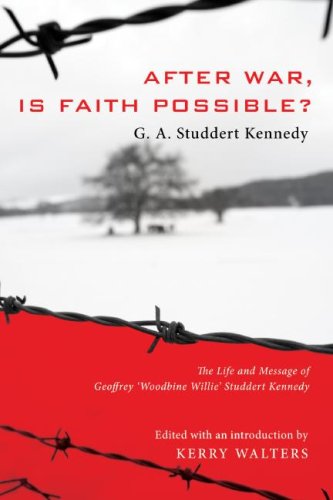
‘After War, Is Faith Possible?’: A Commendation


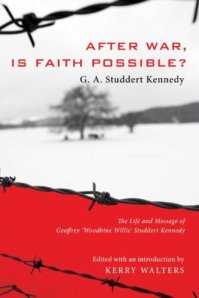
studdert-kennedyGeoffrey A. Studdert Kennedy, After War, Is Faith Possible?: The Life and Message of Geoffrey “Woodbine Willie” Studdert Kennedy (ed. Kerry Walters; Eugene: Cascade, 2008).
xii + 225 pages. ISBN: 978-1-55635-379-6. Review copy courtesy of Wipf and Stock.

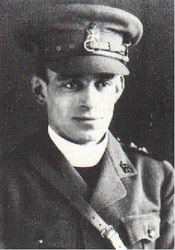
One the real delights of my research into the thought of PT Forsyth has been revisiting, and in some cases discovering for the first time, others who were writing around the same time, and often of the same events. To re-read James Denney, or James Baldwin Brown, or FD Maurice, is one of the best ways one could spend a month … or two. Another giant personality to add to that list would have to be Geoffrey A. Studdert Kennedy, better known as ‘Woodbine Willie’. (I posted on ) My copies of Studdert Kennedy’s work, which are all over 90 years old, form a truly valuable part of my library and one to which I return not infrequently. Collected Poetry (London: Hodder & Stoughton, 1927), The Hardest Part (London: Hodder & Stoughton, 1918), I Believe: Sermons on the Apostles Creed (New York: George H. Doran, 1921), Rough Rhymes of a Padre (Toronto: Hodder & Stoughton, 1918) and The Wicket Gate, or Plain Bread (London: Hodder & Stoughton, 1923) all constitute exceptional reading.
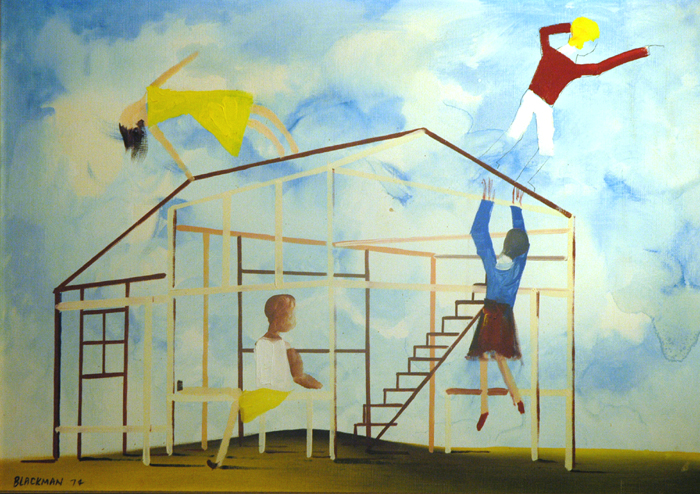
And so I was absolutely delighted to discover that Wipf & Stock decided to republish some Woodbine Willie excerpts, all well chosen and just enough to plant an appetite in those who will no doubt want to hear more from ‘the bloody parson!’ (p. 12). The collection was edited by Kerry Walters, who also contributed a very fine introduction on Studdert Kennedy’s life and message, and a helpful bibliography of the primary and secondary literature.

Woodbine Willie, (June 27, 1883 - March 8, 1929)

Woodbine Willie, (June 27, 1883 - March 8, 1929)

This WWI padre was, of course, one of the best-known and most-loved Christian pacifists of the early twentieth century. Unlike those theological yuppies who defend pacifism on purely ideological grounds and over a café latte in Lygon Street – informed by the Gospel or otherwise – Woodbine Willie’s commitment to pacifism was birthed in the trenches alongside frightened men and their dead mates. In all that he wrote, a number of questions incessantly occupied his thought: ‘Given the insanity and brutality of war (‘the universal disaster’; p. 14), what must the God who allows it be like? (p. 13); How is evil to be gotten rid of? (p. 3); What sort of universe ought an honest person believe in? (p. 15). His answer to these questions eventually led to the conviction that God is not sadistic, or indifferent to the world’s evil. Neither is God ‘Almighty’ enough to prevent such evils: ‘I see no evidence anywhere in nature of the Almighty Potentate Who guides and governs all things with His rod, and knows no failure and thwarting of His Will’ (p. 81). What God does do, Woodbine Willie insists (in Moltmannesque manner), is to suffer with and alongside humanity. This is love’s character – not raw despotic power but entering into the sorrows of the beloved. War then, which is evil in its most acute form, is ‘the test case for determining if Christianity can cope with evil’ (p. 21).

Against those who would ‘blather’ about the ‘glory of war’, or who would hold out hope for war being a converting ordinance, Woodbine Willie says that ‘war is pure undiluted, filthy sin. I don’t believe that it has ever redeemed a single soul – or ever will’ (p. 62):

War is only glorious when you buy it in the Daily Mail and enjoy it at the breakfast table. It goes splendidly with bacon and eggs. Real war is the final limit of damnable brutality, and that all there is in it. It’s about the silliest, filthiest, most inhumanly fatuous thing that ever happened. It makes the whole universe seem like a mad muddle. One feels that all talk of order and meaning in life is insane sentimentality. (p. 41)

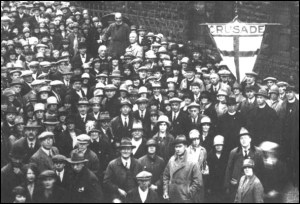
Geoffrey Studdert Kennedy speaking at Tredegar during an Industrial Christian Fellowship Crusade in 1928.

Geoffrey Studdert Kennedy speaking at Tredegar during an Industrial Christian Fellowship Crusade in 1928.

There are no words foul and filthy enough to describe war. Yet I would remind you that this indescribably filthy thing is the commonest thing in History, and that if we believe in a God of Love at all we must believe in the face of war and all it means. The supreme strength of the Christian faith is that it faces the foulest and filthiest of life’s facts in the crude brutality of the Cross, and through them sees the Glory of God in the face of Jesus Christ. (p. 49)

Waste of Muscle, waste of Brain,

Waste of Patience, waste of Pain,

Waste of Manhood, waste of Health,

Waste of Beauty, waste of Wealth,

Waste of Blood, and waste of Tears,

Waste of Youth’s most precious years,

Waste of ways the Saints have trod,

Waste of Glory, waste of God –

              War! (p. 50)

I cannot say that war, disease, pestilence, famine, and all the other characteristics of the process are good. If this word “Almighty” means that the Father could have made this world, and obtained the results He desires, in a thousand other ways, but that He deliberately chose this, that makes my gorge rise. Why in thunder choose this one? It is disreputable if He could have done it otherwise, without this cruelty and wrong. It is not commonly respectable. He must be an evil-minded blackguard, with a nasty disposition like a boy that likes pulling the wings off flies. I cannot get up any reverence for such a being. Why, bless my life, He tortures children, voluntarily tortures them to death, and has done so for thousands of years. I can’t stand that at all – it’s dirty; and when I am told that I must believe it, and that every detail of the process was planned out precisely as He wished, I begin to turn sick. Snakes, sharks, and blood-sucking vermin – what sort of a God is this? He chose this way because He gloried in it! That beats the band. It turns me clean up against the process. I cannot see its beauty for its brutality. I cannot hear the lark sing for the squealing of a rabbit tortured by a stoat, I cannot see the flowers for the face of a consumptive child with rotten teeth, the song of the saints is drowned by the groans of murdered men. (p. 75)

A soldier in time of war is not a person but a puppet, who moves when you pull strings. (p. 78)

… our armaments are symbols, not of our power, but of our weakness … Our military power is an exact index of our spiritual and moral impotence. (p. 79)

Life is one, from the single cell to the Savior in the flesh. I cannot separate swine from Shakespeare or Jellyfish from Jesus of Nazareth; they all are products of the process. So behind the process there must be a Spirit which is like the Spirit of man. (p. 81)

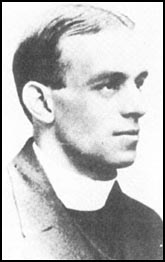
woodbine-willie-1I am not a pacifist (I’ve been too persuaded by Forsyth and Jüngel here), but reading Woodbine Willie continuously challenges me to ask myself whether I should be, whether our Lord’s command to ‘Love your enemies’ (Matt 5:44) really does, in Barth’s words, abolish ‘the whole exercise of force’. Either way, Barth is most certainly correct when he challenges: ‘In conformity with the New Testament, one can be pacifist not in principle but only in practice (praktisch Pazifist). But let everyone consider very carefully whether, being called to discipleship, it is possible to avoid – or permissible to neglect – becoming a practical pacifist!’ (Church Dogmatics IV/2, 549-50).

Faith does not mean that we cease from asking questions; it means that we ask and keep on asking until the answer comes; that we seek and keep on seeking until the truth is found; that we knock and keep on knocking until the door is opened and we enter into the palace of God’s truth. (p. 63)

Woodbine Willie dares us to keep on prayerfully asking the questions …

If the Church is to be a Church indeed, and not a mere farce – and a peculiarly pernicious farce, a game of sentimental make-believe – she must be filled to overflowing with the fire of the ancient prophets for social righteousness, with the wrath and love of the Christ. (p. 196)

The Church is not, and never can be, an end in itself; it is a means to an end; a means to the salvation of the world and the building of the Kingdom of God. It is not the Ark of Salvation for themselves, it is the Agent of Salvation for mankind. It is not a refuge of peace, but an army preparing for war. They seek in it, not security, but sacrifice. This is the infallible mark of the Church, the hallmark of the Cross. And if the sin of our modern slums, and the degradation that they cause; if the sin of our over-crowded, rotten houses, and the ugliness and vice they bring; if the sin of unemployment, with the damnation of body and soul that it means to men and women, boys and girls; if the sin of the heartless, thoughtless luxury at one end, standing out against the squalid and degrading poverty at the other; if the sin of commercial trickery and dishonesty, and wholesale defrauding of the poor; if the sin of prostitution, and the murder of women and children by venereal disease; if the sin of war, the very sin of sins, which is but the bursting into a festering sore of all the filth that the others have bred in years of miscalled peace; if all that is not laid upon the Church as a burden, and Christ’s members do not feel it as their own, then the Church is not a Church at all; and no amount of organization, propaganda, and evangelization can make it live. It has missed its vocation. (p. 167)

Lent Reflection 2

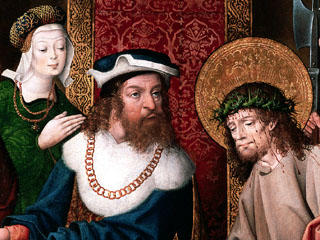
Pontius Pilate‘To the picture of the free but divinely ordained determination of the existence of Jesus to this outcome there must also be added everything that is said in the Gospels about the world around, in which the “wicked husbandmen” are given particular prominence as the decisive agents. We are not set at an indeterminate point in world history. The passion of the Son of Man is, of course, the work of the Gentiles, of Pilate and his race, but only secondarily and indirectly. Pilate has to be there, In more than one respect, especially as the responsible (although not really responsible) representative of government, he is one of the central figures in the Gospel story. Unwillingly and unwittingly he is the executor Novi Testamenti (Bengel). For by delivering Jesus to him, Israel unwittingly accomplishes-“they know not what they do” (Lk. 23:34)-His handing over to humanity outside Israel, and the Messiah of Israel becomes the Saviour of the world. Again, as Pilate delivers him to his men for execution, he is the man by whose will and work the divine act of redemption is accomplished. It is not the case however, as in some schematic presentations, that Israel and the Gentiles, Church and state, co-operated equally in accusing and condemning Jesus and destroying Him as a criminal. It is not for nothing that the one who initiates this action is the apostle Judas, and in his person the elect tribe of Judah to which Christ Himself also belonged, and in Judah (the Jews, as they are summarily described in John) the chosen and called people of Israel. It is in this sphere that we find ourselves in the passion story. We are not really in the main theatre of world history, but in the vineyard of the Lord. It is Israel, represented by its spiritual and ecclesiastical and theological leaders, but also by its vox populi, that refuses and rejects and condemns Jesus and finally delivers Him up as a blasphemer to the Gentiles, to be executed by them as a political criminal, although Pilate is quite unable and unwilling to pronounce Him guilty as such, and only causes Him to be put to death unjustly and against His better judgment. It was to this delivering up by this Israel which rejected and condemned Him, to death at the hands of this people, to this conclusion of His history that Jesus gave up Himself, and was given up by God. This is what we must always keep before us in our understanding of His passion’. – Karl Barth, Church Dogmatics IV.2 (ed. G.W. Bromiley and T.F. Torrance; trans. G.W. Bromiley; Edinburgh: T&T Clark, 1958), 260.

Karl Barth on Children

The Barth House

The Barth House

According to Hans Frei, what distinguished Karl Barth (1886-1968) as a theologian was the ‘startlingly consistent’ identification of ‘universal divine action with divine action in Christ alone’.[1] ‘Here God is present and known to us, and the only logical presupposition for this presence and this knowledge is – itself. For this unique thing there can be no set preconditions; it creates it own. No natural theology, no anthropology, no characterization of the human condition, no ideology or world view can set the conditions for theology or knowledge of God’,[2] and, by implication (after Calvin), for knowledge of creation.

This is where Barth begins. Indeed, there can be, for Barth, no other starting point than the eternal decision of God to be God for us – that God, in Jesus Christ elects to be humanity’s covenant partner and redeemer. We cannot understand humanity apart from this eternal decision of God to become incarnate for our sakes. We cannot understand personhood apart from the sovereign God’s decision to make covenant with God’s ‘other’.

While Barth wrote little directly regarding children,[3] Eberhard Busch has observed Barth’s great love for children, and his commitment to them, even when work pulled him away from home, and from his wife Nelly who assumed the major role in bringing up the Barth children. Busch records that around the time Barth was finishing writing the second edition of Der Römerbrief, Barth ‘watched his children … growing up, with care and delight. He still had time, for example, to comb his son Christoph’s hair every morning, “more for my own pleasure than for his gain and satisfaction”‘.[4] Busch also reports how Barth, during his years as pastor in Safenwil (1911-21), immersed himself in his confirmation and pre-confirmation classes, ‘told Bible stories to the twelve- to fourteen-year-olds in the so-called “children’s class” on Sunday after a sermon’, and held weekly meetings for young people already confirmed. He also had strong ideas about the form that these meetings should take: ‘It cannot merely be teaching and learning: we must discover each other personally and become good friends’. He also confessed that these weekly meetings ‘were always a dreadful worry for me’, that he often stood ‘awkwardly in front of bored faces’, and that he usually ‘simply ran out of steam, even in the most well-known things’.[5]

On comparing Augustine with Barth on children, consider these words from Augustine:

Who can recall to me the sin I did in my infancy? For in thy sight no one is clean of sin, not even the infant whose life is but one day upon earth … What, then, was my sin? Was it that I cried for more as I hung upon the breast? … Even in my infancy, therefore, I was doing something that deserved blame, but because I could not understand anyone who blamed me, custom and reason did not allow me to be blamed … It is clear, indeed, that infants are harmless because of physical weakness, not because of any innocence of mind.[6]

Augustine believes that all of us are born with evil tendencies by virtue of original sin. Indeed, he somewhat ‘fused biological ideas of heredity with the idea of the juridical liability of humanity’.[7] This view constitutes the mainstream Christian tradition.

Barth rejects this (negative) view, stressing instead that children are bearers of God’s gracious promise to make them – and indeed all humanity – his covenant partners in Jesus Christ.

Barth also presents three interrelated thoughts about children:

1. Children are needy beginners. They are ‘inept, inexperienced, unskilled, and immature’, but as such they may humbly acknowledge their need and assume a ‘sheer readiness to learn’.[8] Barth, like Calvin, makes a lot of the correlation between children and the life of filial reality before God:

In invocation of God the Father everything depends on whether or not it is done in sheer need (not self-won competence), in sheer readiness to learn (not schooled erudition), and in sheer helplessness (not the application of a technique of self-help). This can be the work only of very weak and very little and very poor children, of those who in their littleness, weakness, and poverty can only get up and run with empty hands to their Father, appealing to him. Nor should we forget to add that it can only be the work only of naughty children of God who have wilfully run away again from their Father’s house, found themselves among swine in the far country, turned their thoughts back home, and then – if they could – returned to their Father … Christians who regard themselves as big and strong and rich and even dear and good children of God, Christian who refuse to sit with their Master at the table of publicans and sinners, are not Christians at all, have still to become so, and need not be surprised if heaven is gray above them and their calling upon God sounds hollow and finds no hearing. The glory, splendour, truth, and power of divine sonship, and of the freedom to invoke God as Father, and therefore the use of this freedom – the Christian ethos in big and little things alike – depends at every time and in every situation on whether or not Christians come before God as beginners, as people who cannot make anything very imposing out of their faith in Jesus Christ, who even with this faith of theirs – and how else could it be if it is faith in Jesus Christ? – venture to draw near to his presence only with the prayer: “Help my unbelief” (Mk. 9:24). Mark well that this has nothing to do with Christian defeatism. It describes Christians on their best side and not their worst, in their strength and not their weakness (2 Cor. 12:10).[9]

That children are ‘beginners’ does not mean that they should be kept in dependence upon their elders. Rather, it implies that they may mature before the covenant God with a spirit of courage and cheerfulness.

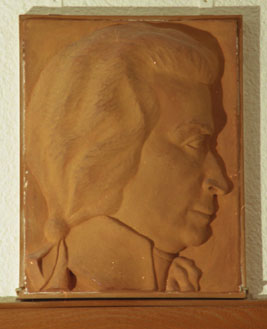
A portrait of Mozart in Barth's house

A portrait of Mozart in Barth's house

2. Being a child is characteristically to be at play. Here Barth draws upon Mozart, whose playing reflects the sheer absence of self-preoccupation. Mozart is not focused on personal confession (as is Beethoven); nor is he about ‘business’ or communicating doctrine (as Barth reads Bach as doing). Mozart just ‘sounds and sings’ with an objectivity that includes ‘an intuitive, childlike awareness of the essence or center – as also the beginning and end – of all things. It is from this center, from this beginning and end, that I hear Mozart create his music’.[10]

3. Being a child is about the opportunity to realise ‘freedom in limitation’. We respond to God’s call as those under the limitations of creation – space and time – and as those elected by God to particular vocations and places of responsibility. The call by the Word of God means freedom. That that same call comes to creatures means limitations. To be a child is to realise this two-fold truth, and to press in various directions in order to identify the boundary between the two – i.e. to step into freedom. This stepping requires what Barth calls a ‘youthful objectivity’.

Youth is the capacity and will to devote oneself to an object without considering or intending that the manner of this devotion should be specifically youthful, but rather in suppression of any such consideration or intention and with the serious aim of rivaling the objectivity of those who are older. He who wants to be a child is not a child; he is merely childish. He who is a child does not want to be a child; he takes his play, his study, his first attempts at accomplishment, his first wrestlings with his environment, in bitter earnest, as though he were already an adult. In so doing he is genuinely childlike. This is what it means to accept the command of the particular hour in true loyalty to its specific determination, to be free in its distinctive limitation.[11]

Directly and indirectly, Barth helps us to ask a number of questions that are pertinent for those in pastoral leadership:[12]

  • Do I treat children as gifts who are promised God’s friendship, and not as corrupt or neutral objects who exist for the sake of my control and fashioning?
  • Does my care for them communicate hope and possibility rather than a sense of failure and ruin?
  • Am I moved to witness good news to other children not my own who need to and by grace may hear it when they have enough to eat, or when they have an opportunity to learn and develop their own powers for responsible life with others?
  • And with my own children, do I really place first their relation with God and my summons joyfully to invite them to rejoice with me in God, rather than first insisting that they mimic my life history or ‘make something of themselves’?

Just before his eightieth birthday, Barth sketched a ‘Rule of life for older people in their relationship with the young’. Eberhard Busch recounts Barth’s words:

You must make it clear that our younger relations have the right to go their own way in accordance with their own principles, not yours … In no circumstances should you give them up: rather, you should go along with them cheerfully, allowing them to be free, thinking the best of them and trusting in God, loving them and praying for them, whatever happens.[13]


[1] Hans W. Frei, Theology and Narrative: Selected Essays (ed. George Hunsinger and William C. Placher; New York/Oxford: Oxford University Press, 1993), 228.

[2] Hans W. Frei, Types of Christian Theology (ed. George Hunsinger and William C. Placher; New Haven/London: Yale University Press, 1992), 154.

[3] Here I am drawing on an essay by William Werpehowski, ‘Reading Karl Barth on Children’ in The Child in Christian Thought (ed. Marcia JoAnn Bunge; Grand Rapids/Cambridge: Wm. B. Eerdmans, 2001), 386-405.

[4] Eberhard Busch, Karl Barth: His Life from Letters and Autobiographical Texts (trans. John Bowden; Philadelphia: Fortress Press, 1975), 121.

[5] Ibid., 64-66.

[6] Augustine, Confessions (trans. Rex Warner; New York: New American Library, 1963), 23-4.

[7] Henry Chadwick, Augustine (New York/Oxford: Oxford University Press, 1986), 111.

[8] Karl Barth, The Christian Life: Church Dogmatics IV.4: Lecture Fragments (trans. Geoffrey W. Bromiley; Edinburgh: T&T Clark, 1981), 79, 80.

[9] Ibid., 80.

[10] Karl Barth, Wolfgang Amadeus Mozart (trans. C.K. Pott; Eugene: Wipf & Stock, 2003), 16.

[11] Karl Barth, Church Dogmatics III.4 (trans. A.T. Mackay, et al.; Edinburgh: T&T Clark, 1961), 609.

[12] These questions are adapted from Werpehowski, ‘Barth on Children’, 405.

[13] Busch, Karl Barth, 476.

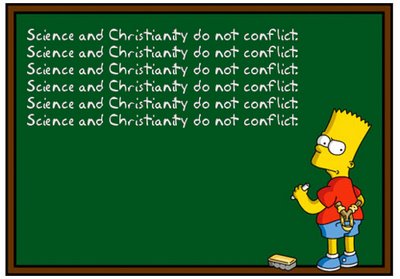
Candour: ‘Science and Christianity’

science-and-christianityThe Presbyterian Church of Aotearoa New Zealand produces a monthly magazine called Candour. The articles are targeted at church leaders and are usually of a good standard. The March issue is now out and concerns the theme ‘Science and Christianity’. You can become a subscriber by emailing here.

The TOC for the March issue is:

  • Reading nature and Scripture today – Don Nield
  • How can we inform bioethics decisions? – Helen Bichan
  • From a backyard point of view – Bob Eyles
  • Science and Christianity face an identical foe – John Kernohan
  • Intelligent Design: The way forward? – Don Nield
  • What kind of justice? – Douglas Mansill

Robert Jenson: Burns Lecture 1 – Creeds, Scripture, Niebuhr and the Preposition between Christ and Culture

robert-jensonThis afternoon, I was priviledged to hear a lecture by Robert W. Jenson who is visiting the University of Otago to deliver this year’s Burns Lectures on the theme of ‘The Regula Fidei and Scripture’. I’ve heard Professor Jenson lecture on a number of occassions, and on three different continents, and he is always enormously stimulating. In his opening lecture today entitled ‘Creed, Scripture, and Their Modern Alienation’, Jenson argued that the relationship between Holy Scripture and the ecumenical Creeds determines the whole life of the Church because together they witness to the Church being the same community yesterday, today and forever. He defined the Church as ‘the community of a message of the God of Israel who raised Christ from the dead’. Those already familiar with Jenson’s work would have heard here themes discussed and argued elsewhere in his writings.

Jenson proceeded to note that whereas the Christian community in the first century lived in the orbit of, and was defined in the light of, as it were, a first-hand history of Jesus and with little regard for its future, the second-century Church had to think through the community’s ‘future history’ and the shape which it would take as the institution of the future. It is to this end that both Scripture and the Regula Fidei bear witness to the one history of God with his people. Creeds are, he insisted, ‘a sort of communal linguistic awareness’  – a ‘gift of the Spirit’ who guides the church in every generation. On the relationship between the Regula Fidei and Church tradition more generally Jenson had little to say, at least in this lecture. [One hopes that this might get some teasing out in subsequent lectures].

Where more breath was expired, however, was over the question of Modernity and the demise of Regula Fidei. Modernity, Jenson repeated, sponsored a shift whereby Scripture and Creed came to be seen as alien to one another rather than as co-witnesses to the one Word of God and of the abiding presence of God with his people. Describing himself as an ‘unreliable Lutheran’, Jenson argued that the modern biblical studies movement began as a movement to redeem itself from creeds.

One fundamental conviction that drove Jenson’s entire presentation was his confidence that ‘Christ does not fit into other narratives. Other narratives have to fit into Christ’. I wish Jenson had unpacked this further (again, perhaps he will in the remaining lectures), but I did find one place where he does do such unpacking:

I have long thought that Niebuhr’s book, for all its individual insights, was based on a false setting of the question. Whatever preposition you put between Christ and culture, its mere presence there marks and enforces the supposition that Christ and culture are entities different in kind. But it is of course only the risen Christ who can now have a relation to a culture, and this living Christ’s body is the church. And the church – with its scriptures, odd rituals and peculiar forms of government – is plainly itself a culture.

Therefore the real question is always about the relation of the church culture to some other culture with which the church’s mission involves it at a time and place. And I do not think the relation can be the same in every case. During the time of “Christendom,” the culture of the church and the culture of the West were barely distinguishable. I do not think this “Constantinian settlement” was avoidable. When the empire said, “Come over and help us hold civilization together,” should the bishops have just refused?

As to Christendom’s consequences for faith, some were beneficial and some were malign, as is usual with great historical configurations. During the present collapse of Christendom and its replacement by an antinomian and would-be pagan culture, confrontation must of course be more the style.

Next lectures:

Friedrich Schleiermacher on Children

schleiermacherFriedrich Daniel Ernst Schleiermacher (1768-1834) is among the most significant Reformed theologians between Calvin and Barth.[1] What constitutes an area of great neglect in his thought, however, is his thinking on children, explored in a number of his writings: Soliloquies (1800), Celebration of Christmas (1806) and Sermons on the Christian Household (1820). He was concerned throughout to explore a number of questions:

  • What is the child?
  • What is the unique spiritual perspective of childhood?
  • Must maturity alienate us from childhood?
  • How might parents best nurture their children and draw out the unique individuality that expresses itself in children?

These kinds of questions were explored against the backdrop of a rise in the importance of the nuclear family as a social institution, and the sharper demarcation between the roll of mothers and fathers – the home, children and emotions were increasingly seen as the domain of mothers, the withdrawal of extended family, etc. More positively, there was greater emphasis on the value of children’s nurture and development through age-appropriate play and education. The period also saw the development of the kindergarten, children’s literature and children’s toys.

More than most theologians, it was Schleiermacher (and later people like Karl Rahner) who believed that children could teach adults, that children – as children – were full human beings and so worthy of respect and dignity. So, in Schleiermacher’s novella The Celebration of Christmas: A Conversation, one of the characters, Agnes, poses a series of important questions:

Is it then the case that the first childish objects of enjoyment must, in fact, be lost that the higher may be gained? May there not be a way of obtaining the latter without letting the former go? Does life then begin with a pure illusion in which there is no truth at all, and nothing enduring? How am I rightly to comprehend this? In the case of the man who has come to reflect upon himself and the world, and who has found God, seeing that this process is not gone through without conflict and warfare, do his joys rest upon the eradication, not merely of what is evil, but of what is blameless? For it is thus we always indicate the childlike, or even the childish, if you will rather so have it.[2]

In 1834, Schleiermacher preached a sermon on Mark 1:13-16. In exegeting v. 15 [‘anyone who will not receive the kingdom of God like a little child will never enter it’], he noted:

The peculiar essence of the child is that he is altogether in the moment … The past disappears for him, and of the future he knows nothing – each moment exists only for itself, and this accounts for the blessedness of a soul content in innocence.[3]

This, Schleiermacher believes, is a child’s gift to adults, and it is towards a recovery of precisely this perspective that Jesus has in mind for those who would enter the Kingdom of God – that those who know communion with God might live in the present with no anxiety about past or future. So DeVries on Schleiermacher:

Children remind us of the fact that God created humanity to live simply. They help adults shed their obsession with the complexities of work and public life. Indeed, children draw adults back into the most basic of human relationships.[4]

Charles Blackman, 'Children Playing' (1974)

Charles Blackman, 'Children Playing' (1974)

Celebration of Christmas is a revelation into Schleiermacher’s theology (on many levels) and not least his (overly)-optimistic view of human personhood. It was this that Barth, in his 1923/24 Göttingen lectures on the Theology of Schleiermacher, rightly picked up on, criticising Schleiermacher for positing an anthropology too without regard for an adequate account of the realities of sin, conversion and the in-breaking of the Word of God.

In those lectures, Barth’s reading of Schleiermacher’s ‘Christological Festival Sermons’ (as Barth calls them) spans some 50 pages wherein Barth expresses his usual mixture of appreciation and criticism for the Silesian-born theologian. One place where Barth’s praise for Schleiermacher’s Christmas sermons is noted concerns Schleiermacher’s sermon on Acts 17:30-31 [‘In the past God overlooked such ignorance, but now he commands all people everywhere to repent. For he has set a day when he will judge the world with justice by the man he has appointed. He has given proof of this to everyone by raising him from the dead’]. On this, ‘the most powerful and impressive Christmas sermon that Schleiermacher preached’, Barth comments:

Let us look beyond the narrow sphere of individual life, Schleiermacher asks in the introduction, to the large and universal sphere. It is the Savior of the world whose coming we celebrate. A new world has dawned since the Word became flesh. His appearing was the great turning-point in the whole history of the human race. What is the change whereby the old age and the new may be distinguished? The fact that ignorance of God is no longer overlooked and tolerated by God. Christ’s life was from beginning to end an increasing revelation. The world’s childhood ended with it. Sin is now known and the image of God is evident. Hence judgement passes on all human action, and we ought to rejoice at this. We are now told that he commands everyone everywhere to repent.[5]

DeVries suggests that Barth’s reading of Schleiermacher’s (positive) child-anthropology is not nearly as nuanced as it ought to be. She notes that, for Schleiermacher, children a not perfect and sinless mediators of the higher life and are born with as much potential for sin as for salvation, and that it is the parents’ duty to nurture their children’s ‘higher self-consciousness’ which connect them to the transcendent and also opens their hearts to others.[6]

Rather than follow the formal catechesis that Calvin and Luther had stressed (and which Schleiermacher thought were too impersonal), the Moravian/Pietist-educated Schleiermacher stressed that the Christian home is the ‘first and irreplaceable school of faith’, for only here can children really experience the full range of what Christian faith is about and so come to faith in Christ. Schleiermacher believes that faith is more ‘caught’ than ‘taught’.

Still, he notes that parents can also damage a child in a number of ways:

  1. by failing to take their concerns/interests seriously.
  2. by failing to respond empathetically or appropriately to their emotions.
  3. parents whose own emotional lives are chaotic or unreliable will drive their children into secrecy.
  4. by attempting to live their own dreams/aspirations through children.

Lewis Hine, 'Children playing with Campbell Kid dolls' (1912)

Lewis Hine, 'Children playing with Campbell Kid dolls' (1912)

Schleiermacher also stresses that pastors have a pivotal role to play in children’s faith, among the most important duty of which is informal and personalised catechises where the focus is on leading children to develop, in DeVries words, ‘sound and sophisticated abilities in reading and interpreting scripture. Such instruction might begin with memorizing Bible verses, but it should eventually lead to developing in children a way of thinking (Gedankenerzeugungsprozess) that can be applied to questions or situations that will arise when the catechizing process is over’.[7] In other words it is about helping children to think theologically about all of life. DeVries continues:

Schleiermacher holds high expectations of the catechizing pastor. He states that when children who have been raised in the church lose their faith in adulthood, it is often because they have received poor catechetical instruction. Mindless repetition of correct answers will not sustain faith through the journey to adulthood. Pastors should treat children as fellow seekers who will be no more satisfied with pat answers than adults. If there is a virtue to be developed in the teaching pastor, it is the virtue of humility, for teaching the faith is probably his [sic] most difficult task. Schleiermacher urges his ministry students always to consider their teaching a work in progress, and challenges them to be quick to admit their mistakes.

What children need more than anything else is living faith in Christ. Parents, teachers, and pastors must devote all their energy and enthusiasm to presenting Christ to their children. This is best achieved through the whole of life itself, lived with children. They should feel the love of adults as “reflecting the splendour of eternal love” in Christ. Children who have received the Spirit in baptism and who have been raised within the loving discipline of the Christian community give us reason to hope for the future.[8]


[1] Here I draw heavily upon an essay by Dawn DeVries, ‘”Be Converted and Become as Little Children”: Friedrich Schleiermacher on the Religious Significance of Childhood’ in The Child in Christian Thought (ed. Marcia JoAnn Bunge; Grand Rapids/Cambridge: Wm. B. Eerdmans, 2001), 329-49.

[2] Friedrich Schleiermacher, Christmas Eve: A Dialogue on the Celebration of Christmas (trans. W. Hastie; Edinburgh: T&T Clark, 1890), 33.

[3] Friedrich Schleiermacher, Friedrich Schleiermachers sämmtliche Werke (vol. II/6; Berlin: Georg Reimer, 1834-1864), 71-2.

[4] DeVries, ‘Schleiermacher on the Religious Significance of Childhood’, 341.

[5] Karl Barth, The Theology of Schleiermacher: Lectures at Göttingen, Winter Semester of 1923/24 (ed. Dietrich Ritschl; trans. Geoffrey W. Bromiley; Grand Rapids: Wm. B. Eerdmans, 1982), 72.

[6] See DeVries, ‘Schleiermacher on the Religious Significance of Childhood’, 341-2.

[7] Ibid., 345.

[8] Ibid., 346-7.

Lent Reflection 1

christ-in-the-wilderness-1898

Briton Riviere, 'Christ in the Wilderness' (1898)

That obedient life which resisted temptation in both desert and garden culminated in an obedient death, a death concerned with holiness’ gracious victory. In Christ, God put himself onto the gallows of public shame – he descended into hell – from where he not only exposed himself to the actual onslaught and grasp of evil until it had done its worst, but confessed the holiness that undergirds not only his own Triune life, but all life.

So Forsyth:

Purity is shamed by human sin. Holiness carries it as a load, and carries it to its destruction. In the great desertion Christ could not feel Himself a sinner whom God rejects. For the sinner cannot carry sin; he collapses under it. Christ felt Himself treated as the sin which God recognises and repels by His very holiness. It covered and hid Him from God. He was made sin (not sinful, as I say). The holiness of God becomes our salvation not by slackness of demand but by completeness of judgment; not because He relaxes His demand, not because He spends less condemnation on sin, lets us off or lets sin off, or lets Christ off (“spared not”); but because in Christ judgment becomes finished and final … [The Work of Christ, 160]

Thus what is at stake in the two great temptations is far more than the destiny of this one man; it is the entire telos of creation itself, and God’s existence with it. In his humanity God declares the moral order of creation sanctified along with himself – Creator and creation are now one. Christ ‘sanctifies the whole lump of humanity by sanctifying Himself as the firstfruits’ [A.B. Bruce, The Humiliation of Christ In its Physical, Ethical and Official Aspects (Edinburgh: T&T Clark, 1895), 350].