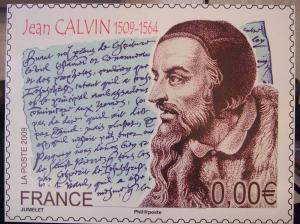
 In recent days, my attention has turned to John Calvin, and to a paper that I’m trying to pen for an upcoming conference on Calvin. It has been great to meet books that have remained unopened on my shelves – and the library’s – for well over a decade (I knew I’d read them eventually!), to revisit some great studies, and to familiarise myself with some of the more recent and hard to get scholarship, including Bruce Gordon’s very readable Calvin, and Jean-Daniel Benoît’s enthralling study, Calvin in His Letters: A Study of Calvin’s Pastoral Counselling, Mainly from his Letters (trans. Richard Haig; Courtenay Studies in Reformation Theology; Appleford: Sutton Courtenay Press, 1986); thanks Jim for putting me on to Benoît. I’m also appreciating some re-digging into Barth’s reading of Calvin, such as this observation:
We must not view Calvin’s church of holiness as a catholicizing confusion of divine and human commands, at least not as far as Calvin himself was concerned, no matter what misunderstandings might have arisen among his successors. Calvin himself clearly saw the possibility of such a confusion. Under the pressure of the order and holiness that he found in God, he realized that order and holiness are incommensurable. They cannot be imitated on this side of the human sphere that is not to be confused with the other world, in the little city of Geneva that even at the pinnacle of his success he never truly regarded as a Jerusalem. With a certain resigned wisdom and grim humor, if we might put it thus, he spoke only of honoring God by bonds of humanity so far as this is possible seeing that we live on earth. Calvin did not fall victim to the illusion that gripped the Middle Ages and that has gained force again in the modern age, the illusion that there is a continuous path that leads step by step from an earthly city of God to the kingdom of heaven. For him the divine was always divine and the human always human. – Karl Barth, The Theology of John Calvin (trans. Geoffrey Bromiley; Grand Rapids: Wm. B. Eerdmans, 1995), 201.
If you’re interested, my own paper, (tentatively) titled ‘John Calvin: Servant of the Word’, proposes to attend to the notion of Calvin as minister of the Word, and to consider the attention that preaching occupied in Calvin’s ministry, his understanding of preaching as divine accommodation, as public, as event, as the Word of God, and its relationship to the proclamation activities of font and table.
 jasongoroncy.com
“If you’re interested… [in] my paper”, Jason asks. Course I am. When it’s ready would love a wee read at it. Hope life’s good Jason, and the paper goes well. And by the way, the John Pilger post is breathtaking in its reckless honesty and vicarious anger – he is one of the more reliable moral direction-finders in a world where fingers often fooilishly or intentionally point the wrong way.
LikeLike