‘Reflections on Grace’: A Review

Thomas A. Langford, Reflections on Grace (ed. Philip A. Rolnick, Jonathan R. Wilson; Eugene: Cascade Books, 2007. xi + 113 pages. ISBN: 978 1 55635 058 0. Review copy courtesy of Wipf and Stock.

‘God present is grace’. So begins this collection of brief, but rich, reflections on the most precious of realities – the inexhaustible grace of God. In under 100 pages, Langford shares with us his reflections – penned during the last years of his life and published posthumously – of what he has learnt over a lifetime of learning about grace as gift, as truth, and as the converse of disgrace. Ever interpreted christologically, and never divorced from its enfleshment in the realities of creation and in the nurturing and interpretation within the community of God’s people, Langford gently – graciously – invites us to catch glimpses of nothing less than the Triune God, and to believe that this God not only speaks in ‘the tongue of our time’ (p. 22), but that he holds nothing of himself back as he throws himself into the most despicable and hopeless of human situations in order to bring transformation. This is grace’s self-giving and cruciform ‘edge’; it is ‘as real as the conditions in which life must be lived’ (p. 29).

Grace, Langford argues, is not only God’s ‘way of being’, but – precisely because it is such – it establishes our way of being, and makes possible ‘the integrity of the faithful responder’ (p. 105). Rejection of this grace, therefore, issues in the malformation of life. This United Methodist minister reminds us that our attempts to live as though God were absent atrophies human possibility and being.

While not convincing at every point (he over-presses, at times, a strained disjunction between God’s love and his law, for example), this is a beautifully-written book and deserves to be read slowly. It would be a great book to work through in a small group.

Burma’s Unjustified Detention Of Aung San Suu Kyi

Today, Condoleezza Rice, secretary of the US State Department, issued the following statement concerning Aung San Suu Kyi:

Tomorrow, on June 19, Aung San Suu Kyi will spend yet another birthday in custody, denied her liberty and fundamental political and civil rights by Burma’s military rulers. This deplorable situation must end.

Sadly, the regime not only continues to keep this distinguished Nobel laureate under house arrest, but there are nearly 2,000 other political prisoners currently in custody. Burma’s rulers should release all political prisoners and begin to move in earnest to transform Burma into a democratic society.

Meanwhile, the regime has backtracked on even the modest steps it had taken – naming a liaison to meet regularly with Aung San Suu Kyi and allowing her to meet with her colleagues in Burma’s National League for Democracy. There have been no meetings with either since January, and Aung San Suu Kyi has even been denied regular access to medical care and legal counsel.

Rather than risking further unrest in Burma by its unjustified detention of political prisoners and its holding of a rigged referendum in May on a sham constitution, the regime should release all political prisoners, including Aung San Suu Kyi, and begin a genuine dialogue with her and other democratic and ethnic minority leaders on a transition to democracy.

UNHCR Condemns Systematic Rights Violations

The United Nations Human Rights Council today condemned “ongoing systematic violations of human rights” in Myanmar and called on the Government to stop making politically motivated arrests and to release all political prisoners immediately.

In a resolution adopted without a vote, the Council also called on the Government of Myanmar to fully implement commitments it made to Secretary-General Ban Ki-moon that it would grant relief workers “immediate, full and unhindered access” to people in need in the wake of last month’s catastrophic Cyclone Nargis.

It called on the Government to refrain from sending victims of the disaster back to areas where they would not have access to emergency relief, and to ensure that any returns are voluntary, safe and carried out with dignity.

The resolution, introduced before the Geneva-based Council by the European Union, also condemned the recruitment of child soldiers by both Government forces and non-State armed groups and urged “an absolute an immediate stop of this appalling activity.”

In addition, it called for an independent investigation into reports of human rights violations, including enforced disappearances, arbitrary detentions, acts of torture and forced labour, and called for those responsible for such crimes to be brought to justice.

The resolution also called on the Government “to engage in a real process of dialogue and national reconciliation with the full and genuine participation of representatives of all political parties and ethnic groups who have been excluded from the political process.”

Introducing the resolution on behalf of the EU, Slovenian representative Andrej Logar said previous resolutions had not been implemented by Myanmar and many political prisoners remained in detention.

The recent constitutional referendum was conducted in complete disregard of basic standards on such issues as freedom of expression and freedom of assembly, he said.

Myanmar’s representative U Wunna Maung Lwin described the resolution as politically motivated and lopsided and said powerful States were trying to influence matters through political interference.

The representative said Myanmar was working with the international community in the response effort to Cyclone Nargis, which struck the country on 2-3 May, and was also making efforts on the political front, such as with the recent holding of the constitutional referendum.

Meanwhile, Secretary-General Ban Ki-moon briefed the General Assembly today on his recent trip to Myanmar, saying that overall the relief effort there is continuing to improve and to be scaled up.

More than 134,000 people are dead or missing as a result of Cyclone Nargis and the subsequent tidal wave, and as many as 2.4 million people were affected and now need humanitarian assistance.

In his address to Assembly members, Mr. Ban stressed that the humanitarian tragedy wrought by the cyclone should not be politicized, and he plans to remain focused on the issue, drawing on the efforts of his Special Adviser, Ibrahim Gambari.

The Secretary-General also covered other issues in his remarks to the Assembly, including his latest travels, the most recent developments in the global food crisis and the situation in Zimbabwe.

Who am I to judge?

‘There exists in our society a widespread fear of judging … [B]ehind the unwillingness to judge lurks the suspicion that no one is a free agent, and hence the doubt that anyone is responsible or could be expected to answer for what he has done … Who am I to judge? actually means We’re all alike, equally bad, and those who try, or pretend that they try, to remain halfway decent are either saints or hypocrites, and in either case should leave us alone. Hence the huge outcry the moment anyone fixes specific blame on some particular person’. – Hannah Arendt, Responsibility and Judgment, 2003.

Scottish Journal of Theology (61/3) is out

The latest Scottish Journal of Theology (Volume 61, Issue 03) is out and includes the following articles and reviews:

‘Resurrection as surplus and possibility: Moltmann and Ricoeur’, by Devin Singh.

Abstract
Though Moltmann and Ricoeur have a history of interaction, little attention has been paid to this relationship and its implications for their respective programmes. These thinkers have much in common, however, and the Ricoeurian categories of surplus and possibility elucidate critical aspects of a theology of hope, serving to strengthen its contemporary implications. Nuance is provided for the resurrection’s role in redemption, and an existential mode of hope is delineated. Focusing on Moltmann’s interactions with Ricoeur concerning the resurrection elevates these latent themes and demonstrates the fruitfulness of a continued conversation between these two thinkers. Furthermore, examining Moltmann’s thought in Ricoeurian perspective opens new directions for conceptualising resurrection hope and praxis in a postmodern context.

‘Maimonides, Aquinas and Ghazali: distinguishing God from world’, by David Burrell

Abstract
This exploration focuses on Moses ben Maimon’s attempt to give philosophical voice to the revelation of the Torah to offer a window into the comparative (though not actually collaborative) efforts of Jewish, Christian and Muslim medieval thinkers to adapt the metaphysical strategies available to them to the hitherto inconceivable task of articulating a creation utterly free, with nothing presupposed to it. Short of a divine revelation, nothing could have suggested such an affirmation, so crafting the adaptations demanded of familiar philosophical categories would require exploiting the illumination inherent in those distinct revelations. Far from being a merely historical exercise, these efforts are presented as object lessons for philosophical theologians today, as we move to show how Aquinas and Ghazali complement Maimonides’ way of negotiating recondite regions where reason and faith interact. In that sense, this exercise inspired by medieval thinkers may be dubbed , since the deliverances of faith can be seen to be interwoven with rational inquiry and indispensable to its execution. Moreover, their witness can also challenge current who may all too easily presume their categories to be adequate to the task of probing the reaches of religious faith. In this way, the call to transform philosophical strategies in ways not unlike that undertaken by our medieval thinkers can suggest a benign reading of the situation in which we admittedly live.

‘From Hilary of Poitiers to Peter of Blois: a Transfiguration journey of biblical interpretation’, by Kenneth Stevenson

Abstract
The Transfiguration narratives have received considerable attention from New Testament scholars, but so far very little has been written about them from the point of view of their reception-history. The purpose of this article is to examine the ways in which they have been interpreted in the Latin West from the time of Hilary of Poitiers in the fourth century to Peter of Blois in the early thirteenth. Among these writers, from the big names like Jerome to the lesser known figures like Peter of Celle, a varied tapestry emerges where light allegory plays an important part, whether in the symbolisms given to the choice of the three disciples, Peter, James and John, or to the dazzling clothes of Christ as baptismal glory before cross ), or as a festival in its own right, the Transfiguration emerges as an unusually rich source of biblical interpretation that poses real challenges to the use of the religious imagination today. And it provides a significant contribution to the development of a balanced view of reception-history in our own time.

‘The Barthian heritage of Hans W. Frei’, by John Allan Knight

Abstract
Hans Frei and the of narrative theology are often understood to be Barthian in orientation, but only rarely have the origins and contours of Frei’s engagement with Barth been treated in the secondary literature. Frei’s dissertation itself remains unpublished, with the exception of an oddly edited abridgement that appeared ten years after Frei’s untimely death. This lacuna is unfortunate, because Frei’s dissertation on Barth, and especially his treatment of Barth’s method, are of signal importance in that they set the agenda and orientation for much, if not all, of Frei’s later work. Consequently, in this article I analyse Frei’s dissertation on Barth, focusing primarily on his treatment of Barth’s protest against . On Frei’s reading, three moves constitute Barth’s break with relationalism: the primacy of ontology over epistemology, the subordination of method to positive affirmations about God, and the conformance of interpretative method both to Barth’s methodological commitments and to his affirmations about God. In his dissertation, Frei argues that Barth believed that, without these moves, theology would be vulnerable to Feuerbach’s critique. Frei’s construal of Barth’s break with relationalism sets the agenda for Frei’s own later work, in which he appropriates these Barthian moves by insisting on the primacy of biblical narratives in theological method. Similar to Barth, Frei takes twentieth-century hermeneutic theology to be vulnerable to deconstructionist critique. His insistence on the primacy of a literal reading of the biblical narratives is his attempt to rectify this vulnerability.

‘The struggle between the “image of God” and Satan in the Greek Life of Adam and Eve’, by Rivka Nir

Abstract
According to a tradition in the Greek Life of Adam and Eve (GLAE), Seth and his mother Eve were confronted by a wild beast that attacked Seth. This article asserts that Seth’s battle with the beast should be understood as a struggle between the and Satan, and viewed in a Christian context. The claim is based on three aspects of the story: how the beast is described, why it attacked Seth and only he could control it, and why the beast was confined to its dwelling place until the Day of Judgement. The struggle between Seth and the beast/Satan should be seen as a link in the chain of struggle between the image of God and Satan. It begins in Paradise between Adam, the image of God, and Satan, as recounted in the story of Satan’s fall from heaven, continues on earth between Seth, Adam’s descendant, and Satan, and will culminate with the final victory of Jesus, the ultimate image of God, over Satan at the end of times.

‘Torture and the Christian conscience: a response to Jeremy Waldron’, by Jean Porter

Abstract
In remarks offered in 2006 at a conference at Princeton Theological Seminary, inaugurating a National Religious Campaign against Torture, the legal philosopher Jeremy Waldron observed that Christian leaders have contributed relatively little to the recent debate over the use of torture. This is regrettable, in his view, because secular morality does not have resources sufficient to address the question of torture, and a Christian perspective emphasising the absoluteness and divine character of the relevant moral norms would represent an important contribution to our reflections on this question. This article offers a response to Waldron’s timely and important challenge, setting forth a Christian theological argument that the practice of torture is categorically prohibited. The basis for this prohibition does not rest, however, on the absoluteness of moral norms as such rather, it rests on the distinctive character of torture as an egregious assault on the human person regarded as image of God.

Book Reviews include:

  • ‘Eberhard Busch, Karl Barth and the Pietists: The Young Karl Barth’s Critique of Pietism and Its Response‘, by Cherith Fee Nordling
  • ‘Donald G. Bloesch, The Last Things: Resurrection, Judgment, Glory‘, by Ray S. Anderson
  • D. Stephen Long, John Wesley’s Moral Theology: The Quest for God and Goodness‘, by Todd C. Ream and Kevin K. Wright
  • ‘James Bernauer and Jeremy Carrette, eds, Michel Foucault and Theology: The Politics of Religious Experience‘, by Matthew Halteman
  • ‘I. Howard Marshall, Beyond the Bible: Moving from Scripture to Theology‘, by Steven J. Koskie
  • ‘Jeffrey Stout and Robert MacSwain, eds, Grammar and Grace: Reformulations of Wittgenstein and Aquinas‘, by Harold E. Ernst
  • ‘Stanley E. Porter, ed, Reading the Gospels Today‘, by Edward W. Klink
  • ‘Samuel Wells, Improvisation: The Drama of Christian Ethics‘, by Mark Douglas
  • ‘Bruce D. Chilton and Jacob Neusner, Classical Christianity and Rabbinic Judaism: Comparing Theologies‘, by Brad Embry

Art, Religion, Identity: An interdisciplinary symposium

In conjunction with an art exhibition at Glasgow University Chapel celebrating the 100th anniversary of the birth of Glasgow Jewish artist Hannah Frank, the Graduate School of Arts and Humanities and the Department of Theology and Religious Studies at the University of Glasgow are planning a two-day symposium on Art, Religion and Identity for 23-24 September 2008

Keynote speakers are Professor Melissa Raphael-Levine (University of Gloucestershire), Professor Shulamit Reinharz (Brandeis University) and Dr. Laura Levitt (Temple University).

Organisers have issued a call for papers on any topic relating to the conference theme, with a focus on the 19th and 20th centuries, although they are open to proposals dealing with other periods. They welcome papers from any discipline, including but not limited to theology, art history, museum and archive studies, cultural studies, history, psychology, sociology, anthropology and literature. Abstracts of 150-300 words, for papers not exceeding 20 minutes in length, or proposals for posters (A1 size) should be addressed to Julie Clague and Alana Vincent no later than 20 July.

Topics may include, but are not limited to:

  • Art as (auto)biography
  • Borrowing and appropriation of imagery
  • Contested (religious) identities
  • Hermeneutics, textuality, and ‘reading’ images
  • Intersections between mythology and religion in visual culture
  • Imagination and the fantastic
  • Material memory and culture making
  • Theological and/or religious aesthetics
  • Tensions, transgressions, heresies, and idolatries
  • Religious uses of art: devotion, illustration, midrash, protest
  • Artistic uses of religion: themes, symbolism, tradition, power
  • Visual markers of religious identity
  • Gender in relation to any of the above

Further information is available here.

[on] church planting … et al

David reminds us that in addition to the currently-running Karl Barth Blog Conference (which so far has included some great papers), that there are also two other blog conferences coming up: the Sergei Bulgakov Blog Conference (September 2008), and the Dietrich Bonhoeffer Blog Conference (November 2008).

Andrew offers a nice reflection on the nature of love, and Craig Carter reviews Douglas Farrow’s, Nation of Bastards: Essays on the End of Marriage.

Finally, Tim Chester has reposted some helpful lessons/reminders about church planting:

1. There are worse things than failure
… we need to take the long view in planting – develop a 100 year plan! [This reminded me of Forsyth’s ‘Think in centuries!]

2. Church planting is like surfing
… reflect on the providence of God. We cannot create the waves, we simply ride them as they come.

3. Know your
… there are different ways of planting – be clear on what your is.

4. You need a team
… for support, for diversity of gifts…

5. Ideals need to become flesh
… ‘too many people plant churches in their heads’. We must live it in everyday life.

6. Enthusiasm is a discipline
… and remind yourself in the hard times, how this estate is beautiful in God’s sight… and remember Jesus is your Saviour not your ministry.

7. Small may not be beautiful but it will do
… and size of church is not the source of your identity/security.

8. Locals are better than me
… those who have been around and grown up in the area will always be better equipped at relating to other locals, so equip them.

9. Read the Parable of the soils
… be clear about your conviction that the Word of God, though small, is powerful and will bring a harvest.

NT Wright – ‘Kingdom come: The public meaning of the Gospels’

Kingdom come: The public meaning of the Gospels
by N.T. Wright

In his new book, The Great Awakening, Jim Wallis describes how as a young man growing up in an evangelical church, he never heard a sermon on the Sermon on the Mount. That telling personal observation reflects a phenomenon about which I have been increasingly concerned: that much evangelical Christianity on both sides of the Atlantic has based itself on the epistles rather than the Gospels, though often misunderstanding the epistles themselves.

Indeed, in this respect evangelicalism has simply mirrored a much larger problem: the entire Western church, both Catholic and Protestant, evangelical and liberal, charismatic and social activist, has not actually known what the Gospels are there for.

Matthew, Mark, Luke and John are all in their various ways about God in public, about the kingdom of God coming on earth as in heaven through the public career and the death and resurrection of Jesus. The massive concentration on source and form criticism, the industrial-scale development of criteria for authenticity (or, more often, inauthenticity), and the extraordinary inverted snobbery of preferring gnostic sayings-sources to the canonical documents all stem from, and in turn reinforce, the determination of the Western world and church to make sure that the four Gospels will not be able to say what they want to say, but will be patronized, muzzled, dismembered and eventually eliminated altogether as a force to be reckoned with.

The central message of all four canonical Gospels is that the Creator God, Israel’s God, is at last reclaiming the whole world as his own, in and through Jesus of Nazareth. That, to offer a riskily broad generalization, is the message of the kingdom of God, which is Jesus’ answer to the question, What would it look like if God were running this show?

And at once, in the 21st century as in the first, we are precipitated into asking the vital question, Which God are we talking about, anyway? It is quite clear if one reads Christopher Hitchens or Friedrich Nietzsche that the image of “God running the world” against which they are reacting is the image of a celestial tyrant imposing his will on an unwilling world and unwilling human beings, cramping their style, squashing their individuality and their very humanness, requiring them to conform to arbitrary and hurtful laws and threatening them with dire consequences if they resist. This narrative (which contains a fair amount of secularist projection) serves the Enlightenment’s deist agenda, as well as the power interests of those who would move God to a remote heaven so that they can continue to exploit the world.

But the whole point of the Gospels is that the coming of God’s kingdom on earth as in heaven is precisely not the imposition of an alien and dehumanizing tyranny, but rather the confrontation of alien and dehumanizing tyrannies with the news of a God-the God recognized in Jesus-who is radically different from them all, and whose inbreaking justice aims at rescuing and restoring genuine humanness. The trouble is that in our flat-Earth political philosophies we know only the spectrum which has tyranny at one end and anarchy at the other, with the present democracies our dangerously fragile way of warding off both extremes. The news of God’s sovereign rule inevitably strikes democrats, not just anarchists, as a worryingly long step toward tyranny as we apply to God and to the Gospels the hermeneutic of suspicion that we rightly apply to those in power who assure us that they have our best interests at heart. But the story that the Gospels tell systematically resists this deconstruction-for three reasons having to do with the integration of the Gospel stories both internally and externally.

First, the narrative told by each Gospel-yes, in different ways, but in this regard the canonical Gospels stand shoulder to shoulder over against the Gospel of Thomas and the rest-presents itself as an integrated whole in a way that scholarship has found almost impossible to reflect. Attention has been divided, focusing either on Jesus’ announcement of the kingdom and the powerful deeds-healings, feastings and so on-in which it is instantiated, or on his death and resurrection. The Gospels have thus been seen either as a social project with an unfortunate, accidental and meaningless conclusion, or as passion narratives with extended introductions. Thus the Gospels, in both popular and scholarly readings, have been regarded either as grounding a social gospel whose naive optimism has no place for the radical fact of the cross, still less the resurrection-the kind of naïveté that Reinhold Niebuhr regularly attacked-or as merely providing the raw historical background for the developed, and salvific, Pauline gospel of the death of Jesus. If you go the latter route, the only role left for the stories of Jesus’ healings and moral teachings is, as for Rudolf Bultmann, as stories witnessing to the church’s faith, or, for his fundamentalist doppelgängers, stories that proved Jesus’ divinity rather than launching any kind of program (despite Luke 4, despite the Sermon on the Mount, despite the terrifying warnings about the sheep and the goats!).

Appeals for an integrated reading have met stiff opposition from both sides: those who have emphasized Jesus’ social program lash out wildly at any attempt to highlight his death and resurrection, as though that would simply legitimate a fundamentalist program, either Catholic or Protestant, while those who have emphasized his death and resurrection do their best to anathematize any attempt to continue Jesus’ work with and for the poor, as though that might result in justification by works, either actually or at the existentialist meta-level of historical method (Bultmann again, and Gerhard Ebeling and others).

The lesson is twofold: (1) Yes, Jesus did indeed launch God’s saving sovereignty on earth as in heaven; but this could not be accomplished without his death and resurrection. The problem to which God’s kingdom-project was and is the answer is deeper than can be addressed by a social program alone.

(2) Yes, Jesus did, as Paul says, die for our sins, but his whole agenda of dealing with sin and all its effects and consequences was never about rescuing individual souls from the world but about saving humans so that they could become part of his project of saving the world. “My kingdom is not from this world,” he said to Pilate; had it been, he would have led an armed resistance movement like other worldly kingdom-prophets. But the kingdom he brought was emphatically for this world, which meant and means that God has arrived on the public stage and is not about to leave it again; he has thus defeated the forces both of tyranny and of chaos-both of shrill modernism and of fluffy postmodernism, if you like-and established in their place a rule of restorative, healing justice, which needs translating into scholarly method if the study of the Gospels is to do proper historical, theological and political justice to the subject matter.

It is in the entire Gospel narrative, rather than any of its possible fragmented parts, that we see that complete, many-sided kingdom work taking shape. And this narrative, read this way, resists deconstruction into power games precisely because of its insistence on the cross. The rulers of the world behave one way, declares Jesus, but you are to behave another way, because the Son of Man came to give his life as a ransom for many. We discover that so-called atonement theology within that statement of so-called political theology. To state either without the other is to resist the integration, the God-in-public narrative, which the Gospels persist in presenting.

Second, the Gospels demand to be read in deep and radical integration with the Old Testament. Recognition of this point has been obscured by perfectly proper post-Holocaust anxiety about apparently anti-Jewish readings. But we do the Gospels no service by screening out the fact that each of them in its own way (as opposed, again, to the Gospel of Thomas and the rest) affirms the God-givenness and God-directedness of the entire Jewish narrative of creation, fall, Abraham, Moses, David and so on. The Old Testament is the narrative of how the Creator God is rescuing creation from its otherwise inevitable fate, and it was this project, rather than some other, which was brought to successful completion in and through Jesus. The Gospels, like Paul’s gospel, are to that extent folly to pagans, ancient and modern alike, and equally scandalous to Jews. We gain nothing exegetically, historically, theologically or politically by trying to make the Gospels less Jewishly foolish (or vice versa) to paganism and hence less scandalous, in their claim of fulfillment, to Judaism.

Third, the Gospels thus demonstrate a close integration with the genuine early Christian hope, which is precisely not the hope for heaven in the sense of a blissful disembodied life after death in which creation is abandoned to its fate, but rather the hope, as in Ephesians 1, Romans 8 and Revelation 21, for the renewal and final coming together of heaven and earth, the consummation precisely of God’s project to be savingly present in an ultimate public world. And the point of the Gospels is that with the public career of Jesus, and with his death and resurrection, this whole project was decisively inaugurated, never to be abandoned.

From the perspective of these three integrations, we can see how mistaken are the readings of both the neo-Gnostic movement that is so rampant today and the fundamentalism that is its conservative analogue. Indeed, if an outsider may venture a guess, I think the phenomenon of the religious right in the U.S. (we really have no parallel in the United Kingdom) may be construed as a clumsy attempt to recapture the coming together of God and the world, which remains stubbornly in scripture but which the Enlightenment had repudiated, and which fundamentalism itself continues to repudiate with its dualistic theology of rapture and Armageddon.

It is as though the religious right has known in its bones that God belongs in public, but without understanding either why or how that might make sense; while the political left in the U.S., and sometimes the religious left on both sides of the Atlantic, has known in its bones that God would make radical personal moral demands as part of his program of restorative justice, and has caricatured his public presence as a form of tyranny in order to evoke the cheap and gloomy Enlightenment critique as a way of holding that challenge at bay.

The resurrection of Jesus is to be seen not as the proof of Jesus’ uniqueness, let alone his divinity-and certainly not as the proof that there is a life after death, a heaven and a hell (as though Jesus rose again to give prospective validation to Dante or Michelangelo!)-but as the launching within the world of space, time and matter of that God-in-public reality of new creation called God’s kingdom, which, within 30 years, would be announced under Caesar’s nose openly and unhindered. The reason those who made that announcement were persecuted is, of course, that the fact of God acting in public is deeply threatening to the rulers of the world in a way that Gnosticism in all its forms never is. The Enlightenment’s rejection of the bodily resurrection has for too long been allowed to get away with its own rhetoric of historical criticism-as though nobody until Gibbon or Voltaire had realized that dead people always stay dead-when in fact its nonresurrectional narrative clearly served its own claim to power, presented as an alternative eschatology in which world history came to its climax not on Easter Day but with the storming of the Bastille and the American Declaration of Independence.

Near the heart of the early chapters of Acts we find a prayer of the church facing persecution, and the prayer makes decisive use of one of the most obviously political of all the Psalms. Psalm 2 declares that though the nations make a great noise and fuss and try to oppose God’s kingdom, God will enthrone his appointed king in Zion and thus call the rulers of the earth to learn wisdom from him. This point, which brings into focus a good deal of Old Testament political theology, is sharply reinforced in the early chapters of the Wisdom of Solomon.

Psalm 2 also appears at the start of the Gospel narratives, as Jesus is anointed by the Spirit at his baptism. Much exegesis has focused on the christological meaning of “Son of God” here; my proposal is that we should focus equally, without marginalizing that Christology, on the political meaning. The Gospels constitute a call to the rulers of the world to learn wisdom in service to the messianic Son of God, and thus they also provide the impetus for a freshly biblical understanding of the role of the “rulers of the world” and of the tasks of the church in relation to them. I have three points to make in this regard.

First, it is noteworthy that the early church, aware of prevailing tyrannies both Jewish and pagan, and insisting on exalting Jesus as Lord over all, did not reject the God-given rule even of pagans. This is a horrible disappointment, of course, to post-Enlightenment liberals, who would much have preferred the early Christians to have embraced some kind of holy anarchy with no place for any rulers at all. But it is quite simply part of a creational view of the world that God wants the world to be ordered, not chaotic, and that human power structures are the God-given means by which that end is to be accomplished-otherwise those with muscle and money will always win, and the poor and the widows will be trampled on afresh. This is the point at which Colossians 1 makes its decisive contribution over against all dualisms which imagine that earthly rulers are a priori a bad thing (the same dualisms that have dominated both the method and the content of much biblical scholarship). This is the point, as well, at which the notion of the common good has its contribution to make. The New Testament does not encourage the idea of a complete disjunction between the political goods to be pursued by the church and the political goods to be pursued by the world outside the church, precisely for the reason that the church is to be seen as the body through whom God is addressing and reclaiming the world.

To put this first point positively, the New Testament reaffirms the God-given place even of secular rulers, even of deeply flawed, sinful, self-serving, corrupt and idolatrous rulers like Pontius Pilate, Felix, Festus and Herod Agrippa. They get it wrong and they will be judged, but God wants them in place because order, even corrupt order, is better than chaos. Here we find, in the Gospels, in Acts and especially in Paul, a tension that cannot be dissolved without great peril. We in the contemporary Western world have all but lost the ability conceptually-never mind practically-to affirm that rulers are corrupt and to be confronted yet are God-given and to be obeyed. That sounds to us as though we are simultaneously to affirm anarchy and tyranny. But this merely shows how far our conceptualities have led us again to muzzle the texts in which both stand together. How can that be?

The answer comes-and this is my second point-in such passages as John 19 on the one hand and 1 Corinthians 2 and Colossians 2 on the other. The rulers of this age inevitably twist their God-given vocation-to bring order to the world-into the satanic possibility of tyranny. But the cross of Jesus, enthroned as the true Son of God as in Psalm 2, constitutes the paradoxical victory by which the rulers’ idolatry and corruption are confronted and overthrown. And the result, as in Colossians 1:18-20, is that the rulers are reconciled, are in some strange sense reinstated as the bringers of God’s wise order to the world, whether or not they would see it that way. This is the point at which Romans 13 comes in, not as the validation of every program that every ruler dreams up, certainly not as the validation of what democratically elected governments of one country decide to do against other countries, but as the strictly limited proposal, in line with Isaiah’s recognition of Cyrus, that the Creator God uses even those rulers who do not know him personally to bring fresh order and even rescue to the world. This lies also behind the narrative of Acts.

This propels us to a third, perhaps unexpected and certainly challenging reflection that the present political situation is to be understood in terms of the paradoxical lordship of Jesus himself. From Matthew to John to Acts, from Colossians to Revelation, with a good deal else in between, Jesus is hailed as already the Lord of both heaven and earth, and in particular as the one through whom the Creator God will at last restore and unite all things in heaven and on earth. And this gives sharp focus to the present task of earthly rulers. Until the achievement of Jesus, a biblical view of pagan rulers might have been that they were charged with keeping God’s creation in order, preventing it from lapsing into chaos. Now, since Jesus’ death and resurrection (though this was of course anticipated in the Psalms and the prophets), their task is to be seen from the other end of the telescope. Instead of moving forward from creation, they are to look forward (however unwillingly or unwittingly) to the ultimate eschaton. In other words, God will one day right all wrongs through Jesus, and earthly rulers, whether or not they acknowledge this Jesus and this coming kingdom, are entrusted with the task of anticipating that final judgment and that final mercy. They are not merely to stop God’s good creation from going utterly to the bad. They are to enact in advance, in a measure, the time when God will make all things new and will once again declare that it is very good.

All this might sound like irrationally idealistic talk-and it is bound to be seen as such by those for whom all human authorities are tyrants by another name-were it not for the fact that along with this vision of God working through earthly rulers comes the church’s vocation to be the people through whom the rulers are to be reminded of their task and called to account. We see this happening throughout the book of Acts and on into the witness of the second-century apologists-and, indeed, the witness of the martyrs as well, because martyrdom (which is what happens when the church bears witness to God’s call to the rulers and the rulers shoot the messenger because they don’t like the message) is an inalienable part of political theology. You can have as high a theology of the God-given calling of rulers as you like, as long as your theology of the church’s witness, and of martyrdom, matches it stride for stride.

This witness comes into sharp focus in John 16:8-11. The Spirit, declares Jesus, will prove the world wrong about sin, righteousness and judgment-about judgment because the ruler of this world is judged. How is the Spirit to do that? Clearly, within Johannine theology, through the witness of the church, in and through which the Spirit is at work. The church will do to the rulers of the world what Jesus did to Pilate in John 18 and 19, confronting him with the news of the kingdom and of truth, deeply unwelcome and indeed incomprehensible though both of them were. Part of the way in which the church will do this is by getting on with, and setting forward, those works of justice and mercy, of beauty and relationship, that the rulers know ought to be flourishing but which they seem powerless to bring about. But the church, even when faced with overtly pagan and hostile rulers, must continue to believe that Jesus is the Lord before whom they will bow and whose final sovereign judgment they are called to anticipate. Thus the church, in its biblical commitment to “doing God in public,” is called to learn how to collaborate without compromise (hence the vital importance of common-good theory) and to critique without dualism.

In particular, as one sharp focus for all this, it is vital that the church learn to critique the present workings of democracy itself. I don’t simply mean that we should scrutinize voting methods, campaign tactics or the use of big money within the electoral process. I mean that we should take seriously the fact that our present glorification of democracy emerged precisely from Enlightenment dualism-the banishing of God from the public square and the elevation of vox populi to fill the vacuum, which we have seen to be profoundly inadequate when faced with the publicness of the kingdom of God. And we should take very seriously the fact that the early Jews and Christians were not terribly interested in the process by which rulers came to power, but were extremely interested in what rulers did once they had obtained power. The greatest democracies of the ancient world, those of Greece and Rome, had well-developed procedures for assessing their rulers once their term of office was over if not before, and if necessary for putting them on trial. Simply not being reelected (the main threat to politicians in today’s democracies) was nowhere near good enough. When Kofi Annan retired as general secretary of the United Nations, one of the key points he made was that we urgently need to develop ways of holding governments to account. That is a central part of the church’s vocation, which we should never have lost and desperately need to recapture.

All this, of course, demands as well that the church itself be continually called to account, since we in our turn easily get it wrong and become part of the problem instead of part of the solution. That is why the church must be semper reformanda as it reads the Bible, especially the Gospels. Fortunately, that’s what the Gospels are there for, and that’s what they are good at, despite generations of so-called critical methods which sometimes seem to have been designed to prevent the Gospels from being themselves. Part of the underlying aim of this essay is to encourage readings of the Bible which, by highlighting the publicness of God and the gospel, set forward those reforms which will enable the church to play its part in holding the powers to account and thus advancing God’s restorative justice.

This article is adapted from a lecture N.T. Wright gave at a meeting of the Society of Biblical Literature in November 2007.

[Source: The Christian Century]

2008 Karl Barth blog conference

The 2008 Karl Barth blog conference has kicked off with an appropriate and juicy post by Jon Mackenzie entitled Introduction: The Impossible Possibility? Philosophy and Theology in the Work of Eberhard Jüngel.

For those who are unaware of this conference (where have you been?), its concern will be the conversation between Barth and his most distinguished student, Eberhard Jüngel. Huge thanks to Travis for coordinating, encouraging and hosting this ongoing conversation on theirs.

Here’s a few tasters from Jon‘s contribution:

‘Faith is not a type of knowledge but instead the very reconstitution of one’s being. Undoubtedly, the holistic nature of this reconstitution of being must include the faculties of reason, but to simply juxtapose faith against reason is to reduce faith down to mere epistemology’.

‘Jüngel is keen to highlight the event-character of faith because it reduces the risk of conceptualising faith as a metaphysical state or attribute. Were this the case, then the identification of God in Jesus would be conceptualised simply as the highest instantiation of a more general metaphysical principle and, thus, God would merely become a part of this world’.

‘It is precisely the fact that faith gives itself to be thought that faith needs theology … The existential nature of faith makes it impossible for faith to be self-reflective. If it could be so, then faith would cease to be what it is: a correspondence to the word of Jesus Christ’.

‘There is in Jüngel … a carefully developed notion of the relationship between philosophy and theology; a dissimilarity in similarity. Whilst both philosophy and theology are formally acts of thought, they still differ materially in that theology remains parasitic upon the event of the word of God appearing in history whereas philosophy is self-justifying. In this sense, it becomes obvious how the relationship between philosophy and theology can only be conceptualised with recourse to the person of Jesus Christ in history. “Theological critique is materially the orientation of theology to the ‘word of the cross’ as the ‘word’ (logos) which is constitutive for all talk about God, and this orientation must be constantly renewed.”’

Check out the full post here.

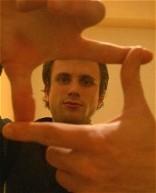
[NB. The scary picture is from Jon’s Myspace page, where you can also listen to some of his funky music. What a talented guy … though he does actually look older and less handsome in real life]

Another new FW Boreham book – ‘A Packet of Surprises’

In addition to the forthcoming FW Boreham book, The Chalice of Life

The book, A Packet of Surprises: The Best Essays and Sermons of F W Boreham, can be ordered by contacting Mike Dalton.

Geoff Pound has also generously made available a copy of his Preface to this new book, which I reproduce here:

Selecting the Best

Choosing the best essays of F W Boreham is as excruciating as selecting some children to get the honors and telling the others that they did not make the grade. As mentioned in the preface to The Best Stories of F W Boreham the selection is subjective. But there is some rhyme and reason to the choices. Some were voted in by current Boreham readers so they appear by popular demand. Others are clearly Boreham’s choice or were popular in his day. His biographer, T Howard Crago, reported that ‘The Other Side of the Hill’ (a variation of which was entitled ‘The Sunny Side of the Ranges’, was an address delivered 80 times and ‘The House that Jack Built’ was given 140 times to churches that requested Dr Boreham to give this lecture to their community as a fund raiser.[1]

In compiling this selection an effort has been made to include essays on a range of themes, those which illustrate different homiletical methods and others that are drawn from different periods in Boreham’s career. The sermons, ‘Mind Your Own Business’, ‘He Made as Though’ and ‘A Prophet’s Pilgrimage’ represent extensive reflections on Biblical stories. The chapters entitled, ‘Dominoes’, ‘Please Shut the Gate!’ and ‘I.O.U.’ are fine examples of the way F W Boreham told parables by taking ordinary, everyday objects or expressions and skillfully helped his hearers to discover a deeper truth. The messages on the favorite texts of Catherine Booth, Fyodor Dostoyevsky and Abraham Lincoln are representative of the 100+ addresses in the most popular Boreham sermon series that are contained in the five books on the theme, ‘Texts that Made History’. ‘The Squirrel’s Dream’ and ‘Waiting for the Tide’ offer glimpses into the way F W Boreham used paintings to illustrate his themes.

The sermon ‘The Whisper of God’ may at face value have not made the cut in Boreham’s best but it is included because it is the best of his earliest sermons and it illustrates how his preaching changed in style, structure and length. His contemporary, J J North, judged Boreham’s early literary ventures to be “long-worded” because “the terse Boreham had not arrived.”[2] Amid the many admiring reviews, it was said of Boreham’s first volume of sermons, The Whisper of God, that “if illustrations and incidents did not jostle so thickly on the pages and the poetical quotations were remorselessly reduced the sermons would gain much in value.”[3] The Best Essays of F W Boreham demonstrates the way that Boreham worked hard to remodel his writing and preaching through such things as the removal of wordy clutter for it is clear to see the emergence of a simple and flowing style.

Genre

Already the terms ‘essay’, ‘sermon’, ‘lecture’ and ‘address’ have been used in this introduction. Some of the chapters in his books are clearly one genre or another but F W Boreham was, as Lindsay Newnham described, the great ‘recycler’ who suited his style to his audience and tweaked his material to fit the allotted time or word limits.[4]

In a review of the book A Bunch of Everlastings, Dr. James Hastings, editor of the famous Dictionary of the Bible, asked a question that many readers have asked: “Is Mr. Boreham able to preach such sermons as these, exactly as they are printed here? Their interest is undoubted and intense. For Mr. Boreham is an artist. Every sermon is constructed. Every thought is in its place, and appropriately expressed. And there are no marks left in the constructing. To the literary student, as to the average reader of sermons, every sermon is literature.” Howard Crago, (whose text was read by F W Boreham) answered, ‘The fact was, of course, that each of these sermons was preached from memory in almost the exact words in which it was printed.’”[5]

Truth through Personality

If the content of these sermons and lectures were word for word the same as what we read in this volume they do not convey fully the total impact of the preaching event—the pausing, the modulation of his voice, the twinkle in the eye and the response of his hearers. Fortunately Howard Crago has recorded this colourful insight into how one of F W Boreham’s addresses was received:

“As time went on and ‘The House That Jack Built’ grew in popularity, the lecturer developed it and perfected its delivery until the whole thing flowed on for more than an hour of fascinating elocution and magnificent eloquence. He himself revelled in reciting it, and the audience enjoyed it to the full while being unconsciously influenced by its gentle suggestiveness.”

“A typical audience-reaction was that of the Rev. C. Bernard Cockett, M.A., who, after hearing the lecture in a Surrey Hills church said, ‘It is not to be wondered at that individuals who appreciate the words of an author are interested in him as a man, lecturer and minister. Therefore, when the Rev. F. W. Boreham’s presence was heralded in a Melbourne suburb many people asked, `What is he like?’ `Can he speak and preach as well as write?’ `Has he personality and originality in the pulpit as well as in the study?’ Boreham came-spoke-and conquered! He spoke for an hour; but the minutes passed by on shimmering wings. He speaks quite as well as he writes—the voice is strong and sweet; ringing, yet winning, and the word lives in the message. ‘The House That Jack Built’ was a brilliant drama, staged and performed by the author. And his control of the audience! A happy and original introduction; apposite stories from history, science, and romance, related with telling effect; soft touches on the varying notes of the human soul, making it tremble with childlike laughter, and then a sudden chord of richer music with concentrated and arresting power—while the listener perceives God through smiles.’”

“Moving a vote of thanks at Wangaratta [Victoria], a local farmer expressed a good deal when he said, ‘I enjoyed the lecture because I could see that Mr. Boreham was enjoying it so much himself.’”[6]

Inflaming Passion

These essays and sermons have been brought together not for literary inspection and homiletical interest but so they might speak powerfully to readers in this contemporary age. F W Boreham believed in the importance of heroes, he devoted an entire chapter of his autobiography to two of his preaching models [7] and he encouraged preachers to study evangelistic models to “inflame your devotion.”[8]

But Boreham sounded a warning about copying the style of someone else. Writing on the topic, ‘A troop of apes’, he drew analogies from nature (lyre bird, jays, ostriches and apes) to state that, “life abounds in mimicry” and if our tendency to imitation is so strong and impossible to eradicate, then human beings must select “worthy models.”[9]

Be Yourself

The great hope for this new book is that it might stimulate among its readers one of the major themes of F W Boreham—that each person, with their God-given gifts might develop their unique style:

“He sees as nobody else sees. He must therefore paint or preach or pray or write as nobody else does. He must be himself: must see with his own eyes and utter that vision in the terms of his own personality.”[10]

[1] T Howard Crago, The Story of F W Boreham (London: Marshall, Morgan & Scott, 1961), 172-174. [2] J J North, New Zealand Baptist, April 1943. [3] Review of Whisper of God, (n.p., n.d.). This review appears in a cutting that Boreham kept in his own copy of his book Whisper of God. [4] Lindsay L Newnham, ‘Recycling by Dr F W Boreham’, Our Yesterdays 5 (Melbourne: Victorian Baptist Historical Society, 1997), 78. [5] Crago, The Story of F W Boreham, 179. [6] Crago, The Story of F W Boreham, 172-173. [7] F W Boreham, My Pilgrimage (London: The Epworth Press, 1940), 98-103. [8] F W Boreham, I Forgot to Say, 42. [9] F W Boreham, Mercury, 8 October 1955. [10] Boreham, Mercury, 9 September 1950.

A new Boreham book

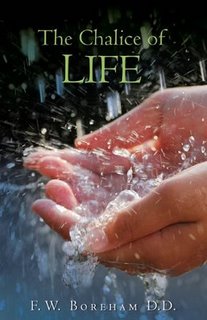
Geoff Pound, who served as principal of Whitley Theological College where I trained, and who is something of a FW Boreham devotee (and a great guy), has announced that a new Boreham book, The Chalice of Life, has just hit the printers. This is exciting news, and worthy of a plug. As a taster, here’s Geoff’s ‘Foreword’ to the book:

This book is a collection of five addresses that F W Boreham delivered on some major stages of life and this quintet is accompanied by two further essays in which the author develops the theme of life’s milestones.

Most of these essays were written soon after Boreham attained the particular milestone even though for his later lecture series he gave them a polish and wrote a new one for a stage he had not written about earlier.

It is good to reflect on Frank Boreham’s life at the time he reached each age as he draws much upon his own experience. At the age of thirty (1901) F W Boreham was married with one daughter, he was pastor of the Mosgiel Baptist church in New Zealand, contributor to the Taieri Advocate and the Otago Daily Times, editor of the New Zealand Baptist, and President of the Baptist Union. At the age of forty (1911) he had two more daughters, was pastor of the Hobart Baptist Tabernacle, he had authored several books and he was soon to begin his marathon commitment with the Hobart Mercury. At the age of fifty (1921) Boreham was pastor of the Armadale Baptist church in Melbourne, he had fathered a boy and another daughter in this last decade and his publishing ministry was in top gear. At the age of sixty (1931) F W Boreham was officially retired from pastoral ministry and was serving as a minister-at-large, across the denominations of the church and undertaking preaching and teaching tours overseas. At the age of seventy (1941), Dr Boreham had published his autobiography, in which he signaled that he had entered into the final stage of life. This was not entirely accurate as he churned out several more books and his weekly ministry at Scot’s Church was blossoming.

It is interesting to note that F W Boreham did not have an article on Life at Twenty, especially as he was fond of quoting Southey who said, “However long a person’s life, the first twenty years represent by far the biggest half of it.”[1] It is also significant that Boreham did not appear to write an article on Life at Eighty, even though he was still publishing books and preaching weekly.

F W Boreham remarks in one of these addresses that the one thing that each of these milestones has is life. F W Boreham was a self-confessed “lover of life.”[2] This theme pulsates through this book and in all his writing and preaching. In an essay on the coming of Spring Boreham reflects on the source of his love for life when saying, “I have learned that my quenchless longing for life is, after all, all unconsciously, a secret, unutterable yearning after God; for how can you conceive of life apart from Him?[3]

Throughout the pages of this volume one feels the sheer exuberance that Boreham had for life. He is possessed with a sense of wonder about the newness of each day:

“Half the fun of waking up in the morning is the feeling that you have come upon a day that the world has never seen before, a day that is certain to do things that no other day has ever done. Half the pleasure of welcoming a new-born baby is the absolute certainty that here you have a packet of amazing surprises….Here is novelty, originality, an infinity of bewildering possibility.[4]

It is Frank Boreham’s love of life that motivates his curiosity and his ministry to people:

“I have so thoroughly relished the little bit of life that was doled out to me that I find myself clamoring for all the lives that I can see….the same hunger underlies my passion for biography and even my fondness for the Bible. …Life has been so sweet to me that I like to mark the relish with which others tell their enjoyment of it.[5]

F W Boreham was very attentive to anniversaries and he kept a ‘birthday book’ or Personal Almanac in which he recorded special dates. He noted down each year the arrival of the first swallow[6] and the exact day that the elms around his house, “attired themselves in their new spring dresses.”[7] Many of his editorials commenced with reference to the birth or death of his subject. Two of his books contain the word ‘milestone’ in the title. His autobiography is a comprehensive record of the important dates of his life and family and it describes the way he remembered and celebrated the key events of his ministry.

The Chalice of Life is not so much about the exact ages as the general stages of life—their pitfalls and their possibilities. What then was Boreham’s favorite stage in life? This question is like asking him to decide which of his children was his favorite. Concerning his three churches he spoke with equal warmth and affection, even though he highlighted their different qualities. In a similar fashion and at the risk of being told that “all his swans were geese” Boreham writes with high commendation of each age and stage of life. What is happening is akin to the way he explained his growing love for Australia, “Life has a wonderful way of coaxing us into a frame of mind in which we not only become reconciled to our lot: we actually fall in love with it.”[8]

In the final two essays of this book, ‘So It’s Your Birthday!’ and ‘Life’s Landmarks’, we see the way F W Boreham is not merely registering dates in a diary or counting commemorations on a calendar. His approach is to greet each day with expectancy and to make the momentous decisions with which life confronts us. F W Boreham claimed that the greatest day of a person’s life was not their birthday, their wedding anniversary or the date of their death but, “The greatest day in a man’s life is the day on which he finds himself overwhelmed and bowed to earth by a sense of the greatness of God.”[9]

Enjoy this book and most importantly, drink deeply from “the chalice of life.”[10]

Dr. Geoff Pound.

Image: Front cover of The Chalice of Life, so beautifully created by Laura Zugzda.

P.S. F W Boreham’s son, Frank, told me that his wife Betty did most of the proof reading of his books. The ship would dock in Melbourne, the proofs would be delivered the next day and FWB and Betty would read and make the corrections before the ship left in a couple of days to return to England. When the first copy of each new book appeared FWB would take it warmly, kiss it and pass it to other members of the family for them to do the same. Producing Boreham books was a concern and a delight of the whole Boreham family.
Footnotes
[1] F W Boreham, My Pilgrimage (London: The Epworth Press, 1940), 91.
[2] F W Boreham, The Golden Milestone (London: Charles H. Kelly, 1915), 9
[3] F W Boreham, The Three Half-Moons (London: The Epworth Press, 1929), 125.
[4] F W Boreham, Faces in the Fire (London: The Epworth Press, 1916), 14.
[5] F W Boreham, On the Other Side of the Hill (London: The Epworth Press, 1917), 173.
[6] Boreham, The Golden Milestone, 34.
[7] F W Boreham, The Passing of John Broadbanks (London: The Epworth Press, 1936), 261.
[8] Boreham, My Pilgrimage, 137.
[9] F W Boreham, A Witch’s Brewing (London: The Epworth Press, 1932), 155.
[10] F W Boreham, A Bunch of Everlastings (London: The Epworth Press, 1920), 88.

Denney on prayers for the dead

Recent days have seen a turning of my attention towards James Denney who was a good mate of PT Forsyth’s and an extraordinary NT scholar. One thing that impressed me today in my reading were his comments on praying for the dead. While Forsyth defends the practice on christological grounds, Denney does so on grounds creational and experiential.

I do not think it is any use telling people not to pray for the dead; you might as well teach them not to think of them or love them, or indeed tell them roundly that after death there is nothing at all. I think most people who pray at all do pray for the dead … Certainly the absence of any example of it from the Bible is remarkable, especially taken with the life and death urgency of all the Bible does say: but a great many things must be lawful that the Bible says nothing about – things covered by the word of Jesus, “If it were not so, I would have told you” – a saying which always seems to me to justify yielding … to any instinct of the nature which is made in God’s image, and cannot be simply delusive in the things of God.

It seems to me odd that the long-held practice of praying for the dead has all but disappeared in Protestant circles (or at least in the circles in which I move). No doubt there are decent historical reasons for such abandonment, but understanding history never justifies history’s poor actions. [As an aside, recall that Denney’s comments – ‘I think most people who pray at all do pray for the dead’ – were not only made by a staunchly-Reformed Protestant, but were written just over a hundred years ago].

What both Denney and Forsyth are seeking to urge is that in Jesus Christ, the living and the dead remain unforgettably and indestructibly united in love for each other, and in a common hopeful sharing. It is not anthropology, therefore, that holds the communion of saints together on both sides of death, but Jesus Christ as Lord of both the living and the dead. Therefore, do not the saints on earth have an obligation in the gospel to pray for those who have died, and who indeed form the largest part of the race? Such prayer helps to bear witness to the Church’s unity and catholicity, and indeed to the theo-organic unity of the race itself under its new Head, himself risen from the dead. To pray for the dead signals a refusal to believe the lie that the state of a person remains fixed at death, and functions as a sign of hope in the God who raises the dead to life. To pray for one who is dying, and then to continue praying after they die – without missing a beat – is not to deny the reality of their death so much as it is to faithfully trust in the God who knows his way out of the grave.

Conference: The Sermon on the Mount and Christian Ethics

The Society for the Study of Christian Ethics is planning a conference at Westcott House, Cambridge on 5-7 September. The conference is open to both students and faculty members in the disciplines of ethics, theology, religion, philosophy, politics, and sociology, and the conference poster can be downloaded here.

This year’s conference is entitled ‘The Sermon on the Mount and Christian Ethics’, and speakers include the John Battle, Richard Bauckham, Carolyn Muessig, Oliver O’Donovan, Susan Parsons, and Glen Stassen.

There is a Call for Papers which can address either the conference theme or more general work-in-progress. But you’ll need to get cracking because the application deadline for giving a paper is 20th June 2008. Proposals and enquiries should be emailed to Jeffrey Bailey.

McCormack lays down the gauntlet

Recently over at aboutlet, Bruce McCormack cleared up a few misreadings and then laid down the gauntlet to Lane Tipton: ‘The issue for me has never been the existence of a Logos asarkos (to deny which would be tantamount to rejecting the pre-existence of the eternal Son). The issue has always been the identity of the Logos asarkos (i.e. whether the identity of the eternal Son can be established on the basis of some form of natural theology or only on the basis of Christology)’. Read the post here.

It’s great to see Bruce entering blogdom.

Stanley Fish on demands for justification

Stanley Fish’s latest post, Politics and the Classroom, makes fascinating reading. Along the way, he makes an observation about demands for justification that might be employed in any number of imaginable (theological) conversations:

The demand for justification … always come from those outside the enterprise. Those inside the enterprise should resist it, because to justify something is to diminish it by implying that its value lies elsewhere.

Burma’s forced labour

The brutal Burmese government has for years forced citizens to work for free. Twenty per cent of those sentenced to prison with hard labour perish. Meanwhile, just who will rebuild the cyclone-hit country?

The Burmese military government has come under huge international pressure and criticism since cyclone Nargis destroyed large parts of Burma, killing at least 78,000 and leaving 56,000 more missing.

A month on, the UN estimates that 2.4 million people are in need of food, shelter or medical care, and more than a million have yet to receive foreign aid. Huge numbers of people are surviving in appalling conditions, with little or no help.

In the month since the disaster, only a small number of international aid workers have been granted access into the affected regions, and there is growing concern that the reconstruction effort will depend on forced labour – be it from children or migrant adult workers.

The International Labour Organisation’s (ILO) liason officer in Rangoon, Steve Marshall, said there had not been any verified reports of forced labour linked to the disaster. But he added: “We’re not saying it isn’t happening.”

Burma is well known for its use of forced labour. The Tatmadaw (Burmese military) routinely forces civilians to work on state infrastructure projects, such as the building of roads, bridges, military bases or even towns.

The military will typically demand labour from local villages, with the threat of fines if households are unable to supply the required amount of people. The ruling State Peace and Development Council’s (SPDC) search for labourers is made easier by the existence of registration documents with details of the exact number of inhabitants, property and livestock within any given village.

Inhabitants have no choice but to apply for national identity cards and register their details or risk fines or arrest.

The military is increasingly relying on SPDC-appointed village chairpersons as intermediaries through whom to disseminate their demands.

One particularly brutal example of forced labour is SPDC’s use of villagers as human minesweepers to clear the way for the safe passage of soldiers.

Projects vary in length and intensity, but they always mean that people are taken away from their land and livelihoods without any remuneration in return.

Military personnel operate under blanket impunity, and know that they will not be held accountable for any mistreatment of civilians. Furthermore, low level officers and soldiers in charge of forced labour projects are under pressure to meet demands, quotas and timetables ordered by their superiors.

Threats, harassment, beatings and even killings are not uncommon, and women risk rape and other sexual abuses. Forced labour often means that villagers are unable to work on their own agricultural work for days or even weeks on end. Regular forced labour in Mon State (South-eastern Burma), for example, has been a primary factor leading to increasing food insecurity.

Prison Labourers

Human rights organisations have reported the continuous use of forced prison labour in Burma, and it is estimated that as many as 20 percent of prisoners sentenced to ‘prison with hard labour’ die as a consequence of the conditions of their detention. It has been reported that at least 91 labour camps operate in areas across the country and the thousands of prisoners in these camps are used to build highways, dams, irrigation canals, and to work on special agricultural projects. Prisoners are reportedly being forced to work 12 hours a day without rest, and the sick and weak are not exempted from work. Inmates who cannot afford bribes are condemned to the harshest labour.

The living conditions and the general treatment of forced prison labourers are widely reported to be far worse than for civilian forced labourers. The work is more dangerous, they have to work even longer hours and health provisions are non-existent. The prisoners are viewed as expendable labour and there are countless reports of their torture, beatings and killings. A constant supply of prison labour is ensured by the continuing arbitrary arrests, as well as the imposition of lengthy sentences for minor misdemeanours. Those arrested often do not receive due legal process and are told that they will be released on payment of a bribe. Those who are unable to bribe the police or the judiciary are automatically sent to prison, whether there is evidence against them or not.

Forced conscription and child soldiers

Human rights groups, meanwhile, believe boys as young as 12 are recruited to fight against ethnic minority rebels. Human Rights Watch (HRW) estimated that there may be more than 70,000 child soldiers in the SPDC Army.

The children are often kidnapped without their parents’ knowledge while on their way home from school. They are then brutalised and physically abused during their induction and basic training before being shipped off to fight in the country’s ethnic states. “Child soldiers are sometimes forced to participate in human rights abuses, such as burning villages and using civilians for forced labour,” said HRW. “Those who attempt to escape or desert are beaten, forcibly re-recruited or imprisoned.”

Following the suppression in 1988 of the nationwide pro democracy demonstrations, the ruling military council initiated a dramatic effort to modernize and expand the armed forces. To tighten its control over its population, the SPDC Army instituted a dramatic expansion of military personnel throughout the country.

Service in the armed forces is for many a dangerous and gruelling experience, and soldiers are often subjected to mistreatment by senior officers. According to the junta’s military meeting minutes, there were about 9,000 desertions during 2006, whereas the army was only able to recruit 6,000. This trend continued in 2007, and the army is facing an acute shortage of trained personnel as a result.

Burma continues to have one of the highest numbers of child soldiers in the world – despite an official age of enlistment of 18.

According to Thein Sein, it is under-18s that are to blame for the problem because they lie about their true age or did not inform their parents that they had enlisted in the army.

Though, in a tacit admission that there remained underage soldiers in the armed forces, he further stated that soldiers with stunted growth were not sent to forward areas but were instead given light work duties at military bases, and that illiterate youth were sent to army schools to be educated.

With forced labour being such a common occurrence in the country, it is expected Burma will make use of it for the reconstruction process. Burma has a long history of ignoring the advice of International Organisations and actively hampering their freedom of movement and investment in the country, and is not about to change its stance.

Once again, the military junta will throw a spanner in the works and prevent ILO from monitoring the reconstruction process properly, adding further suffering to the devastated area and a population that has been through so much already.

[Source: New Statesman]

On Festschriften

One review I read recently described Festschriften as those ‘essays from the bottom drawer which could find no other home, and a disparate volume for which the many are asked to pay high prices for the sake of the few’. A bit harsh perhaps, but all too familiar isn’t it: volumes of essays with very little inter-connection, of interest to about 3 people in the world (including the authors’ mothers), and with a print run so small that basically only libraries can afford them, or remortgaging is required.

It made me wonder though, what is it that makes a good Festschrift? And what one/s have you placed on your must read list?

For my money, there’s four that jump to mind:

At least the first three of these volumes could not be accused of throwing the family budget into turmoil, and none of them of nebulous unrelated content. Each of them is packed with significant essays that contribute to not only some key themes explored by the one being honoured, but do so with a view to engaging with an ongoing conversation about those very themes in a way that will appeal to a wider audience.

But are there other criteria? Fidelity to the work/themes of the one being honoured? Brevity? Does it come with a DVD?

Thoughts?

[One I’m yet to read is Daniel J. Adams’ From East to West: Essays in Honor of Donald G. Bloesch. I’d be keen to hear from anyonwe who is familiar with this volume]

Denney on reading our Bibles too much

I’m currently writing a paper on James Denney, specifically Denney’s understanding of pastoral ministry gleaned as it was not only by some seriously-deep engagement with the NT, but also from critical reflection on his time in two pastorates. I hope to post on some of these reflections soon, but for now consider the following confession, made all the more radical coming from the pen of one whose scholarly and personal devotion to the NT (in particular) was unquestionable:

‘Does it ever occur to you … that we read our Bibles too much, and that it might do us good to read none for a twelvemonth, just as it would do some people good if for as long they read nothing else? I have sometimes felt weary of the very look and sound of the New Testament; the words are so familiar that I can read without catching any meaning, and have to read again, far oftener than in another book, because I have slid a good bit unconsciously’. – James Moffatt, ed., Letters of Principal James Denney to His Family and Friends (London: Hodder & Stoughton, 1921), 81.

‘Painting the fall’

His canvases sagged with decay,

.

each a small shrine to imperfection, dereliction

infecting its seams and squares, left brittle

.

and opens, oils a fecund messenger.

a chorus if sores in line. It had to fester, like

.

damaged flesh, and drink from this corrupt well.

All the world was simply vaudeville.

*

His bankruptcy was inevitable.

What market is there for such things?

Ruin is not a commodity so much

.

as a global condition. Unnecessary

to be so reminded, ruin arriving for each of us.

Set aside for sufficient time.

*

There is a poetry of despair, a paean

to blotched faces and rotten meat.

.

That was not his style.

He sought the itch of existence, the very point

.

where life went off, irretrievably,

and lost its balance.

.

What he thought of as the honesty of disintegration.

.

– Tom Weston, ‘Painting the fall’, in Small Humours of Daylight (Wellington: Steele Roberts & Associates, 2008).