A Script to Live (and to Die) By: 19 Theses by Walter Brueggemann

These 19 theses by Walter Brueggemann are the most interesting thing I’ve read all day [to be sure, it’s been a bit of an admin marathon today], an encouraging invitation to those of us striving to live by, and to train others to live by, what Brueggemann calls ‘the alternative script’:

1.        Everybody lives by a script. The script may be implicit or explicit. It may be recognised or unrecognised, but everybody has a script.

2.        We get scripted. All of us get scripted through the process of nurture and formation and socialisation, and it happens to us without our knowing it.

3.         The dominant scripting in our society is a script of technological, therapeutic, consumer militarism that socialises us all, liberal and conservative.

4.        That script (technological, therapeutic, consumer militarism) enacted through advertising and propaganda and ideology, especially on the liturgies of television, promises to make us safe and to make us happy.

5.        That script has failed. That script of military consumerism cannot make us safe and it cannot make us happy. We may be the unhappiest society in the world.

6.        Health for our society depends upon disengagement from and relinquishment of that script of military consumerism. This is a disengagement and relinquishment that we mostly resist and about which we are profoundly ambiguous.

7.        It is the task of ministry to de-script that script among us. That is, to enable persons to relinquish a world that no longer exists and indeed never did exist.

8.        The task of descripting, relinquishment and disengagement is accomplished by a steady, patient, intentional articulation of an alternative script that we say can make us happy and make us safe.

9.        The alternative script is rooted in the Bible and is enacted through the tradition of the Church. It is an offer of a counter-narrative, counter to the script of technological, therapeutic, consumer militarism.

10.    That alternative script has as its most distinctive feature – its key character – the God of the Bible whom we name as Father, Son, and Spirit.

11.    That script is not monolithic, one dimensional or seamless. It is ragged and disjunctive and incoherent. Partly it is ragged and disjunctive and incoherent because it has been crafted over time by many committees. But it is also ragged and disjunctive and incoherent because the key character is illusive and irascible in freedom and in sovereignty and in hiddenness, and, I’m embarrassed to say, in violence – [a] huge problem for us.

12.    The ragged, disjunctive, and incoherent quality of the counter-script to which we testify cannot be smoothed or made seamless because when we do that the script gets flattened and domesticated and it becomes a weak echo of the dominant script of technological, consumer militarism. Whereas the dominant script of technological, consumer militarism is all about certitude, privilege, and entitlement this counter-script is not about certitude, privilege, and entitlement. Thus care must be taken to let this script be what it is, which entails letting God be God’s irascible self.

13.    The ragged, disjunctive character of the counter-script to which we testify invites its adherents to quarrel among themselves – liberals and conservatives – in ways that detract from the main claims of the script and so to debilitate the focus of the script.

14.    The entry point into the counter-script is baptism. Whereby we say in the old liturgies, “do you renounce the dominant script?

15.    The nurture, formation, and socialisation into the counter-script with this illusive, irascible character is the work of ministry. We do that work of nurture, formation, and socialisation by the practices of preaching, liturgy, education, social action, spirituality, and neighbouring of all kinds.

16.    Most of us are ambiguous about the script; those with whom we minister and I dare say, those of us who minister. Most of us are not at the deepest places wanting to choose between the dominant script and the counter-script. Most of us in the deep places are vacillating and mumbling in ambivalence.

17.    This ambivalence between scripts is precisely the primary venue for the Spirit, so that ministry is to name and enhance the ambivalence that liberals and conservatives have in common that puts people in crisis and consequently that invokes resistance and hostility.

18.    Ministry is to manage that ambivalence that is crucially present among liberals and conservatives in generative faithful ways in order to permit relinquishment of [the] old script and embrace of the new script.

19.    The work of ministry is crucial and pivotal and indispensable in our society precisely because there is no one except the church and the synagogue to name and evoke the ambivalence and to manage a way through it. I think often I see the mundane day-to-day stuff ministers have to do and I think, my God, what would happen if you took all the ministers out. The role of ministry then is as urgent as it is wondrous and difficult.

[These theses were presented at the Emergent Theological Conversation, September 13-15, 2004, All Souls Fellowship, Decatur, GA., USA]


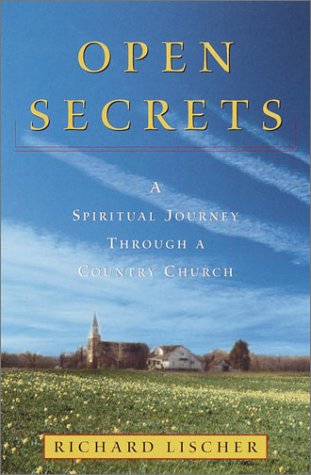
Richard Lischer’s Open Secrets: Part VIII, On Abortion

‘The Supreme Court’s decision in Roe v. Wade meant that country girls like Leeta or Teri or others like them, who found themselves “in trouble,” would have the option of privatizing their problem by removing the stigma of an unwanted pregnancy from the eyes of the congregation. It wouldn’t be necessary for the community to promise to help raise the child. The church would not have the opportunity to offer the hospitality of Jesus to a scared teenager and her family. Nor would it have a chance to fail to do so, as it had sometimes done in the past. No one would know. It was none of the community’s business’. – Richard Lischer, Open Secrets: A Memoir of Faith and Discovery, 208–9.

Richard Lischer’s Open Secrets: Part VII, On the Church Calendar

‘The Protestant church was already in the process of discarding the named Sundays of Lent and Easter even as we blessed and planted the seeds. Now they bear the evocative names “The First Sunday in Lent,” “the Second Sunday in Lent,” and so on. The fourth Sunday in Lent was once named Laetare, which means “rejoice.” It was known in the church as Refreshment Sunday. On this Sunday rose paraments replaced the traditional purple of Lent, and, psychologically and spiritually, we breathed a little easier. The color rose seemed to say, There’s light at the end of the tunnel. Even at the dead center of Lent, Christ is risen.

The Protestant church got rid of Laetare as well as Rogate and many of the other days for reasons I have never fully understood. It created a bland church calendar and liturgies du jour in the image of people who have been abstracted from place and history, who have no feel for the symbols and no memory of the stories. They live, work, and worship in climate-controlled buildings. They have largely adopted a digitalized language. Their daily routines override the natural rhythms and longings of life.

I can only say that the Latin words were not too much for my high school dropouts. The simple outline of church history didn’t overtax their imaginations. The liturgy and church year made sense to the farmers in New Cana, for who better than a farmer understands the circularities of life? The church year had a rhythm, and so did their lives.

Some would argue that the observance of Rogate arose in an agricultural world and is, therefore, irrelevant to all but the 1.7 percent of Americans who still live on farms. But my congregation understood the metaphor that underlay Rogate, which is this: When we do any kind of useful work, we join the act of creation in progress and help God keep the universe humming’. – Richard Lischer, Open Secrets: A Memoir of Faith and Discovery, 144–5.

‘The proclamation of the word … has no functional equivalents in secular culture’

‘Most ministers were “set apart for the gospel”, as Paul says of himself … The preacher’s vocation was once a kind of circle that began and ended in the word. Whatever it was that made you a minister was aimed at its eventual public expression. The minister’s whole existence was concentrated to a point of declaration. Today, however, the circle has been broken.

Our culture devalues proclamation while elevating other associated forms of ministry such as counseling or community work …

But the proclamation of the word cannot be professionalized. It has no functional equivalents in secular culture. It cannot be camouflaged among socially useful or acceptable activities. Its passions are utterly nontransferable. The kerygmatic pitch, as Abraham Heschel said of the prophet’s voice, is usually about an octave too high for the rest of society. If you are filling out a job application, see how far it gets you to put under related skills: “I can preach”.

When ministers allow the word of God to be marginalized, they continue to speak, of course, and make generally helpful comments on a variety of issues, but they do so from no center of authority and with no heart of passion. We do our best to meet people’s needs, but without the divine word we can never know enough or be enough, because consumer need is infinite. We are simply there as members of a helping profession. We annex to our ministry the latest thinking in the social sciences and preface our proclamations with phrases like ‘modern psychology tells us,’ forgetting that the word ‘modern’ in such contexts usually indicates that what follows will be approximately one-hundred years out of date. What we lack in specialized knowledge we can only offset in time by making ourselves compulsively available to anyone in need.

I am convinced that no seminarian or candidate sets out to minister with such reduced expectations, and not everyone succumbs to this scenario, but ultimately the marginalization of the word of God fractions it into a hundred lesser duties’.

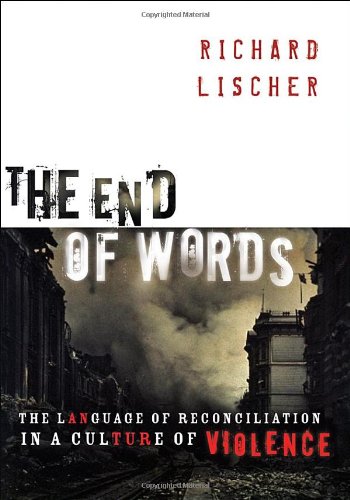
Richard Lischer, The End of Words: The Language of Reconciliation in a Culture of Violence (The Lyman Beecher Lectures in Preaching). (Grand Rapids/Cambridge: Wm. B. Eerdmans, 2005), 22-24.

[H/T: Kim Fabricius]

Richard Lischer’s Open Secrets: Part VI, On Gossip

I recently posted on Luther and Calvin on Slander; now here’s Richard Lischer offering a different take on a similar theme – gossip:

‘The word gossip originally implied a spiritual relationship. A gossip was a sponsor at a baptism, one who spoke on behalf of the child and who would provide spiritual guidance to the child as it grew in years. A gossip was your godmother or godfather. Gossiping was speech within the community of the baptized.

For all its negative associations, gossip retains something of its salutary function in a small town … Gossip is the community’s way of conducting moral discourse and, in an oddly indirect way, of forgiving old offenses. In our town all desires were known, no secrets were hid, and every heart was an open book. Every life was gossiped by all, and all were gossips.

The continuous reworking of the community’s stories, characters, and themes served two purposes. Gossip helps soften the edges of people who are simply too accessible to one another, who irritate one another to death, but who can’t escape one another or their common history. Gossip also explains peculiarities … and tells how they came to be.

Second, our gossip was common discourse. It contributed to a moral consensus on, say, what constitutes decent farming, honorable business, tolerable preaching, or effective parenting. Gossip was our community’s continuing education … Gossip is always a painful business but, when it functions as speech in the community of the baptized, it can serve a constructive end. In my wife’s case, the sifting of stories led to grudging appreciation of a ‘peculiar” sort of prairie wife’. – Richard Lischer, Open Secrets: A Memoir of Faith and Discovery, 95–6, 99.

January bests …

From the reading chair: Not Every Spirit: A Dogmatics of Christian Disbelief by Christopher Morse; Secular Christianity and God Who Acts by Robert J. Blaikie; The Calvin Handbook edited by Herman J. Selderhuis; Studies in Theology by James Denney; Institutes of the Christian Religion: 1541 French Edition by John Calvin, edited by Elsie McKee; Markings: Poems and Drawings, and Berlin Diary by Cilla McQueen; Practical Theology: An Introduction by Richard R. Osmer.

Through the iPod: The Astounding Eyes of Rita, Le Pas Du Chat Noir, Astrakan Cafe, ECM Touchstones: Conte de l’Incroyable Amour, Le Voyage de Sahar, Thimar, Barzakh, and Khomsa, all by Anouar Brahem; Available Light by Dave Dobbyn; Arvo Pärt: I am the True Vine by Paul Hillier; Britten Choral Works by Choir of King’s College Cambridge

On the screen: The Wire (Season 1); Mary and Max [2009].

By the bottle: Olssens Nipple Hill Pinot Noir 2008

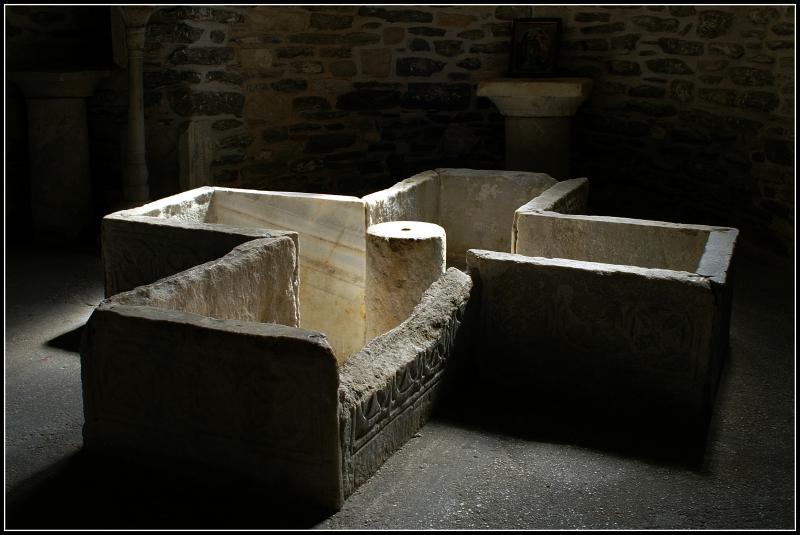
Thinking baptism

Since the birth of his daughter Aurora, Byron Smith has been posting some great little reflections on baptism, on whether to dunk, dip, douse or dribble?, and his latest on timing and why parents should not wait:

… when it comes to baptism, church family trumps blood family. No waiting until great aunt Gertrude can make it up from the farm; the child is welcomed immediately by and into the congregational family at their next major gathering. And this makes good sense. If children are to be welcomed into the household of God so that they are always raised within the Christian faith (as the practice of baptising infant baptism implies), then to be consistent, this baptismal welcome should occur as soon as possible …

Therefore, resolve to make your arrangements for a baptismal celebration prior to the birth. Expectant parents often spend hours researching prams and selecting nursery colours. Why not also (instead?) put some time into making preparations for the child’s spiritual growth? Settle your conscience on the good gift of infant baptism. Meet with your priest or minister to discuss any concerns and to ensure you understand what baptism means and how it will work. Think about godparents early (and remember, godparenting is not primarily a chance to honour your closest friends, but a responsibility for those who will be faithful in prayer and example, taking the lead in discharging the duty and privilege of the whole church family in raising a new child in the faith and love of Christ). Check your church has a font or pool large enough for the infant to be dipped into. Have your child baptised at the first service available after their birth. And read your prayer book.

Great stuff Byron.

New Sidebar Category: Pastoralia

I’m starting to pull together some new sidebar items under the subject of Pastoralia. Really happy to hear of any suggestions, but here’s what I’ve linked to thus far:

Richard Lischer’s Open Secrets: Part V, On Symbols and National Flags

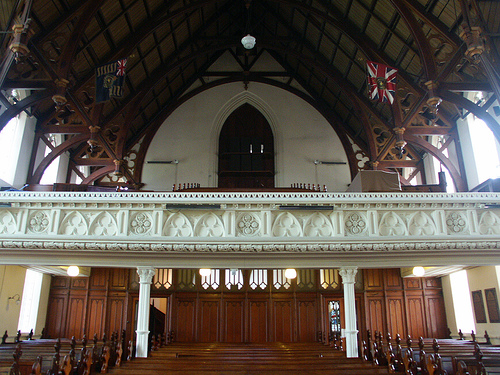
First Church, Dunedin

‘It all begins with the symbols. They capture primal relations, like water and death, fire and purification, seeds and hope. The stories do not come before the symbols, but they emerge from them and bring them to life. The stories explain the symbols, and the symbols make the stories worth remembering and telling. The window in the Lumbee church said, “See, under this sign of suffering, we will accept one another as brothers and sisters.” A congregation lives most deeply by its symbol-bearing stories. They tell us who we are.

Any cultural anthropologist would have warned me not to rearrange the furniture in our church. Of course, there were no cultural anthropologists in New Cana. Had there been, they would have reminded me that the physical focus of worship symbolically “freezes” the community’s story into a sacred universe. Therefore, to shuffle the furniture in the chancel or to alter the ritual, say, by moving the flag or changing the music, is to offend against the stories and derange the universe itself.

Who knew?

I should have known not to try to remove the American flag from the chancel. To me, the national flag represented an intrusion into the sacred space of the congregation, an obvious symbol of civil religion. Theologically, the flag has no business beside the altar.

At one of our congregational “town meetings” I patiently explained that I had nothing against patriotism but that it was a short step from “God and country” to “God equals country”. These were the last hours of Vietnam and the early days of Watergate. How can Christians minister prophetically to the country, I asked, if we embrace the nation’s chief symbol and admit it into our sanctuary’. – Richard Lischer, Open Secrets: A Memoir of Faith and Discovery, 89–90.

I’ve blogged on this theme before too. See Aliens in the Church: A Reflection on ANZAC Day, National Flags and the Church as an Alternative Society

Howard Zinn on prostituting God, history, democratic education, and patriotism

Saddened to read today of the death of Howard Zinn, author of A People’s History of the United States: 1492 to Present, You Can’t Be Neutral on a Moving Train: A Personal History of Our Times, Howard Zinn on Democratic Education, Passionate Declarations: Essays on War and Justice, The Politics of History, Marx in Soho: A Play on History, Emma, A Power Governments Cannot Suppress and a host of other books. James Carroll’s assessment of this ex-air force bombardier is spot on, that ‘Howard had a genius for the shape of public morality and for articulating the great alternative vision of peace as more than a dream’. Typically provocative, and always timely, I don’t always agree with Zinn, but I’ve appreciated everything I’d read from his engaging pen and the gentle courage with which he said it.

For those unfamiliar with Zinn’s thought, here are a few tasters:

‘It is interesting that God is brought into the picture when the government is doing great violence. Maybe it’s when you are doing great violence that you desperately need some support. You’re not going to get any moral support from any thinking person, but since God isn’t thinking at the moment, maybe you can pull out God to support you’. – Howard Zinn, Terrorism and War (New York: Seven Stories Press, 2002), 94.

‘History is always a good entity to call upon if you are hesitant to call upon God because they both play the same role. They are both ab­stractions; they are both actually meaningless until you invest them with meaning. I’ve noticed that President Bush calls upon God a lot. I think he’s hesitant to call upon history because I think the word history throws him; he’s not quite sure what to do with it, but he’s more familiar with God. History is invoked because nobody can say what history really has ordained for you, just as nobody can say what God has ordained for you. It’s an empty vessel, which you can fill in whatever way you can. So you can say that history has decided that the United States will be the great leader of the world and that American values, values being another empty vessel that you can fill with anything you want, will be transmitted to the rest of the world. So you can fill history, that ab­straction history, with anything you want, use it whenever you want. Political leaders, I guess, suppose that the population is as mystified by the word history as they are by the word God, and that therefore they will accept whatever interpretation of history is given to them. So the political leaders feel free to declare that history is on their side, and the way is open for them to use it in whatever manner they want’. Howard Zinn and David Barsamian, Original Zinn: Conversations on History and Politics (Pymble: HarperCollins, 2006), 131–2.

‘To me, a democratic education means many things: It means what you learn in the classroom; it means what you learn outside the classroom; it means not only the content of what you learn, but it means the atmosphere in which you learn it; it refers to the relation­ship between teacher and student. All of these elements of educa­tion can be democratic or undemocratic.

And so for the content of education to be democratic, it must take its cue from the idea of democracy, the idea that people will determine their own destiny. And therefore, it means students have a part in this. Students as human beings, as citizens in a democracy, have the right to determine their lives, have a right to play a role in the society. And therefore, a democratic education gives students the kind of information that will enable them to have a power of their own in the society.

And what that means is really to give the students a kind of education that, going into history, suggests to the students that historically there have been many, many ways in which ordinary people – people as ordinary as the student feels as he or she is sitting in the classroom – can play a part in the making of history, in the development of their society. So that a democratic education in that sense is an education that gives the student examples in history of where ordinary people have shown their power and their energy in not only reshaping their own lives but playing a part in how society works. That would be the substance of a democratic education, or part of the substance of a democratic education.

And then the relationship of the student to the teacher. There is democracy in the classroom. The understanding given to the stu­dent that the student has a right to challenge the teacher, that the student has a right to express ideas of his or her own. That educa­tion is an interchange between the experiences of the teacher, which may be far greater than the student in certain ways, and the experiences of the student, which are unique, since every student has a unique life experience, one which a teacher has not had, and therefore the student is in a position to throw into the educational reservoir of the class the student’s own experience. So the inter­change between student and teacher, the free inquiry that is pro­mulgated in the classroom, a spirit of equality in the classroom, to me that is part of a democratic education’. – Howard Zinn and David Barsamian, Original Zinn: Conversations on History and Politics (Pymble: HarperCollins, 2006), 132–3.

‘Patriotism is being used today the way patriotism has always been used, and that is to try to encircle everybody in the nation into a common cause, the cause being the support of war and the advance of national power. Patriotism is used to create the illusion of a com­mon interest that everybody in the country has. I just mentioned the necessity to see society in class terms, to realize that we do not have a common interest in our society, that people have different inter­ests. What patriotism does is to pretend to a common interest. And the flag is the symbol of that common interest. So patriotism plays the same role that certain phrases in our national language play, and that is to create the illusion of common interest. The words that are used are national security, pretending that there is only one se­curity for everybody, one kind of security for everybody; national interest, pretending that there is one interest for everybody; national defense, pretending that the word defense applies equally to all of us. So patriotism is a way of mobilizing people for causes that may not be in the people’s interest’. Howard Zinn and David Barsamian, Original Zinn: Conversations on History and Politics (Pymble: HarperCollins, 2006), 148–9.

Richard Lischer’s Open Secrets: Part IV, On the Trinity

‘God is persons and nothing else. There is no waxy residue of divinity that is not wrapped up in these three persons, Father, Son, and Holy Spirit. That’s who God is. God is (est) each of these three persons, but the persons are distinct from one another (non est). God is both: alone in majesty and at the same time forever radiating love through each person of the Trinity … We are only able to love each other because the Father loves the Son through the Holy Spirit. We want to be with one another as friends, lovers, and neighbors for the same reason. That’s not an argument that would appeal to most theologians, but that’s what the Trinity meant for us’. – Richard Lischer, Open Secrets: A Memoir of Faith and Discovery, 81.

Richard Lischer’s Open Secrets: Part III, On Homiletical Gridlock

‘Like most preachers, I grossly overestimated the importance of my part in the sermon. When I thought of preaching, I did not consider it to be a congregation’s reception of the word of God, but a speaker’s command of the Bible’s hidden meanings and applications, which were served up in a way to showcase the authority and skill of the preacher. In those days the gospel lived or died by my personal performance. My preaching was a small cloud of glory that followed me around and hung like a canopy over the pulpit whenever I occupied it. How ludicrous I must have appeared to my congregation.

In my first sermon I explained the meaning of an epiphany, not the Epiphany of God in the person of Jesus – no, that would have been too obvious – but the category of epiphanies in general. To this end, I drew at length on the depressing short stories of James Joyce in Dubliners. “Each of these stories has one thing in common,” I said. “In each the central character comes to a deeper and more disturbing understanding of himself. Nothing really happens in these stories except that in the midst of the daily routine a character is unexpectedly exposed to the predicaments of estrangement in his own life. One man realizes that his wife has never loved him. Another recognizes that he is trapped in his vocation. Another finds himself to be a hopeless failure. The human condition is full of such epiphanies …”

Before I could talk about Jesus, I apparently found it necessary to give my farmers a crash course in the angst-ridden plight of modern man. With the help of clichés from Joyce, Heidegger, Camus, and even Walker Percy, I first converted them to existential ennui so that later in the sermon I could rescue them with carefully crafted assurances of “meaning” in a meaningless world. Along the way I defiantly refuted Marx’s view of religion as an opiate that permits us to escape the hard realities of existence. It didn’t concern me that the problem of meaninglessness had not occurred to my audience or that Marx’s critique of religion rarely came up for discussion at the post office.

It’s not that I minimize the importance of the major themes of modernity. No doubt my parishioners would have understood themselves better had they opened their eyes to the intellectual context of their lives. But they did not and could not. The giants of modern thought – Darwin, Marx, Nietzsche, Freud, Sartre – and the movements they unleashed, would never touch New Cana. My parishioners lived in a prison whose view was limited to the natural world and the most obvious technologies of the twentieth century. Aside from formulaic complaints about Communists, perverts, and radicals, they did not engage the modern world.

But then I did not bother to engage their world either. It did not occur to me that I needed a new education. I treated the rural life as an eccentric experience in ministry. I was a spectator once again, as I had been in college, watching a slide show of interesting scenes and odd characters. And since I was the viewer and they were the viewees, I was in control. When I preached, I always stood above my parishioners and looked down upon them.

Consequently, my sermons carried too many prerequisites to be effective. About 90 percent of my listeners had not graduated from high school; the majority of that group had not attended high school. There was no one with a four-year college degree in the church with the exception of a regular visitor named Darryl Sheets, our Lone Intellectual, who was principal of the high school in nearby Cherry Grove. Darryl regularly cornered me in long and fruitless conversations on the possible meanings of the Hebrew word for “young woman” in Isaiah 9:14 and how they all pointed to “Virgin.” But the truth is, Darryl and his wife Marvel didn’t drive all the way to Cana because of my expertise in Hebrew or the intellectual content of my sermons. Darryl was a tongue-speaking, fire-anointed charismatic who for some reason suspected that I might be one, too. It didn’t take him long to figure out he was wrong, and then we saw quite a bit less of Darryl and Marvel.

My audience paid a heavy price for the gospel. The farmers had to swallow my sixties-style cocktail of existentialism and psychology before I served them anything remotely recognizable. I implicitly required them to view their world and its problems through my eyes. All I asked of them was that they pretend to be me.

The only person who appreciated my sermons was my wife, who, like me, lived from books. Tracy was completing her course work for a Ph.D. in English and, therefore, considered poetry and literary allusions to be the most natural of all forms of communication. What’s a sermon without, “Perhaps Milton said it best when he wrote …” But among the rest of the congregation my preaching produced a standoff of sensibilities: If the idea for a sermon did not come from a book, I was not interested in pursuing it. If it did not emerge from life, my parishioners were not interested in hearing about it. In a few short months we had achieved homiletical gridlock’. – Richard Lischer, Open Secrets: A Memoir of Faith and Discovery, pp. 73–5.

Richard Lischer’s Open Secrets: Part II, On Theological Education 2

We continue on with citations from Richard Lischer’s Open Secrets: A Memoir of Faith and Discovery, and with another on theological education:

‘The congregation and I were insignificant figures in a larger and older pattern. The church has always identified its potential leaders, indoctrinated them, and then rudely inserted them in some setting or other where they almost never belong. At seminary we brooded over the mysteries of God for four years only to turn up later as chaplains to covered-dish suppers and car washes with the youth. One part of the church goes to great expense in order to prepare a theologian for another part of the church that wants a guitar player. Like misshelved books, we are there waiting to be used, but will anyone ever find us? As partners in an arranged marriage, my congregation and I might fall madly in love, which, in this creaky old church already seemed unlikely to me, or we could accommodate ourselves to what, if we were honest, each of us knew to be a mismatch’. (pp. 48–9)

Myanmar’s empty promise to free Aung San Suu Kyi

There’s been a lot of hype in recent days about the announcement that Aung San Suu Kyi is ‘to be freed in November’. But Mark Farmener, from Burma Campaign UK, wisely cautions that celebrations arising from this news are premature and we have in fact every reason to belive that the junta’s words are ‘hollow and that the 64 year-old Nobel Laureate will remain in detention’:

‘They [Myanmar’s government] know this will get the media interested. They know this this will get lots of positive publicity and that will give the excuse to governments like Germany and Spain and others that have been wanting to relax the pressure on Burma’s generals’.

‘The regime has made it really clear in their actions that they are not interested in releasing Aung San Suu Kyi. They have doubled the number of political prisoners since the monks’ uprising in 2007. While they’re very good at this kind of spin, the reality on the ground is very different … We need to look at what’s actually going on not the constant lies of the generals’.

This interview (00:05:24) with Farmener on Radio Netherlands Worldwide is well worth listening to.

Richard Lischer’s Open Secrets: Part I, On Theological Education

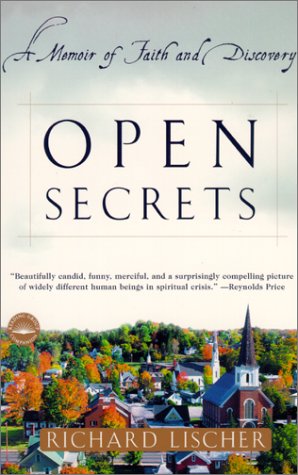
As one whose vocation concerns the formation of ministers, I am for ever on the lookout for resources that assist in this task. One such book is Richard Lischer’s Open Secrets: A Memoir of Faith and Discovery. Rather than write a review of it (Want a review? Just read the book! Repeat: Read the book! There you go), I thought I’d simply post a few of my favourite sections of it over the next week or so. It won’t and it can’t substitute for reading the book, and isolating snippets out of a novel and its narrative is frightfully problematic, but it may at least help to introduce the book to those unfamiliar with it, and, even without wider narrative-bearings, encourage some fruitful thought. So here we go:

‘Exactly why I had arrived at my first call with such a developed sense of entitlement, I’m not sure’. (p. 12)

‘I didn’t ride through eight years of education on a crisis, nor did my co-travelers in the System. We put one foot ahead of another as if following snowprints through a Wisconsin woods, but with no horizon in view. Some of us emerged from the journey open to new learning and experience, and some fancied ourselves as completed ministers of the gospel. But all of us were missing something. Our education taught us to speak the System’s language, but it did not disclose the language that “speaks us” by possessing our spirit and shaping us as human beings. It is not a question of how did we survive the voyage. Surely, at one time or another every boy in that school must have fought through a crisis as quietly as I did mine. The real question is, how did those long years open a path to ministry?

There’s a New Yorker cartoon in which a pompous-looking doctor hands a prescription to his patient and says, “Take this. It will either cure you or kill you.” I’m afraid my education was something like that. It didn’t attend to the gifts of the Spirit, such as love, joy, peace, patience, and long-suffering. It did not help me develop Jesus’ instinct for compassion toward the outsider or outrage toward injustice. Our professors didn’t invite us into the agony of race or war; they never intimated that God could grieve over the poor or that Jesus really cared about the fate of women. Perhaps it was the substructure of Greek humanism that kept us to the middle way, which caused us to overlook God’s grief and anger and the essential excesses of Christianity.

The spirituality imparted to us was the safe spirituality of structure but not of passion or abandonment. The theological categories we memorized would either stifle true spirituality for the rest of our lives or provide the skeleton for a growing and adapting organism.”We’ve given you a vocabulary,” my teachers seemed to say, “Now, what are you going to do with it?

Likewise, the enforced chapel services into which we dutifully filed morning and evening could either kill you or make you well. If you paid too much attention to the sermons of Dean Axelmann and others, you might die in the spirit. But we also sang Matins every morning, and four hundred male voices chanting the Te Deum couldn’t be wrong:

To You all angels cry aloud,
The heavens and all the powers therein.
To You cherubim and seraphim continually do cry,
Holy, holy, holy, Lord God of Sabaoth!

Take that prescription five mornings a week for eight years, and it just might save your life’. (pp. 36–7)

95 Theses Rap

Yale is not only about Harold Attridge, Adela Yarbro Collins, Bruce Gordon, John Hare, Denys Turner, Miroslav Volf, and a host of other great scholars. It’s also home to Bulldog Productions, a student-run film company who are producing some really great stuff. Here a clever wee clip from 2007 on Luther’s 95 Theses:

If you havin’ Church problems then don’t blame God, son …
I got ninety-five theses but the Pope ain’t one.

VERSE 1

Listen up, all my people, it’s a story for the telling
’bout the sin and injustice and corruption I been smelling:
I met that homie Tetzel, then I started rebelling
Once I seen the fat Indulgences that he been selling.
Now the Cath’lics of the world straight up disgracin’ me
Just because I waved my finger at the papacy.
My people got riled up over this Reformation …
That’s when Leo threatened me with Excommunication.
I warned y’all that Rome best agree to the terms.
If not, then you can eat my Diet of Worms!
You think you done something spectacular?
I wrote the Bible in the vernacular!
A heretic! [What?] Someone throw me a bone.
You forgot salvation comes through faith alone.
I’m on a mission from God. You think I do this for fun?
I got ninety-five theses but the Pope ain’t one.
Save me!

CHORUS

Ninety-five theses but the Pope ain’t one.
If you havin’ Church problems then don’t blame God, son …
I got ninety-five theses but the Pope ain’t one.

VERSE 2

One Five One Seven… that’s when it first went down.
Then the real test was when it started spreading around.
Sixty days to recant what I said? Father, please!
You’ve had, what? Goin’ on fifteen centuries?
“Oh snap, he’s messin’ with the holy communion.”
But I ain’t never dissed your precious hypostatic union!
“One place at one time.” Well, thank you Zwingli.
Yeah, way to disregard that whole “I’m God” thingy!
Getting’ all up in my rosary … you little punk.
Your momma shoulda told you not to mess with no monk.
What you bumpin’ me for? Suddenly you sore.
Keep that up, you’ll have yourself another Peasant War.
You blame common folk for the smack they talkin’ …
You ain’t even taught them proper Christian doctrine.
With my hat, my Bible, and my sexy little nun,
I got ninety-five theses but the Pope ain’t one.
Save me!

CHORUS

VERSE 3

When I wrote the ninety-five, haters straight up assailed ’em.
Now they only care whether or not I nailed ’em or mailed ’em.
They got psychoanalytic. Now everyone’s a critic,
And getting on my case just because I’m anti-Semitic.
I’ve come back from obscurity to teach y’all a lesson,
Cuz someone here still ain’t read their Augsburg Confession.
I said Catholicism brings a life of excess,
And we all remember what went down with Philip of Hesse!
But you forgot about me and my demonstration?
Like you can just create your own denomination?
“We don’t like this part, so we’ll just add a little twist.”
Now we Anglican, Amish, and even Calvinist.
I gave you the power, you gone and abused it.
I gave you God’s truth, you just confused it.
Don’t you never underestimate the s*** that I done …
I got 95 theses but the Pope ain’t one.
Save me!

CHORUS

Shout out to Johann Gutenberg … I see you baby.

Weekly wanderings

Lindis Pass

Seamus Heaney: ‘Death of a Naturalist’

I’m really looking forward to spending this weekend with the St Martin Island Community and with Cilla McQueen, a Bluff-based poet who is New Zealand’s Poet Laureate for 2009-2011. (Some of her work can be read here). It will, unsurprisingly, be a weekend of poetry and a celebration of place. Here’s one of two poems that I hope to share:

Death of a Naturalist

All the year the flax-dam festered in the heart
Of the townland; green and heavy headed
Flax had rotted there, weighted down by huge sods.
Daily it sweltered in the punishing sun.
Bubbles gargled delicately, bluebottles
Wove a strong gauze of sound around the smell.
There were dragon-flies, spotted butterflies,
But best of all was the warm thick slobber
Of frogspawn that grew like clotted water
In the shade of the banks. Here, every spring
I would fill jampots full of the jellied
Specks to range on the window-sills at home,
On shelves at school, and wait and watch until
The fattening dots burst into nimble-
Swimming tadpoles. Miss Walls would tell us how
The daddy frog was called a bullfrog
And how he croaked and how the mammy frog
Laid hundreds of little eggs and this was
Frogspawn. You could tell the weather by frogs too
For they were yellow in the sun and brown
In rain.

Then one hot day when fields were rank
With cowdung in the grass the angry frogs
Invaded the flax-dam; I ducked through hedges
To a coarse croaking that I had not heard
Before. The air was thick with a bass chorus.
Right down the dam gross-bellied frogs were cocked
On sods; their loose necks pulsed like snails. Some hopped:
The slap and plop were obscene threats. Some sat
Poised like mud grenades, their blunt heads farting.
I sickened, turned, and ran. The great slime kings
Were gathered there for vengeance and I knew
That if I dipped my hand the spawn would clutch it.

– Seamus Heaney

Gifted to serve the Lord

So I’m wondering if God’s doing a bit of a post-suffering Job thing on me. You know, the bit where ‘the LORD blessed the latter part of Job’s life more than the first. He had fourteen thousand sheep, six thousand camels, a thousand yoke of oxen and a thousand donkeys’ (Job 42:12). I say this because I’m kicking on to middle age now (seriously, how many people do you know who live past 100!) and I get this email today from a Mrs. Mellisa Lewis, a 59 year old sister who was two years ago diagnosed with cancer. She writes:

‘I will be going in for an operation later today. I decided to WILL/donate the sum of (Fourteen Millions Two Hundred Fifty Eight Thousand United States Dollars) to you for the good work of the lord. Contact my lawyer with this email: Name: Mr Jay Mchenry Email:(jmchenry@rcweb.net) (+44 792 435 0212) Tell him that I have WILLED 14.258M to you by quoting my personal reference number JJ/MMS/953/5015/GwrI/316us/uk’. As soon as you contact him with this details quoted above, he should be able to recognize you and help in claiming this amount from my Bank. Be informed also that i have paid for the state tax on this money to be transferred to you. Meanwhile you are advised to keep this mail and it contents confidential as i really want my wish accomplish at the end of the day. Please do pray to God for my recovery. God Bless Regards, Mrs. Mellisa Lewis’.

Now here’s where I need your help faithful readers: While I’m a little gutted that I’m not the only recipient of Mrs Lewis’ generosity, and while it’s somewhat refreshing to get an email (in my spam box) from someone who’s not convinced that Viagra is the answer to all my problems, and while straight moola is (I assume) considerably more easy for me to bank than is six thousand camels, and while I’m not one to break such sincere confidences (especially when so much greenback is at stake for the Lord’s work), I’m not sure yet what ‘good work of the lord’ might be birthed or encouraged with this gift. I mean, ‘Fourteen Millions Two Hundred Fifty Eight Thousand United States Dollars’ can buy a lot of love.

So, all suggestions considered.

And yeah, don’t forget to join me in praying for Mrs. Lewis’ recovery.

Create challenging learning environments

It could be that we need to spend less time writing lectures and more time thinking about springing surprise tests on our students; that is, at least, if Nate Kornell and Sam Kornell are right:

‘… errors are not necessarily the enemy of learning; they can, in fact, enhance it. Likewise, the widely held belief that testing serves no purpose other than assessing performance is built on a similar misconception. In reality, testing — whether self-testing or testing in the classroom — can, under the right conditions, better promote learning than can studying … We tend to assume that the best way to consume and remember information is through the application of rigorous, extended study. What we fail to see, however, is that the process of trying to work through a problem to which we don’t know the answer focuses our attention on it in a way that simply studying it does not. The desire to get the answer right, and the frustration of failure, is partly to account … Create challenging learning environments, make mistakes and then learn from them’. – Nate Kornell and Sam Kornell, A Really Hard Test Really Helps Learning.

Either way, the spoon-feeding days are over.