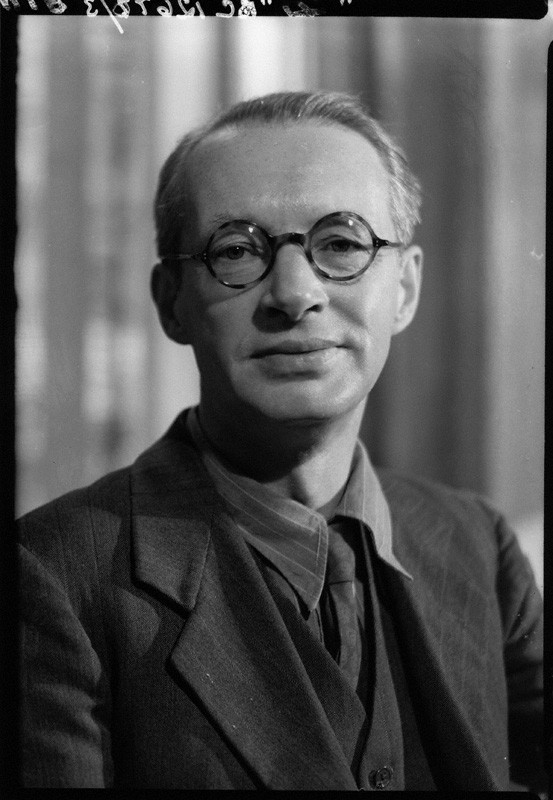
Advent Reflection 1: In Christ God Has Come Together With Us

Each year between 1926 and 1933, the Swiss theologian Karl Barth penned a Christmas meditation for a German daily newspaper. In his 1931 reflection, ‘It gives new lustre to the world’, Barth began by asking a question asked each Advent by Christians generally, and perhaps especially by those called upon to preach: ‘What does it mean to hear the Christmas message?’ He proceeds to say that if the question is put like that, ‘then it behoves us all, especially if we happen to be theologians, to keep our mouths shut and first to consider that the Christmas message is not a philosophy, nor an ideology, nor a moral system or anything like that’. Instead, the Christmas word is ‘the Word of God to which no one has the key and whose real meaning for us, now as in former ages, is God’s secret. Hidden is the point where the Christmas message concerns each one of us and our whole generation, where its grace and judgement, its promise and command affect us’.

However (and it is a big ‘however’), as Barth proceeds to note, the question posed above does not need to be put like that. We could ask, for example, ‘What does it mean that we have heard the Christmas message?’; in which case, while we cannot lay hold of the full reality of the Christmas message, interpret and apply it, as if it were some human wisdom, neither can we or should we ignore its testimony which speaks to us of its hidden reality, of its way and nature, whereby both we and every other generation are reminded of certain possibilities, which are, so to speak, the outer garb of an incomprehensible but real encounter between God and humanity. In the grace of God, we can and must speak that which we know and have heard. In the grace of God, we can and must bear witness, testimony, to God’s self-disclosure. And in the grace of God, this testimony is preserved for us in Holy Scripture.

When, therefore, the Christmas word seems too incredible to believe, we can hear … and believe again. And what is this word? Barth again:

If God had wanted to deal with us as He is free to do, and as we well deserved it, according to His principle, He would never have become man. But He was and is merciful, and therefore in Christ He has come together with us (with us!), though His holiness and our weakness and wickedness should really exclude any coming together on His part and any thought of cooperation on our part. But God did and does just this, the impossible or – should we say? – that which is practical only for Him the Merciful One, which must happen so that His free and merciful will be done. The fact that also in this respect human beings can believe the eternal Light, means that we do perhaps have the will to do that which concerns us most, and which under any circumstance must be done in common with others. – Karl Barth, Christmas (trans. Bernhard Citron; Edinburgh/London: Oliver and Boyd, 1959), 47.

(NB. This is a reposting of my contribution to the Advent reflections at Hopeful Imagination)

Edwin Muir – ‘The Transfiguration’

I’ve been reading some poems by the Orkney writer Edwin Muir (1887-1959). In 1901, when Muir was 14, Muir’s family was forced to move to Glasgow after loosing the family farm, ‘The Bu’. This move from the peaceful Orkney to industrialised Glasgow was significantly traumatic for Muir, and he would later describe it as a descent from the innocence of a rural Eden into Hell. Not only was the Glasgow environment hard, but within a few years two of his brothers and both his parents were dead.

One particular poem that I keep returning to is ‘The Transfiguration’. In this poem, Muir describes visionary experiences he had while undergoing analysis. The result is one of the most theologically-rich visions I’ve ever read, with not a few similarities to Barth’s Church Dogmatics IV/1.

So from the ground we felt that virtue branch
Through all our veins till we were whole, our wrists
As fresh and pure as water from a well,
Our hands made new to handle holy things,
The source of all our seeing rinsed and cleansed
Till earth and light and water entering there
Gave back to us the clear unfallen world.
We would have thrown our clothes away for lightness,
But that even they, though sour and travel stained,
Seemed, like our flesh, made of immortal substance,
And the soiled flax and wool lay light upon us
Like friendly wonders, flower and flock entwined
As in a morning field. Was it a vision?
Or did we see that day the unseeable
One glory of the everlasting world
Perpetually at work, though never seen
Since Eden locked the gate that’s everywhere
And nowhere? Was the change in us alone,
And the enormous earth still left forlorn,
An exile or a prisoner? Yet the world
We saw that day made this unreal, for all
Was in its place. The painted animals
Assembled there in gentle congregations,
Or sought apart their leafy oratories,
Or walked in peace, the wild and tame together,
As if, also for them, the day had come.
The shepherds’ hovels shone, for underneath
The soot we saw the stone clean at the heart
As on the starting-day. The refuse heaps
Were grained with that fine dust that made the world;
For he had said, ‘To the pure all things are pure.’
And when we went into the town, he with us,
The lurkers under doorways, murderers,
With rags tied round their feet for silence, came
Out of themselves to us and were with us,
And those who hide within the labyrinth
Of their own loneliness and greatness came,
And those entangled in their own devices,
The silent and the garrulous liars, all
Stepped out of their dungeons and were free.
Reality or vision, this we have seen.
If it had lasted but another moment
It might have held forever! But the world
Rolled back into its place, and we are here,
And all that radiant kingdom lies forlorn,
As if it had never stirred; no human voice
Is heard among its meadows, but it speaks
To itself alone, alone it flowers and shines
And blossoms for itself while time runs on.

But he will come again, it’s said, though not
Unwanted, unsummoned; for all things,
Beasts of the field, and woods, and rocks, and seas,
And all mankind from end to end of the earth
Will call him with one voice. In our own time,
Some say, or at a time when time is ripe.
Then he will come, Christ the uncrucified,
Christ the discrucified, his death undone,
His agony unmade, his cross dismantled –
Glad to be so – and the tormented wood
Will cure its hurt and grow into a tree
In a green springing corner or young Eden,
And Judas damned take his long journey backward
From darkness into light and be a child
Beside his mother’s knee, and the betrayal
Be quite undone and never more be done.

Philip Pullman on CS Lewis and JRR Tolkien

In a recent interview, Philip Pullman not only properly reminds us of the challenges of talking to fundamentalists ‘You can’t communicate with people who know they’ve got all the answers’ but also makes one of the most ridiculous and ignorant statements I’ve read in a long time:

‘I dislike his Narnia books because of the solution he offers to the great questions of human life: is there a God, what is the purpose, all that stuff, which he really does engage with pretty deeply, unlike Tolkien who doesn’t touch it at all. ”The Lord of the Rings” is essentially trivial. Narnia is essentially serious, though I don’t like the answer Lewis comes up with. If I was doing it at all, I was arguing with Narnia. Tolkien is not worth arguing with.’

You can read the full interview here.

For those in, or near enough to, St Andrews, Dr Grant Macaskill (who is not only a really great guy and an engaging speaker, but also a good musician) will be speaking on Christianity and the Philip Pulman novels on Sunday the 16th of December at 6pm, Martyr’s Church in North Street. The title of his talk, ‘Killing God Softly: Does “The Golden Compass” undermine Christianity?’ For more information, contact Matt.

Ratzinger on Salvation and Hope

Within the past week, on the Feast of Saint Andrew the Apostle and on the eve of Advent, Pope Benedict XVI released an encyclical letter, Spe Salvi (Saved by Hope). In his introduction he writes, ‘Redemption is offered to us in the sense that we have been given hope, trustworthy hope, by virtue of which we can face our present: the present, even if it is arduous, can be lived and accepted if it leads towards a goal, if we can be sure of this goal, and if this goal is great enough to justify the effort of the journey’.

Even if not convincing at all points, it is a rich document that deserves close reading and reflection. Here’s a particularly rich taster:

47. Some recent theologians are of the opinion that the fire which both burns and saves is Christ himself, the Judge and Saviour. The encounter with him is the decisive act of judgement. Before his gaze all falsehood melts away. This encounter with him, as it burns us, transforms and frees us, allowing us to become truly ourselves. All that we build during our lives can prove to be mere straw, pure bluster, and it collapses. Yet in the pain of this encounter, when the impurity and sickness of our lives become evident to us, there lies salvation. His gaze, the touch of his heart heals us through an undeniably painful transformation “as through fire”. But it is a blessed pain, in which the holy power of his love sears through us like a flame, enabling us to become totally ourselves and thus totally of God. In this way the inter-relation between justice and grace also becomes clear: the way we live our lives is not immaterial, but our defilement does not stain us for ever if we have at least continued to reach out towards Christ, towards truth and towards love. Indeed, it has already been burned away through Christ’s Passion. At the moment of judgement we experience and we absorb the overwhelming power of his love over all the evil in the world and in ourselves. The pain of love becomes our salvation and our joy. It is clear that we cannot calculate the “duration” of this transforming burning in terms of the chronological measurements of this world. The transforming “moment” of this encounter eludes earthly time-reckoning-it is the heart’s time, it is the time of “passage” to communion with God in the Body of Christ. The judgement of God is hope, both because it is justice and because it is grace. If it were merely grace, making all earthly things cease to matter, God would still owe us an answer to the question about justice-the crucial question that we ask of history and of God. If it were merely justice, in the end it could bring only fear to us all. The incarnation of God in Christ has so closely linked the two together-judgement and grace-that justice is firmly established: we all work out our salvation “with fear and trembling” (Phil 2:12). Nevertheless grace allows us all to hope, and to go trustfully to meet the Judge whom we know as our “advocate”, or parakletos (cf. 1 Jn 2:1).

Thomas Forsyth Torrance (1913–2007)

Thomas Forsyth Torrance passed away this morning at 3.30. Professor Torrance was, in my opinion, the most significant and greatest British (and, arguably English-speaking) theologian in the twentieth century. Few have helped us more to understand and celebrate the height, depth and breadth of God’s exhaustless love revealed in Jesus Christ. I wish to express my deepest condolences to the Torrance family.

Many of us so deeply blessed through this man’s ministry – a ministry at one with that great apostolic Word of the Father ever going out in the Spirit into the creation, and finding voice through so many of Torrance’s students – can remember where we were when we were first read The Trinitarian Faith, or were overpowered by that faithful witness to the Word in The Mediation of Christ. His missionary sensibility, his service to the Gospel, and to the Church which that Gospel created, sustains and reforms was exemplary, the heart of which was his consistent witness to God’s greatest action in Jesus Christ.

‘If the saving act of God in Christ were something external to Christ, something merely between Christ and us or between Christ and the world, then when completed it would be over and done with. But if the soteriological exchange takes place within the constitution of the incarnate Person of the Mediator, then it is as eternal as Jesus Christ himself, the eternal Son. That is, the staggering truth of the Gospel that so overwhelmed the early Church which they sought to express in their doctrine of theopoieses … that through the kinship which the Son of God has established with us in the incarnation, our creaturely evanescent existence is as securely anchored in the very being and life of God as Jesus Christ himself. Such is the blessed end of the atoning exchange effected in the death, resurrection and ascension of Jesus Christ. Since he has been taken up into God, in him our humanity, in spite of its temporal changeable nature, is given a place in God, and is thus grounded in his eternal unchangeable reality’. – Thomas F. Torrance, The Trinitarian Faith (Edinburgh: T&T Clark, 1988), 183-4.

For those who would like to know more about Torrance, I recently posted a review of a recent work on Torrance theology here and more information is available here.

His brother David has penned a letter to members of the TF Torrance Theological Fellowship in which he writes, among other things:

As a much loved brother and intimate friend with whom I have shared so much over the years, he is and will be a great miss. For his sake however we rejoice that weakness and suffering is now over and he is risen and rejoicing with the Lord, whom he endeavoured to serve throughout his life. There is something appropriate that he passed over to be with the Lord on the day of resurrection, being the first Sunday in Advent. Thank you for your prayers for him and the family.

Others have posted too:

(I’ll be adding to this list as other reflections are posted)

‘We Own the World’: a Chomsky lecture

We Own the World is the name of a new DVD out by Noam Chomsky in which he looks (surprise, surprise) at the US government and corporate elite policies over the years. These policies, he argues, ‘violate international and domestic laws, and involve imperialist designs that depend on targeted assassinations and the killing of innocent civilians on a mass scale. Yet, US elites still lay claim to being just, democratic, and humane. How can they do this? As Chomsky refrains over and over … they can do it only if we accept the basic assumption that “We own the world” – and therefore have the right to do whatever we want.’ More information here.

A dispute also arose among them, as to which of them was to be regarded as the greatest. And [he who really owns the world] said to them, “The kings of the Gentiles exercise lordship over them, and those in authority over them are called benefactors. But not so with you. Rather, let the greatest among you become as the youngest, and the leader as one who serves. For who is the greater, one who reclines at table or one who serves? Is it not the one who reclines at table? But I am among you as the one who serves. (Luke 22:24–27)

It seems to me that those who find any encouragement from being associated with the One who really owns the world, any comfort from his love, any participation in his Spirit, any affection and sympathy, ought to be at one with him in mind, having the same love, being in full accord and of one mind. Surely they are those who do nothing from rivalry or conceit, but in humility count others more significant than themselves. Surely they are those who look not to their own interests, but to the interests of others.


On Being the Church of Jesus Christ in Tumultuous Times: A Review

Joe R. Jones, ON BEING THE CHURCH OF JESUS CHRIST IN TUMULTUOUS TIMES (Eugene: Cascade Books, 2005). Pp. xxx + 239. $27.00, ISBN: 9781597522762. A review.

Joe R. Jones, author of the massive The Grammar of Christian Faith and Doctrine, and who Stanley Hauerwas names ‘the best unknown theologian in America’ (how would Hauerwas know?), is well aware of at least two important realities that inform good theology. First, that theology is a discipline not of the academy but of the believing community which is ever to be that ‘sort of community that sustains a vigorous and continuing conversation within itself as to who has called it into being, to whom it is responsible, and what it is called to be and to do’ (p. xiii). Second, that Christian theology has its ground and end in the redeeming economy of the Triune God. These two convictions inform this collection of essays, sermons, and prayers composed over four decades.

The volume is made up of three sections. In the first, he addresses what it means to be the Church, that ‘broken body [which] must strive, in the midst of its brokenness in tumultuous times, to remember its calling and mission as an alternative community living an alternative way of life under the Lordship of Jesus Christ‘ (p. xiv). He repeatedly posits (pp. xvi, 6, 21, 35-6, 51, passim) his working definition of the Church:

The church is that liberative and redemptive
community of persons
called into being
by the Gospel of Jesus Christ
through the Holy Spirit
to witness in word and deed
to the living triune God
for the benefit of the world
to the glory of God.

Jones, a confessing pacifist ‘with many questions about how to be a pacifist’ (p. xxiv), contends that wherever Jesus’ body lives in the world, there the Church is properly a political entity with a distinct theology and ethic, and whose political witness is never for itself but is for the benefit of the world. Thus with definition above before him, Jones, in the tradition of that prisoner on Patmos, pens ‘A letter to the Churches After 9/11′ in which he reminds the church that it is ‘not called into existence by the American way of life, not called into existence in order to punish evildoers, not called into existence to endorse any given political regime, and not called into existence to protect Christians and wreak vengeance on nonchristians. But it does exist for the “benefit of the world,” though not on the world’s own terms regarding what it finds beneficial as an endorsement of the way it prefers to live’. When the Church, either ecumenically or as a particular congregation, is unclear about how to answer the key questions of its own identity ‘then its life will be a miasma of disarray and confusion’ (p. 6). Jones consistently names nationalism for the destructive and deceitful idol that it is, calling the Church to allegiance to its Lord alone, rather than serve two masters.

Jones turns in the second, third and fourth essays to a reflection on the Church’s illiteracy wherein he argues that the Christian community whose ‘language of faith has too often become hallow and empty’ has become ‘illiterate’ and ‘uneducated’ (p. 11). The Church needs to recover its ‘distinctive language’ (p. xv), its own voice – or that of her Lord’s – lest it be repeatedly ‘overwhelmed and held hostage by the nation-state and its political discourses and practices’ (p. xxiv), and whose discourse and practice form a necessary purlieus for doing theology. The witnessing Church requires a literacy in the Gospel: ‘The Gospel is not willy-nilly whatever people choose it to be. It is not just any presumably good or comforting news. But to be able to hear well and to witness well, the church must incessantly cultivate an understanding of the Gospel and the light it throws on the world. Whenever the church has neglected this cultivation, this education, it has itself become a wandering nomad, bedeviled by the mirages of passing fancies and fads’ (p. 14). He calls for a recovery of the Church’s educational processes that accentuate learning the Gospel’s content and giving it intelligent expression for the world. This doing of theology is not a luxury (or responsibility) for a few but for all the people of God. That said, the Church also needs to recover, he argues, a sense of the pastor as teacher and theologian for the community, to equip the community of theologians for ek-static movement towards and in the world as witness to God’s loving life (see pp. 21-34).

In the second of the three sections, ‘Theological Baselines for Doing Church Theology’, Jones explores, among other themes, notions of faith, soteriology, trinity, and Jewish-Christian dialogue. The essay on salvation (chapter 7) outlines the basis upon which believers have good reason to hope in an apokastasis panton. He argues that ‘the logic of a radical incarnation/atonement view centred in Jesus Christ moves resolutely to the final conclusion that all we be ultimately saved by God’s sovereign grace’ (p. 119). It is of little surprise, therefore, to read that Jones lists among his most significant influences and conversation partners, Karl Barth, Ludwig Wittgenstein, Alfred North Whitehead and Charles Hartshorne.

Also, not a few of the essays betray Jones’ indebtedness to Søren Kierkegaard and to that Dane’s insistence that ‘to be a Christian is to learn how to be a Christian’ (p. 51). This American nonconformist does not, however, share Kierkegaard’s despairing thoughts on the Church more generally, or the latter’s over-subjectivism. Instead, Jones persuasively posits that learning how to be a Christian ‘involves being a member of a community that has characteristic discourses and practices about the narrative of God’s grace’ (p. 67). Little doubt, if Kierkegaard had a different model of Church in mind when he made his bold criticisms, he would agree with Jones here. Jones’ collection includes two fine chapters on Kierkegaard: one on Kierkegaard’s thoughts on authority and revelation; the other on Kierkegaard as ‘Spy, Judge, and Friend’ in which he outlines the basic life, contributions and contours of Kierkegaard’s thought. He laments that while Kierkegaard ‘was one of the most influential intellectuals for the twentieth century’ today ‘I find few entering divinity students that can spell his name, fewer still who have read anything of his, fewer yet that have benefited from his friendship’. He describes Kierkegaard as ‘a Spy who will push you into inward places of hiddenness you are reluctant to explore, a Judge who will indict your vagaries of life with inescapable and relentless precision and vivacity, but finally a Friend who might spiritually edify you on the multifaceted journey of becoming a Christian‘ (p. 154). He proceeds:

‘With uncanny prescience, Kierkegaard knew he would someday be famous but feared and loathed the prospect that he would fall into the hands of the professors, who would analyze and reduce his life and writings to a thumbnail sketch or footnote, or even to a voluminous narrative, but would never realize that the whole of his literature was directed even to the professor as an existing person who still had to exist somehow. He criticized professors, philosophers, and theologians unmercifully for building grand mansions of theory and thought only to live their actual, existing lives in the barnyard, feeding daily out of the pig trough. The point here is this: intellectuals are given to the pursuit and development of thought, concepts, and ideas, and they can easily fool themselves into supposing that if they have thought the thought they have also lived the thought. No, says Kierkegaard; to live the thought means to have one’s living passions and decisions shaped by the thought. Intellectuals are inclined to forget the actual passions and concrete decisions that shape their daily living, and therefore are forgetful of their actual existing. Their theories cannot – of themselves – encompass and shape the theorist’s existential reality without decision and persistence in passions’ (p. 155).

The final section is made up largely of pastoral prayers and some moving sermons, including those preached by Jones at ordination and funeral services.

While few will be convinced of all Jones’ claims, this an engaging and at times provocative miscellany properly written with one eye on the Church (and not least his own Disciples of Christ denomination the focus on which, at times, gives the reader a sense that she is reading an in-house review) and one on God as both God and Church direct their engaging gaze to the world. The reader would have been better served with the inclusion of an index and a little more editing out of repetitious material. That said, this book will assist the Church to better understand, celebrate and practice the good and missional news of Jesus Christ in tumultuous times.


The Demise of the Contemporary Essay

I’m in the middle of grading a pile of ‘essays’ for an undergraduate theology class in theology. (The etymology of the word ‘essay’ suggests, among other things, a piece of unpolished writing. On this definition, some of what I’ve been reading definitely fits the bill!). It is somewhat timely, therefore, that I came across this piece by Cristina Nehring in which she reviews the demise of the contemporary essay. ‘The essay is in a bad way’, she avers. ‘It’s not because essayists have gotten stupider. It’s not because they’ve gotten sloppier. And it is certainly not because they’ve become less anthologized’.

So, whose fault is it? ‘Are we, as readers, responsible for the decline of the American essay?’, she asks. ‘Have we become lazier, less interested, less educated? Attention spans, to be sure, have shortened. Gone are the days when people pored over periodicals at languorous length during transatlantic crossings. But this is not the reason why essay collections gather dust and why essayists so often count themselves “second-class citizens”. If the genre is neglected in our day it is first and foremost because its authors have lost their nerve. It is because essayists—and their editors, their anthologists and the taste-makers on whom they depend—have lost the courage to address large subjects in a large way’.

The problem, she suggests, is not merely our essayists; it’s our culture. ‘We have grown terribly—if somewhat hypocritically—weary of larger truths. The smarter and more intellectual we count ourselves, the more adamantly we insist that there is no such thing as truth, no such thing as general human experience, that everything is plural and relative and therefore undiscussable. Of course, everything is plural, everything is arguable, and there are limits to what we can know about other persons, other cultures, other genders. But there is also a limit to such humility; there is a point at which it becomes narcissism of a most myopic sort, a simple excuse to talk only about one’s own case, only about one’s own small area of specialization. Montaigne thought it the essayist’s duty to cross boundaries, to write not as a specialist (even in himself) but as a generalist, to speak out of turn, to assume, to presume, to provoke. “Where I have least knowledge,” said the blithe Montaigne, “there do I use my judgment most readily.” And how salutary the result; how enjoyable to read—and to spar with—Montaigne’s by turns outrageous and incisive conclusions about humankind. That everything is arguable goes right to the heart of the matter’.

Back to grading …

Italo Calvino on swimming against the stream of time

‘I would like to swim against the stream of time: I would like to erase the consequences of certain events and restore an initial condition. But every moment of my life brings with it an accumulation of new facts and each of these new facts brings with it its consequences; so the more I seek to return to the zero moment from which I set out, the further I move away from it; though all my actions are bent on erasing the consequences of previous actions and though I manage to achieve appreciable results in this erasure, enough to open my heart to hopes of immediate relief, I must, however, bear in mind that my every move to erase previous events provokes a rain of new events, which complicate the situation worse than before and which I will then, in their turn, have to try to erase. Therefore I must calculate carefully every move so as to achieve the maximum of erasure with the minimum of recomplication’. – Italo Calvino, If On a Winter’s Night a Traveler

Question: If you could read only one book by Calvino, which would it be, and why?

Conference on Bible and Justice

The University of Sheffield is organizing a Conference on Bible and Justice for 29 May – 1 June, 2008. The Conference promises to bring together scholars from around the world to explore how the ancient texts of the Bible can play an active role in addressing twenty-first century social concerns.  The purpose of the conference is to foster discussion about the relevance of the Bible to modern social issues, and promote bridges between the academic field of biblical studies and the various endeavours for a just world.
Areas of focus include Human Rights, Economic Justice and Environmental Justice.

Keynote Speakers are Stanley Hauerwas (Duke University), Timothy Gorringe (University of Exeter) and John Rogerson (University of Sheffield, Emeritus). Other speakers include James Crossley, Philip Davies, Daid Horrell, Louise Lawrence, Mary Mills, Hugh Pyper, Christpher Rowland, Gerald West, and Keith Whitelam.

Faculty members and research students are invited to submit abstracts, which will be accepted until 24 January 2008, and participate in this conference. For more information visit the website or contact conference organizer, Matthew Coomber.

Scott Cairns: ‘To Himself’

Lately, I’ve really been enjoying the work of North American poet Scott Cairns whose journey from Baptist to Presbyterian to Orthodox finds voice in poetic word. I’ve been reading his Philokalia: new and selected poems and thought I’d post just a few poems from this fantastic work which really is well worth buying. Here’s his poem entitled ‘To Himself’.

When in scripture we first meet God,
apparently He is talking to Himself,
or to that portion in His midst
which He has only lately quit
to avail our occasion.

In prayer, therefore, we become
most like Him, speaking what no one
else, if not He, will attend.
A book I borrowed once taught me
how in the midst of attendant

 prayer comes a pause when The Addressed
requires nothing else to be said. Yes,
I witnessed once an emptying
like that; though what I saw was not
quite seen, of course. I suspected

 nonetheless a silent Other
silently regarding me as if He
still might speak, but speak as to Himself.
That was yesterday, or many
years ago, and if it profit

 anyone to imitate the terms
of that exchange, let the prior
gesture be extreme hollowing
of the throat, an inclination
to articulate the trouble

 of a word, a world thereafter.

Kierkegaard’s opposite?

While reading Kierkegaard, I am becoming increasingly convinced – against not a few commentators that when he is talking about universals he has Hegel in mind more than he does Kant. But I also want to suggest that Kierkegaard’s opposite is not only Hegel (and Kant), but that kind of levity and paucity of moral seriousness depicted in Monty Python’s controversial conclusion to their brilliant film The Life of Brian and Eric Idle’s invitation to ‘Always look on the bright side of life’:

If life seems jolly rotten
There’s something you’ve forgotten
And that’s to laugh and smile and dance and sing.
When you’re feeling in the dumps
Don’t be silly chumps
Just purse your lips and whistle – that’s the thing.

I am reminded here of the insights of one Kierkegaard scholar who noted that the malady of our age is mediocrity. It is easy to think that with all the busyness of modern life people are actually living engaged lives. In actual fact, however, very few live with passion, or on the basis of conscience. Everything is calculated in a way that whatever we do is reduced to the reasonable or unreasonable, or worse yet, to the law of least resistance. Suffering is to be avoided at all costs. In the name of unconditional freedom options remain open, but in the process, people drift along. In Kierkegaard’s words, ‘There are many people who arrive at conclusions in life much the way schoolboys do; they cheat their teachers by copying the answer book without having worked the problem themselves’.

Can a Scientist Believe in the Resurrection?

NT Wright will be giving a public lecture on ‘Can a Scientist Believe in the Resurrection?’ at the University of St Andrews (Scotland) on Thursday 20 December, Physics Lecture A, at 5.15pm. Admission is free, and more information is obtainable from phoning 01334 474 975.

For those who can’t get there, the audio/video of a previous lecture on the same topic is also available from the following:

Žižek on transcendent meaning, authority and freedom

Commenting on Job’s three theological friends, Slavoj Žižek contends that ‘God is the only true materialist … [God] comes and says there is no transcendent meaning, everything is a miracle … there is no transcendent master, which is why I think we have to read Christ as a repetition of Job. What dies on the cross with Christ? What dies is not an earthly representative of a transcendent. What dies is precisely God as this transcendent master of the universe. What dies on the cross for me is the idea of God as the ultimate guarantee of meaning … The lesson of Christianity … of Christ … [is that] we cannot afford this withdrawal. When we are confronted with horrible things … holocaust, concentration camps or other similar catastrophes it is a little bit vulgar to say, “This only appears to us as a catastrophe because of your limited perspective, withdrawal back and you will see how it contributes to harmony, or whatever”. There is no big other! This is why I think this would be a kind of more materialist reading why Christ truly sacrificed himself. The message is “All we can do is here”; there is no father up there who takes care of it … It is not “Trust God”. No. God trusts us. All that can be done, we should do it. In this sense, with this incomplete notion of reality, … it opens up the space for freedom. There is freedom only in an ontologically unfinished reality’.
While I generally do find Žižek to be a really stimulating thinker, what I find most disturbing here in this particular presentation is his notion of authority and freedom. To be sure, he never seems to challenge the relative need of authority in the area of sociality. However, if I have heard him correctly (and it’s a genuine ‘if’ on my part) when he comes to the purlieus of belief, of faith, the assumption is that we must abandon authority. It is at this point (though not at this point alone) that he so clearly betrays a failure to understand what constitutes a Christian notion of authority. For Žižek, authority is not a power but a force, a coercive burden to be shaken off rather than a love and true freedom to live in. Employing Forsyth here, I want to suggest that Žižek’s notion of authority is not ‘the source of liberty, but its load. It is something which sooner or later must produce impatience and not bring peace. It is something to be renounced as men pass to spiritual maturity. The more spiritual they consider themselves, the less they like to feel, think, or speak of authority’. There is no sense in Žižek’s notion of authority of one who employs his authority to set people – indeed his enemies – free.

Truly, ‘God chose what is low and despised in the world, even things that are not, to bring to nothing things that are, so that no human being might boast in the presence of God’ (1 Cor 1:28). This one who though he was in the form of God became the ‘low and despised’ one taught us that ‘whoever would be great among you must be your servant, and whoever would be first among you must be your slave, even as the Son of Man came not to be served but to serve, and to give his life as a ransom for many’ (Mark 10:43-45).

In this alone is true creaturely freedom. To assert, a Žižek does, that freedom exists ‘only in an ontologically unfinished reality’ is to deny the incarnation of God into our world, and the (cruci)-form that such authority takes. There is no greater freedom than to live under true authority. This is our gifted freedom. If God is creator, not merely in the sense of being the one who began all things but also in the decisive sense of being one who sustains all things from moment to moment by his gracious will then we must confess that no freedom exists apart from him. As C. Stephen Evans notes in his delightful book, Kierkegaard’s Fragments and Postscript: The Religious Philosophy of Johannes Climacus, ‘Because of God man is something; he is in fact a nobel something, created for eternal life with God. But his nobility lies precisely in his ability freely to recognize or fail to recognize his dependence on God. This freedom means that man is to an extent independent of God. But even his independence is itself dependent upon God’s creative power, most properly used when man recognizes – freely – his dependence’. (p. 170)

(If I have read Žižek incorrectly here, I apologise. Please take this as an invitation to help me try and understand this important thinker rightly on this point.)

How children’s books evolved from morals to madcap fun

During the 18th century and for much of the 19th, there wasn’t a whole lot of American literature for children. And when children’s books did get published, they weren’t designed for pleasure. Books were for schooling or for teaching religious and moral lessons—with properly serious illustrations chaperoning the text.

In what became the United States, this somber mode continued through the American Civil War. And then it went poof, dispelled by artists who became children’s illustrators by happenstance. By the end of the 19th century, the art in kids’ books had become madcap and zany and irreverent. From the postwar period, one can trace the imagery and style that are familiar from the classics of one’s own childhood.

(HT: Slate)

Kierkegaard on forgiveness, pantheism and slack orators

In Fear and Trembling, Kierkegaard challenges Hegel’s undermining of the individual and his positing of the common ethic as the highest reality. In its place, Kierkegaard posits individual faith as the highest reality, a reality which is at core personal, paradoxical and beyond empirical or philosophical challenge. It is the individual who alone stands in ‘absolute relation to the absolute’.

Kierkegaard then proceeds to discuss the sin of despairing of the forgiveness of sins itself. He suggests two reasons for such despair: weakness or defiance. Weakness, or what he calls ‘a passive suffering of the self’, describes when one ‘does not dare to believe’, while defiance is when one ‘will not believe’. Both reasons are at core a resistance to not to will to be oneself, that is, a sinner, and so dispense with, or deny, the offer of grace and reconciliation that comes in the forgiveness of sins. Kierkegaard writes, ‘When the sinner despairs of the forgiveness of sins it is almost as if he were directly picking a quarrel with God, it sounds in fact like a rejoinder when he says, “No, there is not any forgiveness of sins, it is an impossibility”; this looks like a hand-to-hand scuffle. But yet a man must remove himself to a qualitative distance from God in order to be able to say this and in order that it may be heard, and in order to fight cominus he must be eminus; so strangely constructed in an acoustic sense is the world of spirit, so strangely are the relationships of distance arranged. A man must be as far as possible removed from God for that “No” to be heard, while yet in a way he wants to pick a quarrel with God’. Kiekegaard’s point is that it is a sin to in one’s own offense turn away toward a direction other than faith. While ‘one might praise the pagan who really managed to despair, not over the world, not over himself in general, but over his sin’, true Christianity (though not Christendom) altered everything, ‘for thou shalt believe in the forgiveness of sins’. Despair of the forgiveness of sins is an offense, Kierkegaard insists, because such despair issues from a wrong view of sin whose opposite is not virtue, but faith.

In the midst of this discussion, Kierkegaard offers a punchy critique of pantheistic tendencies within Christian theology too blindly entrenched in Hegel.

The fundamental misfortune of Christendom is really Christianity, the fact that the doctrine of the God-Man (the Christian understanding of which, be it noted, is secured by the paradox and the possibility of offense) is taken in vain, the qualitative distinction between God and man is pantheistically abolished – first speculatively with an air of superiority, then vulgarly in the streets and alleys. Never anywhere has any doctrine on earth brought God and man so near together as has Christianity; neither could anyone else do it, only God Himself can, every human invention remains after all a dream, an uncertain imagination. Neither has any doctrine ever so carefully defended itself against the most shocking of all blasphemies, that after God had taken this step it then should be taken in vain, as though God and man coalesced in one and the same thing – never has any doctrine ever defended itself against this as Christianity has, which defends itself by the help of the offense. Woe unto the slack orators, woe unto the loose thinkers, and woe, woe unto all the adherents who have learnt from them and extolled them!’ – Søren Kierkegaard, Fear and Trembling and The Sickness Unto Death (trans. Walter Lowrie; Princeton: Princeton University Press, 1954), 248.

John Owen for Today Conference

A ‘John Owen for Today Conference’ has been announced for 19-22 August 2008. It will be held at Westminster College, Cambridge and the speakers will be Alan Spence, Steve Holmes, Carl Trueman, Kelly Kapic, Sebastian Rehnman, Crawford Gribben, Suzanne Macdonald & Michael Horton.
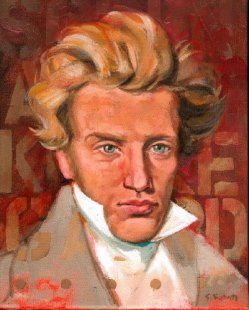
It’s great to see such a conference being organised. On top of having really awesome hair, Owen is arguably English Nonconformity’s most significant pastor and theologian. If you want a taste of his work, I highly recommend reading his Communion with God, his The Death of Death in the Death of Christ, as well as his excellent work on the Spirit (you could start with this one or with this CD). It’s also worth checking out Jim Gordon’s recent review of Carl Trueman’s book, John Owen, Reformed Catholic, Renaissance Man.

A conference blog has also been set up here.

Kierkegaard on reading Scripture

kierkegaard 2I wasn’t going to post on Kierkegaard today, but I came across this provocative statement in his Journal and thought it worth sharing. On face value, I suspect that many of us would disagree with what Kierkegaard is proposing here. Indeed, his own expository practice and adoration of Scripture might in itself challenge these thoughts. However, might he not be pressing on something that is important to hear in these days marked by both bibliolatry and bible neglect?

Fundamentally a reformation which did away with the Bible would now be just as valid as Luther’s doing away with the Pope. All that about the Bible has developed a religion of learning and law, a mere distraction. A little of that knowledge has gradually percolated to the simplest classes so that no one any longer reads the Bible humanly. As a result it does immeasurable harm; where life is concerned its existence is a fortification of excuses and escapes; for there is always something one has to look into first of all, and it always seems as though one had first of all to have the doctrine in perfect form before one could begin to live that is to say, one never begins.

The Bible Societies, those vapid caricatures of missions, societies which like all companies only work with money and are just as mundanely interested in spreading the Bible as other companies in their enterprises: the Bible Societies have done immeasurable harm. Christendom has long been in need of a hero who, in fear and trembling before God, had the courage to forbid people to read the Bible. That is something quite as necessary as preaching against Christianity’.

– Søren Kierkegaard, The Journals of Kierkegaard (ed. Alexander Dru; New York: Harper & Brothers, 1959), 150.

The immediate context of the excerpt sheds little light on what Kierkegaard is here calling for. Some pages earlier, however, he defends the necessity for a more sustained reflection on the truths to which Scripture bears witness: ‘It has constantly been maintained that reflection inevitably destroys Christianity and is its natural enemy. I hope, now, that with God’s help it will be shown that a godfearing reflection can once again tie the knot at which a superficial reflection has been tugging for so long. The divine authority of the Bible and all that belongs to it has been done away with; it looks as though one had only to wait for the last stage of reflection in order to have done with the whole thing. But behold, reflection performs the opposite service by once more bringing the springs of Christianity into play, and in such a way that it can stand up against reflection’. This seems to be Kierkegaard’s main concern here. He is not wanting to change ‘real Christianity’ so much as call upon Christendom to repent of its failure to posit Christian faith as that which is immediate, personal, and simple, even in its paradox. He challenges believers to abandon the false dichotomy between ‘reflection and simplicity armed with reflection’. This alone, he insists, is true sense. He writes: ‘The problem is not to understand Christianity but to understand that it cannot be understood. That is the holiness of faith, and reflection is sanctified by being thus used …’.

His provocative statement regarding Scripture is, in other words, motivated, it seems, by his deep concern that believers are failing to hear, and heed, the word of God which has become domesticated to their ears. ‘It is high time’, he writes, ‘that Christianity was taken away again from men in order to teach them to appreciate it a little’.

Trends

Trevor Cairney has recently shared on how research on families and demographic trends have demonstrated a number of significant changes in families and parental practices in recent decades. He summarises the trends under four headings:

  • Family structures are changing – e.g. there are less children in families, women are having children later in life, there are more sole parent households, there are more blended families, children stay at home longer (and many more return as adults) etc.
  • Employment structures are changing – that have an impact on families, with more parents working in multiple jobs, more women back in the workforce, many workers working longer hours, more people working from home etc.
  • Fathers and mothers have changed roles and levels of engagement as parents – While there is a trend towards some fathers spending more time caring for children, for others longer working hours have affected family life. As well, the increase in women doing paid work outside the home has led to more children in the critical first five years of life being placed in childcare.
  • Research has highlighted the critical role that fathers have – For example, fathers have a significant impact on their children’s learning and behaviour. The influence on children’s education alone (the quality of which is also correlated with many other behavioural factors) is significant, as a UK centre on fatherhood has outlined.


In a synthesis of five key UK studies Goldman (2005) concluded that higher involvement of fathers in their children’s learning alone is associated with:

  • better class and exam results;
  • higher educational expectations & qualifications;
  • better attitude to school, attendance & behaviour;
  • less delinquent & criminal behaviour;
  • higher quality family relationships; and
  • better mental health.

Other research has suggested that the influence of fathers and family structures flows well beyond children’s learning. Qu and Soriano (2004) conclude that family formation has important implications for individuals and society in relation to health and wellbeing, financial security, life outcomes for children and population growth.

Research also suggests that fathers who show affection, give support and yet offer an authoritative parenting style, have a more significant impact on their children, when compared with fathers who adopt a more authoritarian and detached style. Other evidence indicates that who the father is, and what he does in life makes a difference. For example, Goldman reports research that suggest that high levels of antisocial behaviour (eg, not paying bills, aggressiveness and so on) in fathers were associated with sons displaying more difficult behaviour at home and school.

In summary, what many research studies show is that fathers have a significant influence on the cognitive, emotional and social development of their children and that this is even more significant for boys.

What the Bible says about fathers and families?

The importance of families and the critical role of fathers are seen throughout the Bible. The concept of family is central to God’s plan for his creation and its restoration. The Bible teaches that relationships, like creation itself, were affected, disrupted and dislocated by sin in the Garden (the book of Genesis describes what happened). But God sustained his people in families and sought to restore them to their rightful place and adopt them into his own family (Paul’s letter to the Ephesians 1:4-5 talks about this). He continues to do so in spite of the curse that has been placed on family relationships as a result of sin, and the struggle that ensues between men and women (Gen 3:16). God’s plan to rescue his people ultimately involves family – his family!

Throughout the pages of the Old and New Testaments, family is important. The nation of Israel was one family, descended from Abraham. Within the nation that would rise up as a result of God’s promise to Abraham, there would be tribes defined around family lines and ultimately families within the family, all linked through fathers. Fathers are central to families in the Bible. Marriage in turn is seen as necessary to create a nuclear family – a man and woman, committed to each other in a covenant relationship, who seek to have and raise godly children (Mal 2:14-15).

Some practical implications

I can’t cover lots of implications in one post (but I might over a series of posts). There are many places I could turn to in the Bible for guidance, but there can be no better place than the advice that God gave to Moses to pass on to the Israelites in the desert before they entered the Promised Land. Having exhorted them to fear God and obey his commandments and to take care how they live (Deut 6:1-3), God gives instructions on how this is to be done within their families.

“Hear, O Israel: The LORD our God, the LORD is one. You shall love the LORD your God with all your heart and with all your soul and with all your might. And these words that I command you today shall be on your heart. You shall teach them diligently to your children, and shall talk of them when you sit in your house, and when you walk by the way, and when you lie down, and when you rise. You shall bind them as a sign on your hand, and they shall be as frontlets between your eyes. You shall write them on the doorposts of your house
and on your gates.”
(Deut 6:4-9)
God expected the men of Israel to obey his commandments and to love him with all of their being – heart, soul and strength. He also expected them to teach God’s commands and expectations to their children in the ‘everydayness’ of life. To talk about God when they sat together at home, when they walked from place to place, when they were preparing for bed and rest, and when they rose in the morning. They were to speak of God’s ways, to wear the words of God’s law on their foreheads (no I’m not about to suggest we re-introduce this practice that is still followed by some Jewish people), and write them on the doorposts and entrances to their houses, so that they would not forget them and so that they could teach them even more effectively to their children.

Here is a picture of a father with a right view of God, who trusts, obeys and serves his God and who seeks to teach his children to understand the wisdom of God and to follow him. This is also a picture of an involved father. If we were to translate this biblical picture into contemporary terms, we would see a father who seeks to obey and honour God, who sets a good example for his family, who models what it is to be a child of God. Such a father spends time with his children (indeed will ‘waste’ time with them), listens to them and shares godly wisdom at meal times, while resting, while together at home, while travelling.

(HT: The Importance of Fathers)