Review

Conversations with Poppi about God: A Review

Robert W. Jenson & Solveig Lucia Gold, Conversations with Poppi about God: An Eight-Year-Old and Her Theologian Grandfather Trade Questions (Grand Rapids: Brazos Press, 2006). 158 pages. ISBN: 97815874321613. Review copy courtesy of Brazos Press.

When was the last time you had a conversation about baptism, temptation, purgatory, time, economics, the Nicene Creed, creation, the Trinity, Christmas, metaphysics, church calendars, evil, indulgences, the Holy Spirit, liturgy, Lucifer, hamsters, a ‘really stupid’ bishop, the disestablishment of the Roman Church, the imago Dei, and a host of other things, all with the same person? When was the last time you did so with a person who just happens to be a world-renowned Lutheran, and ecumenical, theologian? When was the last time you did so with an eight-year-old who knows more about Dante than not a few philosophy undergrads?

In this remarkable book, we are invited to eavesdrop on a spontaneous and unscripted conversation between elementary schoolgirl Solveig Lucia Gold and her septuagenarian grandfather affectionately called ‘Poppi’, more formally known as the Reverend Canon Professor Dr. D. Robert W. Jenson, B.A., B.D., M.A., D.Theol., D.H.L., DD.

The book comprises the verbatim transcripts – with minor editing of ‘Ums’, ‘Well, buts …’ and ‘You knows…’, etc – of conversations recorded on a Radio Shack cassette recorder over a series of weekends in which Solveig visited her grandparents (‘Poppi’ and ‘Mimi’) in Princeton. After each session, Mimi typed it up.

The authors invite us to read their book ‘as you would a Platonic dialogue, though in this one, the role of Socrates goes back and forth’ (p. 10). Their discussion is more wide-ranging than most systematic theologies, and is filled with wit, warmth and wisdom.

Time for an example:

Solveig: How can God pick who goes to heaven or hell?

Poppi: By looking at Jesus, who loves you, Solveig.

Solveig: Can you show me?

Poppi: One way of saying what happened with Jesus is that Jesus so attached himself to you that if God the Father wants his Son, Jesus, back, he is stuck with you too. Which is how he picks you. (p. 20)

The young Episcopalian and her ‘sort of half Anglican and half Lutheran’ (p. 70) Poppi return to some themes a number of times over the weekends. One such theme that offers some of the book’s richest insights concerns the Spirit, or ‘God’s liveliness’ (p. 38), as the good Professor Dr Poppi likes to remind his granddaughter. Solveig tries on more than one occasion to argue a case that the second and third articles in the Creed ought to be reversed not only because ‘all of us share in the Spirit’ (Father and Son included), but also because that’s how you cross yourself. Poppi agrees, ‘Father, Spirit, Son is probably a better arrangement’ (p. 146). The Spirit is also ‘God’s own future that he is looking forward to’ (p. 42). They compare God’s liveliness with Santa Claus who is ‘sort of like a messenger from the Holy Spirit – in a way’ (p. 100), before coming to discern the spirits to see if they are from God, for whom to have Spirit means that he ‘doesn’t stay shut up in himself … but that the goodness and mercy – and wrath, when it comes to that – that is in God blows out from him to hit you and me. And that means that just like your spirit is yours and not mine, even though your spirit effects me, so God’s Spirit is his and not a spirit like Santa Claus’ (p. 101).

In between laughs, they talk about what it is about Holy Communion – Solveig’s ‘favourite part of going to church’ because she gets to ‘stretch and walk around a little’ (p. 31) – that means that ‘the wine should be the very best’ (p. 33) and that dissolvable bread should be banned. The meal should be appetising, and not like those baptisms ‘when they just dribble a couple of drops on the baby’ (p. 34). They also talk about a confirmation service led by ‘this weird bishop guy’ who is ‘really stupid’ (p. 34).

While I’m trying to resist the temptation to share every gem in the book (and there are lots), allow me one more, this time on heaven, purgatory, and hell:

Solveig: Do you think of where you might go after you die as two places or three places? I think of it as three places.

Poppi: What three is that?

Solveig: Heaven, purgatory, and hell.

Poppi: So you hold to the doctrine of purgatory?

Solveig: Yes.

Poppi: You know that is very controversial.

Solveig: Why? It’s in Dante, isn’t it?

Poppi: Well, it’s in Dante, yes. But of course, Dante isn’t exactly in the Bible.

Solveig: No. But he’s still …

Poppi: The thing about purgatory is that it’s a very reasonable idea. It’s just that we don’t know if it is true.

Solveig: Except … Maybe God thinks that you should just go to two places. If you are bad, he has no patience with you at all, and he will just sort you to go to heaven or hell. I think that is reasonable enough.

Poppi: That God is impatient?

Solveig: Yes.

Poppi: That’s where I think the notion of purgatory is reasonable. I don’t think the Bible talks about God’s being impatient in quite that way.

Solveig: If he isn’t impatient, maybe he doesn’t want us to spend time thinking about where we should go.

Poppi: You know that plate that your mother and father gave us that hangs on the wall in the dining room?

Solveig: Yes.

Poppi: Remember what it says on it?

Solveig: I don’t remember what it says.

Poppi: It says, ‘I desire not the death of the wicked.’

Solveig: ‘As I live, saith the Lord God, I have no pleasure in the death of the wicked.’

Poppi: Right. So the biblical God takes no pleasure in sending people to hell, and that’s why I think that purgatory is a reasonable idea. The problem is we don’t have any way of knowing whether the purgatory idea is true or not.

Solveig: It’s just Dante’s idea.

Poppi: Well, it was older than Dante.

Solveig: It was?

Poppi: Yes.

Solveig: Yes. Well, see, I think of Dante as a theologian, in a way.

Poppi: He was a very great theologian.

Solveig: Yeah, I know. I’m saying that he kind of liked to make up things he wasn’t quite sure about, if you know what I mean.

The delightful exchanges in this album offer us a model of how good theological dialogue can and should take place: with mutual respect and humility which delights in both the giving and the receiving; with an eye on the scripture, an eye on the tradition, and an eye on the world (for those who possess at least three eyes); and within an environment of safety in which no idea is too whacky and no avenue of enquiry cut off prematurely.

Carl Braaten’s words regarding this book are worth repeating,

Robert Jenson has created a new medium, with his granddaughter Solveig, to teach the basics of the Christian faith. Just as Martin Luther wrote his Small Catechism for children, this book of conversations covers the beliefs and practices of the Christian church – among them the commandments, the Lord’s Prayer, the Creed, and the sacraments – in a way that parents, regardless of their denomination, can confidently read and discuss with their children. Robert Jenson has translated the core convictions of his two volumes of Systematic Theology into simple truths that his eight-year-old grandchild can understand in the course of their unrehearsed and lively conversations. If you want to know what a sophisticated theologian really believes, listen to him explain the mysteries of the Christian faith to a child in simple terms without being simplistic.

Conversations with Poppi about God: A Review

Robert W. Jenson & Solveig Lucia Gold, Conversations with Poppi about God: An Eight-Year-Old and Her Theologian Grandfather Trade Questions (Grand Rapids: Brazos Press, 2006). 158 pages. ISBN: 97815874321613. Review copy courtesy of Brazos Press.

When was the last time you had a conversation about baptism, temptation, purgatory, time, economics, the Nicene Creed, creation, the Trinity, Christmas, metaphysics, church calendars, evil, indulgences, the Holy Spirit, liturgy, Lucifer, hamsters, a ‘really stupid’ bishop, the disestablishment of the Roman Church, the imago Dei, and a host of other things, all with the same person? When was the last time you did so with a person who just happens to be a world-renowned Lutheran, and ecumenical, theologian? When was the last time you did so with an eight-year-old who knows more about Dante than not a few philosophy undergrads?

In this remarkable book, we are invited to eavesdrop on a spontaneous and unscripted conversation between elementary schoolgirl Solveig Lucia Gold and her septuagenarian grandfather affectionately called ‘Poppi’, more formally known as the Reverend Canon Professor Dr. D. Robert W. Jenson, B.A., B.D., M.A., D.Theol., D.H.L., DD.

The book comprises the verbatim transcripts – with minor editing of ‘Ums’, ‘Well, buts …’ and ‘You knows…’, etc – of conversations recorded on a Radio Shack cassette recorder over a series of weekends in which Solveig visited her grandparents (‘Poppi’ and ‘Mimi’) in Princeton. After each session, Mimi typed it up.

The authors invite us to read their book ‘as you would a Platonic dialogue, though in this one, the role of Socrates goes back and forth’ (p. 10). Their discussion is more wide-ranging than most systematic theologies, and is filled with wit, warmth and wisdom.

Time for an example:

Solveig: How can God pick who goes to heaven or hell?

Poppi: By looking at Jesus, who loves you, Solveig.

Solveig: Can you show me?

Poppi: One way of saying what happened with Jesus is that Jesus so attached himself to you that if God the Father wants his Son, Jesus, back, he is stuck with you too. Which is how he picks you. (p. 20)

The young Episcopalian and her ‘sort of half Anglican and half Lutheran’ (p. 70) Poppi return to some themes a number of times over the weekends. One such theme that offers some of the book’s richest insights concerns the Spirit, or ‘God’s liveliness’ (p. 38), as the good Professor Dr Poppi likes to remind his granddaughter. Solveig tries on more than one occasion to argue a case that the second and third articles in the Creed ought to be reversed not only because ‘all of us share in the Spirit’ (Father and Son included), but also because that’s how you cross yourself. Poppi agrees, ‘Father, Spirit, Son is probably a better arrangement’ (p. 146). The Spirit is also ‘God’s own future that he is looking forward to’ (p. 42). They compare God’s liveliness with Santa Claus who is ‘sort of like a messenger from the Holy Spirit – in a way’ (p. 100), before coming to discern the spirits to see if they are from God, for whom to have Spirit means that he ‘doesn’t stay shut up in himself … but that the goodness and mercy – and wrath, when it comes to that – that is in God blows out from him to hit you and me. And that means that just like your spirit is yours and not mine, even though your spirit effects me, so God’s Spirit is his and not a spirit like Santa Claus’ (p. 101).

In between laughs, they talk about what it is about Holy Communion – Solveig’s ‘favourite part of going to church’ because she gets to ‘stretch and walk around a little’ (p. 31) – that means that ‘the wine should be the very best’ (p. 33) and that dissolvable bread should be banned. The meal should be appetising, and not like those baptisms ‘when they just dribble a couple of drops on the baby’ (p. 34). They also talk about a confirmation service led by ‘this weird bishop guy’ who is ‘really stupid’ (p. 34).

While I’m trying to resist the temptation to share every gem in the book (and there are lots), allow me one more, this time on heaven, purgatory, and hell:

Solveig: Do you think of where you might go after you die as two places or three places? I think of it as three places.

Poppi: What three is that?

Solveig: Heaven, purgatory, and hell.

Poppi: So you hold to the doctrine of purgatory?

Solveig: Yes.

Poppi: You know that is very controversial.

Solveig: Why? It’s in Dante, isn’t it?

Poppi: Well, it’s in Dante, yes. But of course, Dante isn’t exactly in the Bible.

Solveig: No. But he’s still …

Poppi: The thing about purgatory is that it’s a very reasonable idea. It’s just that we don’t know if it is true.

Solveig: Except … Maybe God thinks that you should just go to two places. If you are bad, he has no patience with you at all, and he will just sort you to go to heaven or hell. I think that is reasonable enough.

Poppi: That God is impatient?

Solveig: Yes.

Poppi: That’s where I think the notion of purgatory is reasonable. I don’t think the Bible talks about God’s being impatient in quite that way.

Solveig: If he isn’t impatient, maybe he doesn’t want us to spend time thinking about where we should go.

Poppi: You know that plate that your mother and father gave us that hangs on the wall in the dining room?

Solveig: Yes.

Poppi: Remember what it says on it?

Solveig: I don’t remember what it says.

Poppi: It says, ‘I desire not the death of the wicked.’

Solveig: ‘As I live, saith the Lord God, I have no pleasure in the death of the wicked.’

Poppi: Right. So the biblical God takes no pleasure in sending people to hell, and that’s why I think that purgatory is a reasonable idea. The problem is we don’t have any way of knowing whether the purgatory idea is true or not.

Solveig: It’s just Dante’s idea.

Poppi: Well, it was older than Dante.

Solveig: It was?

Poppi: Yes.

Solveig: Yes. Well, see, I think of Dante as a theologian, in a way.

Poppi: He was a very great theologian.

Solveig: Yeah, I know. I’m saying that he kind of liked to make up things he wasn’t quite sure about, if you know what I mean.

The delightful exchanges in this album offer us a model of how good theological dialogue can and should take place: with mutual respect and humility which delights in both the giving and the receiving; with an eye on the scripture, an eye on the tradition, and an eye on the world (for those who possess at least three eyes); and within an environment of safety in which no idea is too whacky and no avenue of enquiry cut off prematurely.

Carl Braaten’s words regarding this book are worth repeating,

Robert Jenson has created a new medium, with his granddaughter Solveig, to teach the basics of the Christian faith. Just as Martin Luther wrote his Small Catechism for children, this book of conversations covers the beliefs and practices of the Christian church – among them the commandments, the Lord’s Prayer, the Creed, and the sacraments – in a way that parents, regardless of their denomination, can confidently read and discuss with their children. Robert Jenson has translated the core convictions of his two volumes of Systematic Theology into simple truths that his eight-year-old grandchild can understand in the course of their unrehearsed and lively conversations. If you want to know what a sophisticated theologian really believes, listen to him explain the mysteries of the Christian faith to a child in simple terms without being simplistic.

Nonconformist Theology in the Twentieth Century: A Review

Alan P.F. Sell, Nonconformist Theology in the Twentieth Century (Milton Keynes: Paternoster, 2006). 239 pages. ISBN: 9781842274712. Review copy courtesy of Paternoster/Authentic Books.

Readers already familiar with Professor Alan P. F. Sell’s writing will know that he is a meticulous researcher whose reading is extensive (much of the material cited is now well out of print), whose commitment to ecumenism is exemplary, whose love for, and devotion to, the nonconformist tradition is contagious, whose acumen for critically identifying contemporary theological trends is cultivated and well coached, whose affection for PT Forsyth – and the centrality of the Cross in Forsyth’s thought – is laudable, whose writing betrays not a few hours of pastorally-informed reflection, and whose ability to get to the heart of things with an elegant economy of words makes not a few of his readers (including me) jealous. If all these accolades are accurate, then this published set of Alan Sell’s 2006 Didsbury Lectures is classic Sell, and Nazarene Theological College is to be congratulated for extending the invitation to Professor Sell to give these four distinguished lectures; furthermore, Paternoster are to be saluted for continuing to publish the series of which these lectures form a part. Certainly, here Sell deservedly joins the ranks of some distinguished scholars.

Despite significant works by historians Clyde Binfield, Dale Johnson, David Bebbington, Mark Hopkins, and Jim Gordon, and the wonderful 4-volume series of Protestant Nonconformist Texts, Paternoster’s Studies in Evangelical History and Thought series, and numerous other works by Sell himself, it could still be argued that too little ink has been spilt in recent years exploring the enormously rich contribution that nonconformist theologians have made, and continue to make, to theological conversation and Church life. Sell’s book needs to be considered as one of many – and one of the best – that continue to fill a gap in this area.

Nonconformist Theology in the Twentieth Century is broad in its scope, offering a well-textured balance of historical contextualisation, theological grappling, contemporary application, and anecdotal stories. Areas of divine providence, the New Theology (associated with RJ Campbell), baptism, Feminist Theology, Natural Theology, Process Theology, Calvinism, God’s Fatherhood, merely-Incarnational theology, the reception of Karl Barth into British theological conversation, and contemporary theological education all fall under Sell’s discerning gaze.

In the first lecture, Sell provides an erudite survey, a ‘bird’s-eye-view of the landscape’ (p. 38) of Protestant Nonconformist theology in the twentieth century, particular the century’s first half. The historical terrain, theological motifs, and ecclesiological realities, and their ongoing relevance for understanding and informing contemporary theological thought, debate and practice are all well covered in this chapter, which sets the tone for the remaining three.

Sell then turns in Lecture Two to the ‘doctrinal peaks’ of Christology (pp. 41–66), Pneumatology (pp. 66–71), the Trinity (pp. 71–84), and confessions of faith (pp. 84–89), attending fruitfully to each within their historical context while harnessing contributions from an enormous range of nonconformist theologians. Resisting the temptation to here rehearse multiple citations, I will offer just this one:

‘No Nonconformist theologian did more in the last two decades of the twentieth century to place the Trinity in the centre of theological debate than Colin Gunton. So all-embracing is his Trinitarian vision (an analogy might be drawn with the centrality of the Cross in the writings of P.T. Forsyth) that it is difficult to place him in a study of this kind’. (p. 81)

In the third chapter, Sell turns to discuss one of his great passions: ecumenism. Herein he seeks to address a number of questions: How did the mainline Nonconformist traditions understand themselves in the twentieth century? How did they reach out to one another and to more distant communions during the so-called ‘ecumenical century’? Is their traditional witness as Free Churchpeople still required, or even viable? Sell provides an at times provocative discussion on the relationship between Protestantism and Roman Catholicism (pp. 91–96), wherein he cites favourably the Congregationalist historian Bernard Lord Manning: ‘Protestantism … is not the opposite of medieval Catholicism: it is simply an improved kind of catholicism. Protestantism is not a negative thing. It is a positive re-statement of catholic truth’ (p. 93). True catholicity, Sell argues, is not found in a book, nor in a church, but in that true authority over book, Church and conscience – Jesus Christ, and the effectual word of his Cross, ‘to which the conscience owes its life’ (P.T. Forsyth, Rome, Reform and Reaction, 136). It is not here only that Sell walks abreast with Forsyth.

Professor Sell then accents the many published nonconformist studies on ecclesiology. It is a breathtaking reminder of the central place that ecclesiology has played in informing nonconformist theology, from John Oman to R. Newton Flew to Lesslie Newbigin and Daniel Strange. He notes that while all these contributors were not singing the same part, and ‘occasionally a faintly discordant note was struck’, they were ‘clearly singing in the same choir’ (p. 99), which is a fresh reminder of the breadth within the tradition. In more than one way were these theologians non-conformists.

With a newly sharpened pencil, this internationally known scholar of ecumenical studies turns our attention to ‘an abiding issue of global significance’ (p. 136): that of the historic episcopate. After noting that nonconformists are not simply Protestants but ‘Free Church people’, and as such have played significant roles in various ecumenical councils, he witily suggests that ‘the question for us now is whether there is any theological topic distinctive of Free Churches as a whole and not of one denomination only, on which the Nonconformists of England might be expected to speak with a united voice? Living alongside the only remaining Anglican established Church as they do, the obvious candidate is the establishment question’ (p. 136). Sell recalls that nonconformists have not been those who have denied the necessity of the state recognition of religion; ‘it was, after all, the state which accorded religious toleration’ (p. 137). Nonconformists have well understood the appropriateness of proper Church-state relations, but have (rightfully) questioned the very principal of a national church. Again, he cites Forsyth: ‘What we protest against is not the abuses but the existence, the principle, of a national church’. The very existence of a state church denies the Church’s catholicity. Again, Forsyth: ‘However Establishment may seem to work at a given time, the thing is wrong … For my own part, any doubt of the truth of our Nonconformist principles would mean doubt of the truth of what is most distinctive in Christianity itself – free faith, free action, and free giving, as the response of men who have been moved and changed and controlled by the free gift of God and grace in Jesus Christ’ (P.T. Forsyth, The Charter of the Church, 32). A state church is, as Congregationalist John Whale once noted, a ‘contradiction in terms’ (p. 139). Rightly suspicious of attempts towards dialogue in the past that were based on purely pragmatic principles, Sell looks hopefully towards the future, and towards those Anglicans and Free Church folk who are currently engaged in discussion about issues of establishment. He pleads: ‘May their outlook be ecumenical and their thoughts in the first place be theological’ (p. 144).

The final chapter, entitled ‘Rivers, Rivulets – and Encroaching Desert?’, turns our attention to eschatology, the atonement, and a collection of other themes that Sell identifies as important for understanding nonconformist theology, but have largely been overlooked in the preceeding chapters. He recollects that debates concerning the final fate of the impenitence were hotly contested, not least by Unitarians. Sell’s focus here is mainly on notions of universalism, annihilationism and the possibility of post-mortem probation. The discussion is fascinating, revealing again that there really is nothing new under the sun. I will limit myself here to one quotation. Sell introduces us to Sydney H. Mellone, Principal of Manchester Unitarian College, and his 1916 work Eternal Life Here and Hereafter. Mellone writes,

The assertion, sometimes made, that Universalism means in effect ‘it does not matter what we do, for we shall be all right in the end’ is unworthy of discussion. Universalism rests on the same foundation on which rests our belief in the eternity of goodness and truth in God … The ethical motive of belief in immortality means that compensation and retribution, to be real, must be redemptive. The religious motive means that final communion with God is the destiny of every soul, and not alone of those who know in this present by living experience what such communion is. The chief end of man is to glorify God and enjoy him for ever. (cited on p. 150.)

The chapter, and the book, concludes with Sell offering some hard hitting words as he critically reflects on the demise of the Church’s vocabulary, the integrity-eroding effects of political correctness on inter-faith dialogue, the revival of interest in the Trinity during the last 30 years, the side-lining of the atonement in the Church’s proclamation, the necessity for theologians to not merely speak ‘from faith to faith’ but to commend the faith to others, and the current state of theological education, particularly in England. On the latter, and in the same manner as his champion PT Forsyth, Sell argues that the Church desperately needs a more thoroughly trained clergy than it is currently receiving.

As a devoted churchman who served two pastorates in the United Kingdom from 1959 to 1968, and who has served internationally as a theological educator since, and so not unaware of the practical and financial hurdles that pastoral ministry candidates, their churches and their colleges are often forced to jump, Sell urges churches to take steps to ‘ensure that their younger candidates at least receive a full and rigorous academic course. If this means fewer visits to hospitals and prisons during a candidate’s college years, so be it; required in-service training for licensed probationers prior to ordination is not impossible to provide, and it is never more readily received than by those at the pastoral “coal face”.’ He continues,

I see no viable substitute for practitioners’ having a solid grounding in the Bible, a thorough acquaintance with the history of Christian thought (which is broader than historical theology, but includes both it and the linguistic competence to read salient texts), and sufficient philosophical-analytical skills to probe presuppositions, analyse arguments and avoid the writing of incoherent gobbledegook. None of this is achieved without real time and effort; and the churches would do well to encourage in all possible ways those ministerial candidates whose gifts take them in these directions, and whose academic lungs can withstand prolonged immersion in extensive and sometimes choppy waters (p. 191).

At times throughout the book, Sell makes claims that invite clarification and further comment. For example, he states that ‘there is a common defining essence underlying all genuine religious phenomena’ (p. 37). Does he have something like Otto’s notion of holiness in mind here [which I have written on here, here, here, here and here], or Feuerbach, or something else? I would have liked Sell to unpack this just a little. But this is really an insignificant squabble. More disappointing is the fact that Sell spills comparatively little ink on the second half of the century to which the title of his book flags. Apart from infrequent and brief discussions of the contributions of Paul Fiddes and Colin Gunton, by and large the lectures are heavily weighted towards the century’s first half which, to be fair, is by far where most of the material published by twentieth century nonconformist was birthed. As a consequence, the albeit scarcity of significant contributions from within Pentecostalism, the Brethren, Black churches, and independent evangelical churches are all but ignored. (This says more about the dearthly state of more recent nonconformist scholarship in England than it does about Sell’s treatment of the material.) Congregationalist, which receives the most attention, Baptist, Methodist and Unitarian contributions are, however, well represented. Some readers may also be disappointed that Sell limits his discussion to the nonconformist scene in England and, to some extent, in Wales. While a book that seriously took in any more would expand the book’s length considerably (and I think in this case with little profit), perhaps the title of the book could have been more revelatory here. That said, the book is no poorer for that.

The volume includes a helpful list of biographical references of some of the major personalities discussed in the lectures, as well as an impressive bibliography. Those concerned with the life and theological contribution of the nonconformist family specifically, and those interested in the shape that theology took in twentieth-century Britain more generally (and may be taking in this century) will be prodigiously served by reading this book. An encyclopedic, but accessible, study!

An Introduction to Torrance Theology: A Review

Gerrit Scott Dawson (ed.), An Introduction to Torrance Theology: Discovering the Incarnate Saviour (London: T&T Clark, 2007). viii + 179 pages. ISBN: 9780567031815. Review copy courtesy of Continuum.

The year was 2001. I was away on holidays in Echuca, ‘the paddlesteamer capital of Australia’. The previous week had seen a serious number of books turn up in my letterbox – just in time to take them away in anticipation of finding some space to peruse them. As usual, I was overly ambitious about just how many books I would ‘get through’. In fact, the only book I remember reading (and then re-reading) that holiday was the just-released How to Read T.F. Torrance: Understanding His Trinitarian & Scientific Theology, by Elmer M. Colyer. I remember the doxology that accompanied the reality that someone had finally put together an introduction – and a stunning one at that – to the thought of the most significant British (and arguably English-speaking) theologian this century. I also remember thinking that as richly profitable as Colyer’s introduction is, its size (393 pages) and depth would probably (and unfortunately) be a barrier to many who are not ready for a Torrance main course, and that I hope that someday someone writes a briefer (but no less constructive) entrée to TF Torrance’s thinking.

Finally, that day has come with the arrival of An Introduction to Torrance Theology: Discovering the Incarnate Saviour. The book is precisely what its editor, Gerrit Scott Dawson, claims: a welcoming and accessible introduction ‘for those just testing the Torrance theological waters, yet intellectually rigorous enough for serious engagement by fellow scholars’ (p. vii), opening up and inviting us to explore new theological vistas.

The volume consists of a diverse collection of papers delivered in March 2006 at the First Presbyterian Church of Baton Rouge, Louisiana (USA). It was the largest-ever gathering of scholars (many of whom are former students of a Torrance; a testimony in itself to the ongoing contribution that the Torrances have made, and continue to make, not just in Scotland but around the world) who had come together specifically to reflect on (and celebrate) the theological distinctives and contributions of a family that has for more than six decades had an extraordinary influence on theological and pastoral work, the brothers Torrance – David, Tom and James. The church team, and T&T Clark, is to be congratulated for hosting such an exceptional event, and publishing its fruits.

The anthology begins with a piece by David Torrance wherein he briefly but illuminatingly introduces us to the Torrance family traditions and theological values that have informed their Christ-centered theology. On the way, he gives us an insight into the devotional and pedagogical life of the home in which he, Thomas and James were raised – a life characterised by family worship, prayer and the reading and memorisation of Scripture. As children, the Torrances were introduced to Luther on Galatians, Robert Bruce on the Sacraments, and Calvin’s Institutes. (Apparently, they never watched the antediluvian equivalent of The Simpsons!) He properly reminds us that the Torrances, though deeply honoured by the consideration given to their work, would wish to resist any suggestion of a ‘Torrancian theology’: ‘We have given our understanding of the Word of God. We encourage members of the Church to read the Bible and discover for themselves what God is saying and discover whether what we have said helps towards a deeper understanding of the gospel once committed to the saints and treasured by the evangelical church through the centuries’ (p. 1). As this volume bears witness, many have certainly been so helped.

Andrew Purves explores the christological question: ‘Who Is the Incarnate Saviour of the World?’ and its priority over the attendant ‘How’ questions. He attends to the significance and priority of beginning all theology with the person of Jesus Christ. Christology precedes soteriology, and ought be given first and controlling place in any creed. He argues that Jesus Christ is him who entered into our weak, fallen, and rebellious humanity, penetrating to its very heart in its alienation and rebellion in order to redeem humanity and all creation. He suggests that evangelicals are too often not radical enough in thinking through the meaning and centrality of Jesus Christ, and too ready to replace him in priority with foundationalist, previously determined and independently derived, theistic and metaphysical assumptions that are then ‘clamped down upon the gospel’ (p. 29).

In his compelling essay, Elmer M. Colyer turns our attention to T. F. Torrance’s thinking on the atonement, reminding us that this Torrance’s mission has been to clarify the deep structures that are embedded in the very reality of the gospel itself. Colyer is concerned to highlight that in no sense (and at no stage) does the incarnation drive a wedge between the three persons. A significant proportion of his essay, however, is given to the matter of Christ’s assumption of fallen humanity and the need to qualify the judicial elements in the atonement in light of the tendency in Western theology, from the fifth century on, to embrace the notion that Christ assumed a ‘perfect’ or ‘neutral’ human nature. This Torrance coins the Latin heresy, suggesting that Christ’s atoning sacrifice, in this view, can only be understood in terms of external relations between Christ and humanity’s sin. The ‘Latin heresy’, it is understood, undermines believers’ assurance and confidence that our great High Priest really has entered the brink in his full identification with humanity, and so can truly sympathise with us in our weakness. Torrance, Colyer writes, ‘develops a participatory scientific theology in which our actual knowledge of God, that comes to us in and with God’s atoning self-communication through Jesus Christ and in his Spirit, calls into question all alien presuppositions and prior conceptual frameworks embodying what we think we know about God, for everything in theology has to be related to God’s Trinitarian self-revelation and self-communication to us in the gospel’ (p. 33). Like Purves, Colyer concludes his essay with a brief recapitulation of T. F. Torrance’s twin rejection of the two heresies of limited atonement and universalism.

The important notion of Christ’s assumption of fallen humanity, found so richly in John McLeod Campbell and replayed in the Torrance’s theology, is further taken up in Gerrit Scott Dawson‘s study, ‘Far as the Curse is Found: The Significance of Christ’s Assuming a Fallen Human Nature in the Torrance Theology’. Dawson grants considerable space in his paper to the posse non peccare debate in christology.

Douglas F. Kelly outlines T. F. Torrance’s realist epistemology, arguing that Torrance’s biblical and scientific realism is ‘his greatest contribution to the theological life and mission of the Church for ages to come’ (p. 75).

In Alan J. Torrance‘s moving essay, ‘Towards a Theology of Belonging: Key Themes in the Theology of J. B. Torrance’, Alan honours his father by reaffirming truths that lay at the centre of his father’s, and his own, theological heart: the distinction between indicatives and imperatives in the covenant, a filial rather than legal relationship between humanity and God, and evangelical versus legal repentance. Significant space is devoted to the great overarching theme of all these: covenant. God’s covenant with humanity is unconditioned by human response, is unilateral and is not – in any sense of the word – a contract. He writes: ‘To translate God’s covenantal relationship into contractual terms in order to manipulate people into either repentance or conversion clearly amounts to a betrayal of the life of the Body of Christ and the form of our participation in God’s Triune life. It is to supplant the free, loving and transforming activity of the Holy Spirit, with the worldly manipulation of people’s self-interest – by either the use of fear or the promise of reward’ (p. 106).

Graham Redding, who was I believe one of Alan’s students in New Zealand, offers us a helpful reflection on Reformed theology and current trends in worship entitled ‘Calvin and the Café Church’. Commenting on the emerging church, he suggests that ‘many developments and experiments in worship that accompany talk about the emerging church are taking place in a theological vacuum. Ignorance of the classic liturgies and what they have meant to the Church down the centuries, ignorance of the liturgical theology of Calvin and Knox [he is a Presbyterian!], ignorance of the role of ordained ministry, will lead ultimately to an impoverishment of Reformed worship and a detachment of corporate worship from its Reformed, early church and indeed Jewish roots. Some would argue that that is happening already. Marva Dawn, for example, talks about the dumbing down of worship right across the Church. That which we regard at one time as bravely navigating uncharted waters could with the benefit of hindsight turn out to be symptomatic of us having lost our way’ (p. 131).

Gary W. Deddo‘s essay reminds us just how practically- and pastorally-informed the gospel that the Torrance brothers have dedicated their life to preaching is, with weighty pertinence for how we understand and practice prayer, social justice, racial reconciliation, worship, evangelism, church renewal, mission, and pastoral ministry – indeed, all of life. The Christian life truly is a participation in Christ’s continuing ministry.

The final chapter, ‘The Hermeneutical Nightmare and the Reconciling Work of Jesus Christ’, is an offering from one of James Torrance’s former students, C. Baxter Kruger in which he creatively reiterates the revelation of the Father’s heart in the ministry of the Father’s Son. Echoing many of the themes in his books, and not least his latest publication Across All Worlds, Baxter – with all the passion of a great evangelist who is convinced that what he has to share really is good news – contends that Jesus wants his Father known. He is passionate about it. He cannot bear for us to live without knowing his Father, without knowing his heart, his lavish embrace, his endless love – and the sheer freedom to be that works within us as we see his Father’s face. Jesus knows the Father from all eternity. He sits at his right hand and sees him face to face, and shares life and all things with him in the fellowship of the Spirit. How could he be content, Kruger asks, to leave us in the dark with no vision of his Father’s heart? How could the Father’s Son be indifferent when we are so lost and afraid and bound in our mythology? Burning with the Father’s love for us, inspired with the Spirit’s fire, the Son ran to embrace our broken existence, baptising himself into our blindness. He braved the seas of our darkness to come to us. Why? So that he could share with us his own communion with his Father in the Spirit, and we could know the Father with him, and taste and feel and experience life in his embrace (p. 157).

The volume helps to clarify many of the areas of contention in the Torrance tradition (for example, the notion of Christ’s assumption of fallen flesh, the rejection of any suggestion of limited atonement, and christological universalism receive adequate treatment by not a few of the essayists), while recapitulating some of the great themes of the gospel so central to the heart and thinking of its main proponents. I would have loved to have seen included a paper identifying the critical sources to the Torrance brothers’ thinking, especially Athanasius, the Cappadocian Fathers, John Knox, Robert Bruce, Thomas Erskine, Edward Irving, John McLeod Campbell, Karl Barth, and others. (McGrath’s biography of T. F. Torrance is most helpful here). The collection betrays some of the realities of repetition that inevitably accompany any group of papers which concern themselves with the heart of any tradition. This, however – at least to this reviewer – is a picayune and inconsequential price to pay for being reminded of such significant realities and of the enormous debt we owe to this extraordinary family for faithfully re-making these gospel realities known. An Introduction to Torrance Theology: Discovering the Incarnate Saviour is the most accessible introduction of which I am aware to TF and JB Torrance’s exceptional legacy and thought, serving as a brilliant teaser to go and read the primary works themselves. Each contributor explores the contemporary relevance of Torrance Christology, and areas of ecclesiology, missiology, pastoral ministry and epistemology are all helpfully attended to. Those who devour this excellent entrée will no doubt go on to indulge likewise with the main course (I suggest The Mediation of Christ, and Worship, Community & the Triune God of Grace). An absolute delight to read, and commend!

Across the Spectrum: A Review

Gregory A. Boyd & Paul R. Eddy, Across the Spectrum: Understanding Issues in Evangelical Theology (Grand Rapids: Baker Academic, 2006). 287 pages. ISBN: 9780801022760. Review copy courtesy of Baker Academic.

‘What Christ has done for me’, announced PT Forsyth, ‘has become possible only by what He did even more powerfully for others whose faith and experience have been deeper and richer than mine, but who reflect my experience all the same, even while they diversify and enlarge it mightily. Standing over my experience is the experience of the whole evangelical succession’. What Forsyth reminds us of here is of the great breadth and depth within the Christian tradition, a breadth and depth to be appreciated, studied and celebrated.

The purpose of this book by Gregory A. Boyd and Paul R. Eddy is precisely to appreciate, study and celebrate this diversity within one dominant Christian tradition, and to introduce evangelical college students ‘to the positions evangelicals take on various disputed topics. Each position is argued from the perspective of one defending the position and is therefore presented as persuasively as possible’ (p. 6). The book assumes a distinctly liberal arts approach to theological study, presupposing that the teacher’s job is not indoctrination of one particular position, but rather to introduce students to a variety of perspectives while providing students with the tools to think critically for themselves.

Five presuppositions are identified by the authors: First, the goal of this book is not to present a balanced overview of Christian doctrine. Second, this book considers only options that are discussed and embraced within evangelicalism, defined by a commitment to the core beliefs of historic, orthodox Christianity as expressed in the ecumenical creeds and to the primacy of Scripture in all matters of faith and practice. The authors’ decisions concerning what constitutes ‘major’ and ‘minor’ issues are governed mostly by their own assessment of how lively a particular debate rages within the evangelical family. Third, the book promises only an introduction to the diverse positions within evangelicalism. Thus, along with space limitations, each chapter is intentionally non-technical and general in nature. This it does very well. Fourth, the theological criteria assumed is that proposed by John Wesley’s quadrilateral: Scripture, tradition, reason and experience. Fifth, each chapter follows the same basic outline: Firstly, a brief section introduces each topic. This is followed by an outline of common ground evangelicals share on the topic then a note of the different views evangelicals embrace concerning the topic. Next, major differing perspectives are presented and defended, utilising the quadrilateral when appropriate. Each chapter concludes by refuting objections to the position under discussion.

The various chapters are given to discussing the following questions:

  1. The Inspiration Debate (Inerrantist, Infallibilist)
  2. The Providence Debate (Calvinist, Armenian)
  3. The Foreknowledge Debate (Classical, Open)
  4. The Genesis Debate (Young Earth, Day-Age, Restoration, Literary Framework)
  5. The Divine Image Debate (Substantival, Functional, Relational)
  6. The Human Constitution Debate (Dichotomist, Trichotomist, Monistic)
  7. The Christology Debate (Classic, Kenotic)
  8. The Atonement Debate (Penal Substitution, Christus Victor, Moral Government)
  9. The Salvation Debate (Calvinist, Armenian)
  10. The Sanctification Debate (Lutheran, Calvinist, Keswick, Wesleyan)
  11. The Eternal Security Debate (Eternal Security, Conditional Security)
  12. The Destiny of the Unevangelized Debate (Restrictivist, Universal Opportunity, Post-Mortem Evangelism, Inclusivist)
  13. The Lord’s Supper Debate (Spiritual Presence, Memorial)
  14. The Baptism Debate (Believer’s Baptism, Infant Baptism)
  15. The Charismatic Gifts Debate (Continuationist, Cessationist)
  16. The Women in Ministry Debate (Complementarian, Egalitarian)
  17. The Millennium Debate (Premillennial, Postmillennial, Amillennial)
  18. The Hell Debate (Classical, Annihilationist)

The chapters I found most helpful were 3, 7, 10 and 12.

In addition, an online appendix is given to discuss the following topics:

  1. How Should Evangelicals “Do” Theology? The Theological Method Debate
  2. The Psychological and Social Models of the Trinity
  3. Was Noah’s Flood Global or Local?
  4. Must Wives Submit to their Husbands?
  5. Christians and Politics: Three Views
  6. What Happens to Babies Who Die?
  7. The Debate of the Baptism in the Holy Spirit
  8. Is Speaking in Tongues the Initial Evidence of Receiving the Baptism of the Holy Spirit?
  9. Can a Christian be Demonized?
  10. The Debate over the Book of Revelation
  11. Has Jesus Already Returned? The Preterist Debate
  12. When Will Jesus Return? The Rapture Debate.

Boyd and Eddy provide the entering year theology student or interested lay person with an accessible introduction to some of the burning points of debate amongst conservative evangelicals, introducing readers to major strands in the tradition of which they may be unaware or ignorantly dismissive of. While their selection (rather than their definition) of what constitutes the ‘hot spots’ of evangelical theology betrays something more North American than I am familiar with, Boyd and Eddy’s representations of the various positions are fair and respectful. The volume also includes a useful glossary and a good list of resources for further reading.

Any volume endeavouring to cover such a broad sweep of topics will inevitably fail to address the favourite topics of many of its readers, and this book is no different. The topics covered understandably betray a focus on North American evangelicalism (indeed, some of the non-American related facts are just plain wrong; for example, Keswick is not ‘a seaside English town’ (p. 156)), though there is enough here to inform the reader from anywhere, not least those with some discerning selectivity of chapter readings.

Two smallish reservations: First, the volume could have provided a little more engagement with how ideas develop and are shaped throughout history. Second, the chapter, ‘The Hell Debate, fails to offer as an alternative ‘evangelical’ view the notion of christological universalism, even though this position is increasingly gaining adherents among confessing evangelicals and the authors are content to include George McDonald as a ‘noteworthy evangelical’ (p. 187). Other omissions (even from the appendix) include evangelical convictions regarding war and pacifism, regarding divorce and remarriage, and regarding tithing.

That said, Across the Spectrum is a really useful introductory volume for the student, and a helpful model for the teacher, proving again that what we call ‘evangelical theology’ is kaleidoscopic, versatile and diversiform.

Jesus: A Question of Identity: A Review

JESUS: A QUESTION OF IDENTITY. By J. L. Houlden. London/New York: Continuum, 2006. Pp. vii + 136. $19.95, ISBN: 9780826489418.


At a time when the print run of new books seems to expire almost while the ink is still drying on the copies as they first arrive on the shelf, any volume that is still being republished fourteen years after its initial appearance probably ought to deservedly attract our attention.


In this primer, which grew out of lectures given at King’s College, University of London, J. Leslie Houlden, Emeritus Professor of Theology at King’s College, cogently interweaves together history, biblical studies, theology and apologetics in an effort to explore what we can know about Jesus. While not shying away from some of the perennial ‘problems’ and tensions involved in such a quest, Houlden, with eloquence, humility and non-technical style, invites his readers to engage seriously with the question of Jesus’ identity, not only as a Galilean carpenter’s son, but as God’s; as not merely the object of cool enquiry but as the subject and centre of living faith. He asks: ‘What are we now to make of Jesus, both as a historical figure and as involved with belief?’ (pp. 8–9).


Houlden is acutely aware that with the history of Jesus, both as recorded in the centuries following his death, and its subsequent developments, we have to do with interpreted history. ‘In this sense’, he writes, ‘theology takes precedence over history in the Christian story’ (p. 11). ‘The Gospels’, he contends, ‘are slanted. They were not written to answer our modern questions, about the order of events, causality and psychological awareness, but to commend faith’ (pp. 42–3). That is why Houlden turns first to Paul, and then the Gospels, while properly steering clear of driving any wedge between the Christ of faith and the Jesus of history. He is well aware throughout the essay that the modern ‘quest for a neutral view of Jesus and of Christian origins, one fully and solely evidenced from “the facts” (for example, from the Jewish context of his life), is a chimera’ (p. 124). He characterises the historians’ task thus:


The historian’s assessment has to steer a careful course: between seeing Jesus as so distinctive that he makes no sense in the context of his times and seeing him as so ordinary, so thoroughly part of his background, that the massive and speedy effects of his life become incomprehensible. Two extremes are unlikely: on the one hand, that our accounts of Jesus are wholly shaped by faith and that in reality he was nothing very remarkable; and on the other hand, that the accounts owe nothing to faith and that all happened and was said exactly as told. What is hard is to know at what point between the extremes truth lies. (pp. 53–4)


Tracing the story of Jesus – and the ‘vast yet specific tradition’ (p. 111) that pertains to him – as interpreted from the first century through to the early ecumenical councils, from Pliny and Ignatius of Antioch to Aberlard and Julian of Norwich, from John of the Cross and Aquinas to Schleiermacher and Schweitzer, from Reimarus and Strauss to Hengel and Sanders, from Kant, Tillich and Cupitt to Bonhoeffer, Barth and Moltmann, Houlden offers us a portrait of Jesus impressed with the wrestle marks of the Christian community.


But, as Houlden insists, no matter which of the many different postures about Jesus one adopts, in order to be ‘meaningful’, Jesus cannot be coolly and disengagedly observed from a distance: ‘Jesus must be (at least) my saviour: in that sense subjectivity has to be part of the picture. We are concerned with a religion, at whose heart he stands, not in the first instance a theory, which must be consistent if it is to be satisfactory’ (p. 113).


Houlden possesses a gift all too rare among Christian theologians and biblical scholars – the ability to harness the breadth of the church’s thinking regarding its Lord and communicate it in a way that is palatable, uncondescending and clear to a readership still finding its footing both inside and outside of the church and the academy. While some readers may wish to question some of Houlden’s presuppositions regarding the dating of divine recognition among Jesus’ first disciples, for example, and not all will follow all of Houlden’s theological conclusions, or perhaps even the route taken itself, his essay remains both informed and constructive, suitably identifies many of the important issues at stake, avoids most of the usual pitfalls, and provides us with some direction for how we might proceed. To this end, the volume includes – in addition to an index – a helpful list of suggestions for further reading linked with each chapter.


While Houlden’s opuscule is intended for the enquiring lay person – both ‘sceptics and enthusiastic believers’ (p. 118) – who wishes to ‘understand more about Jesus as a historical figure and as the object of devotion and faith’ (p. vii), it will not fail to educate and inform those more conversant with the technical issues at stake not only in the life and ministry of Jesus but also how that life and ministry touches our life and that of our multi-faith world. A commendable contribution to an ever-growing library of Jesus studies.


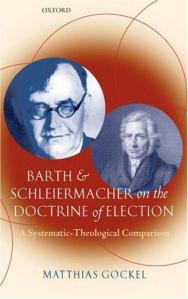
Matthias Gockel on Barth and Schleiermacher on the Doctrine of Election: A Review

Here are the links to my 10-part review of Gockel’s book:

Matthias Gockel on Barth and Schleiermacher on the Doctrine of Election: A Review – Part X

In answering the question, ‘Will, then, all people be saved in the end?’, Lutheran scholar Carl Braaten has reminded us that ‘We do not already know the answer. The final answer is stored up in the mystery of God’s own future. All he has let us know in advance is that he will judge the world according to the measure of his grace and love made known in Jesus Christ, which is ultimately greater than the fierceness of his wrath or the hideousness of our sin’. So Barth noted in The Humanity of God, ‘This much is certain, that we have no theological right to set any sort of limits to the loving-kindness of God which has appeared in Jesus Christ. Our theological duty is to see and understand it as being still greater than we had seen before’.

The criticisms and their implications raised by Gockel will no doubt continue to be a point of dispute – a dialectic – among readers of Barth for the foreseeable future. Those with an interest in the debate more generally over universalism would be well served in reading Gockel’s fine book. However, it ought to be noted that those who are already convinced that Schleiermacher’s and (early) Barth’s doctrine of election remains the most tenable proposal will only find further material here to bolster their conviction. To those who remain unconvinced, Gockel offers little argument here to change their mind.

Gockel’s work fills a notable gap in Schleiermacher and Barth studies. While there is, encouragingly, something of a renaissance of interest in Schleiermacher, Gockel’s contribution to our understanding of, and appreciation for, Schleiermacher’s project in general, and his doctrine of election in particular, is thus far unsurpassed. Schleiermacher is not an easy read. Not only is his own terminology inconsistent but his grammar is largely foreign to contemporary readers. Gockel offers us some assistance here. His contribution too regarding Barth’s early thinking on election also serves as a most worthy conversation partner with other contributions in the same area.

The essay is clearly written, avoids stereotypes of Schleiermacher and Barth, and includes a useful bibliography and two indexes. While Gockel offers us a very valuable survey to the thinking of two Protestant giants on a central theme not only in their theology but in the Reformed tradition of which they were both heirs – a valuable task in itself – I would have liked to have seen more critical engagement with these two voices. It may have also been fruitful, for example, to chart how Schleiermacher’s and Barth’s doctrine of election relates to the human response to God’s free grace in baptism, for example, as Barth was already directing us to in IV/4.

These grumbles aside, in what is certainly one of the finest essays to have appeared on Barth in recent years, Gockel models for us the kind of close dogmatic scrutiny that Schleiermacher’s and Barth’s theological contribution both deserves and demands. Those with an interest in systematic theology and the history of doctrine, those with an interest in getting their head (and hearts) around Barth’s much misunderstood doctrine of election, those with an interest in exploring a way forward for overcoming old rifts between Lutherans and Calvinists, and those with an interest in more current debates over universalism, would all be well served by reading Gockel’s book.

Matthias Gockel on Barth and Schleiermacher on the Doctrine of Election: A Review – Part IX

The only two tenable (i.e. biblically and theologically defensible) positions available for the soteriological question are either (i) a robust reaffirmation of limited atonement (the negative side of which includes the possibility of annihilation), or (ii) some form of christological universalism (with various degrees of agnosticism). Barth, of course, was rightly suspicious of ‘isms’, whether universalism or any other –ism, and would not affirm a dogmatic doctrine of universal salvation, although he does join a tradition of both Eastern and Western theologians going back to Origen of Alexandria (185–232), Clement of Alexandria (d. 215), Gregory of Nyssa (335–394?), Ambrose of Milan (337?–397) and Gregory of Nazianzus (329–389) who all affirm a strong hope in universal salvation.

Barth famously concludes IV/3/1 by again urging that we have no good reason why we should be forbidden, or forbid ourselves from an ‘openness to the possibility that in the reality of God and man in Jesus Christ there is contained much more than we might expect’, including the ‘unexpected withdrawal of that final threat’.

If for a moment we accept the unfalsified truth of the reality which even now so forcefully limits the perverted human situation, does it not point plainly in the direction of the work of a truly eternal divine patience and deliverance and therefore of an apokatastasis or universal reconciliation? If we are certainly forbidden to count on this as though we had a claim to it, as though it were not supremely the work of God to which man can have no possible claim, we are surely commanded the more definitely to hope and pray for it as we may do already on this side of this final possibility, i.e., to hope and pray cautiously and yet distinctly that, in spite of everything which may seem quite conclusively to proclaim the opposite, His compassion should not fail, and that in accordance with His mercy which is ‘new every morning’ He ‘will not cast off for ever’ (La. 3:22f., 31).

The creature cannot impose anything upon God because God is sovereign and free. That is why universalism equals the elimination of God’s freedom. But if God in his sovereignty and freedom has revealed himself in his being-in-act – that is, in Jesus Christ – then ought – nay, must – this not have radical implications for all doctrinal issues, and no less this one. We have no reason to presume that God in his total freedom will act other than he has acted in Jesus Christ – full of grace and truth.

Therefore, we may reasonably hope for a full Apokatastasis. Few have expressed this hope more beautifully than the nineteenth century Congregationalist minister, James Baldwin Brown: ‘The love which won the sceptre on Calvary will wield it as a power, waxing ever, waning never, through all the ages; and that the Father will never cease from yearning over the prodigals, and Christ will never cease from seeking the lost, while one knee remains stubborn before the name of Jesus, and one heart is unmastered by His love’. Or consider these words from Thomas Erskine,

I cannot believe that any human being can be beyond the reach of God’s grace and the sanctifying power of His Spirit. And if all are within His reach, is it possible to suppose that He will allow any to remain unsanctified? Is not the love revealed in Jesus Christ a love unlimited, unbounded, which will not leave undone anything which love could desire? It was surely nothing else than the complete and universal triumph of that love which Paul was contemplating when he cried out, ‘Oh the depth of the riches both of the wisdom and knowledge of God!

In Jesus Christ, the Triune God has bound humanity to himself in such a way that even if we refuse him and damn ourselves to hell, God in his love will never cease hunting us down. So even if the church cannot affirm the apokatastasis panton, we can hope for it, and pray for it, and stop denying the possibility of it in the grace of God. Hans Urs von Balthasar was right when he said that there is all the difference in the world between believing in the certitude of universal salvation and hoping for it.

Matthias Gockel on Barth and Schleiermacher on the Doctrine of Election: A Review – Part VIII

It is difficult to imagine a more solid basis for an Apokatastasis panton than Barth gives us in his doctrine of election and reprobation. But does Barth’s commitment to divine freedom contradict the centre of his christological revision? Does he ultimately lead us all to a country and then not promise us that we might enter? Gockel, following Janowski, suggests he does, and that the payment for such a commitment threatens to ‘tear open again, though in a modified way, the abyss of the decretum absolutum et horribile (p. 210) – as though God’s Word towards a person might be different from that which he has spoken in Jesus Christ.

While Gockel notes Barth’s denial of an ultimate apokatastasis panton, he joins a pantheon of critiques – sympathetic and otherwise – who see an inconsistency in Barth here. Consider, for example, the critique from Bromiley. As one of the editors (with T. F. Torrance) and principal translators of Barth’s work, few are more familiar with Barth’s corpus and theology than Bromiley. Citing IV/3, § 70.2, Bromiley synopsises Barth view: ‘The lie cannot overthrow the truth, but God may finally condemn the liar to live in it’. Bromiley observes in Barth a ‘trend toward an ultimate universalism’ although acknowledges that, for Barth, ‘universalism in the sense of the salvation of all individuals is not a necessary implicate of Barth’s Christological universalism’. He suggests that Barth’s reservation here is ‘not really adequate’. Gockel identifies the same inconsistently in Barth, a holding back of the full consequences of Barth’s christology. Again, Bromiley notes, ‘God’s manifest purpose in Christ is to save, but under the sovereignty of the Spirit some might not be saved. The question is whether the Christological reference finally helps or matters very much. Is not the ultimate decision still taken apart from the revealed election – that is, not in the prior counsel of the Father but in the inscrutable operation of the Spirit? In other words, the decision regarding individuals is simply removed from the inscrutability of sovereign predetermination to the inscrutability of sovereign calling’.

Matthias Gockel on Barth and Schleiermacher on the Doctrine of Election: A Review – Part VII

Brewing away throughout Gockel’s book, not unoften rearing its head, is the question of universal election and universal salvation. Gockel contends that Barth’s christological revision leads him to abandon his 1936 objection to universalism and affirmation of an eschatological division between the elect and the reprobate. Barth now ‘joins Schleiermacher in leaving open the possibility of a “final opening up and expansion of the circle of election and calling” which may include everyone’ (p. 188). Barth’s reluctance, however, to embrace universalism leads to some pointed challenges by Gockel.

Gockel notes that both Schleiermacher and Barth share a stance coherent with supralapsarianism’s claim that the decree of predestination precedes that of creation and Fall, although they both go further in their assertion that God’s mercy is the decisive criterion not of redemption only but also of predestination. Gockel argues that despite Barth’s ‘own explicit unwillingness to go that far’, that is, to embrace a universal predestination to salvation, his affirmation of universal election ‘implies some form of universal salvation’ (p. 189).

Gockel also contends that Barth’s appeal to God’s freedom is inconsistent with Barth’s own position regarding God’s self-determination to be Immanuel in Jesus Christ. Gockel notes that Barth’s (and Schleiermacher’s) caution on the issue can be partly explained by the fact that ‘any affirmation of universalism would have meant the endorsement of an ecumenical heresy, which could have cost him dearly’ (p. 208). The question, however, remains: How can that which has already been overcome in Jesus Christ ever be undone? How can this impossible possibility remain? Gockel suggests that Schleiermacher is at least more consistent here with his emphasis on the unity of God’s will. With all of Barth’s massively powerful christological revisioning, he, according to Gockel, ‘shied away from certain far-ranging implications’ (p. 205). ‘One should ask’, Gockel suggests, ‘whether a consistent theory of an Apokatastasis, far from presenting a danger or even a threat, might not be a more satisfying option than the claim that the New Testament leaves us with a paradoxical constellation of the “universalism of the divine salvific will” versus the “particularism of judgement”’ (p. 208).

I confess that I sympathise with Barth’s reluctance to embrace with certainty an apokatastasis panton, even while I hold out, with Barth, hope in such a reconciliation. Barth was right to insist that God’s grace is characterised by God’s freedom. This means not only that we must never impose limits on the scope of grace, but also that we must never impose a universalist ‘system’ on grace either. To embrace either option would be to compromise the freedom of grace and also to presume that we can define the precise scope of God’s grace. That is why Barth’s theology of grace incorporates a dialectical protest: he protests both against a system of universalism and against a denial of universalism. The essential point, for Barth, is that God’s grace is completely free; that when God acts in grace it is none other than God himself who acts in freedom. When God comes to us in his grace, therefore, we can be certain that no third party or shadowy motive is twisting his arm. Because of this divine freedom and because of the nature of divine grace as grace, we can neither deny nor affirm, therefore, the possibility of universal salvation. I confess with Abraham, ‘Shall not the Judge of all the earth do right?’ (Gen 18:25). Barth writes,

The proclamation of the Church must make allowance for this freedom of grace. Apokatastasis Panton? No, for a grace which automatically would ultimately have to embrace each and every one would certainly not be free grace. It surely would not be God’s grace. But would it be God’s free grace if we could absolutely deny that it could do that? Has Christ been sacrificed only for our sins? Has He not, according to 1 John 2:2, been sacrificed for the whole world? … [Thus] the freedom of grace is preserved on both these sides … Even in the midst of hell, grace would still be grace, and even in the midst of hell it would have to be honored and praised and therefore announced to the other inhabitants of hell. It is not free for nothing, but it is also not grace for nothing. We should certainly not know it if we were of the opinion that we could stop short of announcing it.

Matthias Gockel on Barth and Schleiermacher on the Doctrine of Election: A Review – Part VI

Barth’s concern in his treatment on election is that election should be good news – gospel – or, what Barth calls is another place, ‘joyous news’. Thus does Barth begin his chapter on election in II/2: ‘The doctrine of election is the sum of the Gospel because of all words that can be said or heard it is the best; that God elects man; that God is for man too the One who loves in freedom … Its function is to bear basic testimony to eternal, free and unchanging grace as the beginning of all the ways and works of God’. Here Barth is following Calvin – and, according to Muller, the Reformed tradition more generally at least up until 1650 – who repeatedly stressed that we look to Christ as the assurance of our election. Here Calvin is as adamant as Barth. Where Calvin – and the Reformed tradition – is silent, however, is in how the question of reprobation – the shadow side of election – also relates to Christ. Holmes has suggested that the weakness in Calvin’s account of predestination is not that election is separate from Christ (which, as I have just said, it is not), but that ‘the doctrine of reprobation is detached, Christless and hidden in the unsearchable purposes of God. As such it bears no comparison with the doctrine of election, but remains something less than a Christian doctrine’. Holmes goes on to suggest that Calvin’s shortcoming is not that he reserved an equal stature – a double decree – to God’s ‘Yes’ and ‘No’ in election, but that he has ‘almost no room for the doctrine of reprobation in his account’; ‘the “No” does not really enter his thinking’, thus leading to an asymmetry between the two decrees and so, as Holmes suggests, ‘fails to be gospel’. This contrasts with Barth’s christological theology of reprobation. Holmes helpfully summarises Barth’s position thus:

In willing to be gracious in the particular way God in fact wills to be gracious, the Incarnation of the Divine Son, there is both a ‘Yes’ and a ‘No’, election and reprobation. God elects for humanity life, salvation, forgiveness, hope; for himself he elects death, perdition, even, as the Creed has said, hell. This self-reprobation of God is indeed the primary referent of the doctrine of election, in that God’s determination of himself is formally if not materially more basic than his determination of the creature, and so is considered first by Barth. In the eternal election of grace, which is to say in Jesus Christ, God surrenders his own impassibility, embraces the darkness that he was without – and indeed impervious to – until he willed that it should be otherwise … The apostle put it more succinctly: “He became sin for us.” This is the full content of the divine judgement, of the ‘No’ that is spoken over the evil of the world and of human beings. God elects for himself the consequences of that ‘No’, in saying ‘Yes’ to, that is, in electing, us. That is the whole content of the double decree, the whole content of the ‘Yes’ and the ‘No’ that God pronounces as one word, the whole content the election of grace.

Concerned that his own tradition had at this point replaced Jesus Christ with a decretum absolutum (as there is no Wikipedia reference to the absolutum it must not exist), Barth asked, ‘Is it a fact that there is no other basis of election outside Jesus Christ? Must the doctrine as such be related to this basis and this basis only?’ Because of Jesus Christ, Barth was able to speak of God’s ‘No’ as gospel also.

On the actuality of predestination, Gockel questions how useful Barth’s grammar regarding predestination as a present event is. He suggests that God’s ‘eternally preceding’ decision is ‘the mystery of all historical events’ and that it does not have to imply an ongoingness of the decision itself within history, given God’s predestining election of Jesus Christ. Gockel helpfully suggests that ‘a less actualistic view of predestination could more clearly emphasise the significance of the historical appearance of Jesus Christ and thus dispel the impression that Barth tears apart the “eternal content” and the “temporal form” of election’ (p. 185).

Matthias Gockel on Barth and Schleiermacher on the Doctrine of Election: A Review – Part V

Gockel turns to critically consider the consequences of Barth’s doctrine of election. He identifies six key areas: (1) epistemological implications, (2) the concrete determination of predestination, (3) the issue of double predestination, (4) the actuality of predestination, (5) the question of universal election and universal salvation, and (6) the relation between Israel and the Christian church. I will focus here on (2), (3), (4) and (5).

Regarding the second area, while Barth never intended to drive a wedge between the economy and being of God, Gockel sides with McCormack over against Molnar that this very inconsistency arises within Barth’s own formulation of his doctrine of election: ‘The assumption of a divine will preceding the predestination puts into doubt whether the gracious choice really belongs to God’s “own eternal essence”’ (p. 179). The issue fundamentally concerns whether or not the works of God ad extra (election) are the free overflow of the works of God ad intra (as Molnar suggests) or whether the one eternal will of God is identical with Jesus Christ. Molnar’s reading of Barth’s proposal that God has one being, and that that one being subsists simultaneously in two different forms – the second dependent on the first – which are not separate but rather are a unity-in-distinction and distinction-in-unity, could have been more attended to by Gockel than he does (pp. 179–80).

On the question of double predestination, Gockel rehearses Barth’s conviction that we must speak of Jesus Christ not only in reference to the positive side of election but also in reference to the other side of God’s decree – reprobation. Here, as we shall see below, Barth sets himself apart from the tradition (or at least extends the tradition) and declares that both election and reprobation happen in Jesus Christ. Barth’s doctrine of reprobation is as christological as his doctrine of election. He contends that the God who elected fellowship with humanity also elected our rejection. In electing our rejection, however, ‘He made it his own. He bore it and suffered it with all its most bitter consequences’. Thus in the self-reprobation of Godself in Jesus Christ – the Man justified and the ‘Judge judged in our place’ – humanity recognises not only God’s final ‘Yes’ but also its own reprobation. This self-giving is God’s free choice and entails God’s self-determination and the determination of humanity through a ‘wonderful exchange’ in Jesus Christ. ‘To believe in God’s predestination’, Gockel concludes, ‘means by definition to believe in the non-reprobation of humankind’ (p. 181). As Barth notes, ‘in God’s eternal purpose’ it is not humanity but ‘God Himself who is rejected in His Son’. God’s self-giving in Jesus Christ consists in the fact that he is rejected in our place: ‘Predestination means that from all eternity God has determined upon man’s acquittal at His own cost’. Gockel then raises the question and apparent conflict concerning whether the claim that the Son of God instead of the Son of Man suffered God’s wrath contrasts with Barth’s earlier claim that ‘the elected human being Jesus is the target or “offering” of God’s wrath’. He notes Barth’s own awareness of and answer to this in II/1: ‘Only God Himself could bear God’s wrath. Only God’s mercy was capable of bearing the kind of suffering to which the creature existing in opposition to God is subject. Only God’s mercy could be touched by this suffering in such a way that it knew how to make it its own suffering. And only God’s mercy was strong enough not to perish in this suffering’ (p. 183). As if hell – that is, something of creation – could exhaust the awful shame and scandal of sin.

Matthias Gockel on Barth and Schleiermacher on the Doctrine of Election: A Review – Part IV

In his fifth chapter, entitled ‘Barth’s Christological Revolution’, Gockel turns briefly to Barth’s lectures of 1936 (given at two Reformed seminaries in Hungary) and 1937 (Barth’s Gifford Lectures on the Scots Confession given at the University of Aberdeen), and more substantially to Barth’s Church Dogmatics II/2, where Barth developed his most radical proposal, modifying for a second time his doctrine of election. In the christological revision undertaken in II/2, election no longer refers to the two-fold possibility of faith and unbelief but to the double determination of individual human beings and God’s own being. Barth’s priority: that God sees every human being and also himself in Christ.

Here, Gockel is on the more traversed ground of Barth’s notion that Jesus Christ is both God’s elect himself and the foundation of humanity’s election. Gockel argues that it was not until the 1936 lectures that Barth’s christological revisioning of the doctrine of election first appears; that what happened for and to humanity at Golgotha and was revealed at Easter – though it happened in time – is our eternal election. It is also here that Barth identifies the one will of God in double predestination with Jesus Christ, that is, with God’s own being. ‘Jesus Christ not only reveals but also constitutes God’s gracious choice as the self-determination to be God for His people and the determination of humankind to be the people of God’ (p. 169). As Barth contends, God’s gracious choice is the divine decision made in Jesus Christ, the speculum electionis. It is in and through Jesus Christ that God has actualised his eternal covenant with humanity, God’s eternal election of himself to communion with humanity, and humanity to communion with God. Here Barth distinguishes himself from the disposition in some camps of the Reformed tradition of an insistence on the inscrutableness and invisibility of the divine decrees. In Jesus Christ – the electing God and the elected Man – God’s purposes in election are made manifest to all. Christ is, in Barth’s words, ‘the first and last word to men of the faithfulness of God’ in election. Jesus Christ, therefore, is not merely the channel of God’s one decree, but its source. And he is not merely the one who elects, but he is also the one who elects himself to be the modus operandi by which others are elected.

Matthias Gockel on Barth and Schleiermacher on the Doctrine of Election: A Review – Part III

Barth’s revision of the Reformed doctrine of election is developed further in his so-called Göttingen Dogmatics where he punctuates the teleological ordering of election and reprobation. The real purpose of God’s predestinating act is always election – not rejection – even in rejection. While the reprobation is real as the shadow side of election, it is never God’s final word. God’s final word is Jesus Christ and in him every promise of God finds its ‘Yes’ (2 Cor 1:18–20). ‘Rejection does not take place for its own sake but in revelation of the righteousness of God in order that God’s mercy might be manifested in his election, and in order that in it all, though in this irreversible order, God himself might be known and praised’. In other words, God’s judgement is never divorced from God’s grace and can never be recognised apart from ‘the cross, the judgment, the condemnation in which we stand’; the way of predestination therefore leads us ‘by way of condemnation – indeed, by the way of hell itself – to salvation and life’. We will return to this below in our discussion of Barth’s Church Dogmatics II/2.

Gockel concludes his discussion of Barth’s Göttingen work by surmising that Barth’s doctrine of election ‘becomes more actualistic and less speculative, while still not christocentric’. Also ‘Barth stops short of eschatological universalism, and his consistent emphasis on God’s freedom as well as the assertion that “all are at every moment under the divine Either–Or” should be taken seriously’ (p. 155).

The picture that Gockel paints is that in both the Römerbrief and the Göttingen Dogmatics, Barth has developed a ‘Schleiermacherian reconstruction’ of the doctrine of election by means of the idea of a single divine decree towards life. Although Schleiermacher understands the Creator-creature relationship differently to Barth, they both hold that the single divine decree is to be understood in the context of the historical decision between faith and unbelief. For both of them (at this point), the doctrine of election remains fundamentally theocentric and universal, with a focus on the graced-initiative of the divine act which involves a teleological movement in time from reprobation to election, the former serving the latter, and the latter qualifying the former. Above all, the focus for both theologians is on ‘the predestining God’ rather than ‘individual predestined human beings’ (p. 157). Given this, it is surprising that Gockel introduces his argument with the announcement that it is ‘precisely the anthropocentric outlook of traditional views’ which motivated not only Barth’s but also Schleiermacher’s ‘search for a new approach’ to election (p. 12).

Matthias Gockel on Barth and Schleiermacher on the Doctrine of Election: A Review – Part II

In his Der Römerbrief, Barth raises two objections against the Augustinian formulation, which he regards as ‘a “mythologizing” construction’ (p. 108). First, Barth rejects the notion that predestination can be explained in terms of cause and effect. While the human act of faith happens within a familiar historical context, its origin always lies with God: ‘The act of faith does not occur when a human being has recognized God but when God has recognized a human being’ (p. 108). Barth’s point: ‘God wants to be known through God’. Secondly, Barth discards the attribution of election and reprobation to ‘predetermined quantities of individual persons, since this neglects that God’s eternal predestination is related to humankind as a whole and is not a one-time event but occurs time and again in history when a human being is addressed by God’s Word’ (p. 109). The driving issue here for Barth, as in his whole doctrine of election, is the divine freedom.

For Barth, the key verse for understanding Romans, and Christian theology in general, is 11:32, ‘God enclosed everyone in disobedience, in order to show mercy on everyone’. This verse affirms that the content of God’s predestination is God’s unconditional mercy. More radically, Barth contends that Paul’s claim suggests a modification – though not a rejection – of the notion of double predestination. Double predestination does not require rejection so long as we are clear that it refers to a movement, to the ‘teleology by which God’s salvific act is directed, namely, from reprobation to election’ (p. 113). For Barth, reprobation is never the goal. ‘God’s Yes shines even into the last depth of His No, precisely because the latter is so radical, because it is the divine No’. Reprobation exists therefore ‘only as the shadow of the light of election’.

Gockel contends that there is a distinct echo of Schleiermacher’s doctrine of election in Barth’s own early revision of the doctrine. In Der Römerbrief, Barth accentuates the dialectical unity of God’s decree: ‘God’s reprobation (of the elect) and God’s election (of the reprobate) are “unintuitably one and the same in God”’ (p. 118). Gockel identifies two central aspects concerning the relation between reprobation and election for Barth. First, the possibility of reprobation is overcome eternally in God. Adam’s old world really is surpassed by Christ’s new world. Second, the individual outcome of the two-fold possibility of unbelief and belief is not determined by God before time but rather, in the freedom of God, is the event in which God addresses the creature in time. The content or purpose of such an address is qualified by the ‘turn from reprobation to election’ in God, which expresses the one eternal will of God for humanity. Any duality here of judgement and grace is the duality of God’s unified action, an action which affects all human beings alike, and is determined by God’s redemptive will revealed in Christ’s death and resurrection. The church and the world, therefore, ‘stand under the same promise and the same judgment [which] makes it impossible to conceive them as two separate groups of persons’ (p. 125). Even as early as his Romans commentary, Barth maintained a hopeful universalism grounded in the freedom and love of God leading to the priority of election over reprobation: ‘reprobation has been overcome and absorbed by election’. Christ’s work ‘entails the hope that the duality between faith and history does not preclude the possibility of an eventual restoration of humankind and a return “into the unity with God, which is now and here completely lost”’ (p. 130). Barth’s emphasis here is that the original unity of God and humanity (a notion abandoned in the Göttingen lectures) is not superseded by judgement. Judgement, rather, is practical, leading to a re-union of human and divine righteousness.

Gockel observes that the relationship of the historical appearance of Jesus Christ to the determination of God’s will remains unclear in Barth’s theology, and his emphasis on the original unity leads to similar problems to Schleiermacher’s notion of absolute dependence. Furthermore, when Barth ‘asserts that God’s will is revealed in Jesus Christ who personifies God’s universal faithfulness and righteousness, it remains unclear how the eternal history between God and humankind is related to the history of Jesus Christ’ (p. 131).

Matthias Gockel on Barth and Schleiermacher on the Doctrine of Election: A Review – Part I

‘That God may have mercy upon all’: A Review of Barth and Schleiermacher on the Doctrine of Election: A Systematic-Theological Comparison. By Matthias Gockel. Pp. viii+229. Oxford: Oxford University Press, 2006. ISBN 978 0 19 920322 2. £45.

As promised not so recently, my next few posts will be dedicated to reviewing Gockel’s book, Barth and Schleiermacher on the Doctrine of Election. Because my review is rather lengthy (and because some wise guy thinks that the ideal post should be quite short ), I will break it up into 10 posts. I hope that most who started the ride will still be holding on at the end.

Karl Barth’s vituperative criticisms of Friedrich Schleiermacher are no secret, and no short mileage has been made by theologians on the apparent division between the two. In Matthias Gockel’s latest offering (a revised version of his 2002 doctoral dissertation completed at Princeton under Barth scholar Bruce McCormack) he joins Robert Sherman and others in enriching, with renewed sophistication, our understanding of the relationship between Barth and Schleiermacher, challenging traditional evaluations that ‘liberal theology’ and ‘dialectical theology’ stand in irreconcilable opposition.

Rather than attempt to cover a multi-dimensional canvas with broad strokes, Gockel restricts his inquiry to an incisive and cogent comparison of the development of the doctrine of election in the two thinkers. Without proposing any theory of historical dependence, Gockel contends that the divergence between these two commanding Reformed theologians does not stem from irreconcilable starting points but rather from the indispensability of God’s grace. Gockel convincingly argues that ‘Barth’s theology is not just a repudiation of Schleiermacher but an expansion of his predecessor’s work in a new framework’ (13). He also shows us that while the Swiss theologian’s evaluation of ‘the father of modern theology’ is ‘sometimes negative, sometimes positive and often ambiguous’ (p. 9) Barth was not always a reliable interpreter of his own thought, nor always consistent in his criticisms of others.

Gockel’s thesis is that the doctrine of election in Barth’s early theology bears a close resemblance to Schleiermacher’s own theo-centric position. Barth’s theology however, from 1936 onwards, undergoes a radical christological revisioning of the earlier position. Gockel begins his survey and assessment of Schleiermacher by turning to Schleiermacher’s revision of the doctrine in his 1819 essay, ‘On the Doctrine of Election’. Gockel helpfully, albeit briefly, situates Schleiermacher’s early contribution on election in the context of the ecclesiastical union between the Lutheran and Reformed churches in Prussia in 1817. Central to the preceding union were the debates over the Lord’s Supper and the doctrine of election. The crucial point over the latter concerned ‘the indispensability of divine grace for … conversion and the question whether human beings can accept or resist God’s grace by their own free choice’ (p. 18). Schleiermacher’s most creative contribution to the discussion was his notion of an undivided and unconditional ‘single divine will and decree which effects [both] faith and unbelief’ (p. 26). He argues that the older paradigm of a two-fold divine will of election and reprobation is ‘as meaningless as the question why God made human beings in the way they were made’ (p. 29). The elect, Schleiermacher contends, are those who are ‘regenerated and begin their religious self-development’ (p. 30). While the remainder of persons are for now spiritually dead and ‘not yet members of the kingdom of God’ (p. 34) they are included in God’s love and so ‘they never loose the ability to be revived’ (p. 30). Gockel notes that the notion of the single decree ‘emphasises the unity of the divine attributes and helps to clarify key issues not only in the debate over election but also in the doctrine of God’ (p. 34).

Schleiermacher’s revision of the doctrine of election, articulated in the 1819 essay, is more fully developed in his Der christliche Glaube (1821–22) within the bounds of a single divine decree of universal predestination to salvation in Christ, and systematically located in ecclesiology. Gockel notes that the starting-point of the discussion of election, for Schleiermacher, is the ‘dilemma that arises from the simultaneous existence of believers and non-believers, on the one hand, and the benevolent divine will towards all human beings in Christ’s redemptive work, on the other hand’ (p. 101). Schleiermacher’s response is to insist that the ‘divine will is identical with the work of redemption in and through the person of Christ’ (p. 100).

Schleiermacher rejects any idea of two separate foreordained groups of persons – a double-predestination – and the notion that one group might be eternally excluded from the benefits of Christ’s work. Such ideas, he maintains, betray the general character of redemption and the universal mission of the church. God has one will, and that will is identical with who God is, and what God does in Jesus Christ. Humanity – believers and unbelievers alike – are the object of God’s predestinating will of salvation in Christ. Despite the temporary reprobation of some, ‘God sees all human beings, not only the believers, in Christ’ (p. 102). In light of this reality, the church is called to live, order its life after, and bear universal witness to, the divine decision.

Gockel concludes his examination of Schleiermacher by noting that despite Schleiermacher’s christologically-motivated affirmation of general redemption and rejection of eternal reprobation, his overall construction remains theocentric: ‘it is grounded in the belief in God the almighty creator, even though ecclesiology is its context and christology its background’ (p. 103).

Children’s Letters to God – A Review

There is something particularly special in listening to children pray, and in praying with them. This was brought home afresh to me today when I read Children’s Letters to God, compiled by Stuart Hample and Eric Marshall. While some of the prayers included in this volume seem not merely humorous but silly (to an adult), most betray a deeper cognition. All betray, however, a glaringly beautiful honesty and unpretentiousness that God not only makes possible for us, but encourages in us by the Spirit.

Here’s a few that I like:

  • Dear God. Are you really invisible or is that just a trick?
  • Dear God. Did you mean for the giraffe to look like that or was it an accident?
  • Dear God. Instead of letting people die and having to make new ones why don’t you just keep the ones you got now?
  • Dear God. Who draws the lines around the countries?
  • Dear God. I went to this wedding and they kissed right in church. Is that OK?
  • Dear God. Are there any patriarchs around today?
  • Dear God. It’s OK that you made different religions but don’t you get mixed up sometimes?
  • Dear God. I would like to know why all the things you said are in red?
  • Dear God. Is Reverend Coe a friend of yours, or do you just know him through business?
  • Dear God. I am English. What are you?
  • Dear God. Thank you for the baby brother but what I prayed for was a puppy.
  • Dear God. How come you didn’t invent any new animals lately? We still have just all the old ones.
  • Dear God. Please put another holiday in between Christmas and Easter. There is nothing good in there now.
  • Dear God. Please send Dennis Clark to a different camp this year.
  • Dear God. I wish that there wasn’t no such thing of (sin. I wish that there was not no such thing of war.
  • Dear God. Maybe Cain and Abel would not kill each other so much if they had their own rooms. It works with my brother.
  • Dear God. I bet it is very hard for you to love everybody in the whole world. There are only 4 people in our family and I can never do it.
  • Dear God. If you watch in Church on Sunday I will show you my new shoes.
  • Dear God. I am doing the best I can.

‘… For an answer Jesus called over a child, whom he stood in the middle of the room, and said, “I’m telling you, once and for all, that unless you return to square one and start over like children, you’re not even going to get a look at the kingdom, let alone get in. Whoever becomes simple and elemental again, like this child, will rank high in God’s kingdom. What’s more, when you receive the childlike on my account, it’s the same as receiving me’. (Matthew 18:2-5, The Message)

Children’s Letters to God is a great little book to use to open up the questions of life, of God, and of the world – and to encourage mutual and humble dialogue which, after all, is at least part of what we are engaging in when we pray. Warmly recommended … as is prayer.

Barth and Schleiermacher Review

Finally … just finished a first draft of my review of Matthias Gockel’s Barth and Schleiermacher on the Doctrine of Election: A Systematic-Theological Comparison. What a great read – the book that is. If anyone would like a wee read of my review on the proviso that you give me some serious feedback, just email me. (Of course, all cash donations will be greeted with psalm-worthy thanksgiving, treated with the strictest confidence and will go to a good cause – my holiday fund. Bottles of Laphroaig are received with equal gratitude).

On another note, I’ve been thinking of late about purchasing Sony’s latest toy, the Portable Reader PRS-500. I’d be keen to hear from any who have one, or one like it. I’ve read a few reviews and I’m still on the fence. A criticism of it that would concern me is the apparent inability for it to zoom in and out of pdf’s.

Aboriginal Religions in Australia

The upcoming issue of the Journal of the American Academy of Religion includes a review by Diane Bell (University of Adelaide) of the book Aboriginal Religions in Australia: An Anthology of Recent Writings, edited by Max Charlesworth, Francoise Dussart, and Howard Morphy (Ashgate, 2005).

Bell notes that the contributors to this volumes are ‘predominantly non-Indigenous anthropologists and well-established ones at that’. However, not a few new strands in the study of Aboriginal religion are unrepresented in the book. Bell states that she ‘would like to see more about the intertwining of new age beliefs and practices, eco-tourism, new religious movements, and the emergence of distinctive Aboriginal theologies—some of which have a strong social justice core and others of a decidedly evangelical nature’.

Bell identifies Fiona Magowan’s essay ‘Faith and Fear in Aboriginal Christianity’ (pp. 279–295) as ‘an excellent account of the Yolngu from Galiwin’ku in northeast Arnhem Land, and Ian McIntosh’s ‘Islam and Australia’s Aborigines’ (pp. 297–318), also on the Yolgnu, as ‘a fine example of how outside influences can be absorbed’, but she says we also need to hear from people in rural and urban settings. Bell, who lives in the Ngarrindjeri territory in the southeast of Australia, would have liked to see more teasing out of how Aboriginal religion practiced in the inner cities,’ in the more densely settled south’. ‘What role, for instance, do mainstream churches, evangelical, and fundamentalist religions play in the lives of disaffected youth?’

No anthology – by definition – can possibly traverse any given field fully. Bell criticises this anthology with being ‘too vast’. She concludes: ‘Choices must be made. In my view, the choices made regarding the“recent writings” for this anthology give priority to old concerns. There is much that is new and challenging for scholars of religion, much that is relevant as to how we live our lives in the twenty-first century. The potential audiences for writing on religion are wide ranging. This anthology was an opportunity to address readers beyond the academy. Instead the editors have stayed very much within the lines’.

You can read the whole review here.