Politics

Pilger on Britain’s New Labour

I don’t normally read The Guardian, but yesterday’s carried this piece by John Pilger (whose essays I always read). In his typically undisguised style, Pilger argues that Tony Blair and ‘his cult’ have ‘destroyed the very liberalism millions of Britons thought they were voting for’. He writes:

In the murdochracy that Britain has largely become, once noble terms such as democracy, reform, even freedom itself, have long been emptied of their meaning.

Gone is the bourgeoisie that in good times would extend a few rungs of the ladder to those below. From Blair’s pseudo-moralising assault on single parents a decade ago to Peter Hain’s recent attacks on the disabled, the “project” has completed the work of Thatcher and all but abolished the premises of tolerance and decency, however amorphous, on which much of British public life was based. The trade-off has been mostly superficial “social liberalism” and the highest personal indebtedness on earth.

And, according to Pilger, things are not looking any different under Brown:

Behind a facade of liberal concern for the world’s “disadvantaged”, such as waffle about millennium goals and anti-poverty stunts with the likes of Google and Vodafone, the Brown government, together with its EU partners, is demanding vicious and punitive free-trade agreements that will devastate the economies of scores of impoverished African, Caribbean and Pacific nations. In Iraq, the blood-letting of a “liberal intervention” may well have surpassed that of the Rwanda genocide, while the British occupiers have made no real attempt to help the victims of their lawlessness. And putting out more flags will not cover the shame. “The mortality of children in Basra has increased by nearly 30% compared to the Saddam Hussein era,” says Dr Haydar Salah, a paediatrician at Basra children’s hospital. In January nearly 100 leading British doctors wrote to Hilary Benn, then international development secretary, describing how children were dying because Britain had not fulfilled its obligations under UN security resolution 1483. He refused to see them.

Whole British communities now live in fear of the police. The British are distinguished as one of the most spied upon people in the world …

The cause of any real civil threat to Britons has been identified and confirmed repeatedly by the intelligence services. It is “our” continuing military presence in other people’s countries and collusion with a Washington cabal described by the late Norman Mailer as “pre-fascist”. When famous liberal columnists wring their hands about the domestic consequences, let them look to their own early support for such epic faraway crimes.

Britain is now a centralised single-ideology state, as secure in the grip of a superpower as any former eastern bloc country.

Dear John, ‘Do not prophesy to us what is right; speak to us smooth things, prophesy illusions, leave the way, turn aside from the path …’ (Isaiah 30:10b-11a)

Kevin Rudd on the Gospel

Most of us have grown understandably suspicious of politicians and their ‘God-talk’. In this speech (24 mins) given to New College at the University of New South Wales in 2005 Kevin Rudd (who is now Australia’s Prime Minister) outlined his vision of the appropriate relationship between Church and State in Australia. He stresses that while Jesus teaches compassion for the marginal, Catholic social teaching emphasises the proper balance between the rights of organised capital and labour. Whether you’re an Aussie or not, Rudd’s speech is well worth listening to.

‘We Own the World’: a Chomsky lecture

We Own the World is the name of a new DVD out by Noam Chomsky in which he looks (surprise, surprise) at the US government and corporate elite policies over the years. These policies, he argues, ‘violate international and domestic laws, and involve imperialist designs that depend on targeted assassinations and the killing of innocent civilians on a mass scale. Yet, US elites still lay claim to being just, democratic, and humane. How can they do this? As Chomsky refrains over and over … they can do it only if we accept the basic assumption that “We own the world” – and therefore have the right to do whatever we want.’ More information here.

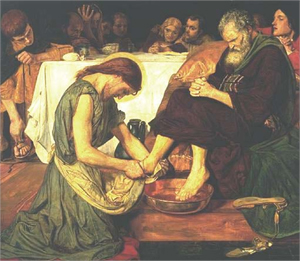
A dispute also arose among them, as to which of them was to be regarded as the greatest. And [he who really owns the world] said to them, “The kings of the Gentiles exercise lordship over them, and those in authority over them are called benefactors. But not so with you. Rather, let the greatest among you become as the youngest, and the leader as one who serves. For who is the greater, one who reclines at table or one who serves? Is it not the one who reclines at table? But I am among you as the one who serves. (Luke 22:24–27)

It seems to me that those who find any encouragement from being associated with the One who really owns the world, any comfort from his love, any participation in his Spirit, any affection and sympathy, ought to be at one with him in mind, having the same love, being in full accord and of one mind. Surely they are those who do nothing from rivalry or conceit, but in humility count others more significant than themselves. Surely they are those who look not to their own interests, but to the interests of others.


Žižek on transcendent meaning, authority and freedom

Commenting on Job’s three theological friends, Slavoj Žižek contends that ‘God is the only true materialist … [God] comes and says there is no transcendent meaning, everything is a miracle … there is no transcendent master, which is why I think we have to read Christ as a repetition of Job. What dies on the cross with Christ? What dies is not an earthly representative of a transcendent. What dies is precisely God as this transcendent master of the universe. What dies on the cross for me is the idea of God as the ultimate guarantee of meaning … The lesson of Christianity … of Christ … [is that] we cannot afford this withdrawal. When we are confronted with horrible things … holocaust, concentration camps or other similar catastrophes it is a little bit vulgar to say, “This only appears to us as a catastrophe because of your limited perspective, withdrawal back and you will see how it contributes to harmony, or whatever”. There is no big other! This is why I think this would be a kind of more materialist reading why Christ truly sacrificed himself. The message is “All we can do is here”; there is no father up there who takes care of it … It is not “Trust God”. No. God trusts us. All that can be done, we should do it. In this sense, with this incomplete notion of reality, … it opens up the space for freedom. There is freedom only in an ontologically unfinished reality’.

While I generally do find Žižek to be a really stimulating thinker, what I find most disturbing here in this particular presentation is his notion of authority and freedom. To be sure, he never seems to challenge the relative need of authority in the area of sociality. However, if I have heard him correctly (and it’s a genuine ‘if’ on my part) when he comes to the purlieus of belief, of faith, the assumption is that we must abandon authority. It is at this point (though not at this point alone) that he so clearly betrays a failure to understand what constitutes a Christian notion of authority. For Žižek, authority is not a power but a force, a coercive burden to be shaken off rather than a love and true freedom to live in. Employing Forsyth here, I want to suggest that Žižek’s notion of authority is not ‘the source of liberty, but its load. It is something which sooner or later must produce impatience and not bring peace. It is something to be renounced as men pass to spiritual maturity. The more spiritual they consider themselves, the less they like to feel, think, or speak of authority’. There is no sense in Žižek’s notion of authority of one who employs his authority to set people – indeed his enemies – free.

Truly, ‘God chose what is low and despised in the world, even things that are not, to bring to nothing things that are, so that no human being might boast in the presence of God’ (1 Cor 1:28). This one who though he was in the form of God became the ‘low and despised’ one taught us that ‘whoever would be great among you must be your servant, and whoever would be first among you must be your slave, even as the Son of Man came not to be served but to serve, and to give his life as a ransom for many’ (Mark 10:43-45).

In this alone is true creaturely freedom. To assert, a Žižek does, that freedom exists ‘only in an ontologically unfinished reality’ is to deny the incarnation of God into our world, and the (cruci)-form that such authority takes. There is no greater freedom than to live under true authority. This is our gifted freedom. If God is creator, not merely in the sense of being the one who began all things but also in the decisive sense of being one who sustains all things from moment to moment by his gracious will then we must confess that no freedom exists apart from him. As C. Stephen Evans notes in his delightful book, Kierkegaard’s Fragments and Postscript: The Religious Philosophy of Johannes Climacus, ‘Because of God man is something; he is in fact a nobel something, created for eternal life with God. But his nobility lies precisely in his ability freely to recognize or fail to recognize his dependence on God. This freedom means that man is to an extent independent of God. But even his independence is itself dependent upon God’s creative power, most properly used when man recognizes – freely – his dependence’. (p. 170)

(If I have read Žižek incorrectly here, I apologise. Please take this as an invitation to help me try and understand this important thinker rightly on this point.)

Thirteen Propositions on Voting


A preamble: this is not an exhaustive list.


1. Remember, if you are a Christian then you are part of a pilgrim people who ought never really feel at home in this world because we have been made for another.

2. No matter which government is in power, the Church’s charge remains the same – to preach the Gospel. This will include, among other things, at least a 4-fold word: (i) challenging the structures of our society that demean humanity made in the image of God; (ii) challenging the agendas of our society that leave the poor and the widows and the orphans without a voice; (iii) challenging the complacency of a people who refuse to think, or can’t be bothered thinking, about the consequences of the decisions we are making (this has obvious international consequences); and (iv) challenging the selfishness of those who get fatter and fatter at the expense of others, and at the expense of the creation.

3. God’s people receive their identity not from earthly governments, but from the knowledge that they belong to the Lord Jesus and live under his government, and by his word. 

4. Regardless of what’s going on in the fleeting world of politics, the Gospel will always have something to say to the world, and to a Church that must continuously strive to keep itself from ever thinking that the Gospel of the Cross is not enough.

5. We must beware lest we fall into the trap that so many Christians throughout history have fallen into of believing that there is such a thing as the only and true Christian form of government. No political party can be baptised, nor any political system. The radical call of Jesus remains regardless of what the government of the day is doing. This doesn’t mean that we shouldn’t strive to bring about godly reforms and laws in the land, but it does mean that we mustn’t delude ourselves into thinking that we can create a heaven on earth.

6. The temptation to deny Christ exists no matter what the political situation and culture is.

7. Don’t be among those who see voting as a chore and as a painful waste of time. Remember that it is a privilege to vote. God has placed many of us in countries where we have the opportunity to take part in decision making as well as in the keeping of our elected leaders accountable. Thank God that some of God’s people live in such places. [I have always struggled to understand how a democracy can encourage non-compulsory voting, not least given the claim of support for democracy-making in other parts of the world!]

8. Thank God for democracy, but never trust it. ‘Democracy’, wrote Forsyth, ‘is but a half-truth. It must have a King. Aristocracy is just as true and as needful. It builds on an authority in things no less than democracy builds on an equality. The free personality of democracy is only possible under a free authority. The free soul is only possible in a free King … There must always be a House of Moral Lords. There must always be leaders and led, prophets and people, apostles and members, genius and its circle, and elect and a called. Ah! democratic and aristocratic principles are both deep in the foundations of our Christian faith’. At the end of the day, ‘democracy is the recurrent suspicion that more than half of the people are right more than half the time’ (E. B. White). Recall the words of C.S. Lewis: ‘I am a democrat [believer in democracy] because I believe in the Fall of Man. I think most people are democrats for the opposite reason. A great deal of democratic enthusiasm descends from the ideas of people like Rousseau, who believed in democracy because they thought mankind so wise and good that every one deserved a share in the government. The danger of defending democracy on those grounds is that they’re not true … I find that they’re not true without looking further than myself. I don’t deserve a share in governing a hen-roost. Much less a nation … The real reason for democracy is just the reverse. Mankind is so fallen that no man can be trusted with unchecked power over his fellows. Aristotle said that some people were only fit to be slaves. I do not contradict him. But I reject slavery because I see no men fit to be masters’.

9. Remember that even secular leadership comes under the domain of God’s sovereignty, and that God uses non-Christians, as well as Christians, to bring about his purposes. The Bible assures us that all those who serve the people well are servants of God. So thank God for his own sovereign governing of the world (Rom 13:1-7).

10. Pray diligently for the leaders and all those in responsibilities of power and decision making. We are commanded by God to pray for all our leaders. Pray that they would make wise and just decisions and govern with mercy as well as strength. Pray for those who do not know Christ, that they would become Christians.

11. Pray for wisdom about your vote. Make your vote count. Make your vote a wise vote.

12. Don’t vote for the party who will best serve your pocket and own interests, but vote for the government or person who you prayerfully and honestly believe can best think through the necessary and complex issues with an attitude of serving others within their own country, and beyond.

13. Once the election has taken place, don’t grumble if your choice of party or person is not elected, for Peter tells us to, ‘Live such good lives among the pagans that, though they accuse you of doing wrong, they may see your good deeds and glorify God on the day he visits us. Submit yourselves for the Lord’s sake to every authority instituted among men: whether to the king, as the supreme authority, or to governors, who are sent by him to punish those who do wrong and to commend those who do right. For it is God’s will that by doing good you should silence the ignorant talk of foolish men. Live as free men, but do not use your freedom as a cover-up for evil; live as servants of God. Show proper respect to everyone: Love the brotherhood of believers, fear God, honour the king (1 Peter 2:12-17).

Resistance Is Surrender

Today’s London Review of Books includes a provocative and challenging (for all who value democracy) essay by Slovenian sociologist, philosopher and cultural critic Slavoj Žižek entitled ‘Resistance Is Surrender’. I reproduce it here:

One of the clearest lessons of the last few decades is that capitalism is indestructible. Marx compared it to a vampire, and one of the salient points of comparison now appears to be that vampires always rise up again after being stabbed to death. Even Mao’s attempt, in the Cultural Revolution, to wipe out the traces of capitalism, ended up in its triumphant return.

Today’s Left reacts in a wide variety of ways to the hegemony of global capitalism and its political supplement, liberal democracy. It might, for example, accept the hegemony, but continue to fight for reform within its rules (this is Third Way social democracy).

Or, it accepts that the hegemony is here to stay, but should nonetheless be resisted from its ‘interstices’.

Or, it accepts the futility of all struggle, since the hegemony is so all-encompassing that nothing can really be done except wait for an outburst of ‘divine violence’ – a revolutionary version of Heidegger’s ‘only God can save us.’

Or, it recognises the temporary futility of the struggle. In today’s triumph of global capitalism, the argument goes, true resistance is not possible, so all we can do till the revolutionary spirit of the global working class is renewed is defend what remains of the welfare state, confronting those in power with demands we know they cannot fulfil, and otherwise withdraw into cultural studies, where one can quietly pursue the work of criticism.

Or, it emphasises the fact that the problem is a more fundamental one, that global capitalism is ultimately an effect of the underlying principles of technology or ‘instrumental reason’.

Or, it posits that one can undermine global capitalism and state power, not by directly attacking them, but by refocusing the field of struggle on everyday practices, where one can ‘build a new world’; in this way, the foundations of the power of capital and the state will be gradually undermined, and, at some point, the state will collapse (the exemplar of this approach is the Zapatista movement).

Or, it takes the ‘postmodern’ route, shifting the accent from anti-capitalist struggle to the multiple forms of politico-ideological struggle for hegemony, emphasising the importance of discursive re-articulation.

Or, it wagers that one can repeat at the postmodern level the classical Marxist gesture of enacting the ‘determinate negation’ of capitalism: with today’s rise of ‘cognitive work’, the contradiction between social production and capitalist relations has become starker than ever, rendering possible for the first time ‘absolute democracy’ (this would be Hardt and Negri’s position).

These positions are not presented as a way of avoiding some ‘true’ radical Left politics – what they are trying to get around is, indeed, the lack of such a position. This defeat of the Left is not the whole story of the last thirty years, however. There is another, no less surprising, lesson to be learned from the Chinese Communists’ presiding over arguably the most explosive development of capitalism in history, and from the growth of West European Third Way social democracy. It is, in short: we can do it better. In the UK, the Thatcher revolution was, at the time, chaotic and impulsive, marked by unpredictable contingencies. It was Tony Blair who was able to institutionalise it, or, in Hegel’s terms, to raise (what first appeared as) a contingency, a historical accident, into a necessity. Thatcher wasn’t a Thatcherite, she was merely herself; it was Blair (more than Major) who truly gave form to Thatcherism.

The response of some critics on the postmodern Left to this predicament is to call for a new politics of resistance. Those who still insist on fighting state power, let alone seizing it, are accused of remaining stuck within the ‘old paradigm’: the task today, their critics say, is to resist state power by withdrawing from its terrain and creating new spaces outside its control. This is, of course, the obverse of accepting the triumph of capitalism. The politics of resistance is nothing but the moralising supplement to a Third Way Left.

Simon Critchley’s recent book, Infinitely Demanding, is an almost perfect embodiment of this position. For Critchley, the liberal-democratic state is here to stay. Attempts to abolish the state failed miserably; consequently, the new politics has to be located at a distance from it: anti-war movements, ecological organisations, groups protesting against racist or sexist abuses, and other forms of local self-organisation. It must be a politics of resistance to the state, of bombarding the state with impossible demands, of denouncing the limitations of state mechanisms. The main argument for conducting the politics of resistance at a distance from the state hinges on the ethical dimension of the ‘infinitely demanding’ call for justice: no state can heed this call, since its ultimate goal is the ‘real-political’ one of ensuring its own reproduction (its economic growth, public safety, etc). ‘Of course,’ Critchley writes,

‘history is habitually written by the people with the guns and sticks and one cannot expect to defeat them with mocking satire and feather dusters. Yet, as the history of ultra-leftist active nihilism eloquently shows, one is lost the moment one picks up the guns and sticks. Anarchic political resistance should not seek to mimic and mirror the archic violent sovereignty it opposes’.

So what should, say, the US Democrats do? Stop competing for state power and withdraw to the interstices of the state, leaving state power to the Republicans and start a campaign of anarchic resistance to it? And what would Critchley do if he were facing an adversary like Hitler? Surely in such a case one should ‘mimic and mirror the archic violent sovereignty’ one opposes? Shouldn’t the Left draw a distinction between the circumstances in which one would resort to violence in confronting the state, and those in which all one can and should do is use ‘mocking satire and feather dusters’? The ambiguity of Critchley’s position resides in a strange non sequitur: if the state is here to stay, if it is impossible to abolish it (or capitalism), why retreat from it? Why not act with(in) the state? Why not accept the basic premise of the Third Way? Why limit oneself to a politics which, as Critchley puts it, ‘calls the state into question and calls the established order to account, not in order to do away with the state, desirable though that might well be in some utopian sense, but in order to better it or attenuate its malicious effect’?

These words simply demonstrate that today’s liberal-democratic state and the dream of an ‘infinitely demanding’ anarchic politics exist in a relationship of mutual parasitism: anarchic agents do the ethical thinking, and the state does the work of running and regulating society. Critchley’s anarchic ethico-political agent acts like a superego, comfortably bombarding the state with demands; and the more the state tries to satisfy these demands, the more guilty it is seen to be. In compliance with this logic, the anarchic agents focus their protest not on open dictatorships, but on the hypocrisy of liberal democracies, who are accused of betraying their own professed principles.

The big demonstrations in London and Washington against the US attack on Iraq a few years ago offer an exemplary case of this strange symbiotic relationship between power and resistance. Their paradoxical outcome was that both sides were satisfied. The protesters saved their beautiful souls: they made it clear that they don’t agree with the government’s policy on Iraq. Those in power calmly accepted it, even profited from it: not only did the protests in no way prevent the already-made decision to attack Iraq; they also served to legitimise it. Thus George Bush’s reaction to mass demonstrations protesting his visit to London, in effect: ‘You see, this is what we are fighting for, so that what people are doing here – protesting against their government policy – will be possible also in Iraq!’

It is striking that the course on which Hugo Chávez has embarked since 2006 is the exact opposite of the one chosen by the postmodern Left: far from resisting state power, he grabbed it (first by an attempted coup, then democratically), ruthlessly using the Venezuelan state apparatuses to promote his goals. Furthermore, he is militarising the barrios, and organising the training of armed units there. And, the ultimate scare: now that he is feeling the economic effects of capital’s ‘resistance’ to his rule (temporary shortages of some goods in the state-subsidised supermarkets), he has announced plans to consolidate the 24 parties that support him into a single party. Even some of his allies are sceptical about this move: will it come at the expense of the popular movements that have given the Venezuelan revolution its élan? However, this choice, though risky, should be fully endorsed: the task is to make the new party function not as a typical state socialist (or Peronist) party, but as a vehicle for the mobilisation of new forms of politics (like the grass roots slum committees). What should we say to someone like Chávez? ‘No, do not grab state power, just withdraw, leave the state and the current situation in place’? Chávez is often dismissed as a clown – but wouldn’t such a withdrawal just reduce him to a version of Subcomandante Marcos, whom many Mexican leftists now refer to as ‘Subcomediante Marcos’? Today, it is the great capitalists – Bill Gates, corporate polluters, fox hunters – who ‘resist’ the state.

The lesson here is that the truly subversive thing is not to insist on ‘infinite’ demands we know those in power cannot fulfil. Since they know that we know it, such an ‘infinitely demanding’ attitude presents no problem for those in power: ‘So wonderful that, with your critical demands, you remind us what kind of world we would all like to live in. Unfortunately, we live in the real world, where we have to make do with what is possible.’ The thing to do is, on the contrary, to bombard those in power with strategically well-selected, precise, finite demands, which can’t be met with the same excuse.

Is God democratic?

In his essay, Why Democracy, Stanley Fish explores, among other things, the relationship between God and democracy. He writes: “Is God democratic?” That one’s easy. God, like Hobbes’ sovereign, requires obedience, and those who worship him must subordinate their personal desires to his will. (Here the Abraham/Isaac story is paradigmatic.) His rule, therefore, is the antithesis of democracy, which elevates individual choice to a position of primacy. That doesn’t mean, however, that God frowns on democratic states or requires a theocratic one or has any political opinions at all. (On the other hand, someone who, like Walt Whitman, believes that God is not a separate being but resides in each of us might conclude that democracy is the deity’s favored form of government).’

I am reminded here of two words: one from CS Lewis and the other from (surprise, surprise) PT Forsyth. Lewis writes,

I am a democrat [believer in democracy] because I believe in the Fall of Man. I think most people are democrats for the opposite reason. A great deal of democratic enthusiasm descends from the ideas of people like Rousseau, who believed in democracy because they thought mankind so wise and good that every one deserved a share in the government. The danger of defending democracy on those grounds is that they’re not true. . . . I find that they’re not true without looking further than myself. I don’t deserve a share in governing a hen-roost. Much less a nation. . . .The real reason for democracy is just the reverse. Mankind is so fallen that no man can be trusted with unchecked power over his fellows. Aristotle said that some people were only fit to be slaves. I do not contradict him. But I reject slavery because I see no men fit to be masters.

And from Forsyth:

Democracy is but a half-truth. It must have a King. Aristocracy is just as true and as needful. It builds on an authority in things no less than democracy builds on an equality. The free personality of democracy is only possible under a free authority. The free soul is only possible in a free King … There must always be a House of Moral Lords. There must always be leaders and led, prophets and people, apostles and members, genius and its circle, and elect and a called. Ah! democratic and aristocratic principles are both deep in the foundations of our Christian faith.

Democracy is, after all, only ‘the recurrent suspicion that more than half of the people are right more than half the time’ (E.B. White)

Blogging around

Kevin has a nice post on Barth’s ongoing legacy, including a quote from Neuhaus in which he recalls Jarislav Pelikan’s identification of ‘the most influential theological mind of the past two hundred years’ as John Henry Newman. Why? ‘Newman’s thought has been received into the tradition of the Catholic Church, whereas Schleiermacher and Harnack, brilliant though they were, wrote against the tradition, and Barth was, as he claimed to be, a “church theologian” but a church theologian without a church capable of bearing his contribution through successive generations. Pelikan understood, as Wilken said at Yale, that it is orthodoxy that is the most consequential, the most adaptable, the most enduring.”‘ Read the full post here.

Byron notes some great words from C.S. Lewis on forgiveness.

Travis generously shares with us his notes from Eberhard Busch’s fascinating lecture at Princeton entitled, ‘A Swiss Voice: The Campaign of the Swiss Government Against the Voice of Karl Barth During the Second World War’. In the lecture, Busch introduces us to some largely ignored documentation from the Swiss and German governments during WWII. He writes,

‘The Swiss government slowly began tightening its grip on critical publication, classifying some of Barth’s lectures as political instigation. Organs of the Swiss government even described Barth as a ‘theologian of hate,’ and he was accused of political agitation against Germany under the cover of religion. The two kingdoms doctrine was even marshaled against Barth, and he was told that he could say whatever he wanted about theology but that he couldn’t give political lectures under the guise of ecclesial style. The publication of certain of Barth’s published lectures and booklets was forbidden. Barth contested these things, arguing that the theologians of the Reformed church in the tradition of Calvin and Zwingli have not only the right but the duty to speak politically. When his appeal failed, Barth was unable to publish or lecture on the political situation in Switzerland. Barth’s phone was tapped, and his correspondence was monitored and censured. In one instance, one of Barth’s letters, including a picture of him in his military uniform bearing the caption ‘Resist the evil with all means,’ was confiscated’.

After spending an afternoon sifting through an ‘impressive pile’ of his old sermons (30 worth worth!), Jim asks ‘When is a sermon past its use by date?‘ After reminding us that his hero James Denney claimed to have burned all his sermons when he left Broughty Ferry in 1897 (‘but fortunately there’s still a few hundred of them so he must only have burned the ones he thought unpreachable elsewhere’), Jim invites us to reflect on two fair questions: 1. What criteria should be used to decide if a sermon preached in the past is worth keeping now? And 2. Should an old sermon ever be re-cycled?

Employing Barth’s help, Michael encourages us to see things differently.

Scott announces the start of a mini-series on the Trinitarian thought of Henry of Ghent. He asks, somewhat provocatively, ‘We know there are three persons, and one ‘substance’/’ousia’ from Scripture and our orthodox Creeds, but is there anything that we could say that might account for why there are three, and not say five divine persons? Or even, why not say there is a potential infinity of divine persons (on some contestable account of the deification of believers)? You get my point. Why three divine persons and what makes it that there are three, no more and no less?’

The ABC’s ‘Religion Report’ makes available via podcast a recent discussion on the Australian Christian Lobby’s invitation to election candidates to justify why they are ‘worthy of the “so-called” Christian vote’.

While on podcasts, there’s a download available here of ‘Tractatus Logico-Philosophicus’ by Ludwig Wittgenstein, and this one on ‘The Emptiness of Existence’ by Arthur Schopenhauer.

The Politics of Hypocrisy

John Pilger, one of my favourite journalists, has written a wee piece in this week’s Guardian which turns the spotlight onto British, North American, Australian and Israeli business interests in Burma – all, of course, at the expense of justice. Thank you John. Here’s the piece:

‘The news is no more from Burma. The young monks are quiet in their cells, or they are dead. But words have escaped: the defiant, beautiful poetry of Aung Than and Zeya Aung; and we know of the unbroken will of the journalist U Win Tin, who makes ink out of brick powder on the walls of his prison cell and writes with a pen made from a bamboo mat – at the age of 77. These are the bravest of the brave. What shame they bring to those in the west whose hypocrisy and silence helps to feed the monster that rules Burma.

Condoleezza Rice comes to mind. “The United States,” she said, “is determined to keep an international focus on the travesty that is taking place in Burma.” What she is less keen to keep a focus on is that the huge American company, Chevron, on whose board of directors she sat, is part of a consortium with the junta and the French company, Total, that operates in Burma’s offshore oilfields. The gas from these fields is exported through a pipeline that was built with forced labour and whose construction involved Halliburton, of which Vice-President Cheney was chief executive.

For many years, the Foreign Office in London promoted business as usual in Burma. When I interviewed Aung San Suu Kyi a decade ago I read her a Foreign Office press release that said, “Through commercial contacts with democratic nations such as Britain, the Burmese people will gain experience of democratic principles.” She smiled sardonically and said, “Not a bit of it.”

In Britain, the official PR line has changed; Burma is a favourite New Labour “cause”; Gordon Brown has written a platitudinous chapter in a book about his admiration of Suu Kyi. On Thursday, he wrote a letter to Pen, waffling about prisoners of conscience, no doubt part of his current empty theme of “returning liberty” when none can be returned without a fight. As for Burma, the essence of Britain’s compliance and collusion has not changed. British tour firms – such as Orient Express and Asean Explorer – are able to make a handsome profit on the suffering of the Burmese people. Aquatic, a sort of mini-Halliburton, has its snout in the same trough, together with Rolls-Royce and others that use Burmese teak.

When did Brown or Blair ever use their platforms at the CBI and in the City of London to name and shame those British companies that make money on the back of the Burmese people? When did a British prime minister call for the EU to plug the loopholes of arms supply to Burma. The reason ought to be obvious. The British government is itself one of the world’s leading arms suppliers. Next week, the dictator of Saudi Arabia, King Abdullah, whose tyranny gorges itself on British arms, will receive a state visit. On Thursday the Brown government approved Washington’s latest fabricated prelude to a criminal attack on Iran – as if the horrors of Iraq and Afghanistan were not enough for the “liberal” lionhearts in Downing Street and Whitehall.

And when did a British prime minister call on its ally and client, Israel, to end its long and sinister relationship with the Burmese junta? Or does Israel’s immunity and impunity also cover its supply of weapons technology to Burma and its reported training of the junta’s most feared internal security thugs? Of course, that is not unusual. The Australian government – so vocal lately in its condemnation of the junta – has not stopped the Australian Federal Police training Burma’s internal security forces.

Those who care for freedom in Burma and Iraq and Iran and Saudi Arabia and beyond must not be distracted by the posturing and weasel pronouncements of our leaders, who themselves should be called to account as accomplices. We owe nothing less to Burma’s bravest of the brave’.

www.johnpilger.com (HT: Guardian Unlimited)

Scandalised by my own hypocrisy (which is no excuse for Rice’s, Brown’s or Howard’s), I am regularly reminded of Kierkegaard’s words from his Either/Or:

Do you not know that there comes a midnight hour when every one has to throw off his mask? Do you believe that life will always let itself be mocked? Do you think you can slip away a little before midnight in order to avoid this? Or are you not terrified by it? I have seen men in real life who so long deceived others that at last their true nature could not reveal itself; … In every man there is something which to a certain degree prevents him from becoming perfectly transparent to himself; and this may be the case in so high a degree, he may be so inexplicably woven into relationships of life which extend far beyond himself that he almost cannot reveal himself. But he who cannot reveal himself cannot love, and he who cannot love is the most unhappy man of all.

Once upon a time …

In this wee essay, On Torture and American Values, David Peterson reminds us: ‘Once upon a time, it was the United States that urged all nations to obey the letter and the spirit of international treaties and protect human rights and liberties. American leaders denounced secret prisons where people were held without charges, tortured and killed. And the people in much of the world, if not their governments, respected the United States for its values’.

But that was once upon a time …

Torture, Suicide and Imprisonment: A Look Back at Five Years of Guantanamo

Today is the fifth anniversary of the first prisoners being sent to the U.S. prison camp at Guantanamo Bay, Cuba. Since then, more than 750 men and boys from 40 countries have been imprisoned there. Not one of them has been put on trial. Hundreds have been released without charge and sent home. Three have committed suicide at least 40 others have tried to do so. Just as well we are winning the war … what a scandal it would be otherwise :-). To listen/watch/read more click here. All this on the same day that the new U.N. Secretary-General Ban Ki-moon stated his conviction that the Guantanamo Bay should be shut down. For more on this see here.