Poetry

‘After A Mockingbird’, by Robert Cording

At my open window—the lurching runs

Of mews and whistles, mechanical arias,
Whirligigs of a robin’s snatched cheerily, cheerily, cheerily.

Too much, too much
Isn’t music, but this mocking-
Bird will not get down from its high perch,

Will not quit calling out, there’s no milk, no milk, no milk;
The car needs gas, the car needs gas;
Hurry, hurry, hurry; that tie? that tie? that tie?

Until the bird seems legion,
And mockingbirds look down
From the lilac’s every branch, dismantling me

One moment at a time. Yet after
It flies off, no more than the briefest incarnation,

I step away from my desk,
From the hallway clock ticking off the silence,

And, at the window, sunlight shouts in the grass,
Irises guzzle clear blue air down their throats,
The lilac’s purple honeycombs buzz with sweetness.

– Robert Cording, Common Life: Poems (Fort Lee: CavanKerry Press, 2006), 88.

‘My Uncle’s Parrot’, by Robert Cording

It’s the voice I hear, the one that comes
When my talk suddenly becomes preachy,
And my class of freshmen begin to nod
Their heads in assent as I’m delivering
Some grand moral claim for Wordsworth’s
Leech-gatherer, or declaring there is a way
To live out our lives hopeful and happy.
Or it comes when my wife, stepping
From a bath, her neck and belly and legs
Diamonded in the bathroom light, stands
Before me like some St. Agnes Eve vision,
And I believe that, yes, our bodies are
For climbing that ladder from pleasure
To pleasure upwards to the sublime.
Or when I see on the late night news
How a whole town, businesses included,
Turns out to re-erect a block of
Tornado-tossed houses and think we could
Learn to live in just that state of love,
The beginning of what could be
Endlessly multiplying loaves and fish.
Or even when late at night, alone,
Reading a good book and listening to
Vivaldi’s oboes, a cup of tea warming
My hands, I suddenly think, then and there,
That everything in my life has only had
The illusion of significance, that
The truth is absolute meaninglessness.
At all those times and more, I hear
The point-blank voice of my uncle’s parrot
Say, bullshit, the only word he could
Ever teach it, though the parrot possessed
An unerring sense of timing,
A pitch-perfect ear for the exact moment
In the conversation when its shrill trumpet
Was required: bullshit, it blared again
And again with the authority of a god
Who knew, as Pascal said, how to keep faith
And doubt off balance as he went on
Balancing both sides of every equation.

– Robert Cording, Common Life: Poems (Fort Lee: CavanKerry Press, 2006), 43–4.

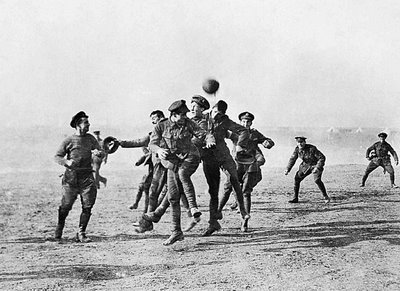
‘Christmas Soccer Game, 1915’, by Robert Cording

I suppose what made it possible
Was that no one expected more
Than a day of unhurried hours, better
Food, some free time to reread old letters,
Write new ones. Small Christmas trees
With candles lined both sides of the trenches
And marked the two days’ truce.

Who can explain it? – one minute troops
Are sitting in mud, the next raising themselves
Out of the trenches, as if all they needed
Was a soccer ball to remind them
Of who they were. Imagine a Scotsman
Heading the ball into the air and catching it
On his instep, then flicking it across

The frosted grass to a German smoking
A cigarette who smiles and settles the ball,
Then boots it back. Soon a few soldiers
From both sides circle around the Scotsman
And the ball moves quickly back and forth,
Left foot, right foot, all of the men rocking
From side to side, the ball, the cold,

Making good neighbors of them all.
A game’s begun, a real match without referees,
Attack and counterattacks, the ball crossing
From side to side, a match played,
We can imagine, as if it were all that mattered,
As if the game’s sudden fizzes of beauty –
Three crisp passes or two perfect triangles

Laying end to end and pointing to the goal –
Could erase what they had learned
To live with. Laughing, out of breath, dizzy
With the speed of the ball skipping over
The frozen earth, did they recognize themselves
For a short while in each other? History says
Only that they exchanged chocolate and cigarettes,

Relaxed in the last ransomed sunlight.
When the night came and they had retreated
To their own sides, some of the men
Wrote about the soccer game as if they had to
Ensure the day had really happened. It did.
We have the letters, though none of them says
How, in the next short hours, they needed,

For their own well-being, to forget everything
That had happened that Christmas day.
It was cold, the long rows of candles must have
Seemed so small in the dark. Restless, awake
In the trenches, the men, I suppose,
Already knew what tomorrow would bring,
How it would be judged by the lost and missing.

– Robert Cording, Common Life: Poems (Fort Lee: CavanKerry Press, 2006), 39–40.

‘What I see in Egoli’, Anonymous

What I see in Egoli
are tall buildings
smart cars
well dressed people
a whole scene
that has no place for me
no place for my wife
no place for my children.

Lord Jesus, where are you?
Are you in those smart white offices
those smart white houses
those smart white churches?

They think you are.
They talk about you the whole time
Just as if you were right there with them.
They are so sure
that you are guiding them,
that they are doing your will.
I like to think
that you are actually here with us
that you are one of the left out ones.

If that is how it is
if you are really here
with us, for us,
I think I could bear it
because I’d know
this wasn’t the end,
that you still come
to get prisoners out of gaol
and blind people out of darkness,
to get hungry people into the place
where they can feed their little ones
instead of helplessly hopelessly
listening to them cry.

But my son does not call you Lord,
Jesus,
let alone call on you,
Lord Jesus,
He uses your name as a swearword.
Jesus! he says,
Bloody white man’s Jesus!

I fear for him,
for us,
for those whites.

O Jesus, Jesus,
come soon,
clear up the barriers
open it all up, because if you don’t
something awful is going to happen.
Do you hear me,
one of those ‘homeland’ blacks
on the outside looking in?
RSVP
soon.

– Anonymous, cited in Margaret Nash, Black Uprooting from ‘White’ South Africa: The Fourth and Final Stage of Apartheid (Johannesburg: South African Council of Churches, 1980), 84–5.

‘Parable of the Moth’, by Robert Cording

Consider this: a moth flies into a man’s ear
One ordinary evening of unnoticed pleasures.

When the moth beats its wings, all the winds
Of earth gather in his ear, roar like nothing
He has ever heard. He shakes and shakes
His head, has his wife dig deep into his ear
With a Q-tip, but the roar will not cease.
It seems as if all the doors and windows
Of his house have blown away at once—
The strange play of circumstances over which
He never had control, but which he could ignore
Until the evening disappeared as if he had
Never lived it. His body no longer
Seems his own; he screams in pain to drown
Out the wind inside his ear, and curses God,
Who, hours ago, was a benign generalization
In a world going along well enough.

On the way to the hospital, his wife stops
The car, tells her husband to get out,
To sit in the grass. There are no car lights,
No streetlights, no moon. She takes
A flashlight from the glove compartment
And holds it beside his ear and, unbelievably,
The moth flies towards the light. His eyes
Are wet. He feels as if he’s suddenly a pilgrim
On the shore of an unexpected world.
When he lies back in the grass, he is a boy
Again. His wife is shining the flashlight
Into the sky and there is only the silence
He has never heard, and the small road
Of light going somewhere he has never been.

– Robert Cording, Common Life: Poems (Fort Lee: CavanKerry Press, 2006), 29–30.

‘Identification’, by Geoffrey Bingham

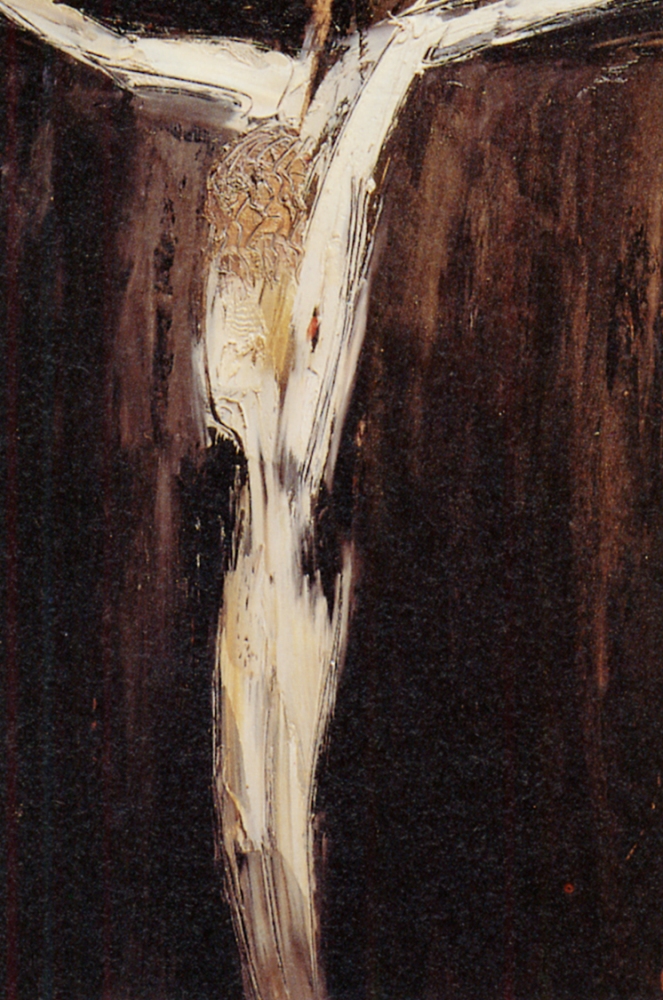
William Congdon, "Crucifixion No.2", 1960

In the dark reaches of Golgotha’s anguish,
His cold and nerveless hands—
Heavy with the pain of entire human sin,
And all cosmic evil (embracing all time)—
Reached out in a purposeful groping,
An attempted desire to reach,
Reach me, the lonesome, loathsome object
Of his insistent love.

In that moment I knew—in the moment of pain
And the high, wild cry—I knew he had embraced me,
Become me wholly as I was in my dream,
In my ineluctable anger and hate,
With all the dark deceits of my heart.

Me he became, and he anguished
As the intolerable pollution spread
Across the pure reaches of his holy self,
Drawing there out of me
The evil that was mine alone.

In the soft silence of his tomb I lay,
One with him in the unconquerable peace,
And with him I rose
When the world dawned new,
And I was the new man.

— Geoffrey C. Bingham, ‘Identification’, in All Things of the Spirit (Blackwood: New Creation Publications, 1997), 1.

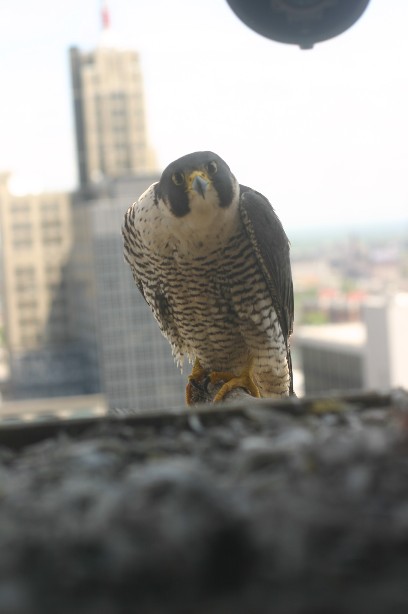
‘Peregrine Falcon, New York City’, by Robert Cording

On the 65th floor where he wrote
Advertising copy, joking about
The erotic thrall of words that had
No purpose other than to make
Far too many buy far too much,
He stood one afternoon face to face
With a falcon that veered on the blade
Of its wings and plummeted, then
Swerved to a halt, wings hovering.

An office of computers clicked
Behind him. Below, the silence
Of the miniature lunch time crowds
And toy-like taxis drifting without
Resolve to the will of others.
This bird’s been brought in, he thought,
To clean up the city’s dirty problems
Of too many pigeons. It’s a hired beak.

Still he remained at the tinted glass
Windows, watching as the falcon
Gave with such purpose its self
To the air that carried it, its sheer falls
Breaking the mirrored self-reflections
Of glass office towers. He chided
Himself: this is how the gods come
To deliver a message or a taunt,
And, for a moment, the falcon
Seemed to wait for his response,
The air articulate with a kind of
Wonder and terror. Then it was gone.

He waited at the glass until he felt
The diminishment of whatever
Had unsettled him. And though
The thin edge of the falcon’s wings
Had opened the slightest fissure in him
And he’d wandered far in thought,
He already felt himself turning back
To words for an ad, the falcon’s power
Surely a fit emblem for something.

– Robert Cording, Common Life: Poems (Fort Lee: CavanKerry Press, 2006), 11–12.

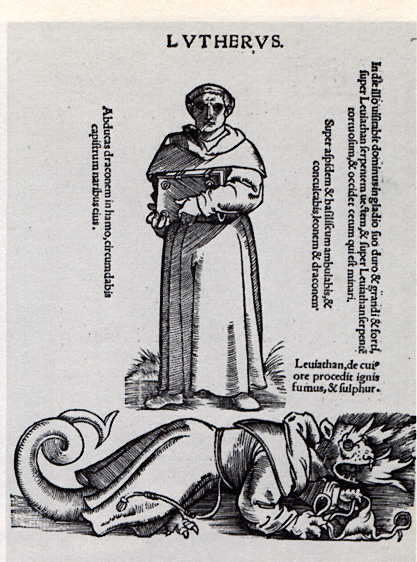
‘Luther and the Devil’, by Robert Cording

Over the coming six or seven weeks, I’d like to share some poems, one a week, probably on Wednesdays, from Robert Cording’s very rich collection of work published as Common Life: Poems.

Here’s the first:

‘Luther and the Devil’, by Robert Cording

When I began to lecture on the Psalms and I was sitting
in the refectory after we had sung matins, studying and
writing my notes, the Devil came and thudded three times
in the storage chamber as if dragging a bushel away.
— Martin Luther

Someone once remarked the medieval air
Was so thick with demons, a needle dropped
Randomly from heaven would have to pierce
One or two on its way down. These days
We’re more likely to believe in poltergeists
Than the heavy-footed, skulking Adversary
Who shows up in Luther’s little story.

Now, when Milton’s Satan of obdurate pride
And stedfast hate can be understood in terms
Of sibling rivalry, how quaint that path
Through the Psalms seems; likewise, the soul
Disturbed by the racket of a jealous Devil
Who needs to be wherever God is. Who believes
That figure of a bushel being dragged away?

Yet we catch certainly a glimmer of Luther’s
Pain over the sure step gone astray,
The barbed hours to come when nothing satisfies,
When that dull thudding in the storage chamber
Seems everywhere, centerless, and there is
No escape from the tightly spiralled Nautilus
Of the self that endures by choosing blindly.

And so perhaps we can come to understand again
Why, when Luther turns back to the Psalms
And his writing, he looks hard for the Devil
Harbored in his words, having learned too often
How that old Adversary shows up each time
The soul comes close to letting itself be found,
His soft mouth whispering one more illusory solace.

– Robert Cording, Common Life: Poems (Fort Lee: CavanKerry Press, 2006), 9–10.

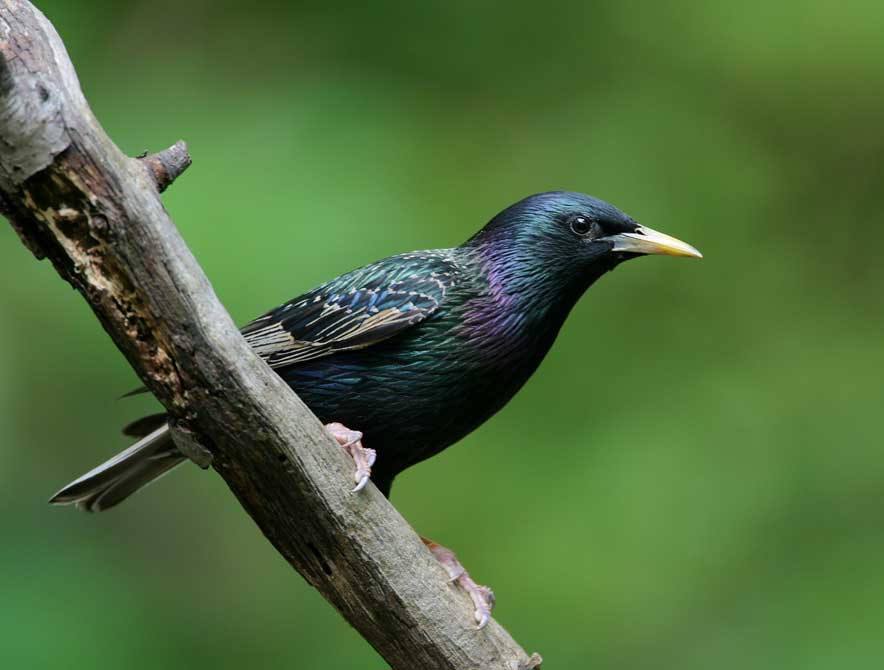
‘Mozart’s Starling’, by Robert Cording

A little fool lies here
Whom I hold dear—
—Mozart, lines of a poem for his pet starling

None of his friends understood.
A poem for a bird?—
and a funeral, and the ridiculous
request that they dress in formal attire.

But when Mozart whistled a yet-to-be
fragment of a piano concerto
in the marketplace, the bird
may have sang it back to him—

the starling appears in his diary
of expenses, May 27, 1784,
along with a transcription of its song.
What fun they must have had,

he whistling a melody, the bird,
a virtuoso mimic, echoing it back,
interspersed among its clicks
and slurs and high-pitched squeals.

Music to Mozart’s ears,
that dear bird who sang incessantly
for the duration of its three
short years in Mozart’s company.

His little fool was wise indeed—
it could hear a squeaking door,
a teapot letting off its steam,
a woman crying or rain pinging

in metal buckets and gurgling
in gutters, even a horse’s snort
or Mozart scratching notes,
and sing it back until Mozart, too,

could hear the cockeyed,
nonstop music in the incidental
bits and pieces of the world going by,
the exuberant excess of it all.

— Robert Cording, ‘Mozart’s Starling’.

Seven Stanzas at Easter

Make no mistake: if He rose at all
it was as His body.
If the cells’ dissolution did not reverse, the molecules reknit, the
amino acids rekindle,
the Church will fall.

It was not as the flowers,
each soft spring recurrent;
it was not as His Spirit in the mouths and fuddled eyes of the
eleven apostles;
it was as his flesh: ours.

The same hinged thumbs and toes,
the same valved heart
that – pierced – died, withered, paused, and then regathered out of
enduring Might
new strength to enclose.

Let us not mock God with metaphor,
analogy, sidestepping transcendence;
making of the event a parable, a thing painted in the faded credulity
of earlier ages:
let us walk through the door.

The stone is rolled back, not papier mache,
not stone in a story,
but the vast rock of materiality that in the slow grinding of time will
eclipse for each of us
the wide light of day.

And if we will have an angel at the tomb,
make it a real angel,
weighty with Max Planck’s quanta, vivid with hair, opaque in the
dawn light, robed in real linen
spun on a definite loom.

Let us not make it less monstrous,
for in our own convenience, our own sense of beauty,
lest, awakened in one unthinkable hour,
we are embarrassed by the miracle,
and crushed by remonstrance.

– John Updike, ‘Seven Stanzas at Easter’, in Telephone Poles and Other Poems (London: Andre Deutsch, 1964), 72–3.

Paul Mitchell, ‘Get the Word’

In the beginning was the word
and the word was with God
then a bag snatcher snatched it
laughed and carried it along a laneway
climbed a cyclone fence
pursued by the constabulary
then dropped the word
in an empty playground.

Now the word was with the law
who took it to the station.

But they took their eyes off it.
The word slipped out the window
said itself down a wall
I can I will I am
finding my way to God.

Overhearing was a priest
who dragged it off to seminary
bound it up in leather
shone a torch in its face
said Show the way to God.

The tortured word was honest
but struggled with its bindings
tried to free itself from paper
it was stamped upon
the imprisoned word of God cried.

Let me off these pages
I can show the way to love
the one I had with Dad
when he spoke me I spoke him
and when that phrase was in the air
it was both of us as well.

The priest took the word to council
who took it to a committee who slapped it
on the table of a busy bishop
who fenced it from intruders.

But he was knocked clean over
by that scheming snatcher
who took the word and threw it
all over the speaking earth.

— Paul Mitchell, Minorphysics (Brisbane: Interactive Press, 2003), 28.

[HT: Simon Carey Holt]

‘Story of God’, by Michael Crotty

Story of God’

My story of God seems
pass the tambourine
and do we have a dollar
here for Jesus.
Essentially, it is
disaster relief,
as history made
not in tutorials,
but from middens of waste.
Best interpretations
are so far off the mark
they must be a laugh
if they last a decade,
then like the wireless
of the forties
maybe derivations will remain.
Create a phonetic alphabet
with one sound missing
randomly chosen by algorithm
in a very limited edition
to be printed on a sheet
of guillotined B4
in six point calibri
and you may start
to get the picture.
When futility had truly tired of me,
only devotion would let it be.

Michael Crotty

[Source: Eureka Street]

‘Why I still go to church’

Why I still go to church’

This moment
Which doesn’t drift away.

John Foulcher
‘Why I go to church’

never for the flat parish choirs

sometimes for tea-towelled shepherds
and tinselled sleepy angels

possibly for the story of St Martin de Porres
who promised the rats he’d feed them
if they stopped annoying the prior

certainly not for the sermon that never asks
can Neanderthal men be saved?
can a single death two thousand years ago
redeem the hypothetical populations
of 55 Cancri’s planets 41 light years away?

partly because even if no one is there
sometimes in the vaster spaces
of St Kit’s, I feel a charged stillness

always because of the kneeling, the touch
of fingers on forehead, the taste of the host
the red, green, purple rhythms of seasons
wisdom of parables, music of psalms

now because of you kneeling
beside me, thumbing the scarred leather
of the little mass-book your grandmother
hid at the back of her Protestant linen-press

and perhaps because driving up Canberra Avenue
when the spire of St Stephen’s briefly aligns
with the national flagpole soaring
like Lucifer above Parliament House, the Big Syringe
of modern communication on Black Mountain,
the stone steeple has human dimensions.

Charlotte Clutterbuck [HT: Eureka Street]

Ruminate, and ‘Weekend Plans’ by David Holper

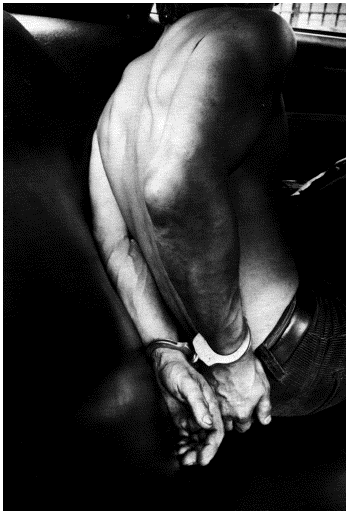
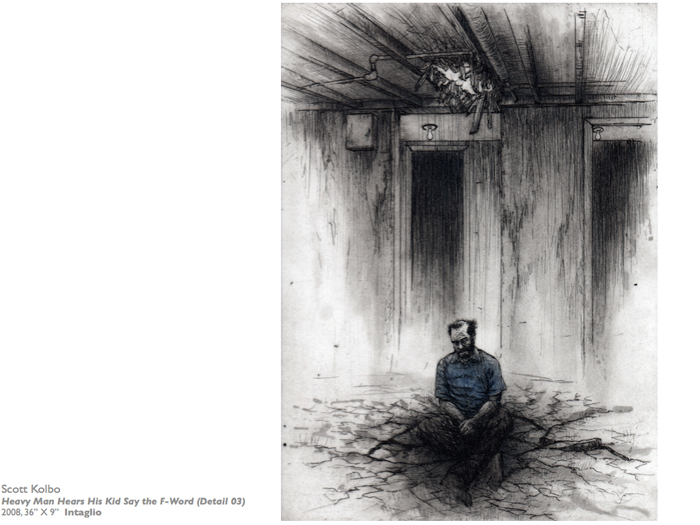
This week, I received my first hard copy of Ruminate (Issue 14, Winter 2009–2010). First impressions? It’s beautifully produced, and aesthetically yummy. Now, having read through it all, I remain delighted. This edition – like most – comprises of mainly poetry, but also includes two short stories, and is peppered with some provocative images (ink and charcoal, serigraphy, intaglio) by Scott Kolbo. Here’s my favourite poem from this issue:

‘Weekend Plans’, by David Holper

In a talk I recently heard, the speaker said
that at 50, a man has less than
1500 weekends left in his life.
Having chewed on this fact for the last week,
I now realize that my 1499th weekend is coming.

And so I’m making big plans:
On this 1499th remaining Saturday,
I plan to grade a stack of student papers.
But knowing that there are only so many of these
Saturdays to sit through,
I am planning on writing the most
remarkable comments and grades
I have ever composed.

Instead of pointing out where the prose clunks,
I will say that the sentence over which I stumble
reminds me of a ’62 Fiat convertible
I once owned, a car that ran well enough
when I bought it,
until I rear-ended a truck one day
and the front end crumbled
pushing the radiator back just enough
that the fan chewed a hole through
the back end,
the blades not only making an unearthly racket,
but also bleeding the radiator dry
and leaving a green stain on the pavement.

And instead of pointing out that a comma is not a coma,
that noone and alot are two words,
that a manor is a large country house
(in a manner of speaking)
and that collage
is not an institution of higher learning,
I will point out to them that Shakespeare, too,
invented new spellings and words
so that rather than see their grades as a kind
of condemnation,
they might rather embrace these marks as a sort of celebration
of their wild and anarchic spirit
which has emancipated itself from all bounds,
from all pedestrian, prosaic concerns
on this glorious, remaining 1499th Saturday.

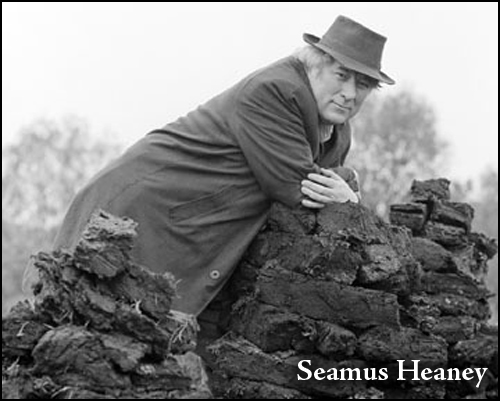
Seamus Heaney: ‘Death of a Naturalist’

I’m really looking forward to spending this weekend with the St Martin Island Community and with Cilla McQueen, a Bluff-based poet who is New Zealand’s Poet Laureate for 2009-2011. (Some of her work can be read here). It will, unsurprisingly, be a weekend of poetry and a celebration of place. Here’s one of two poems that I hope to share:

Death of a Naturalist

All the year the flax-dam festered in the heart
Of the townland; green and heavy headed
Flax had rotted there, weighted down by huge sods.
Daily it sweltered in the punishing sun.
Bubbles gargled delicately, bluebottles
Wove a strong gauze of sound around the smell.
There were dragon-flies, spotted butterflies,
But best of all was the warm thick slobber
Of frogspawn that grew like clotted water
In the shade of the banks. Here, every spring
I would fill jampots full of the jellied
Specks to range on the window-sills at home,
On shelves at school, and wait and watch until
The fattening dots burst into nimble-
Swimming tadpoles. Miss Walls would tell us how
The daddy frog was called a bullfrog
And how he croaked and how the mammy frog
Laid hundreds of little eggs and this was
Frogspawn. You could tell the weather by frogs too
For they were yellow in the sun and brown
In rain.

Then one hot day when fields were rank
With cowdung in the grass the angry frogs
Invaded the flax-dam; I ducked through hedges
To a coarse croaking that I had not heard
Before. The air was thick with a bass chorus.
Right down the dam gross-bellied frogs were cocked
On sods; their loose necks pulsed like snails. Some hopped:
The slap and plop were obscene threats. Some sat
Poised like mud grenades, their blunt heads farting.
I sickened, turned, and ran. The great slime kings
Were gathered there for vengeance and I knew
That if I dipped my hand the spawn would clutch it.

– Seamus Heaney

Scott Cairns: ‘The End of Suffering: Finding Purpose in Pain’

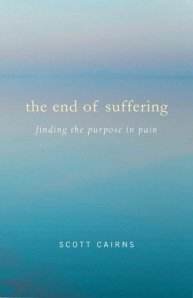
End of SufferingScott Cairns’ most recent publication – The End of Suffering: Finding Purpose in Pain (Brewster: Paraclete Press, 2009) – invites a play on the word end. Cairns recalls that while we can believe that a day will come when suffering will be no more, we live now in ‘our puzzling meantime’, aware both that suffering is no end in itself but also that we sense something of ‘suffering’s purpose’, that ‘our own descents into suffering may turn out to be the occasions in which we – imitating [Christ’s] unique and appalling descent – come to know Him all the more intimately’ (p. 99). Here’s a further snippert:

Saint Isaac counsels, “Blessed is the person who knows his own weakness, because awareness of this becomes for him the foundation and the beginning of all that is good and beautiful.” Affliction appears to be our only reliable access to this kind of knowledge, this necessary confrontation with our own weaknesses, and this advantageous mitigation of our pride. And it seems to be the only way we come against self-esteem to glimpse and thereafter to know our condition, to appreciate our vulnerability, and to live according to this new and chastening light. (pp. 18–19)

Throughout this book, Cairns draws not only upon Saint Isaac, but also upon work by George Steiner, W.H. Auden, G.K. Chesterton, Dostoevsky (mainly his The Brothers Karamazov), Dietrich Bonhoeffer, Archimandrite Sophrony, Saint Theophan the Recluse, Kallistos Ware, Alexander Schmemann, Simone Weil, and others. This essay serves as not only an accessible reflection on suffering (it would be a good book to work through in small groups), but also as a nuanced entrée into the Christian tradition (particularly into its Orthodox branch), and into a way of doing theology that invites us to embrace – or, rather, to be embraced by – a new vision of life via the ‘puzzlement’ of our afflictions. Those already familiar with Cairns’ poetry (and if you’re not, shame on you!) will want to go back and re-read it. Those unfamiliar with Cairns the poet, will (hopefully) get enough of a taste of it in this essay that they will want to ‘take up and read’ [it].

The book concludes – appropriately – by recalling Alexander Schmemann’s reflection on Lent:

For many, if not for the majority of Orthodox Christians, Lent consists of a limited number of formal, predominantly negative, rules and prescriptions: abstention from certain food, dancing, perhaps movies. Such is the degree of our alienation from the real spirit of the Church that it is almost impossible for us to understand that there is “something else” in Lent – something without which all these prescriptions lose much of their meaning. This “something else” can best be described as an “atmosphere,” a “climate” into which one enters, as first of all a state of mind, soul, and spirit, which for seven weeks permeates our entire life. Let us stress once more that the what is lacking purpose of Lent is not to force on us a few formal obligations, but to “soften” our heart so that it may open itself to the realities of the spirit, to experience the hidden “thirst and hunger” for communion with God.

Cairns recalls how that for Schmemann, ‘a “quiet sadness” permeates the Lenten services themselves; “vestments are dark, the services are longer than usual and more monotonous, there is almost no movement.” He observes that despite the alternating readings and chants, “nothing seems to happen.” And so, he acknowledges, we stand for a very long time in this quiet, this sadness, this monotony. “But then we begin to realize that this very length and monotony are needed if we are to experience the secret and at first unnoticeable ‘action’ of the service in us. Little by little, we begin to understand, or rather to feel, that this sadness is indeed ‘bright,’ that a mysterious transformation is about to take place in us.” Moving through the sadness’, Cairns writes, ‘we glimpse the joy. We feel its effects on us and feel how it changes us. We are thereby led to a place where noises, distractions, and false importance of the street – of our dissipated lives – finally “have no access – a place where they have no power.” Similarly, then, in those seasons of our afflictions – those trials in our lives that we do not choose but press through – a stillness, a calm, and a hope become available to us; they are a stillness, a calm, and a hope that must be acquired slowly, because – as Father Schmemann says of our joy in Lent – “our fallen nature has lost the ability to accede there naturally.”’ We are obliged, Cairns insists, to ‘recover this wisdom slowly, bit by bit’. (pp. 112–14)

Slavitt: ‘The Seven Deadly Sins’

Seven Deadly Sins

Having just finished reading David R. Slavitt’s, The Seven Deadly Sins and Other Poems, I could not resist posting just one more. Here’s the title piece: ‘The Seven Deadly Sins’ (pp. 51-56), one I delighted in reading a number of times, not least because of its reminiscence with Lewis’ Wormwood-Screwtape correspondence. It also made me wish that the tradition identified a host more deadly sins.

1 pride
Surely, there must be some mistake. I admit
at once that my name is there with the other six,
but after all, if you look at what I am
and what I do, as you should not only for my
sake but your own, and examine in however
perfunctory a fashion before passing
judgment, you will realize that I have about me
a certain dignity, even a moral weight,
and that my contribution over the generations
has been by no means negligible. Only call me
self-respect, or, avoiding false modesty, honor,
and where are we then? In what way are my promptings
sinful? Pride gives men a reason for doing
the right thing even when the world
has gone mad. Without any self-regard,
I suggest that a man is helpless, very likely
depressed, and could at any moment go
native. In this light you must concede
that I am one of the bulwarks of decency: I
embody not only ethical norms but also
standards of good taste in dress and deportment
as well as in art and music without which
civilization would long ago have toppled.
A sin? No, I’m a virtue and have my pride.

2 anger
This is, to say the very least, annoying,
but as you see, I am calm, I am in control.
I should like to point out, however, that the capacity
for anger is morally neutral, and even, sometimes,
a good thing. Does injustice make you angry?
Do cruelty and suffering not engage
your emotions? Intellectual disapproval
is never enough. What you want is your blood to boil,
to seethe with fury at the outrageousness of what
you cannot tolerate, and mankind ought not to permit.
Anger, or call it instead righteous wrath,
is an aspect of the divine, and if we partake
to any degree in that perfection, then we
also feel rage at what goes on around us.
For me to be classed as one of the seven deadly
sins is enough to make anyone angry,
but what’s wrong with that, as long as I maintain
proper decorum? The mental state, the mere
idea of anger cannot be sinful. Any
random thought that crosses your mind . . . Are you held
accountable for that? Then you are all
eternally damned—that is if you still believe
in damnation and those scary Italian pictures
of the last judgment with the shrieking souls falling
on one side of the canvas, and, on the other,
beatific wimps ascending, smiling,
full of the gas of gentle piety.
Do you want to be one of those? Do you? I ask you.
Grow up, accept who you are, and accept me.

3 avarice
I know what you’re about to say: radix
malorum est cupiditas. I admit
that, in Latin, it has a nice ring to it, but let us
be frank with one another and try to imagine
a world in which there wasn’t at least some degree
of cupiditas. The industrial revolution
is erased, the capitalist system in which mankind
is better off, at least in a material way,
than it ever has been since they rooted about
for acorns. Ambition? The desire for betterment,
for one’s self and family too, the eagerness
for respect that society shows, it cannot be
denied, in financial terms, the only language
universally understood . . . You want to chuck
all that? What are you, some kind of left-wing dreamer?
Greed can get out of hand (but then what can’t?)
and be carried sometimes to grotesque excess.
And if that is the case, then Greed isn’t the sin
but Excess—which oddly does not appear on the list.
A roof over your head, a decent bed,
a nice house, or maybe even a little
more than that? A car that’s fun to drive
and you’re on the road to hell? Does that make sense?
Who’s left? You want to go and live on a commune?
Or maybe some simple place in the third world?
Well, maybe you do, but only because it’s cheaper,
you can get good servants for next to nothing, and live
remarkably well on what your portfolio yields.

4 envy
The rest of them envy me, and I admit
that I am pleased by this. It’s always nice
when somebody looks at your ring, your stickpin, your wife,
the emeralds at her neck and on her bosom,
and smiles to hide the grinding of his teeth
as he admits to himself (but you know, too)
that you are the alpha male. The other six
are on the list, but I am the only one
who appears as well in the Ten Commandments, which galls them.
Not that this makes me especially heinous or different,
for who does not feel envy when window-shopping
on Madison in the sixties? He’s blind, or dead,
or he has so much, himself, that he only knows
envy from the receiving end, for it
is a two-way street. You crave what this man has,
or how much he knows, or how good he looks, or his youth
or health, or his success, or his children’s . . . Of course,
you do, and this is a goad to work harder.
Take a longer view, and all the improvements
of the past five hundred years, you must admit,
resulted from my prompting. The labor movement?
Universal suffrage? The fundamental
belief in equal justice? They’re all my doing,
and answers to the envy that first informed
those men and women that they were being treated
like beasts, like dirt. Why then does my name appear
on lists of prohibitions and taboos?
Precisely for that reason—that I disturb
the social order and make the nobles quake
in their huge dining rooms with the centerpieces
of silver and gold, the crystal chandeliers,
the flatware, the fine china, and all those footmen.
They count on it that wealth arouses envy
and hope that the peasants, believing what they’ve been told,
won’t riot (at least not yet), for that would be sinful.

5 lust
I have an affirmative defense. I am not only not
a sin but the subject of Jehovah’s first commandment:
Be fruitful and multiply. How else does that happen,
do you suppose, and what demented church father
loathing the body, loathing himself, dreamed up
the perverse idea that lust was, in itself,
a bad thing? The Greeks, who were civilized—
at least for a while—thought of me as a god
and accorded me respect. What man or woman
can look at a painting or sculpture, never mind of a nude
but even a pot of flowers, a landscape, a still life,
without lust, or say an appreciation
of the sensuous forms the painter has on offer,
and not respond at all? I should not have been put here
on this ridiculous list, and whoever thinks
I deserve such a calumny ought to see
a shrink. People can, I concede, misuse
my gift, but that’s their business. Love, children,
the survival of the species have their costs.
I invite you to take a walk with me in the springtime
when the girls first reappear in their summer dresses
and tell me it is not good to be alive.

6 gluttony
What, I ask you, distinguishes me from hunger
that can’t be a sin, except in the mind of some
self-abusing monk in his cell, despising
whatever is not pure spirit? Men are bodies,
and bodies need to be fed. But to answer the question,
gluttony is excess, some unattractive
fat rich man whom it’s easy to laugh at.
There are, nevertheless, a few words
of explanation (not perhaps a defense
but at least an extenuation) for the deeper
question is the nature of his hunger
that he knows is unhealthy. His doctor, at every visit,
talks of his sleep apnea, his arthritis,
and his A1C hemoglobin that’s high,
and the poor fellow would cut back if he could.
He resolves to do better, and tries, and fails.
That hunger of his isn’t for food but for love.
He is sad, or beyond sad, and in his heartbreak
he needs to be consoled and he dimly remembers—
or cannot quite remember what his body
keeps, still, in its deepest recesses—lying
on his mother’s breast, snug, warm, loved,
and being suckled, and he would give the world
to go back to that, but he can’t, and instead he gorges,
stuffs himself, and never is satisfied.
But is that a moral defect? Or is it the world,
perilous and unfriendly as it is,
that deserves reproof? Show him a little compassion,
the understanding and love that he hungers for.

7 sloth
Not laziness, no, it’s bigger than that. The older
name was better, Accidie, which suggests
a larger fatigue, not only of flesh but of spirit,
a failure, at last, of faith, and that indeed
would be a sin, that is if you believed
in sin. But my people don’t. Perhaps they used to,
but now they get by on pills, the Lexapro
and maybe a little Wellbutrin. And their despair
may not indicate madness but sanity,
for they have seen through to the dismal truth of things—
that nothing lasts, that the dreams of their youth were merely
dreams. They grow up and age, and the body betrays,
and the mind, as it starts to consider the emptiness
that beckons, resigns itself. The childhood faith
they used to have seems quaint, or a bad joke.
There is no afterlife. There is no life.
It’s poetry ‘Stupid’

stupid‘In an age dominated as much as the past two centuries have been by science and the scientific method, those who fear mechanism have turned for support to the poets and artists. Professor Whitehead suggested that the metaphysicians of the future may be its poets rather than its philosophers, and that more than once, as in the case of Plato, this had been true of the past as well … In Kierkegaard’s century, the opposition to the primacy of intellect as the medium for acquiring knowledge came especially from the Romantic school of writers and thinkers in Germany, France, and England. Realizing that scientific mechanism would bring on what Nietzsche termed “the devaluation of all values,” the Romantics demanded the recognition that poetry communicated a higher knowledge than did prose, and that there was a wisdom in the history of the race which the intellect could neither transmit nor judge’.

So penned Jaroslav Pelikan in his richly-rewarding study Fools for Christ: Essays on the True, the Good, and the Beautiful (Philadelphia: Muhlenberg Press, 1955). While I do not consider myself one who dances with the Romantics (perhaps if you saw me dance you would understand something of why), I am unashamedly one of those who has – in the face of modernity’s unbridled confidence in scientific method – ‘turned for support to the poets and artists’. Consequently, and for some time now, it has been my practice to read a poem a day. Currently, I’m steadily making my way through C.K. Stead’s Collected Poems, 1951–2006, and a great collection by David R. Slavitt, The Seven Deadly Sins and Other Poems. Here’s Slavitt’s ‘Stupid’:

The sneezing having abated, the throat no longer
sore, I am nonetheless less, exhausted, stupid
as if my mental rheostat were turned down.
Paragraphs in books became opaque.
Even the talk on the radio faded in
and out, its reception fine but mine not.
An interesting adventure, one might have imagined,
but stupidity finds nothing interesting,

infecting, dulling the whole world down to itself,
with the one brilliant, heartbreaking exception—
that the dreams of the stupid are vivid as yours or mine,
their colors as bright, their mysteries all the more
mysterious and profound. Beyond, beneath
that intelligence we hold dear, they come into their own.

– David R. Slavitt, ‘Stupid’, in The Seven Deadly Sins and Other Poems (Baton Rouge: Louisiana State University Press, 2009), 16.

And let me share another one. Slavitt again, this time on ‘What Is Poetry About?’ (from pp. 17–18)

Or ask, rather, what earthly good is it,
when a trivial thing like not being able to find
my silver and amber pillbox can ruin my morning?
It’s somewhere here, I had it yesterday, I couldn’t have lost it,
but I can’t find it, which is as good as or as bad as.
One ought not to be too attached to objects, of course, and it is uneconomic
to pay a psychiatrist more to hear one’s kvetches about losing, say, a pillbox,
than the thing cost in the first place. But then think of the vessels
at Balthazar’s feast, not just cathected objects,
but holy, stolen out of the Temple by his father, Nebuchadnezzar.
This pillbox was from Krakow, a gift from my daughter.
We’d had a lovely day at Auschwitz … No, seriously, a good day,
with a Purim service at the end of it, and the old men, the remnants, the relicts,
chanting about Haman and his ignominious end in Shushan.
If you’re going to Auschwitz, you should go erev Purim,
which makes it bearable. And the pillbox was a memento of that.
So I dug through pockets of trousers and jackets, looked in the nightstand drawer,
peered under the bed, in a trivial but desperate
tizzy. Not to drag it out too exquisitely,
it was on the floor beside the nightstand, where the cats had knocked it
or left it after having played a little pillbox hockey,
which is as good as pinecone hockey with what they can snatch
from the guest bathroom potpourri. And everything was better,
I had it in hand and could relax, or at least stop worrying about that.
I’ve given up looking for the pen one cat or the other knocked off my desk,
not an important pen, but one I liked,
but I have forgiven them because what is the point in not forgiving them?
And they are dear cats, now that I’ve figured out
how their licking each other and then fighting, and then running around like dervishes
reminds me of my mother and my Aunt Vera, because these two
are also sisters and have a sororal connection, not
altogether pacific but deeply attached. So I forgive them for this, too,
which is easier, now that I have the pillbox back in my pocket.
Nebuchadnezzar was punished for having taken the vessels from the Temple,
went mad, and, like a beast, ate grass. Or if he wasn’t punished,
he just happened to go mad, which was, to the Jews who observed it,
significant. More modern ones might simply suggest that he see a shrink
and talk about whatever was bothering him, so that even if he was still unhappy
he would at least stop grazing like a bull in a meadow.
It’s the grass at Auschwitz that is misleading.
A friend of mine who was there, who was really there,
told me that they ate all the grass, not crazy but just hungry.
And poetry? Is what holds all this together, what keeps me
more or less together, or at least is a way of changing the subject.

‘What Language Shall I Borrow?’: Reading for ministry

Picasso - The ReaderThere is a lot in the observation that pastors who read (and there are too few of those) not to be drawn into a deeper place of grappling with realities human and otherwise but who engage in page turning primarily with a view to ‘finding illustrations’, or sponsoring homiletical self-aggrandisement that can be employed for doing something ‘really significant’, only betray themselves as soon as they take up the invitation to speak, whether in a public setting or in a more private one. I recall the words of Michael Dirda, the editor of the Washington Post Book World, who once opined:

A true literary work is one that makes us see the world or ourselves in a new way. Most writers accomplish this through an imaginative and original use of language, which is why literature has been defined as writing that needs to be read (at least) twice. Great books tend to feel strange. They leave us uncomfortable. They make us turn their pages slowly. We are left shaken and stirred. But who now is willing to put in the time or effort to read a real book? Most people expect printed matter to be easy. Too often, we expect the pages to aspire to the condition of television, and to just wash over us. But those who really care about literature nearly always sit down with a pencil in their hands, to underline, mark favorite passages, argue in the margins. The relationship between a book and reader may occasionally be likened to a love affair, but it’s just as often a wrestling match. No pain, no gain. This is why the NEA report shows that poetry is suffering most of all. Poets keep their language charged, they make severe demands on our attention, they cut us no slack. While most prose works the room like a smiling politician at a fundraiser, poetry stands quietly in the dusty street, as cool and self-contained as a lone gunfighter with his serape flapping in the wind. It’s not glad-handing anybody. (Washington Post, July 2004)

Moreover, good writing leaves us humbled and grateful for the privilege of learning from adroit diagnosers and physicians of the soul, the accumulation of whose experiences serve to assist those of us charged with ministering to those who labour with diseases and distempers of spirit beyond our own experience.

Therefore, in order to sponsor such happenings, I’m wanting to compile a list of suggested novels, plays and collections of poetry as assigned reading for theology students and pastors. And to this end I am soliciting the help of readers of Per Crucem ad Lucem. I’m thinking of work by Geraldine Brooks, John Updike, John Steinbeck, J.M. Coetzee, David Malouf, F. Scott Fitzgerald, Flannery O’Connor, Jim Crace, Thomas Carlyle, Francine Prose, Kenzaburō Ōe, Thomas Lynch, George MacDonald, A.S. Byatt, and Nathaniel Hawthorne; and poets like William Blake, John Donne, E.E. Cummings, T.S. Eliot, George Herbert, Philip Levine, Sylvia Plath, Anna Akhmatova and John Ciardi.

Here’s some additional suggestions to kick us off:

Novels


Poetry/Plays


What might you add?

Scott Cairns: ‘Adventures in New Testament Greek: Nous’

breathe

You could almost think the word synonymous
with mind, given our so far narrow
history, and the excessive esteem

in which we have been led to hold what is,
in this case, our rightly designated
nervous systems. Little wonder then

that some presume the mind itself both part
and parcel of the person, the very seat
of soul and, lately, crucible for a host

of chemical incentives—combinations
of which can pretty much answer for most
of our habits and for our affections.

When even the handy lexicon cannot
quite place the nous as anything beyond
one rustic ancestor of reason, you might

be satisfied to trouble the odd term
no further—and so would fail to find
your way to it, most fruitful faculty

untried. Dormant in its roaring cave,
the heart’s intellective aptitude grows dim,
unless you find a way to wake it. So,

let’s try something, even now. Even as
you tend these lines, attend for a moment
to your breath as you draw it in: regard

the breath’s cool descent, a stream from mouth
to throat to the furnace of the heart.
Observe that queer, cool confluence of breath

and blood, and do your thinking there.

– Scott Cairns, Philokalia: new and selected poems (Lincoln: Zoo Press, 2002), 26–7.