Though a newcomer to theo-blogdom, Steve Holmes (not this one, nor this one, and definitely not this Transylvanian Saxon from Sibiu) is no stranger to most of us. He has kicked off his blog – Shored Fragments – with, among other tidbits, a number of helpful reflections on Bruce McCormack’s recent TF Torrance Lectures (formerly the SJT lectures) held at the University of St Andrews. Here’s Steve’s posts:
Karl Barth
You Tube on Neo-Orthodoxy
‘Will the Love of God Finally Triumph?’: A response to David Fergusson
 Professor David Fergusson is one of the ablest theologians teaching and writing in Britain today. A few weeks ago, I heard him give a delightful paper on providence, a mere entrée to a larger project that he’s currently working on. Everything I’ve read of his I’ve thoroughly enjoyed, especially his Scottish Philosophical Theology, The Cosmos and the Creator, and Christ Church and Society: Essays on John Baillie and D. Donald Baillie (which he edited). And so it was that I approached his essay ‘Will the Love of God Finally Triumph?’ with the certain sense of excitement, never dreaming that I might be disappointed with its contents. The essay, which was originally presented at the Sixth Edinburgh Dogmatics Conference, appears in a collection from that conference entitled, Nothing Greater, Nothing Better: Theological Essays on the Love of God, edited by Kevin J. Vanhoozer (pp. 186–202).
Fergusson properly begins his essay by reminding us that ‘the love of God demands an eschatology’ (p. 186) before proceeding to rehearse the three possible ways in which his title question can be answered. In the first section, he outlines the Augustinian and Reformed traditions in which the love of God triumphs only through the limiting of its scope, i.e. towards the elect. This, Fergusson suggests, is ‘unacceptable’ (p. 188).
In the next section, ‘Universalizing the Scope’, Fergusson turns to Karl Barth, and to what he considers to be an inconsistency between Barth’s doctrine of the election of humanity in Jesus Christ and his denial of an apokatastasis. After fairly outlining Barth’s position and properly emphasising the Swiss theologian’s fall-back position in the divine freedom, Fergusson elicits Berkouwer’s criticism of Barth in support:
‘In view of Barth’s emphasis on the factuality of Christ’s rejection, it is not possible to close the door to the apokatastasis doctrine by pointing to the fact that the Bible speaks of rejection as well as election and then entrust everything eschatologically to the hand of God. Did not the hand of God become visible in His works, and specifically in the one central “modus” of his work in Jesus Christ, in election as the decretum concretum, in the triumph of grace?’ (p. 192)
The third, and final, section is entitled ‘Against Universalism’. It is in this section that Fergusson outlines his own proposal for answering the question he began with. He begins this section, by asking ‘what is wrong with universalism in any case’? (p. 196). After noting the ‘burgeoning literature on this subject’ (p. 196) he proceeds to note that ‘one of the more perplexing aspects of the current controversy is the way in which critics of the universalist case concede that it would be nice if it were true’ (p. 196-7). He cites Stephen Davis and William Lane Craig as examples of those who would like to believe that ‘universalism were true, but it is not’ (p. 197). He then comments: ‘Such remarks are puzzling. Are we saying that God’s final scheme is undesirable? Are we even suggesting that our own moral preferences are somehow better than God’s. Can we claim to be evangelical if we hold that it would be good if universalism were true while also lamenting wistfully that it is not what God has on offer? There is a good dominical response to this: “If you then, who are evil, know how to give good gifts to your children, how much more will your Father who is in heaven give good things to those who ask him” (Matt. 7:11)’ (p. 197). I believe that we ought to hear these questions with their full force, regardless of where we end up on this vexed question.
 Fergusson proceeds to note that universalism’s attraction is its ‘ability to present a vision of cosmic fulfillment in which God executes justice, not only for human beings whose lives have been maimed by nature or society, but also for the whole creation … Universalism should not be tempered therefore until its profound attractions are understood. We might try to avoid it by proposing that the grace of God is offered to all in Christ but, for those who reject it, God’s scheme of justice demands eternal punishment or at least annihilation’ (p. 197).
Fergusson rehearses the well-worn argument that any certainty in an apokatastasis, while a theoretical possibility, is ultimately ‘as deterministic and destructive of human freedom as the doctrine of double predestination in hyper-Calvinism’ (p. 199). The theoretical possibility Fergusson entertains is entirely dependent on an advance in human free will. He employs the usual rhetoric of love needing to be a free human response, an ontological reality that makes the possibility of rejecting God a final possibility. One of the problems with this common argument is that Jesus potentially died for no-one. And so parroting Davis’ and Craig’s response to universalism, I confess that it would be nice if the free will argument was true, but it’s not. As I’ve argued elsewhere, the only two tenable (i.e. biblically and theologically defensible) positions available for this soteriological question are either (i) a robust reaffirmation of limited atonement (the negative side of which includes the possibility of annihilation), or (ii) some form of christological universalism (as opposed to the Hickian vision).
Fergusson’s final answer to the question that he started off with, that is, ‘Will the Love of God Finally Triumph?’, seems to be answered by, ‘Only with our help’! He concludes: ‘An eschatology needs to express the ways in which our lives are bound up with those of our neighbors and with creation as a whole and involve decisions and projects of eternal significance. By so doing the eschatological vision of the kingdom of God can furnish us with a sense of the permanence and grandeur of God’s love. The possibility that we may inexplicably exclude ourselves from this ultimate community is a condition of the significance , of our God-given freedom’ (p. 202).
My question is this: In the light of God’s action in Christ, is Fergusson’s vision all that we can reasonably hope for? I hope not, and Barth’s witness in 4/1 reminds me why I have good reason to hope not:
The ordaining of salvation for man and of man for salvation is the original and basic will of God, the ground and purpose of His will as Creator. It is not that He first wills and works the being of the world and man, and then ordains it to salvation But God creates, preserves and over-rules man for this prior end and with this prior purpose, that there may be a being distinct from Himself ordained for salvation, for perfect being, for participation in His own being, because as the One who loves in freedom He has determined to exercise redemptive grace – and that there may be an object of this His redemptive grace, a partner to receive it … The “God with us” has nothing to do with chance. As a redemptive happening it means the revelation and confirmation of the most primitive relationship between God and man, that which was freely determined in eternity by God Himself before there was any created being. In the very fact that man is, and that he is man, he is as such chosen by God for salvation; that eschaton is given him by God. Not because God owes it to him. Not in virtue of any quality or capacity of his own being. Completely without claim. – Karl Barth, Church Dogmatics IV.1 (ed. G. W. Bromiley and T. F. Torrance; trans. G. W. Bromiley; Edinburgh: T&T Clark, 1961), 9–10.
Engaging with Barth
 While PhD’s and monographs on Karl Barth’s thinking continue to be produced in greater numbers than ever before (and deservedly so, despite my question here), very few volumes have given us an evaluation both critical and fair of Barth’s massive theological legacy in a multi-author source.
January 2008 will witness the launch of Engaging with Barth: Contemporary Evangelical Critiques, edited by David Gibson & Daniel Strange. I must confess to being a little sceptical when I first surveyed the list of contributors to this title, some of whom I was surprised to see mentioned in a collection on Barth (not to mention the obvious omission of some leading evangelical experts on Barth). However, my tune has somewhat changed since I heard Andy McGowan read his chapter recently and despite remaining unconvinced on a few points, his paper was engaging and served as a model of clarity and fairness, of taking Barth seriously and extending the discussion into some helpful trajectories. If McGowan’s chapter is a true indication of the desire for this book’s authors to engage fairly with Barth, then I can honestly say that I’m now looking forward to reading (and reviewing) the rest, though still some chapters more than others.
The books contents are:
Foreword
Carl R. Trueman
Introduction
David Gibson & Daniel Strange
1. Karl Barth’s Christocentric Method
Henri Blocher
2. Does it matter if Christian Doctrine is Contradictory? Barth on Logic and Theology
Sebastian Rehnman
3. Karl Barth as Historical Theologian: The Recovery of Reformed Theology in Barth’s Early Dogmatics
Ryan Glomsrud
4. Karl Barth and Covenant Theology
A. T. B. McGowan
5. The Day of God’s Mercy: Romans 9-11 in Barth’s Doctrine of Election
David Gibson
6. Witness to the Word: On Barth’s Doctrine of Scripture
Mark D. Thompson
7. A Private Love? Karl Barth and the Triune God
Michael J. Ovey
8. Karl Barth and the Doctrine of the Atonement
Garry J. Williams
9. Karl Barth and the Visibility of God
Paul Helm
10. Karl Barth and Jonathan Edwards on Reprobation (and Hell)
Oliver D. Crisp
11. ‘Church’ Dogmatics: Karl Barth as Ecclesial Theologian
Donald Macleod
12. A Stony Jar: The Legacy of Karl Barth for Evangelical Theology
Michael S. Horton
Advent Reflection 1: In Christ God Has Come Together With Us
 Each year between 1926 and 1933, the Swiss theologian Karl Barth penned a Christmas meditation for a German daily newspaper. In his 1931 reflection, ‘It gives new lustre to the world’, Barth began by asking a question asked each Advent by Christians generally, and perhaps especially by those called upon to preach: ‘What does it mean to hear the Christmas message?’ He proceeds to say that if the question is put like that, ‘then it behoves us all, especially if we happen to be theologians, to keep our mouths shut and first to consider that the Christmas message is not a philosophy, nor an ideology, nor a moral system or anything like that’. Instead, the Christmas word is ‘the Word of God to which no one has the key and whose real meaning for us, now as in former ages, is God’s secret. Hidden is the point where the Christmas message concerns each one of us and our whole generation, where its grace and judgement, its promise and command affect us’.
However (and it is a big ‘however’), as Barth proceeds to note, the question posed above does not need to be put like that. We could ask, for example, ‘What does it mean that we have heard the Christmas message?’; in which case, while we cannot lay hold of the full reality of the Christmas message, interpret and apply it, as if it were some human wisdom, neither can we or should we ignore its testimony which speaks to us of its hidden reality, of its way and nature, whereby both we and every other generation are reminded of certain possibilities, which are, so to speak, the outer garb of an incomprehensible but real encounter between God and humanity. In the grace of God, we can and must speak that which we know and have heard. In the grace of God, we can and must bear witness, testimony, to God’s self-disclosure. And in the grace of God, this testimony is preserved for us in Holy Scripture.
When, therefore, the Christmas word seems too incredible to believe, we can hear … and believe again. And what is this word? Barth again:
If God had wanted to deal with us as He is free to do, and as we well deserved it, according to His principle, He would never have become man. But He was and is merciful, and therefore in Christ He has come together with us (with us!), though His holiness and our weakness and wickedness should really exclude any coming together on His part and any thought of cooperation on our part. But God did and does just this, the impossible or – should we say? – that which is practical only for Him the Merciful One, which must happen so that His free and merciful will be done. The fact that also in this respect human beings can believe the eternal Light, means that we do perhaps have the will to do that which concerns us most, and which under any circumstance must be done in common with others. – Karl Barth, Christmas (trans. Bernhard Citron; Edinburgh/London: Oliver and Boyd, 1959), 47.
(NB. This is a reposting of my contribution to the Advent reflections at Hopeful Imagination)
Two new books on Barth
 Eisenbrauns have recently announced two new books on Barth:
Karl Barth’s Trinitarian Theology, by Peter S. Oh (Continuum, 2007)
Karl Barth’s Trinitarian Theology is an original and insightful discussion of the theme of the Trinity in the thought of Karl Barth, with particular reference to ecclesiology. The book examines Karl Barth’s analogical use of the Trinity, with respect to various patterns of divine-human communion in the context of the doctrine of redemption. In the first part of the book Oh explores Barth’s understanding and use of analogy throughout his theological development, and compares the work of Kierkegaard and Barth. This research gives fresh insight into Karl Barth’s Trinitarian, theological hermeneutics. In part II, Oh examines Barth’s analogical use of the doctrine of the Trinity from an ecclesiastical perspective.
and…
Karl Barth and Hans Urs Von Balthasar: A Critical Engagement, by Stephen Wigley (Continuum, 2007)
Karl Barth and Hans Urs von Balthasar are two of the most important theologians of the last century. Although one being Reformed and the other Catholic, they kept a lifelong friendship which also influenced their theological work. The book argues for the crucial influence of von Balthasar’s meeting with and study of Barth for the emergence of his own great theological trilogy, beginning with The Glory of the Lord, continuing with the Theo-Drama and concluding with the Theo-Logic. In particular it argues that it is von Balthasar’s debate with Barth over the analogy of being which is to determine the shape of von Balthasar’s subsequent theology, structured as it is around the transcendentals of being, the beautiful, the good and the true.
On this second book, check out Jim Gordon’s excellent 6-part review: here, here, here, here, here and here.
Blogging around
 Kevin has a nice post on Barth’s ongoing legacy, including a quote from Neuhaus in which he recalls Jarislav Pelikan’s identification of ‘the most influential theological mind of the past two hundred years’ as John Henry Newman. Why? ‘Newman’s thought has been received into the tradition of the Catholic Church, whereas Schleiermacher and Harnack, brilliant though they were, wrote against the tradition, and Barth was, as he claimed to be, a “church theologian” but a church theologian without a church capable of bearing his contribution through successive generations. Pelikan understood, as Wilken said at Yale, that it is orthodoxy that is the most consequential, the most adaptable, the most enduring.”‘ Read the full post here.
Byron notes some great words from C.S. Lewis on forgiveness.
Travis generously shares with us his notes from Eberhard Busch’s fascinating lecture at Princeton entitled, ‘A Swiss Voice: The Campaign of the Swiss Government Against the Voice of Karl Barth During the Second World War’. In the lecture, Busch introduces us to some largely ignored documentation from the Swiss and German governments during WWII. He writes,
‘The Swiss government slowly began tightening its grip on critical publication, classifying some of Barth’s lectures as political instigation. Organs of the Swiss government even described Barth as a ‘theologian of hate,’ and he was accused of political agitation against Germany under the cover of religion. The two kingdoms doctrine was even marshaled against Barth, and he was told that he could say whatever he wanted about theology but that he couldn’t give political lectures under the guise of ecclesial style. The publication of certain of Barth’s published lectures and booklets was forbidden. Barth contested these things, arguing that the theologians of the Reformed church in the tradition of Calvin and Zwingli have not only the right but the duty to speak politically. When his appeal failed, Barth was unable to publish or lecture on the political situation in Switzerland. Barth’s phone was tapped, and his correspondence was monitored and censured. In one instance, one of Barth’s letters, including a picture of him in his military uniform bearing the caption ‘Resist the evil with all means,’ was confiscated’.
After spending an afternoon sifting through an ‘impressive pile’ of his old sermons (30 worth worth!), Jim asks ‘When is a sermon past its use by date?‘ After reminding us that his hero James Denney claimed to have burned all his sermons when he left Broughty Ferry in 1897 (‘but fortunately there’s still a few hundred of them so he must only have burned the ones he thought unpreachable elsewhere’), Jim invites us to reflect on two fair questions: 1. What criteria should be used to decide if a sermon preached in the past is worth keeping now? And 2. Should an old sermon ever be re-cycled?
Employing Barth’s help, Michael encourages us to see things differently.
Scott announces the start of a mini-series on the Trinitarian thought of Henry of Ghent. He asks, somewhat provocatively, ‘We know there are three persons, and one ‘substance’/’ousia’ from Scripture and our orthodox Creeds, but is there anything that we could say that might account for why there are three, and not say five divine persons? Or even, why not say there is a potential infinity of divine persons (on some contestable account of the deification of believers)? You get my point. Why three divine persons and what makes it that there are three, no more and no less?’
The ABC’s ‘Religion Report’ makes available via podcast a recent discussion on the Australian Christian Lobby’s invitation to election candidates to justify why they are ‘worthy of the “so-called” Christian vote’.
While on podcasts, there’s a download available here of ‘Tractatus Logico-Philosophicus’ by Ludwig Wittgenstein, and this one on ‘The Emptiness of Existence’ by Arthur Schopenhauer.
Barth on Planning
A Letter from Karl Barth
Dear Editor: Your friendly letter of July 23 – for which I thank you heartily – caused me real embarrassment. I opened it expecting that it would be an invitation to take part in a third series, to be published in 1959, on the theme “How My Mind Has Changed”; and to this I would (perhaps!) has contributed with pleasure, as I did to the 1939 and 1949 series. But it appears that you want something altogether different for 1959; namely, a preview of the future – a statement of what tasks and problems I would set myself if, in the light of my past experience, I were now beginning my work as theological teacher and writer. I gather from your letter that you have sent the same invitation to other well-known theologians of my generation, and that you intend to publish our assembled remarks on this theme in book form, for the benefit of today’s younger theologians.
What will these contemporaries of mine have to say to this invitation and plan? I cannot speak for them. But I must say that for my own part this project of yours leaves me non-plused, and so, however gladly I would serve you, I cannot agree to contribute to it.
To the best of my memory, at no stage in my theological career did I ever plan more than the immediate next steps. And these next steps grew inevitably out of the steps that I had already taken, and out of my impressions of the needs and possibilities latent in every new day and every new situation. As I see it now, my career has been a “succession of present moments.” I found myself – the man I had become up to that time, equipped with whatever knowledge I fancied I had acquired – always set suddenly before some biblical or historical or academic complex, some theme thrust upon me from outside, some immediate problem (for example a political one); in short, some new thing that I did not look for but that claimed me. Then I tried to stand up to this new thing as best I could. That was difficult enough, and so I never could think about tomorrow or the day after tomorrow. I have hardly ever had or carried out anything in the nature of a program. Rather my thinking and writing and speaking issued from my encounters with people, events and condition that flowed toward me with their questions and riddles. I discovered them – at first, the liberalism and socialism of the beginning of the century; or later, the text of the letter to the Romans; or still later, the theological tradition of the ancient and the Reformed church; or the German situation after 1933 or the Swiss situation after 1939. I discovered them; which is to say, these people, events, conditions burst upon me; they spoke to me, engaged my interest or compelled me to say something about them. I never planned to be, do or say this or that; I was, did or said this or that as the time for it came.
That is the way it has been with me – for twenty-five years now, and especially in working out the Church Dogmatics: from one semester to another, from one week to another. So with my other books, lectures, sermons. They are, as it were, tress of all kinds, big and little, that sprang up, grew and spread before me. Their existence did not depend on me; rather I had to watch over their development with all my attention. Or I might say that I feel like a man in a boat that I must row and steer diligently; but it swims in a steam I do not control. It glides along between ever new and often totally strange shores, carrying me toward the goals set for me, goals that I see and choose only when I approach them.
Whether God in the inscrutable wisdom of his providence destined and created me to be so unsystematic a theologian, or whether in my human confusion I have made myself such, who shall say? But one thing is sure: if you, dear sir, are of the opinion that (as you say in your letter) I have helped to bring about today’s theological situation and continue to shape it, then you must reckon with the fact that this is the manner in which I have made my contribution to contemporary theology. I prayed for my daily bread, received it and ate it, and let the next day take care of itself. I do not think that at this time of life I shall change my ways. And I do not think that anyone can expect of me more than I can accomplish in my own way during the years yet left me.
And now you will surely understand and not take it amiss that I cannot play along in the “symphony of the future” you plan – not with the first or second violins, nor with the flutes or the double basses, nor as the able man who presides over the great kettle drum. Why not? Certainly not because the future of theology in general (and so also of my own theology) does not interest me; otherwise I would not continue working, as I would like to do so as time and strength are granted me. But because now as in the past the present makes such claims on me that I can indulge in picturing the future only in passing dreams if at all – and because as concerns the future itself (if I did not prefer to remain silent) I should have something serious to say only when that future had become present.
Respectfully and expectantly I look forward to what the other members of the company of elders you have called on will spread out before us in the way of prognoses, programs and prospectuses. And I should rejoice if their comments proved of benefit to the young people who are coming into the field today. But I would have to be a different person, with a different way of life, if I were to produce even thirty – not to speak of 3,000! – sensible and useful words in this matter. All that I can really contribute to your enterprise is three English words – unoriginal and banal but responsible uttered: Wait and see!
With kindest regards and greetings,
Karl Barth
December 31, 1958.
Cited from The Christian Century Reader: Representative Articles, Editorials, & Poems, edited by Harold E. Fey & Margaret Frakes, (Manchester: Ayer Publishing, 1972), 102–5.
Matthias Gockel on Barth and Schleiermacher on the Doctrine of Election: A Review
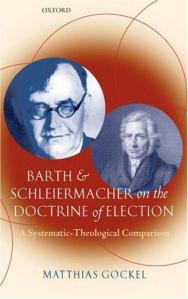
Here are the links to my 10-part review of Gockel’s book:
- Matthias Gockel on Barth and Schleiermacher on the Doctrine of Election: A Review – Part I
- Matthias Gockel on Barth and Schleiermacher on the Doctrine of Election: A Review – Part II
- Matthias Gockel on Barth and Schleiermacher on the Doctrine of Election: A Review – Part III
- Matthias Gockel on Barth and Schleiermacher on the Doctrine of Election: A Review – Part IV
- Matthias Gockel on Barth and Schleiermacher on the Doctrine of Election: A Review – Part V
- Matthias Gockel on Barth and Schleiermacher on the Doctrine of Election: A Review – Part VI
- Matthias Gockel on Barth and Schleiermacher on the Doctrine of Election: A Review – Part VII
- Matthias Gockel on Barth and Schleiermacher on the Doctrine of Election: A Review – Part VIII
- Matthias Gockel on Barth and Schleiermacher on the Doctrine of Election: A Review – Part IX
- Matthias Gockel on Barth and Schleiermacher on the Doctrine of Election: A Review – Part X
Matthias Gockel on Barth and Schleiermacher on the Doctrine of Election: A Review – Part X
 In answering the question, ‘Will, then, all people be saved in the end?’, Lutheran scholar Carl Braaten has reminded us that ‘We do not already know the answer. The final answer is stored up in the mystery of God’s own future. All he has let us know in advance is that he will judge the world according to the measure of his grace and love made known in Jesus Christ, which is ultimately greater than the fierceness of his wrath or the hideousness of our sin’. So Barth noted in The Humanity of God, ‘This much is certain, that we have no theological right to set any sort of limits to the loving-kindness of God which has appeared in Jesus Christ. Our theological duty is to see and understand it as being still greater than we had seen before’.
The criticisms and their implications raised by Gockel will no doubt continue to be a point of dispute – a dialectic – among readers of Barth for the foreseeable future. Those with an interest in the debate more generally over universalism would be well served in reading Gockel’s fine book. However, it ought to be noted that those who are already convinced that Schleiermacher’s and (early) Barth’s doctrine of election remains the most tenable proposal will only find further material here to bolster their conviction. To those who remain unconvinced, Gockel offers little argument here to change their mind.
Gockel’s work fills a notable gap in Schleiermacher and Barth studies. While there is, encouragingly, something of a renaissance of interest in Schleiermacher, Gockel’s contribution to our understanding of, and appreciation for, Schleiermacher’s project in general, and his doctrine of election in particular, is thus far unsurpassed. Schleiermacher is not an easy read. Not only is his own terminology inconsistent but his grammar is largely foreign to contemporary readers. Gockel offers us some assistance here. His contribution too regarding Barth’s early thinking on election also serves as a most worthy conversation partner with other contributions in the same area.
The essay is clearly written, avoids stereotypes of Schleiermacher and Barth, and includes a useful bibliography and two indexes. While Gockel offers us a very valuable survey to the thinking of two Protestant giants on a central theme not only in their theology but in the Reformed tradition of which they were both heirs – a valuable task in itself – I would have liked to have seen more critical engagement with these two voices. It may have also been fruitful, for example, to chart how Schleiermacher’s and Barth’s doctrine of election relates to the human response to God’s free grace in baptism, for example, as Barth was already directing us to in IV/4.
These grumbles aside, in what is certainly one of the finest essays to have appeared on Barth in recent years, Gockel models for us the kind of close dogmatic scrutiny that Schleiermacher’s and Barth’s theological contribution both deserves and demands. Those with an interest in systematic theology and the history of doctrine, those with an interest in getting their head (and hearts) around Barth’s much misunderstood doctrine of election, those with an interest in exploring a way forward for overcoming old rifts between Lutherans and Calvinists, and those with an interest in more current debates over universalism, would all be well served by reading Gockel’s book.
Matthias Gockel on Barth and Schleiermacher on the Doctrine of Election: A Review – Part IX
 The only two tenable (i.e. biblically and theologically defensible) positions available for the soteriological question are either (i) a robust reaffirmation of limited atonement (the negative side of which includes the possibility of annihilation), or (ii) some form of christological universalism (with various degrees of agnosticism). Barth, of course, was rightly suspicious of ‘isms’, whether universalism or any other –ism, and would not affirm a dogmatic doctrine of universal salvation, although he does join a tradition of both Eastern and Western theologians going back to Origen of Alexandria (185–232), Clement of Alexandria (d. 215), Gregory of Nyssa (335–394?), Ambrose of Milan (337?–397) and Gregory of Nazianzus (329–389) who all affirm a strong hope in universal salvation.
Barth famously concludes IV/3/1 by again urging that we have no good reason why we should be forbidden, or forbid ourselves from an ‘openness to the possibility that in the reality of God and man in Jesus Christ there is contained much more than we might expect’, including the ‘unexpected withdrawal of that final threat’.
If for a moment we accept the unfalsified truth of the reality which even now so forcefully limits the perverted human situation, does it not point plainly in the direction of the work of a truly eternal divine patience and deliverance and therefore of an apokatastasis or universal reconciliation? If we are certainly forbidden to count on this as though we had a claim to it, as though it were not supremely the work of God to which man can have no possible claim, we are surely commanded the more definitely to hope and pray for it as we may do already on this side of this final possibility, i.e., to hope and pray cautiously and yet distinctly that, in spite of everything which may seem quite conclusively to proclaim the opposite, His compassion should not fail, and that in accordance with His mercy which is ‘new every morning’ He ‘will not cast off for ever’ (La. 3:22f., 31).
The creature cannot impose anything upon God because God is sovereign and free. That is why universalism equals the elimination of God’s freedom. But if God in his sovereignty and freedom has revealed himself in his being-in-act – that is, in Jesus Christ – then ought – nay, must – this not have radical implications for all doctrinal issues, and no less this one. We have no reason to presume that God in his total freedom will act other than he has acted in Jesus Christ – full of grace and truth.
Therefore, we may reasonably hope for a full Apokatastasis. Few have expressed this hope more beautifully than the nineteenth century Congregationalist minister, James Baldwin Brown: ‘The love which won the sceptre on Calvary will wield it as a power, waxing ever, waning never, through all the ages; and that the Father will never cease from yearning over the prodigals, and Christ will never cease from seeking the lost, while one knee remains stubborn before the name of Jesus, and one heart is unmastered by His love’. Or consider these words from Thomas Erskine,
I cannot believe that any human being can be beyond the reach of God’s grace and the sanctifying power of His Spirit. And if all are within His reach, is it possible to suppose that He will allow any to remain unsanctified? Is not the love revealed in Jesus Christ a love unlimited, unbounded, which will not leave undone anything which love could desire? It was surely nothing else than the complete and universal triumph of that love which Paul was contemplating when he cried out, ‘Oh the depth of the riches both of the wisdom and knowledge of God!
In Jesus Christ, the Triune God has bound humanity to himself in such a way that even if we refuse him and damn ourselves to hell, God in his love will never cease hunting us down. So even if the church cannot affirm the apokatastasis panton, we can hope for it, and pray for it, and stop denying the possibility of it in the grace of God. Hans Urs von Balthasar was right when he said that there is all the difference in the world between believing in the certitude of universal salvation and hoping for it.
Matthias Gockel on Barth and Schleiermacher on the Doctrine of Election: A Review – Part VIII
 It is difficult to imagine a more solid basis for an Apokatastasis panton than Barth gives us in his doctrine of election and reprobation. But does Barth’s commitment to divine freedom contradict the centre of his christological revision? Does he ultimately lead us all to a country and then not promise us that we might enter? Gockel, following Janowski, suggests he does, and that the payment for such a commitment threatens to ‘tear open again, though in a modified way, the abyss of the decretum absolutum et horribile (p. 210) – as though God’s Word towards a person might be different from that which he has spoken in Jesus Christ.
While Gockel notes Barth’s denial of an ultimate apokatastasis panton, he joins a pantheon of critiques – sympathetic and otherwise – who see an inconsistency in Barth here. Consider, for example, the critique from Bromiley. As one of the editors (with T. F. Torrance) and principal translators of Barth’s work, few are more familiar with Barth’s corpus and theology than Bromiley. Citing IV/3, § 70.2, Bromiley synopsises Barth view: ‘The lie cannot overthrow the truth, but God may finally condemn the liar to live in it’. Bromiley observes in Barth a ‘trend toward an ultimate universalism’ although acknowledges that, for Barth, ‘universalism in the sense of the salvation of all individuals is not a necessary implicate of Barth’s Christological universalism’. He suggests that Barth’s reservation here is ‘not really adequate’. Gockel identifies the same inconsistently in Barth, a holding back of the full consequences of Barth’s christology. Again, Bromiley notes, ‘God’s manifest purpose in Christ is to save, but under the sovereignty of the Spirit some might not be saved. The question is whether the Christological reference finally helps or matters very much. Is not the ultimate decision still taken apart from the revealed election – that is, not in the prior counsel of the Father but in the inscrutable operation of the Spirit? In other words, the decision regarding individuals is simply removed from the inscrutability of sovereign predetermination to the inscrutability of sovereign calling’.
Matthias Gockel on Barth and Schleiermacher on the Doctrine of Election: A Review – Part VII
 Brewing away throughout Gockel’s book, not unoften rearing its head, is the question of universal election and universal salvation. Gockel contends that Barth’s christological revision leads him to abandon his 1936 objection to universalism and affirmation of an eschatological division between the elect and the reprobate. Barth now ‘joins Schleiermacher in leaving open the possibility of a “final opening up and expansion of the circle of election and calling” which may include everyone’ (p. 188). Barth’s reluctance, however, to embrace universalism leads to some pointed challenges by Gockel.
Gockel notes that both Schleiermacher and Barth share a stance coherent with supralapsarianism’s claim that the decree of predestination precedes that of creation and Fall, although they both go further in their assertion that God’s mercy is the decisive criterion not of redemption only but also of predestination. Gockel argues that despite Barth’s ‘own explicit unwillingness to go that far’, that is, to embrace a universal predestination to salvation, his affirmation of universal election ‘implies some form of universal salvation’ (p. 189).
Gockel also contends that Barth’s appeal to God’s freedom is inconsistent with Barth’s own position regarding God’s self-determination to be Immanuel in Jesus Christ. Gockel notes that Barth’s (and Schleiermacher’s) caution on the issue can be partly explained by the fact that ‘any affirmation of universalism would have meant the endorsement of an ecumenical heresy, which could have cost him dearly’ (p. 208). The question, however, remains: How can that which has already been overcome in Jesus Christ ever be undone? How can this impossible possibility remain? Gockel suggests that Schleiermacher is at least more consistent here with his emphasis on the unity of God’s will. With all of Barth’s massively powerful christological revisioning, he, according to Gockel, ‘shied away from certain far-ranging implications’ (p. 205). ‘One should ask’, Gockel suggests, ‘whether a consistent theory of an Apokatastasis, far from presenting a danger or even a threat, might not be a more satisfying option than the claim that the New Testament leaves us with a paradoxical constellation of the “universalism of the divine salvific will” versus the “particularism of judgement”’ (p. 208).
I confess that I sympathise with Barth’s reluctance to embrace with certainty an apokatastasis panton, even while I hold out, with Barth, hope in such a reconciliation. Barth was right to insist that God’s grace is characterised by God’s freedom. This means not only that we must never impose limits on the scope of grace, but also that we must never impose a universalist ‘system’ on grace either. To embrace either option would be to compromise the freedom of grace and also to presume that we can define the precise scope of God’s grace. That is why Barth’s theology of grace incorporates a dialectical protest: he protests both against a system of universalism and against a denial of universalism. The essential point, for Barth, is that God’s grace is completely free; that when God acts in grace it is none other than God himself who acts in freedom. When God comes to us in his grace, therefore, we can be certain that no third party or shadowy motive is twisting his arm. Because of this divine freedom and because of the nature of divine grace as grace, we can neither deny nor affirm, therefore, the possibility of universal salvation. I confess with Abraham, ‘Shall not the Judge of all the earth do right?’ (Gen 18:25). Barth writes,
The proclamation of the Church must make allowance for this freedom of grace. Apokatastasis Panton? No, for a grace which automatically would ultimately have to embrace each and every one would certainly not be free grace. It surely would not be God’s grace. But would it be God’s free grace if we could absolutely deny that it could do that? Has Christ been sacrificed only for our sins? Has He not, according to 1 John 2:2, been sacrificed for the whole world? … [Thus] the freedom of grace is preserved on both these sides … Even in the midst of hell, grace would still be grace, and even in the midst of hell it would have to be honored and praised and therefore announced to the other inhabitants of hell. It is not free for nothing, but it is also not grace for nothing. We should certainly not know it if we were of the opinion that we could stop short of announcing it.
Matthias Gockel on Barth and Schleiermacher on the Doctrine of Election: A Review – Part VI
 Barth’s concern in his treatment on election is that election should be good news – gospel – or, what Barth calls is another place, ‘joyous news’. Thus does Barth begin his chapter on election in II/2: ‘The doctrine of election is the sum of the Gospel because of all words that can be said or heard it is the best; that God elects man; that God is for man too the One who loves in freedom … Its function is to bear basic testimony to eternal, free and unchanging grace as the beginning of all the ways and works of God’. Here Barth is following Calvin – and, according to Muller, the Reformed tradition more generally at least up until 1650 – who repeatedly stressed that we look to Christ as the assurance of our election. Here Calvin is as adamant as Barth. Where Calvin – and the Reformed tradition – is silent, however, is in how the question of reprobation – the shadow side of election – also relates to Christ. Holmes has suggested that the weakness in Calvin’s account of predestination is not that election is separate from Christ (which, as I have just said, it is not), but that ‘the doctrine of reprobation is detached, Christless and hidden in the unsearchable purposes of God. As such it bears no comparison with the doctrine of election, but remains something less than a Christian doctrine’. Holmes goes on to suggest that Calvin’s shortcoming is not that he reserved an equal stature – a double decree – to God’s ‘Yes’ and ‘No’ in election, but that he has ‘almost no room for the doctrine of reprobation in his account’; ‘the “No” does not really enter his thinking’, thus leading to an asymmetry between the two decrees and so, as Holmes suggests, ‘fails to be gospel’. This contrasts with Barth’s christological theology of reprobation. Holmes helpfully summarises Barth’s position thus:
In willing to be gracious in the particular way God in fact wills to be gracious, the Incarnation of the Divine Son, there is both a ‘Yes’ and a ‘No’, election and reprobation. God elects for humanity life, salvation, forgiveness, hope; for himself he elects death, perdition, even, as the Creed has said, hell. This self-reprobation of God is indeed the primary referent of the doctrine of election, in that God’s determination of himself is formally if not materially more basic than his determination of the creature, and so is considered first by Barth. In the eternal election of grace, which is to say in Jesus Christ, God surrenders his own impassibility, embraces the darkness that he was without – and indeed impervious to – until he willed that it should be otherwise … The apostle put it more succinctly: “He became sin for us.” This is the full content of the divine judgement, of the ‘No’ that is spoken over the evil of the world and of human beings. God elects for himself the consequences of that ‘No’, in saying ‘Yes’ to, that is, in electing, us. That is the whole content of the double decree, the whole content of the ‘Yes’ and the ‘No’ that God pronounces as one word, the whole content the election of grace.
Concerned that his own tradition had at this point replaced Jesus Christ with a decretum absolutum (as there is no Wikipedia reference to the absolutum it must not exist), Barth asked, ‘Is it a fact that there is no other basis of election outside Jesus Christ? Must the doctrine as such be related to this basis and this basis only?’ Because of Jesus Christ, Barth was able to speak of God’s ‘No’ as gospel also.
On the actuality of predestination, Gockel questions how useful Barth’s grammar regarding predestination as a present event is. He suggests that God’s ‘eternally preceding’ decision is ‘the mystery of all historical events’ and that it does not have to imply an ongoingness of the decision itself within history, given God’s predestining election of Jesus Christ. Gockel helpfully suggests that ‘a less actualistic view of predestination could more clearly emphasise the significance of the historical appearance of Jesus Christ and thus dispel the impression that Barth tears apart the “eternal content” and the “temporal form” of election’ (p. 185).
Matthias Gockel on Barth and Schleiermacher on the Doctrine of Election: A Review – Part V
 Gockel turns to critically consider the consequences of Barth’s doctrine of election. He identifies six key areas: (1) epistemological implications, (2) the concrete determination of predestination, (3) the issue of double predestination, (4) the actuality of predestination, (5) the question of universal election and universal salvation, and (6) the relation between Israel and the Christian church. I will focus here on (2), (3), (4) and (5).
Regarding the second area, while Barth never intended to drive a wedge between the economy and being of God, Gockel sides with McCormack over against Molnar that this very inconsistency arises within Barth’s own formulation of his doctrine of election: ‘The assumption of a divine will preceding the predestination puts into doubt whether the gracious choice really belongs to God’s “own eternal essence”’ (p. 179). The issue fundamentally concerns whether or not the works of God ad extra (election) are the free overflow of the works of God ad intra (as Molnar suggests) or whether the one eternal will of God is identical with Jesus Christ. Molnar’s reading of Barth’s proposal that God has one being, and that that one being subsists simultaneously in two different forms – the second dependent on the first – which are not separate but rather are a unity-in-distinction and distinction-in-unity, could have been more attended to by Gockel than he does (pp. 179–80).
On the question of double predestination, Gockel rehearses Barth’s conviction that we must speak of Jesus Christ not only in reference to the positive side of election but also in reference to the other side of God’s decree – reprobation. Here, as we shall see below, Barth sets himself apart from the tradition (or at least extends the tradition) and declares that both election and reprobation happen in Jesus Christ. Barth’s doctrine of reprobation is as christological as his doctrine of election. He contends that the God who elected fellowship with humanity also elected our rejection. In electing our rejection, however, ‘He made it his own. He bore it and suffered it with all its most bitter consequences’. Thus in the self-reprobation of Godself in Jesus Christ – the Man justified and the ‘Judge judged in our place’ – humanity recognises not only God’s final ‘Yes’ but also its own reprobation. This self-giving is God’s free choice and entails God’s self-determination and the determination of humanity through a ‘wonderful exchange’ in Jesus Christ. ‘To believe in God’s predestination’, Gockel concludes, ‘means by definition to believe in the non-reprobation of humankind’ (p. 181). As Barth notes, ‘in God’s eternal purpose’ it is not humanity but ‘God Himself who is rejected in His Son’. God’s self-giving in Jesus Christ consists in the fact that he is rejected in our place: ‘Predestination means that from all eternity God has determined upon man’s acquittal at His own cost’. Gockel then raises the question and apparent conflict concerning whether the claim that the Son of God instead of the Son of Man suffered God’s wrath contrasts with Barth’s earlier claim that ‘the elected human being Jesus is the target or “offering” of God’s wrath’. He notes Barth’s own awareness of and answer to this in II/1: ‘Only God Himself could bear God’s wrath. Only God’s mercy was capable of bearing the kind of suffering to which the creature existing in opposition to God is subject. Only God’s mercy could be touched by this suffering in such a way that it knew how to make it its own suffering. And only God’s mercy was strong enough not to perish in this suffering’ (p. 183). As if hell – that is, something of creation – could exhaust the awful shame and scandal of sin.
Matthias Gockel on Barth and Schleiermacher on the Doctrine of Election: A Review – Part IV

In his fifth chapter, entitled ‘Barth’s Christological Revolution’, Gockel turns briefly to Barth’s lectures of 1936 (given at two Reformed seminaries in Hungary) and 1937 (Barth’s Gifford Lectures on the Scots Confession given at the University of Aberdeen), and more substantially to Barth’s Church Dogmatics II/2, where Barth developed his most radical proposal, modifying for a second time his doctrine of election. In the christological revision undertaken in II/2, election no longer refers to the two-fold possibility of faith and unbelief but to the double determination of individual human beings and God’s own being. Barth’s priority: that God sees every human being and also himself in Christ.
Here, Gockel is on the more traversed ground of Barth’s notion that Jesus Christ is both God’s elect himself and the foundation of humanity’s election. Gockel argues that it was not until the 1936 lectures that Barth’s christological revisioning of the doctrine of election first appears; that what happened for and to humanity at Golgotha and was revealed at Easter – though it happened in time – is our eternal election. It is also here that Barth identifies the one will of God in double predestination with Jesus Christ, that is, with God’s own being. ‘Jesus Christ not only reveals but also constitutes God’s gracious choice as the self-determination to be God for His people and the determination of humankind to be the people of God’ (p. 169). As Barth contends, God’s gracious choice is the divine decision made in Jesus Christ, the speculum electionis. It is in and through Jesus Christ that God has actualised his eternal covenant with humanity, God’s eternal election of himself to communion with humanity, and humanity to communion with God. Here Barth distinguishes himself from the disposition in some camps of the Reformed tradition of an insistence on the inscrutableness and invisibility of the divine decrees. In Jesus Christ – the electing God and the elected Man – God’s purposes in election are made manifest to all. Christ is, in Barth’s words, ‘the first and last word to men of the faithfulness of God’ in election. Jesus Christ, therefore, is not merely the channel of God’s one decree, but its source. And he is not merely the one who elects, but he is also the one who elects himself to be the modus operandi by which others are elected.
Matthias Gockel on Barth and Schleiermacher on the Doctrine of Election: A Review – Part III
 Barth’s revision of the Reformed doctrine of election is developed further in his so-called Göttingen Dogmatics where he punctuates the teleological ordering of election and reprobation. The real purpose of God’s predestinating act is always election – not rejection – even in rejection. While the reprobation is real as the shadow side of election, it is never God’s final word. God’s final word is Jesus Christ and in him every promise of God finds its ‘Yes’ (2 Cor 1:18–20). ‘Rejection does not take place for its own sake but in revelation of the righteousness of God in order that God’s mercy might be manifested in his election, and in order that in it all, though in this irreversible order, God himself might be known and praised’. In other words, God’s judgement is never divorced from God’s grace and can never be recognised apart from ‘the cross, the judgment, the condemnation in which we stand’; the way of predestination therefore leads us ‘by way of condemnation – indeed, by the way of hell itself – to salvation and life’. We will return to this below in our discussion of Barth’s Church Dogmatics II/2.
Gockel concludes his discussion of Barth’s Göttingen work by surmising that Barth’s doctrine of election ‘becomes more actualistic and less speculative, while still not christocentric’. Also ‘Barth stops short of eschatological universalism, and his consistent emphasis on God’s freedom as well as the assertion that “all are at every moment under the divine Either–Or” should be taken seriously’ (p. 155).
The picture that Gockel paints is that in both the Römerbrief and the Göttingen Dogmatics, Barth has developed a ‘Schleiermacherian reconstruction’ of the doctrine of election by means of the idea of a single divine decree towards life. Although Schleiermacher understands the Creator-creature relationship differently to Barth, they both hold that the single divine decree is to be understood in the context of the historical decision between faith and unbelief. For both of them (at this point), the doctrine of election remains fundamentally theocentric and universal, with a focus on the graced-initiative of the divine act which involves a teleological movement in time from reprobation to election, the former serving the latter, and the latter qualifying the former. Above all, the focus for both theologians is on ‘the predestining God’ rather than ‘individual predestined human beings’ (p. 157). Given this, it is surprising that Gockel introduces his argument with the announcement that it is ‘precisely the anthropocentric outlook of traditional views’ which motivated not only Barth’s but also Schleiermacher’s ‘search for a new approach’ to election (p. 12).
Matthias Gockel on Barth and Schleiermacher on the Doctrine of Election: A Review – Part II
 In his Der Römerbrief, Barth raises two objections against the Augustinian formulation, which he regards as ‘a “mythologizing” construction’ (p. 108). First, Barth rejects the notion that predestination can be explained in terms of cause and effect. While the human act of faith happens within a familiar historical context, its origin always lies with God: ‘The act of faith does not occur when a human being has recognized God but when God has recognized a human being’ (p. 108). Barth’s point: ‘God wants to be known through God’. Secondly, Barth discards the attribution of election and reprobation to ‘predetermined quantities of individual persons, since this neglects that God’s eternal predestination is related to humankind as a whole and is not a one-time event but occurs time and again in history when a human being is addressed by God’s Word’ (p. 109). The driving issue here for Barth, as in his whole doctrine of election, is the divine freedom.
For Barth, the key verse for understanding Romans, and Christian theology in general, is 11:32, ‘God enclosed everyone in disobedience, in order to show mercy on everyone’. This verse affirms that the content of God’s predestination is God’s unconditional mercy. More radically, Barth contends that Paul’s claim suggests a modification – though not a rejection – of the notion of double predestination. Double predestination does not require rejection so long as we are clear that it refers to a movement, to the ‘teleology by which God’s salvific act is directed, namely, from reprobation to election’ (p. 113). For Barth, reprobation is never the goal. ‘God’s Yes shines even into the last depth of His No, precisely because the latter is so radical, because it is the divine No’. Reprobation exists therefore ‘only as the shadow of the light of election’.
Gockel contends that there is a distinct echo of Schleiermacher’s doctrine of election in Barth’s own early revision of the doctrine. In Der Römerbrief, Barth accentuates the dialectical unity of God’s decree: ‘God’s reprobation (of the elect) and God’s election (of the reprobate) are “unintuitably one and the same in God”’ (p. 118). Gockel identifies two central aspects concerning the relation between reprobation and election for Barth. First, the possibility of reprobation is overcome eternally in God. Adam’s old world really is surpassed by Christ’s new world. Second, the individual outcome of the two-fold possibility of unbelief and belief is not determined by God before time but rather, in the freedom of God, is the event in which God addresses the creature in time. The content or purpose of such an address is qualified by the ‘turn from reprobation to election’ in God, which expresses the one eternal will of God for humanity. Any duality here of judgement and grace is the duality of God’s unified action, an action which affects all human beings alike, and is determined by God’s redemptive will revealed in Christ’s death and resurrection. The church and the world, therefore, ‘stand under the same promise and the same judgment [which] makes it impossible to conceive them as two separate groups of persons’ (p. 125). Even as early as his Romans commentary, Barth maintained a hopeful universalism grounded in the freedom and love of God leading to the priority of election over reprobation: ‘reprobation has been overcome and absorbed by election’. Christ’s work ‘entails the hope that the duality between faith and history does not preclude the possibility of an eventual restoration of humankind and a return “into the unity with God, which is now and here completely lost”’ (p. 130). Barth’s emphasis here is that the original unity of God and humanity (a notion abandoned in the Göttingen lectures) is not superseded by judgement. Judgement, rather, is practical, leading to a re-union of human and divine righteousness.
Gockel observes that the relationship of the historical appearance of Jesus Christ to the determination of God’s will remains unclear in Barth’s theology, and his emphasis on the original unity leads to similar problems to Schleiermacher’s notion of absolute dependence. Furthermore, when Barth ‘asserts that God’s will is revealed in Jesus Christ who personifies God’s universal faithfulness and righteousness, it remains unclear how the eternal history between God and humankind is related to the history of Jesus Christ’ (p. 131).
Matthias Gockel on Barth and Schleiermacher on the Doctrine of Election: A Review – Part I
 ‘That God may have mercy upon all’: A Review of Barth and Schleiermacher on the Doctrine of Election: A Systematic-Theological Comparison. By Matthias Gockel. Pp. viii+229. Oxford: Oxford University Press, 2006. ISBN 978 0 19 920322 2. £45.
As promised not so recently, my next few posts will be dedicated to reviewing Gockel’s book, Barth and Schleiermacher on the Doctrine of Election. Because my review is rather lengthy (and because some wise guy thinks that the ideal post should be quite short ), I will break it up into 10 posts. I hope that most who started the ride will still be holding on at the end.
Karl Barth’s vituperative criticisms of Friedrich Schleiermacher are no secret, and no short mileage has been made by theologians on the apparent division between the two. In Matthias Gockel’s latest offering (a revised version of his 2002 doctoral dissertation completed at Princeton under Barth scholar Bruce McCormack) he joins Robert Sherman and others in enriching, with renewed sophistication, our understanding of the relationship between Barth and Schleiermacher, challenging traditional evaluations that ‘liberal theology’ and ‘dialectical theology’ stand in irreconcilable opposition.
Rather than attempt to cover a multi-dimensional canvas with broad strokes, Gockel restricts his inquiry to an incisive and cogent comparison of the development of the doctrine of election in the two thinkers. Without proposing any theory of historical dependence, Gockel contends that the divergence between these two commanding Reformed theologians does not stem from irreconcilable starting points but rather from the indispensability of God’s grace. Gockel convincingly argues that ‘Barth’s theology is not just a repudiation of Schleiermacher but an expansion of his predecessor’s work in a new framework’ (13). He also shows us that while the Swiss theologian’s evaluation of ‘the father of modern theology’ is ‘sometimes negative, sometimes positive and often ambiguous’ (p. 9) Barth was not always a reliable interpreter of his own thought, nor always consistent in his criticisms of others.
Gockel’s thesis is that the doctrine of election in Barth’s early theology bears a close resemblance to Schleiermacher’s own theo-centric position. Barth’s theology however, from 1936 onwards, undergoes a radical christological revisioning of the earlier position. Gockel begins his survey and assessment of Schleiermacher by turning to Schleiermacher’s revision of the doctrine in his 1819 essay, ‘On the Doctrine of Election’. Gockel helpfully, albeit briefly, situates Schleiermacher’s early contribution on election in the context of the ecclesiastical union between the Lutheran and Reformed churches in Prussia in 1817. Central to the preceding union were the debates over the Lord’s Supper and the doctrine of election. The crucial point over the latter concerned ‘the indispensability of divine grace for … conversion and the question whether human beings can accept or resist God’s grace by their own free choice’ (p. 18). Schleiermacher’s most creative contribution to the discussion was his notion of an undivided and unconditional ‘single divine will and decree which effects [both] faith and unbelief’ (p. 26). He argues that the older paradigm of a two-fold divine will of election and reprobation is ‘as meaningless as the question why God made human beings in the way they were made’ (p. 29). The elect, Schleiermacher contends, are those who are ‘regenerated and begin their religious self-development’ (p. 30). While the remainder of persons are for now spiritually dead and ‘not yet members of the kingdom of God’ (p. 34) they are included in God’s love and so ‘they never loose the ability to be revived’ (p. 30). Gockel notes that the notion of the single decree ‘emphasises the unity of the divine attributes and helps to clarify key issues not only in the debate over election but also in the doctrine of God’ (p. 34).
Schleiermacher’s revision of the doctrine of election, articulated in the 1819 essay, is more fully developed in his Der christliche Glaube (1821–22) within the bounds of a single divine decree of universal predestination to salvation in Christ, and systematically located in ecclesiology. Gockel notes that the starting-point of the discussion of election, for Schleiermacher, is the ‘dilemma that arises from the simultaneous existence of believers and non-believers, on the one hand, and the benevolent divine will towards all human beings in Christ’s redemptive work, on the other hand’ (p. 101). Schleiermacher’s response is to insist that the ‘divine will is identical with the work of redemption in and through the person of Christ’ (p. 100).
Schleiermacher rejects any idea of two separate foreordained groups of persons – a double-predestination – and the notion that one group might be eternally excluded from the benefits of Christ’s work. Such ideas, he maintains, betray the general character of redemption and the universal mission of the church. God has one will, and that will is identical with who God is, and what God does in Jesus Christ. Humanity – believers and unbelievers alike – are the object of God’s predestinating will of salvation in Christ. Despite the temporary reprobation of some, ‘God sees all human beings, not only the believers, in Christ’ (p. 102). In light of this reality, the church is called to live, order its life after, and bear universal witness to, the divine decision.
Gockel concludes his examination of Schleiermacher by noting that despite Schleiermacher’s christologically-motivated affirmation of general redemption and rejection of eternal reprobation, his overall construction remains theocentric: ‘it is grounded in the belief in God the almighty creator, even though ecclesiology is its context and christology its background’ (p. 103).
Forsyth and Barth on Judgement
 In the current of my work on my ‘christology chapter’ for my thesis, I have been struck afresh just how much Forsyth anticipates some of Barth’s best moments, and how both of them have an important word to speak into the renewed debate on penal substitution. Of course, many of Barth’s greatest words are in the small print. This, of course, ought be no suprise: it is the small print that makes up the bulk of his Dogmatics it seems. (On that, is someone able to confirm, or otherwise, for me that Barth once said that the reason that he wrote so much was in order to ‘get the Enlightenent out of my system’?).
One thing (among many) that I love in both Forsyth and Barth is their relentless insistence that neither the divine-human reconciliation, nor its attendent judgement is the work of a third party. The issue here is the primacy and triumph of God’s grace – God’s grace. All satisfaction of the Father flows from God’s grace and love; it does not procure it. As Forsyth insisted, ‘Procured grace is a contradiction in terms. The atonement did not procure grace, it flowed from grace’. Forsyth contends that the judgement work of the Cross is not the work of a ‘pardon-broker’ – God does not hire someone else to do his dirty work! – but is the summit work of the gracious God whose grace is ‘unbought and unpurchaseable’. Here’s the same tune in Barth’s wee print. It just grips my heart and sends me a singing:
Jesus Christ, in His solidarity with “human nature which has sinned could pay the penalty of sin” (Heid. Catech. Qu. 16), and at the same time, in the power of His divinity, could “bear the burden of the wrath of God in His humanity” (17). Without any diminution of His divine majesty, in the exercise of the divine majesty of His love He could enter into this “likeness of sinful flesh” to bear, in the same majesty, the judgment of divine wrath without annihilation, to be and to reveal Himself supremely as divine majesty even in His humiliation, to rise from the dead as conqueror of the judgment to which He had subjected Himself, the first fruits of all who were to follow in His steps. He could drink the cup which had to be drunk. Because He was God Himself, He could subject Himself to the severity of God. And because He was God Himself He did not have to succumb to the severity of God. God had to be severe to be true to Himself in His encounter with man, and thus to be true also to man. God’s wrath had to be revealed against the ungodliness and unrighteousness of men. But only God could carry through this necessary revelation of His righteousness without involving an end of all things. Only God Himself could bear the wrath of God. Only God’s mercy was capable of bearing the pain to which the creature existing in opposition to Him is subject. Only God’s mercy could so feel this pain as to take it into the very heart of His being. And only God’s mercy was strong enough not to be annihilated by this pain. And this that could happen only by the divine mercy is just what did happen on the cross of Golgotha: that double proof of omnipotence in which God did not abate the demands of His righteousness but showed Himself equal to His own wrath; on the one hand by submitting to it and on the other by not being consumed by it. In virtue of this omnipotence God’s mercy could be at one and the same time the deepest and sincerest pity and inflexible and impassible divine strength. He could yield to His own inexorable righteousness and by this very surrender maintain Himself as God. He could reveal Himself at once as the One who as the servant of all bore the punishment of death which we had deserved, and the One who as the Lord of all took from death its power and for ever vanquished and destroyed it. In this twofold sense God’s righteousness triumphed in the death of Jesus Christ. (Church Dogmatics II/1, 400)
 jasongoroncy.com