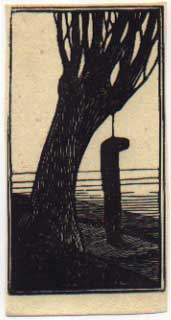
Judas

On friendship that persists through blunders

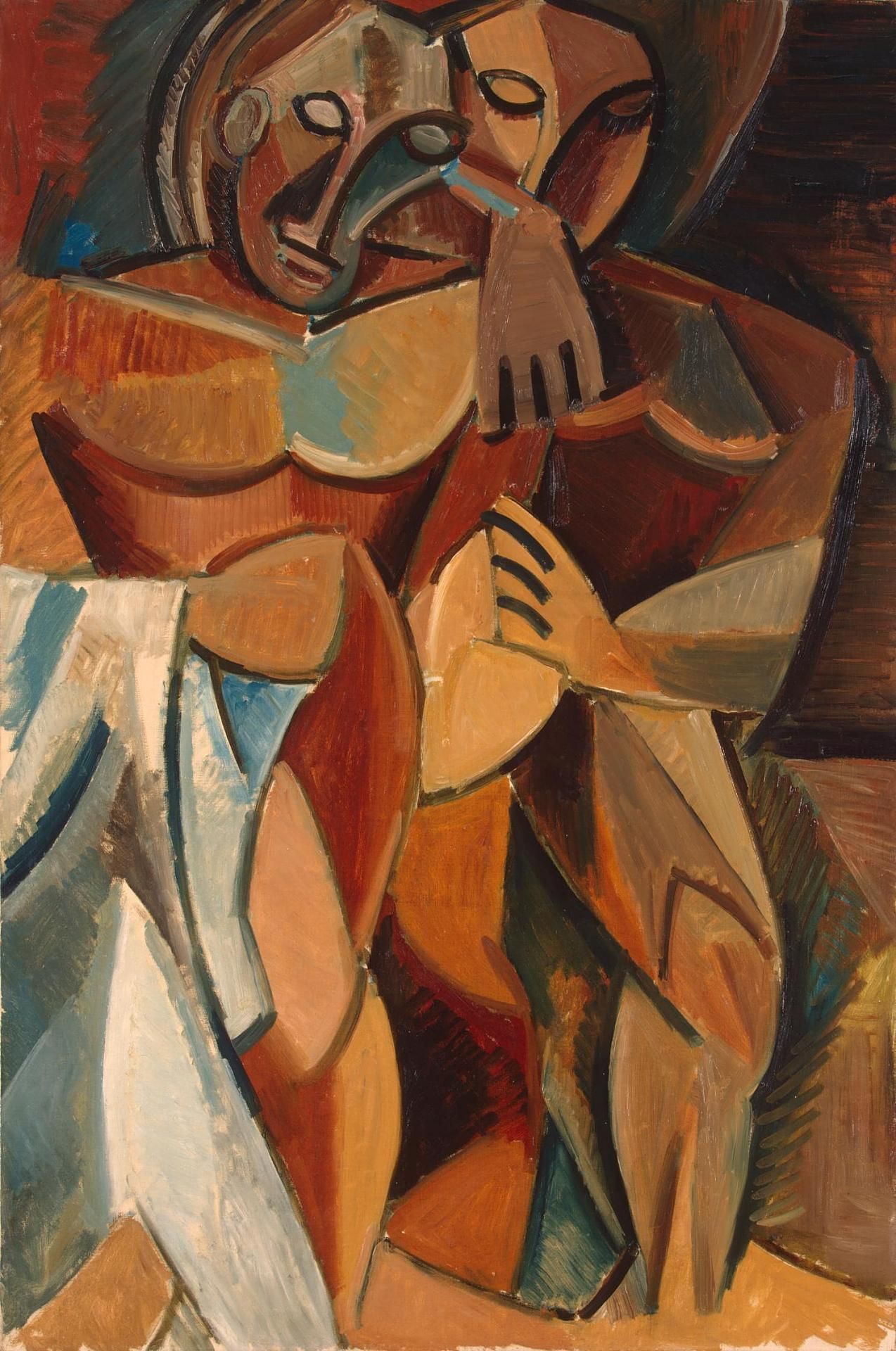
Pablo Picasso, L’amitié, 1908. Oil on canvas, 151.3 x 101.8 cm. Hermitage Museum, Saint Petersburg, Russia.

Jesus said to him, ‘Friend, do what you are here to do’. (Matthew 26.50)

In the darkness of Gethsemane, amid the clash of swords and the flicker of torches, Jesus addresses his betrayer with a word that stops us in our tracks: hetairos (‘friend’). This Greek word is not the warm philos of intimate companionship, but neither is it a term of contempt. It carries the weight of association, of one who has walked alongside, shared meals, witnessed miracles. And Jesus uses it at the precise moment when that companionship is being weaponised against him.

The theological scandal of this address lies in its refusal to unmake the relationship at the very moment it is being violated. Judas arrives with a kiss – the gesture of greeting now twisted into a signal of betrayal, of identification for arrest. Yet Jesus does not revoke the covenant of their shared journey. He names Judas as what he has been and will be, even as Judas enacts what he has chosen to become.

This moment in the garden confirms what was already enacted hours earlier in an upper room. The church’s liturgy captures this with haunting precision: ‘On the night he was betrayed, [Jesus] took bread …’. Not the night before. Not the night after Judas left. The very night of betrayal itself. And the bread broken and shared was given to the twelve, not to eleven. There’s all the hope of the world in that.

The ‘friend’ spoken in Gethsemane thus echoes the broken bread given in the upper room. Both gestures refuse to allow betrayal to have the final word on the relationship. Both offer dignity and recognition at the precise moment when they are least deserved and will be most thoroughly rejected. Knowing does not prevent giving.

This, it seems to me, has profound implications for how the Christian story invites us to understand and embody our own relationships. Jesus’ calling Judas ‘friend’ does not prevent consequences – Judas’ story ends in disaster, just like Jesus’, at least penultimately. Yet it also suggests something subterranean that cannot finally be completely broken. When I think about my own damaged relationships, this is where both hope and pain get generated.

Those who recognise in Jesus something of the divine life see in that meal and garden something of the relentless and outlandish logic of grace, of a love that precedes our choices and persists through our blunders. The bread given to Judas is the same bread given to Peter, who will deny, and to all the other disciples, who will scatter.

For those of us who live in the aftermath of our own experiences of betrayal, small and large, this gives pause. Maybe the same voice that called Judas ‘friend’ in the garden still calls us by name, places bread into our uncertain hands, and refuses to let the worst moments define the terms of our relationships? This, we hope, is the character of divine love: unconditioned not because it is indifferent to betrayal, but because it remains loyal even when loyalty is not returned.
‘Judas in Modern Dress’, by Judith Wright

A Human PatternNot like those men they tell of, who just as suddenly
walk out of life, from wife and fire and cooking-pot
and the whole confusion, to sit alone and naked
and move past motion; gaze through dark and day
with eyes that answer neither. Having completed their journey
they are free to travel past the end of journeys.
But I stepped out alone.
“I reject the journey; it was not I who chose it.
I worked for one end only,
to find the key that lets me through the door
marked Exit. I have found it and I use it.”

There is a tale I heard a wise man tell,
how, tattered with age, beneath a fruiting tree
a seeker sat, and heard in God’s great silence
another traveller, caught in the nets of self,
weeping between anguish and ecstasy,
and over a thousand miles stretched out one hand
to pluck him back again into the Way.

But I was one the saints knew not at all.
A mocking man, a sad man-animal
rejecting world and sense
not for God’s love, but man’s intelligence;
as though a hog looked through a human eye
and saw the human world as dunged as its own sty,
foul ante-room to death. Like that I saw
the abattoir ahead, and smelt the soil
soaked under me with blood. No place for me.

And wise in my own way I worked to find
the weak place in the palings of the Real—
the gap between the Word
and its Creation, the act and the conception—
and forced my way between those married two,
set time against eternity, struggled through,
slipped through annihilation, still being I.

What violence those great powers did to me
as I escaped between, I have forgotten.
But swinging clear I saw the world spin by
and leave me, empty as an insect-shell,
beyond the chance of death, and outside time.

I had the choice. Once I had infinite choices—
all the variety of light and shadow
that sprang to being when Choice first was made.
Now I have knowledge only. Knowledge, and eyes
to watch the worlds cross their eternities.

Times after times the saving word is spoken.
Times after times I feel it wither me.
The fools of time live on and never hear,
and I who hear have chosen not to answer.
It beats against me till my ears are broken.
Times after times I see my death go by
and cannot reach it even with a prayer.
Indeed, since I am neither Here nor There
I cannot live, and therefore cannot die.

Times after times my lips begin to form
the word that I renounced, and close again.
The worlds pass jostling, and their makers dream
immortal life betrayed to daily pain—
the pain that I denied.

I still deny it.

O sweet, sweet, sweet the love in human eyes—
the tree of blossom dressed to meet the bee,
all white, all radiant, golden at the heart.
Halt there, at your Creation! And it dies,
dies into rotting fruit, and tyrannous seed.
If it spring up again, so much the worse.
That was the curse on Eden, Adam’s curse.
The curse by which my heart will not abide.

If I am Judas, still my cause is good.
I will not move my lips to answer God.

– Judith Wright, ‘Judas in Modern Dress’, in A Human Pattern: Selected Poems (North Ryde: Angus and Robertson, 1990), 115–17.

Ray Anderson and The Gospel according to Judas

Was chatting to an old friend tonight about Ray Anderson‘s work on Judas (my favourite saint). I indicated that Anderson’s popular-level book The Gospel According to Judas: Is There a Limit to God’s Forgiveness?, and his later book Judas and Jesus: Amazing Grace for the Wounded Soul, remain two of the most profound treatments on Judas that I have encountered. There’s also Anderson’s very powerful sermon on Judas (given, I understand, at Fuller Theological Seminary in 1998), a copy of which seems to only be available these days to iTunes users. I can’t remember where I got this copy from but I hope that I haven’t broken some ridiculous copyright law uploading it here. It begins proper 4.45 minutes into the video. The sound is not great. The theology is.

For the benefit of my dear readers, I’ve also uploaded a copy of Anderson’s chapter ‘Will Judas Be in Heaven?’ (which was freely available some years ago from Anderson’s own webpage) from his book Dancing with Wolves While Feeding the Sheep: The Musings of a Maverick Theologian (Wipf & Stock, 2001).

Judas: two images

Image One:

‘Judas was a dreadful, walking example of impiety in this world, with his flesh bloated to such an extent that he could not walk through a space where a wagon could easily pass … His eyelids were so swollen that it was absolutely impossible for him to see the light and his eyes could not be seen by a physician, even with the help of a magnifying glass, so far had they sunk from their outward projection. His private parts were shamefully huge and loathsome to behold and, transported through them from all parts of his body, pus and worms flooded out together as he shamefully relieved himself’. – Papias [HT: Joan Acocella]

Image Two:

‘Was it not Judas, the sinner without equal, who offered himself at the decisive moment to carry out the will of God, not in spite of his unparalleled sin, but in it? There is nothing here to venerate, nor is there anything to despise. There is place only for the recognition and adoration and magnifying of God.’ – Karl Barth, Church Dogmatics II/2 (ed. G. W. Bromiley and T. F Torrance; trans. G. W. Bromiley et al.; Edinburgh: T & T Clark, 1957), 503.

It seems to me that if and when we pause long enough to enquire what telling most faithfully witnesses Judas’ service to the Gospel, the preferred invitation becomes decidedly clear.

Edwin Muir – ‘The Transfiguration’

I’ve been reading some poems by the Orkney writer Edwin Muir (1887-1959). In 1901, when Muir was 14, Muir’s family was forced to move to Glasgow after loosing the family farm, ‘The Bu’. This move from the peaceful Orkney to industrialised Glasgow was significantly traumatic for Muir, and he would later describe it as a descent from the innocence of a rural Eden into Hell. Not only was the Glasgow environment hard, but within a few years two of his brothers and both his parents were dead.

One particular poem that I keep returning to is ‘The Transfiguration’. In this poem, Muir describes visionary experiences he had while undergoing analysis. The result is one of the most theologically-rich visions I’ve ever read, with not a few similarities to Barth’s Church Dogmatics IV/1.

So from the ground we felt that virtue branch
Through all our veins till we were whole, our wrists
As fresh and pure as water from a well,
Our hands made new to handle holy things,
The source of all our seeing rinsed and cleansed
Till earth and light and water entering there
Gave back to us the clear unfallen world.
We would have thrown our clothes away for lightness,
But that even they, though sour and travel stained,
Seemed, like our flesh, made of immortal substance,
And the soiled flax and wool lay light upon us
Like friendly wonders, flower and flock entwined
As in a morning field. Was it a vision?
Or did we see that day the unseeable
One glory of the everlasting world
Perpetually at work, though never seen
Since Eden locked the gate that’s everywhere
And nowhere? Was the change in us alone,
And the enormous earth still left forlorn,
An exile or a prisoner? Yet the world
We saw that day made this unreal, for all
Was in its place. The painted animals
Assembled there in gentle congregations,
Or sought apart their leafy oratories,
Or walked in peace, the wild and tame together,
As if, also for them, the day had come.
The shepherds’ hovels shone, for underneath
The soot we saw the stone clean at the heart
As on the starting-day. The refuse heaps
Were grained with that fine dust that made the world;
For he had said, ‘To the pure all things are pure.’
And when we went into the town, he with us,
The lurkers under doorways, murderers,
With rags tied round their feet for silence, came
Out of themselves to us and were with us,
And those who hide within the labyrinth
Of their own loneliness and greatness came,
And those entangled in their own devices,
The silent and the garrulous liars, all
Stepped out of their dungeons and were free.
Reality or vision, this we have seen.
If it had lasted but another moment
It might have held forever! But the world
Rolled back into its place, and we are here,
And all that radiant kingdom lies forlorn,
As if it had never stirred; no human voice
Is heard among its meadows, but it speaks
To itself alone, alone it flowers and shines
And blossoms for itself while time runs on.

But he will come again, it’s said, though not
Unwanted, unsummoned; for all things,
Beasts of the field, and woods, and rocks, and seas,
And all mankind from end to end of the earth
Will call him with one voice. In our own time,
Some say, or at a time when time is ripe.
Then he will come, Christ the uncrucified,
Christ the discrucified, his death undone,
His agony unmade, his cross dismantled –
Glad to be so – and the tormented wood
Will cure its hurt and grow into a tree
In a green springing corner or young Eden,
And Judas damned take his long journey backward
From darkness into light and be a child
Beside his mother’s knee, and the betrayal
Be quite undone and never more be done.

Barth on Judas

‘Was it not Judas, the sinner without equal, who offered himself at the decisive moment to carry out the will of God, not in spite of his unparalleled sin, but in it? There is nothing here to venerate, nor is there anything to despise. There is place only for the recognition and adoration and magnifying of God.’ – Karl Barth, Church Dogmatics II/2 (ed. G. W. Bromiley and T. F Torrance; trans. G. W. Bromiley et al.; Edinburgh: T & T Clark, 1957), 503.

The Gospel of Judas

Although I certain that reading Ray Anderson’s The Gospel According to Judas will offer the reader much more food for thought than the 1700 year old version, Stephen Carlson has some worthwhile postings to read on The Gospel of Judas text and for those who want the full smorgasboard, Mark Goodacre’s blog has got more than one man or an army could make a crack of. They are both worth the read, especially if you’re a Dan Brown fan (which I’m not). By the way, does anybody know if any serious theological commentary has been offered on The Gospel of Judas text?