Faith

Forsyth on Christ’s complete and compendious act of redemption

forsyth-12There simply is never a bad time to read Forsyth, and it’s been a while since I posted any. So here’s a passage that I was meditating on just this morning:

‘The work of Christ does not simply face us as a landscape or a heroism faces us for our appreciation and description. His words might so confront us, but not His work underlying them and rising both to transcend them and suffuse them. It does not simply stamp itself on us. It is not only impressive, but dynamic. It makes and unmakes us for its own response, it creates (it does not simply elicit) the power to answer and understand itself. This we recognize when we say that our faith is not of ourselves, it is the gift of God by the Spirit. But we mostly mean this too vaguely, as if it were God’s gift by a second act of His Spirit distinct from the great, pregnant, and fontal gift of historic redemption in the Cross. We treat it as if it were a new departure and approach to us – that of the Spirit – forming another ‘dispensation’, and, therefore, an arbitrary influence upon us; whereas it is a part or function of God’s one pregnant deed and gift to us of Christ’s Cross, which has a faith-creating power intrinsic to it as the complete and compendious act of redemption; for redemption is really and at last faith-production’. – Peter T. Forsyth, The Preaching of Jesus and the Gospel of Christ (Blackwood: New Creation Publications, 1987), 80.

How the elderly bear witness

Aging-3‘Perhaps it is time to revive the long Christian tradition that regarded old age as a theatre of virtue and courage. Ageing was imagined as a kind of final transaction, whereby the elderly show what the good life looks like, having reached the point where they can drop all pretence and start telling the story of their lives honestly.

But the elderly also bear witness to what good death looks like: how to face the completion of one’s life with courage and faith. Those gathered around in loving community express their humble gratitude for these lives well lived, and urge the dying not to waver in their faith as they sprint toward their final prize’. – Scott Stephens, ‘Aged care in purgatory‘. (HT: Ben Myers)

Christians on their best side

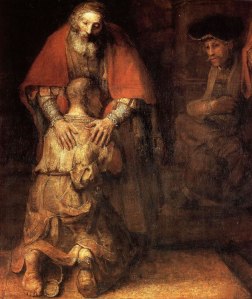
rembrant-prodigal-son-detail‘In invocation of God the Father everything depends on whether or not it is done in sheer need (not self-won competence), in sheer readiness to learn (not schooled erudition), and in sheer helplessness (not the application of a technique of self-help). This can be the work only of very weak and very little and very poor children, of those who in their littleness, weakness, and poverty can only get up and run with empty hands to their Father, appealing to him. Nor should we forget to add that it can only be the work only of naughty children of God who have wilfully run away again from their Father’s house, fond themselves among swine in the far country, turned their thoughts back home, and then – if they could – returned to their Father … Christians who regard themselves as big and strong and rich and even dear and good children of God, Christian who refuse to sit with their Master at the table of publicans and sinners, are not Christians at all, have still to become so, and need not be surprised if heaven is gray above them and their calling upon God sounds hollow and finds no hearing. The glory, splendour, truth, and power of divine sonship, and of the freedom to invoke God as Father, and therefore the use of this freedom – the Christian ethos in big and little things alike – depends at every time and in every situation on whether or not Christians come before God as beginners, as people who cannot make anything very imposing out of their faith in Jesus Christ, who even with this faith of theirs – and how else could it be if it is faith in Jesus Christ? – venture to draw near to his presence only with the prayer: “Help my unbelief” (Mk. 9:24). Mark well that this has nothing to do with Christian defeatism. It describes Christians on their best side and not their worst, in their strength and not their weakness (2 Cor. 12:10).’ – Karl Barth, The Christian Life: Church Dogmatics IV,4: Lecture Fragments (trans. Geoffrey W. Bromiley; Edinburgh: T&T Clark, 1981), 80.

John Paul II on faith and reason


‘Faith and Reason are like two wings on which the human spirit rises to the contemplation of truth; and God has placed in the human heart a desire to know the truth – in a word, to know himself – so that, by knowing and loving God, men and women may also come to the fullness of truth about themselves’. – Pope John Paul II. Fides et Ratio/On the Relationship between Faith and Reason (Boston: Pauline Books and Media, 1998, 7.

In the Beginning: An Interview with Olivera Petrovich

The Saturday Age recently ran this interesting piece. My desire to seek out more then led me to discover this interview with Olivera Petrovich by Rebecca Bryant. I thought it was worth re-posting:

Young children see the world with fresh minds that embrace both scientific causality and metaphysical speculation, says Oxford psychologist Olivera Petrovich. And their conceptions show striking similarities across widely differing cultures, she tells Rebecca Bryant in this exclusive interview with Science & Spirit.

Science & Spirit: What is your current role in the field?

Olivera Petrovich: I am currently with the Experimental Psychology Department at Oxford University, where I research and tutor in developmental psychologist. I also lecture in psychology of religion at Oxford — my course is open to theology, philosophy, and psychology students.

S&S: Your research interests lie in the psychology of religion, focusing especially on the development of spirituality in children. How do you go about it?

Petrovich: My approach to this is very strictly empirical. It begins with children’s accounts of the physical world — notably their causal explanations and the way they categorize objects and events around them. I’m interested in children’s spirituality as it develops in their encounter with the physical world, not through the teaching they may receive in bible classes and so on. I’m not at all looking at the cultural transmission of spirituality.

S&S: You recently conducted cross-cultural studies involving British and Japanese children. What were the aims — and the findings — of this research?

Petrovich: I was really interested in children’s ability to offer both scientific causal explanations and metaphysical explanations, which go beyond the scientific. Japanese culture is very different from Western culture with a very different history of science and religious tradition. So I thought I should be able to get some interesting comparisons between Japanese and Western children.

I tested both the Japanese and British children on the same tasks, showing them very accurate, detailed photographs of selected natural and man-made objects and then asking them questions about the causal origins of the various natural objects at both the scientific level (e.g. how did this particular dog become a dog?) and at the metaphysical level (e.g. how did the first ever dog come into being?). With the Japanese children, it was important to establish whether they even distinguished the two levels of explanation because, as a culture, Japan discourages speculation into the metaphysical, simply because it’s something we can never know, so we shouldn’t attempt it. But the Japanese children did speculate, quite willingly, and in the same way as British children. On forced choice questions, consisting of three possible explanations of primary origin, they would predominantly go for the word “God,” instead of either an agnostic response (e.g., “nobody knows”) or an incorrect response (e.g., “by people”). This is absolutely extraordinary when you think that Japanese religion — Shinto — doesn’t include creation as an aspect of God’s activity at all. So where do these children get the idea that creation is in God’s hands? It’s an example of a natural inference that they form on the basis of their own experience. My Japanese research assistants kept telling me, “We Japanese don’t think about God as creator — it’s just not part of Japanese philosophy.” So it was wonderful when these children said, “Kamisama! God! God made it!” That was probably the most significant finding.

I’ve also established that children’s natural concepts of God aren’t purely anthropomorphic. They certainly acquire a conception of God-as-man through their religious education, but no child actually links the representation of, for example, God-as-Jesus with the creator of the world. Rather, their images of God the creator correspond to abstract notions like gas, air, and person without a body. When you press them, they of course fall back on what they’ve been told, saying things like, “I know he’s a man because I saw him on the telly,” or “He’s just like my daddy.” These are very rational responses, but they’re not natural conceptions formed by children. Rather they’re imposed by the culture in which the children live.

S&S: In what ways do adults’ religious concepts differ from those of children?

Petrovich: I did test adults in Britain, but not yet in Japan. The results show that the differences between lay adults and children tested under the same conditions are largely quantitative. Adults are more accurate at identifying objects and describing their physical properties, but the categories they use in their explanations aren’t qualitatively different from those used by children. When it comes to adults’ speculations about the creator — the source of objects — they do display greater cultural influences than children, but when you systematically compare adults’ and children’s descriptions, you see significant similarities — in their references to God being something like air or gas, for example. Children’s descriptions are very basic, whereas adults use more sophisticated vocabulary, but there is no more information about God in adults’ references than there is in children’s. I think this is perfectly plausible and predictable because we can’t say that we as adults have more privileged access to God than children do. We’re all in the same position.

S&S: From your research, do you think it’s possible that the inclination toward religion or spirituality is universal?

Petrovich: I think possibility is the precise word to use here. I can’t be more certain than that because I have only worked with children aged three-and-a-half upward, and that’s already an old age when it comes to basic understandings, some of which are in evidence in the first year of life. However, the cumulative contribution of many domains of cognitive developmental psychology suggests to me that it’s a serious possibility that spirituality is a universal aspect of human cognition. Recent research shows that human infants aren’t passive recipients of information around them, but obviously think, making inferences and forming hypotheses. There’s also a lot of research showing that very young children are quite good at handling temporarily hidden objects. So, I think it needn’t be too difficult for them to make the inference that surely there must be some kind of invisible principle for what we see around us.

S&S: What drew you to the psychology of religion, as opposed to any other field in psychology?

Petrovich: I’ve always been interested in religion as well as psychology — even before I knew the word “psychology” existed. As a child I remember being interested in how people think, in why I thought this way and others thought that way. I began to notice that some people go to church and believe in God and others don’t. Also, like all children, I kept asking questions about the origin of the world. But I might’ve been more fortunate than some other children because I remember, for example, my mother telling me that even though we don’t really know the answers to these questions, it nonetheless remains very important to think about such issues.

As soon as I discovered psychology as a possible area of serious study, I thought that religion must surely be the most fascinating aspect of human thought. You can’t say that this stimulus is more likely to lead you to the concept of God than any other, and so the interesting question is how thought about God occurs.

S&S: How do you see your work fitting into the wider field of science and religion?

Petrovich: This is a very important question indeed. What drives me is the realization — which I hope is correct — that psychology is probably the best-placed science to explain both the origin and continuity of the interaction between science and religion in human affairs. You can find astronomers, geologists, biologists, and chemists throughout history who have either been religious or non-religious. And the difference between these two groups has always intrigued me. What is it in people’s thought patterns, in their education, in their further development, in their interaction with other people and disciplines that makes them perceive the world in one way rather than the other? I think experimental cognitive psychology is in a unique position to answer most of these questions because we can’t achieve a great deal in inspiring others to see the world as we see it unless we first understand how the human mind works — and that is just what cognitive psychologists aim to do.

S&S: Where do you see your interest in science and religion taking you in the future?

Petrovich: What I ideally would like to do is obtain a proper, funded post in academic psychology of religion within a psychology department. That doesn’t exist at the moment, anywhere, but the interest is tremendous — every year for the past four or five years I’ve had inquiries from students wanting to do research in this area.

The other thing would be to get funding for one or two studentships to work on a large project with me so that people can get trained. At the moment, you have very good psychologists with no education in theology or religion, and theology people who have no technical knowledge of how to do psychological research. Why is that relevant? Because if people have no idea about a field, they can never reach a hypothesis that’s worth investigating.

Olivera Petrovich is the author of the upcoming book, The Child’s Theory of the World. She can be contacted at olivera.petrovich@wolfson.ox.ac.uk. Rebecca Bryant has a doctoral degree in philosophy from Oxford University. She is a writer and researcher based in Oxford.

Science, Philosophy & Belief

Calvin College recently held a four-week faculty development seminar for Chinese professors and postgraduate students which featured lectures by Alvin Plantinga, Owen Gingerich, Richard Swinburne, and John Polkinghorne. MP3’s of each talk are now available for download.

John Polkinghorne
Can a Scientist Believe in a Destiny Beyond Death?
June 26, 2008, Chapel, Calvin Theological Seminary

Alvin Plantinga
Science and Religion: Why Does the Debate Continue?
July 2, 2008, Chapel, Calvin Theological Seminary

Owen Gingerich
The Divine Handiwork: Evolution and the Wonder of Life
July 9, 2008, Gezon Auditorium, Calvin College

Richard Swinburne
God and Morality
July 16, 2008, Gezon Auditorium, Calvin College

Denney on prayers for the dead

Recent days have seen a turning of my attention towards James Denney who was a good mate of PT Forsyth’s and an extraordinary NT scholar. One thing that impressed me today in my reading were his comments on praying for the dead. While Forsyth defends the practice on christological grounds, Denney does so on grounds creational and experiential.

I do not think it is any use telling people not to pray for the dead; you might as well teach them not to think of them or love them, or indeed tell them roundly that after death there is nothing at all. I think most people who pray at all do pray for the dead … Certainly the absence of any example of it from the Bible is remarkable, especially taken with the life and death urgency of all the Bible does say: but a great many things must be lawful that the Bible says nothing about – things covered by the word of Jesus, “If it were not so, I would have told you” – a saying which always seems to me to justify yielding … to any instinct of the nature which is made in God’s image, and cannot be simply delusive in the things of God.

It seems to me odd that the long-held practice of praying for the dead has all but disappeared in Protestant circles (or at least in the circles in which I move). No doubt there are decent historical reasons for such abandonment, but understanding history never justifies history’s poor actions. [As an aside, recall that Denney’s comments – ‘I think most people who pray at all do pray for the dead’ – were not only made by a staunchly-Reformed Protestant, but were written just over a hundred years ago].

What both Denney and Forsyth are seeking to urge is that in Jesus Christ, the living and the dead remain unforgettably and indestructibly united in love for each other, and in a common hopeful sharing. It is not anthropology, therefore, that holds the communion of saints together on both sides of death, but Jesus Christ as Lord of both the living and the dead. Therefore, do not the saints on earth have an obligation in the gospel to pray for those who have died, and who indeed form the largest part of the race? Such prayer helps to bear witness to the Church’s unity and catholicity, and indeed to the theo-organic unity of the race itself under its new Head, himself risen from the dead. To pray for the dead signals a refusal to believe the lie that the state of a person remains fixed at death, and functions as a sign of hope in the God who raises the dead to life. To pray for one who is dying, and then to continue praying after they die – without missing a beat – is not to deny the reality of their death so much as it is to faithfully trust in the God who knows his way out of the grave.

Theodicy: The Justification of God – 11

THE CONQUEST OF TIME BY ETERNITY

Study 11

A guest post by Trevor Faggotter

Take courage; I have conquered the world! – Jesus (John 16:33b)

Now faith is the assurance of things hoped for, the conviction of things not seen… (Hebrews 11:1)

‘…eternity is doing far more for time than time is doing for eternity’ (P.T. Forsyth)[1]

Aware of the complexities of life, the tragedy of war on a global scale, satanic power, and the blindness of humanity among nations, faith sees Jesus! The Justification of God is written that the church might re-establish a renewed confidence in Jesus Christ, and the gospel, on a grand scale. P.T. Forsyth confidently asserts his gospel convictions:

Faith is more than an individual calm; it is the Church’s collective confidence on the scale of the world for the destiny of the world. The evil world will not win at last, because it failed to win at the only time it ever could. It is a vanquished world where men play their devilries. Christ has overcome it. It can make tribulation, but desolation it can never make.[2]

ALL THINGS ARE YOURS[3]

The writing of P.T. Forsyth continues to be a highly valuable gift to the church. Forsyth belongs to us. Our appreciation of Forsyth’s enduring theodicy, should serve us well in our ministries – bearing faithful witness to Christ, in the face of all things.

All things are ours, even that victory, that elevation over a world’s sin in us; and our very relapses cannot rob us of it. It is easy to believe with a poor sense of what the holy is, of what it makes sin to be, of what the world is, and can do, for the devil. But it needs the supernatural courage of the Cross to believe (at such an hour as this, say,) in the completeness of the Cross and its eternal victory. But there, the more horror, the more hope. The most damning light is the saving light. Therefore, the more holy fear, the more the Cross is working in us; and the sense of the Cross’s judgment is the effect of its grace.[4]

In 1 Corinthians 3:21, Paul – having warned his hearers against following party or theological factions – reminds the church that we can learn from and make good use of all things – For all things are Yours! Forsyth may not say everything well.[5] However, he belongs to us. And we can learn much from him. Forsyth himself, skillfully attributed measured praise to the negative, critical work of the German philosopher – Friedrich Nietzsche,[6] who felt as millions feel, that life culminated in its tragic experiences, and that whatever solved the tragedy of life solved all life.[7] Sadly Nietzsche, a vehement critic of Christianity, suffered debilitating mental illness towards the end of his life. Forsyth comments upon this influential man’s failure to find his answers in the cross of Christ (a salient warning, I think):

To grasp the real, deep tragedy of life is enough to unhinge any mind which does not find God’s solution of it in the central tragedy of the Cross and its redemption.[8]

Our plethora of ‘why’ questions concerning injustice and the matter of evil, are resolved in the action of Christ’s cross.  For especially here, Jesus gives active praise to the Father, for the rightness of his just and true judgments, as he personally and willingly enters the furnace of God’s holy judgment upon sin, and bears the guilt and evil of humanity. We can replicate the observations of Jesus early ministry, now applying them to his cross, and the fruit of that event for all eternity: ‘He has done everything well.‘ (Mark 7:37).

FAITH IN CHRIST FOR ALL CIRCUMSTANCES OF LIFE

In the light of:

  1. The worst evil – murdering Jesus Christ, the Son of God, and Author of Life, and
  2. The best news of all – the resurrection of Jesus as Man, which opened possibilities, and a reality, not previously dreamed of,

the early church knew that all things were working together for good for those who loved God and were called according to his purpose. They learned to give thanks in all circumstances (1 Thessalonians 5:18).  Through the cross, understood by faith, in the power of the Holy Spirit the church down through history is assured that nothing is outside of God’s control, nothing is exempt from being used for the purposes of God.[9]

Life begins as a problem, but when it ends well it ends as a faith: a great problem, therefore a great faith. Ordinary experience gives us the first half, it sets a problem; but the second half, the answer of faith to us, comes from God’s revelation of grace. As we here pass from the one to the other it should be on large lines, not that we may simply descant on life in a literary way, but that we may magnify the greatness of Christ.

FORSYTH’S CLOSING RÉSUMÉ

The final chapter is a résumé of all that Forsyth has been writing about in this book. He expands upon the following 9 essential points:

  1. ‘Life, then, is a problem. If offers a task rather than an enjoyment. The soul must be achieved. The kingdom is above all a gift, but it is also a conquest. We are here to fight the good fight rather than to have a good time. The people to whom life is only an excursion, a picnic, a stroll, or a game grow more and more outlanders in society.[10]
  2. The problem of life is tragic, and no mere riddle. It is not a war game. ‘We are in no Kriegspiel,[11] but in the real thing always. It touches the nerve.’[12] ‘Life is not a seductive puzzle; it is a tragic battle for existence, for power, for eternal life’.[13]
  3. There is a solution to the problem. Our battle is not a sport for heaven. The solution is given to us rather than won by us. Already done and not merely shown.
  4. The solution is practical, not philosophical. It is not really an answer to a riddle but a victory in a battle. A life problem cannot be thought out but lived out. Man conquers by faith and not by philosophy.[14]
  5. The practical solution of life by the soul is outside life. The destiny of experience is beyond itself. The lines of life’s moral movement and of thought’s nisus converge in a point beyond life and history.[15]
  6. This world is only complete in another; it is part and prelude of another, and runs up into it, and comes home in it as body does in soul. What is meant when we speak of another world? We do not mean only one that begins at death. We do not mean a new tract of time beyond the grave, but another order, another dimension, of things, that both haunts the precincts and fills the spaces of this life always.
  7. All the crises of His [Jesus’] life, I have been saying, had themselves a crisis in His death, where the victory and the solution was won once for all. He did not cheer the disciples with the sanguine optimism of the good time coming. It was not a sanguine optimism, but an optimism of actual faith and conquest. It was not the hope of a conquering Messiah soon. ‘He is here,’ was the Gospel.[16]
  8. The solution in the Gospel is wrought once for all because it was on a world scale, an eternal scale, because He, and He alone of all men, was on such a scale. He was on a scale, which made the New Testament writers give Him not only a human and historic influence but a cosmic, nay, an absolute. He was to command not only the race but the universe, and save not only the soul but the whole groaning and travailing creation.[17]
  9. Trust God. ‘We cannot solve life by moral thought or effort but by trust, which unites us with the invincible, eternal, moral act of God in Christ. Christianity is not the sacrifice we make, but the sacrifice we trust; not the victory we win, but the victory we inherit … Christ crucified and risen is the final, eternal answer to the riddle of life. One day, when we sit in heavenly places in Christ, we shall see the tangle of life unroll and fall into shape. We shall see death as the key of life. Our own dead could tell us so already. We shall see guilt destroyed; and, with that, death, wrong, darkness, and grief’.[18]

FAITH GREATER THAN THOUGHT

Forsyth’s profound thought rouses us to give our own thought process a solid workout. However, the relationship between thought and faith, is an important one to understand:

Thought is a mighty and precious power, but on the last things it does more to enlarge our field than to steady our feet. It gives us range, not footing; a horizon rather than a foundation. It does not establish the soul, but widens its vision. It extends our reach more than it fixes our grasp. It therefore often magnifies the problem rather than solves it. Truly, that is a great service. To greaten the problem is to prepare for a great answer. Faith is not there as an asylum for those who are too lazy or shallow to think. But, though thought may tax faith mightily, it cannot do its work. It gives it a grand challenge, but it has not faith’s final word.[19]

Rich thought can certainly expand our horizons, but faith steadies our feet, causing us to stand firm, securely, in the strength of the Lord’s power (Ephesians 6:10-18):

There is something that gives us power to live and conquer, where thought may only raise challenge and doubt. Thought opens a world ahead of us, but faith forces us back into the soul and its case. Faith must be more conservative than thought; for it is deeper. The vaster the world that thought opens, the vaster is the question it puts; and the answers, the solutions, that fitted a small world, go out of date in a large. But the solution, the secret, of the soul, is the same yesterday, today, and forever. It is Christ dead and risen that has the key of life. It is living faith in His living, giving, and saving God.[20]

It is good to finish our study book! Faith fortified. Yet, of making many books, there is no end. Much study is a weariness of the flesh (Eccl. 12:12). Jesus said: You search the scriptures because you think that in them you have eternal life; and it is they that testify on my behalf. Yet you refuse to come to me to have life (John 5:39-40).

TO THE LAST WORD – LET US COME!

We only ever say second-to-last words; God, the Word always has the last Word. So then, let us come to the Word, Jesus Christ in faith, in prayer, in praise and thanks, resting in His finished work, assured of the glorious future, glorified in Him: Thank you Lord, for your servant, P.T. Forsyth! May his writing and insight continue to be a blessing, to many! Jesus you said: be of good cheer. Jesus, you have overcome the world, triumphed over the power of evil, and secured eternal life. You are our future, and our Life. Amen.


[1] P.T. Forsyth, This Life and the Next, London Independent Press Ltd., 1918 (1948), p. 81.

[2] P.T. Forsyth, The Justification of God, NCPI, Blackwood, 1988, p. 223.

[3] For the wide application of this short biblical phrase, I am very grateful to Geoffrey C. Bingham, All Things are Yours, NCPI, Blackwood, 1991 (1996).

[4] P.T. Forsyth, The Justification of God, pp. 222-223.

[5] Indeed Forsyth’s final book commends prayers for the dead, and displays a troublesome tendency towards Universalism:  See P.T. Forsyth, This Life and the Next, London Independent Press Ltd., 1918 (1948). It is worthwhile reading it. But many will have strong reservations about some of his statements. [NB. Not all of Forsyth’s readers are as dismissive and unappreciative of his insights in This Life and the Next as Faggotter is here.]

[6] Friedrich Wilhelm Nietzsche (1844-1900) was a significant influence in the establishment of an understanding of life known as Existentialism. This is a movement in philosophy that says that it is not God, bur rather individuals, that create the meaning of their own lives.

[7] P.T. Forsyth, The Justification of God, p. 210.

[8] P.T. Forsyth, p. 210.

[9] P.T. Forsyth, p. 4.

[10] P. T. Forsyth, The Justification of God, pp. 208ff.

[11] Kriegspiel: A full-scale war game between two nations.

[12] P.T. Forsyth,, p. 209.

[13] P.T. Forsyth, p. 209.

[14] P.T. Forsyth, p. 211.

[15] P.T. Forsyth, p. 212.

[16] P.T. Forsyth, p. 219.

[17] P.T. Forsyth, p. 219.

[18] P.T. Forsyth, pp. 220-221.

[19] P.T. Forsyth, p. 211.

[20] P.T. Forsyth, pp. 211-212.
The view from here

‘The recovered awareness is that “the Christian lives not at the End of Time, but rather from the End and in the End of Time” (Lambert). [The Christian] sees everything from an eschatological perspective. The Biblical world-view is not obtained by regarding all things under the form of a timeless eternity, nor as ideally they might be, but as they are already in Christ, the End …

For when that word [of God] is heard, nothing appears quite the same. The fashion of this world looks different when seen from the End. The neutrality goes out of it. It is as though the beam of a searchlight has been turned upon it, immeasurably deepening the contrast between light and shade. The flatness is taken from living. A new edge and tone is given to it. The common round becomes charged with fresh moment and decisiveness.

It is precisely this gift that the modern world so desperately lacks. It is for this reason that it seeks an outlet in the man-made eschatologies of Fascism and Communism. It is for this reason that it creates the artificial stimulants of sensational journalism and football pools, and continually screws itself up to some new pitch of excitement and suspense. All these are attempts to recreate a lost sense of each moment as the day of decision, to restore that pinch of expectancy to a life which has became flat and dead and insipid.

But those who have breathed again the atmosphere of Christian eschatology, who in a tired and drab world have sniffed the clean, crisp air of the Advent message and the Advent hymns, have no need of such expedients. It is difficult to express in language the effect of this recovery.

There is perhaps one analogy which may convey to our contemporaries a little of its feel. For there was a moment in recent English history when something of the transforming power of apocalypse was sensed as a shared experience of the nation. In the summer of 1940 we felt everything become braced to a sudden tautness. The slack went out of life. The indecision vanished. Blurred outlines leapt into focus. For a flash all stood out sharp and clear-cut, pin-pointed as in an etching or as by moonlight on snow. There was nothing artificial about that. The issues of life and death confronted us: there was no shuffling, no shrugging them off.

It is in such a moment that the Christian life is eternally set. It is the very nature of the Christian community to be an eschatological reality. This is what is being rediscovered by many of our generation. And when this happens, the Church wears no longer the dull sub-lunary look which it has when the dimension of apocalypse is absent. It is seen essentially as “the place where … the Spirit, that element of the ‘last days’ is active” (O. Cullmann, Christ et le Temps, 109). It has its very existence “between the times.” It is the bridge which spans the “moment” between the Resurrection and the Parousia’. – John Arthur Thomas Robinson, In the End, God.: A Study of the Christian Doctrine of the Last Things (London: James Clarke & Co., 1950), 125, 126–8.

Ratzinger on Christian Faith


‘Christian faith means understanding our existence as a response to the Word, the Logos, that sustains and maintains all things. It means affirming the fact that the meaningfulness that we do not create but can only receive has already been given to us’. – Joseph Ratzinger, Einführung in das Christentum. Vorlesungen über das Apostolische Glaubensbekenntnis (Munich: Kösel, 1968), 47.

Helmut Thielicke on How Crises in Faith Arise

‘We are all aware of everything that we have to keep in mind, and we also know how the constant round of thinking can wear us down and leave us without a word to say. Do we have any brain cells left over for the process of faith to use? Isn’t every thought about God a deviation form the current task we have been given? When bombs are bursting around us, or even when we are in the working-day harness, we have not time for extra thoughts. And faith, after all, is a thought – or is it?

Certainly everyone has had that experience. And if faith is taken seriously, that experience can make us miserable and sometimes almost tie us in knots. But it is crucial to be clear on this point, because then it become apparent that we cannot base our life on our faith. Faith is often conspicuous by its absence. How few moments there are when I consciously recognize that I am performing an act of faith, when I can establish completely, clearly, and unambiguously, “Now I believe.” Furthermore, faith is also very unstable. Sometimes on a quiet evening, perhaps after hearing Bach’s St. Matthew’s Passion, I am completely filled with faith, in fact, I am downright enraptured. If I should die at that moment, heaven’s gates would be wide open. But the very next morning it takes only one blow from an ugly letter to snuff out that feeling again.

No, we cannot base our life on faith. Even the disciples do not live from their faith in that moment when they are battling anxiety and seasickness. They hardly remember that they are believers. There’s simply no time to think about it. That may be put very crudely, but that’s how it is nevertheless! At that moment the disciples do not live from the fact that God is in their thoughts (because he is not!), but they live because Jesus Christ is thinking of them, and the stillness that surrounds his conversation with the Father is filled with these thoughts about his own. Our faith’s grip on the Father may loosen. But he in whom we believe holds us fast in his grasp. Jesus’ high-priestly prayer does not stop even when we quit praying. Thus, there is really no such thing as “Psychology of Religion” because the decisive events between God and me do not happen in my psyche, my consciousness, at all; they occur in the heart of my Lord. Here (and only here) there is constancy and faithfulness; here there is a love that will not let me go, even though my fever chart fluctuates between faith and little faith, between trust and doubt, and no reliance can be placed on my defiant and despondent heart. I don’t need to tell you what a comfort it can be to know that, and how that knowledge can help me survive those times when my own faith is cold and empty and dead and a sealed heaven arches above me’. – Helmut Thielicke, How To Believe Again (trans. H. G. Anderson; Philadelphia: Fortress Press, 1974), 69-70.

Forsyth on the foundation of hope

‘All the crises of [Christ’s] life … had themselves a crisis in His death, where the victory and the solution was won once for all. He did not cheer the disciples with the sanguine optimism of the good time coming. It was not a sanguine optimism, but an optimism of actual faith and conquest. It was not the hope of a conquering Messiah soon. ‘He is here,’ was the Gospel. And so we are not hopeful that the world will be overcome; we know it has been. We are born into an overcome, a redeemed world. To be sure of that changes the whole complexion of life, religion, and action in a way to which today we are strange. It is much to be quite sure that the world will one day be righteous; it is more to know that a universal Christ is its perfect righteousness already. We see not yet all things put under righteousness, but we see Jesus already crowned with that glory and honour. That is Christianity. If it seem absurd, it is only as the peace of God is so in such a world as surrounds us’. – Peter T. Forsyth, The Justification of God: Lectures for War-Time on a Christian Theodicy (London: Independent Press, 1957), 219.

Kierkegaard on forgiveness, pantheism and slack orators

In Fear and Trembling, Kierkegaard challenges Hegel’s undermining of the individual and his positing of the common ethic as the highest reality. In its place, Kierkegaard posits individual faith as the highest reality, a reality which is at core personal, paradoxical and beyond empirical or philosophical challenge. It is the individual who alone stands in ‘absolute relation to the absolute’.

Kierkegaard then proceeds to discuss the sin of despairing of the forgiveness of sins itself. He suggests two reasons for such despair: weakness or defiance. Weakness, or what he calls ‘a passive suffering of the self’, describes when one ‘does not dare to believe’, while defiance is when one ‘will not believe’. Both reasons are at core a resistance to not to will to be oneself, that is, a sinner, and so dispense with, or deny, the offer of grace and reconciliation that comes in the forgiveness of sins. Kierkegaard writes, ‘When the sinner despairs of the forgiveness of sins it is almost as if he were directly picking a quarrel with God, it sounds in fact like a rejoinder when he says, “No, there is not any forgiveness of sins, it is an impossibility”; this looks like a hand-to-hand scuffle. But yet a man must remove himself to a qualitative distance from God in order to be able to say this and in order that it may be heard, and in order to fight cominus he must be eminus; so strangely constructed in an acoustic sense is the world of spirit, so strangely are the relationships of distance arranged. A man must be as far as possible removed from God for that “No” to be heard, while yet in a way he wants to pick a quarrel with God’. Kiekegaard’s point is that it is a sin to in one’s own offense turn away toward a direction other than faith. While ‘one might praise the pagan who really managed to despair, not over the world, not over himself in general, but over his sin’, true Christianity (though not Christendom) altered everything, ‘for thou shalt believe in the forgiveness of sins’. Despair of the forgiveness of sins is an offense, Kierkegaard insists, because such despair issues from a wrong view of sin whose opposite is not virtue, but faith.

In the midst of this discussion, Kierkegaard offers a punchy critique of pantheistic tendencies within Christian theology too blindly entrenched in Hegel.

The fundamental misfortune of Christendom is really Christianity, the fact that the doctrine of the God-Man (the Christian understanding of which, be it noted, is secured by the paradox and the possibility of offense) is taken in vain, the qualitative distinction between God and man is pantheistically abolished – first speculatively with an air of superiority, then vulgarly in the streets and alleys. Never anywhere has any doctrine on earth brought God and man so near together as has Christianity; neither could anyone else do it, only God Himself can, every human invention remains after all a dream, an uncertain imagination. Neither has any doctrine ever so carefully defended itself against the most shocking of all blasphemies, that after God had taken this step it then should be taken in vain, as though God and man coalesced in one and the same thing – never has any doctrine ever defended itself against this as Christianity has, which defends itself by the help of the offense. Woe unto the slack orators, woe unto the loose thinkers, and woe, woe unto all the adherents who have learnt from them and extolled them!’ – Søren Kierkegaard, Fear and Trembling and The Sickness Unto Death (trans. Walter Lowrie; Princeton: Princeton University Press, 1954), 248.

Ratzinger on the Relationship between the Magisterium and Exegetes

Just finished reading Ratzinger’s 2003 address ‘On the Relationship between the Magisterium and Exegetes’ which he presented on the 100th Anniversary of the Pontifical Biblical Commission. I’ve always enjoyed Ratzinger’s writing, and this piece is no different. I thought I’d just share a few gems:

‘The pilgrim people of God … knows … that it neither speaks nor acts by itself, but is indebted to the ne who makes them a people: the same living God who speaks to them through the authors of the individual books [of Scripture]’.

‘The mere objectivity of the historical method does not exist. It is simply impossible to ompletely exclude philosophy or hermeneutical foresight’.

‘A God who cannot intervene in history and reveal Himself in it is not he God of the Bible. In this way the reality of the birth of Jesus by the Virgin Mary, the effective institution of the Eucharist by Jesus at the Last Supper, his bodily resurrection from the dead – this is the meaning of the empty tomb – are elements of the faith as such, which it can and must defend against an only presumably superior historical knowledge. That Jesus – in all that is essential – was effectively who the Gospels reveal him to be to us is not mere historical conjecture, but a fact of faith. Objections which seek to convince us to the contrary are not the expression of an effective scientific knowledge, but are an arbitrary over-evaluation of the method. What we have learned in the meantime, moreover, is that many questions in their particulars must remain open-ended and be entrusted to a conscious interpretation of their responsibilities. This introduces the second level of the problem: it is not simply a question of making a list of historical elements indispensable to the faith. It is a question of seeing what reason can do, and why the faith can be reasonable and reason open to faith’.

‘Faith and science, Magisterium and exegesis, therefore, are no longer opposed as worlds closed in on themselves. Faith itself is a way of knowing. Wanting to set it aside does not produce pure objectivity, but comprises a point of view which excludes a particular perspective while not wanting to take into account the accompanying conditions of the chosen point of view’.

You can read the entire address here.

Conversations with Poppi about God: A Review

Robert W. Jenson & Solveig Lucia Gold, Conversations with Poppi about God: An Eight-Year-Old and Her Theologian Grandfather Trade Questions (Grand Rapids: Brazos Press, 2006). 158 pages. ISBN: 97815874321613. Review copy courtesy of Brazos Press.

When was the last time you had a conversation about baptism, temptation, purgatory, time, economics, the Nicene Creed, creation, the Trinity, Christmas, metaphysics, church calendars, evil, indulgences, the Holy Spirit, liturgy, Lucifer, hamsters, a ‘really stupid’ bishop, the disestablishment of the Roman Church, the imago Dei, and a host of other things, all with the same person? When was the last time you did so with a person who just happens to be a world-renowned Lutheran, and ecumenical, theologian? When was the last time you did so with an eight-year-old who knows more about Dante than not a few philosophy undergrads?

In this remarkable book, we are invited to eavesdrop on a spontaneous and unscripted conversation between elementary schoolgirl Solveig Lucia Gold and her septuagenarian grandfather affectionately called ‘Poppi’, more formally known as the Reverend Canon Professor Dr. D. Robert W. Jenson, B.A., B.D., M.A., D.Theol., D.H.L., DD.

The book comprises the verbatim transcripts – with minor editing of ‘Ums’, ‘Well, buts …’ and ‘You knows…’, etc – of conversations recorded on a Radio Shack cassette recorder over a series of weekends in which Solveig visited her grandparents (‘Poppi’ and ‘Mimi’) in Princeton. After each session, Mimi typed it up.

The authors invite us to read their book ‘as you would a Platonic dialogue, though in this one, the role of Socrates goes back and forth’ (p. 10). Their discussion is more wide-ranging than most systematic theologies, and is filled with wit, warmth and wisdom.

Time for an example:

Solveig: How can God pick who goes to heaven or hell?

Poppi: By looking at Jesus, who loves you, Solveig.

Solveig: Can you show me?

Poppi: One way of saying what happened with Jesus is that Jesus so attached himself to you that if God the Father wants his Son, Jesus, back, he is stuck with you too. Which is how he picks you. (p. 20)

The young Episcopalian and her ‘sort of half Anglican and half Lutheran’ (p. 70) Poppi return to some themes a number of times over the weekends. One such theme that offers some of the book’s richest insights concerns the Spirit, or ‘God’s liveliness’ (p. 38), as the good Professor Dr Poppi likes to remind his granddaughter. Solveig tries on more than one occasion to argue a case that the second and third articles in the Creed ought to be reversed not only because ‘all of us share in the Spirit’ (Father and Son included), but also because that’s how you cross yourself. Poppi agrees, ‘Father, Spirit, Son is probably a better arrangement’ (p. 146). The Spirit is also ‘God’s own future that he is looking forward to’ (p. 42). They compare God’s liveliness with Santa Claus who is ‘sort of like a messenger from the Holy Spirit – in a way’ (p. 100), before coming to discern the spirits to see if they are from God, for whom to have Spirit means that he ‘doesn’t stay shut up in himself … but that the goodness and mercy – and wrath, when it comes to that – that is in God blows out from him to hit you and me. And that means that just like your spirit is yours and not mine, even though your spirit effects me, so God’s Spirit is his and not a spirit like Santa Claus’ (p. 101).

In between laughs, they talk about what it is about Holy Communion – Solveig’s ‘favourite part of going to church’ because she gets to ‘stretch and walk around a little’ (p. 31) – that means that ‘the wine should be the very best’ (p. 33) and that dissolvable bread should be banned. The meal should be appetising, and not like those baptisms ‘when they just dribble a couple of drops on the baby’ (p. 34). They also talk about a confirmation service led by ‘this weird bishop guy’ who is ‘really stupid’ (p. 34).

While I’m trying to resist the temptation to share every gem in the book (and there are lots), allow me one more, this time on heaven, purgatory, and hell:

Solveig: Do you think of where you might go after you die as two places or three places? I think of it as three places.

Poppi: What three is that?

Solveig: Heaven, purgatory, and hell.

Poppi: So you hold to the doctrine of purgatory?

Solveig: Yes.

Poppi: You know that is very controversial.

Solveig: Why? It’s in Dante, isn’t it?

Poppi: Well, it’s in Dante, yes. But of course, Dante isn’t exactly in the Bible.

Solveig: No. But he’s still …

Poppi: The thing about purgatory is that it’s a very reasonable idea. It’s just that we don’t know if it is true.

Solveig: Except … Maybe God thinks that you should just go to two places. If you are bad, he has no patience with you at all, and he will just sort you to go to heaven or hell. I think that is reasonable enough.

Poppi: That God is impatient?

Solveig: Yes.

Poppi: That’s where I think the notion of purgatory is reasonable. I don’t think the Bible talks about God’s being impatient in quite that way.

Solveig: If he isn’t impatient, maybe he doesn’t want us to spend time thinking about where we should go.

Poppi: You know that plate that your mother and father gave us that hangs on the wall in the dining room?

Solveig: Yes.

Poppi: Remember what it says on it?

Solveig: I don’t remember what it says.

Poppi: It says, ‘I desire not the death of the wicked.’

Solveig: ‘As I live, saith the Lord God, I have no pleasure in the death of the wicked.’

Poppi: Right. So the biblical God takes no pleasure in sending people to hell, and that’s why I think that purgatory is a reasonable idea. The problem is we don’t have any way of knowing whether the purgatory idea is true or not.

Solveig: It’s just Dante’s idea.

Poppi: Well, it was older than Dante.

Solveig: It was?

Poppi: Yes.

Solveig: Yes. Well, see, I think of Dante as a theologian, in a way.

Poppi: He was a very great theologian.

Solveig: Yeah, I know. I’m saying that he kind of liked to make up things he wasn’t quite sure about, if you know what I mean.

The delightful exchanges in this album offer us a model of how good theological dialogue can and should take place: with mutual respect and humility which delights in both the giving and the receiving; with an eye on the scripture, an eye on the tradition, and an eye on the world (for those who possess at least three eyes); and within an environment of safety in which no idea is too whacky and no avenue of enquiry cut off prematurely.

Carl Braaten’s words regarding this book are worth repeating,

Robert Jenson has created a new medium, with his granddaughter Solveig, to teach the basics of the Christian faith. Just as Martin Luther wrote his Small Catechism for children, this book of conversations covers the beliefs and practices of the Christian church – among them the commandments, the Lord’s Prayer, the Creed, and the sacraments – in a way that parents, regardless of their denomination, can confidently read and discuss with their children. Robert Jenson has translated the core convictions of his two volumes of Systematic Theology into simple truths that his eight-year-old grandchild can understand in the course of their unrehearsed and lively conversations. If you want to know what a sophisticated theologian really believes, listen to him explain the mysteries of the Christian faith to a child in simple terms without being simplistic.

Forsyth on Faith

‘We take refuge in what He believed when we are not sure about what we can. We trust His faith in men when experience shakes our own. We rest on His knowledge of the world, on His belief in divine power and human possibility, on His confidence in what He and His work did for men. We trust His experience and His judgment more than our own. When we cannot trust our wishes, hopes, or forecasts of human destiny, we can rest on His faith in it who secured it. If all the facts were against us, He is the fact that outweighs them all. And we both recover and complete our faith by being compelled to trust His.’ – P. T. Forsyth, ‘Faith and Experience’, Wesleyan Methodist Magazine 123 (1900), 417.

Feeling death

‘If we are to feel death, realise the deadliness of it, and yet master it, it must be by Faith, for we are beyond the help of imagination. Imagination, thank God, may carry us through death if it supply visions of heaven and glory vivid enough to submerge its most hideous fears. But it is only faith in God that can master it in its ultimate form, its most desolate, squalid, benumbing and panic form, death in a moral waste, in spiritual solitude, impotence and failure, death with just enough feeling left to feel itself dead’. – Peter T. Forsyth, God the Holy Father (Blackwood: New Creation, 1987), 51.

Death’s Duel

I have spent this morning re-reading John Donne‘s last sermon, preached in 1631. It was a meditation on Psalm 68:20, ‘And unto God the Lord belong the issues of death (i.e. deliverance from death).’ It was so good for my soul. For those who are interested in reading the sermon, read on (apologies for a lengthy post but I just didn’t know where to cut it, and those guys knew how to preach!). BTW, the image is from the National Portrait Gallery in London.

BUILDINGS stand by the benefit of their foundations that sustain and support them, and of their buttresses that comprehend and embrace them, and of their contignations that knit and unite them. The foundations suffer them not to sink, the buttresses suffer them not to swerve, and the contignation and knitting suffers them not to cleave …

To read in, click here.