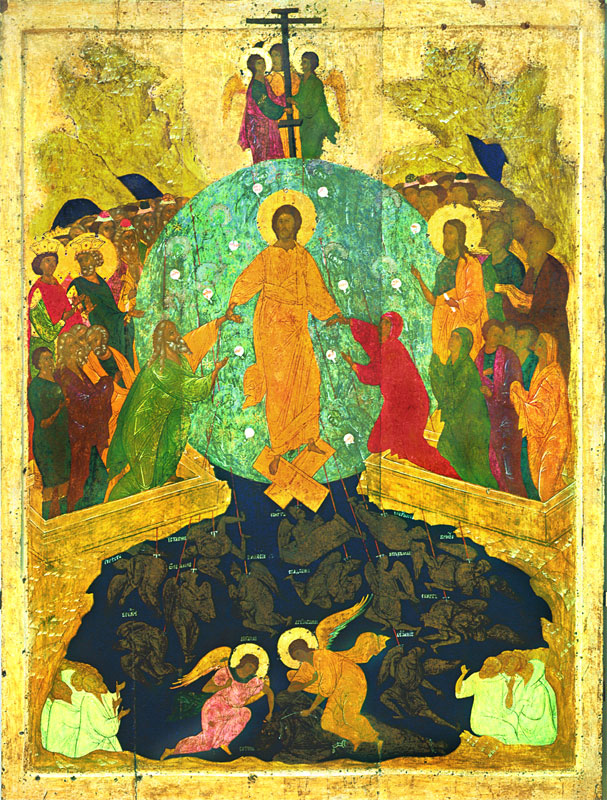
 ‘When Hell and death and their wicked ministers saw that, they were stricken with fear, they and their cruel officers, at the sight of the brightness of so great light in their own realm, seeing Christ of a sudden in their abode, and they cried out, saying: We are overcome by thee. Who art thou that art sent by the Lord for our confusion? Who art thou that without all damage of corruption, and with the signs of thy majesty unblemished, dost in wrath condemn our power? Who art thou that art so great and so small, both humble and exalted, both soldier and commander, a marvelous warrior in the shape of a bondsman, and a King of glory dead and living, whom the cross bare slain upon it? Thou that didst lie dead in the sepulchre hast come down unto us living and at thy death all creation quaked and all the stars were shaken and thou hast become free among the dead and dost rout our legions. Who art thou that settest free the prisoners that are held bound by original sin and restorest them into their former liberty? Who art thou that sheddest thy divine and bright light upon them that were blinded with the darkness of their sins? After the same manner all the legions of devils were stricken with like fear and cried out all together in the terror of their confusion, saying: Whence art thou, Jesus, a man so mighty and bright in majesty, so excellent without spot and clean from sin? For that world of earth which hath been always subject unto us until now, and did pay tribute to our profit, hath never sent unto us a dead man like thee, nor ever dispatched such a gift unto Hell. Who then art thou that so fearlessly enterest our borders, and not only fearest not our torments, but besides essayest to bear away all men out of our bonds? Peradventure thou art that Jesus, of whom Satan our prince said that by thy death of the cross thou shouldest receive the dominion of the whole world’. – ‘The Gospel of Nicodemus, or Acts of Pilate’, in The Apocryphal New Testament (Oxford: Clarendon Press, 1924), 20:1.
Christology
McCormack lays down the gauntlet
 Recently over at aboutlet, Bruce McCormack cleared up a few misreadings and then laid down the gauntlet to Lane Tipton: ‘The issue for me has never been the existence of a Logos asarkos (to deny which would be tantamount to rejecting the pre-existence of the eternal Son). The issue has always been the identity of the Logos asarkos (i.e. whether the identity of the eternal Son can be established on the basis of some form of natural theology or only on the basis of Christology)’. Read the post here.
It’s great to see Bruce entering blogdom.
Commending Jesus Ascended
 An enthusiastic plug: I’ve just finished reading Gerrit Scott Dawson’s Jesus Ascended: The Meaning of Christ’s Continuing Incarnation (London/Phillipsburg: T&T Clark/P&R Publishing, 2004). While I don’t have time to write up a review of it at the moment (though I hope to at some stage) I want to highly commend this excellent and very accessible study.
This is theology as it should be done: formed by scripture, with gratitude for the best of the tradition, and with eyes directed towards the church’s praxis in the world. A must read for pastors, worship leaders, missiologists, and anyone who prays – or wishes they did … and theologians! A taster:
Rejecting the story of Jesus at any point after his crucifixion completely skews the understanding of the church … A Christ who did not ascend has not established our primary identity in heaven, and he is not returning to bring in the new heavens and the new earth. (p. 149)
[Those interested may also like to read my review of a collection of papers edited by Dawson entitled An Introduction to Torrance Theology: Discovering the Incarnate Saviour]
HR Mackintosh, ‘The Person of Jesus Christ’: A Review
Scotland has produced a fair share of weighty theologians, and Paisley-born Hugh Ross Mackintosh (1870-1936) is among her best. From 1904 to 1936 he served as Professor of Systematic Theology at New College (TF Torrance took his systemetics class during 1935-36), where he himself was formerly a student. Between his student days and his teaching days, Mackintosh served churches in Largs (1896-1897), Tayport (1897-1901) and Aberdeen (1901-1904), and also spent time in Freiburg, Halle and Marburg, where he befriended the great Wilhelm Herrmann. Mackintosh’ most significant work was The Person of Jesus Christ (republished in 2000 by T&T Clark) in which he closely followed PT Forsyth’s kenoticism (still, to my mind, the most compelling presentation of the doctrine; though I am awaiting the full exposition of McCormack’s kenoticism). He also penned Christian Experience of Forgiveness, a brilliant work which creatively restates the doctrines of justification and atonement, urging that justification is forgiveness and that the cross is forgiveness’ cost to God.

Discerning Reader has recently published the following review of his The Person of Jesus Christ:
‘Locating a Christology book that is both solidly doctrinal and warmly devotional is rare, but The Person of Jesus Christ by Hugh Ross Mackintosh rewards on both counts. It is at once an exposition of the figure of Christ as God and man, and a celebration of Christ himself. Originally delivered as a series of lectures at Christian student meetings in 1912, Mackintosh’s lectures give the impression of being more of a personal meditation on the person and work of Jesus Christ than a scholarly paper devoid of any emotion. This is an advantage, as it is doubtful a lesser work would have lasted in print these almost one hundred years since its first publication.
An eminent scholar in his own right, in our time Mackintosh has been obscured by his considerably more famous pupil, Thomas F. Torrance. Fittingly, Torrance has written an introduction as a postscript appreciation for T&T Clark’s reissue of this worthy little work. In the introduction, Torrance iterates the value of Mackintosh’s book, explains how it came to be published, and briefly outlines the control center of Mackintosh’s theology, the atonement. Mackintosh himself called the atonement “the subduing magnitude of the Divine sacrifice.” It should be noted that ‘subduing’ is a word frequently deployed in this short book; one gets the distinct sense that Mackintosh was often rightly overcome by the enormity of his subject matter.
The main body of the work sets out “to contemplate the Lord Jesus Christ reverently in … his attitude to men in Palestine … as he still speaks and lives within human souls … [and] to indicate his connexion with the inner life of God.” No problems are more sublime, Mackintosh says, and no problems are so intensely practical. Here is a professor who sought not to live in the ivory tower, but to commune with Christ and his fellowmen in the highways and byways of life.
Every section is simply beautifully crafted. Only one page into the work, I was struck by the way Mackintosh sets up the confluence of the Father and the Son: Jesus “cannot think of himself without thinking also of God who sent him and who is perpetually with him … I am he, he said; I am the Sent of God, in whom every promise is answered and every human prayer fulfilled.” Mackintosh goes on to investigate Christ’s claims to Messiahship, his forgiveness of sins, his miracle-working, and the meaning of his sufferings.
The second section opens by considering Christ in light of our experience of him as Christians: “in many instances … Christ has transformed [our] lives. Men and women like ourselves have been re-created by his influence, changed in the depths and inmost secrets of being. In every man that change takes a different, because a personal, shape. His redemption is as original and individual a fact as the colour of his eyes. Each rising sun, touching the wing of sleeping birds, wakes over the woods a fresh burst of melody, as if the sun had never risen before; and just so, wherever a man finds and grasps redemption, faith in the heart is a new creation, as if he were the first to discover Jesus.” As if the second section needed anything more to commend it after that stunning turn of phrase, Mackintosh later provides food for thought by distinguishing “between a merely past and a present Christ, when we have the courage to ask, not only what we think of him, but what he thinks of us. For that is to bring the question under the light of conscience, with the result that his actual moral supremacy, his piercing judgment of our lives, now becomes the one absorbing fact. His eyes seem to follow us, like those of a great portrait. When men accept or reject him, they do so to his face.”
Finally, Mackintosh explores Christ’s role “in the relationship of God to man which no other can ever fill.” In this section, Mackintosh propounds an understanding of God’s majesty and holiness that is not in the least at odds with Divine Love, and ends with a gospel call of Christ’s lordship over all of life. His admiring student T.F. Torrance rounds out the book with an appreciation essay originally published in the Scottish Bulletin of Evangelical Theology thirty years after Mackintosh’s death. In it, Torrance continues to grind away at the reality of Christ in Mackintosh’s life and thought, and traces the intellectual genealogy of Mackintosh’s theology. Most winsomely, Torrance paints a vivid picture of a sixty-five year-old Mackintosh entering the classroom, brow still furrowed from pondering the intricacies of the person and work of Jesus Christ.
Besides the extraordinary writing craft Mackintosh obviously possessed, two other things stood out in this book. Firstly, that Mackintosh was a friend of Wilhelm Hermann, the liberal theologian who had an early influence on J. Gresham Machen. Like Machen, Mackintosh was able to distill genuine Christological insights out of Hermann’s liberalism. And although he would often publicly disagree with Hermann’s theological positions, ad hominem attacks had no place in Mackintosh’s vocabulary. Secondly, I was struck by a seemingly different historical picture than I learned in high school and university. I had always understood the years leading up to World War I in terms of fin de siècle ennui (industrial-age world-weariness) but here is a professor of the period describing what he identifies as a then-contemporary fascination with the figure of Jesus Christ, both as a historical figure and a Savior.
The Person of Jesus Christ is simply one of the best books I have read all year. As C.S. Lewis admonishes us, we should be reading at least two to three books written by dead authors to every book written by a current author. This little gem, as Torrance calls it, is worth the money spent. The passion and wisdom of this bygone, departed Scottish professor belongs on your bookshelf.’
Bruce McCormack to Lecture at St. Andrews
The Frederick and Margaret L. Weyerhaeuser Professor of Systematic Theology at Princeton Seminary, Bruce L. McCormack, will give the Scottish Journal of Theology Lectures at St Andrews University the week of December 3-6, 2007. His lectureship is titled ‘The Eternity of the Eternal Son: A Reformed Version of Kenotic Christianity’, and will include four lectures. For more information about times and locations, contact St Mary’s College at the University of St Andrews. I know at least one guy in St Andrews who can’t wait. Bring it on Bruce!
Gerald Bray and Alister McGrath in OZ
Those back in OZ may be interested to know that Queensland Theological College will be hosting Drs Gerald Bray and Alister McGrath in the coming months. Here’s the details and the related blurb:
DR. GERALD BRAY IGNORING THE PAST – MAKING THE SAME MISTAKES?
SEPTEMBER 14
Dr. Gerald Bray is Professor of Theology at Beeson Divinity School, Samford University, Birmingham, Alabama and formerly taught at Oak Hill Theological College in London. A prolific author, Dr. Bray has published many scholarly articles and books, including The Doctrine of God. He is considered by many to be one of the foremost thinkers and theologians in the contemporary church. Free Public Lecture held at Queensland Theological College, 7.15pm for a 7.30pm start. Dr. Bray will also be giving a three-day seminar: Controversies over Christ: Then and Now. The seminar runs September 11-13, from 9:30am to 3:00pm each day at QTC.
DR. ALISTER MCGRATH THE BANKRUPTCY OF ATHEISM
MONDAY, OCTOBER 1
Dr. Alister McGrath is Professor of Historical Theology at Oxford University and formerly Principal of Wycliffe Hall, Oxford. He is a world-renowned theologian, the author of over 30 books, which have been translated into over 20 languages. Dr. McGrath is known for explaining difficult ideas to lay audiences. In his talk he will challenge the assumption that the world is becoming more secular and discuss why atheism cannot provide the moral and intellectual guidance needed for modern life. 7:00 for a 7:15 start at the Raybould Lecture Theatre on the University of Queensland campus.
For more information contact QTC here.
Developing a Reading List – 2

Following on from a previous post on developing a reading list in which I listed books on (1) Theological Method and Prolegomena, (2) Systematics/Dogmatics (3) Biblical Theology, and (4) Theology Proper, I continue on with this exercise of developing some sort of a reading list for various areas of systematic and pastoral theology. Remember, the kind of thing I have in mind is a reading list and resource for English-speaking undergraduate theology students. What books have you found helpful, as either a teacher or student, in these areas?
Reading List: 5. Patriology:
Geoffrey Bingham, Father! My Father!
Helmut Thielicke, The Waiting Father
J. Scott Lidgett, The Fatherhood of God
Peter T. Forsyth, God the Holy Father
Thomas Smail, The Forgotten Father
Reading List: 6. Christology:
C. Norman Kraus, Jesus Christ Our Lord: Christology from a Disciple’s Perspective
Donald G. Bloesch, Jesus Christ: Saviour and Lord
Gerd Theissen, The Shadow of the Galilean
Isaac A. Dorner, History of the Development of the Doctrine of the Person of Christ
John Howard Yoder, The Politics of Jesus
Jon Sobrino, Jesus the Liberator
Joseph Ratzinger, Jesus of Nazareth
Jürgen Moltmann, The Crucified God
Jürgen Moltmann, The Way of Jesus Christ
Kathryn Tanner, Jesus, Humanity and the Trinity
Leonardo Boff, Jesus Christ, Liberator
Marcus J. Borg, Christology in the Making
Peter T. Forsyth, The Person and Place of Jesus Christ
Peter T. Forsyth, The Preaching of Jesus and the Gospel of Christ
Richard Bauckham, God Crucified: Monotheism and Christology in the New Testament
Thomas F. Torrance (ed.), The Incarnation: Ecumenical Studies in the Nicene-Constantinopolitan Creed
Thomas F. Torrance, The Mediation of Christ
Thomas Smail, Once and For All: A Confession of the Cross
Trevor A. Hart and Daniel Thimell (eds.), Christ in Our Place: The Humanity of God in Christ for the Reconciliation of the World: Essays Presented to Professor James Torrance
Walter Kasper, Jesus the Christ
Wolfhart Pannenberg, Jesus – God and Man
Reading List: 7. Pneumatology:
Donald G. Bloesch, The Holy Spirit: Work and Gifts
Gordon Fee, God’s Empowering Presence
James D.G. Dunn, Jesus and the Spirit
John Taylor, The Go-Between God
John Webster, Holiness
Jürgen Moltmann, The Spirit of Life: A Universal Affirmation
Molly T. Marshall, Joining the Dance: A Theology of the Spirit
Thomas Smail, The Giving Gift
Yves Congar, I Believe in the Holy Spirit, Vol. 1
Reading List: 8. Revelation:
Colin Gunton, A Brief Theology of Revelation
Donald G. Bloesch, Holy Scripture: Revelation, Inspiration and Interpretation
Emil Brunner & Karl Barth, Natural Theology: Comprising ‘Nature and Grace’ by E. Brunner & the reply ‘No!’ by Karl Barth
Gerrit C. Berkouwer, Holy Scripture
John Webster, Holy Scripture
Peter F. Jensen, The Doctrine of Revelation
Next on the list: Creation, Soteriology, Ecclesiology, and Anthropology.
 jasongoroncy.com