Art

No grace without art

While I would frame the argument rather differently, I enjoyed reading this recent piece by Steve Stockman. Here’s a taste: ‘Without art there can be no grace! … Grace is not a cold creedal confession but the energy that interrupts our lives with an alternative way to live … When we are locked into the malaise of our culture whether it is materialism, racism, sectarianism, environmental catastrophe or war then grace comes alive in alternative possibilities. Grace is more valued with those who need its interruption. But when grace interrupts those who receive its benefits, it should cause those who are turned upside down to start using it, not for their own selfish ends but for the good of others; it is the fruit of grace’s interruption. For followers of Christ who aim to bring God’s Kingdom on earth as it is in heaven, the respect that they give art in their community will deem whether they make any impression in interpreting how it is on earth to conjure how it is going to be in heaven. Grace is a thought that can change the world but it is also an imaginative engine to propel the change. Demean the artist at the cost of the Kingdom.’ Read the whole article here.

On another note, Dan has posted a worthwhile piece on ‘A Few Theses on Christianity and Patriotism‘. It reminded me of Peter Leithart’s great little book Against Christianity.

Princeton Theological Review – Theology and the Arts

The latest issue of The Princeton Theological Review – this edition put together by David Congdon, Chris TerryNelson, and others – is out. Commendably, it is dedicated to the discussion between theology and the arts. It can be read online here or download as a pdf here.

Articles include the following:

A Vacation for Grünewald: On Karl Barth’s Vexed Relationship with Visual Art
by Matthew Milliner

Call Forwarding: Improvising the Response to the Call of Beauty
by Bruce Benson

Theology and Church Music
by Gordon Graham

“A Pre-Appearance of the Truth”: Toward a Christological Aesthetics
by D.W. Congdon

The Beautiful as a Gateway to the Transcendent: The Contributions of the Decadent Movement in 19th Century Literature and the Theological Aesthetics of Hans Urs von Balthasar
by Walter Kedjierski

Fighting Troll-Demons in Vaults of the Mind and Heart – Art, Tragedy, and Sacramentality: Some Observations from Ibsen, Forsyth, and Dostoevsky
by Jason Goroncy

George Frederick Watts: Hope

George Frederick Watts (1817-1904) was a Victorian English painter and sculptor associated with the Symbolist Movement. Forsyth notes that for Watts, ‘Art . . . is a branch of sacred hermeneutics’ (Religion in Recent Art, 88). ‘Let natural beauty be what it may, artistic beauty is higher. And why? because it is spiritual. Because you have in Art the finished product of which Nature is but the initial stage’ (ibid., p. 89). Art is nature ‘born again’ and ‘is to Nature what salvation is to the soul’ (ibid., 90).

Though Watts shares a Victorian fascination with death, Forsyth asserts that this fascination with death is not to be condemned as morbid since ‘Like Art itself, Death is one of the great interpreters and expanders of life’ (ibid., 98). Forsyth writes that of the artists of his day, ‘Mr. Watts is our only artist who is capable of wrestling with death and therefore the only one who understands life’ (ibid., 130). For beyond death Watts has seen the power of love triumphant and has recognised in death itself ‘the arm of the Lord and the shadow of His wing’ (ibid., 115). His work therefore expresses a truly ‘supernatural hope’.

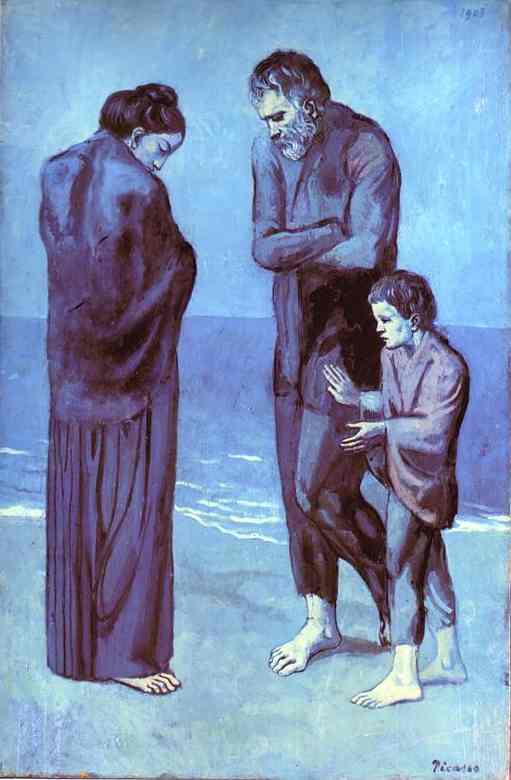
In one of his best known works, ‘Hope’, Watts pictures a blind folded woman sitting on what we take to be the world. She embraces a lyre of which every string is broken … but one. Above, the sky entertains a single star. With its blues and greys, the work is reminiscent of some of Picasso’s blue period works, such as his ‘Tragedy‘.

But is Watts depicting despair or something else? Forsyth argues that here in this work we have the depiction not of hope itself, but certainly of one who hopes. Like her Victorian Age, she has conquered the world, and yet such conquering has brought her neither joy, peace or power. She has turned her face away from ‘heaven’s light’ ‘and now, with earth searched and heaven to explore, her gaze is not up but down, her heaven-searching power of faith is quenched’. But quenched does not mean despair, for ‘the thirst to believe is still there. Look how the darkened soul stoops and strains for the one string’s note, for the one voice to tell her a gospel that all her achievement has not yet attained, and all the round and mastered world cannot promise. The soul has in its own self and nature a note that Nature has not. But is that note of nature only in the soul? Is it a subjective dream of its own? Is there any promise in the ‘not-ourselves’? . . . Yes, there is one star, though the poor soul sees it not. The painter sees it, and we see it. A star is there and a dim dawn.’ (Religion in Recent Art, 108).

On Art Theory and Atonement Fact

Jacques Barzun, in his book, The Culture We Deserve, writes that ‘In the arts, theory comes after the fact of original creation and, far from improving future work, usually spoils it by making the artist a self-conscious intellectual, crippled or mislead by ideas. Not everything that is good can be engineered into existence’ (p. 19). Unlike this all-too-often truth, the work of Christ creates our response of repentance and faith in its very action. Thus is the creative power of grace. By the Spirit of grace, Christ creates the response to grace in us. In Forsyth’s words, ‘Christ’s was a death on behalf of people within whom the power of responding had to be created’. Interestingly, Forsyth equates this with the artist who must create their own positive reception of their work – create a taste for it – and the power to be understood by the public, or by the art critic or theorist. That so few manage to do this is testimony (in some cases) to their brilliance and significance. Christ, however, did not come to impress us, or to be the object of human understanding. He came to redeem. He had to save us ‘from what we were too far gone to feel’.

Barth on art

‘It is a feeble view of art that isolates it as a sphere of its own for those who find it amusing. The word and command of God demand art, since it is art that sets us under the word of the new heaven and the new earth. Those who, in principle or out of indolence, want to evade the anticipatory creativity of aesthetics are certainly not good. Finally, in the proper sense, to be unaesthetic is to be immoral and disobedient.’ – Karl Barth, Ethics (ed. D. Braun; New York: Seabury Press, 1981), 510.

Forsyth on Ibsen

Having just finished a draft of chapter for my thesis, I’ve spent the last few weeks thinking about Forsyth’s encouragement to his North American hearers (in Positive Preaching) to ‘read Ibsen’ … and enjoying life with my 5 week old daughter.

Forsyth saw in Ibsen one who identified the problem with humanism as lacking ‘moral realism’. In words that seem to suggest that Forsyth saw Ibsen’s work functioning not unlike the ‘natural’ conscience, he writes: Ibsen ‘has not “found Christ,” but he has found what drives us to Christ, the need Christ alone meets. He unveils man’s perdition, and makes a Christ inevitable for any hope of righteousness.’ Forsyth laments not only that Ibsen never read Kierkegaard more closely, but that while critics with the judgment such as Ibsen and Nietzsche do not grasp the revealed answer to the question, ‘the Church with the revelation does not critically grasp the problem, nor duly attend to those who do’.

He continues: ‘Therefore [the Church] cannot adjust its revelation to the age. It is too occupied with the comfort of religion, the winsome creed, the wooing note, and the charming home. It does not realise the inveteracy of sin, the ingrained guilt, the devilry at work, and the searching judgment upon society at large. God’s medicine for society burns as it goes down. And we need a vast catastrophe like a European war to bring home what could have been learned from a Christian revelation that gave due place to the element of saving judgment in the Cross of Christ.

Hence, thrice on the one page does he entreat his North American hearers to ‘read Ibsen’, who, more than any dramatist gets ‘closer to life’s moral realities’.

Forsyth praised Ibsen for having ‘enough conscience to know the nature of the human burden’ but lamented that Ibsen lacked the insight to ‘bear it’ or, more importantly, to ‘roll it upon another’. Ibsen’s tragedy is true, but not tragic enough, not real enough. This is because Ibsen lacked one who could ‘create in him the repentance which alone must create personality out of such chaotic material as he found. He had the conscience to feel the sin of the world, but not the power of remedy.’

For the sake of the former, Ibsen, and those prophets like him, must be read, and re-read. But to not read on would be to not tell the whole story. For whereas Nietzsche and Ibsen could only identify the problem, Forsyth, like Paul and Luther before him, points us to Christ. And whereas in Ibsen we see a longing for home, only Forsyth’s gospel of blood-soaked grace can finally bring us there. ‘The practical solution of life by the soul is outside life. The destiny of experience is beyond itself. The lines of life’s moral movement and of thought’s nisus converge in a point beyond life and history … The key is in the Beyond; though not necessarily beyond death, but beyond the world of the obvious, and palpable, and common-sensible. (Yea, beyond the inward it really is.).’

Questions for further thought:

Is Forsyth’s portrayal of Ibsen accurate? Is human drama, or any art form for that matter, able to serve the necessary revelatory purpose that Forsyth insists that God alone can? What of preaching, even when God himself enters the pulpit? Who are the Ibsen’s today? What are they saying? How are they saying it? Does tragedy operate as a point of contact between the divine and the human? If so, how? Why do Christians seek to reproduce tragedy in art? Are they being honest when they do so? Do Christian artists betray an inadequate theology of Holy Saturday? Forsyth said that in Ibsen, ‘as for all of the rest of the tragic poets, guilt is the centre of the tragedy’. What is the relationship between guilt and tragedy? Forsyth and Ibsen identify the source of guilt in different places. For Forsyth, it lies in holiness, and that unclothed in the atonement. For Ibsen, in human self-analysis. How does this shape their respective views of tragedy? ‘Ibsen’s is a dismal lesson, but one that the age and the Church alike much need if only it were properly read to them, as Ibsen does not.’ We commend Ibsen for pointing toward our need of redemption. Do we need these experiences to react against in order to see our guilt? Is Ibsen still able to speak to this generation about their human condition orhave his plays become archaic and elite? What is it about tragic art that allows human persons to express solidarity with one another? ‘Ibsen makes very much of the social responsibility of the individual as the person which only society can make him to be.’ Brand is at the mercy of his experiences by the end of the play but is he a victim? Is Brand a hero or a villain? What insights does tragedy (and comedia) offer that intimate a Beyond in which the play might continue?

Any thoughts on Forsyth and Ibsen would be most appreciated.

Also, for those who might be interested, the Ibsen Festival is on this year (August 24 to September 16). The Nationaltheatret will present 30 Ibsen productions from 15 countries all around the globe, boasting approximately one hundred events during the four festival weeks. More info can be found here, here and the program here. Anyone want to sponsor a student to go?

The strategy of giving away gifts: cultural guidelines for artists

Recently, I purchased 2 books by Calvin Seerveld, a neo-Calvinist in the Kuyperian and Wolterstorff tradition who is best known as a Christian aesthetician. He is practically the patron saint of contemporary Christians for the arts. In his classic book, Rainbows for a Fallen World, he writes: ‘Christ’s body does not need to finish its cultural task in a given generation: it only needs to be faithful with what it is entrusted.’ One such entrustment is art. Anyway, I’m getting off track. In this post, I reproduce a recent article of Seerveld’s on the question of guidlines of artists, including this little gem:’ No one thing has ruined art so much in Western civilization as the cumulative nonsense about the artist as supra-rational genius, the pious talk about “creativity,” and the Romanticist creed that an undisciplined bohemian life affords the milieu most conducive for having artistic “inspiration” strike.’

The strategy of giving away gifts: cultural guidelines for artists
January 2006 – V. 25 I. 10 by Calvin Seerveld

The historical reality we inhabit is complex. The scriptural direction is singularly clear: give back to the Lord and to your neighbour the gifts the Lord has given you, in a ministry of reconciliation (2 Corinthians 5: 17-19), joyously redeeming the time despite the tears (Colossians 4: 5, 6).

Do not become an ideological lobby group. Do not settle for the vanity of kitsch. Do not be confused about what you are doing. You may be doing handicraft, or art, commercial design, advertising art, song or hymn writing, you may be making monuments or painting murals, you may be in propaganda, posters, PR or the media. But let each one give away whatever kind of gift you have received from the Lord, give it away in a holy spirit, with a sure skill, as an innocent and wise, faithful, compassionate deed (Ephesians 4: 7, 12-16; Matthew 10: 16), no matter how imperfect. That is all the Lord requires of you as one of Christ’s body on earth (cf. Micah 6:8).

In Rainbows for the fallen world I gave five directives for those who want to be christian artists, distinguished in their artistry by the holy spirit of compassionate judgment proclaiming the Rule of Jesus Christ:

First, for those who want to be christian artists, that is, musicians, painters, poets, novelists, graphic designers, dramatists, cinematographers, distinguished in their artistry by the holy spirit of compassionate judgment proclaiming the Rule of Jesus Christ:

(1) Become filled with the wisdom of the Holy Spirit.

Unless one’s vision is full-orbed and one’s discernment of what God wants done is sure, one will be weak in artistic leadership and uncertain in testing the spirit of the art facing you and your neighbour. One’s roots have to be deep in Jesus Christ and one’s sensitivity to creation has to be uncommonly rich, if you mean to be vitally redemptive in doing anything with christian identity in this secular age. Christian artistry cannot be done by formula—choose these topics, refrain from that, add a prayer, and give a double tithe of the proceeds—no! It will take a prayer and fasting habit to exorcise secularism from our artistic deed (cf. Matthew 17: 14-21); so, like making a vow, one has to decide whether to suffer such a level of commitment (cf. Ecclesiastes 5: 1-7, Philippians 1: 27-30), and then plead with the Lord to use oneself for establishing his Rule. Without the working presence of the Holy Spirit in the product of our hands, mouth, feet or body, the “christian art” will be a sham, in vain. Unless the river bed of our consciousness is as deep as the living Spirit of God, no matter how fast the water flows or sparkling it seems, it is christianly shallow.

(2) Conceive art as work and undergo its training like a trade.

No one thing has ruined art so much in Western civilization as the cumulative nonsense about the artist as supra-rational genius, the pious talk about “creativity,” and the Romanticist creed that an undisciplined bohemian life affords the milieu most conducive for having artistic “inspiration” strike. Such adulatory isolation may prime artistic egos, but it inevitably undermines the ministry of christian art. Art is a task like building bridges and fixing meals; it takes intelligence, sensitivity to needs, and specialized knowledge. Good intentions and prayerful dedication are not enough in building bridges or seasoning foods: you fall through or the food is flat if the product is not sound. A weak-kneed poem or a shoddy, gaudy painting likewise will mislead little ones who come looking for shalom, and if they stumble on account of one’s irresponsibly botching it, one is in trouble as an artist, according to the Scriptures (cf. Luke 17: 1-2). The burden of producing masterpieces and of being “a star” is not necessary, it is not the easy yoke of Jesus Christ; but art is a job that one may be called to do—writing a song, repairing a chair, composing a speech, sculpturing stone—and after a period of apprenticeship it is important to become a qualified journeyman approved by God lest our painting or novel let our neighbour fall through.

(3) Distill a fruitful christian art historical tradition in your own blood and pioneer its contribution in our day.

Christians have no right to be ignorant of history just because they stand in the truth. As guardians of culture Christians should explore omnivorously whatever men and women have done in the Orient and Africa, Europe and the Americas, in ancient times and today, not to paste bits and pieces eclectically together and not to assimilate a nondescript “best” that has been artistically done throughout the ages, but in order to know surely the consistency and contours of one’s own particular christian tradition so that one can work out the integrity of our christian minority culture set off from but in the context of all the other ways men and women have invented cultivating responses.

I personally come at a christian culturing from a Reformation christian tradition that is Calvinian, Kuyperian, Torontonian—a perspective and dynamic which is not pre-Reformation mediaevalist nor an American Great Awakening Baptist tradition, but one that has a definite shape one can call “Reformational”—coursing deep I think, for example, in the blood of Henk Krijger’s paintings; and it is different from the local christian tradition Gabriela Mistral breathes, a mystical Catholicism of some Spanish variety reaching back to St. Francis of Assisi as patron saint. But both Krijger and Mistral are united as brother and sister in breaking at the heart of their art with secularity. The holy spirit impelling them which surfaces in their artistry is one foreign to accommodating what’s going on; it’s not even reformist—accepting something secularly current and snipping away at the edges. Their art is spirited, the very grain of the shaping colours and so silent flow of the words, as I perceive them, is cradled from the start in a singular affirmation of creation and its fullness as belonging to the Lord, of sin as a waste God hates, of present redemption possibilities and a future judging reconciliation of things back to God so that followers of Jesus Christ may look and read and sing through their tears. Krijger and Gabriela Mistral are examples of maturing indigenously in a christian tradition and of being unashamed at being positively christian (even though they wouldn’t bruit it about in my formulation). That is why both Krijger and Mistral are considered oddities by their secular colleagues who admit, nevertheless, to the quality of their art.

I believe it is a mistake to try to go back and recapture some earlier, canonic christian synthesis: a holy spirited undertaking will always be driven to work reformingly with an historical inheritance. But it is crucial for would-be christian artists in their youth to realize you cannot go it alone; and it is short-sighted, not to say stupid, in the correct desire to be relevant as christian artist in an unchristian age, to pick up the secular fashion of the immediate generation before us and immerse oneself in that as your tradition (cf. T.S. Eliot, in “Tradition and the Individual Talent,” 1919, in The Sacred Wood, London: Methuen & Co., 1960, pp. 48-49). That is why christian artists so often seem to be a generation late, rootless and drifting all by themselves, and seldom stand out from their day with art that raises the scandal of christian artistically presented insight.

A friend and I heard Allen Ginsberg and W.H. Auden at a poetry reading in London, England, several years ago. Two days later we happened upon Ginsberg downstairs in the Tate Gallery, peering intently at one after the other of William Blake’s paintings housed there. Since he was on crutches, having broken a leg recently, he had to sit down to rest; so we struck up a conversation about Blake’s Swedenbourgianism and mythology. Ginsberg told us about learning mantras and we argued about whether Paul’s experience of the third heaven was a drug trip. Why was Ginsberg interested in Blake? Early revolutionary Ginsberg had said: ‘the world is a mountain of shit: if it’s going to be moved at all, it’s got to be taken by handfuls.’

But Allen (“Howl”) Ginsberg had found out that shit doesn’t handful well, and here he was, later, filling in chinks of a tradition in mysticism so he could stay alive poetically and do more than rant in verse about the Pentagon. When he stood up to leave, “Pay special attention to the yellow,” said he, pointing to the paintings lining the walls; “that’s where it’s at.” And he hobbled off on his crutches.

Van Gogh’s yellow is closer to where it’s at, I think, than William Blake’s. But the point is—even though it takes years of maturing before you have really distilled an art historical tradition and made it your own: as christian song-writer plumbing the soul of black spirituals or the joy of early jazz, as christian poet getting blood transfusions from Chaucer, Spenser, Donne, Milton, Hopkins and Thompson, or as painters finding roots in Breughel, Rembrandt, Jan Steen or German “Expressionist” figures, it is imperative that one enters a communion of artistic saints if one would produce poems and songs and paintings of a third and fourth generation of those kept faithful by the Covenanting God of history.

(4) Integrate yourself as a band of christian artists with christian taskforces in other cultural areas in order to reach out as a peoplehood of God to the public at large.

Culture always has a global spread; so a minority culture cannot long, purposefully exist as a mini culture, a few loose strands. Christian schooling limps without supportive christian family life; the christian forming of certain abilities can go down the drain if they are ensnared in an utterly unredeemed, mercenary business enterprise; christian artistry remains badgered if there be no gallery outlet or publishing firm or media center that has ended initiation fees, “best seller” strictures and demands of crowd guarantee. There are numerous exasperating problems in building an integrating minority culture within a dominant, monolithic secular culture (Black culture found this out), for the current monolithic culture tries to disintegrate everything that resists its technocratic mould. I would be a false prophet to predict success for a christian minority culture in our age. But the point is this: the most full, cultural obedience by the communion of saints is not the stand-up testimonial of a lone christian artist, to which one may applaud, but rather an international community of christian artists’ showing themselves, in all their dedicated weakness, as one open door in a christian cultural ark not established by human hands, where young and old believers and unbelievers may enter as a relief and workshop, out of the pouring secular rain—an open-door, christian minority culture.

(5) Persevere in unfolding art historically, with a generations-long patience and hope.

Culture honouring the Lord has been born long ago (even though it doesn’t have birthdays), and in our seeing to it responsibly that christian culture gets born anew in our increasingly secularized day, we must plan long-range and take comfort in the promise of God that the believing generations still in our cultural loins will be given the time and grace to develop our communal offering (cf. Psalms 89, 145). Culture by nature is an ongoing affair that lasts longer than anyone’s lifetime. Therefore, to live under the promise of blessing upon the faithful cultivating responses of coming generations taking up our same task in the same spirit of praise and reconciliation takes the pressure off us Christians to set everything straight ourselves, something that bedevils counter-cultural movements. Christ’s body does not need to finish its cultural task in a given generation: it only needs to be faithful with what it is entrusted.

Such faithfulness includes, along with distilling a christian art tradition, acting in the present with communal horizons, being a qualified artisan filled by the Holy Spirit, that one unfold the specific creaturely strength of the art in question. In order for christian artists to extirpate the plague of elitism from themselves and be able to offer truly diaconal service to God’s people and the present-day men and women inundated by the mass media cultural hypnosis, painters may need to exchange easels and oils temporarily for murals like the “Wall of Respect” at 43rd and Langley in Chicago during the 1960s, and poets may need to forget ode structure and the elegant lines of blank verse for the rollic of ballads. But one may not go historically backward and run dissonance and steel out of our song and architectural experience or head toward picturesque scenes of Millet instead of “Harmony of Grey and Green” (1874) by Whistler. Christian artists who before God know what they are doing artistically—wary of being fooled by the artistic principalities and powers of this age—must persist in converting modern art into a language of healing insight. God’s people everywhere should pray for christian modern artists.

These five directives are still the best counsel I have from Scripture today, but I would like particularly to underline the fourth and fifth ones. We do not bring Christ’s Rule complete to the earth in our lifetime, and we need a vision that will reach across the generations. We only need to be generous stewards of what we have inherited, to edify the faithful and provide direction for the neighbour. God’s providing grace and the promise of Christ’s Rule is sure. Therefore we may develop a body of redemptive artists, art critics, art historians, art brokers, art theorists, surrounded by a host of historical witnesses, in hope. Perhaps someday you may sculpt a figure which will give cheer to someone whose life has been broken, as Ernst Barlach did with the aching curve of the doubting Thomas’ reunion with Christ [Die Wiedersehen]. Perhaps you may carry on Henk Krijger’s brief artistic ministry which led to little jewels like the smile of Somebody loves me, I wonder who?, where sunlit fields and a quiet sky form the ordered backdrop to the mailbox on which a homing pigeon stands to deliver a letter to a wondering fellow, almost like the dove’s proffering an olive branch to Noah. But whatever your talent be, remember the comfort of Psalm 2: Blessed be all those who have run artistically to take shelter with God.

This article consists of segments previously published in Rainbows for the fallen world (1980, 2005) and Bearing Fresh Olive Leaves: Alternative Steps in Understanding Art (2000). For more information see http://www.seerveld.com/tuppence.html.

‘Cheeky bugger’ Pro Hart dies

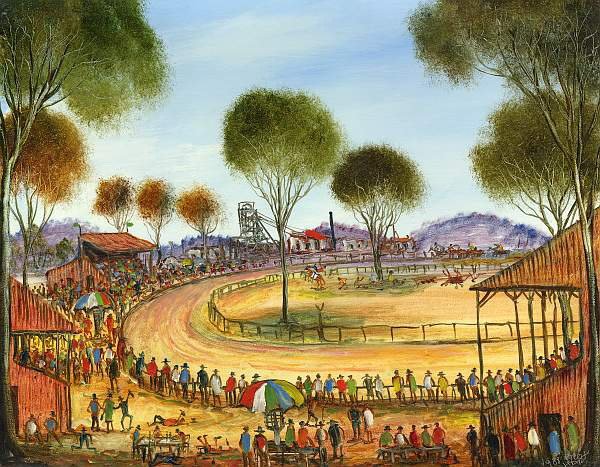
One of my favourite painters, Pro Hart, died this week after battling motor neurone disease. I thought I’d post a few of his pics for us to reflect on. PT Forsyth reminded us what Pro Hart taught us: that art can never be seperated from feidistic concerns, nor of other human pursuits such as philosophy or science. There may be a primacy in the arena of religion, but there can be no independence. ‘Our attitude to each is an indivisible function of the whole rational man. The whole man is turned upon Nature in earnest science, and the whole man is turned on God in real religion. What makes the real difference in our relations to them, in what we call the faculties, comes from the other end. It is a difference in the objects themselves and their behaviour’ (Authority, 148). For both men, I am grateful.


Kuyper on Calvinism and the Arts: A Theological Reflection

Kuyper on Calvinism and the Arts: A Theological Reflection

Jason Goroncy, February 2006

Unless otherwise stated, references are to A Kuyper, Lectures on Calvinism (Grand Rapids: Wm. B. Eerdmans, 1931).

Why didn’t reading Kuyper on the arts inspire me to go and write a song?

Abraham Kuyper (1837-1920), the founder of neo-Calvinism (or Kuyperianism), worked as a pastor, theologian, newspaper editor (for two newspapers), and politician in the Netherlands, organising the Netherlands’ first political party. In his spare time, he also started the Free University of Amsterdam, and served as Prime Minister.

In his chapter on Calvinism and Art, Kuyper makes plain his three-pronged agenda: (i) Why Calvinism was not allowed to develop an art-style of its own; (ii) What flows from its principle for the nature of art; and (iii) What it has actually done for its advancement. The chapter follows this structure.

Many who were both inside and outside Calvinism saw it as merely a doctrinal and ecclesiological position, but Kuyper was resolute that Calvinism be understood as a comprehensive worldview, and argued that ‘Calvinism made its appearance, not merely to create a different Church-form, but an entirely different form for human life, to furnish human society with a different method of existence, and to populate the world of the human heart with different ideals and conceptions’ (p. 17).

Under the umbrella of an emphasis on divine sovereignty, Kuyper’s Calvinistic vision called people to thoughtful, active, artistic, engagement with – and in – the world precisely because the world, and all that is in it, is God’s. According to Kuyper, there is no such thing as truly secular, or religiously independent, art. This is to say more than simply that no one works in a vacuum. It is to state that all art is ultimately derived from Religion – Christian or otherwise – although this may come via political ideology, the latter illustrated in Roman and Byzantinian architecture (pp. 149-51). How could it be otherwise if God is indeed ‘the deepest root’ (p. 151) of all human life? With the secular-sacred divide abolished, human creatures are those ‘who, priestlike, must consecrate to God the whole of creation, and all life thriving in it’ (p. 52). This gives all of life a purpose that Christian dualism cannot deliver. All of life is entirely meaningful to God and must be lived for His glory. It was in this, Kuyper argued, that Calvinism freed art, and artists, from the shackles (and pockets) of the Church and gave art back to the world.

Kuyper’s doctrine of common grace, ‘by which God, maintaining the life of the world, relaxes the curse which rests upon it, arrests its process of corruption, and thus allows the untrammelled development of our life in which to glorify Himself as Creator’ (p. 30), empowers God’s people – indeed all people – for engagement in the world. Because of this common grace, Kuyper concludes that ‘the life of the world is to be honoured in its independence, and that we must, in every domain, discover the treasures and develop the potencies hidden by God in nature and in human life’ (p. 31). In Kuyper’s vision, monastic withdrawal from the world is not an option. More importantly for our purposes here, Kuyper affirmed Calvin’s insistence that human artistry is a gift given by, and pleasing to, God, whether or not the artist is a confessing Christian (p. 160-61).

But here there is an important inconsistency in Kuyper’s thought. When it came to science, education and, arguably, politics, Kuyper called for a distinctively Christian expression on the basis of the antithesis between Christian and non-Christian worldviews. However, on art, Kuyper leaned much more heavily in the direction of emphasising common grace: ‘Aesthetic genius, if I may so call it, had been implanted by God Himself in the Greek, and only by hailing again, amid loud rejoicings, the fundamental laws of art, which Greek genius had discovered, could art justify her claim to an independent existence’ (p. 159; cf. p. 162). Why did he not allow his emphasis on common grace enough command in the spheres of science and education? According to Kuyper, the Greeks had discovered God’s fundamental law for art, and as such provided the foundation upon which all art should be built. This conclusion is not only inconsistent with his view of science and education, but guts the arts of their true foundation in the incarnate life, death and resurrection of Jesus Christ. Kuyper never makes it clear why science needed to be built on a Christian foundation, but art did not. One gets the impression that, for Kuyper, Athens is good enough for art, but for more serious (in his view) human endeavours, one must go to Geneva. Is it because he fears that art makes a more dangerous master than a willing servant and is much harder to harness after it has been freed by reformation faith? Or is it because at the end of the day, i.e. despite his comments regarding the necessity of art to permeate the whole of human life (p. 163), he considers art an ‘optional extra’, a luxury, of human being. (On this see PT Forsyth, Religion in Recent Art, 145-6; cf. pp. 2-4)

But why is Athens good enough for art? Surely religion has done more for art than art has done for it. Did art make or break Athens? If Kuyper is right in affirming this for other human pursuits, why not for art?

On a related note, Kuyper states that the reason that Calvinism did not develop its own architectural style was because it was committed to a ‘higher principle’ (pp. 145-6) and because it had ‘reached a so much higher stage of religious development’ (p. 152), though one is left to wonder exactly what this ‘higher principle’ and ‘higher stage’ might be. Again, Kuyper notes that ‘Calvinism was neither able, nor even permitted, to develop an art-style of its own from its religious principle. To have done this would have been to slide back to a lower level of religious life. On the contrary, its nobler effort must be to release religion and divine worship more and more from its sensual form and to encourage its vigorous spirituality’ (p. 149). Again, what is this ‘vigorous spirituality’ that Calvinism sets one free for, and why are the arts (materiality?) seemingly excluded? Furthermore, why is art, which Kuyper refers to as ‘one of the richest gifts of God’ (p. 143) to humanity, identified with immaturity? Is Kuyper too shackled to Hegel at this point?

Kuyper scraped the bottom of the barrel to find support in Calvin’s references to art. In the Institutes, the only references to art/ists are largely negative, discussed in the context of idolatry in 1.11.12, and the Creator/creature distinction in 1.5.5. There is a brief mention of artistic expression as evidence of the imago dei, particularly when accompanied by the ministry of the Holy Spirit in 2.2.14-16 (cf. Tracts 1:352). Calvin’s commentaries are little fuller with references, as is betrayed by Kuyper himself in the need to resort to the example of Jubal and Tubal-cain in Genesis 4:21-22. This is not to say that Calvin’s theology does not offer a rich canvas on which the artist can begin. On the contrary, despite his seemingly personal indifference to art (as opposed to Luther), the landscape and depth of Calvin’s theological vision, not least his doctrine of a ‘big’ God, and of creation, makes human artistry both inevitable and glorious.

What Calvinism brought to the arts was:
(i) a positive doctrine of creation;
(ii) a grown up God big enough to handle the world He had made;
(iii) a ‘profound conception of religious liberty’ (p. 147);
(iv) the doctrine of the priesthood of all believers (p. 168);
(v) the release of it being the exclusive domain of the rich and powerful (p. 165-8);
(vi) a sense of the importance of human vocation;
(vii) a God-honouring alternative to the Renaissance;
(viii) a God-honouring secularism;
(ix) an affirmation that human artistry is a gift given by, and pleasing to, God, regardless of any religious commitment;
(x) a broad vision of human society; and
(xi) the means through which artistic expression was freed from its ecclesiastically controlled chains (p. 167).

A final comment: Roy Attwood has helpfully reminded us that the Creator of the aesthetic sphere calls His image bearers to be busy doing faithful aesthetic acts: ‘While the world may be busy pursuing “art for art’s sake” or treating aesthetics like it rested on the bottom of the food chain, Christians should adorn their lives, their homes, their worship with humble acts of aesthetic faithfulness because they know the Creator and Lord of Aesthetics delights in them.’ In God’s first act of creation, God gave those who bear His image the capacity to also be creators, to offer back to Him – everlastingly – faithful, and new, aesthetic acts for His glory and for the delight of our fellow creatures. From the very beginning, the Lord of Aesthetics called His covenant children to be busy aesthetically. But it awaited the ultimate revelation of God’s creativity which concerned not the calling forth the creation in an act of creative love, but in calling it back as a new creation in grace, to give art its true meaning. In other words, Art matters not primarily because the creation has been created by God, (‘No Art is possible to a religion which begins with a text like “Cursed be the ground”.’ Forsyth, Art, 144) or even because it has been enfleshed by Him, but because it has been redeemed by Him in His most creative act. Only a world not merely enfleshed but crucified and re-created in a Holy Redeemer can offer to the arts any stable footing.

I wish that Kuyper saw and emphasised that this, too, is something that the reformation rediscovered.

Some discussion starters:

§ How accurately does Kuyper reflect Calvin/ism?

§ ‘What is the world that art takes for granted?’ (Rowan Williams, Grace and Necessity: Reflections on Art and Love. Harrisburg: Morehouse, 2005, 135) If, as Williams puts it, ‘art helps us to understand creation’ (Ibid., 161), what sort of creation does Kuyper present to us via his views on art? Is Kuyper’s world a world in which we are invited to look through or to enjoy and affirm the integrity of for its own sake?

§ ‘Would a world without art lose one of its ideal spheres?’ (p. 152)

§ How does one ‘use’ art prophetically to name the truths that (i) the creation is good, (ii) sin is a reality, (iii) sin does not have the last word, i.e. hope is certain?

§ Has Protestantism removed the arts from the cathedral only to place it in a gallery?

§ How does art ‘not merely … observe everything visible and audible, to apprehend it, and reproduce it artistically, but … discover in those natural forms the order of the beautiful, and … produce a beautiful world that transcends the beautiful of nature’ (p. 154; cf. p. 156-7, 163)? Is there genuine newness involved here, or merely the disclosing of what is hidden? Does art exist to name what is? To create something truly new, i.e. that wasn’t before? To surprise God? To hallow the ‘ordinary’? To spiritualise the material? How are artists able not only ‘to produce a beautiful world that transcends the beautiful of nature’ but also to perfect Nature (Forsyth)? Is this precisely not the very activity of the Sabbath day, thus linking it to both creation and redemption?

For, don’t you mark? we’re made so that we love
First when we see them painted, things we have passed
Perhaps a hundred times nor cared to see;
And so they are better, painted – better to us,
Which is the same thing. Art was given for that;
(Robert Browning, Fra Lippo Lippi, 1855)

If, as Browning states it, the point of painting something is not to reproduce it exactly (which is impossible anyway), but rather to represent it in such a way that it enables others to see the reality of that which is represented for the first time, (‘Art is interpretation’, Forsyth) in what sense might it be fair to envisage human creative activity as ‘unreal’? Are reproductive prints art?

§ What are we to make of Kuyper’s comment concerning the prophetic necessity in art itself to refuse to accept the world as it appears, i.e., that ‘art has the mystical task of reminding us in its productions of the beautiful that was lost and of anticipating its perfect coming luster’ (p. 155)? What does one think that Kuyper thinks that artists will do in the new creation?

§ Affirming that ‘the world after the fall is no lost planet’ (p. 162), Kuyper goes on to say that ‘the world now, as well as in the beginning, is the theater for the mighty works of God and humanity remains a creation of His hand, which, apart from salvation, completes under this present dispensation, here on earth, a mighty process, and in its historical development is to glorify the name of Almighty God’ (p. 162). In what sense can human artistry be said to contribute to creation’s completion, or continuation?

§ Does the particular doctrine of election, as expressed by Kuyper on pp. 166-7, still offer the same liberating power for artists?

§ Are we convinced of Kuyper’s argument (pp. 165f.) that had the Reformation not touched Europe so deeply, Rembrandt (if he painted at all) would have painted differently? Why? Why not?

§ Is Kuyper’s argument sufficiently ‘Christian’? What difference would a more intentionally (i) Trinitarian, (ii) Incarnational, and (iii) Soteriological theology, make to Kuyper’s argument and justification for the arts?

§ In light of the ugliness, and hidden beauty, of the Christian gospel, Jüngel writes: ‘Beauty and art are both welcome and dangerous competitors with the Christian kerygma, for in the beautiful appearance they anticipate that which faith has to declare, without any beautiful appearance and indeed in contrast to it: namely, the hour of truth’ (Theological Essays II, Edinburgh: T&T Clark, 2000, 81). How can this tension be overcome so that art can be considered not as an ‘optional extra’ of human being, or of the telling of good news, but as the constraining means of that being and telling?