 Panorama is an investigative TV documentary programme that airs on BBC One. Recently (14 July 2008) they aired a documentary called ‘China’s Secret War’. After months of investigating China’s covert arms trade, Panorama offered the first evidence of how China is arming the Sudanese government with arms to enable it to wage a campaign of violence in Darfur. Yet another reason to boycott the Olympics and condemn the IOC’s decision. Here’s a preview.
Author: Jason Goroncy
Makoto Fujimura on art, evil and hope
 ‘… I find that the theological answer for suffering is not really an answer at all. Rather, the Bible is about looking at evil square in the face and calling it “evil.” All of my work inevitably comes to the questions of wrestling with the question of evil and hope. Of the different ways to address the problem, I think the most effective approach is through the arts, because the question itself is not, fundamentally, a rational question. You need the world of imagination – the language of art – in order to be convincing in wrestling with it. Lamentations is a path to understanding this issue. We in the West don’t know how to lament … I see my art as part of the river of God, made up of God’s tears, which I have in common with a broken world. Rather than offering an idealized landscape for people to look to as an escape from reality, I paint in the ashes. Out of the ashes. From the ashes. And I’m not offering false hope, nor am I offering a nihilistic spiral of despair. Rather, I’m interpreting a longing that is deeply hopefully [sic] and real’. – ‘Wresting With Evil and Hope‘.
I’ve long revered In a (so-far) four-part interview (i, ii, iii, iv) in which he reflects on the significant impact of Nick Wolterstorff’s wonderful work – Art in Action: Toward a Christian Aesthetic – observes how Wolterstorff’s work is concerned with issues of justice, and with the world’s brokenness. He suggests that art is a fitting medium for mediating conversation about these things. Insofar as art might serve in this capacity, it is, he says, ‘a means for rehumanizing the world’.
In response to the question of what might be the artists’ responsibility towards this end of repairing and rehumanising human culture and the world, and whether Wolterstorff places any such responsibility on artists themselves, he says ‘Yes, and no. Nick is one of the few people who talks about an artist’s responsibility as not the opposite of freedom, but rather that an artist’s freedom is connected to his responsibility in society. To Nick, they’re not disjointed’. he world is drawn to that work which seeks to transform culture’, and to speak of our need to ‘love offensively’.
While it’s certainly not always the case thatto seek those things which transform culture, I thank God for those moments (even in me) when such a reality is realised; for this too is a sign that the kingdom of God is among us, the kingdom which indeed confronts us with an offensive love.
New sounds, great sounds: Jakob Dylan’s Seeing Things … and Tom Waits
 It’s taken me awhile, but I’ve finally ditched my unreliable cheap and nasty mp3-player and purchased an iPod for myself, upon which I’ve been enjoying some new sounds. A mate introduced me to Kiwi artists AJ Bell, Dave Dobbyn, Charmaine Ford, Don McGlashaan, and Hollie Smith – all wonderfully-talented songwriters. I’ve also discovered that Bruckner’s ninth symphony sounds just as good while mowing the lawn as it does laying on the couch.
Now I’m eagerly awaiting the release on Monday of Jakob Dylan‘s (son of Bob) new acoustic album – Seeing Things. I’ve already heard a few tracks from it online; great sounds. TimesOnline have run an interview with Jakob Dylan about his upcoming album, and Newsweek have published a review of it. Both worth reading.
While I’m on music and interviews, The Telegraph are running a fascinating piece on the magnificently warped world of Tom Waits. A snippert:
Listening to the beautiful, fluid tones of Waits’s singing voice on 1974’s The Heart of Saturday Night, I wonder: has any other musician done quite so much deliberate damage to his vocal cords while actually building a career on it? At times, he squeaks and squawks in search of notes that are no longer there, and yet Waits’s painful growl has become such a trademark that he has had to sue to protect it … By his own admission, Waits is a notoriously unreliable narrator. Apparently even when talking to himself. He launched his current tour with a funny and intriguing interview with himself, effectively cutting out the media middle-man. “My reality needs imagination like a bulb needs a socket,” he told himself. “My imagination needs reality like a blind man needs a cane.” It is in this straddling of imagination and reality that Waits forges something truly special. For all the antiquarian texture of his music and the comical flourishes of his persona, he remains vital and contemporary because of his full-blooded commitment to artistic truth, and his ability to articulate the human condition. There is nothing shy or lily-livered about a Tom Waits song. This is music to laugh and cry to, a whole world to lose yourself in.
Enjoy this video of Waits’ ‘Hold On’:
Science, Philosophy & Belief
 Calvin College recently held a four-week faculty development seminar for Chinese professors and postgraduate students which featured lectures by Alvin Plantinga, Owen Gingerich, Richard Swinburne, and John Polkinghorne. MP3’s of each talk are now available for download.
John Polkinghorne
Can a Scientist Believe in a Destiny Beyond Death?
June 26, 2008, Chapel, Calvin Theological Seminary
Alvin Plantinga
Science and Religion: Why Does the Debate Continue?
July 2, 2008, Chapel, Calvin Theological Seminary
Owen Gingerich
The Divine Handiwork: Evolution and the Wonder of Life
July 9, 2008, Gezon Auditorium, Calvin College
Richard Swinburne
God and Morality
July 16, 2008, Gezon Auditorium, Calvin College
Eugene Peterson on believing without loving
 Thoroughly enjoying Peterson’s Christ Plays in Ten Thousand Places of late, and spent some time yesterday reflecting on this passage – on its ramifications for nations, for local communities, and for me.
‘No matter how right we are in what we believe about God, no matter how accurately we phrase our belief or how magnificently and persuasively we preach or write or declare it, if love does not shape the way we speak and act, we falsify the creed, we confess a lie. Believing without loving is what gives religion a bad name. Believing without loving destroys lives. Believing without loving turns the best of creeds into a weapon of oppression. A community that believes but does not love or marginalizes love, regardless of its belief system or doctrinal orthodoxy or “vision statement,” soon, very soon, becomes a “synagogue of Satan” (Rev. 2:9)’. – Eugene Peterson, Christ Plays in Ten Thousand Places: A Conversation in Spiritual Theology (London: Hodder & Stoughton, 2008), 261.
Reviews … et al
- Mike Higton begins a series on homosexuality and the church by putting the discussion in precisely the right context; i.e., by asking ‘What difference does it make to see sexual relationships in the light of God’s word to the world in Christ? ‘The Gospel … is God’s command … The command of God is not extraneous to the gospel – as if God, while saving us in Christ by the Spirit, said, ‘Oh, and there’s another, unrelated thing I wanted to talk to you about…’. A consequence: If there is some intelligible connection between the gospel and sexual relationships, there would be a binding Christian sexual ethic (a command of God regarding sexual behaviour) even if there were no passages in Scripture that explicitly treated sexual matters’.
- Halden Doerge rethinks recapitulation.
- Robert Lieber asks, ‘Is America finished?‘
- Istvan Deak reviews The Bridge Betrayed: Religion and Genocide in Bosnia by Michael A. Sells, and The Muslims of Bosnia-Herzegovina: Their Historic Development from the Middle Ages to the Dissolution of Yugoslavia by edited by Mark Pinson.
- Jonathan Chait offers a hard-hitting review of The Shock Doctrine: The Rise of Disaster Capitalism by Naomi Klein.
- Jim Gordon concludes his series of reflections on an ‘emotionally demanding and theologically enjoyable encounter’ with Hans Küng’s Disputed Truth: Memoirs II.
- And something I’ve been thinking about: ‘Does good art propose a question or an answer?’ Any thoughts?
Hart on God and human artistry
 Those anywhere near Sydney ought not want to miss this year’s New College Lectures (2-4 September) at the University of New South Wales. The three lectures will be delivered by the brilliant Trevor Hart. His theme is God and the Artist: human creativity in theological perspective and his lecture titles are:
- 1. ‘The lunatic, the lover and the poet’: divine copyright and the dangers of ‘strong imagination’
- 2. The ‘heart of man’ and the ‘mind of the maker’: Tolkien and Sayers on imagination and human artistry
- 3. Giveness, grace and gratitude: creation, artistry and Eucharist
New Creation Teaching Ministry 2008 Ministry School
New Creation Teaching Ministry recently held their 2008 Ministry School. The theme was ‘The Wisdom of God and the Healing of Man’. Most talks are now available for download as MP3s, pdfs and video, and the program can be downloaded here.
- 1. We need to be wise, Ian Pennicook
- 2. The only wise God, Noel Due
- 3. Know thyself, Martin Bleby
- 4. Creation & Wisdom, Randall Lawton

- 5. Wisdom & Covenant, Ian Pennicook
- 6. Wisdom & Torah, Randall Lawton
- 7. The Devil and all his works, Trevor Faggotter
- 8. Reversible not reducible, Siew Kiong Tham
- 9. Foolishness and idolatry, Martin Bleby
- 10. The cross & true healing, Deane Meatheringham
- 11. The gospel and wisdom, Ian Pennicook
- 12. Wise unto salvation, Brian Arthur
- 13. Wisdom in OT – Proverbs, Martin Bleby
- 14. Wisdom in the OT – Ecclesiastes, Hank Schoemaker
One of the things I most miss about Australia is being able to get along to this annual school – a smorgasbord for the soul in ministry.
Schools coming up include …
- Sydney Spring School, Chatswood, NSW – 5-6 September, 2008
- Theme: To Love the Lord Your God
- Download brochure
- Southern Highlands Spring School, Mittagong, NSW – 12-13 September, 2008
- Theme: To Love the Lord Your God
- Download brochure
- Summer School 2009, Victor Harbor, South Australia – 4-9 January, 2009
- Theme: The Glorious Image of God
- Download brochure
Around the traps …
I’ve really had no time for blogging of late, but there’s been some good reads around the traps:
- David Congdon offers an insightful critique of the theology of the emerging church. (I’d love to read a serious response to David’s post from an emergent theologian)
- Ben Meyers reviews Adam Kotsko’s, Žižek and theology.
- John Pilger argues that there is a public hunger for incisive political documentaries, if only the media had the courage to show them.
- Byron Smith continues his reflections on having breakfast with Jesus.
- Scot McKnight is looking for books about God.
- Will Gray reviews WALL•E.
- Michael Dalton reviews the Bob Dylan 1978-1989: Both Ends of the Rainbow DVD.
- Baxter Kruger tells us why Augustine is to be blamed for everything, drawing support from John Gregory’s The Neoplatonists:
In their combination of a sophisticated philosophy with religious aspiration, the pagan Neoplatonists had only one serious rival-Christianity, and, anti-Christian though they were, it was the incorporation of their ideas into Christian theology that ensured their permanent influence on European culture. (p. viii).
The principal figure in the transmission of Neoplatonist thought into Christian theology is St. Augustine. (p. 177)
Homosexuality and the Church
 Ben has posted three thought-provoking guest-reflections by Ray S. Anderson on Homosexuality and the Church:
- Homosexuality and the church: a meditation on the tragic (Part One)
- Homosexuality and the church: a meditation on the tragic (Part Two)
- Homosexuality and the church: a meditation on the tragic (Part Three)
I commend them (and the subsequent discussions) heartily to you.
Your Baby Can Read
 Trevor Cairney has posted a helpful (and encouraging) review of the ‘Your Baby Can Read!’ program developed by Dr Robert Titzer. While I was unaware of Titzer’s thesis, the concerns Trevor outlines make real sense to me. As I noted in a comment on his post, I spend all day with a 2-year-old. We cook, play, dance, listen to music, read, count the dongs on the grandfather clock, paint, sort through food, and eat leaves in the garden, among other things. It’s learning all the way, and the resultant growth in her is obvious. I can’t imagine how spending an hour a day sitting in front of a TV (which she is not interested in at all) watching DVD’s can compare with sitting on dad’s knee reading, or kicking a football or counting flower buds in the garden, or learning to share toys and attention with friends. I’m keen to hear from others who may have had experience with Titzer’s program, and whether or not their experiences echo any of Trevor’s concerns.
Introducing: Alfred Ernest Garvie
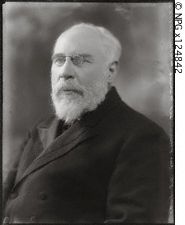 Alfred Ernest Garvie (1861-1945), Congregational minister and theologian, was born on 29 August 1861 at Zyrardow, a Polish town under Russian rule, the son of Peter Garvie and Jane Kedslie (d. 1865). His parents were of Scottish descent, their families having emigrated in the 1820s and worked in the linen and flour trades. Garvie was the fifth in a family of six surviving children; a further three died in infancy, and his mother died when he was four. Plagued by illness as a child, he was left with defective sight after a serious eye inflammation, but during his long periods of convalescence he developed a passion for study, and became fluent in English, German, and Russian. Later he attributed his characteristic preoccupations to childhood influences: the experience of Russian hegemony engendered his instinctive dislike of tyranny and his strong sense of personal liberty. He maintained that his proudly Scottish and reformed upbringing ‘may explain why my Scottish and British patriotism has always been qualified by internationalism, and my congregational loyalty by … ecumenicity’ (Garvie, 53). Sent to Edinburgh to complete his education, Garvie attended George Watson’s College (1874–8) before his four-year apprenticeship as a draper in Glasgow. He attended United Presbyterian church services, committing much of his time to street-mission, but his calling to ministry was hampered by doctrinal difficulties with Presbyterianism and reservations about the Westminster confession. He studied Latin, Greek, and philosophy at Glasgow University (1885–9), gaining the Logan gold medal as the most distinguished arts graduate in 1889, and, having discovered that creed subscription was not a prerequisite for Congregational ministry, changed his church membership and took first-class honours at Mansfield College, Oxford (1889–92). In 1893 he married Agnes Gordon (d. 1914) of Glasgow. His first pastorates were in Macduff (1893–5) and Montrose (1895–1903). Chairman of the Scottish Congregational Union in 1902, he became professor of the philosophy of theism, comparative religion, and Christian ethics at Hackney College and New College, Hampstead, in 1903. He was principal of New College from 1907 and of Hackney College from 1924. When the two merged in 1924, he continued as principal of the institution later known as New College, London. The death of his wife in 1914 was a considerable blow, ameliorated only by devotion to his two daughters.In 1896 Garvie published his first book, The Ethics of Temperance, reflecting a lifelong aversion to alcohol and tobacco. A work of considerable intellectual power and theological influence, his The Ritschlian Theology (1899), a critique of the works of A. Ritschl, W. Herrmann, J. W. M. Kaftan, and A. Harnack, excited some interest in German theology on the normally insular British scene. He criticized Ritschl’s failure to give pre-eminence to the scriptures, but applauded his emphasis on the experiential, insisting that ‘The experience of the apostolic Church must be relived in order that its doctrine may again be rethought’ (Ritschlian Theology, 390–91). This assertion epitomized his self-styled ‘liberal evangelical’ approach to theology, further developed in popular works such as A Guide to Preachers (1906) and The Evangelical Type of Christianity (1916), and in the three volumes of his systematic theology, The Christian Doctrine of the Godhead (1925), The Christian Ideal for Human Society (1920), and The Christian Belief in God (1932). He reacted against Barthianism, describing the doctrine of original sin as a ‘grievous burden on the Church’, and saw the role of the Christian theologian as being to synthesize the ‘absolute eternal values’ latent in the world’s religions
into one Christian monotheistic faith … so that the common brotherhood of man, the goal towards which human evolution points, may be sustained and sublimated by the one Fatherhood of God, as revealed in history by Christ, and realised in experience by His Spirit. (Christian Belief, 411, 191)
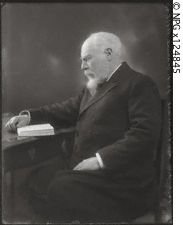 His theology was increasingly cruci-centric and trinitarian.Garvie’s academic career was complemented by consistent social action and ecumenicity. During his pastorate at Montrose he incurred displeasure by announcing his pro-Boer sympathies, and during the First World War he vigorously defended the rights of conscientious objectors. As vice-chairman of the interdenominational Conference on Politics, Economics and Citizenship he chaired its report Christianity and War (1924), but felt that its potentialities for peacemaking were thwarted by arguments about absolutist pacifism. Further ecumenical commitments included the Edinburgh Missionary Conference (1907), and the faith and order, and life and work movements. He was co-president of the latter with Bishop George Bell of Chichester, and also developed friendships with churchmen of such varying outlooks as A. Deissman, C. Gore, and C. G. Lang. At the Stockholm conference in 1925 Garvie and Bell wrote a pacifying message to the churches on Germany and ‘war guilt’. In 1927 he was deputy chairman of the Lausanne conference, and became moderator of the Free Church Federal Council in 1928. He received three honorary doctorates: from Glasgow (1903), Berlin University (1930), and New College, London.
Widely respected for his cheerful personality and genuine flair for peacemaking, Garvie’s intellectual and pastoral life was, as was recognized at Berlin University, marked by his ‘devotion in evangelical love and faith to the unity of the Church of Christ’ (Garvie, 220). After his retirement in 1933 he remained an active public figure in British Christianity until his death at the Hendon Cottage Hospital on 7 March 1945.
Giles C. Watson
Education
- Private school in Poland; home tuition; George Watson’s College, Edinburgh. MA with 1st Class Honours in Philosophy, Glasgow, 1889; BA with 1st Class Honours in Theology, Oxford, 1892; BD Glasgow, 1894; MA Oxford, 1898; hon. DD Glasgow, 1903, Berlin, 1931, London, 1934. Edinburgh Univ. 1878-1879; business in Glasgow, 1880-1884; Glasgow Univ. 1885-1889 (1st Prizeman in Greek, Latin, Logic, Literature, Moral Philosophy, Logan Gold Medal); Oxford University, 1889-1893.
Work
- Minister of Macduff Congregational Church, 1893-1895; President Congregational Union of Scotland, 1902; Minister of Montrose Congregational Church, 1895-1903; Professor of Philosophy of Theism, Comparative Religion, and Christian Ethics in Hackney and New Colleges, London, 1903-1907; Chairman of the Congregational Union of England and Wales, 1920; President of the National Free Church Council, 1923; Deputy Chairman of the Lausanne Conference on Faith and Order, 1927; Moderator of the Federal Council of the Free Churches, 1928.
Publications
- The Ethics of Temperance, 1895
- The Ritschlian Theology, 1899
- Commentary on Romans, 1901
- The Gospel for Today, 1904
- The Christian Personality, 1904
- My Brother’s Keeper, 1905
- Religious Education, 1906
- A Guide to Preachers, 1906
- Studies in the Inner Life of Jesus, 1908
- Commentary on Luke, 1910
- The Christian Certainty, 1910
- Studies of Paul and his Gospel, 1911
- Handbook of Christian Apologetics, 1913
- The Joy of Finding, 1914
- The Missionary Obligation, 1914
- The Evangelical Type of Christianity, 1915
- The Master’s Comfort and Hope, and the Minister and the Young Life of the Church, 1917
- The Purpose of God in Christ, 1919
- The Christian Preacher, 1920
- Tutors unto Christ, 1920
- The Holy Catholic Church, 1921
- Congregational View, 1921
- The Old Testament in the Sunday School, 1921
- The Beloved Disciple, 1922;
- The Way and the Witness, The God Man Craves
- The Christian Doctrine of the Godhead, 1925
- The Preachers of the Church, 1926
- The Christian Ideal for Human Society, 1930
- The Christian Belief in God, 1933
- Can Christ Save Society? 1934
- Revelation through History and Experience, 1934
- The Fatherly Rule of God, 1935
- The Christian Faith, 1936
- Memories and Meanings of My Life, 1937
- Christian Moral Conduct, 1938
- Editor of the Westminster New Testament, 1938
Address
- 34 Sevington Road, Hendon. NW4. Telephone: Hendon 6834.
Sources
- Oxford Dictionary of National Biography
- Who Was Who
- A. E. Garvie, Memories and meanings of my life (1938)
- R. Tudur Jones, Congregationalism in England, 1662–1962 (1962)
- DNB · CGPLA Eng. & Wales (1945)
Archives
- DWL, corresp. and papers
- LPL, corresp. and papers relating to Reunion
- LPL, letters to Tissington Tatlow
Likenesses
- G. E. Butler, oils, New College, London; on loan to DWL, photograph, repro. in Garvie, Memories and meanings of my life, frontispiece
Wealth at death
- £2651 8s. 10d.: probate, 14 July 1945, CGPLA Eng. & Wales
Note: Additional dictionary content from The Oxford Dictionary of National Biography can be obtained free in the UK from public libraries thanks to a national deal with the MLA.
See here for more biographies in the Introducing Series.
Introducing: William Robertson Nicoll
 William Robertson Nicoll (1851-1923), journalist, was born on 10 October 1851 at Lumsden, Aberdeenshire, the elder son of the Revd Harry Nicoll (d. 1891), Free Church of Scotland minister of Auchindoir, Aberdeenshire, and his wife, Jane Robertson. Nicoll acquired his lifelong love of books in his father’s copious library of 17,000 books, to which much of his salary was devoted. He attended the parish school of Auchindoir and Aberdeen grammar school. At fifteen, he entered Aberdeen University, graduating MA in 1870. After four years’ training at the Free Church Divinity Hall, he was ordained to his first charge at Dufftown, Banffshire, in 1874. He was already writing regularly for the Aberdeen Journal, by the age of twenty earning £100 p.a. from journalism. In September 1877 he was inducted minister of the Free Church, Kelso, and the next year, on 21 August in Edinburgh, he married Isa, only child of Peter Dunlop, a prosperous Berwickshire farmer; their son and daughter were born in the manse at Kelso. Witnessing Gladstone’s first Midlothian campaign captured Nicoll for the Liberal cause. While in Kelso, he began to edit The Contemporary Pulpit for Swan, Sonnenschein, and The Expositor, which he directed until his death, for Hodder and Stoughton. Nicoll visited Germany and Norway, where he caught typhoid in 1885. Pleurisy and the fear of tuberculosis, which had killed his father, brother, and sister, ended his promising preaching career, and he moved to Glenroy, Highland Road, Upper Norwood, London, to devote himself to journalism. With his wide intellectual base, his liberal political and theological enthusiasms, and his clerical experience, Nicoll was ideally positioned to write for the huge nonconformist constituency, hitherto rather narrowly served by journalists. Hodder and Stoughton began publication on 5 November 1886 of the British Weekly: a Journal of Social Progress, a penny weekly with Nicoll as editor. It quickly became a success, with J. M. Barrie, S. R. Crockett, and John Watson (‘Ian Maclaren’) as regular contributors; for thirty years he was assisted on it by Jane T. Stoddart. Nicoll often wrote as ‘Claudius Clear’, his letters under that name being later republished (1901, 1905, 1913). He portrayed his abandoned, rural Scotland in a number of rather sentimental pieces, and may be said to have founded the ‘kailyard school’ of Scottish writing by discovering Barrie, who initially wrote Scottish character sketches for the British WeeklyThe Bonnie Briar Bush (from 1887), and encouraging Watson to write for it in 1893. In 1891 Nicoll founded the successful literary monthly The Bookman, and in 1893 Woman at Home, an illustrated magazine intended as a Strand Magazine for women, and subtitled ‘Annie S. Swan’s Magazine’, the Scottish novelist (Anne Burnett Smith) being its chief contributor.
Nicoll and his wife were often unwell. In 1892 they moved to Bay Tree Lodge, Hampstead, with room for 24,000 books. In 1894 Isa Nicoll died, following an operation, and Nicoll was left to rear their children. If anything, he increased his literary output, with Literary Anecdotes of the Nineteenth Century (2 vols., 1894–6), edited with T. J. Wise. In 1896 he visited the USA with J. M. Barrie and on 1 May 1897 he married Catherine, daughter of Joseph Pollard, of Highdown, Hitchin, Hertfordshire; they had one daughter. Catherine Nicoll was the model for Percy Bigland’s painting A Quaker Wedding, and was herself a competent water-colourist. His second marriage rejuvenated Nicoll: the years from 1897 to 1914 were the most energetic and fruitful of his always productive career. In addition to his usual journalism, he began again to preach and lecture widely. He played a prominent role in the ‘passive resistance’ movement against the 1902 Education Act, and campaigned for a fair settlement between the United Free Church of Scotland and the ‘Wee Frees’, which was achieved in 1905. Nicoll supported the Lloyd George group in the Liberal governments of 1905–16, though he was lukewarm about home rule. His knighthood in 1909 recognized his position as ‘the intellectual leader of nonconformity—the chief exponent of its thought, and the most effective advocate of its cause in the press’ (Daily Chronicle, cited in Darlow, 210). He was a strong supporter of war with Germany and his ‘War notes’ in the British Weekly often reflected Lloyd George’s thinking and supported him as he rose to the premiership.
Nicoll’s health began to fail in 1920, though he wrote until his death. He was made CH in 1921. He died, from an abscess, on 4 May 1923 at his home in Hampstead, and was buried in Highgate cemetery. He was a tubby man, with a scrappy moustache, who smoked heavily. He disliked fresh air, and always had a fire blazing in his study. Much of his literary output was dictated from his bed. He was fascinated by palmistry and was notorious for absent-mindedness, often returning from house parties with other men’s clothes. H. A. Vachell recalled:‘he had a dry, pawky wit. He was well-named “Sense and Sensibility”’ (Darlow, 415). Nicoll was among the most prolific of British journalists and succeeded in being both popular and erudite; it was said of him that he had ‘the keenest nose for a book that will sell of any man in the book business’ (Clement Shorter, in Price, 73). His nonconformist readership declined after the war and from that point of view his death was well timed.
Literary Output:
- Calls to Christ, (1877) Morgan & Scott: London.
- The Yale Lectures on Preaching: (1878) Reprinted from the British and Foreign Evangelical Review.
- Songs of Rest [First Series], (1879) Macniven & Wallace, Edinburgh: combined with Second Series (1893), Hodder & Stoughton: London.
- The Incarnate Saviour, (1881) T. & T. Clark: Edinburgh.
- The Lamb of God, (1883) Macniven & Wallace: Edinburgh.
- ‘John Bunyan’ (1884) in The Evangelical Succession, Macniven & Wallace: Edinburgh.
- James Macdonell, Journalist, (1890) Hodder & Stoughton: London.
- Professor W.G. Elmslie, D.D., (1890) (with Macnicoll, A.N.) Hodder & Stoughton: London: revised and enlarged as Professor Elmslie: A Memoir (1911) by W Robertson Nicoll [but minus sermons].
- The Key of the Grave, (1894) Hodder & Stoughton: London.
- Ten Minute Sermons, (1894) Isbister & Co: reprinted 1910, Hodder & Stoughton.
- The Seven Words from the Cross, (1895) Hodder & Stoughton, London.
- When the Worst comes to the Worst, (1896) Isbister & Co.
- ‘Henry Drummond: A Memorial Sketch’, (1897) prefixed to Drummond’s posthumous volume, The Ideal Life, Hodder & Stoughton: London.
- The Return to the Cross, (1897) reprint 1910, Hodder & Stoughton: London.
- Letters to Ministers on the Clerical Life, (1898) (with others) Hodder & Stoughton: London.
- The Ascent of the Soul, (1899) Isbister & Co.
- Letters on Life: by Claudius Clear, (1901) Hodder & Stoughton: London.
- The Church’s One Foundation, (1901) Hodder & Stoughton: London.
- A Memorial Article, Hugh Price Hughes as we knew him, (1902) H Marshall & Son.
- Robert Louis Stevenson, in the Bookman Booklet Series, (1902/6) Hodder & Stoughton, London.
- The Garden of Nuts, (1905) Hodder & Stoughton: London.
- The Day Book of Claudius Clear, (1905) Hodder & Stoughton: London.
- The Scottish Free Church Trust and it’s Donors, (1905) Hodder & Stoughton: London.
- Thomas A History of English Literature [3 Volumes, originally published as The Bookman Illustrated History of English Literature] (1906) (with Seccombe) Hodder & Stoughton, London.
- The Lamp of Sacrifice, (1906) Hodder & Stoughton: London.
- ‘Introduction and Appreciation, Memoirs of the Late Dr Barnardo, Mrs Barnardo & James Marchant, (1907) Hodder & Stoughton, London.
- My Father. An Aberdeenshire Minister, (1908) Hodder & Stoughton: London.
- Ian Maclaren, The Life of the Rev. John Watson D.D., (1908) Hodder & Stoughton: London.
- ‘Introduction’ to Jane Stoddart’s Against the Referendum, (1910) Hodder & Stoughton, London.
- The Round of the Clock: The Story of Our Lives from Year to Year [Claudius Clear], (1910) Hodder & Stoughton: London.
- Sermons of C.H. Spurgeon, (N/D: but after 1910) Nelson & Sons: London.
- The Christian Attitude Towards Democracy [reprinted from the British Weekly], (1912) Hodder & Stoughton, London.
- The Problem of ‘Edwin Drood’ (A study in the Methods of Dickens), (1912) Hodder & Stoughton. London.
- A Bookman’s Letters, (1913) Hodder & Stoughton: London.
- The Difference Christ is Making [reprinted from the British Weekly], (1914) Hodder & Stoughton: London.
- Prayer in War Time, (1916) Hodder & Stoughton: London.
- Reunion in Eternity, (1918) Hodder & Stoughton: London.
- Edited with ‘Appreciation’, Letters of Principal James Denney to W. Robertson Nicoll, (1920) Hodder & Stoughton: London.
- Princes of the Church, (1921) Hodder & Stoughton: London.
- Dickens’s Own Story: Sidelights on his Life and personality, (1923) [reprints from ‘Claudius Clear’ in the British Weekly], Prefatory Note by St John Adcock, Chapman & Hall Ltd, London.
- Memories of Mark Rutherford (William Hale White), (1924) [reprints from ‘Claudius Clear’ in the British Weekly], T Fisher Unwin, London.
A list of his publications up to 1902 is included in a monograph on Nicoll by Jane T. Stoddart (New Century Leaders, 1903). The official biography was written by Nicoll’s friend T H Darlow and published in 1925 as a more complete list.
Sources:
Oxford Dictionary of National Biography
T. H. Darlow, William Robertson Nicoll (1925)
A. Whigham Price, ‘W. Robertson Nicoll and the genesis of the Kailyard school’, Durham Journal, 86 (Jan 1994), 73–82
Archive:
U. Aberdeen L., corresp., news-cuttings, incl. letters of sympathy to Lady Robertson Nicoll · U. Edin. L., corresp. with Charles Sarolea
Note: Additional dictionary content from The Oxford Dictionary of National Biography can be obtained free in the UK from public libraries thanks to a national deal with the MLA.
See here for more biographies in the Introducing Series.
Chomsky: Resonant and Unwavering
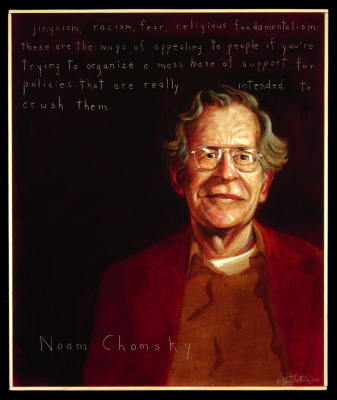 Today’s Bangkok Post includes this fascinating interview with Noam Chomsky by Stuart Alan Becker in which they discuss the Vietnam War, Burma, and the greatest dangers currently facing humanity:
BECKER: You opposed the Vietnam War long before it was fashionable. When and why did you make that decision? Do you feel you made a difference?
CHOMSKY: I opposed the Vietnam war from the mid-1940s, when the French invaded, a few years later receiving direct US support. But I did not do much beyond signing statements and the like until 1962, when the back pages of the New York Times casually reported that the US Air Force was flying a large proportion of the bombing missions against South Vietnam, with the planes disguised with SVN markings. At that point I realised that I had better learn more about this, began to look into it more carefully, and had to make a hard decision. I had enough experience with political activism to know that if I became involved, it would soon grow to be a major undertaking, with few limits, and I would have to give up a lot that meant a great deal to me. I decided to plunge in, not without reluctance. It took years of hard and painful work of protest and resistance before a real anti-war movement developed. There is no doubt that it made a difference. One illustration comes from the Pentagon Papers, the final section, dealing with the immediate reaction to the Tet revolt; in imperial terminology, it is called the “Tet offensive”, on the tacit assumption that a revolt against our military occupation is aggression. The government considered sending several hundred thousand more troops to South Vietnam, but decided not to because of concern that they would need the troops for civil disorder control at home in the likely event of a mass uprising of unprecedented proportions. We also know that by then 70 per cent of the US population felt that the war was “fundamentally wrong and immoral”, not “a mistake” – while intellectual elites debated whether Washington’s “bungling efforts to do good” were a “mistake” that was becoming too costly to us (Anthony Lewis of the New York Times, at the outer limits of dissidence within the mainstream).
How much any one individual contributed to the radical change of consciousness and understanding, and the willingness to do something about state crimes, it is hard to say.
BECKER: You have said the US played a significant role in actions that led to the installation of the Burmese junta back in 1962. What’s the subtext, the background we’re not understanding: What are the consequences of the enormous UK investment in Burma, of earlier US weapons sales, of recent Israeli weapons sales to the junta – and of Chevron Oil’s continued supply of millions and millions of dollars in oil money to the junta?
CHOMSKY: Burma had one of the few elected governments in the region in the 1950s, and was intent on pursuing a neutralist course. The Eisenhower administration was carrying out vigorous efforts to enlist the governments in the region into its Cold War crusades. As part of this broad campaign of subversion and violence, Washington installed thousands of heavily armed Chinese Nationalist troops in northern Burma to carry out cross-border operations into China. Burma vigorously objected, but in vain. The China forces began arming and supporting insurgent minorities in that turbulent region. In reaction, power within Burma began to shift to the military, leading finally to the 1962 coup. The matter is discussed by Audrey and George Kahin, Subversion as Foreign Policy. George Kahin was one of the leading Southeast Asian scholars, virtually the founder of the academic discipline in the US. The consequences of the US-UK-Israeli operations you describe are, of course, to strengthen the military junta. These matters are unreported and unknown in the US, apart from specialists and activists, because they interfere too dramatically with the doctrine that “we are good” and “they are evil”, the foundation of virtually every state propaganda system.
BECKER: Do you think there’s any chance of a popular uprising being successful in Burma, or do you think those who rise up will only be slaughtered because there’s no advantage for the generals to give up their power?
CHOMSKY: I do not know enough to be able to answer with any confidence, but I suspect that now it would be a slaughter. On the other hand, the military leaders are ageing, and there may be popular forces developing that can erode their power from within.
BECKER: Was the Kingdom of Thailand morally justified to host US military bases during the Vietnam War? What lasting effects did the Vietnam War have for Thailand and the region? Is that part of why Thailand is an island of relative easy life, compared to neighbours with more severe problems?
CHOMSKY: Thailand’s involvement in the US wars in Indochina was a disgrace. I presume Thais, at least some of them, made profit from their participation in the destruction of Indochina. I know that Japan and particularly South Korea gained very substantially. It helped spur their “economic miracles”. To evaluate the lasting effects we have to imagine what Southeast Asia would have been without the sadistic Western (mostly US) interventions of the postwar period – not to speak of what happened before. That’s a topic for a carefully researched book, not a brief discussion – and it would still be highly speculative, by necessity.
BECKER: Do you find George W. Bush and his wife Laura calling for change in Burma insincere? Do you think the US president’s action on behalf of the suffering and the marginalised in Burma in the wake of Cyclone Nargis would be more justifiable on moral grounds than the invasions of Iraq and Afghanistan?
CHOMSKY: Bush likes to posture as a deeply religious Christian. Perhaps he has even looked at the Gospels. If so, he knows that the famous definition of the hypocrite in the Gospels could have been written with him in mind. One can think of all kinds of ways in which the Bush couple could show their sincerity, were it to exist.
If Saddam Hussein had given some money to hungry children it would have been more justifiable on moral grounds than his gassing of Kurds in Halabja. The same principles hold in the case of Negris vs Iraq-Afghanistan.
BECKER: What do you think China’s reaction would be if an internal uprising in Burma was successful?
CHOMSKY: China would likely tolerate, maybe even welcome, the overthrowing of the junta. There was, of course, a significant US role in actions that elicited the military coup that installed the still-ruling tyranny. But I don’t know how much that bears on the present situation either.
BECKER: Can you offer any insight into the behaviour of the Burmese generals, their motivations and how things are likely to work out for the people of Burma?
CHOMSKY: The rulers have a good thing going for themselves, nothing to gain by yielding power and no major risks in using it violently. So that’s what they’ll probably do, until the military erodes from within. Mass non-violent protest is predicated on the humanity of the oppressor. Quite often it doesn’t work. Sometimes it does, in unexpected ways. But judgements about that would have to be based on intimate knowledge of the society and its various strands.
BECKER: If a regime is so terrible that its generals loot the wealth of the country’s resources for their personal gain, carry out murders, political imprisonment and forced labour, is there a moral justification for an armed uprising of the suffering people?
CHOMSKY: There certainly is, in my view, with one qualification: An armed uprising would have to evaluate with care the likely consequences for the people who are suffering. I think it’s appropriate for people to rise up, but it’s not for me to tell people to risk mass murder. As for assassinating leaders, the question is very much like asking whether it is appropriate to kill murderers. They should be apprehended by non-violent means, if possible. If they pull a gun and start shooting, it’s legitimate to kill them in self-defence, if there is no lesser option.
BECKER: Would you give any examples of what could happen if the principle of universality were applied in the world today, between nations that are in conflict?
CHOMSKY: One example is that Bush, Cheney, Blair, and a host of others would be facing Nuremberg-style tribunals. And the observation generalises very broadly.
BECKER: What are the greatest dangers facing our human species in the world today and what can we most effectively do about them?
CHOMSKY: There are two dangers that could reach as far as survival of the species: Nuclear war and environmental disaster.
About nuclear war, we know exactly what to do. In fact, the World Court has ruled that it is a legal obligation of the signers of the non-proliferation treaty to live up to their obligation to eliminate all nuclear weapons. And the non-signers can be brought in as well. To give an example that is highly relevant right now, the US population is overwhelmingly in favour of establishing a nuclear-weapons-free zone (NWFZ) in the Middle East, including Iran and Israel. The US and the UK are formally committed to this policy. When they tried to construct a thin legal cover for their invasion of Iraq, they appealed to Security Council resolution 687, which calls upon Iraq to eliminate weapons of mass destruction. The US-UK invaders claimed that it had not done so. Resolution 687 also commits the signers to establish an NWFZ in the region. If the US were a functioning democracy, in which public opinion influenced policy, the exceedingly hazardous confrontation between the US and Iran could be mitigated, perhaps terminated.
Naturally, none of this can be reported or discussed, and it is inconceivable that any viable political candidate would even hint at the stand of the overwhelming majority of the population. One may recall a remark of Gandhi’s when he was asked what he thought of Western civilisation. His response was that it might be a good idea. The same is true of “democracy promotion”, which, if sincere, would begin at home.
How to stave off the threat of severe environmental catastrophe is less clear, though some measures are obvious: Conservation, research and development of renewable energy, measures to cut back emissions sharply, and others. What is eminently clear is that the longer we delay in addressing these problems, the more grave will be the consequences for future generations.
Chomsky on St George
 Today’s Bangkok Post includes an interview with Noam Chomsky by Stuart Alan Becker, in which Chomsky offers the following critique of Bush’s Christianity:
Bush likes to posture as a deeply religious Christian. Perhaps he has even looked at the Gospels. If so, he knows that the famous definition of the hypocrite in the Gospels could have been written with him in mind. One can think of all kinds of ways in which the Bush couple could show their sincerity, were it to exist.
I have re-posted the full interview (which really does make some interesting reading) over at Civicus.
Learning to listen to the tradition faithfully
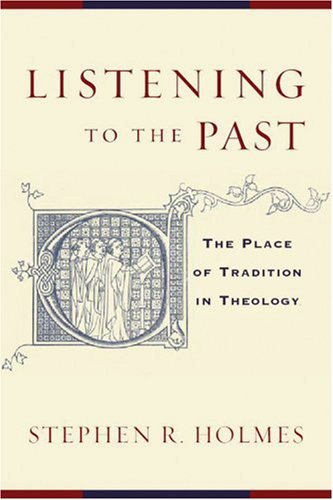 Steve Holmes’ Listening to the Past: The Place of Tradition in Theology is a most valuable and readable collection of essays. I reckon it’s worth buying just for the essays on ‘Why Can’t we Just Read the Bible’, on Anselm, and on ‘Karl Barth’s Doctrine of Reprobation’ – especially this latter one. There’s also a fascinating essay on Edwards on the will which begins with some helpful observations on the abiding value and challenge of tradition:
‘When we learn to listen to the tradition faithfully, not assuming that we already know what we shall hear, but instead allowing earlier voices their own integrity, we will inevitably be surprised by the strangeness of much what is said. At that point we will be faced with a choice: we might take the modern way of patronising earlier voices by assigning them to their ‘place in history’, and so pretending that they have nothing to say to us; or we might believe that to listen to these voices in all their strangeness, and to regard their positions as serious, and live, options is actually a theological imperative. Perhaps the most two obvious areas where this will be true are sexual ethics and biblical interpretation …’ – Steve Holmes, Listening to the Past: The Place of Tradition in Theology (Carlisle/Grand Rapids: Paternoster/Baker, 2002), 86.
As Ben devotes a week of blogging to questions of sex and marriage, we could do much worse than heed Holmes’ words.
Fish on Milton
 Stanley Fish offers some interesting reflections on John Milton. Here’s a snippet:
Rather than being employed for its own sake, the poetry is always in the service of ideas and moral commitments, and it is always demanding that its readers measure themselves against the judgments it repeatedly makes – judgments about the nature of virtue, about the proper mode of civil and domestic behavior, about the true shape of heroism, about the self-parodying bluster of military action, about the criteria of aesthetic excellence, about the uses of leisure, about one’s duties to man and God, about the scope and limitations of reason, about the primacy of faith, about everything. Milton’s poetry never lets you relax . Even when one of the famous similes wanders down what appears to be a desultory path of mythical allusions and idealized landscapes, it always returns you in the end to the moral perspective that had only apparently been suspended.
And on the difference between Milton and Shakespeare:
And the difference is that after reading or seeing a Shakespeare play you want to sit down and discuss the glories of Shakespeare, whereas after reading a Milton poem you want to sit down and discuss the ideas and imperatives he has thrust at you … Shakespeare does many voices but identifies with none of them. (His, as Keats said, is a negative capability.) He’s hard to find, as his would-be biographers well know. Milton has many characters, but they all speak with one voice — his. You don’t have look for him; you can’t get away from him. Despite the variety of scenes and genres there’s always just one guy talking to you; the conversation goes on and on and it is a conversation in which, as Barrow first said, everything is at stake. This is a poetry that reads you.
Herbert Hartwell on our election in Jesus Christ
‘The Son in His relation to his Father is the eternal archetype and prototype of God’s glory in His outward manifestation, in God’s co-existence with another, with man, in the Godman, Jesus Christ and through Him with all men … Moreover, he claims that Jesus Christ-and that includes His humanity – and in Jesus Christ man himself was with God from eternity, namely in God’s thought and will’. – Herbert Hartwell, The Theology of Karl Barth: An Introduction (London: Duckworth, 1964), 100.
‘In Jesus Christ, above all in His divine-human nature, the meaning of God’s election is revealed. For that which has taken place at the very centre of the divine self-revelation, that is, in Jesus Christ, in His person and work, is, seen in the light of His resurrection, God’s election. As the eternal Son of God who became man in the man Jesus of Nazareth, suffered and died on the Cross that sinful man may forever have fellowship with God, Jesus Christ is Himself the eternal decree or rather the realization of that resolve of God within Himself in His eternity before the creation of the world which is termed the eternal decree of God. It is only in Jesus Christ and through Him that God could carry out and has carried out His eternal plan with man, His eternal election of Himself to fellowship with man and of man to fellowship with Himself, and it is for this reason that Jesus Christ is the original and primary object of God’s election, God’s first and eternal thought and will in His election’. – Herbert Hartwell, The Theology of Karl Barth: An Introduction (London: Duckworth, 1964), 107-8.
Every time a butterfly farts …
UK transport charity Sustrans, as part of the Change Your World campaign, explains how chaos theory relates to farting butterflies, Madonna, your mum, the Queen’s undies and driving in July.
Of course, I’m only posting this so that I can feel as if I’m doing my bit for the environment without actually doing anything.
Denney on sanctification
Among the first of ‘Christian’ books that I ever read (many moons ago now) was Denney’s The Death of Christ. I recall that one of the most significant impacts of that book on me concerned not only the awesome subject matter, but Denney’s theological method. [The same thing impressed me in Calvin and in Barth]. Here was a theologian doing rigorous exegesis. [What I didn’t know at the time was that Denney was principally a NT scholar]. Anyway, I revisited that book recently and was no less impressed by it. Here’s Denney’s comments on Hebrews 13:12:
There has been much discussion as to what sanctification in such passages means, and especially as to whether the word is to be taken in a religious or an ethical sense. Probably the distinction would not have been clear to the writer; but one thing is certain, it is not to be taken in the sense of Protestant theology. The people were sanctified, not when they were raised to moral perfection – a conception utterly strange to the New Testament as to the Old – but when, through the annulling of their sin by sacrifice, they had been constituted into a people of God, and in the person of their representative had access to His presence. The word ἁγιάζειν in short, in the Epistle to the Hebrews, corresponds as nearly as possible to the Pauline δικαιοῦν; the sanctification of the one writer is the justification of the other; and the προσαγωγή or access to God, which St. Paul emphasizes as the primary blessing of justification (Romans 5:2 and Ephesians 2:18, 3:12), appears everywhere in Hebrews as the primary religious act of drawing near, to God through the great High Priest (4:16, 7:19-25 and 10:22). It seems fair then to argue that the immediate effect of Christ’s death upon men is religious rather than ethical; in technical language, it alters their relation to God, or is conceived as doing so, rather than their character. Their character, too, alters eventually, but it is on the basis of that initial and primary religious change; the religious change is not a result of the moral one, nor an unreal abstraction from it.
– James Denney, The Death of Christ: Its Place and Interpretation in the New Testament (London: Hodder & Stoughton, 1909), 220-1.
 jasongoroncy.com