Author: Jason Goroncy

The Triune God and the stratification of truth

My previous two posts invite some reflection on where theological thought begins. Here I want to suggest (taking my cues from TF Torrance, and drawing heavily on McGrath’s less-than-brilliant biography on Torrance) that theological reflection, or theological science, begins by immersion within the Christian community and its practices of worship and prayer. Here the believer absorbs the grammar of Christian faith, shares what Torrance calls its ‘evangelical and doxological’ experience, and begins to appreciate the ‘evangelical pattern or economy of the redeeming acts of God in Jesus Christ’ (The Christian Doctrine of God, One Being Three Persons, 98, 91). In other words, the basis upon which Christian theological reflection takes place concerns ecclesiology, christology and soteriology.

Consider the following statements about levels – or layers – of truth in the natural sciences:

… knowledge is gained not in the flat, as it were, by reading it off the surface of things, but in a multi-dimensional way in which we grapple with a range of intelligible structures that spread out far before us. In our theoretic constructions we rise through level after level of organized concepts and statements to their ultimate ontological ground, for our concepts and statements are true only as they rest in the last resort upon being itself. – Thomas F. Torrance, Reality and Scientific Theology (Theology and Science at the Frontiers of Knowledge; Edinburgh: Scottish Academic Press, 1985), 136.

We start with our ordinary experience in which we operate already with some sort of order in our thought which is essential for our understanding of the world around us and for rational behaviour within it. We assume that the world is intelligible and accessible to rational knowledge … we operate on the assumption that by means of thought we can understand in some real measure the relations between events and grasp their orderly sequence and consistent structure. – Reality and Scientific Theology, 147.

This initial perception of orderedness and structure, however, turns out, for Torrance, to be a starting point for a more penetrating and discerning investigation in which successive layers of truth are identified and uncovered, and their inner relationships established. One of the most helpful areas explored by Torrance concerns how our knowing God differs from how we know anything else. Consider this (lengthy) quote:

[When it comes to our knowledge of God] we have to reckon with a considerable difference between the kind of knowledge that obtains in physical science, for the created universe does not disclose or declare itself to us as God does – otherwise it would not be the creaturely or contingent reality that it is. The universe does reveal itself to our inquiries in its own limited reality, in correspondingly limited ways, but it is quite unable to explain itself or to yield any final account of the fact of its astonishing intelligibility, and so at these limits the universe by its finite nature simply turns a blank face to our questions. In contrast, God opens himself to us and informs us of himself in a way that no created being can. Even though he retains behind a veil of ineffability the infinite mystery of his uncreated Being, he nevertheless unveils himself to us as the transcendent Source and sustaining Ground of all created being and created intelligibility, and therefore of all our knowing of him as well as of the universe he has made.

Moreover, the Being of God is made known to us as Subject-being, not just as Object-being over against us. As Subject-being he is the Creator and Ground of all other subject-beings, who sustains them in relation to himself as personal rational agents enabled to have communion with him. That is to say, God interacts personally and intelligibly with us and communicates himself to us in such a personalising or person-constituting way that he establishes relations of intimate reciprocity between us and himself, within which our knowing of God becomes interlocked with God’s knowing of us. In fact our knowledge of God thus mediated is allowed to share in God’s knowledge of himself. An ellipse of knowing, so to speak, is set up within which God’s uncreated Intelligibility and our creaturely intelligibility, God’s self-witness and our human understanding, are correlated, so that there arises among us within the conditions of our earthly and temporal existence authentic knowledge of God in which God’s self-revealing is met by human acknowledgment and reception, and in such a way that our knowing of him, however inadequate, is made to repose ultimately on the free creative ground of God’s own Subject-being.

Nevertheless when all this is admitted it still remains the case that God confronts and interacts with us as he who is utterly transcendent over all our knowing of him, infinitely inexhaustible in the Truth and Intelligibility of his own eternal Being. As such the Reality of God ever remains the Source of all our authentic concepts of him and the unchanging Ground of all our faithful formalisations of his revelation. God himself does not change, and in his unchanging Being is open to ever deepening understanding on our part, while our forms of thought and speech in which we articulate our knowledge of him are ever open to further clarification, fuller amplification, and change. The Truth of the divine Being cannot be enclosed within the embrace of our finite conceptualisations. In that God admits of recognition and understanding on our part we may indeed grasp him in some real measure, but we cannot contain him in the forms of our grasping. We may apprehend God but we cannot comprehend him. In so far as our concepts of God derive from him and terminate upon his Being, there is much more to them than the concepts themselves, more than the formal truths of conception, for the Reality conceived transcends conceptual control. Before the Reality and Majesty of the divine Being whom we are graciously allowed to know, we know that all our knowledge of him is at a comparatively elementary level, and all our articulation or formulation of divine revelation is a relatively insignificant reflection of its Truth. The knowledge and understanding of God, however, which we are allowed to have, and which in some measure we may bring to systematic expression, are what they are in their lowly forms because, in spite of their utter inadequacy, as the human end of the ellipse of knowing established by God and maintained between us and himself, they are locked into an infinite range of truth and intelligibility grounded finally in God’s own eternal Being.

The development of our knowledge of God evidently involves a multi-levelled structure in which our thought moves through various levels of concepts and statements, to the levels of created being through which God makes himself known to us in space and time, and then through them ultimately to the supreme level where God is the transcendent Source of all truth in the Truth of his own uncreated Being. Each lower level is governed by reference beyond itself to the level with which it is immediately coordinated, so that together the lower levels constitute a coherent semantic frame of reference through which we are directed to the ultimate Truth that God is in himself. Thus every lower level, in so far as it is true, must have the character of an open structure pointing us away from its own limited and relative status to its ontological ground in God who is ‘the norm for the truth of all beings’ [Clement of Alexandria]. In clarifying and deepening theological knowledge, therefore, we must learn to penetrate through the various levels of rational complexity that arise in the process of inquiry to the ultimate ground upon which they rest in the Being of God. Just as we do not think statements or even normally think thought but think things through them or by means of them, so the structures of the reason which arise in the process of gaining knowledge have to be treated as refined conceptual instruments through which we let reality shine across to us, in order that its own truth of being and inherent intelligibility can operate creatively in our understanding of it.

What are we to understand by ‘truth’ in a context like this? – Torrance, Reality and Scientific Theology, 138–40.

What are the implications of this for the task of theological reflection? At the very least, it means that our knowledge of God is dependent upon God’s gracious self-unveiling, i.e. epistemology is grounded in the divine economy and particularly in Jesus Christ who comes to us ‘clothed in the gospel’ (Calvin). Jesus Christ is the ‘cornerstone of all authentically Christian theological reflection’. But this process of reflection, like all scientific enquiry, is also is multi-levelled. Torrance identifies three levels: (i) evangelical and doxological level; (ii) theological level; and (iii) higher theological level.

The first level is the evangelical and doxological level. (Torrance, Doctrine of God, 88–90). This might be thought of as the basic level of Christian experience and living, ‘the level of our day-to-day worship and meeting with God in response to the proclamation of the Gospel’. At this level, God is apprehended intuitively, ‘without engaging in analytical or logical process of thought’ (Torrance, Doctrine of God, 89). At this level, the Christian believer has an experience of the reality of God as a ‘basic undefined cognition which informally shapes our faith and regulates our trinitarian understanding of God’ (Torrance, Doctrine of God, 89). The Christian experience of worship, reading of Scripture, and an intuitive awareness of the reality of God constitute the point of departure for further theological reflection.

From the very start of our believing experience and knowledge of the incarnate economy of redemption undertaken by Jesus Christ for our sakes, form and content are found fused together both in what we are given to know and in our experience and knowing of it. A child by the age of five has learned, we are told, an astonishing amount about the physical world to which he or she has become spontaneously and intuitively adapted – far more than the child could ever understand if he or she turned out to be the most brilliant of physicists. Likewise, I believe, we learn far more about God as Father, Son and Holy Spirit, into whose Name we have been baptised, within the family and fellowship and living tradition of the Church than we can ever say: it becomes built into the structure of our souls and minds, and we know much more than we can ever tell. This is what happens evangelically and personally to us within the membership of the Church, the Body of Christ in the world, when through the transforming power of his Word and Spirit our minds become inwardly and intuitively adapted to know the living God. We become spiritually and intellectually implicated in patterns of divine order that are beyond our powers fully to articulate in explicit terms, but we are aware of being apprehended by divine Truth as it is in Jesus which steadily presses for increasing realisation in our understanding, articulation and confession of faith. That is how Christian theology gains its initial impetus, and is then reinforced through constant reading and study of the Bible within the community of the faithful (Torrance, Doctrine of God, 89).

The second stage that Torrance identifies in this process of engagement is what he calls the theological level. This secondary level of engagement involves moving on from the primary level of ‘experiential apprehension’ of God, and towards discerning the structures which lie within it.

By forming appropriate intellectual instruments with which to lay bare the underlying epistemological patterns of thought, and by tracing the claims of connection throughout the coherent body of theological truths, [theologians] feel their way forward to a deeper and more precise knowledge of what God has revealed of himself, even to the extent of reaching a reverent and humble insight into the inner personal relations of his Being. Our concern at this secondary level, however, while distinctly theological, is not primarily with the organic body of theological knowledge, but with penetrating through it to apprehend more fully the economic and ontological and trinitarian structure of God’s revealing and saving acts in Jesus Christ as they are presented to us in the Gospel (Torrance, Doctrine of God, 91).

In the third level (or higher theological level) our thinking ‘enters more deeply into the self-communication of God in the saving and revealing activity of Christ and in his one Spirit’. At this level, Torrance continues, ‘we are explicitly concerned with the epistemological and ontological structure of our knowledge of the Holy Trinity, moving from a level of economic trinitarian relations in all that God is toward us in his self-revealing and self-giving activity to the level in which we discern the trinitarian relations immanent in God himself which lie behind, and are the sustaining ground of, the relations of the economic Trinity’. In other words, this level involves a move from ‘a level of economic trinitarian relations’ to ‘what [God] is ontically in himself’ (Torrance, Doctrine of God, 93, 98–107).

We might map Torrance’s trajectory of trinitarian theological reflection and formulation thus:

Experience of God → Economic Trinity → Essential Trinity

To be sure, Torrance’s distinguishing of different levels of reality must not be taken to mean that he is sponsoring their independence so that one or other may be dispensed with or treated as redundant or superseded. Rather, as McGrath notes, the ontological Trinity cannot be regarded as independent of the economic Trinity, nor of Christian trinitarian experience. Nor is Torrance suggesting that lower levels within the stratification of truth are to be regarded as false or redundant; they are all to be regarded as interconnected responses to their object. A failure to recognise the mutual interconnectedness of these levels of discourse can lead to theological reflection becoming divorced from Christian experience on the one hand, or from its proper ontological foundations on the other (McGrath, Torrance, 174).

Theology for the community

The quote from David Lyall to which I drew attention in my previous post, What is practical theology?, and the ensuing discussion, reminded me of a section from John de Gruchy’s brilliant little book Theology and Ministry in Context and Crisis: A South African Perspective, wherein de Gruchy writes:

In Germany the title ‘theologian’ refers in the first place not to the academic theologian but to the pastor. It is the primary designation within the Protestant churches of an ordained minister. Yet few priests or pastors would regard themselves as such, especially within the Anglo-Saxon world. In his book Ferment in the Ministry, the north American pastoral psychologist Seward Hiltner imagined the possible responses which ordained ministers would give to a Gallup Poll which asked the question: ‘Do you regard yourself as a theologian?’

31% said, ‘Well, I am a minister, but you could hardly call me a theologian.’

22% said, ‘It is true I have studied theology, but I am not really a theologian.’

17% replied, ‘Brother, I sure ain’t. I’m only a simple parson, not one of those highpowered book guys.’

8% admitted, ‘Well, I guess I am, in a way, but I am more interested in serving people than in theology.’

7% said, ‘Where did you get that idea? And don’t do it again.’

4% replied, ‘I am about twice a year, when I go back to the alumni lectures.’

2% said, ‘Pardon me, I have to rush to a funeral.’

1% snorted, ‘I wonder who thought up that question?’

0.9% said, ‘Yes.’ (Seward Hiltner, Ferment in the Ministry (Nashville: Abingdon Press, 1969), 159.)

Why is there this reluctance on the part of ordained ministers, to regard themselves as theologians, and, on the part of some, especially Anglo-Saxons and their heirs, why is there such antipathy towards theology? In the Germanic world the traditional tendency and temptation is precisely the opposite, to glory in the title ‘theologian’, and to create theologies remote from Christian praxis and existence in the world. Helmut Thielicke has a German audience in mind when, in his A Little Exercise for Young Theologians, he writes about the ‘pathology of the young theologian’s conceit’. Yet even in Germany the idea that the ordained minister’s self-perception is that of a theologian cannot be assumed. At Christmas in 1939 Dietrich Bonhoeffer wrote in a letter to his former students:

How superficial and flippant, especially of theologians, to send theology to the knacker’s yard, to make out that one is not a theologian and doesn’t want to be, and in so doing to ridicule one’s own ministry and ordination and in the end to have, and to advocate, a bad theology instead of a good one! – Dietrich Bonhoeffer, True Patriotism: Letters, Lectures and Notes, 1939-1945 (ed. Edwin Hanton Robertson; trans. Edwin Hanton Robertson and John Bowden; The Collected Works of Dietrich Bonhoeffer; vol. 3; London: Collins, 1973), 28.

This attitude parallels the tendency within the church generally to disparage theology in the interests of ‘practical Christianity’.

Theology has a bad name amongst many theological students and ordained ministers, not primarily because of their modesty but because they fail to grasp its vital necessity and relevance to their vocation. Indeed, they may even regard it as something detrimental to their calling and the life and mission of the church. There are theological students who regard the study of theology as an unfortunate requirement for ordination, rather than as that which should provide the focus for their work. The image of a theologian is academic, intellectual, and far-removed from the everyday tasks of the parish minister. Much of the blame for this must be laid at the door of university departments of theology, theological colleges and seminaries, and those of us who teach in them. Theology has too often been taught in ways which reduce it to idealistic abstractions, and result in its rejection as a useful, indeed, essential part of the mission of the church and therefore of the ordained ministry. After all, the value of theology taught as a series of independent academic disciplines lacking both coherence or direction and unrelated to biblical vision or faith, is not self-evident for the Christian community struggling to be faithful in the midst of the world. This situation needs to be radically transformed if theology is to become the vocation of the ordained minister, and central to the total ministry of the church, and not simply be regarded as the peculiar province of scholars.

In John T. McNeill’s magnificent A History of the Cure of Souls, there is what we might call a ‘give-away’ comment which reinforces my argument that the ordained minister, is primarily a theologian. McNeill refers to the fact that ‘Jean Daniel Benoit, the expert on Calvin’s work in the cure of souls, states boldly that the Genevan Reformer was more a pastor than theologian’, but he then continues, ‘to be exact, he was a theologian in order to be a better pastor’. Conversely, in his introduction to Karl Barth’s essays, Against the Stream, Alec Vidler has this perceptive comment about the theologian’s theologian, Karl Barth: ‘I was aware of a quality or style about him which is hard to define. It may perhaps best be called pastoral, so long as this is not understood as a limitation.’ Christian pastors are called to be theologians, and those whom we normally designate theologians may well be pastors …

The primary task of the ministry of the Word and Sacraments is to enable the upbuilding of the church in such a way that it is always pointed beyond itself to the reign of God in Jesus Christ in the midst of the world. Its task is to keep the People of God mindful of the tradition of Jesus, crucified and risen, and what this means for their lives and the praxis of the church today. Its task is to enable the church to be faithful to its identity as the People of God in the world, discerning who God is and what God requires of them. In this way the ministry of the Word and Sacraments is, literally speaking, church leadership because it provides theological direction for the mission of the People of God in the world. – John W. de Gruchy, Theology and Ministry in Context and Crisis: A South African Perspective (London: Collins, 1987), 40–3, 47

And then there’s that wonderful section from Karl Barth’s Evangelical Theology: An Introduction, a book written in part to speak to ‘the present-day younger generation’ (p. i) and clearly with an intention to encourage budding pastors. The first lectures of this collection were delivered under the auspices of the Divinity School, the University of Chicago and were the Annie Kinkead Warfield Lectures of 1962 at the Princeton Theological Seminary. The section which I was reminded of appears in a chapter titled ‘The Community’:

Since the Christian life is consciously or unconsciously also a witness, the question of truth concerns not only the community but the individual Christian. He too is responsible for the quest for truth in this witness. Therefore, every Christian as such is also called to be a theologian. How much more so those who are specially commissioned in the community, whose service is preeminently concerned with speech in the narrower sense of the term! It is always a suspicious phenomenon when leading churchmen (whether or not they are adorned with a bishop’s silver cross), along with certain fiery evangelists, preachers, or well-meaning warriors for this or that practical Christian cause, are heard to affirm, cheerfully and no doubt also a bit disdainfully, that theology is after all not their business. “I am not a theologian; I am an administrator!” a high-ranking English churchman once said to me. And just as bad is the fact that not a few preachers, after they have exchanged their student years for the routine of practical service, seem to think that they are allowed to leave theology behind them as the butterfly does its caterpillar existence, as if it were an exertion over and done with for them. This will not do at all. Christian witness must always be forged anew in the fire of the question of truth. Otherwise it can in no case and at no time be a witness that is substantial and responsible, and consequently trustworthy and forceful. Theology is no undertaking that can be blithely surrendered to others by anyone engaged in the ministry of God’s Word. It is no hobby of some especially interested and gifted individuals. A community that is awake and conscious of its commission and task in the world will of necessity be a theologically interested community. This holds true in still greater measure for those members of the community who are specially commissioned … – Karl Barth, Evangelical Theology: An Introduction (trans. Grover Foley; Grand Rapids: Wm. B. Eerdmans, 1979, 40–1.

A little later on Barth proceeds to recall that theology – even, one should add, that is as extensive as Barth’s own Church Dogmatics (the word ‘Church’ is crucial here) – ought to be undertaken for the sake of the Community and its witness to the Word of God:

Theology would be an utter failure if it should place itself in some elegant eminence where it would be concerned only with God, the world, man, and some other items, perhaps those of historical interest, instead of being theology for the community. Like the pendulum which regulates the movements of a clock, so theology is responsible for the reasonable service of the community. It reminds all its members, especially those who have greater responsibilities, how serious is their situation and task. In this way it opens for them the way to freedom and joy in their service. (p. 42)

Who would have thought – dared to think – that a human discipline might have a responsibility beyond its own indulgence! In this case, ‘for the reasonable service of the community’, even for the equipping of the saints for the work of ministry, for building up the body of Christ, until we all attain to the unity of the faith and of the knowledge of the Son of God … (Eph 4:12–13). Pastors who are serious about serving their communities will be theologians, and unashamedly so.

What is practical theology?

Those engaged in so-called ‘practical theology’ typically struggle to articulate, let alone agree on, any definition of their discipline. David Lyall, who prior to his retirement taught Practical Theology at Edinburgh University and whose book The Integrity of Pastoral Care is one of the texts I have set for my students, offers an attempt at a definition in a recent editorial:

‘So what is practical theology? … It is concerned with practice and it is an academic discipline; it seeks to serve both the mission of the Church and the needs of the world; it touches that which is most personal and engages with that which is most public. Perhaps the truth of the matter is that practical theology cannot be defined too precisely – nor should we try to do so’. – David Lyall, ‘Editorial: So, What Is Practical Theology?’ Practical Theology 2, no. 2 (2009), 158–9.

What’s your working definition?

Flannery O’Connor on fiction and grace

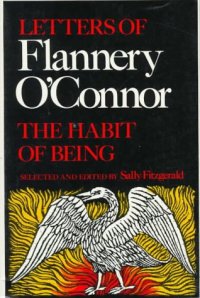
‘What offends my taste in fiction is when right is held up as wrong, or wrong as right. Fiction is the concrete expression of mystery – mystery that is lived. Catholics believe that all creation is good and that evil is the wrong use of good and that without Grace we use it wrong most of the time. It’s almost impossible to write about supernatural Grace in fiction. We almost have to approach it negatively. As to natural Grace, we have to take that the way it comes – through nature. In any case, it operates surrounded by evil’. – Flannery O’Connor, The Habit of Being: Letters of Flannery O’Connor (ed. Sally Fitzgerald; New York: Farrar Straus Giroux, 1988), 144.

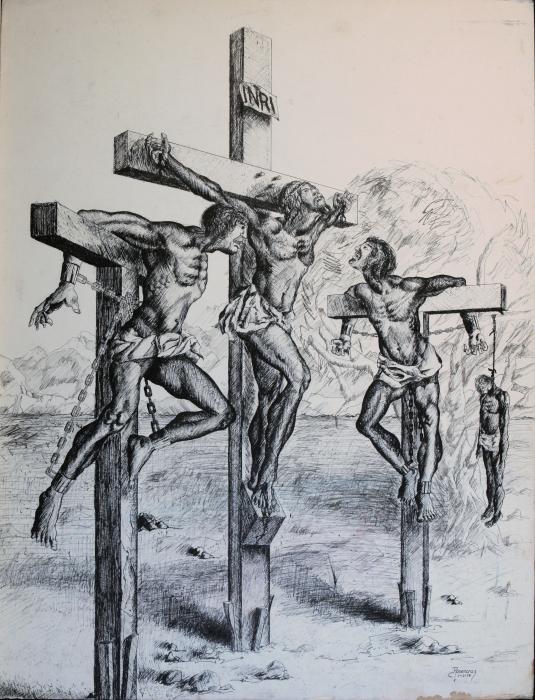
Judas: two images

Image One:

‘Judas was a dreadful, walking example of impiety in this world, with his flesh bloated to such an extent that he could not walk through a space where a wagon could easily pass … His eyelids were so swollen that it was absolutely impossible for him to see the light and his eyes could not be seen by a physician, even with the help of a magnifying glass, so far had they sunk from their outward projection. His private parts were shamefully huge and loathsome to behold and, transported through them from all parts of his body, pus and worms flooded out together as he shamefully relieved himself’. – Papias [HT: Joan Acocella]

Image Two:

‘Was it not Judas, the sinner without equal, who offered himself at the decisive moment to carry out the will of God, not in spite of his unparalleled sin, but in it? There is nothing here to venerate, nor is there anything to despise. There is place only for the recognition and adoration and magnifying of God.’ – Karl Barth, Church Dogmatics II/2 (ed. G. W. Bromiley and T. F Torrance; trans. G. W. Bromiley et al.; Edinburgh: T & T Clark, 1957), 503.

It seems to me that if and when we pause long enough to enquire what telling most faithfully witnesses Judas’ service to the Gospel, the preferred invitation becomes decidedly clear.

I tidied up the kitchenette, I tuned the old banjo …

Slavoj Žižek on ‘The Death of God’ (AAR Annual Meeting 2009)

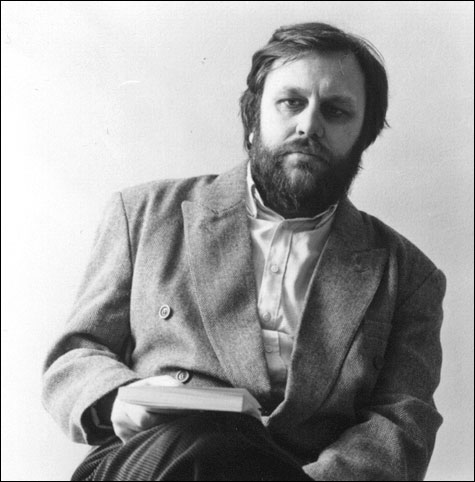
Slavoj Žižek‘s presentation on ‘The Death of God’, given at the recent AAR meeting, is worth watching [HT: to CT Moore], especially for those unfamiliar with Žižek’s atheistic sterilization of the centre of Hegel’s attention to the kenotic reality witnessed to in the gospel. Strange, then, that apart from Adam’s lament of Zizek’s predictable ‘long-windedness’ (a post, by the way, which includes some great discussion and a link to Kotsko’s own article ‘Politics and Perversion: Situating Žižek’s Paul’) I’ve heard/read very little about this session. Anyone who was present at that session care to remedy this for us?

Here’s a snippert: ‘Not only is atheism the truth of Christianity but one can only be a true atheist by passing through the Christian experience. All other atheisms continue to rely on some form of the Big Other’.

Advent II: On the pseudonymous activity of God

In a fascinating collection of personal papers and essays on public theology penned against the backdrop of the Vietnam War, and titled The Pseudonyms of God, Robert McAfee Brown invites us to imagine finding ourselves in a place where we are waiting for some tremendous manifestation of God’s activity. He invites us to imagine a situation where we have heard – or thought we had heard – a promise that God would intervene in our human situation, and that it was now clear that the time was at hand. Where would we look for God?

Brown suggests that we might most likely be found looking ‘in one of the great nations, where as many people as possible would be exposed to this important fact; surely in a well-established family with much influence; surely in such a way that all the resources of public opinion and mass media could be used to acquaint people with what had happened; surely it would be the most public and open and widely accessible event possible’ (pp. 84–5). He then paints a scenario more in keeping with the event of divine disclosure now known to us, but is no less in the stream of divine pseudonymity for that:

A child would be born into a backward South African tribe, the child of poor parents with almost no education. He would grow up under a government that would not acknowledge his right to citizenship. During his entire lifetime he would travel no more than about fifty miles from the village of his birth, and would spend most of that lifetime simply following his father’s trade – a hunter, perhaps, or a primitive farmer. Toward the end he would begin to gather a few followers together, talking about things that sounded so dangerous to the authorities that the police would finally move in and arrest him, at which point his following would collapse and his friends would fade back into their former jobs and situations. After a short time in prison and a rigged trial he would be shot by the prison guards as an enemy of the state. (p. 85)

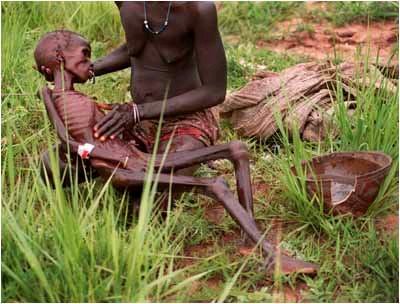
Contemporaries ought not to be surprised to find the outcast – and the outcasted – God among the outcast. We must look for signs of the Servant God’s presence among those who serve. Numbered among an oppressed minority, we must expect to hear the echo of God’s voice among those who are oppressed. The pieta-like image above recalls that since 800 million of the planet’s people suffer from hunger and malnutrition, we might well expect that God’s availability is made tangible in loaves and fishes, rice and safe drinking water. Since God’s identification with the world involves God’s becoming creaturely, we ought look for God not only in ‘holy’ places or by means of ‘holy’ words, but we will look for God also in the very common, ordinary things of life, in the well over 500 million people who are living in what the World Bank has called ‘absolute poverty’, and in all those gathered up in the one great movement of divine kenosis-plerosis. ‘We will not be surprised to discover’, Brown writes, ‘that [God] suffered also, nor will we flinch when Bonhoeffer pronounces the initially disturbing words, “Only the suffering God can help,” even though it is probably the ultimate in the pseudonymous activity of God that he could be acquainted with grief’ (p. 86).

Brown then turns to Kierkegaard, and specifically to the Danes’ parable of the king and the maiden:

The servant-form is no mere outer garment, and therefore God must suffer all things, endure all things, make experience of all things. He must suffer hunger in the desert, he must thirst in the time of his agony, he must be forsaken in death, absolutely like the humblest – behold the man! His suffering is not that of his death, but his entire life is a story of suffering; and it is love that suffers, the love which gives all is itself in want (pp. 86–7).

Truly, in the economy of holy love, the locus of greatest clarity equates to the point of greatest incongruity and surprise. Jesus is God’s grand pseudonym, the supreme instance of God acting in ways contrary to our expectation, the point at which we are offered the criterion in terms of which the action of God elsewhere can be measured. And so if we miss God’s presence in the world, it will not be because God is absent. It will be because we have been looking in the wrong places.

November bests …

From the reading chair:

Reforming Theology: Explorations in the Theological Traditions of the United Reformed Church by David Peel; Dr. Dog by Babette Cole; Theology of Hope by Jürgen Moltmann; Open Secrets: A Spiritual Journey Through a Country Church by Richard Lischer; First As Tragedy, Then As Farce by Slavoj Žižek; Windows on the Cross by Tom Smail; The Seven Storey Mountain by Thomas Merton; The Pseudonyms of God by Robert McAfee Brown.

Through the iPod: Raising Sand by Alison Krauss and Robert Plant; American III: Solitary Man and American V: A Hundred Highways by Johnny Cash; Battle Studies by John Mayer; Play On by Carrie Underwood; The Charity of Night, Stealing Fire and Life Short Call Now by Bruce Cockburn; The Circle by Bon Jovi; Jennifer Hudson by Jennifer Hudson; Reality Killed the Video Star by Robbie Williams (this one took a while to grow on me); The North Star by Roddy Frame (HT: Bruce put me on to this). And as I begin to get into the Christmas thing, I’m listening to Christmas by Bruce Cockburn; Christmas in the Heart by Bob Dylan; My Christmas by Andrea Bocelli; Come to the Cradle by Michael Card; and Breath Of Heaven: A Christmas Collection by Vince Gill.

On the screen: Perfume: The Story of a Murderer [2006]

John Webster’s Evangel articles

Rob Bradshaw has recently made available the following articles by John Webster:

Thanks Rob.

Advent I: O Love, aren’t you tired yet?

For the past few Advents, Andy Goodliff has been inviting a group of bloggers (and others) to post some wee reflections over at Hopeful Imagination. The posts have become a mirthful part of my Advent tarriance, helping me to reflect in a sustained way on the divine magic through what is typically a very busy, and seemingly most unmagical, time.

In addition to posting over at Hopeful Imagination, over the next few weeks, I’ll also be posting some Advent-inspired reflections here at Per Crucem ad Lucem (something in the tradition of my Advent 2007 reflections). I want to kick this off with a re-post from Roddy Hamilton, one of Scotland’s most creative liturgists, who just yesterday posted a wonderful reflection on Isaiah 7 based on ‘The Faith’, a song from the album Dear Heather by Leonard Cohen.

The gathering of darkness,
and the will to fight,
the pain born in conflict,
and the story of loss and fear:
these are the ways we live together.
O Love, aren’t you tired yet?

The turning from light,
and the work of injustice disguised as right,
the journeys we make that lengthen the distance between us.
O love, aren’t you tired yet?

The call unheard,
the silent questions we leave unlived,
and a graveyard of truth
left uncared for,
the bowing of the earth to extravagance,
and the weeping of the rivers.
O love, aren’t you tired yet?

The sun,
the land,
the sea,
limited in what they can give,
for they have given too much already;
the soil,
the faith,
still your holy turf,
but un-renewed by a future un-owned.
O love, aren’t you tired yet?

When the world leaves scattered,
holy words that seem like hope,
torn out from every page,
and past generations’ lessons
are thrown crumpled in a forgotten alley
darkened by the shadow cast from a new world empire,
O love, aren’t you tired yet?

But the seed of a promise
uncrumples,
in a name spoken in passion,
that holds out the future
as the past unwinds,
a love that will never let go,
called emmanuel.
O love, aren’t you tired yet?

[Image: skyrie’s photostream]

Australia’s Apartheid

Freemantle Prison

‘Since Rudd‘s apology, Aboriginal poverty indicators have gone backwards. His “Closing the Gap” programme is a grim joke, having produced not a single new housing project.

An undeclared agenda comes straight from Australia’s colonial past: a land-grab combined with an almost prurient need to control, harass and blame a people who have refused to die off, whose genius is their understanding of an ancient land that still perplexes and threatens white authority. Whenever Canberra’s politicians want to look “tough”, they give the Aborigines a good kicking: it is a ritual as sacred as Don Bradman worship or Anzac Day.

The indigenous affairs minister, Jenny Macklin, has decreed that unless certain communities hand over their precious freehold leases, they will be denied basic services. The Northern Territory contains abundant mineral wealth, such as uranium, and has long been eyed by multinationals as a lucrative radioactive waste dump. The blacks are in the way, yet again: so it is time for the usual feigned innocence. Rudd has said his government “doesn’t have a clear idea of what’s happening on the ground” in Aboriginal Australia. What? The learned studies pour forth as if the sorcerer’s apprentice is loose.

One example: the rate of incarceration of black Australians is five times that of black South Africans during apartheid. Western Australia imprisons Aboriginal men at eight times the apartheid figure, an Aussie world record.

On 16 November, a 12-year-old Aboriginal boy appeared in court charged with receiving a Freddo Frog chocolate bar from a friend who had allegedly taken it from a supermarket. Only the international headlines forced the police to drop the case. Two-thirds of Aboriginal children who have contact with the police are jailed; two-thirds of white children are cautioned. A young Aboriginal man was jailed for a year for stealing £12 worth of biscuits and soft drink’.

– John Pilger, ‘Return to a secret country’. New Statesman 26 November 2009.

It seems that I can’t put away my sackcloth and ashes just yet …

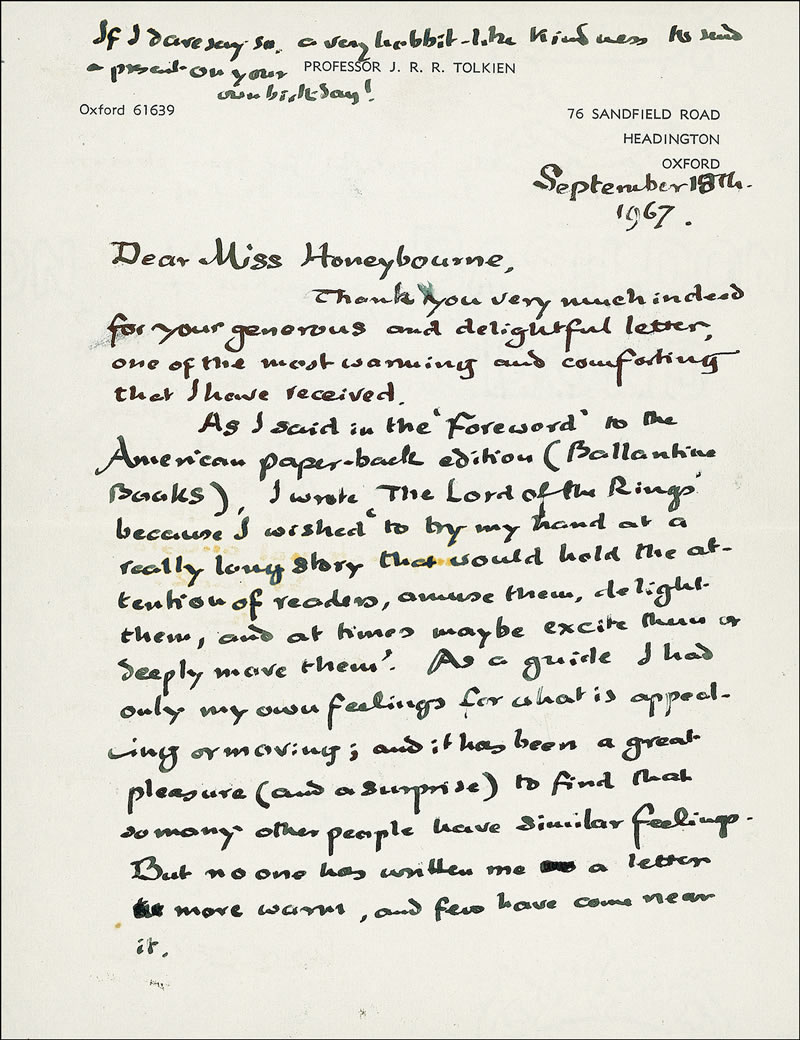
Why did Tolkien write The Lord of the Rings?

‘I wrote The Lord of the Rings because I wished “to try my hand at a really long story that would hold the attention of readers, amuse them, delight them, and at times maybe excite them or deeply move them”. As a guide I had only my own feelings for what is appealing or moving; and it has been a great pleasure (and a surprise) to find that so many other people have similar feelings’. – J.R.R. Tolkien, ‘Letter to Miss Elise Honeybourne’, 18 September 1967.

A more eligible Nobel prize candidate

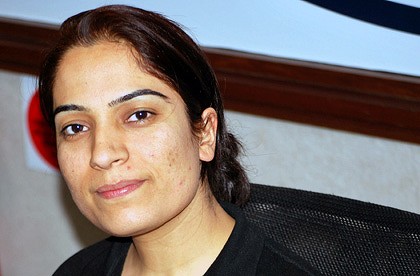
‘The Nobel Peace Prize committee might well have made truly worthy choices, prominent among them the remarkable Afghan activist Malalai Joya. This brave woman survived the Russians, and then the radical Islamists whose brutality was so extreme that the population welcomed the Taliban. Joya has withstood the Taliban and now the return of the warlords under the Karzai government. Throughout, Joya worked effectively for human rights, particularly for women; she was elected to parliament and then expelled when she continued to denounce warlord atrocities. She now lives underground under heavy protection, but she continues the struggle, in word and deed’. – Noam Chomsky, ‘War, Peace, and Obama’s Nobel’. In These Times, November 5, 2009.

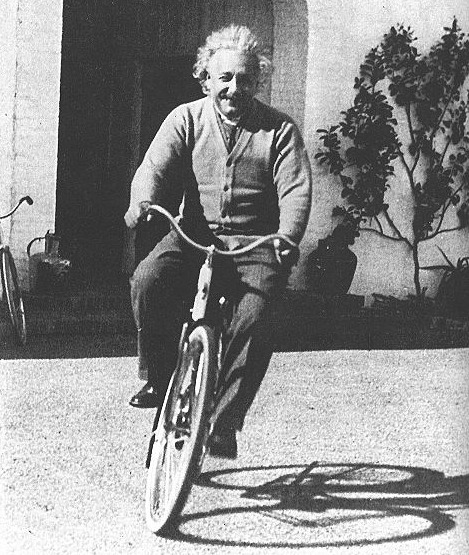
Einstein on ‘God’

A letter that Richard Dawkins was an unsuccessful bidder on sold at auction in May 2008 for a meagre £170,000. The item in question was penned by Albert Einstein in January 1954, just a year before his death, and was addressed to philosopher Erik Gutkind after reading his book, Choose Life: The Biblical Call to Revolt. The letter reads:

Princeton, 3. 1. 1954

Dear Mr Gutkind,

Inspired by Brouwer’s repeated suggestion, I read a great deal in your book, and thank you very much for lending it to me … With regard to the factual attitude to life and to the human community we have a great deal in common. Your personal ideal with its striving for freedom from ego-oriented desires, for making life beautiful and noble, with an emphasis on the purely human element … unites us as having an “American Attitude.”

Still, without Brouwer’s suggestion I would never have gotten myself to engage intensively with your book because it is written in a language inaccessible to me. The word God is for me nothing more than the expression and product of human weakness, the Bible a collection of honorable, but still purely primitive, legends which are nevertheless pretty childish. No interpretation no matter how subtle can (for me) change this … For me the Jewish religion like all other religions is an incarnation of the most childish superstition. And the Jewish people to whom I gladly belong … have no different quality for me than all other people. As far as my experience goes, they are also no better than other human groups, although they are protected from the worst cancers by a lack of power. Otherwise I cannot see anything “chosen” about them.

In general I find it painful that you claim a privileged position and try to defend it by two walls of pride, an external one as a man and an internal one as a Jew. As a man you claim, so to speak, a dispensation from causality otherwise accepted, as a Jew of monotheism. But a limited causality is no longer a causality at all, as our wonderful Spinoza recognized with all incision …

Now that I have quite openly stated our differences in intellectual convictions it is still clear to me that we are quite close to each other in essential things, i.e. in our evaluation of human behavior … I think that we would understand each other quite well if we talked about concrete things.

With friendly thanks and best wishes,

Yours,

A. Einstein

Fascinating stuff. You can read the whole letter with commentary here.


… he is not ashamed to address a lifeless thing

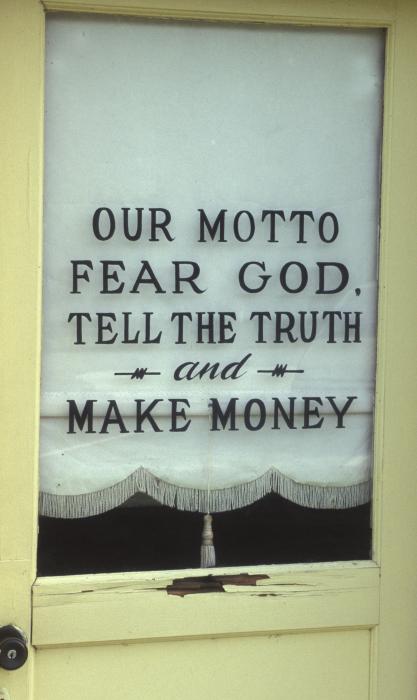
This relatively well-known photograph by Carl Purcell reminded me not only of Matthew 6:24, but also of Wisdom 13:1–19,

‘For all people who were ignorant of God were foolish by nature; and they were unable from the good things that are seen to know the one who exists, nor did they recognize the artisan while paying heed to his works; 2 but they supposed that either fire or wind or swift air, or the circle of the stars, or turbulent water, or the luminaries of heaven were the gods that rule the world. 3 If through delight in the beauty of these things people assumed them to be gods, let them know how much better than these is their Lord, for the author of beauty created them. 4 And if people were amazed at their power and working, let them perceive from them how much more powerful is the one who formed them. 5 For from the greatness and beauty of created things comes a corresponding perception of their Creator. 6 Yet these people are little to be blamed, for perhaps they go astray while seeking God and desiring to find him. 7 For while they live among his works, they keep searching, and they trust in what they see, because the things that are seen are beautiful. 8 Yet again, not even they are to be excused; 9 for if they had the power to know so much that they could investigate the world, how did they fail to find sooner the Lord of these things? 10 But miserable, with their hopes set on dead things, are those who give the name “gods” to the works of human hands, gold and silver fashioned with skill, and likenesses of animals, or a useless stone, the work of an ancient hand. 11 A skilled woodcutter may saw down a tree easy to handle and skillfully strip off all its bark, and then with pleasing workmanship make a useful vessel that serves life’s needs, 12 and burn the cast-off pieces of his work to prepare his food, and eat his fill. 13 But a cast-off piece from among them, useful for nothing, a stick crooked and full of knots, he takes and carves with care in his leisure, and shapes it with skill gained in idleness; he forms it in the likeness of a human being, 14 or makes it like some worthless animal, giving it a coat of red paint and coloring its surface red and covering every blemish in it with paint; 15 then he makes a suitable niche for it, and sets it in the wall, and fastens it there with iron. 16 He takes thought for it, so that it may not fall, because he knows that it cannot help itself, for it is only an image and has need of help. 17 When he prays about possessions and his marriage and children, he is not ashamed to address a lifeless thing. 18 For health he appeals to a thing that is weak; for life he prays to a thing that is dead; for aid he entreats a thing that is utterly inexperienced; for a prosperous journey, a thing that cannot take a step; 19 for money-making and work and success with his hands he asks strength of a thing whose hands have no strength’.


Žižek on Apocalypse, on the Future, and on Obama

In an earlier post, I suggested that few will embrace every element of Žižek’s compassionate-Marxist panacea, but that his analyses of history’s big movements nevertheless remain insightful, often compelling, and usually fascinating. I’ve received a bit of e-flack for reading (and posting on) Žižek, but let me say again that I don’t draw attention to Žižek’s work because I agree with all his conclusions, or with how he gets there. Rather, I read Žižek for many of the same reasons that I read from traditions and centuries other than my own – because I’m grateful for anyone who helps me to think differently about the world, and to ask some different questions about reality and human experience than does the literature I most typically immerse myself in. Apart from all that, reading Žižek is, at times, just such great fun. [Who is this idiot blogger, i.e. me, who feels the need to defend his own reading habits!]

Anyway, that said, here’s more from Žižek’s First As Tragedy, Then As Farce; this time, on Apocalypse:

‘Apocalypse is characterized by a specific mode of time, clearly opposed to the two other predominant modes: traditional circular time (time ordered and regulated on cosmic principles, reflecting the order of nature and the heavens; the time-form in which microcosm and macrocosm resonate in harmony), and the modern linear time of gradual progress or development. Apocalyptic time is the “time of the end of time,” the time of emergency, of the “state of exception” when the end is nigh and we can only prepare for it. There are at least four different versions of apocalyptism today: Christian fundamentalism, New Age spirituality, techno-digital post-humanism, and secular ecologism. Although they all share the basic notion that humanity is approaching a zero-point of radical transmutation, their respective ontologies differ radically: Techno-digital apocalyptism … remains within the confines of scientific naturalism, and discerns in the evolution of human species the contours of our transformation into “post-humans.” New Age spirituality gives this transmutation a further twist, interpreting it as the shift from one mode of “cosmic awareness” to another (usually a shift from the modern dualist-mechanistic stance to one of holistic immersion). Christian fundamentalists of course read the apocalypse in strictly biblical terms, that is, they search for (and find) in the contemporary world signs that the final battle between Christ and the Anti-Christ is imminent. Finally, secular ecologism shares the naturalist stance of post-humanism, but gives it a negative twist-what lies ahead, the “omega point” we are approaching, is not a progression to a higher “post-human” level, but the catastrophic self-destruction of humanity. Although Christian fundamentalist apocalyptism is considered the most ridiculous, and dangerous, in its content, it remains the version closest to a radical “milenarian” emancipatory logic. The task is thus to bring it into closer contact with secular ecologism, thereby conceiving the threat of annihilation as the chance for a radical emancipatory renewal’. (pp. 93–4)

So what future does Žižek look to?

‘The future will be Hegelian … The only true alternative that awaits us – the alternative between socialism and communism – is the alternative between the two Hegels’.

Žižek contrasts Hegel’s ‘conservative’ vision (which points forward to what Žižek describes as ‘capitalism with Asian values’, as ‘a capitalist civil society organized into estates and kept in check by a strong authoritarian state with managerial “public servants” and traditional values’; he suggests that modern Japan comes close to this model), with the young Hegelianism evidenced in Haiti. He suggests: ‘It is as if the split into Old and Young Hegelians is to be re-enacted once again’. (p. 148)

He continues:

But what are the chances for an Hegelian Left today? Can we count only on momentary utopian explosions – like the Paris Commune, the Canudos settlement in Brazil, or the Shanghai Commune – which dissolve because of brutal external suppression or internal weaknesses, fated to remain no more than brief diversions from the main trajectory of History? Is communism then condemned to remain the utopian Idea of another possible world, an Idea whose realization necessarily ends in failure or self- destructive terror? Or should we remain heroically faithful to the Benjaminian project of the final Revolution that will redeem-through-repetition all past defeats, a day of full Reckoning? Or, more radically, should we change the field entirely, recognizing that the alternatives just proposed simply represent two sides of the same coin, that is, of the teleological-redemptive notion of history? Perhaps the solution resides in an eschatological apocalyptism which does not involve the fantasy of the symbolic Last Judgment in which all past accounts will be settled; to refer to another of Benjamin’s metaphors, the task is “merely” to stop the train of history which, left to its own course, leads to a precipice. (Communism is thus not the light at the end of the tunnel, that is, the happy final outcome of a long and arduous struggle – if anything, the light at the end of the tunnel is rather that of another train approaching us at full speed.) This is what a proper political act would be today: not so much to unleash a new movement, as to interrupt the present predominant movement. An act of “divine violence” would then mean pulling the emergency cord on the train of Historical Progress. In other words, one has to learn fully to accept that there is no big Other … (pp. 148–9)

And, in another place, Žižek offers the following reflection/commentary on ‘Obama’s victory’:

‘One can and should entertain cynical doubts about the real consequences of Obama’s victory: from a pragmatic-realistic perspective, it is quite possible that Obama will turn out to be a “Bush with a human face” making no more than a few minor face-lifting improvements. He will pursue the same basic politics in a more attractive mode and thus possibly even strengthen US hegemony, damaged as it has been by the catastrophe of the Bush years. There is nonetheless something deeply wrong in such a reaction – a key dimension is missing. It is in light of the Kantian conception of enthusiasm that Obama’s victory should be viewed not simply as another shift in the eternal parliamentary struggle for a majority, with all its pragmatic calculations and manipulations. It is a sign of something more. This is why a good American friend of mine, a hardened Leftist with no illusions, cried for hours when the news came through of Obama’s victory. Whatever our doubts, fears and compromises, for that instant of enthusiasm, each of us was free and participating in the universal freedom of humanity.

The reason Obama’s victory generated such enthusiasm was not only the fact that, against all the odds, it really happened, but that the possibility of such a thing happening was demonstrated. The same goes for all great historical ruptures – recall the fall of the Berlin Wall. Although we all knew about the rotten inefficiency of the communist regimes, we somehow did not “really believe” that they would disintegrate – like Henry Kissinger, we were all too much victims of a cynical pragmatism. This attitude is best encapsulated by the French expression je sais bien, mais quand même – I know very well that it can happen, but all the same (I cannot really accept that it will happen). This is why, although Obama’s victory was clearly predictable, at least for the last two weeks before the election, his actual victory was still experienced as a surprise – in some sense, the unthinkable had happened, something which we really did not believe could happen. (Note that there is also a tragic version of the unthinkable really taking place: the Holocaust, the Gulag … how can one accept that something like that could happen?)

This is also how one should answer those who point to all the compromises Obama had to make to become electable. The danger Obama courted in his campaign is that he was already applying to himself what the later historical censorship applied to Martin Luther King, namely, cleansing his program of contentious topics in order to assure his eligibility. There is a famous dialogue in Monty Python’s religious spoof The Life of Brian, set in Palestine at the time of Christ: the leader of a Jewish revolutionary resistance organization passionately argues that the Romans have brought only misery to the Jews; when his followers remark that they have nonetheless introduced education, built roads, constructed irrigation, and so on, he triumphantly concludes: “All right, but apart from the sanitation, education, medicine, wine, public order, irrigation, roads, the fresh-water system and public health, what have the Romans ever done for us?” Do the latest proclamations by Obama not follow the same line? “I stand for a radical break with Bush’s politics! OK, I pleaded for full support for Israel, for continuing the war on terror in Afghanistan and Pakistan, for refusing prosecutions against those who ordered torture, and so on, but I still stand for a radical break with Bush’s politics!” Obama’s inauguration speech concluded this process of “political self-cleansing” – which is why it was such a disappointment even for many left-liberals in the US. It was a well-crafted but weirdly anemic speech whose message to “all other peoples and governments who are watching today” was: “we are ready to lead once more”; “we will not apologize for our way of life, nor will we waver in its defense.”

During the election campaign, it was often noted that when Obama talked about the “audacity of hope,” about a change we can believe in, he relied on a rhetoric which lacked any specific content: to hope for what? To change what? Now things are a little clearer: Obama proposes a tactical change destined to reassert the fundamental goals of US politics: the defense of the American way of life and a leading role internationally for the US. The US empire will be now more humane, and respectful of others; it will lead through dialogue, rather than through the brutal imposition of its will. If the Bush administration was the empire with a brutal face, now we shall have the empire with a human face – but it will be the same empire. In Obama’s June 2009 speech in Cairo, in which he tried to reach out to the Muslim world, he formulated the debate in terms of the depoliticized dialogue of religions (not even of civilizations) – this was Obama at his politically-correct worst’. (pp. 107–9)