Author: Jason Goroncy

Changing the Conversation: A Third Way for Congregations: A Review

Anthony B. Robinson, Changing the Conversation: A Third Way for Congregations (Grand Rapids/Cambridge: Wm. B. Eerdmans, 2008), 199 pp; ISBN 978-0-8028-0759-5.

Changing the Conversation is a sequel to Anthony Robinson‘s most recent books Transforming Congregational Culture (2003) and What’s Theology Got to Do with It? Convictions, Vitality, and the Church (2006). It builds upon and complements work done by Diana Butler Bass, Darrell Guder, Michael Foss, Barbara Brown Taylor, Brian McLaren and others in their quest for the Church to find ‘a third way’ of being that moves beyond stereotyped polarities all-too-typical of its life and seeks a redefinition from a new centre which finds its pulse in its defining narrative – that is, in the divine economy. Robinson invites congregations to walk upon a way paved by the rediscovery of fresh language (which includes a rediscovery of ‘older words and concepts of the living tradition of our faith’ (p. 2)), the development of new conceptual frameworks, the formulation of new agendas and imaginings for being and doing church, and the fostering of new ways of framing both internal and external challenges and relations.

Robinson (who has served as an ordained Minister of the United Church of Christ and has remained in touch with the realities of congregational life), understands that change is an inevitable and indispensable part of congregational life, that good leaders know and embrace this, and that a significant part of healthy change involves ceasing the typically dead-end conversations that congregations engage in, embracing reality accurately, and framing the challenges adequately. Drawing upon Ron Heifetz’s distinction between technical problems and adaptive challenges, and rehearsing Peter Drucker’s two simple questions – ‘What business are you in?’ and ‘How’s business?’ – this book identifies and is shaped around ten conversations that Robinson believes are requisite in order to initiate, deepen, sustain and grow congregational and denominational life.

The opening chapter is concerned to map in broad outline some of the important historical and cultural shifts that have shaped, and been shaped by, the Church’s baptism of and in Christendom, and how the emergence of a post-Christendom North America is impacting historically mainline Protestant congregations and their ministry from one of chaplaincy to one of mission. One feature of Church that he believes will need to undergo a significant shift in both conceptuality and praxis concerns the role of pastors: ‘Instead of being chaplains to church and community, they will be congregational leaders and spiritual directors. They will not do most or all of their ministry on behalf of the larger church. They will support that ministry through preaching and teaching, mentoring and guiding’ (p. 29).

William Stringfellow once observed, ‘These are harsh days for Protestants in America. American Protestants suffer the pathetic anxieties of a people once ascendant and reigning, but now defensive and in retreat’. How congregations might respond creatively (and in ways that move beyond lament and complaint, bewilderment and apathy) to the challenges and opportunities of this post-Christendom situation is the subject of Chapter Two. Rather than denying or bemoaning the sea change, Robinson asks if congregations might find a way to discern God at work among them and to respond by birthing new and more productive conversations and hopeful, engaged responses. He reminds us that ‘the word “Protestant” does not mean perpetual protest’ but rather derives from pro (‘for’) and testari (‘to testify). So, he asks, ‘what testimony do we offer about God and about God’s work in our midst?’ (p. 44).

The third conversation, ‘A New Heart’, is an invitation to think about how the renewal of hearts and minds is at the centre of mainline Protestant congregations, is not reducible to a formula or recipe, and is always more important than any technique or program.

In Chapter Four, Robinson turns to the issue of leadership, arguing that the work of leadership in the post-Christendom period is to assist congregations to face their own most important challenges and make progress on them. He defines pastoral leadership as ‘mobilizing a congregation … to engage its own most pressing problems and deepest challenges’ (p. 84). Part of the task of leadership (not necessarily of the ‘ordained’) is to read the context and congregation, to name and describe the challenges accurately, and to ‘remind a congregation (or other group) of its theologically and biblically informed purpose and core values. In other words, leadership should keep before the congregation the issues of “who are we?” (core values) and “why are we here?” (purpose)’ (pp. 85–6). Robinson observes that many congregations suffer a ‘leadership vacuum’, that instead of pastoral leaders and governing boards, they have chaplains and a group that is either ‘listening to endless reports or trying to micro-manage the operational administration of the congregation. The future’, he continues, ‘belongs to congregations that call and empower pastors who are leaders, and then also call and prepare governing boards that provide effective policy direction and leadership’ (p. 96).

This directly raises the question of purpose, which is the concern of Chapter Five. The ‘Why are we here?’ question is, according to Robinson, always the most important question to begin with. He avers that congregations need reasonable clarity about their core purpose if they are to foster any new vitality and to shift, as Foss believes, from ‘a culture of membership to a culture of discipleship’ (p. 101). In making the important distinction between purpose and vision, Robinson, following C. Kirk Hadaway, contends that purpose is more important than vision, the former both precedes and shapes the latter: ‘Without a fairly clear sense of purpose, congregations can get caught up in the game of cultural catch-up or what’s newest and latest’ (p. 105).

Robinson continues to labour this distinction and its logic of priority in chapters six to eight, drawing upon Heifetz’s notions on ‘adaptive challenges’. In Chapter Six, the concern is to explore the relationship between vision and purpose, on how congregations move from naming their raison d’être, to identifying the key challenges and then authoring a vision statement or strategic plan that serves their ministry. One vital emphasis here is that the work of the congregation does not fall to experts or authorities, nor to the pastor, or a consultant, or a small group designated to solve their problems for them. Rather, Robinson insists that ‘it is the people with the problem themselves, the people facing the challenge, who do the work. If the work is “discovering again God’s purpose (mission) for our church,” we can’t simply assign that to a mission committee’ (p. 122). While he acknowledges that most congregations face a combination of technical problems and adaptive challenges, to the extent that they understand those challenges as technical problems only, they will fail. Moreover, they would have ‘missed important, God-given opportunities to experience new hearts and minds’ (p. 123).

In some ways Chapter Seven represents the book’s thesis most clearly: that the governance and organisation that many congregations are working with are outmoded and incompetent because designed for, and assuming of, a Christendom rapidly passing away. Here’s his basic point:

Underlying the Christendom-era structures of church life are two notions: (1) the best way to involve people in Christian life and church participation is to get them serving on a board or committee of the church; and (2) the job of laity is to manage the church. If your church assumes that the best way to involve people in Christian life and the church is to get them on a board or committee, there’s a good chance that your congregation will have a lot of boards and committees to accommodate them. The result is often structures that are either Byzantine in complexity or Catch-22-like in absurdity. The second unhelpful assumption is that the really important job of lay Christians is to manage the church, its buildings, finances, property, and personnel. This effectively takes the team off the playing field and gives it the task of managing the clubhouse. Instead of inviting people to do ministry, current systems invite them to manage the ministry. You put these two assumptions together and let the whole thing settle for some decades, and the result would make for a good Monty Python skit … Could it be that the real job of dedicated Christians is not to manage the work of the ordained or the operational administration of the church facility, but to represent Christ to the world? I suspect that many would affirm this in theory, yet our church structures tend not to support the theory (pp. 137–8, 140).

The eighth conversation attends to another arena of adaptive work facing mainline congregations; namely, public theology. It asks what shape and what voice the Church might embody in the public square in an age of redefined relations. ‘Death and Resurrection’ is the title of Chapter Nine. Here Robinson suggests that while, for some situations, congregational renewal is possible, sometimes a death – or something that looks and feels very much like death – is required before a resurrection is possible. The final conversation is a bit of a ‘Where to from now?’ chapter.

Changing the Conversation will be read with profit by denominational staff, seminarians studying congregational life, and leaders of congregations. It offers a clear vocalization of some important theses and synthesises some valuable material on mission and vision. That said, some readers will want to question whether Robinson himself offers a decisive enough severing from the Christendom mindset that he is so properly concerned about. At the very least, the book’s pages frequently require some translation from a North American congregational context into other local dialects. Finally, how one assesses this book depends largely on whether one is seeking a handbook of tools or nutrition for a renewing of ecclesiological imagination. While there are indications that Robinson is seeking to offer both, it is more of the former rather than the latter that is to be found in this book.
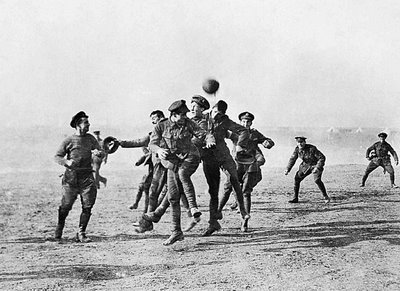
‘Christmas Soccer Game, 1915’, by Robert Cording

I suppose what made it possible
Was that no one expected more
Than a day of unhurried hours, better
Food, some free time to reread old letters,
Write new ones. Small Christmas trees
With candles lined both sides of the trenches
And marked the two days’ truce.

Who can explain it? – one minute troops
Are sitting in mud, the next raising themselves
Out of the trenches, as if all they needed
Was a soccer ball to remind them
Of who they were. Imagine a Scotsman
Heading the ball into the air and catching it
On his instep, then flicking it across

The frosted grass to a German smoking
A cigarette who smiles and settles the ball,
Then boots it back. Soon a few soldiers
From both sides circle around the Scotsman
And the ball moves quickly back and forth,
Left foot, right foot, all of the men rocking
From side to side, the ball, the cold,

Making good neighbors of them all.
A game’s begun, a real match without referees,
Attack and counterattacks, the ball crossing
From side to side, a match played,
We can imagine, as if it were all that mattered,
As if the game’s sudden fizzes of beauty –
Three crisp passes or two perfect triangles

Laying end to end and pointing to the goal –
Could erase what they had learned
To live with. Laughing, out of breath, dizzy
With the speed of the ball skipping over
The frozen earth, did they recognize themselves
For a short while in each other? History says
Only that they exchanged chocolate and cigarettes,

Relaxed in the last ransomed sunlight.
When the night came and they had retreated
To their own sides, some of the men
Wrote about the soccer game as if they had to
Ensure the day had really happened. It did.
We have the letters, though none of them says
How, in the next short hours, they needed,

For their own well-being, to forget everything
That had happened that Christmas day.
It was cold, the long rows of candles must have
Seemed so small in the dark. Restless, awake
In the trenches, the men, I suppose,
Already knew what tomorrow would bring,
How it would be judged by the lost and missing.

– Robert Cording, Common Life: Poems (Fort Lee: CavanKerry Press, 2006), 39–40.

Barth and The Tower of Babel

Among last Sunday’s lectionary readings (and sermons) was the story of the tower of Babel from Genesis 11. This reminded me of a section in Paul Brazier’s facsinating study on Barth and Dostoevsky wherein he writes:

“Barth weaves the biblical story of the Babel tower into ‘Die Gerechtigkeit Gottes’. Barth opened the address with Matthew 3:3 – John the Baptist crying in the wilderness. He immediately cites the importance of conscience as the perfect interpreter of life, ‘what it tells us is no question, no riddle … but a fact – the deepest, innermost, surest fact of life, that God is righteous’. Furthermore, Barth compares conscience with reason, reason is inadequate – ‘It sees what is human but not what is divine.’ We will not learn of God by basing our theology on the human but we must let conscience speak of the righteousness of God in such a way that this righteousness becomes a certainty. Conscience ‘may be reduced almost to silence or crushed into oblivion, it may be led astray to the point of folly and wrongdoing, but it remains forever the place between heaven and earth in which God’s righteousness is manifest.’ But conscience disturbs, it is a pressing accusation, often bitter, sometimes as a crushing curse, then as holy joy, but above all it convinces us that all our living and learning have a goal, it points to a will that is always true to itself, a pure will – the righteousness of God. By comparison Barth cites the human will as capricious, fickle, corrupt. Human will causes us to forget the constancy and purity of God’s righteous will: ‘For we suffer from unrighteousness.’ At times we dread this, we revolt against it, we try to justify our unrighteousness: ‘grounded upon caprice, vagary and self-seeking – a will without faithfulness, logic or correlation, disunited and distraught within itself.’ Barth outlines the state of Europe, possessed by fiendishness, competition in business, passion and wrongdoing, also world war, further, class warfare, moral depravity and economic tyranny. As the argument develops, Barth paints a portrait of the result of this corrupt and fallen will:

The unjust will which imbues and rules our life makes of it, with or without our sanction, a weltering inferno. How heavily it lies upon us! How unendurably! We live in a shadow. We may temporarily deceive ourselves about it. We may temporarily come to an understanding with it … For the righteous will is by nature the unendurable, the impossible. We live by knowing that there is really something else in the world.

But so often unrighteousness triumphs: we make peace with conscience and convince ourselves that such wrong is really right. ‘But now in the midst of this sense of need and apprehension, as resistless and unbroken as the theme of a Bach fugue, comes the assurance of conscience.’ We perceive the righteous will of God above our warped and weakened will. Our greatest pain comes in perceiving this will, this pure righteousness of God. Barth traces this cry through the Hebrew prophets and into John the Baptist as figures ‘never to be erased from humanity.’

But now ‘comes a remarkable turn in our relation with the righteousness of God. The trumpet of conscience sounds … we feel the touch of holiness upon us.’ It is here that what was implicitly analogous to Crime and Punishment becomes explicit. Here Barth invokes The Tower of Babel, woven in with eritis sicut dues … As conscience touches us we fail to respond to the righteousness of God, instead we build a Tower of Babel:

Let us build us a city and a tower … whose top may reach into heaven; and let us make a name, lest we be scattered abroad upon the face of the whole earth! We come to our own rescue and build The Tower of Babel. In what haste we are to soothe within us the stormy desire for the righteousness of God.

We do not let conscience speak to the end, we stifle, we cover, we placate by inventing our own righteousness – worse, our own religion. ‘We stand here before the really tragic, the most fundamental error of humanity. We long for the righteousness of God, and yet we do not let it enter our lives and our world.’ Again,

… we go off and build this pitiable tower at the Babel of our human righteousness, human consequence, human significance. Our answer to the call of conscience … (is) a single gigantic ‘as if’ (als ob) – as if our tower were important, as if something were happening, as if we were doing something in obedience to conscience.

Therefore God’s righteousness eludes us. This is the pattern for the entire address – we discern intimations of the righteousness of God in our conscience but we silence, abort, such intimations through busily building a Tower of Babel from our own righteousness by proudly inventing religions, cultures, human achievement. We are bedevilled by a longing for a new world but fail to achieve anything through our own efforts. Barth saw this particularly in the arrogance of the Western European nations that were locked into the annihilation of the First World War:

The righteousness of God has slowly changed from being the surest of facts into being the highest among various high ideals, and is now at all events our very own affair. This is evident in our ability now to hang it gaily out of the window and now to roll it up again, somewhat like a flag: eritis sicut deus! You may act ‘as if you were God, you may with ease take his righteousness under your own management. This is certainly pride. One might equally well, however, call it despair.

Later, Thurneysen was to write similar words in his theological study – Dostojewski (1921) – about how Raskolnikov was taken in by his idea, further, that he was bewitched, enchanted (bezaubert ), he was a man characterized by hurricanes of passion, capable of a titanic storming of heaven leading inevitably to a demonic plunge into hell:

… (such a) man becomes godlike and devilish … With the parable, however, there is also given the titanic temptation of the eritis sicut deus, the temptation to make out of the parable and allusion more than parable and allusion, the seduction to be superman, to be the man-god (zum Übermenschen, zum Mensch-Gott).

It is because of our despairing pride ‘that we build a Tower of Babel.’”

– Paul H. Brazier, Barth and Dostoevsky: A Study of the Influence of the Russian Writer Fyodor Mikhailovich Dostoevsky on the Development of the Swiss Theologian Karl Barth, 1915–1922 (Paternoster Theological Monographs; Eugene: Wipf & Stock, 2008), 49–51.

Praying with Camus

Tonight I watched Breaking the Silence: Burma’s Resistance by Canadian filmmakers Pierre Mignault and Hélène Magny. It documents the continuing resistance to Burma’s military junta by political and humanitarian activists.

And when I got home, Camus led me in prayer:

‘Hope had returned and with it a new zest for life. No man can live on the stretch all the time, with his energy and willpower strained to the breaking-point, and it is a joy to be able to relax at last and loosen nerves and muscles that were braced for the struggle’. – Albert Camus, The Plague (Harmondsworth: Penguin Books, 1967), 229.

Stanley Hauerwas on the suffering of children

‘I think childhood suffering bothers us so deeply because we assume that children lack a life story which potentially gives their illness some meaning. In that respect I suspect we often fail to appreciate the richness of their young world as well as their toughness and resilience. But I suspect that what bothers us even more about childhood suffering is that it makes us face our deepest suspicions that all of us lack a life story which would make us capable of responding to illness in a manner that would enable us to go on as individuals, as friends, as parents, and as a community. I suspect that if Christian convictions have any guidance to give us about how we are to understand as well as respond to suffering, it is by helping us discover that our lives are located in God’s narrative – the God who has not abandoned us even when we or someone we care deeply about is ill’. – Stanley Hauerwas, Naming the Silences: God, Medicine, and the Problem of Suffering (London/New York: T&T Clark, 2004), 67.

Stanley Hauerwas on being human, on being a theologian

I recently started reading Stanley Hauerwas’ latest book Hannah’s Child: A Theologian’s Memoir. It’s a very special book, and over the next bit I may even post a few exerpts from it. But in the meantime, here’s two videos in which Hauerwas talks about this book, the nature of theological biography, the life of a theologian, having children, engaging with Islamic thought, encountering Karl Barth and other things that have changed his life.

No faith is an island

In a previous post, I draw attention to a comment that Stanley Hauerwas made in an interview wherein, discussing Friendship and Community, he said:

‘The last thing in the world I want is a personal relationship with God. Our relationship with God is mediated. And that’s the reason why without the Church we know not God … Our faith is a mediated faith through people reformed by word and sacrament. So I would never trust myself to have a personal relationship with God’.

I was immediately struck by this comment, spurted out in true Hauerwasian style. And while I reckon that Hauerwas needed to introduce a distinction here between ‘personal’ and ‘individual’ (I assume that it is the latter that he most concerned with) I think that his basic point is right.

Paul Tillich, in one of his clearer bits of writing (and there aren’t many of those), also argued that ‘the life of faith is life in the community of faith, not only in its communal activities and institutions but also in the inner life of its members … There is no life of faith, even in mystical solitude, which is not life in the community of faith’. (Dynamics of Faith, 118)

This same word was brought home to me again recently when I was reading Robert McAfee Brown’s book Is Faith Obsolete? In that book, Brown makes the point that we do not believe by ourselves, as individuals in isolation; ‘we believe as part of a community of believers, whether the community is a Benedictine monastery, a communist cell, a Protestant congregation, a Jewish minyan, or a Hindu ashram’. He continues: ‘To be sure, we must personally appropriate the faith of the community to which we belong and make it our own, and in this sense Luther was right in insisting that everyone has to do his own believing just as everyone has to do his own dying. But we need to remember also that the faith we personally appropriate is the faith of the community, and this means that even the most internalized, existential act of personal commitment will bind us into a communal relationship of shared belief with others. Even if the faith I appropriate were somehow brand new, never before conceived, the product of no apparent community save my own internal dialogue with myself, if I really believed it to be true I would perforce share it with others and thus, whether I directly willed it or not, a new community would be created around it’ (p. 141).

There is, Brown insists, a relationship between faith and community which is ‘inextricably joined together’. ‘Community’, he writes, ‘can only be created around a faith; faith can only be creative within a community’. And then he helpfully proceeds to identify five ways in which community nurtures and strengthens the life of faith.

1. The community is an economy of relations wherein the faith of individuals can be tested against the faith of the community. ‘The community has a long history; better still, it has a memory, which means that it can put its history to use. The individual has a short history that needs frequent checking against the community’s longer history’ (p. 142). This means that the practices and learnings of the present are to be in critical relation with, and to exemplify, the life of faith as the creative appropriation of an open past.

2. The community is an economy of faithful relations where the faith of the community can be tested against the faith of the individual. This means that ‘any community that is truly a community must be able to suffer fools gladly and even embrace the heretics that threaten its peace. Since communities are almost always careful and conservative, they need the leaven of fresh ideas, along with new interpretations of old ideas, and these are contributions that only the most venturesome within their midst are likely to propound’ (p. 143). This, Brown insists, is how communities stay alive and grow. He cites Francis of Assisi, Martin Luther, Hans Küng and Daniel Berrigan, as examples of those who were used by God to bring fresh wine alongside old wineskins.

3. The community is an economy of relations of faith where the burdens of doubt can be shared. Faith always – and necessarily – involves risk, some of which are too overwhelming and potentially destructive to be shouldered by the individual alone. At such times, Brown reminds us, ‘the community can be the place for “the bearing of burdens,” where things too heavy to be borne individually can, at least during crucial moments, be borne corporately. It need not be a sign of individual weakness, but rather it can be a sign of communal strength, when an individual can say of the forgiveness of sins or the inevitability of the victory of the proletariat, or whatever: “Look, that part of it just doesn’t make sense to me right now. It did once, and I hope it will again, but for the moment the rest of you will have to do the believing for me”’ (p. 144). This quality of sharing is not to be interpreted as an exposure of weakness but rather as charismatic, i.e. as gift.

4. The community is an economy of relations which contributes to the life of faith precisely because it functions as the locale where faith can be celebrated and faith’s loves embodied, where the community’s members may ‘draw assurance that their faith is a future possibility for all because it is a present reality for a few’ (p. 145). Is this not precisely why we compose community-forming liturgies, and, conversely where we are made communities by that same liturgical action, in order that we might dramatise our graced convictions and spur each other on to participate in, and be continually recreated by, the faith we share and which has taken hold of us. At the very centre of this action, participation and recreation is the eucharist, that event-location around which communities gather to both remember, in the sense of recalling the past, and also to re-member themselves. There is an important (re-)ordering that needs to takes place here too, and that with ecumenical implications. We ought to eat and drink together first, and then talk theology. To invert this ordering is a nonsense. Debra Dean Murphy recently reminded us, ‘Through the sacramental gifts of Christ’s body and blood, the community receives itself – it becomes the body of Christ, blessed, broken, and shared. As the Great Thanksgiving says, we are made “one with Christ, one with each other, and one in ministry to all the world.” In this act the Church is united across time and distinctions between the global and the local are collapsed, for in every local assembly is the whole body – “the world in a wafer,” as Bill Cavanaugh has said’.

5. Finally, community is an economy of relations which ‘contributes to the life of faith by being the place where faith is energized to turn outward. Communities cannot remain ingrown, concerned only with their own inner life. They too must exemplify faith as the dynamic interrelationship of content and commitment. They must thrust their members out into the “strange land,” into the arenas of life not populated by the community’ (p. 146). In other words, the community called by God and re-membered around generous helpings of broken loaves and poured out bottles of Shiraz is ever the apostolic community, i.e., it is always a people being ‘sent’ out in order to invite others to the feast.

Perhaps Hauerwas’ comments are not so strange after all.

The Joy of Teaching

Harry Hazel, The Joy of Teaching: Effective Strategies for the Classroom (Eugene: Pickwick Publications, 2010). xii + 158 pages. ISBN: 978-1-60608-613-1. Review copy courtesy of Wipf and Stock.

Since I read Ken Bain’s book What the Best College Teachers Do, I’ve tried to keep abreast with books on teaching, books which seek to hold up before me the teacher’s task and to encourage me to attend to its craft. Recently, I read The Joy of Teaching: Effective Strategies for the Classroom by Harry Hazel, Professor of Communication Arts at Gonzaga University and author of Art of Talking to Yourself and Others and The Power of Persuasion, and co-author of Communicating Effectively: Linking Thought and Expression.

In researching for this book, Hazel collected reactions from over one hundred North American teachers about why they like what they do. Most emphasised the joy of helping students learn and seeing those students develop their potential: ‘Good teachers challenge, cajole, prod, push and move each student as far as they can’ (p. 5). Hazel observes that while good teachers ‘give away’ knowledge, those who find little joy in giving to others will find little joy in teaching. Moreover, great teachers exhibit a passion for their profession which leaves no doubt that they enjoy, at a deep level, what they were doing. They hold learning in high esteem and are committed to ongoing formation and to professional development.

He shares a number of other findings:

  • excellence in teaching has more to do with an exceptional grasp of the material and clear communication techniques than with popularity.
  • the best teachers demand much of their students.
  • good teachers take time to find out how students in a class learn best, and then adapt. Like Bain, Hazel too notes that there is all the difference in the world whether we are teaching a subject to students or teaching students a subject, and that effective teachers will employ whatever method they believe will best develop an individual student.
  • good teachers respect and love their students: ‘It may seem obvious that liking students is a prerequisite to liking education, but some teachers don’t really like most of their students. They tolerate them because they have to. Once the class is over, they have little contact with them. Happy teachers, on the other hand, really like the students they encounter’ (p. 133).

Against Gerald Goldhaber’s prophecy (in Organizational Communication) on the death of the lecture, Hazel draws upon Plato, Aristotle and Joseph Lowman’s work in Mastering the Techniques of Teaching to defend the use of ‘what can be an excellent teaching tool’:

Properly delivered, a lecture lights up a room. If a teacher is well organized, presents her ideas clearly and sprinkles theory with riveting examples, she has a good chance of keeping the attention of her students. But if she speaks in a monotone, wanders all over her subject and hovers in the clouds of abstraction, most of her students will tune out. The bland lecture competes with the Quaalude as a way to induce sleep. (p. 37)

While some will find The Joy of Teaching a little anecdote-heavy (a sad trend, it seems, in much recent North American literature), and few engaged with adult-education will find much here that inspires, the book will certainly be read with profit by secondary school teachers and by those who care about what is happening in our high schools.

‘What I see in Egoli’, Anonymous

What I see in Egoli
are tall buildings
smart cars
well dressed people
a whole scene
that has no place for me
no place for my wife
no place for my children.

Lord Jesus, where are you?
Are you in those smart white offices
those smart white houses
those smart white churches?

They think you are.
They talk about you the whole time
Just as if you were right there with them.
They are so sure
that you are guiding them,
that they are doing your will.
I like to think
that you are actually here with us
that you are one of the left out ones.

If that is how it is
if you are really here
with us, for us,
I think I could bear it
because I’d know
this wasn’t the end,
that you still come
to get prisoners out of gaol
and blind people out of darkness,
to get hungry people into the place
where they can feed their little ones
instead of helplessly hopelessly
listening to them cry.

But my son does not call you Lord,
Jesus,
let alone call on you,
Lord Jesus,
He uses your name as a swearword.
Jesus! he says,
Bloody white man’s Jesus!

I fear for him,
for us,
for those whites.

O Jesus, Jesus,
come soon,
clear up the barriers
open it all up, because if you don’t
something awful is going to happen.
Do you hear me,
one of those ‘homeland’ blacks
on the outside looking in?
RSVP
soon.

– Anonymous, cited in Margaret Nash, Black Uprooting from ‘White’ South Africa: The Fourth and Final Stage of Apartheid (Johannesburg: South African Council of Churches, 1980), 84–5.

On boab trees and the healing of the nations

For not a few, the boab is considered to be Australia’s most grotesque tree. Found only on the flood plains and in rocky areas from the south-western Kimberley to the Northern Territory’s Victoria River, their huge, grey swollen trunks topped by a mass of contorted branches make a fascinating spectacle, especially during the dry season when they lose their leaves and are transformed into ‘the tree that was planted upside-down’.

The boab might serve as something of a parable of the church and even of the life of faith:

  • They are awkward looking.
  • They seem like they belong somewhere else. It’s almost as if they are grounded in another world.
  • They store a deep reservoir of moisture in their trunk that they need to survive in hot and harsh environments. A sign of an unhealthy church is one which seeks to maintain its life by drinking deeply only every so often (whether at the Reformation, or at the Billy Graham crusades of the 50s, etc.) and then trying to sustain its life by drawing upon those every descreasing floodwaters which have long become stagnant and toxic. Conversely, a healthy church is one that is planted by a living stream and which drinks of that stream often.
  • Their moisture serves as a lifeline to those who are lost in the bush.

Trees are used frequently in the Bible especially to describe both the life of faithlessness and of faithfulness, and sometimes of both in the same passage. So Jeremiah 17:

‘Thus says the Lord: Cursed are those who trust in mere mortals and make mere flesh their strength, whose hearts turn away from the Lord. They shall be like a shrub in the desert, and shall not see when relief comes. They shall live in the parched places of the wilderness, in an uninhabited salt land. Blessed are those who trust in the Lord, whose trust is the Lord. They shall be like a tree planted by water, sending out its roots by the stream. It shall not fear when heat comes, and its leaves shall stay green; in the year of drought it is not anxious, and it does not cease to bear fruit’. (vv. 5–8)

Here Jeremiah warns us of making human beings the source of our hope and strength, and that those who do so will be ‘like a shrub in the desert, and shall not see when relief comes. They shall live in the parched places of the wilderness, in an uninhabited salt land’. Rather we are called to be those whose ‘trust is the Lord’, and who are ‘like a tree planted by water, sending out its roots by the stream. It shall not fear when heat comes, and its leaves shall stay green; in the year of drought it is not anxious, and it does not cease to bear fruit’.

Such trust, of course, is grounded in another tree – Calvary’s tree, the tree whose roots are planted on the violent conveyor belt of human history but whose branches reach all the way to the New Jerusalem. It is a tree, according to St John’s vision recorded in the Book of the Revelation, that lives beside ‘the river of the water of life, bright as crystal’, and which flows ‘from the throne of God and of the Lamb through the middle of the street of the city’. John tells us that ‘on either side of the river is the tree of life with its twelve kinds of fruit, producing its fruit each month; and the leaves of the tree are for the healing of the nations’ (Rev 22:1–2).

And so this tree of Jeremiah’s vision which is planted by water and which sends out its roots by the stream does not stop establishing itself until all of the nations, all of creation, is healed; this is to be about its core business, and that healing takes place by the very gift of the tree itself.

This post was inspired by a prayer penned by Chandran Devanesen that Jim Gordon posted a few days ago, a slightly-modified version of which reads:

O Tree of Calvary
send thy roots deep down
into our hearts.
Gather together the soil of our hearts,
the sands of our fickleness,
the stones of our stubbornness,
the mud of our desires, bind them together
O Tree of Calvary,
interlace them with thy strong roots,
entwine them with the network
of thy love.

Hauerwas on religion and violence, the place of Christianity in the modern University, death, friendship and community

The Centre for Public Christianity has made available a wonderful four-part interview with Stanley Hauerwas in which he and Greg Clarke discuss the connections between religion and violence, the place of Christianity in the modern University, death, friendship and community.

In the latter, Hauerwas makes the following comment:

‘The last thing in the world I want is a personal relationship with God. Our relationship with God is mediated. And that’s the reason why without the Church we know not God … Our faith is a mediated faith through people reformed by word and sacrament. So I would never trust myself to have a personal relationship with God’.

‘Parable of the Moth’, by Robert Cording

Consider this: a moth flies into a man’s ear
One ordinary evening of unnoticed pleasures.

When the moth beats its wings, all the winds
Of earth gather in his ear, roar like nothing
He has ever heard. He shakes and shakes
His head, has his wife dig deep into his ear
With a Q-tip, but the roar will not cease.
It seems as if all the doors and windows
Of his house have blown away at once—
The strange play of circumstances over which
He never had control, but which he could ignore
Until the evening disappeared as if he had
Never lived it. His body no longer
Seems his own; he screams in pain to drown
Out the wind inside his ear, and curses God,
Who, hours ago, was a benign generalization
In a world going along well enough.

On the way to the hospital, his wife stops
The car, tells her husband to get out,
To sit in the grass. There are no car lights,
No streetlights, no moon. She takes
A flashlight from the glove compartment
And holds it beside his ear and, unbelievably,
The moth flies towards the light. His eyes
Are wet. He feels as if he’s suddenly a pilgrim
On the shore of an unexpected world.
When he lies back in the grass, he is a boy
Again. His wife is shining the flashlight
Into the sky and there is only the silence
He has never heard, and the small road
Of light going somewhere he has never been.

– Robert Cording, Common Life: Poems (Fort Lee: CavanKerry Press, 2006), 29–30.

Donald MacKinnon on the problem of evil

‘If I am honest, I think that I must say that I should cease to believe altogether unless I believed that Jesus had indeed prayed that the hour might pass from him, had indeed been left alone to face the reality of absolute failure. It is fashionable nowadays to speak of Christ as victor, as if the agony and disillusion, the sheer monstrous reality of physical and spiritual suffering which he bore were a mere charade. The idiom of a superficial cosmic optimism, often expressing itself ritually in patterns of liturgical symbolism, is currently fashionable, as if a world that knows, as ours does, extremities of terror as well as hope, could be consoled by a remote metaphysical chatter. But the gospels, including that of John which does not chronicle the episode of Gethsemane, recall our imaginations to a figure prostrate on the earth, afraid and desolate, bidding men and women see in him the ground of all creation.

It is sheer nonsense to speak of the Christian religion as offering a solution of the problem of evil. There is no solution offered in the gospels of the riddle of Iscariot through whose agency the Son of man goes his appointed way. It were good for him that he had not been born. The problem is stated ; it is left unresolved, and we are presented with the likeness of the one who bore its ultimate burden, and bore it to the end, refusing the trick of bloodless victory to which the scoffers, who invited him to descend from his cross, were surely inviting him.

What the gospels present to us is the tale of an endurance. “Christ for us became obedient unto death, even the death of the cross.” The writer of the fourth gospel invites his readers to find in the tale of this endurance the ultimate secret of the universe itself. For the ground of that universe is on his view to be identified with the agent of that endurance. So his teaching cannot easily be qualified as optimistic or pessimistic. He is no pessimist; for he is confident that we can find order and design, the order and design of God himself, in the processes of the universe and in the course of human history. But if men would understand that design, they must not, in random speculative mood, look away from the concrete reality of Jesus of Nazareth, from the bitter history of his coming and rejection. Where the speculative intellect finds answer to its furthest ranging questions is still the same place where the bruised spirit may find consolation from the touch of a man of sorrows.

To suggest that Christianity deals with the problem of evil by encouraging the believer to view it from a cosmic perspective is totally to misunderstand both the difficulty and the consolation of its treatment. Rather Christianity takes the history of Jesus and urges the believer to find, in the endurance of the ultimate contradictions of human existence that belongs to its very substance, the assurance that in the worst that can befall his creatures, the creative Word keeps company with those whom he has called his own. “Is it nothing unto you all ye that pass by? Behold and consider whether there be any sorrow like unto my sorrow.” It is not as if the passer-by were invited immediately to assent to the proposition that there was indeed no such sorrow; he is asked to “consider”. It is a profound mistake to present the Christian gospel as if it were something that immediately showed itself, that authenticated itself without reflection. It is of the manner of the coming of Jesus that he comes so close to the ordinary ways of men that they hardly notice him, that they treat him as one of themselves. “There stands one among you whom you know not”: so the Baptist in that same first chapter of John to which I have so often referred. But how, except by coming so close to men, could he succor them? A Christ who at the last descended from the cross must leave the penitent robber without the promise of his company in paradise; and such a Christ we may dare say must also deprive himself of the precious comfort in his own extremity that he received from the gangster beside him; for it was that gangster who in Luke’s record continued with him to the very end of his temptation.

I am not here offering an apologetic, only bringing out certain elements in the complex reality of Christianity that seems to me of central importance. I would say that nobody these days, who is concerned at all with issues of faith and unbelief, can afford to treat them as opportunities for being clever. If men still believe – in spite of the strong, even overwhelming, case of the sceptic – it must be because they find malgré tout [nevertheless] in Christianity the revelation of the eternal God, a revelation that touches them in the actual circumstances of their lives, whether in the common fear of a week of international crisis, or i n the more personal extremities of sin, failure, bereavement, of unresolvable conflict of obligations when they find themselves pulled in two directions by claims of pity and by claims of truth. Is the so-called gospel in any sense good news to one who has bestowed love and care upon another whom he is forced in obedience to the claims of truth to acknowledge as worthless and corrupt? If it has no word of consolation in such extremity, how can we call it good news to the individual? What value is there in a cosmic optimism which leaves unplumbed the depths of human grief?’

– Donald M. MacKinnon, ‘Order and Evil in the Gospel’ in Borderlands of Theology and Other Essays (ed. George W. Roberts and Donovan E. Smucker; Philadelphia/New York: J.B. Lippincott Company, 1968), 92–4.

Are images of Jesus idolatrous?

It is impossible, it seems, for a theologian to think seriously about the arts and not before long be confronted with the question of visual representations of God and, for the Christian theologian, of God as incarnate. The Orthodox and the Reformed traditions, in particular, have long taken this question with the utmost seriousness (and that beside heated debates on the communicatio idiomatum or of those on the question of Christ’s presence in the Supper). The four main objections seem to be:

# 1. Violation of the second commandment

There are no commands to make pictures of our Lord. In fact such pictures, it is argued, clearly violate the second commandment. There are issues here of the ongoing question of idolatry, witnessed to in the Old Testament’s depiction of pagan idols described as being made of gold, silver, wood, and stone – i.e. of the ‘stuff’ of creation, of the work of human hands, unable to speak, see, hear, smell, eat, grasp, or feel, and powerless either to injure or to benefit (Ps 135:15–18). And, of course, there is the Decalogue’s second commandment:

‘You shall not make for yourself an idol, whether in the form of anything that is in heaven above, or that is on the earth beneath, or that is in the water under the earth’. (Exodus 20:3–4)

Does this commandment put a fence around what artists can – and cannot – depict of God? Are images of Jesus – whether in Sunday School books, galleries, or spaces dedicated for public worship – idolatry? And if not, then how ought we understand the relation between the unique and unrepeatable revelation of God in the incarnation (and that attested to in the inscripturated word and from the Church’s pulpit, font and table) and visual depictions of that Word?

# 2. All attempts are false representations

Since no accurate representation of Christ can be produced by creatures, all attempts are false representations and can only promote idolatry.

# 3. We don’t know what Jesus looks like

Despite passages like Isaiah 53:2 and Revelation 1:13–16, the Bible does not give us enough information to make a faithful representation of Christ’s physical appearance. Therefore, it is obvious that God does not sanction portraits of God’s Son.

# 4. All plastic (i.e. material) representations of Jesus implicitly promote the ancient heresy of Nestorianism

The most serious objection to artists’ attempts to represent Jesus pictorially has been associated with this charge of Nestorianism. In other words, even if we had a photo of Jesus which depicted what he looked like, no human artistry can portray Christ’s divine nature. Therefore, all attempts are a lie and portray Jesus as infinitely less, or other, than he is as the God-human. This argument was proposed by the Council of Constantinople in 754:

‘If any person shall divide human nature, united to the Person of God the Word; and, having it only in the imagination of his mind, shall therefore, attempt to paint the same in an Image; let him be holden as accursed. If any person shall divide Christ, being but one, into two persons; placing on the one side the Son of God, and on the other side the son of Mary; neither doth confess the continual union that is made; and by that reason doth paint in an Image of the son of Mary, as subsisting by himself; let him be accursed. If any person shall paint in an Image the human nature, being deified by the uniting thereof to God the Word; separating the same as it were from the Godhead assumpted and deified; let him be holden as accursed’.

Regarding this council Philip Schaff, in History of the Christian Church. Volume IV: Mediæval Christianity from Gregory I to Gregory VI; A.D. 590–1073, writes:

The council [of Constantinople, 754], appealing to the second commandment and other Scripture passages denouncing idolatry (Rom. 1:23, 25; John 4:24), and opinions of the Fathers (Epiphanius, Eusebius, Gregory Nazianzen, Chrysostom, etc.), condemned and forbade the public and private worship of sacred images on pain of deposition and excommunication … It denounced all religious representations by painter or sculptor as presumptuous, pagan and idolatrous. Those who make pictures of the Saviour, who is God as well as man in one inseparable person, either limit the incomprehensible Godhead to the bounds of created flesh, or confound his two natures, like Eutyches, or separate them, like Nestorius, or deny his Godhead, like Arius; and those who worship such a picture are guilty of the same heresy and blasphemy. The eucharist alone is the proper image of Christ. (pp. 457–8.)

This issue is just one of the many in which the great twentieth-century theologian Karl Barth and his reformation great-grandfather, John Calvin, agree. They both held that:

  • Preaching and sacraments are central to the community’s activity;
  • That static works are a distraction to the ‘listening community’;
  • That the community should not be bound to a particular conception of Jesus;
  • That even the best art cannot ‘display Jesus Christ in his truth, i.e., in his unity as true Son of God and Son of Man. There will necessarily be either on the one side, as in the great Italians, an abstract and docetic over-emphasis on His deity, or on the other, as in Rembrandt, an equally abstract, ebionite over-emphasis on His humanity, so that even with the best of intentions error will be promoted’ (Barth, CD IV.3.2, 867). To be sure, Barth had already anticipated this move in CD IV.2 when he insisted that Jesus Christ cannot be known in his humanity as abstracted from his divine sonship. See CD IV.2, 102–3.
  • ‘Whatever [people] learn of God in images is futile’ (Calvin, Institutes, I.xi.5). God’s majesty ‘is far above the perception of our eyes … Even if the use of images contained nothing evil, it still has no value for teaching’ (Inst., I.xi.12); and
  • ‘Theology cannot fix upon, consider, and put into words any truths which rest on or are moved by themselves – neither an abstract truth about God nor about man nor about the intercourse between God and man. It can never verify, reflect or report in a monologue. Incidentally, let it be said that there is no theological visual art. Since it is an event, the humanity of God does not permit itself to be fixed in an image’ (Barth, The Humanity of God, 57).

That art is concerned with ‘earthly, creaturely things’ is reflected in Karl Barth’s scathing critique of attempts to visualise the ‘inaccessible and incomprehensible side of the created world’, and he lists ‘heaven’, and Christ’s resurrection and ascension as examples: ‘There is no sense in trying to visualise the ascension as a literal event, like going up in a balloon. The achievements of Christian art in this field are amongst its worst perpetrations’ (CD III.2, 453). And, on the resurrection, he writes:

There is something else, however, which the Easter records and the whole of the New Testament say but wisely do not describe. In the appearances He not only came from death, but from His awakening from the dead. The New Testament almost always puts it in this way: “from the dead.” From the innumerable host of the dead this one man, who was the Son of God, was summoned and awakened and reconstituted as a living man, the same man as He had been before. This second thing which the New Testament declares but never attempts to describe is the decisive factor. What was there actually to describe? God awakened Him and so He “rose again.” If only Christian art had refrained from the attempt to depict it! He comes from this event which cannot be described or represented – that God awakened Him. (Barth, CD IV.2, 152)

While Barth and Calvin could and did find proper recognition of the gift of God’s love expressed in human culture, they both failed to find in their theology a positive place for the plastic arts that they could find, for example, in music. Ah Wolfgang!

So what ought we make of Barth’s – and others (e.g. Calvin, Kierkegaard) – judgement against visual representations of Jesus? Are visual representations of Jesus really any more susceptible than words (poetry, sermons, etc) about Jesus? (One recalls here Calvin’s insistence that it is the heart that is factory of idols.) Does not God’s act of redeeming creation not extend to the arts’ service of giving an account to the creatureliness of God in Jesus Christ? Does Barth’s and Calvin’s rejection misunderstand the nature of the dynamic and continuing event which is the relationship of the viewer of a painting or a sculpture with the artwork, and of the freedom of the Word in that event? (See Michael Austin, Explorations in Art, Theology and Imagination, 21.)

For most of the Reformed, theology is something that is meant to be done with words, and not with images. But, of course, every decision we make about how we choose to communicate the good news is loaded with visual symbolism and reinforces a perception that God communicates with us in a particular kind of way. The question, therefore, is not, whether or not we should communicate visually; it is, rather, how we do so and what we say when we do.

One of the things that good art does is to shed light on the true nature of things; it broadens our horizons, enriches our capacity to see, alerts us to dimensions of reality that we had not seen before, and for which words, sometimes, are simply not enough. The arts help us to birth the kind of imagination and re-imagination that the good news itself fosters and encourages and demands and makes and invites. Artists see differently, but no less truthfully than scientists, how things are with the world. If we are to walk in our world well, and justly and with the mercy of God, then we cannot do so without the kind of re-imagining of reality and of human society that the arts promote and invite.

So NT Wright:

‘We have lived for too long with the arts as the pretty bit around the edge with the reality as a non-artistic thing in the middle. But the world is charged with the grandeur of God. Why should we not celebrate and rejoice in that? And the answer sometimes is because the world is also a messy and nasty and horrible place. And, of course, some artists make a living out of representing the world as a very ugly and wicked and horrible place. And our culture has slid in both directions so that we have got sentimental art on the one hand and brutalist art in the other. And if you want to find sentimental art then, tragically, the church is often a good place to look, as people when they want to paint religious pictures screen out the nasty bits. But genuine art, I believe, takes seriously the fact that the world is full of the glory of God, and that it will be full as the waters cover the sea, and, at present (Rom 8), it is groaning in travail. Genuine art responds to that triple awareness: of what is true (the beauty that is there), of what will be true (the ultimate beauty), and of the pain of the present, and holds them together as the psalms do, and asks why and what and where are we. You can do that in music, and you can do that in painting. And our generation needs us to do that not simply to decorate the gospel but to announce the gospel. Because again and again, when you can do that you open up hermeneutic space for people whose minds are so closed by secularism that they just literally cannot imagine any other way of the world being. I have debated in public in America with colleagues in the New Testament guild who refuse to believe in the bodily resurrection and, again and again, the bottom line is when they say ‘I just can’t imagine that’, the answer is, ‘Smarten up your imagination’. And the way to do that is not to beat them over the head with dogma but so to create a world of mystery and beauty and possibility, that actually there are some pieces of music which when you come out of them it is much easier to say ‘I believe in the Father and the Son and the Holy Spirit’ than when you went in’. (NT Wright, ‘Jesus, the Cross and the Power of God’. Conference paper presented at European Leaders’ Conference, Warsaw, February, 2006).

Of course, as Murray Rae recently reminded a bunch of us here in Dunedin, the risk-taking work of re-imagining means that there can be no guarantee that misunderstanding and misinterpretation will be avoided. But neither do we have any such guarantee in the use of our words. In both cases, it seems, what we offer is an act of faith given under God’s imperative that we should share the good news. We offer in Christian witness so much as we have understood, knowing it to be partial, inadequate, and marred by our own sinfulness. And we do so in the name and under the inspiration of the God who makes eloquent the stumbling witness of our faith, and moulds our communication to good and loving purpose. It’s risky, but it is, it seems, God’s risk too.

Perhaps a few words from John de Gruchy would be a fitting way to conclude this post:

Art in itself cannot change society, but good art, whatever its form, helps us both individually and corporately to perceive reality in a new way, and by so doing, it opens up possibilities of transformation. In this way art has the potential to change both our personal and corporate consciousness and perception, challenging perceived reality and enabling us to remember what was best in the past even as it evokes fresh images that serve transformation in the present. This it does through its ability to evoke imagination and wonder, causing us to pause and reflect and thereby opening up the possibility of changing our perception and ultimately our lives … From a Christian perspective, the supreme image that contradicts the inhuman and in doing so becomes the icon of redemption is that of the incarnate, crucified and risen Christ. So it is not surprising that artists through the centuries have sought to represent that alien beauty as a counter to the ugliness of injustice. We are not redeemed by art nor by beauty alone, but by the holy beauty which is revealed in Christ and which, through the Spirit evokes wonder and stirs our imagination. (John W. de Gruchy, ‘Holy Beauty: A Reformed Perspective on Aesthetics Within a World of Ugly Injustice’ in Reformed Theology for the Third Christian Millennium: The 2001 Sprunt Lectures, 14–5).

Hans Küng on Rome’s worst credibility crisis since the Reformation

According to Hans Küng‘s latest open letter to Catholic bishops, Benedict XVI is reponsible for making worse just about everything that is wrong with the Roman Catholic Church: ‘Without a doubt, he conscientiously performs his everyday duties as pope, and he has given us three helpful encyclicals on faith, hope and charity. But when it comes to facing the major challenges of our times, his pontificate has increasingly passed up more opportunities than it has taken’. Küng proceeds to list these missed opportunities:

  • opportunity for the rapprochement with the Protestant churches. Küng specifically has in mind here the Anglican Church.
  • opportunity for long-term reconciliation with Jews.
  • opportunity for dialogue with Muslims in an atmosphere of mutual trust.
  • opportunity for reconciliation with the colonised indigenous peoples of Latin America.
  • opportunity to help the people of Africa by allowing the use of birth control to fight overpopulation and condoms to fight the spread of HIV.
  • opportunity to make peace with modern science by clearly affirming the theory of evolution and accepting stem-cell research.
  • opportunity to make the spirit of the Second Vatican Council the compass for the whole Catholic Church, including the Vatican itself, and thus to promote the needed reforms in the church. Küng considers this point to be ‘the most serious of all’.

And then there’s the ‘scandal crying out to heaven – the revelation of the clerical abuse of thousands of children and adolescents, first in the United States, then in Ireland and now in Germany and other countries. And to make matters worse, the handling of these cases has given rise to an unprecedented leadership crisis and a collapse of trust in church leadership’.

Finally, Küng offers six challenges to bishops. These are summarised as:

1. Do not keep silent: By keeping silent in the face of so many serious grievances, bishops taint themselves with guilt. When they feel that certain laws, directives and measures are counterproductive, they should so in public. ‘Send Rome not professions of your devotion, but rather calls for reform!’

2. Set about reform: Too many in the church and in the episcopate complain about Rome, but do nothing themselves.

3. Act in a collegial way: Bishops should not act for themselves alone, but rather in the community of the other bishops, of the priests and of the men and women who make up the church.

4. Unconditional obedience is owed to God alone: ‘Although at your episcopal consecration you had to take an oath of unconditional obedience to the pope, you know that unconditional obedience can never be paid to any human authority; it is due to God alone. For this reason, you should not feel impeded by your oath to speak the truth about the current crisis facing the church, your diocese and your country. Your model should be the apostle Paul, who dared to oppose Peter “to his face since he was manifestly in the wrong”! (Galatians 2:11). Pressuring the Roman authorities in the spirit of Christian fraternity can be permissible and even necessary when they fail to live up to the spirit of the Gospel and its mission’.

5. Work for regional solutions.

6. Call for a council: ‘Just as the achievement of liturgical reform, religious freedom, ecumenism and inter-religious dialogue required an ecumenical council, so now a council is needed to solve the dramatically escalating problems calling for reform’.

By way of response, George Weigel, considers this latest ‘piece of vitriol’ of Küng’s to be ‘the low-point of a polemical career in which you have become most evident as a man who can concede little intelligence, decency, or good will in his opponents.’

Weigel’s basic argument is that Küng has his facts wrong. He accuses Küng of

  • being ‘blithely indifferent to the doctrinal chaos besetting much of European and North American Protestantism, which has created circumstances in which theologically serious ecumenical dialogue has become gravely imperiled’.
  • of ignoring recent scholarship about Pius’ ‘courage in defense of European Jewry’.
  • of misrepresenting the effects of Benedict XVI’s 2006 Regensburg Lecture in which he mentioned Islam.
  • of displaying no comprehension of what actually prevents HIV/AIDS in Africa.
  • of being oblivious to the scientific evidence underwriting the Church’s defense of the moral status of the human embryo.

According to Weigel, Küng’s basic problem is that he ‘lost the argument over the meaning and the proper hermeneutics of Vatican II’.

You can read all of Weigel’s reponse here.

Seems like a good time to recite the Nicene Creed:

We believe in one holy catholic and apostolic Church.
We acknowledge one baptism for the forgiveness of sins.
We look for the resurrection of the dead, and the life of the world to come. Amen.

Preparing for Ascension Sunday

‘[F]aith exists not only in hope in the epiphany of Christ; it is bound up with the veiling of Christ, with the ascension, and here we come back to the other reason for the ascension or the purposed withdrawal of Christ from sight. Faith can exist only where there is a gap, an eschatological reserve, between the present and the future, between actual participation in the kingdom here and now and the future manifestation of its glory. Let us consider it like this. If Jesus had manifested his full divine glory on earth so that men and women were confronted face to face with the ultimate majesty of God, then they would have been damned on the spot; they would have been face to face with the final judgement. But the veiling of his ultimate glory meant that Jesus was giving people a chance to repent; he was holding them at arm’s length away, so to speak, giving them time to repent, room for decision. He came veiling his glory, yet revealing himself obliquely, so as to give people enough light to believe but not enough finally to blind them or judge them. That is why he refused to give a compelling demonstration of himself, but sought to evoke faith. Faith is not sight, but faith answers to revelation that is yet only in part, for faith exists in the gap between partial and final manifestation. Faith is, therefore, essentially eschatological in its inner nature.

Now the ascension means that Jesus Christ has withdrawn himself from sight and history in order to allow the whole world time for repentance. He holds back the final unveiling of his glory and majesty, holds back the final judgement when there will be no time to repent, and when, as the Apocalypse puts it, the person that is filthy will be filthy still. That gap between the times is the eschatological time when this present age is already interpenetrated by the age to come, but it is time when the new age in all its glory is as yet veiled from sight, in order to leave room to preach the gospel and give all opportunity for repentance and faith. Thus the world-mission of the church is part of God’s grace, for it is God’s grace alone that keeps back the dissolution of this age’. – Thomas F. Torrance, Atonement: The Person and Work of Christ (ed. Robert T. Walker; Downers Grove: IVP Academic/Paternoster, 2009), 434–5.

‘As [Jesus] ascends, creation is healed. The gulf between heaven and earth caused by human sin is bridged; the rift of our ancient wound is closed. The ‘flesh of man’ is able to go where it was always intended but had ever been prevented since the Fall – into the courts of heaven and the immediate presence of God. This is the foretaste of ‘the glorious freedom of the children of God’ in which the entire creation will be ‘liberated from its bondage to decay’ (Romans 8:21). The ascending, triumphant King is the firstfruit of the new creation. Such is the victory procession of the ascension … The victory of Jesus, celebrated in the ascension, inaugurates his reign as the God-human enthroned at the right hand of the Father. This economy will continue until the entire creation in Christ Jesus, led by Christ Jesus, submits to the Father and the Triune God again fills all in all. The ascension, then, is the promise of a more complete victory. Our King has gone forth to his throne; he will come again in splendour. In this hope, the church has found its identity in the world, and the more the church has embraced the place of its ascended Lord, the more it has advanced his kingdom …

For the present situation of the church, a proper doctrine of the ascension preserves the vital core of historic orthodox Christology: Jesus who walked among us was, and is, truly a man, and also fully God. The ascension provides the narrative structure upon which the clothing of the doctrine may be hung. For the ascension locates our understanding of the person of Christ squarely within Jesus-history. Our doctrines are not merely speculations imposed on Jesus, but rather arise from reflection upon what happened to Jesus as well as what he said and did. We find, to our relief and felicity, that the historical frame bears the full weight of the Christology.

In fact, the doctrine of the ascension keeps us from collapsing our understanding of the person of Christ into any of the Christological distortions of the present age. For not only does Jesus continue now in our flesh, he continues in his divinity. The fully human Jesus is and ever shall be fully God. The Son of God from eternity, in the fullness of time, took our humanity up into himself as he became incarnate in Jesus. Now, he will keep our humanity in himself beyond all time. So we may joyfully resonate with the doxology of Professor [Hugh Ross] Mackintosh, who frequently declared: ‘When I look into the face of Jesus Christ and see the face of God, I know that I have not seen that face elsewhere and could not see it elsehow, for he and the Father are one’. The ascension as an essential part of the story of Jesus protects the doctrine of his person against the pluralizing tendencies of our culture. The ascension was a singular event (as was, of course, the resurrection and indeed the whole course of Christ’s sojourn with us) that demands a proper understanding of Jesus to account for it. I believe Professor Mackintosh would agree that not only ‘if we regard him as Saviour’ but also if we regard Jesus as ascended, ‘we must see him at the centre of all things. We must behold him as the pivotal and cardinal reality, round which all life and history have moved. That is a place out of which his Person simply cannot be kept’. When we know the triumphant Jesus as continuing in his full humanity and divinity through the ascension, we are open to the splendour of the riches of understanding him as our head and firstfruits …’. – Gerrit Scott Dawson, Jesus Ascended: The Meaning of Christ’s Continuing Incarnation (London/Phillipsburg: T&T Clark/P&R Publishing, 2004), 71, 72, 90–1.

‘Identification’, by Geoffrey Bingham

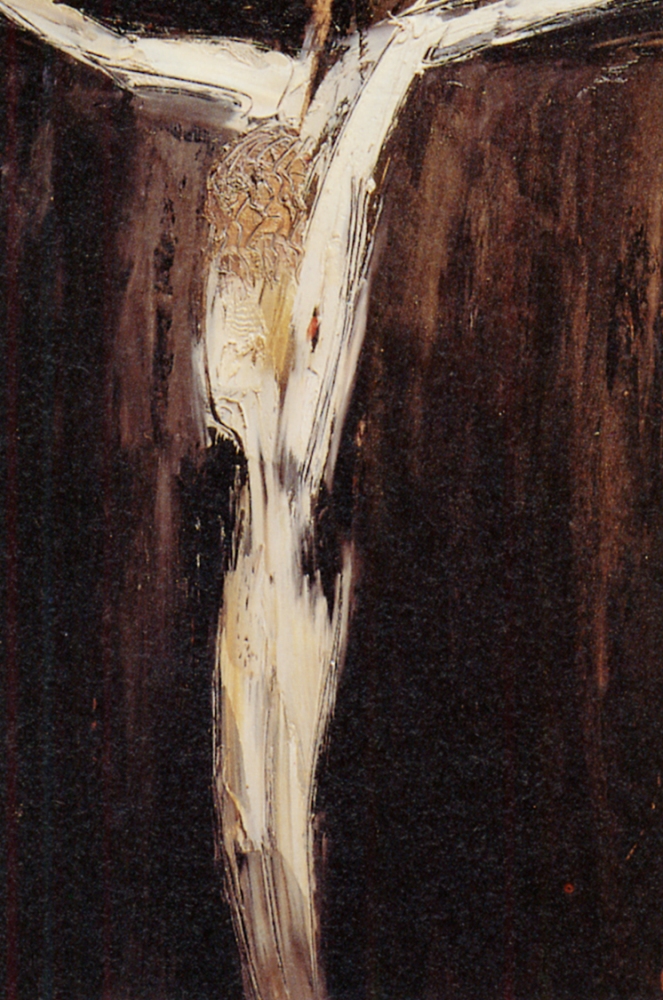
William Congdon, "Crucifixion No.2", 1960

In the dark reaches of Golgotha’s anguish,
His cold and nerveless hands—
Heavy with the pain of entire human sin,
And all cosmic evil (embracing all time)—
Reached out in a purposeful groping,
An attempted desire to reach,
Reach me, the lonesome, loathsome object
Of his insistent love.

In that moment I knew—in the moment of pain
And the high, wild cry—I knew he had embraced me,
Become me wholly as I was in my dream,
In my ineluctable anger and hate,
With all the dark deceits of my heart.

Me he became, and he anguished
As the intolerable pollution spread
Across the pure reaches of his holy self,
Drawing there out of me
The evil that was mine alone.

In the soft silence of his tomb I lay,
One with him in the unconquerable peace,
And with him I rose
When the world dawned new,
And I was the new man.

— Geoffrey C. Bingham, ‘Identification’, in All Things of the Spirit (Blackwood: New Creation Publications, 1997), 1.

Theology in Aotearoa: Two Conferences

1. The Systematic Theology Association of Aotearoa New Zealand is holding its Annual Conference in Dunedin on 11-12 November 2010.

The principal theme of the conference will be ‘Ecclesiology’. Those interested in presenting papers should send an abstract of 200-300 words addressing the theme to Murray Rae by 30 June. Papers to be presented at the conference should be no longer than 45 minutes in duration.

In addition to the principal theme of the conference there will also be opportunity for postgraduate students working in other areas of Systematic Theology to present shorter papers on the theme of their postgraduate research. Such papers will be of 30 minutes duration and an abstract of 200-300 words should likewise be submitted to Murray Rae by 30 June.

Submissions from postgraduate students on the principal theme of the conference will also be welcome.

2. The Laidlaw-Carey Graduate School is sponsoring a colloquium on the theme The Theology and Practice of Lament. The colloquium will explore cultural and theological implications of texts and practices of lament and/or complaint. Potential papers, should address complaint/lament with a focus on spiritual/theological dimensions so might include:

  • readings of biblical or other complaint or lament literature (Psalms, Job, Lamentations etc)
  • studies of historical or contemporary lament songs
  • pastoral perspectives on the contemporary practice of lament
  • theological reflections
  • cross cultural perspectives on lament practices
  • post Holocaust reflections
  • contemporary political reflections

The colloquium will take place in Auckland on 10-11 February 2011, with a view to publishing a book with the same title in 2011. Enquiries and abstracts (before 31 July 2010) should be addressed to Miriam Bier or Tim Bulkeley.

On self-appointed contemporary guardians of orthodoxy

‘There are two things the self-appointed contemporary guardians of orthodoxy seem to forget: (1) orthodoxy was never a guarantee of certainty, but of mystery; and (2) the opposite of faith is not doubt, but apathy.

Augustine spoke to the first point when he reminded us that after we have said everything we can about God we must remember that the God we have described is still not the God who is. As Daniel Migliore has said: “True faith must be distinguished from fideism. Fideism says we reach a point where we must stop our inquiry and simply believe; faith keeps on seeking and asking.” The goal of orthodoxy is to resist the simplistic reductions of irreconcilable realities, realities which invite (even demand) continued interrogation.

George MacDonald, the Scottish writer whom C. S. Lewis called his greatest influence, speaks to the second point in his fairy tale, The Princess and the Goblin: “People must believe what they can, and those who believe more must not be hard upon those who believe less.” The church is not a club; least of all the kind of club with which you beat others over the head.

MacDonald’s admonition is just as important to theology as is Augustine’s, and perhaps even more crucial for the church to hear today. A church rattled by threats from without and within is tempted to retreat into a cocoon of fideism, demanding the unquestioning belief of adherents. But a retrenched faith lacks the energy, imagination and love to engage the world for the sake of the gospel, and a defensive faith tends to prosecute its most creative minds and adventurous spirits precisely when it needs them most’. – Michael Jinkins, ‘Orthodoxy as guarantor of mystery‘.

Some classic Forsyth on the Church, its worship and its service

‘The greatest product of the Church is not brotherly love but divine worship. And we shall never worship right nor serve right till we are more engrossed with our God than even with our worship, with His reality than our piety, with His Cross than our service. It is well to dream and to talk much of brotherly love. But the brethren who love best and the love that loves longest are made by the Gospel. It is this they confess in loving, as they confess it in other ways also. Christian charity is not the sweet reasonableness of culture, nor is it natural kindliness of temper. To the lover of righteousness it does not come easy. It grows only on the stem of Christian faith, which is the tree of the Cross and its righteousness. The good live by faith and work by love. Never did Paul dream that his song of Christian love would be turned to belittle or to belabour the Christian faith on which alone it grows. The Church is the greatest product of history, and the greatest product of the Church is a holiness answering the holiness that made it, which is Holy Love. The first commandment of the Cross is “Be ye holy, for I am holy.” Its call is for the confession, worship, and service of that divine Holiness of love which is the spring of our Redemption. The service of God is the root, the service of man is but the fruit. True, by their fruits shall we know them; but not produce them. The fruits are the evidence, not the principles. Love does more to show faith than to produce it. Grace produces it. We live by that faith in holy Love whose fruit is to be a love not only kind, but, still more, holy’. – Peter T. Forsyth, The Church and the Sacraments (London: Independent Press, 1947), 25–6.

Today is PT Forsyth’s birthday.