We’re going to need the minister
to help this heavy body into the ground.
But he won’t dig the hole;
others who are stronger and weaker will have to do that.
And he won’t wipe his nose and his eyes;
others who are weaker and stronger will have to do that.
And he won’t bake cakes or take care of the kids –
women’s work. Anyway,
what would they do at a time like this
if they didn’t do that?
No, we’ll get the minister to come
and take care of the words.
He doesn’t have to make them up,
he doesn’t have to say them well,
he doesn’t have to like them
so long as they agree to obey him.
We have to have the minister
so the words will know where to go.
Imagine them circling and circling
the confusing cemetery.
Imagine them roving the earth
without anywhere to rest.
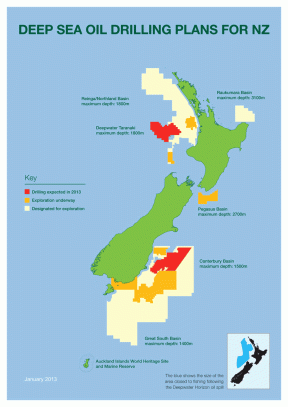
News that the Texan oil and gas exploration company Anadarko Petroleum Corporation is to undertake a test drilling program in the Canterbury Basin just off the Otago Peninsula is causing stir here in Dunedin among a good number of residents deeply concerned about the significant environmental and economic risks that such drilling poses to the region. Shell too have plans to explore the Great South Basin for additional oil and gas reserves.
Such highly-charged ventures rarely display politics in its most attractive, reasoned, transparent and democratic guise. One example of this occurred just a few weeks ago (on 10 January) when the intelligent and responsible folk who make up the St Martin Island Community were ordered, by the Otago Regional Council, to take down a ‘No Drill’ sign (erected in late October 2013) because, according to the ORC, the community were in breach of resource consent which states that ‘no advertising signage shall be erected on the jetty’. Now it’s not at all clear to me, or to the SMIC, just how such a sign is an example of ‘advertising’. (It is difficult to imagine such an order being issued for a sign encouraging the All Blacks to thrash their opponents at a game at the ORC’s beloved stadium (once described, in what sounds like a joke, as ‘pivotal to Dunedin and Otago’s future’; similar rhetoric was being used to sell the drilling program: ‘A key to Dunedin’s future prosperity could lie buried beneath the seabed just 60km off the coast’, we are told), or a sign welcoming cash-carrying Chinese tourists to Dunedin, or a sign championing the importance of brushing one’s teeth without the use of rat poisons, for example. And yet a ‘No Drill’ sign appears to me to be of much the same order.)
At the most recent meeting of the SMIC Council, it was decided that an appeal of the ORC’s decision would be made to the Environment Court asking for a stay on the grounds that the ‘No Drill’ sign is not advertising but ‘a prudent safety message’. Such an appeal has since been lodged and we now await the court’s decision, hoping that common sense and the rule of law (these are not always at odds!) will prevail over all other interests. Certainly any democracy that seeks to legislate against legitimate (i.e., non-violent) forms of protest has failed tragically to understand its own virtue.
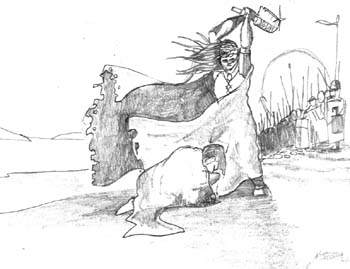
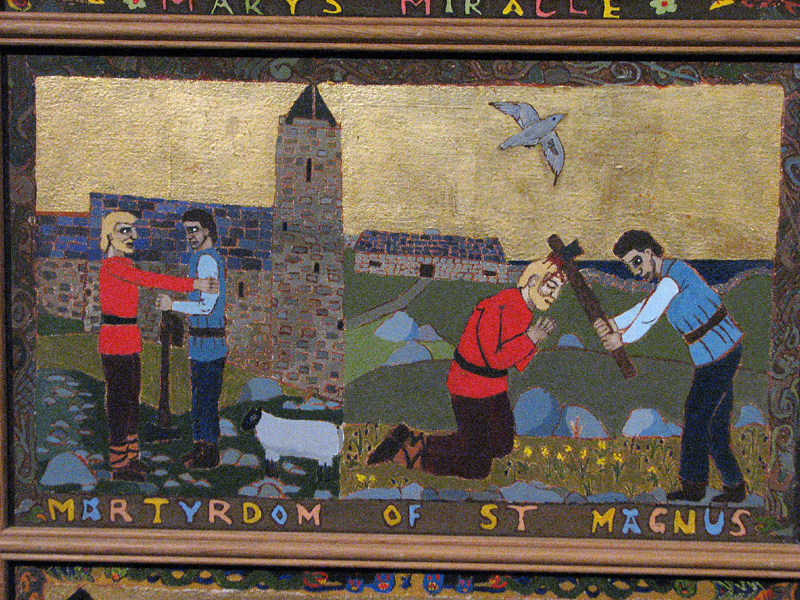
‘So Magnus Erlendson, when he came up from the shore that Easter Monday, towards noon, to the stone in the centre of the island, saw against the sun eleven men and a boy and a man with an axe in his hand who was weeping … Then in the light of the new day, 16 April 1117, there was a blinding flash of metal in the sun’. – George Mackay Brown
‘The Orkney Isles, off the northern coast of Scotland, were ruled by the Viking king of Norway in the 13th century, and Magnus was the rightful heir to the Earldom of the archipelago. He was a bit of an odd one. Once he’d joined the King on a raiding party, but he’d stayed back on the ship and sung psalms. He’d refused to fight. It would be something of a theme in his short life. The King wasn’t sure about a ruler who wouldn’t fight, and so he also recognised the claim to the Earldom by Magnus’ cousin, and the two ruled jointly for some years. It worked pretty well, until some of their followers felt things would be better if their respective Earl had the job to himself. Things started to shape up for war. It seemed inevitable. Inevitable, that is, until Magnus insisted that he and his cousin try and talk their way to a peaceful solution. He suggested that they meet on a deserted island where the only building was an ancient stone chapel. They agreed to meet, each bringing only two ships of men, enough for protection but not enough for serious aggression. Magnus arrived the night before with his two ships. He spent the night in prayer.
In the light of the dawn, however, he saw his cousin’s treachery. Eight ships were entering the harbour. Too many for peace. Too many for truce. Not too many for war.
What would Magnus do? He could run, flee and gather his supporters on the mainland and fight this out. Or he could appeal to the King of Norway to deal with his scoundrel cousin. Instead, he turned quietly and went back into the small stone chapel to pray, as if the chapel were his Garden of Gethsemane. The war party surrounded the chapel and demanded Magnus surrender himself. He did, once the cousin had agreed to leave his men unharmed. The gathered chiefs demanded that the Earl’s duel in order to bring an end to the division that threatened to tear the islands apart. But the cousin wasn’t willing to give up his advantage, and Magnus refused to fight, so the cousin decided to execute Magnus. Magnus tried to talk his cousin out of this course of action so as to save his cousin’s soul. Lest we think that Magnus was acting out of self preservation, however, his alternative suggestion was that he be mercilessly tortured and disfigured, left alive but ruined, so as to protect his cousin from committing murder. But the cousin wanted no rival, however broken. He ordered his finest warrior to kill Magnus. The warrior refused. In fact, none of the cousin’s soldiers would meet his eyes or his demands. Finally, under the threat of death, the cousin’s poor cook, weeping and pleading for Magnus’ forgiveness was chosen for the task. Magnus spoke quietly and calmly to him, telling him the sin was not his, that Magnus held nothing against him, that he should do what he must do, and think no more of it.
So he did, and Magnus was killed. And there was peace, for there was no one left for the cousin to fight. But there was also grief, such grief among the people that Magnus’ body was shortly recovered and buried with honour. A church was built to mark the place and his death, the cross of Magnus became their flag, and the sacrifice of Magnus their pride and their shame.
Could this be what faith looks like, when the beloved ones of God love peace more than themselves, that even the wicked moments of human cruelty might, in the mysterious grace of God, be made to tell the story of love which covers all and conquers all?’
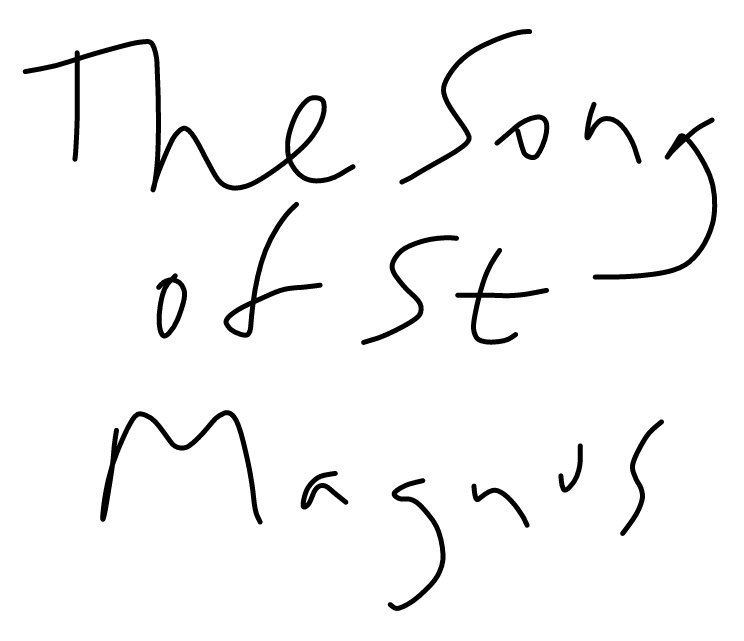
These (lightly edited)words, and the wonderful song that follows, were penned and recorded recently by my dear friend Malcolm Gordon. Those, like myself, who consider themselves fans of the work of George Mackay Brown, from whose pen many of us first heard of Magnus, will enjoy this:
The northern miles
Hold the Orkney Isles
Lands of windswept vale.
And from this place
Comes a tale of grace
Of love amidst betrayal.
Magnus ruled
With his brother too
And peace shone out like dawn.
But rumours spread
That blood would be shed
As battle lines were drawn.
Before we fight
Let’s see if we might
Find ways to live together.
We’ll each bring two boats
See if peace might float
Even in this stormy weather.
For he went to war But he would not fight Yet peace he won undying, For his hands were tied But his heart on fire Saint Magnus Earl of Orkney Isles.
Eight ships appeared
And the trick he feared
This truce became betrayal.
Would he run away?
No, he stayed to pray
To find the strength to fail.
‘One chief we’ll have’,
The brother said,
‘And that chief will be me’.
But he could not find
Someone of his kind
To kill this saint to-be.
For he went to war But he would not fight Yet peace he won undying, For his hands were tied But his heart on fire Saint Magnus Earl of Orkney Isles.
No soldier would
And the brother stood
Alone with death’s desire.
But he found his one
And the sin was done
For fear of him, a murder.
But Magnus swore
This sin is not yours
Your tears will count for something,
So do this deed
And find God’s peace
I’ll hold against you nothing.
For he went to war But he would not fight Yet peace he won undying, For his hands were tied But his heart on fire Saint Magnus Earl of Orkney Isles.
The blow fell sharp
And the saint fell hard
Truce was bought with his blood.
The people wept
But this peace they kept
They kept the peace of Magnus;
Yes, they kept the peace of Magnus.
For he went to war But he would not fight Yet peace he won undying, For his hands were tied But his heart on fire Saint Magnus Earl of Orkney Isles.
It had been on my ‘to read’ list for years, which is probably one reason why I never got around to reading it; that all-too-familiar self deceit that accompanies the knowledge that having placed something somewhere it is now under one’s ‘control’, done with. Done with, at least until someone else mentions it in such a way that the chicanery threatens to become exposed, as happened a few weeks back when William Storrar was in town to deliver a couple of public lectures.
In one lecture, titled ‘The Common Good: A Question of Style’, Storrar attempted to offer a kind of theological justification for democracy. (My friend Andrew wrote a bit about it here.) With refreshing ease, wit and insight, the big Scotsman drew upon a host of material from a wide range of sources. He spoke about David Hollenbach’s Christian ethic of the common good. He mentioned Paul Tillich’s brilliant essay on ‘The Protestant Principle and the Proletarian Situation’ in which Tillich argues that ‘what makes Protestantism Protestant is the fact that it transcends its own religious and confessional character, that it cannot be identified wholly with any of its particular historical forms’. Storrar referred to this trait as a way of underwriting Protestantism’s ‘prophetic scrutiny’. And Protestants need to recover their nerve, he said, to be both disciples and citizens who seek the welfare of the city. Here he drew, I guess unsurprisingly, upon Marilynne Robinson’s very fine essay ‘Open Thy Hand Wide’ (published in When I Was a Child I Read Books), and upon, somewhat surprisingly given the topic, Alan Lewis’s extraordinary study on Holy Saturday, and upon the work of the Scottish architect Alexander Thomson who championed a vision of public space which is both open and horizontal. Most cited, however, and not only because he happened to be in the room, was my dear friend and distinguished church historian Peter Matheson and his book The Rhetoric of the Reformation.
Which brings me back to that ‘to read’ list that I mentioned, and to Peter’s extraordinary book (which I’ve since read) on the Reformation as social choreography. In The Rhetoric of the Reformation, Matheson builds a stunning case for why we should understand the Reformation movements as characterised by a real sense of playfulness, as a game. In his own words:
The Reformation ‘game’ succeeded because it lured onlookers into becoming participants, to join the dance … [T]he word spiel, game, was often used by the Reformers to describe the events in which they were involved. The difficulty of course, was that the traditional referees – the bishops, councils, and Popes – had been sidelined, ‘sin-binned’.
It was a game, therefore, in which the rules were being reinvented as it proceeded. The daring, passionate preachers, the initiators of communal liturgies, the authors of the smudgy, cheap pamphlets and broadsheets which landed on German laps in their tens of thousands in the 1520s were, of course, serious enough, ready to risk career and even life for their convictions. But on another level they were hucksters standing behind their several booths, enticing people to ‘have a go’, to sing along with the Wittenberg nightingale. ‘If, then, you long for truth then come and join us in the dance’, writes Thomas Müntzer to the people of Erfurt at the height of the Peasants’ War.
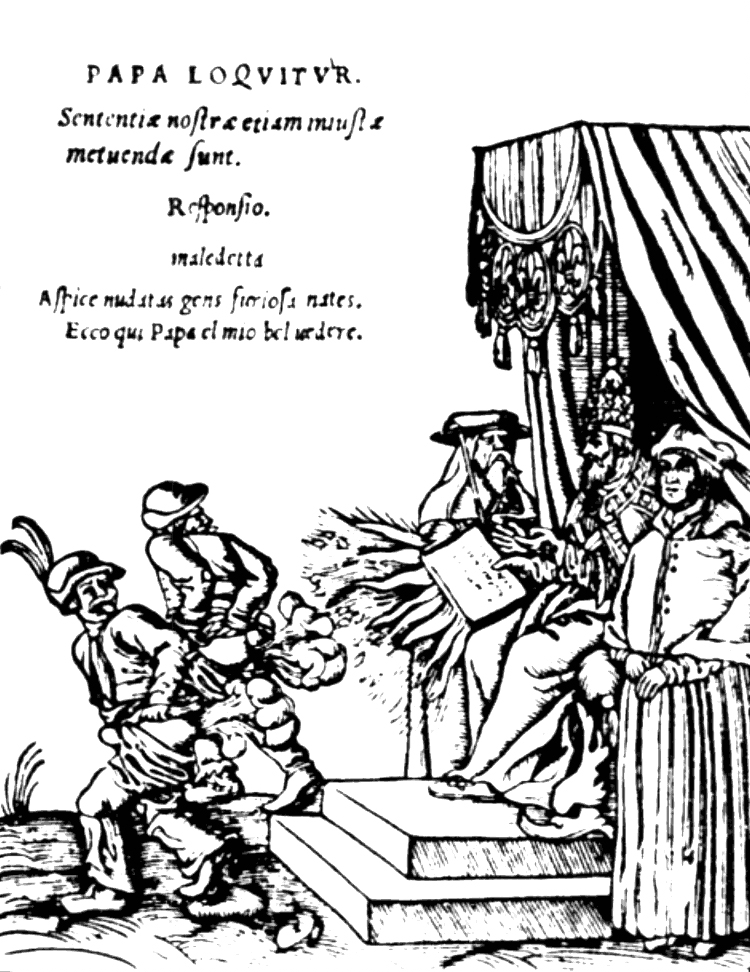
Matheson gets – and that much more than most – that the Reformation was about something much more profound and basic than structural and doctrinal reform. It was ‘a paradigm shift in the religious imagination’. ‘Each pamphlet’, he argues, ‘is witness to a collapsed consensus, and simultaneously signposts the dream of a new religious landscape and inscape. The broadsheets and wood-cuts of the period confirm this. They present the birthpangs of a new age in visual terms: a drastic, simplistic confrontation of dawn and dusk, light and dark, discipleship and corruption, freedom and tyranny. Their striking images are littered with rhymes, slogans, catch-phrases which decoded them, above all with what we can call God’s graffiti, quotations from Scripture’.
Like his The Imaginative World of the Reformation and his most recent Argula von Grumbach (1492–1554/7): A Woman before Her Time, Matheson’s The Rhetoric of the Reformationis a much welcome breath of fresh air among the shelves of mostly turgid and arenose literature on the Reformation. There are some remarkable exceptions of course, MacCulloch’s general introduction being the most obvious, but there might not be anything nearly as fun or which liberates the sixteenth century movements of reform from those flat retellings and makes it come alive in 3-D as a period in which we see our own foibles and idiosyncrasies being played out.
While on the topic of books, I hit a wee jackpot at a book bin this week where, in an act of the most fortuitous blasphemy, titles by Donald MacKinnon, G. W. H. Lampe, John Macquarrie, Alexander Schmemann and G. A. Studdert Kennedy, among others, were being thrown out. Yippee.
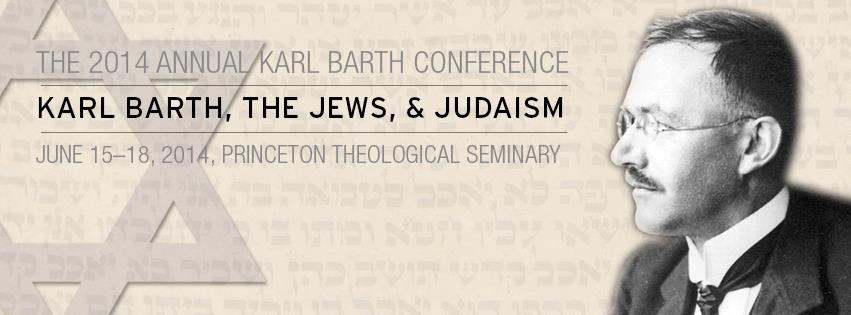
Princeton Theological Seminary is hosting their annual Karl Barth Conference on June 15–18. This year’s theme is ‘Karl Barth, Jews, & Judaism’, and the plenary speakers are:
Victoria Barnett (United States Holocaust Memorial Museum)
Perhaps no dominical injunction has been rendered by christological elaboration more difficult in Christian practice, personal and corporate, than Jesus’ supposedly simple distinction between the proper claims of Caesar and God. (G. H. Williams)
Amid pressure from Nazi defenders for a ‘positive Christianity’, Erik Peterson, in his essay ‘Kaiser Augustus im Urteil des antiken Christentums’ (1933), argues that despite the persecutions in the early centuries of the Christian community, there was – from Luke through Quadratus, Melito of Sardis, Justin Martyr, Theophilus of Antioch, Origen, Eusebius of Caesarea, and Orosius – a somewhat positive evaluation of the Empire. And in his book Der Monotheismus als politisches Problem. Ein Beitrag zur Geschichte der politischen Theologie im Imperium Romanum (1935), Peterson further develops the claim that there existed something of a convergence of interests between pagan and Christian monotheism, a convergence which illustrates how positive evaluations of the Empire in terms of the Logos, and related notions in the Ante-Nicene period, ill-prepared the Christian bishops for handling the vastly enlarged risks and opportunities that lay before them. As G. H. Williams (who was, of all the odd creatures to be, a Unitarian) has noted in a fine article on ‘Christology and Church-State Relations in the Fourth Century’, this meeting of interests at first betrayed the bishops into championing ‘an uncritical acceptance of political support, until at length a fully understood Trinitarianism proved itself capable of resisting the exploitation of Christian monotheism as a means of sanctioning political unity and securing social cohesion’.
At the centre of this discussion lies the question of christology; more particularly, an ancient debate, as Williams has shown, between first ‘the Catholic insistence upon the consubstantiality of the Son and the championship of the independence of the Church of which he is the Head’, and second, ‘between the Arian preference for Christological subordination and the Arian disposition to subordinate the Church to the State’, correlations much obscured by the fact that Christological orthodoxy was at first defined under the presidency of a sole emperor and following a half century of controversy manufactured by another. Yet, as Williams proceeds to note, ‘all who have worked through the fourth century have sensed some affinity between Arianism and Caesaropapism on the one hand and on the other between Nicene orthodoxy and the recovery of a measure of ecclesiastical independence’. He continues:
In insisting that the God of Creation, of Redemption, and the Final Assize is essentially one God, the Catholics were contending that the Lord of Calvary is also the Lord of the Capitol. But for this very reason the typical Nicenes were unwilling to accommodate revelation to reason purely in the interest of enhancing the cohesive value of Christianity for the Empire. In contrast, the Arians, having a comparatively low Christology were pleased to find in their emperor a divine epiphany or instrument or indeed a demigod like Christ himself. Thus the Arians were more disposed than the Nicenes to accept the will of an emperor as a canon and to defer to him as bishops, because the canons, tradition, and scriptural law centering in the historical Christ could not possibly in their eyes take precedence over the living law (nomos empsuchos) of the emperor ordained by the eternal Logos.
While writing a paper on the historical and theological significance that the Latin phrase Ecclesia reformata semper reformanda secundum verbum Dei seeks to capture, I came across these share-worthy sentences from Piet Naudé on the contribution that ‘Reformed’ theologians and bible scholars make:
[F]rom the view of confessions … being a ‘Reformed’ systematician or biblical scholar does matter, not only because confessions are by their very nature a specific hermeneutical decision about reading the text of Scripture today, but also … because the continued struggle to heal schismatic tendencies among Reformed churches places a responsibility on us to be serious about the ethics of our own reading and academic activities.
Being Reformed really matters if we call for a repentance of our ‘hermeneutical diseases’ manifesting themselves inter alia in a narcissistic obsession with methodologies or a lame acceptance of differences prompted by a cynical postmodern arbitrariness. Put in a positive manner, being Reformed really matters if we recommit ourselves to ongoing conversation (Tracy) and true convivendi (Joerns), because interpretative conflicts and deadlocks are not merely between hermeneutical systems, but between living Christians in a world desperate for signs of reconciliation.
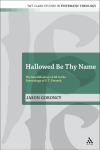
The latest issue of Reviews in Religion & Theology includes a review, by W. Travis McMaken, of my book Hallowed Be Thy Name: The Sanctification of All in the Soteriology of P. T. Forsyth. I’m very grateful to Travis for penning this review and for the prod to again consider turning my attention to the challenge of writing an intellectual biography on this most creative of theologians in the tradition of British dissenters.
Those who don’t have access to the journal can read a copy of the review here.
I’m very proud of my hard-working uncle Jan, and I love (and share) his passions – for life, for good food, for honest music, for healthy animals, and for incomparably good garlic. His Barrington River Organic Farm is not only an absolutely gorgeous and highly productive space, it’s also an inspiring place to be (with the one exception of when he gets onto your back about pulling out the dreaded fireweed). Yesterday, Prime TV ran a wee story on him and the Gloucester Bucketts of Garlic Festival, and I wanted to share it:
January is the month when for a morning or two you expect to wake up with a dry mouth at least.
January is the month when you observe, sadly, six of your seven good resolutions blow away on the cold wind.
January is the month when you dismantle – on a precise date, the sixth – the Christmas tree and give all those expensive Christmas cards to the children to scrawl on with their crayons.
January is the month when bills seem to seep through your letter box with pitiless monotony. The man who was as rich as Rockefeller on Christmas Eve is as poor now as a church mouse.
January is the month when you wait for the worst of the winter to fall, sleet and hail and snow out of the north-east. You kind of exist between an iron earth and a leaden sky.
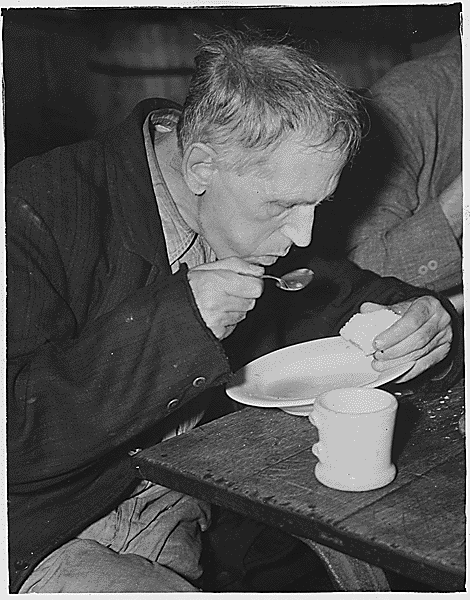
January is the month when turkey and sauterne and tangerines are forgotten about for another eleven months. You are grateful for simple things – a fire, a bowl of soup, a piece of bread.
January is the month of Robbie Burns, that marvellous man whose memory has been ruined in great splurges of sentimentality and hogwash.
January is the month when you go through a box of tissue handkerchiefs a week.
January is the month of the double mask. It looks both ways, into the follies and delights of the past year, and into the nebulous hopes of what is to come. Either way, it tells you very little.
January is the month when you are appalled by the number of empty screwtops in your cupboard. Hopefully you order more malt, more sugar, more hops.
January used to be the month when the people of Orkney read books. Now we grow sick on a surfeit of television. Imagination in the north, which used to be most vivid at this time of year, slowly withers.
January is the month of rubber boots and bonnets and the mittens Aunty Bella knitted.
January is the month when bed is the most beautiful place of all. The eight o’clock news on the bedside wireless is a hateful sound. You rise and have to lay aside all those beautiful swathings of dream.
January is the month when the full moon is most glorious of all (though I think the stars have it, for December).
There is no month of the year quite like January. What is better than a walk along the west shore in that cold, silver air?



 jasongoroncy.com