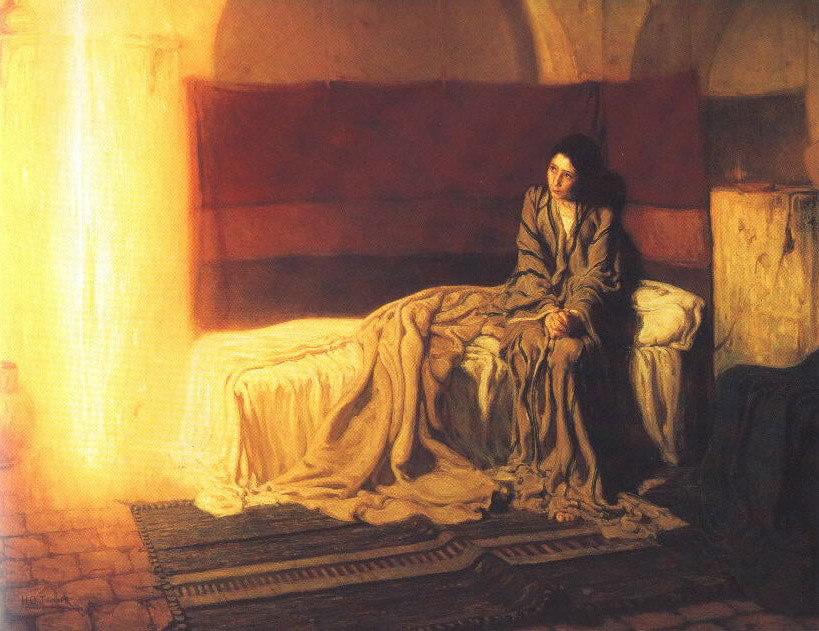
 Advent I: O Love, aren’t you tired yet?
Advent II: On the pseudonymous activity of God
Advent III: But then … they appear
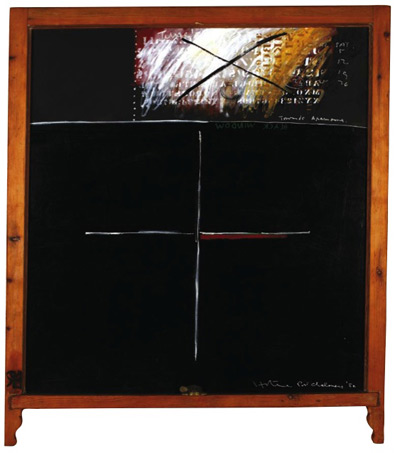
Ralph Hotere, 'Towards Aramoana', 1982
‘That Cross was deep embedded in the very structure of Christ’s Person, because nowadays you cannot separate His Person from His vocation, from the work He came to do, and the words He came to speak. The Cross was not simply a fate awaiting Christ in the future; it pervaded subliminally His holy Person. He was born for the Cross. It was His genius, His destiny. It was quite inevitable that, in a world like this, One holy as Jesus was holy should come to the Cross. The parable was spoken by One in whom the Cross and all it stands for were latent in His idea of God; and it became patent, came to the surface, became actual, and practical, and powerful in the stress of man’s crisis and the fullness of God’s time. That is an important phrase. Christ Himself came in a fullness of time. The Cross which consummated and crowned Christ came in its fullness of time. The time was not full during Christ’s life for preaching an atonement that life could never make’. – P.T. Forsyth, The Work of Christ (London: Hodder & Stoughton, 1910), 107–8.
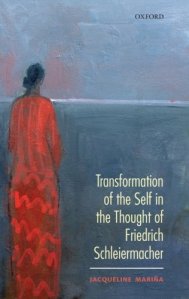 A Review: Transformation of the Self in the Thought of Friedrich Schleiermacher, by Jacqueline Mariña. Pp. x + 270. Oxford: Oxford University Press, 2008, ISBN 978 0 19 920637 7. £61.
In this study, Jacqueline Mariña, a Professor of Philosophy at Purdue University, seeks to provide an exposition and analysis of the key metaphysical concepts undergirding Friedrich Schleiermacher’s thought regarding moral and spiritual transformation. She does so via an exegesis of the post-Enlightenment and post-Kantian metaphysics upon which the mature Schleiermacher develops his ethics – particularly the notions of self-consciousness and personal identity – and that in sustained conversation with some of the German theologian’s key dialogue partners, principally Kant, but also Spinoza and Leibniz, and, less so, Fichte and Jacobi, and with Platonic and Augustinian metaphysics of the self. Mariña also offers some helpful analyses of the development of Schleiermacher’s thought regarding ethics.
Mariña’s essay has notable merits, principal among them being its defence of Schleiermacher’s overall moral theory as both the cornerstone of his thought and a legitimate entrée for understanding his theology. She understands that Schleiermacher’s ethics are irreversibly engaged with his metaphysics of the absolute and the philosophy of religion. Building on the work of Frederick Beiser, she argues that ethical theory is ‘central to Schleiermacher’s outlook’ and that ‘it is in the sphere of ethics that religion has its ultimate meaning, for the fruit of all true religion lies in its transformative power over the self’ (p. 3). The significance of Schleiermacher’s achievement, Mariña argues, is that by focusing on religious experience and the transcendental conditions of subjectivity, Schleiermacher offers an account of religion unencumbered by reductionism and dogmaticism. Insofar as he does this, Mariña contends, Schleiermacher makes an important contribution to contemporary interreligious dialogue.
Drawing on Schleiermacher’s early essays On Freedom (1790–2), his notes on Kant’s second Critique (1789), the third of his Dialogues on Freedom (1789), and his review of Kant’s Anthropology from a Pragmatic Point of View (1799), the opening chapter, titled ‘The Philosopher’s Stone’, examines Schleiermacher’s struggle with Kant’s practical philosophy. Mariña notes that while he had some sympathies with Kant’s project, the early Schleiermacher became ‘increasingly dissatisfied with some of the deep philosophical problems posed by the notion of transcendental freedom’ (p. 16).
Chapters Two and Three provide an analysis of two early works (1793–94) by Schleiermacher on Spinoza, namely Spinozism and the Short Presentation of the Spinozistic System. Chapter Two examines Schleiermacher’s claim that there are no genuine individuals, and does so by way of considering Kant’s distinction between noumena and phenomena. Mariña argues that Kant’s analysis of transcendental subjectivity remains an important part of the early Schleiermacher’s thought and informs his decision to abandon Spinozism. She concludes: ‘Despite his familiarity with Kant’s arguments against the possibility of knowledge of the transcendent, in Spinozism Schleiermacher had already come to the conclusion that it is through the transcendental activity of the self that the soul comes into contact with what is genuinely real’ (p. 75). Chapter Three builds on the work undertaken in the previous chapter and considers more deeply issues of personal identity and (in agreement with Kant) our lack of access to a substantial noumenal self.
Mariña then turns to the influence of Leibniz – ‘a poor philosopher [who] from time to time … developed better insights’ (p. 109) – on Schleiermacher’s thought by way of discussion on Schleiermacher’s Monologen (1800) wherein Schleiermacher, playing on Leibniz’s notion of the self as a mirror of the world, envisions transcendentally-free beings expressing themselves into the world. The author recalls Schleiermacher’s appropriation of Kant’s critique of rational psychology and his avouchment that we have no access to knowledge of self as it is in itself. ‘Self-knowledge is only of the empirical self, and this means that the self knows itself only in its relation to that which is different from it and stands outside it. It is, therefore, through the world that the self comes to know itself’ (pp. 110–11). ‘Without the other, there is no knowledge of the self. The person expresses him or herself to the other, and the self as thus expressed is reflected back to the self in the self-consciousness of the other. Loss of the other is therefore a loss of oneself’ (p. 143). This contextualises and anticipates the later discussion on christology, and addresses a foundation of Schleiermacher’s employment of Leibniz’s (and Hegel’s) claim that it is ‘only in relation to a historical individual with a perfect God-consciousness’ that human beings can ‘achieve moral perfection. For only such a one who expresses the divine love perfectly knows the essence of all rational beings as their capacity to express the divine love. Such a one reflects this essence back to them so that they can thereby know themselves as beings that express the divine love’ (p. 144). Clearly, Schleiermacher has moved beyond Kant. The author here identifies key Leibnizian themes that Schleiermacher will develop further in his Dialektik (1814–15) and in Der christliche Glaube (1821–22); particularly the relationship between God and the self, and the self and the world, and the integration that occurs between one’s representation of the world and one’s own desires, and so one’s actions.
In Chapter Five, Schleiermacher’s 1805–06 works, Notes on Ethics, and his Outline of a Critique of Previous Ethical Theories (1803), serve as the basis for exploring the implications of ensouled human nature, and so a reality in which sensuously-conditioned desires can be infused with ethical content. Mariña considers how the teleology of moral action seeks the perfection of this world and not some other. She recognises (in a later chapter) that at the centre of Schleiermacher’s ethics lies the ‘non-transposable character of individuals and historical communities, each of which has a special character determined by a particular historical development’ (p. 168), and that ‘Schleiermacher recognized that not to acknowledge our situatedness can only lead to delusions of absolute knowledge having the most pernicious of consequences’ (p. 176), but unfortunately she does not take up Karl Barth’s suggestion, in The Theology of Schleiermacher, that we know Schleiermacher best when we understand him as a virtuoso of family life, in the society of relatives either of blood or of one’s own choosing (pp. 108–9).
 The notion of ensoulment is further developed in Chapter Six, wherein Mariña probes the ensoulment of human nature through reason and through the establishment of community, and in Chapter Seven, ‘Transforming the Self through Christ’, in which the author recalls Schleiermacher’s christology (a subject which ‘encapsulates the whole of his theology’ (p. 187)) in terms of Christ’s own God-consciousness and in terms of Christ’s creating God-consciousness in others, consequently transforming their ethical outlook. Mariña contends that Schleiermacher’s Christ – the one who ‘defines what it means to be human’ (p. 196) – engages in person-forming activity, a work established in the original divine decree and which involves a transformation of ethic. Insofar as he does this, Christ is, in Schleiermacher’s words, ‘the completion of the creation of man’ (cited on p. 196). This means, Mariña contends, that for Schleiermacher, ‘Jesus is no mere teacher of morality, but that what he mediates is a relation to the ground of being and love, and thereby to the transcendental ground of all true religion and ethics’ (p. 197). Moreover, our assimilation into Jesus’ divine life is ‘achieved through the communication of his words and deeds’, both of which are required to effect the divine love in history and shape human self-consciousness and being in the world. ‘The divine love manifest in the life of the historical Jesus brings a new way of envisioning what it means to be a human being, and what it means to be in community’ (p. 219).
The final chapter returns to the challenges of religious pluralism which were broached in the introduction and does so via an analysis of arguments proffered in the 1821 edition of On Religion and in the second edition of Der christliche Glaube. Mariña argues that Schleiermacher’s thought provides a ‘generally coherent account of how it is possible that differing religious traditions are all based on the same experience of the absolute’ (p. 224). She further claims that religious differences are differences only in degree, not in kind. ‘It is because there is a single, fundamental experience to which all the world’s religions are related that there can be meaningful and significant dialogue among them’ (p. 243).
Mariña’s study has a number of strengths. Building upon her already published work on Schleiermacher and Kant, she offers a valuable analysis of several chief sources of Schleiermacher’s thought, and of Schleiermacher’s employment, discarding and development of some of their ideas through various stages of his own theological and philosophical maturation, properly observing the way in which Schleiermacher’s ethics are grounded upon his theological claims, that philosophical ethics is purposely descriptive of how divine causality finds shape in human community through individual persons. Insofar as she does this, Mariña’s essay fills a noticeable gap in the English-speaking literature, and is a welcome complement to works by Richard R. Niebuhr (Schleiermacher on Christ and Religion, 1964), Albert Blackwell (Schleiermacher’s Early Philosophy of Life: Determinism, Freedom, Phantasy, 1982), Brian Gerrish (A Prince of the Church: Schleiermacher and the Beginnings of Modern Theology, 1984), Julia A. Lamm (The Living God: Schleiermacher’s Theological Appropriation of Spinoza, 1996), Catherine L. Kelsey, (Thinking about Christ with Schleiermacher, 2003), and Richard Crouter (Friedrich Schleiermacher: Between Enlightenment and Romanticism, 2005).
Mariña’s argument could have been more persuasive had she attended further to a number of her claims: for example, the claim that Schleiermacher’s proposals concerning transcendental freedom are made at the cost of abandoning determinism. Readers may also be left unsatisfied that Mariña stops short of recounting how the transformation of self with which Schleiermacher is so concerned is effected, and what lay behind the author’s decision to give relatively little attention to Schleiermacher’s more mature ethics (for example, his lectures on philosophical ethics delivered at the University of Berlin between 1812–1830, a period which overlaps Hegel’s time at that same institution, or Schleiermacher’s six Akademieabhandlungen read before the Academy of Sciences between 1819 and 1830) which invite us to consider how language, tradition and institutions inform the moral shape of human being both universally and particularly, and which may have assisted Mariña to provide a more rigorous comparison between Schleiermacher’s early and later ethics and their relation to Schleiermacher’s christology developed in Der christliche Glaube (1821/22, 1830/31) – to which she appropriately turns in her penultimate chapter though fails to develop as fully as her project requires – and particularly the relationship between Jesus’ own God-consciousness, the ethical significance of the hypostatic union, and his mediating to us divine causality. Moreover, Schleiermacher’s privileging of God’s ecclesiological community as that creation of the Spirit with which Jesus’ religiosity is a contemporary reality is disregarded by Mariña. Here, some readers may also take issue that Mariña’s reading of Schleiermacher as positing unmediated moments of the feeling of absolute dependence (a notion which betrays Leibniz’ influence) are offered too independently of Schleiermacher’s careful underscoring of historical, social, theological and cultural contingencies and practices with which much of his philosophical ethics are concerned. Finally, while appropriately situating this project and its value against the backdrop of contemporary challenges posed by various forms of religious (and other) fundamentalism and inter-religious dialogue, the author minimises the obstacles to interreligious dialogue and overplays the profitability that Schleiermacher’s project offers therein.
Few will follow Mariña on every point, and those seeking a particularly transpicuous exposition of Schleiermacher’s thought might well be disappointed, but this remains a valuable essay all the same, and those wishing to engage with Schleiermacher’s abiding significance for ethics will not want to be without it.
 The postie was very kind to me today, delivering no bills but only the following fun Christmas reading/listening:
And I’m still working my way through Diarmaid MacCulloch’s latest tome, Christianity: The First Three Thousand Years.
But first things first: fishing!
 In her delightful book, The World of Street Food, Troth Wells recalls a story by Liz Cullen as part of her introduction to a recipe for nasi goreng:
As a first-time delegate at a meeting on sustainable development in Bali, I was feeling disheartened. It seemed that every agreement reached was being diluted by the addition of statements such as ‘where appropriate’ or ‘where feasible’ thus mitigating any feeling that the ‘major players’ were about addressing issues of inequality and justice. It was therefore refreshing to walk on the beach at Nusa Dua and eat nasi goreng, cooked at a little mobile stall under the trees … (p. 60)
’twas strange weather today in Dunedin …

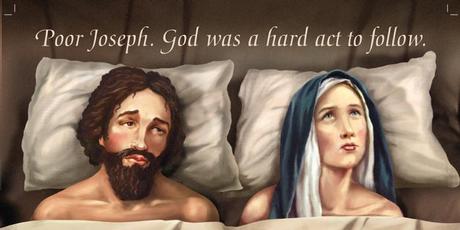
Today’s New Zealand Herald ran this image and its accompanying story about an Auckland church’s (St Matthews’) new billboard. I’m not really interested here in engaging with the controversy around the offensiveness or cleverness or otherwise of the image, or about how I feel about its defacement some five hours after it was erected. I am interested, however, in taking up the image’s and St Matthews’ (both St Matthews in fact, the apostle’s and the Auckland church’s) invitation to enquire about the Christmas event of Mary’s virginal conception, and about the Church’s ongoing proclamation of that event as part of the Good News for which it exists to bear witness.
So here’s my response to that invitation: The miracle of the virgin conception is a judgement against the possibility of the creature producing its own word of revelation and reconciliation. It is a judgement against us thinking that we can know God apart from God’s initiative, and that we might save ourselves apart from God’s bloody intrusion into our situation. It is the proclamation of God’s gracious and free decision to be God for us, to unveil for us, to reconcile us. And it is the proclamation of God’s gracious and free decision to save us, and that by becoming personally involved – literally enfleshed – in the deepest depths of creaturely experience. This is why it is Good News. In PT Forsyth’s words, ‘The Virgin birth is not a necessity created by the integrity and infallibility of the Bible; it is a necessity created (if at all) by the solidarity of the Gospel, and by the requirements of grace’. (Positive Preaching and the Modern Mind, 14).
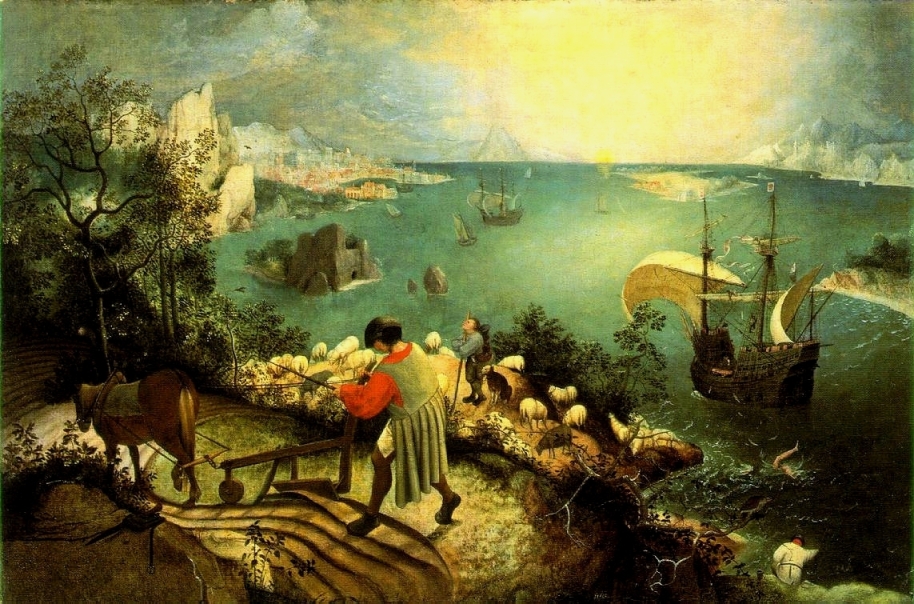 After W.H. Auden had visited the Musées Royaux des Beaux-Arts de Belgique in Brussels, and seen Pieter Brueghel the Elder’s c.1558 work, Landscape with the Fall of Icarus, he went away and penned the following cynical words:
About suffering they were never wrong,
The Old Masters; how well, they understood
Its human position; how it takes place
While someone else is eating or opening a window or just walking dully along;
How, when the aged are reverently, passionately waiting
For the miraculous birth, there always must be
Children who did not specially want it to happen, skating
On a pond at the edge of the wood:
They never forgot
That even the dreadful martyrdom must run its course
Anyhow in a corner, some untidy spot
Where the dogs go on with their doggy life and the torturer’s horse
Scratches its innocent behind on a tree.
In Breughel’s Icarus, for instance: how everything turns away
Quite leisurely from the disaster; the ploughman may
Have heard the splash, the forsaken cry,
But for him it was not an important failure; the sun shone
As it had to on the white legs disappearing into the green
Water; and the expensive delicate ship that must have seen
Something amazing, a boy falling out of the sky,
had somewhere to get to and sailed calmly on.
William Willimon recalls Brueghel’s painting, and Auden’s poem, in his book On a Wild and Windy Mountain, wherein he observes that we trudge past bleeding crosses with a shrug of the shoulders, that Good Fridays are so commonplace among us as to be unnoteworthy, and that tragedy achieves nobility only in the theater. ‘Everydayness and ordinariness’, he writes, ‘become our best defenses, the most effective relativizers of the tragic in our midst. Some young Icarus falls from the sky every day, so one had best get on with the business at hand until the extraordinary comes. For now, go to work, eat, make friends, make money, make love, mind your business – that’s the best way to cope, for the time being, with the expectedness of the tragic. The old masters knew best’ (p. 15).
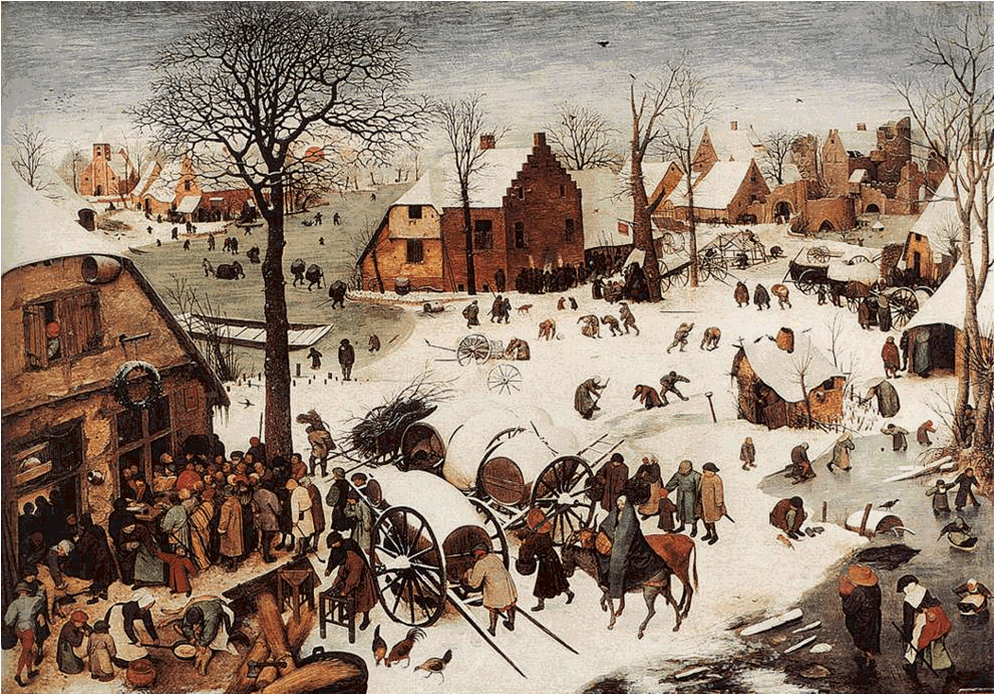 Willimon proceeds to compare Landscape with the Fall of Icarus with another of the Dutch masters’ works: Numbering at Bethlehem. He notes the ordinariness of the depiction, a day mundane and unpromising – in its highlights at least – and nothing beyond the expected.
But then … they appear.
They appear. ‘An inconspicuous, thoroughly ordinary young woman on a little donkey led by a stoop-shouldered, bearded peasant who carries a saw. Here is Mary, with Joseph the carpenter, come to town to be counted. They are so easily overlooked in the midst of ordinariness. Old masters like Brueghel’, Willimon rightly suggests (and we might add Rembrandt), ‘were never wrong’. Rather, they understood, and bore witness to in their work, the truth of Emmanuel, the scandal of the unostentatious God living – and dying – with us, of God stained with the sweat of human bondage and soaked – baptised – in the blood of human violence, of God incognito. ‘They understood our blindness not only to the tragic but also to the triumphant in our midst … In life, the Presence goes unnoted as we thumb through the evening paper. And so we wait, sitting in the darkness of the everyday until something extraordinary breaks in. Someday God may break into this world, we say. But for the time being, it is best to work, eat, make love, pay taxes, fill out government forms, and mind our business. The old masters knew it best’ (p. 16).
I have posted elsewhere on the pseudonymous activity of God, suggesting that ‘in the economy of holy love, the locus of greatest clarity equates to the point of greatest incongruity and surprise’. It is precisely that we may ‘see’ what Willimon so beautifully refers to as ‘the triumphant in our midst’ that we are graced, and that that we might witness to the day when good will triumph over all, certain that the grace of holy love will win at last because it did not fail to win at its most decisive time. In the meantime, such seeing typically requires what is another great advent theme: waiting, or what R.S. Thomas, in his poem ‘Kneeling’, called ‘moments of great calm’:
Moments of great calm,
Kneeling before an altar
Of wood in a stone church
In summer, waiting for the God
To speak; the air a staircase
For silence; the sun’s light
Ringing me, as though I acted
A great role. And the audiences
Still; all that close throng
Of spirits waiting, as I,
For the message.
Prompt me, God;
But not yet. When I speak,
Though it be you who speak
Through me, something is lost.
The meaning is in the waiting.
[This meditation was first written for the Advent series over at Hopeful Imagination, and I have posted other Advent reflections here.]
 My previous two posts invite some reflection on where theological thought begins. Here I want to suggest (taking my cues from TF Torrance, and drawing heavily on McGrath’s less-than-brilliant biography on Torrance) that theological reflection, or theological science, begins by immersion within the Christian community and its practices of worship and prayer. Here the believer absorbs the grammar of Christian faith, shares what Torrance calls its ‘evangelical and doxological’ experience, and begins to appreciate the ‘evangelical pattern or economy of the redeeming acts of God in Jesus Christ’ (The Christian Doctrine of God, One Being Three Persons, 98, 91). In other words, the basis upon which Christian theological reflection takes place concerns ecclesiology, christology and soteriology.
Consider the following statements about levels – or layers – of truth in the natural sciences:
… knowledge is gained not in the flat, as it were, by reading it off the surface of things, but in a multi-dimensional way in which we grapple with a range of intelligible structures that spread out far before us. In our theoretic constructions we rise through level after level of organized concepts and statements to their ultimate ontological ground, for our concepts and statements are true only as they rest in the last resort upon being itself. – Thomas F. Torrance, Reality and Scientific Theology (Theology and Science at the Frontiers of Knowledge; Edinburgh: Scottish Academic Press, 1985), 136.
We start with our ordinary experience in which we operate already with some sort of order in our thought which is essential for our understanding of the world around us and for rational behaviour within it. We assume that the world is intelligible and accessible to rational knowledge … we operate on the assumption that by means of thought we can understand in some real measure the relations between events and grasp their orderly sequence and consistent structure. – Reality and Scientific Theology, 147.
This initial perception of orderedness and structure, however, turns out, for Torrance, to be a starting point for a more penetrating and discerning investigation in which successive layers of truth are identified and uncovered, and their inner relationships established. One of the most helpful areas explored by Torrance concerns how our knowing God differs from how we know anything else. Consider this (lengthy) quote:
[When it comes to our knowledge of God] we have to reckon with a considerable difference between the kind of knowledge that obtains in physical science, for the created universe does not disclose or declare itself to us as God does – otherwise it would not be the creaturely or contingent reality that it is. The universe does reveal itself to our inquiries in its own limited reality, in correspondingly limited ways, but it is quite unable to explain itself or to yield any final account of the fact of its astonishing intelligibility, and so at these limits the universe by its finite nature simply turns a blank face to our questions. In contrast, God opens himself to us and informs us of himself in a way that no created being can. Even though he retains behind a veil of ineffability the infinite mystery of his uncreated Being, he nevertheless unveils himself to us as the transcendent Source and sustaining Ground of all created being and created intelligibility, and therefore of all our knowing of him as well as of the universe he has made.
Moreover, the Being of God is made known to us as Subject-being, not just as Object-being over against us. As Subject-being he is the Creator and Ground of all other subject-beings, who sustains them in relation to himself as personal rational agents enabled to have communion with him. That is to say, God interacts personally and intelligibly with us and communicates himself to us in such a personalising or person-constituting way that he establishes relations of intimate reciprocity between us and himself, within which our knowing of God becomes interlocked with God’s knowing of us. In fact our knowledge of God thus mediated is allowed to share in God’s knowledge of himself. An ellipse of knowing, so to speak, is set up within which God’s uncreated Intelligibility and our creaturely intelligibility, God’s self-witness and our human understanding, are correlated, so that there arises among us within the conditions of our earthly and temporal existence authentic knowledge of God in which God’s self-revealing is met by human acknowledgment and reception, and in such a way that our knowing of him, however inadequate, is made to repose ultimately on the free creative ground of God’s own Subject-being.
Nevertheless when all this is admitted it still remains the case that God confronts and interacts with us as he who is utterly transcendent over all our knowing of him, infinitely inexhaustible in the Truth and Intelligibility of his own eternal Being. As such the Reality of God ever remains the Source of all our authentic concepts of him and the unchanging Ground of all our faithful formalisations of his revelation. God himself does not change, and in his unchanging Being is open to ever deepening understanding on our part, while our forms of thought and speech in which we articulate our knowledge of him are ever open to further clarification, fuller amplification, and change. The Truth of the divine Being cannot be enclosed within the embrace of our finite conceptualisations. In that God admits of recognition and understanding on our part we may indeed grasp him in some real measure, but we cannot contain him in the forms of our grasping. We may apprehend God but we cannot comprehend him. In so far as our concepts of God derive from him and terminate upon his Being, there is much more to them than the concepts themselves, more than the formal truths of conception, for the Reality conceived transcends conceptual control. Before the Reality and Majesty of the divine Being whom we are graciously allowed to know, we know that all our knowledge of him is at a comparatively elementary level, and all our articulation or formulation of divine revelation is a relatively insignificant reflection of its Truth. The knowledge and understanding of God, however, which we are allowed to have, and which in some measure we may bring to systematic expression, are what they are in their lowly forms because, in spite of their utter inadequacy, as the human end of the ellipse of knowing established by God and maintained between us and himself, they are locked into an infinite range of truth and intelligibility grounded finally in God’s own eternal Being.
The development of our knowledge of God evidently involves a multi-levelled structure in which our thought moves through various levels of concepts and statements, to the levels of created being through which God makes himself known to us in space and time, and then through them ultimately to the supreme level where God is the transcendent Source of all truth in the Truth of his own uncreated Being. Each lower level is governed by reference beyond itself to the level with which it is immediately coordinated, so that together the lower levels constitute a coherent semantic frame of reference through which we are directed to the ultimate Truth that God is in himself. Thus every lower level, in so far as it is true, must have the character of an open structure pointing us away from its own limited and relative status to its ontological ground in God who is ‘the norm for the truth of all beings’ [Clement of Alexandria]. In clarifying and deepening theological knowledge, therefore, we must learn to penetrate through the various levels of rational complexity that arise in the process of inquiry to the ultimate ground upon which they rest in the Being of God. Just as we do not think statements or even normally think thought but think things through them or by means of them, so the structures of the reason which arise in the process of gaining knowledge have to be treated as refined conceptual instruments through which we let reality shine across to us, in order that its own truth of being and inherent intelligibility can operate creatively in our understanding of it.
What are we to understand by ‘truth’ in a context like this? – Torrance, Reality and Scientific Theology, 138–40.
What are the implications of this for the task of theological reflection? At the very least, it means that our knowledge of God is dependent upon God’s gracious self-unveiling, i.e. epistemology is grounded in the divine economy and particularly in Jesus Christ who comes to us ‘clothed in the gospel’ (Calvin). Jesus Christ is the ‘cornerstone of all authentically Christian theological reflection’. But this process of reflection, like all scientific enquiry, is also is multi-levelled. Torrance identifies three levels: (i) evangelical and doxological level; (ii) theological level; and (iii) higher theological level.
The first level is the evangelical and doxological level. (Torrance, Doctrine of God, 88–90). This might be thought of as the basic level of Christian experience and living, ‘the level of our day-to-day worship and meeting with God in response to the proclamation of the Gospel’. At this level, God is apprehended intuitively, ‘without engaging in analytical or logical process of thought’ (Torrance, Doctrine of God, 89). At this level, the Christian believer has an experience of the reality of God as a ‘basic undefined cognition which informally shapes our faith and regulates our trinitarian understanding of God’ (Torrance, Doctrine of God, 89). The Christian experience of worship, reading of Scripture, and an intuitive awareness of the reality of God constitute the point of departure for further theological reflection.
From the very start of our believing experience and knowledge of the incarnate economy of redemption undertaken by Jesus Christ for our sakes, form and content are found fused together both in what we are given to know and in our experience and knowing of it. A child by the age of five has learned, we are told, an astonishing amount about the physical world to which he or she has become spontaneously and intuitively adapted – far more than the child could ever understand if he or she turned out to be the most brilliant of physicists. Likewise, I believe, we learn far more about God as Father, Son and Holy Spirit, into whose Name we have been baptised, within the family and fellowship and living tradition of the Church than we can ever say: it becomes built into the structure of our souls and minds, and we know much more than we can ever tell. This is what happens evangelically and personally to us within the membership of the Church, the Body of Christ in the world, when through the transforming power of his Word and Spirit our minds become inwardly and intuitively adapted to know the living God. We become spiritually and intellectually implicated in patterns of divine order that are beyond our powers fully to articulate in explicit terms, but we are aware of being apprehended by divine Truth as it is in Jesus which steadily presses for increasing realisation in our understanding, articulation and confession of faith. That is how Christian theology gains its initial impetus, and is then reinforced through constant reading and study of the Bible within the community of the faithful (Torrance, Doctrine of God, 89).
The second stage that Torrance identifies in this process of engagement is what he calls the theological level. This secondary level of engagement involves moving on from the primary level of ‘experiential apprehension’ of God, and towards discerning the structures which lie within it.
By forming appropriate intellectual instruments with which to lay bare the underlying epistemological patterns of thought, and by tracing the claims of connection throughout the coherent body of theological truths, [theologians] feel their way forward to a deeper and more precise knowledge of what God has revealed of himself, even to the extent of reaching a reverent and humble insight into the inner personal relations of his Being. Our concern at this secondary level, however, while distinctly theological, is not primarily with the organic body of theological knowledge, but with penetrating through it to apprehend more fully the economic and ontological and trinitarian structure of God’s revealing and saving acts in Jesus Christ as they are presented to us in the Gospel (Torrance, Doctrine of God, 91).
In the third level (or higher theological level) our thinking ‘enters more deeply into the self-communication of God in the saving and revealing activity of Christ and in his one Spirit’. At this level, Torrance continues, ‘we are explicitly concerned with the epistemological and ontological structure of our knowledge of the Holy Trinity, moving from a level of economic trinitarian relations in all that God is toward us in his self-revealing and self-giving activity to the level in which we discern the trinitarian relations immanent in God himself which lie behind, and are the sustaining ground of, the relations of the economic Trinity’. In other words, this level involves a move from ‘a level of economic trinitarian relations’ to ‘what [God] is ontically in himself’ (Torrance, Doctrine of God, 93, 98–107).
We might map Torrance’s trajectory of trinitarian theological reflection and formulation thus:
Experience of God → Economic Trinity → Essential Trinity
To be sure, Torrance’s distinguishing of different levels of reality must not be taken to mean that he is sponsoring their independence so that one or other may be dispensed with or treated as redundant or superseded. Rather, as McGrath notes, the ontological Trinity cannot be regarded as independent of the economic Trinity, nor of Christian trinitarian experience. Nor is Torrance suggesting that lower levels within the stratification of truth are to be regarded as false or redundant; they are all to be regarded as interconnected responses to their object. A failure to recognise the mutual interconnectedness of these levels of discourse can lead to theological reflection becoming divorced from Christian experience on the one hand, or from its proper ontological foundations on the other (McGrath, Torrance, 174).
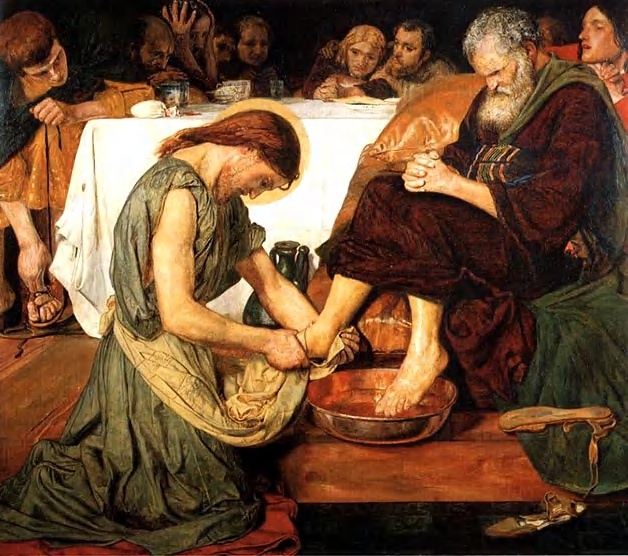 The quote from David Lyall to which I drew attention in my previous post, What is practical theology?, and the ensuing discussion, reminded me of a section from John de Gruchy’s brilliant little book Theology and Ministry in Context and Crisis: A South African Perspective, wherein de Gruchy writes:
In Germany the title ‘theologian’ refers in the first place not to the academic theologian but to the pastor. It is the primary designation within the Protestant churches of an ordained minister. Yet few priests or pastors would regard themselves as such, especially within the Anglo-Saxon world. In his book Ferment in the Ministry, the north American pastoral psychologist Seward Hiltner imagined the possible responses which ordained ministers would give to a Gallup Poll which asked the question: ‘Do you regard yourself as a theologian?’
31% said, ‘Well, I am a minister, but you could hardly call me a theologian.’
22% said, ‘It is true I have studied theology, but I am not really a theologian.’
17% replied, ‘Brother, I sure ain’t. I’m only a simple parson, not one of those highpowered book guys.’
8% admitted, ‘Well, I guess I am, in a way, but I am more interested in serving people than in theology.’
7% said, ‘Where did you get that idea? And don’t do it again.’
4% replied, ‘I am about twice a year, when I go back to the alumni lectures.’
2% said, ‘Pardon me, I have to rush to a funeral.’
1% snorted, ‘I wonder who thought up that question?’
0.9% said, ‘Yes.’ (Seward Hiltner, Ferment in the Ministry (Nashville: Abingdon Press, 1969), 159.)
Why is there this reluctance on the part of ordained ministers, to regard themselves as theologians, and, on the part of some, especially Anglo-Saxons and their heirs, why is there such antipathy towards theology? In the Germanic world the traditional tendency and temptation is precisely the opposite, to glory in the title ‘theologian’, and to create theologies remote from Christian praxis and existence in the world. Helmut Thielicke has a German audience in mind when, in his A Little Exercise for Young Theologians, he writes about the ‘pathology of the young theologian’s conceit’. Yet even in Germany the idea that the ordained minister’s self-perception is that of a theologian cannot be assumed. At Christmas in 1939 Dietrich Bonhoeffer wrote in a letter to his former students:
How superficial and flippant, especially of theologians, to send theology to the knacker’s yard, to make out that one is not a theologian and doesn’t want to be, and in so doing to ridicule one’s own ministry and ordination and in the end to have, and to advocate, a bad theology instead of a good one! – Dietrich Bonhoeffer, True Patriotism: Letters, Lectures and Notes, 1939-1945 (ed. Edwin Hanton Robertson; trans. Edwin Hanton Robertson and John Bowden; The Collected Works of Dietrich Bonhoeffer; vol. 3; London: Collins, 1973), 28.
This attitude parallels the tendency within the church generally to disparage theology in the interests of ‘practical Christianity’.
Theology has a bad name amongst many theological students and ordained ministers, not primarily because of their modesty but because they fail to grasp its vital necessity and relevance to their vocation. Indeed, they may even regard it as something detrimental to their calling and the life and mission of the church. There are theological students who regard the study of theology as an unfortunate requirement for ordination, rather than as that which should provide the focus for their work. The image of a theologian is academic, intellectual, and far-removed from the everyday tasks of the parish minister. Much of the blame for this must be laid at the door of university departments of theology, theological colleges and seminaries, and those of us who teach in them. Theology has too often been taught in ways which reduce it to idealistic abstractions, and result in its rejection as a useful, indeed, essential part of the mission of the church and therefore of the ordained ministry. After all, the value of theology taught as a series of independent academic disciplines lacking both coherence or direction and unrelated to biblical vision or faith, is not self-evident for the Christian community struggling to be faithful in the midst of the world. This situation needs to be radically transformed if theology is to become the vocation of the ordained minister, and central to the total ministry of the church, and not simply be regarded as the peculiar province of scholars.
In John T. McNeill’s magnificent A History of the Cure of Souls, there is what we might call a ‘give-away’ comment which reinforces my argument that the ordained minister, is primarily a theologian. McNeill refers to the fact that ‘Jean Daniel Benoit, the expert on Calvin’s work in the cure of souls, states boldly that the Genevan Reformer was more a pastor than theologian’, but he then continues, ‘to be exact, he was a theologian in order to be a better pastor’. Conversely, in his introduction to Karl Barth’s essays, Against the Stream, Alec Vidler has this perceptive comment about the theologian’s theologian, Karl Barth: ‘I was aware of a quality or style about him which is hard to define. It may perhaps best be called pastoral, so long as this is not understood as a limitation.’ Christian pastors are called to be theologians, and those whom we normally designate theologians may well be pastors …
The primary task of the ministry of the Word and Sacraments is to enable the upbuilding of the church in such a way that it is always pointed beyond itself to the reign of God in Jesus Christ in the midst of the world. Its task is to keep the People of God mindful of the tradition of Jesus, crucified and risen, and what this means for their lives and the praxis of the church today. Its task is to enable the church to be faithful to its identity as the People of God in the world, discerning who God is and what God requires of them. In this way the ministry of the Word and Sacraments is, literally speaking, church leadership because it provides theological direction for the mission of the People of God in the world. – John W. de Gruchy, Theology and Ministry in Context and Crisis: A South African Perspective (London: Collins, 1987), 40–3, 47
And then there’s that wonderful section from Karl Barth’s Evangelical Theology: An Introduction, a book written in part to speak to ‘the present-day younger generation’ (p. i) and clearly with an intention to encourage budding pastors. The first lectures of this collection were delivered under the auspices of the Divinity School, the University of Chicago and were the Annie Kinkead Warfield Lectures of 1962 at the Princeton Theological Seminary. The section which I was reminded of appears in a chapter titled ‘The Community’:
Since the Christian life is consciously or unconsciously also a witness, the question of truth concerns not only the community but the individual Christian. He too is responsible for the quest for truth in this witness. Therefore, every Christian as such is also called to be a theologian. How much more so those who are specially commissioned in the community, whose service is preeminently concerned with speech in the narrower sense of the term! It is always a suspicious phenomenon when leading churchmen (whether or not they are adorned with a bishop’s silver cross), along with certain fiery evangelists, preachers, or well-meaning warriors for this or that practical Christian cause, are heard to affirm, cheerfully and no doubt also a bit disdainfully, that theology is after all not their business. “I am not a theologian; I am an administrator!” a high-ranking English churchman once said to me. And just as bad is the fact that not a few preachers, after they have exchanged their student years for the routine of practical service, seem to think that they are allowed to leave theology behind them as the butterfly does its caterpillar existence, as if it were an exertion over and done with for them. This will not do at all. Christian witness must always be forged anew in the fire of the question of truth. Otherwise it can in no case and at no time be a witness that is substantial and responsible, and consequently trustworthy and forceful. Theology is no undertaking that can be blithely surrendered to others by anyone engaged in the ministry of God’s Word. It is no hobby of some especially interested and gifted individuals. A community that is awake and conscious of its commission and task in the world will of necessity be a theologically interested community. This holds true in still greater measure for those members of the community who are specially commissioned … – Karl Barth, Evangelical Theology: An Introduction (trans. Grover Foley; Grand Rapids: Wm. B. Eerdmans, 1979, 40–1.
A little later on Barth proceeds to recall that theology – even, one should add, that is as extensive as Barth’s own Church Dogmatics (the word ‘Church’ is crucial here) – ought to be undertaken for the sake of the Community and its witness to the Word of God:
Theology would be an utter failure if it should place itself in some elegant eminence where it would be concerned only with God, the world, man, and some other items, perhaps those of historical interest, instead of being theology for the community. Like the pendulum which regulates the movements of a clock, so theology is responsible for the reasonable service of the community. It reminds all its members, especially those who have greater responsibilities, how serious is their situation and task. In this way it opens for them the way to freedom and joy in their service. (p. 42)
Who would have thought – dared to think – that a human discipline might have a responsibility beyond its own indulgence! In this case, ‘for the reasonable service of the community’, even for the equipping of the saints for the work of ministry, for building up the body of Christ, until we all attain to the unity of the faith and of the knowledge of the Son of God … (Eph 4:12–13). Pastors who are serious about serving their communities will be theologians, and unashamedly so.

Those engaged in so-called ‘practical theology’ typically struggle to articulate, let alone agree on, any definition of their discipline. David Lyall, who prior to his retirement taught Practical Theology at Edinburgh University and whose book The Integrity of Pastoral Care is one of the texts I have set for my students, offers an attempt at a definition in a recent editorial:
‘So what is practical theology? … It is concerned with practice and it is an academic discipline; it seeks to serve both the mission of the Church and the needs of the world; it touches that which is most personal and engages with that which is most public. Perhaps the truth of the matter is that practical theology cannot be defined too precisely – nor should we try to do so’. – David Lyall, ‘Editorial: So, What Is Practical Theology?’ Practical Theology 2, no. 2 (2009), 158–9.
What’s your working definition?
‘What offends my taste in fiction is when right is held up as wrong, or wrong as right. Fiction is the concrete expression of mystery – mystery that is lived. Catholics believe that all creation is good and that evil is the wrong use of good and that without Grace we use it wrong most of the time. It’s almost impossible to write about supernatural Grace in fiction. We almost have to approach it negatively. As to natural Grace, we have to take that the way it comes – through nature. In any case, it operates surrounded by evil’. – Flannery O’Connor, The Habit of Being: Letters of Flannery O’Connor (ed. Sally Fitzgerald; New York: Farrar Straus Giroux, 1988), 144.
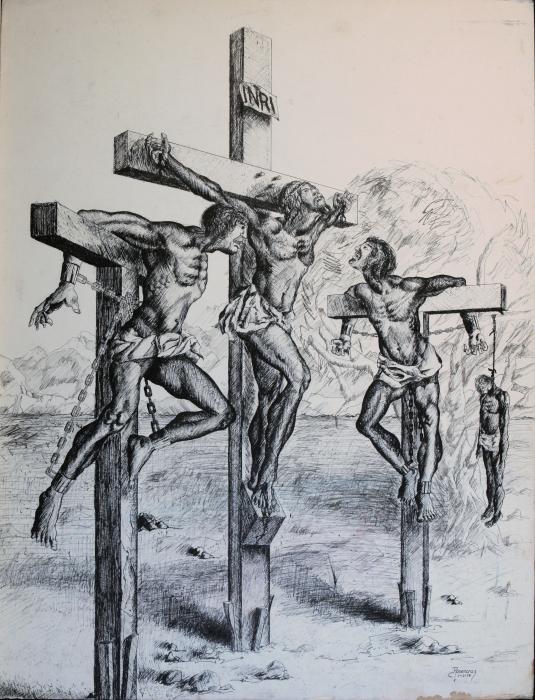 Image One:
‘Judas was a dreadful, walking example of impiety in this world, with his flesh bloated to such an extent that he could not walk through a space where a wagon could easily pass … His eyelids were so swollen that it was absolutely impossible for him to see the light and his eyes could not be seen by a physician, even with the help of a magnifying glass, so far had they sunk from their outward projection. His private parts were shamefully huge and loathsome to behold and, transported through them from all parts of his body, pus and worms flooded out together as he shamefully relieved himself’. – Papias [HT: Joan Acocella]
Image Two:
‘Was it not Judas, the sinner without equal, who offered himself at the decisive moment to carry out the will of God, not in spite of his unparalleled sin, but in it? There is nothing here to venerate, nor is there anything to despise. There is place only for the recognition and adoration and magnifying of God.’ – Karl Barth, Church Dogmatics II/2 (ed. G. W. Bromiley and T. F Torrance; trans. G. W. Bromiley et al.; Edinburgh: T & T Clark, 1957), 503.
It seems to me that if and when we pause long enough to enquire what telling most faithfully witnesses Judas’ service to the Gospel, the preferred invitation becomes decidedly clear.
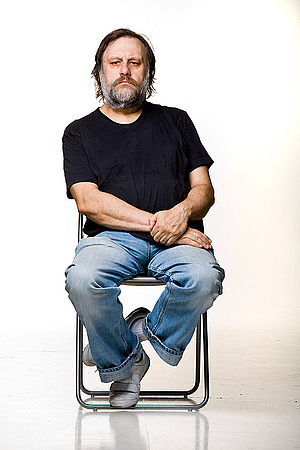 Slavoj Žižek‘s presentation on ‘The Death of God’, given at the recent AAR meeting, is worth watching [HT: to CT Moore], especially for those unfamiliar with Žižek’s atheistic sterilization of the centre of Hegel’s attention to the kenotic reality witnessed to in the gospel. Strange, then, that apart from Adam’s lament of Zizek’s predictable ‘long-windedness’ (a post, by the way, which includes some great discussion and a link to Kotsko’s own article ‘Politics and Perversion: Situating Žižek’s Paul’) I’ve heard/read very little about this session. Anyone who was present at that session care to remedy this for us?
Here’s a snippert: ‘Not only is atheism the truth of Christianity but one can only be a true atheist by passing through the Christian experience. All other atheisms continue to rely on some form of the Big Other’.
 In a fascinating collection of personal papers and essays on public theology penned against the backdrop of the Vietnam War, and titled The Pseudonyms of God, Robert McAfee Brown invites us to imagine finding ourselves in a place where we are waiting for some tremendous manifestation of God’s activity. He invites us to imagine a situation where we have heard – or thought we had heard – a promise that God would intervene in our human situation, and that it was now clear that the time was at hand. Where would we look for God?
Brown suggests that we might most likely be found looking ‘in one of the great nations, where as many people as possible would be exposed to this important fact; surely in a well-established family with much influence; surely in such a way that all the resources of public opinion and mass media could be used to acquaint people with what had happened; surely it would be the most public and open and widely accessible event possible’ (pp. 84–5). He then paints a scenario more in keeping with the event of divine disclosure now known to us, but is no less in the stream of divine pseudonymity for that:
A child would be born into a backward South African tribe, the child of poor parents with almost no education. He would grow up under a government that would not acknowledge his right to citizenship. During his entire lifetime he would travel no more than about fifty miles from the village of his birth, and would spend most of that lifetime simply following his father’s trade – a hunter, perhaps, or a primitive farmer. Toward the end he would begin to gather a few followers together, talking about things that sounded so dangerous to the authorities that the police would finally move in and arrest him, at which point his following would collapse and his friends would fade back into their former jobs and situations. After a short time in prison and a rigged trial he would be shot by the prison guards as an enemy of the state. (p. 85)
Contemporaries ought not to be surprised to find the outcast – and the outcasted – God among the outcast. We must look for signs of the Servant God’s presence among those who serve. Numbered among an oppressed minority, we must expect to hear the echo of God’s voice among those who are oppressed. The pieta-like image above recalls that since 800 million of the planet’s people suffer from hunger and malnutrition, we might well expect that God’s availability is made tangible in loaves and fishes, rice and safe drinking water. Since God’s identification with the world involves God’s becoming creaturely, we ought look for God not only in ‘holy’ places or by means of ‘holy’ words, but we will look for God also in the very common, ordinary things of life, in the well over 500 million people who are living in what the World Bank has called ‘absolute poverty’, and in all those gathered up in the one great movement of divine kenosis-plerosis. ‘We will not be surprised to discover’, Brown writes, ‘that [God] suffered also, nor will we flinch when Bonhoeffer pronounces the initially disturbing words, “Only the suffering God can help,” even though it is probably the ultimate in the pseudonymous activity of God that he could be acquainted with grief’ (p. 86).
Brown then turns to Kierkegaard, and specifically to the Danes’ parable of the king and the maiden:
The servant-form is no mere outer garment, and therefore God must suffer all things, endure all things, make experience of all things. He must suffer hunger in the desert, he must thirst in the time of his agony, he must be forsaken in death, absolutely like the humblest – behold the man! His suffering is not that of his death, but his entire life is a story of suffering; and it is love that suffers, the love which gives all is itself in want (pp. 86–7).
Truly, in the economy of holy love, the locus of greatest clarity equates to the point of greatest incongruity and surprise. Jesus is God’s grand pseudonym, the supreme instance of God acting in ways contrary to our expectation, the point at which we are offered the criterion in terms of which the action of God elsewhere can be measured. And so if we miss God’s presence in the world, it will not be because God is absent. It will be because we have been looking in the wrong places.
 From the reading chair:
Reforming Theology: Explorations in the Theological Traditions of the United Reformed Church by David Peel; Dr. Dog by Babette Cole; Theology of Hope by Jürgen Moltmann; Open Secrets: A Spiritual Journey Through a Country Church by Richard Lischer; First As Tragedy, Then As Farce by Slavoj Žižek; Windows on the Cross by Tom Smail; The Seven Storey Mountain by Thomas Merton; The Pseudonyms of God by Robert McAfee Brown.
Through the iPod: Raising Sand by Alison Krauss and Robert Plant; American III: Solitary Man and American V: A Hundred Highways by Johnny Cash; Battle Studies by John Mayer; Play On by Carrie Underwood; The Charity of Night, Stealing Fire and Life Short Call Now by Bruce Cockburn; The Circle by Bon Jovi; Jennifer Hudson by Jennifer Hudson; Reality Killed the Video Star by Robbie Williams (this one took a while to grow on me); The North Star by Roddy Frame (HT: Bruce put me on to this). And as I begin to get into the Christmas thing, I’m listening to Christmas by Bruce Cockburn; Christmas in the Heart by Bob Dylan; My Christmas by Andrea Bocelli; Come to the Cradle by Michael Card; and Breath Of Heaven: A Christmas Collection by Vince Gill.
On the screen: Perfume: The Story of a Murderer [2006]
 Rob Bradshaw has recently made available the following articles by John Webster:

 For the past few Advents, Andy Goodliff has been inviting a group of bloggers (and others) to post some wee reflections over at Hopeful Imagination. The posts have become a mirthful part of my Advent tarriance, helping me to reflect in a sustained way on the divine magic through what is typically a very busy, and seemingly most unmagical, time.
In addition to posting over at Hopeful Imagination, over the next few weeks, I’ll also be posting some Advent-inspired reflections here at Per Crucem ad Lucem (something in the tradition of my Advent 2007 reflections). I want to kick this off with a re-post from Roddy Hamilton, one of Scotland’s most creative liturgists, who just yesterday posted a wonderful reflection on Isaiah 7 based on ‘The Faith’, a song from the album Dear Heather by Leonard Cohen.
The gathering of darkness,
and the will to fight,
the pain born in conflict,
and the story of loss and fear:
these are the ways we live together.
O Love, aren’t you tired yet?
The turning from light,
and the work of injustice disguised as right,
the journeys we make that lengthen the distance between us.
O love, aren’t you tired yet?
The call unheard,
the silent questions we leave unlived,
and a graveyard of truth
left uncared for,
the bowing of the earth to extravagance,
and the weeping of the rivers.
O love, aren’t you tired yet?
The sun,
the land,
the sea,
limited in what they can give,
for they have given too much already;
the soil,
the faith,
still your holy turf,
but un-renewed by a future un-owned.
O love, aren’t you tired yet?
When the world leaves scattered,
holy words that seem like hope,
torn out from every page,
and past generations’ lessons
are thrown crumpled in a forgotten alley
darkened by the shadow cast from a new world empire,
O love, aren’t you tired yet?
But the seed of a promise
uncrumples,
in a name spoken in passion,
that holds out the future
as the past unwinds,
a love that will never let go,
called emmanuel.
O love, aren’t you tired yet?
[Image: skyrie’s photostream]
 jasongoroncy.com