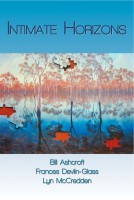
 Intimate Horizons: The Post-Colonial Sacred in Australian Literature, by Bill Ashcroft, Frances Devlin-Glass, and Lyn McCredden. (Adelaide: ATF Press, 2009), vi + 364 pp. IBSN 9781921511790
Intimate Horizons is an erudite and intriguing overture to post-colonial Australian literature and, via such, into the psyche of a nation. Its enquiry proceeds on the assumption that the twentieth-century’s final defeat of the gods is injudicious and that Australian authors working after the savageries of two world wars – and as indigenous peoples began to speak back to their colonisers, and in so doing open up new vistas of understanding about the land and about human relationships – began to “encounter the sacred as a region of difference, transformation and empowerment” (2).
The clear movement of Australian literature at the middle of the century is away from time – and its correlates such as history and rationality – to space which overwhelms it, and to the bodies and the proximate material world, and their stories, around which space is constituted. The conclusion to be made from this is that the literary engagement with place during this period, veering away from the horizontal sublime towards the sense of the sacred in the proximate, ordinary and material world, undertakes an unconscious movement towards Aboriginal experience, towards place as an embodied presence – characteristic of Aboriginal culture. (22–3)
The works of Francis Webb, Roland Robinson, David Malouf, and others, echo a fugue of common themes replayed across genres and decades, and which relate to the sacredness of place and embodiment, and the production of aesthetic “presence,” both of which are demotic and proximate, which stand in tension with those inherited forms from Europe, and “in which the sacred is glimpsed outside structure of interpretation” (18). Indeed, the authors of this volume (Bill Ashcroft, Frances Devlin-Glass and Lyn McCredden) believe that art and literature have been the “cultural discourses most successful in shedding the European yoke” (4) and have created, in Joseph Addison’s words, a “spacious horizon” as liberating as it is terrifying and which intimates distance and “placelessness” (8) that overwhelms the colonial imagination, disrupting the Romantic notion of the sublime and opening up the way to an acuity of the sacred in the broad spaces that characterise the horizontal experience of place. The authors are particularly critical of that literature which “seeks refuge in a melancholic and privileged mythologising of Australian history and white settler responses to it” (258).
Perceptive chapters on Patrick White (who “seemed to promise a new imagining of what is meant to be Australian” (33)), James McAuley (whose poetry speaks in a “haunted, homeless and displaced register” (105)), and Judith Wright (whose “‘parabolic’ vision … ‘runs beside or beyond the world of everyday’” (143)), are complemented with follow-up chapters exploring the “creative collision/encounter of paradigms of bush nationalism … and earthed sacredness” (165), and, drawing upon the work of Xavier Herbert, Kim Scott and Alexis Wright, “versions of the Indigenous sacred” (206) which find voice from the ecological depths of indigenous epistemology.
Chapter Seven, perhaps the most engaging of the chapters, surveys some contemporary Australian poetry which invites us to embrace questions of sacredness – a “theology of the earth” (285) – through “an immersion in the material world of place and time, and the material processes of poetic language” (244). Here we are introduced to poems by Kevin Hart, Robert Adamson, Gwen Harwood, Les Murray, Robert Gray, Lionel Fogarty and Sam Wagan Watson, whose poetry “triggers possibilities for change, even as it keeps the horrors of the colonial past in sight (283). Heirs to Webb and Wright, each of these poets, it is argued, when read within the context of the sacred, can be seen “grappling in new, demotic forms of language with the thisness of place, … with the intricate, lived realities of history in Australia” (245), and that partly by a refusal to be “pale reflections of European forms and ideas” (250). Such particularities, it is suggested, “are never merely backdrops to the poetry; nor does some abstracted ‘other’ seem to be the desired goal. Rather, in different but related ways, the poets confront this palpable, earthed, proximate place, Australia, through processes that do not cede any simplistic or monolithic access to the sacred” (245). This is evident, our authors observe, in “the drive to find new words” – “earthed, demotic languages of the sacred” – in order to respond to the “tangible realities of this place” (248). One place where this drive is evidenced is when Murray (a Roman Catholic) and Gray (one deeply influenced by Buddhist and Dharmic thought) are brought into conversation: “Gray’s Australia is permeated by the moral and spiritual meditativeness of a solitary poet, a cosmopolitan intellectual and sensualist, given to the detailed ‘thinginess’ of this place, but facing finally towards universalising formulations garnered across the centuries, into his reading and writing. Murray’s is a much more embattled, idiosyncratic and restless imagination” (277).
The final chapter considers the ways in which contemporary Australian fiction operates in a continual and heteroglossic dialogue with “earlier voices, a dialogue between different perceptions of the sacred sublime, and increasingly a dialogue between white and Aboriginal, between meaning cultures and presence cultures … [and which] constantly avoids closure” (288). It is one thing to suggest that the apotheosis of language adheres to an “intimation of the horizon of meaning at the edge of language” (321), to treat language as in some sense “sacramental” (232), to avoid monologism and to embrace a “multiplicity of voices” (288); it is another entirely to avoid clarifying the basis upon which such a discourse might take place. It is of little help to the reader to confess (after wading through over 300 pages!) that this book “avoids defining the term [‘the sacred’] because the very ground of our discussion – the concept of Presence, of meaning which exceeds final interpretation – makes definitions useless” (325). To be sure, I am not calling here for a kind of “doctrinal statement,” what I take the authors to mean by “orthodoxy” (288). Rather, as a Christian theologian, I wish to suggest that the dialogue and quest for new languages that a “metaphorically displaced society” (318) is groping after are literally given to us not in silence (as the authors suggest) but in the noise of divine incarnation, in the enfleshment of the divine in a particular location and story – in the ordinary – which is indeed “realised in the creative imagination” (300). As it stands, the pseudo-mysticism assumed throughout the book is as destructive of discursive knowledge as it is of birthing ethical action, concerns which are, I suspect, not far from some of the writers herein considered.
Those with deep allergies to natural theology – of the grammar of “place that remains the path to the sacred” (32) – will find much herein to baulk at: in its starkness, a borrowed fight which reminds the reader that while escape into cosmic emotions contemplating the grandeurs of antipodean place and space has some draw, any enlargement of the intelligence and calm of the mind is offset by the starvation of the soul groping for what Murray calls “unpurchased lifelong plenishment.”
The authors of Intimate Horizons assume much of their readers. They assume knowledge of Australian history, of post-colonial literature, of aboriginal spirituality, of the basic contours of theological grammar, of current discourse around race-relations, of the sense and sacramentality of place, and of antipodean attitudes to sentimentalism and religion. Some grasp of Heidegger’s notion of “Being” would be of help too.
The book highlighted again for me the legitimacy of Ian Anderson’s claim (in his Introduction to Blacklines: Contemporary Critical Writing by Indigenous Australians, edited by Michele Grossman), that “in the context of settler colonial states, such as Australia, colonial structures have never been dismantled. Colonial ways of knowing are not historical artefacts that simply linger in contemporary discourse. They are actively reproduced within contemporary dynamics of colonial power. Yet this fundamental observation does not really seem to have penetrated mainstream postcolonial theory” (24). Still, this stimulating book invites, and deserves, close reading. It helps one read Australian fiction and poetry – and, indeed, a national mythology – with more informed and sharpened eyes.
[An edited version of this review is to appear in Colloquium in due course]
 jasongoroncy.com