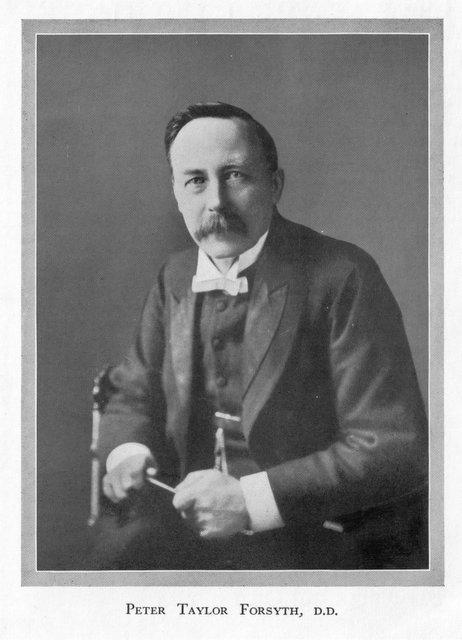
PT Forsyth

The Soul of Prayer: A Review

Jeffrey Bruce has recently posted a review on PT Forsyth’s The Soul of Prayer. He writes:

One of my great failures as a Christ-follower pertains to prayer. Throughout my life, I have consistently failed to cultivate this spiritual discipline. Sure, I throw up a few petitions each day, and set aside times for focused prayer every now and again; but, it does not characterize my living. Frankly, I find this disconcerting. Great Christians seems to pray…all the time…like Paul commands (1 Thess 5:17). In High School, I remember reading about Martin Luther, and how he would lament when constrained to spending only three hours in prayer at the beginning of the day.

Given my deficiency in this discipline, I deemed it wise to read a book on prayer. I began by going to one who, in my opinion, is an expert on the subject; Bud Burk, the children’s pastor at Whittier Hills. Bud immediately recommended The Soul of Prayer, by P.T. Forsyth. Sometimes described as an English pre-cursor to Karl Barth, Forsyth (1848-1921) was a leader in the Congregational church in Scotland. Early in his tenure as a minister, he was inimical to orthodoxy, and sought to reformulate Christianity according to his liberal sensibilities. However, in 1878 he had a conversion experience, wherein he went from (in his own words), “a lover of love to an object of grace.” He gained notoriety as a British non-conformist, who taught his generation the depth and reality of God’s grace. This book is dense, brief (only 107 pages), and chalked full of theological grist. Though his writing suffers at times from awkward phraseology,
and some of his theologizing raises the eyebrow, this tome remains a gem, and, as Eugene Peterson says, “goes straight for the jugular.”

Forsyth divides his discussion into various qualities of prayer; viz. the inwardness of prayer, the naturalness of prayer, the moral reactions of prayer, the timeliness of prayer, the ceaselessness of prayer, the vicariousness of prayer, and the insistency of prayer. In each section, Forsyth hones in on misconceptions regarding prayer, and tries to get behind the inner workings of the divine-human interaction.

He is eminently quotable. Allow me to demonstrate.

“Prayer has its great end when it lifts us to be conscious and more sure of the gift than the need, of the grace than the sin…We shall come one day to a heave where we shall gratefully know that God’s great refusals were sometimes the true answers to our truest prayer. Our soul is fulfilled if our petition is not.” (12)

“God is the answer to prayer.” (35)

“If it be true that the whole Trinity is in the gospel of our salvation, it is also true that all theology lies hidden in the prayer which is our chief answer to the gospel.” (51)

“Prayer is not identical with the occasional act of praying. Like the act of faith, it is a whole life thought of as action. It is the life of faith in its purity, in its vital action. Eating and speaking are necessary to life, but they are not living.” (69)

“Petition is not mere receptivity, not is it mere pressure; it is filial reciprocity. Love loves to be told what it knows already. Every lover knows that. It wants to be asked for what it longs to give. And that is the principle of prayer to the all-knowing Love.” (72-73)

“Let prayer be concrete. actual, a direct product of life’s real experiences. Pray as your actual self, not as some fancied saint. Let it be closely relevant to your real situation. Pray without ceasing in this sense. Pray without a break between your prayer and your life. Pray so that there is a real continuity between your prayer and your whole actual life.” (74)

“…as we learn more of the seriousness of the gospel for the human soul, we feel the more that every time we present it we are adding to the judgment of some as well as to the salvation of others. We are not like speakers who present a matter that men can freely take or leave, where they can agree or differ with us without moral result.” (83)

“Prayer is given us as wings wherewith to mount, but also to shield our face when they have carried us before the great throne. It is in prayer that the holiness comes home as love, and the love is established as holiness.” (85)

“Our public may kill by its triviality a soul which could easily resist the assaults of oppositions or wickedness.” (91)

“Strenuous prayer will help us to recover the masculine type of religion – and then our opponents will at least respect us.” (95)

“Prayer is not really a power till it is importunate. And it cannot be importunate unless it is felt to have a real effect on the Will of God.” (95)

What struck me most deeply were the following points;

(1) Prayer must be (in Forsyth’s words) importunate. Indeed, Jesus wanted to actually teach us something through the parable of the persistent widow! Prayer is strenuous, a mental exercise, and the passive resignation that so often characterizes prayer is not always a sign of piety. God wants us to pray mightily. We need not be afraid of urging and pleading with God to act. This is what he wants from us.

(2) Take public prayer seriously.

(3) Good theology can be prayed, and good prayer is theological.

(4) God is the answer to prayer.

I still have a few misgivings about Forsyth. In his attempts to be profound, I feel he sounds a tad pantheistic (though I know he is no pantheist). Moreover, his thoughts on resisting the lower will in God to arrive at his higher will need copious nuancing. Overall though, this book definitely hits hard, and presents a challenge to any alacrity in one’s heart for the discipline of prayer.

It is always encouraging to see Forsyth’s work being read. A pdf version of many of Forsyth’s books, including The Soul of Prayer, is available from here.

Journal of Theological Interpretation

The latest edition of Journal of Theological Interpretation (1.2; Fall 2007) is out. The Table of Contents reads:

‘P. T. Forsyth, Scripture, and the Crisis of the Gospel’, by Angus Paddison

It is truly exciting to see a paper on Forsyth. They are an all-too-rare thing. I commend Angus’ paper to you, in which he examines Forsyth’s theological interpretation of Scripture. Scripture for P.T. Forsyth is a sacramental agent of the gospel and the NT writings are decisively incorporated within the redemptive activity of God in Christ. Forsyth’s location of authority in the gospel conveyed by Scripture allows him considerable flexibility in relation to two alternative sources of authority: biblical scholarship and biblical infallibility. An ecclesial reading of Scripture is beholden neither to the rationalism of the academy nor to mechanical theories of verbal inspiration. A church resourced by what Forsyth termed the “positive gospel” will read Scripture with decisiveness and litheness, giving space for the lively activity of the Spirit upon the Word. Moreover, the cross is the one super-historic principle capable of interpreting all history and human action. The essay then turns to the Jesus that Forsyth encounters in his preaching of John 12 and John 16. Forsyth’s powerful reading of the NT reinvigorates John’s language of judgment, conviction, and sin. The holiness of the Son moving through the world and dying on the cross is the crisis of the world and accomplishes the sinful world’s reconciliation with the Holy Father. Forsyth’s consistently theological interpretation demonstrates the potential of a theologian immersing herself in Scripture and concentrating on the resources of the gospel.

‘”Although/Because He Was in the Form of God”: The Theological Significance of Paul’s Master Story (Phil 2:6–11)’, by Michael J. Gorman

‘The “New Creation,” the Crucified and Risen Christ, and the Temple: A Pauline Audience for Mark’, by Andy Johnson

‘Apocalypticizing Dogmatics: Karl Barth’s Reading of the Book of Revelation’, by Joseph L. Mangina

‘The Hermeneutical Circle of Christian Community: Biblical, Theological, and Practical Dimensions of the Unity of Scripture’, by Charles J. Scalise


Is God democratic?

In his essay, Why Democracy, Stanley Fish explores, among other things, the relationship between God and democracy. He writes: “Is God democratic?” That one’s easy. God, like Hobbes’ sovereign, requires obedience, and those who worship him must subordinate their personal desires to his will. (Here the Abraham/Isaac story is paradigmatic.) His rule, therefore, is the antithesis of democracy, which elevates individual choice to a position of primacy. That doesn’t mean, however, that God frowns on democratic states or requires a theocratic one or has any political opinions at all. (On the other hand, someone who, like Walt Whitman, believes that God is not a separate being but resides in each of us might conclude that democracy is the deity’s favored form of government).’

I am reminded here of two words: one from CS Lewis and the other from (surprise, surprise) PT Forsyth. Lewis writes,

I am a democrat [believer in democracy] because I believe in the Fall of Man. I think most people are democrats for the opposite reason. A great deal of democratic enthusiasm descends from the ideas of people like Rousseau, who believed in democracy because they thought mankind so wise and good that every one deserved a share in the government. The danger of defending democracy on those grounds is that they’re not true. . . . I find that they’re not true without looking further than myself. I don’t deserve a share in governing a hen-roost. Much less a nation. . . .The real reason for democracy is just the reverse. Mankind is so fallen that no man can be trusted with unchecked power over his fellows. Aristotle said that some people were only fit to be slaves. I do not contradict him. But I reject slavery because I see no men fit to be masters.

And from Forsyth:

Democracy is but a half-truth. It must have a King. Aristocracy is just as true and as needful. It builds on an authority in things no less than democracy builds on an equality. The free personality of democracy is only possible under a free authority. The free soul is only possible in a free King … There must always be a House of Moral Lords. There must always be leaders and led, prophets and people, apostles and members, genius and its circle, and elect and a called. Ah! democratic and aristocratic principles are both deep in the foundations of our Christian faith.

Democracy is, after all, only ‘the recurrent suspicion that more than half of the people are right more than half the time’ (E.B. White)

Suffering, Evil and the Existence of God

In today’s New York Times, Stanley Fish gives us a heads up on two soon-to-be-published books on the theodicy question. The two authors are Bart D. Ehrman (a theist turned agnostic) whose book is entitled God’s Problem: How the Bible Fails to Answer Our Most Important Question – Why We Suffer, and Antony Flew (an athiest turned theist) whose book is entitled There Is a God: How the World’s Most Notorious Atheist Changed His Mind. While both come from opposite directions they meet, or rather cross paths, on the subject of suffering and evil.

Fish suggests that while ‘Flew is for the moment satisfied with the intellectual progress he has been able to make … Ehrman is satisfied with nothing, and the passion and indignation he feels at the manifest inequities of the world are not diminished in the slightest when he writes his last word’. Fish asks, ‘Is there a conclusion to be drawn from these two books, at once so similar in their concerns and so different in their ways of addressing them? Does one or the other persuade?’ Fish contends that while the odd reader may have their mind’s changed as a result of reading either book, ‘their chief value is that together they testify to the continuing vitality and significance of their shared subject. Both are serious inquiries into matters that have been discussed and debated by sincere and learned persons for many centuries. The project is an old one, but these authors pursue it with an energy and goodwill that invite further conversation with sympathetic and unsympathetic readers alike’.

Fish concludes: ‘In short, these books neither trivialize their subject nor demonize those who have a different view of it, which is more than can be said for the efforts of those fashionable atheist writers whose major form of argument would seem to be ridicule’.

While these two books testify to humanity’s ongoing quest for a theodicy (or an atheodicy), Forsyth was right to press that the real question is not the justification of evil – as any attempt at a theodicy is ultimately to retreat into an ideology, which is the one thing we must not do – but the justification of God for whom there can be no rational vindication, as the Cross bears witness. I am reminded here of Bonhoeffer’s assertion in Creation and Fall, Temptation (pp. 84-5), that the question of why evil exists is not a theological question, for it assumes that it is possible to go behind the existence forced upon us as sinners. If we could answer it then we would not be sinners. We could make something else responsible. Therefore the ‘question of why’ can always only be answered with the ‘that’, which burdens humanity completely. The theological question does not arise about the origin of evil but about the real overcoming of evil on the Cross; it asks for the forgiveness of guilt, for the reconciliation of the fallen world.

PT Forsyth Group on Facebook

For those who appreciate the work of PT Forsyth (shame on you if you don’t) and wish to discuss it further, I’ve started a PT Forsyth Group on Facebook. Please visit us and join in the discussion.

The most recent topic invites discussion concerning Forsyth’s criticism of John McLeod Campbell’s notion of vicarious repentance? Do you think Forsyth has read Campbell fairly? Are his concerns fair?

Bleby on Forsyth


‘As I turned the pages of [P.T. Forsyth’s] The Cruciality of the Cross, I was amazed. Writing in England in 1909, he was talking about the church as I knew it in Australia in the 1980s! Here indeed was a prophet of the twentieth century. Had he been widely heeded in his day, the history of this century, and of the church in particular, might have been very different’. – Martin Bleby, The Vinedresser: An Anglican Meets Wrath & Grace (Blackwood: New Creation, 1993), 26.

The Great Word of Gospel

‘The great Word of Gospel is not God is love. That is too stationary, too little energetic. It produces a religion unable to cope with crises. But the Word is this—Love is omnipotent for ever because it is holy. That is the voice of Christ-raised from the midst of time, and its chaos, and its convulsions, yet coming from the depths of eternity, where the Son dwells in the bosom of the Father, the Son to whom all power is given in heaven and on earth because He overcame the world in a Cross holier than love itself, more tragic, more solemn, more dynamic than all earth’s wars. The key to history is the historic Christ above history and in command of it, and there is no other’. –– Peter T. Forsyth, The Justification of God: Lectures for War-Time on a Christian Theodicy (London: Independent Press, 1957), 217–8.

Forsyth on ‘The Power Of The Resurrection’

Here’s a series of posts on Forsyth on the Power of the Resurrection:

Forsyth on ‘The Power Of The Resurrection’ – Part 1

Forsyth on ‘The Power Of The Resurrection’ – Part 2

Forsyth on ‘The Power Of The Resurrection’ – Part 3

Forsyth on ‘The Power Of The Resurrection’ – Part 4

Forsyth on ‘The Power Of The Resurrection’ – Part 5

Praise for Forsyth’s Positive Preaching and the Modern Mind

‘It is like the Word of which it speaks so much, ‘living, powerful and piercing. If the first three pages of this book were digested, believed, worked out and acted upon by the men [sic] in all our theological colleges today there would ensue a revolution in the ministry and in the pulpit work of tomorrow’s clergy’. – FD Coggan

‘Master this book and the tone and quality of preaching cannot but be enhanced. Here the author stands out as a greaf diagnostician of the soul, the Church and society, a prophetic seer with an uncanny discernment of spirits’. – WL Leembruggen

And some general praise from James Denney, ‘Forsyth had more true and important things to say than any other man writing theology’.

More Forsyth online

Paul Moser over at Idolaters Anonymous has just done one of the most beautiful things a human being can do: post some more Forsyth articles on his site. Thanks Paul. He tells me that he plans to add some more of Forsyth’s (lesser known) books soon, so keep a look out for that. His latest uploads are:

Poll Results

Here’s the results from the latest poll on Forsyth’s greatest influences. As I mentioned here, I would have loved to have added another 4-5 names but was limited to just 5. Anselm, Butler, Calvin, Nietzsche, Newman, Schopenhauer, Ritschl, Goethe, von Harnack, Ibsen, Kierkegaard, and Wagner woudl have all been worthy contenders. The inclusion of Hegel was as an anti-influence, i.e. someone Forsyth’s writings are engaging with all the time. The results were:

Luther (33%)
Goodwin (0%)
Hegel (22%)
Kant (33%)
Schleiermacher (11%)

Bit sad Goodwin got no votes. I think he deserved more than 0%, but that’s statistics for you.

Forsyth on the World Cup

I’m not sure that Forsyth had the World Cup in mind when he wrote ‘Justice may be satisfied with penalty: but the only satisfaction to holiness is holiness.’ But he might have had something at least similar when he asked in a 1913 sermon, ‘What is to protect us from that antisocial passion for sport and pleasure, for instance, which is breeding gamblers and bleeding citizenship, which throngs to football but cannot be dragged to vote?’ If he had only watched the Aussie game last night. Go Aussies!!! oi oi oi.

A poll on Forsyth’s greatest influences

I have just created a poll to find out who you think Forsyth’s greatest influences were. I would have loved to have added another 4-5 names but was limited to just 5. For example, what about Anselm? Butler? Calvin? Nietzsche? Newman? Schopenhauer? Ritschl? Goethe? von Harnack? Ibsen? Kierkegaard? Wagner? The inclusion of Hegel is as an anti-influence, i.e. someone Forsyth’s writings are engaging with all the time. If you think that there’s someone who ‘really should be there’ and isn’t, let us know. The poll can be found over on the right hand side bar.

Life is all about perspective

This site was just too awesome to pass up: http://www.impactlab.com/modules.php?name=News&file=article&sid=7567

It cries out for a theological reflection? Anyone want to offer one? Is it about living in a lie or redefining truth? Is it about being certain of the things you think you see? Funny thing faith … this believing in advance only what makes sense in reverse. Faith, of course is not primarily a sympathy, a trust in illusion, but it is, as Forsyth contends, an ‘absolute obedience, an attitude to One Who has a right over us high above all His response to us, One to be trusted and obeyed even amid any dereliction by Him and refusal of His response.’ (See Principle of Authority, 12-13). Such faith can only come as gift and is only truly known in the cut and thrust of trusting obedience.

A proposal…

Peter Taylor Forsyth has been a subject of a number of studies of which the focus has been mostly, and understandably, on issues of christology, atonement, sacraments, homiletics and pastoral ministry. More recently, Leslie McCurdy has done us a great service in his project of understanding and interpreting Forsyth’s theology under the guise of God’s ‘holy love’ as the key ingredient in Forsyth’s atonement theology. Wanting to further broaden this trend, my project explores whether Forsyth’s theology might best be understood through the grid of a massively broad vision of the sanctification of all things to the glory of God. If the answer is ‘Yes’, how is this sanctification achieved? And by whom? And how does creation participate in such a work, if at all?