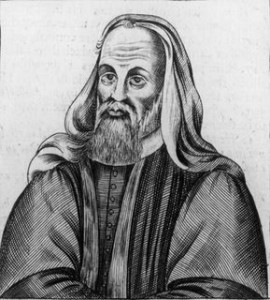
 There is a time for everything under heaven … and it is time to reveal the answer to our Who said it? competition. It was Pelagius! What this might say about the suggestions of Jonathan Edwards, Calvin and Augustine (!), to say nothing of Joel Osteen, is absolutely fascinating, and recalls (at least) the polemical point-scoring nature of the theological enterprise, and the distortive fruit of such. Ah depravity! (Speaking of which, check out Halden’s recent posts)
There are few things more blatantly satanic for a Reformed theologian than Pelagianism. Remembering Pelagius, however, recalls that history is written by the winners; in this case by those who sat on the winning team at the Council of Carthage in 418 and honked their Augustinian kazoos.
But what do we know about Pelagius himself? Sadly little. We do, however, have the following brief account by J. Stevenson:
Pelagius, b. c. 355, a lay monk (?) from Great Britain or Ireland, was in Rome for a long period up to 410. Later he was in Sicily and Africa (410), and in Palestine (411ff). He was the author of a Commentary on the Epistles of Paul (still extant). From c. 410 he was involved in the controversy about grace and free will, to which his name is attached. His views were attacked by Augustine (q.v.), Jerome and Orosius, and were finally condemned by the Council of Ephesus in 431.
Donald Meek notes that Pelagius’s views met with a strong following in Britain (a following which has been abiding; so Barth’s description of British Christianity as ‘incurably Pelagian’), but his teaching met with severe disapproval beyond Britain in the years around 431. In 429 Germanus, bishop of Auxerre, was dispatched to Britain by Pope Celestine in an attempt to root out the heresy. Like most bishops, he was unsuccessful, but tried again around 436–7. The ‘official’ story is that Pelagianism was suppressed during the fifth century. Clearly this applies to Pelagianism as a mass movement, since it certainly does not mean that the thoughts and influence of Pelagius were banned or destroyed; commentaries by Pelagius, often under more respectable names (e.g. Jerone) or expurgated, were read by ecclesiastics in the churches of Britain and Ireland many centuries later. And Barth’s description of anglo-Christianity still rings true – perhaps more than ever.
Still, it must be questioned just how far Pelagius’ own views relate to that of the movement which would bear his name. In a helpful review of Diarmaid MacCulloch’s brilliant new study, Christianity: The First Three Thousand Years, Rowan Williams properly cautions that ‘Pelagius’s opposition to Augustine on original sin was not a sunny and optimistic vision but part of a fiercely rigorous morality that left little room for the lights and shadows of human experience and the uneven quality of what we call freedom’. Feel cautioned.
Thanks to those who threw their hat in the ring with this. It was fun, and so we might do it again sometime soon.
**UPDATE**
For those wishing to read further on these issues, Dr Mark Elliott (who really isn’t as grumpy as he looks in this photo) has been kind enough to offer a few suggestions:
- Augustine M.C. Casiday, Tradition and Theology in St John Cassian (Oxford Early Christian Studies).
- Otto Wermelinger, Rom und Pelagius: Die theologische Position der romischen Bischofe im pelagianischen Streit in den Jahren 411-432 (Papste und Papsttum ; Bd. 7).
- Serge Lancel, St Augustine.
- Rebecca Harden Weaver, Divine Grace and Human Agency: A Study of the Semi-Pelagian Controversy.
- Josef Lössl, Intellectus Gratiae: Die Erkenntnistheoretische Und Hermeneutische Dimension Der Gnadenlehre Augustins Von Hippo.
- Josef Lössl, Julian Von Aeclanum: Studien Zu Seinem Leben, Seinem Werk, Seiner Lehre Und Ihrer Uberlieferung.
- Solignac, ‘Pélage, Pélagianisme’, in Dictionaire de Spiritualité 12.2, 2889–2942.
- Theodore de Bruyn (ed.)., Pelagius’s Commentary on St Paul’s Epistle to the Romans (Oxford Early Christian Studies).
- Sebastian Thier, Kirche Bei Pelagius (Patristische Texte Und Studien).
 jasongoroncy.com