Books

Matthias Gockel on Barth and Schleiermacher on the Doctrine of Election: A Review – Part V

Gockel turns to critically consider the consequences of Barth’s doctrine of election. He identifies six key areas: (1) epistemological implications, (2) the concrete determination of predestination, (3) the issue of double predestination, (4) the actuality of predestination, (5) the question of universal election and universal salvation, and (6) the relation between Israel and the Christian church. I will focus here on (2), (3), (4) and (5).

Regarding the second area, while Barth never intended to drive a wedge between the economy and being of God, Gockel sides with McCormack over against Molnar that this very inconsistency arises within Barth’s own formulation of his doctrine of election: ‘The assumption of a divine will preceding the predestination puts into doubt whether the gracious choice really belongs to God’s “own eternal essence”’ (p. 179). The issue fundamentally concerns whether or not the works of God ad extra (election) are the free overflow of the works of God ad intra (as Molnar suggests) or whether the one eternal will of God is identical with Jesus Christ. Molnar’s reading of Barth’s proposal that God has one being, and that that one being subsists simultaneously in two different forms – the second dependent on the first – which are not separate but rather are a unity-in-distinction and distinction-in-unity, could have been more attended to by Gockel than he does (pp. 179–80).

On the question of double predestination, Gockel rehearses Barth’s conviction that we must speak of Jesus Christ not only in reference to the positive side of election but also in reference to the other side of God’s decree – reprobation. Here, as we shall see below, Barth sets himself apart from the tradition (or at least extends the tradition) and declares that both election and reprobation happen in Jesus Christ. Barth’s doctrine of reprobation is as christological as his doctrine of election. He contends that the God who elected fellowship with humanity also elected our rejection. In electing our rejection, however, ‘He made it his own. He bore it and suffered it with all its most bitter consequences’. Thus in the self-reprobation of Godself in Jesus Christ – the Man justified and the ‘Judge judged in our place’ – humanity recognises not only God’s final ‘Yes’ but also its own reprobation. This self-giving is God’s free choice and entails God’s self-determination and the determination of humanity through a ‘wonderful exchange’ in Jesus Christ. ‘To believe in God’s predestination’, Gockel concludes, ‘means by definition to believe in the non-reprobation of humankind’ (p. 181). As Barth notes, ‘in God’s eternal purpose’ it is not humanity but ‘God Himself who is rejected in His Son’. God’s self-giving in Jesus Christ consists in the fact that he is rejected in our place: ‘Predestination means that from all eternity God has determined upon man’s acquittal at His own cost’. Gockel then raises the question and apparent conflict concerning whether the claim that the Son of God instead of the Son of Man suffered God’s wrath contrasts with Barth’s earlier claim that ‘the elected human being Jesus is the target or “offering” of God’s wrath’. He notes Barth’s own awareness of and answer to this in II/1: ‘Only God Himself could bear God’s wrath. Only God’s mercy was capable of bearing the kind of suffering to which the creature existing in opposition to God is subject. Only God’s mercy could be touched by this suffering in such a way that it knew how to make it its own suffering. And only God’s mercy was strong enough not to perish in this suffering’ (p. 183). As if hell – that is, something of creation – could exhaust the awful shame and scandal of sin.

Matthias Gockel on Barth and Schleiermacher on the Doctrine of Election: A Review – Part IV

In his fifth chapter, entitled ‘Barth’s Christological Revolution’, Gockel turns briefly to Barth’s lectures of 1936 (given at two Reformed seminaries in Hungary) and 1937 (Barth’s Gifford Lectures on the Scots Confession given at the University of Aberdeen), and more substantially to Barth’s Church Dogmatics II/2, where Barth developed his most radical proposal, modifying for a second time his doctrine of election. In the christological revision undertaken in II/2, election no longer refers to the two-fold possibility of faith and unbelief but to the double determination of individual human beings and God’s own being. Barth’s priority: that God sees every human being and also himself in Christ.

Here, Gockel is on the more traversed ground of Barth’s notion that Jesus Christ is both God’s elect himself and the foundation of humanity’s election. Gockel argues that it was not until the 1936 lectures that Barth’s christological revisioning of the doctrine of election first appears; that what happened for and to humanity at Golgotha and was revealed at Easter – though it happened in time – is our eternal election. It is also here that Barth identifies the one will of God in double predestination with Jesus Christ, that is, with God’s own being. ‘Jesus Christ not only reveals but also constitutes God’s gracious choice as the self-determination to be God for His people and the determination of humankind to be the people of God’ (p. 169). As Barth contends, God’s gracious choice is the divine decision made in Jesus Christ, the speculum electionis. It is in and through Jesus Christ that God has actualised his eternal covenant with humanity, God’s eternal election of himself to communion with humanity, and humanity to communion with God. Here Barth distinguishes himself from the disposition in some camps of the Reformed tradition of an insistence on the inscrutableness and invisibility of the divine decrees. In Jesus Christ – the electing God and the elected Man – God’s purposes in election are made manifest to all. Christ is, in Barth’s words, ‘the first and last word to men of the faithfulness of God’ in election. Jesus Christ, therefore, is not merely the channel of God’s one decree, but its source. And he is not merely the one who elects, but he is also the one who elects himself to be the modus operandi by which others are elected.

Matthias Gockel on Barth and Schleiermacher on the Doctrine of Election: A Review – Part III

Barth’s revision of the Reformed doctrine of election is developed further in his so-called Göttingen Dogmatics where he punctuates the teleological ordering of election and reprobation. The real purpose of God’s predestinating act is always election – not rejection – even in rejection. While the reprobation is real as the shadow side of election, it is never God’s final word. God’s final word is Jesus Christ and in him every promise of God finds its ‘Yes’ (2 Cor 1:18–20). ‘Rejection does not take place for its own sake but in revelation of the righteousness of God in order that God’s mercy might be manifested in his election, and in order that in it all, though in this irreversible order, God himself might be known and praised’. In other words, God’s judgement is never divorced from God’s grace and can never be recognised apart from ‘the cross, the judgment, the condemnation in which we stand’; the way of predestination therefore leads us ‘by way of condemnation – indeed, by the way of hell itself – to salvation and life’. We will return to this below in our discussion of Barth’s Church Dogmatics II/2.

Gockel concludes his discussion of Barth’s Göttingen work by surmising that Barth’s doctrine of election ‘becomes more actualistic and less speculative, while still not christocentric’. Also ‘Barth stops short of eschatological universalism, and his consistent emphasis on God’s freedom as well as the assertion that “all are at every moment under the divine Either–Or” should be taken seriously’ (p. 155).

The picture that Gockel paints is that in both the Römerbrief and the Göttingen Dogmatics, Barth has developed a ‘Schleiermacherian reconstruction’ of the doctrine of election by means of the idea of a single divine decree towards life. Although Schleiermacher understands the Creator-creature relationship differently to Barth, they both hold that the single divine decree is to be understood in the context of the historical decision between faith and unbelief. For both of them (at this point), the doctrine of election remains fundamentally theocentric and universal, with a focus on the graced-initiative of the divine act which involves a teleological movement in time from reprobation to election, the former serving the latter, and the latter qualifying the former. Above all, the focus for both theologians is on ‘the predestining God’ rather than ‘individual predestined human beings’ (p. 157). Given this, it is surprising that Gockel introduces his argument with the announcement that it is ‘precisely the anthropocentric outlook of traditional views’ which motivated not only Barth’s but also Schleiermacher’s ‘search for a new approach’ to election (p. 12).

Matthias Gockel on Barth and Schleiermacher on the Doctrine of Election: A Review – Part II

In his Der Römerbrief, Barth raises two objections against the Augustinian formulation, which he regards as ‘a “mythologizing” construction’ (p. 108). First, Barth rejects the notion that predestination can be explained in terms of cause and effect. While the human act of faith happens within a familiar historical context, its origin always lies with God: ‘The act of faith does not occur when a human being has recognized God but when God has recognized a human being’ (p. 108). Barth’s point: ‘God wants to be known through God’. Secondly, Barth discards the attribution of election and reprobation to ‘predetermined quantities of individual persons, since this neglects that God’s eternal predestination is related to humankind as a whole and is not a one-time event but occurs time and again in history when a human being is addressed by God’s Word’ (p. 109). The driving issue here for Barth, as in his whole doctrine of election, is the divine freedom.

For Barth, the key verse for understanding Romans, and Christian theology in general, is 11:32, ‘God enclosed everyone in disobedience, in order to show mercy on everyone’. This verse affirms that the content of God’s predestination is God’s unconditional mercy. More radically, Barth contends that Paul’s claim suggests a modification – though not a rejection – of the notion of double predestination. Double predestination does not require rejection so long as we are clear that it refers to a movement, to the ‘teleology by which God’s salvific act is directed, namely, from reprobation to election’ (p. 113). For Barth, reprobation is never the goal. ‘God’s Yes shines even into the last depth of His No, precisely because the latter is so radical, because it is the divine No’. Reprobation exists therefore ‘only as the shadow of the light of election’.

Gockel contends that there is a distinct echo of Schleiermacher’s doctrine of election in Barth’s own early revision of the doctrine. In Der Römerbrief, Barth accentuates the dialectical unity of God’s decree: ‘God’s reprobation (of the elect) and God’s election (of the reprobate) are “unintuitably one and the same in God”’ (p. 118). Gockel identifies two central aspects concerning the relation between reprobation and election for Barth. First, the possibility of reprobation is overcome eternally in God. Adam’s old world really is surpassed by Christ’s new world. Second, the individual outcome of the two-fold possibility of unbelief and belief is not determined by God before time but rather, in the freedom of God, is the event in which God addresses the creature in time. The content or purpose of such an address is qualified by the ‘turn from reprobation to election’ in God, which expresses the one eternal will of God for humanity. Any duality here of judgement and grace is the duality of God’s unified action, an action which affects all human beings alike, and is determined by God’s redemptive will revealed in Christ’s death and resurrection. The church and the world, therefore, ‘stand under the same promise and the same judgment [which] makes it impossible to conceive them as two separate groups of persons’ (p. 125). Even as early as his Romans commentary, Barth maintained a hopeful universalism grounded in the freedom and love of God leading to the priority of election over reprobation: ‘reprobation has been overcome and absorbed by election’. Christ’s work ‘entails the hope that the duality between faith and history does not preclude the possibility of an eventual restoration of humankind and a return “into the unity with God, which is now and here completely lost”’ (p. 130). Barth’s emphasis here is that the original unity of God and humanity (a notion abandoned in the Göttingen lectures) is not superseded by judgement. Judgement, rather, is practical, leading to a re-union of human and divine righteousness.

Gockel observes that the relationship of the historical appearance of Jesus Christ to the determination of God’s will remains unclear in Barth’s theology, and his emphasis on the original unity leads to similar problems to Schleiermacher’s notion of absolute dependence. Furthermore, when Barth ‘asserts that God’s will is revealed in Jesus Christ who personifies God’s universal faithfulness and righteousness, it remains unclear how the eternal history between God and humankind is related to the history of Jesus Christ’ (p. 131).

Matthias Gockel on Barth and Schleiermacher on the Doctrine of Election: A Review – Part I

‘That God may have mercy upon all’: A Review of Barth and Schleiermacher on the Doctrine of Election: A Systematic-Theological Comparison. By Matthias Gockel. Pp. viii+229. Oxford: Oxford University Press, 2006. ISBN 978 0 19 920322 2. £45.

As promised not so recently, my next few posts will be dedicated to reviewing Gockel’s book, Barth and Schleiermacher on the Doctrine of Election. Because my review is rather lengthy (and because some wise guy thinks that the ideal post should be quite short ), I will break it up into 10 posts. I hope that most who started the ride will still be holding on at the end.

Karl Barth’s vituperative criticisms of Friedrich Schleiermacher are no secret, and no short mileage has been made by theologians on the apparent division between the two. In Matthias Gockel’s latest offering (a revised version of his 2002 doctoral dissertation completed at Princeton under Barth scholar Bruce McCormack) he joins Robert Sherman and others in enriching, with renewed sophistication, our understanding of the relationship between Barth and Schleiermacher, challenging traditional evaluations that ‘liberal theology’ and ‘dialectical theology’ stand in irreconcilable opposition.

Rather than attempt to cover a multi-dimensional canvas with broad strokes, Gockel restricts his inquiry to an incisive and cogent comparison of the development of the doctrine of election in the two thinkers. Without proposing any theory of historical dependence, Gockel contends that the divergence between these two commanding Reformed theologians does not stem from irreconcilable starting points but rather from the indispensability of God’s grace. Gockel convincingly argues that ‘Barth’s theology is not just a repudiation of Schleiermacher but an expansion of his predecessor’s work in a new framework’ (13). He also shows us that while the Swiss theologian’s evaluation of ‘the father of modern theology’ is ‘sometimes negative, sometimes positive and often ambiguous’ (p. 9) Barth was not always a reliable interpreter of his own thought, nor always consistent in his criticisms of others.

Gockel’s thesis is that the doctrine of election in Barth’s early theology bears a close resemblance to Schleiermacher’s own theo-centric position. Barth’s theology however, from 1936 onwards, undergoes a radical christological revisioning of the earlier position. Gockel begins his survey and assessment of Schleiermacher by turning to Schleiermacher’s revision of the doctrine in his 1819 essay, ‘On the Doctrine of Election’. Gockel helpfully, albeit briefly, situates Schleiermacher’s early contribution on election in the context of the ecclesiastical union between the Lutheran and Reformed churches in Prussia in 1817. Central to the preceding union were the debates over the Lord’s Supper and the doctrine of election. The crucial point over the latter concerned ‘the indispensability of divine grace for … conversion and the question whether human beings can accept or resist God’s grace by their own free choice’ (p. 18). Schleiermacher’s most creative contribution to the discussion was his notion of an undivided and unconditional ‘single divine will and decree which effects [both] faith and unbelief’ (p. 26). He argues that the older paradigm of a two-fold divine will of election and reprobation is ‘as meaningless as the question why God made human beings in the way they were made’ (p. 29). The elect, Schleiermacher contends, are those who are ‘regenerated and begin their religious self-development’ (p. 30). While the remainder of persons are for now spiritually dead and ‘not yet members of the kingdom of God’ (p. 34) they are included in God’s love and so ‘they never loose the ability to be revived’ (p. 30). Gockel notes that the notion of the single decree ‘emphasises the unity of the divine attributes and helps to clarify key issues not only in the debate over election but also in the doctrine of God’ (p. 34).

Schleiermacher’s revision of the doctrine of election, articulated in the 1819 essay, is more fully developed in his Der christliche Glaube (1821–22) within the bounds of a single divine decree of universal predestination to salvation in Christ, and systematically located in ecclesiology. Gockel notes that the starting-point of the discussion of election, for Schleiermacher, is the ‘dilemma that arises from the simultaneous existence of believers and non-believers, on the one hand, and the benevolent divine will towards all human beings in Christ’s redemptive work, on the other hand’ (p. 101). Schleiermacher’s response is to insist that the ‘divine will is identical with the work of redemption in and through the person of Christ’ (p. 100).

Schleiermacher rejects any idea of two separate foreordained groups of persons – a double-predestination – and the notion that one group might be eternally excluded from the benefits of Christ’s work. Such ideas, he maintains, betray the general character of redemption and the universal mission of the church. God has one will, and that will is identical with who God is, and what God does in Jesus Christ. Humanity – believers and unbelievers alike – are the object of God’s predestinating will of salvation in Christ. Despite the temporary reprobation of some, ‘God sees all human beings, not only the believers, in Christ’ (p. 102). In light of this reality, the church is called to live, order its life after, and bear universal witness to, the divine decision.

Gockel concludes his examination of Schleiermacher by noting that despite Schleiermacher’s christologically-motivated affirmation of general redemption and rejection of eternal reprobation, his overall construction remains theocentric: ‘it is grounded in the belief in God the almighty creator, even though ecclesiology is its context and christology its background’ (p. 103).

New Book Announced

Brill has announced a forthcoming book: The Authority of Scripture in Reformed Theology: Truth and Trust, by Henk van den Belt. Looks like a published version of his 2006 thesis from Leiden University.


Here’s the blurb:

The authority of Scripture is the cornerstone of Reformed theology. Calvin introduced the term autopistos from Greek philosophy to express that this authority does not depend on the church or on rational arguments, but is self-convincing. After dealing with Calvin’s Institutes, the development of Reformed orthodoxy, and the positions of Benjamin B. Warfield and Herman Bavinck, the author draws theological conclusions, advocating a renewed emphasis on the autopistia of Scripture as starting point for Reformed theology in a postmodern context. The subject-object scheme leads to separating the certainty of faith from the authority of Scripture. The autopistia of Scripture, understood as a confessional statement, implies that truth and trust are inseparable.

Ah! Books

Just having a break at the moment and decided to pick up a book that’s been on my ‘Books I really Want to Read and Hope I Get Around to Doing So One Day’ list. The one I picked up was Mister God, This is Anna. Here’s a few words from Verna Sproxton’s ‘Introduction’:

‘There are good books, indifferent books, and bad books. Amongst the good books some are honest, inspiring, moving, prophetic, and improving. But in my language there is another category: there are Ah! Books …. Ah! Books are those which induce a fundamental change in the reader’s consciousness. They widen his sensibility in such a way that he is able to look upon familiar things as though he is seeing and understanding them for the first time. Ah! Books are galvanic. They touch the nerve-centre of the whole being so that the reader receives an almost palpable physical shock. A tremor of excited perception tipples through the person … Ah! Books give you sentences which you can roll around in the mind, throw in the air, catch, tease out, analyse. But in whatever l way you handle them, they widen your vision. For they are essentially Idea-creating, in the sense that Coleridge meant when he described the Idea as containing future thought – as opposed to the Epigram which encapsulates past thought. Ah! Books give the impression that you are opening a new account, not closing an old one down’. Vernon Sproxton, ‘Introduction’, to Fynn. Mister God, This Is Anna (London: Fount, 1979), 12.

Wow. Now I can’t wait to keep reading …

Praise for Forsyth’s Positive Preaching and the Modern Mind

‘It is like the Word of which it speaks so much, ‘living, powerful and piercing. If the first three pages of this book were digested, believed, worked out and acted upon by the men [sic] in all our theological colleges today there would ensue a revolution in the ministry and in the pulpit work of tomorrow’s clergy’. – FD Coggan

‘Master this book and the tone and quality of preaching cannot but be enhanced. Here the author stands out as a greaf diagnostician of the soul, the Church and society, a prophetic seer with an uncanny discernment of spirits’. – WL Leembruggen

And some general praise from James Denney, ‘Forsyth had more true and important things to say than any other man writing theology’.

Books on the Atonement

In the year of his passing (1917), the great James Denney’s The Christian Doctrine of Reconciliation was published. Commenting on books written on the atonement, he penned the following:

‘Of all books that have ever been written on the atonement, as God’s way of reconciling man to Himself, McLeod Campbell’s is probably that which is most completely inspired by the spirit of the truth with which it deals. There is a reconciling power of Christ in it to which no tormented conscience can be insensible. The originality of it is spiritual as well as intellectual, and no one who has ever felt its power will cease to put it in a class by itself. In speculative power he cannot be compared to Schleiermacher, nor in historical learning to Ritschl, and sometimes he writes as badly as either; but he walks in the light all the time, and every thing he touches lives’.

Of course, the first half of the twentieth century saw some wonderful work done on the atonement. Forsyth’s The Cruciality of the Cross and The Work of Christ, and Denney’s The Death of Christ, being of, to my mind, the best. And in the previous century, Erskine’s The Brazen Serpent stands out alongside McLeod’s Campbell’s work.

But what of the second half of last century, and the first years of this one? What are the works that do (and should) stand out? Of whose work could it today be said, ‘There is a reconciling power of Christ in it to which no tormented conscience can be insensible’?

What works would you nominate?: Moltmann’s The Crucified God? Smail’s Once and For All? Torrance’s The Mediation of Christ? Gunton’s The Actuality of the Atonement? Bingham’s Christ’s Cross Over Man’s Abyss? Stott’s The Cross of Christ? Morris’ The Apostolic Preaching of the Cross? Schmiechen’s Saving Power? … ? What works would you nominate, and why?

Moreover, who is writing of the atonement today not as an onlooker but as one who has been there, and is there still?


One Book Meme

It’s frightening how quickly these things catch on, but for what it’s worth, Ben Meyers has started a one book meme that is being geminated around the sphere of blogdom. Here is my own contribution:

1. One book that changed your life:
Bingham, ‘Christ’s Cross Over Man’s Abyss’

2. One book that you’ve read more than once:
Mandela, ‘No Easy Walk to Freedom’

3. One book that you’d want on a desert island:
Forsyth, ‘The Cruciality of the Cross’

4. One book that made you laugh:
Kung, ‘The Church’

5. One book that made you cry:
Roberts, ‘Join Up’

6. One book that you wish you had written:
Calvin, ‘Institutes of the Christian Religion’

7. One book that you wish had never been written:
‘The Oxford Manual of Style’

8. One book you are currently reading:
Petuchowski, ‘The Lord’s Prayer and Jewish Liturgy’

9. One book that you’ve been meaning to read:
Thielicke, ‘Being Human … Becoming Human’

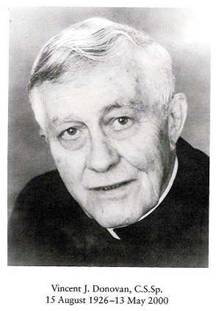
A reflection on Vincent Donovan

In The Church in the Midst of Creation, Donovan builds on his previous work, Christianity Rediscovered: An Epistle from the Masai, and in many ways it really cannot be appreciated without having first read that book. I was particularly reminded of one part of his earlier work where he writes about what he is observing amongst the Masai, an observation that is pertinent for his later book. He observes:

There is no use arguing that it isn’t true happiness they have, or that they aren’t really happy – because they are, at least in that momentary escape from their loneliness and hopelessness while drinking the rich butterfat milk of their Zebu cattle, or striding across the Masai plains, or dancing the beautiful dances of the nomads. St. Paul says this happiness is a sign of God among them. He was here before we ever got there. It is simply up to us to bring him out so they can recognise him.

Writing from back home in the United States, Donovan, in The Church in the Midst of Creation, has, between the Preface and the Epilogue, nine chapters in which he peruses back and forth across history seeing the way that the Roman Catholic Church has became standardised, specialised, and centralised (he argues largely because of the industrial revolution), with a uniformity imposed by the Vatican and a Christ who has become a European Christ and has shackled the Spirit. Donovan responds by proposing a cosmic, or planetary, Christ.

There are echoes here of a response he offered to a review of his previous book, Christianity Rediscovered, where he wrote that

While we have to admit that Western Christianity has monopolized Christ, and has shackled Christ in the bondage of a single culture to such an extent that the Western Christ has become a stumbling block for the Holy Spirit, Christ will remain, I believe, the point at which Christianity and Hinduism will meet, the point at which Christianity and every religion and culture will meet. It will serve no purpose at all to water down the heart of the Christian message to make it more acceptable to the world of humankind. We must bring the full brunt of the gospel message to the religions and cultures of the world. The understanding of Christ will undoubtedly change, and expand and grow as a result of this process, perhaps even in a frightening and unfamiliar manner, but it should have grown long ago out of the narrow dimensions of the Mediterranean Christ.

He develops this thought further in The Church in the Midst of Creation where he advocates the need for the Western Church to embrace a planetary Christ, a world Christ. He writes:

We have to admit that after all this existence and scientific scholarship, after nearly two thousand years of Christianity, the Christ that is worshipped in our churches, the Christ that is the basis for our church and all its faith life and activity, is no more than a Mediterranean Christ. That is as far as Christ has grown. European and American theologians see nothing wrong with that, nothing wrong with the fact that we have not even begun to think of, or search for, the meaning of a planetary Christ, a world Christ. We continue to let all our efforts revolve around a Mediterranean Christ. We of the West have monopolized Christ…. There is surely more to be revealed about the Christ than is already known. But we, trapped in our own culture with its exact and measured scientific view of the world, with our lack of sacramental vision, may not be the ones to discover it. Like Mary Magdelene, we are afraid to let go of Christ, to let Christ out of our grasp, out of our control.

This kind of thinking raises serious questions about how we understand the nature of Church as Incarnational. In what sense are Christ’s people his form in the world? This is a different question than that of whether of not the Church is a continuation of the Incarnation. With Forsyth, I contend that it is not. However, Donovan’s question, one of many raised in his book, is one that I wish to consider in this post, albeit briefly.

I think that we need to respond to this question firstly by seeing the Church as a kenotic community. There is at the heart of reconciliation the solidarity with the world which the Church does not take on as an extra-curricula activity, but which is constituted of its very existence as the kenotic community. The kenosis of Christ is the ‘self-emptying’ (Phil 2) which constitutes the inner movement of condescension and humility which characterises the life of the Son to the Father. As Jesus drew his disciples into his own ‘self-emptying’ life and ministry of obedience and service to the Father on behalf of the world, he formed them into a ‘kenotic community’. As those who bare continuous testimony to the presence of Christ in the world following Pentecost, the Church exists as the community where the world can discover and experience its own participation, reconciliation and salvation in the kenosis of God in Christ. Karl Barth noted that ‘The world does not know itself. It does not know God, nor man, nor the relationship and covenant between God and man. Hence it does not know its own origin, state or goal. It does not know what divides nor what unites. It does not know either its life and salvation or its death and destruction. It is blind to its own reality. Its existence is a groping in the dark.’

All this serves as a sober reminder that the Church does not ‘possess’ Christ as its own. To this end, Bonhoeffer observed that ‘Everything would be ruined if one were to try and reserve Christ for the Church and to allow the world only some kind of law, even if it were a Christian law. Christ dies for the world, and it is only in the midst of the world that Christ is Christ.’ It is not as though the world needs the Church in order to have Christ; the Church also needs the world in order to know Christ. In this sense, Christ’s existence in the world is ‘non-religious’ or ‘worldly’. Thus there is a certain ‘boundary-lessness’ to the Church in the world. Because Christ is the true centre, there are no longer any boundaries by which one can determine or define the existence of God in the world. So there is a need for us to be able to speak freely of the reality of the world for the Church, and of the solidarity between the Church and the world. The latter because the true community of Jesus Christ does not exist esoterically and invisibly but visibly and exoterically, so that it may be noted by the world around. Otto Weber notes,

Seen Christologically, every rejection of the world by the Community would have to place in question “docetically” the incarnation of Jesus Christ. It would have to have been the case that God did not become “true man” in Jesus Christ if the Community were intended not to be “truly” in the world. But above all, the victory of the Resurrected One over the “cosmos” (John 16:33) would have to be disregarded if the Community were supposed to understand the “world” solely as a confusing, alien reality, to be held at a distance and excluded.

The incarnational solidarity between Christ and the world binds the Church to the world and the world to the Church in a critical but positive tension of judgement and reconciliation, of sin and grace. As Barth says,

Solidarity with the world means full commitment to it, unreserved participation in its situation, in the promise given it by creation, in its responsibility for the arrogance, sloth and falsehood which reign within it, in its suffering under the resultant distress, but primarily and supremely in the free grace of God demonstrated and addressed to it in Jesus Christ, and therefore in its hope…. Solidarity with the world means that those who are genuinely pious approach the children of the world as such, that those who are genuinely righteous are not ashamed to sit down with the unrighteous as friends, that those who are genuinely wise do not hesitate to seem to be fools among fools, and that those who are genuinely holy are not too good or irreproachable to go down “into hell” in a very secular fashion…. since Jesus Christ is the Saviour of the world, [the Church] can exist in worldly fashion, not unwillingly nor with a bad conscience, but willingly and with a good conscience. It consists in the recognition that its members also bear in themselves and in some way actualise all human possibilities.

Given this, there is an obligation placed upon the Church towards the world. This obligation is the responsibility for the world, or to the world, which Christ assumed in coming to the World as the Word. So one cannot discharge obligation to God and at the same time be irresponsible toward the world.

But at the same time, there is a necessary contradiction which must be borne within the ‘same body’, a contradiction that Donovan, in my opinion, fails to take seriously enough, and which Hauerwas and Willimon bear witness to when they write:

The challenge facing today’s Christians is not the necessity to translate Christian convictions into a modern idiom, but rather to form a community, a colony of resident aliens which is so shaped by our convictions that no one even has to ask what we mean by confessing belief in God as Father, Son, and Holy Spirit. The biggest problem facing Christian theology is not translation but enactment. No doubt, one of the major reasons for the great modern theologians who strove to translate our language for modernity was that the church had become so inept at enactment. Yet no clever theological moves can be substituted for the necessity of the church being a community of people who embody our language about God, where talk about God is used without apology, because our life together does not mock our words. The church is the visible, political enactment of our language of God by a people who can name their sin and accept God’s forgiveness and are thereby enabled to speak the truth in love. Our Sunday worship has a way of reminding us, in the most explicit and ecclesial of ways, of the source of our power, the peculiar nature of our solutions to what ails us.

Returning back now to our earlier discussion regarding that necessary contradiction between Christ and the world, we might deduce that the reconciliation of the world to God produces and sustains the contradiction for the sake of its healing. Thus, the ‘kenotic community’ exposes the contradiction by virtue of its solidarity with the world. Barth discusses the problem between the reconciliation actualised in Christ and the contemporary situation of the Christian in the world as the ‘divine problem’, and says that God takes up this ‘problem’ and solves it in the presence and action of the Holy Spirit.

Thus there remains a ‘difference in solidarity’. ‘In Jesus Christ the community and the rest of humanity constitute a differentiated, yet in this differentiation firmly integrated, whole.’ This leads to a three-part conclusion: (i) the world would be lost without Jesus Christ and his word and work; (ii) the world would not necessarily be lost if there were no Church; and (iii) the Church would be lost if it had no counterpart in the world. The ‘difference’ is the presence of Christ – ‘For where two or three come together in my name, there am I with them’ (Matt 18:20).

With this theological horizon, and motivated by his conviction that God is still creating and calling the Church to participate in what is its ontological purpose for being, Donovan appeals for the people to “refound” the Church. His experience with the Masai, and what this experience has helped him to discover in Scripture, has clearly played a significant role in shaping his sense of creation’s direction. Writing out of a post-Vatican II context, he finds Scripture pointing to an ecclesiastical model with increased simplicity in its lifestyle, with less oppressive hierarchy, with less space between leaders and people at all levels, and with a keener awareness of the pressing needs of a close-by world. In his last chapter, he gives us a glimpse at how such a congregation could look. He also espouses an approach to evangelism whereby both parties are changed by God during their communicative interchange. It is with this awareness that he argues for “evangelization of culture” which includes genuinely mutual dialogue with the other major faiths of the world. His argument is interesting: that convert-making is geared to individuals and its success is measured numerically, when what is required is to evangelise the whole culture.

Unfortunately, he falls victim, I believe, to contemporary culture’s addiction to “new age” expectations. Citing as his gurus Sorokin, Rahner and Toffler, he argues that our time (written in 1989) is a time of significant change to the point where we are “an age in the process of breaking up”. His discussion is helpful in that he argues for the need for the Church to ‘grow-up’ to meet these changing conditions, but I wish that his grounding in Scripture reminded him that the new age is God’s gift in Christ and is not a pseudohistorical concept.

In light of this, NT Wright, in a discussion of Romans 9-11, offers some poignant insights into the Church’s ontological nature as that which issues from the Cross – that place/event which serves as the passionate concern of the Church, led by the Spirit, as the loving justice of God to all the world in real space and time. He writes,

And when the church really turns to face this task, as it must if it is to be true to its vocation, it will find (as Paul saw in 2 Corinthians particularly) that its role is Christ-shaped: to bear the pain and shame of the world in its own body, that the world may be healed. And with this we realize (in case it were not already apparent) that there is no room in this hermeneutic for a Christian or ecclesial triumphalism, which is precisely what Paul is opposing in Romans 11. The church is called to do and be for the world what the Messiah was and did for Israel … The church must find out the pain of the world, and must share it and bear it.

Another issue that is raised by Donovan, moreover, raises this issue of the Church community’s place in time and space. In other words, in what sense is the Church an eschatological community? Surely the Church is the community that is determined by its final destiny, the resurrection of the Incarnate Word-Son of God, Jesus Christ. The Church’s ‘now-life’ is lived in this realised sense as Christ’s presence in the Church and world is as the Coming or Last One, and it’s in this sense that his ministry is one of reconciliation, liberation and hope.

Karl Barth wrote that “We must understand that God is the measure of all reality and propriety, understand that eternity exists first and then time, and therefore the future first and then the present.” In this sense the Church is simultaneously the ‘kenotic community’ and the ‘ek-static community’. The ek-static dimension of the Church’s life is its orientation toward the ultimate destiny, by which it ‘stands out’ (ek-stasis) of its existence in solidarity with the world toward the source of its life and being in the Christ who is coming.

A brief story. Imagine that geese could talk, Kierkegaard once said, and that they arranged things so that they too could have their Church services and their worship:

Every Sunday they would assemble together and a gander would preach. The essential content of the sermon was the exalted destiny of the geese, the exalted goal for which the creator had destined geese (and every time his name was named all the geese curtsied and the ganders bowed their heads). With the help of their wings they could fly away to far countries, blessed countries, where they really were at home; for here they were just like exiles. And so every Sunday. Then the gathering broke up, and every goose waddles home. Then the next Sunday off they went to the service again, then home again. That was all. They throve and grew fat, they became plump and tender… that was all. For while the sermon sounded so exalted on Sundays, on Mondays they would tell one another of the fate of the goose who wanted to take his destiny seriously, with the help of the wings the creator had given it. And they spoke of the horrors it had to endure. But they prudently kept this knowledge among themselves. For, of course, to speak of it on Sundays was most unsuitable, for as they said, in that case it would be obvious that our service would be a mockery both of God and of ourselves. There were also among the geese some that looked ill and thin. Of them the others said, “You see, that’s what comes from being serious about wanting to fly. It is because they are always thinking of flying that they get thin and do not thrive, and do not have God’s grace as we do. That is why we get plump and fat and tender, for it is by God’s grace that one gets plump and fat and tender.

So it is with Christians, added Keirkegaard: they conclude that the domesticating grace of God is not meant to take seriously the wings of the Spirit, for to do so emaciates one’s well-being and destroys one’s peace as an earth-bound creature. Whereas, in fact, the wings are meant to be used – humans have Spirit, and thus are destined to live a transcendent life of ek-statis, the content of which is love.