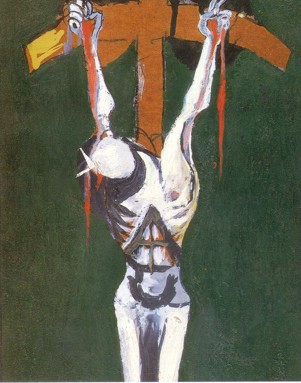
Atonement

SBJT, Substitutionary Atonement, and Metaphors of the Cross

The latest volume of the Southern Baptist Journal of Theology is out. And … surprise surprise … it’s dedicated to the crucial (pun intended) topic of substitutionary atonement. I suspect that there may be a wee run of journals dedicating an issue or two to this all important topic. For that I would be grateful. I do hope, however, that the attention on the substitutionary nature of the atonement would not be at the expense of the many other equally important realities of Christ’s atoning work.

One of the reasons that I love Forsyth so much is that he harnesses a broad range of metaphors – both biblical and extra-biblical – to talk about the work of Christ. Warfare, redemption, judicial and sacrificial dialects are all employed – as are dialects of poetry and the social and hard sciences – with the conviction that although no one group of metaphors can exhaust the atonement’s meaning, it is through metaphor that the Church has been able to say anything at all about the Cross. Moreover, Forsyth is concerned that no metaphor can translate the reality of the atonement. Christ did not die for a metaphor. The dominance of any metaphor risks distorting the reality which, like conversion itself, carries a totality in it, an eternal crisis, to which nothing in the world is comparable and all metaphor inadequate. Little wonder that Forsyth (like the Apostle Paul) wrestled for days on end to invent or discover ways – torturing language itself – of expressing what happened in the Crucified.

That said, I don’t normally read SBJT (nor do I have access to it) but I will be trying to chase down one or two of these articles:


Editorial: Stephen J. Wellum
“Articulating, Defending, and Proclaiming Christ our Substitute”
4
Gregg Allison
“A History of the Doctrine of the Atonement”
20
Peter J. Gentry
“The Atonement in Isaiah’s Fourth Servant Song” (Isaiah 52:13-53:12)
48
Derek Tidball
“Songs of the Crucified One: The Psalms and the Crucifixion”
64
Simon Gathercole
“The Cross and Substitutionary Atonement”
74
Barry C. Joslin
“Christ Bore the Sins of Many: Substitution and the Atonement in Hebrews”
104
The SBJT Forum
“The Atonement under Fire”

HT: Justin for pointing this out.

Moberly on the Atonement

Of late, I’ve been reading Moberly’s Atonement and Personality. For all the mileage that has been made in trying to identify the differences between Moberly and Forsyth – mainly on the issue of vicarious repentance – the fact is that they have much more in common than has been given credit. Here’s a taste:

He condemned sin – that is, there is an aspect of the Atonement according to which it can be summed up as a pronouncing, by Jesus Christ, of the judgement and sentence of eternal Righteousness against all human sin. It is He who is the judging and condemning Righteousness. He was made sin – that is, He the eternal Righteousness, in judging sin, judged it not in another, but judged it rather, as a penitent judges it, within Himself; He surrendered Himself for the judgement that He pronounced; He took, in His own Person, the whole responsibility and burthen of its penance; He stood, that is, in the place, not of a judge simply, nor of a mere victim, but of a voluntary penitent wholly one with the righteousness of God in the sacrifice of Himself’. – Robert Campbell Moberly, Atonement and Personality (London: John Murray, 1901), 110.

Warfield on Penal Substitution

Speaking at the ‘Religious Conference’ at Princeton in 1902, B. B. Warfield (sounds like a great name for the first great Presbyterian rapper) offered the following observations, pertinent for our own times:

‘It is probable that a half-century ago the doctrine of penal satisfaction had so strong a hold on the churches that not more than than an academic interest attached to rival theories … [Penal substitution] has not even been lost from the forum of theological discussion. It still commands powerful advocates wherever a vital Christianity enters academical circles: and, as a rule, the more profound the thinker, the more clear is the note he strikes in its proclamation and defense. But if we were to judge only by the popular literature of the day – a procedure happily not possible – the doctrine of a substitutive atonement has retired well into the background. Probably the majority of those who hold the public ear, whether as academical or as popular religious guides, have definitely broken with it, and are commending to their audiences something other and, as they no doubt believe, something very much better. A tone of speech has even grown up regarding it which is not only scornful but positively abusive. There are no epithets too harsh to be applied to it, no invectives too intense to be poured out on it’. Benjamin B. Warfield, ‘Modern Theories of the Atonement’, in Studies in Theology. Edited by Benjamin B. Warfield. Vol. 9 of 10 vols.; The Works of Benjamin B. Warfield. Grand Rapids: Baker, 2003, 286, 287.

Once again, the ancient preacher was spot on: ‘What has been is what will be, and what has been done is what will be done, and there is nothing new under the sun. Is there a thing of which it is said, “See, this is new”? It has been already in the ages before us’. (Ecc 1:9-10)

Cross Purposes

Three of the UK’s most prominent Christian groups – Keswick, UCCF and Spring Harvest – have ended a 14-year conference partnership amid growing debate over the penal substitution. Read on here.

The CT article also links to Hans Boersma’s article, ‘The Disappearance of Punishment: Metaphors, models, and the meaning of the atonement

and

Stephen N. Williams’ article, Atonement: The Penal View?: Toward a trinitarian theology of atonement.

The hotness of this topic is also evident in the recent release of Pierced for Our Transgressions, by Steve Jeffery, Mike Ovey, Andrew Sach – a book that comes with its own website.

Books on the Atonement

In the year of his passing (1917), the great James Denney’s The Christian Doctrine of Reconciliation was published. Commenting on books written on the atonement, he penned the following:

‘Of all books that have ever been written on the atonement, as God’s way of reconciling man to Himself, McLeod Campbell’s is probably that which is most completely inspired by the spirit of the truth with which it deals. There is a reconciling power of Christ in it to which no tormented conscience can be insensible. The originality of it is spiritual as well as intellectual, and no one who has ever felt its power will cease to put it in a class by itself. In speculative power he cannot be compared to Schleiermacher, nor in historical learning to Ritschl, and sometimes he writes as badly as either; but he walks in the light all the time, and every thing he touches lives’.

Of course, the first half of the twentieth century saw some wonderful work done on the atonement. Forsyth’s The Cruciality of the Cross and The Work of Christ, and Denney’s The Death of Christ, being of, to my mind, the best. And in the previous century, Erskine’s The Brazen Serpent stands out alongside McLeod’s Campbell’s work.

But what of the second half of last century, and the first years of this one? What are the works that do (and should) stand out? Of whose work could it today be said, ‘There is a reconciling power of Christ in it to which no tormented conscience can be insensible’?

What works would you nominate?: Moltmann’s The Crucified God? Smail’s Once and For All? Torrance’s The Mediation of Christ? Gunton’s The Actuality of the Atonement? Bingham’s Christ’s Cross Over Man’s Abyss? Stott’s The Cross of Christ? Morris’ The Apostolic Preaching of the Cross? Schmiechen’s Saving Power? … ? What works would you nominate, and why?

Moreover, who is writing of the atonement today not as an onlooker but as one who has been there, and is there still?


On Art Theory and Atonement Fact

Jacques Barzun, in his book, The Culture We Deserve, writes that ‘In the arts, theory comes after the fact of original creation and, far from improving future work, usually spoils it by making the artist a self-conscious intellectual, crippled or mislead by ideas. Not everything that is good can be engineered into existence’ (p. 19). Unlike this all-too-often truth, the work of Christ creates our response of repentance and faith in its very action. Thus is the creative power of grace. By the Spirit of grace, Christ creates the response to grace in us. In Forsyth’s words, ‘Christ’s was a death on behalf of people within whom the power of responding had to be created’. Interestingly, Forsyth equates this with the artist who must create their own positive reception of their work – create a taste for it – and the power to be understood by the public, or by the art critic or theorist. That so few manage to do this is testimony (in some cases) to their brilliance and significance. Christ, however, did not come to impress us, or to be the object of human understanding. He came to redeem. He had to save us ‘from what we were too far gone to feel’.

Wrath Averted

Cascades of wrath descend on me.
Have done so all my life.
In the midst of life there was death—
Your hot breath upon me.
In the midst of my sin and guilt,
The fire of your love was my torture:
Cascades of wrath always upon me.

Now I cannot escape you,
Your eyes fixed upon me,
Warning of love that is a deeper torture
Than angry hate. Such hate you have not.
Your love is wrathful at my evil
And I cannot say you, ‘Nay!’
Nor raise a protest for my own protection.

If your wrath ceases then I am done.
I am a worm shrivelled, a creature burdened,
With no future love. I am lost
In the futility of your rejection,
Your refusal to honour me
With the fire of your wrath,
The cascades of burning zeal
That must tell me eternally
That you love this soul of mine.

How, Lord shall I escape?
How shall I emerge from the torment
Of your ceaseless love? How shall I regain
The pristine purity of spirit
In which you once created me?
Your wrath—my guilt—I surely know,
But how shall I escape, escape, escape?

Here in my Cross you must come—
Here when the crowd mocks maniacally
And calls this the judgment of my Father
To strike in fury at my mind and heart—
You must come and hide within me.
Be crucified with me, be one with me
For I have myself wholly to be
One with you. Hide in me
For the wrath is now cascading
Out of His heart of love.
All guilt and pain, all sorrow, heaviness,
Confusion of spirit, and foulness of pollution–
These are His wrath you feel.
Contempt and broken pride, sheer loneliness
That knows no loving friend—
These are the things of wrath
That burn within your conscience.

Ah, strong cascades that empty from
The Eternal Bosom, fall upon
The Son He loves, the beloved Son.
He bears that wrath since he is one with me
And all my dread and sorrow cease
In the wrath of love that bears on him
In place of me. Ah, blessed love
Of Father and of Son that shelter me
From wrath that’s truly mine,
The wrath I should endure.

Who can endure such wrath, O Man?
Be still whilst I endure.
See all your sins, your guilts and shames
Dissolve in my love, that love that bears for you
Its holy due. Cascades of human blood
Or blood of beasts cannot erase the shame
Of all the human race. There is no power
But this the holy love that hides you full
Whilst wrath’s full fires expend themselves
Upon my holy Self. Crucified you are with me
And risen in peerless purity
For all eternity. That’s love!

(Geoffrey Bingham)

The Killing Tree

Arms bare
bloodied sap,
stripped of all pretense,
simplicity giving way to strange beauty.
Alone, yet koinoniaed
Violence, yet concord
No form to desire this ugly tree
yet satisfied
the satisfaction of misplacement.
Its white crooked limbs stretch laboriously upward,
Longing …

A germ so long ago planted
out of season, yet for a time.
Once being about a business
Now being about a business … aching
forlorn and isolated,
rootedness in desiccated ground … and waiting …
Will it spring again?

© Jason Goroncy, 3 March 2006. (NB. The first stanza of this poem is a reworked version of an awesome piece at http://trinitarianlife.blogspot.com/).