 ‘If any assert that He has now put off His holy flesh, and that His Godhead is stripped of the body, and deny that He is now with his body and will come again with it, let him not see the glory of His coming … For that which He has not assumed He has not healed … If only half of Adam fell, then that which Christ assumes and saves may by half also; but if the whole of his nature fell, it must be united to the whole nature of Him that was begotten, an so be save as a whole. Let them not, then, begrudge us our complete salvation’. – Gregory of Nazianzus (4th cent. A.D.), Epistle 101, in Nicene and Post-Nicene Fathers, Vol. 7 (Peabody: Hendrickson), 1994, 440.
Advent
Advent Reflection 9: Going the Whole Way
 ‘The cross was the reflection (or say rather the historic pole) of an act within Godhead. The historic victory was the index and the correlate of a choice grid a conquest in Godhead itself. Nothing less will carry the fulness of faith, the swelling soul, and the Church’s organ voice of liturgy in every land and age. If our thought do not allow that belief we must reduce the pitch of faith to something plain, laic, and songless, and, in making it more homely, make it less holy, less absolute, less adoring. The adoration of Christ can only go with this view of Him in the long run. Nothing lower takes with due seriousness the superhuman value of the soul, the unearthliness of our salvation, and its last conquest of the whole world. It would reduce the unworldly value of the soul if it could be saved by anything less than a Christ before the worlds. It came upon me, as upon many at the first it must have mightily done, that His whole life was not simply occupied with a series of decisions crucial for our race, or filled with a great deed then first done; but that that life of His was itself the obverse of a heavenly eternal deed, and the result of a timeless decision before it here began. His emergence on earth was as it were the swelling in of heaven. His sacrifice began before He came into the world, and his cross was that of a lamb slain before the world’s foundation. There was a Calvary above which was the mother of it all, His obedience, however impressive, does not take divine magnitude if it first rose upon earth, nor has it the due compelling power upon ours. His obedience as man was but the detail of the supreme obedience which made him man. His love transcends all human measure only if, out of love, he renounced the glory of heavenly being for all he here became. Only then could one grasp the full stay and comfort of words like these “Who shall separate us from the love of Christ?” Unlike us, he chose the oblivion of birth and the humiliation of life. He consented not only to die but to be born. His life here, like His death which pointed it, was the result of his free will. It was all one death for him. It was all one obedience. And it was free. He was rich and for our sakes became poor. What he gave up was the fulness, power, and immunity of a heavenly life. He became “a man from heaven.”’ – Peter T. Forsyth, The Person & Place of Jesus Christ: The Congregational Union Lecture for 1909 (London: Congregational Union of England and Wales/Hodder & Stoughton, 1910), 270–2.
Advent Reflection 8: What God Uses

‘When Christ assumed a human body, he entered fully into the created order, using what God had created to accomplish his purposes’. – C. R. Koester, Hebrews: A New Translation with Introduction and Commentary (Anchor Bible Commentary 36; New York: Doubleday, 2001), 97.
Advent Reflection 7: Incarnation is Revelation
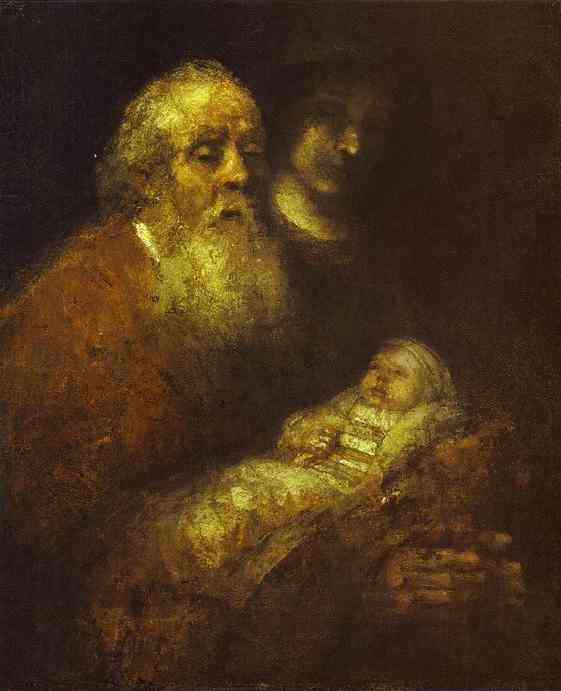
‘For the eternal Word’s becoming incarnate must be understood as a divine endorsement of how God intends himself and his purposes to be known. This would suggest, therefore, that when we come to interpret God’s purposes for humanity our thinking should be informed by this Word, not as an afterthought or as icing on a cake that has been prepared in advance but right from the outset. Second, beginning with the person of Christ takes cognizance of the fact that the Incarnation is revelatory as the Self-presentation not merely of God as God but of God as human. In God’s Self-disclosure God presents us with all that it is to be truly human’. – Alan J. Torrance.
Image: Rembrandt Harmenszoon van Rijn, Simeon with the Christ Child in the Temple. c. 1666-69. Oil on canvas. Nationalmuseum, Stockholm, Sweden.
Advent Reflection 6: ‘Ich bringe alles wieder’
 In his ‘Editor’s Forward’ to Dietrich Bonhoeffer’s most precious book, Letters and Papers from Prison, Eberhard Bethge recalls how this German Lutheran pastor spent the first eighteen months (from April 5th 1943 until October 8th 1944) of his confinement in the military section of Tegel Prison in Berlin. After not a little quibbling he was given permission to write to his parents. Within six months, Bonhoeffer had ‘made such good friends among the warders and medical orderlies’ that he was also able to start writing to them, ‘partly by letter, partly on scraps of paper’. In one such letter, written in Advent 1943, Bonhoeffer penned to a friend the following words, words which betray not only what was on his mind and in his heart at this time of year, but in doing so also serve as an indictment to so much of what passes for Christianity today, a Christianity for whom the Word which created it – and for which it exists to serve – has become all too foreign.
… For the past week or two these words have been constantly running through my head:
Let pass, dear brother, every pain;
What lacketh you I’ll bring again.
What does ‘bring again’ mean? It means that nothing is lost, everything is taken up again in Christ, though of course it is transfigured in the process, becoming transparent, clear and free from all self-seeking and desire. Christ brings it all again as God intended it to be, without the distortion which results from human sin. The doctrine of the restoration of all things – avnakefalaiw,sij – which is derived from Ephesians 1.10, recapitulatio (Irenaeus), is a magnificent conception, and full of comfort. This is the way in which the words ‘God seeketh again that which is passed away’ are fulfilled. And no one has expressed this more simply than Paul Gerhardt in the words which he puts in the mouth of the Christ-child:
Ich bringe alles wieder.
– Dietrich Bonhoeffer, Letters and Papers from Prison (ed. Eberhard Bethge; trans. Reginald H. Fuller; London: SCM, 1954), 87.
(NB. This is a reposting of my contribution to the Advent reflections at Hopeful Imagination)
Advent Reflection 5: The Great Dividing Issue for the Soul
 ‘Questions about immanence may concern philosophers. And questions about miracles may agitate physicists. But the great dividing issue for the soul is neither the Bethlehem cradle nor the empty grave, nor the Bible, nor the social question. For the Church at least (however it be with individuals) it is the question of a redeeming atonement. It is here that the evangelical issue lies. It is here, and not upon the nativity, that we part company with the Unitarians. It is here that the unsure may test their crypto-unitarianism. I would unchurch none. I would but clear the issue for the honest conscience. It is this that determines whether a man is Unitarian or Evangelical, and it is this that should guide his conscience as to his ecclesiastical associations. Only if he hold that in the atoning cross of Christ the world was redeemed by holy God once for all, that there, and only there, sin was judged and broken, that there and only there the race was reconciled and has its access to the face and grace of God-only then has he the genius and the plerophory of the Gospel’. – Peter T. Forsyth, The Cruciality of the Cross (London: Hodder & Stoughton, 1910), 73-4.
Dawkins on Christmas
In today’s New Statesman, Richard Dawkins reflects on what he was taught about Christmas, and what he thinks now:
We never wondered why God would go to such lengths simply to fulfil a prophecy. Nor, indeed, why God would go to the even greater lengths of sending his son into the world in order that he should be agonisingly punished for the sins that mankind might decide to commit at some time in the future (or for the past scrumping offence of one non-existent man, Adam) – surely one of the single nastiest ideas ever to occur to a human mind (Paul’s, of course). We never wondered why God, if he wanted to forgive our sins, didn’t just forgive them. Why did he have to scapegoat himself first? Where religion was concerned, we never wondered anything. That was the point about religion. You could ask questions about any other subject, but not religion.
…
For better or worse, ours is historically a Christian culture, and children who grow up ignorant of biblical literature are diminished, unable to take literary allusions, actually impoverished. I am no lover of Christianity, and I loathe the annual orgy of waste and reckless reciprocal spending, but I must say I’d rather wish you “Happy Christmas” than “Happy Holiday Season”.
Fortunately, this is not the only choice: 25 December is the birthday of one of the truly great men ever to walk the earth, Sir Isaac Newton. His achievements might justly be celebrated wherever his truths hold sway. And that means from one end of the universe to the other. Happy Newton Day!
Read the whole article here.
God taking shape in community

My old theology professor, Dr Frank Rees, has posted a great Advent reflection on Incarnational Community. He writes:
‘Right now, in the Advent and Christmas seasons, there is a lot of talk about Christ being born: about God becoming a human person, appearing in human form and so on. Making some sense of the reality of this claim is an enormous task: God, in one human person, within God’s own creation.
For many people, of course, the question is whether such a claim can possibly be true. I would tackle this question in a different way: I think it helps to ask, ‘How can we know this?’ Or, to put it in another way, if we were to know this, what kind of knowledge is it?
I don’t think it’s a matter of believing some things, about something which is said to have happened a long time ago, and refusing to consider other evidence or possibilities. I don’t think that’s faith at all. It has no creative and life-giving dimensions whatsoever.
What I think this means is something to be known in a personal and communal experience, in the present, which in some ways helps us to understand the past, and yet is also shaped by the past.
Recently, I found this quotation from Dietrich Bonhoeffer’s Letters and Papers from Prison. I must have read it before, but it struck me this time: p. 359, “One has to live for some time in community to understand that Christ is ‘formed’ in it’.” There is a reference here to Galations 4. 19, where Paul uses an image of childbirth, saying that he (the Apostle) is ‘in the pain of childbirth until Christ is formed in you.’ For Paul, too, there is this idea not only that Christ was a human person who lived in his recent past, but that Christ yet lives, and yet embodies, takes shape: Paul was convinced that the community of Christians, made alive in the Spirit, really is a living body of Christ, an incarnation of the same God who appeared to us as Jesus of Nazareth.
Bonhoeffer, especially in his Ethics, was interested in the idea that Christ ‘takes shape’ and ‘is formed’ in the world. This was his idea of whatever is meaningful in ‘the church’. It is a community in which Christ is taking shape. And to put it another way, his view was that wherever Christ is taking shape in the world that is where the church needs to be, where Christian people need to find themselves involved.
Incarnation is not an idea about once upon a time. It is a divine habit, indeed a divine habitation. It is something God perpetually does, and invites us to know, to be part of. This knowing is a present experience. We can discover ourselves becoming part of the ‘taking shape’, and Bonhoeffer rightly sees that this is something we learn in community, in deep and committed relationships.
More than that, such communities, usually informed and shaped by the story and vision which Jesus offered, his Gospel of God, also find that through these experiences of community, this sense of Christ taking shape among, within, between them, they can also more clearly comprehend the historic claims, the idea of God being ‘incarnate’, born among us, in the person of Jesus, in a messy world of power games and political intrigues, and little people being pushed aside, abused, slaughtered, and religion playing along with it all, for its own self-preservation.
We can believe that, because this is our reality too, and yet, —yet— we dare to acknowledge that within us, in our community, even , Christ is formed.
There’s a lot to think on, and to hope for, amidst the words and music and all the rest which is called ‘Christmas’, the birth of Christ.’
Advent Reflection 4: What God is doing

‘[In the Incarnation], God is doing what God is always doing, attempting to give all that God is to what is not God’. – Kathryn Tanner, Jesus, Humanity, and the Trinity: A Brief Systematic Theology, p. 15.
Advent Reflection 3: Born for the Cross
 ‘That Cross was deep embedded in the very structure of Christ’s Person, because nowadays you cannot separate His Person from His vocation, from the work lie came to do, and the words He came to speak. The Cross was not simply a fate awaiting Christ in the future; it pervaded subliminally His holy Person. He was born for the Cross. It was His genius, His destiny. It was quite inevitable that, in a world like this, One holy as Jesus was holy should come to the Cross. The parable [of the prodigal Son] was spoken by One in whom the Cross and all it stands for were latent in His idea of God; and it became patent, came to the surface, became actual, and practical, and powerful in the stress of man’s crisis and the fullness of God’s time. That is an important phrase. Christ Himself came in a fullness of time. The Cross which consummated and crowned Christ came in its fullness of time. The time was not full during Christ’s life for preaching an atonement that life could never make’. – Peter T. Forsyth, The Work of Christ (London: Hodder & Stoughton, 1910), 107-8.
Advent Reflection 2: No Longer the Day of The Child
 ‘In our secularized Western society Christmas offers a good occasion to experience [an] illusory happiness that offers a short break in our fear-filled lives. For many, Christmas is no longer the day to celebrate the mystery of the birth of God among us, the God hidden in the wounds of humanity. It is no longer the day of the child, awaited with prayer and repentance, contemplated with watchful attentiveness, and remembered in liturgical solemnity, joyful song, and peaceful family meals. Instead, Christmas has become a time when companies send elaborate gifts to their clients to thank them for their business, when post offices work overtime to process an overload of cards, when immense amounts of money are spent on food and drink, and socializing becomes a full-time activity. There are trees, decorate streets, sweet tunes in the supermarkets, and children saying to their parents: I want this and I want that.’ The shallow happiness of busy people often fills the place meant to experience the deep, lasting joy of Emmanuel, God-with-us’. — Henri Nouwen, Lifesigns: Intimacy, Fecundity, and Ecstasy in Christian Perspective (New York: Image, 1986), 98.
(HT: Aaron)
Advent Reflection 1: In Christ God Has Come Together With Us
 Each year between 1926 and 1933, the Swiss theologian Karl Barth penned a Christmas meditation for a German daily newspaper. In his 1931 reflection, ‘It gives new lustre to the world’, Barth began by asking a question asked each Advent by Christians generally, and perhaps especially by those called upon to preach: ‘What does it mean to hear the Christmas message?’ He proceeds to say that if the question is put like that, ‘then it behoves us all, especially if we happen to be theologians, to keep our mouths shut and first to consider that the Christmas message is not a philosophy, nor an ideology, nor a moral system or anything like that’. Instead, the Christmas word is ‘the Word of God to which no one has the key and whose real meaning for us, now as in former ages, is God’s secret. Hidden is the point where the Christmas message concerns each one of us and our whole generation, where its grace and judgement, its promise and command affect us’.
However (and it is a big ‘however’), as Barth proceeds to note, the question posed above does not need to be put like that. We could ask, for example, ‘What does it mean that we have heard the Christmas message?’; in which case, while we cannot lay hold of the full reality of the Christmas message, interpret and apply it, as if it were some human wisdom, neither can we or should we ignore its testimony which speaks to us of its hidden reality, of its way and nature, whereby both we and every other generation are reminded of certain possibilities, which are, so to speak, the outer garb of an incomprehensible but real encounter between God and humanity. In the grace of God, we can and must speak that which we know and have heard. In the grace of God, we can and must bear witness, testimony, to God’s self-disclosure. And in the grace of God, this testimony is preserved for us in Holy Scripture.
When, therefore, the Christmas word seems too incredible to believe, we can hear … and believe again. And what is this word? Barth again:
If God had wanted to deal with us as He is free to do, and as we well deserved it, according to His principle, He would never have become man. But He was and is merciful, and therefore in Christ He has come together with us (with us!), though His holiness and our weakness and wickedness should really exclude any coming together on His part and any thought of cooperation on our part. But God did and does just this, the impossible or – should we say? – that which is practical only for Him the Merciful One, which must happen so that His free and merciful will be done. The fact that also in this respect human beings can believe the eternal Light, means that we do perhaps have the will to do that which concerns us most, and which under any circumstance must be done in common with others. – Karl Barth, Christmas (trans. Bernhard Citron; Edinburgh/London: Oliver and Boyd, 1959), 47.
(NB. This is a reposting of my contribution to the Advent reflections at Hopeful Imagination)
 jasongoroncy.com