Author: Jason Goroncy

April bests …

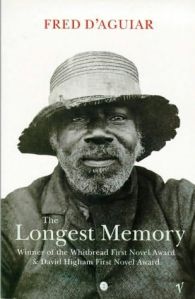
the-longest-memoryBest books: Wilfred Gordon McDonald Partridge, written by Mem Fox and illustrated by Julie Vivas; The Longest Memory, by Fred D’Aguiar; The Death of Adam: Essays on Modern Thought by Marilynne Robinson; The Puppet and the Dwarf: The Perverse Core of Christianity by Slavoj Žižek; Always the Sound of the Sea: The Daily Lives of New Zealand’s Lighthouse Keepers by Helen Beaglehole.

Best music: Blair Douglas, Stay Strong; Don McGlashan and the Seven Sisters, Marvellous Year; Neil Finn, Try Whistling This; Placido Domingo, Amore Infinito: Songs inspired by the Poetry of John Paul II (Karol Wojtyla); Nick Cave and Warren Ellis, The Assassination of Jesse James; Conor Oberst, Conor Oberst; Bob Dylan, Together Through Life.

Best films: Pan’s Labyrinth [2006]; Hunger [2008]; Pride and Prejudice [2001].

Best drink: PNG Coffee (Fairtrade) from Izon Coffee. (BTW: the folk at Izon are great to deal with)

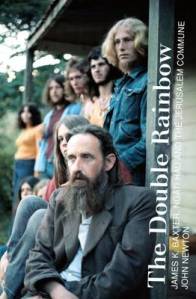
The Double Rainbow: James K. Baxter, Ngati Hau and the Jerusalem Commune

the-double-rainbowLast night saw the launch of John Newton’s new book, The Double Rainbow: James K. Baxter, Ngati Hau and the Jerusalem Commune, which examines the commune that New Zealand’s best-known poet James K. Baxter was instrumental in establishing at Jerusalem, on the Whanganui River.

The book was lauched by Lydia Wevers in Wellington at Unity Books. Here’s what she said:

‘In his introduction John says he was fractionally too young at fifteen to have known Baxter or been part of the commune at Jerusalem, yet it is his book which makes sense of that world to me. I wasn’t too young. I encountered Baxter first as a poet – he was the NZ poet when I came to university in 1968. I loved his richly metaphorical formalist poems, his essays and broadsheets and later Autumn Testament and the Jerusalem Sonnets. He embodied, for me and for many other people, the spirit of the age. Baxter was a frequent presence at Vic, at student meetings, round campus, at class. It was said that when he needed money he rang Frank McKay, our NZ lit lecturer and later Baxter’s biographer, and arranged to teach a class. I remember one 8am lecture when he recited an ode he’d written on the way to class which began with the petrol station at the far end of the Viaduct. Even more excitingly he borrowed my watch-I kept it for years after it stopped working because of that. Soon after he died I was marking first year exam papers, and a number of them were dedicated to Hemi – the emotions of his death marked the end of 1972 in a way that I have never forgotten.

But this book The Double Rainbow is not a book about Baxter in a biographical or personal way. John calls it a ‘work of cultural history which aspires to be a work of bicultural history’ which is his typically modest way of describing what is a really remarkable achievement. Like the story it tells, this is a book inspired by Baxter but not contained by him.

First I want to say-this is a brave book. In February 1969 Thomas Wallace was chopping firewood when ‘a bare-footed, bearded Pakeha emerged from the mist’. This is how John described Baxter’s first appearance at Jerusalem & though John is not barefoot or bearded it made me think about the courage it takes to really engage with another culture. There are very very few scholars in Aotearoa who have attempted real bicultural work. Lots of people, myself included, have discussed Maori history or literature from a Pakeha point of view. But to try to see from the other side of the river requires courage, openness, and the willingness to actually learn something hard and new. Baxter could do that, and so did some of his followers. Ngati Hau did it and so did the sisters at the convent. And now so has John. I think it’s a remarkable achievement.

The second thing I want to say is what a huge amount of work has gone into this book. You can see it in the list of acknowledgements, and its contextual depth. From the ancient eel weirs of the Whanganui to what happened after Baxter died, the book provides a deep and rich slice into a particular place and what has happened there. John has journeyed the length and breadth of Aotearoa, to say nothing of the river, to talk to participants. He has spent months at Jerusalem talking to iwi and to the sisters at the convent. He has read the considerable number of books written about the river, intentional communities, the commune and Baxter – the result is a book that will take its place as a new and adventurous history and also as a cultural analysis that might tell us something about what we should do now. In a way it’s a call to action. Part of what is so striking about this story of Baxter and the diverse community that surrounded him is the loving-kindness and generosity that emerged between cultures, between generations, between city and country and between the pa and the Top House. John makes the point that there were many economic and social transactions that took place – gifts of food for gifts of work – but what struck me most was the way that something happened there, suggested also by what happened at Baxter’s tangi, that briefly transcended the fears and anxieties and moral failings that keeps most people living in the circles of their own skulls. What John’s book reveals, in the voices of the people who lived in it and through his own lucid prose, is something bigger than the people who took part in it.

Before The Double Rainbow the prevailing idea, as John points out and in my own idea of it, was that Jerusalem was Baxter. There’s no doubt that Baxter was visionary and charismatic. But what his vision resulted in was the product of many people – the old ladies at the pa and the Ngati Hau leaders are crucial, as were the sisters at the convent and the remarkable and saintly Father Te Awhitu – there are too many people for me to name and anyway they are in the book. But their collective story is a very powerful one – it is touching and charming but also inspiring – the way the pa educated the influx of city pakeha in tikanga and kaupapa, so they could be part of what happened on the marae. In this book the most remarkable generosity is that of the iwi, as Baxter noted, the tuakana, the older brother, and the response of pakeha to it – open minded to a vision of an alternative world, is what we should all be doing. When I read about how the kuia would march up to the Top House with a bottle of Jeyes fluid and insist they used it, I had to scrub my house from top to bottom.

The last thing I want to say about The Double Rainbow is that this book is a joy to read. I left myself slightly too little time for it – or so I thought, panicking slightly that it was Saturday morning and I hadn’t started. I needn’t have worried. I know John’s writing – it has flow and light. He sweeps you along. I had time to start on something else by Sunday. But at the same time I felt enlightened and excited by John’s lucid prose and even more importantly, his sense of conviction – this is a book with a commitment to what it describes. And it made me go and reread Baxter. So I thought, even though this book is a bicultural social history, an ethnography, a work of fact and not a ‘book about Baxter’, I’d give Hemi the last word

This is from ‘Sestina of the River Road’, one of his last poems from 1972:

I want to go up the river road
Even by starlight or moonlight
Or no light at all, past the Parakino bridge
Past Atene where the tarseal ends
Past Koroniti where the cattle run in a paddock
Past Operiki, the pa that was never taken,

Past Matahiwi, Ranana, till the last step is taken
And I can lie down at the end of the road
Like an old horse in his own paddock
Among the tribe of Te Hau. Then my heart will be light
To be in the place where the hard road ends
And my soul can walk the rainbow bridge
That binds earth to sky. In his cave below the bridge
Where big eels can be taken
With the hinaki, and the ends
Of willow branches trail from the edge of the road
Onto the water, the dark one rises to the light,
The taniwha who guards the tribal paddock

And saves men from drowning.

‘”What Happened Next?”: Vincent Donovan, Thirty-five Years On’

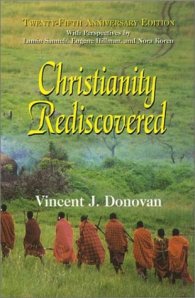
christianity-rediscoveredDear Bishop,

… Suddenly I feel the urgent need to cast aside all theories and discussions, all efforts at strategy, and simply go to these people and do the work among them for which I came to Africa. I would propose cutting myself off from the schools and the hospital and just go and talk to them about God and the Christian message. Outside of this, I have no theory, no plan, no strategy, no gimmick, no idea of what will come. I feel rather naked. I will begin as soon as possible … (Vincent J. Donovan)

I will always be grateful for my being introduced to Christianity Rediscovered: An Epistle to the Masai by Vincent J. Donovan, who I’ve posted on before. I can’t recall how many copies that I’ve given away over the years but it runs well into double figures (a wee plea: this is not a gloat but an indication of how highly I view this book). The book continues to have a profound influence on the way I think about Church, mission and the Gospel. Yet like many readers of this wonderful story, I was always left with a set of frustrating questions: ‘What happened next?’ ‘Did the Masai Donovan encountered go on to do the self-theologising and self-ecclesiologicalising that he (in the spirit of Roland Allen) had hoped that they would?’ ‘What happened to Donovan himself?’ etc. So I was absolutely thrilled yesterday to pick up the latest copy of the International Bulletin of Missionary Research (33/2 April 2009) and read John P. Bowen’s article entitled ‘”What Happened Next?”: Vincent Donovan, Thirty-five Years On’. The story is significantly sadder than I had hoped, but Bowen’s piece is no less important for that. Bowen also draws attention to his forthcoming edited book The Letters of Vincent Donovan, to be published by Orbis Books.

And while I’m drawing attention to newies, here’s two more to look out for:

Impressing or Confessing?

hillsong‘One reason why the Church does not impress the world more may be because we are too much bent on impressing it, more bent on impressing than on confessing. We labour on the world rather than overflow on it. We have a deeper sense of its need than of our own fulness, of its problems than of our answer … We are tempted to forget that we have not, in the first place, either to impress the world or to save it, but heartily and mightily to confess in word and deed a saviour who has done both, who has done it for ourselves, and who is doing it every day’. – PT Forsyth, ‘The Soul of Christ and the Cross of Christ’. London Quarterly Review 116 (1911), 193.

Susan Boyle: Judged by Beauty

susan-boyleA guest post by Bruce Hamill:

The story of Susan Boyle captured the imagination of the world. At one level it was simply the surprise of beauty. Where did that voice come from? And yet there is so much more than that here. And the “so much more” has to do with the expression on the judges’ faces and the sniggers of the audience including those universal judges on their couches throughout the world. It was here that the analogy to resurrection is greatest. For here the whole world was agreed on the form of the beautiful and it didn’t include Susan Boyle. Only the act of casting her out, in which both audience and judges were complicit, explains the looks on the judges’ faces and the astonishing popularity of her YouTube clip. And yet in that moment of discovery a strange thing happened. We realized for a moment our own judgment. We were the judges judged by her truth. And then another thing happened. We began to tell stories which justified the world we are a part of. We could not face the judgment that her unveiling made upon our world, so we turned the attention on her heroism, in such a way that we could in fact adore her as an appropriate idol and icon of our time. Like Pilate we avert our gaze from the truth that judges us. Where Pilate asks the dialectical question, we renarrated the familiar ‘rags to riches’ tale in which there is no judgment or surprise and Susan’s triumph is the logical conclusion of our meritocracy. She becomes the hero so we can avoid the spotlight being turned on us the audience and the world of American Idol-atry that we participate in.

I wonder what will happen to Susan now? How much longer will she avoid baptism by ‘makeover’? How much longer will we be able to stand her ‘look’? How much longer will she be able to avoid seeing herself through the eyes of the crowd?

Kevin Rudd and the problem of evil

kevin-ruddAndrew Hamilton has this good piece in Eureka Street:

After both the bushfires and the recent explosion on the asylum seekers’ boat, Mr Rudd expressed himself with uncharacteristic vehemence. In the first case he spoke of the evil of arson, and in the second he said that people smugglers could rot in hell.

This kind of language echoes the tabloid characterisation of people who have done particularly foul deeds as monsters. Such strong language serves many purposes. It insists that there is a clear difference between right and wrong, and that moral standards are objective, not subjective. It cuts through moral complexities and through arguments that would diffuse or minimise the moral culpability of the perpetrators of monstrous deeds.

It also separates evil-doers from ‘people like us’, and effectively excommunicates them from society. Arsonists and people smugglers have abandoned themselves to an evil that is alien to the rest of us. By denouncing and excluding them we keep ourselves untainted by their evil.

This view, for all its uses, contrasts with the Christian view of moral evil. The Christian view is more complex and holds together under tension three different insights.

First, it sees sin as pervasive, present in every human heart, and as distorting every relationship and institution of society. Because sin is so pervasive, the crucial line of separation does not lie between monsters and ordinary human beings. It lies between movements of the human heart that are open to God and others, and those that are selfish and possessive. The difference between Hitler and ourselves is one of degree, not of kind.

Of course, simply to insist that sin is ordinary and universal risks domesticating it. If there is a little Hitler in every human being, then what Hitler did could also seem to be of little significance. The second strand of the Christian view of sin is to recognise its destructiveness. When we choose our individual interests over our relationship to God and to others, we incalculably harm both our world and ourselves.

The BrisConnections business illustrates this. The greed of the parties who structured the deal, lured investors into it and served their own interests in resolving its conflicts is ordinary enough. But its drabness may cause us to neglect the potential damage done to society when it leads observers sensibly to decide that neither the parties to the dispute nor similar financial organisations are trustworthy. Such withdrawal of trust led to the Recession and its diminishment of human lives.

To recognise simultaneously the havoc that sin wreaks in individuals and society, and its pervasiveness in all human lives and relationships is challenging. It seems to encourage a grim view of the world. Indeed it is no wonder that people associate negativity and repression with Christianity and with any emphasis on sin. So the third strand of the Christian view of sin is also central. It is that God has overcome evil. So we can look honestly at our own lives and realistically at our world, confident that the Good News has outrun the bad.

The Christian attitude to people who have done monstrous deeds is complex. It encourages us to begin by seeing them as people like ourselves who are held in play by God’s love. We recognise the twisted knots of motivation in them and the factors that lessen moral culpability. We also give weight to the harm they have done. That does not deprive them of the respect to which they are entitled by their shared humanity.

Seen in this light, the incident involving people smugglers and asylum seekers requires a more complex view than that taken by the Prime Minister. We should look carefully at all the people involved. They are human beings like us, and the line of sinfulness runs through them as for us.

But they are also caught up in the sin of others — embodied in the Russian occupation, the initial encouragement of the Taliban for geopolitical ends, the current military action, and the ethnic hostility between different tribal groups in Afghanistan.

We should also give full weight to the selfishness that has led Australians to evade the claims that asyulum seekers make on us by virtue of their shared humanity. This is embodied in the artificial devices used to exclude asylum seekers, the pressure previously put on asylum seekers to return to their death in Afghanistan, the forced separation of refugees from their families through Temporary Protection Visas and so on.

But our focus throughout ought to be on the people caught in this story who are like us. They include the asylum seekers, the people smugglers, the officials administering an unjust policy, and Mr Rudd himself. Each makes claims on us that should be heard and judged. All are entitled to receive a hearing and a just judgment.

[Source: Eureka Street]

Psalm 6: A reflection

anguishFor the director of music. With stringed instruments. According to sheminith.

A psalm of David.

1O LORD, do not rebuke me in your anger
or discipline me in your wrath.

2 Be merciful to me, LORD, for I am faint;
O LORD, heal me, for my bones are in agony.

3 My soul is in anguish.
How long, O LORD, how long?

4 Turn, O LORD, and deliver me;
save me because of your unfailing love.

5 No one remembers you when he is dead.
Who praises you from the grave?

6 I am worn out from groaning;
all night long I flood my bed with weeping
and drench my couch with tears.

7 My eyes grow weak with sorrow;
they fail because of all my foes.

8 Away from me, all you who do evil,
for the LORD has heard my weeping.

9 The LORD has heard my cry for mercy;
the LORD accepts my prayer.

10 All my enemies will be ashamed and dismayed;
they will turn back in disgrace.

The problem with a hymnody that focuses on equilibrium, coherence, and symmetry (as in the psalms of orientation) is that it may deceive and cover over. Life is not like that. Life is so savagely marked by incoherence, a loss of balance, and unrelieved asymmetry.[1]

What strikes me most about Psalm 6 is that (like Job), when under the cloud of defeat, David doesn’t whinge to others, nor does he use the occasion to cultivate a calloused heart toward God. Fear, pain and distress constitute his world (and little else, or so it would seem). And his enemies want him dead.

But David turns to God. His turning constitutes a refusal to settle for things as they are, a snub to recognise the world as it would seem. His song is an act of relentless hope that considers that no situation falls outside of God’s capacity for transformation, nor of God’s responsibility.[2] Dan Allender and Tremper Longman III, in their book Cry of the Soul: How our emotions reveal our deepest questions about God, recall that:

The Psalms do not offer an analytical treatment of emotions. They are not a how-to text from which we can extrapolate four easy steps to resolving difficult emotions. Such simplistic reductions of our inner world, and of life itself, strip the heart of calling out to God in the darkness of His mysterious involvement with us. Instead, the Psalms invite us to question God. But they do this in the context of worship – they were the hymnal used in public worship. God invites us to bring before Him our rage, doubt, and terror – but He intends for us to do so as part of worship.[3]

So David calls out to God, and he recalls, among other things, God’s unfailing love.

Yet what if we were to listen in on this prayer as if it were not only David’s, but also that of a frightened man in Gethsemane, afraid that his impending death would mean the end of fellowship with God. ‘Who praises you from the grave?’ There is no resurrection hope here. So Thielicke:

Sheol [is] the land of no return, which means exclusion from God’s saving dealings with his community. Since salvation is history – in God’s mighty acts and in worship – exclusion from history is particularly painful. It involves the contradiction that on the one side life is ordained for God’s honor and praise and the other side is lost in the land of no return.[4]

When the Son takes on flesh and becomes Jesus, he becomes our brother, fully identifies with us in all the experiences of life, entering into the depth of creaturely existence ‘so savagely marked by incoherence, a loss of balance, and unrelieved asymmetry’. And as our brother, he dies our death, the death of all. All humanity enters Sheol in him.

And on the third day … Jesus – and humanity in him – turned to God.


[1] Walter Brueggemann, Spirituality of the Psalms (Minneapolis: Fortress Press, 2002), 25.

[2] Walter Brueggemann, Old Testament Theology: Essays on Structure, Theme, and Text (Minneapolis: Fortress, 1992), 29.

[3] Dan Allender and Tremper Longman III, Cry of the Soul: How our emotions reveal our deepest questions about God (Colorado Springs: Navpress, 1994), 37.

[4] Helmut Thielicke, The Evangelical Faith, Volume Three: Theology of the Spirit (ed. Geoffrey W. Bromiley; trans. Geoffrey W. Bromiley; Edinburgh: T&T Clark, 1997), 401.

Conferencing in the Antipodes

oamaruThere’s a number of conferences coming up in the greatest part of the world:

What love has in view …

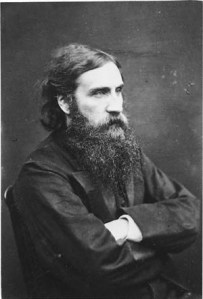
george-macdonald-by-william-jeffrey-c1852e2809360


‘For love loves unto purity. Love has ever in view the absolute loveliness of that which it beholds. Where loveliness is incomplete, and love cannot love its fill of loving, it spends itself to make more lovely, that it may love more; it strives for perfection, even that itself may be perfected – not in itself, but in the object’. – George MacDonald, Unspoken Sermons: Series I, II and III (Whitefish: Kessinger, 2004), 10.

If creation fails …

creation


‘If creation fails, then all has failed: God has failed. Making a new and different creation is not the sign of God’s success but of His failure. Indeed a new creation has no guarantee, either, that it will succeed. If the work of redemption is a corrective and an aid to initial creation, then that is not good enough: creation would still prove to be defective if it were to fail. It must succeed’. – Geoffrey C. Bingham, Creation and the Liberating Glory (Blackwood: New Creation Publications, 2004), 73.

Hell: The Nemesis of Hope?

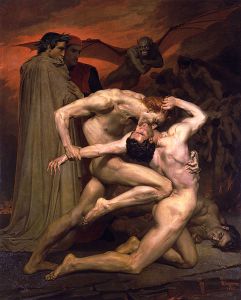
William-Adolphe Bouguereau, 'Dante And Virgil In Hell' (1850)

William-Adolphe Bouguereau, 'Dante And Virgil In Hell' (1850)

Some time ago I mentioned Nik Ansell’s superb study, The Annihilation of Hell: Universal Salvation and the Redemption of Time in the Eschatology of Jürgen Moltmann (Paternoster, forthcoming). Nik is professor of theology at the Institute for Christian Studies in Toronto. The Other Journal recently posted this piece wherein Nik picks up many of the themes in his forthcoming must read(!):

Abandon every hope, who enter here.

-Dante, Inferno, Canto III.9

Despite the Church’s curse, there is no one

so lost that the eternal love cannot

return-as long as hope shows something green

-Dante, Purgatorio, Canto III. 133-1351

If Hell is the nemesis of hope, can it be part of the Gospel? If Christ came to “free those who all their lives were held in slavery by their fear of death” (Heb. 2:15), should the fear of Hell keep the Church in business?2 If not, what on earth does “hell” mean in the New Testament?

Too hot to handle?

I’d like to explore these questions by first revisiting a controversy that came to a head twenty years ago concerning the theology of John Stott—a church leader who has been so influential and is so highly regarded worldwide that the New York Times recently referred to him as the “Pope” of Evangelicals.3

In 1988, David Edwards, an Anglican scholar long associated with the Student Christian Movement and SCM Press in the United Kingdom, published a respectful yet probing analysis of Stott’s theology entitled Essentials: A Liberal-Evangelical Dialogue. Predictably enough perhaps, one of Edwards’ sharpest challenges concerned the traditional doctrine of hell. Stott’s response, in the space he was given at the end of the relevant chapter,4 is now as famous as it is contentious. Forced to come clean about a topic he had largely avoided in his writings, he unambiguously rejected mainstream evangelical theology, declaring himself to be an “annihilationist.” While in traditional orthodoxy, the eternal souls of the saved and the damned experience either the blessing or the wrath of God forever, in Stott’s “conditional immortality,” the parallel (if not the contrast) is broken as those who fail to repent have no future in the age to come, thus passing out of existence. In the overcoming of evil, hell itself will pass away.5

Although reluctant to articulate his convictions in this area due to his concern for unity in the worldwide evangelical community, Stott nevertheless thanked Edwards for forcing the issue. He even went as far as to say of the traditional position, “[E]motionally, I find the concept intolerable and do not understand how people can live with it without either cauterizing their feelings or cracking under the strain.”6

Stott’s reluctance to write on the issue of hell and its annihilation because of the disunity it could create (or reveal) proved well founded. Soon afterward, at a major North American conference on what it meant to be an evangelical, the question was raised as to whether Stott himself should now be excluded given these recent revelations.7 It was put to a vote, and the motion was only narrowly defeated. The Pope was nearly excommunicated!

The Annihilationist Alternative

Annihilationism or conditional immortality has since been widely discussed and debated.8 If Stott’s theology is as representative here as it is elsewhere, then perhaps in another twenty years, this view of hell will no longer be confined to “open” evangelicals but may come to characterize the evangelical mainstream. Much will depend on whether there is widespread acceptance of Stott’s two-fold conviction that the Bible “points in the direction of annihilation” and that “‘eternal conscious torment’ is a tradition which has to yield to the supreme authority of Scripture.”9

Stott puts forward four main reasons for his position. Firstly, he proposes, we must take the biblical language of judgment-as-destruction far more seriously, and secondly, in the light of this extensive body of material,10 we must interpret the imagery of eternal fire far more carefully. In this context, Stott argues that fire’s main function “is not to cause pain, but to secure destruction, as all the world’s incinerators bear witness.”11 It is the fire that is eternal and unquenchable, Stott insists, not what is thrown into it. The smoke that “rises for ever and ever” (Rev. 14:11) is therefore to be seen as evidence that the fire has done its work. Eternal punishment, in other words, is not eternal punishing.

Stott claims that the “imagery” of hellfire, addressed in his second argument, is to be understood within the “language” of destruction, addressed in his first argument.12 His third and fourth arguments for annihilationism are similarly connected and concern the nature of justice as that is to be understood within God’s victory over evil.

Stott’s third point is that God’s justice is surely a justice in which “the penalty inflicted will be commensurate with the evil done.” Sin is indeed a grave matter, but in the traditional position there is a “serious disproportion,”13 in Stott’s judgment, between sins consciously committed in time and the torment that is to be consciously experienced throughout eternity as a result. Aware that traditional orthodoxy justifies everlasting punishment on the grounds that sinners will continue in their impenitence for ever, Stott develops his fourth point, which involves an appeal to those texts that are taken by some to point to a biblical vision of universal salvation. It is not that Stott wishes to defend universalism­­—far from it!14 But the biblical themes of God’s final victory over evil and his becoming “all in all” (1 Cor. 15:28) that are present in these texts,15 are incompatible, he insists, with the eternal existence of those who are damned and who would thus presumably continue to be in a state of rebellion against God.

Annihilationism, Stott proposes, solves these problems while doing justice to the biblical language about the judgment of the impenitent. His critics, however, accuse him of “special pleading” and of “playing fast and loose” with Scripture.16 The questions this controversy raises are still very much alive. Which position can claim biblical support? Which viewpoint should we endorse? With whom should we side: the annihilationists or the traditionalists?

The Last Word?

My own answer is: neither! Both positions, I suggest, must be rejected for at least two reasons, both of which call out for the development of a new theology in which Hell is no longer the nemesis of hope.

Firstly, both views allow evil to have the last word. As annihilationists have been quick to realize, the hell of traditional orthodoxy cannot do justice to the vision of Habakkuk 2:14 in which “the earth will be filled with the knowledge of the glory of the Lord as the waters cover the sea” or to the New Testament expression of this hope found in the promise that God will become “all in all” (1 Cor. 15:28). The traditional claim that the eternal suffering of the impenitent serves to glorify God by revealing his justice reduces the revelation of God’s glory to the restoration of God’s honor, thus separating the glory of God from the glorification of creation.17 Justice conceived as retribution closes down redemption and blocks the dawn of the age to come. In traditional eschatology, sinners no longer have the power to sin after the final judgment, yet they remain sinners. If they are to be everlastingly punished for the sins of the past, and for their impenitent condition, how is evil not still present in the world?18

Although the annihilationist attempt to find eschatological resolution beyond the confines of traditional orthodoxy is certainly justified, their own position has serious problems of its own. It is worth reminding ourselves, especially in this age of ecological violence and crisis, that the annihilation and destruction of God’s good creation is precisely the aim and goal of evil, not evidence of its defeat. The destruction, including the self-destruction, of those made in God’s image represents a victory for the forces of darkness. In the transformation of everlasting punishment into final judgment,19 evil still has the last word.

Secondly, I would like to suggest that both traditional orthodoxy and annihilationism seriously misread the Scriptures. There are fourteen references to “Hell” in the New Testament according to the New International Version (NIV), eleven of which refer to a place where human beings may end up as a result of God’s judgment. These eleven references all occur in the words of Jesus. Seven of the eleven are to be found in Matthew (5:22, 29, 30; 10:28; 18:9; 23:15, 33). The remaining four are all parallel texts: three in Mark (9:43-7) and one in Luke (12:5). These biblical references require closer attention than they have received in the current debate.

Gehenna

The Greek word for Hell in these texts is transliterated into English as Gehenna.20 In its earlier Hebrew form, Gehenna makes its debut in the Bible as a geographical place: the valley of (the son[s] of) Hinnom, or gê hinnōm (see Josh. 15:8, 18:16).21 According to archeologists, this is one of the valleys that is found close to the walls of Jerusalem.22

In Jeremiah 7:30-34, this valley is no longer seen as a piece of real estate that anyone would wish to own.23 Now it has become a place of judgment—an imminent judgment in history directed against Israel:

The people of Judah have done evil in my eyes, declares the Lord. They have set up their detestable idols in the house that bears my Name and have defiled it. They have built the high places of Topheth24 in the Valley of Ben Hinnom to burn their sons and daughters in the fire—something I did not command, nor did it enter my mind. So beware, the days are coming, declares the Lord, when people will no longer call it Topheth or the Valley of Ben Hinnom, but the Valley of Slaughter, for they will bury the dead in Topheth until there is no more room. Then the carcasses of the people will become food for the birds of the air and the beasts of the earth, and there will be no one to frighten them away. I will bring an end to the sounds of joy and gladness and to the voices of bride and bridegroom in the towns of Judah and the streets of Jerusalem, for the land will become desolate.

Similar language occurs in Jeremiah 19, where an imminent siege of Jerusalem is prophesied in response to Israel’s idolatry. The references to burning sons and daughters in the fire (see Jer. 7:31, 19:5, and 32:35) refer to atrocities associated with Judah’s kings Ahaz and Manasseh (2 Ki. 16:2-3, and 21:1-6). That such sacrifices were conducted in the Valley of Hinnom is made explicit in 2 Kings 23:10 and in the parallel account of their reigns found in 2 Chronicles 28:3 and 33:6.

The valley continues to be associated with idolatry and fire in the prophetic tradition, but now the fire is seen as coming from God. In Isaiah 30:33, God says:

Topheth has long been prepared; it has been made ready for the king [of Assyria, cf. v. 31].
Its fire pit has been made deep and wide, with an abundance of fire and wood;
the breath of the Lord, like a stream of burning sulfur, sets it ablaze.

In this imminent, historical judgment, we have fire and sulfur, or fire and brimstone, which harks back to the destruction of Sodom and Gomorrah (Gen. 19:24) and reappears in the book of Revelation (see Rev. 14:10, 19:20, 20:10, and 21:8).25

The same valley is also intended as the location for the judgment described in the final verse of the book of Isaiah. Thus, Isaiah 66:22–23 reads:

“From one New Moon to another and from one Sabbath to another, all mankind will come and bow down before me,” says the Lord. “And they will go out and look upon the dead bodies of those who rebelled against me; their worm will not die, nor will their fire be quenched, and they will be loathsome to all mankind.”

During the rise and fall of Jewish nationalism—a period that includes the Maccabean revolt against the Seleucids (169-160 BCE), the Great War against Rome (66-70 CE), and the revolt of Bar Kokhba, also against Rome (132-135 CE)—it is not hard to see how these passages from Isaiah, taken together with the portrayal of God’s judgment of the nations in Joel 3,26 could have fuelled the conviction that the dead bodies of Israel’s enemies should be cast into this Gehenna.27

Although a nationalistic agenda that would equate God’s enemies with Israel’s enemies is foreign to the prophetic tradition, it remains the case that for the Old Testament prophets, Gehenna is understood as the place where the wicked will be punished with fire in the “last days.” But as this is an earthly place outside Jerusalem and as the “last days” are clearly understood as taking place within history,28 this is very different from the Gehenna of later rabbinic literature in which the Valley of Hinnom has become an underworld or otherworldly realm that has been in existence since the creation.29 Such a place can indeed be identified with the Hell of traditional Christian theology. But these later Jewish texts all come from a time after the destruction of Jerusalem in AD 7030 when the Jewish worldview was thrown into crisis, to be recast by the rabbis into a far less geographically rooted form.31 By contrast, the Gehenna of the gospels, I suggest, continues the Old Testament tradition of imminent, this-worldly judgment.32

But there is a twist. Whereas his Jewish contemporaries saw Gehenna as the place where the nations in general and the Romans in particular would get what was coming to them,33 Jesus, standing in the tradition of Jeremiah, uses the language of the prophets to speak of God’s wrath against Jerusalem.34 Thus, in Mark 9:48, Jesus draws on the final verse of Isaiah, as cited above, to refer to a judgment that will soon fall not on the Romans as expected, but on his fellow Israelites:

And if your eye causes you to sin, pluck it out. It is better for you to enter the kingdom of God with one eye than to have two eyes and be thrown into [Gehenna], where “their worm will not die, nor will their fire be quenched.”

All of Jesus’s references to Gehenna, which are widely thought by believer and non-believer alike to refer to a last judgment at the end of time, are actually about the coming judgment on Israel, Jerusalem, and its temple. Here we should not be misled by the fact that Jesus’s language is apocalyptic in character. It is no coincidence that the last of the seven references to Gehenna in Matthew’s gospel (Mt. 23:33) is so close to the long discourse about the “end of the age” (Mt. 24:3 cf. Mt. 24:4-25:46). But to speak of this coming judgment of Jerusalem as “the end of the world,” thus using apocalyptic language for the events of history, is a way of speaking that is not as foreign to us as we might think. When we refer to certain events as “earth shattering,” for example, we know that there may be no literal geological upheavals or volcanic eruptions. But we also know that there are times when we need this kind of language if we are to even begin to capture the significance of what is happening. If we bear this language of cosmic upheaval in mind, then we can better understand the apocalyptic discourse that is found in Scripture.35

Contrary to popular belief, no Jew in Jesus’s day was expecting God to bring about the end of the space-time universe.36 But the destruction of the temple, which was built to symbolize the creation, thus revealing God’s presence within it,37 would be seen as truly cataclysmic. For Jesus, this was God’s judgment on Israel, signaling nothing less than what we might call the end of the old world order.38 The only appropriate language was the language of de-creation. This is precisely how Jeremiah speaks in his day of the coming destruction of Judah and the temple (Jer. 4:23-28). God’s judgment on Israel, carried out by the Romans, is acted out by Jesus in his ‘cleansing’ of the temple and his cursing of the fig-tree (see Mk. 11:12-25 and 13:28-31). In the coming destruction, he said, the Son of Man would be vindicated (see Mk. 1339). This judgment/vindication, which is described in terms of de-creation and enthronement, is also a main theme of the book of Revelation.40

The Jewish leaders and those who followed them were destined for Gehenna, said Jesus. In refusing to be a light to the Gentiles, in judging the world, and in preparing to engage in “holy” war against Rome, Israel had become like her Gentile oppressors, caught in idolatry. It is a grim fact of history that when the Romans laid siege to Jerusalem and the temple, culminating in its destruction, one generation later, the dead who were thrown from the city walls literally piled up in the Valley of Hinnom, Gehenna, Hell.41

In Jesus’s understanding, this was the “eternal” fire or destruction of God’s judgment (Mt. 18:8, 25:41, 25:46). When annihilationists claim that it is the punishment rather than the punishing that is everlasting, the argument is tenuous and tortured. But it is also unnecessary. The word translated as eternal here literally means “of the age (to come).”42 This is the judgment that ushers in the new age as foreseen by the prophets who looked forward to the end of the exile.43 According to the New Testament, God’s judgment on Israel at the hand of the Romans is a judgment that Jesus suffers on the cross so that his followers may avoid it. The destruction of the temple is the vindication of Jesus and his followers as the true Israel. It also marks God’s judgment on the enemies of this true Israel: a judgment that marks the birth pangs of a new world, heralding the true return from exile and the dawn of the new creation. Now, with the establishment of the people of God made up of Jews and Gentiles, God’s promise to Abraham—that he would have offspring as numerous as the stars—is finally coming true.44

The decisive victory against evil and thus against the idolatrous powers and principalities that humanity serves has been won on the cross, says Paul—a cross through which even the very powers and principalities that crucified Christ are reconciled to their Creator (see Col. 1:20ff.). In the power of the Spirit, the church is to live out this redemption, spreading the good news to the ends of the earth.

The future is far from dark. The non-human creation too will be healed and, according to the famous language of Romans 8, will experience a cosmic exodus and thus be set free from the oppression of our idolatry.45 Evil will be completely eradicated. As Paul puts it in 1 Corinthians 15: 24-25, 28:

For as in Adam all die, so in Christ all will be made alive. But each in his own turn: Christ, the firstfruits; then, when he comes, those who belong to him. Then the end will come, when he hands over the kingdom to God the Father after he has destroyed all dominion, authority and power. For he must reign until he has put all his enemies under his feet [. . . .] When he has done this, then the Son himself will be made subject to him who put everything under him, so that God may be all in all.

It is significant that here, in the most sustained discussion of the general resurrection in the New Testament, there is no mention of Hell, either as eternal torment or as annihilation. But this should come as no surprise, I suggest, as the Christian doctrine of Hell, for all the appeals to Scripture that have been made on its behalf, has no biblical basis.

Hell in History

Although Hell is foreign to the gospels, Gehenna is another matter—its significance for the church’s own history having been completely overlooked.

To briefly summarize the gospel setting in which the judgment of Gehenna is found, the Israel of Jesus’s day is consistently portrayed as failing to be a light to the Gentiles, its election being (mis)understood not as a calling to reveal God’s presence to the nations but as a sign that it is safe from the justice and wrath of God that would soon descend on the Gentile—and specifically Roman—world for its moral depravity and idolatrous ways.46 Far from sharing God’s love and wisdom, Israel’s leaders, according to the gospel writers, understood the way of holiness as purity from outside contamination.47 Yet the very different spirituality and holiness of Jesus is vindicated when the judgment that he prophesied and enacted against the temple comes to pass, marking the end of the old age (Mt. 24:3, 14) and the birth pangs (Mt. 24:7) of the age to come.

Generalizations have their limits, but a good generalization is generally true. More often than not, I suggest, the church has gone on to recapitulate the sins of Israel: calling God’s wrath down on sinners, setting itself “over” and “against” the world, hiding its true light under a bushel.48 The Roman Empire fell. Christendom was born. The Holy Roman Empire,49 as it came to be known, ruled the world, threatening all who would not toe the line with the fires of eternal torment.50 There is a place for nuanced historiography, but to those who were oppressed by the church when it was at the height of its powers, this would not be seen as a caricature. The secular critique of Christianity, for all its one-sidedness, is not without foundation.

There are two biblical patterns, I believe, that can help us interpret this history. The first is a complex, two-part motif found in the prophets, whereas the second is a pattern found throughout Scripture in which judgment is understood as related to salvation rather than to damnation.

This first biblical pattern, evident in Isaiah 10: 5-17, comes to the fore in the conviction that when God’s people fall into idolatry and fail to respond to the warnings of the prophets, they are handed over to their enemies who act out God’s wrath, to be judged in turn when God, responding out of his covenant love, judges Israel’s enemies for the way they have judged his people! In this light, and in the light of the judgment revealed against Israel in the synoptic apocalypse (Mt. 24/Mk. 13/Lk. 21), should we not ask ourselves whether history reveals God handing Christendom over to its enemies to face its hell, its Gehenna? If the Christian era came to an end with the dawn of the Enlightenment, which, in is secular form, attacked the church for its evils, not least for its cruel doctrine of Hell, then instead of condemning it, should we not, first and foremost, ask whether the dawn of the modern age can be seen as God’s judgment against the church? Even as we may also ask whether, given the violence with which modernity has dealt with people of faith, God has now handed modernity over to its postmodern critics.

Judgment unto Salvation

If we are open to God’s revelation in the secular critique of Christianity, it will not be hard to see that for too long, a church bent on control and motivated by fear has proclaimed that the good news amounts to avoiding the bad news. The self-critique of the prophetic tradition can further alert us to the fact that the church, if it is to avoid being thrown into Gehenna yet again, will need to jettison its doctrine of Hell and the mentality that goes with it and recapture how the Gospel is the good news of life lived to the full in covenant with God, without whom there is no life.51

That said, if we are to find a deeply biblical orientation to our own history, this way of understanding the significance of Gehenna—the way of self-critique— needs to be related to the second biblical pattern I have alluded to. Because justice conceived as retribution closes down redemption, we must be careful that we are not simply historicizing the traditional or annihilationist understanding of how God responds to evil. In a truly biblical redemptive-historical paradigm, I propose, judgment is not an end in itself and is therefore not final in that sense, but is always a judgment-unto-salvation.

This understanding of justice and judgment calls for a fundamental rereading of many biblical passages. Elsewhere I have explored this in relation to the book of Revelation.52 Here I will mention just one example that I think is paradigmatic for all of Scripture: the diversifying of the peoples and their ways of speaking that happens after the fall of Babel.53 In the light of God’s self-maledictory oath, after the flood, never to annihilate human life (Gen. 8:21, 9:11), it is important to see how the judgment of Babel is not a punishment, but a blessing that intends to get history back on track in line with the emergence of the nations that are described as “spread[ing] out over the earth” in Genesis 10:32 (cf. Gen. 10:5). Viewed within Genesis as a whole, the diversifying of the peoples that is highlighted in emphatic detail just before the Babel narrative (see Gen. 10:1-32) is seen as a positive response to the original benediction of Genesis 1:28 to “fill the earth,” even though this blessing, due to fear, is experienced as a threat in Genesis 11:4. What the judgment on Babel reveals is that the attempt to resist history is itself a dead end. It is a judgment-unto-salvation because the scattering allows the call to “fill the earth,” misconstrued in a fallen world as the word of death, to become once again the word of life.

The good news of Gehenna is that for those who have ears to hear and eyes to see, the attempt to invoke God’s judgment as an end in itself, as final, is revealed as a dead end. Such a spirituality does not belong to, and cannot be a part of, the life of the age to come. Thus, in looking back over church history at the rise and fall of the doctrine of Hell, we may be set free to develop an eschatology in which hope is allowed to triumph over fear.

Open Ended

Rather than close by spelling out what this means for our theologies, or by articulating a theological position as such, I would like to end with an open-ended image from the book of Revelation that is suggestive of a theology and a vision of the church that does not yet exist.

In the final chapters of John’s Apocalypse, we might expect to discover that the sinners who clearly do not escape the judgment that is described in language drawn from the fall of Jerusalem54 are either in the lake of fire or have now been annihilated by it. But instead, we actually find them outside the city (Rev. 22:15).55 Furthermore, this ‘exclusion’ is one that must be read in the light of the fact that there is still a mission to the nations (Rev. 21:24; 22:2). John’s vision reveals that because sin has no future in God’s world, the impure may not enter the city (Rev. 21:27). Yet this provides no ammunition for those who want to preach the final judgment of hellfire and damnation as “On no day will [the] gates [of the New Jerusalem] ever be shut” (Rev. 21:25).

Against the openness of God, the evil that would annihilate God’s creation, close down history, and shut the world off from its Creator, does not have a hope in hell.56


Notes
1. The Divine Comedy Of Dante Alighieri, Inferno, A Verse Translation with an Introduction by Allen Mandelbaum (New York, NY: Quality Paperback Book Club, 1981), 20-21 and The Divine Comedy Of Dante Alighieri, Purgatorio, A Verse Translation with an Introduction by Allen Mandelbaum (New York, NY: Quality Paperback Book Club, 1983), 26-27.

2. Because I am engaging with evangelical theology in particular in this essay, biblical quotations will be from the New International Version (NIV).

3. See David Brooks, “Who Is John Stott?” New York Times, November 30, 2004, available online at: http://www.nytimes.com/2004/11/30/opinion/30brooks.html?_r=1. Brooks cites Michael Cromartie of the Ethics and Public Policy Center as saying that “if evangelicals could elect a pope, Stott is the person they would likely choose.”

4. See “John Stott’s Response to Chapter 6,” in Essentials: A Liberal-Evangelical Dialogue, David L. Edwards with John Stott (London, UK: Hodder and Stoughton, 1988), 306-331.

5. Although Stott does refer to “annihilation,” (Essentials, 315, 318, 320), he seems to prefer to speak of “conditional immortality” (Essentials, 316). One of the merits of characterizing this position as “annihilationsim” is that it captures how those who remain in their sins come to nothing (Latin nihil) to the point where they are not even “history.” At the same time, it is important to note that for Stott, and for many others associated with this viewpoint, this is a misleading term because of what it could imply about God. A key tenet of Stott’s position, in distinction from traditional orthodoxy, is that the soul is not inherently immortal. Consequently, those who reject the gift of eternal life are seen as either foregoing resurrection altogether or as being left to pass out of existence after the final judgment. God, in other words, does not “actively” destroy them. This is a more fundamental departure from the God of traditional orthodoxy than annihilationism might be imply.

6. Stott, Essentials, 314.

7. The back cover of Essentials—hot off the press and on sale at the conference—introduced a summary of the dialogue to be found within its pages by posing the question: “What beliefs define an evangelical?” For an account of the Evangelical Affirmations consultation, see Walter Unger, “Focusing the Evangelical Vision” in Direction 20, no. 1 (Spring 1991): 3-17, available online at: http://www.directionjournal.org/article/?692.

8. In Essentials, 320, Stott wrote, “I do not dogmatise about the position to which I have come. I hold it tentatively. But I do plead for frank dialogue among Evangelicals on the basis of Scripture.” For examples of the dialogue that Stott was hoping for, see William Crockett, ed., Four Views On Hell (Grand Rapids, MI: Zondervan, 1996) and Edward William Fudge and Robert A Peterson, Two Views of Hell: A Biblical and Theological Dialogue (Downers Grove, IL: InterVarsity Press, 2000). For additional evidence that annihilationism is increasingly perceived as a legitimate evangelical position, see David Hilborn, ed., The Nature Of Hell: A Report by the Evangelical Alliance’s Commission on Unity and Truth among Evangelicals (ACUTE) (Carlisle, UK: Acute/Paternoster Publishing, 2000). For an Anglican case for annihilationism that included but was not confined to evangelical input, see The Mystery Of Salvation: The Story of God’s Gift. A Report by the Doctrine Commission of the General Synod of the Church of England (London, UK: Church House Publishing, 1995), 198-199.

9 Stott, Essentials, 315. One might explore the question of the future of evangelicalism by asking whether it will be the theology of John Stott or that of J. I. Packer that will endure. See note 14 below.

10. In support of reading judgment as destruction, Stott, Essentials, 315, initially cites: Mt. 7:13, 10:28; Jn. 3:16, 10:28, 17:12; Rom. 2:12, 9:22; 1 Cor 1:18, 15:18; 2 Cor. 2:15, 4:3; Phil. 1:28, 3:19; 1 Thess. 5:3; 2 Thess. 1:9, 2:10; Heb. 10:39; James 4:12; 2 Pet. 3, 9 and Rev. 17:8, 11.

11. Stott, Essentials, 316.

12. Stott’s distinction between “language” and “imagery” is explicit in Essentials, 315 and 318, and it frames the discussion of the first two points. His critics could presumably reverse this hermeneutically loaded distinction.

13. Ibid., 318.

14. Ibid., 319. There is now some evidence that universalism is being considered as an evangelical possibility. See David Hilborn and Don Horrocks, “Universalistic Trends in the Evangelical Tradition: An Historical Perspective” in Universal Salvation? The Current Debate, ed. Robin A. Parry and Christopher H. Partridge (Grand Rapids, MI: Eerdmans, 2003). This volume gives particular attention to the evangelical universalism of Thomas Talbott. Compare to Gregory MacDonald, The Evangelical Universalist (Eugene, OR: Cascade, 2006)

15. In addition to 1 Cor. 15:28 here, Stott also cites Jn. 12:32, Eph. 1:10, Phil. 2:10-11, and Col. 1:20 in Essentials, 319. There is a parallel between Stott’s first and fourth points and between his claim that the biblical texts that speak of judgment-as-destruction and the biblical texts that speak of the “universal” nature of salvation both need to be taken far more seriously. But the parallel is incomplete as Stott does not turn to the latter texts to define the contours of a paradigm.

16. See for example, J. I. Packer, “The Problem of Eternal Punishment” in Orthos, no. 10 (nd [an address originally given in Melbourne on August 31, 1990]), the account of Packer’s response to Stott in Robert A Peterson, Hell On Trial: The Case for Eternal Punishment (Phillipsburg, NJ: P&R Publishing, 1995), 11-16 and Peterson’s own response to Stott in Hell on Trial, 161-182. For Peterson’s debate with Fudge, see Peterson, Two Views of Hell.

17. Another way to put this is to say that God’s rule over creation, in this understanding, can never find fulfilment in God’s presence with creation.

18. One might redefine good and evil in the light of a certain view of God’s honor and imagine that provided God’s justice is being revealed, there is no longer evil from God’s point of view. But I do not see how God can be “all in all” in this perspective. Traditional orthodoxy can, in its own way, speak of God’s eschatological presence. Thus, God might be said to be present in terms of (a certain view of) justice toward the impenitent while being present in terms of a love beyond justice toward the saved. But the contrast—between justice and love, between a justice without love and a love beyond justice—points to an absence and thus to a limited view of God’s full eschatological presence that cannot do justice to Hab. 2:14 and 1 Cor. 15:28.

It is important to stress that love beyond justice includes a justice whose nature is fulfilled in love. While there cannot be love without justice, there cannot be the fullest form of justice without love. This means that traditional orthodoxy cannot do justice to justice. On the notion of justice “making way for” love, see the comments on “judgment unto salvation” below.

19. On the language of final judgment, see the section entitled “judgment unto salvation” below.

20. Gehenna is also the term in James 3:6, but this is not a reference to a place of judgment. To complete the survey of the fourteen references to “hell” in the NIV, Lk. 16:23 refers to Hades as an intermediate state, while 2 Peter 2:4 refers to Tartarus, which is also intermediate and not associated with human beings.

21. To trace the journey of the term fully from Hebrew to English, there are four main steps: first, the Hebrew gê hinnōm takes on an Aramaic form gēhinā(m). This is then transliterated into Greek as géenna, before being transliterated into the Latin Gehenna, from which is derived the English term.

22. See Lloyd R. Bailey, “Gehenna: The Topography of Hell” in Biblical Archaeologist 49, no. 3 (September 1986): 187-191. Cf. Stephen Von Wyrick, “Gehenna” Eerdmans Dictionary of the Bible, ed. David Noel Freedman, Allen C. Myers, and Astrid B. Beck (Grand Rapids, MI: Eerdmans, 2000), 489 and Richard A. Spencer, “Hinnom, Valley of” in Eerdmans Dictionary, Freedman et al., 592. Compare to note 24 below.

23. There is one other geographical reference, found in Neh. 11:30, that does not carry the connotations of judgment to be explored below.

24. In Brian P. Irwin, “Topheth,” in Eerdmans Dictionary, Freedman et al., 1321,  Irwin notes that Topheth was probably “at the lower end of Hinnom Valley close to the southern tip of the City of David.” It is thought that the name may derive from the Aramaic word for fireplace combined with the vowels from the Hebrew word for shame.

25. Imagery from Jer. 7:30-34 shows up in Rev. 18:23 and 19:21.

26. While the valley in Joel 3:2, 12, 14 is symbolically rather than geographically named, its close vicinity to Jerusalem, as indicated in 2:9 and 3:16, means that it would have been associated, if not identified, with the Valley of Hinnom.

27. As Von Wyrick puts it in “Gehenna,” Eerdmans Dictionary, Freedman et al., 489, “By the time of the Maccabees, the valley was the appropriate location in which to burn the bodies of one’s enemies.” Here he would seem to be echoing Bailey’s claim, in “Gehenna,” 188, about the use of the Valley of Hinnom in the Maccabean revolt. Although 1 Maccabees itself is not considered an apocalyptic work, and although it makes no mention of the valley, the frequent references to the burning of Israel’s enemies (see 1 Macc. 3:5; 4:20; 5:5, 28, 35, 44, 65, 68; 6:31; 10:84, 85; 11:4, 61; 16:10; cf. 2 Macc. 8:33, 10:36, 12:6) are significant, especially if this work influenced the way Joel 3 and Isa. 66:23 were (mis)read. Compare to note 33 below. The other texts that Von Wyrick refers to in this context are 2 Esdras 7:36 and 1 Enoch 27:1-2 (see note 32 below).

28. If one were to read Isa. 66 in the light of the reference to the “last days” in Isa. 2:2, or if we were to interpret Joel 2:28 as referring to the “last days” (as this text is cited in Acts 2:17) and then read Joel 3:1ff in that light, Peter’s understanding of the “last days” as falling within history in Acts 2 underscores the point I am making. Old Testament apocalyptic prophecy is not about the “end” of history. Compare to note 35.

29. Although child sacrifice in the Valley of Hinnom was associated with Molech (2 Kings 23:10) who was an underworld deity, the prophetic tradition does not seek to portray an “underworldly” reality. When later Christians saw this as a hellish realm ruled over by Satan (thus going beyond the underworld understanding of Gehenna found in the later rabbinic tradition, cf. n. 31 below), one might wonder whether Molech had found a place in the “Christian” imagination.

30. I refer to 70 CE as AD 70 here because AD (anno Domini) connotes the vindication of Jesus’s message in relation to the destruction of the temple, as explored below.

31. At this point, I find a crucial lack of precision in the articles by Bailey, Von Wyrick, Spencer, Kirk-Duggan, and Reicke cited in this note and notes 22 (above) and 32 (below). For further details concerning the dating and evaluation of the relevant references to Gehenna, see my The Annihilation Of Hell: Universal Salvation and the Redemption of Time in the Eschatology of Jürgen Moltmann (Carlisle, UK: Paternoster Press, forthcoming), chap. 7, especially 7.1. There I argue that the eclipse of Jewish nationalism and its focus on land as the locus of God’s promises after the destruction of Jerusalem, an eclipse which is so evident in the early rabbinic tradition, must be borne in mind when that tradition occasionally attributes belief in an “underworldly” Gehenna to Jewish teachers in the early first century. For, as Bo Reicke notes, in “Gehenna” in The Oxford Companion To The Bible, Bruce M. Metzger and Michael D. Coogan (New York, NY: Oxford University Press, 1993), 243, “In the Mishnah and later rabbinic texts, the name Gehenna [. . .] has superseded the older terms for underworld (Sheol).” Compare to note 32 below.

That Gehenna is effectively hellenized after 70 CE in the rabbinic tradition is a modest claim (cf. the analysis of the extent to which the Jewish worldview could be recast given the eclipse of Jewish nationalism after the failed revolt of 115-7 CE in Carl B. Smith, No Longer Jews: The Search for Gnostic Origins [Peabody, MA: Hendrickson, 2004]). But whatever we make of the relevant first century evidence outside the New Testament, my main point below is that Gehenna is not seen as a postmortem underworld in the gospels.

32. This prophetic interpretation of Gehenna also makes good sense of the reference to the “cursed valley” in 1 Enoch 27:1-2 (contra Cheryl A. Kirk-Duggan, “Hell,” in Eerdmans Dictionary, Freedman et al., 572-3, which is misleading at this point). It is important to note that this valley is distinct from the underworld of 1 Enoch 22 (cf. George W. E. Nickelsburg, 1 Enoch 1: A Commentary on the Book of 1 Enoch, Chapters 1-36; 81-108 [Minneapolis, MN: Fortress Press, 2001], 308). Furthermore, the fact that the chapters that follow (1 Enoch 28-36) lack “explicit eschatological material” but “fill out the comprehensive tour of the ends of the earth” begun in 1 Enoch 17, as John J. Collins notes in The Apocalyptic Imagination: An Introduction to Jewish Apocalyptic Literature. Second edition (Grand Rapids, MI: Eerdmans, 1998), 55-56, should (contra Collins) come as no surprise. This material, from what is usually considered the earliest (third century BCE) part of 1 Enoch, is in line with the geographically located portrayal of Gehenna in the Old Testament prophetic tradition. I think that a good case can be made for discerning the same perspective when this valley is in view in later parts of 1 Enoch. See 1 Enoch 54:2 (cf. 53:1, 5) and 90:26 (where the valley, seen as an “abyss [. . .] south of that house” [i.e., Jerusalem], is distinguished from the “abyss” of vv. 24-25, as noted by Nickelsburg, 1 Enoch 1, 403-404).

The reference to Gehenna in 4 Ezra 7:36 (= 2 Esdras 7:36) seems to belong in a somewhat different—and in many ways unique—category. While in this Jewish apocalypse, Gehenna (in distinction from the rabbinic tradition) is still distinguished from Hades (see 4:7-8 and 8:53) and while there are echoes of the prophetic tradition’s judgment of the nations here (see 7:37, cf. the discussion in Michael E. Stone, 4 Ezra: A Commentary on the Book of Fourth Ezra [Minneapolis, MN: Fortress, 1990], 222 and cf. 5 Ezra 2:28-29 [= 2 Esdras 2:28-29]), this judgment is seen as taking place after a resurrection in the transition between the present age and the age to come. This is a significant departure from the Old Testament, where the idea of postmortem, post-resurrection judgment, found only in Dan. 12:2, is not explicitly associated with Gehenna (though Nickelsburg, 1 Enoch 1, 319, detects a linguistic connection between Dan. 12:2 and Isa. 66:24).

4 Ezra 7:36, dated after 70 CE (and usually at the end of the first century, cf. 4 Ezra 3:1) marks an important transition between the Old Testament (and, I will, argue, the New Testament) understanding of Gehenna and post-biblical conceptions of Hell. Other pre-diaspora Jewish texts also from the first century CE (for current views of their dating and location, see Collins, The Apocalyptic Imagination) either give fleeting or confused attention to Gehenna (see 2 Baruch 59:10, Apocalypse of Abraham 15:6 [cf. the comments in James H. Charlesworth, ed., The Old Testament Pseudepigrapha, volume 1: Apocalyptic Literature and Testaments (New York, NY: Doubleday, 1983), 686, 696] and Testament of Moses 10:10 [cf. the rejection of R. H. Charles’s textual emendation in ibid., 933]). By the time we get to the Sibylline Oracles 1.101-103, 2.293 and 4.106, later in the first century and written beyond the promised land, Gehenna and Tartarus have become synonymous (cf. the blending of Gehenna and Sheol in the rabbinic tradition in note 31 above).

Of all the extra-biblical books thought to shed light on Gehenna in the New Testament, 1 Enoch and 4 Ezra are the most important both historically and theologically. Both texts are considered canonical in the Ethiopian Orthodox tradition, the latter also having this status in the Russian Orthodox and Coptic traditions. Even if 4 Ezra were considered fully canonical, even if we overlook the fact that most Christian groups who preserved it knew a text that was actually missing 4 Ezra 7:36-140 (cf. Bruce W. Longnecker, 2 Esdras [Sheffield, UK: Sheffield Academic Press, 1995], 110-112), it is still important to maintain on historical grounds that the post-resurrection Gehenna of 4 Ezra 7:36 should not be read into the gospels (see note 39 below). Its perspective also differs from the book of Revelation (see note 55 below).

33. It is easy to imagine how the success of the Maccabean revolt less than two hundred years earlier could inspire a certain reading of Joel 3 in this context.

34. It is most significant that seven of the eleven references to Gehenna in the synoptics occur in Matthew, for this gospel is particularly steeped in allusions to Jeremiah. Cf. Michael Knowles, Jeremiah in Matthew’s Gospel: The Rejected-Prophet Motif in Matthaean Redaction (Sheffield, UK: JSOT Press, 1993).

35. The nature of biblical apocalyptic is contested, but here and in what follows, I am indebted to what I take to be the extremely insightful analysis of N. T. Wright in his The New Testament And The People Of God: Christian Origins and the Question of God, volume 1 (London, UK: SPCK; Philadelphia, PA: Fortress Press, 1992), 280–299. In my judgment, biblical apocalyptic, in its fullest form, has as its focus the transition between the old age and the new age, which I refer to below as the death throes of the old world order and the birth-pangs of the new creation. Our contemporary language for the cataclysmic, though it does help us understand this kind of discourse, typically lacks a reference to the birthing of the new.

36. See Wright, The New Testament And The People Of God, 333.

37. See G. K. Beale, The Temple and the Church’s Mission: A Biblical Theology of the Dwelling Place of God (Downers Grove, IL: InterVarsity Press, 2004).

38. Using more traditional terms, this is the end of the old covenant. As references to the “old” covenant can easily be co-opted by anti-Judaism, it is worth pointing out that the language of the new (and by implication the old, first, or former) covenant is found in the Hebrew Bible (see Jer. 31:31 and see the contrast between new and former in Isa. 65:17).

39. Mk. 13:28 connects this apocalyptic discourse to the cursing of the fig tree in Mk. 11:12-14. The reference to the passing away of heaven and earth in Mk. 13:31, given the cosmic symbolism and significance of the temple, may be connected to Mk. 13:1-2. These two references to the temple thus frame the chapter.

In Wright’s analysis, in The New Testament And The People Of God, 390-396, the language about “the Son of Man coming in clouds with great power and glory” in Mk. 13:26 (and parallels) refers in the language of Dan. 7:13 to the coming of the Son of Man to God. This is enthronement language that signals vindication. If there is thus no reference to the “second coming” in the synoptic apocalypse (Mk. 13, Mt. 24, Lk. 21), this coheres with the fact that there is nothing in these passages, or in the synoptics’ references to Gehenna, that would place the judgment referred to after the general resurrection. This is an important difference between the gospels and 4 Ezra 7:36 (cf. note 32 above).

40. I have explored the book of Revelation in “An Apocalyptic Appendix” in The Annihilation Of Hell.

41. For a contemporary account, see Josephus, The Jewish War, 5.12.3-4.

42. This translation allows us to maintain the inverse parallelism of Mt. 25:46, while robbing traditionalists of their main “proof text” against universalists and annihilationists.

43. For the return-from-exile theme in the New Testament as far deeper than a geographical return to the promised land, see N. T. Wright, Jesus And The Victory Of God: Christian Origins and the Question of God, volume 2 (London, UK: SPCK; Philadelphia, PA: Fortress Press, 1996) and Brant Pitre, Jesus, The Tribulation, And The End Of The Exile: Restoration Eschatology and the Origin of the Atonement (Tubingen: Mohr Siebeck; Grand Rapids, MI: Baker Academic, 2005).

44. For a discussion in relation to Romans 9-11, see N. T. Wright, The Climax Of The Covenant: Christ and the Law in Pauline Theology (Edinburgh, UK: T and T Clark, 1991), chap. 13.

45. See Sylvia C. Keesmaat, Paul and His Story: (Re)interpreting the Exodus Tradition (Sheffield, UK: Sheffield Academic Press, 1999).

46. It is worth considering whether Paul in Rom. 2:1 aims to expose not merely hypocrisy but the mindset that would say “Amen!” to the words found in Rom. 1:18-31. Cf. the discussion in James D. G. Dunn, Romans 1-8: Word Biblical Commentary 38A (Nashville, TN: Thomas Nelson, 1988), 78ff., including his comments on Rom. 2:24 on ibid., 115-116.

47. See Marcus J. Borg, Conflict, Holiness and Politics in The Teachings of Jesus (Philadelphia, PA: Trinity Press International, 1998).

48. Here I allude to Mt. 5:15/Mk. 4:21/Lk. 11:33 in its famous King James Version form. These words have been understood individualistically but are best understood as referring to Israel in relation to the nations.

49. Here my generalizing is focused on Western Christianity. The first Holy Roman Emperor (Otto I) was crowned in 962, while the last (Francis II) abdicated in 1806. Although the language of the Holy Roman Empire is striking, and should be alarming, in the light of Christianity’s origins, the same ethos can be discerned whether we focus on the royal or papal throne.

50. For an illustrated history, see Alice K. Turner, The History Of Hell (New York, NY: Harcourt Brace & Co., 1993). The social function of Hell also comes to light in the debates engendered by the growing opposition to Hell and damnation since the Protestant Reformation. D. P. Walker, in his The Decline of Hell: Seventeenth-Century Discussions of Eternal Torment (London, UK: Routledge and Kegan Paul, 1964), 159-160, notes that even those who rejected eternal punishment distinguished between a secret esoteric doctrine for themselves and a vulgar exoteric doctrine (i.e., the standard view) which was to be presented to the masses in order to maintain the social order. Geoffrey Rowell, in his Hell And The Victorians: A Study of the Nineteenth Century Theological Controversies Concerning Eternal Punishment and the Future Life (Oxford, UK: Clarendon Press, 1974), 83, n. 79, cites one anonymous nineteenth-century critic of F. W. Farrar as saying: “Once remove the restraints of religion, teach the poor that future punishment is a fable, and what will be left to hinder the bursting forth with savage yells of millions of ravening wolves, before whom the salt of the earth will be trodden underfoot, Church establishments dissolved, and baronial halls become piles of blackened ruin?”

51. For this emphasis on “Life,” see Deut. 30:11-20.

52. Ansell, “An Apocalyptic Appendix,” in The Annihilation Of Hell, especially 9.5.

53. For a very helpful analysis of this narrative, see David Smith, “What Hope After Babel? Diversity and Community in Gen 11:1-9, Exod 1:1-14, Zeph 3:1-13 and Acts 2:1-13,” in Horizons in Biblical Theology 18, no. 2 (1996): 169-191.

54. See my “An Apocalyptic Appendix” in The Annihilation Of Hell.

55. This is an important difference from 4 Ezra (and from the paradigm that results from reading 4 Ezra 7:36 into the gospel references to Gehenna). Compare to note 32 above. For further discussion, see my “An Apocalyptic Appendix” in The Annihilation Of Hell.

56. This essay is a revised version of a workshop presentation made at the “Crossing Thresholds, Blurring Boundaries: What Next for the Christian Community?” ICS worldview conference, Toronto, Ontario, October 30, 2004. My thanks to all who participated and to all who have commented on this essay since then.
New books on Bruce Springsteen

springsteen


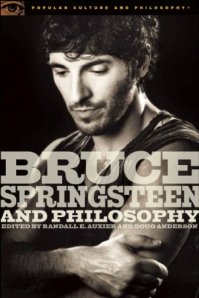
There’s two new(ish) books on Springsteen: Bruce Springsteen and Philosophy edited by Randall E. Auxier and Doug Anderson; and The Gospel According to Bruce Springsteen: Rock and Redemption, from Asbury Park to Magic by Jeffrey B. Symnkywicz [Reviewed here].

As a long-time Springsteen fan, I’d be keen to hear thoughts from anyone who has read one or both of these. What is their value (for the theologian)? Strengths? Weaknesses? Basic theses? Do they provide a healthy model for cross-discipline study?

Stanley Hauerwas on ‘Preaching As Though We Had Enemies’

dog2I am just postmodern enough not to trust “postmodern” as a description of our times, for it privileges the practices and intellectual formations of modernity. Calling this a postmodern age reproduces the modernist assumption that history must be policed by periods. Just as modernity created the “middle ages,” which we all then knew could be safely left behind, “postmodern” is far too comforting since it gives the illusion that we know where we are – in contradiction to the postmodernist’s epistemological doubt that such knowledge is available.

Modernity was created by a deliberate rejection of the past, but ironically modernity is now our past. Accordingly, as J. Bottum puts it (“Christians and Postmoderns,” FT, February 1994), “postmodernity is still in the line of modernity, as rebellion against rebellion is still rebellion, as an attack on the constraints of grammar must still be written in grammatical sentences, as a skeptical argument against the structures of rationality must still be put rationally.” Or as Reinhard Hutter observes, “it belongs to the ironies of modernity that exactly those who are most modern increasingly claim postmodernity as modernity’s most recent advance.”

I confess I take perverse delight as a theologian in the controversies surrounding postmodernism. Modernity sought to secure knowledge in the structure of human rationality, and relegated God to the “gaps” or denied Him all together. Modernity said that God is a projection of the ideals and wants of what it means to be human so let us serve and worship the only God that matters – that is, the human. Postmodernists, in the quest to be thorough in their atheism, now deny that the human exists. Postmodernists are thus the atheists that only modernity could produce.

I do find it puzzling, however, to watch theologians, both conservative and liberal, come to the defense of the human, the rational, objectivity, the “text,” “moral values,” science, and all the other conceits the modern university cherishes in the name of “humanism.” It is as though Christians have forgotten that we also have a stake in atheism. Christians do not believe in the “human”; we believe in God – a God we believe, moreover, who intends to kill us all in the end. So we Christians do not oppose nuclear weapons because they threaten to destroy “mother earth,” but because the God we serve would not have one life unjustly taken even if such a killing would insure the survival of the human species. Indeed, it is not even clear that we Christians know what the human species is or what status it may have since we have surer knowledge that we are creatures than that we are human.

Christians, therefore, have little stake in the question of whether we live in a postmodern time. For us, any divide in history, the way we tell the story of how we have come to the place where we are, requires a reading of God’s providential care of God’s creation through the people of Israel and the Church. Israel and the Church are not characters in a larger story called “world,” but rather “world” is a character in God’s story as known through the story that Israel is the Church. Without them there is no world to have a story. From my perspective, “postmodernism” merely names an interesting set of developments in the social order that is based on the presumption that God does not matter.

The imperialistic character of these claims for the significance of the Church does not mean that it is unimportant for Christians to understand the peculiar development called modernity. Rather, as I just suggested, we must narrate the modern story on our terms. That, I fear, is what we have not done in modernity. Christians’ attitudes toward modernity have primarily been characterized by a sense of inferiority. As John Milbank observes, “the pathos of modern theology is its false humility.” Our preaching and theology has been one ceaseless effort to conform to the canons of intelligibility produced by the economic and intellectual formations characteristic of modern and liberal societies.

Christians in modernity thought their task was to make the Gospel intelligible to the world rather than to help the world understand why it could not be intelligible without the Gospel. Desiring to become part of the modernist project, preachers and theologians accepted the presumption that Christianity is a set of beliefs, a “worldview,” designed to give meaning to our lives. In the name of being politically responsible in, to, and for liberal social orders, the politics of Christian discourse was relegated to the private realm. We accepted the politics of translation believing that neither we nor our non-Christian and half-Christian neighbors could be expected to submit to the discipline of Christian speech.

Ironically, the attempt to make Christianity intelligible often sought support from those philosophical and literary theories that attempted to protect discourse from translation-the most prominent example being New Criticism. Under the influence of New Criticism, some thought that Christianity could be conceived as a beautiful poem that is its own justification. Such a poem, of course, could and should illumine the human condition, but exactly because the poem provided such illumination, all attempts to make the poem “do something” must be condemned as crass. Paul Tillich and Reinhold Niebuhr, in quite different ways, gave theological warrant to the high humanism intrinsic to the powerful set of suggestions associated with such formalist theories. What could be more comforting to modern consciousness than to discover that “ultimate concern” and “sin” are essential and unavoidable characteristics of the human condition? You do not even need to go to church to learn that. Reading Shakespeare will do just as well if not better.

The humanistic presumptions of New Criticism nicely fit the aestheticism of the middle class that dominates Christianity in America – at least the Christianity that produces intellectuals like us. That is why I take it that contemporary preaching is still dominated by formalist presumptions even if preachers think they have theoretically left such theories behind. New critical habits are hard habits to break because they fit so well the class interests that dominate the seminary cultures in which many of us are located.

In particular, new critical assumptions hide from us how our theological presumptions are shaped by class interests. Frank Lentricchia, in his Modernist Quartet, makes the fascinating suggestion that the modernist writer defined himself against the standards of the mass market by becoming the champion of radical originality and the maker of a “one-of-a-kind-text.” He observes, however, that “the modernist desire in Frost and Eliot – to preserve an independent selfhood against the coercions of the market, a self made secure by the creation of a unique style – is subverted by the market, not because they wrote according to popular formulas, but because they give us their poems as delicious experiences of voyeurism, illusions of direct access to the life and thought of the famous writer, with the poet inside the poem like a rare animal in a zoo. This was the only commodity Frost and Eliot were capable of producing: the modernist phenomenon as product, mass culture’s ultimate revenge on those who would scorn it.”

In like manner, the preaching and theology shaped by new critical presumptions to illumine the human condition hid from us that the human condition we were illuminating was that of the bourgeoisie. That is why the sermon meant to illumine our condition, which is often eloquent and profound, is also so forgettable and even boring. Insights about the human condition are a dime a dozen. Most days most of us would rightly trade any insight for a good meal.

The high humanism of contemporary theology and preaching not only hid the class interest intrinsic to such preaching, but also reinforced the presumption that Christians could be Christians without enemies. Christianity, as the illumination of the human condition, is not a Christianity at war with the world. Liberal Christianity, of course, has enemies, but they are everyone’s enemies – sexism, racism, homophobia. But liberal versions of Christianity, which can be both theologically and politically conservative, assume that what it means to be Christian qua Christian is to have no enemies peculiar to being Christian. Psalms such as Psalm 109, which ask God to destroy our enemies and their children, can appear only as embarrassing holdovers of “primitive” religious beliefs. Equally problematic are apocalyptic texts that suggest Christians have been made part of a cosmic struggle.

“Cosmic struggle” sounds like a video game that middle-class children play. Most of us do not go to church because we are seeking a safe haven from our enemies; we go to church to be assured we have no enemies. Accordingly, we expect our ministers to exemplify the same kind of bureaucratic mentality so characteristic of modern organizational behavior and politics. I sometimes think that there is a conspiracy afoot to make Alasdair MacIntyre’s account of the manager in After Virtue empirically verifiable.

That the manager has become characteristic of liberal politics should not be surprising, but I continue to be taken aback by the preponderance of such character types in the ministry. Of course, I should not be surprised that a soulless church produces a soulless ministry devoid of passion. The ministry seems captured in our time by people who are desperately afraid they might actually be caught with a conviction at some point in their ministry that might curtail future ambition. They, therefore, see their task to “manage” their congregations by specializing in the politics of agreement by always being agreeable. The preaching such a ministry produces is designed to reinforce our presumed agreements, since a “good church” is one without conflict. You cannot preach about abortion, suicide, or war because those are such controversial subjects – better to concentrate on “insights” since they do so little work for the actual shaping of our lives and occasion no conflict.

I confess one of the things I like about the Southern Baptists is that they have managed to have a fight in public. Fundamentalists at least believe they are supposed to have strong views, and they even believe they are supposed to act on their convictions. The problem with most of the mainstream churches is that we do not even know how to join an argument-better, we think, to create a committee to “study the issue.”

If postmodernism means anything, it means that the comforting illusion of modernity that conflict is, can be, and should be avoided is over. No unbiased viewpoint exists that can in principle insure agreements. Our difficulty is not that we have conflicts, but that as modern people we have not had the courage to force the conflicts we ought to have had. Instead, we have comforted ourselves with the ideology of pluralism, forgetting that pluralism is the peace treaty left over from past wars that now benefits the victors of those wars.

One hopes that God is using this time to remind the Church that Christianity is unintelligible without enemies. Indeed, the whole point of Christianity is to produce the right kind of enemies. We have been beguiled by our established status to forget that to be a Christian is to be made part of an army against armies. It has been suggested that satisfaction theories of the Atonement and the correlative understanding of the Christian life as a life of interiority became the rule during the long process we call the Constantinian settlement. When Caesar becomes a member of the Church the enemy becomes internalized. The problem is no longer that the Church is seen as a threat to the political order, but that now my desires are disordered. The name for such an internalization in modernity is pietism and the theological expression of that practice is called Protestant liberalism.

In contrast, I am suggesting that our preaching should presume that we are preaching to a Church in the midst of a war – a position you may find odd to be advocated by a pacifist. I hope the oddness, however, might encourage you to reexamine your understanding of Christian nonviolence – which, if you are like me, was probably shaped by Reinhold Niebuhr. Who more than the Christian pacifist knows that Christians are in a war against war? Moreover, as a pacifist, I do not need something called the human condition illumined when I am preparing to face the enemy. Rather, I need to have a sense of where the battle is, what the stakes are, and what the long-term strategy might be. But that is exactly what most preaching does not do. It does not help us locate our enemy, because it does not believe that Christians should have enemies. In the name of love and peace, Christian preaching has reinforced the “normal nihilism” that grips our lives. We have a difficult time recognizing the wars that are already occurring or the wars that should be occurring because we think it so irrational that some should kill others in the name of “values.”

James Edwards has argued in his The Plain Sense of Things: The Fate of Religion in An Age of Values that nothing characterizes the nihilism that grips our lives better than the language of “values.” Nihilism is not a philosophical conspiracy designed by Nietzsche and some French intellectuals to undermine the good sense of liberal Americans – indeed Nietzsche was the great enemy of nihilism. Rather, nihilism is now the normal condition of our lives to the extent that we all believe that our lives are constituted by what Edwards calls “self-devaluating values.” All our values are self-devaluating because we recognize their contingency as values. As Edwards puts it, “normal nihilism is just the Western intellectual’s recognition and tolerance of her own historical and conceptual contingency. To be a normal nihilist is just to acknowledge that, however fervent and essential one’s commitment to a particular set of values, that’s all one has: a commitment to a particular set of values.”

Normal nihilism is not, however, a condition that grips only intellectuals, but rather forms everyone in liberal social orders. Edwards, for example, suggests that one could not want a better exemplification of normal nihilism than the regional shopping mall. In the mall, one not only sees alternative values tenuously jostling one another, but our very participation as consumers means we also indirectly act as the creator of those values. “In air-conditioned comfort one can stroll from life to life, from world to world, complete with appropriate sound effects (beeping computers; roaring lions). Laid out before one are whole lives that one can, if one has the necessary credit line, freely choose to inhabit: devout Christian; high-tech yuppie; Down East guide; great white hunter. This striking transformation of life into lifestyle, the way in which the tools, garments, and attitudes specific to particular times and places become commodities to be marketed to anonymous and rootless consumers: they are the natural (if also banal) expressions of our normal nihilism.” Nihilism is the result of having so many compact discs from which to choose that, no matter which ones we choose, we are dissatisfied because we cannot be sure we have chosen what we really wanted.

The moral threat is not consumerism or materialism. Such characterizations of the enemy we face as Christians are far too superficial and moralistic. The problem is not just that we have become consumers of our own lives, but that we can conceive of no alternative narrative since we lack any practices that could make such a narrative intelligible. Put differently, the project of modernity was to produce people who believe they should have no story except the story they choose when they have no story. Such a story is called the story of freedom and is assumed to be irreversibly institutionalized economically as market capitalism and politically as democracy. That story and the institutions that embody it is the enemy we must attack through Christian preaching.

I am aware that such a suggestion can only be met with disbelief. You may well think I cannot be serious. Normal nihilism is so wonderfully tolerant. Surely you are not against tolerance? How can anyone be against freedom? Let me assure you I am serious, I am against tolerance, I do not believe the story of freedom is a true or good story. I do not believe it is a good story because it is so clearly a lie. The lie is exposed by simply asking, “Who told you the story that you should have no story except the story you choose when you have no story?” Why should you let that story determine your life? Simply put, the story of freedom has now become our fate.

Consider, for example, the hallmark sentence of the Casey decision on abortion: “At the heart of liberty is the right to define one’s own concept of existence, of meaning, of the universe, and of the mystery of human life.” This is exactly the view of freedom that John Paul II so eloquently condemns in the encyclical Veritatis Splendor. A view of freedom like that embodied in Casey assumes, according to John Paul II, that we must be able to create values since freedom enjoys “a primacy over truth, to the point that truth itself would be considered a creation of freedom.”

In contrast, John Paul II, who is not afraid to have enemies, reminds us that the good news of the Gospel, known through proclamation, is that we are not fated to be determined by such false stories of freedom. For the truth is that since we are God’s good creation we are not free to choose our own stories. Freedom lies not in creating our lives, but in learning to recognize our lives as a gift. We do not receive our lives as though they were a gift, but rather our lives simply are a gift: we do not exist first and then receive from God a gift. The great magic of the Gospel is providing us with the skills to acknowledge our life, as created, without resentment and regret. Such skills must be embodied in a community of people across time, constituted by practices such as baptism, preaching, and the Eucharist, which become the means for us to discover God’s story for our lives.

The very activity of preaching – the proclamation of a story that cannot be known apart from such proclamation – is an affront to the ethos of freedom. As the Church, we stand under the word because we know we are told what we otherwise could not know. We stand under the word because we know we need to be told what to do. We stand under the word because we do not believe we have minds worth making up on our own. Such guidance is particularly necessary for people like us who have been corrupted by our tolerance.

The liberal nihilists are, of course, right that our lives are contingent, but their account of contingency is unintelligible. Contingent to what? If everything is contingent, then to say we are contingent is simply not interesting. In contrast, Christians know their contingency is a correlative to their status as creatures. To be contingent is to recognize that our lives are intelligible only to the extent that we discover we are characters in a narrative we did not create. The recognition of our created status produces not tolerance, but humility. Humility derives not from the presumption that no one knows the truth, but rather is a virtue dependent on our confidence that God’s word is truthful and good.

Ironically, in the world in which we live if you preach with such humility you will more than likely be accused of being arrogant and authoritarian. To be so accused is a sign that the enemy has been engaged. After all, the enemy (who is often enough ourselves) does not like to be reminded that the narratives that constitute our lives are false. Moreover, you had better be ready for a fierce counteroffensive as well as be prepared to take some casualties. God has not promised us safety, but participation in an adventure called the Kingdom. That seems to me to be great good news in a world that is literally dying of boredom.

God has entrusted us, His Church, with the best story in the world. With great ingenuity we have managed, with the aid of much theory, to make that story boring as hell. Theories about meaning are what you get when you forget that the Church and Christians are embattled by subtle enemies who win easily by denying that any war exists. God knows what He is doing in this strange time between “worlds,” but hopefully He is inviting us again to engage the enemy through the godly weapons of preaching and sacrament. I pray that we will have the courage and humility to fight the enemy in Walter Rauschenbusch’s wonderful words, with “no sword but the truth.” According to Rauschenbusch, “such truth reveals lies and their true nature, as when Satan was touched by the spear of Ithuriel. It makes injustice quail on its throne, chafe, sneer, abuse, hurl its spear, tender its goal, and finally offer to serve as truth’s vassal. But the truth that can do such things is not an old woman wrapped in the spangled robes of earthly authority, bedizened with golden ornaments, the marks of honor given by injustice in turn for services rendered, and muttering dead formulas of the past. The truth that can serve God as the mightiest of his archangels is robed only in love, her weighty limbs unfettered by needless weight, calm-browed, her eyes terrible with beholding God.” May our eyes and our preaching be just as terrible. Indeed, may we preach so truthfully that people will call us terrorists. If you preach that way you will never again have to worry about whether a sermon is “meaningful.”

[Source: First Things, May 1995]

Stanley Hauerwas on patriotism, pacifism and just warriors

hauerwas-1On 2 March 2003, David Rutledge conducted the following interview with Stanley Hauerwas on ABC’s Encounter program:

David Rutledge: One of the most prominent Christian pacifist voices in the US at the moment is Stanley Hauerwas, from Duke University in North Carolina. His prominence – or notoriety, perhaps – was established by Time magazine in its “America’s Best” issue of 2001, which proclaimed Stanley Hauerwas as “America’s Best Theologian” and ran a profile on him, entitled Christian Contrarian. In that article, he called on Christians not to be defined by their political community, and he condemned “any and all forms of patriotism, nationalism and state worship”. Well that issue of Time magazine hit the newsstands on September 10th, just 24 hours before the terrorist attacks that dramatically altered the American psyche – and that suddenly put Stanley Hauerwas out on the radical fringe of American public life. I asked Stanley Hauerwas if there was anything in that article that he would have changed, had he known that history was about to take the turn that it did.

Stanley Hauerwas: No, not a thing. I suppose that the claim that radical pacifism and Christian non-violence means that you’re critical of all forms of patriotism – I don’t know that I’m critical of “all forms of patriotism”, because I don’t know what “all forms of patriotism” would look like. I’m certainly critical of the kind of patriotism that we find in America. That is the worst kind possible, because it’s not just a loyalty to the particularities of history and geography, but because of America’s basis within the fundamental norms of the Enlightenment – freedom, equality, abstractions like that – then that means American patriotism cannot help but be a form of imperialism. And that’s always the way it has been. And I think it’s one of the most dangerous forms – indeed it’s virulent on the world stage. 

Americans can’t understand – I mean, we just – Americans assume that if you just had enough education and enough money, you would want to be just like us – because we’re what free people look like. And therefore American patriotism, I think, is one of the worst forms that could possibly be present in the world.

I think that in America now, we’re really being ruled by the Right. And I think that they have a view of the world that is just not going to be open to any evidence. And so they’re determined to do this. I really believe that this war was on the drawing tables of many of the people that came into the Bush administration. And I think that September 11th was their licence to do it. September 11th determinatively changed American politics, there is absolutely no question about that. The mid-term elections that we just had, in which the Republicans gained seats both in the Senate and the Congress, is really – I mean, that has never happened in America. That’s new. And I think it has everything to do with Americans’ desire for security. September 11th brought the world home to America – and they don’t like it, they just don’t like it. And they’re willing to go with anyone that’s going to promise safety. And that’s what Bush is offering them. 

But I really believe, since I’m a Christian, that you always live in a world at risk. Indeed, what Christianity is about, is always learning how to die early for the right reasons. And Americans just – that’s a thought that is unthinkable right now. I think the American response to September 11th is exactly the other side of the Americans’ unbelievable support for crisis care medicine. They think that if we just get good enough at curing cancer, or good enough at doing something about people suffering heart attacks, or good enough with genetics today, then they’re going to get out of this life alive. It’s just not going to happen.

David Rutledge: Can we go back to just war for a minute? You made an interesting comment, that the just war tradition raises the right kinds of questions; but then the just war tradition is seemingly being invoked at the moment as a justification for war. The assumption seems to be that we can and do wage war, so how can we do it and still remain faithful to our Christian ideals. Now as a pacifist, do you think that that is legitimate? How do you evaluate the just war tradition?

Stanley Hauerwas: I’m certainly willing always to join serious just war thinkers in trying to think through what the implications of being a just warrior should be. But if you take the war on Iraq: why is America able to even imagine going to war in Iraq? It’s because we can. We’ve got all this unbelievable military power, so we can envision it, because we have the capacity for it. Now, the question is: did you get the capacity to wage that kind of war on just war considerations? Is the United States’ foreign policy a just war foreign policy? Is the United States’ military preparedness based on just war considerations? No way! They’re based on presuppositions, that you’d better have as much military might as you can, in a world of anarchy, because the one with the most weapons at the end, wins.

Now, if just war people were more serious about raising questions about the implications of what just war would commit them to – for example, the war on terrorism could not possibly be a just war. I don’t even think it’s a war, I mean that’s a metaphorical use of the word “war” that comes from Americans’ views of – you know, the “war on drugs”, the “war on crime” – I mean, it’s just crap. Because what they need to think about is: just war is always about a political end, that you need to declare, so your enemy will know how they can resign and surrender. And so if you’re about annihilating your enemy, as we were in World War II – that is, we fought it for unconditional surrender – you can’t fight a just war for unconditional surrender, because you’re not trying to destroy your enemy, you’re only trying to stop your enemy from doing the wrong that you declared the war for. I mean, there can’t be a just war against terrorism, because you don’t even know who the enemy is, and you get to keep changing it, and the presumption that a just war should be in response to aggression: well, in what way is Iraq really threatening America? That hasn’t been shown at all. What Iraq threatens is American imperial hegemony in the world. How is that a criterion for just war? 

So I regard most of the people that are trying to give an account of why it is that the war against Iraq could meet just war criteria, as just an ideological cover for American realism. And notice: no one’s talking about the war on terrorism that much in America right now, because we lost it. Or at least, we haven’t won it. So instead, everyone’s talking about the war against Iraq, and so you’ve made the shift from the war on terrorism to the war against Iraq, which you’re going to win, and so Bush is not being held accountable for the mistaken strategy of ever declaring war against terrorism.

David Rutledge: Theologian and pacifist Stanley Hauerwas, talking earlier this year on the eve of the American attack on Iraq. 

hauerwas-4Stanley Hauerwas: What I find absolutely crucial is reflecting on Christ’s death and resurrection. What that means is that God would rather die, God would rather have God’s own Son die, than to redeem the world through violence. And that central story is what Christians are about. 

I go to an Episcopal church, and after we finish the Mass, one of the prayers that I find a deep comfort is – I just have the Book of Common Prayer here – Eternal God, heavenly Father, you have graciously accepted us as living members of your Son, our saviour Jesus Christ. You have fed us with spiritual food, in the sacrament of His body and blood. Send us now into the world in peace, and grant us strength and courage to love and serve you, with gladness and singleness of heart, through Christ our Lord. Amen. Now, how could someone that prays that prayer every week at the Eucharistic sacrifice – and remember, the Eucharistic sacrifice is where we become part of Christ’s sacrifice for the world, so the world will know it’s got an alternative to violence – how can anyone that prays that prayer, week after week, run for the Presidency of the United States? It beats the hell out of me. 

You know, I’m not trying to call Christians out of being politically involved; I just want them to be there as Christians. And instead, what they get is they think they have a personal relationship with Jesus, which makes it OK for them to do anything that they damn well please, in the name of what’s important for national defence. Well, Jesus is a political saviour, and that prayer is a political prayer. And that’s the kind of seizing of the imagination I’m trying to help Christians regain in America. Because in America, Christians just cannot distinguish themselves – what it means to be Christian, they assume it goes hand in hand with what it means to be an American. And that’s just a deep mistake. But how to help Christians recover that difference is very difficult indeed.

David Rutledge: How much help are you getting in that from the American Christian leadership? 

Stanley Hauerwas: Well, for example: the Methodist bishops have given a kind of statement against going to war pre-emptively. And you know, they want you to work through the UN, and that kind of thing. They don’t just come out and say “you do it, George, and your soul is going to Hell. Or your soul is already in Hell”. Which I wish they would do. But George Bush, on the whole, is just ignoring any of that kind of statement, because he knows it doesn’t represent the American Methodists. Most American Methodists assume “well, something needs to be done”, and they therefore wouldn’t follow the lead of their bishops. 

There’s been quite a number of statements by most of the mainstream religious bodies – you know, saying “go through the UN” and that kind of thing, but it’s had no effect. Because I think that Bush is right: most of the laity doesn’t know how to think about war at all. And the reason most Christian laity don’t know how to think about war at all, is because our religious leadership has never helped educate the American people. As a pacifist, when I go and lecture to churches about the ethics of war, and try to introduce them to just war considerations – because I think that just war is certainly a very serious alternative that people, if they do it seriously, it raises the right kinds of questions that ought to be raised – I usually get a hand stuck up, and someone says “no one’s every told me that Christians have a problem with war”. Isn’t that remarkable? I say “I know you’ve been betrayed. Fire your bishops”. The teaching office of the church has just been absent, over the years, about these kinds of matters.

David Rutledge: There was commentator in the journal First Things, who said that when Christian go off to fight a just war, they’re following Christ, but at a distance. And I wonder if, in your pacifism, you’re talking about something much more immediate, you’re talking about pacifism as the road to Calvary, if it has to be that way, as following Christ in such a way as to be led unresisting to a horrible death, if that’s what your Christianity calls you to do? Is that the kind of end that you have in mind?

Stanley Hauerwas: It certainly could be. I mean, what is the deep problem? The deep problem of Christian non-violence is: you must be willing to watch innocent people suffer for your convictions. Of course, that’s true. In the hard cases, it means it’s not just your death, it’s watching other people die, whom you might have been able to defend. Now of course, you want to try to do everything you can that would prevent that alternative. But you may have to envision that. 

But look: the just warriors are in exactly the same position. Hiroshima and Nagasaki, on just war grounds, were murder. There’s no other description for that. Just warriors need to argue that it would have been better for more people to die on the beaches of Japan, both Americans and Japanese, than to commit one murder. That’s what the position should be committed to holding. So of course, any account of serious attempt to morally control war, would mean that if you’re a just warrior, you’re going to have to watch the innocent suffer for your convictions – just like the pacifist does. But on the whole, most people who argue on just war grounds don’t want to acknowledge that. But they should.

David Rutledge: Do you think that one of the key problems for a message like yours, in America or in the world right now, is that when you talk about watching innocent people suffer in the course of a war, the most outstanding recent example of that is the deaths of thousands of Americans at the World Trade Centre and the Pentagon. And the most difficult thing in the world at the moment is for Americans to say “well, in the name of justice, we can’t allow those deaths to be the pretext for more deaths” – even though that’s right at the heart of Christian teaching?

Stanley Hauerwas: Well, I think that Americans simply cannot contemplate Americans getting to die as victims. And they want to turn their deaths into some good. And when they do that, you exactly betray – at least, as Christians – what we should have learned through the Cross: that the attempt to make life meaningful, even life that has died, through further violence, is absolutely futile. But we seem determined to want to do that, and I think we in the world will pay a great price for that. I mean, the price that Americans are going to have to pay for the kind of arrogance that we are operating out of right now, is going to be terrible indeed. And I think that when America isn’t able to rule the world, that people will exact some very strong judgements against America – and I think we will well deserve it.

Brueggemann on Isaiah 40:28-29

sowerJim Gordon shares a ripper from Brueggemann on Isaiah 40:28-29 that speaks powerfully to the anxiety that attends and motivates modern life:

‘Creation not only works for the powerful, the mighty, and the knowledgeable. It works as well for the faint, the powerless, the hopeless and the worthless. It works by giving seed to the sower and bread to the eater. It works so that strength is renewed. It is creation that precludes weariness and faintness, and invites walking, running and flying.

Evangelical concern may derivatively raise the issue of our terrible disorderedness that issues in unseemly anxiety and in inescapable fatigue. It is a good question to raise in a local parish; Why so driven, so insatiable, so restless? The answer, in this doxological tradition, is that our lives are driven because we are seriously at variance from God’s gracious food-giving program. 

And where there is a variance and a refusal to trust:
youth are faint and weary, 
     the young are exhausted, 
     and there is little liberated flying or exhilarated running. (Isaiah 40.30)’.

– Walter Brueggemann, Text under Negotiation: The Bible and Postmodern Imagination (Minneapolis: Fortress, 1993), 35-6.

Around the traps … [updated]

Pacifism and War: Some Resources [Updated]

pacifismI’m trying to put together a list of responsible books/essays that explore theologically questions of Christian pacifism and Christian attitudes to war, and would be keen to hear of such that others have found helpful (and, if possible, why). Here’s what I’ve come up with so far:

Wilma A. Bailey, “You shall not kill” or “You shall not murder”?: The Assault on a Biblical Text (Collegeville: Liturgical Press, 2005).

Roland H. Bainton, Christian Attitudes Towards War and Peace: A Historical Survey and Critical Re-evaluation (Nashville: Abingdon Press, 1960).

Oliver R. Barclay, ed., Pacifism and War (When Christians Disagree) (Leicester: Inter-Varsity Press, 1984).

Clive Barrett, ed., Peace Together: A Vision of Christian Pacifism (Cambridge: James Clarke & Co., 1987).

Eberhard Bethge, Dietrich Bonhoeffer: Man of Vision, Man of Courage (New York: Harper & Row, 1970).

Robert W. Brimlow, What About Hitler?: Wrestling with Jesus’s Call to Nonviolence in an Evil World (Grand Rapids: Brazos, 2006).

Martin Ceadel, Pacifism in Britain, 1914-45: Defining of a Faith (Oxford: Clarendon Press 1980).

*David L. Clough and Brian Stiltner, Faith and Force: A Christian Debate About War (Washington D.C.: Georgetown University Press, 2007).

Robert G. Clouse, ed., War: Four Christian Views (Downers Grove: InterVarsity Press, 1981).

James Denney, War and the Fear of God (London: Hodder and Stoughton, 1916).

Kim Fabricius, Ten Propositions on Peace and War (with a postscript)

Kim Fabricius, Ten Stations on My Way to Christian Pacifism

Gabriella Fiori, Simone Weil: An Intellectual Biography (trans. J.R. Berrigan; Athens/London: University of Georgia Press, 1989).

Peter T. Forsyth, The Christian Ethic of War (London: Longmans, Green, and Co., 1916).

Peter T. Forsyth, The Justification of God: Lectures for War-Time on a Christian Theodicy (London: Independent Press, 1957).

*Stanley Hauerwas, Against the Nations: War and Survival in a Liberal Society (Notre Dame: University of Notre Dame Press, 1992).

Stanley Hauerwas, Dispatches from the Front: Theological Engagements with the Secular (Durham: Duke University Press, 1994).

Stanley Hauerwas, September 11: A Pacifist Response. From remarks given at the University of Virginia, October 1, 2001.

Stanley Hauerwas, ‘No, This War Would Not Be Moral’, in Time (3 March, 2003).

Stanley Hauerwas and Paul Griffiths, ‘War, Peace & Jean Bethke Elshtain’, in First Things (October, 2003).

Stanley Hauerwas, Performing the Faith: Bonhoeffer and the Practice of Nonviolence (Grand Rapids: Brazos Press, 2004).

Stanley Hauerwas and Jean Vanier, Living Gently in a Violent World: The Prophetic Witness of Weakness (Downers Grove: IVP, 2008).

Eberhard Jüngel, Christ, Justice and Peace: Toward a Theology of the State in Dialogue with the Barmen Declaration (Edinburgh: T&T Clark, 1992).

Geoffrey A. Studdert Kennedy, Rough Rhymes of a Padre (Toronto: Hodder & Stoughton, 1918).

Geoffrey A. Studdert Kennedy, After War, Is Faith Possible?: The Life and Message of Geoffrey “Woodbine Willie” Studdert Kennedy (ed. Kerry Walters; Eugene: Cascade, 2008). [Reviewed here]

Jean Lasserre, War and the Gospel (London: James Clarke, 1962).

Philip Matthews and David Neville, ‘C.S. Lewis and Christian Pacifism’ in Faith and Freedom: Christian Ethics in a Pluralist Culture (Hindmarsh: ATF Press, 2004), 205-16.

Paul O’Donnell and Stanley Hauerwas, A Pacifist’s Look at Memorial Day: Duke University Divinity professor Stanley Hauerwas on nonviolence, Iraq and killing Hitler.

Oliver O’Donovan, In Pursuit of a Christian View of War (Bramcotte Notts: Grove Books, 1977).

*Oliver O’Donovan, The Just War Revisited (Cambridge: Cambridge University Press, 2003).

George Orwell, ‘Pacifism and the War’, Partisan Review August-September (1942).

Paul Ramsey, War and the Christian Conscience (Durham: Duke University Press, 1968).

Paul Ramsey, The Just War: Force and Political Responsibility (Lanham/Oxford: Rowman & Littlefield, 2002).

Alan Ruston, ‘Protestant Nonconformist Attitudes towards the First World War’, in Protestant Nonconformity in the Twentieth Century (ed. Alan P. F. Sell and Anthony R. Cross; Milton Keynes: Paternoster, 2003), 240-263. [The book is reviewed here]

*W. J. Sheils, ed., The Church and War: Papers read at the Twenty-first Summer Meeting and the Twenty-second Winter Meeting of the Ecclesiastical History Society (Oxford: Basil Blackwell, 1983).

Ronald J. Sider, Christ and Violence (Kitchener: Herald Press, 1979).

*Glen H. Stassen, ed., Just Peacemaking: The New Paradigm for the Ethics of Peace and War (Cleveland: Pilgrim Press, 2008).

John Stott, ed., The Year 2000AD (London: Marshalls, 1983), 27-71.

John Stott, Issues Facing Christians Today: New Perspectives on Social and Moral Dilemmas (London: William Collins Sons & Co., 1990), 82-112.

Helmut Thielicke, Theological Ethics Volume 2: Politics (Grand Rapids: Wm. B. Eerdmans, 1979).

Miroslav Volf, ‘Christianity and Violence’ (A paper presented at the Boardman Lectureship in Christian Ethics, Boardman Lecture XXXVIII, University of Pennsylvania, 1 March, 2002).

Alan Wilkinson, Dissent or Conform? War, Peace and the English Churches, 1900-1945 (London: SCM Press, 1986).

*John Howard Yoder, The Original Revolution: Essays on Christian Pacifism (Scottdale/Kitchener: Herald Press, 1971).

John Howard Yoder, When War is Unjust: Being Honest in Just-War Thinking (Minneapolis: Augsburg, 1984).

John Howard Yoder et al., What Would You Do?: A Serious Answer to a Standard Question (Scottsdale/Kitchener: Herald Press, 1983).

John Howard Yoder, Christian Attitudes to War, Peace, and Revolution (ed. Theodore J. Koontz and Andy Alexis-Baker; Grand Rapids: Brazos Press, 2009).

Supplementary Readings

Terry Eagleton, ‘Isaiah Berlin and Richard Hoggart’ in Figures of Dissent: Critical Essays on Fish, Spivak, Žižek and Others (London/New York: Verso, 2003), 104-8.

Richard Hays on ‘Limping and Praising’: An ordination sermon

richard-haysHere’s a sermon preached by the Rev. Richard Hays for the ordination of his son, the Rev. Christopher Hays, at La Crescenta Presbyterian Church, La Crescenta, Calif., on March 8, 2009.

Texts: Genesis 32:9-1122-30Colossians. 1:9-14Revelation 4:10-5:10

I have to admit, I didn’t always see this coming. But having watched Chris grow up, I realize now that I probably should have anticipated this day, because there is a pattern here.

When Chris was five years old, there was that classic pennant race between the Boston Red Sox and the New York Yankees, the one that ended in a one-game playoff won by the Yankees on Bucky Dent’s home run. Chris watched his longsuffering dad desperately rooting for his beloved Red Sox – and he decided to become a Yankees fan.

Later, when Chris began to feel the inexorable pull of vocation to the serious academic study of theology, he sized up his father’s career as a New Testament scholar – and decided to assert his intellectual independence by going into the field of Old Testament studies.

And so, when the time came that Chris felt God’s powerful call to ordained ministry, it was probably inevitable that he would take note of his dad’s service as a United Methodist minister and once again rebel against the paternal example – by being ordained in the PC(USA). And so we find ourselves here this evening … to celebrate this latest contrarian act of rebellion.

To be fair, I should acknowledge that Chris comes by his Calvinist inclinations with an honest sense of family roots. His proud mother was a cradle Presbyterian and indeed served as an elder in the First Presbyterian Church of New Haven during Chris’s formative adolescent years. And even his Methodist father harbors the secret opinion that Calvin and Barth got a lot of things right.

The truth is, of course, that all of us are here to celebrate this glad occasion with great joy, along with the due sense of awe that always attends any service of ordination to the ministry of word and sacrament in the church of Jesus Christ. We are here to solemnize the particular call that lies on Chris’s life and to confirm publicly the office he now assumes within the church. But at the same time, we are mindful that ministry is first and last the work of the Holy Spirit in the church, and that all of us, as the people of God, are called in one way or another to share in the work of ministry through the diverse gifts and graces which the Spirit distributes broadly among us all. And so, as we reflect together on the Scriptural texts and on the prayers and liturgical actions through which we set Chris apart for this work, each of us here should also prayerfully consider our own calling and renew our own sense of vocation, whatever it may be, within the church’s ministry.

But as we enter that process of prayerful consideration, we have to acknowledge that the Scriptural texts Chris has chosen for this occasion are more than a little daunting. Interestingly, none of them says anything at all about ordination or about ministry as such. The letter to the Colossians is addressed to all “the saints and faithful brothers and sisters in Christ in Colossae,” (Colossians 1:2) and it speaks to all of them, together, as people who have been “rescued us from the power of darkness and transferred us into the kingdom of his beloved Son.” (Colossians 1:13) And we get the distinct impression from our other two texts that being transferred into that kingdom is both a cause for joy and – at the same time – a strange and fearsome experience, as love always is. I want to reflect with you tonight about these two strange texts from the beginning and end of the canon, from Genesis and Revelation. What do they have to teach us about ministry?

We begin with Jacob. From the day of his birth, he was a trickster and an operator, grabbing and scrambling, figuring the angles to outsmart and outmaneuver his brother Esau – indeed, cutting a deal to swindle him out of his rightful inheritance – then later jockeying for economic advantage with his equally devious father-in-law, Laban. You can bet that if the banking business had existed in his day (it was actually forbidden by Old Testament law – but that’s a topic for another day), Jacob would have been packaging derivatives and collecting sweet executive bonuses. But – as is always the case – the day of reckoning was coming. After long absence, Jacob is returning home, preparing to face his estranged brother Esau, whom he had defrauded. And it is under these circumstances that he meets God.

God does not come to him as some sweet, forgiving presence. Rather, under the cloak of darkness, God comes as a mysterious adversary, appearing from nowhere to accost Jacob in a wrestling match. The struggle is lengthy and inconclusive, but Jacob hangs on for dear life, refuses to let go without receiving a blessing. And the blessing he receives includes a new name: Israel – the one who strives with God. The name Israel recalls a protracted struggle in the dark – a struggle that leaves Israel lame, permanently limping as a reminder of surviving a strange face-to-face encounter with God.

What does all that have to do with ministry? First, if Jacob/Israel is our precursor as one who first receives and then finally gives blessings (and surely that is not a bad description of what we do in ministry), then we should remember that we don’t deserve what we get or get what we deserve. Why does God choose Jacob as the one through whom the line of promised blessing is to extend? God knows … but it certainly wasn’t because Jacob was more devout or virtuous than others around him. One of the particular charisms you Calvinists bring to the church universal is the gift of depravity. You remind us constantly that we receive God’s grace despite our total unworthiness. That’s not a popular message in an age that prizes self-esteem, but it is, simply put, the gospel. That is what Paul means when he characterizes God as the one who “justifies the ungodly” (Romans 4:5). God chose Jacob to become Israel for reasons we cannot begin to fathom. Just before this midnight encounter, you will recall, Jacob had rightly prayed, “I am unworthy of the steadfast love and all the faithfulness you have shown to your servant” (Genesis 32:10). And so it is also with those who are called to ministry – not just Chris, but all of us here.

richard-hays-1

Precisely for that reason, the encounter with God as Genesis 32 describes it is a fearsome one. If we unworthy servants are to be transferred from the power of darkness, that means God is going to have to come after us in the dark. If we are honest with ourselves, we will see it couldn’t be any other way. And it also means that ministry has its genesis in a struggle. Those who encounter God in the dark will be not only changed but also marked, left with the wound created by God’s wrenching us out of one life and blessing us with a new one. And this God who wrenches us free may well have a dreadful aspect.

Such a God cannot be lightly named. Jacob asks the name of his adversary, but the only reply he receives is this: “Why do you ask my name?” What kind of an answer is that? In the book of Judges, there is a similar passage that may give us a clue. The angel of the Lord appears to Samson’s mother and father to proclaim that they are at last, after years of barrenness, to have a child. They too ask the messenger’s name, and this is his answer: “Why do you ask my name? It is too wonderful” (Judges 13:18). So also with the divine figure who wrestles with Jacob: His name is too wonderful to be spoken. And thus Jacob comes to realize with whom he has been wrestling: “I have seen God face to face, and yet my life is preserved.”

Those called to the work of ministry will emerge from such an encounter limping and chastened, knowing that our words are inadequate, that we are not sufficient for these things. But we also will know that the God whom we serve, the God who has graciously and inexplicably called and blessed us, is wonderful beyond all telling.

And with that we turn to our other text from the Book of Revelation. Those saints casting down their crowns around the heavenly throne know well the wonder of God. The God they worship is worthy “to receive glory and honor and power,” for this is the God who has created all things. This word “worthy” echoes through the whole passage. The Lord God on the throne is worthy, but no one else can be found who is worthy to open the scroll.

Now, I don’t know for sure why Chris chose this text for his ordination service, but I do know this: For those of us in the business of biblical scholarship, there is nothing more enticing than an unopened scroll with hidden writing on it. You could build a whole career on the basis of finding something like that. But apart from any career-building concerns, we are just dying with curiosity – holy curiosity, if I may say so – to find out what might be in that sealed scroll. This scroll, it seems, contains the revelation of God’s hidden designs for all history. So we go to school for years and study Greek and Hebrew, or even Akkadian and Ugaritic, in hopes that we might be deemed prepared and worthy to read that mysterious text. But the seer John is insistent: “No one in heaven or on earth or under the earth was able to open the scroll, or to look into it” – not even if they have a Ph.D. in Old Testament. And so he weeps bitterly. You have to understand how frustrating this would be: all those years of study, all this vast erudition – it all comes to nothing. No one is worthy.

There is only one, it turns out, who is worthy to open the scroll that hides the secrets of creation, the one whom one of the heavenly elders calls “the Lion of the tribe of Judah.” And so we are expecting a glorious, roaring figure to appear and break open the seals. But then John looks, and what does he see? “A Lamb, standing as if it had been slaughtered.” The heavenly chorus proclaims in their new song that only this one is worthy to open the scroll. Why? Not because he is smarter than everyone else, not because he commands an army, but precisely because he has been slaughtered. And by his blood he has ransomed a great throng from all over the world and “made them to be a kingdom and priests serving our God.”

So again, I ask, what does this have to do with ministry? As it turns out, everything. We constantly live with the illusion that our effectiveness in ministry, our fitness for the job, will have something to do with our intellectual acuity, our level of dedication and hard work, our interpersonal skills, our passion for justice. The book of Revelation punctures that illusion with a simple devastating pronouncement: No one was found worthy. It is only the slain Lamb who can be the revealer. If Jacob was marked by a limp, this Lamb is marked by the wounds of the cross. Only so does he open what is otherwise hidden, and only so does he make us into priests serving our God.

What, then, is our role in ministry? Chiefly, above all else, it is to follow the Lamb wherever he goes and to join the great heavenly chorus, singing – perhaps to music composed by Handel – “Worthy is the Lamb who was slain, to receive power and wealth and wisdom and might and honor and glory and blessing.” Praise is our vocation. It is in blessing God that we in turn are blessed. As the Reformed tradition confesses, our chief end – and our fulfillment – is to glorify God and to enjoy him forever. That is why it is fitting that our first hymn today offers up this prayer: “Come thou fount of every blessing,/ Tune my heart to sing thy grace,/ Streams of mercy, never ceasing,/ Call for songs of loudest praise.”

“Tune my heart.” Just as the tuning of a guitar is different from the tuning of a violin or the tuning of a piano, for each of us it will mean something slightly different to have our hearts rightly tuned for praise. For Chris, being rightly tuned for praise will indeed mean opening books, including those Ugaritic books, and sharing with students snatches of the mysterious melody of creation and redemption. That is at least part of the unfinished song he has been given. Much of the rest of it remains to be disclosed and played later.

So, as we wrestle with these texts, they press upon us this understanding of ministry: We are unworthy of the blessings we receive and the tasks to which we are called, limping as we go. The heart of our service is simply to worship faithfully, to declare the praise of the God who spoke us into being and rescued us from the power of darkness by the self-giving death of the One who is worthy: the Lamb. All else will follow from that.

Only when we understand ministry in this way can we join together in praying for Chris the prayer that Paul offers for the Colossians:

“… May you walk worthily of the Lord … as you bear fruit in every good work, and as you grow in the knowledge of God.”

[Source: Faith & Leadership]