Author: Jason Goroncy

Recent Meanderings

1. I really enjoyed listening to this talk on the relationship between theology and science by Professor John Polkinghorne.

2. Ben, the father of a growing family, gives us a great wee review and critique of Spong’s latest book, Jesus for the Non-Religious. I reproduce his punchy conclusion here:

‘in spite of Spong’s characterisation of his own book as radical, “shocking” and “audacious” (pp. 10, 290), the real problem is that this book is not radical enough. The Jesus who emerges from these pages is ultimately indistinguishable from any other respectably innocuous, politically correct member of the Western middle classes. Instead of provoking a challenging political or theological response, therefore, this Jesus serves to justify our own values and assumptions. To adopt such a Jesus is like the new tendency of consumers to purchase “carbon offsets” as compensation for their own greenhouse emissions: one makes a seemingly radical gesture precisely in order to ensure that nothing changes! Like purchasing a carbon offset, Spong’s Jesus – far from challenging us or provoking us to action – simply reassures us that all is well. Bishop Spong’s Jesus may be useful and consoling, then, but he is not especially interesting, much less unique. He poses no threat, no challenge. He makes no demands. He tells us nothing that we didn’t know already. And for just that reason, it’s hard to see why “the non-religious” – or anyone else, for that matter – should have any special regard for this Jesus’.

3. I was inspired by this. The photo gallery is brilliant and you can read more here.

4. The ongoing Karen-Burmese conflict on the Thai-Burma Border continues to sporadically make news. The discussion starts about 18 minutes into this podcast.

5. ‘Any word you have to hunt for in a thesaurus is the wrong word. There are no exceptions to this rule’ (Stephen King). Whadda load of debris, dregs, dross, junk, litter, lumber, offal, refuse, rubble, rummage, scrap, sweepings, trash, waste, balderdash, bilge, bunkum, claptrap, crap, drivel, gibberish, hogwash, hooey, junk, moonshine, poppycock, rot, tommyrot, balderdash, baloney, bilge, etc… you get the idea.

Jesus: A Question of Identity: A Review

JESUS: A QUESTION OF IDENTITY. By J. L. Houlden. London/New York: Continuum, 2006. Pp. vii + 136. $19.95, ISBN: 9780826489418.


At a time when the print run of new books seems to expire almost while the ink is still drying on the copies as they first arrive on the shelf, any volume that is still being republished fourteen years after its initial appearance probably ought to deservedly attract our attention.


In this primer, which grew out of lectures given at King’s College, University of London, J. Leslie Houlden, Emeritus Professor of Theology at King’s College, cogently interweaves together history, biblical studies, theology and apologetics in an effort to explore what we can know about Jesus. While not shying away from some of the perennial ‘problems’ and tensions involved in such a quest, Houlden, with eloquence, humility and non-technical style, invites his readers to engage seriously with the question of Jesus’ identity, not only as a Galilean carpenter’s son, but as God’s; as not merely the object of cool enquiry but as the subject and centre of living faith. He asks: ‘What are we now to make of Jesus, both as a historical figure and as involved with belief?’ (pp. 8–9).


Houlden is acutely aware that with the history of Jesus, both as recorded in the centuries following his death, and its subsequent developments, we have to do with interpreted history. ‘In this sense’, he writes, ‘theology takes precedence over history in the Christian story’ (p. 11). ‘The Gospels’, he contends, ‘are slanted. They were not written to answer our modern questions, about the order of events, causality and psychological awareness, but to commend faith’ (pp. 42–3). That is why Houlden turns first to Paul, and then the Gospels, while properly steering clear of driving any wedge between the Christ of faith and the Jesus of history. He is well aware throughout the essay that the modern ‘quest for a neutral view of Jesus and of Christian origins, one fully and solely evidenced from “the facts” (for example, from the Jewish context of his life), is a chimera’ (p. 124). He characterises the historians’ task thus:


The historian’s assessment has to steer a careful course: between seeing Jesus as so distinctive that he makes no sense in the context of his times and seeing him as so ordinary, so thoroughly part of his background, that the massive and speedy effects of his life become incomprehensible. Two extremes are unlikely: on the one hand, that our accounts of Jesus are wholly shaped by faith and that in reality he was nothing very remarkable; and on the other hand, that the accounts owe nothing to faith and that all happened and was said exactly as told. What is hard is to know at what point between the extremes truth lies. (pp. 53–4)


Tracing the story of Jesus – and the ‘vast yet specific tradition’ (p. 111) that pertains to him – as interpreted from the first century through to the early ecumenical councils, from Pliny and Ignatius of Antioch to Aberlard and Julian of Norwich, from John of the Cross and Aquinas to Schleiermacher and Schweitzer, from Reimarus and Strauss to Hengel and Sanders, from Kant, Tillich and Cupitt to Bonhoeffer, Barth and Moltmann, Houlden offers us a portrait of Jesus impressed with the wrestle marks of the Christian community.


But, as Houlden insists, no matter which of the many different postures about Jesus one adopts, in order to be ‘meaningful’, Jesus cannot be coolly and disengagedly observed from a distance: ‘Jesus must be (at least) my saviour: in that sense subjectivity has to be part of the picture. We are concerned with a religion, at whose heart he stands, not in the first instance a theory, which must be consistent if it is to be satisfactory’ (p. 113).


Houlden possesses a gift all too rare among Christian theologians and biblical scholars – the ability to harness the breadth of the church’s thinking regarding its Lord and communicate it in a way that is palatable, uncondescending and clear to a readership still finding its footing both inside and outside of the church and the academy. While some readers may wish to question some of Houlden’s presuppositions regarding the dating of divine recognition among Jesus’ first disciples, for example, and not all will follow all of Houlden’s theological conclusions, or perhaps even the route taken itself, his essay remains both informed and constructive, suitably identifies many of the important issues at stake, avoids most of the usual pitfalls, and provides us with some direction for how we might proceed. To this end, the volume includes – in addition to an index – a helpful list of suggestions for further reading linked with each chapter.


While Houlden’s opuscule is intended for the enquiring lay person – both ‘sceptics and enthusiastic believers’ (p. 118) – who wishes to ‘understand more about Jesus as a historical figure and as the object of devotion and faith’ (p. vii), it will not fail to educate and inform those more conversant with the technical issues at stake not only in the life and ministry of Jesus but also how that life and ministry touches our life and that of our multi-faith world. A commendable contribution to an ever-growing library of Jesus studies.


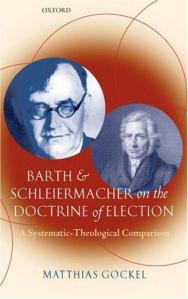
Matthias Gockel on Barth and Schleiermacher on the Doctrine of Election: A Review

Here are the links to my 10-part review of Gockel’s book:

Matthias Gockel on Barth and Schleiermacher on the Doctrine of Election: A Review – Part X

In answering the question, ‘Will, then, all people be saved in the end?’, Lutheran scholar Carl Braaten has reminded us that ‘We do not already know the answer. The final answer is stored up in the mystery of God’s own future. All he has let us know in advance is that he will judge the world according to the measure of his grace and love made known in Jesus Christ, which is ultimately greater than the fierceness of his wrath or the hideousness of our sin’. So Barth noted in The Humanity of God, ‘This much is certain, that we have no theological right to set any sort of limits to the loving-kindness of God which has appeared in Jesus Christ. Our theological duty is to see and understand it as being still greater than we had seen before’.

The criticisms and their implications raised by Gockel will no doubt continue to be a point of dispute – a dialectic – among readers of Barth for the foreseeable future. Those with an interest in the debate more generally over universalism would be well served in reading Gockel’s fine book. However, it ought to be noted that those who are already convinced that Schleiermacher’s and (early) Barth’s doctrine of election remains the most tenable proposal will only find further material here to bolster their conviction. To those who remain unconvinced, Gockel offers little argument here to change their mind.

Gockel’s work fills a notable gap in Schleiermacher and Barth studies. While there is, encouragingly, something of a renaissance of interest in Schleiermacher, Gockel’s contribution to our understanding of, and appreciation for, Schleiermacher’s project in general, and his doctrine of election in particular, is thus far unsurpassed. Schleiermacher is not an easy read. Not only is his own terminology inconsistent but his grammar is largely foreign to contemporary readers. Gockel offers us some assistance here. His contribution too regarding Barth’s early thinking on election also serves as a most worthy conversation partner with other contributions in the same area.

The essay is clearly written, avoids stereotypes of Schleiermacher and Barth, and includes a useful bibliography and two indexes. While Gockel offers us a very valuable survey to the thinking of two Protestant giants on a central theme not only in their theology but in the Reformed tradition of which they were both heirs – a valuable task in itself – I would have liked to have seen more critical engagement with these two voices. It may have also been fruitful, for example, to chart how Schleiermacher’s and Barth’s doctrine of election relates to the human response to God’s free grace in baptism, for example, as Barth was already directing us to in IV/4.

These grumbles aside, in what is certainly one of the finest essays to have appeared on Barth in recent years, Gockel models for us the kind of close dogmatic scrutiny that Schleiermacher’s and Barth’s theological contribution both deserves and demands. Those with an interest in systematic theology and the history of doctrine, those with an interest in getting their head (and hearts) around Barth’s much misunderstood doctrine of election, those with an interest in exploring a way forward for overcoming old rifts between Lutherans and Calvinists, and those with an interest in more current debates over universalism, would all be well served by reading Gockel’s book.

Matthias Gockel on Barth and Schleiermacher on the Doctrine of Election: A Review – Part IX

The only two tenable (i.e. biblically and theologically defensible) positions available for the soteriological question are either (i) a robust reaffirmation of limited atonement (the negative side of which includes the possibility of annihilation), or (ii) some form of christological universalism (with various degrees of agnosticism). Barth, of course, was rightly suspicious of ‘isms’, whether universalism or any other –ism, and would not affirm a dogmatic doctrine of universal salvation, although he does join a tradition of both Eastern and Western theologians going back to Origen of Alexandria (185–232), Clement of Alexandria (d. 215), Gregory of Nyssa (335–394?), Ambrose of Milan (337?–397) and Gregory of Nazianzus (329–389) who all affirm a strong hope in universal salvation.

Barth famously concludes IV/3/1 by again urging that we have no good reason why we should be forbidden, or forbid ourselves from an ‘openness to the possibility that in the reality of God and man in Jesus Christ there is contained much more than we might expect’, including the ‘unexpected withdrawal of that final threat’.

If for a moment we accept the unfalsified truth of the reality which even now so forcefully limits the perverted human situation, does it not point plainly in the direction of the work of a truly eternal divine patience and deliverance and therefore of an apokatastasis or universal reconciliation? If we are certainly forbidden to count on this as though we had a claim to it, as though it were not supremely the work of God to which man can have no possible claim, we are surely commanded the more definitely to hope and pray for it as we may do already on this side of this final possibility, i.e., to hope and pray cautiously and yet distinctly that, in spite of everything which may seem quite conclusively to proclaim the opposite, His compassion should not fail, and that in accordance with His mercy which is ‘new every morning’ He ‘will not cast off for ever’ (La. 3:22f., 31).

The creature cannot impose anything upon God because God is sovereign and free. That is why universalism equals the elimination of God’s freedom. But if God in his sovereignty and freedom has revealed himself in his being-in-act – that is, in Jesus Christ – then ought – nay, must – this not have radical implications for all doctrinal issues, and no less this one. We have no reason to presume that God in his total freedom will act other than he has acted in Jesus Christ – full of grace and truth.

Therefore, we may reasonably hope for a full Apokatastasis. Few have expressed this hope more beautifully than the nineteenth century Congregationalist minister, James Baldwin Brown: ‘The love which won the sceptre on Calvary will wield it as a power, waxing ever, waning never, through all the ages; and that the Father will never cease from yearning over the prodigals, and Christ will never cease from seeking the lost, while one knee remains stubborn before the name of Jesus, and one heart is unmastered by His love’. Or consider these words from Thomas Erskine,

I cannot believe that any human being can be beyond the reach of God’s grace and the sanctifying power of His Spirit. And if all are within His reach, is it possible to suppose that He will allow any to remain unsanctified? Is not the love revealed in Jesus Christ a love unlimited, unbounded, which will not leave undone anything which love could desire? It was surely nothing else than the complete and universal triumph of that love which Paul was contemplating when he cried out, ‘Oh the depth of the riches both of the wisdom and knowledge of God!

In Jesus Christ, the Triune God has bound humanity to himself in such a way that even if we refuse him and damn ourselves to hell, God in his love will never cease hunting us down. So even if the church cannot affirm the apokatastasis panton, we can hope for it, and pray for it, and stop denying the possibility of it in the grace of God. Hans Urs von Balthasar was right when he said that there is all the difference in the world between believing in the certitude of universal salvation and hoping for it.

Matthias Gockel on Barth and Schleiermacher on the Doctrine of Election: A Review – Part VIII

It is difficult to imagine a more solid basis for an Apokatastasis panton than Barth gives us in his doctrine of election and reprobation. But does Barth’s commitment to divine freedom contradict the centre of his christological revision? Does he ultimately lead us all to a country and then not promise us that we might enter? Gockel, following Janowski, suggests he does, and that the payment for such a commitment threatens to ‘tear open again, though in a modified way, the abyss of the decretum absolutum et horribile (p. 210) – as though God’s Word towards a person might be different from that which he has spoken in Jesus Christ.

While Gockel notes Barth’s denial of an ultimate apokatastasis panton, he joins a pantheon of critiques – sympathetic and otherwise – who see an inconsistency in Barth here. Consider, for example, the critique from Bromiley. As one of the editors (with T. F. Torrance) and principal translators of Barth’s work, few are more familiar with Barth’s corpus and theology than Bromiley. Citing IV/3, § 70.2, Bromiley synopsises Barth view: ‘The lie cannot overthrow the truth, but God may finally condemn the liar to live in it’. Bromiley observes in Barth a ‘trend toward an ultimate universalism’ although acknowledges that, for Barth, ‘universalism in the sense of the salvation of all individuals is not a necessary implicate of Barth’s Christological universalism’. He suggests that Barth’s reservation here is ‘not really adequate’. Gockel identifies the same inconsistently in Barth, a holding back of the full consequences of Barth’s christology. Again, Bromiley notes, ‘God’s manifest purpose in Christ is to save, but under the sovereignty of the Spirit some might not be saved. The question is whether the Christological reference finally helps or matters very much. Is not the ultimate decision still taken apart from the revealed election – that is, not in the prior counsel of the Father but in the inscrutable operation of the Spirit? In other words, the decision regarding individuals is simply removed from the inscrutability of sovereign predetermination to the inscrutability of sovereign calling’.

Matthias Gockel on Barth and Schleiermacher on the Doctrine of Election: A Review – Part VII

Brewing away throughout Gockel’s book, not unoften rearing its head, is the question of universal election and universal salvation. Gockel contends that Barth’s christological revision leads him to abandon his 1936 objection to universalism and affirmation of an eschatological division between the elect and the reprobate. Barth now ‘joins Schleiermacher in leaving open the possibility of a “final opening up and expansion of the circle of election and calling” which may include everyone’ (p. 188). Barth’s reluctance, however, to embrace universalism leads to some pointed challenges by Gockel.

Gockel notes that both Schleiermacher and Barth share a stance coherent with supralapsarianism’s claim that the decree of predestination precedes that of creation and Fall, although they both go further in their assertion that God’s mercy is the decisive criterion not of redemption only but also of predestination. Gockel argues that despite Barth’s ‘own explicit unwillingness to go that far’, that is, to embrace a universal predestination to salvation, his affirmation of universal election ‘implies some form of universal salvation’ (p. 189).

Gockel also contends that Barth’s appeal to God’s freedom is inconsistent with Barth’s own position regarding God’s self-determination to be Immanuel in Jesus Christ. Gockel notes that Barth’s (and Schleiermacher’s) caution on the issue can be partly explained by the fact that ‘any affirmation of universalism would have meant the endorsement of an ecumenical heresy, which could have cost him dearly’ (p. 208). The question, however, remains: How can that which has already been overcome in Jesus Christ ever be undone? How can this impossible possibility remain? Gockel suggests that Schleiermacher is at least more consistent here with his emphasis on the unity of God’s will. With all of Barth’s massively powerful christological revisioning, he, according to Gockel, ‘shied away from certain far-ranging implications’ (p. 205). ‘One should ask’, Gockel suggests, ‘whether a consistent theory of an Apokatastasis, far from presenting a danger or even a threat, might not be a more satisfying option than the claim that the New Testament leaves us with a paradoxical constellation of the “universalism of the divine salvific will” versus the “particularism of judgement”’ (p. 208).

I confess that I sympathise with Barth’s reluctance to embrace with certainty an apokatastasis panton, even while I hold out, with Barth, hope in such a reconciliation. Barth was right to insist that God’s grace is characterised by God’s freedom. This means not only that we must never impose limits on the scope of grace, but also that we must never impose a universalist ‘system’ on grace either. To embrace either option would be to compromise the freedom of grace and also to presume that we can define the precise scope of God’s grace. That is why Barth’s theology of grace incorporates a dialectical protest: he protests both against a system of universalism and against a denial of universalism. The essential point, for Barth, is that God’s grace is completely free; that when God acts in grace it is none other than God himself who acts in freedom. When God comes to us in his grace, therefore, we can be certain that no third party or shadowy motive is twisting his arm. Because of this divine freedom and because of the nature of divine grace as grace, we can neither deny nor affirm, therefore, the possibility of universal salvation. I confess with Abraham, ‘Shall not the Judge of all the earth do right?’ (Gen 18:25). Barth writes,

The proclamation of the Church must make allowance for this freedom of grace. Apokatastasis Panton? No, for a grace which automatically would ultimately have to embrace each and every one would certainly not be free grace. It surely would not be God’s grace. But would it be God’s free grace if we could absolutely deny that it could do that? Has Christ been sacrificed only for our sins? Has He not, according to 1 John 2:2, been sacrificed for the whole world? … [Thus] the freedom of grace is preserved on both these sides … Even in the midst of hell, grace would still be grace, and even in the midst of hell it would have to be honored and praised and therefore announced to the other inhabitants of hell. It is not free for nothing, but it is also not grace for nothing. We should certainly not know it if we were of the opinion that we could stop short of announcing it.

Matthias Gockel on Barth and Schleiermacher on the Doctrine of Election: A Review – Part VI

Barth’s concern in his treatment on election is that election should be good news – gospel – or, what Barth calls is another place, ‘joyous news’. Thus does Barth begin his chapter on election in II/2: ‘The doctrine of election is the sum of the Gospel because of all words that can be said or heard it is the best; that God elects man; that God is for man too the One who loves in freedom … Its function is to bear basic testimony to eternal, free and unchanging grace as the beginning of all the ways and works of God’. Here Barth is following Calvin – and, according to Muller, the Reformed tradition more generally at least up until 1650 – who repeatedly stressed that we look to Christ as the assurance of our election. Here Calvin is as adamant as Barth. Where Calvin – and the Reformed tradition – is silent, however, is in how the question of reprobation – the shadow side of election – also relates to Christ. Holmes has suggested that the weakness in Calvin’s account of predestination is not that election is separate from Christ (which, as I have just said, it is not), but that ‘the doctrine of reprobation is detached, Christless and hidden in the unsearchable purposes of God. As such it bears no comparison with the doctrine of election, but remains something less than a Christian doctrine’. Holmes goes on to suggest that Calvin’s shortcoming is not that he reserved an equal stature – a double decree – to God’s ‘Yes’ and ‘No’ in election, but that he has ‘almost no room for the doctrine of reprobation in his account’; ‘the “No” does not really enter his thinking’, thus leading to an asymmetry between the two decrees and so, as Holmes suggests, ‘fails to be gospel’. This contrasts with Barth’s christological theology of reprobation. Holmes helpfully summarises Barth’s position thus:

In willing to be gracious in the particular way God in fact wills to be gracious, the Incarnation of the Divine Son, there is both a ‘Yes’ and a ‘No’, election and reprobation. God elects for humanity life, salvation, forgiveness, hope; for himself he elects death, perdition, even, as the Creed has said, hell. This self-reprobation of God is indeed the primary referent of the doctrine of election, in that God’s determination of himself is formally if not materially more basic than his determination of the creature, and so is considered first by Barth. In the eternal election of grace, which is to say in Jesus Christ, God surrenders his own impassibility, embraces the darkness that he was without – and indeed impervious to – until he willed that it should be otherwise … The apostle put it more succinctly: “He became sin for us.” This is the full content of the divine judgement, of the ‘No’ that is spoken over the evil of the world and of human beings. God elects for himself the consequences of that ‘No’, in saying ‘Yes’ to, that is, in electing, us. That is the whole content of the double decree, the whole content of the ‘Yes’ and the ‘No’ that God pronounces as one word, the whole content the election of grace.

Concerned that his own tradition had at this point replaced Jesus Christ with a decretum absolutum (as there is no Wikipedia reference to the absolutum it must not exist), Barth asked, ‘Is it a fact that there is no other basis of election outside Jesus Christ? Must the doctrine as such be related to this basis and this basis only?’ Because of Jesus Christ, Barth was able to speak of God’s ‘No’ as gospel also.

On the actuality of predestination, Gockel questions how useful Barth’s grammar regarding predestination as a present event is. He suggests that God’s ‘eternally preceding’ decision is ‘the mystery of all historical events’ and that it does not have to imply an ongoingness of the decision itself within history, given God’s predestining election of Jesus Christ. Gockel helpfully suggests that ‘a less actualistic view of predestination could more clearly emphasise the significance of the historical appearance of Jesus Christ and thus dispel the impression that Barth tears apart the “eternal content” and the “temporal form” of election’ (p. 185).

Matthias Gockel on Barth and Schleiermacher on the Doctrine of Election: A Review – Part V

Gockel turns to critically consider the consequences of Barth’s doctrine of election. He identifies six key areas: (1) epistemological implications, (2) the concrete determination of predestination, (3) the issue of double predestination, (4) the actuality of predestination, (5) the question of universal election and universal salvation, and (6) the relation between Israel and the Christian church. I will focus here on (2), (3), (4) and (5).

Regarding the second area, while Barth never intended to drive a wedge between the economy and being of God, Gockel sides with McCormack over against Molnar that this very inconsistency arises within Barth’s own formulation of his doctrine of election: ‘The assumption of a divine will preceding the predestination puts into doubt whether the gracious choice really belongs to God’s “own eternal essence”’ (p. 179). The issue fundamentally concerns whether or not the works of God ad extra (election) are the free overflow of the works of God ad intra (as Molnar suggests) or whether the one eternal will of God is identical with Jesus Christ. Molnar’s reading of Barth’s proposal that God has one being, and that that one being subsists simultaneously in two different forms – the second dependent on the first – which are not separate but rather are a unity-in-distinction and distinction-in-unity, could have been more attended to by Gockel than he does (pp. 179–80).

On the question of double predestination, Gockel rehearses Barth’s conviction that we must speak of Jesus Christ not only in reference to the positive side of election but also in reference to the other side of God’s decree – reprobation. Here, as we shall see below, Barth sets himself apart from the tradition (or at least extends the tradition) and declares that both election and reprobation happen in Jesus Christ. Barth’s doctrine of reprobation is as christological as his doctrine of election. He contends that the God who elected fellowship with humanity also elected our rejection. In electing our rejection, however, ‘He made it his own. He bore it and suffered it with all its most bitter consequences’. Thus in the self-reprobation of Godself in Jesus Christ – the Man justified and the ‘Judge judged in our place’ – humanity recognises not only God’s final ‘Yes’ but also its own reprobation. This self-giving is God’s free choice and entails God’s self-determination and the determination of humanity through a ‘wonderful exchange’ in Jesus Christ. ‘To believe in God’s predestination’, Gockel concludes, ‘means by definition to believe in the non-reprobation of humankind’ (p. 181). As Barth notes, ‘in God’s eternal purpose’ it is not humanity but ‘God Himself who is rejected in His Son’. God’s self-giving in Jesus Christ consists in the fact that he is rejected in our place: ‘Predestination means that from all eternity God has determined upon man’s acquittal at His own cost’. Gockel then raises the question and apparent conflict concerning whether the claim that the Son of God instead of the Son of Man suffered God’s wrath contrasts with Barth’s earlier claim that ‘the elected human being Jesus is the target or “offering” of God’s wrath’. He notes Barth’s own awareness of and answer to this in II/1: ‘Only God Himself could bear God’s wrath. Only God’s mercy was capable of bearing the kind of suffering to which the creature existing in opposition to God is subject. Only God’s mercy could be touched by this suffering in such a way that it knew how to make it its own suffering. And only God’s mercy was strong enough not to perish in this suffering’ (p. 183). As if hell – that is, something of creation – could exhaust the awful shame and scandal of sin.

Matthias Gockel on Barth and Schleiermacher on the Doctrine of Election: A Review – Part IV

In his fifth chapter, entitled ‘Barth’s Christological Revolution’, Gockel turns briefly to Barth’s lectures of 1936 (given at two Reformed seminaries in Hungary) and 1937 (Barth’s Gifford Lectures on the Scots Confession given at the University of Aberdeen), and more substantially to Barth’s Church Dogmatics II/2, where Barth developed his most radical proposal, modifying for a second time his doctrine of election. In the christological revision undertaken in II/2, election no longer refers to the two-fold possibility of faith and unbelief but to the double determination of individual human beings and God’s own being. Barth’s priority: that God sees every human being and also himself in Christ.

Here, Gockel is on the more traversed ground of Barth’s notion that Jesus Christ is both God’s elect himself and the foundation of humanity’s election. Gockel argues that it was not until the 1936 lectures that Barth’s christological revisioning of the doctrine of election first appears; that what happened for and to humanity at Golgotha and was revealed at Easter – though it happened in time – is our eternal election. It is also here that Barth identifies the one will of God in double predestination with Jesus Christ, that is, with God’s own being. ‘Jesus Christ not only reveals but also constitutes God’s gracious choice as the self-determination to be God for His people and the determination of humankind to be the people of God’ (p. 169). As Barth contends, God’s gracious choice is the divine decision made in Jesus Christ, the speculum electionis. It is in and through Jesus Christ that God has actualised his eternal covenant with humanity, God’s eternal election of himself to communion with humanity, and humanity to communion with God. Here Barth distinguishes himself from the disposition in some camps of the Reformed tradition of an insistence on the inscrutableness and invisibility of the divine decrees. In Jesus Christ – the electing God and the elected Man – God’s purposes in election are made manifest to all. Christ is, in Barth’s words, ‘the first and last word to men of the faithfulness of God’ in election. Jesus Christ, therefore, is not merely the channel of God’s one decree, but its source. And he is not merely the one who elects, but he is also the one who elects himself to be the modus operandi by which others are elected.

Matthias Gockel on Barth and Schleiermacher on the Doctrine of Election: A Review – Part III

Barth’s revision of the Reformed doctrine of election is developed further in his so-called Göttingen Dogmatics where he punctuates the teleological ordering of election and reprobation. The real purpose of God’s predestinating act is always election – not rejection – even in rejection. While the reprobation is real as the shadow side of election, it is never God’s final word. God’s final word is Jesus Christ and in him every promise of God finds its ‘Yes’ (2 Cor 1:18–20). ‘Rejection does not take place for its own sake but in revelation of the righteousness of God in order that God’s mercy might be manifested in his election, and in order that in it all, though in this irreversible order, God himself might be known and praised’. In other words, God’s judgement is never divorced from God’s grace and can never be recognised apart from ‘the cross, the judgment, the condemnation in which we stand’; the way of predestination therefore leads us ‘by way of condemnation – indeed, by the way of hell itself – to salvation and life’. We will return to this below in our discussion of Barth’s Church Dogmatics II/2.

Gockel concludes his discussion of Barth’s Göttingen work by surmising that Barth’s doctrine of election ‘becomes more actualistic and less speculative, while still not christocentric’. Also ‘Barth stops short of eschatological universalism, and his consistent emphasis on God’s freedom as well as the assertion that “all are at every moment under the divine Either–Or” should be taken seriously’ (p. 155).

The picture that Gockel paints is that in both the Römerbrief and the Göttingen Dogmatics, Barth has developed a ‘Schleiermacherian reconstruction’ of the doctrine of election by means of the idea of a single divine decree towards life. Although Schleiermacher understands the Creator-creature relationship differently to Barth, they both hold that the single divine decree is to be understood in the context of the historical decision between faith and unbelief. For both of them (at this point), the doctrine of election remains fundamentally theocentric and universal, with a focus on the graced-initiative of the divine act which involves a teleological movement in time from reprobation to election, the former serving the latter, and the latter qualifying the former. Above all, the focus for both theologians is on ‘the predestining God’ rather than ‘individual predestined human beings’ (p. 157). Given this, it is surprising that Gockel introduces his argument with the announcement that it is ‘precisely the anthropocentric outlook of traditional views’ which motivated not only Barth’s but also Schleiermacher’s ‘search for a new approach’ to election (p. 12).

Matthias Gockel on Barth and Schleiermacher on the Doctrine of Election: A Review – Part II

In his Der Römerbrief, Barth raises two objections against the Augustinian formulation, which he regards as ‘a “mythologizing” construction’ (p. 108). First, Barth rejects the notion that predestination can be explained in terms of cause and effect. While the human act of faith happens within a familiar historical context, its origin always lies with God: ‘The act of faith does not occur when a human being has recognized God but when God has recognized a human being’ (p. 108). Barth’s point: ‘God wants to be known through God’. Secondly, Barth discards the attribution of election and reprobation to ‘predetermined quantities of individual persons, since this neglects that God’s eternal predestination is related to humankind as a whole and is not a one-time event but occurs time and again in history when a human being is addressed by God’s Word’ (p. 109). The driving issue here for Barth, as in his whole doctrine of election, is the divine freedom.

For Barth, the key verse for understanding Romans, and Christian theology in general, is 11:32, ‘God enclosed everyone in disobedience, in order to show mercy on everyone’. This verse affirms that the content of God’s predestination is God’s unconditional mercy. More radically, Barth contends that Paul’s claim suggests a modification – though not a rejection – of the notion of double predestination. Double predestination does not require rejection so long as we are clear that it refers to a movement, to the ‘teleology by which God’s salvific act is directed, namely, from reprobation to election’ (p. 113). For Barth, reprobation is never the goal. ‘God’s Yes shines even into the last depth of His No, precisely because the latter is so radical, because it is the divine No’. Reprobation exists therefore ‘only as the shadow of the light of election’.

Gockel contends that there is a distinct echo of Schleiermacher’s doctrine of election in Barth’s own early revision of the doctrine. In Der Römerbrief, Barth accentuates the dialectical unity of God’s decree: ‘God’s reprobation (of the elect) and God’s election (of the reprobate) are “unintuitably one and the same in God”’ (p. 118). Gockel identifies two central aspects concerning the relation between reprobation and election for Barth. First, the possibility of reprobation is overcome eternally in God. Adam’s old world really is surpassed by Christ’s new world. Second, the individual outcome of the two-fold possibility of unbelief and belief is not determined by God before time but rather, in the freedom of God, is the event in which God addresses the creature in time. The content or purpose of such an address is qualified by the ‘turn from reprobation to election’ in God, which expresses the one eternal will of God for humanity. Any duality here of judgement and grace is the duality of God’s unified action, an action which affects all human beings alike, and is determined by God’s redemptive will revealed in Christ’s death and resurrection. The church and the world, therefore, ‘stand under the same promise and the same judgment [which] makes it impossible to conceive them as two separate groups of persons’ (p. 125). Even as early as his Romans commentary, Barth maintained a hopeful universalism grounded in the freedom and love of God leading to the priority of election over reprobation: ‘reprobation has been overcome and absorbed by election’. Christ’s work ‘entails the hope that the duality between faith and history does not preclude the possibility of an eventual restoration of humankind and a return “into the unity with God, which is now and here completely lost”’ (p. 130). Barth’s emphasis here is that the original unity of God and humanity (a notion abandoned in the Göttingen lectures) is not superseded by judgement. Judgement, rather, is practical, leading to a re-union of human and divine righteousness.

Gockel observes that the relationship of the historical appearance of Jesus Christ to the determination of God’s will remains unclear in Barth’s theology, and his emphasis on the original unity leads to similar problems to Schleiermacher’s notion of absolute dependence. Furthermore, when Barth ‘asserts that God’s will is revealed in Jesus Christ who personifies God’s universal faithfulness and righteousness, it remains unclear how the eternal history between God and humankind is related to the history of Jesus Christ’ (p. 131).

Matthias Gockel on Barth and Schleiermacher on the Doctrine of Election: A Review – Part I

‘That God may have mercy upon all’: A Review of Barth and Schleiermacher on the Doctrine of Election: A Systematic-Theological Comparison. By Matthias Gockel. Pp. viii+229. Oxford: Oxford University Press, 2006. ISBN 978 0 19 920322 2. £45.

As promised not so recently, my next few posts will be dedicated to reviewing Gockel’s book, Barth and Schleiermacher on the Doctrine of Election. Because my review is rather lengthy (and because some wise guy thinks that the ideal post should be quite short ), I will break it up into 10 posts. I hope that most who started the ride will still be holding on at the end.

Karl Barth’s vituperative criticisms of Friedrich Schleiermacher are no secret, and no short mileage has been made by theologians on the apparent division between the two. In Matthias Gockel’s latest offering (a revised version of his 2002 doctoral dissertation completed at Princeton under Barth scholar Bruce McCormack) he joins Robert Sherman and others in enriching, with renewed sophistication, our understanding of the relationship between Barth and Schleiermacher, challenging traditional evaluations that ‘liberal theology’ and ‘dialectical theology’ stand in irreconcilable opposition.

Rather than attempt to cover a multi-dimensional canvas with broad strokes, Gockel restricts his inquiry to an incisive and cogent comparison of the development of the doctrine of election in the two thinkers. Without proposing any theory of historical dependence, Gockel contends that the divergence between these two commanding Reformed theologians does not stem from irreconcilable starting points but rather from the indispensability of God’s grace. Gockel convincingly argues that ‘Barth’s theology is not just a repudiation of Schleiermacher but an expansion of his predecessor’s work in a new framework’ (13). He also shows us that while the Swiss theologian’s evaluation of ‘the father of modern theology’ is ‘sometimes negative, sometimes positive and often ambiguous’ (p. 9) Barth was not always a reliable interpreter of his own thought, nor always consistent in his criticisms of others.

Gockel’s thesis is that the doctrine of election in Barth’s early theology bears a close resemblance to Schleiermacher’s own theo-centric position. Barth’s theology however, from 1936 onwards, undergoes a radical christological revisioning of the earlier position. Gockel begins his survey and assessment of Schleiermacher by turning to Schleiermacher’s revision of the doctrine in his 1819 essay, ‘On the Doctrine of Election’. Gockel helpfully, albeit briefly, situates Schleiermacher’s early contribution on election in the context of the ecclesiastical union between the Lutheran and Reformed churches in Prussia in 1817. Central to the preceding union were the debates over the Lord’s Supper and the doctrine of election. The crucial point over the latter concerned ‘the indispensability of divine grace for … conversion and the question whether human beings can accept or resist God’s grace by their own free choice’ (p. 18). Schleiermacher’s most creative contribution to the discussion was his notion of an undivided and unconditional ‘single divine will and decree which effects [both] faith and unbelief’ (p. 26). He argues that the older paradigm of a two-fold divine will of election and reprobation is ‘as meaningless as the question why God made human beings in the way they were made’ (p. 29). The elect, Schleiermacher contends, are those who are ‘regenerated and begin their religious self-development’ (p. 30). While the remainder of persons are for now spiritually dead and ‘not yet members of the kingdom of God’ (p. 34) they are included in God’s love and so ‘they never loose the ability to be revived’ (p. 30). Gockel notes that the notion of the single decree ‘emphasises the unity of the divine attributes and helps to clarify key issues not only in the debate over election but also in the doctrine of God’ (p. 34).

Schleiermacher’s revision of the doctrine of election, articulated in the 1819 essay, is more fully developed in his Der christliche Glaube (1821–22) within the bounds of a single divine decree of universal predestination to salvation in Christ, and systematically located in ecclesiology. Gockel notes that the starting-point of the discussion of election, for Schleiermacher, is the ‘dilemma that arises from the simultaneous existence of believers and non-believers, on the one hand, and the benevolent divine will towards all human beings in Christ’s redemptive work, on the other hand’ (p. 101). Schleiermacher’s response is to insist that the ‘divine will is identical with the work of redemption in and through the person of Christ’ (p. 100).

Schleiermacher rejects any idea of two separate foreordained groups of persons – a double-predestination – and the notion that one group might be eternally excluded from the benefits of Christ’s work. Such ideas, he maintains, betray the general character of redemption and the universal mission of the church. God has one will, and that will is identical with who God is, and what God does in Jesus Christ. Humanity – believers and unbelievers alike – are the object of God’s predestinating will of salvation in Christ. Despite the temporary reprobation of some, ‘God sees all human beings, not only the believers, in Christ’ (p. 102). In light of this reality, the church is called to live, order its life after, and bear universal witness to, the divine decision.

Gockel concludes his examination of Schleiermacher by noting that despite Schleiermacher’s christologically-motivated affirmation of general redemption and rejection of eternal reprobation, his overall construction remains theocentric: ‘it is grounded in the belief in God the almighty creator, even though ecclesiology is its context and christology its background’ (p. 103).

Luther on being a sinner

‘If you are a preacher of mercy, do not preach an imaginary but the true mercy. If the mercy is true, you must therefore bear the true, not an imaginary sin. God does not save those who are only imaginary sinners. Be a sinner, and let your sins be strong, but let your trust in Christ be stronger, and rejoice in Christ who is the victor over sin, death, and the world. We will commit sins while we are here, for this life is not a place where justice resides. We, however, says Peter (2 Peter 3:13) are looking forward to a new heaven and a new earth where justice will reign. It suffices that through God’s glory we have recognized the Lamb who takes away the sin of the world. No sin can separate us from Him, even if we were to kill or commit adultery thousands of times each day. Do you think such an exalted Lamb paid merely a small price with a meager sacrifice for our sins? Pray hard for you are quite a sinner’. – Letter From Luther to Melanchthon. Letter no. 99, 1 August 1521, From the Wartburg (Segment). Translated by Erika Bullmann Flores from: Dr. Martin Luther’s Saemmtliche Schriften Dr, Johannes Georg Walch, Ed. (St. Louis: Concordia Publishing House, N.D.), Vol. 15,cols. 2585-2590.

Religion and Social Policy: A Seminar

There’s an upcoming seminar on ‘Religion and Social Policy: Health Care and Christian Ethics’ with Professor Robin Gill, the Michael Ramsay Professor of Modern Theology, University of Kent, and Canon of Canterbury Cathedral.

Details:10 September 2007 at 2:00–3.30pm, at Monash University (Caulfield Campus) in Melbourne.

The seminar will be held in the School of political and social inquiry, Building H, Room h5.29. For more information and to RSVP contact Gary Bouma by 8 September (space is limited).

Weekly Meanderings

‘Hundreds of demonstrators have defied the military junta in Burma to stage a rare protest march, despite the arrests of 13 leading pro-democracy activists.

Witnesses said 300 people staged an hour-long march then were dispersed by gangs of unidentified men, believed to be members of the regime-created Union Solidarity and Development Association (Usda).

There has been a series of midnight raids aimed at confronting the growing protests over rising fuel prices. Among those arrested were some of the country’s most important dissidents.’ Read on here.

Also, there’s a wee interview with Pat Dodson, Pete Postlethwaite, Michael Long and Bishop John Selby Spong here and, more interestingly, Clive James here. Also, there’s an interview here with an Iraq veteran speaking out against the war and media coverage of Iraq.

More MP3’s of interest include this one on Religious Toleration in an Age of Terrorism (at about 18 mins) and this one on Minority Religious Groups in Iraq, and The War For Children’s Minds.

I really enjoyed this wee piece by Brendon O’Connor entitled Just something about George or is an anti-American century likely? and this piece by George Williams on ‘Does Australia need a Charter of Rights?’

And finally there’s Robert Fisk, who is always worth reading, on The Iraqis don’t deserve us. So we betray them… and this shocker on Abu Ghraib abuse.

And after all that heavy reading and listening …

Travel Advice: HELP

Is it really stupid (you’re allowed to say ‘yes’) for me to be contemplating a 30+ hour plane flight next March with a 23 month old? I did it about a year ago and it was exhausting but fine. Now my daughter is, of course, much more active and I’m anxious how she (and I) will cope. It will probably be just the two of us (and a plane load of wierdos). I am really keen to hear from others who may have been (or still are) similarly mad and if you have any tips.

When I was younger, so much younger than today,
I never needed anybody’s help in any way.
But now these days are gone, I’m not so self assured,
Now I find I’ve got few clues about most things …

New Book Announced

Brill has announced a forthcoming book: The Authority of Scripture in Reformed Theology: Truth and Trust, by Henk van den Belt. Looks like a published version of his 2006 thesis from Leiden University.


Here’s the blurb:

The authority of Scripture is the cornerstone of Reformed theology. Calvin introduced the term autopistos from Greek philosophy to express that this authority does not depend on the church or on rational arguments, but is self-convincing. After dealing with Calvin’s Institutes, the development of Reformed orthodoxy, and the positions of Benjamin B. Warfield and Herman Bavinck, the author draws theological conclusions, advocating a renewed emphasis on the autopistia of Scripture as starting point for Reformed theology in a postmodern context. The subject-object scheme leads to separating the certainty of faith from the authority of Scripture. The autopistia of Scripture, understood as a confessional statement, implies that truth and trust are inseparable.

On the Creeds – and Doctrines – of the Church

This is the boldest statement that I have ever read on the Creeds of the Church:

‘We may have ground for believing the Creeds of the Church to be the most perfectly balanced and harmonious expression of the truth whereof our earthly knowledge is, or will be, capable. Yet when we struggle, as in the language of the Athanasian Creed, to express the relations which have been exhibited to us in the eternal Godhead through the use of the words ‘Person’ and ‘Substance,’ or ‘upostasis and ousia; or when we thus profess our belief in the Person of the Holy Ghost, ‘The Holy Ghost is of the Father and of the Son: neither made, nor created, nor begotten, but proceeding,’ need we fear to own that the instruments which, perforce, we make use of upon earth, even in the Creeds of the Church, are necessarily imperfect instruments; the power of conception imperfect; the power of phrase and imagery imperfect also; and that their sufficiency of truth (though not their correctness meanwhile) is so far temporary that it is limited to earth and to time; and that, in the perfect light and knowledge of the presence of God, the perfectest knowledge represented by them will be superseded and absorbed, while the glosses and materialisms with which, in various ways, we may have been unconsciously clothing them to our own imaginations, will be – not superseded only but corrected, and, it may be, reproved? Moreover, if the truths represented in the Creeds are wider and deeper than our conceptions of them, we can admit that there may possibly be particulars in which, even now, the experience of spiritual life may deepen and enlarge the meaning, to us, of our Creeds; as, for instance, the words heaven and hell may present to us ideas differing, in the direction of more correctness, from those which they presented to some of our forefathers. It is not that the Creeds will be some day corrected. It is not that we shall see hereafter how false they were, but how far the best conceptions which they opened to us, the best, that is, that our earthly faculties were capable of, lagged in their clumsiness behind the perfect apprehension of the truths which they had, nevertheless, not untruly represented; but which we then shall have power to see and know as they are. The truth which is dimly imaged for us in the Creeds, will never belie, but will infinitely transcend, what their words represented on earth’. – Arthur Lyttelton. ‘The Atonement’, in Lux Mundi: A Series of Studies in the Religion of the Incarnation. (Edited by Charles Gore. London: J. Murray, 1890), 256-7.

Now contrast this with a comment recently made by NT Wright at a seminar at the University of St Andrews:

‘The idea that doctrines are portable stories is of course already present in the classic statements of Christian doctrines, that is, the great early Creeds. They are not simply check-lists which could in principle be presented in any order at all. They consciously tell the story – precisely the scriptural story! – from creation to new creation, focussing particularly of course on Jesus and summing up what scripture says about him in a powerful brief narrative (a process we can already see happening within the New Testament itself; not only in the obvious places but also when Luke, for instance, decides to telescope Paul’s defence together as in Acts 26.22f: ‘saying nothing but what Moses and the prophets said would take place, that the Messiah must suffer and that, by being the first to rise again, he would proclaim light both to our people and to the Gentiles.’)’ … You can, in fact, join up all the dots not only in the classic early creeds and most of the later ones (for instance, the post-Reformation Confessions and Articles) and still be many a mile away from affirming what the biblical writers, all through, were wanting people to affirm. You can join all the dots and still produce, shall we say, a thistle instead of a rose, an elephant instead of a donkey. Or whatever. To take a rather different but related example, if I come upon the letters BC written down somewhere, only the larger context, the larger implicit narrative, can tell me whether they mean Bishop’s Council (if it’s a note in my diary), British Columbia (if it’s a note of my cousins’ address), Before Christ (if it’s in a notebook about ancient history), or the two musical notes which bear those names (if it’s about the end of Sibelius’s Seventh Symphony). Implicit narrative is all; and if you affirm a doctrine but put it in the wrong implicit narrative, you potentially falsify it as fully and thoroughly as if you simply denied it altogether.’