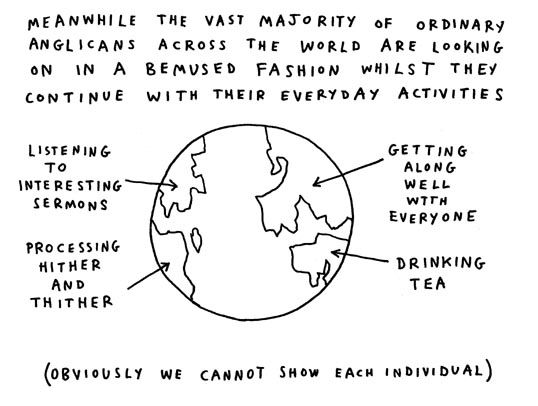
I have a deep and abiding appreciation for Anglicanism, and for Anglican theology, fostered in no small part by a year that I spent as an undergrad studying at Ridley Theological College. But it is no news to anyone that Anglicanism finds itself in hard times. Not uniquely hard, nor uniquely for this time, but still hard. And it may be fair to say that the Anglican communion needs all the friends it can get at the moment. So I was struck by these stinging words from Thomas Merton:
‘The Church of England depends, for its existence, almost entirely on the solidarity and conservativism of the English ruling class. Its strength is not in anything supernatural, but in the strong social and racial instincts which bind the members of this caste together; and the English cling to their Church the way they cling to their King and to their old schools: because of a big, vague, sweet complex of subjective dispositions regarding the English countryside, old castles and cottages, games of cricket in the long summer afternoons, tea-parties on the Thames, croquet, roast-beef, pipe-smoking, the Christmas panto, Punch and the London Times and all those other things the mere thought of which produces a kind of a warm and inexpressible ache in the English heart’. – Thomas Merton, The Seven Storey Mountain (San Diego: Harcourt Brace, 1988), 72.
Let’s just pretend for a moment that Merton is not completely off the page here, and that most Anglicans really are like Jane Austen’s Mr Collins; is this all that we might want to – even feel compelled to – say about our Anglican sisters and brothers, few of whom I know enjoy ‘tea-parties on the Thames’ or anywhere for that matter, and about Anglicanism itself?
Forsyth’s assessment of Anglicanism has significantly more currency than that of Merton’s and, in true Forsyth style, he goes to the bottom of things. Forsyth locates the enigma and scandal of Anglicanism in the schism which occured at the time of the Reformation. Painfully aware that he may cause offense, and that he is stepping on toes long blistered, some of which like it so, Forsyth, addressing a British audience from the Free Church camp, recalls that it is the judgement of the chief branch of the Catholic family that Anglicanism is guilty of sponsoring (ongoing) schism in the church:
‘If it is denied that there was a schism, how is it that the put with so much learning (whatever insight) fails to convince? It fails to convince, on one side, Rome and the Greek Church (which know a good deal about schisms), and, on the other hand, ourselves (who are not ignorant of them). If the Anglican Church did not owe its existence to a schism from the Pope and, in connection therewith, to a schism from the great Church of the West, at least it came out there. By its detachment from European Christianity it acquired much of the insular spirit, which in a Church is the sectarian note. It seems extravagant, not to say harsh, to speak thus of a Church so great and even glorious. But I am only speaking the language it has taught us. Of course, it is a true Church and a noble, with a great glory both in past and future. Historically it is the mother of us all. And we should differ as Churches – respectfully, and not bitterly, like political parties or petty heretics. But, if it will insist on treating as sectaries and schismatics those outside itself in virtue of a succession now more than shaky to its own scholars – it must not be grieved if we interrogate its own history and explore it with the torch of the Gospel. It is a schism and a sect, which abjures the name because of its greatness just as the Norman raid is dignified as the Conquest, and claims to be the beginning of the true England and of English nobility. But it is not size that parts a Church from a sect. Indeed, the larger the Church the greater is the risk of corruption into a sect, by the spirit of ascendancy; while quite small “sects” may be full of the faith and love that make a Church. Most of the sects were, in their inception, nearer the actual conditions of the New Testament churches than the Churches were which they left. And, if the actual form, practice, and precedent of the New Testament Churches, as distinct from their Gospel, were decisive for all time, it is the sects that would be in the true succession, the true Churches. But, if a sect is the debasement of a Church, and if a Church is really debased only by moral faults, then the egoism, the pride, the spirit of ascendancy that gather these up is more likely to beset a great institution with a prerogative, a history, and vested interests. A Church becomes a sect when it develops the egoism which for the Church is moral marasmus and when it sees in its size, its splendour, and its domination the chief sign of its calling’. – The Church and the Sacraments, pp. 41–2.
 jasongoroncy.com
Jason,
Since my dismissal from the pulpit, my family and I have been worshiping with an Anglican church. There’s much to love and much to struggle with. Interestingly enough, in the last two years or so I have been devouring NT Wright who is, in my judgment, the best theology has to offer right now. That may be too minimizing, but he is writing things that I had long since held dear–before he wrote them or I read them. I’m closer to the Anglican church than I would have ever guessed.
On a different note, I too am reading Hannah’s Child by Hauerwas. He is an amazing thinker and a brilliant writer and a profound theologian. Witty. Wonderful.
Blessings,
jerry
PS–The blog looks good. I’m slowly working my way back into the blog world. It’s kind of tough, though, to manage blogging and graduate school and two jobs…but slowly…
Have a wonderful weekend.
LikeLike
Merton, who’s father was English saw the England in the 1930’s I believe, as my memory serves me? Since I am an Irish born sort of Anglo-Irish now, (enducated there). -But right now in America- And having served in the RMC -Royal Marine Commandos-(over ten years with just the reserves, after my combat days). I have a very different spin on the English, or England and the CoE. The Anglican English, have had their many good and great theolog’s for sure, not to mention someone like Newman, who like some was on both sides, Anglican to Roman. And the Church has a history like no other “via media”…Low Church, Puritan, Evangelical; to High Church Anglican, to outright “Anglo-Catholic” or “Catholic”. Not to mention the “broad church” liberals. But indeed, the CoE and Anglican in general is adrift badly! Indeed Tom Wright has been a great help in that last many years, but he has never “cracked” the leadership itself, bishop or not. And now he goes back to the academy. We will have to wait and see just how much will come from the new statement, and gutty move by the the Archbishop (Rowan Williams) over the appointment of the female lesbian American ax bishop. Let’s hope he will not muck it up, and back down? My thoughts anyway.
Fr. Robert
LikeLike
I agree that Wright hasn’t cracked the leadership. I wonder why that is? I think, I could be wrong, that he is more interested in producing a theology that will stand the test and that, maybe, he wants others to get on board. He seems to be more popular among non-Anglicans than he does among Anglicans–at least here in the US.
I’m glad he’s back to the academy where he can produce the sort of leaders and thinkers his theology demands. Evidently he wasn’t able to do that in his position as Bishop. Maybe now he can.
Who knows?
LikeLike
Jerry,
I like many of Tom Wrights theological works, however, I don’t follow his NPP. At first it seemed new and perhaps insightful, but for me, it both does not follow either the Reformation, nor the Catholic truth. Like many theories it is presuppositional to its own ideas, i.e. the Second Temple Judaism, etc. And finally, it must effect and help the laity and this has not simply happened yet. Time will tell where this position and theology will lead? So far it has been just an academy doctrine.
AS you note, Wright is much more popular with the Americans, than the British. And much of it is outside of the Anglican Communion.
For myself, I think those like Barth and Torrance in the west have affected and served the Church with their theology on the great doctrine of the Trinity of God. And it is here that we must continue. Note Robert Letham’s 2004 book: The Holy Trinity In Scipture, History, Theology, and Worship.
LikeLike